



Abstract
With the increasing popularity of some alternative social media platforms, the flow of information has to some extent shifted from the periphery to the core, where problematic discourses are produced, reproduced, and amplified in the alternative ecosystem, to later find their way into mainstream platforms. The non- or less-moderated nature of some alternative platforms provides a suitable space for politicization and radicalization of discourses. In this article, we use a case study of conversations about vaccination on Gab Social—an alternative platform often conceptualized as a far-right platform—to examine this radicalization process through a mixed-methods analysis of over 68,000 vaccination-related posts from before the COVID-19 pandemic until August 2021. The article shows that while antagonistic and conspiratorial thinking was an element of vaccination discourses on Gab even before the pandemic, such conversations became gradually politicized, and expanded far beyond the medical discourse and entered the domain of organizational politics.
Introduction
Attempts at creating viable alternatives to dominant Mainstream Social Media (MsSM) platforms (Van Dijck et al., 2021, p. 3) are nothing new, and have existed for over a decade. MsSM such as Facebook, Twitter, Instagram, and YouTube have successfully scaled across the globe and are impacting social, personal, political, and everyday life. A key factor for MsSM is their reliance on commercialization, profiteering, and commodification of data (Van Dijck & Poell, 2013). However, alternatives such as Ello, Twister, GNU social, Diaspora, and the like have often relied on idealistic goals—at least at their beginning—moving away from the commercial logics of the MsSM. These Alternative Social Media (ASM) platforms aim to provide spaces for “alternative ideas, discourses, and organizing” (Gehl, 2015, p. 1). Users from marginal communities and arguably with generally liberal, left-leaning (Gehl, 2015; Rochko, 2017), or utopian views (Fitts, 2016) were ideologically motivated to participate on these platforms. Of course, technical challenges and uncertain funding have traditionally been obstacles hampering the viability of these ASM platforms. Another challenge historically impacting such alternative spaces has been that given the low barriers of participation in such spaces, problematic discourses such as racism or hateful speech have sometimes found their way into them, effectively posing a danger on the utopian, liberal, and left-leaning roots of these platforms (Gehl, 2017). Therefore, the early ASM platforms did not gain the necessary “network effect” (Gehl, 2017, p. 344) to scale up.
In the past few years, though, and partly due to an increased polarization in political spheres, some platforms have managed to create relatively stable and viable alternatives for ideologically non-mainstream users across the political spectrum and sustain a relatively small, yet strong and loud user base. This growth has been arguably more pronounced in the case of platforms that frame themselves as “free speech” platforms, such as Parler (Ali et al., 2021), Gab (Zannettou et al., 2018), Gettr (Paudel et al., 2021), or BitChute (Trujillo et al., 2020), so much so that they have often been considered synonymous to alt-right, far-right, hate speech, and extremist spaces. This rise in popularity and the relative stability of some of these spaces, particularly Gab, gives space to a new form of alternative social media; one that is ideologically—and commercially—in complete opposition and antagonism to the left-leaning, liberal ideological roots of alternative spaces. That is, such ASM do not solely rely on a technological response to the deplatformization (Van Dijck et al., 2021) they face—to build a decentralized alternative system. Rather, they operate from an ideologically opposite contention to what they perceive as the problem. In this way, they utilize similar deplatformization strategies and tactics as mainstream actors, through creation of both technological and discursive spaces that ensure the minimization of the presence of opposing discourses.
While platforms like Gab may have originally been created for and populated by users with explicitly political aims and discourses, their relative stability and increasing popularity would inevitably lead to other, not directly political topics to also enter online conversations. Just like on an MsSM, where a range of topics from funny cat videos to elections are discussed, this range of topics would also find its way to the alternative spaces and turn them into places for commentary and social discussion, and not just organizational politics (Jasser et al., 2021, p. 8). This “monotonous, day-to-day participation” (Donovan et al., 2018, p. 53) can in fact open the way for the necessary interdiscursive linkages that enable the radicalization of discourses, users, and topics. However, so far, not enough academic attention has been paid to this type of radicalization process. Expectedly, and given the acuteness of some of the topics and issues circulating on these platforms, the major focus of studies on platforms like Gab has limited itself to either explicitly political topics, or on certain problematic discourses and content such as hate speech, misinformation, and conspiracy theories. In this article, we study the radicalization process of a non-political topic, and examine how it gets interdiscursively linked to other, political topics. Drawing from Chantal Mouffe’s distinction between “the political” and “Politics” (Mouffe, 1993, 2005, 2013), the article examines how a medical discourse, that is, vaccination, moves to become a “political” topic, and then enters the domain of “Politics” in a space like Gab.
With Gab starting as a “free speech,” ideologically right-leaning, alternative platform, antagonism toward the mainstream and left-leaning discourses is part and parcel of the platform’s identity (Guerin et al., 2021). This antagonism shows itself not only through the discourses circulating on the platform, but also through the platform’s attempts at remaining viable, working, and relevant. Part of this direct antagonism against the mainstream has shown itself through the challenges faced by the platform to remain online. Events such as the Pittsburgh synagogue shooting, Charlottesville incident, USA presidential elections in 2016 and 2020, followed by the Capitol attacks, and of course, the COVID-19 pandemic, have all played a dual role for the platform. On one hand, they have all led to exponential growth periods for the platform. On the other hand, they have also led to increasing external pressures on Gab, hence forcing it to find new ways to adopt and adapt. At the moment, the platform is using alternative hosting provider Epik (Van Dijck et al., 2021), has moved to an open-source fork of the Mastodon infrastructure (Robertson, 2019; Rochko, 2019), does not use cloud-based technologies to store its content, uses alternative payment systems, and has transformed from a stand-alone website-based social media platform to what its founder—Andrew Torba—calls a “parallel economy” (Torba, 2022). This “parallel economy” currently consists of social media platforms, browser extensions, payment systems, and browsing and advertising solutions.
Concurrent to Gab’s relative success at stabilization and remaining visible, there has also been an increase in the sheer number of other alternative options, such as video hosting platforms (e.g., BitChute, Banned Videos), alternative “news” websites (e.g., Gateway Pundit), and commentary sources (e.g., Infowars, Breitbart). This has not only led to an expanding alternative ecosystem, but it also provides a discursive space to founders, creators, and users on these platforms to strategically use this antagonism to their advantage. Being deplatformed, banned by, or vilified by MsSM acts as a form of social capital in such spaces, used strategically as a victimization discursive strategy to prove that such users are speaking the “truth” and are “onto something” (Jasser et al., 2021; Rogers, 2020; Zeng & Schäfer, 2021). In other words, the very fact that there is antagonism toward them is strategically used by them to argue that they are on the right track to finding the “truth,” and that is why the powerful elite are trying to “silence,” “censor,” or “cancel” them. Furthermore, the expanding alternative ecosystem has also led to a significant and concerning shift in cross-platform and inter-platform flows of information. While alternative spaces traditionally relied on MsSM as sources of information, places to gain visibility, or main areas of activity, there has been a major inversion in this flow. Increasingly, content is being produced, reproduced, amplified, and sourced in the alternative ecosystem, only to later find its way toward the MsSM, to recruit more people. In other words, the alternative ecosystem has seemingly reached a point where it can operate relatively independently of the MsSM. While on the surface it might actually seem like a desirable outcome, as it may reduce the reach and breadth of such content and only keep it at the periphery of the information system, a danger it also poses is that it might add to the depth of radicalization, and create a further deepening cross-platform and social polarization. It is, we argue, this depth, rather than breadth, that should receive further attention.
Research Objectives
Drawing from Chantal Mouffe’s distinction between “the political” and “Politics” (Mouffe, 1993, 2005, 2013), the article examines how a medical discourse, that is, vaccination, moves to become a “political” topic, and then enters the domain of “Politics” in a space like Gab.
This article aims to understand the changes to vaccination discourse on Gab, as a case study that can show shifts in the politicization and radicalization of discourses in the alternative platforms ecosystem.
The world health organization (WHO) declared COVID-19 a pandemic on 11 March 2020 (WHO Director-General’s Opening Remarks at the Media Briefing on COVID-19—11 March 2020, n.d.). This is the central point between the stabilization of Gab (2018–2019) as a platform, and changes to vaccination discourse in general, and on Gab in particular (2020–2021, until the time of writing this article). We use the term pre-pandemic for a timeline before 11 March 2020, and the time after this date as during pandemic. Although this timeline nearly coincides with other events that led to the rise of Gab’s popularity (e.g., Capitol attacks), vaccination discussion changed significantly after March 2020. Hence, we use these timelines to illustrate the changes to vaccination discourse on Gab.
The research aims to understand the features of the vaccination discourse in a non-mainstream platform before the pandemic, as a timeframe representing the day-to-day discussion of a topic in an alternative space. The project then examines the evolution of this discourse following an acute event (i.e., the COVID-19 pandemic), to study how a non-Political discussion becomes increasingly antagonistic, Political, and radicalized. In doing so, we also examine the cross-platform flows of information, by analyzing the sources of information that feed into vaccination discussions on Gab, and cross-platform flows of information.
Literature Review
While first generation ASM did not gain popularity and remained understudied, the newer “Alternative Technology” (Alt-Tech) movement has risen in popularity due to consequences and events outside the digital platforms. Therefore, there is an increasing interest among media and communication scholars to understand these platforms. However, many such studies have been quantitative, and they often focus on problematic discourses such as hate speech (Trujillo et al., 2020; Zelenkauskaite et al., 2021) or the migration of deplatformed users (Ali et al., 2021; Jasser et al., 2021; Rogers, 2020). These studies locate alt-tech platforms alongside MsSMs and focus on participation, engagement, and reach. For instance, to understand the effectiveness of deplatforming, Rogers (2020) analyzed the migration and activities of deplatformed “extreme Internet celebrities” (p. 213) on Telegram. They found that these celebrities used Telegram as an alternative to MsSM, to broadcast “short (and frequent) posts put out on public channels” (Rogers, 2020, p. 226). More importantly, there was a decline in audience, the activity remained steady, and language became milder (Rogers, 2020, p. 226). Along similar lines, analyzing the migration of users from MsSM to Gab, Jasser et al. (2021) argue that Gab became a space for far-right users to grow together as a “community of grievance” (p. 13). Their study also found that several users left Gab over time, hence they argue that, although Gab facilitates “distribution of hateful content,” “its reach (and hence, appeal) is seriously curtailed” (Jasser et al., 2021) due to a smaller user base. While such studies illustrate a significant reduction in the number of users, they also suggest alt-tech platforms nurture hate speech. Here, it is important to note that such sustained efforts have radicalized individuals and small communities to carry out harmful events. Hence, we must closely examine the content on alt-tech platforms over a period.
As a relatively new platform, and due to the limited and sparse application programming interface (API) documentation, there is a dearth of studies on Gab, in comparison to other mainstream or alternative platforms. Many of the studies done on Gab draw from a large-scale data dump of posts on the platform, provided by Pushshift (Baumgartner, 2018) or make use of the older version of Gab’s API, before its move to the Mastodon infrastructure. While these datasets are very valuable sources of rich data for studies on Gab, their data are limited to before the increasing popularity of the platform following the 2019 move to Mastodon, the COVID-19 pandemic, the 2020 USA presidential elections, and its ensuing events.
A prominent focus of attention in studies on Gab corresponds to the changes in the USA political environment and its relation to social media platforms. As discussed earlier, Gab witnessed a sharp growth following the hardening of content moderation and participation norms by MsSM. Gab became a collective space for thousands of users who created millions of posts. With the increasing popularity of the platform, there came a rise in the number of users from all around the world, while arguably, the platform is still dominated by American users.
Also, as a relatively new platform, on which there are not many studies, it is expected that a large part of literature on the platform attempts to provide big-picture, whole-of-platform insights, and act as first steps toward more in-depth studies. This has given more room to computational, big data approaches to the study of Gab, mainly stemming from quantitative and large-scale approaches, such as Zannettou et al. (2018), Kalmar et al. (2018), Zhou et al. (2019), and Zeng and Schäfer (2021). More specifically, an important question addressed by such studies is comparing the nature of content and user behavior on Gab to that on platforms such as Twitter, Reddit, and 4chan, or broad overviews of how different topics flow on the platform. Zannettou et al. (2018), for instance, found that Gab users reacted “very strongly to real-world events focused around white nationalism and support of Donald Trump” (p. 7). They also found an increase in hate speech as compared to Twitter (Zannettou et al., 2018, p. 6). Zhou et al. (2019) argue that a small number of influential users direct the discourse on Gab and are dominated by social or political topics in the United States. In analyzing the Soros Myth case study across Twitter and Gab (based on posts from the United States), Kalmar et al. (2018, p. 334) argue that users on Gab exhibit more anti-semiticism as compared to Twitter.
In a study comparing the effects of deplatforming on mainstream platforms, Ali et al. (2021) found that users deplatformed from Twitter and Reddit exhibited more toxicity on Gab. The findings of Ali et al. (2021) have important implications for the argument put forward in this article; there should be a shift in the focus toward deplatforming and content moderation—or direct intra-platform antagonism—from a logic emphasizing reach and breadth, to one also considering depth. The quantification logic generally relied on in mainstream platform spaces does not conveniently apply to alternative spaces like Gab. Although commercialization and fund-raising are still highly important driving forces behind such platforms, there is also a strong ideological driving force motivating activities on them. This ideological, discursive aspect of conversations on the platform needs to both rely on quantification and breadth—to attract more users to the platform and “recruit” allies—but also on depth—to establish the discourse and give it more stability.
Another dominant frame of thought, both in media and some scholarly work, is that Gab, and by extension, its users, can be understood as a far-right space, dominated by alt-right and far-right discourse and hate speech. Kor-Sins (2021) argues that Gab’s branding positions itself as an ally of alt-right and far-right groups (p. 15) and that the platform’s “affordances are specifically designed for the exclusivity of alt-right viewpoints” (p. 14). Zannettou et al. (2018) found that Gab attracted different types of users including “alt-right personalities” (p. 1) and troll accounts. Assessing the hate speech on the platform, they found the use of hate words on Gab to be significantly higher than Twitter, while less than half as compared to 4chan’s /pol/ board (Zannettou et al., 2018, p. 6). Zhou et al. (2019) note that Gab has attracted alt-right users from the United States, as well as from Europe. Studying right-wing extremism in Canada, Hart et al. (2021) note that a significant number of users on Gab are aligned with White supremacist ideology and ethnonationalism and “express more extreme ideas” (p. 50). Similarly, Guerin et al. (2021) report increased far-right conversations and antisemitism in their study of far-right activities on Gab in Australia.
While it is most likely still true that Gab is dominated by a large number of politically and socially right-leaning, ultra-conservative users, voices, and discourses, it is at the same time crucial not to rely on essentialist and reductionist understandings of the platform and its users. Reducing all discourses on the platform to only an extreme in the political spectrum—the far-right—particularly following its increasingly large userbase, masks our understanding of interdiscursive processes, and the banal, mundane, or day-to-day conversations in this space. It is through the resignification of discourses that different topics are intertwined, and various social, political, or everyday topics enter the spiral of radicalization. This is especially true for studies considering discourses beyond the domain of “the political” or Politics, as is the case in this study.
Theoretical Framework
The inherently antagonistic nature of Gab, both as a platform—standing against the mainstream platforms, their economy, and alleged “censorship” on them—and as a discursive space—where the “truth” is told, political correctness does not exist, and “free speech” is the rule—requires a theoretical and conceptual framework that is built around antagonism as the core of discursive struggles. Therefore, this article builds on Laclau and Mouffe’s (1985) discourse theory (henceforth, Discourse Theory), and Mouffe’s expansion of the theory into the important distinction between “the political” and Politics (Mouffe, 1993, 2005, 2013).
Discourse Theory argues that discourses are built around central signifiers (i.e., “nodal points”), which are so “overflowed with meaning” (Torfing, 1999, p. 301) that each discourse formed around them attempts to establish its own meaning of the signifiers, and become hegemonic. This contingency in the meaning of the nodal points, and with it, contingency in the whole discursive structure, leads to a process of struggle among competing discourses that aim to provide a stability of meaning to those nodal points, and succeed in the hegemonic struggle. This process of discursive struggles is referred to as antagonism.
Therefore, any discursive struggle is built around antagonism, and this, in turn, means that anything within this antagonism is a “political” (lowercase p) matter, as there is a struggle over its meaning, identity, and position in the discursive structures. As Mouffe puts it, “the political” is “the dimension of antagonism [that is] constitutive of human societies” (Mouffe, 2005, p. 9). In other words, many (or all) topics related to culture, identity, race, gender, religion, and so on are within the domain of “the political.”
For Mouffe, “Politics” (capital P), however, is the series of antagonisms that are directly related to the arrangement of societies into particular orders (Mouffe, 2005, p. 9). It is this formulation of Politics that is closer to our everyday understanding of the term. Therefore, while all Politics is by definition “political,” the opposite is not necessarily always the case. What is important, however, is that “the political” can also move into the domain of Politics and become part and parcel of it. It is exactly at this stage, and during this process, where non-political issues and topics can be introduced in the domain of “the political” and Politics, and get interdiscursively so intertwined with other topics that the potential for radicalization is strengthened.
The object of this study—vaccination discourse on Gab—is indeed an example of one such topic. While vaccination, its safety, implications, public dispersion, and the science behind it are normally things that should be considered as within the discourses of health and medicine, the COVID-19 pandemic showed clearly how such discourses can easily turn to “political” issues, and later, enter the domain of Politics. In this article, we trace this process of radicalization of a non-p/Political discourse, by observing how a medical discourse becomes politicized, and later, Politicized, particularly in the alternative platforms ecosystem. We then move to discuss how this process can repeat itself in other domains and discourses, further leading to deepening polarizations and antagonisms. In doing so, we also investigate the role of the alternative technology ecosystem, and how it can provide the material dimension needed for this process.
Methodology
We collected the data for this project using “garc,” which is “a Python library and command line tool for collecting JSON data from Gab.com” (Stevens, 2021). At the time of writing this article, garc is one of the only tools able to provide reliable, structured datasets obtained from Gab, as the platform has undergone several infrastructure changes since its creation, and there is very sparse API documentation available for it. Other studies on the platform have either also relied on garc, the 2018 massive dataset provided by Pushshift (Baumgartner, 2018), or in cases, in-house data collection tools developed based on Gab’s API (Guerin et al., 2021).
Garc only allows for single keyword/hashtag-based searches at any time. Therefore, we used a snowballing approach to collect any gabs that contained vaccination-related keywords or hashtags. To do so, the process started with querying Gab’s API to retrieve all gabs with “vaccine” or “vax” in them. We then analyzed those gabs to identify secondary keywords and hashtags and did further collections based on these findings. The eventual collection includes “antivax,” “nomandatoryvaccine,” “vaccinated,” “vaccine,” “vaccinedebate,” “vaccinesideeffects,” “vaccineskill,” “vaccinetruth,” “vaccineweapon,” and “vaxed” as the main terms used for the data collection. For terms such as “vaccine” or “vax,” we used the range of possible spellings and combinations (e.g., vaccines, vaccination, vaxed, vaxxed, vaxxxed). After cleaning and deduplication, the dataset contains 68,441 gabs, posted between July 2019 and August 2021 by 2,255 unique Gab users. In total, 344 unique Gab users posted 1,292 gabs pre-pandemic and 1,911 unique Gab users posted 67,149 gabs during the pandemic.
Although the volume of data gathered was not huge, the structure of the data provided by Gab API is highly nested and complex. The 68,441 gabs contained rows of top-level gabs and re-gabs, comments, and replies nested as a data row under the top-level gab. In a few instances of replies, there were over 40 levels of nesting. This complex structure challenges data organization and analysis using standard database query tools or data analysis tools such as Tableau. As the primary focus of the study is on the overall evolution of discourse, rather than conversations, we limited the scope of the analysis to only original gabs, rather than replies and conversations. To clean up the dataset and make it more manageable for researchers, we developed an open-source tool—Gab Tidy Data—in collaboration with the Queensland University of Technology (QUT) Digital Observatory. Gab Tidy Data (Alpert, 2021) accept garc JavaScript Object Notation (JSON) collections as input, and outputs them to a relational database structure. The final dataset contains all original gabs that include one or more of the keywords we queried for. The data from gab also have a flag to identify bots. In the data we collected, we found very few accounts with this flag. We considered and excluded very obvious indicators of botness in the dataset, such as repeated duplicate posts from the same account, especially within a short period of time, or accounts that only repost others, without posting original gabs. However, we did not perform any in-depth bot analyses on the dataset, and that remains a limitation of the study.
After cleaning up the dataset, we analyzed the data through a mixed-methods approach. The analysis started by considering general changes in the volume of posts containing vaccination keywords. For periods of time with heightened activity, we sampled gabs with the highest level of engagement (highest numbers of shares, likes, and comments), and qualitatively analyzed them to study their argument, themes, and topics. Another focus for the study was the dynamics of visibility; that is, actors, secondary hashtags, posts, and information sources that were the most prominent in the dataset. We identified these most visible objects, and qualitatively analyzed samples of posts containing them. This process was repeated for both before and during the pandemic.
Findings
Pre-Pandemic
Prior to the COVID-19 pandemic, the vaccination discourse on Gab primarily focuses on a conspiratorial mode of framing, insisting that the truth is being hidden from the people. The so-called hidden truth, however, does not have a singular narrative attached to it. Rather, “what” is being hidden, and “who” is hiding it find a range of different interpretations. The two most dominant signifiers, however, are children and “magic cures.” A high proportion of gabs discussing these so-called hidden truths place children’s health as the main cause for concern, and argue that vaccines cause a range of illnesses and problems in children and infants, including autism, attention deficit hyperactivity disorder (ADHD), SIDS (sudden infant death syndrome), among others. Such topics are also evident in the list of top shared hashtags (Table 1). Another frame related to children is the claim that vaccines contain aborted human fetal cells known as MRC-5 and WI-38, or that human baby genes which have been modified to promote cancer can also be found in Chickenpox vaccines.
Top Shared Hashtags Pre-Pandemic.
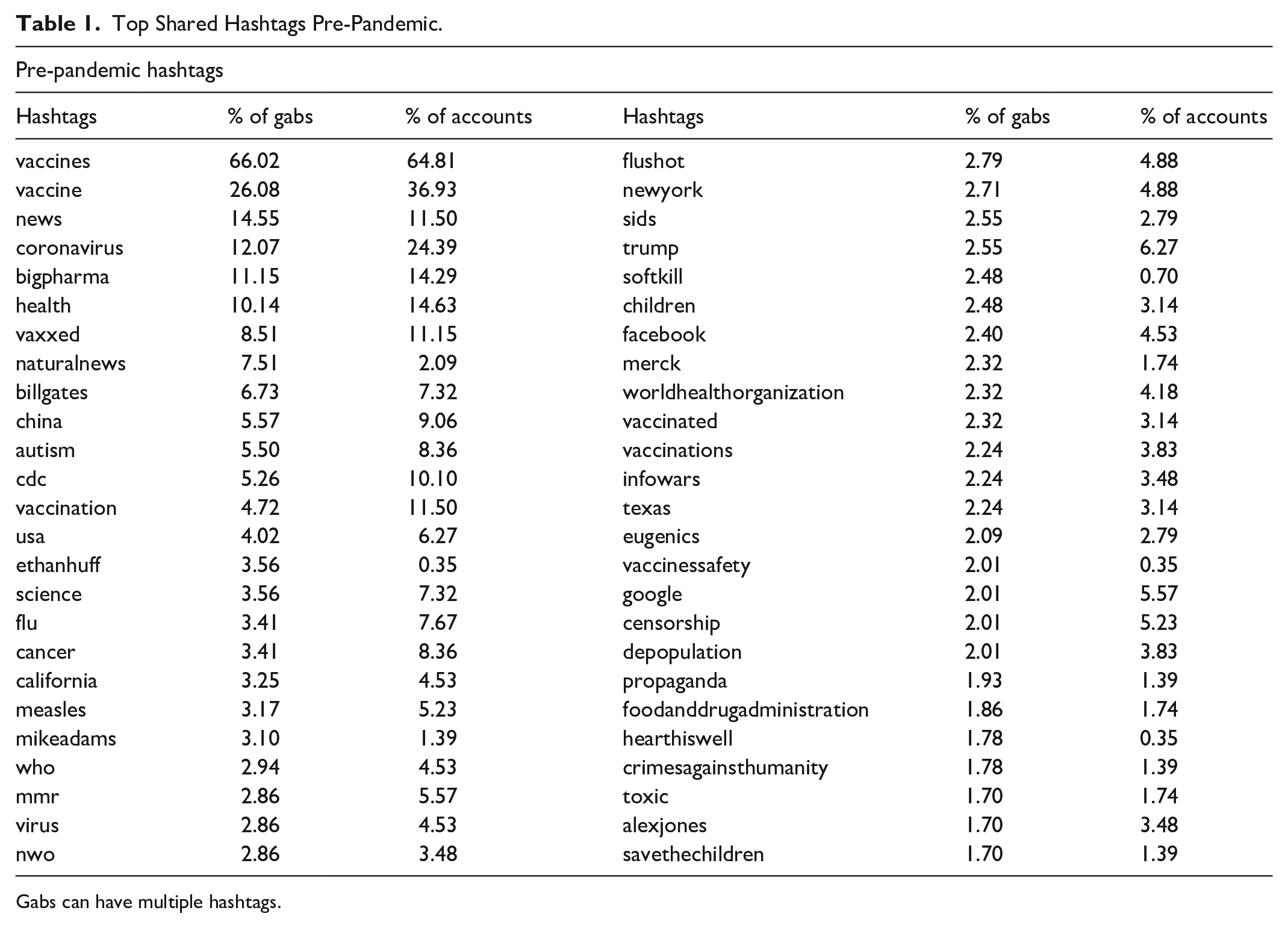
Gabs can have multiple hashtags.
Regarding the “magic cures,” it is argued that there are particular genes and/or treatments that could potentially completely cure a wide gamut of diseases. These treatments, such as Gc protein-derived macrophage-activating factor (GcMAf) therapy, or some of the claims regarding components of vaccines, may indeed have some basis in medical literature, but the representation of such literature, or the cherry-picked parts of the medical literature are completely out of context, and interpreted fallaciously to lead to the unsubstantiated claims related to vaccines or the overblown potentials of such cures and treatments. The presence of some reliable medical authorities in the list of top information sources shared on gabs, along with a series of faux scientific and pseudo-scientific websites in this list (Table 2) shows this discursive strategy. By relying on what looks to be scientific, such gabs can lay the foundation for their claims in scientific or scientific-looking literature, before fallaciously moving from these premises to the conspiratorial conclusions.
Top Domains Pre-Pandemic, Where Over 1% of Gabs or Accounts Link to Them.

When it comes to “who” is hiding the aforementioned truths, one can observe the same inconsistent patterns. While some gabs place the blame on “Big Pharma,” others blame particular political or economic elites, such as politicians (mainly US democrats), billionaires such as Bill Gates, Big Tech, or simply a group of elites so powerful that one cannot even know their identity.
Reviewing the top shared hashtags (Table 1), domains (Table 2), and content of gabs prior to the pandemic points to the fact that although conspiratorial mode of thought is a dominant feature of the conversations, the conversations still remain primarily in the discursive field of medicine and science. That is, while the users and conversations in this space insist on providing an alternative, counter-hegemonic discourse about vaccines, the inherent antagonism between their discursive positions and the mainstream scientific discourse is still restricted to the primary discursive domain that vaccination belongs to, that is, health and medicine. In this way, it can be argued that the vaccination discourse on Gab pre-pandemic contains elements of an antagonistic, “political” discourse. However, the politicization or antagonism is strictly within the general domain of medical discourse, and is not directly entangled with matters related to organizational politics—Politics in Mouffe’s (2005, 2013) argumentation.
Another significant feature of the information flows on gab prior to the pandemic is the presence of several mainstream information sources in gabs: YouTube, Twitter, and Vimeo as the social media platforms that gabs link to, and a series of mainstream websites and news outlet sites such as New York Times, Fox News, and Daily Mail UK. This partly relates to the lack of alternative information sources in the information ecosystem of Gab users at the time. Expectedly, to sustain the flow of information on the platform and remain visible, a large part of the content on any social media platform enters it through links to external content. However, due to a relative lack of such content for Gab users at the time, and also due to a lower number of users compared to mainstream platforms, Gab users still had to rely on content produced and shared on mainstream platforms and media as information sources. That is, they had to paradoxically rely on what they stand against as an information source. However, as we will discuss later, this type of information flow substantially decreased after the series of events that led to large-scale movement of users to Gab, such as banning several high-profile problematic users from mainstream platforms, the US elections, Capitol attacks, and of course, the COVID-19 pandemic and vaccination discourse surrounding it.
During the Pandemic
With the first reports of COVID-19 coming out of China and different countries, and subsequently, the fast spread of the disease, the vaccination discussions on Gab soon started to take a discursive turn, which was to a large extent reliant on the breaking of news external to the platform. The first highly shared gabs that show a clear move to the Politicization of the discourse focus on some of the earliest cases in the United States, but foreground certain political elements of the news, rather than the health-related or medical aspects of the pandemic. For instance, one of the earliest of such gabs reports that nine people in California were suspected of being infected by the virus. However, the gab does not suffice to only report the number and location in a manner normally expected of a social media post aimed at sharing facts or information. Rather, it adds two particular Political framings to the discourse: it avoids calling the virus by its proper, mainstream names (i.e., COVID-19 or coronavirus), and instead, calls it the #WuFlu (Wuhan Flu). Second, it reports that all of the nine infected people worked for Dianne Feinstein, a Democrat senator. By clearly demarcating its Political stance, the gab amplifies the external antagonism between the United States and China, and the internal antagonisms between the Republicans and Democrats in the United States.
Following the declaration of the COVID-19 as a pandemic by the WHO, one clearly observes the Politicization and radicalization of the surrounding discourse on Gab (Table 3). While the conspiratorial mode of thought observed prior to the pandemic is still a dominant feature of the gabs, the conspiracies take new shapes, interpretations, and enter new discursive fields.
Top Hashtags During the Pandemic.

Gabs can have multiple hashtags.
That is, the domain of the discourse moves further away from a medical and health domain, and instead moves directly to the domain of Politics. The “usual suspects,” observed before the pandemic, such as Bill Gates, Big Pharma, and elites are still the focus of blames, but they now take new forms, find new names, or obtain new discursive functions as “evidence” to prove the sinister agendas of those so-called elites. Historical political conspiracy theories, such as the antisemitic claims of a New World Order, Globalists, and the like readily expand to also include conspiracies that entail the creation of a virus in a lab, dissemination of ineffective treatments to get richer, polluting vaccines with materials that could kill large numbers of people in the long run, to let the “globalists” take over the world and control it. Simply put, the discursive struggle over vaccines no longer operates within the signifiers of a discourse of medicine or health, but in a discursive system around Politics, economy, and who should or should not have the power to control and order societies into particular arrangements.
This Politicization of the discourse is both favored by the hyperpartisan, explicitly conspiratorial publics and groups, such as QAnon, and by the general userbase on Gab. Content explicitly posted by and about QAnon publics shows a high level of activity by the supporters of the conspiracy theory. However, when comparing the level of activity of accounts with the overall percentage of gabs containing such content, it is clear that explicit QAnon content is mainly due to a small, yet highly active user group. For example, while around 11% of all vaccination-related gabs contain the QAnon hashtag #WWG1WGA (Where We Go 1 We Go All), these gabs are posted by only 4% of accounts contributing to the conversations. Other QAnon-related hashtags show similar patterns, where a large percentage of gabs are posted by a small, but loud group of users.
Another key feature of the information flows after the increasing popularity of Gab as a platform and the discussions around vaccines is the decreasing reliance on mainstream media and social media platforms. While Twitter was one of the top sources of information in the early days of the platform and before the pandemic in our dataset (Table 2), it no longer appears in the list of top URLs in 2020 and 2021 (Table 4). Rather, the flow of information has now moved almost completely to an alternative ecosystem, in which information is produced by “dark participants” (Zeng & Schäfer, 2021, p. 1338) and “conspiracy entrepreneurs” (Sunstein & Vermeule, 2009, p. 212), shared and amplified by ordinary users, and then posted on the mainstream platforms to recruit new members. This points to a shift in the flow of problematic information from the periphery to the core, rather than the opposite, which has traditionally been the case. This shift in the direction of information and the deepening of the alternative ecosystem is also apparent in the significant changes in the sources of information after the pandemic. Of course, more research is needed to examine whether such shift is only restricted to the vaccination discourse, or whether other politicized discourses also show similar patterns.
Top Domains During the Pandemic Where Over 1% of Gabs or Accounts Link to Them.

Alternative video sharing platforms like BitChute, Brighteon, and the like are now key sources of information sharing on Gab. An interesting exception, however, is that YouTube still plays an important role as an information source for videos on Gab. Our manual analysis of a random selection of the top YouTube videos shared on Gab shows that many of these videos are still online on YouTube, but some have been removed. In the videos that are still online, though, not many are explicitly or categorically problematic or anti-vaccination. Rather, there is a mix of conservative voices, pseudo-scientific claims, political commentary, humor, and in general, videos that do not directly violate YouTube’s terms of service, except for a few. What differentiates these videos on a platform like YouTube from one such as Gab, however, is the commentary and interpretations attached to them when they are shared on each platform. In other words, it is not the videos alone that are the source of the problem, but how they are de- or recontextualized on Gab. On YouTube, for instance, a content creator simply shares the video, and adds some captions to it. The captions on Gab, however, give the video a completely different interpretation and framing, through juxtaposing it with other discourses, using secondary hashtags, extensive editing, or adding unsubstantiated claims or captions to the edited video.
Short and cherry-picked edited versions of long-format YouTube videos are a prominent example in our dataset. Decontextualized multi-second cuts of videos that are originally over 30 minutes long are heavily edited, to convey particular information against vaccines, and introduce Political dimensions into them. One highly shared example of this in our dataset is a 2-minute video cut from a longer 50-minute original on YouTube, in which a scientist talks about the future of genetic science and what it can look like. Some of the hypothetical examples discussed in that video were decontextualized in the 2-minute version, presented as what is already been done through genetics engineering, and then recontextualized into the argument that COVID-19 vaccines are already using the same technology to remotely control humans, and that they are promoted to the populations by “globalists” to enable them to control the world.
Several other highly shared YouTube videos are from YouTubers and content creators who produce borderline problematic content, in ways that have strong potentials for being recontextualized elsewhere, without directly violating YouTube’s terms. These dog-whistle videos, borderline content, and partisan discourse, produced and shared by groups and accounts such as Project Veritas, Russel Brand, and other less well-known YouTubers play a large part in the vaccination discourse on Gab.
The more problematic and extreme content, however, such as content that explicitly shares hyperpartisan, offensive, conspiratorial, anti-science, or antisemitic content, almost exclusively comes from alternative platforms like BitChute. That is, Gab users have now learnt the rules of antagonism that they should play by borderline content and content that can be used to ease others into the radicalization process are still produced and shared on mainstream platforms. However, content that is exclusively produced for the “inner circle” is produced and shared in the alternative ecosystem.
Discussion
The range and diversity of voices and discourses in the broader vaccination discourse on Gab—both before and during the pandemic—points to a lack of a monolithic, homogeneous anti-vaccination or vaccine hesitant group of users. While platforms like Gab have traditionally been studied and framed as primarily far-right or alt-right spaces, our analysis of the temporal conversations on the platform calls for a more holistic understanding of the platform, rather than essentializing the discourses circulating on the platform to only a single Political viewpoint or conspiracy theory. This, of course, is not to argue that Gab does not have a far-right problem. As literature has shown, many users of the platform do hold ultra-conservative, right-leaning views, and many can indeed be categorized as far-right or alt-right. However, reducing the range of discourses and topics discussed on the platform to a particular political discourse or ideology, that is, far-right, restricts our understanding of the dynamics of conversations and discourses on such platforms, especially about non-Political topics and issues.
Particularly prior to the pandemic, we observed that the vaccination discussions on the platform did not necessarily fit into what could be considered as the domain of Politics, and that the discursive field was limited to the domain it normally belongs to: the discourse of medicine and health. However, with the temporal evolution of the debate, breaking of the COVID-19 pandemic, and the politicization of the vaccination debate, the discourse entered new fields, became politicized, and further Politicized. The antagonistic nature of discourses circulating on Gab and similar platforms increases the likelihood that this Politicization and radicalization process could replicate itself in other topics, discourses, and events.
What creates the necessary conditions for this radicalization is not necessarily the presence of far-right users on the platform. Our analysis shows that more extreme views, such as QAnon supporters, explicit white supremacist views, and the like are indeed an exigent part of the conversations on Gab. However, such conversations and positions are not the dominant, majority views. The platform also has a large user base of socially and culturally conservative views, conspiracy-prone users, political junkies, trolls, and the like. This diversity of voice could at times be so wide in breadth that it creates internal antagonisms in the discourse on what the best “explanations” to events are. As Donovan et al. (2018) argue, engagement on this platform is at times “so vitriolic that it may do more to destroy the alliances” (p. 62) among these users, rather than to help build communities of completely like-minded users.
What brings this diversity of voices together, even despite the internal antagonisms, is the nodal point of all discourses flowing on the platform; no matter what explanation, what theory, or what alternative view is shared, the nodal point remains the same: the mainstream, hegemonic narrative is always wrong, and there is always something hidden from plain sight. This nodal point, formed around the negation of the mainstream, builds the foundation for the amalgamation of different discourses into one larger discursive field: if two discourse are in agreement in the fact that the mainstream narrative is not the correct one, they then form a discursive alliance using the technological affordances of the platform or the ecosystem, or what Dehghan (2020) calls “networked discursive alliances.”
The formation of these networked discursive alliances around a nodal point built on negation also raises very important considerations for research on mis-, dis-, and mal-information. The consensus in bulk of such literature is that much of these information disorders revolve around information that is not fact-based, and depending on intention or consequences, these information disorders can be classified in different ways, such as misinformation, disinformation, and the like (Tandoc et al., 2018; Wardle & Derakhshan, 2018). However, the issue less addressed by mis- and disinformation literature is that facts are not necessarily the basis of conspiratorial discourses shared on alternative platforms like Gab. As the nodal point of such discourses is built around the negation of mainstream, what is normally considered as facts in mainstream discourses would then be yet another thing to negate and reject. Consequently, any information campaign, fact-based action, or fact-checking attempt would simply be disregarded on such platforms, as it is just another mainstream narrative.
Another point to consider regarding a continued emphasis on facts as the basis of normative evaluation of discourses and information is that reducing a discourse to a series of facts means that it cannot cover many of the other discourses crucial for the formation of conspiratorial, counter-hegemonic discourses built around the negation of mainstream narratives. Issues and topics in the domain of “the political,” such as religion, race, culture, gender, superstitions, and in case of the COVID-19 pandemic, vaccinations, do not have the necessary conditions to fit into a fact-based discursive field, while they are normally the most significant points of debate, antagonism, and politicization on social media. The same topics also cover such wide gamut of debates that their discussion on mainstream social media platforms does not necessarily mean an automatic violation of a platform’s community guidelines or terms of service. This would enable content creators discussing these topics, particularly from the normatively “problematic” side of the debate, to be able to freely discuss them on a platform without violating any rules. In turn, as it was observed in our findings, these posts can then be reposted in an alternative space, get de- or recontextualized, and further politicized. The additional conversation and commentary on such discussions in a non-moderated alternative space like Gab can spiral the discourse into radicalization and Politicization.
Conclusion
The increasingly pressing problem of polarization and radicalization has attracted a great deal of attention, both in and beyond academia. This study examined the process of radicalization in the alternative platform ecosystem, and showed how seemingly non-political issues and topics like vaccination can become gradually radicalized, due to the reliance of discourses in the alt-tech space on the negation of hegemonic voices.
Our study also shows a shift in the flow of information from mainstream platforms like YouTube and Twitter toward alternative spaces such as BitChute and hyperpartisan websites. Although the findings of the work are limited to the particular case study at hand, this shift is worthy of more attention, and further studies on other cases and issues are required. In addition, this observed shift in the information flows and also the increasing depth of radicalization in the absence of other viewpoints, calls for a renewed attention to the alternative ecosystem as a whole, and not as single spaces like Gab.
Although studies have shown that mainstream platforms’ attempts at reducing the reach and visibility of problematic discourses on them have been generally successful (Rauchfleisch & Kaiser, 2021), there is also evidence that the movement of problematic users toward alternative spaces will also lead to more toxicity (Ali et al., 2021), and as the findings of this article showed, further radicalization of discourses that are not normally considered as Political. The alternative ecosystem has now grown substantially, and as this study showed, it is now showing elements of moving toward becoming a self-sufficient, sustainable parallel ecosystem. This can lead to further radicalization and polarization of public debate, not only in social terms, but also in technological terms, wherein the sides of the debate will not even exist on the same platform. This, one can argue, would be the true echo chamber.
Footnotes
Acknowledgements
The authors are extremely grateful to QUT’s Digital Observatory, particularly Betsy Alpert, for their help in the development, testing, and publishing of the open-source tool Gab Tidy Data.
Declaration of Conflicting Interests
The author(s) declared no potential conflicts of interest with respect to the research, authorship, and/or publication of this article.
Funding
The author(s) disclosed receipt of the following financial support for the research, authorship, and/or publication of this article: This research is supported by funding received from QUT’s Digital Media Research Centre to facilitate research assistance and publication fees of the article.
