




Abstract
The study of Black digital and Internet cultures is a burgeoning site of inquiry. While prior research on identity and the Internet does well to address racialized experiences online, further exploration into so-called niche or under-the-radar Black digital spaces is necessary for a more comprehensive documentation of early Internet applications, practices, and digitally mediated sociality during the early 20th century. This article centers Black southern Internet culture by examining the website, InDmix.com, a photo-based asynchronous web media platform, and one of the first Internet visual catalogs of southern Black college nightlife of the aughts. Combining scholarly inquiry with first-person storytelling, this article provides historical references to contextualize an aspect of early Black Internet culture while arguing that Black women, in particular, mediate the process of visibility and valuation since they carry conceptions of beauty and Blackness across the platform. Engaging with concepts of architectural Blackness and informational Blackness, this article demonstrates the ways in which southern Black youth culture combined with early Web 2.0 technology practices provides a digital snapshot of college and urban nightlife experiences along the backdrop of socioeconomic and cultural shifts in the Gulf Coast region of the United States. In the spirit of documenting Black digital cultures, this article concludes with a conversation with founder Ikem Onyekwena, the Phi Beta Sigma photographer and tech entrepreneur who founded InDmix.com in 2004.
Every Sunday morning after a night out at the club, I would go online to see if Saturday night’s pictures were posted. I refreshed the homepage waiting for new uploads, hoping to find the latest image of me posing in front of the DJ booth. I scrolled through endless black web pages colored with bright neon hyperlinked text and high-resolution images, searching for my name in the captions. I came across pictures from the previous weekend of me raising a plastic cup in the air at club Jamaica Jamaica on Westheimer road in Houston, Texas. “Southside” by Lil Keke played in the background. The image was visual proof that I was in the place to be, and everyone who saw it, knew it. Before study sessions and breakfast, I sat at a tiny desk in the dorm hovered over my VAIO laptop anticipating that first glimpse of how my outfit, hair, and makeup looked through the computer screen. In the afternoon, I met up with my teammates to talk about the night before; who all was there, and how our friend, Ikem Onyekwena, the Phi Beta Sigma photographer always managed to capture the track girls’ best angles with his digital SLR camera.
Before Instagram, there was inDmix. Founded in 2004, inDmix shares a lineage with Black Planet (est. 1999) and Myspace (est. 2003), two primary web platforms for Black college students to connect at the turn of the century. Indmix.com is best described as a photo-based asynchronous web media platform, and one of the first Internet visual catalogs of southern Black college nightlife of the aughts. The tagline “Are you inDmix?” signals to a time, place, and vernacular that reflects an era when online and offline modes of visual culture collided. Though my memory is somewhat fuzzy, as I reflect back on inDmix.com, I think about how visual, digital, networked, and youth cultures of the early 21st century merged into what is commonly understood as social media. More importantly, reflecting on these moments helps me understand where I, as a young Black woman from Northeast, Ohio, was located among early 21st-century convergence culture. From there, I can ask: What elements of convergence emerged in the early era of inDmix.com that unpacks digital Blackness and racialized gender discourse relative to web media in the aughts? What are the implications therein?
This article seeks to address these questions using inDmix, the website and community, as a case. I begin with a brief history of Houston, Texas at the turn of the century to set the economic and social context for how Houston’s urban 1 scene formed during the aughts. Here, I frame inDmix.com through the concept of architectural Blackness, which “understands blackness as the architectonic logic . . . not bounded by phenotype or figurai representation” (Cramer, 2016, p. 2). Informed by Black feminist approaches to visual culture, I examine inDmix’s web interface as racialized gender discourse. I contend that representations of Black women, in particular function as mediators across inDmix.com; they carry conceptualizations of Blackness and beauty across virtual and non-virtual spaces.
I end this article with a conversation with Ikem Onyekwena, inDmix.com’s CEO and founder, who discusses the early history of his website, and the campus and nightlife culture he cultivated through digital photography and online photo sharing.
Hybrid Subjectivity and the Houston Cultural Scene
I moved to Houston, Texas at the turn of the century when I was 18-year-old. I left Ohio to begin a new life as a college student on a track and field scholarship to the University of Houston. I was leaving behind a region of the country still suffering from the effects of deindustrialization while regions in the Gulf Coast were thriving as a result of oil industry expansion in the latter half of the 20th century. It was 1999, the same year ExxonMobil, the world’s most powerful oil company was formed and headquartered in Texas. Márquez (2014) notes that “[t]he Houston area was in an economic boom while most of the United States was beginning to experience the ill effects of deindustrialization” (p. 116). This economic boom impacted migration patterns as more working class Blacks and Latinx, and other immigrants of color fled to the Gulf for jobs. As Márquez argues, overtime the influx and coalescence of marginalized communities would influence how young people of color saw themselves in a society undergoing rapid economic and cultural changes. Márquez (2014) explains, The increasingly shared experience of expendability, in addition to demographic shifts that placed blacks and Latinos/as in closer proximity within more mixed neighborhoods across the Houston area, often resulted in greater potential for expressions of black-brown solidarity if not the emergence of a hybrid oppositional consciousness and subjectivity. (p. 114)
As a young Black woman from a Midwest working-class family, I found myself in the midst of this paradigm shift in the US American society: migrating across the country as racial demographics and narratives about the US economic landscapes were changing. For me, moving to the south on an athletic scholarship made financial sense. Notions of the south conjured up ideals of deeply rooted cultures, proud heritages, hotter temperatures, slower pace, and more affordable ways of living. The south was also a place to experience a broader range of the diaspora than what I had known growing up in Ohio. Reflecting back, it also marked a moment in time where idea(l)s of womanhood were formed at the crossroads of southern Black life and Mexican and Caribbean cultures.
The blending of cultures in Houston was also reflected in the hip hop music scene. Though I arrived to Houston aware that the Scarface, Geto Boys, UGK (Underground Kings), and J. Prince were canonical names in hip hop music, it was the next generation of Houston-area hip hop and pop artists like Fat Pat, Mike Jones, Lil’ Keke, Chamillionaire, Slim Thug, Chingo Bling, Southpark Mexican, and Destiny’s Child that largely composed the soundtrack of my formidable years. Some of these artists were part of my peer group. Paul Slayton (better known as Paul Wall) and I had chemistry class together at the University of Houston. Beyoncé, who I mistook for her sister Solange showed up at mutual friends’ house parties in Third Ward. A welcoming consequence of young Houstonians and expats being brought together overtime as a result of societal shifts was that music, entertainment, and college scenes were increasingly tight knit. I came of age alongside many of Houston’s young artists and cultural gatekeepers of that time; an era not only characterized by its geography but also by the history, politics, and technologies that shaped Houston’s culture at the turn of the century.
Indeed, it was a fun time to grow up in Houston with its diverse population, healthy economy, and influential music scene, but it was also easy to miss the turmoil happening in smaller immigrant communities and in Black and brown neighborhoods if one was not paying attention. Racial segregation, gang violence, and police brutality persisted. These everyday problems in local communities coupled with the socio-political shifts happening across the nation and globe engendered a hybrid way of seeing and being in the world, more specifically being on the margins of the US American life in the Gulf Coast. Márquez (2014) conceptualizes this experience through Houstonian artist DJ Screw’s chopped and screwed musical sound, an electronic music technique formed by slowing down, morphing, and chopping sounds and melodies in a song: I borrow [DJ] Screw’s chopped and screwed methodology to highlight the effects of time and space being compressed between black and Latino/a subjectivities in Houston-area neighborhoods. The ethnic and racial boundaries, both symbolic and concrete, that divided the two groups in previous decades were being chopped up by demographic changes, mostly a Latino/a population boom, resulting in the subjectivities of the two groups being screwed or fused together in the neighborhoods, schools, jails, and workplaces where they increasingly shared space and interactions. (p. 115)
Márquez application of DJ Screw’s signature music production technique to analyze racial solidarities is useful for thinking about the amalgamation of subjectivities encoded through the digital, more specifically across the Internet where diasporic cultures collided. Black and brown neighborhoods in Houston were not the only sites where young people and our cultures were enmeshed. We also knew where to find each other online, which enhanced the way cross-cultural community practices were formed and established.
Around the same time I arrived to Houston, participation in online communities was becoming more common on college campuses, especially among young Black college students. Despite widespread fears that computers clocks were incapable of rolling over to the new millennium thus causing system failures (also known as Y2K), we were still going online. This migration online is not surprising considering it follows the trajectory of Black users in general flocking to the Internet in the mid-to-late 1990s. Everett (2009) notes, From 1995 to the present, the swelled ranks of black people throughout the African diaspora connecting to the Internet, particularly the World Wide Web, have forced a new reckoning with the rapidly changing configuration of the new electronic frontier. (p. 20)
Whether through our own personal computer or by way of campus computers, it was common practice to log on to America Online (AOL) chat rooms and sign in to Black Planet and Myspace to update our profiles and meet people online. Aside from sharing information, online communities were spaces where young Black college students could present ourselves the way we wanted the world to see us across photo-based social media and “urban” media platforms. This practice characterizes “informational Blackness,” in that, the “rhythmic and expressive articulations of Blackness [are] made possible by Black pathos and information technologies” (Brock, 2020, p. 122). Here, not only is hybrid subjectivity formed through my experience migrating to a new diasporic landscape of the south in the United States, but it was also formed by a fusion of symbolic, material, technical, and vernacular articulations of Black identity.
InDmix.com locates hybrid subjectivities of the Houston cultural scene, namely through the digital photo as a compressed moment. Similar to Berger’s (2013) idea of the “arrested moment” when the photograph seizes the viewer in time that lacks continuity to the present, the compressed moment flattens time and space. Yet unlike Berger’s arrested moment, which was written about in the context of agony and war photography, in this case, cultural experiences, diasporic identities, and social contexts are suspended in the digital image as an expression of celebration and libation.
Photographer and co-founder of inDmix.com, Ikem Onyekwena recognized this new societal and mediated frontier as an opportunity to establish a virtual site of informational Blackness for young Houstonians who wanted to be seen on the scene. As a result, inDmix.com has transformed into a time capsule of compressed self-presentation and intercultural community expression in the south where our lived experiences have been encoded on the Internet. At the time, and even still, inDmix.com functioned as a virtual space that documented when the college student, the video vixen, the rapper, and the club rat posed for the camera ultimately writing ourselves into a world moving between eras of historic economic, social, and technological reorganization.
InDmix.com and Architectural Blackness
I designed the website. The construct of the website is intended to share characteristics of nightlife hence the black background and fluorescent neon colors. The new website has a gray background which is supposed to be more aesthetically pleasant to eye than its predecessor. (Ikem Onyekwena, email interview, May 2020)
Hybrid subjectivities as discussed above are superimposed across inDmix.com making it so that the site itself functions as an amalgamation of discourse and lived experiences—as “visions of reality through signs and simulations of a ‘hyper real’” (Hobson, 2012, p. 102). Onyekwena tells me he started inDmix as a college assignment to archive family and travel photos.
I started inDmix as part of a final project for my HTML web class in 2000. We were taught the basics of web design and the final project was to create a website implementing the tools we learned. I created a basic website with a brief summary of where I was from, my resume, my family pictures and my hobbies. The hobbies section, which included my social destinations eventually became inDmix.com. And I kept it updated for my close friends.
Onyekwena’s identity as a Nigerian-born college student and aspiring entrepreneur is reflected in the site’s architecture as it evolved from personal diary for family and friends to a profit-generating business. Onyekwena tells me he bought both inDmix.com and inDmix.biz URLs (or Uniform Resource Locators) at the same time, knowing that the site would eventually turn into a business: “It was the thing to do back in the day. You wanted to own your own .net and .com at the very least [. . .] You always gotta think big.”
Taking cues from Cramer’s (2016) analysis of World Star Hip Hop (WSHH) (est. 2005), I conceptualize inDmix through an architectural understanding of Blackness where Blackness is understood “as an aestheticized social continuity” and read as a cultural object (pp. 2–3). In other words, though Blackness is not contained on inDmix.com, it is a space where racialized and gendered events take shape. Similar to World Star Hip Hop (WSHH, n.d.), a content aggregating video website, or “home to everything entertainment and hip hop,” inDmix.com, established 1 year prior, featured curated imagery that reflected “urban” lifestyle and Black diasporic youth cultures. Also similar to WSHH, inDmix’s image gallery and interface are illustrative of racialized gender discourse, namely, in the ways scripts of gender and sexuality are encoded across inDmix’s interface. This shows up, for example, in the way female clubgoers are represented and positioned by way of the digital image. Blackness too is mediated across different visual and non-visual elements of the site, as well as through users who visit the site, and by way of Onyekwena who maintains the site.
Onyekwena officially launched inDmix.com in October 2004. Early versions of inDmix characterize a web interface arguably akin to personal Myspace webpages in terms of neon color hyperlinks, digital event flyers in JPEG format (a compression method for rendering digital images), and moving banners powered by Adobe Flash (see Figure 1). Later versions of the site incorporated more multimodal web elements like video, social media widgets, Rich Site Summary (RSS for aggregating web content) feeds, and podcast episodes. As Onyekwena notes, the design of the site has changed to create what he deems as a more aesthetically pleasing experience for the viewer. InDmix’s logo, however, has remained consistent since its inception (see Figure 2). The logo design consists of neon green font that spells out “inDmix” in upper and lowercase letters with the tagline (that has changed over the years) in block bubble letters positioned underneath. The logo is distinguishable with an air of the West Indian carnival in terms of the font’s flamboyance, expressiveness, and unwillingness to be neatly structured like, for instance, a logo designed in black Helvetica font. InDmix’s logo functions to erect an “objectively black space [as] an example of the interface not constructing an actual (black) thing, but a (black) effect” (Cramer, 2016, p. 7). In that sense, the logo gestures to Blackness without necessarily being a symbol of Blackness.

inDmix.com homepage September 1, 2005.

inDmix.com logo.
Similar to Cramer’s (2016) analysis of WSHH, I consider inDmix.com a site that mobilizes Blackness through interracial and intercultural exchange (p. 6). This is most obvious with the site’s Beauty of the Week feature 2 on the homepage, which primarily showcases non-White women of various ethnic backgrounds posing at urban night clubs (see Figure 3). Over the years, the Beauty of the Week feature has been distributed across inDmix’s social media sites like Twitter and Instagram with the hashtag, #BeautyoftheWeek. The Beauty of the Week feature harkens back to early forms of Black print culture like Jet Magazine where Black women and their bodies were “brought into the mainstream” in the 20th century (Johnson, 2019). Not only does the hashtag locate visual images of women, and the conversations attached to them, but #BeautyoftheWeek also locates the technical processes of distributing discourse, information, and ideological underpinnings of intracommunity cultural digital practices across the web (Conley, 2017). However, Onyekwena notes that in his view, inDmix.com characterizes a Black platform “because we cover events that cater primarily to the African American audience—it’s about 95% of the events we cover.” Informational content posted on the site, like event location and external links to RSVP websites caters to Black audiences even though some of the visual imagery like digital flyers and the picture gallery features non-Black party-goers and models. Notwithstanding Onyekwena’s intent for the site, inDmix.com serves as an example of architectural Blackness, in that, it “expands the possibilities for reading blackness in cultural objects that do not resemble or exclusively feature black bodies” (Cramer, 2016, p. 3).
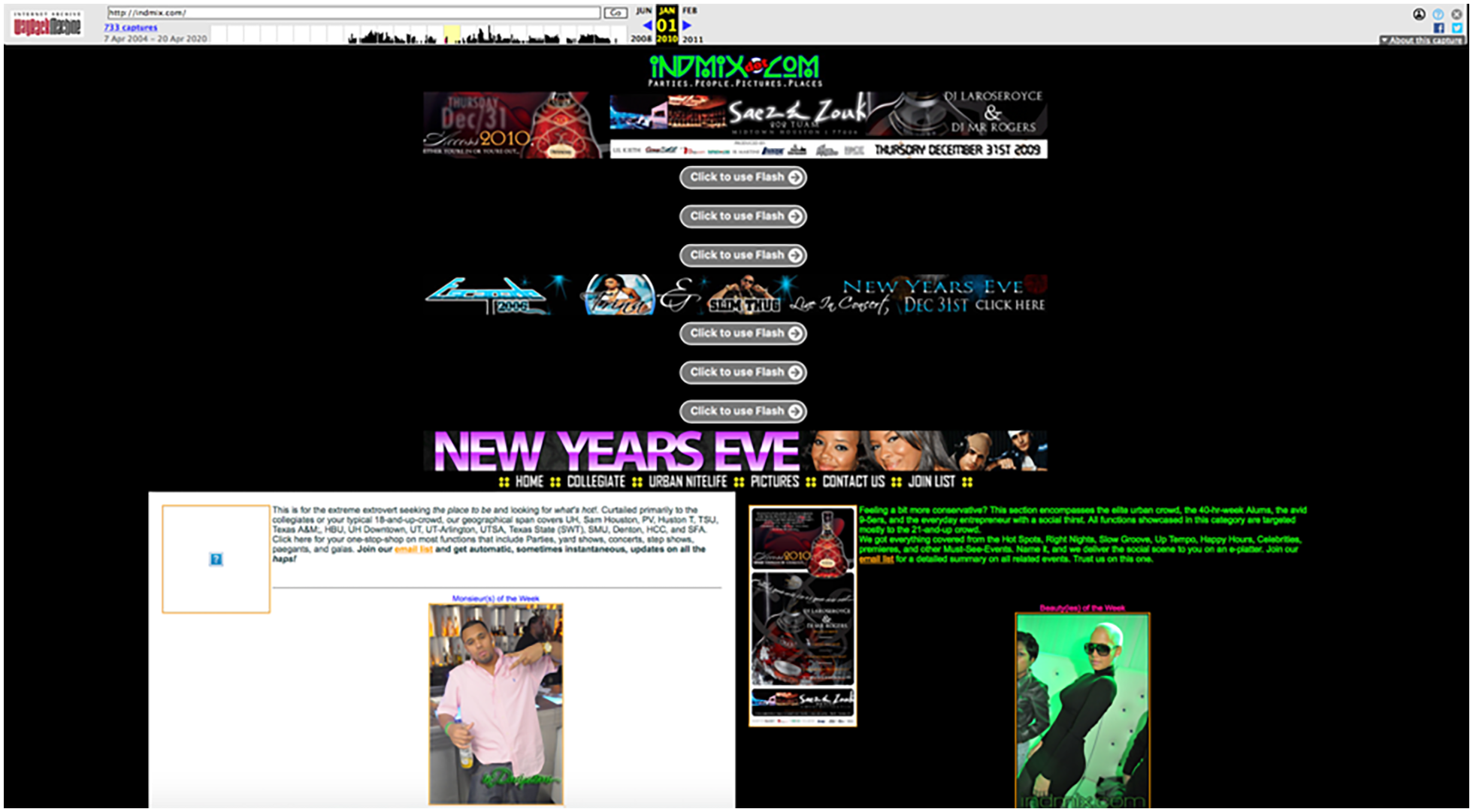
inDmix.com homepage January 1, 2010.
Unlike WSHH, inDmix’s original interface was not modeled after clean lines, seamless usability, and empty space of the modernist aesthetic. Users will not find too much white space “to fill with preferences” (Cramer, 2016, p. 6). Rather, inDmix’s interface bombards users; colors are loud, still images show subjects in motion, and at times hyperlinks are broken. InDmix’s untidiness requires users to be self-directed and less reliant on the design of the site to dictate user experience. These self-directed practices also characterize the way users engage with the platform and community, namely, in how they are to be seen on the screen and on the scene.
InDmix’s Intracommunity Gaze and Web 2.0
Intracommunity gaze, or an imagined audience’s awareness of each other characterizes an important cultural practice of the inDmix community. However, it is not only an awareness of each other but also of share referents, like music, clothing, and lingo that characterize much of the offline-to-online practices relative to this community. Even ways of posing in front of the camera, which are also gendered practices, serves as a way to identify (with) this particular community (as I recalled at the beginning of this article). Here, imagined community “emerges as a result of the intersection between people, technology, and practice” (boyd, 2014, p. 8). The gaze, in all the ways it has been theorized according to whiteness, is an inherent phenomenon with digital platforms. Particular to inDmix, however, the community gaze is neither a one-sided nor passive event; it does not rely upon whiteness, or White audiences to exist. Rather, the gaze here reflects shared experiences of belonging among people of similar diasporic, regional, and cultural communities, of “transnational networks and experiences related to ‘race,’ or more precisely ‘racialization’” (Borst & González, 2018, p. 290). As Borst and González (2018) further note, “[t]he individual relates to this community, which—independent of its ontological status—is imagined as such” (p. 290). The intracommunity gaze inherent to inDmix.com also challenges the notion that the gaze is something done to another. From posing in front of the camera to arriving at the club at the right time demonstrates a deliberate positioning of self among the community, as well as strategic form of self-expression and self-representation. In this way, inDmix, the digital platform and community, “challenge mainstream perceptions of so-called ‘minority groups’” as passive observers by demonstrating that this community emerges as creators of visual Web 2.0 counterdiscourse (Borst & González, 2018, p. 290).
InDmix.com launched during a time when websites, especially popular social media platforms were becoming more scrutinized as separate racialized spaces. This is not to suggest virtual spaces that predate the 2000s were not racialized. 3 Rather, in highlighting the era when inDmix.com was launched, I am also pointing to the role of Big Media in facilitating social (re)organization vis-à-vis web development and design, as well as institutional (philanthropic, non-profit, policy-making, and academic) response to the rise of digital practices among users of color, especially young users. 4 It goes without saying that inDmix.com came of age during a moment ripe to interrogate digital Blackness and Web 2.0 technologies.
InDmix’s web design can also be analyzed in the context of racialized digital migrations of Web 2.0,
5
namely, in the way web design and aesthetics have been (de)valued along racial and class lines. boyd’s (2012) foundational ethnographic analysis is one of the first to chronicle the phenomenon of racialized migration of popular social media sites, looking at movement patterns of young users across Myspace and Facebook. Boyd posits that taste and aesthetics reflect users’ identity and values, and mass migration from Myspace to Facebook among White teenage users mirrored offline social organization patterns based on race and class, commonly referred to “white flight.” Boyd writes, While Facebook’s minimalism is not inherently better, conscientious restraint has been one marker of bourgeois fashion (Arnold, 2001). On the contrary, the flashy style that is popular on Myspace is often marked in relation to “bling-bling,” a style of conspicuous consumption that is associated with urban black culture and hip-hop. To some, bling and flashy Myspace profiles are beautiful and creative; to others, these styles are garish. While style preference is not inherently about race and class, the specific styles referenced have racial overtones and socioeconomic implications (pp. 214–215).
Boyd’s analysis is useful to consider how the aesthetics of early Web 2.0 interfaces became racialized and classed overtime. Related to boyd’s analysis, Hobson (2012) takes up the issue of digital white flight from a Black feminist perspective arguing that racialized and gendered power dynamics also get reproduced online, notably “in disturbing and retrogressive ways” (p. 94). Hobson’s analysis of white flight pertaining to film elucidates boyd’s perspective of white flight online since Hobson critically engages the idea of the body itself. This is especially important to note given debates about disembodiment and online sociality over the decades, and the implications for Black women, especially in that one cannot simply separate Black women’s bodies from our practices online. 6
Considering these scholarly and historical perspectives, inDmix might also be read as a Black primitive space in the sense that it lacks the modernist or bourgeois aesthetic characteristic of digital whiteness (boyd, 2012; Cramer, 2016). With respect to values placed on Black virtual spaces, however, Brock (2020) makes it plain: “Black websites are labeled as niche online spaces in part because of the technocultural belief that Black folk lack the capacity for ‘appropriate’ internet practices.” (Brock, 2020, pp. 17–18). Considering inDmix.com’s origin story as a college assignment, it is clear that Onyekwena not only understands the Internet, he also contributed to building early Web 2.0 infrastructure not owned by Big Media. Despite inDmix’s arguable niche interface, the site characterizes Black online discursive styles in that its “rhythmic, stylish, striking, and visceral” design elements push up against rational, hierarchal, and controlled Internet practices characteristic of digital whiteness (Brock, 2020, p. 80). In addition to the site functioning as a space to interrogate digital Blackness and correspondingly, digital whiteness, inDmix.com also serves as a space to analyzed how scripts of gender and sexuality get reproduced.
Black Women Mediating Beauty and Blackness on inDmix.com
inDmix has three major components to its website: events, picture gallery and ads. In the events section most events are designed to draw the attention of African-American women because if women come to the events then men will follow suit. In the picture gallery, women get the most views and downloads, and most of the women in the picture galleries are African-American. They shape and define the majority of inDmix’s content for consumption. Additionally, women double the amount of men that peruse picture galleries because women like to see pictures of men and women, whereas men mostly view the picture galleries to see women. The majority of ads that are gender specific on the website cater to women. Hair salons, hair weave, fashion boutiques, skin care, and eyelash ad campaigns are purchased weekly for display on the website because they’re the most popular. (Ikem Onyekwena, email interview, May 2020)
I opened this article with a vignette that characterizes inDmix.com as an intermediary of Houston college and night life. In its early years, the site was the main gatekeeper to a digital catalog of Houston’s urban college nightlife. Users relied on inDmix.com for information and for indulging in the pleasure of perusing images of friends and others party-goers. In this way, Onyekwena’s website describes a black box technology, one that can be viewed in terms of its inputs and outputs. However, inDmix is not a neutral technology characterized by simple technical transactions. InDmix.com is where representation, signification, and mediation take place; where meaning enters into the site as users view and are viewed through its interface. Among the users I center here are Black women. More succinctly, I consider Black women who participate with inDmix’s online community as mediators. Unlike intermediaries, mediators “transform, translate, distort, and modify the meaning or the elements they are supposed to carry” (Latour, 2005, p. 39). As Onyekwena notes above, Black women drive engagement and shape the interface. They also carry conceptions of beauty and Blackness across the site.
Critical scholarship that interrogates Black women and beauty has long held that the concept of beauty is inextricably linked to power. This is because the concept of beauty, like Blackness is tied to personal and political values and judgments (Kant, 1914; Tate, 2009). Across critical media and technology scholarship, Black women, in particular, serve as qualitative indicators to study racialized discourse around definitions of womanhood and empowerment (Balaji, 2010; Brock et al., 2010). Other critical scholarship takes up counternarratives of Black beauty as a contested site of inquiry, analyzing Black womanhood with nuance across class and age (Crawford, 2018; McMillan Cotton, 2019). Tate (2009) tackles the cultural politics of Black beauty, urging one to rethink Black beauty as “both about the visibility of a surface and recognition within an economy of racialized and racializing valuation” (p. 12). With these perspectives in mind, perceptions of beauty reveal individual and collective values placed on racialized bodies, namely, Black women’s bodies, serving as a frank reminder that “beauty isn’t actually what you look like; beauty is the preferences that reproduce the existing social order” (McMillan Cotton, 2019, p. 44).
InDmix.com’s interface facilitates a process whereby the visibility and valuation of Black beauty are constantly contested, reaffirmed, and reevaluated. Black women’s digital practices as well as representations of Black women by way of the digital image function to mediate the process of visibility and valuation. Black women as mediators reconcile two concepts seemingly at odds with each other; that is, beauty and Blackness. As the Black Arts and Power Movements teach us, Blackness has always had to be rearticulated and re-visualized as beautiful and as “a political challenge to white beauty iconicity [that] at the same time put Black beauty’s recognition at risk” (Smith, 2018; Tate, 2009, p. 9). So mediating the process of beauty and Blackness, especially online, as lived experiences are superimposed onto the digital is as much a political undertaking as it is an ontological one. Yet, the process of mediation does not occur in isolation. As Tate (2009) argues, beauty is not without context and “cannot rightfully just belong to an individual but is based in sociality” (p. 4). In other words, values and judgments of Black beauty are discursive, and inDmix.com’s Black male users play an integral part in rendering this interplay. Onyekwena discusses Black men’s role on inDmix.com: Black men use inDmix as a tool to find out where to go for events that cater to African Americans. They refer to the picture galleries to find out about trends, who’s in the crowd, and about women attending the event. When there are more beautiful and attractive women featured are on the website, the more men clamor to view the picture galleries and download the images. More downloads translate into more attention. And more attractive women drive more views and site visits, which drive more ads. That’s good for business. It’s important to note though that this is not the only way to drive views and web visits. [Featuring beautiful women on the site] is one of many methods.
Without having conducted a systematic discourse analysis on inDmix’s image gallery over the years, I would argue that the women most often featured on the site appear abled-bodied, curvy and voluptuous, and ranging in skin tones, hair textures, and facial features. There is not one type of Black beauty featured on the site. However, it can also be argued that inDmix.com has featured women that appeal to the idea of “universal satisfaction,” an uncritical view whereby beauty is understood the same way for everyone (Tate, 2009, p. 4). Since inDmix’s economy is dependent on women’s “attractiveness,” it is worth considering the variations and re-articulations of Black beauty represented across inDmix, and how male users, in particular, place value on Black women according to the ways they engage with the website.
To that end, visual representations of Black women across inDmix’s are sites of struggle and subversion. The picture gallery is one of the main draws to the website where visual representations of Black women’s bodies are especially on display. Black women represent the party-goer, the trendsetter, the fashionista, and the business women. The digital image also captures Black women being looked at by others in the background. They are not just part of the crowd. At the moment the photo is taken to when it is posted online, Black women’s bodies are the subject of curiosity, desire, pleasure, and judgment. The visual images can also be read as Black women orchestrating the gaze in the sense that “her aim is for the desire of those watching her to be as visible as her own body and implicated in the image-making process” (Cramer, 2016, p. 5). This awareness of being seen on the scene and on the screen is at the crux of inDmix’s business model, and a central practice of visual culture writ large—and was certainly the case for me as a Black cisgender female college student anticipating my pictures being posted on the site. Yet, the racialized gendered aspects of visuality complicate the pleasure of visibility given that Black women can also be read as “embodied cultural capital” (Brock et al., 2010). That is to say, their bodies are valued for their return on investment (in this case, inDmix’s profit-generating structure), and for their symbolic and cultural power. At the same time, they cannot escape “tropes of fetishism” and the scrutiny of being stereotyped (Cramer, 2016, 2). In other words, when it comes to visual representations of Black women on inDmix.com, bodily visibility comes with careful negotiation of expressions of pleasure.
Conclusion
One could certainly argue that Black women’s bodies are all at once celebrated and commodified across inDmix.com. They—we had agency in how our image would be rendered on the screen. For instance, I would always ask Ikem to see the photo in the camera after he snapped an image of me posing in the club. I wanted to make sure the lighting and my angles were on point. This is not to suggest that everyone Ikem snapped a picture of had editorial and creative license at the moment the picture was taken. It is to suggest, however, that the process whereby Black women’s club going experiences were “arrested” in time and captured online was a communal practice. We had a say so in how we were re-presented online while knowing too that our bodies were the main source of generating revenue for the website.
Notwithstanding the broader political and cultural implications InDmix.com, the website serves as a public time capsule of my experience coming of age in Houston, Texas at the turn of the century. Perhaps more importantly, the site is an integral element of early 20th-century Black digital visual culture because it serves as a snapshot of intracommunity cultural experiences along the backdrop of socio-political and economic changes in the US American life. Though some may consider inDmix.com a niche virtual space, and perhaps even a problematic one at that, it constitutes an important site to study digital manifestations of diasporic identity formation, and racialized migration, Black aesthetics, and gender discourse. For these reasons alone, inDmix.com, and other independently run sites like it, is an important documentation of early 20th-century Black digital cultures.
In the spirit of documenting Black digital cultures, the following section includes the full text of the interview I conducted with Ikem Onyekwena, founder of inDmix.com. Ikem is also a good friend I met as an undergraduate while attending the University of Houston in the early 2000s.
Interview With Ikem Onyekwena, Founder of inDmix.com
Footnotes
Acknowledgements
Many thanks to Ikem Onyekwena for contributing to this article and my sister-friend and former teammate, Aisha Morgan for helping me to remember the names of places and locations as I researched and wrote this article.
Declaration of Conflicting Interests
The author(s) declared no potential conflicts of interest with respect to the research, authorship, and/or publication of this article.
Funding
The author(s) received no financial support for the research, authorship, and/or publication of this article.
Notes
Author Biography
 .
.