



Abstract
This article examines the affordances of Instagram and YouTube in leveraging Black women the ability to contest antiblackness and colorism in the beauty industry. Specifically, I examine how prominent Black beauty influencers, Jackie Aina and Nyma Tang, and everyday Black women respond to the cosmetic brand, Beautyblender, and their lack of foundation shades in the initial release of their first foundation. Using Critical technocultural discourse analysis (CTDA), I explore the importance of Black women’s content creation and call-out practices within racist beauty culture. I argue that Instagram and YouTube afford Black women the ability to contest antiblackness and colorism in the beauty industry and practice traditional Black feminist traditions such as self-definition and self-empowerment. Overall, I illuminate how Instagram and YouTube became sites of contention between brands, users, influencers, to engage in discourse about the political economy and material culture of Black beauty.
Instagram has become an important commercial platform for beauty brands to market their products and use influencers and consumers as brand ambassadors. Simultaneously, it is equally as important for consumers to provide direct feedback about beauty brands’ products and marketing, especially for Black women consumers that have been historically excluded from US beauty culture. In July 2018, Beautyblender, known for the infamous egg-shaped makeup sponge, announced their first-ever complexion product, Bounce Liquid Whip Long Wear Foundation. Immediately, Beautyblender received backlash for their lack of foundation shades for deep skin tones (Hoshikawa, 2018). The preview revealed 32 shades, with only five shades for darker complexions, including a shade with an orange hue. 1 Many Black women took to social media to express their disappointment in the shade range, noting that Rea Anna Silva, the CEO of Beautyblender, is a Latina makeup artist who has experience working with dark complexions.
Following Patricia Hill Collins’ (2000) assertion that it is important to study how prevailing standards of beauty affect US Black women’s experiences in everyday life, this article explores how Instagram and YouTube became sites of contention between brands, users, and more prominent users known as influencers, to engage in discourse about the political economy and material culture of Black beauty. In this regard, Instagram and YouTube become key sites of inquiry about the contestation of antiblackness, or “the accumulation of practices, knowledge systems, and institutions designed to impose nothing onto blackness and the unending domination/eradication of Black presence as nothing incarnated” (Warren, 2018).
With every product launch, beauty consumers, especially Black women, are keeping a close eye on shade ranges and marketing techniques through social media. Instagram and YouTube are important spaces for holding brands accountable and creating counter-narratives against the cosmetic industry’s Eurocentric beauty standards. Call-out culture has been studied on Twitter and is one of the ways in which Black Internet users signify, or perform their race (Clark, 2020; Nakamura, 2015). However, the ways in which Black women use other social media platforms such as Instagram and YouTube to contest antiblackness is understudied. In this article, I focus on the discourse from popular Black beauty influencers, Jackie Aina and Nyma Tang, and everyday Black women’s commentary on their YouTube videos and Beautyblender’s posts. While the beauty vloggers I focus on have high visibility and status, it is also important to study everyday Black women’s commentary because they are participating in quotidian social interactions on Instagram, do not have a high follower count, and have no financial partnerships with beauty brands.
Using networked vanity (Pham, 2015), Black cyberculture (Brock, 2020), and digital Black feminism (Steele, 2021) as frameworks to describe Black women’s advocacy within the makeup industry, I argue that visual social media platforms, such as Instagram and YouTube, afford Black women the ability to contest antiblackness and colorism in the beauty industry and practice traditional Black feminist traditions such as self-definition and self-empowerment. In addition, I argue that Beautyblender deploys the burden of representation and a false sense of inclusivity as a marketing technique, in which one or few shades for darker complexions are represented as applicable to many dark complexions while light to fair complexion products has a range of shades represented. This article offers insight into how Black beauty culture has manifested online to contest the prevailing standards of beauty in US beauty culture and analyzes how structures of discrimination are translated onto social media through marketing and consumerism.
Literature Review
Black Beauty Culture
Beauty culture encompasses an array of techniques, professions, institutions, and perceptions relating to physical appearance (Craig, 2017). However, Black women have and continue to create our own beauty culture because of our active exclusion from cultural institutions. Following Hortense Spillers (1987), I use a Black feminist epistemology to examine the construction of racial aesthetics that privilege whiteness and extend this inquiry to grapple with how race, gender, and sexuality converge when evaluating the construction of beauty and the beauty industry (Collins, 2000). This critical lens, informed by my own situated knowledge in navigating the world as a dark-skinned Black woman, allows me to rethink the absence of blackness and Black women within the beauty industry.
Spillers (1987) argues that enslaved Black women experienced gendering and ungendering, which produced a “Black female body in crisis.” Spillers notes that Black female slaves experienced interiorized violations of the mind and body (rape) and externalized acts of torture (doing masculinized labor, being whipped, etc.). The value extracted from enslaved women included their productive labor as cotton pickers, farm workers, and their reproductive capacities, which determined the future of slavery (Hartman, 2016, p. 169). Essentially, Spillers details how “Black female sexuality is a site of loss under slavery, in which birth, parentage, heredity, motherhood, sexual desire, and sexual consent are produced and denied through the terms of captivity” (McKittrick, 2006, p. 82). This ungendering provides the grounding for Black women’s long-standing exclusion from constructions of femininity and beauty within a US context. For example, in 2014, OkCupid’s user data showed that men found Black women less attractive than women of other races and ethnicities (Brown, 2018). In 2017, Rachel Lindsay made history by becoming the first Black and Latina Bachelorette, for the popular ABC network show, “The Bachelorette” (Chuba, 2020). Black women have long been framed as less attractive within industries that focus on attractiveness and privilege whiteness.
Collins (2000) notes Black women’s oppression encompasses three interdependent dimensions—the economic dimension of Black women’s long-standing exploitation that is essential to US capitalism, the political dimension of the rights and privileges denied to Black women but extended to White men, and finally the ideological dimension of controlling images applied to Black women that originated during the slavery era. Together they function effectively to keep Black women in an “assigned, subordinate place” (Collins, 2000, p. 5) and construct our contemporary standards of beauty and Black aesthetics. Controlling images, such as Mammy and the Jezebel, position Black women as unattractive, hypersexual beings, and permeate social institutions which reproduce these controlling images. This can be seen through how filmmaker Tyler Perry’s comedic caricature Madea reproduces the mammy figure, which perpetuates the idea that Black women are loud, unattractive beings. As Moya Bailey (2021) explains “Black women are unpaid and exploited labor behind the success of many comedians and entertainers, mules that drag their drivers to new heights” (p. 48).
During the late 19th and early 20th century, the rise of the makeup industry began. Western makeup is tied to “a history of whitening the face” (Dyer, 1997, p. 49). The practice of whitening dates back to the Ancient Greek use of white lead on the skin. In “The Fact of Lightness: Skin Bleaching and the Colored Codes of Racial Aesthetics,” Jemima Pierre (2012) explores the materiality of colorism, through the springboard of skin bleaching practices in Ghana. In providing an overview of beauty culture, Pierre notes that White women always had the common goal of lighter complexions. Pierre (2012) explains, “Lighter complexions projected ideal White and genteel beauty, and it marked distinctions between and within social classes” (p. 11). Through ethnographic interviews and historical background on Western makeup, Pierre (2012) asserts that light skin has always been associated with being more beautiful and that it opens up the possibility to attain cultural capital and economic upward mobility. Collins (2000) notes that “it is important to explore how prevailing standards of beauty affect US Black women’s treatment in everyday life” and that musicians, writers, and artists reveal the pervasiveness of colorism and Eurocentric beauty standards, especially among African American women themselves. For example, author Marita Golden narrates the everydayness and pervasiveness of colorism in her personal narrative Don’t Play in the Sun through interactions with friends, family, lovers, and colleagues. This text was inspired by her mother telling her not to play in the sun because “you gonna have to get a light-skinned husband anyway, for the sake of your children” (Golden, 2004, p. 24). Toni Morrison (2007) also details the struggles of prevailing beauty standards in The Bluest Eye. Frieda, a dark-skinned Black girl struggled with her light-skinned friend, Maureen Peal’s attractiveness that got the love and attention of adults, Black boys, teachers, and more. As Golden (2004) and Morrison (2007) detail, beauty standards permeate Black women and girls’ everyday experiences.
The “Virtual Beauty Shop”
Black women have had a long-standing relationship with technology. However, as technology became synonymous with expertise and skill, it became attached to White masculinity. To explore our relationship to technology, or Black feminist technoculture, Steele (2021) offers the (virtual) beauty shop as a tool for us to “interrogate a Black feminist technoculture wherein we no longer treat Black women’s use and manipulation of digital technologies as deviant, deficient, or an aberration” (p. 16). The metaphor of the beauty shop reinforces the importance of Black women’s enclave spaces, or separate spaces constructed for and by Black women. Material and virtual beauty shops display Black women’s ingenuity through hair care technologies, their entrepreneurship and building clientele, and Black feminist communication strategies. This ingenuity was sparked due to our exclusion from mainstream beauty culture, which circulated racist and sexist images of Black women, and excluded us from cultural institutions such as beauty contests and cosmetic industries.
Steele argues that the beauty shop helps us reconsider what counts as technology, by reinforcing the importance of Black women’s hair care technologies. For us, hair grooming is a process that can take several hours and multiple days and often includes “washing, combing, oiling, braiding, twisting, and decorating the hair with any number of adornments” (Patton, 2006; Steele, 2021, p. 44). Black hair has always been considered unprofessional and inferior. Black women invented hair care technologies to straighten the hair to provide safety and employment opportunities. However, we often wear our hair in protective styles, to protect the hair from tension, heat damage, and chemicals, such as braids. Braids are considered a haircare technology, materialized through the relationship between the braider and braidee. Steele (2021) notes, Whether braids are covered by a wig or weave, are adorned with beads, or feature intricate patterns on full display, they are a collective project wherein the braider’s skill, efficiency, and aesthetic design meet the imagination and scalp of her partner. (Steele, 2021, p. 47)
Our beauticians within the beauty shops are entrepreneurs, who serviced in traditional storefronts and serviced their neighbors, friends, and family in their own homes. Without formal training, they mastered marketing and branding in partnership with their loyal clientele. For example, Madame C.J Walker formulated hair care products for Black women’s natural hair in the 20th century in response to White-owned manufacturers of hair straightening products marketing to Black women in the Black press. Our entrepreneurship “thrives within a system that does not equally disperse loans, provide capital, offer formal business training, or provide education in marketing and development” (Steele, 2021, pp. 47–48). This mastery of skills and self-help have paved the way for lifestyle bloggers, social media entrepreneurs, and influencers, who develop loyal followings through carefully curated interaction and intimate connections through digital interaction. Similar to how beauticians develop technical skill sets and personalities, aesthetics of the shop, and communication dynamics, social media influencers, and lifestyle bloggers today practice these same dynamics by developing thematic content, tone of discourse, engagement with the audience, and page/site aesthetics.
Finally, beauty shops engender shoptalk. Shoptalk honors “personal ways of knowing, validation of emotion, personal accountability, and a preference for narrative and dialogue over debate” or Black feminist principles for dialogue (Steele, 2021, p. 49). Shoptalk is replicated within the virtual beauty shop, in which Black women can create more culturally specific content, processes of explanation, and storytelling. For example, Patrice Grell Yursik, known as the “Godmother of Brown Beauty Blogging” and founder of Afrobella, created Afrobella.com to celebrate black beauty by “shining a loving light on natural hair and the wonderfully wide range of skin tones and sizes women come in” (Yursik, 2021). Overall, the beauty shop “unsettles the centrality of whiteness in technology” (Yursik, 2021). The Black women influencers and everyday women I explore in this study demonstrate the importance of the virtual beauty shop in response to their continued exclusion within US beauty culture.
Black Cyberculture
In Distributed Blackness: African American Cybercultures, Brock (2020) asserts that Black folks have always had a natural affinity for technology. Black cyberculture, or Black digital practice, arises from the aesthetic and libidinal. Brock argues that the libidinal is generated by phobias and desire and reflects our ability to use technology in the mundane and interject pleasure and joy into technology from a Black standpoint. In addition, Brock highlights the affective tensions powering White technoculture, such as antiblackness. Black Cyberculture functions through three frames—ratchetry, racism, and respectability. Ratchet digital practice is deviant online behavior that refuses to assimilate to notions of appropriate behavior and aesthetics. Ratchet digital practice can look like Black women who record themselves twerking or unique online displays that play on Black cultural commonplaces such as Tardi B or Zora Neal Hurstlin. Racism, or reflexive digital practice, goes hand in hand with ratchet digital practice “to read, shade, or celebrate Black everyday life through sensuality, humor, or anger” (Brock, 2020, p. 150). Racism as a libidinal frame engenders Black online discourse from microaggressions and macroagressions. For example, Black Twitter deployed #PaulasBestDishes in response to allegations of racism against television chef, Paula Dean (Steele, 2021). Finally, respectability as frame engenders dogmatic digital practice. Dogmatic digital practice pathologizes ratchet activity and unproductive digital behavior to create moral Black subjects that assimilate to White Western technocultural norms and aesthetics. An example of dogmatic digital practice is Ayesha Curry’s tweet about the inappropriate behavior of women “barely wearing” clothes on the Internet. Within this study, racism as frame helps explain how we respond to Beautyblender’s antiblack racism. While Brock’s conceptualization Black cyberculture is foundational for digital research, it does not account for how gender can shape Black digital practice.
Digital Black Feminism
Catherine Knight Steele helps distinguish how gender and race shape technology through digital Black feminism. Digital Black feminism is a mechanism to help understand how Black feminist thought is altered by and alters technology and consists of different practices, praxis, and products. Digital Black Feminism has five principles that construct a new era of Black feminist thought and our discourse online. The five principles are “the prioritization of agency, the reclamation of the right to self-identify, the centralization of gender nonbinary spaces of discourse, the creation of complicated allegiances, and the insertion of a dialectic of self and community interests” and are shaped by the affordances of the platform in which they emerge (Steele, 2021, p. 7).
Digital Black Feminism’s praxis consists of capturing, publishing, threading/stitchings. The praxis considers how Black feminist writers use tools of technology, how they relate to those tools, and what impact those tools have on their process. The activity of capturing encompasses how we make our lives available in words or images. Due to the systemic discrimination Black women experience with publishing their scholarship, publishing refers to our “persistence, resistance, and vulnerability” we experience within this act of war. Lastly, threading and stitching details how Black digital feminists intentionally “stitch together their public and private lives” (Steele, 2021, p. 17). Ultimately, digital Black feminism provides a lens for us to explore Black women’s technological capability to appropriate digital platforms for their needs and illuminate how our practices of resistance are connected to our “historically unique position of having to exist in multiple worlds, manipulate various technologies, and maximize our resources” (Steele, 2021, p. 5).
The Shoppable Life: Instagram and YouTube
Instagram is a mobile application for iOS and Android operating systems that allows users to upload photographs and videos (IGTV and Reels), share them with other Instagram users, and comment or “like” the content of others. Not only is Instagram popular for visual content, but it is a new hub for consumerism. While Instagram did not begin with commercial intentions, the earliest sights of commercial activity on the app were initiated by users who saw the potential to monetize their mass followings by integrating sponsored messages into their posts. These users are now called social media influencers.
Influencing on Instagram begins with the selfie, which intensified the importance of visual self-presentation (Marwick, 2015, p. 137). Self-presentation strategies consist of self-branding, or constructing the self as a salable commodity, microcelebrity, or presenting oneself as a celebrity and being famous to a niche group of people, and lifestreaming, in which a user broadcasts every moment of one’s everyday life (Marwick, 2013). Influencers have reappropriated Instagram as a “digital repository of self-branded images,” in which followers can locate purchasing information, reviews, and keep track of their projected lifestyle. Influencers engage with positive self-branding strategies, maintain public visibility, influence followers to consume their content aspirationally, and funnel their high Internet visibility into a full-time career. Thus, influencers produce and carefully select their self-portraits for promotional purposes. Their promotional photos often include a sponsored product or document experiencing a sponsored service to convince followers that they have personally experienced a production or service. Product placement selfies mark influencers as an experiential authority, in which influencers are seen as providing an authentic review by taking the time and effort to try it out themselves before making an honest recommendation (Abidin et al., 2020). In addition, they function as a marketing device for commercial brands that influencers “have personally crafted their posts and messages” (Abidin, 2016).
These promotional portraits lead to a shoppable life (Hund & McGuigan, 2019), which is a complicated web of celebrity culture, consumption, brand marketing, and the presentation and commodification of the self. Influencers and marketers are carefully constructing visual content to monetize expressions of “ordinary” life by capturing staged renderings of experience and self-identity. In conjunction with the marketplace infrastructures that Instagram affords, these “authentic” portrayals of desirable lifestyles make elements of these lifestyles available for instant purchase (Hund & McGuigan, 2019). For example, since adding Instagram stories, which are photos and videos that last for 24 hr and are not a part of your Instagram feeds, influencers, such as Jackie Aina, will ask their followers to “swipe up” for the link to the item being advertised, as seen in Figure 1. For commercial brands, such as Beauty Blender, you can now link the product within the Instagram photo with a sticker, which has a direct link to purchase from the brand’s website or purchase straight from the Instagram Shop feature. The shoppable life pushes the boundaries of the “interpenetration of brand cultures and ubiquitous marketplace connectivity as it gains visibility and opens technological accessibility to more people on social media platforms like Instagram” (Hund & McGuigan, 2019, p. 31). Thus, as a hub for consumerism, customer reviews are just as important as influencers, making cases such as Beautyblender’s high stakes for Black women and people who enjoy makeup with darker complexions.

Product placement selfie.
YouTube provides different affordances of the shoppable life compared to Instagram. YouTube is a video-based social networking site that “presents itself as a neutral web service for sharing and viewing content, rather than as a content producer itself” (Burgess & Green, 2009, p.16). YouTube was acquired by Google in 2006 for $1.65 billion and has become a commercial platform for music, television, and movies, while also hosting user-generated content, such as the influencer video’s I analyze for this case study. YouTube has offered content discovery programs, which offered content contributors revenue streams from advertising sold on the website, signed more than 10,000 partners such as Disney, Turner, and Univison, and has monetized more than 2 billion video views per week globally. Jean Burgess and Joshua Green (2009, p. 18) see YouTube as an “unstable object of study” due to its “dual function as both a ‘top-down’ platform for the distribution of popular culture and a ‘bottom-up platform for vernacular creativity.’” This dual function makes YouTube a particularly rich site for self-branding, which is an essential practice for YouTube beauty vloggers (Banet-Weiser, 2012).
YouTube is a contradictory space for young women and girls because their YouTube videos support and perpetuate a postfeminist self-brand, in which young women and girls are “empowered” through public bodily performances and the production of user-generated content (Banet-Weiser, 2012). YouTube beauty vlogs, which are marketed as how-to videos are lifestyle videos that “promote and privilege specific body types, consumeristic behaviors, and gender and racial performances” (Chang, 2014, p. 7). While self-branding on the Internet appears as a space for girls’ and young women’s identity construction, Banet-Weiser (2012) complicates this by arguing that the ambivalence of self-identity and self-branding on the Internet is animated by the tensions between “empowering oneself as a producer and occupying this empowered position within the terms and definitions set up by broader brand and commercial culture” (p. 70). Thus, young girls and women are empowering themselves through commodifying their free time to be repackaged and sold on social media within the bounds of capitalistic business practices that leave them vulnerable to negative feedback and hegemonic ideas of femininity.
YouTube videos afford vloggers the opportunity to construct their self-brand, build authenticity and transparency by connecting with their audiences through long-form videos, and feedback from their subscribers through video comments. Similar to Instagram, beauty vloggers practice experiential authority on product and service reviews, through long-form visual communication. In the context of reviews specifically, vloggers such Aina and Tang walk their subscribers through in-depth tutorials on makeup application, wear tests to demonstrate how long the product lasted throughout their busy days, and their honest thoughts. In the description box, vloggers can link the products and services that they review, which makes the products easily accessible. This encourages consumption if the product wears well, especially among their Black female subscribers. While this serves their subscribers, the success of the video also is intrinsic to their careers. For Black beauty vloggers, in particular, their authenticity and transparency are essential for their Black subscribers. At the same time, they must balance professionalism to maintain relationships with commercial brands they partner with.
The shoppable life relies on two things—(1) the aspirational labor of social media users who hope to profit from presenting monetizable lifestyles and (2) the aspirational leisure of their followers to convert abstract consumerist dreams into an immediately buyable reality (Hund & McGuigan, 2019). While this section highlights the importance of influencers on Instagram and YouTube, ordinary social media users also have the chance to step into the role of the endorser, even if they experience little to no financial or reputational returns (Duffy, 2017). Thus, both the Black beauty influencers and everyday Black women I analyze use the affordance of endorsement as a strategy against Beautyblender and other brands that perpetuate antiblack racism and colorism.
Method
To carry out this study, I draw on Critical Technocultural Discourse Analysis (CTDA) (Brock, 2018). CTDA provides a more holistic analysis by integrating critical theory (such as critical race, feminist, or queer theory) to an analysis of the technological artifact and user discourse to unpack semiotic and material connections between form, function, brief, and meaning of information and communication technologies (ICTs). CTDA is invaluable to this study because it interrogates “ideological influences within the technological artifact, within the practices incurred through the artifact’s design, and within the discourse of that technology’s users” (Brock, 2020, p. 10).
I began this research in July 2018, when @Trendmood1 broke the news about Beautyblender’s new complexion product. I analyze the comments of @Trendmood1’s original post, one of Beautybender’s posts, and YouTube reviews (and subscriber comments) by Nyma Tang (2018) and Jackie Aina (2018). Since I am focused on Black women’s appropriation of Instagram and YouTube to call out antiblackness and colorism, I randomly sampled every three comments by users that appear to identify as Black women through their profile picture or Instagram username. The comments were organized around themes of exclusion, inclusivity, colorism, purchasing practices and cost, and disappointment.
The Black women social media users I analyze are organized in two different categories—Black beauty influencers and everyday Black women. Abidin et al. (2020) demarcate influencers on Instagram from regular users by their high-follower to low-following ratio, use of validity metrics such as “likes,” comments, and “views,” the presence of advertorials, the business account option which allows for additional features such as a “contact” button, the use of the “paid partnership” stamp, and the ability to hide followers’ options to comment on specific posts, and more. (p. 221)
Jackie Aina has 3.3 million subscribers and is the most popular Black beauty vlogger in the cosmetics industry. Nyma Tang has 1.1 million subscribers. While there are many other Black beauty vloggers who discussed the Bounce foundation, I chose these two because I subscribe to and enjoy their content outside of research, their high status within the beauty industry and influencer economy, and their deep complexions. I define everyday Black women as Instagram users with personal accounts rather than business accounts, lower follower counts, having no financial partnerships, and participating in quotidian social media practice.
I chose Instagram and YouTube as digital ethnographic sites because they offer different affordances for commercial branding and influencers. The Instagram profile, @TrendMood1, known for beauty and makeup news, posted the announcement of Beautyblender’s first foundation. The discourse about the lack of inclusivity began with this post and moved to Beautyblender’s Instagram profile. In addition, Instagram is an important site because I am able to analyze how they market their products through photographs. I can interrogate which shades are highlighted or excluded, and piece together the marketing story they tell through photographs. Finally, Instagram allows me to analyze how Beautyblender’s consumers responded to their posts.
YouTube is an important digital site for beauty influencers’ commentary and branding. For influencers, YouTube was the only platform for long-form videos, before Instagram TV was developed in 2018. Long-form videos allow Aina and Tang to walk their subscribers through makeup application, give detailed reviews, and allow their subscribers to see the shades on dark skin, without the risk of filters or editing that commercial brands may partake in.
Analysis
The Problem: Four Out of 32
For everyday people, social media affords hundreds of thousands of users a networked collectivity and sense of immediacy to demand accountability from a range of powerful figures (Clark, 2020). In the case of Beautyblender, Instagram grants everyday Black women and other beauty consumers the opportunity for direct feedback and affords commercial brands a gauge of excitement or disdain for forthcoming products and services. This feedback began on @Trendmood1’s announcement post: How do you go from Donald Trump orange to Hershey brown in 5 shades? Like . . . who looked at this said, “man, we are diverse. Release it! . . .” I need tuh know? (justiff247, 2018) You are either white, orange or deep dark (ibrooklynbabyy, 2018) Color selection mad disrespectful, 32 shades we can’t even get 10 (lethallifestyle, 2018) So . . . 25 fair to barely medium shades, 3 medium, 2 Dark, and 2 Deep. Really?!?!?!!! (beautymaries, 2018)
Here, Black women point out the dismal shade range, in which light and fair shades dominate the foundation range, while medium and dark shades account for about seven shades. In addition, they point out how some of the shades have an orange hue, which is used as a color corrector for hyperpigmented skin on darker complexions, rather than a foundation shade. In response, Beautyblender’s Instagram responded to several commenters with, “We hear you but the image on Trendmood1’s post has a wacky filter and doesn’t give a true representation of our shade range.” While filters are known for distortion, many customers were not buying the excuse and @trendmood1 refuted claims of a filtered photo. A Beautyblender correspondent further explained: Our founder, Rea Ann Silva is not only Latina, but a professional makeup artist who has always worked with women of color throughout her 30-year career. Those with tan, deep and dark skin tones understand that finding the right color foundation is all about matching your undertone and this is where Rea Ann saw the biggest hole in the market—for women like herself and her multicultural family. (Rodulfo, 2018)
The focus on multiculturalism is used to thwart concerns about the lack of shade range. Multiculturalism celebrates and acknowledges group differences and memberships to undo the undermining of the cultural heritage of non-White individuals (Richeson & Nussbaum, 2004). While multicultural movements strive to get rid of White supremacist practices by shifting away from racialized essentialism, it still reifies the same racialized categories it avoids. Thus if mixed, by claiming neither race, it suggests that there are pure races to disidentify with, which is blackness (Sexton, 2008). Beautyblender and Silva’s statement appear to celebrate the diversity of their consumers. However, the problematics of multicultural rhetoric are evident in the lack of shade range of her product and her complicity in catering to light and fair complexions, or whiteness. In addition, Silva shifts the focus from lack of shade ranges to undertones, or the tone underneath the surface of your skin, which is an “underserved market” in makeup according to Silva. This is key, because no matter your complexion, everyone has an undertone that is cool, warm, neutral, olive, or peach. While many consumers may not have deep complexions, every consumer has undertones which fulfills Silva’s focus on cultural diversity, or multiculturalism. However, as Black women point out, Beautyblender’s strategy of catering to undertones still excludes makeup users with darker complexions contributing to rhetoric that blackness is inferior.
The Burden of Representation and Beautyblender
Once Beautyblender made their official announcement on their Instagram profile, everyday Black women participated in discourse about their marketing under their posts. Specifically, Black women point out how Beautyblender adapts “the burden of representation” (Mercer, 1990). This concept originates in visual cultures of TV representation, in which one Black voice in public discourse is assumed to “speak for” and “represent” the many voices and viewpoints of the entire community that is marginalized from the means of representation in society (Mercer, 1990). In this context, Beautyblender uses foundation shades and a Black woman model who found her match to represent consumers with dark and deep complexions.
Without @Trendmood1’s initial post, it would be difficult to see that the Bounce foundation did not cater to darker complexions. At the time of data collection, their Instagram only showed the shade range by headshots of models, rather than product swatches (Figure 2). In Figure 3, there are five different Instagram videos with four different women of racial and ethnic backgrounds applying Bounce Foundation, but only one has a dark complexion, while the other models have fair to medium complexions. The model states, “It didn’t take me forever to find my shade. I knew right away what was going to work and it worked beautifully as you can tell” (Figure 4). Black women used the comments as an opportunity to express their disappointment with this particular marketing strategy: So the only dark-skinned person you allowed on your Instagram has to mix all three of your ONLY dark shades to look halfway decent . . . Tragic . . . That’s 120 on foundation that’s going to expire before you can use it all. Is that realistic for anyone? (diztastik42, 2018) This is just sad she used all the darker shades for one look. If I want my shade I have to buy all 4 deep shades that makes no sense! With the founder having a “multicultural” family why doesn’t she test this on them? (brittanyandria, 2018) So in order for me to use this foundation I have to mix it? That’s $80!! I’d rather use another brand that included my shade instead of a company that is trying to defend their 4 shades for deep complexions that obviously don’t work. (vietnamya, 2018) Of course she didn’t have trouble finding her shade with only 4 options vs 28. (_french.v)
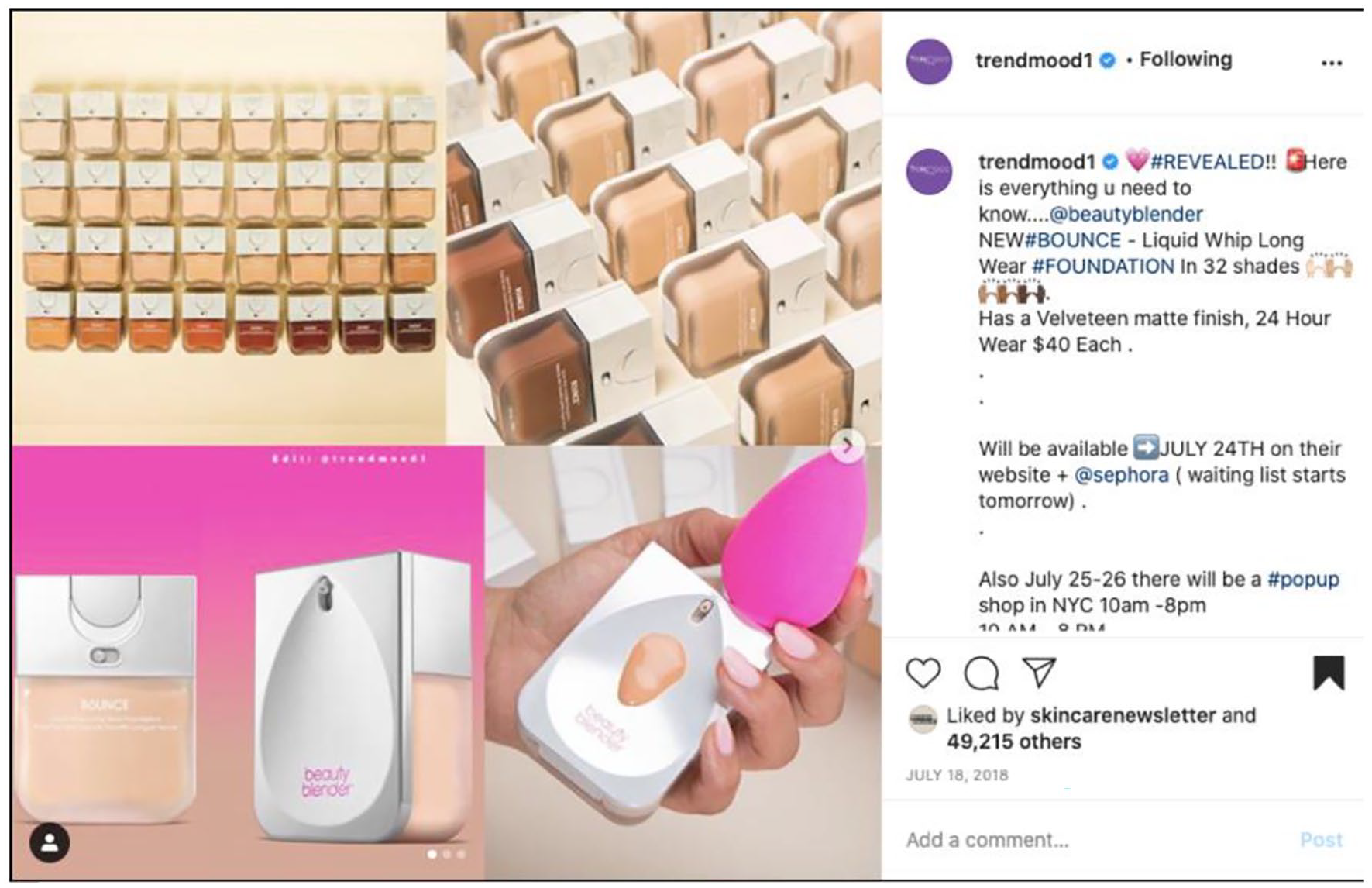
@Trendmood1’s Beautyblender Instagram post.
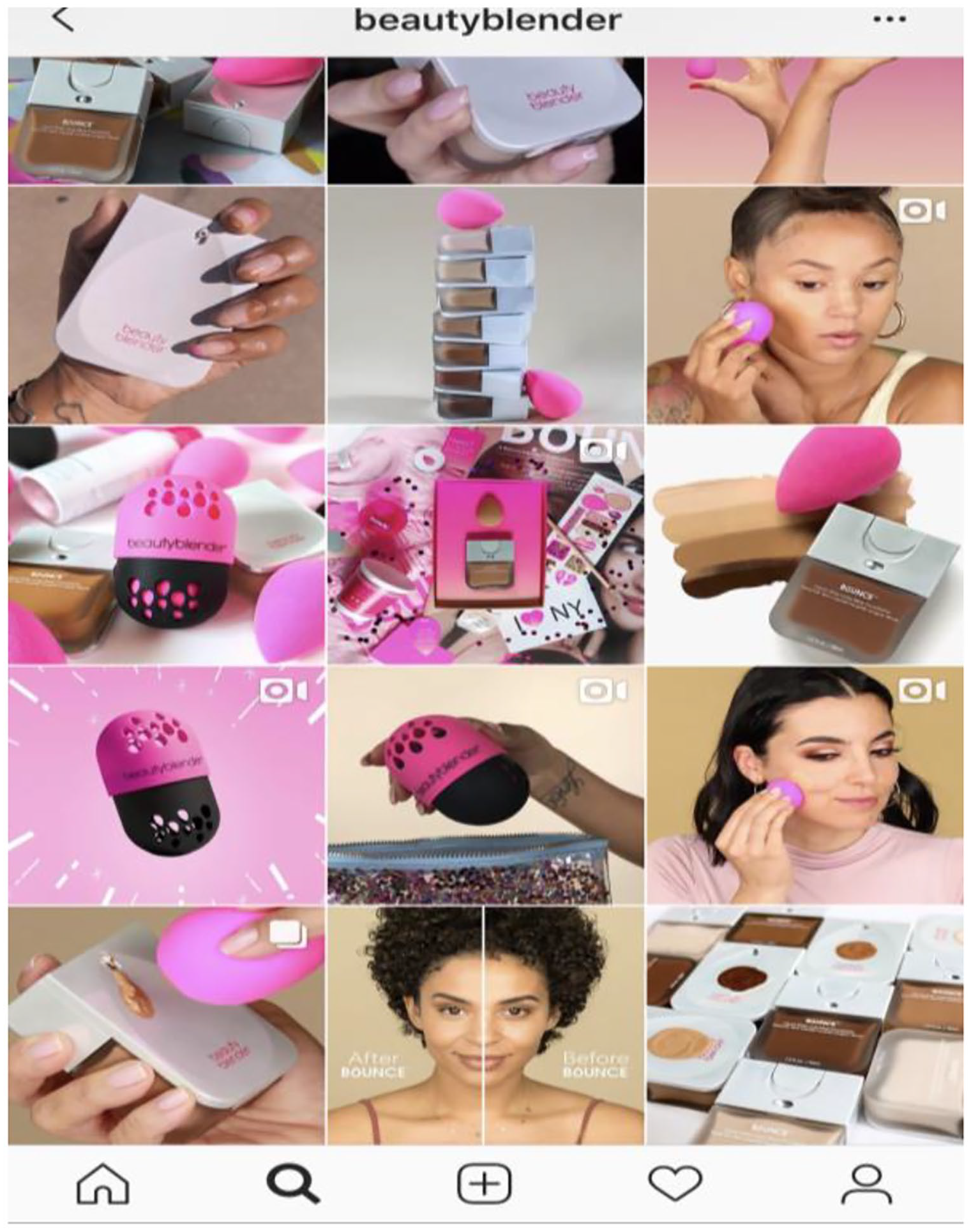
Screenshot of Beautyblender’s IG July 2018.
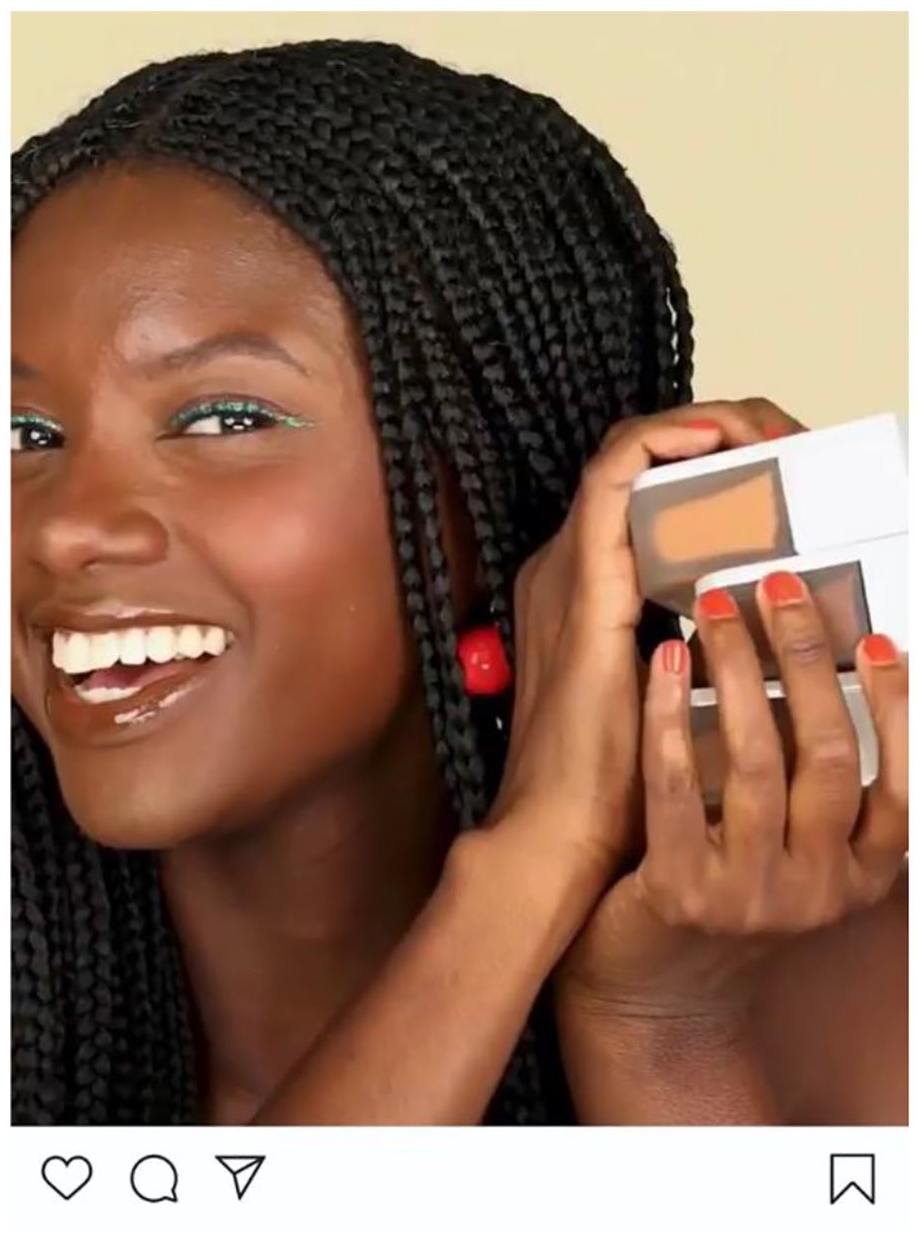
Beautyblender’s Black woman model.
I am often between shades, which means that I have often bought two shades to match my skin tone. Here, we point out how their only Black model mixes all three shades of the foundation, priced at $40 per bottle, which is not cost-effective for the average consumer. The wide range of light to fair foundation shades allows their White consumers to save money, as they have more variety to purchase one product compared to their Black counterparts. Further, In Figure 5 they isolate and overemphasize their dark shade to signal to consumers that they cater to deep complexions. @brittanylucastx writes, “TERRIBLE SHADE RANGE!!!!!! You just keep posting the same black shades because you only have 4 or 5.” @P.urple notes, “Lol they used all the dark colors they have for this pic.”

Beauty Blender’s overemphasis of dark complexions.
While the burden of representation is usually applied to TV representation, I argue that it is adaptable for cosmetic marketing. The video of the Black model with successful application and the overemphasis of dark shades represents a contemporary form of the burden of representation with US beauty culture. We point out how the Beautyblender’s promotional video uses the Black model as a proxy for all Black women’s success with their foundation. The other promotional videos with fair to light skin models mention its “innovative packaging,” “ease of use,” and the “glow” it gives, while the Black model comments on the “easiness of finding her shade.” Although light and fair skin consumers have the flexibility to choose from more than 25 shades, Beautyblender limits their consumers with dark skin to about 5 shades. In addition to the Black model becoming a proxy for all Black women’s success with this product, the 5 shades are used as signifiers for diversity and catering to Black women. Although Beautyblender is knowledgeable about the struggles of Black women within the beauty industry, they still perpetuate the idea that Black complexions are inferior by limiting the number of shades ranges we can choose from.
Beauty Influencer’s Responses to Beautyblender
Beauty influencers are integral to beauty brands’ campaigns. Influencers have the ability to reinforce brand strategy online by providing information that guides consumers’ engagement with the product and mitigates perceived risk (Forbes, 2016). Specifically, Black beauty influencers and vloggers’ reviews function as sites of knowledge production for their subscribers and determines consumers’ potential support for the brand. Tang and Aina used their YouTube reviews to walk subscribers through the unboxing (opening of the product), product application process, and compatibility with skin types and the quality of the product.
Nyma Tang
Nyma Tang is a Sudanese beauty influencer who is most known for her “Darkest Shade Series” (Abelman, 2017). Tang’s complexion is really deep, along with hyperpigmentation, which often makes her the darkest or last shade of a foundation (Figure 6). Sometimes, she cannot find her shade at all which makes her a great resource for Black women beauty consumers. Beautyblender’s last shade, 4.70, was fortunately a match for Tang. However, she still used her review video as a space for holding Beautyblender accountable. Tang continues to build on everyday Black women’s discourse of Beautyblender’s failed marketing strategies on Instagram. Tang explained, “Ever since Fenty released 40 shades, I feel 40 shades is the golden number. But if you just have 40 shades of like beige it’s like why? You don’t need to have 40 shades, just have 15 and go.” Here, Tang is describing the tectonic shift in the beauty industry known as the “Fenty Effect.” On 8 September 2017, Roc Nation singer, Rihanna, released her cosmetics line, Fenty Beauty, consisting of 40 shades of foundation with even numbers of shades across the light, medium, tan, and deep categories. Rihanna’s marketing and products really catered to Black women as their deep foundation shades were sold out for months after the initial launch. This resulted in a chain reaction of brands launching more inclusive shade ranges. Companies such as CoverGirl, Maybelline, and Dior now carry 40 shades of foundation. In addition to widening the range of shades, companies such as NARS and Makeup Forever that always had more inclusive shade ranges than most, started marketing their deeper shades on their Instagram feeds. The opportunities for Black beauty influencers to collaborate with beauty brands also increased after Fenty Beauty’s release (Schallon, 2018). However, as Tang and the everyday Black women reveal, unlike Fenty Beauty, companies such as Beautyblender use large number foundation releases for marketing, only to cater overwhelmingly to light to medium complexions. For Tang, adding on two darker shades to a brand that caters to medium and fair skin tones is a “last minute strategy” to appease consumers that desire inclusiveness. Tang’s subscribers echoed her sentiments: Nyma you hit the nail right on the head! These brands treat inclusivity like it’s a trend. If they add a couple deep/dark shades plus 50 shades of beige, they can claim inclusivity. Also let’s note that they didn’t bother to make shades for the pale/extremely fair people. I’m so tired of this in 2018. (@JungleNaps, 2018) I’m not shocked, the owner is a white Latina who wanted to make undertones for people with her skin color aka 50 shades of beige. she also said the shade range represents the “shades that are most universal” as if afro latinx and brown latinx people don’t exist?? it’s literally not even inclusive to the people she says she made it for. (@Bethany, 2018) I’m so tired of companies adding 2 dark shades or saying “we will add darker shades later.” So darkskin is an afterthought. Smh. (@GirlieGirl, 2018) Honestly we can preach about inclusivity all we want, but if makeup brands actually wanted to include deep dark shades, they would actually do it the first time. Just like how Rihanna’s makeup line came out the gate with all-inclusive shades and shades for dark skinned women. If they want to do it, they’ll do it without anyone saying anything about it. (@TrueBeauty J, 2018)
Tang’s video opened up a dialogue for her subscribers and possible consumers of Beautyblender. Led from our subjugated knowledge, as her subscribers, we were able to discuss the contradictions of what inclusivity means to the beauty industry. Inspired by the Fenty Effect, many beauty brands believe that inclusivity means having a few deep shades and a large number of foundation shades. However, as we point out, inclusivity means catering to Black women by having an expansive range of dark shades, rather than four out of 32. Tang further explains that her dark skin “is something she lives with on a day-to-day basis” and impacts her daily decision with beauty products. Tang highlights a tension that we live with every day—living within our embodied blackness as a dark-skinned Black woman versus how brands use blackness as a trend to experiment with.

Nyma Tang and Swatch comparison.
Tang reveals another personal experience that is unsettling for her subscribers. Her rich complexion is underrepresented in mainstream beauty culture, which makes her journey in the beauty influencing industry difficult. Often influencers receive PR packages with free products of a brand to encourage reviews. Tang revealed that while she is on Beautyblender’s PR list, they did not send her the Bounce foundation and only a package of sponges. Tang explained, They’ll send eyeshadow, but when it comes to complexion products, I do not know if it is a fear of like maybe it is not going to work or they’re afraid that I am going to say negative things. I am never negative; I just tell the truth.
Instead of broadening the shade ranges to accompany complexions like Tang’s, beauty brands avoid sending her complexion products because of their limited shade range. As an avid watcher of beauty vlogs, this is the first time a Black beauty influencer revealed this experience. Her subscribers were shocked at this revelation as well: very interesting what u said about brands not sending you complexion products! it really makes u think that if they weren’t confident enough in their shade range to have you try it out, they shouldn’t have gone through with the launch yet!! (@IzChi, 2018) holy crap. they don’t send you complexion products??? that’s honestly crazy why aren’t you talking about this more?? I wanna know what other companies do that (@HayleyBelvins, 2018) I also find it odd that Beauty Blender has you on their PR list, but didn’t send you their foundation, especially since you specialize in foundation reviews! I guess they know they aren’t coming through! (@JennW, 2018)
Here, we point out Beautyblender’s complicitness in antiblackness and colorism. Although Tang’s YouTube is public and available for anyone to view, Tang curates a safe space in which she shares the covert discrimination she experiences. While this is a major risk for her influencing career, Tang reveals the contradiction of selling inclusivity. Although Silva credits this brand as catering to her multicultural family, they were not confident enough that their foundation would be a match for the “Darkest Shade Series” influencer. What we point out is the beauty industry’s illusion of inclusion. In her discussion of racial capital and the beauty industry, Margaret Hunter (2011) notes, the global beauty industry reinvented itself due to multiculturalism and partakes in a process in which cosmetic companies that once exclusively featured White women had added light-skinned women of color to their advertisements and as spokespersons for their products. I argue that the illusion of inclusion has been modernized by the burden of representation, in which beauty brands rely on one Black voice or a small number of dark foundation shades to signify their brands’ inclusiveness, while still overwhelmingly catering to lighter skin tones. Thus, while dark shades signify catering to consumers with deeper complexions, beauty brands still perpetuate the idea that blackness is not aesthetically pleasing and subordinate.
Jackie Aina
Jackie Aina was sent the PR foundation package, unlike her counterpart Tang. Aina is arguably the most known Black beauty influencer in the industry, which makes her reviews the most visible to both Black and non-Black subscribers. Aina maintains her authenticity, specifically to her Black women subscribers, by committing to giving honest reviews that center around dark and deep complexions. Aina’s video takes her viewers through the swatching process, wear test, and significant time for her honest thoughts after the successful application.
Aina begins by unboxing the shades, shown in Figure 7, and swatching them on her skin. While this strategy is used to find Aina’s matching shade, this helps viewers visualize what the shades look like on a dark complexion. As the everyday Black women pointed out under @TrendMood1’s post, Aina also states that some of the shades and undertones were “miscategorized” despite Silva’s goal to focus on undertones for the multicultural community. While Beautyblender’s Instagram feed curated content with the goal of getting their consumer to buy their product, they have no control in how the product will work for their influencers and if they choose to do a review, if it will be a positive review. Aina’s video becomes a site of knowledge production, in which subscribers can determine if this is a brand they can support and what other brands are worth supporting based on Aina’s expertise in makeup. Aina’s subscribers commented: issa no for me (OUUU Chilee . . . @AndreaRenee, 2018) Thanks so much for this review Jackie! The founder’s reasoning was . . . off base, quite frankly. Also, there are dark skinned Latinos so . . . A mess! (@TeaTimeWithEyek, 2018) I’m here for the roasting I’m good luv, enjoy  glad I watched this before I went to buy (@RehannaJohnson, 2019)
 Go Jackie ! Gooooooo girl!!!!! (@KhumoSibanyoni, 2018)
 (@DejaSherre, 2018)
Everyday Black women use the comments to signify or perform their blackness via set-based oral performance and social critique. For example, phrases such as “Issa no for me” and “I’m good love, enjoy” reference memetic units of Black culture and mainstream culture to create a shared social and cultural experience around critiquing Beautyblender. Throwing shade in response to the beauty industry’s antiblackness creates “affective and intimate in-group bonds that are responsive to racist ideology but not solely constituted by racism” (Brock, 2020, p. 158).
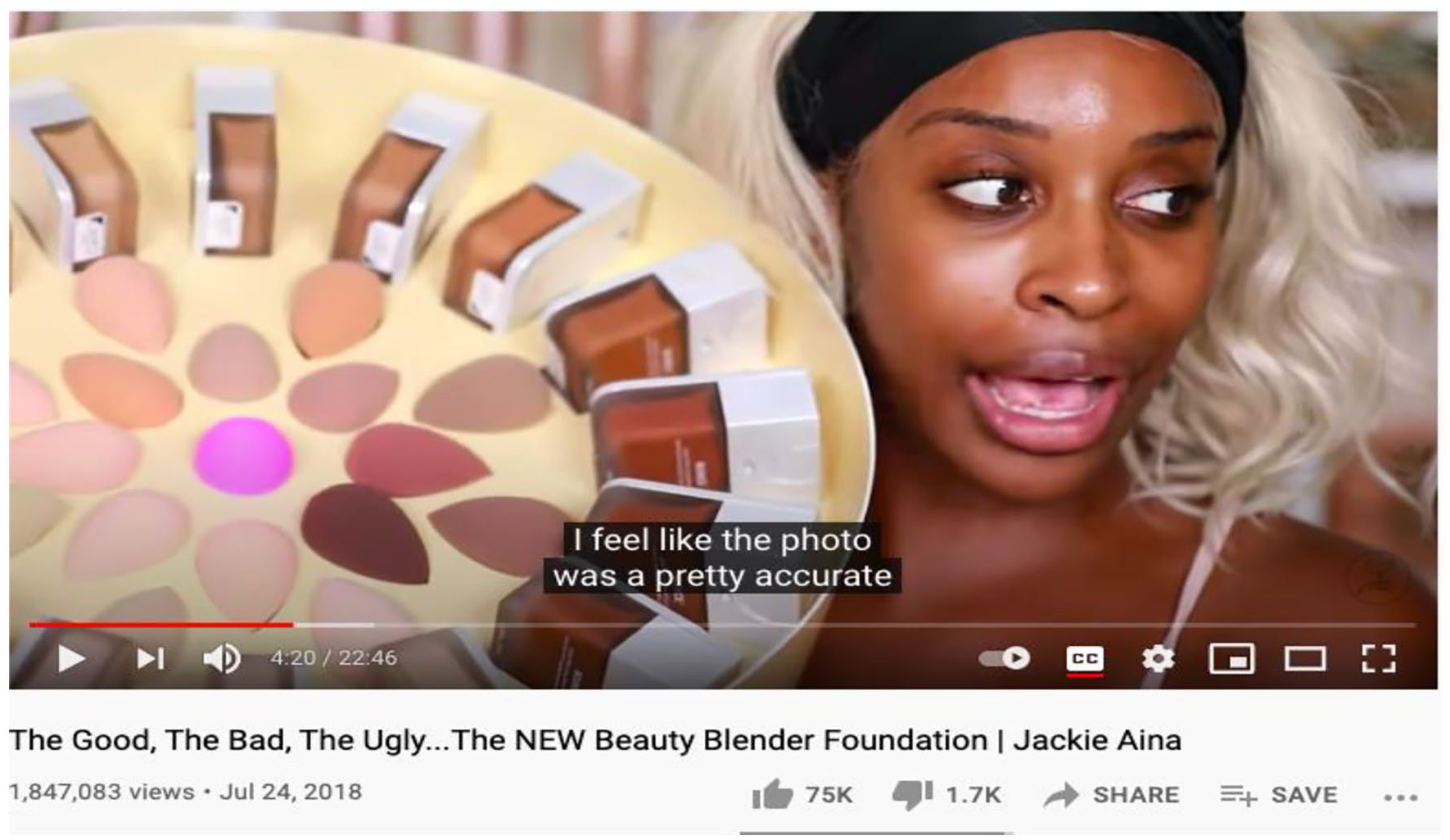
Jackie Aina and PR Package.
YouTube videos can function as an extension of televisual technologies of intimacy due to the feeling of proximity engendered by intimate media encouraging the formation of affective relationships between the audience, content, and YouTube (Berryman & Kavka, 2017). By walking the audience through the makeup application, which functions as a form of lifestreaming and transparency that influencers deploy across social media platforms, Aina helps generate a sense of intimacy and community. Aina’s comment section encouraged reflection from her non-Black subscribers too: As a Latina, I just want to say that I don’t stand by what the owner of Beauty Blender’s comments addressed. Hispanic and Latina women come in all shades, not just “light to medium” and “olive” tones. (@Emmles, 2018) It’s sad when their sponges have a better shade ranger than their foundations. (@ShannonLocke) It seems to me like they expect the deep/dark spectrum to “mix shades” to get the perfect match. That’s not fair . . . who would want to do that. Furthermore why would someone pay double when we have brands like Too faced and Fenty that are inclusive to everyone. (@HalseyIsMyRealName, @2018)
Not only does Aina’s video dissuade Black women consumers, but her transparency fosters allyship in the comments. In Brock’s (2020, p. 156) discussion of reflexive digital practice, he develops the concept of weak-tie-racism, or “racism that is indirectly experienced through digital representation and the distribution, interactivity, or algorithmic repetition of antiblackness directed toward a specific Black body or bodies but abstracted through social media participation.” Weak-tie-racism can lead to Black people bonding over their awareness and positionality to racism (Brock, 2020). Therefore, Tang and Aina’s self-disclosure (Banet-Weiser, 2012) or reflexive digital practice generates long-form dialogue about the awareness of antiblackness in the cosmetics industry and the illusion of inclusion.
Capturing and Racial Battle Fatigue Amongst Beauty Influencers
Tang and Aina illuminate the complexities of being a Black beauty influencer. They both participate in the digital Black feminist praxis of capture. As Steele (2021, p. 104) notes, self-capture (e.g selfies, vlogs) “force a reconciliation for digital Black feminists.” Tang and Aina use their public work to contest institutional and communal acts of oppression. Their acknowledgement of their subjectivity and positionality is valuable. However, as beauty vloggers their participation in self-capture means that their personal lives are widely distributed and critiqued. In other words, their life experiences are judged alongside their work, “as the curated capture of their lives becomes a work product” (Steele, 2021, p. 104). As Hund and McGuigan (2019, p. 29) explain, because “the shoppable life is fueled by the real personal tastes, relationships, likes and dislikes, and other affinities of the individual behind the account, this can entail a certain amount of risk and vulnerability for the person behind the persona.” Influencing is their career, thus, they must balance maintaining professional partnerships with brands such as Beautyblender and authenticity by calling out antiblackness and colorism in the beauty industry. Similar to the Black model that Beautyblender marketed in Figure 4, Tang expressed that it “sucked” that she had a successful application because there are complexions that are still not catered to in Beautyblender’s product. She notes: I know you all wanted to hear my thoughts and I feel like it’s good to keep this conversation going. I feel like that’s why we’ve been able to see such a change in the beauty industry because of that fact that we’ve been vocal about it and talked about it and brought it to the light. I teeter in between getting annoyed and being like I don’t want to review, but this is how all this change is able to be brought about. (Tang, 2018)
Aina also discusses this “teetering” Tang expresses. Aina explains, “I turn on my camera and I keep saying the same things about the same brands. That’s why I always have these inner conversations in my head like –should I make the video? Should I not?” Their streams of consciousness represent an effect of weak-tie racism — racial battle fatigue (RBF). RBF is the process of “harmful and psychophysiological symptoms resulting from living in racist environments which arise from deciding to acknowledge or how to respond to instances of antiblackness” (Brock, 2020, p. 160). Tang and Aina invoke the burden of representation as well, by being two popular Black beauty influencers within the beauty industry that have the visibility and voice to flag issues around antiblack racism and colorism in the beauty industry. However, they struggle on deciding whether to acknowledge or how to respond to issues around antiblack racism and colorism because it happens so often. This is a direct libidinal effect of weak-tie racism in which racial battle fatigue and stress “accumulate not only from direct racist posts or comments but also from repeated exposure to televisual and textual racial affronts that are displayed as a result of the algorithmic mechanism of social media feeds, shares, or indirect contact with well-meaning non-Black others” (Brock, 2020, p. 160). Therefore, while their capture is useful to us as subscribers who experience exclusion in the beauty industry and need guidance on what products to purchase, they must balance mental health and their professional and financial partnerships within the precarious influencer economy.
Conclusion
Six months later, Beautyblender expanded from 32 shades to 40 shades. They added three shades to the dark category. In response to the question of why the dark category took longer to develop, Silva expressed, “It’s harder to differentiate undertones in dark shades. So, these shades need extra love and attention when perfecting because they are variations of the existing shades” (Diaz, 2018). Logic like Silva’s perpetuates racist logics that blackness as ugly, difficult, and an afterthought in the makeup industry. Even though it took six months, our digital Black feminism contributed to the expansion of Beautyblender’s Bounce Foundation.
While the Fenty Effect may have taken the beauty industry by storm, companies such as Beautyblender exemplify the difference between inclusivity as a trend versus valuing consumers with dark complexions. The everyday Black women and beauty influencers, Tang and Aina, construct a virtual beauty shop on YouTube and Instagram, which offers us a way to understand how Black women build community, agency, and profit that mirrors our offline practices. Together, we participate in reflexive digital practice, and digital Black feminist praxes of capture and threading to call out Beautyblender’s complicitness in antiblack racism and colorism. Our digital practice illuminates two marketing strategies — a modified version of the burden of representation and the illusion of inclusion. As Steele (2021, p. 7) writes, “Black Girl Magic is the shorthand for the centuries of experience Black women have in doing everything for everyone while maintaining dignity and not sweating out their edges.” Our digital practice affords us the opportunity to self-define ourselves as beautiful, build community, and contest longstanding practices of exclusion in the beauty industry.
Footnotes
Declaration of Conflicting Interests
The author(s) declared no potential conflicts of interest with respect to the research, authorship, and/or publication of this article.
Funding
The author(s) received no financial support for the research, authorship, and/or publication of this article.
