



Abstract
Research has suggested that social media usage increases during times of social isolation. However, rather than making users feel more connected to others, social media may cause negative mental health and relational outcomes, including a fear of missing out (FoMO). Against the backdrop of the global coronavirus disease-19 (COVID-19) pandemic, this health communication study sought to understand the impact of physical and emotional isolation (i.e., prescribed social isolation) on people as we turned to social media more frequently. As the pandemic wore on, many remained online, watching people they knew “returning to normal,” potentially creating high levels of FoMO despite disagreeing with others’ decisions. This study examines whether social media use (frequency and purpose) influences individuals’ perception of the acceptability of others’ behavior, and whether those perceptions impact individuals’ own behavioral decisions. Participants (N = 459) from the United States were recruited from late 2021 to early 2022 to complete an anonymous online survey regarding the “acceptableness” of behavior shown in posts by friends and family. Results indicated that increased social media frequency was correlated with an increased sense of FoMO, which was significantly and positively associated with favorable perceptions of others’ behaviors, such as gathering indoors with others, even when public health officials discouraged it. However, FoMO was not significantly related to users’ personal intentions to follow public health recommendations. A post hoc analysis determined that fear of COVID-19 moderated the relationship between FoMO and the perception of others’ behavior, as well as the relationship between FoMO and behavioral intentions.
Keywords
Introduction
Despite the important connection and information-sharing that social media can facilitate, researchers have begun exploring the negative consequences of social media use. For example, “fear of missing out” (FoMO) is the desire to not only keep up with what others are doing, but also the belief that others’ experiences are more interesting than one’s own (Przybylski et al., 2013). Some studies have led to the belief that high levels of social media frequency can create or exacerbate the feeling of, and outcomes associated with, FoMO. However, to our knowledge, no studies have empirically explored whether increased social media usage definitively leads to higher levels of FoMO. In addition, although researchers have studied the connection between FoMO and some behavioral outcomes, such as alcohol use (Riordan et al., 2021), problematic internet use (Stead & Bibby, 2017), and product consumption (Saavedra & Bautista, 2020), there is a gap in the research surrounding health behaviors. Thus, we have yet to understand how FoMO might relate to the intention to follow specific public health recommendations. Finally, although studies have hinted that social media usage may increase the feeling of being “left out,” the reverse relationship has not been explored: namely, whether FoMO impacts one’s perception of others’ social media posts. Therefore, the current study questions how we perceive others’ behavior during a time when we feel intense FoMO and if those feelings impact our intention to behave similarly—an imperative context during a global health pandemic when health behaviors have the ability to slow the spread.
Situating this research in the novel context of coronavirus disease-19 (COVID-19) was beneficial: the global pandemic presented a unique opportunity to study social media usage and impact during a time of widespread social isolation. In addition, the pandemic created an interesting tension between individuals’ desire to avoid contracting a new, highly contagious disease and their desire to feel included and socially connected to loved ones and society. The dichotomy between the desire to follow “the rules” and the feeling of being left out of others’ (rule-breaking) fun certainly exists during non-pandemic times as well, but was highlighted and amplified by the cumulative unique circumstances of the COVID-19 pandemic, creating a rare chance for researchers to learn more about the relationships between social media frequency, FoMO, perceptions, and intentions.
FoMO
Although social media is able to “give people the power to build community and bring the world closer together” (Facebook, 2019), studies have shown that social media can disrupt day-to-day activities and interpersonal relationships. Social media consumption has been connected to negative mental health outcomes (Vannucci et al., 2017), including the “fear of missing out,” or a desire to not only keep up with what others are doing, but also believing that others’ experiences are more interesting than one’s own (Przybylski et al., 2013). Some have argued that the FoMO is “a fundamental human motivation that consists in craving interpersonal attachments” (Blachnio & Przepiorka, 2018, p. 514). The need for attachment leads to a fear of social exclusion, which is linked to actual felt pain (Lai et al., 2016). FoMO is also linked to stress, problematic phone use, depression, negativity, and anxiety (Elhai et al., 2016; Tugtekin et al., 2020; Wortham, 2011). Moreover, Blachnio and Przepiorka (2018) argued higher FoMO is a positive indicator of social media intrusion, primarily addictive behaviors, and impacts overall life satisfaction.
FoMO During Social Isolation
Social media usage increased during the 2020–2022 COVID-19 pandemic, as people sought to feel connected to others while physically distanced in accordance with health guidelines. A 2020 Harris poll found that in addition to messaging apps (e.g., Messenger, WhatsApp), platforms such as Facebook, Instagram, and Snapchat experienced higher traffic compared with prior years (Samet, 2020). More than half of Americans said the Internet was essential during the pandemic to gather, livestream events, participate in fitness classes, and seek out information (Vogels, 2020).
At the beginning of the pandemic, particularly, people were asked to curb social activity and stay home, meaning that gatherings and events were canceled. However, Trepany, in his article in USA Today, argued that FoMO continued despite mass social isolation (2020), spurred by photos of others’ at-home productivity or, at the very least, “better” pandemic experiences: baking successes, time spent in nature, or digital experiences such as live workouts or virtual cooking classes (Trepany, 2020). As the pandemic continued throughout 2020 and 2021, many people found ways to interact with friends or family while still following public health guidelines, such as having outdoor, socially distanced meet-ups while wearing face masks. Others deemed such safety precautions as not necessary, too tiresome, or too detrimental to their mental health, and eased up on their efforts to self-isolate (Scheinfeld, Gangi, et al., 2021). People began posting photos of these gatherings on social media, which may have incited (or even increased) FoMO, even when everything was [supposed to be] canceled. This feeling of being “left out” because you are following the rules—while others seemingly aren’t—likely complicates one’s perceptions of their friends and family and weakens their intentions to engage in proper health precautions like social distancing.
During the height of the global pandemic, images of baby showers, large weddings, or vacations may have incited feelings of “Flying and gathering is irresponsible right now,” as well as feelings of “But I wish I was doing that.” Even smaller gatherings may have increased feelings of FoMO, despite the threat of contracting COVID-19, because extant research shows that FoMO may influence our behavior, despite our best intentions.
Social Media, Perception, and Behavior
In addition to stirring feelings of FoMO, social media may influence how users’ see and understand the world, as well as how they move through it. Research has explored various perception issues entangled with social media: third-person perception (e.g., the type of content others post versus the type of content you post, Pham et al., 2019); self-impression management and perception control (Keep & Attrill-Smith, 2017); perception of social media use (Keating et al., 2016); and perception of message influence and behavioral intentions (Cortese et al., 2018; Kim, 2018). But few studies have examined the factors that affect social media users’ perception of others’ social media content. Jacovi and her colleagues (2014)s explored how people perceived the trustworthiness, influence, expertise, and impact of people they follow on social media platforms, but the study utilized a hypothetical influencer’s account rather than accounts of those that people actually know, like friends and family. Cortese and his colleagues (2018) studied real Instagram posts, but they used posts using specific hashtags. Therefore, their sample included posts from users that participants did not actually know, and would have only found by searching specific, public hashtags (i.e., #cigarette, #smokingselfie). This line of research is therefore difficult to generalize to how people appraise the potentially unsafe or unhealthy behaviors (as seen on social media) of people they also interact with in real life. The current study attempts to fill that research gap by exploring how increased levels of social media use, hereafter referred to as social media frequency, may influence how people perceive the behavior of those they know (e.g., friends and family).
The Pandemic
Due to the rapid spread and highly contagious nature of COVID-19, counties and cities worldwide instituted mandatory shelter-in-place orders early on in the pandemic (Arango et al., 2020). Many people were forced to work from home and events including more than 10 people were banned. Thus, people were isolated at home with their roommates, parents, their children—or no one. Moreover, people around the world were prescribed the same health-related behavioral guidelines, including this need to self-isolate within your home (especially in geographic areas experiencing high COVID-19 rates), avoid indoor settings in public, and mask up (Centers for Disease Control and Prevention [CDC], 2021). Because these guidelines were so widespread, social media posts in which people were blatantly ignoring it stood out. When someone viewed social posts of their friends or family going against these recommendations, they may have perceived the posts negatively because they felt that the posted behavior went against the values and beliefs, they thought the person posting the photos held. However, an overriding sense of FoMO may influence this perception by: (a) causing the viewer to perceive the posted behavior as “more acceptable” or “more responsible” than they typically would, since they strongly empathize with the poster’s desire for in-person social interaction; or (b) causing the viewer to perceive the posted behavior as “less acceptable” or “less responsible” than they typically would, since the viewer’s overwhelming desire to be included increases their sense of resentment at others’ blatant disregard for the recommended limitations others are following.
It is also possible that FoMO may be related to specific health-related behaviors, particularly during these times of social isolation. If someone’s friends and family are openly disobeying prescribed health behaviors, they may experience feelings of confusion and self-doubt about their own health beliefs and safety precautions. The viewer may begin to question the seriousness of the situation or their understanding of it. Such an internal conflict could impact their intent to continue engaging in behaviors they consider safe and responsible. As the colloquialism goes, “If everyone else is doing it, why can’t I?”
Other Contexts
An individual’s social media usage may also increase in times of voluntary or involuntary isolation. For example, people may be encouraged to avoid crowded areas or gatherings during medical situations such as chemotherapy treatments, and those experiencing chronic illness or immobility may voluntarily isolate due to pain associated with movement (MS Society, 2018). Social isolation can take hold of those who move from home (e.g., for a job, or to follow a partner), due to potential hazard vulnerability or people being displaced from their homes (Watson et al., 2007). Each of these scenarios may encourage greater social media usage to stay connected and feel less isolated. In this manner, social media platforms allow people to stay apart, together (Scheinfeld, Barney, et al., 2021).
Research Questions
The pandemic is the first time in generations that the world was forced into social isolation en masse. Like during other times of social isolation, many people turned to social media to stay connected with loved ones, stay informed of local and global events, and receive information about available resources and services. Therefore, we believe that social media may encourage similar emotions (i.e., FoMO, negative perception of friend’s behavior, reassessment of behavioral intentions) during such non-pandemic times, particularly in the context of other publicly prescribed health behaviors, such as responsible drinking, smoking or vaping cessation, getting children vaccinated, getting an annual flu shot, and wearing helmets when riding bicycles or motorcycles (see Figures 1 and 2). Given the lack of prior research on the relationships between FoMO and perceptions of others’ behaviors as seen through social media, as well as with intentions to engage in prescribed public health behaviors, we posit the following research questions:
RQ1. How does social media use (a) frequency and (b) purpose impact feelings of FoMO?
RQ2. How is FoMO associated with the perceptions of others’ disregard of public health recommendations during the COVID-19 pandemic (as seen on social media)?
RQ3. How does social media frequency impact the relationship between FoMO and perception of others’ health-related behavior on social media?
RQ4. How is FoMO associated with the intention to engage in recommended public health behaviors during the COVID-19 pandemic?
RQ5. How does social media frequency impact the relationship between FoMO and the intention to engage in public health behaviors recommended during the COVID-19 pandemic?

Research Questions 1 and 2.
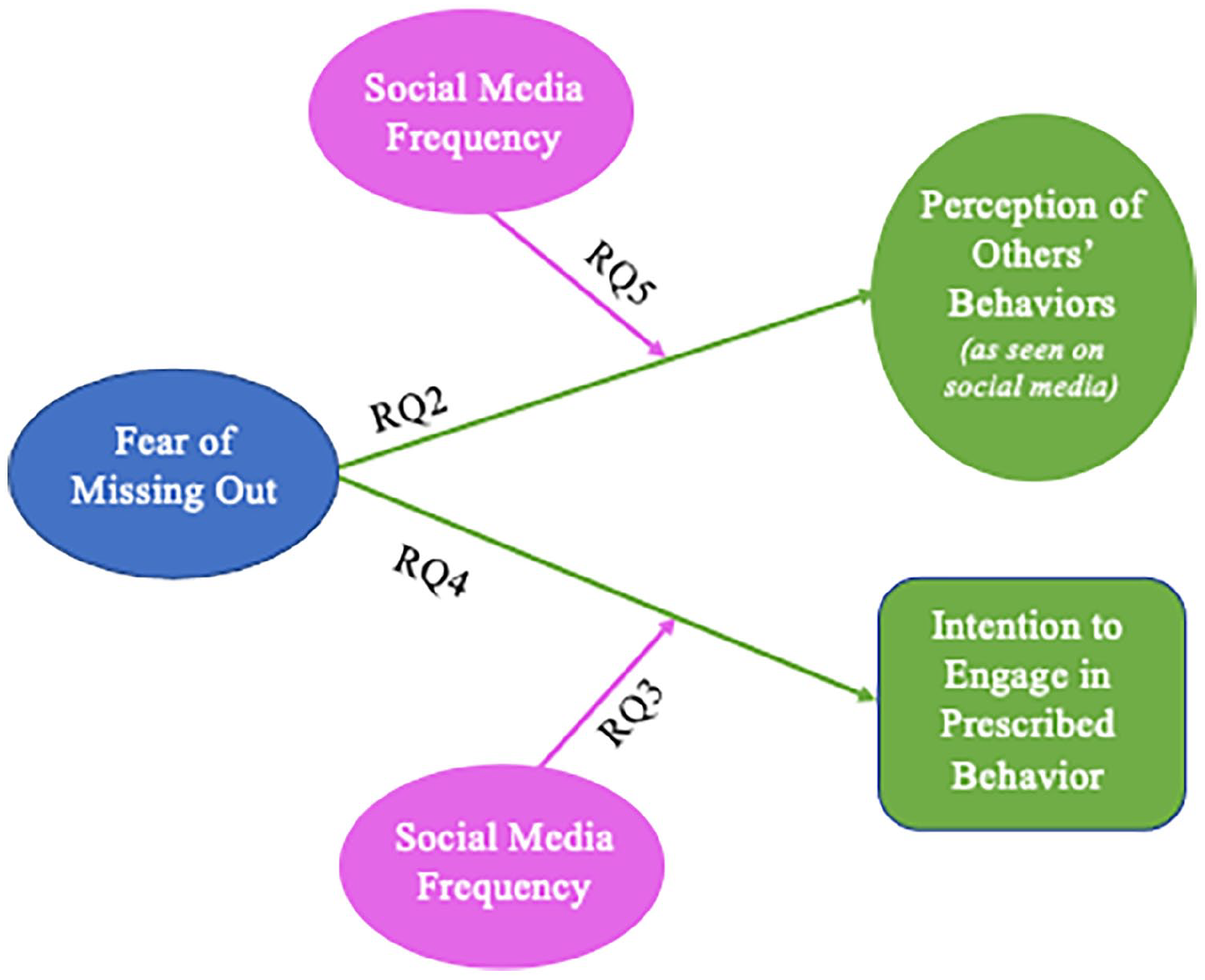
Research Questions 3–5.
Methods
Participants
Participants included 459 individuals, aged 22–73 years (M = 32.1; SD = 12.6) from across North America, though 24 individuals did not provide any demographic information. 1 The majority of participants identified their sex and gender as a woman (n = 280, 64.4%), and their sexual orientation as heterosexual (n = 363, 83.6%). Most of the sample identified as non-Hispanic or White (n = 328; 75.6%), followed by Black or African American (n = 36; 8.3%), and then Asian American (n = 34; 7.8%). Our sample was highly educated, with 15.4% (n = 67) holding a graduate or professional degree, another 39.8% (n = 173) either still in college or having completed some college, and 30.6% (n = 133) having completed college. Most participants lived either in a suburban area (n = 194, 44.8%) or in a city (n = 159, 36.7%). Regarding living arrangements, 29.3% (n = 127) lived with roommates, 26.6% (n = 115) lived with a partner, and 26.9% (n = 104) lived with a partner and children; 16.4% (n = 71) reported living alone. See Table 1 for further details on participant demographics.
Participants’ Demographic Information.

Note. Because some of the overall participants did not answer certain questions, percentages reported are valid percentages, based on the number of participants who answered each particular question.
Procedures
As part of a larger study, data were collected via an anonymous online survey between late October 2020 and February 2021. After institutional review board approval, participants were recruited through online channels, including Facebook, LinkedIn, Instagram, Reddit, TikTok, Snapchat, and Twitter. The researchers shared the call on their own personal social media accounts and with online communities they were a part of, as well as to online groups connected to the topic (e.g., a subreddit devoted to discussions about Facebook). The researchers also shared the recruitment announcement with colleagues via email, asking them to share the call, and participants were encouraged to send the survey to others through a convenience snowball sampling method. A Facebook page was also developed to share information about the study. Participants could opt-into a random raffle for one of 10 US$25 gift cards to Amazon, and students at participating universities could earn extra credit for taking the survey. Finally, participants were recruited through Mechanical Turk (MTurk), run by Amazon, to get a larger, more representative and diverse participant pool (e.g., Aguinis et al., 2021). MTurk respondents were compensated US$3.25 based on the length of the survey and the average minimum wage in the United States and were not given the option to enter the raffle. MTurk data (n = 216, 47%) were kept separate from non-MTurk responses (n = 243, 53%) to compare the groups for any major demographic or attitude differences as a quality check (see Table 2). Upon arriving at the survey, participants were first prompted to provide consent. Given the inclusion criteria of having/using at least one social media account, the first question participants were asked was which social media platforms they utilized, allowing them to select all platforms they had an active account on. If they did not select any, they were redirected to the end of the survey, as they would not be able to respond to questions about things they saw on social media. Participants recruited through snowball sampling methods used an average of 4.85 (SD = 1.54) social media platforms. Those recruited on MTurk used an average of 5.41(SD = 1.85) social media platforms. Next, they answered survey questions regarding the study’s independent and dependent variables, were asked about their fear of COVID, given a health literacy test, and asked several demographic questions at the end (as these would require less intellectual power). They were able to skip any question they did not feel comfortable responding to. Every measure was quantitative in nature. The average time spent on the study was 26.9 min (SE = 20.84 min)
t-Tests Between MTurk and Social Media Recruited Participants.

significant at .004; **significant at .0001; ***significant at .00001 (with a Bonferroni correction).
Measures
Social Media Platforms
Participants were presented with a list of social media platforms and asked to indicate which they used and how frequently they used each platform for personal use, specifically since March 2020. These included: Facebook (M = 3.41, SD = 1.76), Twitter (M = 2.29, SD = 1.91), Instagram (M = 3.44, SD = 1.79), Snapchat (M = 2.44, SD = 2.14), TikTok (M = 1.87, SD = 2.06), Reddit (M = 1.64, SD = 1.84), LinkedIn (M = 1.44, SD = 1.44), and Other (M = .77, SD = 1.60). Within the Other category, participants are listed using blogs, Parler, Goodreads, Clubhouse, Nextdoor, YouTube, and messaging apps. Every participant indicated using at least two platforms with some frequency. All but four participants indicated they used at least one popular platform (e.g., Facebook, Instagram, Snapchat, Twitter) that allows people to readily share personal opinions and/or photos with friends and family. Participants could indicate “N/A, I do not have an account” or on the scale from 1 = rarely to 7 = multiple times a day. To use this measure, we summed across all responses.
Social Media Purpose
As there was no real measure to assess social media purposes, we developed a scale using a Likert-type scale (1 = strongly disagree, 5 = strongly agree), participants responded to 10 items pertaining to how they usually use their various social media platforms, from staying connected, to following influencers, to gathering information, and so forth. Example items include, “I use social media as a way to feel connected with friends and family when I can’t be near them” (see the appendix). After running a principal axis factor analysis, confirmatory factor analysis (Worthington & Whittaker, 2006), and reliability analysis, 2 the correlated model with three distinct factors made more sense for analyses. Therefore, three distinct aggregates were created: information seeking (M = 2.80, SD = 1.03, α = .75), connecting with friends and family (M = 4.18, SD = 1.02, α = .87), and for fun/hobbies (M = 3.69, SD = 0.85, α = .48; low reliability due few items included and a Spearman–Brown correction results in increasing Cronbach’s α to .51). Item 3 was removed, “I use social media primarily as work as an influencer or to promote myself/my business” as it loaded onto its own factor (M = 2.12, SD = 1.40).
Perception of Others’ Behavior on Social Media
Adapted from Sun et al. (2008) and measures used to assess attitude (Fishbein & Ajzen, 2010), participants were presented with several scenarios they may encounter on their social media. They were given the prompt, Clicking through social media, you stumble upon the following scenarios in posts or images of individuals (including friends, family, as well as acquaintances) you follow on social media, all of who we will refer to as “friends” in the following statements.
The scenarios ranged in COVID-specific, government-recommended behaviors including, gathering with (M = 3.28, SD = 1.53) or spending time indoors with people they don’t live with (M = 3.73, SD = 1.70), wearing a mask (M = 2.21, SD = 1.42), showing off their personal protective equipment (PPE; latex gloves, protective gowns, etc.) (M = 2.61, SD = 1.53), or sharing hand-washing methods and memes (M = 2.38, SD = 1.43). They then ranked each behavior on a semantic differential to assess how much they relate to or understand why their friends and family may engage in these behaviors (1 = responsible to 7 = irresponsible, and 1 = understandable to 7 = confusing). To assess the perception of each behavior, participants responded to two items per behavior (i.e., responsibility and understanding). Therefore, responses from each set of semantic differential that asked about a specific behavior were averaged, and reliability could not be calculated.
Fear of Missing Out
Participants responded to nine items (Przybylski et al., 2013) using a 5-point Likert-type scale (1 = not at all, 5 = extremely true of me) to indicate how much each item is true to them. They were asked to consider “friends” as people they follow on social media that they also know in real life (i.e., friends, family members, co-workers, acquaintances, etc.). Example items include, “I fear my friends have more rewarding experiences than me,” and “I get worried when I find out my friends are having fun without me.” Consistent with past research, this FoMO scale showed good reliability (M = 2.50, SD = 0.90, α = .88).
Behavioral Intention
Participants were asked about their intention to follow public health behavior recommendations (Fishbein & Ajzen, 2010). Using a 5-point Likert-type scale (1 = strongly disagree, 5 = strongly agree) they responded to the prompt “In the next 30 days, I will . . . ” for several behaviors: gather with people with whom they don’t live (M = 2.96, SD = 1.47), wear a mask (M = 4.61, SD = 0.94), spend time in indoor spaces with people with whom they do not live (M = 3.14, SD = 1.45), and socially distance from others (M = 3.28, SD = 1.31).
COVID-19 Fear
Ten items were adapted (Ahorsu et al., 2020; Arpaci et al., 2020; Bitan et al., 2020; Mejia et al., 2020) to assess the level of fear participants felt as it pertained to COVID-19. Items were assessed using a 5-point Likert-type scale (1 = strongly disagree, 5 = strongly agree). Example items include, “The treatment of the COVID-19 pandemic within this country has been blown out of proportion,” and “I am unable to stop or control my worrying as it pertains to COVID-19.” After reverse coding necessary items and removing item 6 that had little to do with COVID-19 compared with other items, “I feel hopeful about the future,” the scale was aggregated and showed relatively good reliability (M = 3.69, SD = 1.17, α = .78). Confirmatory factor analysis confirmed the necessity of removing item 6.
Demographic Information
Several additional variables were collected and controlled for due to their possible relevance in this study, including age, gender, sex, sexuality, race, employment, income type, income level, and education. Given that much of the country was given a shelter-in-place order at some point during the COVID-19 pandemic, we also asked who participants were living with and where they were living. Therefore, we also asked about the nature of who they were currently living with, the number of adults and children they were living with, their living situation (i.e., house, condo, apartment, etc.), what type of area they lived in (i.e., urban, suburban, or rural), and what town or city they lived in. Participants were also asked to report on the political party they voted for in 2020, which political party most of their social media friends most aligned with in the 2020 election, religious affiliation, and religiosity (i.e., how many days a week, if any, they participated in some formal religious activity). As COVID-19 has become religious and/or political, we felt these were important factors to include as they likely influenced who participants trusted for information, and what information they trusted when it came to controlling COVID-19 in their communities and homes. Gender, sexuality, income, political party, and religiosity were strongly correlated with outcome variables and thus used as controls throughout the analyses. The rest of the demographic characteristics will not be mentioned from here on out, due to the lack of their statistical influence.
Results
In addition to using captcha and quality-check questions within our survey to discourage bots and insufficient response effort (Lovett et al., 2018), we sifted through the data to ensure quality responses, discarding those with suspicious or dramatically skewed answer patterns. We also conducted t-tests between participants recruited through social media and MTurk to ensure no major differences between the two groups. There were a few demographic differences among gender and employment status; this was expected, given MTurk workers tend to be younger, more liberal, less religious, single, and oftentimes employed by entities providing income in the same way (e.g., commission, contract work, wages; Chandler et al., 2019). However, there was no significant difference between MTurk users and participants recruited via convenience snowball sampling on social media when it came to several imperative variables (see Table 2). Although there was a significant difference between the two groups when it came to using social media for information seeking, there was no significant difference for using it to connect with family and friends, or for fun/hobbies.
Descriptive analyses were conducted to examine the mean, standard deviation, and distribution of all primary variables. Correlations between all variables were also examined as preliminary analyses before testing any research questions. The majority of the variables were relatively normal in nature. However, FoMO was slightly skewed to the left, as was state anxiety, especially when compared with trait anxiety.
RQ1: Social Media Frequency and FoMO
To assess how social media frequency and purpose impacted feelings of FoMO (RQ1), we ran a multiple linear regression. With social media frequency in Block 2, the overall model was significant at p < .001, F(6,416) = 20.85, p < .001, adjusted R2 = .22, R2 change = .21. Frequency was significantly and positively associated with FoMO, β = .46, p < .001. Social media purposes were also significant. The overall model regressing the social media purpose of information seeking on FoMO was significant, F(6,416) = 11.52, p < .001, adjusted R2 = .13, R2 change = .12, β = .35, p < .001. Regressing using social media to connect with friends and family on FoMO was also significant, F(6,416) = 6.62, p < .001, adjusted R2 = .07, R2 change = .06, β = .32, p < .001. Finally, the overall model using social media for fun/hobbies (i.e., following accounts of people you mostly don’t know) was also significant, F(6,416) = 11.13, p < .001, adjusted R2 = .13, R2 change = .11, β = .34, p < .001. These results give evidence for the idea that increased time on social media is correlated with an increase in FoMO. FoMO was also significantly associated with all three purposes for using social media (information seeking, connecting with others, and fun/hobbies).
RQ2: FoMO and Perception of Others’ Behaviors on Social Media
Hierarchical regressions to account for the control variables were conducted to understand any relationship between FoMO and perception of others’ behavior on social media (see Table 3). We examined each behavior individually. The overall model examining the relationship between FoMO and the perception of others’ gathering with people from outside of their household was significant, F(6,416) = 3.72, p < .001, adjusted R2 = .04, R2 change = .01. FoMO was significantly and positively associated with perceiving friends’ spending time inside with people they do not live with, F(6,416) = 5.84, p < .001, adjusted R2 = .06, R2 change = .01. The overall model regressing FoMO on perception of friends not wearing masks out in public was also significant, F(6,416) = 4.40, p < .001, adjusted R2 = .05, R2 change = .01. Two behaviors were not significantly associated with FoMO: showing off PPE was not significant, F(6,416) = .74, p = .62, adjusted R2 = −.004, R2 change = .002; and although the overall model for hand-washing was significant, F(6,416) = 3.30, p = .003, adjusted R2 = .03, R2 change = .01, the path of FoMO to perception of others’ washing their hands was not significant, β = .08, p = .09.
Multiple Regression Between FoMO and Perception of Prescribed Behaviors on Social Media.

significant at .05; **significant at .01; ***significant at .001.
Therefore, whether FoMO is significantly associated with the perception of others’ behavior depends on the behavior itself. The behaviors that were associated with higher levels of FoMO and with more positive perceptions were those that government officials said were the most unsafe (e.g., gathering with others, going without a mask, and spending time indoors).
RQ4: FoMO and the Intention to Engage in Prescribed Public Health Behaviors
Regression tests were conducted to examine the relationship between FoMO and the intention to engage in prescribed public health behaviors (see Table 4). The overall model regressing FoMO on intention to gather with others from outside your household was not significant, finding no relationship between the two variables, F(6,416) = 1.13, p = .35, adjusted R2 = .03, R2 change = .01. Regressing FoMO on the intention to wear masks in public was significant, F(6,416) = 2.62, p = .017, adjusted R2 = .02, R2 change = .002. However, the individual path of the intention to wear a mask was not significant, β = −.04, p = .37. The intention to spend time indoors with people you don’t live with was also not significantly associated with FoMO, F(6,416) = 1.71, p = .12, adjusted R2 = .01, R2 change = .001. Finally, the overall model regressing FoMO on the intention to social distance was significant, F(6,416) = 4.92, p < .001, adjusted R2 = .05, R2 change = .001. However, the individual path was not significant, β = −.04, p = .44. Therefore, we found no evidence of a significant relationship between FoMO and the intention to engage in recommended public health behaviors.
Multiple Regression Between FoMO and Intention to Engage in Prescribed Behaviors.

significant at .05; ***significant at .001.
RQ3 and RQ5: Moderation Effects of Social Media Frequency
Finally, RQ3 and RQ5 explored whether social media frequency moderates a relationship between FoMO and (a) perceptions of others’ behavior (RQ3), and (b) intention to follow recommended behavioral guidelines (RQ5). Using PROCESS v.3.5 by Hayes (2022), we ran moderation analyses between the linear regression tests for each individual behavioral intention and perception, as outlined in the above two sections (see Tables 5 and 6). We found two perception-related moderations that were partially significant: social media frequency moderated the relationship between FoMO and perception of others’ mask usage, and the relationship between FoMO and perception of others’ hand-washing behaviors. First, social media frequency moderated the relationship between FoMO and perception of mask use, F(8,414) = 5.15, p < .001, adjusted R2 = .09. Incorporating the interaction term of social media frequency and FoMO was also significant at p < .001, accounting for 3% of the variance. At one negative standard deviation from the mean, the relationship between FoMO and perception of others’ mask wearing as seen on social media was negative, but non-significant (β = −.18, SE = 0.12, p = .14). However, at one positive standard deviation from the mean, there is a positive and significant effect (β = .38, SE = 0.11, p < .001; see Figure 3). The other significant moderation was FoMO and perception of others’ hand-washing behaviors, F(8,414) = 4.66, p < .001, adjusted R2 = .08, with the interaction accounting for 4%, which was also significant at p < .001. The conditional effects were similar, at negative one standard deviation, the effect was not statistically significant and had a negative effect (β = −.18, SE = 0.12, p = .13). But at positive one standard deviation, the effect was statistically significant and positive (β = .43, SE = 0.11, p < .001; see Figure 4).
Moderation Analyses of Social Media Frequency on FoMO and Perception of Others’ Behaviors.

Coefficient of interaction.
significant at .001.
Moderation Analyses of Social Media Frequency on FoMO and Intention to Engage.

Coefficient of interaction.
significant at .05; **significant at .01; ***significant at .001.

Moderation analyses of social media frequency on FoMO and perception of others’ mask wearing.

Moderation analyses of social media frequency on FoMO and perception of others’ hand-washing.
In terms of FoMO and the intention to follow prescribed behaviors, the only moderation analysis yielding significant results was the relationship between FoMO and the intention to wear masks, F(8,414) = 2.66, p = .007, adjusted R2 = .05, with the interaction accounting for 2%, which was also significant at p = .02. The conditional effects were significant at positive one standard deviation, had a negative effect (β = −.16, SE = 0.07, p = .03), compared with negative one standard deviation (β = .08, SE = 0.08, p = .35) which was not significant (see Figure 5).

Moderation analyses of social media frequency on FoMO and intention to wear a mask.
Post Hoc Analyses
Due to the prior regression results and the lack of significance in the moderation by social media purpose and frequency, we believed there was still something moderating these relationships between FoMO and the perception of others’ behaviors, and the intention to engage in prescribed public health behaviors. Given the variables measured and the nature of the pandemic, we believed that the fear of COVID-19 may outweigh the emotions stirred up by viewing social media. That is, social media frequency is significantly and positively related to FoMO, but no matter how often people use social media, their fear of being infected with COVID stunts the connection between FoMO and perception of others’ behaviors. This could likely be the case in other situations, as well (e.g., undergoing chemotherapy and fear of getting an infection by being around others). We therefore ran additional moderation analyses with fear of COVID-19 as the moderating variable. Most of the moderation tests yielded non-significant results (see Tables 7 and 8). However, fear of COVID-19 was found to moderate the relationship between FoMO and the perception of others’ gathering, F(8,413) = 9.36, p < .001, adjusted R2 = .15, with the interaction accounting for 2%, which was also significant at p = .01. The conditional effects were significant both at the mean (β = .25, SE = 0.08, p = .002) and at positive one standard deviation (β = .43, SE = 0.10, p < .001). The effect was not statistically significant at negative one standard deviation (β = .07, SE = 0.12, p = .57; see Figure 6). The relationship between FoMO and the intention to gather with others outside of one’s household was also moderated by fear of COVID-19, F(8,413) = 5.30, p < .001, adjusted R2 = .09, with the interaction accounting for 2%, which was also significant at p = .02. The conditional effects of the intention to gather had similar significant results as the perception of others’ gathering behavior as seen on social media. That is, at the mean, the effect was significant (β = .16, SE = 0.08, p = .04), as was at positive one standard deviation (β = .33, SE = 0.10, p = .001). At negative one standard deviation, the effect was negative and non-significant (β = −.002, SE = 11, p = .98; see Figure 7). Thus, higher levels of fear of COVID-19 moderates the relationships between FoMO and the perceptions of others gathering, as well as the intention to gather.
Moderation Analyses of Fear of COVID-19 on FoMO and Perception of Others’ Behaviors.

Coefficient of interaction.
significant at .05; **significant at .01; ***significant at .001.
Moderation Analyses of Fear of COVID-19 on FoMO and Intention to Engage in Behaviors.
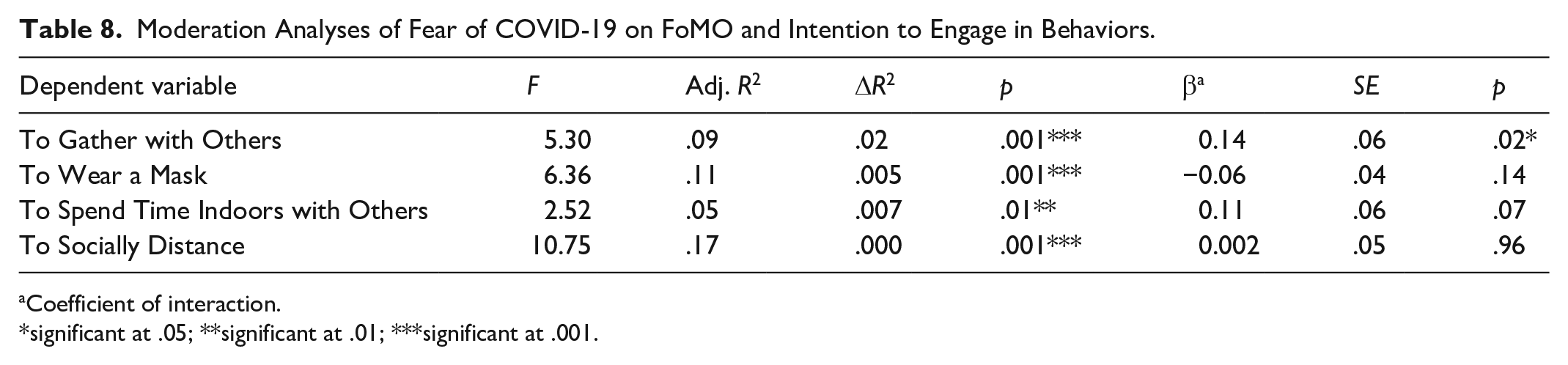
Coefficient of interaction.
significant at .05; **significant at .01; ***significant at .001.

Moderation analyses of fear of COVID-19 on FoMO and perception of others’ gathering behaviors.

Moderation analyses of fear of COVID-19 on FoMO and intention to gather with others.
Discussion
The current study sought to understand the relationships, if any, between social media usage (including purpose and frequency), the “FoMO”, an individual’s perception of others’ behavior as seen on social media, and the intention to follow public health recommendations, such as avoiding indoor gatherings during outbreaks of a communicable disease. We first wanted to determine whether increased social media usage led to greater feelings of FoMO, which prior research suggests, but has not confirmed (e.g., Roberts & David, 2020). Our regression analyses found that, indeed, a higher frequency of social media use, no matter the purpose, is correlated with higher levels of FoMO.
Next, results indicated that FoMO was positively associated with the favorable perception of gathering with friends and family, spending time indoors with others, and not wearing a mask. Specifically, higher levels of FoMO were correlated with believing these behaviors were more acceptable. We also examined whether FoMO influenced people’s intention to break from prescribed health behaviors but found no significant results. Therefore, it seems that higher levels of FoMO increased understanding of why friends and family members were not following prescribed behaviors, but did not impact one’s personal decision to, or not to, break from prescribed health behaviors, even if they understand why others may have.
Furthermore, considering that increased social media usage leads to higher levels of FoMO, and that FoMO is related to perception of others’ behavior, we sought to determine if increased social media usage impacts the tension between FoMO and the negative perception of others’ behavior: if an individual consumes more social media (which, presumably, would increase their likelihood of viewing posts about people ignoring public health recommendations), are they more likely to feel like they’re missing out while viewing that behavior as negative? Our analysis indicated that only two relationships were moderated by social media frequency: that between FoMO and the negative perception of others not wearing masks, and that between FoMO and the positive perception of hand-washing. The other relationships may not be impacted by increased social usage because although social media frequency impacts FoMO, increased social media usage may not change your initial perception of others’ behavior: once you judge someone’s behavior negatively, your perception is cemented, no matter how many more times you witness that behavior. It should be noted that we do not know what types of social media posts were viewed. That is, more social media usage doesn’t necessarily equate to more images of people ignoring health-related guidelines.
Similarly, we wanted to determine if increased social media usage creates or exacerbates a tension between FoMO and one’s intentions to follow public health guidelines. According to our analysis, only the intention to wear a mask was moderated by social media usage, and the moderation did not seem to create tension: the more social media a person consumed, the more FoMO they felt and the stronger their intention to not wear a mask (see Figure 3). These results suggest the more social media someone consumes—which may include seeing examples of friends gathering and/or not wearing masks—the more they will experience FoMO, subsequently lowering intentions to follow health precautions. Considering that most people surround themselves by those that are similar in personality, behaviors, and values (Youyou et al., 2017), if you feel particularly left out of your friend group, you may change your behaviors to mimic theirs, even if those behaviors go against your values and beliefs (e.g., not wearing masks despite prescribed public health precautions).
In light of these results, we suspected that an overriding fear of COVID-19 was a stronger moderator of these suspected tensions than social media usage. A post hoc analysis determined that the relationship between FoMO and the perception of others gathering with people they didn’t live with was moderated by fear of COVID-19. That is, as FoMO increased, so did peoples’ perception of gathering with people as acceptable, but higher levels of fear of COVID-19 kept that perception more negative than if they weren’t worried about COVID-19 (see Figure 4). A similar interaction happened with intention to gather: as FoMO increased, so did the intention to gather with others, but fear of COVID-19 capped that intention far below others who felt little to no fear of COVID-19. This indicates that no matter how frequently someone views others ignoring public health recommendations through social media, their overarching fear of contracting COVID-19 stopped them from acting in a similar manner.
Practical and Public Health Implications
The current study’s results add dimension to our understanding of social media usage and its effects. One novel finding is that increased social media frequency is correlated with a stronger sense of FoMO. Although this connection may seem intuitive—the more social media you consume, the more likely you are to see photos of your friends and family having fun without you, which will increase your sense of being left out—this specific relationship has not been empirically proven before, to our knowledge. Second, the current study is unique in that our analysis suggests FoMO is sometimes connected to one’s perceptions of the “acceptableness” or “responsibility” of others’ actions, which implies that others’ behavior may influence your sense of right and wrong. This is an important idea that merits further research; if you believe that certain others hold different beliefs and values than you do, the overwhelming desire to fit in and “belong,” or even just be doing what others are doing, may encourage you to rethink your own beliefs and values.
However, the current study indicates that while FoMO may cause us to rethink the acceptableness of certain health-related behaviors, FoMO does not encourage us to engage in those behaviors. There are multiple reasons this may be the case, but we speculate that the overriding fear of consequences (in this case, negative health outcomes) is stronger than FoMO. This intriguing finding implies that if governments and public health agencies effectively and truthfully communicate the detrimental outcomes and overall seriousness of a health threat (e.g., a communicable disease, unhealthy habit, or dangerous product), that sense of seriousness could buffer individuals from crisis fatigue, which can create a temptation to “let down their guard” if they see others doing so.
The current study measured perceptions of several specific health behaviors prescribed during the COVID-19 pandemic that, pragmatically, seem unconnected to FoMO—in particular, hand-washing and showing off PPE. However, we found partial connections between perceptions of these social media posts and feelings of FoMO. Why would a feeling of being “left out” of your friends’ fun have anything to do with photos of people washing their hands? Toward the beginning of the pandemic, it was popular to post photos, videos, or memes about proper hand-washing techniques, usually to a clever new song created to count the recommended time for hand-washing. At one point, these posts may have felt preachy or tiresome to some viewers, but as the lockdown wore on and people felt increasingly disconnected from their friends and loved ones, their feelings about such posts may have evolved into acceptance, because “If everyone else is so concerned about hand hygiene, maybe I should be, too?” This finding is noteworthy, as it implies that FoMO and social isolation may influence our perceptions about all sorts of health-related actions, not just “controversial” or public-facing behaviors like mask-wearing, smoking, or vaccinations. Future studies should explore these relationships in the context of other health behaviors, such as binge drinking, dieting, and exercising.
This study lays the groundwork for combining several lines of extant research. Much of the past research has shown social media can negatively influence one’s mental health (e.g., Vannucci et al., 2017), change our perceptions about the world around us (Jacovi et al., 2014), and impact our interpersonal relationships (e.g., Mustaffa et al., 2011; Vannucci et al., 2017). However, many of these studies have focused on advertising campaigns, planned social media blitzes from organizations, or online gaming (e.g., Hong & Kim, 2019; Jiang & Beaudoin, 2016; Kostygina et al., 2020; Siuki & Webster, 2021). Little research has explored the impact of casual, non-sponsored social media posts by friends and family (i.e., people we actually know “in real life”). In addition, the current study builds on the existing knowledge that social media can be a successful tool for health communication (e.g., Plaisime et al., 2020) by demonstrating that FoMO may dull our objection to our friends’ and loved ones’ health-related behaviors (such as when others ignore mask mandates during an outbreak of an infectious disease). The current study also demonstrates that in addition to strategic, planned campaigns by public health organizations and government agencies, casual social media posts we see every day in our “permanently online” (Vorderer & Kohring, 2013) world also influence our health-related beliefs and behavior. Kostygina and her colleagues (2020) have already found some success by utilizing social media influencers within structured health campaigns, but there is a need to focus on the specifics of how “regular people” (i.e., friends and family members, rather than paid influencers) engage with and perceive social media in these situations (e.g., mindless scrolling), what type of social media is being used (e.g., anonymous platforms versus those attached to a user’s real name and photo), and who is actually posting about health-related issues (e.g., family members, close friends, co-workers, acquaintances, etc.).
Though the current study was situated in the context of the ongoing COVID-19 pandemic, we believe the results can be generalized to situations beyond a global health crisis. As noted earlier, individuals sometimes have reasons to self-isolate, such as natural disasters, moving away from friends and family, or undergoing medical treatments that leave their immune systems compromised. These individuals may increase their social media usage during these times to update loved ones (Chung & Kim, 2008; Heilferty, 2009) and feel connected to those they cannot be with physically. By understanding the relationship between increased social media usage, FoMO, and the intention to follow prescribed behavioral guidelines, we can better support and encourage these people as they struggle through a difficult and lonely time.
Limitations
This study was widely distributed, and participants ranged in several demographics, yet it is important to note that it was not representative in its gender, education, and socioeconomic status, as per the US Census (United States Census Bureau, 2020). COVID-19 is widely known to have disproportionately impacted the working class (Parker et al., 2020); this study was less able to survey those individuals.
Another important consideration is that the current study was cross-sectional, designed to understand attitudes and behaviors at one moment in time, but attitudes and opinions about COVID-19 can change rapidly. When it first became a global emergency in early 2020, COVID-19 was a novel, poorly understood illness; as researchers’ understanding of the virus evolved over time, so too did the general public’s worries and fears. By the time we collected our data (i.e., winter of 2020/2021), crisis fatigue may have set in for many individuals, and peoples’ attitudes and beliefs about safe behavior may have been different than they were at earlier stages of the pandemic. In addition, the current study’s data were collected from October 2020 to February 2021, a period in which COVID-related attitudes may have changed quickly. During these 5 months, several winter holidays were celebrated, virus variants were first reported, vaccines first became available and were distributed to approximately 20 million Americans, vaccine hesitancy gained traction, and COVID-related deaths plateaued, spiked, and then decreased (New York Times, 2022). We conducted t-tests to compare the responses of those who completed the survey earlier on (using snowball sampling methods) and in February (using MTurk), but as mentioned previously, no major differences were found.
It is important to acknowledge that the data were collected via an anonymous, self-report, online survey that could be subject to self-serving biases. This becomes especially important when it comes to nationally and globally mandated health precautions, which some people may believe are unnecessary despite being socially accepted: they might simply lie about breaking public behavioral guidelines. We also acknowledge that several of the variables that had to do with a particular behavior (i.e., perception of that behavior, intention to engage) were composed of one or two items, which can be somewhat problematic. As this was part of a larger study, we collected data about eight different behaviors, with items about perception, attitude, subjective norm, intention, enactment of each of those behaviors. Thus, if we had more items per behavior for each variable, we could have jeopardized our data with high respondent fatigue, falsified data, or a high amount of missing data. We therefore made the methodological choice to have one or two straightforward items about each behavior in each variable.
Finally, though we measured overall social media usage and asked which platforms participants were spending their time using, we did not measure the content of the social media consumed. It is sensible to assume that increased social media usage brought increased amounts of posts in which loved ones were ignoring health guidelines, but that is merely an assumption. Moreover, future research should collect data on both participants who do not use, or more rarely use, social media to compare these results with; we do, however, acknowledge the difficulty of finding an equal population to those who do use social media more frequently.
Conclusion
During the COVID-19 pandemic, when people across the globe were asked to physically isolate themselves and take certain behavioral precautions when venturing out into public (e.g., washing hands consistently, wearing a face mask, social distancing), people increasingly turned to social media to feel more connected to others. This presented a unique opportunity to study how people use social media during times of isolation and chaos, and the outcomes of that usage. The current study questions whether increased social media usage was connected to the “FoMO”, what effect, if any, FoMO had on the perception of others’ behavior as seen on social media (i.e., pictures of your friends gathering without masks), and how FoMO influences the intentions to follow recommended, health-related behavioral guidelines (e.g., staying 6 feet apart from others). Our analysis suggests that increased social media frequency leads to a greater sense of FoMO. A greater sense of FoMO is associated with more acceptable perceptions of others’ social media posts featuring them going against government recommended health guidelines. However, we did not find a connection between higher levels of FoMO and higher intentions to disobey those health guidelines, and social media purpose did not moderate these relationships. Rather, individuals’ fear of COVID-19 moderated that relationship: with high levels of fear of contagion keeping many obeying prescribed health precautions, despite high levels of FoMO. By better understanding the connection between social media frequency and purposes, “FoMO,” perceptions of others’ behavior, and behavioral intentions, we get a clearer picture of social media’s overall effects, particularly when people are socially isolated.
Footnotes
Appendix
Declaration of Conflicting Interests
The author(s) declared no potential conflicts of interest with respect to the research, authorship, and/or publication of this article.
Funding
The author(s) received no financial support for the research, authorship, and/or publication of this article.
