



Abstract
Conspiracy theories were once perceived as delusions of individuals on the fringes of society, but have become commonplace in mainstream culture. Today, they are produced, consumed, and circulated on various online media environments. From memes on 4chan, QAnon influencers on Instagram, to flat earth or antivaxx videos on YouTube, modern-day conspiracy culture embodies compelling mediated images and narratives that are composed of various audiovisual materials. Building on Stuart Hall’s encoding/decoding model, and Henry Jenkins’ notion of “participatory culture,” we analyze these audiovisual conspiracy theories as “oppositional readings” of hegemonic truths. More concretely, we analyze how conspiracy theorists reconstruct various audiovisual (mass-media) materials into streamlined narratives on YouTube videos to picture opaque power. Based on an in-depth qualitative analysis of 24 conspiracy theory videos, strategically selected from a larger sample of 200, we present three major categories of audiovisual narrative construction in conspiracy videos on YouTube: (1) Simulating: using fiction, religious and cultural images and narratives to render images of events otherwise invisible; (2) Deciphering: decoding hidden messages by “closely reading” images and looking for hidden symbolism; (3) Exhibiting: exposing information, research, and images that are “hidden in plain sight” but point to conspiracy. This article contributes to the growing body of literature on conspiracy theories by showing how they are not just texts, but should better be seen as media practices involving the recontextualizing of (mass)media material into new audiovisual conspiracy theory narratives. This shapes not just their content and form, but also their place in public discourse.
Introduction
From stories about secret societies like the Illuminati, terrorist attacks of 9/11, chemtrails, 5G networks, vaccinations, or the coronavirus—conspiracy theories about the secret, powerful groups controlling society have become widespread in the last decades (e.g., Aupers, 2012; Barkun, 2006; Harambam, 2020; Knight, 2000; Oliver & Wood, 2014). Media play an important role; conspiracy narratives are popularized through the Internet and spread rapidly on social media (e.g., De Zeeuw & Tuters, 2020; Sunstein & Vermeule, 2009; Vosoughi et al., 2018). Conspiracy theories today are deeply mediatized cultural products: from conspiracy memes on 4chan and the “save the children” movement on Instagram to “flat earth” videos on YouTube. The Internet is often understood as a “breeding ground for the transmission of conspirational ideas” (Starbird, 2017) where self-contained conspirational “echo chambers” are formed (Bessi et al., 2015) and conspiracy theories are “continuously sampled, remixed and even remade by online users” (Stano, 2020, p. 493).
The crucial role of the Internet in the spread and popularization of conspiracy theories is central to broader moral-political debates about disinformation, fake news, and post-truth (Leal, 2020; Lewandowsky et al., 2017; Wardle & Derakhshan, 2017). In this article, we step away from such moral concerns by empirically studying conspiracy theories in a concrete media context. Theories about conspiracies, evil plots, and invisible power are not just abstract ideas or random chunks of information “going viral” on the Internet. They are concrete media practices (Bräuchler & Postill, 2010)—cultural products grounded in what people actually do on the Internet with the countless media resources available. We, therefore, study in empirical detail how conspiracy theorists construct their oppositional narratives online and how these are informed, supported, and shaped by the technological affordances of social media, or specifically, YouTube as an audiovisual medium. In more theoretical terms, our research problem boils down to the question: how do conspiracy theorists picture opaque power on YouTube? To empirically assess this question, we selected 200 YouTube videos derived from 40 conspiracy theory channels and, based on theoretical selection, performed an in-depth, qualitative content analysis of 24 videos.
Picturing Opaque Power on YouTube
From the early works of Sigmund Freud, Karl Popper, and Richard Hofstadter onward, conspiracy theories are often described as “pathological,” “delusional,” “irrational,” “extremist,” and a danger to society (Harambam, 2020). In this study, however, we adopt a cultural sociological perspective and take an agnostic stance: conspiracy theories may or may not be true or dangerous but should be empirically studied as narratives that give meaning to people. They have become particularly salient in contemporary, late- or postmodern societies where social systems, institutions, and power structures have become overly complex and opaque (Aupers, 2012; Harambam, 2020; Knight, 2000; Melley, 2000). In this situation, Frederic Jameson noted 30 years ago, conspiracy theories function as “cognitive maps” to represent social systems that have become too complex to represent, or even, to “think the impossible totality of the contemporary world system” (1991, p. 38). Conspiracy theories hence give answers to nagging questions about “what is really going on” in global politics, economy, and the media landscape and, particularly, are meaningful stories to make sense of what we call “opaque power”: power structures that cannot (easily) be seen, visualized or represented by citizens in a complex, late-modern society, but, precisely because of this opacity, fuel the collective imagination about a (global) conspiracy.
In these sociological theories on the function and cultural meanings of conspiracy theories in late-modern societies, however, there is hardly attention paid to the question of how people actually make sense of opaque power in everyday life: how they represent the “hidden conspiracy,” actively construct “cognitive maps” and, in doing so, try to convince others of the “truth out there.” If we want to deal with this “how” question we have to look at media representations and, more precisely, take into account that every medium provides different affordances to represent and communicate the message (e.g., McLuhan, 1964; Meyrowitz, 1994). In most studies on conspiracy culture, the focus lies on mass media texts and encoded ideologies: literature and fiction (Knight, 2000; Melley, 2000), film, television series and documentaries (Butter, 2020), and lyrics in rap songs (Gosa, 2011). This methodological focus on published texts; however, blinkers the fact that conspiracy theories in everyday life/for ordinary people are neither stable narratives nor full-fledged worldviews. Conspiracy theorists should therefore better be considered audiences involved in “interpretive practices” since their theories about opaque power are unstable, open-ended, and often nonconclusive interpretations of “the truth out there” (Dean, 1998 Knight, 2000).
If we want to study how ordinary people imagine opaque power, in short, we should shift the focus of analysis from conspiracy theories in mass media texts to the way people interpret, appropriate, decode, and modify such texts with media. This brings us, first of all, to the approach of audience studies (e.g., Fiske, 1998; Hall, 1980; Radway, 1987). In his essay “Encoding and Decoding in the Television Discourse,” Hall (1980) presents a theoretical framework for understanding how media messages are produced, disseminated, and interpreted. Mass media texts, as his argument goes, are always decoded in their consumption since people with different social-economic backgrounds produce different readings and meanings that, respectively, confirm, negotiate, or oppose the preferred (original) reading (Hall, 1980). His model has been influential in the field of cultural studies that analyze the ways different groups view and understand media products. In our study, we use Hall’s encoding/decoding model to conceptualize and understand the “oppositional readings” of conspiracy theorists. Following Hall, oppositional readings go “against the grain”: they are counter-hegemonic interpretations of mass media, wherein the reader does not share the text’s original code and imbues it with alternative ideological codes. Conspiracy theory producers exemplify “oppositional readers”: they antagonistically “decode” societally dominant narratives and views, reinterpret mainstream media material (i.e., newspapers, broadcast news, film, and other media material), and reconstruct it in a relentless form of “bricolage” to unveil the “truth out there” (Aupers, 2020; Harambam, 2020).
Although Hall wrote about mass media texts, the open, interactive, and nonhierarchical structure of the Internet affords even more agency to media users and diffuses distinctions between encoding and decoding, production and consumption. Jenkins (2012) writes in this respect about “participatory culture” exemplified by the Internet. “Participatory culture” refers to the involvement of users, audiences, consumers, and fans in the creation of culture and content—an idea that departs from a previously held view of people as mere consumers of traditional media. On Internet platforms like Twitter, Instagram, Facebook, or YouTube, people are encouraged to both consume (watch, read, and listen) content and produce it (write, record, edit, or otherwise re-appropriate). One key aspect of participatory social media, Jenkins (2009) argues, is that they are “spreadable.” Consumers here become “grassroots advocates for materials which are personally and socially meaningful to them” (Jenkins et al., 2009, p. 23). Social media users are nowadays veritable “prosumers” (Ritzer & Jurgenson, 2010), radically modifying existing cultural products in their own reconsumption practices. They both contrast this from the previous hierarchical model of cultural production. Conspiracy theorists on social media platforms are good examples of such “prosumers” in today’s participatory online culture: they draw from a diverse sample of mass media material, recontextualize accordingly with their “decoding” of the media messages they offer, and “encode” it with their readings (Aupers, 2020).
The participatory affordances of social media thus enable conspiracy theorists to construct their own theories about opaque power in contemporary society. Such theories are not just texts, but embody various audiovisual materials that make the invisible, literally visible in self-edited clips. According to Burgess and Green (2018), YouTube exemplifies participatory culture, where ordinary people are invited to produce and contribute content, appropriating mass media images, and providing their audiences with their (oppositional) “readings” (Hall, 1980). Not surprisingly, then, YouTube is one of the platforms on which conspiracy media practices are especially prevalent. Despite efforts to censor and remove content flagged as “disinformation,” conspiracy videos on YouTube were viewed 3.5 billion times in 2020 alone (transparency.tube, n.d.), while producers of deleted channels often come back to the platform with yet another account and new content. Some have even called YouTube the “great radicalizer” because its recommendation algorithms lure people deep down the “rabbit hole” of extremist conspiratorial content (Tufekci, 2018). While the large-scale quantitative analyses of Ribeiro et al. (2020) indeed show that people easily shift from moderate to more extreme content on YouTube, Rebecca Lewis (2018) goes beyond the radicalizing power of algorithms alone and shows how political content creators on YouTube deploy techniques of brand influencers to build audiences and “sell” them radical ideologies, and “alternative frameworks for understanding the world” (p. 35). Similarly, Munger and Phillips (2019) propose a demand and supply model to argue that YouTube’s affordances facilitate interactions between radical content creators and audiences “alienated from the mainstream” (p. 25).
The point is that YouTube is now an important media tool of “conspiracy theorists,” and its specific possibilities to broadcast self-made audiovisual conspiracy theories shape and form the theories themselves (cf. Hannan, 2018). Hence, our research question is, How do conspiracy theorists picture opaque power on YouTube? In what ways do they “decode” mass media material and “encode” their oppositional readings in self-constructed videos?
Method, Data, and Analysis
We focus on YouTube because this social media platform is the perfect exemplar to study participatory (conspiracy) culture (Burgess & Green, 2018). But what constitutes conspiracy theory videos is far from straightforward since its definition/label is the product of power relations (Harambam, 2020, pp. 17–19). Because of its negative connotations, the label is also a strong rhetorical weapon as well to de-legitimize and exclude certain people and thoughts from public discussion (Husting & Orr, 2007). To stay sensitive to these political dynamics of labeling, we use an emic, or a bottom-up, community-informed definition of conspiracy theory to select our videos. Because YouTube actively bans videos with conspiratorial content/names, we followed what commenters on the discussion board platform Reddit indicate as conspiracy theory videos/channels on YouTube. More specifically, from May until August 2020 we scanned the conspiracy theory subreddit (R/conspiracy) for members’ posts that included links to YouTube videos and selected the 40 most mentioned channels. From each of those channels, we selected the top five most-watched videos, resulting in a sample of 200 videos. The initial dataset is part of a larger project that analyses conspiracy culture, production, and consumption on YouTube. All 200 videos were narrated in English.
The first author then watched, analyzed, and coded these videos for subject matter, amount of views, the producer channel, year of production, and primary source of footage. This gave us a general idea of the kind of conspiracy videos, and the distribution of topics, leading us to identify 11 conspiracy video categories (Table 1). To establish the primary subject of the video, we posed the question: who, in this video, is to blame? Many videos combined multiple conspiracy theories or spoke about several themes at once. This method of selecting a subject is based on earlier literature that sought to characterize/define conspiracy theories (Harambam, 2020; Knight, 2000).
Conspiracy Video Subjects.
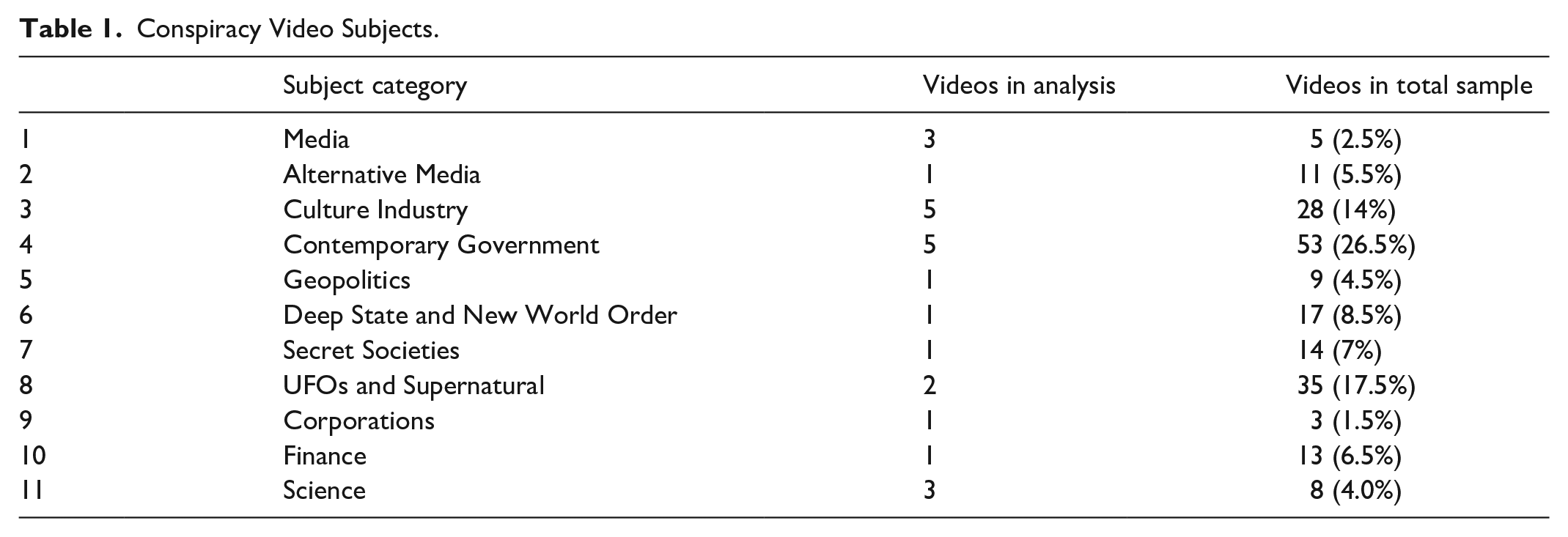
We then analyzed a smaller sample in full qualitative detail to be able to answer our research questions. We started with a video from Categories 1 to 11 and back until we reached theoretical saturation after having fully analyzed 24 videos. This means that additional videos did not lead to new insights, but confirmed what was already found (Hennick et al., 2017). We transcribed and coded all videos along with their visual, audial, and narrative aspects. Using qualitative data-analysis software Atlas.ti, and loosely following a grounded theory approach (cf. Charmaz, 2006; Glaser & Strauss, 1967), we went through several phases of coding: first, we openly coded meaningful segments of the video (visuals, music, editing techniques, and voiceover narrative), attaching relevant annotations to them. This resulted in a code-book of 73 codes, ranging from “Pop culture references” and “comparisons” to “use of numerology” and “voiceover instructions.” Second, in a round of axial coding which is meant to establish relations between codes (Glaser & Strauss, 1967), we classified the open codes by inductively tying them to each other into specific clusters (e.g., “showing evidence,” “connecting dots,” and “proving points”). Finally, we developed from these clusters three overarching categories: simulating, deciphering, and exhibiting, which form the backbone of our analysis. After the first review round, we reanalyzed the videos to find whether we could find meaningful patterns in the types or combinations of strategies used across the different videos.
Analysis and Findings
The analysis that follows shows how YouTube conspiracy theorists use audiovisual strategies to picture opaque powers. It centers around the techniques used to render an audiovisual conspiracy theory intelligible, appealing, authentic, and credible. The analysis yielded three major categories: simulating (most prevalent, N = 160), deciphering (least prevalent, N = 74), and exhibiting (second most prevalent, N = 103). The three audiovisual strategies were used alongside each other in the videos. Combining all three strategies was the most popular way of building videos throughout the sample. In addition, a large portion of the videos used simulating and exhibiting techniques together. However, no videos used exhibiting and deciphering techniques exclusively in one video.
Simulating: Visualizing the Invisible
YouTube conspiracy theorists make use of various audiovisual techniques to simulate the conspiracy theory they wish to convey in their video. These techniques aim at visualizing what is generally invisible and undocumented: the conspiracy theory in question. They make such simulations possible by using pop culture images and references; by using religious narratives and images; and by editing found stock footage with actors or situations that are ascribed to the conspiracy (e.g., politicians, pop stars, and public figures).
First, conspiracy theory video producers deploy various pop-cultural images, such as Hollywood films, Netflix series, and animation fragments, to visualize what is hidden or difficult to conceive to help their viewers imagine the truthfulness of the conspiracy theory. This can relate to secret societies or to phenomena that are not documented by official sources, think of the presence of extra-terrestrial life on earth. The pop-cultural materials are used to activate the imagination, filling the viewers’ fantasies and giving shape to aspects of the theory that are otherwise hard to imagine. To give some telling examples. In this video (Figure 1), the producers of the YouTube channel “It’s [Redacted]” tie their narrative speculating about the existence of extra-terrestrial life on the earth with segments of the 1993 science fiction mystery film “A Fire In The Sky” directed by Robert Lieberman. In the video, we see the film’s poster, featuring a beam of light illuminating a reclining man’s figure, a common Hollywood depiction of being abducted by aliens. Illustrating the producer’s insistence of the film as a truthful depiction of alien abductions, the voiceover offers: “During his alleged abduction in 1975, later chronicled in the film Fire in the Sky, Travis Walton says he saw tall, blond men in the craft.” (It’s [redacted] 2020). The film’s reference serves as proof of the existence of UFOs and gives visual shape to this testimony.
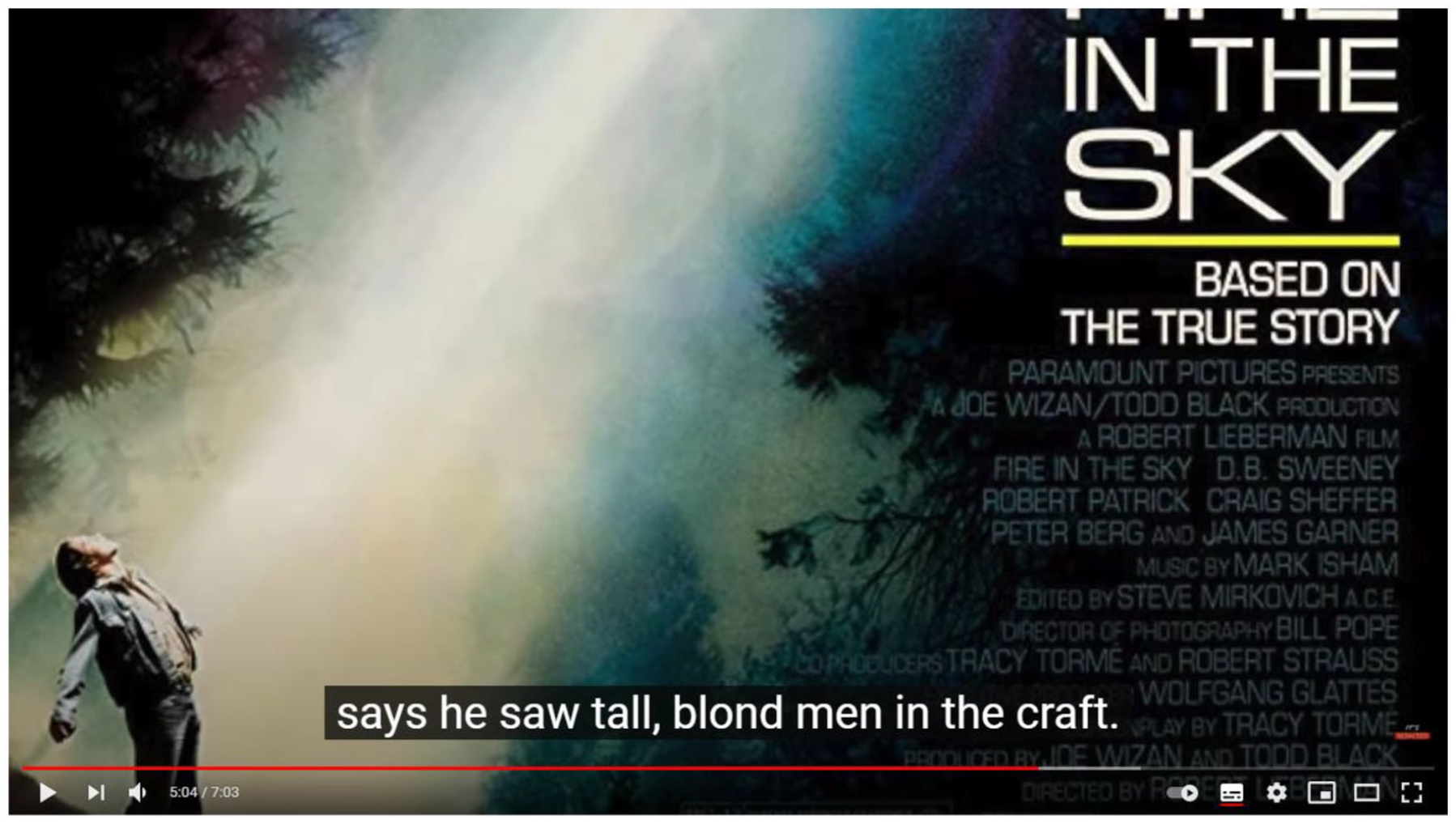
Still from “Spanish Navy Files Disclose Underwater UFOs and ‘Thin, Swedish-Looking’ Beings” by It’s [redacted] (2019).
Similarly, a video excerpt from the famous Netflix horror series Stranger Things is displayed in a video advancing the existence of psychic powers. This narrator does not interpret or explain the piece, but this pop culture reference immediately adds to the comprehension of the suggested conspiracy theory because of the great popularity of the series and the concrete image for viewers to rely on. Furthermore, the excerpt is combined with an image of a researcher, which the narrator presents as “the head of the laboratory of abnormal studies at Princeton University” (Universe Inside You, 2018) (Figure 2). This re-contextualizes the image as if the portrayed character is, in fact, a test subject for such studies. Or at least it aims to simulate so.
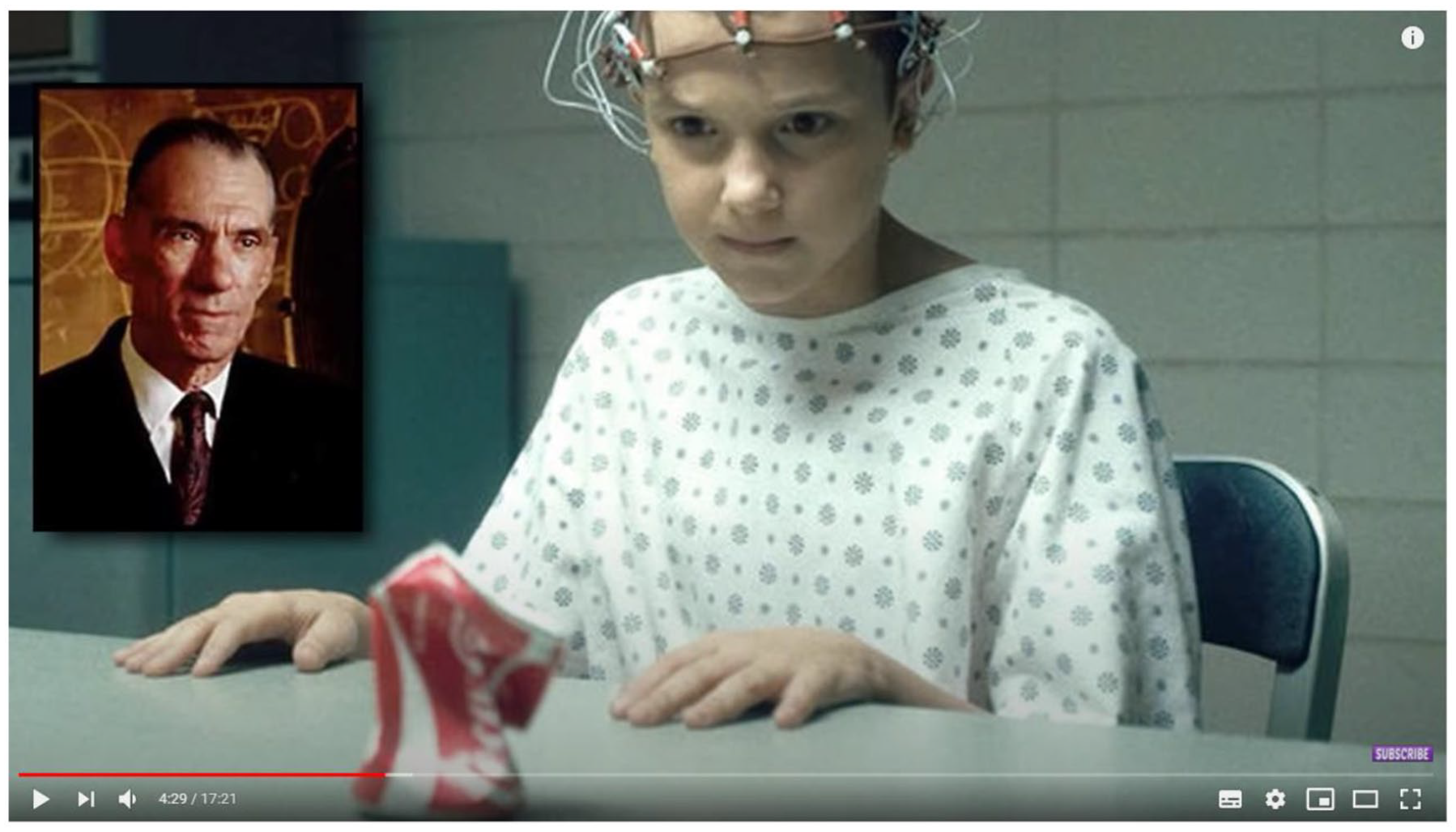
Still from a video “Psychic Abilities Everyone Can Unlock” by Universe Inside You (2018).
In short, using pop-cultural audiovisual references makes it possible to represent and therefore make present what is otherwise hidden: they make the invisible visible.
Second, religious narratives and images are put to similar use, offering ways for the viewer to imagine the conspiracy theory by simulating its truthful existence. For example, in this video on Hip Hop and the Illuminati, the religious narrative is used as a building block to simulate a story about powerful elites (Figure 3). With running, images of ancient tablets and the burning candle still live, reminiscent of dark religious rituals as popularized in The Da Vinci Code, the voiceover offers that It was in Afghanistan that the Illuminati, meaning the enlightened ones, was first used to describe a sect which summoned the Spirits, Angels and Demons. The Mage was employed by the elites in the ancient world to contact the gods. [. . .] The benevolent and malevolent aspects of planets were given names such as Zeus which is the planet Jupiter, and these names are now known in modern as the names of Gods, Angels, and Demons, (Isaac Weishaupt, 2019)
This historical story-telling with religious analogies is then abruptly cut off and replaced with a video “Illuminati” by Prodigy that aired on MTV in 2008.

Still from “Illuminati and HipHop: Symbolism of the Occult in Rap Music” by Isaac Weishaupt (2019).
Similarly, a video about vaccinations and the COVID-19 pandemic (Figure 4) opens with an image of Christ with the words “people of the way” followed by an image of the bible and the words “For we wrestle not against flesh and blood, but against principalities, against powers. . .-Ephesians 6:12” (Isaac Weishaupt, 2019).

Still from video “Masked, Vaxxed and Death” by PeopleOfTheWay.
Or in this video (Figure 5), Money was created to enslave humanity, producer Michael Tellinger tells the story of how the first elites (religious leaders turned into bankers) came to dominate the financial system, and how money is since then used to enslave the rest of humanity. He uses a religious narrative to imagine rebellion to this kind of enslavement. By using video fragments of the 2004 “The Passion of the Christ” movie directed by Mel Gibson, blending the convincing lure of Hollywood movies and religious narratives, the producers provide viewers with his “reading” of this material, offering that Jesus [. . .] chased out the bankers or the money changers from the temple. This was one of the few moments or events of his life where he probably showed violence or became violent with other individuals. . . it was with the bankers. (Tellinger, 2020)
This narrative is used as a building block to the story of money as oppression, and using Jesus Christ not just simulates his historic resistance to financial brokers, but immediately asks the (rhetorical) question: if such highly praised biblical figures already rebelled against bankers, then it must true that our current monetary system was indeed “invented” to oppress people.

Still from “Money was created to enslave humanity” by Michael Tellinger.
Finally, the bricolage of various found and stock footage in these videos serves as a method of narrative simulation. This editing of images comes in many variations and is technically achieved through visual effects, image filters, collages, and overlays of images, which results in combinations that help build a visual narrative from isolated images. Here, the most unexpected combinations become possible to envisage, building a bridge between different aspects of the theory and making a direct association between the actor and the subject. Various historical footages (of wars, scientific experiments from the past, government operations, and historical presidential speeches) are used with ease in combinations with found footage, rendering fact and fiction in an esthetically convincing visual narrative. These video “collages” typically consist of a primary image that is essential for the story, and a secondary image that almost unnoticeably ties the story together. These images are either put one in front of the other or layered on top of each other with transparency.
For example, in this video by the Truth Factory (Figure 6), the narrator offers a story that Donald Trump is a secret time traveler, who inherited the technologies developed by Nicolas Tesla and was, therefore, able to predict and win the US election of 2016, knowing the detrimental consequences if Hillary Clinton would win. Through the video, images of actors and events are followed by, or overlaid with, images of skies, galaxies, and clocks, that provide the portraits of President D. Trump the intended context or “reading” of the producer of this video (Figure 6). In this way, the actor of the story (President Donald Trump) is put into context with symbols of time and space (like clocks and galaxies), rendering these images visual manifestations of the story. In other words, the way of editing here becomes a cornerstone of the visual narrative, simulating it through the ways the combinations are produced.

Still from video “Donald Trump Time Travel Theory- Tesla, Barron Trump, Mike Pence and Meme Magic” by The Truth Factory.
In other words, contemporary digital editing technologies and the YouTube medium affords a playground were separate pieces of AV material are recontextualized and turned into building blocks to visualize the invisible conspiracy theory. These combinations inspire awe and foster plausibility since the produced videos go beyond the boundaries of everyday reality. Such editing techniques make concrete documentation of events and proof irrelevant as every narrative can be pieced together in a simulation of the conspiracy theory.
Deciphering: Reading Hidden Symbols and Signs
The second category of audiovisual narrative construction by which YouTube conspiracy theorists try to demonstrate opaque powers is “deciphering.” Many of these producers believe there are hidden symbols and signs in various media contents (e.g., songs, ancient art, film fragments, fashion, and event calendars) that can and should be “decoded” to find their “true” but obscured meaning. And so they do in full splendor: in their videos, they decipher media contents and reconstruct such excerpts in a running conspiracy theory narrative. As such, they aim to reveal what is “hiding behind the curtain” and visualize what remains hidden to the general public. They employ three specific techniques to decipher these hidden symbols: looking for what is not shown or said; performing “close readings” of images and symbols; and deploying systems, such as gematria, to decode words, people, and events.
First, media contents are deciphered by “listening to the silences.” These YouTube conspiracy theory producers look for what is not being said, for the omissions, discrepancies, and contradictions in media content to find “the real truth.” For instance, in this video on the problematics of “woke” identity politics by The Truth Factory (Figure 7), the producer “trolls” the “social justice warrior” trope and argues that mainstream media have a leftist bias, giving a rather selective picture of what is going on. The narrator contends that “the left predominantly owns mainstream media including the news, Hollywood and social media oligopolies” and that “despite what the mainstream media wants you to believe, about eighty percent of the American population thinks that political correctness is a problem” (The Truth Factory, 2020). What the media did not tell you is thus a more truthful depiction than what they convey, but so these conspiracy theorists hold, “they can’t stop us because we are the makers of memes,” filling their gaps in the hegemonic media narratives (The Truth Factory, 2020).

Still from “Why The NPC Meme Triggers NPCs” by The Truth Factory.
This search for what is hidden in media content even applies to conspiracy media content, as this video about the widely popular right-wing conspiracy theory Internet show host Alex Jones of Infowars testifies (Figure 8). The narrator opens with the question: “Why does Alex Jones refuse to criticize Israel?” (Know More News, 2017), and he audiovisually builds the argument that it is suspicious that such a foremost conspiracy celebrity speaks out against many alleged conspirators, but not those representing Israel. The video takes the viewer through video clips and voice recordings of (what are presented as) former Infowars employees who present Alex Jones as untrustworthy in various ways. Having built this image, the video concludes in his voiceover that “He’s obviously a big fat Zionist shill” (Know More News, 2017).

Still from “Infowars Employees Expose Alex Jones” by Know More News.
In a similar vein, insisting on the meaning of what is not said or shown applies to images as well. One of such videos (Figure 9) that “investigates” the “Jewish Kosher Tax,” the conspiracy theory that products secretly have a hidden Jewish tax component, is indicated by the letter U, normally signifying that it is a certified kosher product. This producer goes through ads in different magazines and journals and finds that products in certain outlets do not have the “U” while others do, and that is suspicious. He rhetorically asks, “why is this, if there’s nothing to hide?” (91177info2, 2010). Why would the kosher certification symbol not appear in different publications? What does that mean? Concluding that the symbol is purposefully hidden in publications that do not target Jewish populations, to not make the general public question their contribution to the Jewish tax. Following these interpretative strategies, such omissions, silences, and absent spaces direct these producers to a hidden conspiracy that is audiovisually communicated to their viewers.
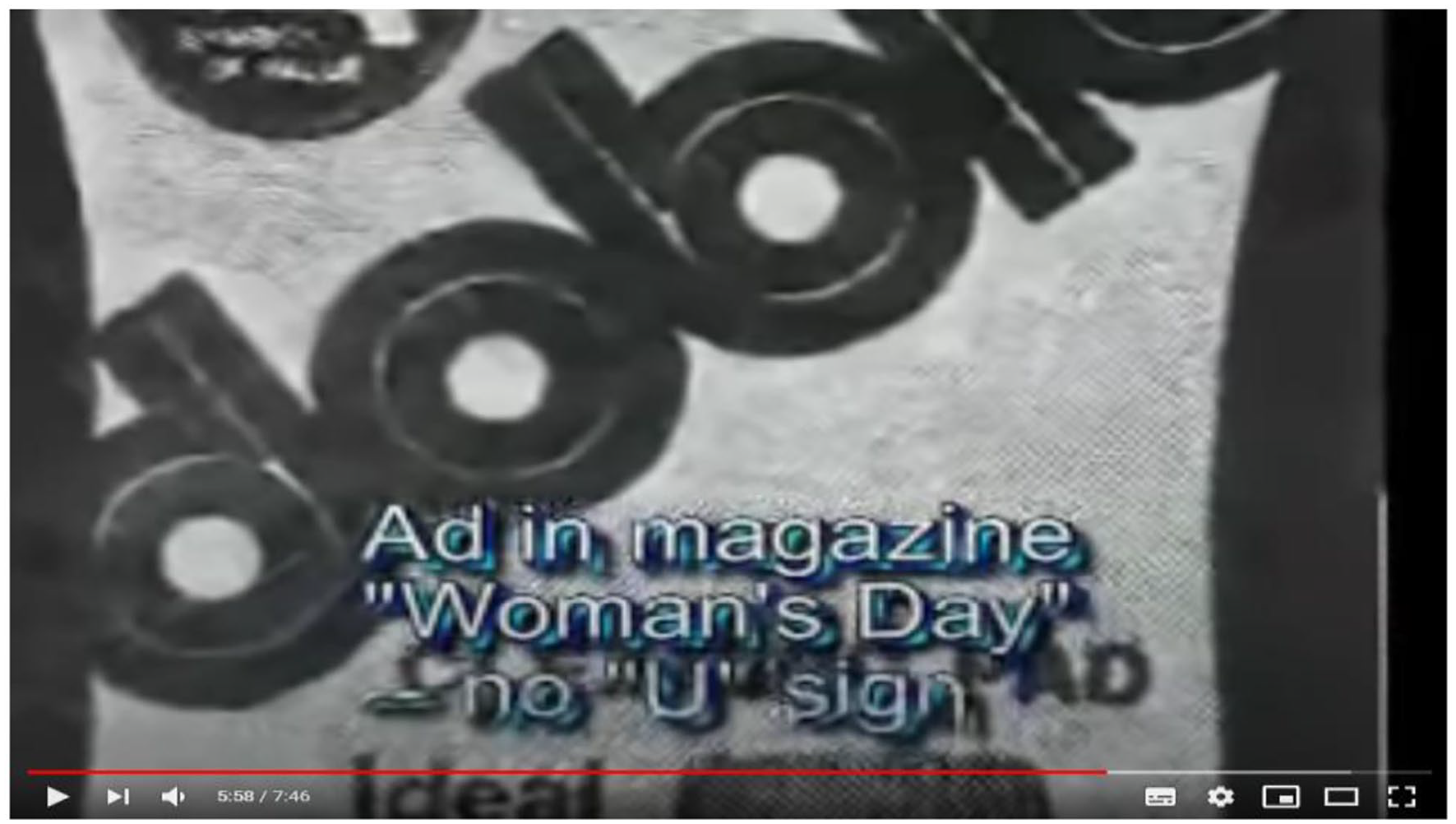
Still from “Zionist Kosher Tax and the symbols on YOUR food supporting Israel” by 91177info2.
Second, the producers of these conspiracy theory videos decipher media contents by closely reading them. In contrast to pointing to what is absent, this strategy focuses on what is present, but “hidden in plain sight.” Using arrows and circles, or zooming in on particular features, they highlight those suspicious aspects in media content and narrate their conspiratorial reading of those features in a voiceover. Take Figure 10, this producer argues there is “a group that has sinister intentions for Earth, lurking in the shadows of our society” (What We Know, 2020).” According to the producer, these beings “came from another world” and “changed our [human] ancestor’s genetic code.” These are reptilians that came to Earth in the time of ancient Sumerians, and for that reason, “much of what we know of them is documented in Sumerian writings” (What We Know, 2020). The producer highlights those aspects in Sumerian writings and artifacts (including the sky and people worshipping gods) that tell the story of the Arunna (gods in ancient Sumerian) coming down from the sky, settling on earth, and finally being worshipped as gods (Annunaki: “gods who live on earth”), hence indicating the truthfulness of his reptilian conspiracy theory.

Still from “The Reptilian Elite—Conspiracy Theories” by What We Know (2020).
In the same way, body gestures of music or movie stars are interpreted as concealed signs, sending out the “message that there is an Illuminati that controls the entertainment industry” (Isaac Weishaupt, 2019). This video showcases a series of pop stars with their hands up forming triangles out of their thumb and index fingers: a popular conspiracy reading of Illuminati symbolism, and pop stars’ allegiance to this notorious secret society (Figure 11).

Still from video “Illuminati and Hiphop: Symbolism of the Occult in Rap Music” by Isaac Weishaupt (2019).
What all these producers do is highlight the taken-for-granted and often unnoticed symbols in images that they assume bear hidden meanings. It is a form of visual semiotics by which details in images are interpreted in such a way that points to a conspiracy.
Third, conspiracy theorists “decode” hidden messages in images, texts, or events, using techniques like numerology and gematria (a Jewish practice in which the letters of the Hebrew alphabet are substituted with corresponding numbers, here often described as the “masonic practice of coding numbers into words”). The numbers on an actor’s jersey t-shirt are interpreted as hidden symbols pointing to deeper meanings with which the “true” narrative of events can be unveiled. These videos carefully pick apart dates, google statistics news articles, and interpret the meanings of symbols and numbers used in them. In this video (Figure 12), Chigoze Truth explains why the “Universal Music Group is the freemasons” sacrificing celebrities in masonic rituals.

Still from “Gucci Mane’s Mother was Murdered for His Career by Warner Bros and Universal studios” by Chigoze Truth (2019).
He explains that if you follow Gucci Mane’s personal life you’ve gotten this. . . his mother passed on the 5th of this month and he did not attend the service. Gucci Mane. . . his upcoming birthday is February 12. He’ll be turning 39 right now he’s 38 right so he was 38 gonna turn 39 in February his mother dies 38 days a span [. . .] that’s the 39th primum dying 39 days from her son’s birthday for his career. Do you understand how murder by numbers works? Murder equals 38, death equals 38, killing equals 38, cancel equals 38, destroy equals 38
The creator of this video argues that with his numerological interpretative strategy, he can “logically break out all these numbers” to “show you (the viewers) a clear numerical ritual” (Chigoze Truth, 2019). In this way, he deciphers what no one else could, namely, the true story behind the cover-up of Gucci Mane’s death. Mentions of numerology and gematria came back often as “deciphering” the meanings of mysterious events. Another video (Figure 13) analyses the last days of basketball player Kobe Bryant and his daughter, taking apart the dates, ages, times of the day of events that have befallen the celebrity. The producer argues that him dying on the 26; [. . .] they say Kobe’s helicopter crashed right off the 101 freeway. The first chapter in my book, it’s about 26 and 101, you have to know these numbers to see how often they are used ritualistically together like this.

Still from “Kobe Bryant 41 and daughter Diana 13” by Gematria Effect News (2020).
He then concludes that his death was intentional and planned by “the elites” as a masonic rite, which is encoded in the numbers marking his death (Gematria Effect News, 2020).
Such systems of “deciphering” provide systematic interpretative strategies by which these conspiracy theorists find “hidden” meanings behind seemingly “random” aspects of the event, such as a person’s age or the time of day. While the first two “deciphering” methods, like listening to the silences and closely reading signs and symbols, are more qualitative and interpretative in nature, this method of “deciphering” claims for a quantifiable explanation of events. The “truth” is hidden here in the numbers that are simply out there.
Exhibiting: Demonstrating the Evidence
The third category of narrative construction in conspiracy videos we find is “exhibiting.” Besides trying to visualize the invisible through “simulation,” and “deciphering” secret meanings in media contents, conspiracy theorists on YouTube also exhibit the evidence that is already out there and demonstrate how various public materials point to a conspiracy. Such producers argue in three distinct ways that “evidence is hiding in plain sight”: (1) they expose government documents, scientific findings, footage of scientific experiments, and other forms of “legitimate knowledge”; (2) they draw from social media testimonies on the Internet and include screenshots, documents, and video excerpts in their productions; and (3) they present visual comparisons between the alleged conspirators and specific media contents that would highlight similarity (and complicity) between source and target domain. In this category of picturing opaque powers, the presented material speaks for itself, it needs no deciphering, and the evidence is in the open. The producers are merely here to point us to it.
First, YouTube conspiracy theorists present a variety of official documents that demonstrate the truthfulness of their theory. These can be de-classified governmental files, as in this video on alien life on earth by It’s [redacted] (Figure 14) where the narrator presents information from governmental files and edits it with testimonies from ordinary people and mass media images to construct an account of alien visits on earth, including descriptions of the physical looks of the alien species. The governmental documents take the central stage both visually and in the narrative of the video: pages of text sliding through the screen, and the voiceover recounting how they tie into the story of alien species that have been visiting earth for centuries. The voiceover offers a clear “reading” of the documents: crucial information that has for a long time been hidden is now widespread in the open.

Still from “Spanish Navy Files Disclose Underwater UFOs and ‘Thin, Swedish-Looking’ Beings” by It’s [redacted].
But they also use fragments of scientific research findings, and they reference anything from radioactivity (Jesse Perez Casanova), human psychology (Universe Inside You), and political science (CorbetReport). In the “Thorium Conspiracy” video (Figure 15), the producer shows a series of experiments being carried out and says that here is where it gets crazy: for decades scientists have argued for the use of thorium as a power source and though it has made some progress, uranium fuel source still dominates the market! The big question is this, would it possible that some organizations have purposefully suppressed the technology?

Still from “Thorium Conspiracy” by “Stuff They Don’t Want You To Know.”
Or take this video on 5G and electromagnetic radiation by Jesse Perez Casanova who showcases MRI research scans of the human brain (Figure 16). He urges his listeners to look at the scientific image while he offers his interpretation: “Here’s a diagram of microwave absorption by the brain.” As you can see, this is not good for kids and not good for adults. The real question is if wireless technology is safe, why can so many people not live near wireless technologies? The major reason is that our bodies are electric. [. . .] If you think that living in an environment with microwave radiation is safe for you and is good for your body, well, that is simply not true (Jesse Perez Casanova, 2020). Here, Casanova uses the visual exposition of brain research and MRI scans as a building block for his conspiracy video. Like the others in this section, these video producers draw on scientific research and government documents as “legitimate knowledge” to increase the plausibility of their alternative theories.

Still from “5G Radiation Exploration” by Jesse Perez Casanova (2020).
Second, social media posts from politicians, investigators, journalists, “citizen journalists,” and ordinary people are selected as testimonies and presented as “evidence” in their videos. For instance, the producer of the channel Know More News, discussed in the “Deciphering” section, goes through several social media posts to portray Alex Jones as a “traitor” (Figure 17). After reading out the contents of the post, he says: “a guy who worked with Alex for over 2 years is calling him a ‘duplicitous liar’,” and “his audience is thumb-sucking cult members,” before switching to yet another post about Alex Jones. The social media informant is presented here as a reliable source of judgment and information.

Still from “Infowars Employees Expose Alex Jones” by Know More News.
Similarly, a video on President Donald Trump (Figure 18) uses his Twitter account as a resource in a narrative on the struggle between him and candidate Hillary Clinton. The “Truth Cat” (as the producer coins herself) presents it as evidence of the completion of Trump’s race through time to win the presidency and stop the “Clinton regime.”

Still from “Donald Trump Time Travel Theory- Tesla, Barron Trump, Mike Pence and Meme Magic” by The Truth Factory.
Another video (Figure 19), subtly titled “Masked, Vaxxed and Death” (PeopleOfTheWay, 2020), presents messages of followers received over social media as evidence. In the narrative over the SARS-CoV-2 pandemic as a tool of mass control, he shows a screenshot of a message from a fan that owns a carton business and says that “the government has given them a major contract to produce these cardboard disaster caskets [. . .] thousands upon thousands [. . .] Now we can see what the government is preparing and planning for [. . .] you guys really need to be prepared.”

A still from “Masked, Vaxxed and Death” by PeopleOfTheWay.
Public social media posts and private messages from people in the social networks of these conspiracy video producers are advanced as important proofs. The people behind those posts are seen as authoritative whistleblowers that have information from the inside and need no further (suspicious) inspection. Rather interestingly, these informal messages are put on par with official documents, rendering their legitimacy as evidence almost indistinguishable.
A third way in which conspiracy theorists “exhibit” evidence in YouTube videos is through visual comparison. This implies two or more different images being presented together to show their similarities or connection as proof of conspiracy. Ever doubted Hillary Clinton had Reptilian features? Or that Barron Trump was a time traveler? According to the following videos, the similarities between them and their visual proofs are just too uncanny to ignore. In one such video about reptilian elites covertly ruling the world (Figure 20), Hillary Clinton is presented as a lizard-human hybrid that traveled to earth thousands of years ago and masquerades as humans to control the earth behind the curtains. The video then presents a side-to-side comparison of various images of features of reptilians and Hillary Clinton and, in this way, urges the viewer to find the similarities between these images.

Still from “The Reptilian Elite—Conspiracy Theories” by What We Know.
In much the same way, a video on Donald Trump and time travel (Figure 21) shows a side-by-side comparison of Donald Trump’s son Barron and the main character with the same name of Ingersoll Lockwood’s book from 1890. The existence of this novel and the clear resemblance of the character with Trump’s son is advanced as proof of his theory.
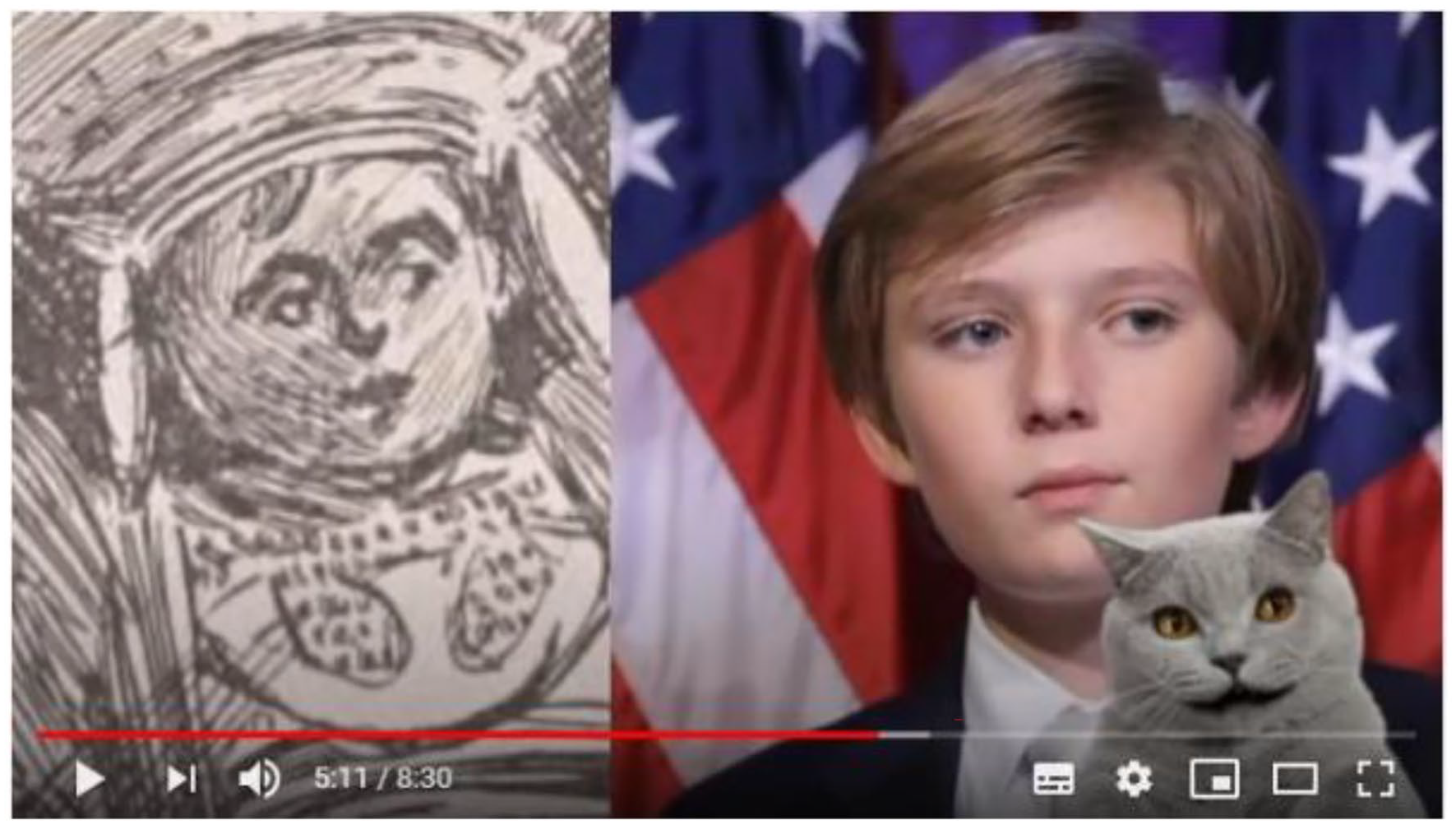
Still from video “Donald Trump Time Travel Theory- Tesla, Barron Trump, Mike Pence and Meme Magic” by The Truth Factory.
Visual comparisons provide conspiratorial narratives with intuitive proofs: no belief or trust is required, it is all a matter of seeing what is simply out there.
Conclusion and Discussion
The theoretical point of departure of this study was the sociological assumption that conspiracy theories function as “cognitive maps” representing social systems that have become too complex to represent (Jameson, 1991, p. 38) and hence, as meaningful and explanatory meta-narratives, they make sense of opaque power (Boltanski, 2014, pp. xv–xvi; e.g., Knight, 2000; Melley, 2000). Such sociological theories explain much of the appeal of conspiracy theories, but are overly general, functionalist, and based on conspiracy theories in mass media texts—fiction, literature, film—that do not capture conspiracy theorizing as a verb—as a dynamic, active and “never-ending” interpretative practice (Fenster, 1999, p. 107) that is afforded by social media. Studying conspiracy theorizing as a (social) media practice, we focused particularly on YouTube—not only because the platform is brimming with self-made conspiracy theories, but because it exemplifies a shift from conspiracy theories as written text to the audiovisual. The key question was how conspiracy theorists picture opaque power on YouTube and, particularly, how they “decode” mass media material and “encode” their oppositional readings in self-constructed videos.
Grounded in an in-depth qualitative analysis of 24 conspiracy YouTube videos, we can first of all conclude that conspiracy theorizing on YouTube can be found in countless forms and varieties. Particularly since the “real” figuration of “power” is allegedly hidden, opaque, and actively cover-up by the “power elite,” conspiracy theorists are trying to make the hidden “truth” visible by using the audiovisual affordances of the YouTube platform. They creatively decode mass-media material—from televised news items, interviews, and performances to fiction in film, series, and animations—recontextualize their meanings and, in doing so, construct oppositional readings and alternative meanings. In our analysis, we distinguished three ideal-typical audiovisual strategies to represent the opaque power: (1) “Simulating,” (2) “Deciphering,” and (3) “Exhibiting.”
We conceptualized the first strategy as “simulating” since the video instrumentally uses and edits images derived from fiction, animations, popular culture, and religious images to construct a narrative and convince the viewer to visualize the invisible political power. The audiovisual material presented in these videos may be too easily understood as fictitious, a simulation, or even a “hyper-reality”—a model of “a real without origin or reality” (Baudrillard, 1994, p. 1). A more adequate concept to capture this strategy of using simulation to tell the “real truth” is what Barkun calls “fact-fiction reversal” (2006). This is the paradox: given the hidden and horrible nature of the Truth, only fiction can be used as a language to describe and represent it. More than that: the underlying assumption of this strategy seems that the “real truth” is, in fact, more outlandish, surreal, and frightening than what we see and read in fiction. The second category, “deciphering,” refers to the way conspiracy theorists on YouTube “uncover the secret meanings” of mass media material by “close reading” such texts and interpreting their signs and symbols. In contrast with the strategy of “simulating,” it is assumed in this strategy that the Truth can be discovered in the mainstream text itself. The mainstream “meaning”—intentionally constructed by the power elite and infused with their oppressive, hegemonic ideology—is here actively “decoded” by the producers of these videos. Motivated by the adage “nothing is what it seems” or, more precisely “nothing that you see or hear is real,” conspiracy theorists analyze every meticulous detail in audiovisual texts to render—piece by piece—their “oppositional reading” (Hall, 1980). They point out what MMS or actors within the conspiracy are “refusing” to say or look at what is not shown/said and draw attention to hidden symbols and signs in lyrics, video clips, gestures, and public performances and connect these rhetorically to bigger narratives about history and conspiracy theories about power. Images are never “just images”—they allegedly have deeper symbolic meaning, ideological connotations whereas conspiracy theorists develop complex intertextual references to other sources. Such “deciphering” in YouTube videos, then, can therefore be understood as a form of “pop-semiotics” (Aupers, 2020). The third and final category we theorize is “exhibiting,” or audio-visually portraying “evidence” that is allegedly “out in the open.” In contrast to a person “deciphering” texts, the conspiracy theorist in this scenario takes on more the role of a (citizen) journalist or (amateur) scientist showing or exhibiting empirical evidence. We distinguished three main ways in which “exhibiting” was carried out. First, by showing government documents, scientific findings, and footage of scientific experiments, conspiracy theorists draw from a pool of “legitimate knowledge” to render their theory plausible. Second, they rely on social media testimonies as trustworthy “whistle-blowing” accounts and expose these visually in their videos. Third, they provide visual comparisons of images, similarities of which are presented as hard “evidence” of a conspiracy.
These three categories map out the strategies conspiracy theorists use to construct their narratives on YouTube and, particularly, provide insight into how they make invisible power visible using audio-visual techniques. Our research has important implications for further research. First of all, we encourage more studies on the audiovisual representation of conspiracy theories in general and on the Internet particularly. Most studies are still dominated by a “textual gaze” (Meyer, 2015)—a focus on mass-mediated written texts and documents—and this blinkers the fact that “the visual culture of conspiracy theory is an essential device for its transmission” (Caumanns & Önnerfors, 2020, p. 453). Indeed, there are some medium effect studies (e.g., Newman et al., 2012) indicating that a statement is more likely to be perceived as “true” or “real” if combined with an image. What, then, is the appeal of conspiracy videos online in comparison with written (mass-mediated) texts? And related to the findings of our study: how do audiences on the Internet decode conspiracy videos on YouTube and, particularly, the three audiovisual strategies distinguished in our analysis?
The latter question opens up new, important theoretical issues about the applicability of the encoding/decoding model of Stuart Hall for Internet studies. On the one hand, our study demonstrates the persistent value of this classical model in analyzing the production of conspiracy texts—the way their makers actively “decode” hegemonic mass media material and “encode” their critical, oppositional, and counter-hegemonic reading in self-constructed YouTube videos. The theoretical significance lies in the reversal of the model of Stuart Hall: in a “participatory culture” afforded by the Internet (Jenkins, 2012), the encoding/decoding model rather becomes a decoding/encoding model. On the other hand, however, we see the limitations of our analysis: this empirical study is only a static snap-shot in a never-ending process of decoding and encoding—one shackle in a chain of online hermeneutic events—in which different audiences continuously rethink, debate, modify, remix, and remake conspiracy videos on the Internet (Stano, 2020). This may be referred to as “going viral” or “rhizomatic” (Jenkins, 2012) but such metaphors derived from nature overemphasize the chaotic, uncontrollable, untraceable character of User Generated Content. A challenge for future research is, then, to empirically study the online contexts of “oppositional” conspiracy videos on YouTube (how they are decoded in comment sections and online debates) and, ultimately, assess in a longitudinal study how they travel, diffuse and transform in the process.
Footnotes
Appendix
Appendix. List of Videos and Categories.

| Video | Channel | Topic | Views | Methods (by order of dominance) | Combinations/Transitions |
|---|---|---|---|---|---|
| “Psychic Abilities Everyone Can Unlock” | Universe Inside You | Supernatural | 1,729,855 | Simulating Exhibiting |
Simulating: pop culture + Exhibiting: use of science (3) Simulating: bricolage + Exhibiting: use of science (2) Simulating: religious narratives + Exhibiting: use of science (1) Simulating: Pop culture + Exhibiting: testimonies (1) Simulating: bricolage + Exhibiting: testimonies (1) |
| “Illuminati and HipHop: Symbolism of the Occult in Rap Music” | Isaac Weishaupt | Culture Industry | 21,908 | Simulating Deciphering Exhibiting |
Simulating: Pop Culture + Deciphering: close reading (4) Simulating: pop culture + Exhibiting: testimonies (3) Exhibiting: Visual comparison + Deciphering: close reading (2) |
| “Masked, Vaxxed and Death” | PeopleOfTheWay | Science | 2,653 | Exhibiting Deciphering |
Deciphering: close reading + Exhibiting: Testimonies (3) |
| “Donald Trump Time Travel Theory- Tesla, Barron Trump, Mike Pence and Meme Magic” | The Truth Factory | Contemporary government | 325,378 | Simulating Exhibiting |
Exhibiting: testimonies + Simulating: pop culture (3) Exhibiting: comparisons + Simulating: pop culture (2) Exhibiting: use of science + Simulating: pop culture (1) Exhibiting: use of science + Simulating: bricolage (1) |
| ‘Money was created to enslave humanity’ | Michael Tellinger | Finance | 4,047 | Simulating Exhibiting |
Simulating: bricolage + simulating: religious narratives (3) Exhibiting: visual comparisons + Simulating: religious narratives (2) |
| “Why The NPC Meme Triggers NPCs” | The Truth Factory | Media | 652,814 | Simulating Exhibiting |
Exhibiting: use of science/doc + Simulating: pop culture (4) Simulating: bricolage + Simulating: pop culture (4) |
| “Infowars Employees Expose Alex Jones” | Know More News | (Alternative) media | 424,268 | Exhibiting Simulating |
Exhibiting: testimonies + Simulating: bricolage (4) Simulating: pop culture + Exhibiting: testimonies (2) Exhibiting: testimonies + Exhibiting: gov. doc (2) |
| “Zionist Kosher Tax and the symbols on YOUR food supporting Israel” | 91177info2 | Geopolitics | 113,623 | Deciphering Simulating Exhibiting |
Exhibiting: gov. doc/science + deciphering: close reading (4) Simulating: bricolage + Exhibiting: gov. doc/science (2) Deciphering: listening to the silences + Exhibiting: visual comparison (1) Deciphering: close reading + deciphering: listening to the silences (1) |
| “The Reptilian Elite—Conspiracy Theories” | What We Know | Deep State & New World Order | 8,922 | Simulating Exhibiting Deciphering |
Simulating: bricolage + Simulating: religious narratives (5) Exhibiting: visual comparison + Simulating: bricolage (2) Deciphering: close reading + Simulating: religious narratives (1) Exhibiting: visual comparison + Simulating: religious narratives (1) Exhibiting: testimonies + Simulation: bricolage + Simulation: pop culture (1) Simulating: pop culture + Exhibiting: Testimonies (1) |
| “Kobe Bryant 41 and daughter Diana 13” | Gematria Effect News | Culture Industry | 29,868 | Deciphering Simulating |
Deciphering: Close reading + Deciphering: listening to the silences (5) Deciphering: Gematria/Numerology + Deciphering: listening to the silences (4) Simulating: religious narratives + Gematria/Numerology (3) Simulating: religious narratives + Deciphering: close reading (2) |
| “Spanish Navy Files Disclose Underwater UFOs and ‘Thin, Swedish-Looking’ Beings” | It’s [redacted] | UFO’s | 15,896 | Simulating Exhibiting Deciphering |
Deciphering: close reading + Exhibiting: use of science (3) Simulating: bricolage + Exhibiting: testimonies (3) Simulating: bricolage + Exhibiting: use of science (2) |
| “Thorium Conspiracy” | Stuff They Don’t Want You To Know | Contemporary Government | 1,606,034 | Exhibiting Simulating |
Exhibiting: use of science + Simulating: bricolage (5) |
| “5G Radiation Exploration” | Jesse Perez Casanova | Science | 1,551 | Exhibiting Deciphering Simulating |
Exhibiting: Science + Deciphering: Close reading (5) Exhibiting: testimonies + Simulating: Bricolage (4) Exhibiting: visual comparisons + Exhibiting: use of science (2) Exhibiting: Science + Deciphering: listening to the silences (1) |
| “Gucci Mane’s Mother was Murdered for His Career by Warner Bros. and Universal studios” | Gematria Effect News | Culture Industry | 15,962 | Deciphering Simulating |
Deciphering: gematria + Simulating: religious narratives (2) Deciphering: gematria + Simulating: pop culture references (2) Deciphering: close reading + Deciphering: gematria (1) |
| “9/11: A Conspiracy Theory” | corbettreport | Contemporary Government | 3,315,416 | Deciphering Simulating Exhibiting |
Exhibiting: gov. documents + Deciphering: listening to the silences (2) Deciphering: listening to the silences + Simulating: pop culture (2) Deciphering: listening to the silences + Simulating: bricolage (2) Deciphering: listening to the silences + Exhibiting: testimonies (1) Deciphering: close reading + Deciphering: Listening to the silences (1) |
| “QAnon Project Looking Glass It all makes sense!” | Ir0nbelly | Contemporary Government | 197,524 | Exhibiting Simulating Deciphering |
Exhibiting: Testimonies = Simulating: bricolage (4) Simulating: bricolage + Deciphering: listening to the silences (2) |
| “What else does Seth MacFarlane know? Family Guy Predictions” | Jay Myers Documentaries | Culture Industry | 2,301,526 | Simulating Exhibiting Deciphering |
Simulating: pop culture references + Exhibiting: Use of science/ official documents (3) Simulating: bricolage + Exhibiting: Use of science/ official documents (2) Deciphering: Listening to the silences + Simulating: pop culture references (1) Simulating: pop culture references + Simulating: religious narratives (1) |
| “Be warned of Digital Deception;)” | 91177info | Media | 134,538 | Exhibiting Simulating |
Exhibiting: Visual Comparisons + Simulating: Bricolage (6) |
| “Hypothetical Experiment” | John le Bron | Science | 7,708 | Deciphering Simulating Exhibiting |
Deciphering: Listening to the silences + Simulating: Bricolage (5) Exhibiting: use of science + Deciphering: listening to the silences (3) Deciphering: Listening to the silences + Simulating: religious narratives (1) Deciphering: Listening to the silences + Deciphering: close reading (1) |
| “EXPOSED The Elite Torture Children & Drink Their Adrenalised Blood called Adrenochrome.” | Third Eye Open | Deep State & New World Order | 17,247 | Simulating Deciphering Exhibiting |
Simulating: bricolage + Exhibiting: testimonies (3) Simulating: Bricolage + Exhibiting: use of government documents (2) Deciphering: listening to the silences + Exhibiting: use of government documents (1) Deciphering: close reading + Deciphering: Listening to the silences (1) Exhibiting: testimonies + Exhibiting: Use of government documents (1) |
| “American Pravda: CNN Producer Says Russia Narrative ‘bullsh*t’” | Project Veritas | Media | 2,915,400 | Deciphering Simulating Exhibiting |
Simulating: Bricolage + Deciphering: Listening to the Silences (4) Deciphering: listening to the silences + Deciphering: close reading (2) Simulating: Bricolage + Exhibiting: Testimonies (3) Exhibiting: Testimonies + Deciphering: Listening to the silences (1) Simulating: Bricolage + Exhibiting: Use of Statistics (1) |
| “Why coronavirus has me very scared” | John le Bron | Corporations (Big Pharma) | 9,422 | Deciphering Exhibiting Simulating |
Exhibiting: news reports + Deciphering: listening to the silences (1) Deciphering: listening to the silences + Simulating: religious narratives (1) |
| News—What just happened? TYT, Jordan Chariton, H.A. Goodman, and Tim Black | Ebon Kim | Culture Industry | 9,331 | Exhibiting Simulating |
Exhibiting: Testimonies + Simulating: bricolage (3) |
| Anonymous—The TRUTH about Donald Trump | Anonymous | Contemporary Government | 3,602,028 | Exhibiting Deciphering Simulating |
Simulating: bricolage + Exhibiting: official documents (8) Deciphering: listening to the silences + Exhibiting: official documents (2) Exhibiting: testimonies + Deciphering: close reading (2) |
Declaration of Conflicting Interests
The author(s) declared no potential conflicts of interest with respect to the research, authorship, and/or publication of this article.
Funding
The author(s) disclosed receipt of the following financial support for the research, authorship, and/or publication of this article: Fonds Wetenschappelijk Onderzoek (Research Foundation- Flanders).
