



Abstract
Social media platforms record and fuel the construction of memories and social identities through discursive processes of memory work—or reconstructing the past in the present—and identity work—or representing individual and group characteristics. In this article, I interrogated sites of intersection and friction between mediated memory and identity work to uncover their shared political potential. I conducted a visual discourse analysis of Facebook Live videos and Instagram photos captured at the gravesite of famed women’s suffragist Susan B. Anthony during the 2016 US presidential election. In a long-standing Election Day tradition in Rochester, NY, local women visit Anthony’s grave after casting their ballots to pay tribute to her suffrage activism. However, when the nation saw its first woman presidential candidate nominated by a major political party in 2016, the gravesite drew an unprecedented crowd. The resulting media texts both capture and shape memory and identity work as they unfold. Ultimately, I identify a collection of four discursive practices that illustrate distinct modes of interdependence between memory and identity work in the gravesite livestreams and photos: (a) representing commemoration, (b) displaying affect, (c) regulating “respect,” and (d) personalizing political imaginaries. Together, these practices illustrate how memory and identity work can spark collective sentiments, encourage political sense-making, and invite discord or social regulation. They also demonstrate how competing politics of memory and identity coincide and clash to envision participatory futures across digital and physical spaces.
On US election days, the typically quiet footpaths of Mount Hope Cemetery in Rochester, New York fill with people. They gather to visit the grave of famed women’s suffragist Susan B. Anthony, who died just after the turn of the 20th century, over a decade before the 19th amendment granted some American women the constitutional right to vote. For years, Rochester women have visited the grave after casting their ballots, offering traces of their political participation by adhering their “I voted” stickers to the surface of Anthony’s headstone. On 8 November 2016, however, what was previously a commemorative tradition practiced by a few local women became a regional and national spectacle. The 2016 election marked the first time in US history that a major political party nominated a woman presidential candidate, Hillary Clinton. In light of this milestone, an unprecedented crowd of over 7,000 people visited Anthony’s grave on Election Day (Kray et al., 2018). Beyond the crowd that gathered at the cemetery, however, another much larger crowd gathered to witness the event online.
One of Rochester’s local news stations, WROC-TV, posted a series of unplanned livestreams of the gravesite and its visitors to Facebook Live, amounting to 13.5 hr of content, all filmed and narrated by a single journalist. Livestreams are networked broadcasts that combine live video with a real-time comment feed, allowing viewers to interact with one another and the broadcaster as the event unfolds (Taylor, 2018). Facebook Live enables users to stream shareable, public videos for friends, followers, and wider platform audiences, which can be archived after airing. These collected livestreams capture Anthony’s gravestone piled with flowers and plastered with “I voted” stickers as people leave offerings and pose for photos alongside it. Accruing millions of views, thousands of comments, and articles by dozens of news outlets on Election Day, the viral broadcast stretched to fill the hours before election results materialized. Although Clinton lost the 2016 election to Donald Trump, the event and livestreams imbued the gravesite tradition with new momentum, as the site continued to draw large crowds during the 2018 and 2020 elections.
Positioned at the juncture of digital commemoration and self-representation during the liminal period of election day, I argue that the 2016 gravesite livestreams capture and facilitate two complementary discursive processes as they unfold. These are memory work, or the process of actively reconstructing and reinterpreting the past in the present (Kuhn, 2010; Smit et al., 2018), and identity work, or the process of aligning performances of self with shared social frameworks (Humphreys, 2018). Social media play an increasingly important role in structuring and recording personal histories, including histories of political participation and self-expression (Papacharissi, 2015; Van Dijck, 2007). In turn, social media also contribute to bridging the gap between citizens’ personal and political lives by furnishing tools and spaces for networked political discourse and identification (Bennett, 2012; Mason, 2018). Together, memory and identity work help to deconstruct and theorize how citizens negotiate tensions of self and citizenship across physical and digital environments. Rather than studying the textual products of digital memory and identity work alone, however, I examine them through the understudied mode of livestreaming. In doing so, I reveal entangled practices of memory and identity work situated within their sociopolitical and technical infrastructures.
I conducted a visual discourse analysis (Rose, 2016) of media artifacts from Susan B. Anthony’s gravesite on US Election Day in 2016, including Facebook Live videos and their real-time comment feeds as well as associated Instagram photos. I study the gravesite livestreams to illustrate how different frictions of memory and identity work forge four discursive practices, with liveness serving as both a condition of mediation and a media construct that records and indelibly shapes these political performances (Hammelberg, 2015). I also probe how power structures embedded within (White) feminist political imaginaries of the past and future can mold how women use social media to record and display their political experiences in the present. To preface the analysis, I situate it within literatures on memory work and identity work in digital contexts and livestreaming historic events.
The Politics of Memory Work and Identity Work on Social Media
Memory is discrete from formal accounts of history, but historical events and figures continue to galvanize new, temporally re-situated memories long after they unfold (Halbwachs, 1980). Although memory-making can seem innate and individualized, memory studies scholars suggest that people strategically construct and interpret memories through the social process of memory work. Memory work describes how practices and symbols used in the present shape shared understandings of the past and perpetuate them into the future—constituting “the conscious and purposeful staging of memory” (Jansen, 2007; Kuhn, 2010, p. 303; Smit et al., 2018). Memory work is a relational project that can bolster collective memories of public, historical events, or figures as well as personal histories (Humphreys, 2020). It also invites interpretation and debate about the meaning of remembered events, which exist in an ongoing discursive process of revisiting and revision (Kuhn, 2010). Therefore, memory work is inherently political, as the memories we maintain and forget are embedded within structures of power and contestation (Merrill et al., 2020; Smit, 2020).
Mediation is central to memory work, with media traces such as photo albums, news articles, or Facebook profiles serving as mnemonic signifiers that both help us to remember the past and structure the media memory practices we should use to represent it in the present and future (Kaun & Stiernstedt, 2018; Van Dijck, 2007). Lohmeier and Pentzold (2014) further specify this process as mediated memory work, which is made up of “bundles of bodily and materially grounded practices to accomplish memories in and through media environments” (p. 778). Mediated memory work connects people to constructed versions of the past and to one another, filtered through individual and social group identities, embodied experiences, and the materiality of media technologies. Although memory work is rooted in the past, collective memories can help to propel social movements and activism in the present by uniting individuals around shared narratives of prior events (Merrill et al., 2020; Smit et al., 2018). Therefore, social media platforms have come to serve as important sites for mediated memory work in various forms, arising from their social functionalities and bolstered through technological features that repackage and capitalize upon personal histories (Humphreys, 2020; Jacobsen & Beer, 2021).
Just as social media platforms facilitate the ongoing project of making and re-making memories, they also help to construct individual and group identities. The process of identity work describes how people perform and negotiate between situated and sometimes competing social frameworks, such as parent, woman, or voter (Humphreys, 2018). Through individualized practices, collective or social identity work can also delimit meaningful social categories shared among groups of people (Eschler & Menking, 2018). In this sense, identity work has political implications. The blurring of personal and political life has become pronounced in digitizing democracies (Bennett, 2012) in a process helped along by the technological affordances of social media platforms, which determine how platform features shape the available behaviors and social actions of users (Bucher & Helmond, 2017; Papacharissi, 2015). In turn, democratic participation involves negotiating an array of sometimes conflicting political roles surrounding citizenship, collectivity, and selfhood (Schudson, 1998). Discourse on identity politics directly reflects this pressing struggle, as social identities coincide to inform political opinions and actions (Mason, 2018). Representing identity work is a major function of social media, as people assert their presence across mundane and extraordinary moments, incrementally forging their senses of self through the communication ritual of sharing their identities online (Humphreys, 2018). Identity work engages social media users in the political act of selecting which of their own ideas and experiences are worthy of recording, sharing, and ultimately, remembering to reflect and shape social norms (Caldeira et al., 2020; Coleman, 2021). Nevertheless, these representations are circulated within the confines of platform features and interfaces, cultures, and content policies.
Mediated memory and identity work mutually shape one another as people construct and negotiate their identities by strategically positioning themselves in relation to shared visions of the past (Halbwachs, 1980; Humphreys, 2018; Lindholm, 2017). Forging collective memories builds collective identities, a key ingredient of political solidarity and social action (Smit, 2020). This includes the shared identity of networked publics, “an imagined collective that emerges as a result of the intersection of people, technology, and practice” (boyd, 2011, p. 39). The livestreams at Susan B. Anthony’s gravesite illustrate the interdependence of memory and identity work by documenting how members of a networked public built from fraught memories of US women’s voting rights use media technologies to represent themselves within a historic political moment in real-time. Amid landmark elections, the livestreams record negotiations of memory and identity work, as well as political and social identities, through the medium of live broadcast.
Livestreaming Political Events
Popularized through video gaming and activist applications (Martini, 2018; Taylor, 2018), livestreaming has become an increasingly prevalent mode for broadcasting everyday and extraordinary events. By enabling people across physical distances to connect temporally with events as they unfold, live digital broadcasts present opportunities for civic coordination and contestation (Dougherty, 2011). Beyond the simultaneity of mediated experiences, however, liveness is also a media construct itself. Liveness is determined through the immediacy of witnessing an ongoing event and the affinity it inspires by connecting people, ideas, and occurrences across physical distances (Hammelberg, 2015). In turn, liveness suggests ever-shifting potentialities for unfolding events—inviting many possible outcomes, performances, and registers of meaning that bolster the sense of realism associated with live broadcasts (Auslander, 2008). This can be attributed, in part, to the affordances and aesthetics of livestreaming, which grant it a truth value beyond that of legacy media broadcasts. Instead, livestreams are recognizable for their raw, blurred, and disjointed video and audio quality; affective immediacy; and subjectively embodied first-person perspective (Andén-Papadopoulos, 2013; Kavada & Treré, 2020). For Couldry (2004), liveness “is a category whose use naturalizes the idea that, through the media, we achieve a shared attention to the ‘realities’ that matter for us as a society” (p. 356).
Rather than the all-consuming, integrative, and televised spectacles of “media events” (Dayan & Katz, 1992), livestreams allow networked viewers to bear witness to major political events while also participating directly in their mediation. As platform algorithms govern the visibility of Facebook livestreams and the responses they receive, viewers connect through embedded features such as sharing and live chat (Bucher, 2012; Martini, 2018). Within a framework of media witnessing, Frosh and Pinchevsky (2009) posit that the significance of shared viewing experiences in digital cultures should not be bounded within the categorization of “event” nor the strict roles of “producer” and “viewer.” Instead, they suggest that witnessing “in, by, and through media” captures the constant potentiality for experiences shared through digital media to become “eventful” spaces for unification and conciliation as well as contestation and discord (Frosh & Pinchevsky, 2009, p. 1). Examining livestreaming also extends growing literature on the politics of digital commemoration (Wagner, 2018). The performative commemorative, which describes the “public memorialization of death toward a social end” using ritual processions and participatory shrines, originated long before the Internet, but digital mediation and interactivity stand to enhance its performative capabilities and reach (Merrill, 2019; Santino, 2004, p. 364). In this sense, the gravesite livestreams present a striking lens through which to witness a historic and contentious election together with emergent practices of memory and identity work. Therefore, I examine the live interplay of memory and identity work in the gravesite livestreams through the following research questions: First, how do the gravesite livestreams record and shape discursive practices of mediated memory and identity work? Second, how do the technical, physical, and socio-historical contexts of the livestreams contribute to forging these practices?
Research Design
Contextual Background
Susan B. Anthony died in 1906 at age 86, and she is buried at Mount Hope Cemetery in her hometown of Rochester, NY. Among many lesser-known or marginalized contemporaries, Anthony is remembered as one of the most prominent American women’s suffragists, traveling the country to advocate for women’s right to vote. She openly opposed the 14th and 15th constitutional amendments after the Civil War, which granted African American men the right to vote, because they did not include White women’s suffrage—contributing to a schism between movements for women’s and African American rights that persists today (Jones, 2020). This encompasses White feminism, a feminist ideology that relies upon White supremacy and the exclusion of women of color. The eventual passage of the 19th amendment in 1919 granted American women the right to vote, although this victory was an uneven one. Due to discriminatory citizenship restrictions and voter suppression, many women of color were not able to exercise their right to vote until decades later (Jones, 2020).
Anthony’s grave is a popular tourist destination, and visiting on election days is a local tradition for women in Rochester dating back decades. However, in 2016, the gravesite visitors swelled from a few small groups to an unprecedented crowd of thousands. The election marked the approaching centennial of the 19th amendment and the first woman presidential candidate nominated by a major political party. Journalists and researchers reported that most visitors were women, and nearly all of them were White, despite Rochester’s population being 40% African American (Kray et al., 2018). Although the number of visitors on this election day was unprecedented, it was not unanticipated. Taking the political moment into account, Rochester’s mayor Lovely Warren—who was also the first woman and first Black woman elected to her position—coordinated with the cemetery to expand and systematize her city’s local tradition. In preparation for Election Day, Warren’s staff coordinated advertising, crowd control, and documentation efforts to transform a local tradition into a media event.
One person who could not have anticipated his role in this event was John Kucko, a local journalist for WROC-TV who ventured to Mount Hope Cemetery at 6:20 a.m. on Election Day to take a snapshot of the sun rising over Anthony’s grave for the station’s social media accounts. The media he shared instead was far more substantial: an unplanned livestream of the gravesite lasting from around 7 a.m. to 9:30 p.m. on Election Day. He posted the stream on WROC-TV’s Facebook Live page, serving as the sole narrator and cameraperson. The impromptu stream is filmed entirely in portrait mode on an iPhone with blurred video quality and shaky, often off-center footage. As millions of viewers tuned in and out, Kucko kept up an ongoing, recursive commentary about Anthony and the nature and logistics of the event. Figure 1 is a screenshot depicting the 2016 livestream as it appears archived on Facebook Live.

Screenshot from the Election Day livestream at Susan B. Anthony’s gravesite in 2016 captured in 2021.
Visual Discourse Analysis
This analysis is derived from Kucko’s Facebook Live videos and their real-time comment feeds (i.e., auto-scrolling comments synced to appear at their original video timestamps) as well as Instagram photos captured at the gravesite and shared during the election. Drawing from Rose (2016) and a cultural studies approach, I conducted a visual discourse analysis of these texts to analyze emergent and interdependent discursive practices of memory work and identity work within them. Discourse analysis attends to power relations articulated through and between images (Rose, 2016), which can also include the roles of platform interfaces and social expectations in contributing to the structure and reception of analyzed texts (Smit et al., 2018). In this sense, the collected gravesite texts furnish a generative case for examining memory work and identity work in-action, mediated through Facebook Live.
The discursive “starting point” for the analysis (Rose, 2016, p. 194) originated with the 2016 Election Day livestream at Susan B. Anthony’s grave, which I analyzed several years later in May 2021. Studying the livestreams archivally presents a potential limitation by eliminating the “live” component and introducing temporal discrepancies between the visual and textual components of the livestream, that is, comments may be added or removed over time. Nevertheless, existing research suggests that Facebook livestreams tend to accrue most of their comments within 24 hr of the original broadcast (Martini, 2018). I chose to study WROC-TV’s archived Facebook Live videos specifically because they present the most complete and far-reaching live broadcasts of the gravesite event. The station’s Facebook page broadcast six consecutive live videos on Election Day in 2016, with their runtime totaling 13 hr and 39 min. Facebook Live automatically ended each stream after 4 hr, requiring viewers to rejoin a new stream. Altogether, the videos had a combined total of roughly 6.8 million views, 165,000 reactions, and 33,000 comments at the time of data collection. See Table 1 for a full breakdown of the video corpus and engagement statistics.
WROC-TV Gravesite Livestream Video Statistics.

EST = Eastern Standard Time.
Due to constraints in Facebook’s video interface, view count, reaction, comment, and share quantities over 1,000 are approximated. All totals were collected in May 2021.
I also traced the event across platforms by mapping it onto a supplemental corpus of Instagram posts independently shared by gravesite visitors during the election, akin to Lawson’s (2018) multiplatform discourse analysis. The livestreams display thousands of people posing for mobile phone photos, displaying intertextual connections between the photos and live videos (Rose, 2016). The Instagram photos reflect only a portion of the digital traces produced at the gravesite and recorded in the livestreams. Nevertheless, studying the livestreams and Instagram posts in combination allows for investigation of live discursive processes taking place on Election Day while also interrogating some of the more personalized products of these processes within the context of Instagram’s distinct affordances and platform culture (Rogers, 2017). The Instagram corpus includes photos with the geo-tag “Mount Hope Cemetery—Rochester” shared on Election Day: 8 November 2016. Of 411 total geo-tagged Instagram posts from Election Day, I compiled 384 posts that depicted Anthony’s gravesite or mentioned her by name in caption text or hashtags.
Drawing from prior close analyses of livestreamed events (e.g., Page & Jones, 2021) and Rose’s (2016) critical visual methodology, I analyzed the livestreams and Instagram photos using what Hall (1976) calls “a long preliminary soak” to identify representative examples and recurrences or points of emphasis in the corpus (Coleman, 2021). Akin to “finding the cream in the data” (Stern, 2016, p. 116), this immersive approach enabled me to view multimodal and cross-platform texts in conversation with one another. By immersing myself in the materials, I was able to analyze discourse across sites of visual meaning, including image characteristics and audience reception (Rose, 2016). I noted key themes that emerged across the livestreams and Instagram posts, such as photo-taking rituals, crowd management, notions of respect, and emotional displays. I watched all of the livestream videos twice in full with synced comments. I followed this by closely re-watching several 30 min segments positioned at pivotal time-points during the stream. During these watch throughs, I captured and revisited detailed memos of the events and practices unfolding onscreen in connection with the comments. I analyzed the Instagram corpus after the livestream analysis was complete by using a similar immersive approach, revisiting recognizable portions of the livestream, and adding to my memos.
Although all materials in the corpus were publicly available at the time of data collection, analyzing them might still violate users’ expectations for how their data will be circulated (franzke et al., 2020). I protect users’ privacy in this analysis by employing ethical fabrication where necessary to prevent reverse searchability (Markham, 2012) and anonymizing figures and quotations. Furthermore, I make every effort to avoid imputing identity characteristics, particularly surrounding race and gender, for any persons depicted in the streams or Instagram photos. I rely instead on self-identifications made visible in caption text or live interviews and, to a lesser extent, firsthand accounts of the events in question (e.g., Kray et al., 2018).
Practicing Memory and Identity Work at Susan B. Anthony’s Gravesite
As a result of this analysis, I identified four discursive practices of mediated memory and identity work in the gravesite livestreams, including (a) representing commemoration, (b) displaying affect, (c) regulating “respect,” and (d) personalizing political imaginaries. Although these practices are not mutually exclusive and can overlap, each of them illustrates a distinct site of intersection between memory and identity work. I outline the practices by describing how they manifest in the activities of a networked public: gravesite visitors onscreen in the livestream and Instagram photos and the Facebook Live viewers through engagement with the livestream.
Representing Commemoration
Visitors to the gravesite and viewers of the livestream engaged in the memory and identity work of representing commemoration, albeit in different ways. Representing commemoration involves creating or contributing to the creation of mediated and material traces of a commemorative event, like the one at Anthony’s gravesite. It relies on the memory work of collectively honoring a historic figure in the present through staged displays of commemoration that can be revisited in the future (Kuhn, 2010). These representations and the commemorative acts recorded within them also serve as a form of identity work, tying individuals to collective social categories through their construction and distribution. For those who visited the gravesite in-person, representing commemoration involved capturing photos of themselves with Anthony’s gravestone and leaving offerings behind. For viewers of the livestream who were not physically present at the gravesite, it meant perpetuating the stream by engaging with Facebook Live’s affordances.
The same scene repeats thousands of times during the gravesite livestreams: groups of people step up beside Anthony’s headstone, attach their “I voted” stickers to its surface, and, almost invariably, pose for smartphone photos alongside it. The results are visible in hundreds of Instagram photos, like those depicted in Figure 2. The livestream reveals the social rituals of identity work involved in staging self- and family-focused photos, as people handed their phones to volunteer photographers, directed crying or confused children, and discussed where to look and how to pose. Emergent posing norms included displays of respect and embodied association with Anthony by touching or caressing the headstone, placing stickers or other objects, and standing with family members or friends behind the stone. Visitors left offerings on and around the headstone that visibly accumulated throughout the day. Through these objects, visitors signified citizen, partisan, and feminist social roles by tying their identity work with collective memories of Anthony’s legacy. The most prevalent offering of “I voted” stickers, adhesive badges distributed to voters as they leave many US polling places, covered the gravestone in layers. “I voted” stickers serve as material proof of political participation while also labeling the bodies of voters and citizens (Butkowski, 2022). By placing their stickers on Anthony’s grave, women collectively pay tribute to her activism through traces that index their own participation. For example, one Instagram user captioned a photo of herself crouching next to the grave by writing, There’s no better way to honor Susan B. Anthony than to give her my ‘I voted’ sticker after casting my ballot for the first woman president. She never got to legally vote, but I did, and it’s because of people like her.
Other offerings included indicators of partisan alignment in the form of Hillary Clinton campaign merchandise, such as “I’m with her” buttons and signs. These coincided with offerings that symbolize feminism, including yellow roses associated with the first-wave feminist suffragettes and a jar of glass shards to represent the shattering of “the glass ceiling” with Hillary Clinton’s potential presidency.

Instagram photos of the gravesite from 2016.
The livestream is itself a media representation of the commemorative event at Anthony’s gravesite, which also enabled viewers to communicate with its creator, John Kucko, in real-time (Taylor, 2018). Much of this communication happened in the live comments feature, as viewers engaged in the memory work of attempting to improve or influence the content of the broadcast as a more “faithful” or comprehensive representation of the unfolding event by drawing on their own technological and visual expertise. In addition to asking questions about the event (e.g., “I’m not from the U.S. What are they doing here?” “Whose grave is this?”), commenters encouraged Kucko to keep the stream going for as long as possible, to show different aspects of the event, or to enhance the poor camera quality. One commenter responded to a long shot of the gravestone by writing, “This is really great and all, but could you get some shots of the line? I want to see if my friends are there.” Another repeatedly posted variations of, “PLEASE HOLD THE CAMERA UP HIGHER! You’ve been framing the shot too low all day, and you’re cutting off people’s heads.” Other commenters asked Kucko to adjust the presentation of the grave (e.g., “Can you move those flowers, John? They’re covering Susan’s name.”). Kucko often altered the stream by incorporating technical feedback or verbally responding to it, demonstrating the impact of livestreaming interactivity. A small group of viewers materially intervened to support the stream by sending or delivering resources for Kucko, including pizza, water, and portable phone batteries, directly to the gravesite.
Overall, representing commemoration focuses on the production and circulation of media texts, whether this involves taking photos or contributing to the logistics of the livestreams through their participatory affordances. However, it also reflects the ways that emergent social rituals of self-representation, as a mediated form of identity work, can facilitate and shape memory work. As viewers and visitors construct personalized narratives of a historic figure and event, they also shape how that event will be remembered, on both individualized and collective levels.
Displaying Affect
Memory and identity work also intersected in the practice of displaying affect as gravesite visitors and livestream viewers connected with the collective energy surrounding the gravesite event. According to Papacharissi (2015), affect describes an intensity of feeling that people can sense and collectively tune into, evinced by shared gestures, expressions, and emotions. At Anthony’s gravesite, the physical crowd of visitors and the networked crowd of viewers visibly demonstrated the affective intensity of the event. This affectivity is tied to the memory work of commemorating a historic figure during the liminal period of Election Day, a time of major political change driven through citizen participation. However, affect is also articulated through personalized expressions that connect individual experiences with larger groups and categories (Papacharissi, 2015), a vital ingredient of identity work. Gravesite visitors and livestream viewers used similar strategies to display affect, yet they did so within different technical environments.
The livestream chronicles the visual and auditory impact of the growing crowd, as people gathered in twisting queues through the cemetery footpaths. Shots of the crowd, as shown in Figure 3, made the scale of memory and identity work visible. Visitors could also be heard discussing the bonds they developed with others in line, which are repeatedly recounted in Instagram captions as well. One visitor accompanied an Instagram photo of herself holding sunflowers next to Anthony’s grave by writing, “I waited a little less than three hours in the rain and watched the building of community and respect of history. Everyone in line made friends with the people surrounding them. I can’t overstate how important this was as a woman.” The livestream augmented and connected the physical and digital crowds, spreading the word about the live event without enabling direct conversation between in-person visitors and online viewers. In-person visitors described watching the stream before going to the gravesite and livestream commenters mentioned visiting in-person earlier in the day. Kucko also incorporated dozens of interviews into the stream, which contributed to repeated assertions of the “historical,” “unprecedented,” and “unique” character of the event. One interviewee cried as she told Kucko, “In today’s world, we have so few shared experiences the magnitude of something like this, and I just didn’t want to let today go without participating.”
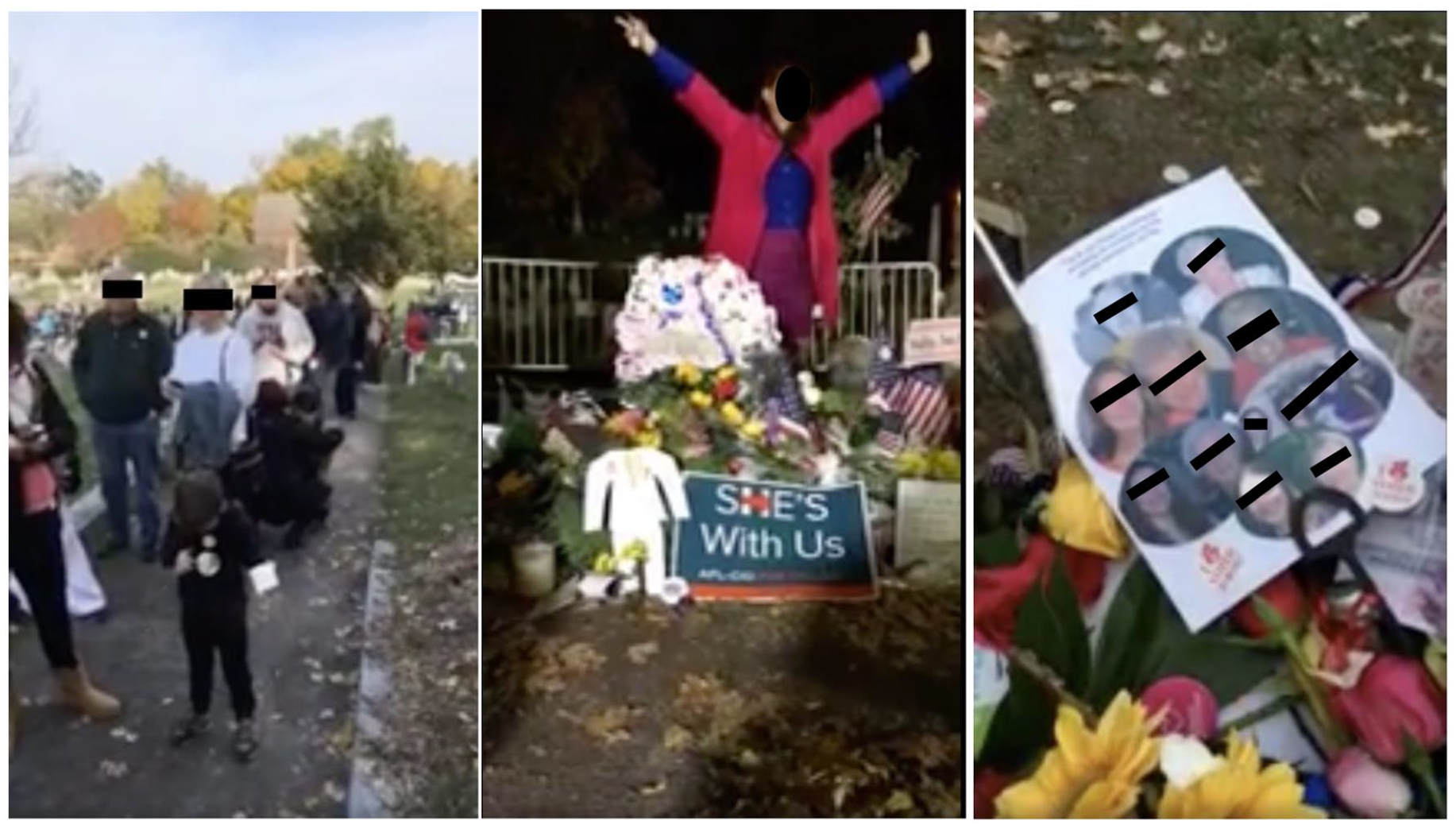
Screenshots from the livestreams, including shots of the crowd of people waiting in line, a visitor posing with the grave, and a close-up of an offering representing a woman’s family history.
Livestream viewers matched these expressions with descriptions of their emotional experiences and gratitude, brought on by collective memories and political liminality. One commenter reacted, “Seriously sobbing all over my desk right now. What an inspiring moment. Thank you, Susan B. Anthony!” Another said, “I’ve never cried over an election before, but here I am, misty-eyed over this. Someone touch the gravestone for me.” The online crowd conveyed its magnitude, not only through quantified metrics embedded in the Facebook Live interface such as view counts and the rapidly updating, sometimes illegible comment feed, but also through the identity work of conveying viewers’ geographic expansiveness and temporal investment. Kucko repeatedly asked viewers to comment with where in the country, or the world, they were watching from. Thousands of viewers chimed in with their locations, and Kucko counted all 50 US states and many other countries. Among the locational comments, one woman wrote, “I’m a 61 year-old woman and I’m so emotional right now. I’m with you all, and we’re with HER. Salt Lake City REPRESENTED!” Many people also shared how long they had watched the over 13 hr broadcast or how many times they had checked in throughout the day. One person commented, “Been watching for 11 hours now. Thanks for sticking with us.” Another said, “Having this on in the background during work really calmed me down today. It’s a good antidote for the political tension during the election cycle. Thanks!”
Displays of affect demonstrate how memory and identity work, filtered through the affordances of livestreaming, can encourage displays of collectivity enabled through the ongoing formation of narrative and performative norms, even across physical distances. Participants demonstrated their commitment to the event and the livestream by waiting in line or watching for hours. In doing so, they also display their commitment to the networked public surrounding the gravesite (Papacharissi, 2015). However, in evaluating these networked and physical collectives, it is also necessary to consider questions of identity and visibility. The types of participation and emotional reactions to Anthony’s legacy and Clinton’s candidacy that become most visible (e.g., pride, hope, joy) also speak to the identities and memories that are privileged at the center of historical and present events.
Regulating “Respect”
The interplay of memory and identity work also invited debate over the true meaning of “paying respects,” attending to social norms surrounding death and performativity in online and offline spaces (Santino, 2004; Wagner, 2018). This practice of regulating “respect” involves debating, policing, or systematizing how historic events and people should be celebrated and remembered within the physical setting of the cemetery and the technical space of Facebook Live. Whereas memory work is a part of remembering the dead (Humphreys, 2018), regulating “respect” often involved criticizing identity work strategies taking place at the gravesite. Regulating “respect” among gravesite visitors centered on systematizing commemorative strategies, while livestream viewers engaged in ongoing debate about the unfolding event.
Early-on in the livestreams, the memory and identity work of visiting Anthony’s grave and taking commemorative photos followed a collaborative process. People lingered around the stone, crouched in front of it, and exchanged smartphones with friends or strangers for photo-taking purposes. They can be heard in the background audio negotiating the inner workings of their phone cameras, requesting additional shots, and thanking one another for the photo-op. After 9 a.m., about midway through the second Facebook Live video, this social photo-taking routine underwent a drastic change as the crowd grew and local government staffers became more involved. A staffer-turned-photographer began taking visitors’ phones and capturing photos as others stood beside the gravestone to usher waiting visitors forward and return their phones to them afterward. The off-camera staffers can be heard instructing people about where to stand and when to move along (“just a few seconds each, please”); directing them to “have your cameras ready,” “zoomed out,” and “flash turned on”; and dismissing those who asked for multiple photos. As a result, visitors stopped pausing to view the grave and primarily paused to pose with it instead, reflecting a friction in rituals of commemoration and emergent patterns of self-representation—a tension situated at the juncture of memory and identity work. In his narration of the broadcast, Kucko calls this “expediting the line,” which stretched to an hour-long wait, and one commenter requested that Kucko, “ask the photographer to be kinder . . . I know they’re trying to move the crowd along, but this is a special moment for many people!”
Viewers of the livestream criticized the activities and partisan displays taking place at the gravesite. They engaged in memory work throughout the livestreams by questioning whether visiting Anthony’s grave in such large numbers, leaving stickers and offerings, and taking photos with the headstone were “respectful” at all. One commenter said, “This desecrates her final resting place . . . how disrespectful! You watch these fools walk all over the grave and video it. This is cemetery etiquette 101 . . . my parents taught me as a child . . . don’t step or walk on the dead!” Another wrote, “I’m confused . . . I thought we were honoring Susan B Anthony. This looks more like a big photo op with her grave? What’s going on here? Like, seriously?” These issues were magnified by discussion surrounding the partisan identity work that informed the event, favoring Hillary Clinton and the Democratic party, as commenters grappled with the ethics of attaching partisan sentiments to the dead. The discourse centered on partisan offerings and signage placed around the grave, as seen in Figure 3, amid comments supporting Clinton and a smaller contingent supporting the Republican candidate, Donald Trump. One commenter wrote, “I want to go down there and kick that Killary sign off the grave. Susan B was a saint. Hillary is a devil.” This coalesced with a wider contingent of viewers who set out to reject the “identity politics” of connecting Clinton and Anthony at all, as “voting for Hillary because she is a woman is like drinking antifreeze because it looks like Gatorade.” Many of these negative comments were attributed to “trolls” who were also regularly classified as men. One commenter noted, “I love all the men who keep sharing rude comments, trying to ruin this for us. Yeah, as if we don’t have to deal with that every day, lol.” Kucko set out to control the comments by regularly reminding viewers to “put your politics aside . . . this is about being in the moment.”
Efforts to regulate “respect” among gravesite visitors and viewers reflect how memory and identity work can spark criticism and social regulation. Commemorating Anthony’s legacy resulted in moralizing over the most respectful way to do so. For some, activities and discourses that center identity (e.g., photo ops, partisan identity politics) were viewed as signs of disrespect or opportunities to exert control during the unfolding event. Just as they can invite collectivity, memory and identity work can coincide to spur discord.
Personalizing Political Imaginaries
Finally, in collectively waiting out a historic political moment, gravesite visitors and livestream viewers personalized political imaginaries by positioning themselves within contested visions of US American women’s political history and future. This encompasses the memory work of reconstructing and revising histories of women’s suffrage while strategically imagining its future legacy through visions of Hillary Clinton’s presidency. Citizens, and particularly women, articulated these visions through the identity work of positioning themselves and their personal memories within conflicted narratives of the political past and future. Gravesite visitors embodied past and future narratives through their presentation and activities at the event, and livestream viewers entered their visions into the comment feed.
As seen in Figure 1, people visited the gravesite in multi-generational groups of children, adults, and elderly citizens, representing different generational perspectives on women’s suffrage and a wider feminist politics leading up to Hillary Clinton’s presidential candidacy. Visitors ranged from baby girls dressed in “future president” shirts and women World War II (WWII) veterans who were born over a century prior. Visitors and viewers remarked on the symbolic significance of young and old women at the gravesite. One viewer wrote, “These children are our future! I love seeing people bring them here.” Women also dressed in white to symbolically associate themselves with the clothing worn by suffragettes or donned full historical costume. A group of women from the Susan B. Anthony Center at the University of Rochester did a live reading of the Declaration of Sentiments, a document signed in 1848 by representatives (although not Anthony) from the first women’s rights convention in Seneca Falls, NY. Visitors also brought offerings that bridged identity and memory work by memorializing women’s history in their own families, including signs with collaged photos of women relatives, as seen in Figure 3. Linking the past and future, one person left a miniature pantsuit, a symbol of Hillary Clinton, made in white fabric, to emulate suffragette garb.
Livestream viewers used the comments to imagine and revise the history of women’s suffrage articulated through the event while also envisioning a future with a woman US president. Viewers shared their own personal connections to Susan B. Anthony through family histories and other ties, including grandmothers who lived in Anthony’s time, sharing the same birthday, or attending a school named after her. They also questioned both whether Anthony would approve of the event at her gravesite and who she would have voted for if she lived to see the 2016 election. Disapproval based on identity politics or Clinton’s policy positions became attached to the phrase, “Susan B. Anthony must be rolling in her grave.” For example, “She was a Republican and voted the Republican ticket. She’s gotta be rolling over in her grave that the Democratic party is using her legacy like this.” Others suggested that Anthony would celebrate Clinton’s candidacy and women’s right to vote for a woman president, “This is so special. Susan is dancing in heaven.” Beyond debating Anthony’s opinion of contemporary politics, viewers also commented to criticize what honoring Anthony on such a large scale represents. They presented revisions to the historical accounts and memories articulated at the event as expressions of White feminism. One commenter wrote, “She fought for white women to get the vote, white women only. I can understand them being grateful, but I’ll thank Ida B. Wells instead.” Another noted, “Remember that Shirley Chisholm, an African woman, ran for president a while ago and Winona LaDuke, an indigenous woman, ran for vice president too.” Visions of the future sparked far less debate. Beyond merely supporting Clinton or predicting her presidency, some commenters imagined the future by behaving as though she had already won the election, writing things like “I hope Madame President visits this grave tomorrow so she can put her sticker there too” or “A woman will finally hold the most powerful elected office in the most powerful country.”
To engage in the memory work of tying the past and future to the present, visitors and viewers of the gravesite event drew together their own bodies, identities, and personal histories. Amid the liminal hours of major political transition, the gravesite event, Instagram, and the livestreams afforded digital and physical spaces to imagine one’s own place within women’s political history and, in the comments section, to reflect on the limitations of these visions.
Conclusion
Livestreaming has played key roles in institutionalized politics beyond the 2016 election. Due in part to pandemic-era safety restrictions, the 2020 US election kicked off with a gaming livestream hosted by Congresswoman Alexandria Ocasio-Cortez that quickly became one of the largest in history (Kastrenakes, 2020) and concluded with local ballot-counting livestreams broadcast in the interest of electoral transparency (Basu, 2020). The 2020 election, which marks the centennial of the 19th amendment granting women the right to vote, also saw Kamala Harris elected to office as the first woman and person of color to serve as Vice President of the United States. Nevertheless, tensions between the personal and political continue to inform and challenge contemporary politics, driven in part by the growth of digital technologies (Bennett, 2012; Mason, 2018). The 2016 Election Day livestreams at Susan B. Anthony’s gravesite exemplify how citizens’ memories and identities can straddle the imagined boundary between the personal and political to inform displays of political participation. This research examines four discursive practices of memory and identity work that contributed to recording and sharing a major political event. The practices include representing commemoration, displaying affect, regulating “respect,” and personalizing political imaginaries. They emerge from a networked public based in complex institutional and personal tensions, including collective memories of Susan B. Anthony’s suffrage activism and White feminist legacy, coordination by a Black woman mayor, and participation from largely White women.
Although it is rooted in a specific case, this project makes broader contributions to literature on political communication, digital technologies, and identity that could be applied across contexts. I examine how the discursive processes of memory and identity work can mutually inform one another to co-constitute political practices, witnessed “in, by, and through media” (Frosh & Pinchevsky, 2009, p. 1). The interdependence of memory and identity work can unite individualized political expressions to build networked publics through interaction and identification with shared narratives of self and society while also compounding criticism about how identities can be performed and how memories should be constructed. The mode of livestreaming, through its live broadcast and real-time comment feed, can further enable viewer interaction and investment across physical distances (Taylor, 2018). I outline how these processes intersect to shape personal narratives of political participation and cultivate participatory cultures in digital and physical spaces. This case suggests the significance of memory and historical narratives in citizens’ political sense-making processes, a topic that requires further empirical research.
I also prioritize the work within memory and identity work through close study of these discursive processes in real time, as well as the textual products they produce. In other words, the livestreams provide a constructed lens through which to examine how memory and identity work unfold and overlap. The discursive practices I outline here could not have emerged without the distinct technical affordances of livestreaming, cultivating real-time sociality during an unfolding political milestone. I attend to the distinct roles that Facebook Live affords to various stakeholders in the livestreams, including in-person visitors to the gravesite onscreen, livestream viewers in the comments, the journalist behind the camera, and local government staffers organizing the in-person event. Although the significance of livestreaming in social movement activism, sousveillance, and protest is well documented (e.g., Andén-Papadopoulos, 2013; Kavada & Treré, 2020; Martini, 2018), this case demonstrates the important role it can play in institutionalized political processes, by bolstering collective identities, giving voice to conflict among citizens, and bridging physical and digital spaces for political engagement. As livestreaming continues to shape institutionalized politics on a global scale, it is critical to understand how its affordances can uniquely support and trouble these processes.
Susan B. Anthony is an icon of contemporary feminism for her contributions to securing US American women’s right to vote, but studying the 2016 gravesite livestreams also highlights tensions within Anthony’s legacy, women’s political positions in digital spaces, the enduring history of White feminism, and the broader personal politics of identity at the intersection of race and gender. These tensions invite questions about how “ordinary” citizens, and particularly women, represent themselves within major and everyday political moments using the political and digital tools at their disposal. Visions of a woman US President articulated in the gravesite livestreams remain unfulfilled. In 2016, election exit polls reported that over 50% of White women voted for Donald Trump instead of Hillary Clinton. The Women’s March, a nationwide feminist protest staged after Trump’s inauguration in 2017, was widely criticized for prioritizing White cisgender feminist perspectives (Desmond-Harris, 2017). These events invite scholars to continue considering the social meaning and significance of political representation and whether historical and contemporary political figures can reflect, inform, or stand in for the multifaceted perspectives and histories of US American women. The gravesite livestreams present a call for continued inquiry into the relationship between identity and politics while also suggesting the mutual importance of memory and history in shaping participatory futures.
Footnotes
Declaration of Conflicting Interests
The author(s) declared no potential conflicts of interest with respect to the research, authorship, and/or publication of this article.
Funding
The author(s) received no financial support for the research, authorship, and/or publication of this article.
