



Abstract
This study draws on the social identity approach (SIA), to examine how political elites (i.e., members of the 116th United States Congress) communicated norms about mask-wearing on social media during the COVID-19 pandemic. Using Twitter data collected in 2020, we found that Republican members of Congress were significantly less likely to promote mask-wearing than Democratic members. We also observed some variations in norm-conforming behaviors among the members of each party. For Republicans, increased loyalty to the Trump leadership was significantly associated with a lower level of mask promotion. For Democrats, we found some evidence that loyalty to the party predicted higher levels of mask promotion. On the other hand, interactions with out-group members decreased adherence to party norms for both Republican and Democratic members of Congress. These findings allow us to better understand the social–psychological effects of party membership among political elites as well as the importance of leader–follower relationships and intergroup interactions.
Keywords
Introduction
There is a broad scholarly consensus that political polarization in the United States has increased in recent decades at the elite level (McCarty et al., 2016). Some scholars view the increasing party polarization among elites as a social–psychological phenomenon that stems from intergroup conflicts (Gelman et al., 2021; Russell, 2012). According to this view, group identity-based motivation drives the polarization of the political elites. This is particularly prevalent in the context of social media, where partisan cues are publicly available (Grossman et al., 2020).
This group identity perspective may help to explain elite party members’ polarizing attitudes toward the COVID-19 preventive measures, with Democrats promoting social distancing and mask-wearing and Republicans shunning such policies. However, existing research suggests that not all politicians adhere to party norms with the same level of intensity (Gelman et al., 2021). Some members may even demonstrate behaviors that diverge from party norms (Green, 2016). Given these observations, we pose the following questions: What factors or sources drive the partisan intensity of politicians? When do politicians diverge from party norms? Since the Trump leadership was based on populist ideologies (Bucy et al., 2020), another important question to consider is: How does populist leadership influence the partisan behaviors of politicians regarding the COVID-19 pandemic? Answers to these questions should advance our understanding of contemporary American politics on social media and assist in finding paths to meaningful political dialogues and political consensus building.
To address these questions, we applied the social identity approach (SIA) to political communication on social media. We examined three sources of partisan intensity: leadership, party identification, and (in- and out-) party member interactions. We further investigated how different sources of partisanship influenced the extent to which Republican and Democratic congressional members promoted mask-wearing on Twitter in 2020. We focused on the social media-mediated communication of this public health issue for three reasons. First, mask-wearing remained controversial throughout the 2020 Presidential campaign although health authorities in April 2020 recommended that everyone should wear masks to prevent the spread of COVID-19. Second, research has shown that members of Congress (MoC) increasingly use social media to publicize their policy positions, share reactions to topics, and support their party (Gelman et al., 2021; Yu et al., 2021). In highly uncertain times, such as during the COVID-19 pandemic, many constituents look to their representatives for guidance. Thus, politicians who publicize their thoughts regarding public health policies on social media may have profound social and public health impacts. Third, politicians may demonstrate strong partisanship during a major election year, thereby making the effect of partisan identity more pronounced.
For Republicans, we found that the intensity of partisanship based on loyalty to the Trump leadership was a significant driver of norm-conforming behaviors (i.e., reluctance to promote mask-wearing). However, interactions with out-group members (Democrats) significantly predicted deviation from Republican party norms (i.e., interactions with Democrats were associated with increased mask promotion). For Democrats, members who frequently interacted with the official party were more likely to promote mask-wearing and adhere to party norms. However, out-group interactions with Republicans significantly decreased the norm-conforming behaviors of Democratic members.
Our findings show that the SIA provides a useful lens for understanding the communication dimension of partisan identity among political elites and comparing the impact of partisanship intensity based on three different sources. This study provides explanations for drivers of politicians’ convergent and divergent behaviors with respect to partisan norms. In addition, we find that populist leadership alone can turn a non-partisan, public health issue into a partisan symbol, via a trickle-down effect from political leaders. Finally, our findings suggest that out-group interactions are also key to understanding partisan dynamics, and may create more common ground in a hyper-partisan Congress.
Political Parties as Social Groups
Social Identity Approach
The SIA 1 provides a theoretical framework for understanding the emergence of norms and polarizing behaviors in an intergroup setting. SIA comprises a number of complementary theories, most notably social identity theory (SIT; Tajfel & Turner, 1979) and self-categorization theory (SCT; Turner et al., 1987). SIT was developed to explain collective phenomena—such as intergroup conflicts and cooperation—from a group perspective. Moreover, SIT assumes that social identities are vital to a person’s self-concept and serve as a map for one to navigate the social world. According to SIT, when people think of themselves and each other as members of social groups as opposed to idiosyncratic individuals, they are motivated to create a positive distinction between one’s own group (the in-group) and the other group (the out-group) (Hogg & Reid, 2006; Tajfel & Turner, 1979). People engage in various group-serving behaviors—such as in-group favoritism and outgroup derogation (Tajfel & Turner, 1979)—a way to maintain a positive social identity. They perceive the fate of the group as their own. At a collective level, this shared sense of identity (or “we-ness”) leads group members to increase the distance between the groups and reach a consensus within the same group.
SCT adds to SIT by articulating the social cognitive processes that generate social identity effects (Hogg & Reid, 2006; Turner et al., 1987). The key elements of SCT are the notions of group prototypes and norms. Group prototypes are a set of stereotypical attributes, which are formed based on the comparative intergroup context. SCT posits that people cognitively represent social groups in terms of group prototypes (Turner et al., 1987). Prototypes are not an objective reality but rather a subjective sense of attributes—including beliefs, attitudes, and behaviors—that characterize a certain group (Hogg & Reid, 2006; Hornsey, 2008). In addition, prototypes are not static and can be changed by members both within and external to the group.
When these prototypes are shared through communication and social interaction, they reflect members’ shared understanding of reality and guide their collective behavior to become group norms. Critically, group norms have prescriptive power in that those who identify with a group are motivated to conform to the norms (Turner et al., 1987). When there are no clearly established norms, people look to core group members and leaders for information about context-specific group norms (Hogg & Reid, 2001). Leaders and elite members are perceived to be reliable sources as they are believed to advance the positive distinctiveness of the group. Hence, leaders have considerable freedom and power to define group norms in ways that do not appear to be associated with group identity (Hogg, 2001). For this reason, leaders are characterized as “entrepreneurs of identity” (Reicher et al., 2018) who can effectively construct and manage group norms. They spend a great deal of time defining a problem facing the group and communicating an approach to resolve the issue.
Partisanship and Mask-Wearing as a Group Norm
The SIA has been extensively used to account for the nature of partisanship and its political consequences (Greene, 2004; Iyengar et al., 2012). A political party is a well-defined group that binds members together based on shared goals and worldviews (Raymond & Overby, 2016). Members of the same party naturally develop a sense of camaraderie and belonging, which leads to both sensitivity to group norms and mimicry of other in-group members’ behaviors. This group process can supersede individuals’ personal preferences or values.
This socio-psychological approach also provides a lens to investigate differences between Republican and Democratic Congress members with respect to their attitudes about public policies related to COVID-19, including mask-wearing. During the early days of the pandemic in the United States, then-President Donald Trump often emphasized “us” versus “them” and stoked partisan division (Gollust et al., 2020). President Trump argued that the Democrats were using COVID-19 to scare people for political gain and that Democrats’ health concerns were their new hoax (Egan, 2020). Trump also associated mask-wearing with the norms of the other group, such as the media or Democrats, refusing to wear one in public until July 27, 2020 2 (Victor et al., 2020). For example, President Trump said “I wore one (a mask) in the back area. I didn’t want to give the press the pleasure of seeing it” (May 21, 2020). At a presidential debate, he also pointed to Joe Biden, the rival Presidential candidate, and remarked: “I don’t wear masks like him” (September 29, 2020).
According to SIA, the tendency to self-categorize in terms of the salient group is elevated when uncertainty is high and intergroup comparisons are pronounced. As such, an unstable external environment such as COVID-19 increases people’s desire for a positive group identity to reduce uncertainty (Abrams et al., 2021). In this process of self-categorization, people interpret cues from their leaders as guiding principles to model their own group behaviors. In this sense, Trump’s repeated refusal to wear a face mask and cavalier attitudes about the pandemic would have impacted the prominence of COVID-19 to political parties and the emergence of norms (i.e., wearing masks) perceived to be associated with a particular group (i.e., Democratic party).
This theorization leads us to believe that Republican and Democratic congressional members differ in the extent to which they promote mask-wearing on social media to mirror the norms of their respective parties. Previous studies have observed a similar partisan gap in the public’s attitudes toward the seriousness of COVID-19 (Allcott et al., 2020; Clinton et al., 2021; Kerr et al., 2021). Unlike these studies, the current study focuses on elite party members and their social media messaging. We argue that elite members’ communication on social media have an important value in shaping and activating group norms. The technological affordance of social media offers politicians abundant opportunities to express their social identities and popularize party norms (Buccoliero et al., 2020). In addition, the highly homophilous nature of interactions among MoC on social media (Chamberlain et al., 2021) can make politicians highly cognizant of party identity and further encourage them to align their attitudes with the party (García-Sánchez et al., 2021). For these reasons, we propose the following hypothesis:
H1: Democratic congressional members are more likely to promote mask-wearing than Republican congressional members on Twitter.
Major Drivers of Partisanship Intensity
SIT suggests that not all members demonstrate the same level of partisanship intensity despite the motivation to differentiate between groups (Tajfel & Turner, 1979). For instance, studies of political parties have found that MoC demonstrate different levels of party support and loyalty although party cohesion measured by voting behaviors may appear to be unanimous (Gelman, 2020; Russell, 2012). Similarly, studies of internal party leadership dynamics suggest that legislators perceive some members to be more partisan than others, which subsequently influences the perception of their leadership (Green & Harris, 2019).
These findings beg the question: What are the major drivers of partisanship within the context of COVID-19? The extensive literature on political social identity suggests three possible sources: individual leader, political party, and fellow members (Barber & Pope, 2019; Lee, 2008). In general, these sources provide cues and collectively shape the group norm. However, they can invoke different prototypes and represent the group to a varying degree. Previous studies have found that individual leaders have a large influence on public opinion, sometimes overriding those of official parties (Agadjanian, 2021; Barber & Pope, 2019). Despite such findings, the extent to which individual leaders, parties, and members influence norm formation is highly subject to the emerging group dynamics and ultimately an empirical question.
Partisan identification and intensity can be measured in a number of different ways. In this study, we use the number of times politicians re-shared messages from a target source on social media as a proxy of their support. We chose this indicator for two reasons. First, asking political elites about their attitudes toward leaders or parties is challenging due to the difficulty in gaining access to this population. Thus, extensive efforts have been made to measure the attitudes of political elites based on social media data (Gelman et al., 2021; Russell, 2020). Second, previous studies measure partisan intensity based on the amount of time and effort that group members devote to partisan activities (Gelman, 2020). In particular, prior research has found that sharing other partisan individual’s posts (e.g., retweets) on social media is a reliable measure of partisan cheerleading (Meier & Elsweiler, 2019; Shin & Thorson, 2017; Spell et al., 2020). Although retweeting or resharing can have various meanings depending on the situation and contexts, repeating the other user’s messages verbatim is generally considered as a form of endorsement, especially in political discussions (Ceron & d’Adda, 2015; Guerrero-Solé, 2018).
Leadership and Populist Leaders
In American politics, party leaders—especially presidents—have great power in terms of managing the party’s identity (Lee, 2008). According to SIA, people in groups trust their leaders to advance the group’s best interest and thus allow leaders to construct the group’s identity (Hogg, 2001). A leader’s influence is the extent that the leader establishes himself or herself as a highly prototypical member within the group and displays strong in-group favoritism. Trump fits this description (Hornsey et al., 2020). Political scientists (Bartels, 2018; Espinoza, 2021) argue that since the 2016 election, Trump has successfully united Republican partisans on several issues (e.g., concerns about reverse discrimination against Whites) and redefined the prototypicality of the Republican party (e.g., what it means to be a Republican in the Trump era).
In addition, Trump’s populist-style leadership may have magnified his appeal during turbulent times. Over the last decade, the rise of populist leaders and parties has introduced a powerful political movement worldwide (Chernov, 2019). Because populist politicians claim that they fight on behalf of “the virtuous people” against “the corrupt elite” (Mansbridge & Macedo, 2019), populist leaders often demand loyalty not toward their party (which can be a symbol of the establishment) but toward them personally (Jacobs & Spierings, 2019). Populist leaders are often described as charismatic idols who defend the people and do not depend on the patronage of the establishment (Kreis, 2017). In parties led by populist leaders, members are commonly expected to yield to the will of the leader. In such groups, signs of deviance could be perceived as disloyalty.
As such, we expect that group members who identify with President Trump would also endorse his attitudes toward public policies, such as wearing a mask. As discussed earlier, Trump has expressed hostile attitudes toward mask-wearing. During the period of time considered in this study, the Republican Party had a highly visible leader, President Trump, but the Democratic Party did not have a similar uniting figure. Therefore, we focused on our hypothesis on the impact of in-group leaders on Republicans 3 , and predicted that Republican congressional members who showed more signs of endorsing Trump would be less likely to promote mask-wearing. As such, we propose the following hypothesis:
H2: Republican congressional members who retweeted more of Trump’s messages are less likely to promote mask-wearing on Twitter.
Party Identification
Partisan intensity can vary depending on the extent to which members identify with their formal political party (Greene, 2004). For MoC, political parties represent group identity and are a reminder of group goals against a common rival (Raymond & Overby, 2016; Russell, 2012). Parties can take different forms, but national party organizations—such as the Democratic National Committee (DNC) and Republican National Committee (RNC)—embody group identities, as they provide continuity and stability for the group members (Heersink, 2021; Herrnson, 2009). Party leaders and elite members pay considerable attention to their party organizations as a brand that represents their interests. Moreover, they engage in various activities that publicize the party’s policy positions through social media, campaign ads, and press releases (Heersink, 2021).
Identification with official party organizations increases intergroup differentiation (Iyengar & Westwood, 2015), and those with a stronger partisan identity may exhibit behaviors consistent with group norms to a greater extent than others (Greene, 2004). This context suggests that, for Republicans, party identification could have decreased mask-wearing because the party leader, Trump, showed a cavalier attitude about wearing masks. For Democrats, party identification could lead to increased promotion of mask-wearing to differentiate themselves from the Republican party. Therefore, we proposed the following hypotheses:
H3(a): Democratic members of Congress who more frequently retweet official party accounts’ messages are more likely to promote mask-wearing on Twitter.
H3(b): Republican members of Congress who more frequently retweet official party accounts’ messages are less likely to promote mask-wearing on Twitter.
Member Interactions
In addition to leadership and official party identification, politicians’ interactions with other politicians both within and outside of their own political parties may also influence their dedication to party norms. According to the SIA (Tajfel & Turner, 1979), group affiliation could enhance interactions among in-group members at the cost of decreased interactions with out-group members. Previous research in social network science has found that the convergence of behaviors due to frequent social interactions generates a strong sense of group belonging (Heere et al., 2011; Tamburrini et al., 2015). Heere et al. (2011), for example, found that interactions between individual members strongly influenced their perception of group-belonging, the formation of social identity, and support for associated organizations. In political settings, research has shown that politicians are more likely to co-sponsor a bill with in-group members (Neal, 2020) and interact with in-group members on social media (Chamberlain et al., 2021).
SIA, in particular SCT, proposes that in-group/out-group differentiation is key to social identity formation (Turner et al., 1987). In terms of in-group interactions, research has found that frequent interactions with in-group members can strengthen conformity to group norms and often leads to out-group derogation. Suzuki (1998) found evidence that strong identification with one’s in-group may justify social distancing from the out-group, which may further reinforce feelings of dislike and mistrust against the out-group. As such, we hypothesized that for both Democrats and Republicans, more frequent in-group interactions lead to greater group norm-conforming behaviors.
H4(a): Democratic members of Congressional who more frequently retweet messages from other in-group members are more likely to promote mask-wearing on Twitter.
H4(b): Republican members of Congress who more frequently retweet messages from other in-group members are less likely to promote mask-wearing on Twitter.
In contrast, interactions with out-group members may lead members to deviate from in-group norms. For instance, research suggests that more diverse individual networks and frequent interactions with out-group members are associated with higher levels of knowledge and acceptance of out-group views (Chen, 2015). In other words, interactions with the out-group may counter the effect of political polarization and allow some members to adopt the views of the other party. Therefore, we proposed the following hypotheses:
H5(a): Democratic members of Congress who more frequently retweet messages from out-group members are less likely to promote mask-wearing on Twitter.
H5(b): Republican members of Congress who more frequently retweet messages from out-group members are more likely to promote mask-wearing on Twitter.
Method
Data
Twitter was the venue for data collection. We collected publicly available tweets from the members of the 116th US Congress (n = 536) between January 1 and November 3, 2020 (the day of the 2020 presidential election). Twitter accounts of members were identified from C-SPAN as well as the congress-legislators GitHub repository 4 . Following Green et al. (2020), we selected a personal account, which tended to have more followers than an official account, if a member had multiple accounts. Once the accounts were identified, we used the Twitter REST application protocol interface (API) to collect tweets and basic account information. The API calls were made on a regular basis to avoid gaps in data collection.
Dependent Variables
Number of Tweets Promoting Masks
We employed the following steps to identify pro-mask tweets. First, we filtered tweets (n = 8,529) from the MoC that contained the keyword “mask(s)” from a larger corpus of tweets. Then, a group of eight trained human coders independently reviewed each tweet and coded for two variables: relevancy and attitude. The relevancy variable indicated whether the tweet itself was relevant to facial masks in the context of the COVID-19. This step was necessary because the keyword “mask(s)” was often used for other meanings, such as in the example of “the whistleblower is still masked by a dark veil of secrecy.” If the coder deemed the tweet as relevant, he or she then determined the attitude of the tweets toward mask-wearing either as pro-mask, anti-mask, or neither. The codebook developed for this study specified that if a tweet encouraged mask-wearing or mentioned the effectiveness of masks as a preventive health measure, it should be coded as “pro-mask.” If a tweet discouraged mask-wearing or cast doubt on the effectiveness of masks, it was coded as “anti-mask.” If a tweet did not fall into one of these two categories, then the message was coded as “neither.”
To establish high intercoder reliability, coders went through two rounds of training led by the first author. Coders were assigned to evaluate a random set of tweets at each session (n = 50, n = 100) and compared results. During this process, some further clarifications were made such that tweets lacking an explicit endorsement of mask-wearing should be classified as “neither.” According to this rule, tweets focusing on the status updates of mask supplies, manufacturers, and donors were coded as “neither.” See Table 1 for the examples of tweets for each category. A sufficient level of intercoder reliability was achieved by the third training session. Thus, the remaining tweets were independently coded by two coders without further instruction. Intercoder reliability was assessed using Krippendorff’s alpha, which was 0.89 for the relevancy variable and 0.81 for the attitude variable. Disagreements between coders were resolved by the first author who decided the final values. For the main analyses, the numbers of pro- and anti-mask tweets were aggregated at each individual member level. Since an exceptionally small number of Congress members publicly expressed negative attitudes about masks, we did not run statistical models on anti-mask tweets.
Examples of Tweets for Each Category.

Independent Variables
Party Affiliation
This variable indicated whether a member was affiliated with the Republican Party or Democratic Party. Independent members were excluded from the study. Party identification was determined from the congress.gov website and was cross-checked with data from C-SPAN.
Retweets of President Trump’s Messages
We extracted members’ retweets 5 of President Trump (@realDonaldTrump) from the corpus of tweets made in 2020. We used the number of times a member shared President Trump’s tweets during the data collection period to quantify the level of Trump endorsement (M = 1.48, SD = 5.81). Trump’s messages were mostly retweeted by Republican members (M = 3.13, SD = 8.15) and rarely retweeted by Democratic members (M = 0.01, SD = 0.10).
Retweets of Official Party Messages
We measured the number of times that members retweeted messages of the official Twitter accounts of each party. For Republicans (M = 4.87, SD = 19.13), we extracted retweets of three accounts: GOP (Republican National Committee), HouseGOP (House Republicans), and SenateGOP (Senate Republicans). Similarly, for Democrats (M = 3.06, SD = 9.32), we retrieved retweets of three accounts: TheDemocrats (Democratic National Committee), SenateDems (Senate Democrats), and HouseDemocrats (House Democrats).
Retweets of Republican MoC Messages
We quantified the extent to which Congressional members retweeted other Republican members during the data collection period (M = 14.72, SD = 54.64). For Democrats, this number represented out-group member support, whereas for Republicans, it indicated in-group member support.
Retweets of Democratic MoC Messages
We measured the extent to which Congressional members retweeted other Democratic members during the data collection period (M = 31.39, SD = 69.60). For Republicans, this number represented out-group member support, whereas for Democrats it indicated in-group member support.
Control Variables
Our models included several Twitter-related and demographic-related control variables, which had previously shown to be of importance (Jacobs et al., 2020; Shin, 2020).
Number of Twitter Followers
Using the Twitter API, we recorded the number of followers for each member (i.e., those who followed the Congress member’s account, M = 135,754.70, SD = 455,232.80) on November 3, 2020 (the last day of the data collection).
Number of Twitter Followers
We recorded the number of followers for each member (i.e., the accounts that the MoC themselves followed, M = 1,938.33, SD = 4,025.29) on November 3, 2020.
Number of Tweets in 2020
We calculated the number of times each MoC tweeted during the data collection period, excluding any mask-related tweets. This variable indicated the amount of Twitter activity for each member in 2020 (M = 934.82, SD = 671.49).
Twitter Tenure
This variable refers to the number of years that each member had been on Twitter and was calculated by subtracting the year the member created their account from 2020 (M = 6.93, SD = 3.54).
Chambers of Congress
This variable indicated the chamber to which a member belonged: Senate (18.28%) or House of Representatives (81.72%).
Age and Gender
The age (M = 59.90, SD = 11.85) and gender of each politician (Male = 75.47%) were recorded from the congress-legislators GitHub repository.
Local COVID severity
Based on the New York Times database, we calculated the average number of COVID-19 deaths by the state over the 10-month study period (January–November) (M = 4,511.87, SD = 5,591.03) 6 .
Analytical Approach
Because our outcome variable was in the form of a count variable, we applied negative binomial regression models to test our hypotheses and assess the relationships between pro-mask tweets and the proposed explanatory variables. Due to overdispersion present in the data, a negative binomial regression was more appropriate than a Poisson distribution (Hilbe, 2007). In preliminary analyses, we also compared several models and confirmed that negative binomial regression models performed better than other models (See Appendix Table A1).
In the main analysis, we included only the tweets that were sent after April 3, 2020, the day that Centers for Disease Control (CDC) announced an updated guideline that recommended mask-wearing for all Americans. Prior to April 3, health authorities issued mixed messages about mask effectiveness.
Results
Descriptive Analysis
We first present the descriptive statistics for our data and key variables. During the study period, the MoC produced approximately half a million tweets. Of these, 63.26% (n = 310,111) were from Democratic members and 36.74% (n = 180,122) were from Republican members 7 . This pattern was consistent with the finding of a study from the Pew Research Center (Van Kessel et al., 2020) that suggested that Democratic members tweet more frequently than Republican members. Of these tweets, 1.66% (n = 8,158) were concerned with face masks in the context of COVID-19. From the tweets initially retrieved through the keyword search (i.e., mask), only 4.35% (n = 371) were found to be irrelevant. This result indicates that masks were a distinctive and salient topic during the pandemic.
Of the mask-related tweets, a majority of messages (69.29%, n = 5,653) promoted mask-wearing. A total of 389 members of Congress tweeted at least one pro-mask tweet during the 10-month study period. Of those who posted at least one promotional tweet, 68.48% (n = 265) were Democrats and 31.52% (n = 122) were Republicans. On average, each politician posted approximately 10 pro-mask tweets during the data collection period. The average number of pro-mask tweets was 17.90 (SD = 20.20) for Democrats and 2.10 (SD = 4.92) for Republicans. See Appendix Table A2 for the average number of pro-mask tweets between January 1 and April 2.
Approximately 27.32% (n = 2,229) of the tweets that mentioned masks did not explicitly express an attitude about wearing a mask. Most of these messages concerned mask supplies, such as urging more rapid production of masks and thanking those who manufactured or donated masks. On average, Democrats posted 3.00 (SD = 4.25) tweets of this type and Republicans posted 2.77 (SD = 4.20) tweets. The tweets of this category were primarily restricted to the early months of the pandemic when masks were in short supply.
Only 3.38% (n = 276) of all mask-related tweets were negative toward mask-wearing. Initially, these tweets appeared to be equally distributed between Democrats (46.67%, n = 21) and Republicans (53.33%, n = 24). However, a subsequent inspection of the data revealed a different pattern. All anti-mask tweets from Democrats occurred before updated guidelines were released by the CDC on April 3, 2020. After this date, all anti-mask tweets (n = 245) were made by a small number of Republican members (n = 16), with one particularly vocal member releasing 188 negative messages about masks. See Figure 1 for the distributions of pro-mask messages and anti-mask messages. The distributions and correlations of key variables are illustrated in Appendix Figure A1.

Distributions of pro-mask and anti-mask tweets between January 1 and November 3, 2020.
Hypothesis Testing
Table 2 shows the results of the negative binomial regression models predicting the number of pro-mask tweets by individual members of Congress. Multicollinearity tests confirmed that the data did not suffer from collinearity, with all variables having a variance inflation factor (VIF) of <2.5.
Negative Binomial Regression Analyses with Number of Pro-Mask Tweets as the Dependent Variable
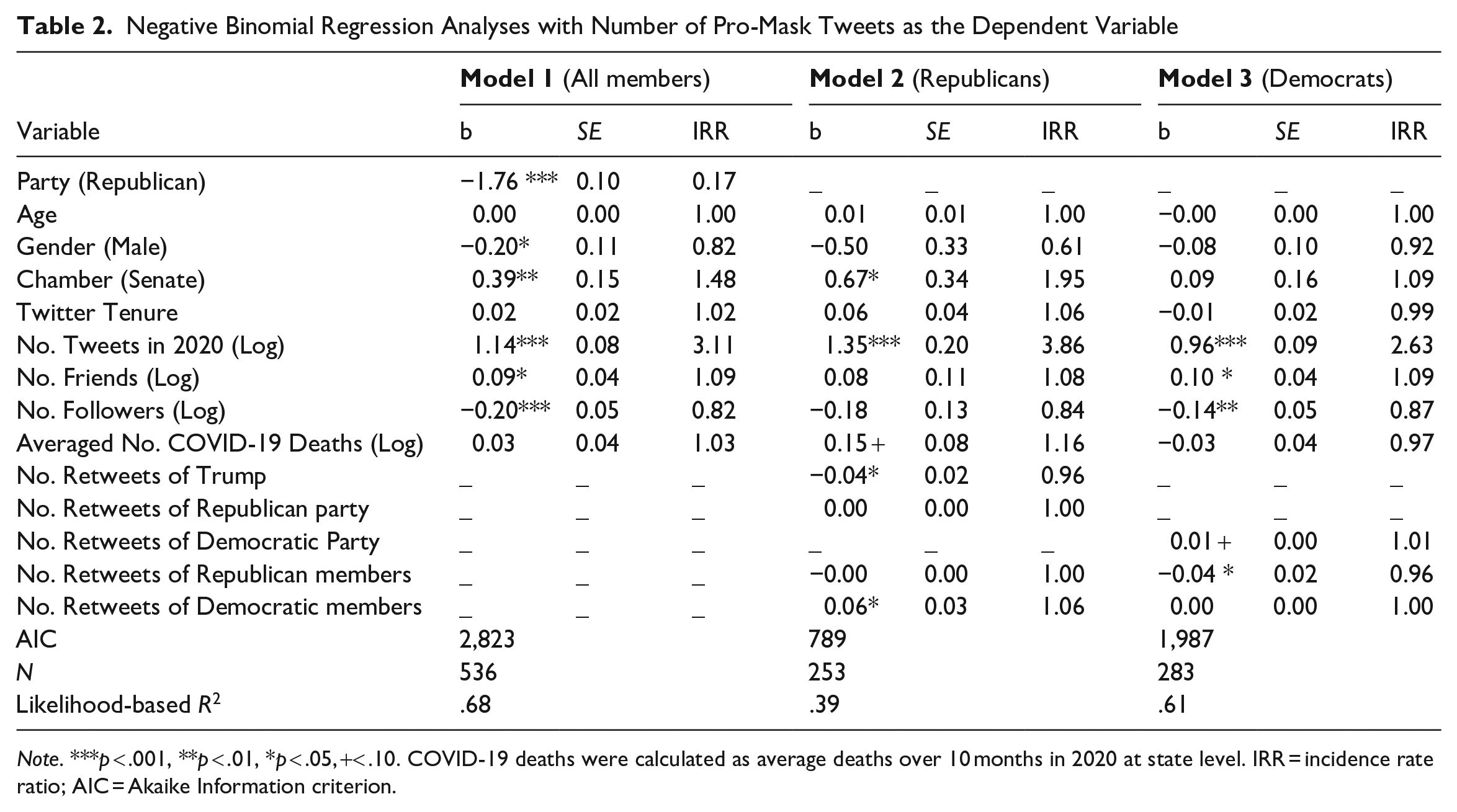
Note. ***p < .001, **p < .01, *p < .05, +< .10. COVID-19 deaths were calculated as average deaths over 10 months in 2020 at state level. IRR = incidence rate ratio; AIC = Akaike Information criterion.
H1 hypothesized that partisanship affiliation was a significant predictor of mask-wearing promotion on Twitter. As shown in Model 1, Republican MoC were significantly less likely to post pro-mask tweets than Democratic members (b = –1.76, SE = 0.10, p < .001, 95% confidence interval [CI]: [–1.97, –1.56]). Therefore, H1 was supported.
We ran separate analyses for Republicans and Democrats to test the remaining hypotheses. Specifically, H2 hypothesized that Republican members who more frequently retweeted President Trump’s messages would be less likely to promote mask-wearing. As Model 2 shows, retweeting President Trump was negatively and statistically significantly related to posting pro-mask tweets (b = –0.04, SE = 0.02, p = .03, 95% CI [–0.08, 0.00]). Thus, H2 was supported.
H3(a) and H3(b) were concerned with the relationship between the endorsement of official party accounts and conformity to group norms. H3(a) posited that Democratic members who had more frequently retweeted their official party Twitter accounts would be more likely to promote masks. As Model 3 shows, a positive, marginally significant relationship was found between retweeting official party accounts and mask promotion (b = 0.01, SE = 0.00, p = .08, 95% CI [0.00, 0.02]). Therefore, H3(a) was marginally supported. The counter hypothesis, H3(b), suggested that Republican members who had more frequently retweeted messages from their official party Twitter accounts would be less likely to promote masks. As shown in Model 2, we did not find a significant relationship between retweeting party accounts and mask promotion among Republicans (b = 0.00, SE = 0.00, p = .40, 95% CI [–0.00, 0.01]).
H4(a) posited that Democratic members who frequently retweeted other in-group members would be more likely to promote mask-wearing. This hypothesis was not supported by Model 3 (b = 0.00, SE = 0.00, p = .47, 95% CI [–0.00, 0.00]). The counter hypothesis, H4(b), suggested that Republican members who frequently retweeted other in-group members would be less likely to promote mask-wearing. The results of Model 2 indicated that there was no relationship between Republicans’ retweets of in-group members and posting pro-mask tweets (b = –0.00, SE = 0.00, p = .48, 95% CI [–0.01, 0.00]).
H5(a) predicted that Democratic members who frequently retweeted out-group members would be less likely to promote mask-wearing. As Model 3 shows, among Democratic members, there was a negative, statistically significant relationship between retweeting out-group members and posting pro-mask tweets (b = –.0.04, SE = 0.02, p = .02, 95% CI [–0.08, –0.01]). Thus, H5(a) was supported. The counter hypothesis, H5(b), anticipated that Republican members who frequently retweeted out-group members would be more likely to promote mask-wearing. In Model 2, we observed a positive, significant relationship between retweeting out-group members’ messages and posting pro-mask tweets among Republicans (b = 0.06, SE = 0.03, p = .04, 95% CI [0.00, 0.12]). Therefore, H5(b) was confirmed.
Discussion
SIA offers a useful theoretical framework to explain interactions and differences between groups such as political parties (Hogg, 2001). The current study applied this social identity framework to better understand how congressional members of two major parties politicized the issue of mask-wearing on Twitter. Our analysis showed that although members of Congress largely echoed the norms of their respective parties, they discussed the topic of mask-wearing to different degrees. Specifically, we found that Republicans’ reluctance to promote mask-wearing was significantly associated with their loyalty to President Trump but not to their official Republican party. For Democratic members, we found that identification with their party was a marginally significant driver of mask promotion. As for the member influence, in-group member interactions did not seem to influence the convergence of norms. However, in both parties, interactions with out-group members did contribute to norm-divergent behaviors. The theoretical and practical implications of each finding are further discussed below.
The Power of Populist Leadership
In our analysis, we found that Trump was a powerful influence in the Republican Party. During the pandemic, President Trump often described mask-wearing as a marker of the Democratic party to downplay the risks of COVID-19. The news media’s coverage of Trump and his staff’s refusal to wear a face mask at public events was widely perceived as a partisan symbol for Republicans (Rojas, 2020). SCT illustrates the process in which cues from a leader activate group identity and lead to the internalization of group norms. Our study consistently demonstrated that Republican MoC were reluctant to promote mask-wearing on social media, mirroring the attitude of Trump. A small number of Republican members even expressed anti-mask attitudes. More importantly, our data corroborated our hypothesis that support for Trump significantly predicted the lack of mask endorsement among Republican MoC.
This finding is consistent with Hogg’s (2001) description of leadership in totalist groups, where party members define party identity based on prototypical members. When leadership in a group is largely based on prototypicality rather than institutionalized structures, the quality of group decision-making can be degraded. Groups may repress deviant voices and distance minorities, eventually resulting in suboptimal decision-making procedures and poor outcomes (Greene, 1999). Such a process could further produce in-group blindness that persists even in the face of adversarial realities. Our study showed that most Republicans were unwilling to change their stance even after the CDC officially endorsed the effectiveness of mask-wearing. Moreover, a leader’s influence on political groups may be enhanced under equivocal conditions—such as a pandemic—simply because following a leader assists in reducing uncertainty (Hogg & Reid, 2001).
Party Identification and Norm Formation
We found mixed effects of party influence. Democratic Congressional members who more frequently retweeted messages from the official Democratic Party accounts demonstrated, albeit marginally significant, a higher level of behaviors that confirmed the group norm (i.e., masks promotion) 8 . This finding is consistent with predictions from SIT and the results of previous research (Iyengar & Westwood, 2015; Neal, 2020). The effect of party identification may be especially salient during times of uncertainty, such as the COVID-19 pandemic. According to social identity theory, one important function that group-based social identity provides for individuals is uncertainty reduction (Tajfel & Turner, 1979). Because the Democratic Party lacked a clear party leader, members may have looked to the official party establishment for group cues and behaved accordingly.
By contrast, we did not find that identification with the official Republican Party accounts had a significant effect on the behaviors of Republican MoC. This finding has two possible explanations. First, the antagonistic approach to wearing face masks may have been President Trump’s agenda but not the Republican party’s. Our study showed that the norm eventually trickled down to elite Republican party members, following an “us” versus “them” group dynamic. In this process, the Republican party did not seem to exert significant influence on the norm diffusion. This may indicate that the populist leadership style substantially undermined the influence of other institutions and establishment in the Republican Party, to the degree that Trump largely represented the party. In this scenario, no other mechanism could counterbalance the President’s influence on Republicans’ construction of norms. In this sense, this finding, along with our earlier findings on the powerful impact of populist leadership, consistently paints a picture of weakening checks and balances in American politics. Second, it is also possible that because of President Trump’s outsized influence, the party official accounts largely repeated what Trump claimed anyway. In this case, the observed lack of influence of these accounts on behaviors could be due to a lack of new insights or value for guiding party members.
The Power of Out-Group Member Interactions
According to social identity theory, intergroup differentiation occurs through a combination of in-group favoritism and out-group derogation (Greene, 1999, 2004); However, the two processes need not occur at the same time. Thus, a higher level of in-group identification may not always be associated with an out-group derogation. We found that when Congressional members had a record of retweeting out-group members (a form of endorsing the views of out-group members), these benign interactions could introduce different views and create motivations for behaviors that diverge from party norms.
According to another prominent political science theory, the political advocacy coalition framework (Sabatier, 1987), interactions among politicians with different beliefs have been found to produce policy learning and belief change, despite the fact that the two parties exist in a competing relationship. Our finding provides robust support for this perspective. We found that within both the Republican and the Democratic Parties, members who interacted more with the other group were more open to out-group influence, leading to fewer behaviors that confirmed group norms. Republicans who interacted more with Democrats were more likely to promote mask-wearing. Similarly, Democrats who interacted more with Republicans were less likely to promote mask-wearing.
However, the idea of cross-partisan interaction deserves a more nuanced understanding given its doubled-edged role. It suggests a possible direction for creating more mutual understanding and cooperation between partisan groups. Exploring alternate perspectives and making informed decisions are key to a deliberative democracy (Kim & Kim, 2008). At the same time, however, meeting halfway is not always beneficial to society, especially when it involves an evidence-based policy. Our study contends that it is important to prevent the formation of an association between a political group and certain public health behavior.
Finally, our findings have implications for the current partisan divide over basic public health measures in the United States. Previous studies (e.g., Bisgaard & Slothuus, 2018) have shown that messages from political elites substantially influence citizens’ interpretations of reality, creating the “follow-the-leader” effect. In this sense, social media is an amplifier of party cues through influential individuals (i.e., politicians). Partisan prototypes turn into prescriptive norms only when they are shared through communication (Hogg & Reid, 2006). In addition, social media is not only a source of influence but also helps to enact norms. Thus, social media offers valuable data capturing political elites’ attitudes and norm communication at a granular level that otherwise would not have been available.
Limitations and Future Research
This study has several limitations. First, our findings were drawn from communications made by members of Congress from a single platform, Twitter. Although Twitter use among politicians is ubiquitous and its content generally mirrors that of other social media outlets (Grossman et al., 2020), future research should expand to include multiple platforms. Second, the current study used retweets of congressional members to measure partisanship intensity. We acknowledge that retweeting is one of many partisan social activities that members could engage in on social media. Future research could leverage various opinion-mining techniques to measure partisanship intensity from the rich social media data. Similarly, because we relied on retweets, we could not measure the attitudes of Democratic members toward the leader of the out-group. Future research may benefit from triangulating data sources to study the behaviors of the political elites and their attitudes toward out-group leaders. Finally, it should be noted that because our data were not longitudinal, we cannot prove causality. Interactions with out-group members could reflect other underlying characteristics, such as district composition and personal beliefs.
Despite these limitations, the current study showed that the social identity approach can be a fruitful perspective for examining the partisan behaviors of political elites on social media. Although SIT and other social–psychological frameworks have been used extensively to account for polarization at the level of the masses, much less research has been conducted at the elite level. Our study showed that social group identity can lead to political polarization over mask-wearing, a value-neutral preventive health measure among political elites. Our study also exposed a trickling-down effect from a populist leader who created an association between mask-wearing and political identity during the early stages of the pandemic. Previous research suggests that after a polarization process unfolds, it takes on a life of its own, making it difficult to dissolve over time (Agadjanian, 2021). Consistent with social identity theory, our findings emphasized the importance of leader–follower relationships as well as in- and out-group interactions. In particular, interactions with out-group members carry significant weight in depolarization.
Supplemental Material
sj-docx-1-sms-10.1177_20563051221086233 – Supplemental material for Mask-Wearing as a Partisan Issue: Social Identity and Communication of Party Norms on Social Media Among Political Elites
Supplemental material, sj-docx-1-sms-10.1177_20563051221086233 for Mask-Wearing as a Partisan Issue: Social Identity and Communication of Party Norms on Social Media Among Political Elites by Jieun Shin, Aimei Yang, Wenlin Liu, Hye Min Kim, Alvin Zhou and Jingyi Sun in Social Media + Society
Footnotes
Declaration of Conflicting Interests
The author(s) declared no potential conflicts of interest with respect to the research, authorship, and/or publication of this article.
Funding
The author(s) received no financial support for the research, authorship, and/or publication of this article.

Supplemental Material
Supplemental material for this article is available online.
Notes
Author Biographies
References
Supplementary Material
Please find the following supplemental material available below.
For Open Access articles published under a Creative Commons License, all supplemental material carries the same license as the article it is associated with.
For non-Open Access articles published, all supplemental material carries a non-exclusive license, and permission requests for re-use of supplemental material or any part of supplemental material shall be sent directly to the copyright owner as specified in the copyright notice associated with the article.
