




Abstract
This study (N = 217) explores the potential for virtual reality to decrease social distance toward outgroup members among women. Raising the salience of individuals’ real physical identity through avatar customization and common ingroup identity manipulations was theorized to influence social distance. Participants who customized an avatar to resemble their real selves showed increased social distance. However, avatar customization also increased user identifiability, which was linked to reduced social distance. Priming a common ingroup identity increased identity salience but did not influence social distance. In examining heterogeneous effects by prior levels of issue involvement, participants with high and moderate involvement with immigration showed increased social distance after customizing an avatar to resemble their real selves, thus implying boomerang effects. The study discusses how avatar customization, identifiability, and common ingroup primes in virtual encounters may influence outgroup attitudes and intergroup relations.
Although interactions between members of different social groups can overcome prejudice toward outgroup members (Allport, 1954), they often entail logistic, linguistic, cultural, institutional, and individual-level barriers. Outgroup members are individuals who do not share an exclusive identity category with someone else, and as such they do not overlap on a salient group membership category (Brewer & Pierce, 2005). Computer-mediated communication (CMC) offers a new arena for outgroup contact that may help overcome these barriers (Alvídrez et al., 2015; Schumann et al., 2017). Increased access, reduced contact anxiety, lower physical risk, and choice between anonymity and identifiability (e.g., nicknames, names, avatars, and photos) may facilitate intergroup interactions in CMC (Amichai-Hamburger & McKenna, 2006). Thus, CMC has potential for supporting intergroup contact and reducing prejudice (N. Kim & Wojcieszak, 2018).
Scant research, however, explores the effects of encounters with outgroup members in virtual reality (VR) despite the increased access and popularity of this technology (Bailenson, 2018). VR offers immersive graphics, along with selective self-presentation features, such as avatar embodiment and customization. Avatar embodiment may trigger perspective-taking effects or melding the self with a virtual character, which may allow users to consider events from someone else’s perspective (Oh et al., 2016), ultimately improving attitudes toward outgroup members. Recent studies take important steps in this direction by documenting how becoming the outgroup in VR influences empathy toward a target (Herrera et al., 2018; van Loon et al., 2018), without—however—examining the basic question of whether and how a virtual intergroup encounter can improve outgroup attitudes.
This study addresses this important and underexplored area, testing the capacity of VR encounters with a political outgroup member to reduce prejudice. Consider that conservatives feel excluded and may self-select out of academia (Rothman et al., 2010) and US academics, college students, and educated adults lean toward liberal political values (Pew Research Center, 2016). Left-wing individuals show increased intergroup bias and negative emotions toward right-wing outgroups (Schepisi et al., 2019). Thus, this study attempts to contribute to the literature by documenting the effects of VR-enabled contact on how liberals perceive conservative political outgroups. To do so, we developed a VR scenario meant to expose immigration supporters to an anti-immigration avatar. We investigated factors that may influence outgroup prejudice following a VR-enabled encounter, such as increasing the salience of individuals’ real self through avatar customization and priming a common ingroup identity before a VR interaction. Whereas the former factor should enhance prejudice by reinforcing a sense of self through mindset priming mechanisms (Sah et al., 2017), stressing a superordinate shared identity should improve outgroup attitudes (Gaertner & Dovidio, 2000; Gaertner et al., 1996; Levendusky, 2018).
The second contribution of our work lies in testing the mechanisms through which VR interactions improve outgroup attitudes. While direct contact research stresses mechanisms, such as reduced anxiety (Pettigrew & Tropp, 2008), the mechanisms by which technology-mediated contact improves outgroup attitudes require further research (Cao & Lin, 2017; N. Kim & Wojcieszak, 2018). In particular, this study explores the link between identifiability and improved outgroup attitudes. Customizing VR avatars to resemble the self may increase individual’s perception that others may identify them in the real world through the appearance of their avatar, which may in turn decrease outgroup prejudice based on increased identifiability mechanisms (Spears & Lea, 1994).
In sum, we test the effects of customizing an avatar to resemble an individual’s physical self and of activating a common identity on outgroup attitudes. We specifically focus on social distance, which is an affective dimension of prejudice which measures intimacy, indifference, or hostility toward outgroups (Bogardus, 1925) or, more specifically, unwillingness to interact with, live next door to, or marry outgroup members. We examine this concept in relation to DACA supporters’ perceptions toward the opponents of DACA, which is a Deferred Action for Childhood Arrivals program for undocumented immigrants that, as of this study, divides the American public (Bialik, 2019).
Avatar Customization
The first theoretically relevant factor considered in this study is avatar customization, which allows detailed modifications of a digital self-representation’s weight, height, outfit, gender, race, and abilities. Users may form deep connections with their avatars. For example, an analysis of user descriptions of their avatars reveals that some players of online games perceive them as independent synthetic entities and thus refer to them as “he” or “she,” whereas other players perceive their main avatar as part of their online social selves and refer to it using everyday life references (Banks & Bowman, 2016). This implies that individuals form parasocial attachment with avatars which vary in degrees of identity differentiation (Banks & Bowman, 2016). Of key importance to the contact hypothesis, avatar customization may raise the salience of an individual’s self through mindset priming mechanisms (Sah et al., 2017). Mindset priming refers to the activation of cognitive operations and procedures which direct individuals to seek specific outcomes and goals in subsequent tasks (Fujita & Trope, 2014). This is rooted in the assumption that avatar customization serves as self-guide and provides behavioral standards as, in general, individuals reduce the discrepancy between current states and salient personal goals by regulating their behavior (Sah et al., 2017). For instance, Sah et al. (2017) asked participants to either customize avatars resembling their actual self with attributes they truly possess, ideal self-avatars reflecting attributes they would like to possess, or ought self-avatars representing duties and attributes they believe must possess. After customizing an ought self-avatar, more health-conscious participants selected healthier food items inside and outside of a game. When making health-related decisions in a virtual world, participants who customized actual and ideal self-avatars also spent more time and money to maintain good health (Y. Kim & Sundar, 2012). Based on the above, self-reflective avatar customization may anchor participant’s mindset in their actual and ideal selves. This should directly increase social distance toward political outgroups as self-reflective avatar customization may raise the salience of race, gender, ethnicity, appearance, and beliefs, which should activate individuals’ personal and political selves (DeMarree et al., 2014).
H1: Customizing an avatar to resemble one’s physical real self will increase social distance toward outgroup members relative to customizing an avatar to resemble someone else.
The Social Effects of Identifiability and Anonymity
At the same time, however, self-reflective avatar customization may indirectly increase identifiability, which should decrease social distance toward political outgroups. While anonymity decreased responsibility and accountability, identifiability decreases social transgressions. This is congruent with deindividuation effects, in which anonymity reduces concerns for how others evaluate the self, which in turn enables individuals to disregard societal norms (Festinger et al., 1952; Zimbardo, 1969). For instance, asking children to use their real names and addresses decreases stealing by increasing transgression accountability relative to having children remain anonymous (Diener et al., 1976). In addition, the social identity model of deindividuation effects (SIDE) predicts that online identifiability leads to increased strategic self-presentation concerns and perceived accountability (Spears & Lea, 1994), whereas online anonymity coupled with partners perceiving each other as dissimilar leads to decreased conformity (Spears et al., 1990). For example, commenters logging in through identifiable social media accounts show less conformity to an aggressive social norm of commenting relative to anonymous commenters (Rösner & Krämer, 2016). Moreover, perceived anonymity among social media bystanders decreases intention to defend a victim of cyberbullying relative to increased identifiability (Brody & Vangelisti, 2016). Although yet unexplored, VR avatar customization may increase identifiability when a resulting avatar exposes the visual that features a user’s real self. Since contact situations entail getting to know outgroup members, individuals experiencing increased identifiability should feel more compelled to improve their outgroup attitudes.
H2: Customizing an avatar to resemble participants’ physical real selves will reduce social distance toward outgroup members by increasing identifiability compared to customizing an avatar to resemble someone else.
Common Ingroup Identity Model
This study also explores whether raising the salience of a common or superordinate group shared by an individual and an outgroup member before a VR encounter reduces social distance. Individuals have multiple personal and social identities varying in relevance across context and time and, thus, different identities of the same individual may be active depending on the salience and fit of a specific identity within a particular context (Turner et al., 1987). Building on this assumption, the common ingroup identity model posits that priming a superordinate ingroup identity may reduce intergroup conflict through identity salience and partner recategorization mechanisms (Gaertner & Dovidio, 2000; Gaertner et al., 1996; Hornsey & Hogg, 2000). Applying this framework to the contact hypothesis, VR intergroup contact effects could be enhanced by priming a cognitive recategorization of two distinct groups (“us” and “them”) into a single superordinate identity (“we”), thereby increasing positive evaluations of outgroup members (Gaertner & Dovidio, 2000; Gaertner et al., 1996). Studies often experimentally induce a superordinate identity by increasing the salience of a feature shared by ingroup and outgroup members or by raising the salience of a broader superordinate identity that represents both ingroup and outgroup members. For example, inducing a common American national identity reduces social distance among US partisans (Levendusky, 2018; Wojcieszak & Garrett, 2018). In this context, inducing a superordinate identity, such as identity of “womanhood” among female study participants may trigger recategorizing an outgroup member (e.g., DACA opponent, as viewed by a DACA supporter) as part of an ingroup (i.e., “we are all women”), thus directly improving outgroup attitudes. This process should also operate indirectly through increased identity salience, which facilitates recategorization and social distance reduction. For example, previous studies examine how perceived identity salience acts as a mediator between racial identity priming and consumer reactions to targeted advertising among participants primed with their Asian and Caucasian identities (Forehand et al., 2002). Similarly, perceived identity salience is investigated as a mediator between national and personal identity priming on stereotype consensus (Haslam et al., 1999). Thus,
H3: Priming a common ingroup identity before a VR encounter will directly reduce social distance toward political outgroups.
H4: Increased female identity salience will mediate the effects of priming a common ingroup identity and social distance toward outgroup members.
There is no formal model articulating the link between avatar customization and common ingroup identity priming on social distance. Based on the above, customizing an avatar to resemble participants’ physical real selves coupled with no common ingroup identity salience may increase social distance. Interaction effects may provide practical implications for interventions aimed at reducing social distance. Thus, we examine potential statistical interactions with a research question asking
RQ1: Is there an interaction effect between avatar customization and common ingroup identity priming on social distance?
Finally, this study examines whether the hypothesized effects emerge differently for sub-groups of individuals. In general, strong attitudes are more resistant to change (Taber & Lodge, 2006) and, more specifically, common ingroup identity inductions are less effective among individuals with stronger partisan identities (Levendusky, 2018). Relative to weak partisans and nonpartisans, strong partisans are more resistant to preferring political candidates with more similar facial features after exposure to a photo of a politician’s face morphed with the participant’s face (Bailenson et al., 2009). Greater issue involvement, thus, may generate resistance toward avatar customization and common ingroup identity primes. We thus expect heterogeneous effects.
H5: The effects of avatar customization and common ingroup identity priming on social distance will be lower among those with higher levels of pre-existing involvement with immigration than among those with lower levels of pre-existing issue involvement.
Method
Participants
To test the proposed hypotheses and research questions, we conducted a 2 × 2 between-subjects laboratory experiment on a convenience sample of female students. A total of 217 participants were recruited at a large West Coast public university for extra credit using a prescreen survey that included several demographic and attitudinal questions. The study was approved by the institutional review board. To examine how liberals react to conservatives, we recruited participants who were female and supported the path to citizenship program for undocumented immigrants in the United States (DACA), an issue that was highly salient when the study was conducted in the first half of 2018. For reference, DACA was rescinded in March 2018. Average participant age was 20.3 years (SD = 2.04). However, 38.2% of the participants were Asian, 27.2% were Latino, 29.9% were Caucasian, 2.3% were African American, and 2.4% identified as other race.
Procedure
Female participants who supported DACA completed a pre-laboratory survey measuring their attitudes toward DACA, climate change, and abortion, as detailed below. On arriving to the laboratory, participants were fitted with an Oculus Rift headgear and motion controls. Experimenters then launched vTime, a free-to-play VR social network platform. Participants were randomly assigned to either customize an avatar that physically looked like themselves or another woman. They were instructed to customize their avatar’s body size, skin color, face, eyes, nose, and hair to make it an accurate representation of themselves or another woman. They could also edit avatar clothes if they thought this was an important factor. This was meant to create a stronger or weaker sense of identifiability. After 10 min of customization, participants were randomly assigned to a common female identity induction or a control. In each condition, an experimenter asked the participants to either reflect about what traits are common to women in general and to describe the experience of being a woman (common female identity condition) or to describe their dormitory room (control condition). Participants had 3 min to write their response and were later told that they will have a discussion with a virtual partner. Experimenters rolled a dice in front of the participant to simulate a randomized selection of a discussion topic. However, the topic was predetermined to be immigration and there was no actual discussion partner.
Participants then viewed and approached their alleged VR discussion partner’s avatar for 30 s. The outgroup avatar was designed as a White female with “Immigrants Out” printed across her shirt (Figure 1). After 30 s, the researcher informed participants that the conversation could not start due to technical difficulties and that, to save time, participants should move forward and complete a survey. The survey asked participants to identify the political stance of their virtual partner as a supporter or opponent to DACA. In total, 27 participants identified it incorrectly and 34 participants reported they did not know. Six cases had missing prescreen or post-test data. One case failed the customization check. In total, these 68 participants were removed from the analysis, resulting in a sample size of 149 participants. A post hoc Monte Carlo power analysis for indirect effects was conducted as recommended for simple and complex mediation models (Schoemann et al., 2017) with α = .05 and power (1 − β) = .84. Despite the removal of 68 participants, the study had enough participants to ensure statistical power of 84% in detecting the hypothesized indirect effects. At the end, all the participants were then debriefed to the true nature of the study and awarded credit for their participation.

Female political outgroup avatar.
Measures
Pre-Existing Issue Involvement
Three items in the prescreen survey assessed participants’ levels of engagement with the issue of immigration: “How important is immigration to you personally?” “How strong are your opinions on immigration?” and “How interested are you in the issue of immigration?” Items were measured on a 7-point Likert-type scale ranging from not important/not at all strong/not interested at all to very important/very strong/very interested. The scale was reliable (α = .837).
Identifiability
This scale captured identifiability to others, which may decrease proscribed behaviors for fear or disapproval or sanction (Spears & Lea, 1994). Three items measured participants’ perceived identifiability with a 7-point Likert-type scale where 1 = strongly disagree and 7 = strongly agree. The items included “If people who knew me saw my avatar, they would notice it looks like me,” “If people who knew me saw my avatar, they would recognize me through my avatar’s appearance,” and “If people who knew me saw my avatar, they would identify the character as bearing my resemblance.” This scale was reliable (α = .967).
Female Identity Salience
Four items measured how salient participants’ female identity was after the priming task. Examples include “After the writing task, I am thinking about what it means to be a woman,” and “After the writing task, I think that my gender is central to my identity” (all from 1 strongly disagree to 7 strongly agree). The scale was reliable (α = .893).
Social Distance
We used an adapted version of the classic social distance scale (Bogardus, 1925) to assess participants’ comfort with DACA opponents in three hypothetical situations, as “a close friend,” “someone I have to work closely with during a class assignment,” and “as a neighbor on the same street.” Using a 7-point Likert-type scale, responses ranged from extremely uncomfortable to extremely comfortable. The scale was reliable (α = .875; higher values reflect lower social distance). The study considered other indicators of social distance, such as outgroup feeling thermometers and trait ratings, but these effects were less consistent (see the online appendix at https://osf.io/3d9qt/?view_only=09037e7462d441d5a4dc8aef8a851222).
Manipulation Checks
Avatar Customization
To ensure that participants created avatars that were assigned to look either like themselves or someone else, the second author inspected study records to ensure they matched the initial random assignment and excluded one participant from the analysis who wrongly customized their avatar to look like themselves rather than someone else. This subject was included in the count of participants omitted from the study.
Female Identity Priming
After customizing an avatar and before entering the VR, participants spent 3 min writing about what they have in common with other women (common female identity condition) or describing their dormitory room (control condition). Participants’ written responses were analyzed with Linguistic Inquiry and Word Count (LIWC), an automated linguistic analysis program that can detect cognitive, affective, and social processes (Pennebaker et al., 2015). The analysis focused on theoretically relevant categories, such as pronouns implying a common ingroup identity (e.g., “we,” “us”), affect (e.g., “care”), female-related words (e.g., “women,” “mother”), and social factors (e.g., “friend,” “family”). Relative to the control condition (M = 0.088, SD = 0.632), participants used more (a) second personal plural pronouns (i.e., “we,” “our”) in the common female identity condition (M = 4.737, SD = 5.058), F(1, 215) = 90.671, p = .001, partial η2 = .297; (b) affect-related words (i.e., “strong,” “caring”) in the common female identity condition (M = 10.110, SD = 10.740) compared with the control (M = 1.321, SD = 2.264), F(1, 215) = 69.861, p = .001, partial η2 = .245; (c) female-related words (i.e., “women,” “mother,” “wife”) in the common female identity (M = 4.722, SD = 3.551) relative to the control (M = 0.345, SD = 0.993), F(1, 215) = 153.495, p = .001, partial η2 = .417; and (d) social words (i.e., “society,” “friend”) in the common female identity (M = 15.833, SD = 5.863) compared with the control condition (M = 1.426, SD = 2.236), F(1, 215) = 573.925, p = .001, partial η2 = .727. In sum, the common ingroup identity prime increased the salience of inclusive pronouns, affect, and female and social concepts indicative of common female identity relative to the control condition.
Results
Hypotheses Tests
We estimated two-Process Model 15 that tests to investigate for both direct effects of the treatments on social distance (H1 and H3) as well as indirect effects from the manipulations to the outcome variables through identifiability and female identity salience (H2 and H4) as mediators of avatar customization and common identity priming manipulations, respectively. Avatar customization (1 = self, 0 = other) and common ingroup identity were dummy coded (1 = female identity, 0 = control). These models also entered pre-existing DACA issue involvement as a theoretical moderator to test H5. Following Hayes and Montoya (2017), RQ1 was tested using a third separate Model 15 with an interaction term dummy coded for each of the four resulting conditions (e.g., self-reflective customization-female identity prime against the remaining conditions). Across the models, social distance was mean-centered. Descriptive statistics per condition appear in Table 1.
Means and Standard Deviations for Measures Per Condition.

Note. Higher social distance scores imply reduced outgroup prejudice.
In a VR contact encounter with a political outgroup member, participants who customized an avatar to resemble their real self showed increased social distance toward DACA opponents relative to their counterparts who customized the avatar to look like another person, b = −0.995, SE = .477, t(149) = −2.086, p = .039, CI = [−1.939, −0.052]. This confirmed H1. In support for H2, those participants also felt more identifiable, b = 3.554, SE = .162, t(149) = 21.926, p = .001, CI = [3.234, 3.874], which was linked to decreased social distance toward the political outgroup, b = 0.327, SE = .118, t(149) = 2.770, p = .006, CI = [0.094, 0.560].
Turning to the effects of common ingroup identity priming, a separate Model 15 tested for H3, which predicted that priming a common female identity prior to a VR encounter would lower social distance, and also H4, according to which doing so would increase female identity salience, thereby reducing social distance toward a female DACA opponent. There were no differences in social distance toward DACA opponents between participants who were primed with their female identity relative to a control group prime, b = −0.344, SE = .274, t(149) = −1.253, p = .212, CI = [−0.886, 0.199]. When it came to the indirect effect (H4), participants primed with their female identity had increased female identity salience relative to the control group, b = 1.701, SE = .212, t(149) = 8.040, p = .001, CI = [1.283, 2.119]. Increased female identity salience, however, was not related to social distance, b = 0.114, SE = .090, t(149) = 1.594, p = .113, CI = [−0.034, 0.322], and so the indirect effect was insignificant (rejecting H4).
In response to RQ1, participants who customized the avatar to look like another person and were primed with no common identity felt increased social distance relative to the other conditions, although this effect was not statistically significant, b = 0.320, SE = .120, t(149) = 2.662, p = .053, CI = [−0.015, 2.070]. Relative to the remaining conditions, participants who customized an avatar to resemble their real selves showed increased identifiability in both the common ingroup identity, b = −0.3663, SE = .236, t(149) = 15.521, p = .001, CI = [−4.130, −3.197], and control prime condition, b = −3.468, SE = .224, t(149) = 15.481, p = .001, CI = [−3.910, −3.025]. Same as above, increased identifiability was linked to decreased social distance, b = 0.320, SE = .120, t(149) = 2.662, p = .009, CI = [0.082, 0.557]. Relative conditional direct effects using the Johnson-Neyman approach showed that for participants in the self-avatar customization with a common ingroup prime condition, increased pre-existing immigration involvement augmented social distance, bhigh involvement = 1.424, SE = .685, t(183) = 2.079, p = .039, CI = [0.070, 2.779]. For participants in the other avatar customization with a control prime condition, greater pre-existing issue involvement was also positively associated with augmented social distance, bhigh involvement = 1.570, SE = .646, t(183) = 2.428, p = .016, CI = [0.292, 2.848]. For participants in the self-avatar customization with a common ingroup prime condition at average level of pre-existing issue involvement, this indirect mechanism was negative, b = −1.171, SE = .486, CI = [−2.135, −0.197]. Interaction effects reinforced the main effects described above. Both in the common ingroup identity and control conditions, participants who customized an avatar to resemble their real selves showed increased identifiability relative to the remaining conditions. Increased identifiability was again linked to decreased social distance. Participants with increased pre-existing immigration involvement showed increased social distance toward outgroups in the other customization-control condition; however, those in the self-reflective avatar customization-common ingroup identity condition showed decreased social distance.
H5 predicted that the influence of avatar customization and common ingroup identity priming on social distance would be lower among participants with higher levels of prior involvement with immigration than among those with prior involvement. In response to H5, the conditional direct effect of the avatar customization through identifiability on social distance path was influenced by participant’s pre-existing immigration involvement. Only for participants at the average level of pre-existing issue involvement, this indirect mechanism was positive, b = 1.162, SE = .455, CI = [0.251, 2.067]. The index of moderated mediation for those highly involved, b = 1.269, SE = .646, CI = [−0.385, 2.096], and for those with low issue involvement, b = 1.054, SE = .736, CI = [−0.248, 2.666], was not significant. The model also found that the conditional direct effect of the avatar customization on social distance path was influenced by participant’s pre-existing immigration involvement. In response to H5, for participants at average, b = −0.995, SE = .477, t(149) = −2.086, p = .039, CI = [−1.939, −0.052], and high levels issue involvement, b = −1.443, SE = .577, t(149) = −2.499, p = .014, CI = [−2.584, −0.302], the path from customization to social distance was negative, indicating that those participants showed increased social distance after customizing an avatar to resemble their real self. This coefficient was insignificant for those at low levels of issue involvement, b = −0.548, SE = .779, t(149) = −.704, p = .483, CI = [−2.088, 0.992]. No interaction was found between avatar customization and pre-existing immigration involvement on social distance or between identifiability and pre-existing immigration involvement (Fs < 1). Figure 2 displays the means for social distance and identifiability for the customization and female identity priming conditions as moderated by prior issue involvement.
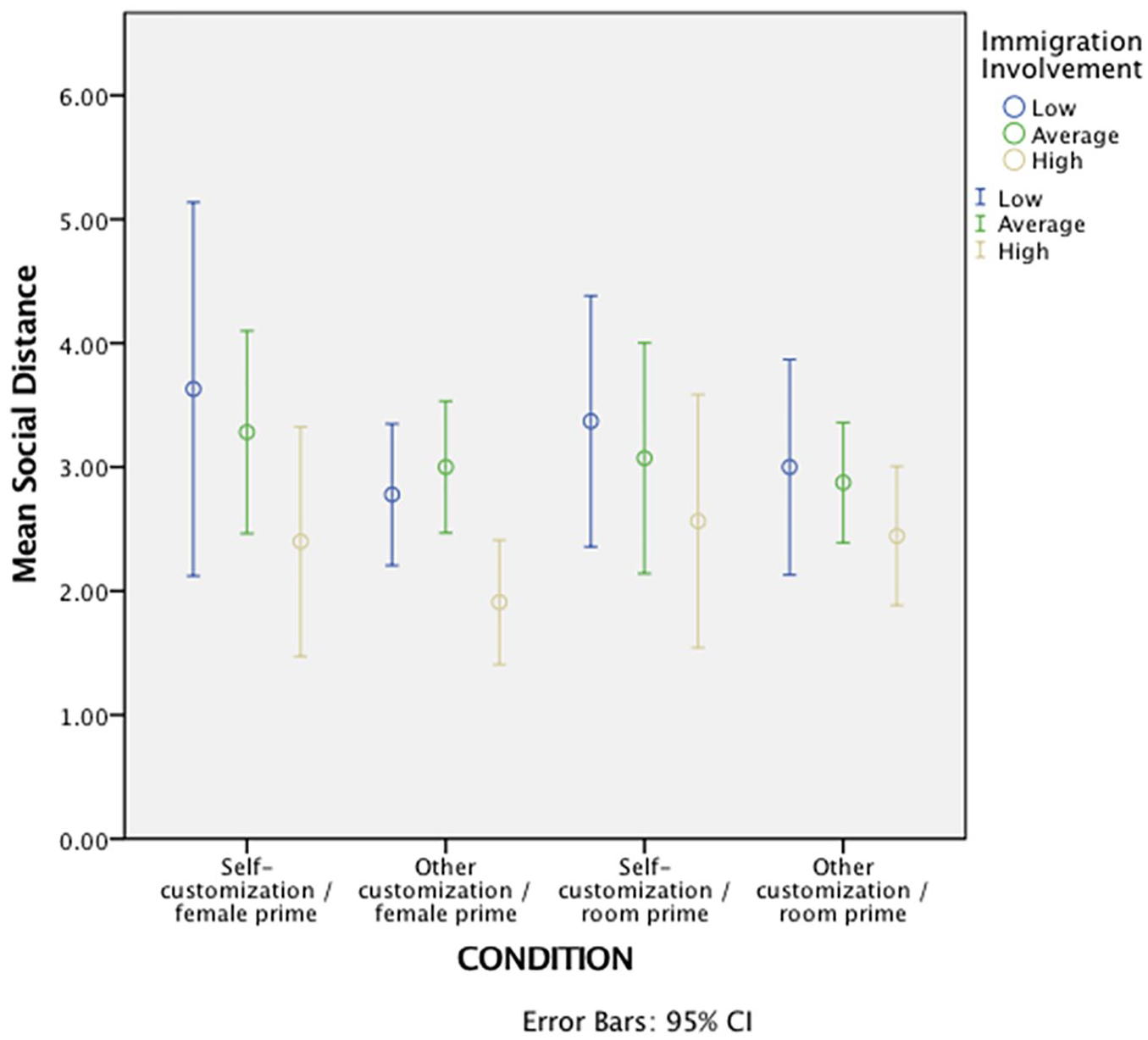
Means for social distance for customization and female identity priming conditions as moderated by participant’s pre-existing immigration involvement.
In regards to heterogeneous effects from the common female identity priming manipulation, we examined how participants’ high, medium, and low pre-existing immigra-tion involvement influenced the indirect effects from female identity priming to gender identity salience to reduced social distance. No interaction was found between the female identity priming and prior issue involvement or between female identity salience scores and pre-existing immigration involvement (ts < 1). For participants that had average and one standard deviation above and below in pre-existing immigration involvement, the female priming > female identity salience > social distance path was not significant, baverage involvement = −0.344, SE = .274, t(149) = −1.253, p = .212, CI = [−0.886, 0.199]; bhigh involvement = −0.428, SE = .373, t(149) = −1.145, p = .254, CI = [−1.166, 0.310]; and blow involvement = −0.260, SE = .376, t(149) = −.691, p = .490, CI = [−1.003, 0.483]. In addition, the conditional indirect effect of the priming > female identity salience > social distance path was not influenced by pre-existing immigration involvement, baverage involvement = 0.244, SE = .151, CI = [−0.042, 0.542]; bhigh involvement = 0.215, SE = .202, CI = [−0.148, 0.650]; and blow involvement = 0.273, SE = .237, CI = [−0.223, 0.725]. Thus, H5 was rejected.
Discussion
This study custom-built a VR encounter with a political outgroup member to test for the effects of avatar customization, identifiability, and common ingroup identity salience on social distance toward a conservative political outgroup in the context of DACA, a highly salient issue related to immigration. The results showed that self-reflective avatar customization directly augmented social distance, whereas it indirectly reduced social distance through perceived identifiability that it provoked. It is possible that avatar self-customization by itself may have raised the salience of participants’ actual self and their liberal political values through mindset priming mechanisms (Sah et al., 2017), which resulted in more negative outgroup attitudes. In contrast, participants’ perception of being more identifiable indirectly translated into greater acceptance of political outgroup members. Researchers and practitioners should examine the direct and indirect effects of avatar customization in more detail. Disentangling the differential effects of both factors is an important task, given the growing popularity of virtual environments. Avatar customization tasks effectively increased users’ perceived identifiability in a VR encounter, thus providing first evidence that the act of customizing an avatar to resemble the self may trigger identifiability. These findings were congruent with SIDE’s assumption that increased identifiability of the self to others may increase accountability (Spears & Lea, 1994) and also expanded previous research on the social effects of identifiability and anonymity (Rösner & Krämer, 2016). In addition, researchers and practitioners may attempt to instill identifiability through other means. Recall that identifiability was a self-reported variable in this study, and so this variable should be experimentally manipulated. For instance, studies have documented the persuasive effects of operating avatars which display the user’s face instead of someone else’s (Ahn & Bailenson, 2011) and, building on this procedure, it is possible that individuals assigned to avatars which realistically display their face may feel more identifiable and thus show decreased social distance in VR intergroup contexts.
Despite the theoretical hopes, we find that activating a female identity among our female participants had no effects on outgroup attitudes. Although female identity priming did increase the salience of a female identity, it did not directly or indirectly influence social distance. It is possible that customizing avatars and using VR was novel and engaging to the participants, thereby dampening the effect of a prime that was induced outside of the virtual environment. It is also possible that the female identity prime was not sufficiently powerful to prompt a recategorization of outgroup members into a common identity. Whether other primes would be more successful is an interesting avenue for future research (Levendusky, 2018; Wojcieszak & Garrett, 2018). Based on Levendusky (2018), researchers and practitioners may attempt to prime a common national identity relative to rival partisan identities in intergroup VR encounters to test whether such superordinate identities are more effective than female identity primes in reducing social distance.
The study found some evidence for how prior issue involvement influenced individual reactions to avatar customization. Those who were moderately and highly concerned with the issue of immigration, self-reflective avatar customization enhanced social distance. Those whose avatar resembled their real selves and who were more involved with DACA may have resisted contact effects, thus implying a boomerang effect in which outgroup virtual contact increased social distance. This is consistent with research on biased processing and backfire effects, as individuals with strong pre-existing attitudes are least likely to be influenced by communication, information, and media messages and may, in fact, use incoming communication to strengthen their prior attitudes (Taber & Lodge, 2006). For instance, strong partisans were more impervious to preferring political candidates with similar facial features after exposure to a self-politician morphed face (Bailenson et al., 2009). Same as face morphing procedures, an immersive VR encounter may not be not strong enough of an intervention to weaken the grasp of pre-existing political beliefs.
Limitations
As any study, ours is not free from limitations. Although some of our findings were statistically significant, they were small in size. In addition, the results were obtained in laboratory conditions that privileged internal over external validity. The findings may only apply to young women under similar laboratory conditions. Future studies should advance similar hypotheses with more diverse samples to document possible gender differences. It is also not clear whether similar effects would be detected among non-student samples, politically conservative participants, and in the context of more widely adopted immersive technologies, such as video games. Researchers may be interested in replicating these findings in more accessible and lower cost interactive settings, such as in multiplayer video games which allow avatar customization and partner interaction. Although VR may potentially have stronger effects because it is more immersive, it is possible that modern multiplayer games can yield similar effects as they offer in-depth avatar customization and team communication features. For instance, participants may attempt to solve an interdependent game quest with outgroup members while embodied in avatars which resemble their users to increase identifiability. Practitioners attempting to decrease social distance toward outgroups may capitalize on these results by increasing user identifiability in VR encounters through self-reflective avatar customization or by assigning individuals to avatars which display their real face with increased photographic detail. Another limitation was participant attrition as a large number of participants failed to pay attention to their virtual partner. It is possible that these participants were not motivated enough to pay attention, got distracted by the new experience of using VR, or the outgroup political message was too subtle as it needed to be read from an avatar’s t-shirt. The VR experience we created was not nearly as sophisticated as that enabled by commercial video games, in that participants did not actually interact with the outgroup and did not have to go through various narrative quests or tasks.
Conclusion
Although earlier research took a utopian perspective in which new technologies would increase the ability to radically change the self and usher an era of increased connectivity with individuals different from ourselves, people instead bring several preconceptions about the self, along with personal experiences and political views that, when activated by avatar customization, may influence their intention to associate with outgroup members. Virtual experiences are immersive and memorable but may not be yet capable of preventing boomerang effects among individuals more involved with specific political issues. Our findings added to studies showing how receiving counter-altitudinal information may actually strengthen pre-existing beliefs. At the same time, the findings showed promising societal benefits as VR encounters that promote increased user identifiability may decrease outgroup prejudice by augmenting perceived accountability.
Footnotes
Declaration of Conflicting Interests
The author(s) declared no potential conflicts of interest with respect to the research, authorship, and/or publication of this article.
Funding
The author(s) received no financial support for the research, authorship, and/or publication of this article.
