




Abstract
Today, internet provides opportunities for solidarization and collective action to initiative groups of social movements, including those of high degree of radicalism. For radical groups, language continues to be a crucial instrument through which social movements influence public attitudes. In this article, we analyze discursive strategies that the radical social movement (RSM) of Russian lesbian feminism uses to shape its image among the out-group and in-group publics. To identify the strategies of RSM self-representation, we employ semi-structured interviewing, qualitative content analysis, discourse analysis, and semantic network visualization. We find that, in a hostile anti-LGBT legal and discursive environment, self-representation of lesbian feminists is mostly linked to issues of aggression, violence, and systemic social, political, and legal constraints, unlike in the United States; it is also based on separation from the wider society and dehumanization of bearers of patriarchal views.
Keywords
Introduction
Radicalization of individuals and social groups in contemporary societies (Dingley & Herman, 2017) creates a need for developing means of identification and analysis of their discourses. This may be especially true for the societies with no long democratic tradition, where deliberative spaces are not occupied by strong mainstream actors of moderate political stance. In such circumstances, radicalized discourses play a double role (Litvinenko et al., 2021). On one hand, they actively add to social polarization offline and to the rise of aggression in the networked discussions (Cotgrove & Duff, 1980; Scrivens et al., 2018), which might also influence offline action. On the other hand, they may foster community consolidation against openly non-tolerant discursive environments and enhance political mobilization of radical (and less radical) social movement adherers, as exemplified by the Canadian lesbian movement (Podmore, 2006). The essence of radicalized discourses of disadvantaged groups in non-democratic context remains heavily understudied, unlike that in established democracies; our article aims at partially covering this gap, with the Russian lesbian feminist discourse taken as a case.
Our overarching goal is to understand whether the discursive strategies through which the ideology of the movement is disseminated are similar to those that the American lesbian feminist movement utilized in the past. In wide sense, discursive strategies may be interpreted as “forms of discursive manipulation of reality by social actors . . . [utilized] to achieve a certain effect or goal” (Carvalho, 2008, p. 169). In our case, the goal of the lesbian feminism is to form and sustain collective identity.
We would like to assess whether Russian lesbian feminism significantly altered the discursive structures taken from its American ancestor. First, verbal representation of the movement is tightly connected with its practices. This implies that alternations in the ideology of the movement in the Russian institutional and civil context could produce changes in the discourse. Second, internet as a specific milieu for social movement practices could change the means used today by the lesbian feminist community to establish its collective identity.
Lesbian feminism is taken as a radical social movement (RSM) example, as it possesses the features proposed by Fitzgerald and Rodgers (2000) for such movements. These are presence of the coordinating leader or complete absence of leadership, participatory democratic organization and egalitarian membership based on inclusiveness, radical agenda and emphasis on structural changes, flexible ideology and antimilitarist positioning, involvement in the international network of organizations and hybrid activism, use of innovative tactics of protest and non-traditional forms of communication, substantive rationality, opposition to the state, limited resources, and short duration of existence.
Previously, lesbian feminism was studied mostly in the American social context. The studies dealt with it as with an ideology, looking at its historical origins and main assumptions (Bryson, 1999), a social movement (Freeman, 1975), or an identity and its strategic usage (Bernstein, 1997; Fingerhut et al., 2005; Richardson & Seidman, 2002). Scholars also examined behavioral models of lesbian feminists in “real life” (Valentine, 1993) and in literature (Zimmerman, 1984), as well as the community’s stigmatization practices (Herek, 2004), while discursive practices of the movement were not actively investigated. Our study is focused on the sociolinguistical self-representation features of the Russian lesbian feminism. Speech markers are a significant part of the movement’s collective identity, and their underestimation leads to the incomplete depiction of the movement.
Recently, researchers have started to assess the linguistical patterns of feminist and lesbian communities in Russia. However, the papers have not yet problematized offline versus online contexts where these communities exist and have developed neither descriptions nor explanations of the tactics used by lesbians and feminists. Mostly, the scholarly attention is concentrated on the “outside” coverage of the lesbian feminist culture (e.g., Semykina, 2019). Also, studies that employ automated data collection and analysis methods to explore Russian-language radical discourses remain very rare; for lesbian feminism, they are virtually non-extant.
To partly cover these gaps, we employ interviewing and semantic network analysis to investigate offline habitual (everyday) versus internet discourses produced by the Russian lesbian feminist movement. We expect that these discourses differ in a noticeable way, and that this difference may, at least partly, be related to the environment they have existed in. However, we need to be cautious with direct comparisons, as different data collection techniques for offline and online discourses may affect our conclusions (see below).
The remainder of the article is organized as follows. The “Genesis of Russian Lesbian Feminist Discourse and Academic Studies of Lesbian and Feminist Culture in Russia” section addresses the genesis of Russian lesbian feminist discourse and the academic studies of the Russian lesbian and feminist culture, to set the context for the assessment of discourse. “The Study Goals and Methodology” section describes the methodological strategy employed in this study. The “Results” section presents the results. In the discussion part, we put the reported results into wider context.
Genesis of Russian Lesbian Feminist Discourse and Academic Studies of Lesbian and Feminist Culture in Russia
Origins of Lesbian Feminism and Radical Feminist Agendas
Lesbian feminism was studied not only as a discourse (Echols, 1989; Reger, 2017; Ryan, 2013) but also as a social movement that forms social identity and practices (Freeman, 1975; Tartakovskaya, 2008; Taylor, 1989; Temkina, 2001). In our study, we consider lesbian feminism an ideology that emerged along with the eponymous social movement in America of the 1980s. The social base of the movement consisted mainly of White middle-class female students. Most of them became directly involved into the movement; however, some women joined it through the gay movement and feminist initiatives (Reger, 2017).
As an ideology, lesbian feminism belongs to radical feminism (Taylor & Rupp, 1993), where it coexists with Marxist and socialist feminism (Ryan, 2013). The main difference in the ideological positions lies in the attitude to cooperation with the New Left (Ryan, 2013). An exceptional feature of the lesbian feminist movement is concentration on the rights of homosexual women and the attempt to completely isolate themselves from transgender people and heterosexual women in the lesbian feminist spaces.
All in all, the main task of the movement was the creation of separate female linguistic, cultural, symbolic, and sexual spaces in the city and the countryside (Ryan, 2013). In an attempt to explain the necessity of separation from Others, lesbian feminists argued that the traditional model of citizenship is based on the exploitation of women as a way to transmit property between men. The destruction of traditional models of citizenship was carried out through active and aggressive criticism, discreditation, and reduction of masculine discourse. In fact, by destroying the masculine discourse, lesbian feminism created an ideal type of woman who could lie at the foundation of a new ideal lesbian state.
Ideas about the ideal lesbian spaces were multiple and heterogeneous. They were reflected in lesbian literature, and some of the lesbian feminists were also successful in creating the “material” lesbian feminist spaces where individuals who identify themselves as lesbians worked and spent their leisure time (Browne & Ferreira, 2016). As students of American universities, lesbian feminists not only defended their position in public and political discussions, rallies, and protest actions but also formed their strands in science and literature (Frye, 1983; Kitzinger, 1991; Robson, 2004). No men, heterosexual women, transgenders, or transsexuals should have been allowed to such places; all things and actions in such places would be created by lesbian women for lesbian women.
Historical Account of the Russian Lesbian Culture
There are very few systematized historical studies of queer activism in Russia. One of the noticeable studies is the book by Healey (2014); its only drawback is that it focuses upon Moscow. Recently, another book by this author (Healey, 2017) focused more on the outsiders’ attitudes to gay culture and did not pay attention to the in-group communication. Unfortunately, in Healey’s studies, one could find only scarce information regarding Russian lesbianism. This may be explained by asynchronous development of queer groups in Russia and abroad; not all ideological offshoots have manifested themselves in Russia by the 2010s, including lesbian separatism (Healey, 2014).
After the collapse of the USSR, the policies that officially oppressed the Soviet LGBT communities were abolished, but it was not until 1993 that homosexuality was de-criminalized. In the late 1980s, the generally hostile public opinion on the gay and lesbian behavior did not allow homosexual persons openly declare their sexual preferences and form a publicly available culture. Another significant feature that prevented opening up gay communities to public was a widespread male prison and post-prison culture, which severely stigmatized and rejected gay practices due to their involuntary nature in prisons. As to the lesbian culture, it remained widely unknown to general public before 1990. In the early 1990s, LGBT press started in Russia, including lesbian magazines like Adelfe, Sapho, or Ostrov. The first attempts of community and community language creation were linked to them as well as to the first associations like “Wings,” ASM (Association of Sexual Minorities) or MOLLI (Moscow Association of Lesbian Literature and Arts), non-governmental organizations (Aesop Center or Triangle Center, both short-lived), and attempts of queer research.
In 2006, publicity of lesbian culture reached new heights, with formation of an NGO called “The Russian LGBT network” and with the first gay pride rally in Moscow (dispersed by the Moscow police). The 2000s were the time of active struggle of the gay and lesbian activists against re-criminalization of homosexuality, as well as for alternation of its public perception. In the 2010s, however, this struggle turned less successful, as promotion of homosexual rights became part of public confrontation between the “traditional values” promoted by the state and the “Western values” denounced by the elites as alien for the Russian culture. A notable protest action of the queer community in Moscow took place in December 2011, when they, together with the political opposition, protested against the results of the (allegedly flawed) parliamentary elections. Soon, in June 2013, Clause 6.21 of the Code on Administrative Offenses of the Russian Federation “Promotion of non-traditional sexual relations among minors” banned promotion of non-traditional sexual relations. This legislation has sharply reduced the opportunities of queer activism in offline public spaces and has led to an intense spread of radicalized lesbian discourse in the social networking communities. A subsequent line of ambiguous “anti-extremist” legislation on media and internet speech, though, contained vague definitions of extremism (Litvinenko & Kharuk, 2016), which might have prevented the lesbian feminist communities from openly expressing their radical views.
Academic Works on the Russian Lesbian Culture
Parallel to development of lesbian feminist culture in Russia of the 2000s, it became a focus of academic research inside the country. Gradually, its focus has started to move from offline behavioral patterns to examining semantic spaces and discourses, with a watershed lying circa 2015. In the early 2000s, issues related to homophobia, the construction of distance to heterosexuals, and coming out were investigated by Omelchenko (2002, 2004). Linguistic analysis of the identity of lesbian subculture representatives was carried out by Saraeva (2014). Also, Russian scholars analyzed the family space of lesbian couples (Kon, 2003; Nartova, 2004; Zdravomyslova & Temkina, 2002) and internal culture of the lesbian groups (Onegina, 2019). A notable work by Barchunova and Parfenova (2010) described a “Shift-F2” phenomenon—a transition from one form of relationships between lesbians to another, mediated by both virtual spaces and material locations like mediated communities or cafes. Legal status of lesbians and gays was investigated by Kondakov (2017). Similar topics were covered by Ukrainian statistics-based works on lesbian communities (Geydar & Dovbach, 2007; Plahotnik, 2008). Recently, due to the growing role of internet and social networks in social group construction, the focus of research has shifted toward discursive practices (Semykina, 2017, 2019; Tolkachev, 2016).
Many youth practices migrated to or originated on the internet, and lesbian cultural practices are no exception. Thus, on the mainly Russian-language social network VK.com , one can meet thousands of small and middle-size lesbian feminist communities. However, it remains unclear how the online discourse corresponds with the everyday (habitual) one of the group whose ideology is reproduced on the internet. This is why our mixed-method approach unites analysis of data gathered both from offline and online milieus; this implies that the data collection methods are different. Despite this, we argue that the focus of our analysis is speech in its discursive aspects, and that ideological patterns found in offline and online speech may be juxtaposed, if not compared.
The Study Goals and Methodology
As stated above, the goal of this study is to examine the discursive strategies that are used in the Russian lesbian feminist movement’s self-representation. Due to scarcity of research on Russian lesbian feminism, we cannot juxtapose our findings to its earlier discursive stance, but we will be able to collate them to the American one of earlier time.
Despite our wish to juxtapose our results to earlier data on American lesbian feminist discourse, our study is of exploratory nature. This is why we do not pose any strict hypotheses, limiting ourselves to the following research questions that help reconstruct discursive strategies of lesbian feminists in their everyday and online speech:
The distinction between habitual and internet discourses in our study is both instrumental and theoretical. First of all, it is connected to the types of data we have gathered. The habitual discourse was collected using semi-structured interviews with 20 members of the Russian lesbian feminist movement. The internet discourse was harvested using automated data collection techniques from the 574 groups in the most populated Russian social network, VK.com (ex-“VKontakte”) that declared their lesbian feminist orientation. Data collection of semi-structured interviews were carried out from March 13, 2018, to April 2, 2018. The information from social networks was downloaded from December 1, 2017, to March 1, 2018. Also, the difference between habitual and internet discourse lies in the form of the discourse presence, which certainly could affect the results we got out of this study.
Data Collection
For the “offline” part of our study, in-depth interviews were conducted with 20 women who identified themselves as lesbian feminists. Often, it is difficult to gain access to RSMs, as their members are afraid of being prosecuted (Sikkens et al., 2017). Thanks to the connections with community gatekeepers, we were able to build trustful relations with several other members. Then, using snowball sampling with five entering points, we could gather data. As a result, women from 11 Russian regions, aged 18 to 30, took part in our study. While, with 20 interviewees, it is hard to ensure a full-fledged mirroring of the entire discursive palette of habitual discourse, we aimed at ensuring heterogeneity of the sample, taking into account age, activist position, professional affiliation, and place of residence of the respondents.
For the “online” part of our study, posts and comments were downloaded from 574 lesbian feminist groups from the social networking site VK.com . Again, these groups were found using the snowball technique: we started sampling from the groups that were explicit about conveying lesbian feminist discourse and detected other groups connected to the first-step ones via links.
Data Analysis
Discourse analysis that we have performed was inspired by the socio-cognitive approach proposed by Van Dijk (1993). It is widely recognized that discourse analysis may bring subjective enough results; we have mixed it with semantic network analysis to ensure greater validity of our conclusions. Semantic network analysis is a highly developed methodological tool utilized in social/technical sciences and humanities (Sowa, 1922/1987). Although we focus on different types of semantic networks, we understand the basic structure of semantic networks to be represented by concepts and connections between them that emerge based on coexistence in the same context (Diesner & Carley, 2011).
Two software packages, Automap and Ora (Carley et al., 2008), were used for semantic network processing. Automap allows for the initial processing of textual data, while Ora visualizes the resulting semantic networks. This allows for evaluation of the mutual arrangement of speech markers and helps detect their semantic groupings and thematic clusters. Ora also helps visualize chains of related speech markers, which indicate the position of a concept relative to other concepts in the text (using spatial metaphor, it will be right or left). Thus, a visualized network of concepts emerges as a graph with nodes (concepts) and verges (connections between concepts). This method ensures the maximum proximity of results for the habitual and internet-based discourse. In addition, we ensured that the processing and analysis algorithms for both types of discourse were alike. Thus, first, both discourses were lemmatized. The network on habitual discourse included 1,170 nodes and 10,778 connections; the one on the internet discourse consisted of 2,129 nodes and 38,672 connections. Then, expert hand coding and grouping, quantitative content analysis, and visualization of the semantic networks were carried out for both discourses.
Results
RQ1: General Description and Comparison of Thematic Groups in the Habitual and Internet Lesbian Feminist Discourses
Based on the speech markers found in the semantic space of the internet and habitual discourses (see Table 1), we hand-coded the nodes in the networks. Here, we will summarize the differences and similarities between discourses; below, a more detailed account is provided. Thus, the major differences and similarities may be conceptualized as follows:
The internet discourse includes more topics than the habitual discourse. This may be explained by the fact that, on the internet, the lesbian feminist discursive space intersects with the spaces of other social groups, such as esoteric communities.
The habitual discourse does not contain topics related to the sacred and magical, flora and fauna (see Table 1, under footnote). We link presence of animal nominations in the internet discourse to greater dehumanization (see below).
The central themes for both discourses are those of violence/aggression/abuse against lesbian feminists; activism; “personalized social” issues like motherhood, age, or health; and ways of information dissemination.
In both discursive spaces, the topic of pornography is not salient. This subject was one of the most important for American lesbian feminists, so we expected to see it among the significant topics in Russian lesbian feminism. However, it was virtually non-extant in our data.
Thematic Groups Ranged by Normalized Frequency in Lesbian Feminist Internet and Habitual Discourses.
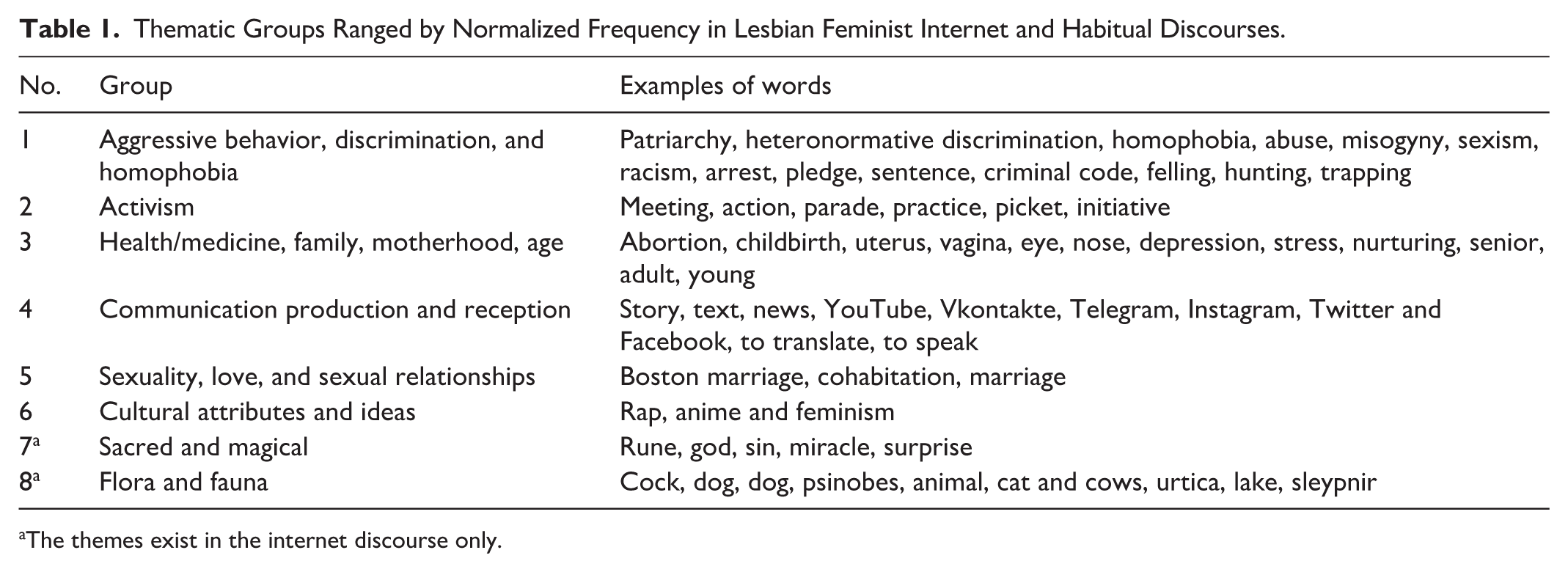
The themes exist in the internet discourse only.
Below, we provide an account on all the content groups in the internet and habitual discourses.
Aggressive Behavior and Sanctions
In both discourses, types of violence, types of sanctioning behavior, pro- and anti-LGBT institutions, organizations that regulate deviant and delinquent behavior, and consequences of aggressive influence are discussed. They are denoted mostly formally, by legal terminology. In addition to aggression, there is also a smaller group of words devoted to protection and preservation, which include charitable activities, protection, and care. The internet discourse contains a wider palette of the described types of aggressive behavior than the habitual discourse, and these are not limited to violence against a person. In the internet discourse, users also mention violence directed against nature and animals.
Activism
The tactics used in both the internet and habitual discourses do not quite correspond with those utilized by supporters of the movement in the US festivals, communes, and marches. Russian lesbian feminists claim that being active in the public space for women from disadvantaged socioeconomic backgrounds is risky in Russia. They are afraid of being punished for their political activity by their relatives or acquaintances, or of being jailed, as there were cases of jailing among lesbian feminists in Moscow and Saint Petersburg. Therefore, most of them either try to hide their views or engage in discussions and create protest actions on the internet, sometimes with hidden identities.
Health/Medicine, Family, Motherhood, Age
This group of words is mainly associated in the habitual discourse with bodily diseases and childbearing process. In the internet discourse, speech markers of the topic include the names of medical institutions and are an encyclopedia of the human body. A special place is occupied by naming mental states. The names of physical diseases and injuries, for example, fractures, do not appear in the internet discourse. For American lesbian feminism, health issues were not central; however, all of our informants had mental or hormonal diseases and actively discussed them with us. The speech markers that belong to this word group also create a negative image of the process of childbirth. Children are shown as a source of trouble, an extra burden on the path of self-development.
Communication Production and Reception
Pronounced 360 times, the word “speak” is #2 by frequency of occurrence in the habitual discourse; a range of speech- and communication-related words are linked to it. Their high frequency is not surprising, as communication is embedded into several social projecting mechanisms of the lesbian feminist community, for example, into implementation of psychological assistance, which involves expressing one’s own emotional states during consciousness-raising groups (Larson, 2014) or in-person with a therapist/psychoanalyst/psychiatrist. In the internet discourse, a range of social networks and messengers play a decisive role, while VK.com is the predominant sources of content for the offline respondents.
Sexuality, love, and sexual relationships are described in relation to finding partners and naming sexual orientations, as well as cohabitation, of which “Boston marriage” is of particular interest. This form of cohabitation was mentioned in the habitual discourse the greatest number of times compared to other forms of “cohabitation” or “marriage.” Boston marriage is a form of spatial separation within the lesbian feminist movement. The emphasis on cohabitation patterns was also peculiar to American lesbian feminism.
Cultural Attributes
This word group describes the art forms and styles. “Sacred,” “magical,” “occult” include the elements of Scandinavian mythology (“rune”), ethics and religion (“god,” “sin”), and designation of contact with the sacred (“miracle,” “surprise”). Orientation to sacralization of space and use of networks of social spaces, shops, media, and people is characteristic of RSMs that implement spatial separation, as first described in relation to the hippie culture by Charles Perry (Leach & Haunss, 2008). However, interestingly, this topic was endemic for the internet discourse, not for the habitual one.
Flora and Fauna
First, the theme of “fauna” continues the imaginative grid of Scandinavian discourses (“sleypnir”) but also indicates the blatant dehumanization of Others which is happening in the internet discourse. Dehumanization is one of the central mechanisms in aggressive behavior because it weakens moral norms (Kteily et al., 2015). When blatantly dehumanized, an object is completely deprived of humanity and is directly referred to as an animal or a robot. A milder form of dehumanization deprives the object of human features, and the speakers stop using adjectives and verbs characteristic for human actions; this form was found in the offline interviews.
RQ2: Comparison of the Habitual and Internet Lesbian Feminist Discourses Using Semantic Network Indicators
As detection of the most frequent words does not take into account the structure of the discursive field, we calculated centralities of speech markers and ranked words in the descending order (see Tables 2, 3, and 4 for the shared vocabularies, internet vocabulary, and habitual one, respectively). For this, the “total degree” centrality metric was used. In an undirected network like ours, the total degree is the sum of all actor connections (Borgatti et al., 2018). We have chosen the total degree metric, as it is traditionally used in network analysis for studying the distribution of power in network structures (Bonacich, 1987).
Top Degree Centralities for the Words Which Exist in Both Discourses.

Top Degree Centralities for the Words Which Exist Only in the Internet Discourse.

Top Degree Centralities for the Words Which Exist Only in the Habitual Discourse.
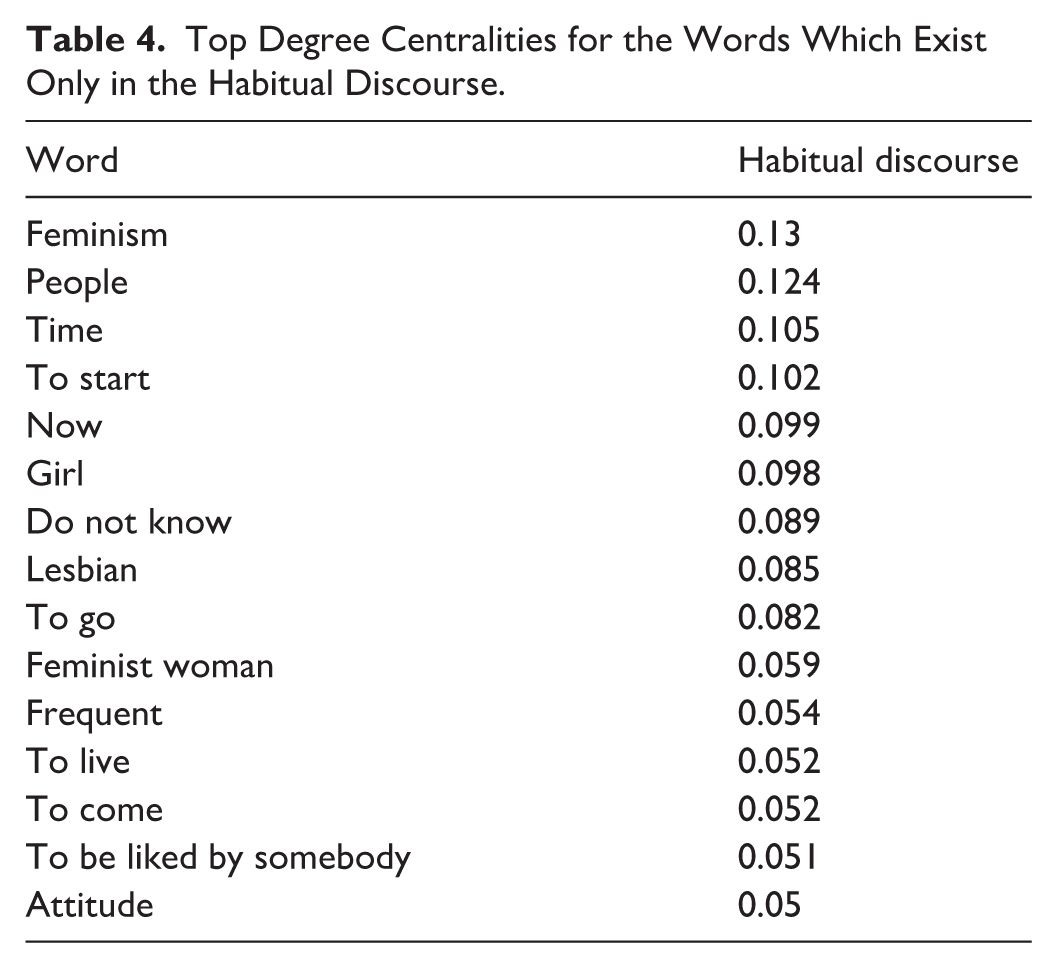
As a result, half of the words with the maximum values of total degree centrality are present in both discourses. Most of the shared concepts are those of generalist meaning; in other circumstances, they could even be considered stop words. However, in our research, they bear key meanings. Below, we demonstrate their immediate speech context to prove it. Thus, the “we versus they” and “man versus woman” are reflected by the most central speech markers in both discourses (see Table 2), and, in both discourses, actors and objects are both “alone” and “many.” Another significant axis is time: in the internet discourse, time is present as ‘year’; in the habitual one, “now and ‘rare” are salient. Top positions in the internet discourse are occupied by markers like “child,” “animal,” or “dog” that point out to the blatant dehumanization described above, while, in the habitual discourse, “people,” “girl,” “lesbian,” and “feminist” show up. These actors in both discourses “want” something, “know,” “speak,” “understand,” “do,” and “think”—that is, they carry out various forms of social actions and interactions. However, offline respondents show greater uncertainty in speech, as they “do not know,” “begin,” or “have to do,” while online speakers are more focused on developmental and direct actions (“become,” “write,” “give”), which is partly compensated by problematization (“[to] question”).
The analysis of semantic networks allows us to state the similarity of the most influential concepts in the network. All in all, differences in semantic structures correspond to the aforementioned divergence in the manifestation of the forms of dehumanization. It is also noticeable that, in the habitual discourse, the actors are more indecisive; they carry out actions they do not want to perform. In the internet discourse, the most influential verbs reflect vigorous activity, while in the habitual discourse, verbs are more associated with states (“vital statuses”).
RQ3: Discursive Strategies and “We” Versus “They” Construction
In Table 5, we describe the discursive strategies that we have identified in both discourses. To conceptualize them, we have deduced five thematic areas of what the authors employ and where the strategic effect is directed: culture, communication, sociality/group formation, individual psychology, and politics.
Discursive Strategies and Their Effects in Five Areas: Culture, Communication, Sociality (Group Formation), Individual Psychology, and Politics.

Table 5 shows that group formation is the main goal of strategic speech in both discourses. This, to our viewpoint, proves that the lesbian feminist community is in the early stage of making in Russia. For this, cultural, communicative, and psychological phenomena are introduced into the speech. Individual psychology and politics are second to sociality as an aim of speech; however, politicization of the discourse is evident. Both users and respondents underlined the systemic origins of the threats to the community, linking the state as a primary definer to them. The problems of the community are partly localized in the political realm (see below), and online talk is used to rise activist potential of the community.
Here, summarizing Table 5, we deconstruct an overarching discursive strategy, namely, the “we vs. they” opposition (Van Dijk, 1993). The discursive field around “we” and “they” is dense.
The Immediate Environment of the “We” Concept
Denotation of the “we” concept in both discourses is carried out through the gender speech markers of “women,” “girls,” “ladies.” This emphasizes age-related heterogeneity within the movement. “We” also refers to internal flows in feminism (“radical feminists,” “liberal feminists,” “lesbian separatists,” etc.). The multiplicity of the movement titles corresponds to several approaches to categorization of lesbian feminism, as mentioned by Echols (Kteily et al., 2015).
Self-identification among Russian feminist lesbians is not yet linguistically sustainable: its members belong either to LeSbi or to LeZbi movement. In the offline responses, transcription versus transliteration has received a social dimension: “LeSbi,” as our informants have argued, are lesbian feminist women who emphasize the lesbian part of their identity, while the feminist part is not that significant for them. “LeZbi” are lesbian feminists for whom their feminist matters most; they believe that, by changing “s” to “z,” they promote heterogeneous understanding of lesbianism in the public sphere.
The Immediate Environment of the “They” Concept
In fact, “they” refers to everything that is “not us.” Thus, this category becomes extensive, and the respondents’ “identity zone narrows down to the size of the community opposing the blurred hostile ‘mass’” (Darya, 21). Mostly, “they” are “men,” primary socialization agents such as “family,” “mother,”’ and “father” but also “mass” and “people.” To describe men and women, approximately the same number of symbols and proper names is used.
Men are linked to their profession and family positions but are also associated with violent acts, are involved into murders and violence, and thus possess aggressiveness and spontaneity in the eyes of lesbian feminists. Relationships with the opposite sex cause fear and doubt. Pessimism regarding the lesbians’ position in the social system leads to the struggle with the exploiting class, which for them is objectified by men.
Although women are not associated with violence, they are also, like men, described in the context of professional affiliation and positioning in a family-role structure. Perhaps the difference in the attitudes toward the male and female part of society lies in the fact that “patriarchal” women, in accordance with the ideology of lesbian feminism, are a potential resource for the movement; therefore, they should be “pitied” and directed to “right ideas.” The boundaries of this pessimism are not overcome via logic, as the justification of the inherent danger of men is irrational, even though recognized as natural.
The key to solving all the problems lies in generational change, as the state of crisis is perceived as localized in the extant social system. Via the pessimism stated above, can see a certain parallelism in how the social relations and the political system are treated by the Russian lesbian feminist community.
RQ4. Social Resistance and Politics in the Habitual and Internet Discourse
As known from previous research, discriminated communities may build their identities upon the idea of social resistance, including political one. However, political trends inside such a community may, on the contrary, become bones of contention, like in the United States, where political lesbianism became a concept that split the movement (Reger, 2017).
In Russian lesbian feminism, understanding of “the Other” as systemically oppressive and, simultaneously, unenlightened extends to the whole society, thus marked as “tribe/tribal” (also in connection to neo-Pagan rituals), “multitude,” “mass,” “sum,” “all.” Here, we detect a triangle of “multitude”–“group”–“person” as the basic structure of socialization, and the resistance is spread along both “multitude” versus “group” and “multitude” versus “person” axes.
Table 5 shows that, as for now, social resistance, including struggle for human rights or open resistance to discrimination, does not seem to be a primary concern of the movement. More precisely, the nature of resistance is different: rather than being based on social competition, it is based on deep, even denialist contraposition toward the state and the dominant culture. In both discourses, Russia as a state, politics, and law is perceived in an unequivocally hostile manner. Politics is nearly entirely substituted by the very upper echelon of power: “the president,” “the Kremlin,” “the state,” and “powers” (= higher authorities). Despite the aforementioned laws that induce self-censorship, both offline and online discourse bearers are open in their criticism toward the state. Current events that intrude the discussions (“elections,” “representatives”) do not shift the perceptions toward lesser criticism.
Last but not least, Russia is often enough described within international context. In addition to Russia, Belarus, and Ukraine, we see four world regions to be particularly relevant: developing areas (“India,” “Africa”), East Asia (“China,” “Japan”), North America (“the United States,” “Canada”), and Western and Northern Europe (“Germany,” “the United Kingdom” “Scandinavia”). Among these, the United States and Ukraine are most frequent. The United States is mentioned as a universal reference point in terms of group behavior and feminist traditions, and Ukraine is mentioned as an example of a post-Soviet country that has experienced a value shift toward freedom, including gender and sexual ones.
Discussion and Conclusion
In this article, our aim was to analyze the discursive self-presentation strategies of the Russian lesbian feminist movement, to see whether its agenda and the ways it is spread change in years and space, becoming Russia-specific. Examining this social movement and its ideology grows in relevance due to the current radicalization processes in the world. For that purpose, we conducted interviews and gathered data from the online communities that carry the lesbian feminist discourse. The main limitation of our study is the dependence of the boundaries of the internet semantic space on the researchers’ judgment upon the online communities. However, we have seen that the differences in the offline and online discourses are notable but not critical, and this, at least partly, supports our choice of the online data.
Out of this examination, we understood that early-stage lesbian feminism in Russia has undergone significant alterations in both substance and the forms of communication, compared to its American prototype of over 40 years ago. We expected that technological factors significantly contributed to this difference in discourse articulation since discourse spreads mainly through social networks and the internet, in which movement creates its own speech space. In this space, there are various social projecting mechanisms that allow the movement maintain the existing social base and attract new members.
The thematic content of the lesbian feminist discourse in Russia differs from the American one; the themes of “violence and aggression” as well as “communication and dissemination of information” became the most important in online and offline Russian-language spaces. These topics were not central to the American discourse of lesbian feminism (Barry, 1984; Long, 2012). Rather, we could see the proliferation of juridical themes of the existing lesbian-separatist legal literature, which was scientific, rather than journalistic, in American realities.
The Russian lesbian feminism cultivates the ideas of separation from society realized through building of contrasting images of the in-groups and out-groups, as well as systemically oppressive and uneducated images of the state and outer society. This controversy is not limited to negative representation of “others.” Patriarchal women and men are dehumanized, and therefore cease to be equal to feminist lesbians in their rights in the discursive representations.
The conclusions drawn from the study of lesbian feminist discourse can potentially be extended to other RSMs. We have demonstrated the separation of the social projecting roles of two types of discourse: the habitual (offline) discourse and the internet-based one. The internet discourse creates the background for the existence of the movement and provides a link with the “ideological metropolis”—the United States. It demonstrates clearer rules of behavior and legitimizes the methods of development and spread of the RSM. The habitual discourse, on the contrary, reveals “zones of ideological uncertainty” when it reaches the personal level, which can be used to block the spread of radical social currents.
Footnotes
Declaration of Conflicting Interests
The author(s) declared no potential conflicts of interest with respect to the research, authorship, and/or publication of this article.
Funding
The author(s) disclosed receipt of the following financial support for the research, authorship, and/or publication of this article: The reported study was funded by RFBR and EISR, research project #20-011-31664, “Political construction of a university city in an emerging image of the future of Russia.”
