




Abstract
Kate Charlesworth’s graphic narrative Sensible Footwear: A Girl’s Guide (2019), part memoir and part documentary of lesbian, gay, bisexual, transgender, queer, and intersex life and activism in the United Kingdom from 1950 to 2019, remembers the time when the LGBTQI+ and feminist movements met and influenced each other deeply, namely in lesbian feminism of the 1970s and 1980s. Drawing on feminist historiography and memory studies, this article discusses the role the figure of the lesbian has played in the collective memory of lesbian feminism. With a focus on the expressive capacities of comics, it examines how the work revisits this figure at a time when women’s and LGBTQI+ rights face a backlash led by anti-gender campaigners, some of whom draw on discourses associated with lesbian feminism. It concludes that the work challenges dominant narratives about the relationship between lesbian, queer, and trans feminism and enables a reconsideration of these movements as parts of a common political project.
Keywords
Introduction: Sensible Footwear, feminist historiography, and memory studies
Kate Charlesworth’s (2019) Sensible Footwear: A Girl’s Guide is a graphic narrative that is part memoir and part documentary of the lesbian, gay, bisexual, transgender, queer, and intersex (LGBTQI+) movement 1 in the United Kingdom from the 1950s to today. It came out at a time when women’s and LGBTQI+ rights faced a backlash led by anti-gender campaigners in the United Kingdom and abroad, and when a growing number of voices explicitly drawing on discourses associated with women’s liberation aligned themselves with such campaigners to articulate trans-exclusionary ideologies (Pearce et al., 2020). The year before its publication, for example, a group of lesbians had led an anti-trans demonstration at the London Pride (Tudor, 2019: 362). The book is meant to celebrate the achievements of the LGBTQI+ movement, to teach those who do not know how much the freedoms enjoyed today are the result of its struggles, and to caution against taking these freedoms for granted. It also aims at inviting concord into the movement. It foregrounds the perspective of a lesbian: the memoir strand recounts Charlesworth’s own life and the documentary strand is largely based on her memories and archive of memorabilia (Charlesworth, 10 June 2021, personal communication). This makes the work particularly relevant today, not only because lesbians have occupied a more marginal position within the LGBTQI+ movement historically, but also because it offers an opportunity to discuss the moment when the LGBTQI+ and feminist 2 movements met and influenced each other deeply, namely, in lesbian feminism of the 1970s and 1980s. Some of the debates about gender and sexuality within lesbian feminism of that time reverberate in discussions around the inclusion of trans people in feminism today. One can also hear their echo when a straw figure of feminist theorizations of gender is used by backlash ideologies outside of feminism to curb rights gained through feminist and LGBTQI+ struggles. The way we remember that era of lesbian feminism affects the alliances and conflicts of the present.
Sensible Footwear revisits the past as a form of community public history (Kelland, 2018) and as a memoir that makes a claim to “autobiographical truth” (Smith and Watson, 2010: 15–18), the author’s remembered subjective experiences of the movements. At the same time, its highly stylized form underscores the creative mediatedness of the facts and memories recounted in it. 3 The semi-constructed nature of such accounts does not prevent them from shaping what is remembered and how. On the contrary, they can effect changes in collective memory, which is always mediated, by turning the “overlooked to the ‘not forgotten’,” combining occluded aspects of the past with new “memories” formed with creative imagination (Rigney, 2021b: 12). Moreover, narrative arts have been shown to enhance the memorability and involvement in a story through the aesthetic qualities of their medium and experiential modes of narration that enable the reader or spectator to vividly imagine a character’s experience through empathy. These mediations keep the redrawn memories into circulation, ensuring that they remain at the forefront of conversations about the past (Rigney, 2015: 67–74). In this article, I examine how Sensible Footwear remembers feminism of the 1970s and the 1980s through a contemporary lens, and specifically how it looks at lesbian feminism—showing and effecting changes in its remembrance—from a feminist present that is largely informed by queer and trans feminism.
My reading draws on scholarship that enables me to position the work in relation to the collective memory of the feminist movement, especially as curated by the movement itself, its members, and its allies for political purposes. Social movements are deeply invested in remembering their origins or highlights and managing their own legacy to gain support and legitimacy (Berger et al., 2021: 1), readjust their objectives and strategies (Rigney, 2021a: 301), imagine future mobilizations and their relationship to other movements (Doerr, 2014: 207), establish collective identities, and invite members to adopt a position (Neveu, 2014: 276). Although the scholarship that critically examines the ways the feminist movement has curated its remembrance in relation to such aims has been called feminist historiography (Browne, 2014: 4), I argue that it falls within the purview of memory studies as it researches a variety of sources, including historical and theoretical texts, (auto)biographies, essays, art, and popular culture, that reflect on the history of feminist thought and politics, focusing not on the past as such but on the past as it is remembered. 4 I read, in particular, work that looks at the figure of the lesbian, because I see this figure as one of the main memory sites where this diverse movement becomes condensed into representable and coherent narratives. Memory sites, that is, “reusable texts and images,” are never fixed but function as points of relative stability in a dynamic system of memory that is always in conversation with changes in social conditions and renegotiations of collective identities (Rigney, 2012: 19) such as the ones at play when Sensible Footwear was published.
The first section of this article gives an overview of the forms and functions the figure of the lesbian has taken in the history of feminism. The sections that follow examine the ways this figure is currently revisited, and the role Charlesworth’s work plays in this. Sensible Footwear focuses on the LGBTQI+ movement and mentions the feminist movement in relation to the former, in a way that largely emphasizes the continuity in and alliance between the movements, but also occasionally shows friction. The analysis consists in a close reading of the moments when lesbian identity or practice and the feminist movement intersects and debates around the meaning of lesbianism for the feminist movement and vice versa make an appearance. It, moreover, focuses on the representation of lesbians in the book, looking both at lesbian characters from Charlesworth’s autobiographical memory and representations of lesbians as types.
The figure of the lesbian as a memory site for feminism
The figure of the lesbian has dominated the collective memory of the feminist movement for multiple reasons. To begin with, this figure became associated with feminism when women’s liberation increasingly entered the public sphere. To counter homophobia within feminism, lesbian feminists in the late 1960s and early 1970s, starting in the United States, emphasized the importance of lesbianism for women’s liberation, which paid a lot of attention to sexuality, explaining the oppression of women through institutions and ideologies that secured social reproduction, such as the family and heterosexuality (Hesford, 2013: 116). Lesbian feminists argued that the direction of women’s resources away from men and toward other women could emancipate women from this oppression. It brought forth, they argued, an awakening of consciousness that enabled women to ask what “woman” might be when not defined by men (Lorde, 1978; Radicalesbians, 1970; Rich, 1980) or to question the naturalness of “woman” (Wittig, 1992). In this move, lesbianism was transformed from a sexuality into a political practice and its definition expanded to include any woman who organized her life around other women.
Following this, the political rhetoric of the feminist movement itself used the figure to express its rebellion against proper bourgeois femininity and as a representation for the movement’s imagined constituency that enabled different groups of women to identify with feminism (Hesford, 2013). Rather than a stereotype, the figure of the lesbian functioned as a shorthand that could express different ideals of the movement simultaneously, such as personal and economic independence from men, solidarity among women, and feminist social and cultural practices that were changing the way women inhabited their body and the world. At the same time, mainstream media and backlash forces used the image of the lesbian to represent their fear of the movement’s political implications (Hesford, 2013; Tate, 2005). For Victoria Hesford (2013: 14–17), it is the coincidence of the rhetorical use of this figure by the movement and by anti-feminist voices, in mass culture and subcultural spaces alike, that has rendered it a hypervisible image-memory which has dominated generalized perceptions of the women’s movement in the decades that followed. With a focus on news media as a primary domain for the production of collective memory, Hesford’s (2013) analysis shows how representational strategies, such as personification through the publication of portraits of prominent feminists, including lesbians, became dominant frameworks of representing a movement that was exploding in myriad groups and diverse interests. Such strategies, she argues, were not the result of a clash between movement intentions and media practices, but of “a crisis of imagination in which the dictates of a public sphere, dependent upon the spectacle as its primary form of publicity, created the need for a feminism that could be looked at and identified with” (Hesford, 2013: 38).
In the decades that followed, the figure of the lesbian has remained closely associated with feminism both within and outside the movement, but the gap between this figure and the plurality of lesbian feminism has widened, as the former became more fixed and two-dimensional. As subsequent accounts of the movement have approached this figure not as a rhetorical tool but as evidence of the existence of coherence within the movement, the predominance of whiteness in representations of lesbian feminists (the result of the ways racism affects which bodies can be seen as generalizable and thus abstracted) has led to reductive readings of the womens’ liberation as a white women’s movement which is turn has enabled identifications and disidentifications that tend to confirm these readings (Hesford, 2013: 2).
Subsequent narrativizations, moreover, saw reductive readings of the many different theorizations of gender, the subject and aim of feminism, and sexual practices and aesthetics that lesbian feminist voices brought forth. The spectrum of approaches navigating these complexities came to be discursively framed as two distinct schools of thought, roughly summarized thus: one school supported that being a lesbian enabled the exploration of what women and their sexuality would be like when not restricted by heteropatriarchy. Some representative thinkers of this school are the group Radicalesbians, Adrienne Rich, Audre Lorde, and Mary Daly, who were quite influential in the United Kingdom. While lesbian sexuality was heavily invested with political meaning in all political lesbianism, this school is associated with suspicion around penetration, sexual role playing, sadomasochism, and butch–femme aesthetics, for their supposed ties with male sexuality (Abbott and Love, 1972; Frye, 1993; Jeffreys, 1989). Moreover, while the importance of women-only spaces were widely accepted 5 in the women’s liberation movement—spaces largely “unmarked by the categorical differentiations that characterise contemporary feminism such as ‘cis-gender women’ and ‘trans women’” (Withers, 2019: 6)—some voices associated with this school of thought, though by no means all, 6 used biology as the ground on which to exclude trans women from them. Adherents of the UK lesbian feminist faction called “Revolutionary Feminism,” such as Sheila Jeffreys, promoted a strong trans-exclusionary agenda within the women’s liberation movement in the United Kingdom (Withers, 2019: 6).
The other school saw lesbianism as an opportunity to deconstruct the category of woman and proposed that the aim of feminism should not be gender equality or a revaluation of the feminine but the destruction of gender as an institution. Prominent thinkers here are Monique Wittig and Teresa de Lauretis. Voices within it criticized the first school’s understanding of gender (De Lauretis, 1994; Wittig, 1992) and what they saw as a prescriptive approach to sexuality, celebrating instead the variety of dress and sexual practices within lesbian subcultures (Califia, 1988; Faderman, 1991, 1992; Rubin, 2006). Although these schools of thought are two ends of a spectrum that coexisted in the 1970s and 1980s, and few thinkers or activists even among the ones mentioned here fully adhere to all aspects of one school, there is a tendency in the mainstream memory of feminism from the 1990s onward not only to oversimplify the pluralism of voices that operated within this spectrum, but also to associate lesbian feminism with the first school only, locating the second school’s approach within 1990s queer feminist thought. This is the result of a rhetorical move that proposes queer feminism as the solution to the perceived limitations of women’s liberation and lesbian feminism (Hesford, 2013: 76).
Feminist scholars have criticized the narratives of progress that have dominated the remembrance of feminism following this move for the political purposes, they serve within the feminist movement as well as its amenability to cooptation by forces outside the movement (Enke, 2018; Hemmings, 2011; Henry, 2004; Hesford, 2013). These narratives present the development of feminist thinking as moving from the simplicity and essentialism of assuming a unitary subject of feminism (“women”)—associated with lesbian feminism—toward diversification and complexity—associated with queer feminism—and push the feminist subject of the present to identify with the latter, leaving the former behind (Hemmings, 2011; Henry, 2004; Hesford, 2013). Moreover, despite the presence, participation, and critique of feminists of color (Breines, 2002; Hemmings, 2011: 53) and trans people (Heaney, 2016; Williams, 2016) in lesbian feminism, it features in collective memory as “‘white feminism’ and ‘trans-exclusionary feminism’, 7 and . . . is often used as a shorthand genealogy of today’s racist and trans-exclusionary feminists (TERFs)” (Enke, 2018: 10). The flattening of differences within lesbian feminism is supported by the stereotypical image of the “antistyle” lesbian feminist who wears Birkenstocks and flannel, which contrasts with queer feminists’ representation as fashionable and embracing various styles, such as the butch, the femme, and the lipstick lesbian (Henry, 2004: 124–129).
Reductive understandings of what a lesbian is, however, are also found in narratives of loss, where queer and trans feminism are seen as bringing forth the fragmentation of lesbian feminism and the destruction of its cultural revolutionary potential (Hemmings, 2011: 47; Henry, 2004: 124). Such narratives are mobilized anew in current conflicts around gender and trans women’s inclusion in feminism, which are especially scathing in the United Kingdom. In these debates, an increasingly vocal group of feminists criticize the concept of gender as “an ideological smokescreen that masks the persistence of male supremacy and oppression of women by men, and assert that ‘transgender’ is the nonsensical and pernicious outcome of this politically spurious set of beliefs” (Stryker and Bettcher, 2016: 6). Sheila Jeffreys’ (2018) recent book on the history of lesbian feminism in the United Kingdom is an example of this discourse. In it, she defines the lesbian feminist in such narrow terms that the figure it creates coincides almost entirely with the stereotype: the lesbian feminist is someone who cannot be queer or non-binary (Jeffreys, 2018: 3), who was born and grew up as a woman (Jeffreys, 2018: 71), who is driven by an ethics of equality in sex and relationships and does not engage in butch/femme role-playing or sadomasochism (Jeffreys, 2018: 9–10, 88), whose culture, theorization of sexuality, politics, and very existence are threatened by trans activism and queer theory (Jeffreys, 2018: 55, 72, 111, 187, 190).
Such instrumentalization of this figure breaks the connection between the movements, casting them as separate identitarian projects, resulting in lack of awareness of their common genealogies. It moreover contributes to rendering the term lesbian synonymous with reactionary politics (Thomsen and Essig, 2021) as well as to dismissing the danger posed by anti-trans feminist voices as anachronistic. This does not only foreclose real understanding of parts of feminism that have different agendas in the present, but it may also drive women who either were part of women’s liberation and/or lesbian feminism of that time, or sympathize with their aims, into an identification with anti-queer/trans voices. It is no surprise, therefore, that feminist scholars studying the relationship between lesbian, queer, and trans feminism today emphasize the importance of complexifying this figure, as discussed in the next section.
Redrawing the lesbian
To challenge dominant narratives about feminism and their effects on contemporary politics, Clare Hemmings (2011) proposes the strategy of recitation. She identifies scholarly work that is precluded from prevailing citational practices when the relationship between lesbian and queer feminism is discussed, and she invites “absent presences” back into the narrative rewriting academic publications to include quotes from the forgotten works. Recitation, Hemmings explains, is not an alternative history as it is “limited by its original frames of engagement” (Hemmings, 2011: 23). It occupies a middle ground between attempting objectivity and an “anything goes” approach and is founded on a transparently motivated relation to the history of feminism, which constitutes the basis of a “reflexive and accountable historiography” (Hemmings, 2011: 23). Most importantly, recitation “operates as a breaking open of the presumed relation between the past and the present” (Hemmings, 2011: 181) and can “precipitate the imagining of feminist subjects as inheritors of contradictory legacies” (Hemmings, 2011: 194). In this article, I look at Hemmings’ creative method as a metaphor for the more general practice of reframing our relationship to the past in order to undo its limitations on the present. I use the term redrawing for the practice, especially, of challenging the stereotypical image of the lesbian feminist by inviting overlooked or under-remembered visual and narrative elements that complexify this image.
Redrawing the figure of the lesbian plays a considerable part in scholarship calling for a reconsideration of these movements as parts of a common antifoundational political project (Henderson, 2018: 186). Hesford (2013: 118–119) proposes seeing the feminist-as-lesbian as an access point to the moment in women’s liberation when rejection of normative heterosexuality led to the production of a politicized lesbianism, whose aim was to establish a political collectivity that was not as singular and fixed as subsequent readings would have it. Although a stereotypical version of this image tends to “signify the perceived essentialism of women’s liberation . . . in actuality, she emerged as a symptom and effect of the movement’s radical questioning of essentializing notions of sexual difference” (Hesford, 2013: 76). Hesford’s (2013) aim is to challenge the accusation by queer theorists and sex-positive feminists that the movement had adopted a political lesbianism that was essentialist and exclusionary: [t]he politics of women’s liberation was a project of radical collective and self-transformation—that the women who participated in its promise failed to transform the terms through which they were socially and culturally legible as women does not negate the possibilities inherent in their attempt. (p. 205)
A similar reading of women’s liberation as an anti-essentialist movement can be found in the work of D-M Withers (2019), who directs their criticism toward UK “gender critical” feminists and trans activists alike for failing to understand the potential of the movement. Withers contends that “the activist, epistemic and ontological legacies of the British Women’s Liberation Movement (WLM) are woefully—and irresponsibly—absent from how ‘gender-critical’ feminists in the UK have articulated their arguments about what feminism is, and who its constituents are,” but also that trans activists and their allies, as an understandable response to the enduring characterization of the movement as hostile to trans people, “frequently overlook potential alliances with the activist struggles of the WLM” which is “an injustice to the radicalism of . . . a social movement that must be credited for creating conceptual and lived resources for much of the feminism, including transfeminist discourse, we can speak and think with today” (Withers, 2019: 3). As a way to challenge such readings of the movement, Hesford draws on Avery Gordon’s idea of haunting as “the trace of . . . experiential realities of social and political life that are unacknowledged by traditional forms of knowledge making” to read the figure of the lesbian as a “ghostly” presence that offers the promise of “as-yet-to-be-articulated possibilities of a different sociality” (Hesford, 2005: 229).
Lynne Huffer (2013) argues that the rift that has developed between feminist and queer thought relies on the silencing of certain antifoundationalist voices within feminism, which claimed an “instability of any ground in whose name a movement or mode of thinking might speak” (p. 14). To restore these voices, she challenges the binary of “the frumpy, sex-phobic feminists pitted against their kinky, stylish queer cousins” (Huffer, 2013: 6) by “bringing the term lesbian back into the picture,” drawing on lesbian feminist literary, graphic, and cinematic figures of lesbians that challenge “an identitarian conception of lesbian” (Huffer, 2013: 118). Similarly, Kevin Henderson (2018: 186) criticizes current understandings of feminist, queer, and transgender theory and politics as distinct projects with different subjects—women, queer people, and trans people, respectively—envisioning them instead as parts of a shared enterprise that critically examines the ways power creates gendered and sexual subjects. He places the rekindling of the figure of the lesbian as a non-woman, as theorized by Wittig in the late 1970s, as central to this enterprise. Wittig’s lesbian questions the stability and naturalness of all the categories of queer and straight, trans and cis, offering queer-trans-feminism a source of “self-critique,” “intellectual affinities,” and “coalitional imaginaries” (Henderson, 2018: 201). I argue that such strategies constitute a redrawing of the figure of the lesbian that resembles Hemmings’ recitation. Based on existing but more marginal images from the past, they create a figure that disrupts dominant narratives about the relationship between lesbian, queer, and trans feminism as well as the coherent and determined feminist subject these narratives invite one to become.
The role comics/graphic narratives can play in engendering such redrawings has been pointed out by two of these scholars. In an autobiographical comic strip by Alison Bechdel, Huffer (2013) finds an image of Bechdel in the 1980s on a quest of knowledge about lesbianism that consists in reading books about homosexuality written from within and outside of lesbian feminism and the gay movement, while masturbating. This image, argues Huffer (2013), “helps us to think about queer feminist subjectivity” (p. 120) by linking autoeroticism, knowledge, and relationality in a way that resonates with both feminist and queer theorizations of gender, sexuality, and subjectivity. Hesford (2013) finds a similar reading of the figure of the lesbian in a graphic memoir by the same author, Fun Home: A Family Tragicomic (2007). She follows Ann Cvetkovich’s reading of Fun Home as a queer archive of personal memories and literary allusions. This archive, Cvetkovich (2008: 122–124) shows, disrupts routine memories of lesbian feminism in two ways: through references to feminist and lesbian texts, it shows Bechdel’s unapologetic connection to the lesbian feminist milieu of her youth and by creating a link between Bechdel’s sexuality and her father’s gayness, it destabilizes common understandings of lesbian feminism as disengaged from the gay movement. To this Hesford (2013) adds that Bechdel’s identifications with various styles of butchness in the text are not posited in an explicitly antagonistic relation to her growing political and sexual consciousness as a lesbian feminist; on the contrary, and perhaps because Bechdel tends to draw the convergences between her butchness and lesbian feminism rather than write them, they remain suggestively indeterminate in their meanings. (p. 263)
Huffer and Hesford do not give much space to formalist considerations about comics and graphic narratives, but they point out that Bechdel’s work is able to literally give visual form to the figure of the lesbian they want to create. For Hesford (2013: 261) specifically, it is in the graphic narrative’s hybrid form of verbal and visual language where its historiographical and political potential lies. To support and add to their insight, I read Sensible Footwear drawing on comics analysis—the examination of the poetics of comics—and the narratology of the comic art—the study of those properties in comics that affect narrative form and meaning (Mikkonen, 2017). Thus, I investigate how the narrative function of the medium’s distinctive features, such as the interplay between words and images (Eisner, 1985; Herman, 2011; McCloud, 1993), the registration of temporality in spatial terms (Chute, 2010, 2017; Groensteen, 2007), and, most importantly, descriptive elements, such as characters’ appearance (Baetens and Frey, 2014), enable the work to redraw the figure of the lesbian in order to bolster the concord within and alliance among the movements.
Redrawing the lesbian in Sensible Footwear
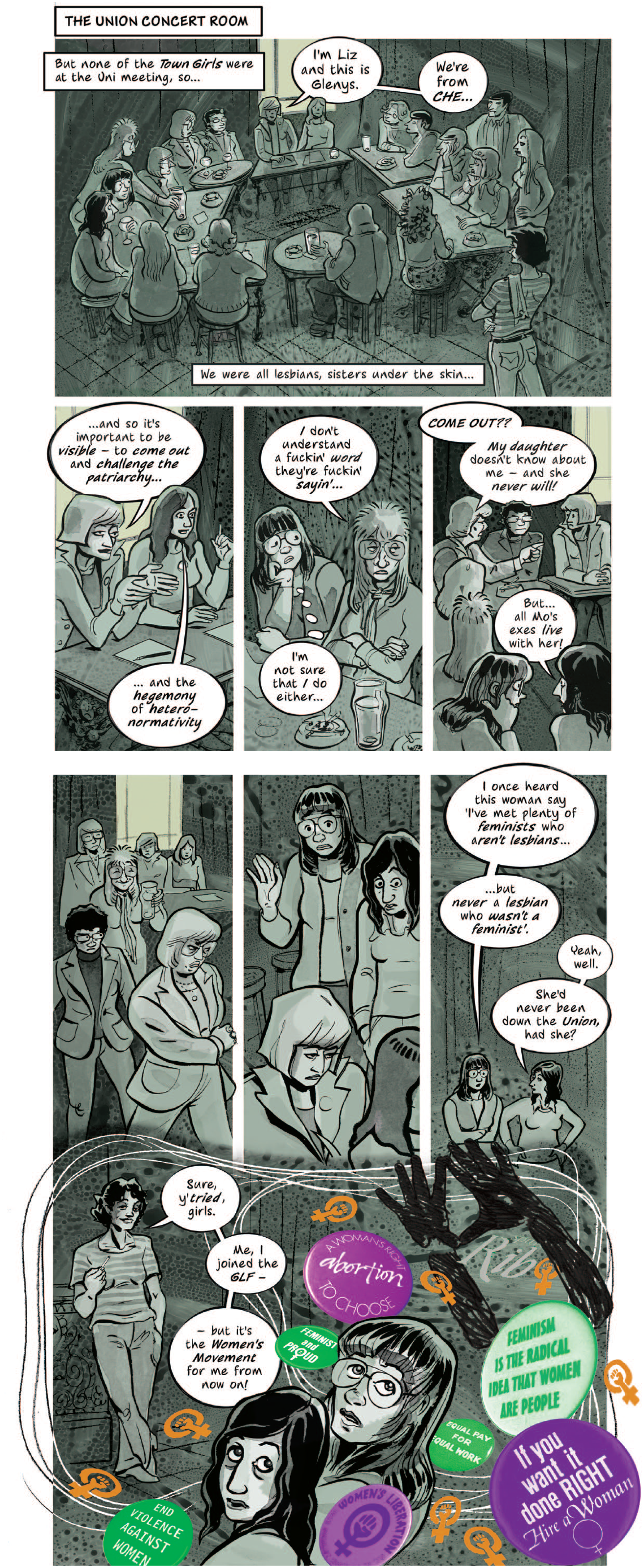
By 1972, Kate Charlesworth and her friend and fellow student Jackie, after 2 years of a lesbian life consisting exclusively of nights out at the – friendly to lesbians – pub the Union, begin to feel restricted. “Same old faces . . . There’s gotta be more that this . . .,” says Jackie, to which Kate responds, “I’m going to a CHE 8 meeting at the University Union” (Charlesworth, 2019: 134). Soon after, the two women help organize a Campaign for Homosexual Equality meeting especially for women at the university. When the Union’s patrons, “Town Girls,” do not attend that—otherwise popular—meeting, Kate and Jackie invite the CHE organizers to come to the Union and talk to the patrons, showing that their participation in CHE is also politically motivated. However, the meeting fails to establish a connection between CHE and the patrons. In the two pages that depict that meeting (see Figure 1), one can read what has been described as the move of many lesbians in the 1970s away from the lesbian bar subculture and the gay movement toward the feminist movement. One can also read the ambivalent position that Charlesworth reserves for her younger self and her friend in this move.
The CHE meeting at the Union, Sensible Footwear: A Girl’s Guide by Kate Charlesworth (2019: 136–137).
The two pages mirror each other diagonally, starting and ending with two tier-sized panels with two three-panel tiers in between. The layout builds tension between the bigger panels, which create a sense of longer lasting moments, and the smaller panels, where the action progresses fast. This layout helps to show a movement from unity to disintegration and from a specific moment in the life of the narrator to a greater historical moment in time. The meeting starts with the Town Girls and CHE representatives sitting in a circle while introductions take place. The caption supports a sense of unanimity: “We were all lesbians, sisters under the skin . . ..” The narrow panels below, however, which focus on smaller groups, create a feeling of fragmentation. In the first panel, the CHE representatives’ bodies and high-flown feminist vocabulary show assertiveness, even condescension: Liz’s half-closed eyes and hand gesture lends a pedantic air to her lecture on the importance of challenging the patriarchy while Glenys, casually holding a cigarette, adds more jargon. In contrast, in the second panel, a Union patron crosses her arms defensively and raises her eyebrow, while telling Kate she does not understand a word the representatives are saying. In the next panel, things escalate: another patron, Mo, strongly protests the representatives’ pressure to come out, which originates in values and needs foreign to hers. In the following panels, the meeting ends abruptly when patrons and representatives leave the room. Wide-eyed and with raised eyebrows, Kate and Jackie appear surprised to find that the famous quote “I’ve met plenty of feminists who aren’t lesbians but never a lesbian who wasn’t a feminist” 9 apparently does not apply to the Union lesbians.
The association Kate makes between feminism and CHE also comes to the fore in the vocabulary used by the representatives: “patriarchy,” “heteronormativity.” CHE, as well as GLF, 10 mentioned by Bernie, were the two main activist organizations for LGBTQI+ rights in the United Kingdom in the early 1970s. Like their US equivalents, their discourse was influenced by the women’s movement, especially lesbian feminism’s theorization of homosexuality as a revolution against the patriarchy (Walter, 1980: 7–8, 27, 39–41). The respectability feminism offered to lesbian life (Henry, 2004: 127), the centrality of women’s economic independence from men in feminism’s agenda (Abbott and Love, 1972: 135), as well as the sexism some lesbians experienced in the gay liberation movement (Walter, 1980: 31), resulted in lesbians “increasingly beg[inning] to coalesce around the banner of feminism rather than gay liberation” (Henry, 2004: 127). Indeed, Bernie’s words in the last panel show gay liberation as an intermediary step on her way to joining the women’s movement, visualized by allocating the GLF to the middle speech bubble. Not all lesbians were part of this move toward feminism, however, and these two pages pay tribute to those who were not. Earlier in Sensible Footwear, the Union is introduced as a seedy place owned by a crook and frequented by lowlifes, a place where petty crime takes place and where, initially, Kate and Jackie are received with suspicion for being university students. The majority of its patrons are older than Kate and Jackie, follow the butch–femme sexual styles common in bars in the 1950s and 1960s, and are politically “inactive” (Charlesworth, 2019: 102–106). The pull of gay liberation and the women’s movement was stronger for white, middle-class, educated young women, who often had easier access to the resources that disseminated these movements’ ideas (Seidman, 1995: 119). CHE, GLF, and the women’s movement, moreover, shared a disapproval of bar culture, believing that its lower class status contributed to the ghettoization of gay and lesbian people and that “role-playing” reproduced heterosexual dynamics (Walter, 1980). The difference in status is obvious in the smugness of the CHE representatives and the defensiveness of the patrons, which inevitably foreclose the possibility of a fruitful exchange of ideas.
In all this, Kate and Jackie occupy an in between position. The two women are dressed differently than the other patrons: Kate’s aviation glasses, their long, natural hair, and the trousers or jeans and sweaters, they wear comprise the androgynous radical chic style that originated in the counterculture of the 1960s but was already part of the fashionable mainstream by the early 1970s. This look, popularized by iconic feminist Gloria Steinem, appealed to White, middle-class, educated young women who either consciously identified with feminism’s ideology or unconsciously reflected the movement’s cultural success (Rabinovitch-Fox, 2021: 158–176). Kate and Jackie, moreover, rather function as witnesses than as participants. They do not contribute to the plenary discussion, but the direction of and expression in their eyes is consistently visible to the reader, unlike that of the other participants. The two women are simultaneously focalized and focalizers in a way particular to comics: as their act of looking is the focus of attention, they import their subjective perspective into the panels, inviting the reader to identify with their position (Mikkonen, 2017: 151–154). The two friends mainly look dumbfounded by what is happening around them: they express difficulty understanding what the representatives and patrons are saying, and when the others leave the meeting, they look on in shock. The humorous element that their expressions and words introduce shows that they occupy a position of insider–outsider in relation to both “camps” and of innocence regarding what is taking place. It also helps establish the affectionately satirical attitude that characterizes the remembrance of lesbian feminism in Sensible Footwear, which I will discuss more in the next pages.
The last panel markedly shows both the forcefulness of the feminist movement’s interpellation of lesbians and the ambivalent position Kate and Jackie occupy in this historical moment. As Bernie tells Kate and Jackie that she has moved from the GLF to the women’s movement, they find themselves amid an agglomeration of pins with slogans and symbols from 1970s feminism, which represent concerns beyond sexuality, such as reproductive rights and violence against women. As the pins swirl around them, they look up wide-eyed, in awe and apprehension. This panel is distinct from the first seven panels, which have clear edges, as it leaks into the other panels and out of the book. It visually resembles the documentary strand of the book, drawn in vivid colors and displaying ephemera. The two strands meet here as this greater historical moment enters the young women’s lives. The rhetorical force of this panel shows the women’s movement as something overwhelming that comes to dominate the scene, and the two women as reluctantly drawn to it. Kate’s move toward the women’s movement without fully identifying with it enables Sensible Footwear to maintain a distance from lesbian feminist approaches toward sexuality and gender that are not popular today, which can be seen more clearly in the page analyzed next.
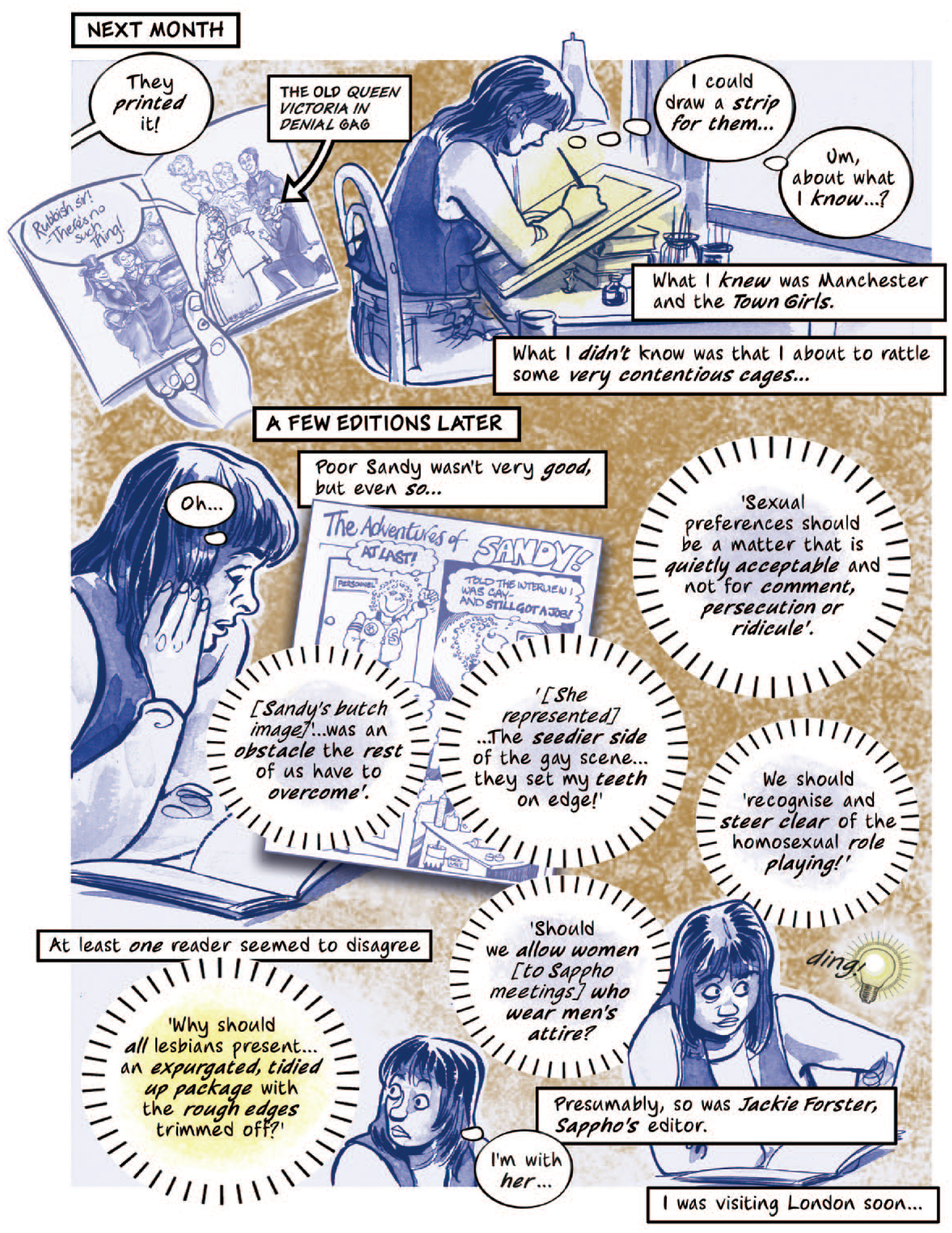
In 1974, Kate starts drawing comics for the magazine of Sappho, a London-based lesbian organization. Her contribution, the strip “The Adventures of Sandy,” is informed by her background in the lesbian bar subculture of Manchester. Sandy’s butch image incites some angry responses from readers that touch upon a hot debate in lesbian feminism (see Figure 2): it is “an obstacle the rest of us had to overcome,” as it represents “the seedier side of the gay scene,” and the “homosexual role-playing” “we should recognize and steer clear of.” The relationship between Kate and the reader’s comments in this page casts her again as a witness. While Kate appears three times, she is placed in a marginal position compared to wheel-like shapes containing the readers’ disembodied quotes. Yet, her expressive face—eyes wide open in surprise and concern—makes her subjective vision the lens through which the comments, as focalized objects, are seen and invite identification with her marginal point of view and emotional response.
Drawing for Sappho and reception, Sensible Footwear: A Girl’s Guide by Kate Charlesworth (2019: 150).
The page stages the two schools of thought discussed earlier without addressing all their differences, by letting the part—approaches toward the butch—stand for the whole. Presenting the critical side as more dominant than the accepting one, and showing Kate as identifying with the minoritarian position, enables a distancing from aspects of lesbian feminism associated with trans-exclusionary practices. As Kate’s point of view coincides with the approach that is predominant within queer feminism, this page prepares the reader for the eventual victory of the minoritarian position, showing the lingering linearity in the narrative. Yet, it shows the two schools of thought as coexistent in the 1970s, which creates a more complex image of lesbian feminism than often found in progress narratives.
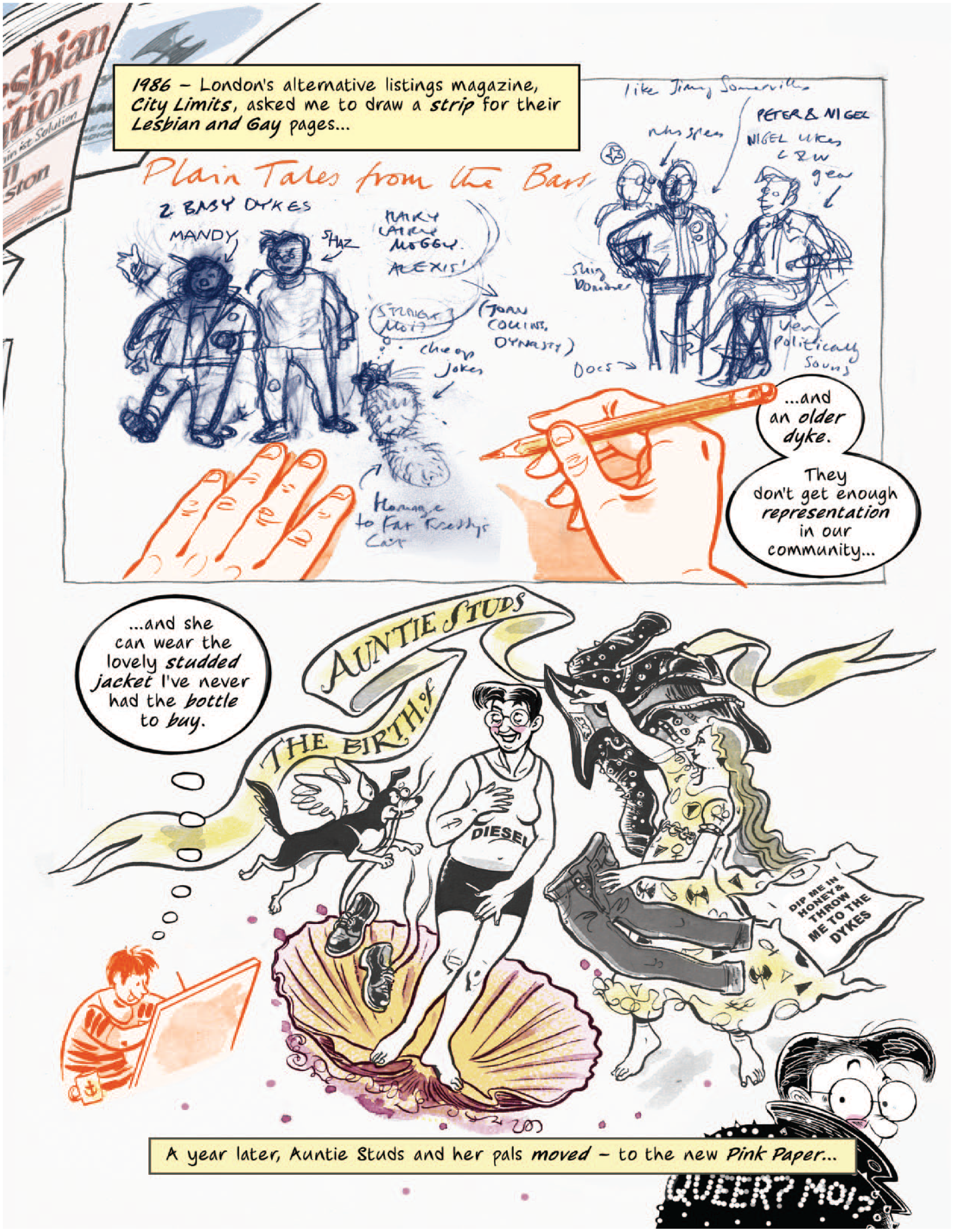
This complex image can be seen again when Sensible Footwear chronicles the LGBTQI+ activism of the 1980s and early 1990s. In a moment when Charlesworth (2019: 230) discusses the “Golden Age of Feminist Publishing,” she mentions her own work within it and remembers Auntie Studs (see Figure 3), a character she created for a comic strip that ran in gay and lesbian newspapers at the time. Auntie Studs functions as a bridge between the two narrative strands: she is Charlesworth’s avatar (Charlesworth, 10 June 2021, personal communication), and she represents the activists of the LGBTQI+ community in the documentary strand. However, as what is presented as a minoritarian position in the 1970s is given center stage in the 1980s, I argue that this figure bridges more than that: she stands for both progress and continuity, a connection with queer feminism and a grounding in lesbian feminism.
The birth of Auntie Studs, Sensible Footwear: A Girl’s Guide by Kate Charlesworth (2019: 231).
“The Birth of Auntie Studs” resembles a single-image cartoon incorporated in a panel. Auntie Studs is drawn in a more caricature-like way compared to the memoir and documentary parts of the book, with a face made up by ink work without much shading and with unrealistic, more abstracted features that move too freely and facilitate exaggerated facial expressions. This drawing style is not only funny but ensures that she is read as a type. Moving toward the abstract along the realistic–abstract continuum enables a comics character to represent a worldview, theme, or idea. This is the result of “amplification through simplification,” when characters are simplified with the purpose of focusing our attention on what they stand for (McCloud, 1993: 29–31), a practice that plays a more significant role in comics than in other mediums (Mikkonen, 2017: 179). The image, a parody of Botticelli’s iconic painting The Birth of Venus, shows a White, middle-aged woman on a seashell. She has scraped knees, an anchor tattoo, and is clad in a pair of boxers and a sleeveless undershirt that reads “DIESEL.” A flying dog and a young woman bestow on her a pair of brogues, a white T-shirt that reads “dip me in honey and throw me to the dykes,” a pair of jeans, and “the lovely studded jacket I’ve never had the bottle to buy.” Her hairstyle replaces Venus’ long, flowing golden locks with a quiff, a 1950s haircut revived in the UK gay and lesbian subcultures of the 1980s (Geczy and Karaminas, 2013: 37). Invoking the cultural revolution of the Renaissance, 11 Auntie Stud’s image manifests the birth of both a new ideal of female masculine beauty and an epoch in which this ideal is invested with significant meaning. She resembles the 1980s butch lesbians (Geczy and Karaminas, 2013: 33), whose highly stylized look was argued to be a reaction to the stereotype of the “drab stylelessness” of 1970s lesbian feminists (Faderman, 1992: 593) and what was seen as the feminist antipathy toward fashion (Blackman and Perry, 1990: 4; Rabinovitch-Fox, 2021). Replacing the figure of the lesbian feminist of the previous decade, the butch then “metamorphosed into the prime warrior against male chauvinism” (Faderman, 1992: 588).
The figure marks a shift in lesbian feminism due to her connection to the LGBTQI+ movement. In the documentary pages that follow, Auntie Studs functions as narrator and commentator on issues and events that concerned the LGBTQI+ community in the 1980s, namely the HIV/AIDS crisis and the actions against Section 28, a law that forbade the promotion of the acceptability of homosexuality by local authorities and the institutions they funded, such as schools. She explains that these events united and made stronger a community consisting of “gay men, a shadowy lesbian presence, occasional bisexuals and a few marginalized trans folk, all sharing an edgy coexistence” (Charlesworth, 2019: 233), and foregrounds the role lesbian activists played in the events. These were the events that brought back into the LGBTQI+ movement a big number of lesbian feminists who had earlier withdrawn from it, marking what is seen as the beginning of queer feminism, recalled by the words “Queer? Moi?” on the back of Auntie Studs’ jacket, on the bottom right corner of the “Birth” panel.
At the same time, the image alludes to the figure’s origins in lesbian feminism: the woman that presents Auntie Studs with clothing wears a dress adorned with feminist, lesbian feminist, and gay symbols that were popularized in the 1970s and 1980s: among them are the Venus symbol, associated with the women’s liberation movement; the double Venus, a symbol of lesbian feminism; and the labrys, a consistent symbol of radical lesbian feminism (Campbell, 2019). Bringing the symbols of lesbian feminism and radical lesbian feminism in proximity with Auntie Studs’ butch style challenges the common association of these movements with anti-trans and anti-gender ideologies, enabling a more complex and conciliatory remembrance of them.
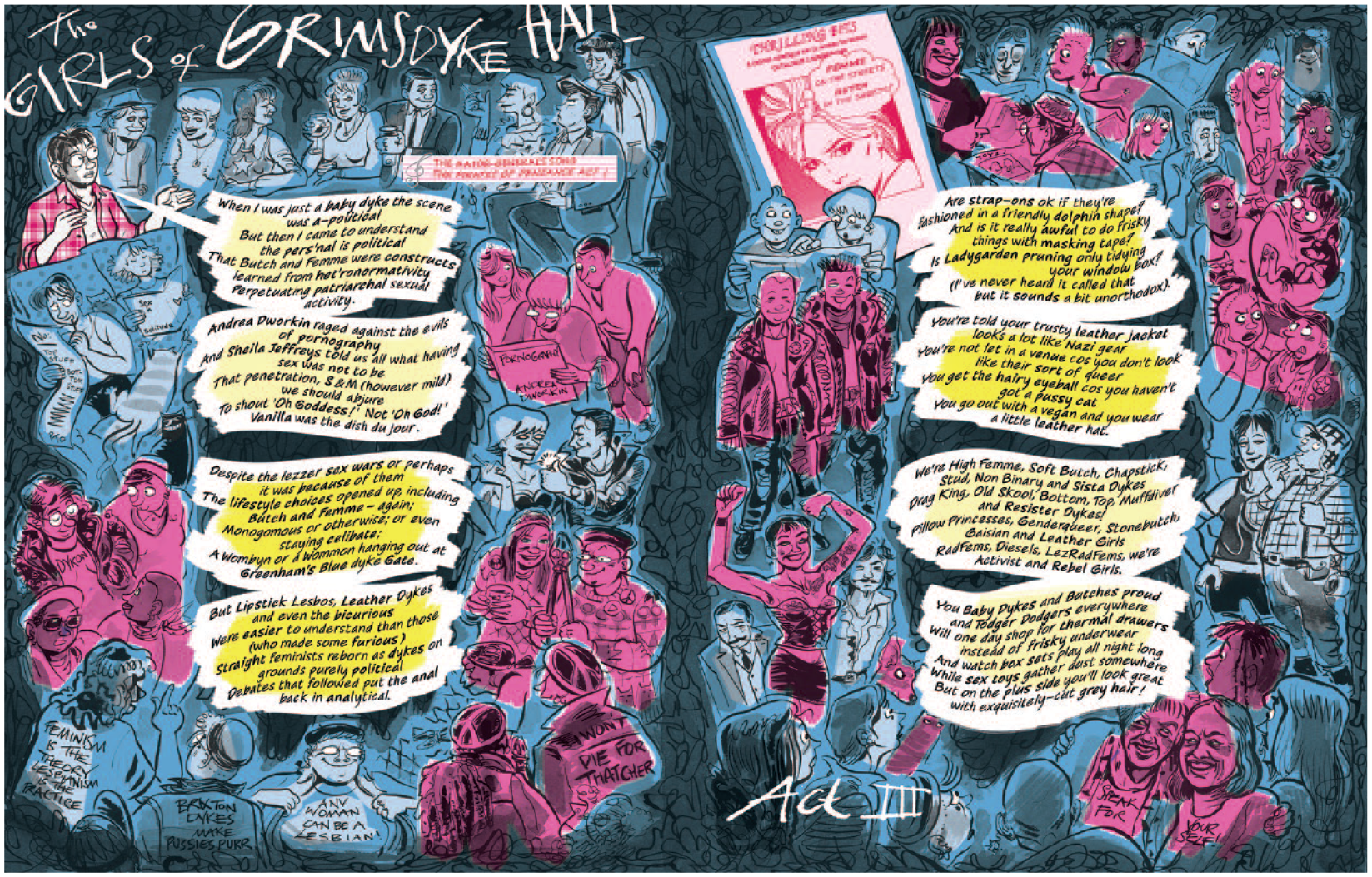
The work’s conciliatory tone comes to the fore more strongly in the third and last act of “The Girls of Grimsdyke Hall” (see Figure 4), an interlude-like set of breaks in the action, matched to the music of songs from Gilbert and Sullivan’s Savoy Operas. Unlike the first two acts, which celebrate the lesbian bar scene of Manchester in the 1970s, Act III is a humorous overview of decades of lesbian subcultures. This two-page spread shows a diverse crowd of lesbians, acting both like illustration and chorus, surrounding a song sung by Kate in her 30s. The song follows the tune of “The Major General’s Song” from The Pirates of Penzance, Gilbert and Sullivan’s most recognizable and widely pastiched patter song. Following the patter song format (Fiss, 2009), the pages contain as much verbal and visual information as possible within a limited space/time, giving Charlesworth more space to address the debates within and among these subcultures and pay closer attention to them.
The Girls of Grimsdyke Hall, Act III, Sensible Footwear: A Girl’s Guide by Kate Charlesworth (2019: 214–215).
Bringing together the two types of content in patter songs (Fiss, 2009: 106), the eight stanzas combine a narrative with a number of lists. The first two stanzas list the things that Kate learned when the apolitical lesbian scene of her youth became informed by lesbian feminism. Here, one sees common stereotypes about lesbian feminism’s approach to sexuality, such as “the pers’nal is political,” “Butch and Femme were constructs learned from het’ronormativity perpetuating patriarchal sexual activity,” Andrea Dworkin’s case against pornography, and Sheila Jeffreys’s hatred toward sex, penetration, and “S&M (however mild).” The next two stanzas list the lifestyle choices and identities that “opened up” during the “lezzer sex wars,” including “Butch and Femme,” monogamous, celibate, “Wombyn” or “Wommon,” “Lipstick Lesbos,” “Leather Dykes,” and “Straight feminists reborn as dykes on grounds purely political.” Stanzas 5 and 6 list debates within the community about the appropriateness of certain sexual practices and exclusions generated by such debates. The last two stanzas move forward in time in relation to the timeline of the book (the intermezzo takes place between the years 1982 and 1983): stanza 7, specifically, is a list of names for lesbians based on style, gender presentation, sexual preferences, race, and political affiliation, some of which were not widely used in activist circles before the 1990s and are associated with queer feminism, such as “non-binary” and “genderqueer.” The list is not exhaustive but meant to celebrate the gender and sexual diversity in lesbian communities.
The narrative of progress that dominates the remembrance of lesbian feminism echoes here; we move from the apolitical lesbian scene before the 1970s to lesbian feminism and its restrictions, to the sex wars of the 1980s that led to a greater acceptance of diversity within the LGBTQI+ movement, marking the end of lesbian feminism and the beginning of queer feminism. This narrative is—unsurprisingly—created with an oversimplification and erasure of different voices within the same movement. For example, the choice of Sheila Jeffreys and Andrea Dworkin as representatives of the feminist ideas that informed the movement at the time reinforces the idea that feminism was afraid of sexuality and excluded non-normative genders. 12 Lesbian feminist writers such as Monique Wittig (1992), Gloria Anzaldúa (1987), and Gayle Rubin (2006) are not made to represent lesbian feminism here, even though their work, expressing views on gender and sexuality more in line with queer/trans feminist ideas, was published at the same time. This creates an image of lesbian feminism that is easy to satirize. Yet, significantly, the song promotes an image of unity despite differences, by making fun of not only a specific era or school but the whole variety of lesbian identities and positions in the debates, which are presented as odd and funny, regardless of their origin.
The patter song format helps create a tone of affectionate teasing that is directed all around, including at Kate herself. Patter songs use incongruous lists with as many alliterations and tongue twisters as possible in an extremely quick tempo. This poses a challenge in intelligibility and creates a comic effect that undermines the dignity and authority of the character who sings it (Fiss, 2009: 98–107). This is achieved here by the disparate list of questions and issues about lifestyle choices, including choice of pet, clothes, sexual practices, and diet. The list is also incongruous on the level of seriousness: the debate in the London lesbian scene in the 1980s about the appropriateness of wearing leather gear, which resulted in different factions socializing and organizing politically in different venues (Shanahan and Williams, 2021), is juxtaposed with the question whether a lesbian ought to own a cat or not. The celebratory list of queer identities is based, again, on incoherent characteristics, from sexual preference to race or style, or even on no characteristic at all: some of these words are simply generic slang for lesbians.
The imagery is a visual adaptation of the patter song genre in its own right: it fits in as much information as a two-page spread can hold and it constitutes both a narrative and a list. Around 60 lesbians are drawn in a caricature-like way to represent, similarly to Auntie Studs, different types. They display diverse styles, from butch–femme to the feminist antistyle of the 1970s, from diesel dykes to lipstick lesbians, crossdressers, and the androgynous styles of the late 1980s and 1990s (Geczy and Karaminas, 2013; Reddy-Best and Jones, 2020). They wear clothes with mottos expressing various political affiliations and accessories with lesbian feminist symbols, from the labrys and the double Venus to the lesbian pride star, and they read texts that represent different approaches to sexuality. The figures can be read in order from top to bottom and from left to right, representing the development of lesbian subcultures from the 1960s to our time. Simultaneously, they can be read synchronically, as constituting a crowd that coexists in time. Thus, they celebrate the richness of lesbian subcultures, alive in the past as well as the present.
The expression of emotion and the kinds of engagement between these types also contribute to the comic effect: lesbians one would expect to see in conflict engage in friendly interaction, whereas lesbians one would expect to see in agreement appear to disagree over insignificant issues. For example, in the middle of the first page, a lesbian dressed in 1970s style is making eyes at a femme (whose butch is looking elsewhere) undermining the understanding of 1970s lesbians as not very interested in sex. On the lower left side of the same page, a long-haired woman wearing a T-shirt with the 1970s slogan “Feminism is the theory, lesbianism is the practice” speaks with her index finger raised, while a woman with a quiff and a jacket that reads “Brixton Dykes make pussies purr” (emphasizing a lustful energy associated with another approach to lesbianism) listens attentively. In contrast to this friendly attitude, a group of lesbians on the top right of the second page look at another, very similar-looking, lesbian in shock and disapproval, apparently because she carries a dog in her arms.
The imagery, therefore, works in synthesis with the lyrics to create a satire and a celebration out of this section dedicated to the conflicts within lesbian and queer feminism, conveying the messages “don’t take anything too seriously” and “live and let live.” Although the remembrance of lesbian and queer feminism enacted here is not so different from mainstream narratives of progress, it enables the rehabilitation of lesbian feminism in the queer family and its teasingly affectionate welcome.
The importance of humor in establishing Sensible Footwear’s balance between celebration and critique, marks it as an opportunity to study an aspect often not addressed in scholarship on graphic memoirs, histories, and documentaries, which tends to focus on such works’ aptitude for witnessing and processing conflict, oppression, and trauma (Chute, 2010, 2016; Hirsch, 2011; Smith, 2011). Charlesworth’s use of humor shows the influence of what Nicole Streeten (2020) identifies as the feminist visual humor cultivated by feminist and lesbian cartoonists and comic artists in the United Kingdom, from the 1970s to today. Streeten mentions, specifically, the practice of lesbian cartoonists, such as Charlesworth herself and Cath Jackson, of directing satire not only outwardly, toward a mainstream patriarchal and homophobic society, but also toward the lesbian/feminist self or community. Drawing on Julia Kristeva’s theorization of laughter as a way to displace abjection, Streeten (2020: 120) sees self-mockery as a technique that helped manage anxieties around identity and group belonging. Self-mockery could take different forms and served a number of purposes: it provided gentle critique for norms and stereotypes within lesbianism, pinpointed tensions between experience, desire, and theory; challenged uniform representations of lesbians; consolidated a sense of community by addressing inside jokes to a knowing audience, and cemented solidarity with outsiders by helping lesbians look less threatening (Streeten, 2020: 125–135).
Not only does the influence of this lesbian comics tradition vibrate throughout the book, but the presence of Auntie Studs, a character in her earlier strips, in Sensible Footwear pays explicit tribute to this tradition as well as the feminist cultural public that engendered it. This counters the “archival erasure” in a contemporary publishing and scholarly context where such comics strips are often overlooked, for centering lesbian life in a form that is considered “low brow” in comparison to the “more serious” graphic narratives, as Erin la Cour (2021) has pointed out in the case of the reception of Alison Bechdel’s oeuvre. These earlier works did not only create humorous practices that foreground “the fun and funny side of comics and feminism” (Streeten, 2020: 38), but they also played a role in the expansion of comics readership outside traditional comics fandom (Streeten, 2020: 37). Further research would be required to explore to what extent feminist/lesbian comics, as well as their creators and readers, formed a kind of cultural “abeyance structure” (Taylor, 1989) that helped keep alive the connection between feminism and humor during the dominant anti-feminism of the 1990s and 2000s, or whether they contributed to the rise and popularity of the feminist graphic narrative.
Conclusion
Kate Charlesworth’s Sensible Footwear has been praised for its compelling and accessible representation of 70 years of feminist and LGBTQI+ life and activism in the United Kingdom, and for centering the perspective and experiences of lesbians while “[n]ot [being] TERFy” (Mendlesohn, 2020). The implied surprise in the observation that the book is “[n]ot TERFy” is not surprising given the long-standing association of the figure of the lesbian with certain aspects of lesbian and radical feminism that have adopted trans-exclusionary practices and disagree with feminist theories of gender as socially constructed. However, the book’s careful construction of images of lesbians that stand apart from such associations is indicative of a larger tendency to reconsider what the figure of the lesbian can mean for feminist and LGBTQI+ politics today.
The stereotypification of the figure of the lesbian in the collective memory of feminism has served political purposes not only outside but also within the movement. Feminist narratives of progress and loss alike rely on a figure of the lesbian that is distinct from the figure of the queer in terms of style and sexual practices, in order to either celebrate the development of feminism into a movement that accepts diversity and celebrates sexual pleasure or laments the loss of a movement which promised a radical break from systems of oppression through a cultural revolution that started with sexuality. Such narratives, in all their differences, serve to recruit political subjects into affiliation with parts of feminism that have different values and political agendas in the present (Enke, 2018; Hemmings, 2011; Henry, 2004; Hesford, 2013). It is indeed the widening gap between these parts and the recent radicalization and momentum of feminist anti-trans voices, especially strong in the United Kingdom, that has urged queer feminist scholars to argue for the necessity of redrawing the figure of the lesbian so she can represent the common origins of contemporary feminist and LGBTQI+ activism as a wider antifoundational political project (Henderson, 2018; Huffer, 2013).
The term I use for this practice, redrawing, is inspired by Clare Hemmings’ (2011) creative method of recitation, which foregrounds existing but less remembered elements of the feminist past to change well-rehearsed narratives that account for relationships between feminist factions. The practice of recitation, which makes for a creative yet accountable use of the past, resembles, I argue, what Ann Rigney (2012; 2021b) identifies as the practice, common in art, of renegotiating collective memories in conversation with societal and political changes, combining occluded aspects with creative imagination. Redrawing the lesbian means delving into different aspects of lesbian feminism, including ideologies, practices, and styles, to diversify the stereotypical imagery that has accompanied this figure and challenge common understandings of the relationship between lesbian feminism and queer/trans feminism.
Although redrawing the lesbian does not necessarily involve actual drawing, the role the medium of comics can play in it has been noted by feminist scholars (Hesford, 2013; Huffer, 2013). Expanding on this observation, this article has read Sensible Footwear with a focus on elements that give comics their characteristic expressive capacities. There are various elements that enable the work to create a vivid representation of lesbian politics and cultures that is easy to follow yet dense and multilayered in meaning. Such elements include page layout and the ways it invites linear and/or synchronous readings of time, and showcases relationships between characters; drawing style variation, used to distinguish between narrative strands and the function of figures as characters and/or types; characters’ appearance, including facial expressions, gestures, and style of dress, which gives rich information about group belonging; the capacity of comics’ characters to act as focalizers and as focalized objects at the same time; comics’ aptitude for popular and material culture references that include music, fashion, and painting; and more generally, the use of humor as a means to disseminate knowledge about lesbian life and manage anxieties about identity and belonging.
Sensible Footwear, thus, redraws the figure of the lesbian and challenges the dominant remembrance of lesbian feminism in three main ways. The first one is the consistent representation of a plurality of voices coexisting in time, voices which are commonly remembered as belonging either with lesbian or queer feminism. The second is the representation of lesbians, whether they are main characters or types, as embodying elements that come from diverse traditions within feminism and LGBTQI+ life and activism, and as occupying a complex belonging in relation to these traditions, distancing themselves from exclusionary tendencies without shaming factions associated with these tendencies. Finally, the work characterizes an affectionally satirical approach toward all these traditions, which refuses to make a villain or a fool of any one of them. Although Charlesworth’s narrative, understandably for the celebratory aims of the book, reproduces dominant understandings of the development of the feminist movement by way of linear progress from lesbian to queer feminism, it builds a complex picture of lesbian feminism and cultivates a truly conciliatory tone that is rare for such narratives.
Footnotes
Funding
The author disclosed receipt of the following financial support for the research, authorship, and/or publication of this article: This publication is part of the project Redrawing feminism: graphic narrative engagements with the feminist past, which is financed by the Dutch Research Council (NWO).
