



Abstract
Political polarization in Spain has been aggravated by a left-wing coalition government and the rise of the extreme right in the context of health and economic crisis created by COVID-19. This article delves into the collective story that memes offer of this context and aims to establish a categorization that can be used for comparison with other countries. We carried out a content analysis of 636 Spanish political memes published on Twitter throughout 2020. Current affairs were taken into account, as well as the frame, and rhetorical elements, references to popular culture, and symbols. We also took into consideration the objectives of the message and the presence of offensive content. We demonstrate that these memes do not play a subversive role, but rather contribute to the polarization and fragmentation of the digital public, echoing the existing ideological confrontation. They do not deliver new ideas, but only reproduce expressions and disqualifications already existing in the society, although the disinhibition of anonymity magnifies the intensity. Current affairs are an excuse to convey ideological position, and political communication becomes more emotional. There are no significant differences in terms of political polarization between left and right, and criticism toward politicians is mainly of personal and moral nature. Hate speech on other social media appears in these cultural creations, highlighting the misogyny toward women politicians regardless of their political party. The rhetorical and expressive resources are adapted to this confrontation, and there is little innovation because it is subject to the understanding of the message.
Introduction
The year 2020 was marked by COVID-19 and its political, social, and economic consequences: strict home confinement, self-isolation, the increase of working from home, political tensions, unemployment, and economic crisis. In the communication field, the use of social media has intensified, which has manifested in the rise of fake news and disinformation (Naeem & Bhatti, 2020). It has also promoted solidarity and shared identities. In the cultural ecosystem (Xu et al., 2016), the creative actions of users in Web 2.0 have become relevant in the form of the so-called meme, one of the most prominent phenomena of recent years.
This research analyzes Spanish political memes spread via Twitter throughout 2020 to assess the content and resources used to convey them. Unlike the pre-digital environment, where users relied on traditional media for information, nowadays, audiences get increasingly engaged in the communicative process through simultaneous production and consumption. Memes are “units of popular culture that circulate, imitate and transform through the internet, creating a shared cultural experience” (Shifman, 2013b, p. 367). The digital meme can be an image—video, photograph, music production, or GIF—with superimposed/overlap text and austere quality; it is important to convey a message, not a style (Börzsei, 2013).
The link between social media and politics began to consolidate in the 2008 US elections. Candidate Barack Obama innovatively used digital platforms to carry out his campaign (Shifman, 2013a, p. 120). A clear example of the strategies used by Obama is the viralization of the Hope Poster as a meme. In 2011, during the Arab Spring, protesters used social media and memes, and these protests became memetic in other countries (Shifman, 2013a, p. 122). These examples show that in past years memes contributed to subversive political activism. In contrast, the findings here show these artifacts have come to contribute to a broader division in already toxic digital audiences due to the aggressive fragmentation of national discourse.
Memes stand out mainly as a widespread cultural practice (Gal et al., 2016; Wiggins & Bowers, 2015) that expresses ideas, energies, trends, and desires of different audiences (Jenkins, 2014) and shapes internet users’ everyday experience. Memes are often light-hearted online texts generated by the demands of popular entertainment (Milner, 2016), but others are subversive (Davis et al., 2016) and express collective emotion (Cepeda, 2018). According to Mielczarek (2018), memes and, by extension, their rhetoric of resistance are not always ephemeral: they can resurface to prompt former ideas or create new meanings.
The political image macro memes we analyze in this study are suited for political persuasion and propaganda campaigns (Nee & De Maio, 2019). Perhaps this is because they can be easily shared and transformed, and because images contain more identifiable symbols than purely text-based messages (Kharroub & Bas, 2016). In this context, Denisova’s (2019) monograph analyzing Russian political memes on Twitter concludes that a meme is a powerful tool for influencing public awareness.
It can be argued that internet memes act as agents that select information through sharing (Meraz & Papacharissi, 2013), repetition, and manipulation (Wiggins, 2019), but they also establish topics, frames, and the opinion individuals have about them. In the context of memetic videos, Hansen et al. (2011) claim that memes containing messages that engage people with different interests achieve greater virality. However, comments often show that users talk to others with similar political and cultural beliefs (van Zoonen et al., 2011). In any case, memes have become a standard frame of reference for acting on and discussing a wide range of topics (Seiffert-Brockmann et al., 2018).
Shifman (2014) proposed a classification of three genres of memes originating from still images: memetic photos (edited with software); image macros or stock character macros (images with superimposed text); and photo fads (photographs of people posing in a particular way, imitating specific positions or attitudes). The use of photographs and iconic images function as a metaphor that can be re-contextualized to form new symbolic associations. Historical images can be adapted, recycled, parodied, and even simulated to obtain the desired meaning (Huntington, 2016, p. 80).
Because of Twitter-specific functions, users are able to create a meme by simply adding a comment on top of any image, video, or GIF (Beskow et al., 2020, p. 4). Another user can edit a meme by using the retweet feature to add another comment, image, website address, or hashtag, generating a memetic mutation (Elsharkawy et al., 2019). Thus, memes are a combination of qualities shared with the original image, to which unique elements are added, such that there is a balance between similarity for repetition and variety in the mix (Segev et al., 2015). However, there are also the so-called “orphan” memes that share elements with other memes but lack further replication (Brubaker et al., 2018).
Memes generally use humor to communicate ideas or messages ranging from the absurd to the offensive (Williams et al., 2016). As Dahlgren (2009, p. 139) argues, humor serves to “strip away artifice, highlight inconsistencies, and generally challenge the authority of official political discourse.” In other words, memes offer new possibilities for parodying political parties and politicians and their ideological agendas (Piata, 2016, p. 40). Nonetheless, memes are sometimes racist (Williams et al., 2016); they resort to disparagement and even hate speech to spread political ideas, attack minorities, and exacerbate existing differences between political, social, and ideological extremes (Beskow et al., 2020).
Denisova (2019) and Wiggins (2019) highlight the importance of specific socio-cultural factors. Memes require us to “finish the sentence to complete [the] joke” (Denisova, 2019, p. 10). This entails understanding “the references to the cultural and social issues, popular and alternative culture, general knowledge and media awareness, internet and political literacy,” among other aspects (Denisova, 2019, p. 11). Context is defined as the set of antecedents, assumptions, and beliefs assumed to exist in the participant’s mind. However, the ideological intention of meme creators may be ambiguous and memes can be understood or “decoded” (Hall, 2001) in multiple different ways by audiences (Chonka, 2019).
Memes are polysemous and open to various interpretations. Although the addressee has to interpret the meaning of the message, the socio-cultural environment largely contributes to constructing the coherence of the message (Johann & Bülow, 2019, p. 1723). In the use of some iconic or historical images, the context becomes secondary due to its symbolic charge, which facilitates the interpretation of the meme. However, the constant recycling and editing of such images can cause the original image to acquire a radically opposing meaning, which is contradictory (Boudana et al., 2017).
This symbolic load has led to the assertion that these digital texts are increasingly shared throughout the world and are not restricted to a specific region (Benaim, 2018), thus the growing interest among politics and other sectors in taking advantage of those symbolic values. This analysis of politically charged Spanish memes shared on Twitter attempts to go beyond the case study to delve deeper into the characterization of the memetic creation. This meme-creation activity channels political and social commentary on the internet and generates a collective account of facts, problems, and events occurring in specific communities and/or globally.
Regarding the Spanish case, we will show that memes are not always naively humorous or intentionally subversive. They also increase the political polarization of the ideological environment in which they are reproduced. This role of polarization is achieved through a subjective interpretation of current affairs (frames) to attack the political leaders of the opposition who are held responsible for the country’s problems. They go beyond parody to discredit them as individuals, intensifying ideas already exposed in politically positioned media. Thus, the meme contributes to the fragmentation of the digital public and the creation of an emotional political narrative.
Method
As outlined above, we analyzed Spanish political memes, including the entire ideological spectrum manifested in their attacks (from the extreme right to the extreme left), spread via Twitter from 1 January 2020 to 31 December 2020. We used Twitter because, unlike other social media outlets, politically related themes are considered to be more widely addressed on this platform (Bozdag, 2020, p. 10), which has been the case especially during the global pandemic (de Saint Laurent et al., 2021, p. 11). We selected image macro memes, the most popular meme (Zenner & Geeraerts, 2018), and excluded those with no image, video, or GIF.
We analyzed to what extent political memes reflect ideological confrontation, how that is expressed visually, and their role throughout 2020 in Spain. This was a year characterized by high political polarization following the formation of a left-wing coalition government (between The Socialist Party—PSOE—and extreme left-wing party Unidas Podemos), along with the rise of the extreme right (Vox), and the political, social, and economic actions taken to address the pandemic.
The corpus was compiled by searching keywords on Twitter (left-wing, right-wing, reds, fascist, names of political parties, and names of politicians, among others) from an account created specifically for this research. From this first sample, we analyzed the user accounts (not party accounts) returned by the Twitter algorithm. We then selected accounts that were active during 2020 and published at least five memes per month. For the final corpus, a total of 33 accounts were selected: 18 satirical and 15 partisan. From these 33 accounts, we obtained 1,345 memes. After excluding references to politicians no longer in public office, the monarchy, or government technicians (such as Fernando Simón, the epidemiologist responsible for managing the pandemic), we gave all the accounts a similar proportionality to avoid overrepresentation. Since this research aims to establish the characteristics of the content and how this is expressed, engagement was excluded from the analysis, as were retweets and “likes.” The result was a corpus of 636 memes.
Based on the theoretical background, we posed the following research questions to analyze Spanish political memes in 2020:
Q1: What current affairs did Spanish political memes illustrate on Twitter in 2020? What was their quantitative evolution throughout the year? Which frames were used?
Q2: Was there more meme production against the political right or against the political left? Did the political polarization materialize in parties or politicians?
Q3: What is the importance of history, popular culture references, and other symbolic elements (national, political, religious, or historical) in the Spanish political memes?
Q4: What rhetorical devices are used in the analyzed memes? What is the meaning behind each meme? Is hate speech featured in these messages?
Q5: Is it necessary to contextualize political memes to understand them? Is it essential for the creator and the addressee to have the same cultural background?
The three authors of this article acted as coders. We undertook a content analysis to answer these questions, creating a codebook and a complete code sheet with examples. The unit of analysis was each of the selected memes. To confirm the effectiveness of the analysis, we ran a pre-test with 10% of the sample (64 memes). Because the latent content of some variables needed interpretation, four sessions were needed to discuss how to code each item. In the end, we reached 94.8% of intercoder reliability. The most complex variables were hate and antagonism, followed by affront and insult. Since the two latter depend on cultural conventions, it was agreed that affront discredits and undervalues an aspect in which a politician has a defined position; insult is a provocation with no connection to reality. Satire was identified by its sarcastic tone. Humor was excluded as a variable because it was a feature present in all analyzed memes.
The content analysis, which included the meme creation data (ID, account name, day, and month), revolved around two fundamental issues: content and expressive resources, always differentiating between the “right” (Vox and Partido Popular) and the “left” (PSOE and Podemos), without discarding centrist (Ciudadanos) and the pro-independence parties (Bildu, Esquerra Republicana, Junts per Cataluyna). We considered Spanish politicians, Spanish political parties and their ideology, foreign politicians, and national and international political issues (or those with political implications) in memes created throughout 2020. We also specified the variables, including these items, as well as their definitions.
Regarding the expressive resources or ways of presenting these contents, we distinguished between the rhetorical elements essential to describe and understand the memes (Huntington, 2016; Jenkins, 2014): satire and metaphor. Given Spain’s current political situation, Polarization was included, understanding by such messages that confront two factions without options: “you are either with me or against me” (Manfredi-Sánchez et al., 2021, p. 84). We also analyzed pop culture references (film posters, fictional film, television and animation characters, video games, television shows, among others) and the symbols used. The relevance of the Catholic religion for right-wing parties and allusions to contemporary Spanish history (the Spanish Civil War and Francoism), which feature strongly in current Spanish political debate, were also taken into account (Chart 1).

Expressive resources of the content analysis and its variables.
Finally, we analyzed the message’s objective, whether it was positive or negative, and whether it was crucial to know the national cultural context to understand the concept or idea conveyed (Chart 2).

Message variables included in the content analysis.
Hate speech, which has been circulated widely on social media in recent years, was analyzed within the negative message group. Memes are vehicles for hate speech because they share specific discursive strategies (humor, metaphor, and satire). Given the difficulty to distinguish clearly between hate and antagonism (Paz et al., 2020, p. 6), we regarded hate as the presence of injury, insult, or threat toward a group or person on account of their gender identity and sexual orientation, religious beliefs/practices, race, ideology, and physical or intellectual disability, among other aspects (Cereceda, 2019). We typified this hate as xenophobia, misogyny, homophobia, discrimination due to intellectual or physical disability, or ideology.
Based on the variables described, this inductive methodological design also covered trends emerging beyond this initial approach. The deductive analysis detected certain aspects, such as the importance of press photographs in meme creation, which we describe in the results to outline these political memes as fully as possible and assess their present-day role.
Results
Interpretation of Current Affairs and Frame Purpose
The connection between the corpus memes and current politics was not determined by the number of political events. January and December were months of intense political activity (discussion and passing of laws, government control sessions); however, December ranks third in meme production and January seventh.
COVID-19-related topic and their political repercussions were the most discussed issues, although there were exceptions to this general trend. For instance, in October, meme production rose due to the vote of no confidence proposed by the extreme right, and it decreased in June, despite the ending of the state of emergency. This shows that meme authors are interested in news relevant to their ideology because of its controversial nature, rather than in good news or those that affect the citizens’ life, work, or health.
This peculiar relationship between memes and current affairs is confirmed in the analysis of the topics. Memes are used to criticize political leaders as people and for their political activity. Out of eight themes covered, only 44.9% of the analyzed memes allude to a current event (Chart 3). The rest of events have a low (less than 9 memes) and heterogeneous presence (extreme right-wing rallies, tax rises, education-related issues, and national or regional government control sessions).

Number of memes analyzed by event during 2020.
We found more memes against the left (57%) than against the right (43%). Political opposition stimulates critical thinking against the government. Memes against the right attach more importance to the political news appearing in the media daily (52% approximately), while messages aimed at the left focus less on political agendas and more on people. International news went unnoticed, with just three memes referencing the US elections.
When approaching current affairs, memes use different frames. These types of frames make it possible to establish a classification of the cases analyzed. Only frames with more than 30 memes were considered to be representative models:
The Scornful frame: criticizes politicians because of the decisions they make (Figure 1); it is only an excuse to discredit and essentially insult the person. For example, the celebrated Disaster girl meme is used by the left to brand right-wing leader Pablo Casado (Partido Popular) a rat, for seeking to sabotage Spain by opposing against an extension to the state of emergency. Critics of the Spanish president label him a criminal for the high number of COVID-related deaths.
The Nosy frame: delves into politicians’ private affairs to show inconsistencies between their political position and behavior or personal background (Figure 2). For example, when extreme right-wing leader Santiago Abascal (Vox) demanded a naval blockade to prevent an influx of migrants from reaching the Canary Islands, several memes noted he had not finished his military service. Another meme mentions that Minister of Equality Irene Montero (extreme left-wing Unidas Podemos) worked as a supermarket cashier before holding public office. Many memes also used photos taken before the pandemic to insinuate that political leaders were not complying with the anti-Covid measures.
The Robin Hood frame: contrasts the privileges of politicians against people’s social inequalities (Figure 3). This frame was particularly pertinent for panning the left-wing government. It stresses aspects that mainly affect ordinary people, such as health care during the pandemic and the economic downturn caused by the national lockdown. For example, several memes feature photographs of the hospital room where Vice-President Carmen Calvo 1 (PSOE) stayed when she had COVID-19. In contrast, other memes include images of a makeshift hospital set up at a convention center in Madrid, with several hundred beds per ward.
The Overly dramatic frame: hyperbolizes the consequences of political decisions, using rumors and fake news to highlight what is presented as error or malpractice. The politician’s intention is inverted to generate surprise (Figure 4). For example, Isabel Díaz Ayuso, president of the Community of Madrid (right-wing Partido Popular), was criticized for the handling of the pandemic: she is scorned for building a hospital for infectious diseases that remained empty for some time, and the Eric Andre Shooting meme is used to criticize the management of the retirement homes during the early stages of the pandemic (Eric portrays the Partido Popular killing the elderly).
The government was blamed for the economic crisis and data manipulation on public service television, tax hikes, the new Education law (“Children do not belong to their parents. Socialist PSOE, repossession agent”), and Catalan independence (“Independence is as easy as eating an orange,” using as reference a meme where Hans Moleman from The Simpsons compares a successful marriage to eating an orange).
5. The Projection frame: uses a picture of a character with a peculiar gesture or look that allows them to be attributed negative thoughts, wishes, or words. Facts bend to the intention of the meme, which creates a fictional reality (Figure 5). Some insinuate Santiago Abascal’s (extreme right-wing Vox) desire to participate in “a Nazi gay orgy”; and others that Pablo Iglesias 2 (extreme left-wing Unidas Podemos) is “angry because three vice-presidencies were created in addition to his own.”
6. The Reaction frame: replies or makes fun of other memes. It can be considered counter-propaganda because the sender intends to baffle the receiver with a similar image, presenting an argument while making fun of the original meme (Figure 6). A good example is the right-wing and left-wing versions of a modified movie poster of the film Les Miserables: politicians and partisan flags of the opposing political spectrum are shown in each version.

Example of Scornful frame. President of the Community of Madrid (right-winger Díaz Ayuso) between the wise monkeys, an allusion to turning a blind eye.

Example of Nosy frame. Picture of a supermarket cashier with the overlapped face of Minister of Gender Equality (extreme left-winger Irene Montero) (“Your total is 60 euros, Sir”).
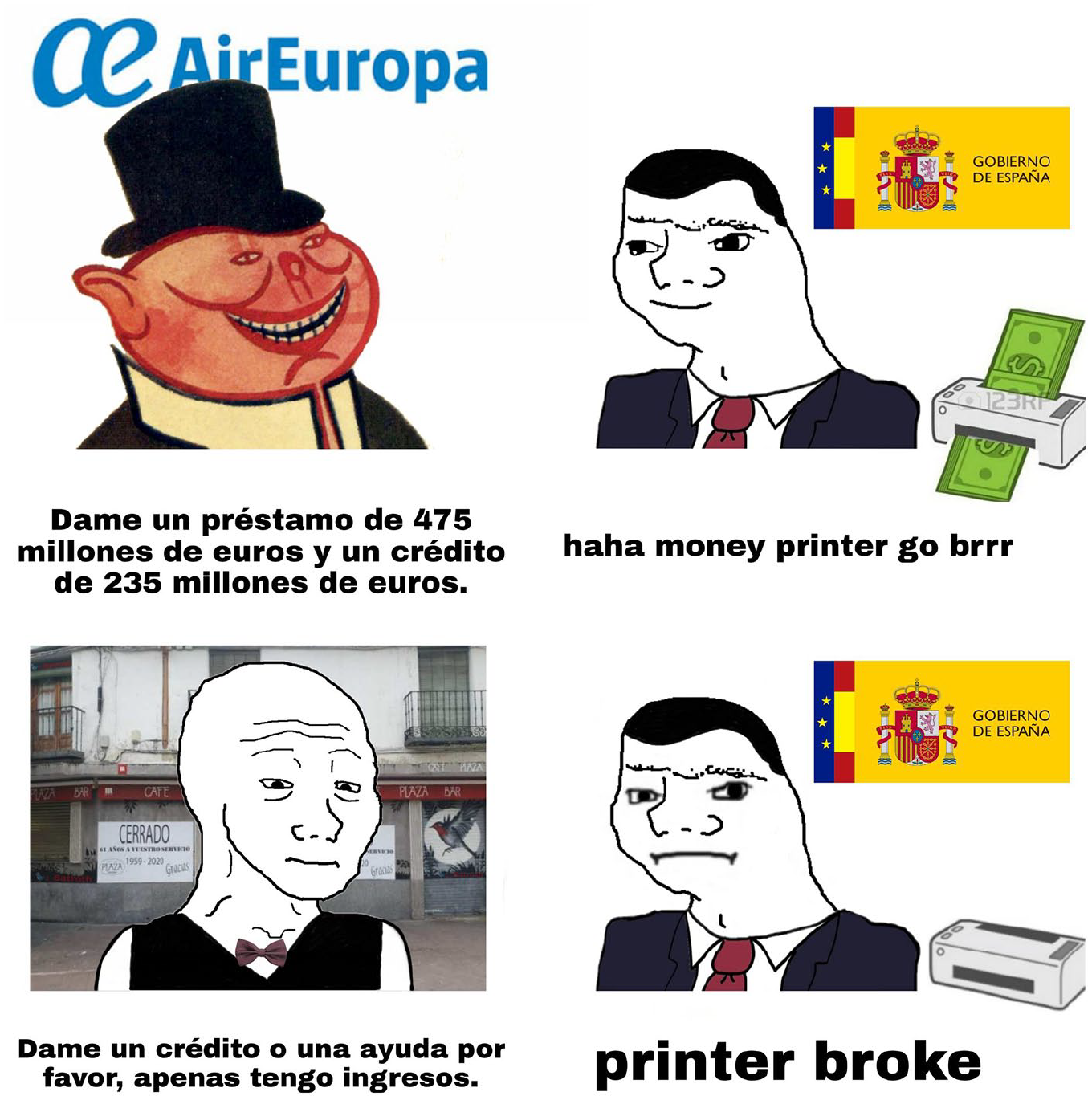
Robin Hood frame. Wojak meme. The capitalist pig represents companies (in this case, the airline AirEuropa) whom the government granted loans and credits; in contrast, the working class was denied credits or stimulus checks. (Give a loan for 475 million euros, and credit for 235 million euros. Please grant me credit or any help, I barely have any income).
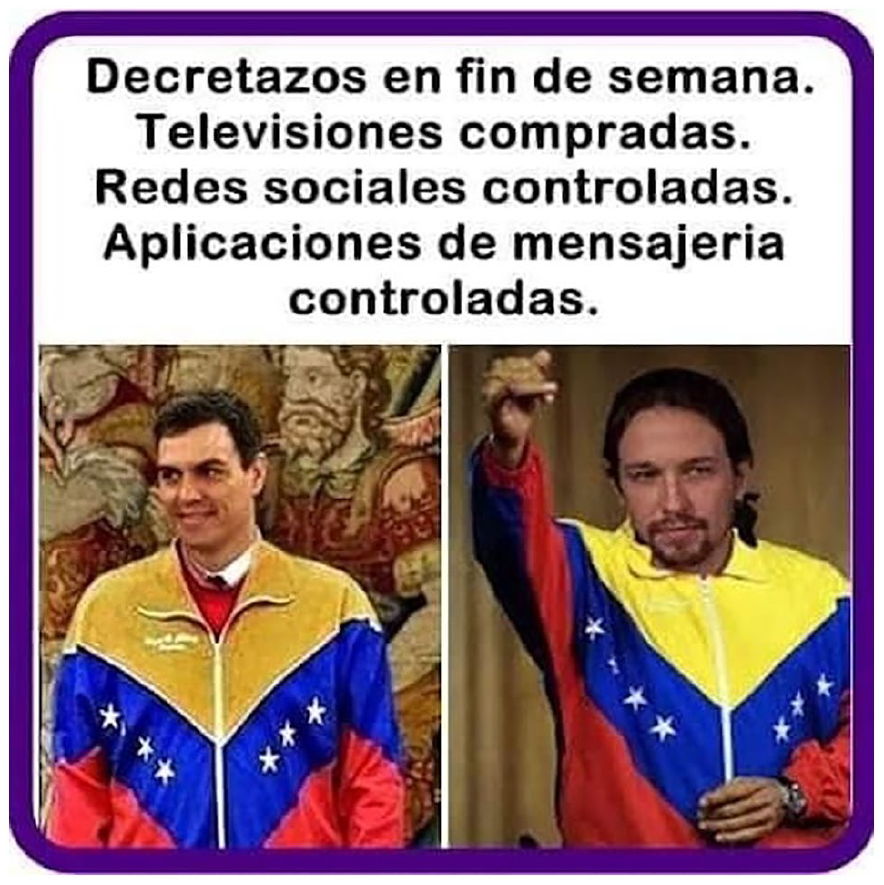
Example of Overly Dramatic frame. Faces of President Sánchez (right-winger) and Vice-President Iglesias (extrema right-winger) superimposed on figures wearing tracksuits bearing the Venezuelan flag (Weekend executive orders. Bought TV stations. Controlled social media. Controlled messaging apps.).
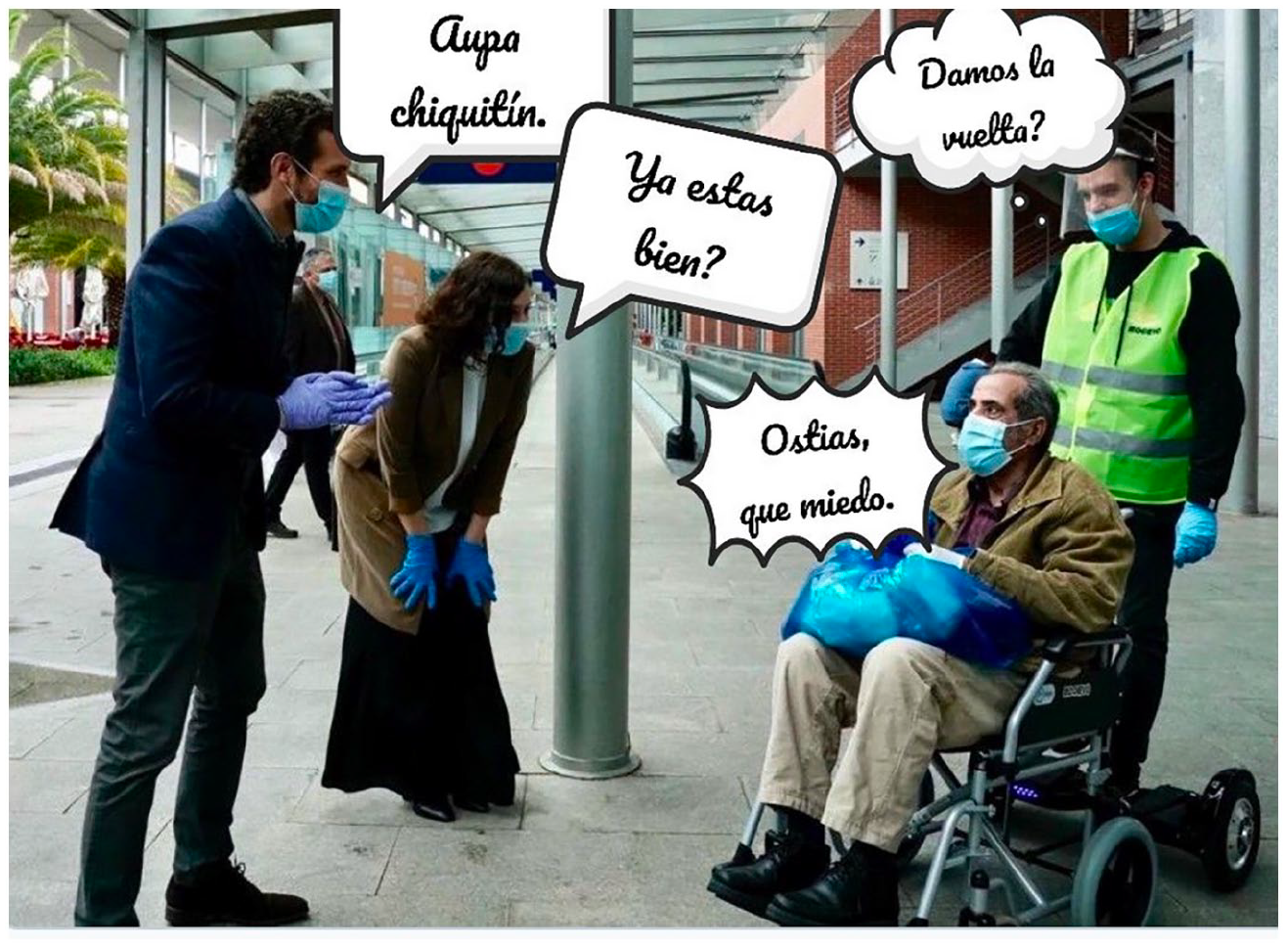
Example of Projection frame. Picture of Pablo Casado (right-wing Partido Popular) and Isabel Díaz Ayuso (right-wing Partido Popular) interacting with a patient and a nurse at Madrid’s COVID-19 makeshift hospital (“Come on little guy”/“Are you already recovered?”/“Yikes, this is scary”/“Want to go for a stroll?”).

Example of Reaction frame. Swole Doge versus Cheems meme. Left-wing meme: Swole Doge is wearing a hat and armband with Nazi motifs (Fascists before: I’ll invade all Europe, subdue villages, no one will stop me) Cheems is wearing a VOX-extreme right-wing party-hat (Fascists now: Ow! they painted a van with bright colors). Right-wing meme: Swole Doge is wearing a hat and t-shirt with communist motifs (1950 communists: I killed a dozen homosexuals); Cheems is wearing a pro-choice green handkerchief, an iPhone, and an LGTBIQ flag (2020 communists: There are men with vaginas).
We confirmed that interest focuses on politicians rather than on political parties. This may be due to the current personalistic nature of politics (Balmas & Sheafer, 2013) or the addressee’s ability to instantly identify the politician with the party (Mudde & Rovira Kaltwasser, 2019, p. 86). The results on the prominence of certain politicians were predictable: notable public office holders (President Sánchez and Vice-President Iglesias) are the main targets of critical memes against the left-wing (44% of the sample with individual or joint memes). Next are memes against right-wing and extreme right-wing leaders totaling 30% of the corpus. Other politicians also appear, albeit to a much lesser extent. In this case, images show party leaders, mainly those from pro-independence parties from the autonomous regions of Catalonia and the Basque Country. There are a few references to foreign politicians, where Spanish right-wingers are associated with Trump (9 memes) and with left-wingers (Unidas Podemos in particular) with Hugo Chavez or Nicolás Maduro (17 memes).
Overall, meme creators interpret and sometimes fabricate current affairs in line with their ideology. There is no dialogue to draw positions closer together. On the contrary, the hyperbole and the intrusion into people’s private lives creates a climate of tension where emotions take over, and there is no room for rational argumentation. These cultural products are fueled by ideas put forward by certain media outlets that do not hide their ideological affiliation and statements that politicians themselves make. Memes act as an impulsive spokesperson for these ideas.
Images at the Service of Ideologies
Images used to show these ideological stances on current affairs are mostly historical and/or national symbols (46% of the sample) due to the expressive ease they offer when encapsulating concepts and emotions in an image. These are followed by pop culture elements (25%) as a knowing wink, facilitating a bond between senders and addressees, and finally, references to events or characters from Spanish or universal history (19.9%). We analyzed them in that order.
Among the historical/national symbols, flags stand out (specifically the Spanish flag), and in second place, far behind, political party logos. The Spanish flag appears regardless of ideological content (17.1% of the analyzed memes), but in anti-left-wing memes the flag is included as a sign of identity (8.6% of the total). In memes critical of the right, the flag plays a secondary role (8.4%) since it is part of the background in an image, generally taken from the media (official ceremonies, press conferences). Other flags (Catalan, feminist, LGTBI, etc.), as well as Nazi and communist icons, are found in these images to a far lesser degree. Memes criticizing the left most often feature these symbols, including the communist motifs associated with the left (mainly connected with the president and vice-president of the government, and the Catalan pro-independence leader Quim Torra).
Pop culture references include images from films, while television series are far more frequent in the left-wing memes (7.5% of the total) than right-wing ones (4.7%). The Simpsons also appear, especially Homer, whose grotesque characterization offers a wide range of interpretative possibilities. We found a wealth of references to audio-visual productions from the 1990s, such as Friends, Tarantino films (Reservoir Dogs), and even earlier ones, such as children’s television shows from the 1970s or classics (Dirty Harry or the Marx Brothers). However, images from more recent Spanish productions (such as the TV series La Peste [The Plague] and foreign productions (Jojo Rabbit and films from the Marvel Universe), video games (such as Assassin’s Creed) are also featured. Television, the medium that draws Spain’s largest audience, provided the primary source of inspiration. Characters from series (such as The Walking Dead and Game of Thrones) are mimicked, as are quiz shows, reality shows, and even commercials. In keeping with the nature of memes, there is no shortage of takes on well-known memes (Disaster girl, Eric Andre shooting, Wojak, Waiting for dad, Roll safe, You killed the man but not the idea, Swole Doge vs. Cheems, and Drakeposting, among others).
Regarding history, photographs of Franco far outstrip (in 36 memes) other figures linked to a totalitarian ideology: Hitler (12), Mussolini (9), and Stalin (4). This finding is logical, given the controversy surrounding the Spanish dictator’s exhumation in October 2019; although this event was not the subject of many memes, it was used to establish a connection between the transfer of Franco’s coffin and those of the COVID-19 victims. The Spanish Civil War, which is used politically by both sides of the ideological divide, barely appeared in the analyzed corpus. In line with Franco’s exhumation, the most referenced period of history was the dictator’s regime, commemorated in two ways. Detractors use Francoism to demand the Republic, while others exalt Franco’s victory and the reestablishment of the dictatorship to convince themselves of the final victory.
Among the diverse sources of images used, press and agency photographs stand out as the prime source of material in the memes analyzed. We found images from posters, book covers, publications from politicians’ social media accounts, and government and party websites to a lesser extent. Surprisingly, clericalism no longer constitutes a prominent feature of the Spanish right in a secularized society; Church’s association with the right-wing is no longer a characteristic attacked by the Spanish left.
Among the rhetorical elements (satire, metaphor, and polarization), satire stands out (58% of the analyzed corpus); it predominates in messages criticizing politicians with an ironic and scathing counterpoint. This rhetorical element emphasizes emotional arguments, as stated before, to hold politicians accountable for the country’s problems. We classified in several categories memes that use satire, based on whether there was a reference to a politician or their political decisions (Table 1).
Forms of Satire Used in the Spanish Political Memes Analyzed.

Source. Own elaboration.
Note. COVID-19 = coronavirus disease.
Overall, satire builds an imperfect character (Example 1), with no dignity (Example 2, 3, 4), as an inferior person (Example 6), with intentions of subverting the constitutional order (Example 7).
We also found metaphors in 34.4% of the analyzed memes. The usual feature in this trope was to transfer the meaning of one image to a different one. For example, the president and vice-president of the government are portrayed as rats. Other tropes were also used: metonymy was expressed, for example, in a meme showing the face of the minister of universities on an inanimate carbon rod, a character from The Simpsons that saves Homer’s life when he goes into outer space. Synecdoche appears in the meme where Abascal’s face is overlapped on the Iranian Ayatollah Ali Khamenei’s body to label him a fundamentalist. Visual metaphors were less frequent due to the complexity involved in their design and the difficulty that general audiences would have to understand them. Nevertheless, the accompanying text clarifies the meaning.
Polarization was evident in 19.1% of the sample. Although not an extraordinary figure, it is high enough to interfere with democratic dialogue on Web 2.0. Such polarization translates into direct political confrontation: “Will you let this shit (extreme left-wing Pablo Iglesias) destroy Spain?”; “We will stop this government together” (an allusion to the government’s slogan on Covid “We will stop this virus together”); or “Vox is the cure for communists, socialists, Podemos supporters, feminazis, secessionists, and other fellow Bolsheviks.” Hostility was also brought to the economic sphere, with a battle between rich and poor in the economic crisis caused by coronavirus: the rich get loans, the poor get neither loans nor help. Right-wing memes resort more often to polarization, while left-wing memes opt for satire, the former is more explicit, while the latter shows more examples of metaphor.
Negative Targets of the Message: Defamation and Hate
These characteristics point to an evident majority of memes with a negative objective (95%) compared with the smaller number of positive memes (5%). We found no constructive criticism, and few memes express just an opinion or feeling. Whether from the left or the right, 59.9% of these memes deride (31.1% by the left and 28.7% by the right). They essentially poke fun at government agreements (Figure 7), political decisions (tax rises, for example), and personal behavior (Figure 8).

Family picture with overlapped faces of President Sánchez and Vice-President Iglesias as the parents, and Pablo Echenique (extreme left-wing Unidas Podemos) as their son.

Isabel Díaz Ayuso (right winger) wearing a mask under her chin (Like Díaz Ayuso, I went to the pharmacy to get some masks to protect my chin, but they were sold out).
In addition to diminishing politicians, some memes suggested a strong eagerness to offend and insult, particularly in those directed against the left (96 compared to 38). Insults were explicitly correlated to politicians’ physique or intellect, including memes attacking their performance as civil society representatives. The insults were varied, and many were textually or visually explicit. The concurrence of specific terms leads to the discrediting of the political class in general. This generates little confidence in their administration since they are portrayed as despicable (rats), lacking sufficient intelligence to govern (fools), and disrespectful of the democratic system (dictators).
Slurs and vitriol feature in memes with hate-speech content account for 30.6% of the corpus. This confirms that these digital texts also advocate racism and xenophobia (Williams et al., 2016), dehumanizing migrants and refugees, branding them as a threat (Gómez-García et al., 2021, p. 2), with images of packed boats making it impossible to identify them as individuals (Glăveanu et al., 2018, p. 443). On the contrary, female politicians in government posts were the group that received the most hostility. Memes against the right-wing make use of misogynistic tropes because the president of the Community of Madrid is a woman (Isabel Díaz Ayuso) and from a right-wing party. Similarly, there were many attacks on the left-wing government’s female politicians. Misogyny in both cases is based on a perceived naivety of inexperienced and unqualified people who make mistakes (“Each time she opens her mouth, she screws up”). These perceptions of women in politics are due to the cultural disconnect between what the public perceives as the attributes demanded of political leadership and the stereotypes associated with women as “the weaker sex,” as demonstrated in the 2016 US Presidential election campaign (Nee & De Maio, 2019). If they are feminists, they are dubbed feminazis, lonely and bitter, and whenever political disputes arise between them, the memes become personal, portraying these women as childish (“Weren’t we friends?”). There was no shortage of sexual allusions to male submission, usually toward the leader of the party to which they belong, thus asserting their public status through the provision of sexual favors (Figures 9 and 10).

I’ve been promoted meme with the superimposed face of Irene Montero (extreme left-wing Unidas Podemos) in an image of a woman after performing a sex act.

Altered picture of Cayetana Álvarez de Toledo (right-wing Partido Popular) and Pablo Casado (right-wing Partido Popular) during a parliamentary session. (“-Are you the piggy bank for the retirement fund?” “-No.” “-So what is this slot?”).
Granted that female politicians are discriminated against for their status as women, disabled male politicians become the focus of mockery. Pablo Echenique (extreme left-wing Unidas Podemos), who suffers from spinal muscular atrophy, is attacked for his physical appearance (Figure 11). He is depicted as a thief, a child, a toy (an articulated dog), or a virus. Derogatory language, such as “subnormal,” is also aimed at people with intellectual disabilities (Figure 12). Given the physical threat expressed, some of these statements against politicians are so strong they can be considered a hate crime: “Euthanize Abascal,” “Deport Echenique immediately,” “Kill Iñigo,” among other similar expressions, such as calling terrorist left and right-wing leaders (linking them to ETA, a Basque nationalist and separatist organization).

Picture of a disabled man with the overlapped face of Pablo Echenique, extreme left-winger (This is how I would be in Cuba or in another communist country).

Adapted picture of Vox extreme right-wing leaders. The meme creator added the portrait of Franco and the slogan (Do not make fun of the retarded, please).
Ideology-based discrimination, constituting the highest percentage of hate crimes and incidents in Spain in 2019, figured in 19% of the total sample, with 62.3% attacking the left and 37.7% the right. Feminists were criticized for spreading the coronavirus due to the International Women’s Day rally that went ahead shortly before the state of emergency was announced. Catalan pro-independence supporters (“they want to break up Spain”), leftists are considered murderous reds, and right-wingers as fascists and Nazis. Both sides identify the “enemies” with the four horsemen of the Apocalypse.
Denisova (2019), who analyzes Russian memes, points out that it is crucial to know the political and cultural context to understand the meaning of most memes. It is also necessary to understand the past since memes include expressions that a young addressee would find difficult to comprehend without background knowledge; in the same way, an older addressee might not understand current pop culture references. For example, the leader of the extreme right-wing (Abascal) is called a “bakala,” a term to describe young Spanish people in the late eighties and early nineties who would spend long, sleepless weekends on a “discotheque crawl” (“Ruta del bacalao”) while indulging in non-stop sex and drug consumption. Among the pop culture elements found, memes connect the addressee with Spanish television shows of yesteryear that form part of earlier generations’ nostalgia. Only memes with a strong visual symbolic load or an explicit image (e.g., a picture of Stalin or Franco) do not necessarily require previous knowledge, because they themselves constitute their context. These political symbols are an effect of the meta-narrative culture, and people adopt and adapt them to organize and understand their reality (Wydra, 2012).
In an increasingly globalized online culture, the political meme primarily connects the national community.
Discussion and Conclusion
Our analysis of Spanish political memes shared on Spanish Twitter shows no significant changes either in the themes and resources used or the aim of the message over the year analyzed. Perhaps one year is insufficient time to observe significant transformations, or maybe memes, in their general conception, have not undergone significant alterations because they are already consolidated as a format. The ongoing search for simple quality (Börzsei, 2013) leads to a restriction in innovation to ease the comprehension of the message, which is the main objective of this popular creation.
We believe that, rather than reflect current news, memes reflect the current political situation and the society they refer to. Spanish memes, in particular, contribute no new ideas, as some authors point out in other cases (Mielczarek, 2018), they replicate and consolidate existing stereotypes, expressions, and attacks. Memes represent an emotional change of direction in political communication, similar to the Ukrainian and Venezuelan cases (Makhortykh & González-Aguilar, 2020).
Journalistic information, chiefly press photographs, provides the meme with its primary source material, which serves as an excuse to polemicize, and test the limits of ideological beliefs, as shown in the classification of frames. These frames highlight the subjective and interpretative nature of daily information. Few people analyze or discuss the issues in the media in a way that contributes to democratic debate. It seems likely that party propaganda machines are behind these productions (although we did not analyze political party accounts) since some messages echo the turns of phrase of some politicians and their parties and of some media outlets. Nonetheless, the uninhibited anonymity of social media encourages meme creators to notch up the intensity of their abuse. It must also be considered that troll culture in social media is not an unusual activity, given that it is part of the mainstream culture (Phillips, 2015).
COVID-19 and the measures taken to control it are the main themes of the messages. Memes against the left-wing government outnumbered those against the right-wing because it is the opposition’s prerogative to lash out at government decisions. However, in Spain, memes from the right wing and left wing are similar in terms of criticism, polarization, and sometimes use the same icons or meme characters to expose their ideas (similar to the Italian case, where political satire and polarization were distinctive aspects during the beginning of the pandemic; Vicari & Murru, 2020). This stands in contrast to the United States, where the (arguably more radical) alt-right using specific meme characters such as Pepe the Frog (Nagle, 2017), whose image (almost always linked to this ideology) has never recovered its original meaning (Pelletier-Gagnon et al., 2021).
The result is a primary collective narrative that responds to the first thought triggered by a news item or person (an insult, an expression of hate) and one in which fake news is sometimes used to underpin their intended message.
There is more satire than parody (unlike the Greek context, Piata, 2016). Parody introduces humor to amuse the reader, but satire is clearly about attacking. In this case, as we have explained, parody is used not to condemn political situations or issues but to criticize personal decisions, specifically the ineptitude of politicians reflected in their actions of moral or social nature. The aim is not to amend or help remedy but to ensure critical effectiveness. The distrust and disappointment toward political leaders observed in the 2016 Spanish general election campaign (Meso et al., 2017, p. 680) has increased over time, particularly with the impact of the health crisis.
It is crucial to know the national political context because the protagonists tend not to be globally well-known names (such as Trump or Merkel). Although the symbolic load of the memes diffuses as addressees adopt these references (Benaim, 2018, p. 908), in some cases, they only acquire a full meaning if they are explained. For this reason and for the eagerness to connect with the national addressee, meme authors, conditioned by their political ideology, present current affairs in a certain way, including their own cultural references and echo rumors circulating in society, integrating them into the satire. History (with few exceptions) barely has any weight; in comparison, popular culture gains prominence. In short, there is a link between the different elements that characterize political memes and their objectives. Moreover, memes assume a generalized anti-civic role regardless of the ideology, which tends to accentuate the confrontation between the various ideological beliefs, as in other countries (Gruzd & Roy, 2014; Jiang et al., 2020; Pidkuimukha & Kiss, 2020). The growing danger of polarization in US social networks (Penney, 2020, p. 804) is a reality in Spain, where there is evidence of a clear intention of political persuasion with the same strategies used during electoral campaigns (Zamora-Medina et al., 2021, p. 19), but with a significant presence of hostile emotions (Ihlebæk & Holter, 2021), especially rage.
Footnotes
Declaration of Conflicting Interests
The author(s) declared no potential conflicts of interest with respect to the research, authorship, and/or publication of this article.
Funding
The author(s) disclosed receipt of the following financial support for the research, authorship, and/or publication of this article: This research was made within the framework of the research project PID2019-105613GB-C31 “Mapping of Hate Speech in Spain”, funded by The Ministry of Science and Innovation (Spain).
