



Abstract
Current research on the weaponisation of far-right discourse online has mostly focused on the dangers of normalising hate speech. However, this often operates on questionable assumptions about how far-right terms retain problematic meanings over time and across different platforms. Yet contextual meaning-change, we argue, is key to assessing the normalisation of problematic but fuzzy terms as they spread across the Web. To redress this, our article traces the changing meaning of the term based, a word that was appropriated from Black Twitter to become a staple of online far-right slang in the mid-2010s. Through a quali-quantitative cross-platform approach, we analyse the evolution of the term between 2010 and 2021 on Twitter, Reddit and 4chan. We find that while the far right meaning of based partially survived, its meaning changed and was rendered diffuse as it was adopted by other communities, afforded by a repurposable kernel of meaning to based as ‘not caring about what other people think’ and ‘being true to yourself’ to which different (political) connotations were attached. This challenges the understanding of far-right memes and hate speech as carrying a single and persistent problematic message, and instead emphasises their varied meanings and subcultural functions within specific online communities.
This article is a part of special theme on Mapping the Micropolitics of Online Oppositional Subcultures. To see a full list of all articles in this special theme, please click here: https://journals.sagepub.com/page/bds/collections/micropoliticsonlinesubcultures
Introduction
Oh, oh, oh
I just wanna be, I just wanna be based (Yes)
Oh, oh, oh, yes
I just wanna be, I just wanna be based
So goes the chorus of Lil B's Based, a rap song released in December 2009. More than just a passing mention, the term based became Lil B's personal trademark, a positive revision of the pejorative ‘basehead’ (i.e. a cocaine addict) and appropriated as an eccentric nickname: Lil B ‘The BasedGod’. Similar to other hip-hop-related vernacular like skkrt or swag (Daniels, 2017), the term quickly outgrew Lil B himself, the artist later describing it as ‘the first meme of music’ (Blanchet, 2021). When asked to elaborate on the word's meaning, Lil B stated based is about ‘being yourself, not caring what people think, and letting your thoughts flow and come to you’ (Allanoff, 2020). In his many tweets, Lil B further outlined his based philosophy as one of empathy, equality and care for nature, peace and happiness, in what seems a parodic inversion of the antagonistic machismo historically common to the hip-hop scene.
Ten years after Lil B slung the term onto the public stage, based appears in a meme with Breaking Bad protagonists Jesse Pinkman and Walter White (Figure 1). Far removed from Lil B's original usage, it depicts how the term came to connote anti-liberal, ‘alt-right’ ideas, being associated with Pepe the Frog and the practice of ‘owning the libs’. As one Slate article noted, based was ‘appropriated by racist Trump supporters’ and became the ‘preferred term of praise in an internet community of white nationalists’ (Mathis-Lilley, 2016). The word even landed in a glossary of far-right terms compiled by a counter-terrorist intelligence agency, where it was defined as ‘the state of voicing or acting upon far-right beliefs without regard for consequences’ (Katz, 2022: 132). Beyond this, Walter's final line in the meme (‘Jesse, what the fuck are you talking about’) also signals something else: confusion surrounding the term became a running gag, signalling a generational divide and different levels of familiarity with Internet slang. In the span of a decade, then, based had moved from Lil B, to the ‘alt-right’, to more mainstream publics confused by its vernacular use.

An image macro depicting confusion over the meaning of based. Image saved from Know Your Meme on 13 December 2021. See https://knowyourmeme.com/memes/based-on-what-slang-misinterpretation.
In fast-paced attention economies, Internet memes and catchphrases that manage to ‘stick’ have arguably come to dominate online discourse: from discussions on ‘wokeness’, clashes between ‘boomers’ and ‘zoomers’, to catchphrase-laden conspiracy theories (Donovan et al., 2022a). Similarly, based has entered the ever-evolving lexicon of global Internet argot, raising important questions on how politically charged words are diffused or ‘refracted’ across parallel and intersecting online networks (Rieder, 2012). Whereas much has been written on similarly politically loaded meme-terms (Beran, 2019; Wendling, 2018; Woods and Hahner, 2019), to our knowledge there exists no thorough academic analysis of based, despite its tumultuous history and, at least for a while, popularity as a far-right term.
In dialogue with a growing body of new media scholarship warning about the dangers of amplifying hate speech and far-right discourse online, we take based as a case to empirically interrogate how such language spreads, including how its meanings change over time and across different platforms. Through this, we also seek to interrogate some of the assumptions entangled with language diffusion online, which go largely unchallenged in research on hate speech and the far right's weaponisation of communication (Mercieca, 2019). Specifically, in the first section, we outline how implicit linguistic assumptions and ‘semiotic ideologies’ factor into how we imagine online discourse as sites of radicalisation, affected by memes, dog whistles, viral weapons and so on. While such framings might be suitable for more explicitly hateful terms, the relevance of based lies exactly in its almost atmospheric open-endedness and nebulous use across different contexts, thus forming a useful vector to study how different online communities (re)attribute meaning to such terms. To do so, we employ large-scale data analysis and quali-quantitative methods to trace based's meanings on Twitter, Reddit, and 4chan from 2010 to 2021. Methodologically, then, this paper develops and applies a cross-platform approach for studying the (micro)politics of online language that is receptive to its dialogic and polyvocal character (Keane, 2018; Milner, 2013).
Our analysis shows that, after an appropriation by far right groups on 4chan and Reddit, the reactionary meaning of based only to a limited extent carried over to other communities. We find this has to do with a persistent ethical meaning of based as ‘not caring about what other people think’ and ‘being true to yourself’. This kernel allows the term to be reappropriated within different online habitats, resulting in different or even clashing subcultural and ideological connotations. What this shows is the contextual specificity and plasticity of slang as it moves across the Web, thus problematising existing worries about far right memes as carrying the same uniform meanings over time and across platforms. That said, based may nevertheless construct an ideologically charged atmosphere of like-minded users, especially when antagonising those not deemed based, pointing to the importance of identifying the context-specific subcultural function of such contested memes.
The spread of hate speech and its linguistic assumptions
In 2018, Ben Zimmer wrote an article for The Atlantic on the problematic origins of the term globalist, an anti-Semitic and conspiratorial dog whistle used by then-president Donald Trump and his chief strategist Steve Bannon. The term ‘dog whistle’ has been used to conceptualise and explain how such instances of covert public communication operate (Bhat and Klein, 2020). A dog whistle is defined as a speech act designed, with intent, to allow two plausible interpretations, with one interpretation being a private, coded message targeted for a subset of the general audience, and concealed in such a way that this general audience is unaware of the existence of the second, coded interpretation. (Witten, 2008: 2)
The strategic use of dog whistles – and ambiguous communication or ‘alt-signalling’ more broadly (McIntosh, 2021) – may also subtly redefine the criteria for publicly acceptable speech and political ideas. As captured in the pseudo-scientific term ‘Overton window’ (see e.g. Marantz, 2019), the idea is that as a contentious term proliferates from niche to more mainstream channels, the social acceptance of extremist discourse increases. This then offers more opportunities for its advocates to propagate their message, which ultimately pushes more people to accept their political worldview. In online far right circles like those on 4chan's /pol/ ‘Politically Incorrect’ board, for example, globalist may more or less equate to ‘Jews’, rendering its hateful connotation obvious. However, the neutral, surface meaning of the term makes it more likely to be adopted by mainstream ‘normies’. The idea goes that when these outsiders start to use the term they unwittingly transmit and normalise its anti-liberal or anti-Semitic message.
In their study of ‘networked propaganda’, Benkler et al. (2018) found a mention of globalist by the New York Times, which they saw as evidence for the dangerous normalisation of far right discourse. In some of the relevant academic literature such cases have been framed as proliferations of ‘hate speech’ (Pohjonen and Udupa, 2017). Other studies more specifically pinpoint how extremist discourse may carry a covert yet uniform problematic meaning across the Web. In her analysis of far right communities on the Swedish web, Åkerlund claims that ‘beliefs which were previously considered unspeakable are now progressively being normalised as mainstream political ideas’ as a consequence of ‘coded discourse’ being deployed by ‘users and sites to disguise, launder and legitimise far right ideas’ (2021: 1). 1 In their work on the tactics of the alt-right, Woods and Hahner (2019) warn about the mainstreaming of problematic rhetoric online by arguing that far right memes retain their rhetorical essence even after they spread to other platforms. According to them, memes including Pepe the Frog may remain ‘somewhat tethered to the norms enunciated on the original [image]boards’, while their subsequent uptake ‘often echoes and reifies the claims designed to travel with them’ (Woods and Hahner, 2019: 12). 2 This relates to what Phillips (2018) calls the ‘oxygen of amplification’: in spectacularised online environments where nuance is easily lost, well-intended accounts or even the critical debunking of hateful content may inadvertently contribute to its spread. Or, as she puts it, ‘the information ecology doesn’t give a shit why anyone does what they do online. Sharing is sharing is sharing’ (Phillips, 2020). In other words, focusing on intent and how problematic content spreads may overlook the intrinsic harms of the fact that it is shared.
These amplification dynamics have indeed been exploited by far right influencers and trolls who sought to poison the well of public debate by flooding it with extremist discourse, often under the cloak of irony and subcultural transgression (Phillips and Milner, 2021). Steven Bannon explicitly advocated for this strategy of ‘flooding the zone with shit’ (Illing, 2020). This includes the subtle use of politically charged code words where irony serves plausible deniability. A famous example includes the leaked style guide by the neo-Nazi website The Daily Stormer, which implored its adherents to subtly encode its messages with extremist symbols (Feinberg, 2017). In the ‘online culture wars’ of the mid-2010s, such discursive strategies fit with a metapolitical view on politics as ‘downstream of culture’ (Maly, 2022). Slang like ‘SJW’ and ‘the red pill’ were seen by far right activists as vehicles to influence public debate (Beran, 2019; Marantz, 2019; O’Brien, 2016). These practices of ‘meme warfare’ or ‘meme magic’ (Asprem 2020) have in turn attracted the attention of media scholars and governments alike (e.g. Wiggins, 2020; Zakem et al., 2018). As multimodal agents of cultural influence, viral phrases and memes are framed as ‘the perfect mechanism for moving politically fringe ideas toward the mainstream over time’ (Donovan et al., 2022b).
Contrary to pragmatist theories of language which hold that meaning is always bound to a specific context or a ‘discursive situation’, such framings of the weaponisation of online discourse rightly problematises the spread of extremist language, but in doing so assumes words or phrases to be relatively stable and self-contained (Levinson, 1983). While such assumptions may be warranted when studying the amplification of clearly toxic messages, it is less evident in the case of how online communities appropriate more fuzzy terms like based. Moreover, these assumptions echo ‘diffusionist’ frameworks that uphold a ‘separation between an infrastructure and the (informational) ‘units’ that circulate in it’, ignoring how different material factors might ‘refract’ their meaning (Rieder, 2012). How we conceptualise meaning-making dynamics online will thus largely determine how we imagine and critically assess their effects, including the spread of far right slang and the associated dangers of normalisation.
These questions on the (micro)politics of language are also of concern to online users themselves. It is well-studied how the anonymous users of 4chan engage in ‘meta-aware’ conversations around the use, meaning, and effect of their vernacular (Auerbach, 2011; Nissenbaum and Limor, Shifman). During our research we found a thread from 4chan/pol/ that engaged in meta-conversation on the outgroup adoption of based when ‘based Biden’ trended on Twitter.
3
Some 4channers applauded this usage outside of their ideological vicinity because it helped far right discourse become more acceptable. As one user put it: The more of our memes they steal, the stronger they make us. They’re reshaping society to be more receptive to our memes the more they use them. If they were smart, they’d ban words like ‘based’ from all Media, but they’re so uncreative they have no idea what to replace them with.
Others however expressed concern that the mainstreaming of based would wear down and ultimately corrupt its original meaning, thereby rendering it politically ineffective. As one user responded: ‘No no no my friend. They take these words and ‘bend’ them to their liking. They redefine them’. This latter view seems congruent with social semiotic theories of meaning as described by Hodge and Kress: Social semiotics cannot assume that texts produce exactly the meanings and effects that their authors hope for: it is precisely the struggles and their uncertain outcomes that must be studied at the level of social action, and their effects in the production of meaning. (Hodge and Kress, 1991: 12)
Whereas the first user is confident that the reactionary connotation of based will survive its propagation in other contexts, the latter user posits that social context ultimately determines meaning, suggesting the intended political connotations might well be lost in translation. The problem these users seem to grapple with is that, while ambiguous terms like based or even globalist are more likely to be normalised (in contrast to overtly racist terminology), that very same feature renders them susceptible to neutralisation when adopted by other communities.
These vernacular negotiations relate to what Keane calls ‘semiotic ideology’, which refers to ‘people's underlying assumptions about what signs are, what functions signs do or do not serve, and what consequences they might or might not produce’ (2018: 65). Metalinguistic concepts like meme magic, dog whistles and the Overton window assume a specific semiotic ideology in the sense that they make certain contingent assumptions about what signs are and what they can do: how they produce real-world effects, channel different meanings to select audiences, or lower the unconscious threshold of acceptance for certain ideas, respectively. Moreover, in online environments, users’ shared semiotic ideology is complemented by a ‘media ideology’ (Gershon, 2010) dealing with people's implicit assumptions about how media operate, for example, the schematics of ‘virality’ in notions of memes as ‘political weapons’.
As we will show, based is not self-evidently a dog whistle, as it was not designed to transmit extremist connotations in the way globalist does. However, at a specific time and place, based did feature similar characteristics, signalling far right sympathies to those in the know but lacking this effect on those unfamiliar with the term. Like a dog whistle, then, it targets a subgroup while leaving the majority of the public oblivious to its ingroup connotation. As such, based acts as a form of social steganography, the practice of ‘hiding messages in plain sight by leveraging shared knowledge and cues embedded in particular social contexts’ (boyd, 2014: 65). Such participation in coded language games is especially pertinent on imageboards like 4chan: since they are open to anyone, its participants develop a unique, almost esoteric communication style to discursively differentiate themselves from (and keep out) ‘outsiders’ (Hagen, 2022). It is therefore no surprise that much of 4chan's culture depends on the repetition and variation of memetic phrases or ‘formulas’. 4
What the case study of based allows us to explore is how the more general dynamics of subcultural practices can be weaponised to foster radical politics, yet how this weaponisation also fails to ‘spread outwards’ as meanings are lost in translation and terms are reappropriated across different platforms. In this case, we show how labelling things as based instead becomes a diverse performative act tethered to specific and diverse subcultural contexts. This collectivising, local dimension challenges the aforementioned views on far right memes as viral weapons or ‘hate speech’ that uniformly carry a political message. Instead, following pragmatics and social semiotics, we emphasise the relevance of tracing different ‘contexts of use’. This approach responds to literature on ‘extreme speech’ which calls for recognition of the ambiguity of speech contexts as well as the need for comparative analyses (Pohjonen and Udupa, 2017). This means moving beyond simple binaries of acceptable and unacceptable speech and instead employing a research ethos benefiting from ‘a critical ethnographic sensibility to cultural difference, local practices, and meanings drawn by users themselves in everyday lived environments’ (3053).
Methodology: A quali-quantitative cross-platform analysis
To trace the spread and changing meanings of based, we conduct a quali-quantitative cross-platform analysis (Hall et al., 2018; Rogers, 2017) using large datasets from three online sources. A cross-platform approach facilitates a comparative analysis that is not only mindful of local practices, but may also ‘separate the characteristics of collective phenomena from the features of the media’ (Venturini et al., 2018: 4207). In this case it enabled triangulating whether a certain use of based was unique to one platform or marked a broader cultural trend. It also allowed us to avoid framing a single far right community as a powerful manipulator and instead consider their role in broader media ecologies (Topinka et al., 2021). After a preliminary exploration of what platforms based often appeared on, we chose to collect data from Twitter, Reddit, and 4chan's /pol/ board. MySpace (where Lil B was first active) and YouTube would also have been relevant to include, but both presented significant complications in data collection. 5 While thus only a partial mapping, the three diverse sources likely speak to broader cultural and media-ecological patterns. We settled on a lengthy timeline of almost twelve years: from January 2010, the year wherein based started to gain traction on Twitter, to November 2021, the time of research.
Data gathering and filtering
To gather data we used 4CAT (Peeters and Hagen, 2022), a tool that captures and analyses data from a variety of online sources. Our 4CAT server contains an archive of nearly all posts from 4chan/pol/ since late-2013, in part consisting of 4plebs data (from November 2013 until mid-2018) and self-gathered data through the 4chan API (from mid-2018 onwards). 6 For Reddit, 4CAT uses the Pushshift API (Baumgartner et al., 2020) which offers an archive of nearly all Reddit posts and comments. For Twitter, we used 4CAT's ability to collect tweets through the v2 Academic Track. All queries were carried out in late-November 2021. This meant that for ‘live’ APIs like Twitter's, posts deleted prior to this date could not be retrieved. 7 The 4chan/pol/ and Reddit data featured some gaps, but did not significantly impact the findings: they were relatively minor (often daily) omissions and did not affect the snapshots chosen for the qualitative exploration.
Because based is commonly used in a traditional sense (e.g. ‘based on’ or ‘based in’) collecting posts using the word as slang was a big challenge. API restrictions greatly limited how easily we could filter out the large quantities of false positives. 4chan/pol/ was the least troublesome: we could directly query 4CAT's PostgreSQL database for all posts and comments including ‘based’ (case-insensitive, pre- and suffixes allowed) while excluding appearances with co-words that suggested its traditional meaning (e.g. ‘based off’). For Reddit, we queried for comments including ‘based’ while excluding a long list of false positives so the Pushshift backend could finish in a reasonable time. Twitter required yet a stricter approach: querying for ‘based’ while excluding common false positives resulted in 85 million tweets, 8 far exceeding the 10 million tweets the Twitter v2 Academic Track allows for per month. We thus had to think of a stricter sampling strategy. We ultimately chose to acquire tweets containing either 1) ‘#based’ or 2) the keyword ‘based’ and co-words implying its vernacular use. We chose these co-words by extracting small samples and iteratively adding recurring vernacular phrases (‘kinda based’) and other slang (e.g. ‘god’, ‘lol’, ‘redpilled’) until we reached the maximum 40 characters allowed for the query. This strategy seems biased – favouring certain co-words and potentially missing other vernacular uses – but we believe it is a representative longitudinal sample after verifying its representativeness in multiple ways. 9 We excluded promoted tweets, tweets mentioning based as part of a username, and retweets (quote tweets were allowed).
With the three datasets, we further removed false positives by generating random samples of 200 posts, labelling whether based appeared in its vernacular use, removing phrases that constituted false positives (e.g. ‘plant based’) if the precision fell below 0.9 (i.e. below 180 entries), and extracting a new sample to repeat the process. For Reddit, we carried out some additional filtering steps due to a high volume of false positives. The final datasets compose 4.5 million tweets, 4.3 million 4chan/pol/ comments, and 3.2 million Reddit comments (Table 1). The final datasets and samples can be found on Zenodo, where further details on the queries, filtering steps and data gaps are also listed. 10 In light of data ethics, we anonymised all uploaded datasets and chose to omit the full Twitter dataset because of its relatively higher amount of personal information. We included one figure with tweets (Figures 4), but only ones made by a celebrity (Lil B).
Information on the final datasets.

Quali-quantitative analysis
Plotting the general cross-platform spread of based revealed interesting diffusion patterns, but said little on how the word was used. Following Firth's (1957) idea that you can ‘know the word by the company it keeps’, we devised a mixed methods approach using both quantitative and qualitative techniques. The former entailed a co-word analysis, a method with roots in STS and actor-network theory to map associations between actors (He, 1999). 11 We used 4CAT's analytical processors to retrieve the words appearing directly next to based in pre-processed text. 12 We preferred these close associations over more distant ones since, after experimenting with different windows, it was deemed most effective in extracting the specific memetic phrases based appeared in. We plotted the ten most common co-words per year for each platform and visualised them as a normalised streamgraph to increase legibility. After we found the expression ‘based and […]pilled’ was extremely common, we also created a ternary plot where the contents between these words were spaced according to their relative appearance per platform.
This quantitative approach was in line with Benkler et al.'s (2017) study of globalist, which also uses co-word analysis. Yet where their study uses a single contextual example, we try to more rigorously integrate ‘situational perspectives’ (Marres, 2017: 55) by qualitatively exploring the context of based. This exercise was inspired by Krippendorf's (1989) formulation of content analysis where the goal is to render ‘the (unobserved) context of data analyzable’ (403). The situational reading was facilitated by 4CAT's Explorer feature, which simulates and links to the original appearance of the posts. On the basis of post volumes, we identified three snapshots for such qualitative exploration:
July 2012: The peak in our Twitter sample. January 2017: The peak of the first wave on 4chan/pol/ and Reddit. September 2021: The moment when based had grown significantly on Reddit and Twitter but started decreasing on 4chan/pol/.
For Reddit and Twitter, per snapshot we read through the 200 posts with the highest score and most likes, which allowed us to interrogate what uses of based received the most approval. 4chan's barebones infrastructure lacks such ‘vanity metrics’ (Rogers, 2018) so we opted for a random sample, matching the contingent experience of browsing the imageboard (Knuttila, 2011). To provide some quantitative handles for the qualitative description, we annotated each post with (1) general observations, (2) who or what was deemed based, and (3) whether it expressed meta-discussion on the word itself. The annotated samples can be found on Zenodo.
Twelve based years
A glance at the post volumes (Figure 2) already reveals insightful dynamics on based's proliferation. While 4chan users eagerly imagine the imageboard as an autonomous zone of meme-creation (Phillips, 2015), based was already heavily used on Twitter long before their adoption, gaining traction at the end of 2010 and reaching a peak in 2012. At the time, the comparably low use on Reddit and (later) on /pol/ suggest that based was closely tied to Lil B's account and Twitter's specific platform vernacular instead of being commonly used across the Web. From 2014 onwards, however, a decrease in tweet volumes intersects with a steady rise on 4chan/pol/. Rather than subsiding after the heyday of the alt-right around 2017, based became even more common on /pol/ from 2018 onwards. Soon after, the term exploded in popularity on Reddit, followed by a slightly slower adoption on Twitter. Interestingly, while /pol/-anons started using the term less after 2020, it only got more popular on Reddit and Twitter. These trends seem to reflect broader subcultural dynamics, whereby the value that members attribute to cultural artefacts (like fashion, memes, and slang) is inversely proportional to their adoption by outsiders (e.g. Hebdige, 1979; Literat and Van den Berg, 2017).

The counts of posts with ‘based’ per month in our collected samples.
A general look at the co-words surrounding based (Figure 3) paints a pretty clear picture as well. Based's early days are clearly connected to ‘the BasedGod’ Lil B: ‘god’ is by far the most common co-word on both Twitter and Reddit. The term was thus popular as an epithet, a recurring phrase or adjective to describe someone (e.g. ‘Alexander the Great’). Other early co-words include argot related to hip-hop and African-American Vernacular English (AAVE), like ‘stay based’, ‘swag’ and ‘bitch’, the latter referring to the ironic phrase ‘please fuck my bitch based god’. Such AAVE discourse signals the ‘discursive, public performance of Black identity’ that Twitter has historically been famous for (Brock, 2012: 537), spawning a subculture that has sprouted countless other memetic phrases. Yet this AAVE-related use of based was a far cry from its first appearance in our 4chan/pol/ dataset. At the start of the /pol/-archive in 2013, the term is again used as an epithet, but now associated with the names of autocrats and populists like Putin, Assad and Farage, as well as to more obscure far-right memes. 13 Up until 2016, Reddit's small number of based-references seemed to align with Lil B-related use on Twitter, but soon after, the far right connotation already present on /pol/ also finds its way to Reddit, as illustrated by the epithets ‘based Trump’, ‘based patriot’ and ‘based Stickman’. 14 From 2018 onwards, the based-associations seem to diversify, yet increasingly overlap across the three platforms. For instance, on all three sites the term became entwined with the formula ‘based and redpilled’ next to other memetic phrases, from references to things being ‘pretty based’ or based as antithesis to ‘cringe’. Informed by these quantitative trends, below we dive into the more granular analysis of three snapshots.

The 10 most common words next to based on Twitter, Reddit and 4chan/pol/. See https://oilab.eu/based for the full-size image. Made with RAWGraphs (Mauri et al., 2017).
July 2012: Thank you based god
The most-liked tweets from July 2012 originate from Lil B ‘the Based God’ himself, many of which contain meta-commentary on his ‘based philosophy’. In all caps, he portrayed it foremost as one of empathy, relating it to ‘TAKING ACTION INTO HELPING YOUR COMMUNITY YOUR FRIENDS FAMILY’ (78 likes) while characterising a based person as someone who ‘HAS CLASS, INTERGIRTY [sic] AND HONOR, WHO HELPS PEOPLE WITH NO REGARD FOR THEMSEVES [sic]’ (43 likes). While the AAVE-related terms discussed above show how the term was entangled with Black Twitter, Lil B also tried to separate basedness from race (Figure 4). Promoting human equality beyond race, this use of based starkly contrasts with its white supremacist appropriation on 4chan later on (Donovan et al., 2022a, 2022b: 101).

Lil B separating basedness from race. Screenshot taken from Twitter on 4 March 2022.
While a single actor is central to based's early use, it was at the time also already adopted by a broader set of other Twitter users. Many tweets display positive calls to ‘stay #based’ (akin to ‘keepin’ it real’) or use the term in ironic venerations in the format ‘thank you based god’ (‘TYBG’ in short). One set of tweets even surveyed different ‘levels of based’, listing how Lil B's positive lifestyle could lead to a path from ‘turfbased’ to ‘basedlord’ and ultimately ‘basedgod’. While less than on Twitter, the Lil B-connection seems to be present in the sampled Reddit comments as well, mostly on subreddits like r/Music and r/HipHopHeads.
While explicit political connotations in this snapshot are rare, meta-discussions on the effects of irony are already present, which would later intensify with the rise of the alt-right. Again, this mostly revolved around Lil B, whose ambivalent and carnivalesque persona successfully inverted masculine hip-hop norms. 15 One redditor described him as ‘the troll of the rap game’, noting: ‘Dude is wack as fuck but has hella fans. lol beats me’ (score: 5). Another commenter attributed the rapper's success to the outrage he elicited, arguing that ‘the whole point of Lil B is the controversy […] without the controversy he's nothing’ (score: 2) – a playbook later adopted by alt-right figures seeking influence through conflict and attention (Marantz, 2019).
January 2017: From based god to god emperor
Five years later, a large portion of sampled tweets still reference Lil B, but the term seemed to have drifted away from his cultural vicinity somewhat. Instead, in our Twitter sample the phrase ‘thank you based […]’ became a more general catchphrase linked to a range of actors other than ‘god’, for instance ‘thank you based Best Buy’. Such phrasal templates have also been called ‘snowclones’, understood as a ‘specific type of idiom in which most of the phrase remains the same, but one or more key content words commonly change’ (David, 2022: 96; see also Pullum, 2003). Despite based's prior connection to Lil B, its meaning was thus ambiguous enough to morph into multi-applicable snowclones.
Further exemplifying this diversification was a far-right appropriation on Reddit and 4chan/pol/. Half of the 200 top-scoring Reddit comments from January 2017 were from r/The_Donald, a pro-Trump subreddit that formed much of the creative fuel to Trump's online campaign (Marantz, 2019; Figure 6). Instead of empathy, here basedness became associated with unashamed displays of anti-liberal, anti-immigrant and otherwise Trumpist sentiments. Commonly, based was linked to nationalist pride, controversial public figures and other far-right xenophobic memes. While the sampled Reddit comments in the previous snapshot showed some meta-discussion on the meaning of based, the lack thereof in the 2017 sample testifies to the ritualistic and formulaic discourse r/The_Donald was known for; its users rallying behind the ‘MAGA’ battle cry, labelling Donald Trump as ‘God Emperor’, and using collective monikers like ‘centipedes’ (Mills, 2017). Based seemed to fit neatly within this discursive community as a formulaic way to signal unabashed Trumpism.
While on a few occasions r/The_Donald members attributed basedness to people outside of its traditionally white ingroup (e.g. ‘based Asian’), on 4chan/pol/, its use was unsurprisingly more extreme, linked to the blunt acceptance of white supremacy and ethnonationalism. For instance, the sampled post in Figure 5 claims that white supremacist Jared Taylor is ‘based af’ (as fuck), together with a slew of other formulas to further demarcate /pol/ as a space for genuine racists (e.g. being ‘soft on the JQ [Jewish Question]’). Other actors in the /pol/-sample were similarly deemed based because they displayed aversion to the left, people of colour, immigrants, women, and other shared enemies. As such, this snapshot supports the claim that based indeed formed ‘a foundational meme for right-wing insurgent movements’ (Donovan et al., 2022a: 100), acting a shorthand to pin down things, events, and persons in accordance with far right politics.

A post on 4chan/pol/ posing Jared Taylor is ‘based af’. Screenshot taken from 4CAT on 4 March 2022.
September 2021: Grillpilling and anti-woke antagonism
By June 2020, r/The_Donald had been banned for repeatedly violating Reddit's policies. But instead of dropping in use, based exploded in popularity shortly after the purge (Figure 6). The primary culprit was r/PoliticalCompassMemes (r/PCM), a subreddit created in January 2017 concerned with memes involving the ‘political compass’. Consisting of a matrix with the axes ‘Economic Left/Economic Right’ and ‘Authoritarian/Libertarian’, the political compass functions as a way to map ideologies, each involving their own host of memetic personae (see Figure 8). 16 The r/PCM community cherishes a pluralism of different political tribes that, despite common clashes, unites around the idea of cross-partisanship. Based sits comfortably here as a term to celebrate the brazen acceptance of one's quadrant (see ‘based libleft’ and ‘based libright’ in Figure 3). While much of this materialises as a defence of transgressive views, even the adherents of the compass’ grey centre (for centrists) could therefore be based.

Monthly mentions based on Reddit, separated by subreddits. See https://oilab.eu/based for the full-size image. Made with RAWGraphs (Mauri et al., 2017).
From 2018 onwards, on all three platforms, based became closely tied to ‘redpilled’ through the formula ‘based and redpilled’ (Figure 3). While redpilling came to be associated with the ‘manosphere’, incels, and white supremacism (Donovan et al., 2022a), by 2021 ‘based and redpilled’ had started to change into a more general snowclone: ‘based and […]pilled’. Especially on r/PCM, the increasingly eclectic use of this phrase became wildly popular. To provide just one example, being ‘based and grillpilled’ connotes the state of having left political concerns aside to unashamedly enjoy the petty materialism of Western consumerism from behind the barbecue grill. r/PCM even sports a bot, u/basedcount_bot, which identifies replies containing ‘based and […]pilled’ and extracts its contents for a tally of a commenter's ‘Based Count’. When identifying which words between ‘based and’ and ‘pilled’ are typical per platform (Figure 7), we can observe how the far right adoption of the snowclone was mostly tied to /pol/, while Reddit displays a wider range of ideological connotations.

Most-used words between ‘based and’ and ‘pilled’ on Twitter, Reddit and 4chan/pol/, until November 2021, spaced according to relative appearance per platform. See https://oilab.eu/based for the full image.
However, behind r/PCM's supposed political diversity is a steady stream of reactionary sentiments reminiscent of r/The_Donald. 17 For instance, one of the highest-scoring comments in the sample applauded another Redditor as ‘actually, genuinely based’ for stating transgender people should be ‘treated with respect’ but that their transition feels ‘fake and forced’ (score: 2.1k). The alignment is further exemplified by r/PCM's consistent antagonism towards ‘woke liberals’. 18 While what being based entails is often unclear (see Figure 9), r/PCM members generally agree that the ‘woke left’ is not. For instance, in a popular meme from February 2022 (score: 13k; Figure 8), we see how the compass’ woke ‘orange left’ subcategory becomes the butt of the joke for emotionally denouncing everything as a ‘phobia’ (also note the gendered coding of the different personae).

‘Full compass unity’ barring the orange and purple sub-quadrants. Downloaded from Reddit on 4 March 2022. See https://www.reddit.com/r/PoliticalCompassMemes/comments/svured/compass_reacts_to_standing_your_ground/.
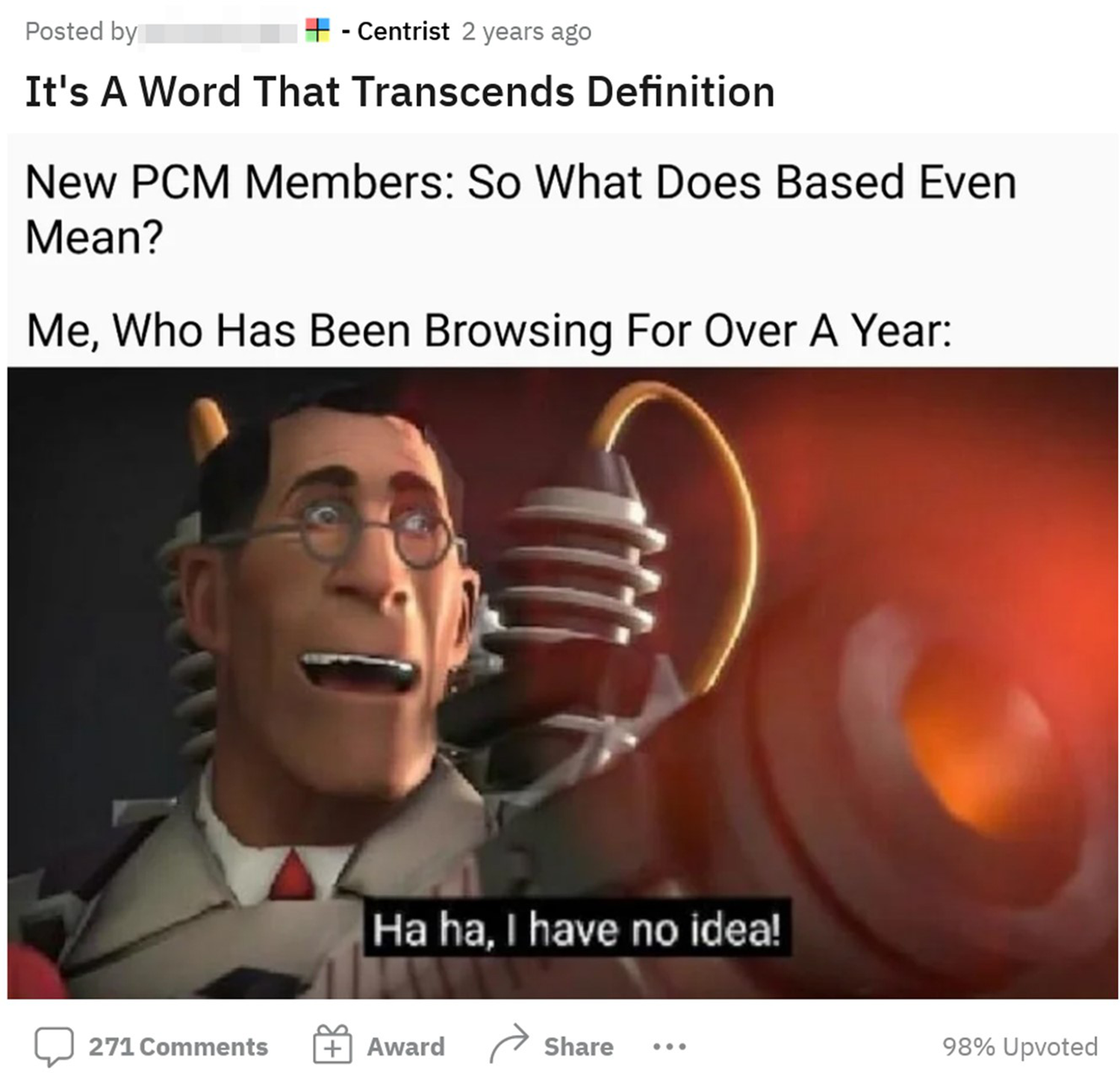
A meme expressing confusion of based's meaning. Screenshot taken from r/PoliticalCompassMemes on 18 February 2022.
Finally, what stands out in the 2021 snapshot are political and vernacular diversifications. Based retained its far right connotation in the /pol/ sample, 19 but on Twitter, it became associated with a wider variety of political movements, from anti-vaxx protests to transgender activism. One progressive Twitter user, for example, praised the proper use of pronouns for a trans woman in the 1950s as ‘INCREDIBLY based’ (1.4k likes). In stark contrast to /pol/, r/The_Donald, and (parts of) r/PCM, here the term is used affirmatively by progressive users, suggesting the reactionary meaning of based was not (or no longer) dominant enough to foreclose such radically different political connotations. Based now became deployed in a wider variety of snowclones and epithets, whether it be ‘based, checked, and redpilled’, ‘based department’ 20 or as the opposite of ‘cringe’. Such vernacular associations got so saturated that mockery of based's hollowed-out meaning became a running gag in itself (Figure 9), as we also saw in the Breaking Bad-meme (Figure 1). Rather than ambiguously signalling adherence to far right views, by this point the term based seems up for grabs, with different connotations constantly added to it.
Discussion: The basedline
Having analysed based across three platforms over 12 years, what can we discern regarding its (changing) meaning, and what does this teach us about the proliferation of far-right discourse online? Firstly, we can state there exists a base meaning of based which is ethical more than political. Across the different platforms and snapshots, based quite consistently conveys an attitude of not caring about what other people think, as well as of staying true to yourself and to the raw, undisguised facts of life. Rather than affirming a political affiliation, the semiotic kernel of based is primarily concerned with an ideal notion of authenticity. Varying epithets and snowclones like ‘based and […]pilled’ acted as templates to signal this authenticity, onto which political connotations are then articulated. After all, staying true to yourself in defiance of what others think does not dictate who this ‘true self’ is, nor does it fix the inauthentic other. As a kind of semiotic shell or ‘floating signifier’, the base meaning of based can be ‘filled in’ in various ways, where platform- and context-specific associations are often odds with each other (e.g. Lil B's egalitarian philosophy versus /pol/'s white supremacist values).
This does not mean that based can mean anything to anyone. Specifically, it is through the dominant outgroup which the idea of authenticity implies – those who are not true to themselves and who do adjust their behaviour to hegemonic pressure – that the term affirms and retains its subcultural status and function. As we saw on 4chan/pol/ and r/The_Donald, the ‘true self’ is a nationalist, white supremacist, or Trump voter no longer abiding by the discursive norms of liberals’ ‘political correctness’. But this oppositional brazenness is equally present in Lil B's inversion of the ‘tough’ norms of hip-hop culture and r/PCM's antagonistic attitude towards ‘woke culture’. In negotiating these distinctions of authenticity, terms like based come to possess a meta-linguistic function where they ‘stand in’ for the larger subcultural identity.
When someone applies the term based correctly, they display and validate their belonging to a subcultural milieu, including the ideological connotations that, in the case of the far right, come with it. Massanari had observed this with different ritualised acts on Reddit, stating that neologisms and rituals ‘become almost empty signifiers with participants unaware of the origins or purpose’, yet at the same ‘signal membership and convey a kind of reddit experience’ (2015: 92). Indeed, several memes we encountered on r/PCM affirm based's function as a collective ritual. For instance, the post in Figure 10 alludes to how based's primary function lies not in its precise meaning but in its performativity as a unifying act: in the shared recognition of something or someone as based, a ‘right unity’ is forged, even if (or rather precisely because) the exact meaning of the term remains fuzzy. 21
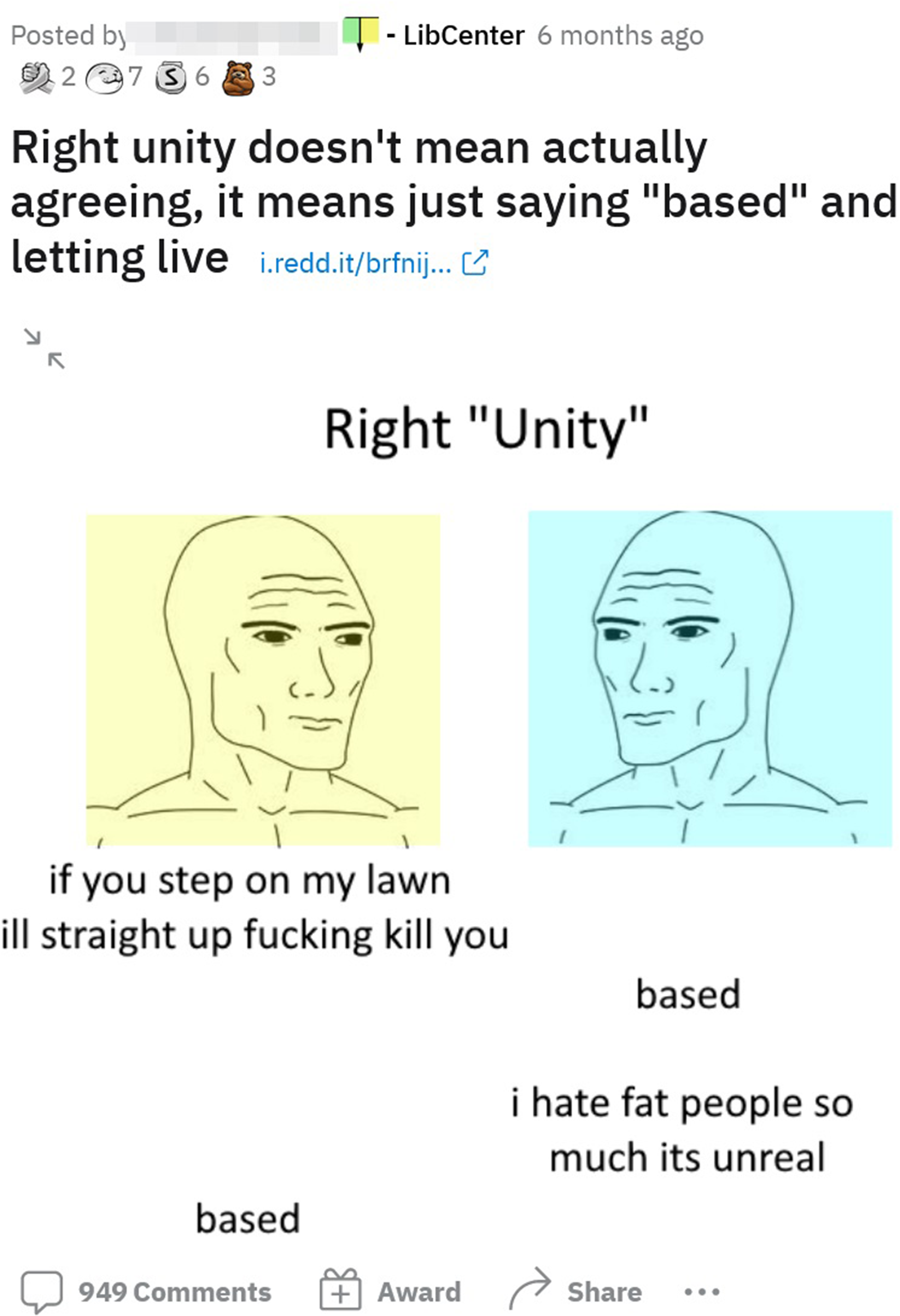
A post on r/PoliticalCompassMemes where a unity between the right-wing quadrants is posed to consist solely out of the recognition of things as based. Screenshot taken from Reddit on 4 March 2022.
This returns us to current debates on radicalisation and the spread of far-right hate speech online. In contrast to views on hate speech and far-right memes as ‘echo[ing] and reifi[ng] the claims designed to travel with them’ (Woods and Hahner, 2019: 12), the changing and diverse use of based after its far-right appropriation paints a more complex picture, one where the meaning of terms is open-ended, contingent and negotiated. On r/PCM the term has carried over at least some of the anti-liberal/anti-woke connotations of 4chan/pol/ and r/The_Donald. Twitter and other subreddits, however, show how its meaning is never totally overcoded by its far right association, implying that the negotiation of based's meaning is mostly contingent upon context and discursive practice. Based thus points to how, for some ‘foundational memes’ of extremist movements, an outright disavowal as viral weapons or hate speech may underestimate or miss their malleability. Instead, our case emphasises the importance of local contexts and temporality as proposed in frameworks on ‘extreme speech’ (Pohjonen and Udupa, 2017). In the case of ‘awfully mutable’ (Cooper, 2017) terms like based, context does matter.
Conclusion: Transcending definition
Having traced based's idiosyncratic journey across the Web, we saw how, after being associated with Lil B's positive philosophy of kindness and empathy, based came to carry various far-right connotations on 4chan/pol/ and Reddit. In the process, its kernel meaning of ‘not caring about what other people think’ was repurposed as celebrating political incorrectness while ‘being true to yourself’ came to mark one's fidelity to the ethnonationalist cause. Soon after, there occurs yet another semantic forking of based into various connotations, to the point where it even became perceived as meaningless. How based nonetheless maintains its coherency in the face of diverging articulations, we found, derives from its kernel meaning as asserting a person or object's authenticity. This is effectively the baseline around which different online communities congregate, and which remains structurally open to contesting appropriations and political articulations.
The proliferation of toxic online discourse has rightly raised concern on memes being ‘workshopped’ as viral weapons (Donovan et al., 2022b). While accelerated by the Web, such concern over the infectious potential of language is not new, for instance echoing Klemperer (2013 [1975]) classic study on the language of the Nazis wherein he related words to ‘tiny doses of arsenic: they are swallowed unnoticed, appear to have no effect and then after a little time the toxic reaction sets in after all’ (15–16). Yet our study shows how there is no uniform effect of the word-as-poison on the mind-as-body; instead, there are only contextually specific encounters between language and the games that we play with them, in which people have arguably more agency than Klemperer's quote suggests. Both the early use of based and its later diversification emphasise the often messy and contrasting character of (once) extremist memes, which helps to demystify far-right actors as omnipotent ‘media manipulators’ (Marwick and Lewis, 2017) and increases the potential for later resignification.
That said, the diffuse cultural influence of terms like based should not be underestimated either. In slipping through the cracks of meaning – or ‘transcending definition’ (Figure 9) – these terms may travel between many discursive spaces, adapting and attaching themselves to local contexts without being detected. Memes and slang terms like based may thus function as subcultural synecdoches, gateways to a subterranean network of fringe communities (Marrs and Dingsun, 2021). While struggling to retain their political connotations across disparate online environments, they may forge an insidious ideological milieu whose effects remain hard to gauge. Contextually aware empirical analyses like ours can help elucidate how such online slang shapes young people's political sensibilities and worldviews.
At this point we may revisit the 4channers from the first section, quarrelling whether the outgroup adoption of based was good or bad for their political cause. Looking at the quantitative diffusion of based in isolation (Figure 2), one could reasonably agree with the first anonymous commenter: /pol/'s adoption of based was followed by a proliferation across Twitter and Reddit, suggesting a successful reinscription and diffusion of the term. However, having interrogated based's varying contexts of use throughout the years, we contend with the second user: outsiders did indeed ‘bend’ based ‘to their liking’. It remains to be seen whether based will metastasise into a generally used adjective like ‘cool’ or if, as another commenter argued, it will go ‘the way of the jelly shoe and friendship bracelet’.
Footnotes
Declaration of conflicting interests
The author(s) declared no potential conflicts of interest with respect to the research, authorship, and/or publication of this article.
Funding
The author(s) disclosed receipt of the following financial support for the research, authorship, and/or publication of this article: The first author was supported by a PhD in the Humanities grant from the Dutch Research Council (NWO) under grant number PGW.19.030. The second author was supported by the Fonds Wetenschappelijk Onderzoek (FWO) under grant number 12ZU322N.
