



Abstract
This study examines how Instagram’s design and norms influence expectations for political imagery and, subsequently, the effects of these images on electability, vote likelihood, and candidate evaluations. Using the Elaboration Likelihood Model, we propose three norms of Instagram that likely function as heuristic cues and affect the reception of political visual communication on the platform: liveness, authenticity, and emotionality. We experimentally test these visual features on Congressional candidate images, finding some evidence that live, authentic, and emotional images positively influence vote likelihood but negatively impact electability. Results also indicate that live, authentic, and emotional images either have no or negative effects on female candidate evaluations or have no or positive effects on male candidate evaluations.
Keywords
Visual images are a prominent political information source and a cornerstone of the modern political campaign (Grabe & Bucy, 2009). Scholars have long noted the persuasive power of visual images, suggesting they can function as rhetorical arguments, clarify or reinforce policy initiatives, enhance political knowledge, evoke emotional responses, and influence news narratives (Bucy, 2010; Schill, 2012). Visual images are also said to have a “clear impact on voters’ judgments regarding a candidate’s congressional demeanor, competence, leadership ability, attractiveness, likeability, and integrity” (Rosenberg et al., 1986, p. 123). Understandably, much strategy goes into the visual and nonverbal presentation of political candidates. Because politicians have little control over their mainstream media narratives, they carefully manage their visual portrayals—from hair and clothing to campaign images, to (now) social media presences.
One social media site that reinforces the power but changes the nature of images in the political context is Instagram. Instagram is the world’s number one photo-sharing platform and one of the most popular social media sites (Tankovska, 2021b). Instagram currently boasts 500 million daily users and one billion monthly active users worldwide, considerably more than Twitter’s 353 million users (Tankovska, 2021b). The platform is trendy among users aged 18 to 34 and a valuable political tool (Tankovska, 2021a). Indeed, most major news organizations and politicians have active Instagram accounts. Instagram is also rated as the top source of news content for the Gen Z demographic (Taylor, 2019). Importantly, Instagram is unique from other social media platforms (e.g., Twitter, Facebook) and traditional media where images are published (e.g., magazines, newspapers), which could significantly influence how users process political imagery and evaluate the candidates who use Instagram. For politicians, understanding the norms of Instagram is critical to reaching the voters who participate on the platform (see Bossetta, 2018; Bucy, 2010).
This exploratory study thus examines how Instagram’s design and norms affect expectations for political imagery and, subsequently, the effects of these images on perceived electability, vote likelihood, and candidate evaluations. So far, scholars have mainly focused on the content of Instagram posts to determine how politicians and political parties use the platform (e.g., Filimonov et al., 2016; Liebhart & Bernhardt, 2017; Muñoz & Towner, 2017; Russmann & Svensson, 2017). We take a different approach, interrogating how specific Instagram norms affect political outcomes. Using the Elaboration Likelihood Model (ELM), we propose three norms of Instagram that likely function as heuristic cues and affect the reception of political visual communication on the platform: visual liveness, authenticity, and emotionality. We experimentally test these image features, exposing subjects to Instagram images from two U.S. Congressional candidates’ Instagram feeds. We find some evidence that live, authentic, and emotional images positively influence vote likelihood but negatively impact perceptions a candidate can win their election. While our findings are mixed, subjects’ candidate evaluations are influenced by authentic and emotional images, illustrating how including specific heuristic and visual cues on Instagram can be critical to successfully campaigning on the platform.
ELM and Instagram Norms
The goal of this study is to assess if and how Instagram images shape perceptions of political candidates. To do so, we first consider the ELM and how Instagram’s design and norms influence how users process information on the platform. The ELM is a theory of attitude change and outlines the general processes underlying the effectiveness of persuasive messages (Petty & Cacioppo, 1986). There are two main routes of persuasion. The central process includes the thoughtful consideration of an argument central to the issue. The peripheral route relies on simple, heuristic cues in the persuasive context. The ELM postulates that message elaboration, or “the extent to which a person thinks about the issue-relevant arguments contained in a message” (p. 128), depends on an individual’s motivation and ability to process messages. A variety of factors influence motivation and ability, from the perceived relevance of the issue to the need for cognition to the message’s source. The central route of persuasion is activated when motivation and ability are high. When the likelihood for elaboration is low, peripheral or heuristic cues become a greater determinant in the effectiveness of persuasive messages.
The modality of messages is one contextual variable that affects central versus peripheral-based processing (Petty & Cacioppo, 1986). A message may be easier or harder to evaluate depending on the nature of its delivery. Scholars argue that heuristic cues and peripheral processing become a greater persuasive factor for audio and visual messages due to their fast-paced and ephemeral nature; written messages better facilitate complex arguments and central processing (Chaiken & Eagly, 1976; Mattes et al., 2010). Message modality becomes important when considering that social media platforms enable, constrain, and shape communication in different ways (Bossetta, 2018). By including or excluding certain digital features, social media platforms can suggest particular lines of action and modes of engagement to their users (Davis, 2020). For example, Twitter encourages brevity by restricting tweets to 280 characters. Facebook allows for lengthier posts. TikTok requires video-based messages.
On Instagram, users primarily, and sometimes only, encounter images. Rarely do users see the textual information accompanying an image unless something in the visual frame entices them to click on a photo. This contrasts with Twitter or Facebook, where textual information precedes and supersedes any images users might attach to a tweet/post. Instagram’s “explore” page is also filled with an endless supply of images, encouraging quick and continuous scrolling (Zulli, 2018). Due to these features, users likely process Instagram images through the peripheral route, quickly moving from one image to another, only stopping to like, comment, or share a post if a cue in the visual frame captures their attention. On Instagram, then, heuristic cues function as a gateway to encountering the substantive information that can be processed through the central route. For politicians, including the right heuristic cues in their images could be particularly influential in promoting positive assessments of their candidacy (Bucy, 2010). Therefore, we specify three norms of Instagram images that likely function as heuristic processing cues and, subsequently, influence candidate perceptions on the platform: liveness, authenticity, and emotionality. Although we discuss liveness, authenticity, and emotionality separately, it is important to note that, in practice, these norms can sometimes overlap with and buttress each other.
Visual Liveness
Visual liveness is the first norm of Instagram that potentially functions as a heuristic cue and influences perceived electability, vote likelihood, and candidate evaluations. Liveness is defined as the “live transmission” that “guarantees a potential connection to our shared social realities as they are happening” (Couldry, 2003, p. 7) and is characteristic of most digital technology today. Social media platforms often code into their infrastructure opportunities for “live” posting, streaming, and tracking (e.g., prompts to post “What’s on your mind?,” live stories). These features allow users to post or observe content in something closely approximating “real-time,” generating a sense of “unpredictable flow and potential eventfulness” as if something could always be happening online (Lupinacci, 2021, p. 2).
Social media liveness has primarily been discussed in discursive (e.g., live-tweeting; Deller, 2011) or user behavior (e.g., explaining why people spend hours scrolling on social media; Lupinacci, 2021; Zulli, 2021). However, there are visual markers of liveness on Instagram as well. Instagram’s name and digital features suggest an ethos of liveness (Zulli, 2018). Branded as an instant facilitator of images, “Insta”gram encourages quick posting and reposting of images. Instagram’s “live” videos and stories occur in “real time” and require users to be “in the moment” to view the content (or within a 24-hour window). Liveness is also reflected in the semiotic composition of Instagram images. Because Instagram simplifies the image-taking process, the site has become a live tracker of user behavior, showcasing users’ literal and figurative movement as they go about their days. The result is a norm of dynamic and active visuals that appear “in the moment,” as if the subject is unaware a photograph is being taken (Borges-Rey, 2015). This is compared to static photographs where subjects appear to be carefully posed, very much aware of the camera. Certainly, subjects are aware they are being photographed. And all images posted to Instagram are intentional. However, visual liveness gives the impression the image was taken while the subject was engaged in an activity other than photo-taking (e.g., a politician photographed speaking at a campaign event). The point of view for live images, then, is that of the photographer, capturing the moment as it unfolds. Ultimately, through these live images, Instagram has engendered a “you could be here with me” photography style (Zappavigna, 2016, p. 272).
The visual norm of liveness on Instagram can function as a critical heuristic in political images, thus influencing the perceptions of candidates who use the platform. By posting dynamic images, politicians can align with the conventions of Instagram and provide voters unparalleled access to their political lives and activities. Showing movement (e.g., traveling across the country), “real-time” campaign activities (e.g., meeting with voters, attending town halls), and “live” moments (e.g., walking to the stage, shaking hands) demonstrate candidates actively and dynamically “doing the work” of politics. Such live imagery is particularly compelling (Allan, 2006) and could help voters visualize candidates in office; users see the political work and not just hear about it. Therefore, to better understand if visual liveness functions as a persuasive heuristic cue in the political context, we ask: How does exposure to “live” Instagram images—images implying and visually demonstrating real-time activity happening in-the-moment with suggested physical movement—influence perceived electability (RQ1a), vote likelihood (RQ1b), and candidate evaluations (RQ1c)?
Visual Authenticity
Visual authenticity is the second Instagram norm that potentially functions as a heuristic cue and affects perceived electability, vote likelihood, and candidate evaluations. Political authenticity represents the cultural and symbolic phenomenon of arriving at a politician’s “true self” (Parry-Giles, 2014). The desire for authenticity is grounded in concerns about politicians’ morality and integrity; voters choose representation with the hope that politicians are truthful, transparent, and “real.” However, political authenticity is not an inherent candidate quality. Rather, politicians, opponents, news media, the public, and, as we argue, visual images on Instagram all contribute to the construction or refutation of authenticity narratives.
Authenticity, or highlighting one’s backstage and personal self, is digitally coded into most social media platforms. For example, suggesting social media users note their biographical, educational, and relational information on Facebook profiles puts these intimate details at the forefront of user identity (Gaden & Dumitrica, 2014). Tweeting provides firsthand accounts of users’ thoughts and opinions (Zappavigna, 2016). Visually, Instagram promotes similar markers of authenticity. Instagram is branded as a “lifestyle” platform where users are expected and encouraged to post about their everyday lives, from their food and workouts to their homes and families (Borges-Rey, 2015). Showcasing everyday life on Instagram often manifests in the deployment of personal and “behind the curtain” images (Reade, 2021). Such visual authenticity performatively pushes back on a “picture-perfect” or “in front of the curtain” ideal, thereby reducing perceived barriers between the poster and the viewer, in this case, the elite politician and the voter. The point of view is that of the poster who intentionally allows viewers to see them in intimate settings (e.g., a politician who shows their home). “Authentic” users are rewarded for their visual realness through increased social capital (e.g., more followers, feelings of closeness), which can be parlayed into political capital (e.g., positive candidate evaluations; van Dijck, 2013).
Authenticity is an essential component in the modern political era. Scacco and Coe (2021) theorized personalization, a marker of authenticity, as a key feature of the ubiquitous presidency. McGregor et al. (2017) argued that personalized discourse is now required if politicians want to participate on social media. Recent research on Instagram illustrates that politicians have leveraged the platform’s authenticity norms to visually collapse the distance between them and voters (Lalancette & Raynauld, 2019). We add to this literature by assessing the heuristic value of authentic candidate images on Instagram. Specifically, we ask: How does exposure to “authentic” Instagram images—images depicting a candidate’s backstage, non-political, and personal life (e.g., casual dress, children, homes)—influence perceived electability (RQ2a), vote likelihood (RQ2b), and candidate evaluations (RQ2c)?
Visual Emotionality
Visual emotionality is the third norm of Instagram that potentially functions as a heuristic cue and affects perceived electability, vote likelihood, and candidate evaluations. The importance of emotions in the political context dates back to Aristotle’s contention that pathos, or emotions, functions as a central means of persuasion (Hoggett & Thompson, 2012). Much of political communication—campaign speeches, advertisements, rallies, and so on—serves to tap into the emotions of voters with the goal that feelings, both positive and negative, will be associated with politicians and their policies (Schill, 2012). Verbal and nonverbal emotions are connected to a range of political outcomes, including candidate appraisals (McHugo et al., 1991). However, politicians often strive to cultivate an image of composure and confidence, so excessive or inappropriate displays of happiness, sadness, or anger can contribute to candidates being perceived as unfit for office (Bucy, 2010; Glaser & Salovey, 1998).
The features of Instagram potentially position visual emotionality as a key heuristic in captivating user attention, incidentally shaping candidate perceptions on the platform. Instagram’s emphasis on lifestyle content discussed earlier likely includes visual emotionality. Highlighting a politician’s “backstage self” necessarily includes the emotional responses that accompany such vulnerability, and social media engender expressive tendencies among users (Waterloo et al., 2018). As Reade (2021) argued in an analysis of Instagram fitness culture, “raw [authenticity] is a form of aesthetic, emotional, and affective labour which works to cultivate digital intimacies [emphasis added]” between Instagram users (p. 16), or, in this context, between candidates and voters. Importantly, eye-tracking research on social cause advertising suggests that emotional appeals in images increase viewer engagement (Sciulli et al., 2012). Emotion-evoking content is also a significant predictor of content virality online (Berger & Milkman, 2012).
That said, positive emotional expressions are considered more appropriate on Instagram than negative emotional expressions (and compared to Facebook, Twitter, and WhatsApp; Waterloo et al., 2018). Positive nonverbal displays by candidates have also been found to increase public opinion ratings, with negative nonverbals decreasing public opinion (Coleman & Banning, 2006). We thus assess the effects of “positive emotionality” images—close-up images of candidates smiling, laughing, exuding joy, and satisfaction—and “negative emotionality” images—close-up images of candidates frowning, angry, looking serious, or sad—on Instagram. Specifically, we ask: How does exposure to “emotionality” in Instagram images influence perceived electability (RQ3a), vote likelihood (RQ3b), and candidate evaluations (RQ3c)?
Gender
Because this study examines images, there are gender considerations that must be acknowledged and accounted for. Gender acts as a heuristic cue that influences the effectiveness of persuasive messages (Petty & Cacioppo, 1986), often to the detriment of women in politics. Women politicians have long been subjected to gendered stereotypes apparent in visual representations (Bauer & Carpinella, 2018). Women are often associated with feminine qualities deemed less desirable in the political sphere, such as warmth, collaboration, and emotionality (Brescoll, 2016). Female attractiveness also (typically) negatively activates gender stereotypes and harms perceptions of their electability (Sigelman et al., 1987; see also Mattes et al., 2010). Ultimately, voters often make voting assessments based on who looks like a leader (Benstead et al., 2015), hindering women from winning higher offices.
However, political images with more feminine nonverbal and visual content, such as positive emotionality (e.g., smiling, happiness), are rated more favorably than political images with masculine content (i.e., dominance, aggression; Peng, 2018). Female voters are also particularly receptive to these positive images (Barrett & Barrington, 2005). More women and women politicians use Instagram than men and male politicians (O’Connell, 2018; Sheldon & Bryant, 2016), potentially mitigating gender biases in image interpretation. For example, during the 2016 presidential primary campaign, Hillary Clinton posted more images related to family and children—her most-liked images during the nomination campaign—than her male counterparts (Muñoz & Towner, 2017). Given this conflicting research, we pose a final research question: Do the effects of live, authentic, and emotional Instagram images on perceived electability (RQ4a), vote likelihood (RQ4b), and candidate evaluations (RQ4c) differ by candidate gender?
Method
To answer these research questions, we executed an online experiment with a post-test-only, control group design. We recruited subjects through Amazon.com’s Mechanical Turk (MTurk) online platform from September 25–26, 2020, requiring participants to be older than 18 and U.S. citizens. Relying upon MTurk’s filter system, we requested respondents be located in the United States and have a Human Intelligence Task (HIT) approval rating of 90 and above. 1 Each respondent was paid US$.90 for completing the survey. To ensure high-quality data, we employed several methods to screen out “bots,” “scripts,” and “fraudsters.” We required participants to respond to an image, disabled the survey “back” button, required a text box to be left blank, and reviewed for inconsistent and straight liner answers. In addition, participants who did not meet the geographic location eligibility were flagged and removed from the analysis using the relevant STATA package (Winter, 2019). Any repeat I.P. addresses were also removed and blocked (see Kennedy et al., 2020). Overall, 60 “participants” were removed and blocked.
In total, 1,008 participants completed the study. Participants had a mean age of 37.75 (SD = 11.15). Thirty-eight percent (SD = 0.485) of respondents reported they were female, had a “4-year college degree” (M = 4.95; SD = 1.08), and were 67% White (SD = 0.469). Fifty-two percent of respondents identified as Strong Republican or Republican and 35% as Strong Democrat or Democrat. Eleven percent identified as Independent (M = 2.71; SD = 1.35). Compared to the U.S. Census (2019) population estimates, the sample reasonably represented the U.S. adult population regarding demographic characteristics but with a slight under-representation of women. See Table 1 for descriptive statistics for each treatment group.
Sample and Condition Characteristics.
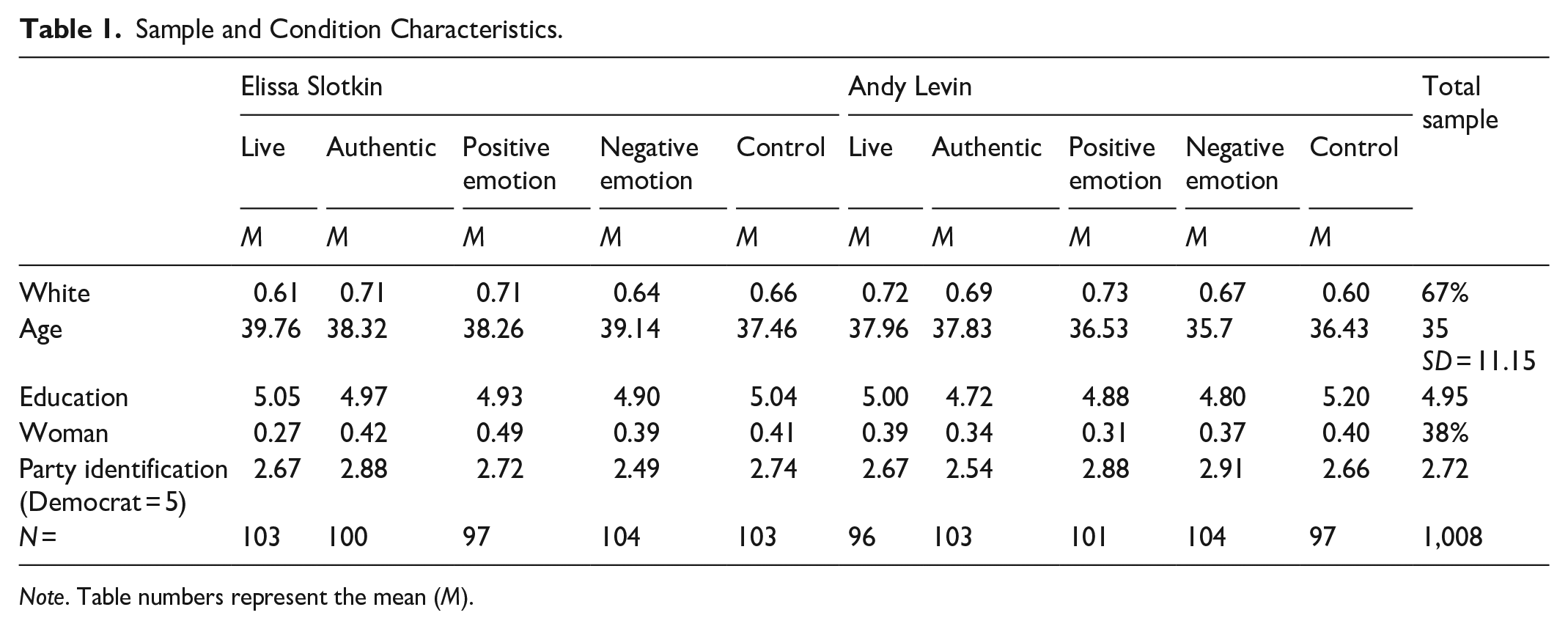
Note. Table numbers represent the mean (M).
Design
We employed a 5 × 2 experimental design. Subjects were randomly assigned to 1 of 10 groups. All groups were told they would see an Instagram image posted by a 2020 U.S. Congressional candidate. The first group was asked to view an Instagram image illustrating “liveness” taken from a female congressional candidate’s Instagram feed. The second group saw Instagram images displaying “authenticity” from a female congressional candidate’s Instagram account. The third group saw an Instagram image displaying “positive emotionality” from a female congressional candidate’s Instagram account, whereas the fourth group saw Instagram images displaying “negative emotionality.” The following four groups were randomly assigned to groups representing a male congressional candidate’s Instagram images for “liveness,” “authenticity,” “positive emotionality,” and “negative emotionality.” There were two control groups, with one group viewing a neutral image of a crowd (no faces visible) affiliated with the female candidate’s Instagram account and the second control group also viewing a neutral crowd picture affiliated with the male candidate’s Instagram account.
Treatments
To select Instagram images displaying candidate “liveness,” “authenticity,” “positive emotionality,” and “negative emotionality,” the Instagram feeds of two (one female and one male) U.S. Congressional candidates in Michigan were selected for examination: Representative Elissa Slotkin (Democrat, 8th District) and Representative Andy Levin (Democrat, 9th District). These candidates’ Instagram feeds were chosen for several reasons: Slotkin and Levin were (1) incumbents who faced competitive elections in a battleground state; (2) both Democrats; (3) representatives from neighboring districts; and (4) active Instagram users with official congressional accounts (@repslotkin; @repandylevin).
Based on a content analysis of approximately 150 images (videos and stories were omitted) from each candidate’s Instagram feed, the authors selected 20 Instagram images illustrating “liveness,” “authenticity,” “positive emotionality,” and “negative emotionality.” These 20 Instagram images were then designed to appear as screenshots from the congressional candidate’s real Instagram feed. To maintain realism, Instagram’s top header was incorporated, displaying the Instagram icon, search box, and the discovery, heart, and person icons. The theme, colors, and font were the same across treatments. The candidate’s profile photo and username were displayed. To eliminate any extraneous factors, the Instagram images did not display the number of posts, followers, and following. We removed highlights, “likes,” and comments, as these metrics may influence candidate evaluations rather than the image (see Mena et al., 2020). There was no information about the candidate’s ideology or political affiliation. The only difference between each image was the Instagram image and the affiliated candidate photo and username.
Preliminary Survey
Two separate, preliminary online surveys were conducted to identify which of these 20 Instagram images best represented “liveness,” “authenticity,” “positive emotionality,” and “negative emotionality.” From September 1 to 9, 2020, 73 college students at a large midwestern university were asked to view the 20 Instagram images and then rate them for “liveness,” “authenticity,” “positive emotionality,” and “negative emotionality” on a 0 (low) to 10 (high) scale. In a separate national survey, 100 subjects were recruited through MTurk on 11 September 2020. These respondents were administered the same survey, viewing and rating the same 20 Instagram images. The MTurk participants were required to be older than the age of 18 and U.S. citizens. After comparing the mean ratings for each image from both the college and the national surveys, we found that respondents gave similar, if not the same, ratings for “liveness,” “authenticity,” “positive emotionality,” and “negative emotionality.” Based on these results, the four images for Slotkin and four images for Levin with the highest mean ratings on each of the four characteristics were included in the experiment. In total, eight Instagram images were employed as treatments. See Images 1 to 4.

“Liveness” Instagram image from Rep. Slotkin’s feed.
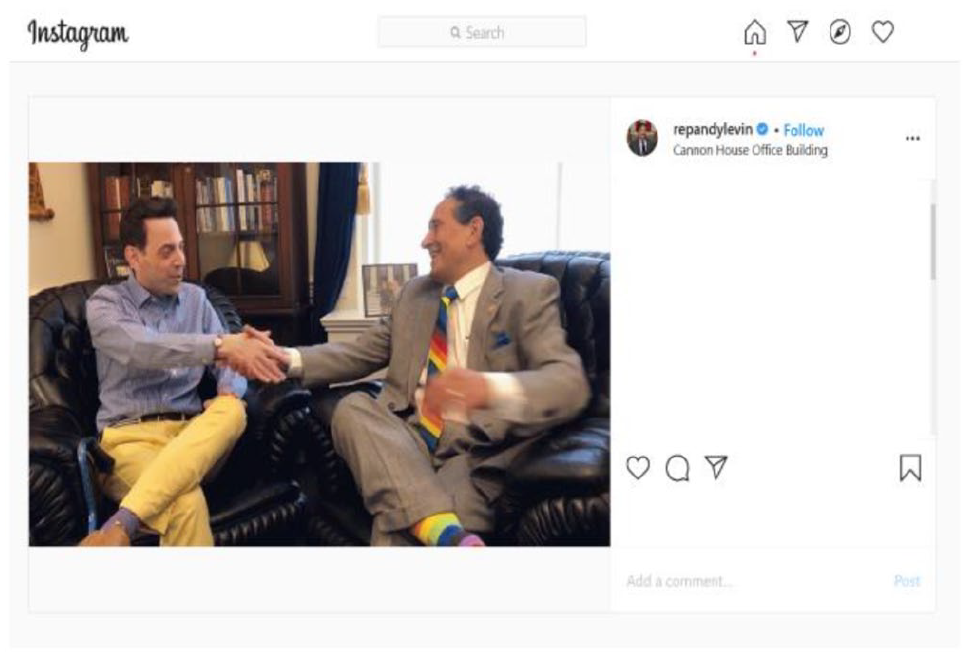
“Liveness” Instagram image from Rep. Levin’s feed.

“Authentic” Instagram image from Rep. Slotkin’s feed.

“Authentic” Instagram image from Rep. Levin’s feed.
Procedure
The main experiment was conducted online in September 2020 (N = 1,008). After completing informed consent and introductory questions, subjects were instructed to view one Instagram image. In the experiment, subjects did not know in which of the eight experimental conditions (and two control groups) they were randomly placed. While viewing the Instagram image, subjects were instructed to “think about the candidate screenshot” and answer questions about the likelihood of the candidate winning their election, candidate character evaluations, their likelihood of voting for the candidate, political affiliation, and demographics.
Dependent Variables
This survey experiment examined three dependent variables: electability, vote likelihood, and candidate evaluations. Consistent with the prior literature on electability (Bartels, 1985; Jones et al., 2016), we asked participants their perceptions of the candidates’ likelihood of winning their election with: “In your opinion, how likely or unlikely is [Elissa Slotkin, Andy Levin] going to win [her, his] election?” (1 = Extremely Unlikely; 3 = Neutral; 5 = Extremely Likely). Our second dependent variable measured vote likelihood, or if participants would vote for the candidate after viewing the Instagram image, asking, “If you had the opportunity to vote for [Elissa Slotkin, Andy Levin] in an upcoming election, how likely or unlikely are you to vote for this candidate?” (1 = Extremely Unlikely; 3 = Neutral; 5 = Extremely Likely). Finally, we measured participants’ evaluation of the candidates, which is known to influence votes (e.g., Rosenberg et al., 1986). Subjects were asked to rate how well eight personality, character, and leadership attributes described the candidate (1 = Not well at all, 3 = Neutral, 5 = Extremely well). These attributes were (a) experienced, (b) knowledgeable, (c) qualified, (d) dependable, (e) honest, (f) trustworthy, (g) credible, and (h) truthfulness. The items were combined into a measure of overall candidate evaluation, with higher numbers indicating higher evaluations. The reliability coefficient using Cronbach’s α for the 8-item additive measure was .90.
Independent Variables
The independent variables were whether subjects were exposed to one of the four treatments: a candidate’s visual “liveness,” “authenticity,” “positive emotionality” and “negative emotionality” Instagram images (1 = exposed, 0 = not exposed; the control group is the omitted category). We also included demographic and political predisposition questions. We specifically asked participants their gender (1 = woman; 0 = man), as the respondent’s gender can drive perceptions of electability, vote likelihood, and candidate evaluations. The former is particularly true when the candidate is female (Sigelman et al., 1987). We also expected that electability may be influenced by a respondent’s race (1 = White, 0 = Non-White), age (in years), and education level (1 = less than high school; 2 = high school/GED; 3 = some college; 4 = 2-year college degree; 5 = 4-year college degree; 6 = master’s degree; 7 = doctoral degree; 8 = professional degree). Given that partisan cues were absent in the treatments (i.e., candidates’ party affiliation were not mentioned in the Instagram image) and party identification is constant (i.e., both candidates are Democrats), we did not expect party identification to play a central role in participants’ evaluations. However, we still included party identification as a control variable. To measure partisan attachment, subjects were asked, “Generally speaking, do you usually think of yourself as a Republican, a Democrat, an independent, or what?” (1 = Strong Republican, 2 = Republican; 3 = Independent, 4 = Democrat; 5 = Strong Democrat).
Analytical Plan
To assess Research Questions 1–4, we regressed the dependent variables against the indicators of exposure to Slotkin and Levin’s Instagram images for “liveness,” “authenticity,” “positive emotionality,” and “negative emotionality,” along with five control variables: gender, age, race, education, and party identification. See Table 2 for the full regression results. Below, we report the standardized regression weights with standard errors.
Regression Analysis Predicting Electability, Vote Likelihood, and Evaluation Measures.
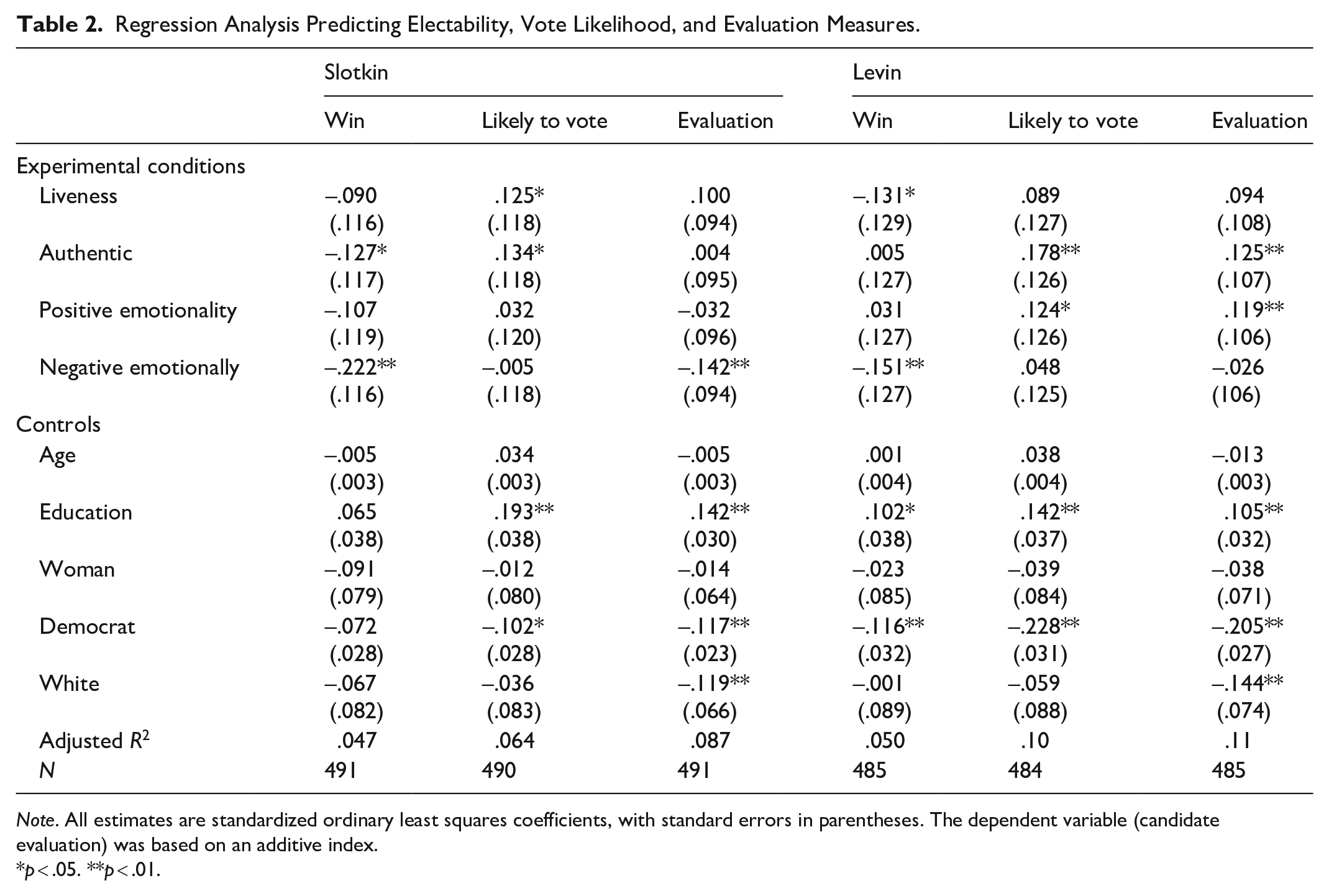
Note. All estimates are standardized ordinary least squares coefficients, with standard errors in parentheses. The dependent variable (candidate evaluation) was based on an additive index.
p < .05. **p < .01.
Results
Liveness (RQ1a, b, and c)
First, we examined how exposure to liveness in Instagram images influenced Slotkin and Levin’s electability, vote likelihood, and evaluations. The first column in Table 2 reveals that exposure to Slotkin’s “live” Instagram image did not influence subjects’ perception of her winning her election. In contrast to Slotkin, Levin’s “live” image had a negative and significant influence on subjects’ perceptions of him winning his election (Column 4) (β = −.131, SE = 0.129, p < .02), indicating that exposure to liveness decreased Levin’s electability.
While liveness did not influence the perception of Slotkin winning her election, we found that exposure to Slotkin’s “live” image significantly increased subjects’ likelihood of voting for her (Column 2) (β = .125, SE = 1.18, p < .02). However, this was not the case for Levin, as exposure to his “live” Instagram image did not influence vote likelihood (Column 5) (β = .089, SE = 0.127, p < .10).
The regression results in Columns 3 and 6 show that exposure to Slotkin and Levin’s “live” Instagram images did not significantly affect subjects’ evaluations. Thus, there is some evidence here that liveness in images influences electability and vote likelihood, but these effects differ by the candidate’s gender (RQ4a and RQ4b).
Authenticity (RQ2a, b, and c)
Next, we assessed how authenticity influenced the three dependent variables. We found in Column 1 that exposure to Slotkin’s “authentic” Instagram image negatively influenced subjects’ perception of her winning her election (β = −.127, SE = 0.117, p < .02). Exposure to Levin’s “authentic” Instagram image had no impact on perceptions of him winning (Column 4). Again, the results differed by the candidate’s gender (RQ4a), as exposure to “authentic” Instagram images decreased perceptions of Slotkin winning her election while having no effect on Levin.
Importantly, Columns 2 and 5 show that exposure to “authentic” Instagram images had positive and significant effects on subjects’ likelihood of voting for both Slotkin (β = .134, SE = 0.289, p < .01) and Levin (β = .178, SE = 0.126, p < .00). While both genders were significantly and positively influenced by “authentic” posts, Levin’s “authentic” Instagram image had a slightly more robust impact on vote likelihood than Slotkin’s “authentic” image (RQ4b).
In Columns 3 and 6, the regression results show that exposure to Slotkin’s “authentic” Instagram image did not significantly affect subjects’ evaluations of her. In contrast to Slotkin, exposure to Levin’s “authenticity” Instagram image significantly increased his evaluations (β = .125, SE = 0.107, p < .02). Notably, Levin’s “authenticity” image had a slightly more robust influence on subjects’ likelihood of voting for him and their evaluations when compared to his “positive emotionality” image (see Columns 5 and 6).
Positive and Negative Emotionality (RQ3a, b, and c)
Last, we tested how exposure to both positive and negative emotionality images impacted electability, vote likelihood, and evaluations. Exposure to “positive emotionality” Instagram images did not influence the subjects’ perceptions of Slotkin and Levin winning their elections (Columns 1 and 4). However, exposure to “negative emotionality” Instagram images had negative effects on participants’ perceptions of winning for both candidates: Slotkin (β = −.222, SE = 0.116, p < .00) and Levin (β = −.151, SE = 0.127, p < .01). The effects of the “negative emotionality” Instagram images were robust, outweighing all other predictors.
Column 2 shows that exposure to a “positive emotionality” Instagram image did not affect subjects’ likelihood of voting for Slotkin. Interestingly, the positive emotionality image positively influenced subjects’ likelihood of voting for Levin (Column 5) (β = .124, SE = 0.126, p < .03). Negative emotionality images had no impact on the likelihood of voting for both Slotkin and Levin.
In Column 3, the regression results show that exposure to Slotkin’s “positive emotionality” Instagram image did not significantly affect subjects’ evaluations of her. Interestingly, Levin benefited again from exposure to his “positive emotionality” Instagram image, as the image significantly increased his evaluations (Column 6). In Column 3, we did find evidence that viewing Slotkin’s “negative emotionality” image significantly decreased participants’ evaluations of her (β = −.142, SE = 0.094, p < .01). Levin’s “negative emotionality” image had no impact on subjects’ evaluations (Column 6). Addressing RQ4c, exposure to these emotionality Instagram images had either no effect or a negative effect on evaluations of the female candidate. However, the male candidate enjoyed either no effect or a boost from the images.
Discussion
This exploratory study assessed the effects of Instagram images on perceived electability, vote likelihood, and candidate evaluations. Instagram is unlike any other social media platform in its affordances and adoption. Due to the platform’s digital and social norms, we questioned if and how the heuristic cues of liveness, authenticity, and emotionality would shape political outcomes. Prior research has established that social media content, particularly campaign images and photos, can influence candidate evaluations and vote choice (e.g., Dimitrova & Bystrom, 2013; Towner, 2016; Towner & Dulio, 2011). Less is known regarding how exposure to real images posted by the candidates on Instagram influences public perceptions (exception in non-U.S. context; Lindholm et al., 2021). Our results thus provide important preliminary insight into which types of Instagram images influence voters’ perceptions of candidates.
Overall, the findings were mixed, suggesting some limitations to the persuasive value of visual liveness, authenticity, and positive emotionality on Instagram. For example, these visual heuristics had either no effect or negative effects on perceptions of electability or the likelihood the candidates would win their elections. The nature of electability and peripheral processing likely explain these results. Media often shape electability through game- and horse-race framing in television, newspapers, and internet messages (e.g., who is winning and who is likely to win; Bartels, 1985; Jones et al., 2016; Kaid & Postelnicu, 2005; McLeod et al., 1983). Voters begin differentiating and selecting their preferred candidate as news discussions center on which primary candidate possesses the necessary character qualities, experience, policies, and public support to win the general election, explicitly pitting candidates against each other. Therefore, visual images and heuristic cues alone are perhaps not enough to determine a candidate’s electability due to their inferential, isolated, and peripheral nature. Devoid of captions, the Instagram images in this study may not have been able to illustrate a horse race frame; discursive messages could have better facilitated central processing related to electability (Chaiken & Eagly, 1976). The candidates’ images were also shown individually; therefore, direct comparisons with their competitors were not visually present. Consequently, subjects may have assessed electability more tentatively without explicit markers the candidates were viable candidates. While liveness, authenticity, and positive emotionality may be necessary for users to engage with Instagram photos, some discursive explanation of an image in a caption is likely needed to construct the electability narrative, especially for less familiar candidates. The latter conclusion is consistent with research that finds reading campaign websites and textual ad information significantly influenced candidate evaluations (Kaid & Postelnicu, 2005).
Positive emotionality also did not affect subjects’ perceptions of whether Slotkin and Levin would win their election. However, the results suggest negative emotionality images prompted subjects to perceive Slotkin and Levin’s electability negatively; emotionality functioned as an influential heuristic cue but in the opposite direction. These results can potentially be explained through expectancy violation theory (Burgoon, 1993). Instagram users likely expect candidates to understand the visual conventions of the platform at this point, adopting an aesthetic style similar to the images of regular users (see Borges-Rey, 2015; Reade, 2021; Zappavigna, 2016). One of those expectations is that users will display positive emotions on Instagram instead of the negative emotions more common on other social media platforms, like Facebook and Twitter (Waterloo et al., 2018). If so, such positive visual political representations may have become normalized on Instagram, thereby losing their immediate persuasive impact on electability, whereas negative emotional displays are more impactful on message elaboration as they deviate from patterned expectations.
The heuristic cues of liveness, authenticity, and emotionality did affect vote likelihood, indicating that Instagram images, if they align with the platform’s conventions, can contribute to enhanced feelings of liking and support. In particular, authentic candidate images significantly increased the likelihood participants would vote for both candidates. It is well known that the “raw” or “personalized” view of a candidate or campaign can influence credibility and evaluations (Housholder & LaMarre, 2014; Lee & Oh, 2012). The subjects in our study resonated with images of Slotkin as a child with her mother (Image 3) and Levin with his children (Image 4). These authentic images provided zero political information about the candidates, but they perhaps “revealed” who they were as people, an increasingly critical component of the modern political campaign (McGregor et al., 2017; Scacco & Coe, 2021). Although voters may still be skeptical about who can win political elections based on their visual representations alone, Instagram images can still provide a compelling cue about candidates, which can function as a key voting heuristic.
The results also lend insight into how gender cues interact with the effects of visual liveness, authenticity, and emotionality on Instagram. Notably, the positive results related to Slotkin’s live and authentic images provide some optimism for a shift in gender norms on Instagram, although we are hesitant to overstate these findings. Women have historically been barred from politics and thus have had less opportunity to demonstrate their political “timber” (Duerst-Lahti & Oakley, 2018, p. 28). Live visual imagery illustrates women “doing the work” of politics, so Instagram users may better visualize women in leadership roles through these live images. That showcasing Slotkin’s “authentic” family side on Instagram also increased vote likelihood perhaps suggests a slight trend away from families and motherhood being perceived as a hindrance to women seeking political office (Jamieson, 1995). Or just that this content functions as a positive heuristic cue on Instagram. However, Slotkin’s authenticity image negatively affected perceptions she would win her election. Positive emotional displays by Slotkin also decreased subjects’ vote intention. While live, authentic, and positive emotionality images had either no or negative effects on Slotkin’s overall evaluation, such images either had no or positive effects on subjects’ overall assessment of Levin, with subjects finding him to be more experienced, knowledgeable, qualified, credible, and so on when he posted such images. Candidate gender will likely always be a persuasive factor in candidate perceptions. However, given our results related to vote likelihood, future research should consider how Instagram’s visual features can reduce or mitigate limiting gender norms.
Collectively, this study provides an initial step in understanding which visual heuristic cues influence perceptions of political Instagram images. Instagram enables candidates to better control their visual representations, so the platform’s opportunities for strategic political marketing are clear. Considering the ELM, the results show even brief exposure to live, authentic, and emotional cues in a political image can alter candidate likability and support. This finding advances prior work finding that candidate images impact evaluations (McLeod et al., 1983) with causal evidence that some digital Instagram images can do the same. Authentic images were particularly impactful. Conversely, images that violate the visual conventions of the platform can hinder perceived electability. These effects may be amplified if candidates frequently deviate from or align with the visual expectations of Instagram during the long campaign season. Instagram should thus not be considered another platform for which candidates can reach voters, cross-posting content from Facebook or Twitter, for example (Bossetta, 2018). Rather, political marketers and campaign managers should be mindful of how the specific visuals accompanying political content on Instagram can contribute to or hinder perceived electability and candidate support.
As with any exploratory study, the treatment images and external validity likely affected the results. Real images from Slotkin and Levin’s Instagram accounts were chosen to test the effects of live, authentic, and emotional political images. These images were tested in two preliminary surveys to ensure they best represented the independent variables. However, the images were not consistent between the two candidates, potentially explaining why some treatments influenced the dependent variables while others did not. For example, Slotkin’s “live” image was of her reading to a group of children (Image 1). Levin’s “live” image was of him shaking hands with another man (Image 2). The live image had a positive effect on subjects’ intention to vote for Slotkin but negatively affected perceptions that Levin would win his election. Shaking hands illustrates active campaign work, but it is perhaps less compelling than reading to children. An image of a female candidate reading to children may also be considered more gendered. Subjects were also shown the treatment images individually and without captions to isolate the effects of visual liveness, authenticity, and emotionality. However, Instagram images do include captions, although they are not featured prominently. If a user followed Slotkin or Levin, they would see captions with images on their home feed. Instagram profiles also present images on a grid, so users would see multiple images at one time if they clicked on the profile. Future scholars should thus consider how visual cues and captions on Instagram mutually influence perceived electability, candidate evaluations, and vote likelihood.
This study was limited by the subjects’ demographics. We chose to recruit participants through Amazon’s MTurk system to obtain a more representative sample. However, Instagram users are not representative of the U.S. population in that they skew younger and female. Although we took considerable measures to ensure our data quality and thus feel confident in the results, bots and spoof accounts have been known to pollute MTurk data. Future experiments should consider a more purposeful sampling technique using different survey methods to better understand perceptions by those more likely to use Instagram for political content. Future studies can add to this research by testing other, more consistent treatment images. Future studies should also unpack the overlap between visual liveness, authenticity, and emotionality on Instagram. Finally, future studies should consider if and how Instagram images affect the perceived electability of those running for different political offices, like the presidency.
Ultimately, the role of Instagram images in shaping perceptions of political candidates is somewhat unclear. What is clear is candidates are increasingly turning to Instagram to reach voters, and voters are increasingly turning to Instagram for political content. Thus, aligning with the aesthetic conventions of Instagram will be important to successfully incorporate the platform into a political marketing strategy.
Footnotes
Acknowledgements
The authors would like to acknowledge and thank Christina P. Walker for collecting the Instagram images used in this analysis.
Declaration of Conflicting Interests
The author(s) declared no potential conflicts of interest with respect to the research, authorship, and/or publication of this article.
Funding
The author(s) disclosed receipt of the following financial support for the research, authorship, and/or publication of this article: This study was funded by discretionary funds through the Brian Lamb School of Communication at Purdue University.
