




Abstract
Social networking sites (SNSs) allow individuals to establish and maintain a variety of relationships as well as share different aspects of their identity by expressing their views on numerous topics, including politics. SNS also come with perceived interpersonal risks and benefits tied to sharing with a collapsed networked audience. Using a nationally representative sample of US social media users (N = 2,873) from 2016, this study investigated how perceived network characteristics influence people’s decision to engage in online political expression on three platforms: Facebook, Twitter, and Instagram. Findings indicate that perceived ideological homophily with the audience on an SNS and past use of privacy management settings both predict how much individuals post about politics on Facebook and Twitter, but not on Instagram. On Instagram, Black Americans were significantly more likely to engage in online political expression. On Facebook and Twitter, older Americans engaged in more political expression, and across all platforms, perceptions that political discussion online is uncivil were negatively associated with political expression.
Keywords
As social networking sites (SNSs) have become a part of our everyday interactions, many social behaviors have taken new forms. One form of communication facilitated by the rise of these platforms is political interaction (Bennett, 2008; Cohen & Kahne, 2012). Behaviors such as voting, donating to a political campaign, going on rallies, and talking politics at dinner now occur in both online and face-to-face contexts. Issues related to race, law enforcement, sexual assault, and nearly any other polarizing topic have been “trending” in a new sphere: online communities in which our connections or audiences may or may not be in our immediate social circle (Quinn & Papacharissi, 2018). Today it takes only a few seconds to sign up to volunteer for a campaign, only the push of a button to donate to a cause, and a click to share an issue one is passionate about (Gil de Zúñiga et al., 2014). Of course, easy-to-access SNSs also invite partisan political discussion, risking friendships with heated controversial discussions (Barnidge et al., 2018; Cionea et al., 2017).
This study explores the choices individuals make concerning online political expression based on their perceived online audience, using nationally representative data collected in the months leading up to the 2016 US presidential election. The significant role of social media platforms in the 2016 US presidential election cycle is undeniable as both candidates relied on social media as one of the main outlets for their campaigns, and voters debated and critiqued the process within their networks on these platforms (Enli, 2017). The 2016 election is considered a turning point in American politics in terms of both rhetoric and discussion norms (Rowland, 2021). Because of both the growth in the number of social media users relative to prior election cycles and the unique social media communication strategies used in the 2016 campaigns, social media users’ political communication behavior in 2016 remains of interest among communication scholars, especially those studying social media (Desliver, 2016; Enli, 2017).
We argue individuals’ perceptions of their network characteristics, including partners’ ideology, influence online political communication choices. Specifically, using the risk-return framework (Blais & Weber, 2006; Weber et al., 2002), we posit that individuals make decisions about engaging in online political expression by assessing risks and benefits. In line with past research, we conceptualize risks as conditions from which interpersonal challenges may arise (Barnidge et al., 2018). Risks may include perceived ideological compatibility with social media connections (i.e., ideological homophily), social costs, self-presentational preferences, or perceived civility of online political discussions (Rui et al., 2020). In contrast, returns represent past experiences that have led to a perceived benefit. The risk-return framework assumes that individuals who are more experienced in a behavioral domain will assess the situation to be more manageable and less risky, and they will be more likely to engage in that behavior (Blais & Weber, 2006; Lane et al., 2019). Hence, we argue that the participants’ past experiences utilizing privacy settings will affect their willingness to engage in online political expression across platforms. In all, individuals’ perceptions of the characteristics of their network, past use behaviors, and beliefs about the media environment all likely shape their online political identity and political expression.
To explore online political expression, we engage in a secondary analysis of national random sample data collected by Pew Research Center in July and August of 2016. Pew’s survey offers novel questions about the relationships between one’s network, behaviors, perceptions of online political deliberation, and political behavior. This data was collected immediately before the 2016 US presidential election. Given the changing US political landscape, the conclusions are bound by this unique time period, so future investigation of this topic is required. This rich survey offers measures of perceived ideological network homophily, the similarity of political ideology with one’s connections, on three different social platforms including Facebook, Twitter, and Instagram. Contrasting behavior across platforms is a common approach to understanding communication on social media (e.g., Lee & Yuan, 2020; Phua et al., 2017). We choose to investigate all three platforms to avoid a myopic view of online political expression limited to a single platform (Piercy & Carr, 2020). Below we overview the existing research on SNSs and political expression across contexts, present our theoretical lenses, and offer hypotheses. We then present our method, results, and a discussion of the theoretical and practical implications considering future research directions.
SNSs and Politics
As they have been so widely adopted, social media platforms have become common spaces in which sociopolitical discussions take place (Bennett, 2008; Cohen & Kahne, 2012). Americans generally believe SNSs are important for accomplishing a range of political goals: 69% believe SNS can garner the attention of politicians and 67% believe SNSs can create sustained social change (M. Anderson et al., 2018). In addition, some social media users who are members of minority groups consider these platforms as an important tool for their political engagement (Vromen et al., 2015).
Furthermore, SNS have sparked political change across the globe. In the Middle East, the Arab Spring and Egyptian Revolution were fueled by political activism on Twitter (Kharroub & Bas, 2016). Similarly, 2020 protests in Hong Kong were driven largely by SNSs engagement (Chen et al., 2021). Engagement in political topics ranging from critiques on capitalism to human rights and environmental activism all happen on SNSs worldwide (Neumayer & Rossi, 2016). In the United States, #blacklivesmatter has virtually brought together the voices of Black Americans and helped form a movement through collective action (Keib et al., 2018). Furthermore, in the United States, SNSs have been used to promote civil rights, encourage disaster aid, encourage corporate social responsibility, and as a general space for political engagement (Murthy, 2018).
Self-Expression, Context Collapse, and Imagined Audiences
Social media platforms facilitate users’ tendency for self-expression (Kligler-Vilenchik, 2017). However, the structure of these platforms can also influence the way people communicate their political selves. For example, on many platforms, multiple audiences are combined (e.g., friends, family, colleagues). This context collapse (Marwick & boyd, 2011), whereby typically distinct groups form a single audience in a shared SNS space, can make some users apprehensive about what content and messages they post and share (Vitak et al., 2015). Furthermore, posts made in online spaces often persist across time leading to additional reticence to genuinely share (Brandtzaeg & Lüders, 2018). Thus, context collapse is tied to the imagined audience users envision viewing or engaging with posted content, both in the present and in the future. These audiences include people users may or may not know in person and with whom they may have different kinds of social relationships such as colleagues, close friends, relatives, and friends-of-friends. Depending on the nature of political issues and the social relationships individuals may have with their audiences, political expression may be perceived to have different levels of social costs, motivating individuals to self-present strategically on SNSs (Rui et al., 2020). Perceptions of context collapse can lead to self-censorship (Vitak et al., 2015).
Online Political Talk and Expression
Previous studies have shown that using SNS for social interactions is associated with an increased likelihood that the user engages in political talk or political expression (Papacharissi, 2011). Political expression is generally conceptualized as posting one’s political opinion, sharing someone else’s political posts, or commenting on political content (Gil de Zúñiga et al., 2014; Velasquez & Rojas, 2017). Political expression is an important matter in its own right but ignoring its ramifications in potentially democratizing SNSs would be folly. Political expression is facilitated when people interact with others and gain new perceptions of themselves, their political views, and the views espoused by others in a networked world. In fact, engaging in political expression on social media can reinforce the expresser’s partisan thought process and strengthen their preferences as they receive self-reinforcing feedback (Cho et al., 2018).
New media allow for more varied performances of the self via SNS platforms (Papacharissi, 2011, 2012). Social media provide opportunities to connect to a variety of social domains. In each of these domains, individuals may have different audiences to whom they may want to reveal or conceal potential beliefs or aspects of identities (Abercrombie & Longhurst, 1998). Thus, users experience a tension between desired identity portrayals and collapsed audiences, which manifests in the relationship between the expected audience and the enacted self (Papacharissi, 2012). SNSs facilitate opportunities to enact a variety of aspects of one’s identity online, opening the possibility for individuals to disclose more, about a wider variety of topics, to their imagined audience (Gil-Lopez et al., 2018; Marwick & boyd, 2011).
Political self-presentation and self-expression are both facilitated by social media use (Gil de Zúñiga et al., 2014). As a form of self-presentation, political expression has positive associations with shaping individuals’ perceived sense of political self-efficacy, interest, and participation (Lane et al., 2019). Online political expression increases social media users’ motivations to present a more politically active image. Network composition also informs how much people engage in political expression. Some studies have found that users with more diverse or collapsed audiences were more likely to share political views and content online (Barnidge et al., 2018; Beam et al., 2018), but these relationships are complicated. In a sample collected before the 2016 US presidential election, people who were interested in politics, consumed news, and were politically active online were more likely to engage with heterogeneous networks, or more diverse and dissimilar audiences. However, after considering the role of political knowledge and how it affects political engagement within different networks, higher political knowledge was associated with political engagement within more homogeneous networks because “politically savvy” participants were less willing to listen “to counter-attitudinal viewpoints” (Strauß et al., 2020, p. 1172). Thus, when users engage with others online, they can both gain the confidence to express aspects of their identities and opinions in new ways, and they may also learn to manage their audiences so that they can define and maintain a consistent sense of self online (Hogan, 2010).
Online political expression can also pose many risks to individuals (Barnidge et al., 2018). People can get involved in online flame wars, be subject to hostile comments and incivility, and be trolled because of their political opinion expression (A. Anderson et al., 2014). Lack of context cues, like tone, facial expression, or gestures, coupled with anonymity can foster an uncivil environment on certain SNS. Such environments may facilitate conversations that are “acrimoniously unpleasant or pleasantly uninformative” (Shugars & Beauchamp, 2019, p. 1). Being the target of such online incivility can have negative influences on individuals including more polarized attitudes on political issues (A. Anderson et al., 2014). Polarized attitudes can be a disadvantage to the political dialogue and may negatively influence informed public deliberation; furthermore, online political expression can also pose risks to interpersonal relationships (Cionea et al., 2017).
Deliberative processes are also perceived as, and might be, more contentious in online contexts compared with public offline contexts (Barnidge, 2018; Steffensmeier & Schenck-Hamlin, 2008). But, in mediated one-on-one chat, disagreement tends to be reduced relative to face-to-face discussions (Stromer-Galley et al., 2015). The masspersonal dynamics of SNS, whereby users post to a large audience but also engage in a smaller group and one-on-one dialogue affect the deliberation process on SNSs. In all, scholars have labeled this complex set of findings, that online fora both facilitate expression and limit conversation in meaningful ways, the “unfulfilled promise of online deliberation” (Hartz-Karp & Sullivan, 2014, p. 1). Deliberative processes seem to shift in online contexts, like SNS.
Impression Management for Imagined Audiences in Collapsed Contexts
Goffman’s (1959) impression management theory is one common perspective to understand online identity portrayal. This approach argues identity portrayals are akin to actors on a stage who are constantly managing impressions of others through controlled and strategic performances (Piercy & Carr, 2020). In each interaction with others, we put on a face, a portrayed identity for a specific audience in a given social situation. Our identity portrayal depends on the situation, our goals, our audience, and the reaction we expect to receive from that audience. In short, users’ perceptions of their audience affect their identity performances. For instance, if a user perceives their Instagram connections have beliefs similar to their own, they may feel more empowered to share.
SNS users can experiment with images that portray varied, complex, and imaginative identities (Papacharissi, 2011). These personal disclosures need not match identities enacted in communication with their offline networks (Hogan, 2010). This identity-impression management dynamic can get more complicated when the audiences belong to different life contexts; for example, having one’s conservative relatives as social media connections within the same network as one’s liberal colleagues (i.e., context collapse; Marwick & boyd, 2011).
Sharing Political Identity Online
Online political identity, or aspects of one’s identity enacted by posting one’s political opinion online, are challenged by the tension between ubiquitous context collapse and users’ ability to selectively present in a wide variety of ways. Previous research has shown that the styles of political expression on SNSs, such as the kind of language used in these expressions, are affected by perceptions of homophily, or the perception that those in one’s network are similar to the self (Maia & Rezende, 2016). Homophily is both a natural process based on the availability of new connections in one’s network and a selective process whereby individuals curate networks that are homogeneous in terms of social and demographic characteristics (McPherson et al., 2001). Hence, social media interactions can be informed by users’ perceptions of their audiences and audience reactions.
Recent research largely supports the notion that people connect with like-minded others on SNSs, especially in terms of espoused political values. Research has demonstrated a tendency toward political homophily using large-scale data from both Facebook (Bakshy et al., 2015) and Twitter (Colleoni et al., 2014). Since homophily is nearly ubiquitous across contexts (McPherson et al., 2001), we expect homophily on SNSs is both a product and a process that affects how people communicate online (Lane et al., 2019). In other words, to the extent that one’s network is politically homophilous, we ought to expect higher levels of political expression (cf. Barnidge et al., 2018).
Risks, Returns, and Past Privacy Management Behaviors
Online political identity performance allows users to have more control over audiences and message content. While new media allow for more fluid identity performances than offline selves, SNSs also facilitate interactions that are perceived as costly (Lane et al., 2019) and could threaten interpersonal relationships. One may lose or weaken their relationship with a partisan relative if they post an opposing political view on an issue (A. Anderson et al., 2014; Kruse et al., 2018). As Gil-Lopez et al. (2018) conclude, because of the diverse goals and audiences found on SNSs, each user “may struggle to frame messages relevant to subsets of a network” (p. 127). In addition, enacting a political self through online political expression can prompt uncivil reactions from a person’s network members (M. Anderson & Auxier, 2020). The ability to potentially share with larger and more diverse audiences may also affect polarization and division (Colleoni et al., 2014). Online disagreements are perceived as more harmful than those occurring offline (Barnidge, 2018) and can even permanently harm relationships (Cionea et al., 2017). In short, there are both potential risks and returns associated with online political expression.
The risk-return framework contends people make choices based on their perceptions of benefits/gains and risks/losses (Weber et al., 2002). For example, if someone believes that sharing their political opinion online is salient with the identity they seek to portray and that sharing such posts will have some kind of benefit for them (e.g., strengthening relationships, portraying a desired image/identity, changing others minds), they are more likely to express their political opinion online. However, if one assumes that sharing their political opinion online may lead to a loss (e.g., losing friends or followers, being subject to incivility, receiving negative feedback), they are less likely to express their political views online (Vitak & Kim, 2014). But disagreements are minimized on social media when interacting with those we perceive as similar (Barnidge, 2018). Based on the assumption that individuals are less likely to face negative feedback from network members with similar ideological characteristics, and more likely to perceive negative feedback from network members with different ideological characteristics, we hypothesize:
H1. There is a positive relationship between perceived ideological homophily of one’s connections and how much a user posts about politics on (a) Facebook, (b) Twitter, and (c) Instagram.
Privacy Concerns and Management
Another factor that influences individuals’ choices to express political views online is their perceptions of manageability and controllability of the situation (Vitak et al., 2015; Weber et al., 2002). Users with higher social media skills may take action to tailor their audience to their message in order to manage their identity on social media. While some politically active users may enjoy the heat of these discussions with partners who have different ideas than them, more than half of users have reported being worn out by such discussions (M. Anderson & Auxier, 2020). In addition, most users reported that they curate their feed to avoid offensive political content and discussions and use technological tools to remove troublesome users from their feed (e.g., changing their settings to see fewer posts from some of their network members, blocking, or unfriending someone).
According to the risk-return framework (Weber et al., 2002), individuals who believe they have more control over a situation will perceive that situation as less risky, and hence will be more likely to engage. Beam et al. (2018) found that when individuals were more concerned about privacy on Facebook, they were less likely to share news content. SNSs often enable users to customize their audience through grouping or privacy settings, and users may decide to limit their audiences by using the privacy features (though they often do not; Vitak et al., 2015). People can also create smaller groups of audiences within their online networks that they believe share their beliefs. In other words, privacy settings allow users to curate homophily.
We argue that those who have used privacy features on SNSs in the past have actively taken steps to manage privacy and to curate their audience. Those who alter privacy features, therefore, perceive greater control over who sees their (political) identity portrayals. Individuals who manage their privacy settings on social media have a less collapsed/diverse audience (Lee & Yuan, 2020; Vitak et al., 2015). Privacy management research recommends a focus on privacy management behaviors to further understand the relationship between privacy and online disclosures (Beam et al., 2018). Thus, we hypothesize:
H2. Individuals who have changed privacy settings to manage their online audience are more likely to post their political opinion on (a) Facebook, (b) Twitter, and (c) Instagram.
Perceived Civility on Social Media
Preconceived beliefs about how social media functions as either a benefit or detriment to civil and political conversation likely affect users’ choice to engage in online political expression. Indeed, relative to face-to-face political discussions, online discussions are associated with reduced interpersonal evaluations and increased perceived disagreement (Barnidge, 2018). In their content analysis of news comments, Rains et al. (2017) found that homogeneous group composition online affected perceived civility (by up/downvotes of comments). In short, views of civility in the online environment affect users’ communication practice (Kruse et al., 2018).
Even though SNSs have become routine communication media, people still hold generalized views toward these platforms. On one hand, there are those who believe social media have given a new voice to minorities and those whose voice was not heard or welcomed before (Baym, 2015). This group appreciates the mobilization and collective action facilitated by the new media (Papacharissi, 2015). This school of thinking contends online political expression benefits users.
On the other hand, some remain wary of SNSs, they feel the lack of social cues, anonymity, and other qualities harm interaction (Baym, 2015). This view reinforces a view that online deliberation about politics is nasty, disagreeable, and hurtful (A. Anderson et al., 2014; Barnidge, 2018; Vitak & Kim, 2014). This school of thought sees interaction as less civil than traditional deliberative processes, and they might be correct (Hmielowski et al., 2014; Masullo Chen et al., 2019). We contend that risk-return attributions are associated with perceptions that social media can facilitate civil interaction. Individuals’ risk perceptions are associated with perceived civility in online discussions, so we pose the following hypothesis:
H3. Those who see online deliberation as less civil than face-to-face discussion will be less likely to engage in online political expression on (a) Facebook, (b) Twitter, and (c) Instagram.
Method
Participants
This study uses publicly available data collected by Pew Research Center. Data were collected in July and August 2016 from a nationally representative sample of individuals ages 18 and older residing in all 50 states and the District of Columbia. The sample used for the original descriptive Pew report consisted of 5,621 members of the American Trends Panel. This survey featured a simultaneous mixed-mode design including both online and mail surveys. The results reported here do not represent the views of Pew Research Center.
The sample was narrowed down to only include individuals who answered related questions and who reported that they use one of the three social media platforms (N = 2,873, 51.11%) including Facebook (n = 2,769), Twitter (n = 710), and Instagram (n = 791) users. There are some participants (n = 334) who use more than one platform, given the large sample we choose not to exclude these participants. The sample is reduced because not all participants received all questions. Given the randomization and the large sample, we use listwise exclusion to conduct all tests reported below. All questions are presented in the Online Appendix.
Measures
Perceived Ideological Network Homophily
This variable was measured using a single item asking participants if most people they connected with on each platform have similar, different, or a mix of political opinions relative to the respondents themselves. Participants who responded they were unsure about the composition of their network were not included in the analysis (removing 16 Facebook users, 191 Twitter users, and 379 Instagram users). We coded this item such that higher values signaled increased homophily: 1 = different political beliefs than you, 2 = a mix of political beliefs, and 3 = similar political beliefs to you. These three items provide values for each platform: Facebook (n = 2,762, M = 2.23, SD = 0.52), Twitter (n = 519, M = 2.22, SD = 0.53), and Instagram (n = 413, M = 2.24, SD = 0.49).
Changing Privacy Settings
This variable was measured using two dichotomous items about altering settings on social media to manage privacy. Participants were asked if they have changed their settings to see fewer posts from someone in their feed (1,270 had; 2,267 had not), and if they have blocked or unfriended someone because of something related to politics (1,046 had; 2,491 had not). The two behaviors were highly correlated (r = 0.55, p < .001). Among respondents 57.2% had never done these behaviors, 20.4% had engaged in one, and 22.5% had both edited settings and blocked/unfriended someone (n = 3,527, M = 0.65, SD = 0.82).
Perceived Incivility on Social Media
Seven items asked participants to compare online political discussions to those occurring offline in terms of civility. Participants were given the prompt: “Thinking about all of the places outside of social media, where people might discuss politics or political issues: Are the political discussions you see on social media . . . “less,” “about the same,” or “more” of the following: “civil,” “respectful,” “informative,” “politically correct,” “likely to come to a resolution,” “focused on important policy debates,” and a reverse-coded item “angry.” We coded this scale such that higher values indicated lower perceived civility in discussion online, this scale was reliable, α = .79.
Online Political Expression
Participants were asked to report how much the content they posted on each platform was related to politics (including content about the 2016 election) on a four-point scale (1 = a lot to 4 = none). We reverse coded this item such that larger values indicate more political posts (see Velasquez & Rojas, 2017). Participants responded separately for each platform including Facebook (n = 2,769, M = 1.90, SD = 0.96), Twitter (n = 710, M = 1.78, SD = 1.04), and Instagram (n = 791, M = 1.20, SD = 0.52).
Control Variables
Demographics
Demographic variables included age (18–29: 12%; 30–49: 27.9%; 50–64: 31.7; 65 +: 28.8%), sex (male: 48.8%; female: 51.2%), race (White non-Hispanic: 76.9%; Black non-Hispanic: 8.4%; Hispanic: 7.7%; other: 5.9%; don’t know/refused: 1.1%), party affiliation (Republican: 25.9%; Democrat: 35.7%; Independent: 29%; something else: 8.6%; refused: 0.7%), and level of education (less than high school: 4%; high school graduate: 13.8%; some college, no degree: 22.4%; associates degree: 9.9%; college graduate/some postgrad: 26.6%; postgraduate: 23.3%). We dummy coded sex (male = 0, female = 1), race, and political affiliation for the analysis.
Results
To test the hypotheses posed in this study, a series of hierarchical regression analyses were conducted. We created three regression models, one for political expression on each platform. Table 1 presents the results. A variance inflation factor (VIF) test showed no indication of multicollinearity among the hypothesized predictor variables. In each model variables were introduced in four steps: (1) demographic variables, (2) perceived network (homophily), (3) past privacy management behaviors, and (4) perceived incivility. Below, we report the results from the final (full) model, including the final standardized effect size, we also report the change in effect size (ΔR2) based on each step for hypothesis testing.
Political Expression Across Platforms.
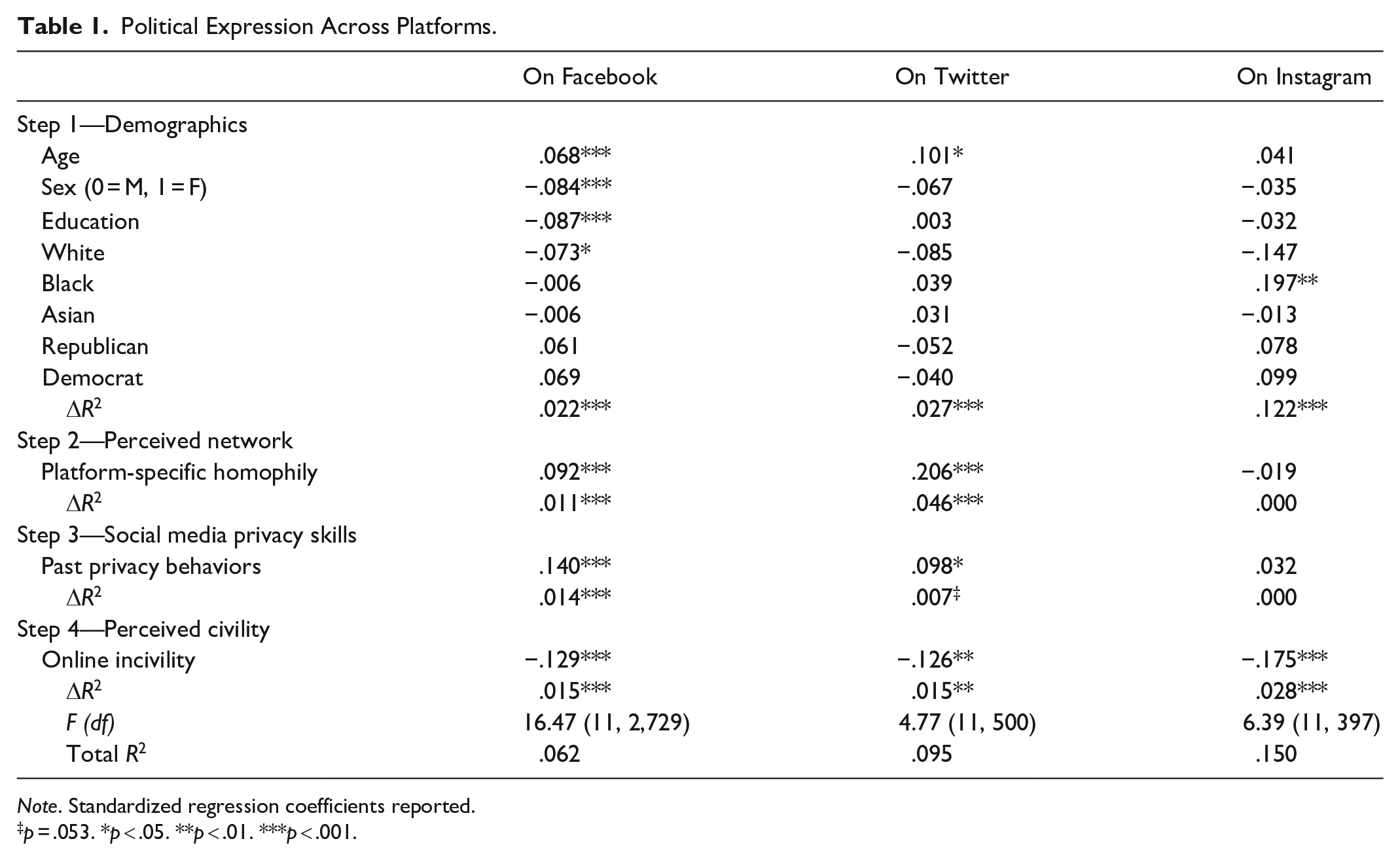
Note. Standardized regression coefficients reported.
p = .053. *p < .05. **p < .01. ***p < .001.
Overall Model and Demographic Effects
The full model testing Facebook political disclosures was significant, F (11, 2729) = 16.47, p < .001, R2 = .062. The first step, introducing demographic controls accounted for 2.2% (ΔR2 = .022) of variance in political expression. Specifically, age was positively associated with political expression (β = .068, p < .001), females were less likely to engage in online political expression (β = −.084, p < .001), education was negatively associated with expression (β = −.087, p < .001), and White participants were less likely to engage in online political expression (β = −.073, p = .017) on Facebook.
The full model testing political expression on Twitter was significant, F (11, 500) = 4.77, p < .001, R2 = .095. The first step, introducing demographic controls accounted for 2.7% (ΔR2 = .027) of variance in political expression. Only age was positively associated with political expression (β = .101, p = .013) on Twitter.
The full model testing political expression on Instagram was also significant, F (11, 397) = 6.39, p < .001, R2 = .15. The first step, introducing demographic controls accounted for 12.2% (ΔR2 = .122) of variance in political expression. Interestingly, Black participants were more likely to engage in online political expression on Instagram (β = .197, p = .013), but no other demographic predictor was significant. In light of these controls, we report the results of the hypothesis testing below.
Perceived Ideological Homophily
Hypothesis 1 proposed a positive relationship between perceived ideological homophily of individuals’ networks and online political expression on each of the three social media platforms. Results indicate that this relationship differs based on the platform. On Facebook, perceived ideological homophily was positively related to online political opinion expression (β = .092, p < .001, ΔR2 = .011), supporting H1a.
Homophily was also found to have a significant role in individuals’ likelihood to engage in political expression on Twitter (β = .206, p < .001, ΔR2 = .046), supporting H1b.
Unlike Facebook and Twitter, Instagram users’ political expression on the platform was unrelated to their perception of connections’ ideological homophily (β = −.019, p = .690, ΔR2 = .00), so H1c was rejected. Thus, results for H1 show when people believe their Facebook and Twitter connections have similar political views to theirs, they are more likely to post about politics, but this is not the case for Instagram.
Past Privacy Management Behaviors
Hypothesis 2 predicted that individuals’ past privacy management behaviors would positively predict their online political expression on each of the three social media platforms. Similar to perceived ideological homophily, results indicate that this relationship differs by platform. On Facebook, past privacy management behaviors significantly improved model fit (β = .140, p < .001, ΔR2 = .014), confirming H2a.
Users who reported having changed privacy settings to manage their audience were also more likely to post about politics on Twitter (β = .098, p = .026, ΔR2 = .007) and H2b was supported.
There was no relationship between past use of privacy tools and online political expression on Instagram (β = .032, p = .513, ΔR2 = .00), so H2c was rejected. Overall, past use of privacy tools was associated with increased online political expression on Facebook and Twitter, but not Instagram.
Perceptions of Online Incivility
Hypothesis 3 predicted that those who see online deliberation as less civil than offline discussion would be less likely to engage in online political expression on the three social media platforms. Online deliberation incivility was negatively related to political opinion expression on Facebook (β = −.129, p < .001, ΔR2 = .015), confirming H3a.
Perceived incivility of online deliberation was also negatively related to political opinion expression on Twitter (β = −.126, p < .01, ΔR2 = .015), supporting H3b.
Perceptions that online discussion were uncivil were also negatively associated with political expression on Instagram (β = −.175, p < .001, ΔR2 = .028), supporting H3c. Across platforms, perceptions that online discussion is less civil than face-to-face discussion reduced political expression.
Discussion
This study investigated the relationship between perceived ideological homophily of one’s social media connections, past use of privacy settings, and perceptions of civility in online discussions with online political expression on three platforms: Facebook, Twitter, and Instagram. Results indicate that perceived ideological homophily and past use of privacy settings to manage connections both affect how much individuals post about politics on Facebook and Twitter, but not on Instagram. Furthermore, across all three platforms, perceptions of civility online (relative to offline discussion) were associated with willingness to engage in political expression on ones’ social media. In this discussion, we explore how these findings complement and extend our understanding of online political expression.
The similarities and differences in findings varied by platform and inform both online self-presentation and situated platform use. Each platform is used for different purposes including sharing different kinds of content and establishing/maintaining different connections with others. While Twitter fosters bridging connections with those one knows less intimately, Facebook and Instagram foster higher bonding capital with closer ties (Phua et al., 2017). Furthermore, research on college students’ media use shows that Instagram is used for more self-documentation, entertainment, and self-expression than are Facebook and Twitter (Alhabash & Ma, 2017). Findings from our study add to our understandings of platforms and show audience perceptions (i.e., homophily) and personal behaviors (i.e., past privacy setting use) both promote increased political expression on Facebook and Twitter, but not Instagram. The way users perceive the platform, their audience, and engage in behaviors on the platform affects their willingness to engage in online political expression (Goffman, 1959). Indeed, engaging in political expression online has been associated with self-rated political interest, efficacy, and participation (Lane et al., 2019). Future research will benefit from combining perceptual and behavioral dynamics to model political expression online.
Each platform also allows for a variety of feedback from the audience such as likes, comments, resharing content, unfriending, and blocking. These platform-specific features along with anticipated outcomes of political expression (Velasquez & Rojas, 2017) likely affect how users engage with content. Indeed, past use of tools to manage one’s audience (i.e., muting, unfriending) was significantly associated with willingness to engage in political expression. This finding adds to the privacy literature, by focusing on previously enacted behaviors, on Facebook and Twitter. At the same time, it is unsurprising that past privacy management behaviors predict future actions on social media, as past behaviors are associated with perceived returns for future interaction (Weber et al., 2002). Following our theoretical framework, SNSs users leverage perceived risks and rewards, in their decision to post political opinions online. There are several tactics users can leverage to manage the information they share on social media, including both self-censorship and utilizing settings (Vitak et al., 2015). Our findings suggest that managing settings may supplement self-censorship related to political content sharing (cf., Fiesler et al., 2017).
On Facebook nearly all users provided an inference about the politics of their network, fewer did so on Twitter, and even fewer on Instagram. Each platform represents a site for different forms of expression. Against our hypothesis, perceived audience homophily was not a significant predictor of online political expression on Instagram; and, surprisingly Black Americans were more likely to post on the platform. There are several reasons this may be the case. On Instagram users carefully curate their selves (e.g., Caldeira et al., 2020). Given the evidence that Instagram users are likely to follow like-minded political leaders (Parmelee & Roman, 2020), it is surprising that Instagram users do not perceive audience similarity as a driving force for political expression on the platform. On each platform, participants saw their audience as relatively homophilous (i.e., means are all 2.2 out of 3 with small SDs). While political expression was uniformly low across platforms, Instagram had the lowest expression. Furthermore, almost half of participants reported not knowing the political beliefs of those they followed on Instagram (n = 379, 47.9%). In all, while those who follow political leaders on Instagram may seek to insulate themselves with selective exposure and avoidance (Parmelee & Roman, 2020), it also seems many Instagram users do not see the platform as a place to engage in political expression and are unaware of the political beliefs of their connections. The personal expression and image-driven nature of Instagram may account for increased variance explained by demographic variables.
On Instagram Black American’s were more likely to engage in political expression. In all, there seems to be a racial divide in posting politics on Instagram; but, surprisingly, this does not seem to be associated with perceived audience homophily (McPherson et al., 2001). Given the base-rate dynamics of Black Americans as largely supportive of the Democratic party (Igielnik & Budiman, 2020), this may signal that the politics of Instagram users may be conducive to Democratic ideologies. Thus, community norms, audience dynamics, or some other factor may provide Black Americans more voice on the platform (relative to other groups and other platforms). The role of race, political expression, and SNS deserves even more attention. Of course, on Instagram, neither homophily nor party affiliation was a significant predictor above the variance explained by race. This finding may reinforce recent evidence that Instagram users, especially conservative users, engage in selective avoidance on the platform (Parmelee & Roman, 2020). As platforms begin to profess ideological ideals (i.e., Parler, Telegram, etc.) future research may focus on how various platforms create spaces more conducive to particular ideological beliefs.
On Facebook older, male, less-educated, and non-White users were more likely to post political content. On Twitter, only age was positively associated with posting political content, with older adults being more likely to post about politics on this platform. Given the platform features and goals, demographic differences affect who is willing to share political opinions online. Males are more apt to share about politics on the largest platform, Facebook. Research using the risk-return framework has found that gender affects risk perceptions. Specifically, men are more likely to take risks in most domains (Blais & Weber, 2001; Sun & Gloor, 2021). Based on the assumption that posting about politics on social media can be perceived as risky behavior, our findings confirm that men might perceive this behavior as less risky and be more likely to engage, at least on Facebook. Past research also shows marginalized individuals use social media for political expression and activism because they feel connected to like-minded individuals (Vromen et al., 2015). The perception of a like-minded network, or network opinion homophily, can explain why non-White Facebook users were found to be more likely to post political content in this study. In line with our theoretical framework, we argue posting political content is evaluated via perceived risks or rewards. These tradeoffs affect the decisions users make to post or not post about politics on each platform.
Evidence for the value of risk-reward tradeoff is captured well in the positive effect of perceived homophily on willingness to engage in political expression on Facebook and Twitter. Heterogeneous networks allow for higher perceived possibilities of interpersonal conflict, making political expression on these networks more risky (Barnidge et al., 2018; Rui et al., 2020). Still, Barnidge et al. (2018) found an association between heterophily and online discussion, using a measure combining online and offline networks. In contrast, our analysis shows the value of matching network perceptions and behaviors for each platform. Furthermore, Barnidge et al.’s (2018) cross-country analysis revealed that countries with higher freedom of expression ratings had a lower association between overall network heterophily (online and offline) and online political expression. Since the United States has higher freedom of expression values, our findings thus complement existing research on network dynamics and online political expression. Still, future research comparing online political expression, perceived audience dynamics, and social media behaviors across countries could be valuable.
Given past evidence and our findings, we contend contextually perceived homophily in a given network space (e.g., on Instagram) seems to be associated with reduced risks by the participants, resulting in higher political expression. However, one of the possible perceived benefits of networks with higher perceived homophily is that the network members share similar world views, reducing the possibility of interpersonal conflict which results in more political interaction such as retweeting (Colleoni et al., 2014). This finding aligns with previous studies within the risk-return framework which show having a supportive personal network is related to lower risk perceptions and higher engagement in a behavior (Schneider et al., 2017; Weber & Hsee, 1998). Goals in posting and the kind of contacts people establish and maintain on each platform affect the impression management strategies they use. Future research will benefit from additional exploration of the conditions in which homophily and heterophily affect political expression with a focus on offline and online dynamics.
Though content analyses show online disagreements are less frequent, bold, and sustained than in-person disagreements (Stromer-Galley et al., 2015), this study shows users’ views of how civil online discussion (relative to offline) directly affects their willingness to post political content across platforms. For users of Facebook, Twitter, and Instagram perceived online civility was related to increased willingness to engage in political expression on the platform. Thus, to the extent that platforms can promote values of civility, user engagement in political discussion might increase. If deliberation is the goal of democratic engagement, and deliberation can be facilitated online, managing perceptions of civility may be important to encouraging deliberative dialogue online (see also, Masullo Chen et al., 2019).
Strengths, Limitations, and Conclusion
Because this study used a nationally representative sample, it ought to provide some generalizable insights. At the same time, this data was collected in 2016 just before the election of Donald Trump in the United States. Many scholars have noted dramatic shifts in political rhetoric following Trump’s election (e.g., Rowland, 2021). Thus, while this nationally representative sample is a strength of this study, we would like to emphasize that the changing political and media landscape requires future attention.
Another challenge with this data is the limited measures and secondary analysis of US data. While the generalizability for the nationally representative sample is high, all relationships detailed here are correlational, not causal, in nature. Additional longitudinal research capturing more psychometrically validated measures (as opposed to single-item indicators) and including expected outcomes of posting (see Velasquez & Rojas, 2017) can add confidence to our findings. The value of comparing multiple platforms adds to a growing body of evidence comparing platform effects and audiences (e.g., Lee & Yuan, 2020). Still, because political engagement worldwide increasingly relies on SNSs (Chen et al., 2021; Neumayer & Rossi, 2016), additional research about risks and benefits in different political systems is needed (Weber & Hsee, 1998).
The measure of past privacy management behaviors was somewhat blunt, with only two items that were not platform-specific. The measure asked participants if they have ever used privacy settings to see less of the other network members’ content, not to limit the visibility of their content to other network members. This represents a meaningful limitation in this study. Still, past behaviors predicted willingness to share political content on Facebook and Twitter. Furthermore, while the two privacy practice measures were highly correlated, one focused on blocking due to politics while the other focused on blocking, unfriending, or modifying settings in general. But a follow-up question asked why participants engaged in this behavior: 45.8% reported doing so because the person was posting too much political content, 35.6% because the person posted something respondents disagreed with, and 66.1% reported doing so because the person posted something offensive. In all, this supplemental evidence coupled with a high correlation give us confidence that managing social media privacy tools often deals with political ideologies. Since users on both Facebook and Twitter were more likely to share political content if they engaged in these types of behaviors, we privacy behaviors as a useful avenue for future research.
This study leverages a large nationally representative sample to offer insights about online political expression, in light of perceived audience, civility, and past privacy management behaviors. The findings largely support both strategic self-presentation and the risks-returns framework in online political behavior. This study demonstrates that perceptions of the ideological homophily of one’s network connections, past privacy management behaviors, and conceptualization of online conversation as less civil than in-person discussion all affected one’s willingness to engage in online political disclosures. The other contribution of this study is differentiating among three social media platforms and how these differences may lead to unique disclosure patterns associated with unique networks that each have their own interpersonal risks and benefits. Overall, we see many future avenues for studying online political expression on SNS. These findings invite further investigation of the topic of interpersonal risks and benefits in online political discussion.
Supplemental Material
sj-docx-1-sms-10.1177_20563051211055439 – Supplemental material for What Will They Think If I Post This? Risks and Returns for Political Expression Across Platforms
Supplemental material, sj-docx-1-sms-10.1177_20563051211055439 for What Will They Think If I Post This? Risks and Returns for Political Expression Across Platforms by Elnaz Parviz and Cameron W. Piercy in Social Media + Society
Footnotes
Acknowledgements
The authors are grateful to the Political Communication group at the University of Kansas (KU).
Declaration of Conflicting Interests
The author(s) declared no potential conflicts of interest with respect to the research, authorship, and/or publication of this article.
Funding
The author(s) disclosed receipt of the following financial support for the research, authorship, and/or publication of this article: The article processing charges related to the publication of this article were supported by the Drury University Communication Department and KU One University Open Access Author Fund sponsored jointly by the KU Provost, KU Vice Chancellor for Research & Graduate Studies, and KUMC Vice Chancellor for Research and managed jointly by the Libraries at the Medical Center and KU—Lawrence.
Supplemental Material
Supplemental material for this article is available online.
Author Biographies
 ). His research explores how technology is (re)shaping social networks. He is especially interested in how perceptions of technology affect the way people engage with both technologies and other people.
References
Supplementary Material
Please find the following supplemental material available below.
For Open Access articles published under a Creative Commons License, all supplemental material carries the same license as the article it is associated with.
For non-Open Access articles published, all supplemental material carries a non-exclusive license, and permission requests for re-use of supplemental material or any part of supplemental material shall be sent directly to the copyright owner as specified in the copyright notice associated with the article.
