



Abstract
Older adults make little use of social networking sites (SNS). SNS has become essential for maintaining social contacts and countering loneliness in the current era marked by the Covid-19 pandemic. This study explores the attitudes of the oldest-old on SNS after attending a training course on SNS use. The study’s goals are to investigate their personal experiences, choices of use and to survey their views on the usefulness of SNS and its effects on mitigating loneliness for older people. The interviews were conducted in the context of the “Ageing in a Networked Society—Social Experiment Study.” The participants, who were randomly selected for the course on SNS use, agreed to be interviewed during the post-intervention evaluation (N = 39). Results show SNS are mainly and productively used with relatives and friends. A positive view is reported for the potential impact of using SNS to counter loneliness, but mainly for socially isolated older individuals, while only a few find online contact futile. Intergenerational communication and a perspective of SNS as a leisure activity were identified as motivational factors for SNS use. Rare use or non-use are mainly related to privacy and security issues and technical difficulties. This is also the reason underlying the majority’s preference for WhatsApp over Facebook. These findings confirm the need for widespread SNS-focused online communication training interventions for seniors. On the speculative level, these results complement the existing literature by delving deeper into the perceptions of new older SNS users, a poorly studied segment of the population.
Introduction
Population Aging Raises the Question of Quality of Life
In the last decades, older people’s quality of life became a focal issue in the international debate on aging policy (Appau et al., 2020; Klompstra et al., 2019; Rondón García & Ramírez Navarro, 2018). The social relevance of an aging population will increase: in 2030, one individual out of four in the global population will be over 65 (United Nations, Department of Economic and Social Affairs, Population Division, 2015). Particularly relevant is the increase in the number of oldest-old: in Europe, the proportion of people aged 80 and over is projected to rise by two and a half-fold between 2019 and 2100, that is, from 5.8% to 14.6% (Eurostat, 2021).
Social Participation—Relationships Relevant to Older People’s Well-Being
The literature underlines how social participation and social relationships are relevant aspects of older adults’ well-being (Amiri et al., 2017; Baker et al., 2018). Recently, Achdut and Sarid (2020) highlighted the relevance of including social participation activities in preventive medicine for older people, especially for the oldest-old, who are often characterized by an increased need for support with a parallel reduction in social life and participation. These activities are useful for the elderly to lessen the effects of a reduced social life and participation due to the increased need for support in the activities of daily living (ADL). For these reasons, social capital resources and loneliness are also highly influenced by health status (Nyqvist et al., 2013).
Loneliness May Have Detrimental Effects on Older People
Well-being and poor health are related to loneliness. The negative implications of loneliness on the well-being of older adults are extensively discussed in the literature (Shankar et al., 2011; Tani et al., 2020). Peplau and Perlman (1982) defined loneliness as an undesirable individual experience due to a subjective feeling of dissatisfied social needs. Loneliness is a common experience for Europeans aged 60–80: a quite severe level of loneliness is detected in 30%–55% of older people living in Eastern Europe, and in 10%–20% of those living in Western and Northern Europe (Hansen & Slagsvold, 2016).
Internet and SNS Use May be Beneficial to Decrease Loneliness
Several interventions were adopted in many countries to reduce loneliness and increase the well-being of older adults. In this regard, specific interest is given to technologies (e.g., PC, laptop, smartphone, tablet with e-mail and internet) that connect people and support their social lives (Fernández-Ardèvol & Rosales, 2017; Poscia et al., 2018; Wilson, 2018). Using the internet may be beneficial for decreasing loneliness and increasing social contact among older adults in independent living communities (Cotten et al., 2013). Among these, social network sites (SNS) attracted experts’ attention due to their ability to promote people’s social relationships, including those of the elderly (Khalaila & Vitman-Schorr, 2018). In 2015, Ihm & Hsieh underlined how information and communication technology usage was one of the top contributors to the social well-being of 60+ people (Ihm & Hsieh, 2015).
COVID 19 and the Digital Divide Increased the Social Isolation and Loneliness of Older People
The long social isolation caused by the global Covid-19 outbreak pushed the literature to focus even more on older people’s loneliness (Luchetti et al., 2020; Wu, 2020) and on the existing digital divide between young and older people (Sala et al., 2020; Yu et al., 2016), which influences the social well-being of older adults. Seifert et al. (2021) identify a double offline and online exclusion for older people during the time of the pandemic. Indeed, offline social exclusion due to isolation and online exclusion due to the existing digital divide exacerbated by technophobia are often detected in older people (Nimrod, 2021). Specialized literature on internet use in later life underlines how the digital divide on the internet and online media are influenced by age, spatial differences, and socioeconomic inequities. A Pew Research Center (2016) research study found that among internet-using older adults, 48% need someone to set up or show them how to use a new device. Moreover, 34% lack confidence in their ability to use electronic devices to perform online tasks. Despite older adults’ enthusiasm to use technology, many older adults need training to start using their devices and programs of interest (Pew Research Center, 2017). Technology can be an important tool with the potential to reduce these social engagement barriers (Bixter et al., 2019; Quan-Haase et al., 2017). Prot and colleagues (2015) emphasize how, even if internet and social media use among older adults has steadily increased over time, it is still low, particularly for the over-80s. Prot’s study suggests that a high level of education and middle to high-income support internet use, including among the older segment of the population.
No General Consensus on the Beneficial Effects of SNS Use on the Social Life of Older People
However, the literature has not achieved general consensus on the effects that SNS use has on older people’s social well-being. Studies have often detected conflicting results on the effectiveness of SNS in reducing loneliness in older adults (Cotten et al., 2013; Hunsaker & Hargittai, 2018). Other authors underline the positive effect of SNS use on older people’s satisfaction with their social relationships (Larsson et al., 2016). Recent studies involving the oldest-old confirm the positive relationship between ICT use and subjective well-being, including the feeling of loneliness in oldest-old people (Rolandi et al., 2020).
Experimental Studies on the Use of SNS Are Not Conclusive Due to Several Limitations
A recent review study (Casanova et al., 2021) underlines the dearth of experimental studies investigating the relationship between the use of SNS and the loneliness of older people. The main limitations are often related to the sampling process due to a small sample size and the lack of randomization. In particular, self-candidature for training on the use of SNS could have influenced the results obtained. Finally, participants in experimental studies are often aged 70 years or less, while the over-80s find less room for involvement. However, social connectedness can become more difficult due to mobility limitations, chronic diseases, and other age-related issues for the over-80s. In fact, the training course is the main treatment used in the existing experimental trials on the effects of SNS use by older people. Training courses help to clearly identify the pre- and post-evaluation times, allowing us to pinpoint changes in attitudes and behaviors (Casanova et al., 2021). In 2016, a global report edited by the Pew Research Center (2017) confirmed these assumptions, further remarking how the rate of internet use by older people is lower than 20% in Italy, and how in the Italian peninsula, at variance with other countries, the internet finds wider use among middle to lower income people.
The Relevance of Age and Dwelling Context on internet Use
Hodge et al. (2017) emphasize the relevance of internet use by older people living in rural and tiny towns because it impacts the accessibility of services. In line with Hodge’s assumptions, Rosenberg and Nimrod (2021) identify spatial inequalities among older media users, underlining how older people living in small cities use a lower variety of technologies and emphasizing how accessibility to technologies characterizes social stratification. In 2009, Calvert et al. suggested how the oldest-old use technologies more frequently if these are already known and perceived useful for daily living. In this regard, Carver and colleagues (2018) emphasized how older people living in small cities and rural areas are more inclined to continue their social participation in their community. However, older people in rural areas face particular challenges of access, which may exacerbate the cycle of rural social exclusion in the context of the Australian National Broadband rollout (Warburton et al., 2013). The data in the literature reported so far largely concern the elderly population in general, because very little specific data and studies on the use of the internet and SNS by oldest old are available. Pew Research Center (2017) underlined how the American oldest-old make lower use of digital devices than older people and the younger generation. In 2009, Conci and colleagues (2009) underlined how intrinsic motivations are important factors for older people’s adoption of mobile phones or new technologies. In particular, Conci’s study confirmed the importance of the pressure from the social environment (mainly children and other relatives) as a determinant of extrinsic motivation (perceived usefulness) and, directly, on the intention to use the Mobile Phone.
Aims and Goals of the Study
What has been reported in the literature focuses on the relevance of promoting the use of SNS to the oldest-old to support their subjective well-being and counteract the feeling of loneliness. Due to low SNS use by the oldest-old, people in this segment of the population are generally not users or new users of digital technologies. The analysis of the experiences of SNS use by oldest-old people supports a better understanding of the effect of SNS use at older age, and contributes to the identification of strategies for promoting the use of SNS even to the oldest-old.
The present study aims to explore the attitudes of new users who are over 80 years old living in small cities in semirural areas, the use of SNS to investigate their choices of use, and to survey their opinions on the effects of SNS use on loneliness. Three research questions were identified to achieve the study’s goals: (a) What is the opinion of new SNS users on their personal experience of using WhatsApp and Facebook? (b) What is the opinion of participants, after their experience, on the use of SNS? and (c) What is the opinion of participants on the effects of SNS use to counteract older people’s loneliness? Qualitative interviews enable the detection of nuanced perspectives on personal experience and opinions (Frost et al., 2020).
This study adds to the specialized literature on the oldest-old, not yet extensively studied as a specific population target for technology intervention. To summarize the different aspects discussed above, this study’s contribution focuses on the oldest-old, a segment of the population that is rapidly growing around the world, characterized by a high risk of social exclusion due to the progressive worsening of individual health conditions and a reduction in social contacts. In this regard, this study proposes specific reflection and useful insights into the effects of SNS use on this specific target. The considerable attention afforded to technologies to alleviate loneliness is well-aligned with the literature focusing on the pandemic era, which was marked by the social isolation of individuals and made the existing generational digital divide more visible. Finally, it is recommended that future studies specifically focus on small cities as a study environment due to their unique characteristics in terms of social life attitudes of older citizens.
Materials and Methods
The findings presented in this paper emerged from a qualitative study carried out by means of face-to-face interviews (Hand, 2003; Kvale, 1996). The qualitative study was conducted as an additional part of the ANS-SE study.
The ANS-SE study protocol (detailed in Zaccaria et al., 2020) involved a sample of 180 older adults (79–84 years) living in Abbiategrasso (Italy) and having good physical and mental health (Mini-Mental State Examination—[MMSE] > 26; Geriatric Depression Scale [GDS] < 11]) with no hearing or eyesight impairments. The criteria for the inclusion of participants in the ANS-SE study included no previous experience with SNS. Additional skills on the use of a mobile or smartphone were not included in the ANS-SE study protocol’s selection criteria.
Table 1 shows the socio-demographic characteristics of the ANS-SE sample. Social engagement with family and friends was explored with the 6-item Lubben Social Network Scale (LSNS-6, Lubben et al., 2006). The LSNS-6 comprises a set of 3 questions to evaluate relationships with relatives, followed by a comparable set of 3 questions to evaluate relationships with friends. The total score was the sum of the 6 items, ranging from 0 to 30 (LSNS-6 Total), with higher scores indicating higher social engagement. Subscale scores were also obtained by adding the items for relatives (LSNS-6 Family, range 0–15) and friends (LSNS-6 Friends, range 0–15). There are no recent data assessing older people on the use of social networks by means of LSNS-6. However, in a 2006 survey involving older adult populations living in three European Community countries, the total LSNS-6 mean value was 16.1 + 5.5: Family 8.2 + 3.3 and Friends 7.9 + 3.4. These values are similar to those of our sample (Lubben et al., 2006). The sample of our study manifests a level of loneliness and social exclusion in line with their age.
Socio-Demographic and Baseline Characteristics of 115 Participants of Ageing in a Networked Society—Social Experiment Study (ANS-SE) Who Successfully Completed the Study Stratified by Groups. a

SNS = Social Network Scale; GDS = Geriatric Depression Scale; MMSE = Mini Mental State Examination; LSNS = Lubben Social Network Scale 6-items; ANOVA = analysis of variance.
Values denote mean ± sd for continuous variables, counts (percentages) for qualitative variables. Statistics test of the differences: the data in the column show the chi square (X2) and ANOVA Fisher test (F) values. All the differences between the three groups are not statistically significant.
The sample was randomly allocated to three trial groups: (a) a training course on the use of SNS (intervention group), (b) a discussion group via offline meetings (active control group), and (c) a waiting list (inactive control group). Between February 18 and March 7, 2019, participants in the training course received 5 two-hour training sessions to learn elementary skills on the use of a smartphone, Facebook, and WhatsApp. Participants were provided with user-friendly smartphones designed for older adults. For the remaining 3 weeks of the experimental phase, two junior trainers were available twice a week for on-demand face-to-face tutoring. Trainers also used SNS to interactively involve participants via messages and media in a dedicated WhatsApp group and Facebook pages.
Training staff consisted of (a) one sociologist specializing in aging aspects, as senior trainer; (b) a junior trainer highly-skilled in SNS use; and (c) a group of Human Science students from a local high school. The students’ participation supported the older people during the training course, helping them to manage difficulties and clarifying any misunderstandings about the instructions provided by the two trainers. This support activity allowed participants to receive more personalized training in those cases where they were unable to manage the instructions given by the trainers in real-time (Gooding et al., 2016).
The experimental study was based on pre- and post-intervention assessment times. Among the 180 people included in the randomized sample, 144 agreed to participate in the experimental study and completed the baseline assessment. In all, 115 participants finished the post-intervention assessment, while 43 of them completed the double assessment. The psychologist who completed the ANS-SE assessment asked all of the training course participants to be interviewed and recorded as an additional part of the study, and 39 of them accepted. The analysis performed on these interviews is included in this paper.
Participants’ remarks will be designated a number from 1 to 39 to ensure anonymity in compliance with privacy rules, allowing the reader to follow each individual in the quotations contained in the manuscript. Table 2 illustrates the set of semi-structured questions prepared by the research team, which included sociologists, neuropsychologists, and geriatric physicians, based on their own professional expertise in the field of research on older people’s activities.
The Interview Structure: Questions for Each of the Study’s Concepts.

SNS = social network sites.
Source: Formulated by the authors.
In particular, personal experiences concerning the use of Facebook and WhatsApp were analyzed to identify attitudes and feelings when using them, the choices made by participants on which SNS to use, and the rationale behind opting to use or not to use them.
The first part of the interview concerning personal experiences on the use of SNS starts with a dichotomous question (y/n), useful to: introduce the issue, orient the path of the interview and explore the trend driving SNS use by participants. Depending on the interviewee’s answer to Question 1, that is, if the interviewee confirmed the use of SNS, this was followed by Questions 2 to 8. On the other hand, the interviewer handed out Questions 9 to 12 if the interviewee did not use WhatsApp and Facebook, despite attending the training course. Questions 13 to 16 were given to all interviewees.
Interviews were carried out in the period between April and June 2019, at the end of the two-month trial. The interviews were collected by psychologists and neuropsychologists specializing in aging, and employed at the Fondazione Golgi Cenci, the promoter of the experimental trial.
The interviews were released as an additional part of post-intervention data collection, and each interview was conducted for around 25 min. Interviews were recorded and transcribed in line with the Cohen and Crabtree (2006) guidelines for conducting semi-structured interviews. The answers collected then underwent qualitative content analysis for a systematic, step-by-step development of interpretation categories derived from the data collected (Kohlbacher, 2005; Titscher et al., 2000).
The analysis focused on thematic discovery from the transcripts recorded during the interviews with the older people involved in the study. This was achieved using the methodological principles of open and axial coding described by Strauss and Corbin (1998). The risk of distortion of data interpretation was limited as a result of separating the task of collecting data, which was assigned to the psychologists and neuropsychologists, from the task of analyzing data, mostly conducted by the research team’s senior sociologist. As a result of the separation of roles to reduce any distortion in the analysis, observation data during the training course were not collected by the senior trainer. The researchers identified relevant thematic codes in accordance with the study’s aims through an in-depth examination of themes and then cross-checked these by referencing individual transcripts and looking at a collective data set. Figure 1 illustrates the methodology used for text analysis, supported by a specific tool to enable the research team to collect and analyze transcripts.
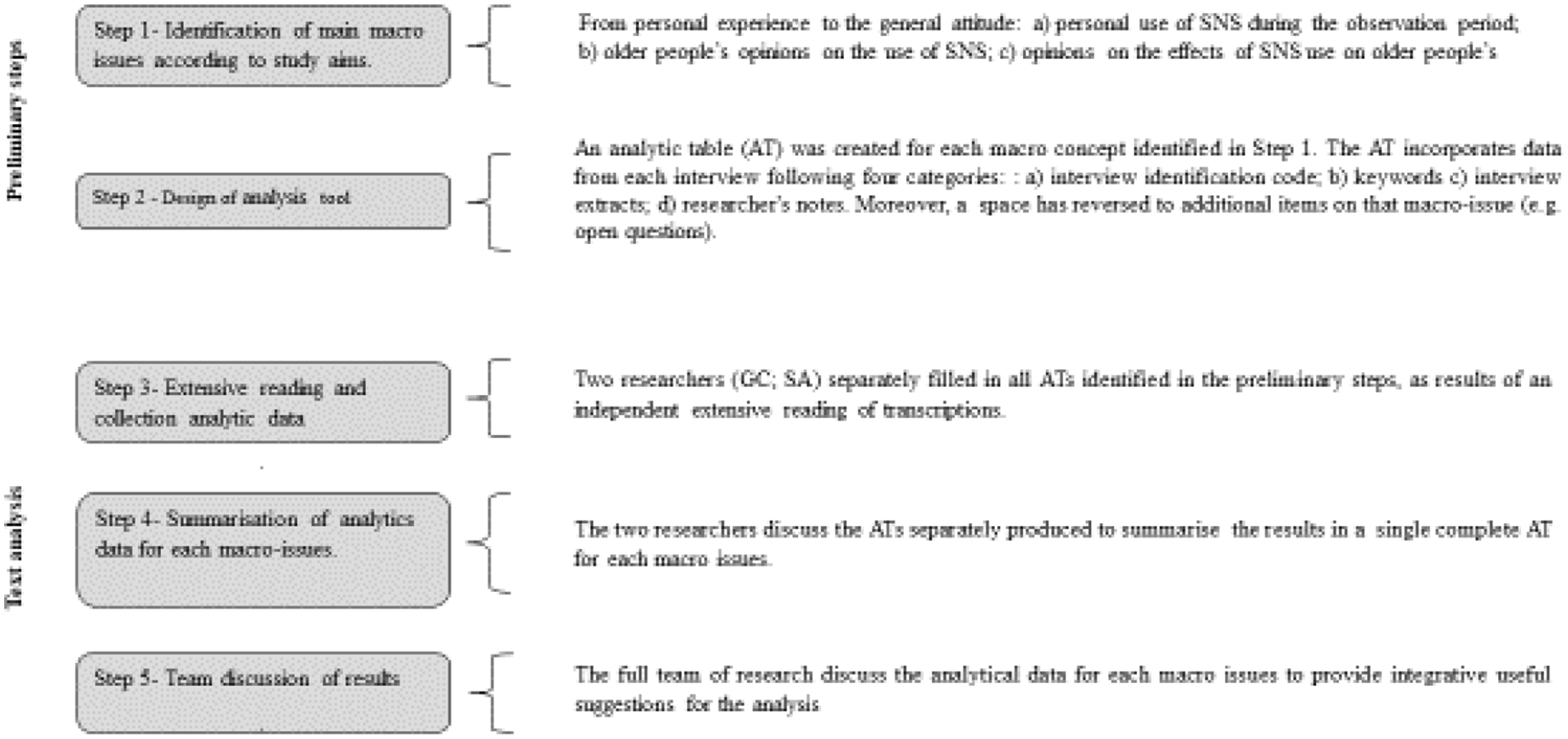
Flowchart of the text analysis path.
Results
The interview analysis made it possible to elicit six main themes related to three research questions. Four of the themes were related to the personal experience on SNS use: (a) personal experience stories on SNS use, (b) the rationale for SNS use, (c) the differences in the use between WhatsApp and Facebook, and (d) online relationships during SNS use. The opinions on (e) SNS use by older people and (f) SNS effects to counteract loneliness, contribute to completing the themes’ scheme. Results are shown for each theme.
Personal Experiences on SNS Use
The majority of interviewees (30 out of 39) expressed a positive experience on their learning how to use SNS. “It was an excellent experience (..) both social networks [WhatsApp and Facebook] are not as difficult to use as I thought” (P1). “I’m delighted to have a Facebook profile; someone told me that he is delighted to find me there (..) moreover, my grandchildren were surprised at how many friends I met there” (P2).
The training course seemed to work as a stimulus to help participants use SNS. “During the training, I understood what SNS are and how I can use them” (P28, P8). “The atmosphere in the classroom was so lovely. Everybody was ready to help. That made me feel good and encouraged me to try and use SNS” (P29): When I started the training, I was a little annoyed because I had to do it, but I felt better after getting to know the people there and the trainers, and now I think that it was an excellent opportunity to learn something new. (P10, P30, P31)
“The training helped me because I often got confused before, but now no: it is not as hard as I thought, the training made me more confident” (P7): Now that I have finished the course, my daughter often helps me with the smartphone and SNS (..). She tells me to take the phone and to practise with her on how to do things with it. It never occurred to her to teach me how to use them before the training. (P18) The training was fine, but I would like to have more teaching approach and more classes (..). After the class I had to ask my daughter to help me, and after I repeat the procedure 4 or 5 times, I can remember what to do. (P4)
Only 6 participants stated that they did not use, or seldom used, SNS outside of the training course. The reasons given are linked to difficulties in understanding how to use smartphones and SNS. “It is too difficult for me; there are too many things to remember” (P21, P22, P23). “I tried to use the phone at home, but I made several mistakes, and now I understand that it’s not for me” (P24, P25). “At home, I had to wait for my son to come and help me to use them, otherwise (..) I make mistakes” (P11).
Reasons for SNS Use
The interviews stressed the presence of personal motivation to learn how to use WhatsApp and Facebook: “I want to learn how to make a video call so I can stay in touch with my son who lives in Uruguay, (..) I haven’t seen him for three years” (P15). “WhatsApp is beneficial for calling different countries. I often need to phone overseas and it is free, (..). I can send texts but also pictures, videos, and music (..). So, it’s a great thing” (P5). “I received some video calls, fewer texts, and I like the video camera” (P16).
Twenty participants are firmly convinced on the use of WhatsApp and Facebook, and emphasized how convenient they are in daily life: “I want to use new technologies because they are useful (..) for example, if I have problems with the car, I can call or text someone who can help me, or I can find a closer garage” P13). “Thanks to Facebook, I found an old friend living in Turin and the son of a friend who passed away. I sent him my condolences (P14).”
Three participants recall their personal attitudes to justify their low use of SNS: “I don’t feel comfortable with new technologies and with Social Networks. I don’t like to speak to people I don’t know because I don’t know what they might do” (P26). Moreover, some of them stopped attending the training course due to health or family problems: “I did not complete the training due to health reasons. I couldn’t attend (..), I gave the smartphone back. I felt uncomfortable (..), I’m clumsy when I use it” (P24, P27).
The Difference in Use of WhatsApp and Facebook
Among participants, the daily use of WhatsApp and Facebook mostly felt like a moment of leisure time and entertainment. “It is fun to find their pictures and to keep in touch with them” (P17): The first thing I do in the morning is to turn on the phone, and I am waiting for my daughter’s good morning or a text from a friend to go out together. They [WhatsApp and Facebook] help me to break the daily monotony. (P18)
For other participants, SNS are used to find information to satisfy a specific curiosity: “I look for info on cities, countries and schedules on local events” (P19, P20).
The interview analysis clearly highlights the different ways that participants use SNS. At least 2 out of 3 participants stated that they preferred WhatsApp over Facebook. “I usually use both of them, but I use WhatsApp daily for texts, while I use Facebook less because the truth is, I don’t like it much. I don’t understand what I have to do” (P6, P26, P32) and “Facebook is full of stupid things” (P21).
WhatsApp is used daily for interactions with friends and family. Facebook is seen as a virtual space to find humorous things, but participants seem to be afraid of using Facebook. “I find WhatsApp interesting for staying in contact. Facebook is interesting for seeing funny pictures, but less so for finding new friends. I am afraid of coming across bad people” (P14); “(..) there is less privacy on Facebook” (P4); “I’m afraid of doing something wrong” (P33); “Facebook? It is a waste of time” (P19); “There are several scams on Facebook” (P34). The privacy issue is the most relevant for participants who do not use Facebook: “I don’t like Facebook. I don’t understand if and which of my personal info is going around” (P23).
Online Relationships During SNS Use
With regard to the question “Did you meet new people through Facebook and WhatsApp?,” most participants gave a negative answer: “No, I don’t need more friends” (P3); “My daughter doesn’t want me to use Facebook to make new friends because we do not know who these people are, and afterwards we can lose our peace of mind” (P4).
Nevertheless, almost half of the participants (17 out of 39) had a good experience as regards new friendships through SNS: “I looked for other people living here in Abbiategrasso and I requested their friendship” (P5); “I found an old friend. We grew up together and I hadn’t seen her for many years. I found out she had gotten married and has grandchildren. She lives in the north of Italy, far from here” (P1). “Sometimes we meet up with some of the training participants in the WhatsApp group around the city. We greet each other and have a coffee together” (P5).
The text analysis showed that WhatsApp and Facebook were mainly used by participants to keep in touch with other trainees, family members, and friends: “How do I use them? I communicate with my family or friends: one sends me texts, and I reply to them” (P6). “I keep in touch with my grandchildren on a daily basis” (P7). “I often send a text to the training course WhatsApp group” (P8). “I usually say hello to some friends and I send pictures of flowers to the women” (P9, P10). “I usually send a text to my son, and he replies to me” (P11): I met a group of people when I went to the seaside, and we keep in touch now through WhatsApp (. . .). They are in Ischia now. I know that place very well, so I am suggesting some places they should visit. (P12)
Older People’s Opinion on the Use of SNS
Participants’ opinions on the usefulness of SNS for older people refer to feelings coming from their personal experiences. More than half of the participants (21 out of 39) would recommend learning how to use SNS to other older adults because they’re fun to use: “You can find so many good things on Facebook (e.g., animal or children’s pictures)” (P1, P24), or “(..) why, Facebook and WhatsApp help me to pass the day” (P29, P35) or “keep in touch with other friends whom you can text, send funny pictures, or voice messages” (P13, P36). You can use Facebook to look for news or other things: “(..) it is leisure” (P21, P14).
Nevertheless, participants made specific reference to the need to be aware of the risks when using SNS. First, their excessive use: “(..) I decided to use the smartphone and SNS moderately because they could be like a drug. The more you use them, the more time you want to spend on them” (P20, P30). The issue is also about meeting the right people because it can be dangerous, but if you meet the right people, it can be a very good experience” (P26). The fear of scams pushed some participants to recommend only using WhatsApp and not Facebook (P17, P24). One participant identified a solution: “It’s crucial to attend a training course to feel more confident and to not make relevant mistakes when using them (SNS) and when going into online Facebook sections” (P7).
To complete the range of different opinions, four participants would not recommend the use of SNS to other older people. “Not for me, because there are so many ways to meet people. I suggest attending yoga courses, or other physical exercise courses, or playing cards. So, SNS are not necessary” (P15, P19, P20). “I don’t know if it’s the right way. You don’t know the people that you meet online, so I think it is a little immoral” (P4).
SNS Use Should Alleviate Older People’s Loneliness
In line with the other findings, the specific questions relating to personal opinions on the use of SNS to counteract loneliness for older people received conflicting answers. Most participants agreed that the use of SNS could help other older people overcome loneliness. “Yes, of course, because with a single click you can meet people, your families, or people that you like (..), you call them in a second (..), you see them on a video call” (P1). “The percentage of people who cheer up thanks to SNS is high, especially if you are alone” (P37). “I think so yes, because you find funny things (..). Yesterday, I laughed out loud over the funny posts on Facebook and WhatsApp chat” (P39).
The possibility of improving one’s personal social life was the main reason why people started using SNS. Still, participants linked the use of WhatsApp or Facebook to specific characteristics of personal life. “If you are living alone, it could be a good way to interact with someone, to feel less alone. In particular, if they [the older people living alone) have never tried to use them, they must try” (P8, P32, P38). “Yes, it could be an opportunity if they can’t go out because of health or other family problems, Facebook or WhatsApp could help you have a social life with friends” (P33). “Facebook and WhatsApp could be useful for getting to know new people, of course, but only if they can meet you in person afterwards” (P4).
On the other hand, those who believed that the use of SNS was not suitable for the elderly considered SNS to be useless. “I think no, they (SNS) are futile (..). Real contact with real people counteracts loneliness and not something virtual” (P22, P30).
A summary of the main results for each of the study’s three research questions is shown in Table 3.
Main Results for Research Question.

SNS = social network sites.
Source: Formulated by the authors.
Discussion
The study qualitatively investigates the very first experiences of SNS use by oldest-old individuals living in a small city in Italy, further exploring their opinions on SNS’ usefulness and their potential to counteract older people’s loneliness. The findings demonstrate the positive attitude toward the use of SNS by healthy individuals over 80 years old after their first experience of using SNS for 2 months supported by trainers. The oldest-old participants manifested their personal satisfaction with regard to improving their ability to communicate by means of WhatsApp and Facebook. Family members, including sons and nephews, and the personal friendship network are the main recipients of SNS communication by the oldest-old. The eventual search for new friendships is often characterized by elements of life proximity, in terms of territorial belonging or shared interests. The fear of scams seems to influence their openness to meeting unknown people. Moreover, the oldest-old participants manifested positive opinions on the time spent on SNS, seen as leisure and potentially useful to contrast loneliness, as suggested by recent quantitative studies (Casanova et al., 2021; Gaia et al., 2021; König et al., 2018; Rolandi et al., 2020). These findings are largely in line with previous studies investigating the attitudes and the experiences of older adults with SNS, showing that the main motivations for use are to maintain social contacts with their own social network and to enter into intergenerational communication with young family members, while the main barriers are privacy concerns, technical difficulties, and lack of perceived usefulness (Nef et al., 2013).
The relevance of this study’s results increases due to the focus on fourth-age people selected to be new users of SNS. According to the gray digital divide (Sala et al., 2020), 80 + individuals are hardly involved in experimental studies on the use of SNS, due to sampling choices (Casanova et al., 2021; Newman et al., 2021). There is limited research on an individualized approach to teaching older adults about technology (LoBuono et al., 2019).
The study confirms the attitude of the oldest-old toward including the technologies they are already familiar with in their daily life (Rosenberg & Nimrod, 2021). The greater use of WhatsApp compared to Facebook seems to move in this direction: writing WhatsApp text is similar to traditional SMS and allows communication with familiar people.
The study identifies two factors supporting the positive attitude toward SNS found in the oldest-old participants who are new users. First, the training course works as a driver to overcome the main practical adversity, that is, helping participants feel comfortable using SNS. Moreover, knowing each other or having territorial or other elements of life proximity (e.g., living in the same city) makes the choice of contacting each other easier. These suggestions confirm the attitude of new older adult SNS users in maintaining the connection between an online and offline social life, seeing online activities as a diversion to reduce life’s monotony (Friemel, 2016; Muscanell & Guadagno, 2012).
The results underline how participants’ positive experiences are related to using new technologies, previously considered to be for the exclusive use of younger people, and improving the possibility of keeping in touch with the family members and friends who use them. The oldest-old participants continued to learn and improve SNS use with the support of their family members after the training. Furthermore, the positive reinforcement of the use of SNS stemmed from the younger generation’s surprise at the learning abilities of their parents and grandparents.
These suggestions move toward the assumption of a positive effect of SNS use on social inclusion and older people’s loneliness (Blažun et al., 2012; Larsson et al., 2016), highlighting the power of SNS in reinforcing intergenerational relationships (Jung et al., 2017).
One interesting research study shows that the perceived usefulness and potential benefits of a device or program are key technology adoption factors for older adults (Lee & Coughlin, 2015). The implementation of initiatives to increase older adults’ abilities to use online technologies should increase the accessibility of services for this target population, especially for those living in small cities often excluded by online services (Hodge et al., 2017), and help counter their technophobia (Nimrod, 2021). In this regard, this study’s positive results should encourage the promotion of training courses on SNS use for those oldest-old individuals living in small cities. Training courses should aim to support their better inclusion into the community’s social life and the better use of existing online community services.
The success or failure of the personal experience seems to influence participants’ opinions on the usefulness of SNS in reducing loneliness for the oldest-old. In particular, the interviews confirm that SNS are seen as an integrative tool to counteract older people’s loneliness, especially for people living in specific social isolation conditions (Barbosa Neves et al., 2019).
A recent study published by Caliandro and colleagues (2021) underlines how WhatsApp use by older people is strongly related to social connections with members who are already a part of their social network and to accomplish daily tasks, while the ludic use of a smartphone is rarely carried out. The data coming from the present study confirm the existence of this attitude even in the oldest older people.
The analysis reported herein on the reasons why the use of Facebook or WhatsApp is avoided, brings out the tendency of oldest-old people to consider online activities as useless, “not real life” and potentially dangerous (e.g., fears of online scams and excessive use) because of unknown or unhealthy relationships (Bonsaksen et al., 2021; Jung et al., 2017; Wilson, 2018). The fears disclosed during the study seem to confirm the existence of the relevance of feelings of confidence in their own digital abilities and safety concerning privacy and fraud issues. Finally, the presence of certain fears also seems to open the debate on the effect of fear of online social exclusion on older people, proposed in the literature by Olsson et al. (2019). Therefore, we can conclude that the majority of oldest-old individuals, cognitively healthy and without previous experience of SNS use, could potentially benefit from a brief training course on SNS use held in a group. This is an important finding for future initiatives (e.g., specialized training courses) to reduce the gray digital divide and to counteract ageism.
These themes acquired even more relevance in the context of the COVID-19 pandemic, characterized by a prolonged period of social distancing and lockdowns to reduce the spread of the virus. In these periods, the use of digital technology became essential to maintain social contact. Oldest-old individuals displayed the highest risk of mortality from COVID-19 and, at the same time, the lowest digital literacy. Several commentaries advised on the need to improve digital literacy of older adults to counteract the detrimental effect of social isolation during the pandemic (Armitage & Nellums, 2020; Nimrod, 2021). Regarding this aspect, the ANS-SE experiment was conducted in 2019, before the COVID-19 pandemic. A 1-year follow-up was planned in Spring 2020 to evaluate the long-term effect of the training course on SNS use, loneliness and social isolation. Therefore, we performed a telephone survey with the ANS-SE study participants in May 2020, soon after the first attenuation of the Italian lockdown, and found that training on SNS use had a positive impact on social engagement and loneliness, even in extreme conditions of self-isolation and perceived vulnerability for the oldest-old due to the spread of COVID-19 (Rolandi et al., 2020). Similar findings were detected in representative samples of Italian, French, and Spanish individuals over 50 years old, where it emerged that non-physical contact (by phone, WhatsApp or Facebook) played a protective role against depressive feelings during the lockdown, with a stronger effect for intergenerational contacts and in individuals aged 70 and over (Arpino et al., 2021). These results further highlight the need to invest in similar initiatives to improve older adults’ well-being and their social participation.
Conclusion
This qualitative study explored SNS use by new users aged 80+, to investigate their use and explore their opinions on the effects of SNS use on loneliness. The study connects different relevant yet under-explored issues: SNS use by the oldest-old, and a focus on the effects on their subjective well-being, including loneliness. Moreover, this study identifying oldest-old individuals as new users of SNS contributes to the debate on this population segment’s online social inclusion. The qualitative analysis of the opinions of a randomized sample of these people supports a better understanding of the attitudes and preferences toward the use of SNS by this specific target group. Results show a positive attitude toward WhatsApp and Facebook reported by the majority of the oldest-old interviewed, underlining the potential power of SNS to counteract older people’s loneliness and to support their social life activities. The study also highlights how, in older people over 80, the main motivation for using SNS is related to maintaining contact with the people already included in their personal offline social network (mainly family members and friends). Searching for new friendships was influenced by territorial or life activity proximities.
The possibility of improving intergenerational communication with children and grandchildren contributes to the over-80s’ satisfaction with SNS use. In this regard, the findings emphasize some preference for WhatsApp rather than Facebook, because Facebook is more open to strangers.
The study effectively allowed us to identify the main fears of older individuals regarding SNS use, highlighting the relevance of privacy and safety issues when browsing online. The positive results emphasize how specialized interventions for oldest-old people, including training activities on online communication and focused on SNS, should be spread.
Finally, some limitations need to be considered in this study. First, the interviews are short because they were carried out as just one phase of a multi-part evaluation path lasting about 2 hours. Furthermore, the interview was conducted a short while after encouraging the use of SNS, making it possible to capture the attitude toward use and the relative choices of use by the new over-80 users. Finally, participants who had a positive experience on SNS were more inclined to accept to be interviewed than the others. Nevertheless, the results’ validity is not largely influenced by the refusal to be interviewed, since only four people declined, mostly stating that they did not have additional time to spend on the interview after the evaluation path. However, the authors agree that more research into the reasons for non-adherence to this type of interview is needed in other studies. Future studies should include in-depth interviews to understand better attitudes and choices on SNSs use by the oldest older people in their daily lives free from the stimulations included in the experimental studies. Moreover, due to a lack of observation data provided by trainers, the direct socialization opportunities of participants throughout the training course, as well as other dimensions of their offline socialization (e.g., individual social network ties) have not been analyzed sufficiently. Ultimately, the study involves a specific subgroup of older adults residing in a small city in a specific country setting. These limitations restrict the applicability of findings to all the oldest-old people living in a different territorial context (e.g., a big city, a rural city) or countries. Despite these limitations, the study contributes to the literature debate by offering the perspective of fourth-age people who became new SNS users.
Footnotes
Acknowledgements
Emanuela Maria Sala and Daniele Zaccaria conceived and designed the ANS-SE study. Doro Italia donated the smartphones used for the “Social Networking Sites” training course. “Liceo Bachelet” high school students contributed by acting as tutors in the smartphone use courses.
Author contributions
G.C. conceived and designed the investigation. E.R., R.V., S.A., L.P., and A.G. contributed to data collection and data management. G.C and SA provided data analysis and interpretation of the results. G.C. drafted the manuscript. All authors reviewed the paper, provided significant feedback, and approved the final manuscript. All authors have read and agreed to the published version of the manuscript.
Declaration of Conflicting Interests
The author(s) declared no potential conflicts of interest with respect to the research, authorship, and/or publication of this article.
Funding
The author(s) disclosed receipt of the following financial support for the research, authorship, and/or publication of this article: This research was funded by the Italian Fondazione Cariplo (Bando 2017, ricerca scientifica: Ricerca sociale sull’invecchiamento: persone, luoghi e relazioni. Grant number: 2017-0946. Title of the project: Aging in a networked society. Older people, social networks and well-being). This study was partially supported by a Ricerca Corrente funding from the Italian Ministry of Health to IRCCS INRCA.
