




Abstract
This study explored Facebook users’ hostile perceptions of shared news content and its relationship with their political participation. This study conducted an online experiment with a 3 (news slant: pro-attitudinal, neutral, counter-attitudinal) × 3 (news sharer: in-group, neutral, out-group) between-subjects design. This experiment was administered in the context of the abortion issue in South Korea. Consistent with the hostile media effect, the news slant (pro-attitudinal, counter-attitudinal) of shared news content was found to influence Facebook users’ hostile perceptions of shared news content. Out-group sharers also significantly affected their hostile perceptions of shared news content. However, in-group sharers did not. Furthermore, the effect of Facebook users’ hostile perceptions of shared news content on their willingness for political participation was moderated by their prior minority perception in the general society. Only for Facebook users with high levels of prior minority perception in the general society, their hostile perceptions of shared news content appeared to encourage their political engagement. The implications of these findings were discussed.
Keywords
Social media has played an important role in delivering news content. Facebook is one of the most popular social media platforms for news content (Shearer & Klein, 2019). Facebook users are exposed to a constant flow of news content or information shared by others from their online networks (Mitchell et al., 2016). They can encounter agreeable or disagreeable content shared by their online friends with diverse political or social backgrounds (Duggan & Smith, 2016). Abundant studies have examined individuals’ bias perceptions of news content using the hostile media effect (HME), which posits that individuals who are highly involved in a contentious issue evaluate neutral news content on that issue as biased against their positions (Gunther & Liebhart, 2006; Vallone et al., 1985). The HME was originally documented by using traditional media content such as newspaper articles or television news programs. However, recently, some studies have started to examine the HME in online media settings and found that online news content (e.g., blog posting, Twitter content) can produce the HME (e.g., M. Kim, 2015; E. J. Lee, 2012; T. K. Lee et al., 2018; Yun et al., 2016). Furthermore, the scope of HME research has been extended to include the role of online news sharers. Specifically, T. K. Lee et al. (2018) demonstrated that partisan news sharers (Republicans or Democrats) influence Twitter users’ bias perception of shared news content. Drawing on the prior research on the HME of social media content, this study jointly investigates the role of news slant and news sharers in Facebook users’ hostile perceptions of news content shared by others.
Furthermore, this study examines how Facebook users’ hostile perceptions of shared news content influence their intended political participation. Facebook users’ political expression has been investigated from the theoretical framework of the corrective action hypothesis (Rojas, 2010) and the spiral of silence (Noelle-Neumann, 1974, 1993). The spiral of silence theory indicates that Facebook users’ minority perceptions discourage their willingness to speak out (Chen, 2018; Gearhart & Zhang, 2015; M. Kim, 2016a), whereas the corrective action hypothesis maintains that their hostile perceptions of shared news content lead to politically expressive activities (Barnidge & Rojas, 2014; Hwang et al., 2008). Motivated to reconcile the spiral of silence theory and the corrective action hypothesis, this study investigates a possible moderating role of Facebook users’ prior minority perceptions in the relationship between their hostile perceptions of shared news content and their willingness for political participation.
The Slant of News Content on Facebook
Numerous HME studies have demonstrated that individuals with opposing views evaluate the same news content differently depending on whether the slant of news content is consistent or inconsistent with their own opinion (Perloff, 2015). Those who are highly involved with a controversial issue want to maintain their own attitude toward that issue even when they encounter counter-attitudinal news content (Gunther, 1992). For holding on to their original position, they tend to engage in the biased processing of news content (Petty & Cacioppo, 1979).
As a consequence, people tend to evaluate pro-attitudinal content to be favorable or less biased, which produces assimilation effects (Gunther et al., 2009). Conversely, people turn to perceive counter-attitudinal content to be unfavorable or more biased, which generates contrast effects, the HME (Choi et al., 2009; Gunther et al., 2009). Accordingly, those who have an incongruent view with a news slant are more likely to perceive the news as more biased than those who hold a congruent view with the news slant (Coe et al., 2008; Feldman, 2011; Gunther & Chia, 2001; M. Kim, 2016b).
The HME has been empirically tested in the context of traditional media. However, recently, some researchers have turned their attention to investigating the HME in social media environments (e.g., M. Kim, 2015; T. K. Lee et al., 2018; Yun et al., 2016). For instance, M. Kim (2015) showed that individuals who disagreed with a blog content evaluated the blog content as more hostile and less trustworthy than did those who agreed with the blog content. This shows that depending on the news slant (agreeable or disagreeable), social media content can generate assimilation or contrast effects.
Summarizing existing literature, Facebook users’ bias perceptions of shared news content can “fall anywhere on a continuum from assimilation to contrast” (Gunther et al., 2009, p. 748). Thus, Facebook users may evaluate attitude-consistent content to be relatively more favorable, whereas they may judge attitude-discrepant content to be relatively more unfavorable. This leads to proposing the following hypothesis:
H1. Facebook users will perceive pro-attitudinal content to be relatively more favorable, while they will perceive counter-attitudinal content to be relatively more hostile.
News Sharer as a News Source
With the prevalence of partisan news sources, HME scholars have begun to consider the role of news sources in individuals’ bias perceptions of news content. The self-categorization (Turner et al., 1987) and social identity theory (Tajfel & Turner, 1979) have provided a theoretical framework for exploring source effects on the HME. From the perspective of self-categorization (Turner et al., 1987), when an in-group identity is salient, individuals seek to understand themselves as in-group members. They thus become focused on not only the traits that they share with in-group members but also the characteristics that distinguish them from out-group members. To achieve their positive self-concept, they positively assess the traits of the in-group members and negatively evaluate those of the out-group members (Hornsey, 2008; Tajfel & Turner, 1979). Accordingly, people tend to evaluate more positively news content from in-group members compared to the same news from out-group members. Indeed, many HME studies have demonstrated such source effects on the HME (Ariyanto et al., 2007; Arpan & Raney, 2003; Gunther et al., 2017; M. Kim, 2016b, 2019; Reid, 2012). For instance, Yun et al. (2016) indicated that individuals’ exposure to blog news content from an inconsistent media source increases their hostile perception of the news content, whereas their exposure to blog news content from a consistent media source decreases it.
Previous studies mentioned above have focused on traditional news media as a news source. As news sharing activities play a pivotal role in distributing news content on social media platforms (Gottfried & Shearer, 2016), some studies have attempted to extend the scope of news sources to news sharers. For example, T. K. Lee et al. (2018) demonstrated that both partisan groups (Democrats and Republicans) evaluated news content shared by a Twitter user from a rival political party to be more unfavored against their position than the same news content shared by a Twitter user from their own political party. Partisans appeared to self-categorize a news sharer as an in-group or out-group source depending on whether their own political orientation is consistent with the news sharer’s party affiliation. Guided by this literature, this study predicts that Facebook users will assimilate news content shared by an in-group member, whereas they will contrast news content shared by an out-group member. Therefore, the following hypothesis is proposed:
H2. Facebook users will perceive news content shared by an in-group member to be relatively more favorable, while they will perceive news content shared by an out-group member to be relatively more hostile.
Facebook Users’ Corrective Actions and Prior Minority Perception
The corrective action hypothesis and the spiral of silence theory have commonly addressed individuals’ willingness to speak out. However, both theoretical models focus on different causal factors of people’s political expression or participation. The corrective action hypothesis considers individuals’ perceived bias as a predictor of their participation in corrective actions. This hypothesis postulates that when people encounter others’ opinions or news content opposing their view, they speak up their voices or take actions in public to “correct” perceived biases or wrongs (Rojas, 2010). The spiral of silence theory centers on people’s perceived minority status for explaining their expressive activities. This theory posits that those who perceive themselves as a minority are reluctant to make their voice heard in public because they fear social isolation (Noelle-Neumann, 1974, 1993). According to the theory, when individuals believe that a majority opinion is different from their own views, they remain silent.
This study attempts to jointly examine the corrective action hypothesis and the spiral of silence theory by measuring each predictor of both theories in the context of news use on Facebook.
Facebook Users’ Corrective Actions
According to the corrective action hypothesis (Rojas, 2010), individuals with hostile perceptions of news content believe the persuasive impacts of the news content on others, which leads to their corrective actions. Many studies have provided empirical evidence for supporting the corrective action hypothesis (Barnidge & Rojas, 2014; Tsfati & Cohen, 2005). For instance, Hwang et al. (2008) demonstrated people’s perceptions of partisan bias in traditional media had a positive impact on their intention to engage in discursive activities through intensifying media indignation. In addition to political conversations, the hostile perceptions of news coverage can encourage people’s particular actions. Specifically, Choi et al. (2011) showed that the HME induces advocacy groups to adopt more aggressive advocacy strategies including attacking counterparts.
The HME is also found to be positively related to expressive activities online. Rojas (2010) showed that people’s hostile perception of mass media was positively associated with their online political behaviors such as emailing political views and posting comments in online discussion forums. In the same vein, McKeever et al. (2017) demonstrated that when individuals perceive the news coverage of a particular issue to be biased or hostile, they are more likely to express their views about the issue online. Some studies also indicated that as a corrective action, people tend to comment on online news stories that they judged to be biased against their opinion (Chung et al., 2015; Yun et al., 2016). Based on prior research on the corrective action hypothesis, the following hypothesis is proposed:
H3. Facebook users’ hostile perception of news content will be positively related to their willingness for political participation.
Facebook Users’ Prior Minority Perception
The spiral of silence theory (Noelle-Neumann, 1974) that was documented in the age of mass media has been largely applied to specific online environments such as social media platforms or online forums. Many studies have shown that people’s minority perceptions on particular online settings in which they were directed to speak out suppress their expression (Chen, 2018; Gearhart & Zhang, 2015; M. Kim, 2016a; Leong & Ho, 2020; Yun & Park, 2011).
Social media users may often infer their opinion’s relative standing (majority or minority) from their opinion’s historical status and legitimacy in the general society (Hoffner & Rhenkoff, 2011). As Yun et al. (2016) put it, there may be a difference between a social media user’s perceived opinion climate on one’s social media network and in the general society. Indeed, Yun et al. (2016) found people’s minority perception online was influenced by the perceived slant of manipulated online news through their perceived influence of that news. Conversely, their minority perception in the general society was not significantly related to the perceived slant of manipulated online news and the perceived influence of that news. This suggests that Facebook users may estimate the general society’s opinion climate from various sources beyond Facebook content. Therefore, when people are exposed to news content on social media, their prior minority perceptions may play a distinct role in their willingness for political expression. Based on this discussion, this study examines the spiral of silence phenomenon among Facebook users by measuring their prior minority perception in the general society. The following hypothesis is posited:
H4. Facebook users’ prior minority perception will be negatively associated with their willingness for political participation.
As mentioned earlier, the corrective action hypothesis and the spiral of silence theory have employed distinct predictors of people’s expression or participation. This suggests that two theories may operate together as one theory modifies a predictor of the other. Therefore, this study attempts to explore how the corrective action hypothesis and the spiral of silence theory work together among Facebook users. Specifically, this study investigates whether and how Facebook users’ prior minority perceptions interact with their hostile perceptions of news content in influencing their willingness for political participation. Thus, a related research question is pursued:
RQ1. Do Facebook users’ prior minority perceptions interact with their hostile perceptions of news content to influence their willingness for political participation?
Method
To examine proposed hypotheses and research question, this study employed a web-based experiment with a 3 (news slant: pro-attitudinal, neutral, counter-attitudinal) × 3 (news sharer: in-group, neutral, out-group) between-subjects design. This experiment was conducted in the context of the abortion issue in South Korea in July 2018. South Korea enacted the anti-abortion law in 1953 (Ock, 2019). South Korea’s Constitutional Court was scheduled to judge whether the anti-abortion law was constitutional or not in the spring 2019. Before the decision of the Court, the controversy over the abortion issue was mounting in South Korea in July 2018.
Participants
Participants were recruited via a leading research company in South Korea. The company maintains a nationally representative panel. The panel consists of people who have voluntarily expressed their willingness to participate in the survey. Initially, a total of 2,445 individuals were randomly selected from the panel. The online invitation was sent out to all of them. For selecting actual Facebook users, those who reported that they did not use Facebook at all in the last week were excluded. Partisanship or prior opinion (pro or con) on a controversial issue has been considered to be an antecedent of the HME (Choi et al., 2009; Gunther et al., 2009). Therefore, participants who indicated a neutral position on the abortion issue were excluded. Those who did not completely finish the survey were also excluded.
This process resulted in a total sample of 512 participants (259 men, 253 women; age: M = 34.47, SD = 8.21). Overall, participants were well educated. The majority of the participants reported having a BA degree (70.5%), followed by a high-school diploma (18%) and a graduate degree (11.5%). In terms of monthly household income, 32.8% of the respondents indicated between US$3,600 and US$5,400, followed by between US$1,700 and US$3,600 (29.9%), between US$5,400 and US$7,100 (18.2%), above US$7,100 (9.6%), and under US$1,700 (9.6%). The average monthly household income of the participants was between US$3,600 and US$5,400. Given that the average monthly household income of the Korean population in 2018 was US$4,200 (Shin, 2021), about half of the participants appeared to have the average or above-average income in South Korea.
Procedure
Participants received an email containing instructions and a link to a study website. First of all, they were directed to access a pretest questionnaire that asked about their positions on the abortion issue and their prior minority perceptions. Upon completing the pretest survey, participants were randomly assigned to one of the nine Facebook page conditions. They were asked to view a mockup of the Facebook page showing a news posting shared by one of the three users (in-group, neural, or out-group). All participants were directed to click the headline of the shared news posting and read a linked new content (pro-attitudinal, neutral, or counter-attitudinal). Once the participants finished reading the news content, they were asked to complete a post-survey measuring their hostile perceptions of the news story they had read and their intention of political participation.
Stimulus Materials
Three types of Facebook pages were created to follow the design and outline of the actual Facebook page. Facebook pages show a news posting shared by one of the three news sharers (pro-life, neutral, or pro-choice). Participants in a neutral news sharer version were exposed to a news posting shared by a Facebook user with the following comments, “I am sharing below news story. Please read this story.” People in a pro-life news sharer version were exposed to a news posting shared by a Facebook user with the following comments, “I am a director of the Citizen Network for Pro-life. I am sharing below news story. Please read this story.” The participants were told that, “The Citizen Network for Pro-life describes itself as a network for 15 grassroots organizations devoted to opposing the abolition of the anti-abortion law.” Participants in a pro-choice news sharer condition were exposed to a news posting shared by a Facebook user with the following comments, “I am a director of the Citizen Network for Pro-choice. I am sharing below news story. Please read this story.” The participants were told that, “the Citizen Network for Pro-choice describes itself as a network for 15 nonprofit organizations devoted to abolishing the anti-abortion law.”
In addition to news sharers, three versions of news stories (pro-life, neutral, pro-choice) were created based on actual news stories about the abortion issue. The news stories’ slant was tested by a group of 10 graduate students. They unanimously evaluated the slant of news content as intended. All news stories were attributed to the Seoul Daily Newspaper widely known as a politically neutral newspaper in South Korea (Choi et al., 2012). The news article pages were created to resemble the layout of the online version of the Seoul Daily Newspaper with its logo and a headline reading, “Heating up the controversy on the abortion ban.”
Pretest Measures
The participants’ prior opinion on the abortion issue was measured by asking, “To what extent do you support or oppose the abolition of the anti-abortion law?” (−5 = strongly support, 5 = strongly oppose). The difference in opinions between supporters (N = 254, M = −3.35, SD = 1.45) and opponents (N = 258, M = 2.81, SD = 1.45) of the focal issue was significant, t (510) = −47.97, p < .001.
In addition, based on the prior research (e.g., Wojcieszak, 2017), this study measured participants’ pre-existing minority perceptions. Participants were asked to indicate how many Koreans shared their opinions on the issue of abortion (1 = very few, 7 = majority) (M = 4.47, SD = 0.99). All responses were reversed. Therefore, higher scores indicate higher levels of minority perceptions.
Posttest Measures
In line with previous studies (e.g., Gunther et al., 2017; T. K. Lee et al., 2018), the participants’ hostile perception was measured by asking the following: “Would you say that the news article is biased for or against the abolition of the anti-abortion law?” and “Would you say that the journalist responsible for this news article is biased for or against the abolition of the anti-abortion law?” (−5 = strongly biased in favor, 5 = strongly biased against). Responses to all items were averaged (α = .93). The answers were recoded based on the participants’ positions. The original responses from the supporters of the abolition of the anti-abortion law were retained. The responses of the opponents were reverse-coded. Positive scores show perceptions of hostile slant, whereas negative scores show perceptions of favorable slant (M = −0.09, SD = 1.99).
To measure the willingness for political participation, participants were asked to report the possibility of engaging in seven offline political activities surrounding the abortion issue within the next 6 months (1 = very unlikely, 7 = very likely). These activities include “participating in a protest, demonstration or march,” “joining a political or civic organization,” and “attending a public hearing or town hall meeting.” Answers to all items were averaged (α = .98, M = 2.96, SD = 1.70).
Control Variables
Facebook network size and Facebook use were controlled in all the analyses. For Facebook network size, participants were directed to indicate the number of Facebook friends (M = 143, SD = 206). Facebook use was measured by asking “on a typical day, how often do you use Facebook?” (1 = not at all, 2 = once a day, 3 = every 5 hr, 4 = every 4 hr, 5 = every 3 hr, 6 = every 2 hr, 7 = every hour, 8 = every 30 min, 9 = every 10 min, 10 = every 2 min) (M = 3.52, SD = 2.04). In addition, demographic variables such as age, gender, education, and monthly household income were measured and entered as control variables in all analyses.
Results
Manipulation Checks
First of all, to check that the news slant was perceived as intended, participants were asked to report how much they thought the news article support or oppose the abolition of the anti-abortion law (−5 = strongly support, +5 = strongly oppose). One-sample t test was conducted with a group of those who were exposed to a news article manipulated to be neutral (M = −0.01, SD = 2.12). Results showed that the perceived slant of the news article was not significantly different from the scale midpoint (0.00), t (178) = −0.03, p = .97, attesting to the neutrality of the news article. In addition, an independent t test was conducted with participants who were assigned to a news article supporting or opposing the abolition of the anti-abortion law. The news article manipulated in favor of the abolition of the anti-abortion law was considered to support the abolition (M = −1.68, SD = 2.80). In contrast, the article that was created to be against abolition was perceived to oppose it (M = 1.91, SD = 2.86). The difference was significant, t (331) = 11.58, p < .001. This check confirmed that participants perceived the news slant as intended.
Next, to assure that news sharers’ issue positions were recognized, participants were directed to indicate how much they thought the news sharers support or oppose the abolition of the anti-abortion law (−5 = strongly support, +5 = strongly oppose). Results of one-sample t test showed that a news sharer manipulated to be neutral was perceived as intended (M = 0.06, SD = 1.86). The perceived opinion of the news sharer was not significantly different from the scale midpoint (0.00), t (178) = 0.44, p = .66. A news sharer manipulated to support or oppose the abolition of the anti-abortion was also perceived as intended. A news sharer, a director of the Citizen Network for Pro-choice, was regarded to be in favor of the abolition of the anti-abortion law (M = −0.1.82, SD = 2.59), while a news sharer, a director of the Citizen Network for Pro-life, was considered to be against the abolition (M = 1.95, SD = 2.65). The difference was significant, t (331) = 13.17, p < .001.
Hypothesis Tests
For testing Hypotheses 1 and 2, a two-way analysis of covariance (ANCOVA) was performed controlling for demographics (i.e., age, gender, education, and income), Facebook network size, and Facebook use (see Table 1). Hypothesis 1 predicted that Facebook users will perceive pro-attitudinal content to be relatively more favorable, while they will perceive counter-attitudinal content to be relatively more hostile. Results of the ANCOVA showed a significant main effect of news slant, F(2, 497) = 56.79, p < .001,
Analysis of Covariance Predicting Facebook Users’ Hostile Perceptions of Shared News Content.

SS: sum of squares; MS: mean square.
p < .05, **p < .001.
Hypothesis 2 predicted that Facebook users will perceive news content shared by an in-group member to be relatively more favorable, while they will perceive news content shared by an out-group member to be relatively more hostile. A significant main effect of news sharers was found, F(2, 497) = 11.63, p < .001,
For testing Hypotheses 3 and 4, and Research Question 1, a moderation test was conducted using the SPSS PROCESS macro (Model 1) (Hayes, 2013) (see Table 2). Hypothesis 3 predicted that Facebook users’ perception of hostile slant is positively related to their willingness for political participation. Results showed that there was no significant relationship between Facebook users’ perceptions of news content and their intention of political engagement (b = .04, SE = .04, t = 1.18, p = .24). Thus, Hypothesis 3 was not supported.
Regression Results From the Moderated Model (PROCESS Model 1) for Predicting Facebook Users’ Willingness for Political Participation.

b: unstandardized regression coefficients.
Gender: 0 = male, 1 = female. Hostile perceptions of news content and prior minority perceptions were mean centered prior to computing the interaction term.
p < .01, **p < .001.
Hypothesis 4 posited that Facebook users’ prior minority perception is negatively related to their willingness for political participation. Consistent with prediction, there was a significant negative relationship between Facebook users’ minority perception and their willingness for political participation (b = −.27, SE = .07, t = −3.75, p < .001). Therefore, Hypothesis 4 was supported.
Research Question 1 asked whether Facebook users’ minority perception moderates the relationship between their hostile perceptions of news content and political participation. Results of the moderation test showed a significant interaction effect between hostile perceptions of Facebook news content and the minority perception on the political participation (b = .08, SE = .03, t = 2.73, p < .01). As presented in Table 3, a positive relationship between hostile perceptions of news content on Facebook and the intention of political participation was significant only among those with high levels of minority perceptions. This association was not significant among those who have average and low levels of minority perceptions. These findings indicate that the effect of Facebook users’ hostile perceptions of news content on their political engagement is conditional on their prior minority perceptions.
The Conditional Effect of Facebook Users’ Hostile Perceptions of Shared News Content on Their Willingness for Political Participation at Values of Their Prior Minority Perceptions.
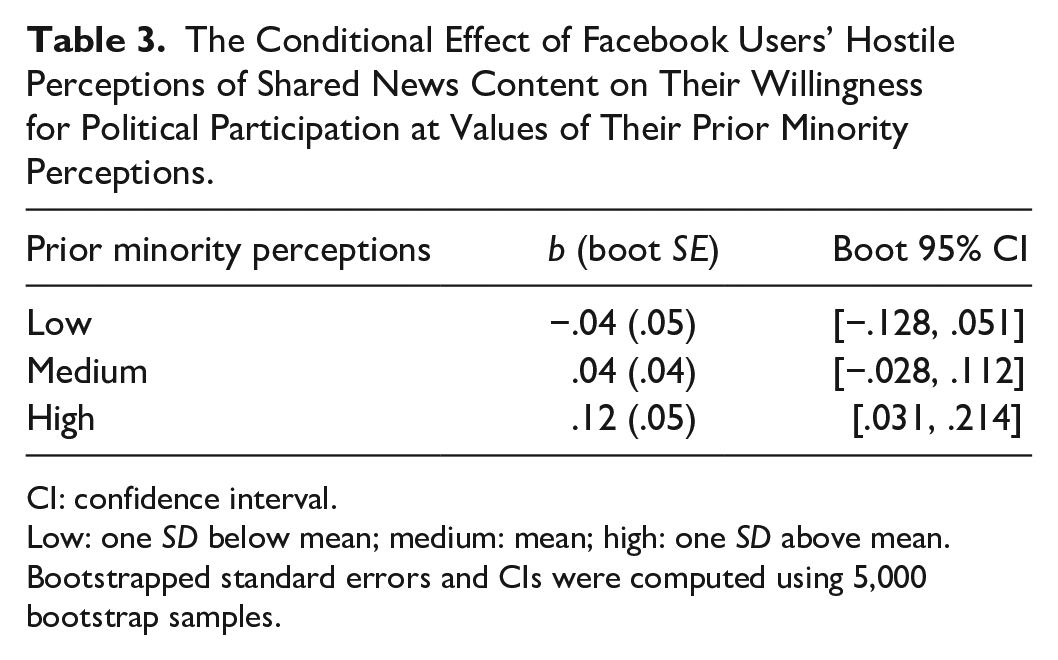
CI: confidence interval.
Low: one SD below mean; medium: mean; high: one SD above mean. Bootstrapped standard errors and CIs were computed using 5,000 bootstrap samples.
Discussion
This study explored Facebook users’ hostile perceptions of shared news content and its relationship with their political participation. Consistent with the HME, the news slant (pro-attitudinal, counter-attitudinal) was found to influence Facebook users’ hostile perceptions of shared news content. Out-group sharers also significantly affected their hostile perceptions of shared news content. However, in-group sharers did not. Furthermore, the effect of Facebook users’ hostile perceptions of shared news content on their willingness for political participation was moderated by their prior minority perception in the general society. Only for Facebook users with high levels of prior minority perception in the general society, the hostile perception of shared news content was found to encourage their political engagement.
The findings from this study provide several theoretical and political implications. First of all, this study extends the prior research on the HME by jointly examining the role of news slant and news sharers in the Facebook context. As expected, this study found that the pro-attitudinal content on Facebook was perceived to be relatively more favorable, whereas the counter-attitudinal content was perceived to be relatively more hostile. Consistent with the literature on the HME (e.g., Gunther et al., 2017), the pro-attitudinal content on Facebook appeared to produce assimilation effects and the counter-attitudinal content on Facebook seemed to create contrast effects.
News sharers were also found to play a role in Facebook users’ bias perception of news content. However, the findings of this study suggest that news sharers influence Facebook users’ assessment of news content in a more nuanced way. Consistent with the prior research on source effects on the HME (e.g., T. K. Lee et al., 2018), news content shared by an out-group user was perceived to be more hostile than the same news content shared by a neutral user. As the self-categorization theory posits (Turner et al., 1987), Facebook users seemed to categorize a news sharer who holds an opinion incongruent with their own as an out-group news source. They might consider an out-group news sharer as a threat to their group. Therefore, they seemed to defensively process news content shared by an out-group user and, as a consequence, perceived it to be more hostile than the same news content shared by a neutral user.
Of interest, an in-group sharer did not influence Facebook users’ hostile perceptions of news content. There was no difference between Facebook users’ hostile perceptions of news content shared by a neutral user and an in-group user. When Facebook users were exposed to news content shared by an in-group member, they might not perceive any group threat, and thus, their group identity might not be salient. As a result, Facebook users seemed to evaluate news content shared by an in-group user only depending on whether the slant of news content was consistent with their own position.
Previous studies have demonstrated that in-group media sources contribute to mitigating individuals’ hostile perceptions of news stories (Ariyanto et al., 2007; Arpan & Raney, 2003; Gunther et al., 2017; M. Kim, 2016b, 2019; Reid, 2012). Particularly, M. Kim (2016b) suggests that in-group media sources may give a chance for people to carefully consider disagreeable news content by decreasing the level of their hostile perceptions of the disagreeable news. Contrary to in-group media sources, in-group news sharers were not found to have such buffering effects on Facebook users’ hostile perceptions of disagreeable news content. Instead, this study shows that the out-group news sharing provides a boost for the HME of disagreeable content on the Facebook space. Facebook users can be intentionally or unintentionally exposed to cross-cutting news shared by their online friends (Y. Kim, 2011; Min & Wohn, 2018). Some scholars have argued that those who are exposed to cross-cutting news may have opportunities for recognizing the other side’s opinion and rethink their own position, which may lead to ambivalent attitudes (Meffert et al., 2004). However, the findings of this study suggest that Facebook users’ frequent exposure to the cross-cutting news shared by out-group or in-group members may not weaken but strengthen their own opinion by increasing their hostility toward the other side. This may further bolster the opinion polarization regarding controversial issues among Facebook users.
The most noteworthy finding of this study is that the spiral of silence and the corrective action hypothesis can operate together among Facebook users. This study contributes to extending the literature on both theories by illustrating the conditions under which the theories work to expect social media users’ political participation. Specifically, consistent with the spiral of silence, this study found Facebook users’ pre-existing minority perceptions in the general society were negatively associated with their willingness for political participation. These findings show that regardless of news slant they are encountering on Facebook, those with prior majority perceptions are more likely to participate in offline political actions compared to those with prior minority perceptions.
Contrary to the expectation from the corrective action hypothesis, Facebook users’ hostile perception of news content was not associated with their willingness for political participation. However, this relationship was moderated by Facebook users’ pre-existing minority perceptions. The positive association between Facebook users’ hostile perception of news content and their intended participation was manifest only for those with high levels of prior minority perceptions. That is, the corrective action hypothesis appeared to function only for Facebook users with high levels of prior minority perceptions. This shows that even though Facebook users with prior minority perceptions are less participatory than those with prior majority perceptions, their offline political engagement can be encouraged by the exposure to political differences on Facebook. It is probably because minority opinion holders may inherently want to change their status quo in opinion climates and persuade or influence others to support their “unpopular” views or beliefs (Moscovici, 1980; Wojcieszak, 2017). This latent desire may be activated when they perceive shared news content to be hostile rather than favorable. Minority opinion holders’ opinion strength may be another plausible explanation for their willingness for corrective actions. Those who have strong partisanship or opinions are more likely to engage in corrective actions in a hostile opinion climate (Duncan et al., 2020; M. Kim, 2016a). Minority opinion holders who showed high levels of willingness for corrective actions might have unpopular but strong views.
Naturally, this study had several limitations. First, participants of this experimental study were exposed to manipulated news content shared by a fabricated and unknown Facebook user. This might be somewhat different from news content and news sharers the participants encounter in their real Facebook pages, which might affect the ecological validity of this study. Also, shared news content was created to appear to be online news from a news organization, the Seoul Daily Newspaper. Even though this newspaper is known as a politically neutral newspaper (Choi et al., 2012), individuals’ bias perceptions of this newspaper can be subjective. Participants’ subjective evaluations of this newspaper might influence their perceptions of news content provided by that newspaper. Thus, the results of this study should be interpreted with the limitations of manipulations in mind. Second, this study measured Facebook users’ self-reported minority perceptions. People’s perceptions of opinion climate in a society may be different from the real opinion distribution. Therefore, it would be worthwhile to differentiate the real and perceived minority in future research.
Third, this study mainly examined Facebook users’ willingness for offline political participation. Given that online has emerged as an important venue for political expression, future studies could investigate the relationships between Facebook users’ hostile perceptions, minority perceptions, and online political engagement. Finally, this study was conducted using one controversial issue, abortion. The knowledge on the abortion issue might influence people’s hostile perceptions and opinion expression regarding that issue. Thus, future researchers should consider measuring and controlling participants’ levels of issue knowledge to offer a more complete understanding of Facebook users’ political engagement. Furthermore, the abortion issue is categorized as an easy issue related to one’s religious and moral values (Johnston & Wronski, 2013). It is needed to validate the results of this study by using hard issues such as economic issues.
Despite the above limitations, this study sheds light on nuanced relationships between Facebook news sharing, hostile perceptions of news content, and political participation. More importantly, the findings of this study contribute to the field of the corrective action hypothesis and the spiral of silence theory by showing how both theories operate together among Facebook users.
Footnotes
Declaration of Conflicting Interests
The author(s) declared no potential conflicts of interest with respect to the research, authorship, and/or publication of this article.
Funding
The author(s) received no financial support for the research, authorship, and/or publication of this article.
