




Abstract
This study investigates copyright discourses on YouTube. Through a qualitative content analysis of 144 YouTube videos, we explore how YouTube creators understand copyright law, how they minimize risks posed by copyright infringement, and how they navigate a highly technical and dynamic copyright enforcement ecosystem. Our findings offer insights into how digitally situated cultural producers are impacted by and respond to automated content moderation. This is important because increasingly lawmakers around the world are asking digital platforms to implement efficient systems for content moderation, and yet there is a lack of good information about the stakeholders most directly impacted by these practices. In this study, we present a systematic analysis of copyright gossip, building on the concept of algorithmic gossip, which comprises the opinions, theories, and strategies of creators who are affected by YouTube’s copyright enforcement systems.
Introduction
In digital spaces, copyright is governed in significant part by the private copyright rulemaking and enforcement policies of Internet platforms (Bridy, 2010; Gray, 2020). On YouTube, copyright owners or rightsholders who participate in YouTube’s rights management programs have available to them a wide and evolving array of tools they can use to contest or remove unlicensed content posted by users (Urban et al., 2016). These enforcement measures are justified as serving the interest of creators, by protecting their economic rights to remuneration and their moral rights to attribution and integrity (Edwards et al., 2015). In practice, however, typically only certain creators benefit from these measures. For many YouTube creators, the risk of having a video demonetized or removed from YouTube due to a copyright claim is high, and “copyright remains at the center of industry struggles for power and control” on YouTube (Burgess & Green, 2018, p. 44). When disseminating their works, YouTube creators are required to interact with a complex copyright enforcement system that is highly automated, dynamic, and opaque (Perel & Elkin-Koren, 2017). Often, these creators post videos sharing their experiences with copyright enforcement on YouTube. They offer interpretations of copyright law and explanations of YouTube’s technical systems, and they share strategies for avoiding copyright strikes, video removals, and account terminations. By sharing their experiences and opinions on the platform, these creators contribute to discourses about copyright policies and practices that are championed as serving their best interests.
This study investigates copyright discourses on YouTube. Through a qualitative content analysis of 144 YouTube videos, we explore how YouTube creators understand copyright enforcement on YouTube and how they navigate a highly technical and dynamic copyright ecosystem. Our findings offer insights into how digitally situated cultural producers react and respond to automated content moderation (Gillespie, 2018). This is important because increasingly lawmakers around the world are asking digital platforms to implement efficient systems for content moderation at scale (see e.g., European Union Parliament, 2018; Reda, 2019), yet there is a lack of good information about the full range of stakeholders impacted by these regimes. This article aims to address this gap by providing a systematic analysis of a specific form of algorithmic gossip (Bishop, 2019)—what we call copyright gossip—generated by cultural producers who are directly affected by YouTube’s copyright enforcement system.
Copyright Enforcement and Algorithmic Gossip on YouTube
On YouTube, copyright enforcement is governed in principle by the Digital Millennium Copyright Act (DMCA) which provides safe harbor from liability for copyright infringement to intermediaries that host user content, provided they meet a number of conditions, including, most notably, the implementation of a “notice and takedown” policy. 1 A notice and takedown policy requires that intermediaries act to remove or disable access to content upon notification by a rightsholder that the content is infringing. Over the past decade, YouTube has developed and deployed a multifaceted notice and takedown regime, one that goes substantially beyond the requirements of the DMCA (Bridy, 2016).
On YouTube, copyright may be enforced through a public webform for submitting individual takedown notices; a Copyright Match Tool which automatically scans uploaded videos and identifies full length reuploads of videos already hosted on YouTube; a Content Verification Program which enables large-scale notice and takedown practices by “trusted members”; and Content ID, YouTube’s automated digital fingerprint technology (YouTube, 2021c). Content ID matches the content with rightsholders and applies the rightsholder’s predetermined settings to any videos containing matched content (Google, 2018). Rightsholders can choose between blocking videos that include their content so that the video will not be available on YouTube; monetizing videos so that they receive income from the advertising revenue generated by video streams; or tracking the video’s viewership data. According to company reports, over 98% of copyright matters on YouTube are “managed” by Content ID (Google, 2018).
For large media and entertainment companies, YouTube’s system for copyright enforcement is generally both efficient and efficacious. A 2020 large-scale analysis of removal rates on YouTube found the platform to be highly effective at detecting and removing clearly infringing content, such as film piracy and live streams of sporting events (Gray & Suzor, 2020). The same study also found that rightsholders working within YouTube’s copyright enforcement system have available to them a significant amount of discretionary decision-making capacity. For example, “let’s play” videos—videos in which YouTube creators record themselves commentating while playing video games—had a low probability of being removed from YouTube due to a copyright claim (although they could still be subject to a monetization claim by a rightsholder). Game play videos are known to provide beneficial promotion of video games (Taylor, 2015), and so while they may technically infringe copyright, rightsholders are often willing to tolerate this type of infringement (Boroughf, 2015) and the 2020 study by Gray and Suzor suggests YouTube’s enforcement system can facilitate some tolerated uses of copyrighted material (Wu, 2008). Overall, by participating in Content ID and the Content Verification Program, in addition to employing professional rights management services to manage notice and takedowns on a large scale (Urban et al., 2016), large media and entertainment organizations have available to them a significant amount of control over their economic interests on YouTube.
For digitally situated cultural producers on YouTube, however, the system is more problematic, particularly if they are confronted with a copyright claim made against one of their videos. Following Cunningham and Craig (2021), we define social media entrepreneurs as creators; YouTube creators are social media users who commercialize and professionalize the generation and circulation of “original content in close interaction and engagement with their communities on the major social media platforms” (p. 1). Over the past decade, in connection to the growing economic value of social media networks, social media entrepreneurs have flourished on YouTube (Cunningham & Craig, 2021). Today, they make up a large and growing part of the social media entertainment sector of the creative industries (Cunningham & Craig, 2019). These creators have built careers playing video gamers, producing music, and creating informational, educational and entertainment videos, accumulating millions of subscribers and viewers around the world (Burgess & Green, 2018).
Typically, the livelihoods of professional YouTube creators depend on the continued monetization of their videos and they must work to ensure they avoid copyright infringements to minimize the risk of having their account terminated (Burgess, 2011). Where a takedown request has been issued by a rightsholder, the YouTube creator subject to the copyright claim will automatically receive a “strike” against their account (YouTube, 2021a). One copyright strike results in the YouTube creator being sent to “Copyright School” where they must watch videos about copyright law. If a channel receives three strikes, their account may be terminated and all uploaded videos removed from YouTube. This policy ensures YouTube creators have a strong incentive not to infringe copyright on the platform. Yet, YouTube’s copyright enforcement system is notoriously prone to error and is largely insensitive to exceptions to copyright such as fair use or fair dealings (Pihlaja, 2017; Soha & McDowell, 2016; Tushnet, 2014). On YouTube, exercising the right to use a work under an exception to copyright will likely be subject to the discretion of rightsholders (Simon, 2014).
When deciding whether to dispute what they believe to be an erroneous claim, YouTube creators must balance a loss of revenue with the risk of triggering a copyright strike and increasing the risk of an account termination. When confronted with a copyright claim, YouTube creators can choose to accept the claim and abandon their video, dispute the claim, edit out a component of their video, change or mute the music, or, if the YouTube creator is a member of the YouTube Partner Program, they can request to share revenue with the claimant (YouTube, 2021f). If the YouTube creator opts to dispute a Content ID claim, however, the claimant presides over the dispute in the first and second instance. When a claim is disputed, the claimant can let their claim expire after 30 days, immediately release the claim, uphold the claim, or submit a takedown request with YouTube, which automatically triggers a strike against the YouTube creator subject to the original claim. The YouTube creator can file an appeal, but again the claimant will have 30 days to respond by either releasing the claim or requesting a takedown in which case the YouTube creator will automatically receive a copyright strike (YouTube, 2021b). It is only on a second appeal that YouTube will intervene if the YouTube creator submits a copyright counter notification. If the counter notification meets all of YouTube’s requirements, YouTube will forward it to the claimant (YouTube, 2021d). To continue to uphold their claim, the claimant can provide YouTube with evidence that they have initiated a court action to keep the content off YouTube. Overall, on YouTube, the copyright claiming and dispute resolution process is structured to favor the interest of whoever first makes a claim, and, whichever path is taken, the YouTube creator subject to a claim is highly vulnerable to receiving a copyright strike.
While YouTube is prima facie transparent about these risks and procedures, there are layers of opacity YouTube creators are confronted with in practice. First, YouTube has in place undisclosed private agreements with rightsholders, which can include contractual arrangements that substantially change its copyright policies and procedures (Tushnet, 2014).
YouTube explains, YouTube enters into agreements with certain music copyright owners to allow use of their sound recordings and musical compositions. Under these contracts, we may be required to remove specific videos from the site. We may also block specific videos in certain territories, or prevent specific videos from being reinstated after a counter notification. Sometimes, this may mean the Content ID appeals and counter notification processes won’t be available. (YouTube, 2021e)
For YouTube creators, there can be a substantial divide between policy and practice. Copyright laws also differ across jurisdictions, and this can create further inconsistencies regarding how copyright is enforced on YouTube (Yu, 2018). As well, the automated nature of YouTube’s enforcement system adds a technical layer of opacity (Roberts, 2018; Zarsky, 2016). When claims are made through automated processes—through Content ID and the Content Verification Program, in particular—those YouTube creators subject to a claim are provided limited information to help them understand and respond to the claim (Urban et al., 2016). YouTube creators are often left to draw inferences and arrive at their own conclusions regarding the infringement, the claimant, and the options available to them.
When interacting with this system, often YouTube creators post videos to YouTube in which they describe their experiences, express opinions, and offer theories about copyright enforcement on the platform. Following Bishop’s (2019) model of algorithmic gossip, we systematically examined a sample of these videos. Broadly, gossip refers to the “relational, reflexive communicative practice through which individuals engage in sensemaking and knowing” (Waddington, 2012, p. 2). Gossip is “communally and socially informed knowledge” (Bishop, 2019, p. 2590) that is characteristically “loose” and “unmethodical” but nonetheless generative. On YouTube, through gossip, new knowledge about a highly automated and opaque sociotechnical system is created and disseminated.
As Bishop’s study of the technical knowledge of beauty vloggers demonstrates, studying gossip as a “resource and method for knowledge exchange” (Bishop, 2019, p. 2590) is useful, particularly for those who might otherwise be excluded from technical discourses or policy debates. Previous studies suggest that everyday media users are often underrepresented in or excluded from copyright policy discourses (Edwards et al., 2015). For marginalized groups, gossip can also be a powerful tool to subvert biases (Abelove, 2003) and it can provide a counternarrative to dominant narratives such as the call for stronger copyright enforcement measures online (Patry, 2009) that has dominated digital copyright policy discourses for the past two decades (Cohen, 2014; Litman, 2001).
We frame copyright gossip following Bishop’s (2019) conception of algorithmic gossip with some important distinctions. On the one hand, copyright law is not as confounding as recommender algorithms. There are a litany of free resources available online that explain theoretical foundations of copyright, judicial precedent across various national contexts, and governance policies that dictate how copyright is handled on specific platforms, such as YouTube. On the other hand, copyright enforcement systems, both automated and manual, can be as opaque as algorithmic recommender systems.
Studying copyright gossip on YouTube reveals how YouTube creators manage “platform-specific risks” (Bishop, 2020, p. 1) and how these risks impact cultural practices on the platform. As the majority of copyright enforcement occurs through Content ID, an algorithmic “blackbox” (Pasquale, 2015) about which information is limited, this study provides insights into how YouTube creators understand, experience, and interact with a blackbox system that is central to the financial viability of their careers (Bishop, 2019, p. 2590). Our analysis reveals the extent to which risk management and risk mitigation practices—formulated in response to the ever-present threat of copyright enforcement inaccuracies and abuses, and in an environment that is highly automated and structurally biased toward large corporate stakeholders—impact the practice and perceptions of YouTube creators.
Methodology
To gather data for this study, between November and December 2019, we manually collected a sample of over 200 (n = 213) YouTube videos using keyword search terms “Copyright,” “Copyright Strike,” “Copyright Claim,” and “DMCA.” Videos were collected from a broad range of account sizes, from small creators with less than 100 subscribers to those with over a 100 million subscribers. In our initial data collection, we searched for videos posted on YouTube between 2009 and 2019; however, we ultimately narrowed the scope of the study to videos posted between 2017 and 2019, the time period during which the majority of the videos collected were posted. This narrowed timeframe allowed us to focus on the most current discourses; however, an historical study that analyses changes in copyright discourse over time, in our view, is a topic worthy of future exploration.
From our initial data collection, videos were excluded from analysis if they were non-English language videos and if they were published by a formal institution such as a government agency or educational organization, to ensure we focused on the contributions of digitally situated cultural producers on YouTube. Our final dataset comprised 144 videos and included channels from both professional and self-identified amateur or hobbyist YouTube creators, covering a range of genres including gaming, tech tips, music, personal vlogging, visual arts and crafts, sports, comedy, and religious content (Table 1).
Final Dataset Overview.

Note. DMCA = Digital Millennium Copyright Act.
For each video, we logged the video publication date, URL, title, account, channel, hashtags, and number of views, likes, comments, and subscribers. We conducted a pilot study of 20 (n = 20) randomly selected videos to develop a codebook. Two researchers viewed and analyzed each of the 20 videos separately, identifying evident themes and issues. The two researchers then compared their analysis to develop the codebook which ultimately included closed-ended sections for manual sentiment analysis (either positive or negative) and a series of qualitative categories and subcategories for thematic analysis (discussed below). The codebook also included an open-ended section for additional research notes and quotations. The 20 pilot videos were coded using the codebook by two researchers for intercoder reliability check that revealed a satisfactory level of agreement calculated using Cohen’s kappa (k = 0.69). The remaining sample of videos (n = 124) was then coded by one researcher.
For the thematic analysis, qualitative categories were developed using a grounded approach, meaning clusters of codes were aggregated to build thematic categories rather than using previously established codes or themes (Charmaz, 2006; Corbin & Strauss, 2008). Our grounded thematic analysis revealed three central thematic clusters. The first cluster, “opinions,” includes creators’ personal opinions about YouTube’s copyright enforcement system. The second cluster, “theories,” captured ideas that creators shared based on their experiences with automated copyright enforcement. The third cluster, “strategies,” refers to suggestions creators offered for avoiding or managing the risk of a copyright claim.
Results
Copyright Sentiment
We first coded videos to determine sentiment toward copyright. Sentiment was manually coded according to whether the YouTube creator spoke positively or negatively about copyright law in general and copyright enforcement on YouTube specifically. Sentiment analysis was automatically conducted in NVivo based on notes and quotations from the pilot data to inform the subsequent manual coding of the full dataset. The majority of videos (79.8%; n = 115) did not express any identifiable sentiment toward copyright law in general and less than half expressed no sentiment toward YouTube’s copyright enforcement systems (42.3%; n = 61). Of the subset of videos that did express sentiment toward copyright (20.1%, n = 29), approximately half were negative (n = 14). By contrast, of the videos that expressed sentiment toward copyright enforcement on YouTube (57.6%, n = 83), the vast majority were negative (n = 75). Table 2 provides examples of negative and positive sentiments expressed in videos.
Copyright Sentiment Examples.

Note. DMCA = Digital Millennium Copyright Act.
Copyright Gossip
During pilot coding, under the one umbrella term copyright gossip, using a grounded theory approach we delineated the views expressed by YouTube creators about YouTube’s copyright system into three broad streams: opinions, theories, and strategies. The categories were neither discrete nor mutually exclusive. The first cluster, “opinions,” includes creators’ personal views or judgments made of YouTube’s copyright enforcement system that were not assertions of fact. In many cases, YouTubers explicitly stated that the comments in their videos were personal opinions, and this category facilitated an exploration of these publicly expressed positions. The opinions category was also useful for an extended exploration of the results of the sentiment analysis. The second cluster, “theories,” captured ideas that creators shared based on their experiences with YouTube’s copyright enforcement system. These were informed assumptions made by YouTubers who were seeking to make sense of the copyright enforcement system on YouTube. Theories extended beyond opinions to include assertions of fact, based on anecdotal evidence, personal experience, or legal interpretation. Of our three categories of copyright gossip, theories most closely follow Bishop’s (2020) conception of algorithmic lore, “a mix of data-informed assumptions that are weaved into a subjective narrative” (p. 1). The third cluster, “strategies,” captured suggestions creators offered for avoiding or managing the risk of a copyright claim. We found it useful to separate theories from strategies so that we could explore the different types of publicly offered advice for navigating and (in some cases) circumventing YouTube’s copyright enforcement system. We were able to capture the guidance provided by YouTube creators for minimizing the risk of receiving a copyright claim (risk mitigation) and advice for what to do if a YouTube creator was subject to what they believe to be an unfounded claim (risk management).
Opinions
Opinions were the most frequently expressed form of copyright gossip (68.7%, n = 99, Table 3). The most commonly expressed opinions were that copyright on YouTube is “unfair” (n = 56) and “broken” (n = 54). A lack of fairness was a recurring theme with users expressing that the system is biased toward large corporations (n = 29), there exists on the platform a systemic power imbalance between large and small creators (n = 16), and there is a lack of due process available to creators subject to a copyright claim (n = 25). Several creators also expressed the opinion that the system is open to abuse (n = 16), often in the form of false or inaccurate copyright claims made against videos (n = 57). Opinions expressing systemic unfairness were often associated with negative sentiment toward YouTube and/or copyright. For example, one creator expressed, Copyright law is now a joke. I’m all for protecting intellectual property but copyright law is being abused to its fullest extent on YouTube and it has been for a long time. It just happened to happen on my doorstep, and now I’m stepping in the ring. (2019-67)
Thematic Clusters of Copyright Opinions (Non-Discretely Coded).

This creator also explained that they had no particular opinion of copyright or YouTube’s copyright enforcement system until they were faced with a copyright claim and had to engage with YouTube’s system for disputing the claim. Many YouTube creators in our sample explicitly stated that they were not lawyers or legal experts but had become engrossed in copyright law research after their livelihood was impacted by a claim. These creators tended to express that there was an unfair burden placed on them to defend their own interests against spurious or inaccurate claims, making statements such as “If someone is abusing the DMCA, why is it up to us [YouTube creators] to prove that we’re in the right? It’s an extremely one-sided system” (2019-19); another stated more bluntly that smaller channels were “getting fucked over” by YouTube’s copyright system (2018-26). YouTube creators spoke directly to the risk that copyright enforcement presents to their livelihood. For example, one expressed, “YouTubers are living paycheck to paycheck and their main source of income just stops because of an error from YouTube” (2019-29), and another argued for more equal treatment: “YouTube. Please stop considering creators as doing this for a hobby. Some of us are doing this as a full-time job” (2019-13).
A high number of videos (n = 57) spoke to instances of third parties falsely claiming rights to their videos and described their subsequent engagement with YouTube’s dispute process. A number of videos in which false claims were discussed included claims that copyright enforcement on YouTube was abusive, amounting to censorship, retaliation, or extortion (n = 16). For example, one creator argued videos are “taken down if the creator of the original content doesn’t like the criticism of their content . . . they don’t have to prove there’s actual infringement or that they’re doing it out of bitterness” (2019-29). Ten YouTube creators (n = 10) alleged Universal Music Group (UMG) frequently submitted false copyright claims. In a video essay about the ways UMG “abuses” copyright, one YouTube creator expressed, “YouTube, as a company, is content to let this happen over and over . . . UMG can send these false claims and face no consequences” (2019-43).
Eight YouTube creators (n = 8) argued that abuse of the manual notice and takedown system was a central problem with copyright enforcement on YouTube. Several discussed how notice and takedowns are used to censor video games commentary, particularly in the case of negative reviews or criticism, arguing that publishers were permitted to lodge manual claims recklessly and with impunity (2017-
Multiple creators (n = 25) argued that the platform fails to provide proper due process to creators subject to a claim. One user argued the system was designed to ensure they are “guilty until proven innocent” (2019-35). They also pointed to a lack of transparency in the process of making and disputing a claim and to the lack of sufficient recourse provided to creators by YouTube. For example, the second most viewed video in our sample (7M views in June 2021) was posted by TheFatRat, a music producer and vlogger who had a video of their own original music posted to their own channel, claimed by another channel for copyright violation. TheFatRat stated they were unable to locate or contact the claimant and posed the question, “How am I supposed to resolve the issue with the claimant when there’s no way to contact the claimant” (2018-34). Consequently, TheFatRat started a petition and promoted a hashtag campaign, #fixyoutubecopyright. Another creator stated, “YouTube doesn’t give a shit about creators. Why don’t you just help me with my copyright claims?” (2019-46)
Aligning with the opinion that there is no due process on YouTube, multiple YouTube creators (n = 24) expressed the opinion that there was no point in disputing a claim at all because the claimant presided over copyright disputes. Under YouTube’s enforcement system, claimants assess the dispute and are given two opportunities to reject the dispute and to trigger a copyright strike before YouTube will review the case. Many creators argued this was unfair and rendered the dispute resolution process useless to creators, calling it “absurd” (2019-56), “inadequate” (2019-46), and an “eldritch mess” (2018-23). One creator suggested, “it is like a murderer going to court and deciding whether he is guilty or not” (2019-73). A few (n = 4) creators acknowledged YouTube had made some improvements by identifying what media in the video had been claimed (a 2019 technical and policy update), for example, one creator stated, “before YouTubers had no idea what was being claimed but now they know exactly what is being claimed . . .this is a step in the right direction” (2019-72).
Theories
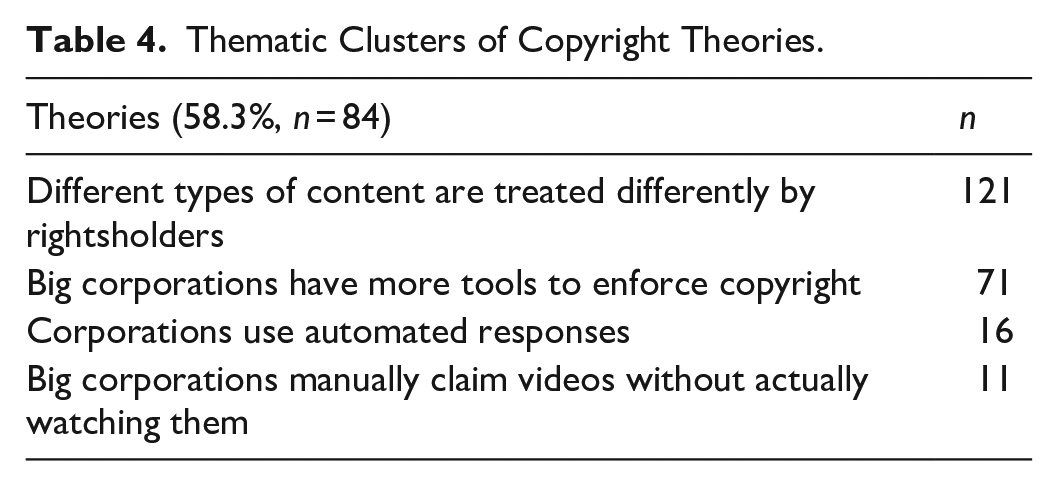
Copyright theories were the second most frequently expressed form of copyright gossip (58.3%, n = 84, Table 4). The most frequently discussed theory (n = 121) 2 was that different types of content (different copyright subject matter) are enforced differently on YouTube. That is, creators tended to believe certain types of content had a higher risk of being claimed than others. In our analysis, we coded these theories as a subset of categories distinguishing between content believed to be heavily enforced, weakly enforced, or not enforced at all (Figure 1). Music (n = 59) was by far the most frequently referenced type of content that creators believed was treated differently on the platform: creators asserted that music is more heavily enforced than other types of content.
Thematic Clusters of Copyright Theories.
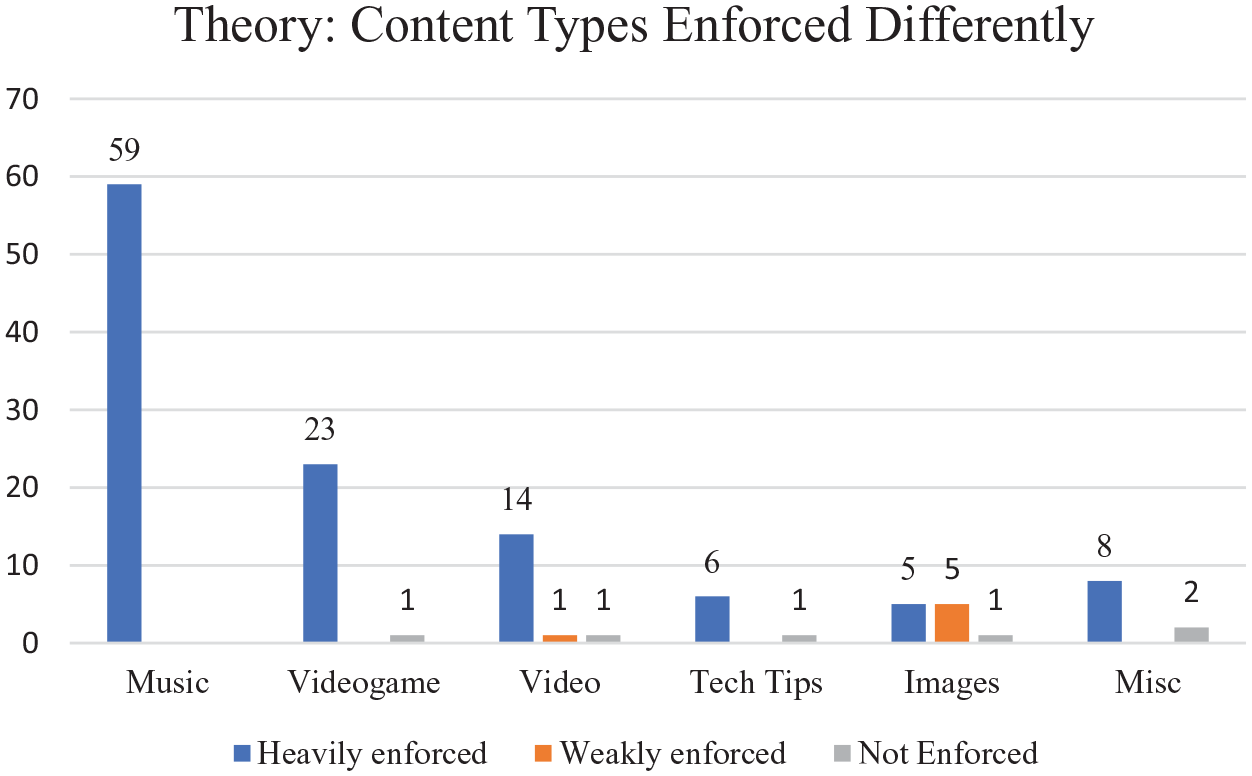
Enforcement theories for different types of content on YouTube.
In discussing music copyright, YouTube creators often speculated about what would trigger the Content ID algorithm. Some postulated Content ID would only claim copyrighted material over 20 s long, suggesting creators should use less than 20 s to avoid an automated copyright claim against their video, while others argued Content ID could be triggered by much smaller amounts. Others warned that YouTube’s royalty free music library, which offers YouTube creators music licensed for use on the platform free of charge, was untrustworthy and that the license could be revoked and a video claimed at any time.
Several videos offered the theory that large media and entertainment corporations have available to them a wide array of tools and resources they could use to detect copyright content and file copyright claims with YouTube (n = 71), tools unavailable to independent YouTube creators. For example, in the video discussed above, TheFatRat (2018-34) theorized that UMG created its own algorithm to detect content under 5 s. Several creators (n = 16) also suggested large corporations use automated systems to respond to disputes. For example, a music producer (2019-51) described receiving a claim from Apple for using a supposedly royalty free sound in one of their videos. After disputing the claim, Apple was given 30 days to respond to the dispute. The creator heard nothing back until the final day when they received an automated notification that their dispute was not accepted.
Some creators (n = 7) theorized that large corporations employed people to file manual claims, to the extent that being employed as a manual claimant for large corporations had become “a multimillion dollar” and “cottage” industry (2018-22; 2019-20). In a video about a film trailer review that received a copyright claim, one creator stated that “this was not a bot, this is an employee who looks for who is talking about [a copyrighted film trailer]. We were talking about their trailer, then he manually claims it” (2019-3). Later in the video, the creator theorized that the corporations responsible for claiming the video, in this case Lionsgate Films and UMG, were training their employees to seek out videos that discuss the company’s intellectual property and to file manual copyright claims, legitimately or illegitimately, if the videos are overly critical.
Other creators (n = 11) expressed the theory that manual claims were filed against creators without the claimants actually watching videos. In a viral reaction video, one YouTube creator (2018-30) described a video they had previously posted that was manually claimed by UMG for verbally mentioning, but not at all playing, the name of a song by Queen. The YouTuber theorized that merely saying the words “Bohemian Rhapsody” in their video was enough for manual claimants to decide to file a copyright claim on the video without having actually watched the video to confirm if it was or was not infringing.
Strategies
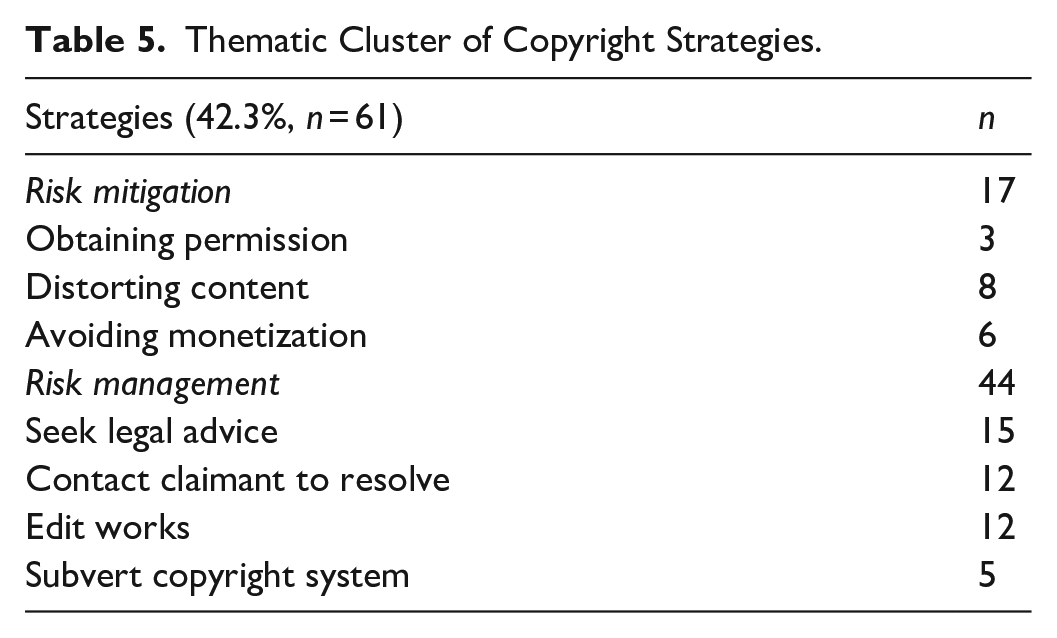
The third category of copyright gossip analyzed in this study was prescriptive or actionable advice, which we term strategies (42.3%, n = 61, Table 5), including both risk mitigation and risk management strategies. Risk mitigation strategies fell into three subcategories: obtaining permission to use works from independent creators; distorting or disguising content; and avoiding monetization on YouTube altogether. First, to avoid a claim, some creators suggested seeking permission to use music from independent artists rather than from artists represented by large music organizations. For example, in one video, a YouTube creator described contacting a smaller independent musician to use music that was posted online via the streaming platform SoundCloud. In this case, the artist was happy for their music to be used without payment, leading the YouTuber to advise viewers to “ask creators for permission” and “always credit the original creator” (2018-12). Yet, others warned of risks inherent to this approach: one YouTube creator (2019-58) reported that with permission they used a song by an independent artist, but it included a sample of another song (unbeknownst to the YouTube creator) and they received a copyright claim from a music label who claimed the sample. Another YouTube creator (2018-26) warned that they obtained permission and paid for the use of a song by an independent artist but still received a claim from a digital music aggregator which the artist had used to distribute their music to streaming platforms.
Thematic Cluster of Copyright Strategies.
Another strategy offered by YouTube creators was to distort content to elude manual claimants and/or trick the ContentID system (n = 8). Some suggested YouTube creators use a variety of video and audio editing techniques to render copyrighted content unrecognizable by an automated detection system. One YouTube creator (2019-88;102;107) presented an extensive overview of the YouTube copyright system in a three-part video essay series in which they introduced strategies for “copyright smuggling” which they described as “a form of civil disobedience that attempts to put the fair back in fair use” (2019-102). This YouTuber presented a laundry list of strategies for copyright smuggling, including uploading lower quality audio, deconstructing videos into series of images, or distorting content with pitch or color shifting. They also suggested alternative approaches to copyright smuggling, such as using instrumental cover versions of songs or using music from video games.
To avoid manual claims from individuals or rights management companies, four YouTube creators suggested changing titles and thumbnails to avoid drawing attention and one creator advised not to use any hashtags that might alert a human claimant to possible uses of copyrighted works. Six YouTube creators considered copyright risk on YouTube to be so great that they advised other creators to not attempt to monetize their videos on the platform and instead to find alternative revenue streams, such as merchandise sales, cross-platform promotions, or crowdfunding services, such as Patreon (2019-61).
Risk management strategies fell into four key subcategories: seek legal advice, contact a claimant, edit works, or take action to use the copyright system subversively. When faced with a copyright claim, a small number of YouTube creators suggested obtaining formal legal advice (n = 15), while a slightly smaller number (n = 12) suggested contacting the claimant. These YouTube creators acknowledge the power imbalance between the claimant and creators subject to a claim; for example, one stated, “If you get a copyright strike, do not fear, send an email to the person that filed the claim, be nice in your email, hopefully you get an email right back and then you just delete the video” (2017-14). Not surprisingly, few advocated this approach as deleting a video that is a source of revenue and is an outcome most YouTube creators wish to avoid. As one commented after capitulating to a claim, “I didn’t want to delete and reupload popular videos that are not monetized because I would lose all of my views” (2018-31).
Other YouTube creators (n = 12) suggested removing the portion of the video that contained copyright content by making use of YouTube’s editing features (n = 10) or replacing it with royalty free content (n = 11) regardless of the merits of the copyright claim. They suggested this strategy could be effective at avoiding further troubles or escalation. One YouTube creator explained they replaced a claimed version of a song with a humorous rendition sung in their voice, making noises to mimic the song that had been claimed (2019-25).
Five YouTube creators (n = 5) offered strategies for using the copyright claiming system against abusive claimants. One strategy required YouTube creators to create their own original music and distribute it through a digital aggregator to ensure it is included in the Content ID database. The YouTube creator then creates a video that includes something owned by the allegedly abusive copyright owner, for example, a Taylor Swift song that will be claimed by UMG, and includes their own music as an outro. The YouTube creator can then share the revenue stream with UMG once the YouTube creator and UMG both claim ownership of the video. In the video explaining this strategy, this YouTuber suggested that this strategy could be used to abusively upload other copyrighted works, such as a Taylor Swift album, although they also commented that it might be “totally illegal and a bad idea” (2019-103) and might result in a copyright strike or violate the multi-channel networks terms of agreement.
In another video, a musical duo (2019-42) took an activist approach to the subversive claiming strategy. After receiving a copyright claim to one of their original videos, the pair released a song that parodied and critiqued the YouTube copyright system, which they urged their viewers to use in their videos. They said all videos that included the song would be claimed and proceeds donated to a charity. They said their aim was to have “YouTube’s Content ID system become a tool for a great cause” (2019-42).
Discussion
Copyright gossip on YouTube is rich with insights into user experiences with copyright enforcement in practice. An analysis of this communally generated and shared copyright knowledge reveals the extent to which on YouTube digitally situated creative practice is impacted by copyright law. On YouTube, copyright enforcement is an ever-present threat to creator livelihoods. This risk takes multiple forms. There is a risk of automated detection and claiming through Content ID and there is a risk of manual claiming by individuals and professional rights management organizations. Our data show that YouTube creators perceive the risk of a copyright claim to be high, even when their videos do not infringe copyright because their use falls within a copyright exception or where there is no use of a copyrighted work in the video at all. As one YouTuber described, merely speaking the title of a copyrighted work resulted in a claim. Our data show that creators typically respond to these “platform-specific risks” (Bishop, 2019, p. 1) by editing or manipulating their content and, where possible, avoiding the use of and references to all copyrighted works.
Our results suggest the copyright system on YouTube is open to abuse. Several creators pointed to manual claims filed by large music companies that they believed to be made in bad faith. Notably, this aligns with previous claims made against UMG, for example, in the case of Lenz v Universal Music Corp. 3 Other creators described instances of what we call copyright extortion, whereby false claims were filed and released on fulfillment of some extortionate condition, such as direct payment or self-censorship. It appears that the potential for abuse stems from the structure of YouTube’s dispute resolution process under which anyone can claim a video and the claimant will in the first and second instance preside over the resolution of that claim. In our data, YouTube creators expressed skepticism about YouTube’s willingness to intervene in the dispute process, for example, one creator asserted that “it’s in YouTube’s interest to placate the copyright holders . . . to placate people like UMG” (2019-27). Overall, our study supports prior research which suggests disputing content moderation decisions on YouTube can be complex and ineffective (Soha & McDowell, 2016).
There is broad consensus that copyright enforcement on YouTube is structured in favor of large media and entertainment organizations (see e.g., de Beer, 2017; Flew et al., 2013; Gray, 2020; Urban et al., 2016) and that it is consistent with a maximalist approach to copyright enforcement (Bucher, 2012). On YouTube, there is a “technical and architectural organization of power” which favors large commercial entities, and for creators on the platform, “becoming visible, or being granted visibility” is often determined by these structures of power (Bucher, 2012, p. 1165). In effect, YouTube creators are subject to commercial platform logics that mediate their visibility and, by extension, their livelihoods (Bucher, 2012). As Cunningham and Craig (2019) have argued, the social media entertainment industry is characterized by precarity for creators. Our data suggest creators perceive themselves as working within a copyright system that is systemically biased and open to abuse, always cognizant of the threat of permanent invisibility by way of three copyright strikes.
An analysis of copyright gossip on YouTube provides a strong counter-narrative to the maximalist copyright agenda that has dominated digital copyright policy since the early days of the internet (Litman, 2001; Patry, 2009; Weatherall, 2012). In our data, we see how a structural bias toward over-enforcement impacts negatively digital cultural practice, introducing the perception of economic risk and narrowing the parameters of what can be created and disseminated. For copyright and content moderation policy, these insights are timely. In 2020, the European Union proposed a content moderation framework aimed at compelling platforms to act more quickly to remove “illegal” content by requiring platforms to host mechanisms for users to flag content (European Commission, 2020). If these user “flags” are treated as notice of infringing content under the region’s intermediary liability regime, a platform would be obliged to immediately remove the content to maintain its intermediary safe harbor status (Penfrat, 2021). As our analysis of copyright gossip on YouTube suggests, the risk of abuse is potentially quite high within a system that permits discretionary claims without independent oversight. If YouTuber perceptions of risk are in any way accurate, the proposed European Union regime has the potential to substantially increase the occurrence of abusive content moderation practices. If the flagging and takedown process is automated—and automation is likely given the scale at which content moderation must occur (Gorwa et al., 2020)—without meaningful transparency and due process mechanisms, the regime could create a new layer of risk for digitally situated creators. When developing new content moderation regimes, lawmakers should carefully consider the advantages and disadvantages of both discretionary and automated systems of enforcement, paying close attention to the impact on the full range of stakeholders.
This study shows the value in analyzing copyright gossip to increase the understanding of stakeholders who are often marginalized in copyright policy debates. Our results align with previous research which shows that, despite the substantial complexities, creators tend to be committed to understanding and working within the boundaries of copyright law (Edwards et al., 2015; Pappalardo et al., 2017; Silbey, 2014; Street & Philips, 2017). While an analysis of the accuracy of YouTuber legal knowledge was beyond the scope of this project, in our data we found YouTubers to be highly engaged with and informed about the copyright enforcement system on YouTube. Yet, more often than not, when disputing claims they believed to be inaccurate or erroneous, knowledge of copyright law and user rights did little to empower YouTubers confronted with the blackbox of YouTube’s automated enforcement and dispute resolution system. In a policy area where “the public voice faces stiff competition from vested interests” (Edwards & Moss, 2020, pp. 943–944), our study provides support to those who argue that bottom-up input into copyright policymaking has the potential to improve the legitimacy of the copyright law (Edwards & Moss, 2020).
Arguably, what we see in our data is a growing political consciousness among YouTube creators. The most viewed video in our sample (9M views in June 2021) was posted by the highly influential YouTuber, PewDiePie, who called on his 100M+ subscribers to sign a petition specifically protesting Article 17 (Draft Article 13) of the European Union Copyright Directive which in effects requires platforms, such as YouTube, to negotiate further copyright licensing agreements with rightsholders.
4
In another video with over half a million views, John Green, co-founder of the popular YouTube channels VlogBrothers and CrashCourse, and founder of the YouTube creator convention VidCon, highlighted the power of YouTube to influence how copyright law takes effect: When YouTube changes policies in ways that benefits creators . . . it doesn’t do that for legal reasons, it does that because of creators. Changes to YouTube policies have real world legitimate effects on IP and how creators interact with it . . . YouTube matters far more than the courts for copyright law. (2019-13)
Creators in our data also suggested specific policy reforms for improving copyright enforcement on YouTube: Two major changes are needed to the system: First, YouTubers need to know a lot more information about where copyright claims are made against videos; claimants need to show exactly where in the video the claim is occurring. Second, claims need to be made by identifiable legal people. (2019-29)
The former suggestion—to provide clearer information about copyright claims—was adopted by YouTube late in 2019 (Wojcicki, 2019) and the latter aligns with ongoing efforts to improve knowledge, transparency, and advocacy for creators struggling with copyright issues, led by organizations, such as the Electronic Frontier Foundation (2020). Notably, in 2020 a class action lawsuit was filed against YouTube alleging Content ID is illegally and unfairly only available to select corporate rightsholders and not to “ordinary creators.” 5 Plausibly, what we are seeing now is the political awakening of the social media entertainment sector.
Conclusion
Copyright gossip provides a useful conceptual and methodological lens for studying digitally situated cultural producers and their day-to-day experiences with copyright law. Future studies might usefully delve deeper into the genres and demographics of YouTube creators engaged in copyright gossip to understand whose voices are loudest and the power dynamics that exist between larger and smaller creators. As well, important insights might be gained if this study were to be replicated across different platforms that deploy a combination of automated and manual copyright enforcement systems. The short video platform TikTok is a particularly important target for future studies of copyright gossip as copyright takedowns on TikTok increased 10-fold between early 2019 and late 2020 through an expansion of automated enforcement systems (TikTok, 2020, 2021). We suggest future studies could also investigate the prevalence and potential for copyright extortion, that is, the capacity for abusive copyright claims aimed at extorting money or other value from content creators. Currently, copyright abuse is understudied and not comprehensively accounted for in policy proposals such as the European Union’s Digital Services Act. To properly understand and account for these risks (and others) in content moderation policy development, more attention must be paid to the real experience of digitally situated cultural producers.
Footnotes
Declaration of Conflicting Interests
The author(s) declared no potential conflicts of interest with respect to the research, authorship, and/or publication of this article.
Funding
The author(s) disclosed receipt of the following financial support for the research, authorship, and/or publication of this article: This research was supported by the Digital Media Research Centre at the Queensland University of Technology.
