



Abstract
In the past decade, social networking sites have become central forums for public discourse and political engagement. Of particular interest is the role that Twitter plays in the facilitation of political discourse. To this end, the existing literature argues that a healthy political discussion space is key to maintaining a trusting and robust democratic society. Using Suler’s online disinhibition effect as a theoretical orientation, this study seeks to address the extent of incivility on Twitter in discourse regarding the top three 2020 Democratic primary candidates. A total corpus of 18,237,296 tweets was analyzed in an effort to assess the extent to which incivility dominated Twitter discourse surrounding these candidates. Our results reveal that tweets that mention Senator Elizabeth Warren were associated with higher levels of uncivil discourse than tweets that mentioned Senator Bernie Sanders and former Vice President Joe Biden. Interestingly, there does not appear to be a relationship with anonymity and incivility, as uncivil tweets were just as likely to originate from tweets that identified users’ names as they were to originate from anonymous or pseudonymous accounts. Finally, our findings provide evidence that certain policy issues are more closely related to uncivil discourse than others. Through the use of k-means clustering, our findings illustrate that the issue of gun control and immigration is closely related with mentions of Warren and fiscal policy with Sanders; however, we did not find any policy keywords linked to Biden.
In the past decade, social networking sites have become central forums for public discourse and political engagement. Among the leading social media platforms, Twitter has garnered particular attention within the political communication literature due to its popularity, size, and accessibility for research. Specifically, the platform has few in-network exposure limitations, which allows users to freely express and disseminate their views, enabling the widespread proliferation of opinion (Park, 2013).
As much as the open nature of Twitter has created a vibrant online space for political discourse, the platform has also fostered a culture of hostility and incivility—users insulting or attacking others with seemingly little fear of punishment or retaliation (Groshek & Cutino, 2016). Incivility, as defined in the existing literature, refers to rude or offensive speech that impedes productive, democratic dialogue (Anderson et al., 2014). Online incivility has the potential to spiral out of control and lead to severe offline consequences, including hate crimes and other forms of violence (Siegel, 2020). Understanding this phenomenon is particularly vital within the realm of political discourse and decision-making in election cycles, as it is difficult to distinguish the line between emotionally driven, personal attacks versus rationally driven, constructive debates. However, while there have been a myriad of studies dedicated to better understanding the presence of incivility in online conversations, there has yet to be a comprehensive analysis of what factors promote uncivil spaces online. As such, the goal of this study seeks to elucidate the various factors that may promulgate uncivil Twitter discourse.
A healthy political discussion space, in which ideas are able to be discussed freely without fears of repercussion, is key to maintaining a trusting and robust democratic society (Anderson et al., 2014; Papacharissi, 2004; Wang, 2020). As such, the quality of public political participation is largely dependent on the quality of collective deliberation (Page & Shapiro, 1992). To this end, it has been argued that incivility has the potential to stifle democratic discourse and cause adverse effects within the political sphere, such as altering the public’s perceptions and opinion formation (Anderson et al., 2014).
Given the negative societal implications of online incivility, specifically its ability to impede productive democratic discourse (Anderson et al., 2014; Wang, 2020), we argue that there is great need to continue studying this phenomenon. Considering the tenor of online conversations over the course of the last decade, as well as the tendency of online uncivil political discussions to bleed into offline spaces, we argue that it is important to better understand the various factors that can contribute to online incivility. Using Suler’s (2004) online disinhibition effect as a theoretical orientation, this study seeks to address the extent of incivility on Twitter in discourse regarding the top three 2020 Democratic primary candidates to illustrate the extent to which uncivil discourse was present in political discussions. Specifically addressing the role of candidate gender as well as the presence of bots in online conversations, this study seeks to build upon the existing literature pertinent to the online disinhibition effect, to better understand the myriad of factors that drive online incivility, as well as the specific policy issues that garner the greatest levels of uncivil engagement.
Literature Review
Overview of Incivility
Online incivility is a growing concern among the American public. According to a recent survey, 68% of those polled identified online incivility as a “major problem” in the United States (Weber Shandwick, 2019). Moreover, nearly 90% of survey respondents identified significant consequences from online incivility, including “cyberbullying, harassment, violence and hate crimes, intimidation and threats, intolerance, and people feeling less safe in public places” (Weber Shandwick, 2019, p. 3).
Incivility refers to rude or offensive speech that impedes productive, democratic dialogue, as defined by Anderson et al. (2014). With the introduction of social media, the concept of incivility has expanded significantly within communication research (see e.g., Borah, 2014; Groshek & Cutino, 2016; Lee et al., 2019). This strand of literature has been studied fairly rigorously to date, with a particular emphasis on the impact of incivility on online discourse (Groshek & Cutino, 2016; Megarry, 2014), civic engagement and political polarization (Hwang et al., 2014; Lee et al., 2019).
Recent research indicates several potential implications for the spread of online incivility. In one analysis, Lee et al. (2019) found that online incivility often grew as the volume of political discussions increased. The authors also found that incivility led to higher levels of polarization. Based on these findings, the authors assert that incivility may serve as a mediating force between political discourse and polarization. Regarding political polarization and incivility, Hwang et al.’s (2014) study revealed that while uncivil discourse didn’t link to attitude polarization, perceived polarization of the public and lower expectations about public deliberation were significantly affected outcomes. Similarly, Borah (2014) documented that uncivil comments associated with news articles were able to influence readers’ overall perceptions of the articles. In a similar vein, Anderson et al. (2018) identified that perceptions of bias are often greatest after audiences are exposed to incivility—further illustrating the detrimental effects of incivility in information processing.
Furthermore, Rossini (2020) adopted a more granular approach to understanding incivility and examined expressions surrounding intolerance. The study’s results indicated that there were differences between uncivil and intolerant discourse. While incivility often occurred in a heterogeneous setting of different opinions and perspectives, intolerance was more likely to come up in a homogeneous, like-minded environment (Rossini, 2020). This distinction further explains the varying level of harm that online conversations can bring to the state of democracy and to the wellbeing of a civil society.
Considering the existing literature pertaining to online incivility, our research builds off previous work by Groshek and Cutino (2016) in which they used a big data analysis of nearly 2.3 million tweets to operationalize incivility through the presence of five characteristics: (a) personal or inflammatory attacks; (b) threats; (c) vulgarities, abusive, or foul language; (d) xenophobic or other hateful language or expressions; (e) epithets or ethnic slurs, sentiments that are racist or bigoted, and/or disparaging on the basis of race/ethnicity or that assign stereotypes. Through a quantitative content analysis, the authors present interesting findings regarding the presence of incivility in online discourse. Namely, their research asserts that specific dialogic features of Twitter enable the spread of incivility, such as direct mentions and retweets (Groshek & Cutino, 2016). Considering the existing literature, this study offers the following research question in an attempt to illuminate the prevalence of incivility on Twitter pertaining to the top three candidates at the time of data collection:
Online Disinhibition Effect
There has been a considerable amount of research dedicated to the impact of online settings on user behavior (Davis, 2009; Groshek & Cutino, 2016; Stromer-Galley, 2002; Suler, 2004). In the early 2000s, when the internet was growing in popularity among more mainstream audiences, Stromer-Galley (2002) observed that the absence of nonverbal cues in online settings lead to “lowered senses of social presence and the heightened sense of anonymity” (p. 35). With the introduction of social media, the existing literature demonstrates how this phenomenon has only been augmented (Rheault et al., 2019; Tromble & Koole, 2020).
This study is based on the online disinhibition theoretical framework conceptualized by Suler (2004), who posited that people tend to behave and communicate differently in cyberspace than they would in real-life. The online disinhibition effect can occur in two ways: positively (benign) or negatively (toxic). Suler’s (2004) framework identifies six key factors that contribute to disinhibition in both its forms. One of the principal factors of the framework that this study will focus on is anonymity, which occurs when individuals are able to separate their online actions from their actual personas.
To this end, there is ample evidence provided throughout the existing literature that further details the relationship between anonymity and incivility (Phillips & Milner, 2017; Suler, 2004; Wang, 2020). The literature postulates that anonymity is perhaps the most relevant affordance that can explain online incivility (Coe et al., 2014; Rossini, 2020). Wang (2020) builds upon this argument, and asserts that anonymity often motivates users to act in ways they may not otherwise, such as being more negative or uncivil in their interactions. This affordance of online communication often enables individuals to feel less vulnerable. Specifically, work from Nithyanand et al. (2017) reveals that the most offensive and uncivil political discussions on Reddit were often initiated and spread by pseudonymous accounts. Similarly, Phillips, and Milner (2017) illustrate how on Twitter, which the authors describe as “free-wheeling,” there is no policy against the creation of anonymous accounts. This often leads to a platform culture of satirical and ambivalent discourse.
Considering the anonymity of Twitter, it is likely users may feel more inclined to engage in uncivil behavior. In this article, we operationalize anonymity into two avenues. The first consists of individuals masking their identity by distorting their username. Based on the existing literature (Nithyanand et al., 2017; Phillips & Milner, 2017; Suler, 2004), we posit the following hypothesis:
The second consists of the existence of bots, which are algorithmic actors that not only mimic, but also are known to falsify or misconstrue their identity in various ways, which will be discussed in the following section.
The Role of Bots on Twitter
As indicated by Coleman (2018), bots are automated computer programs that operate social media accounts to comment, reply, share or even create their own posts (p. 120). It is often difficult to distinguish social bots from human users, as these bots are designed to interact with human users through imitating and purporting to be real people as opposed to robots. Edwards et al. (2014) found that there were no significant differences in perceptions of credibility—including user competence and character—as well as intention to interact between human agents and Twitter bots. As a result, social bots may alter social media users’ impression on the magnitude of a given issue or argument, artificially enlarging the effects of certain opinions. Furthermore, we expand on the concept of anonymity in the online disinhibition theory by including the role of algorithmic actors—in our case, bots.
Following the 2016 U.S. presidential election, there has been growing interest in both industry and academia to better understand the role that bot accounts play in driving online discourses (Albadi et al., 2019; el Hjouji et al., 2018; Liu, 2019). As demonstrated throughout the existing literature, Twitter is inundated with bots, some of which are designed to distort reality (Liu, 2019), instigate political feuds, and spread misinformation and hateful rhetoric (Albadi et al., 2019). Along this line of research, Yuan et al. (2019) argue that social media bots can impede online discourse by posting a substantial number of automated messages and inundating online discourse. Findings from el Hjouji et al. (2018) echo this argument, as the authors illustrate that bots are able to produce a significant shift in opinion on Twitter. In an analysis of Twitter conversations on the 2016 U.S. presidential hopefuls, Hillary Clinton and Donald Trump, the authors found that bot accounts posted 100 times more frequently than human accounts—further illustrating the sheer magnitude of posts that originate from bot accounts.
In addition, there is ample empirical evidence that illustrates the deleterious impact that bots can have on social media discourse. Albadi et al. (2019) argue that bots often are able to spur political arguments, spread misinformation and propagate hateful rhetoric on Twitter. Similarly, Broniatowski et al. (2018) found that bots often are able to erode public consensus and promote harmful misinformation, such as anti-vaccination propaganda. The effects of bots pose serious implications, as work from Schuchard et al. (2019) indicates that bots are hyper-social accounts that display a disproportionately high level of structural network influence online. Thus, this implies that the online reach of bots spans far beyond the reach of an average human user (Schuchard et al., 2019).
As demonstrated, the existing literature is rife with indications that unidentifiable bots can impart deleterious effects on users, particularly those who turn to social media for news-gathering purposes. With these effects in mind, this study analyzes the content and tenor of the conversation facilitated by bot accounts and hope to offer valuable insight regarding the role that bots may have played in instigating online incivility through their algorithmically-driven anonymous identity. To this end, we offer the following research question:
Policy Issues Within Uncivil Tweets
Drawing upon the online disinhibition effect, as well as the existing literature surrounding the constructs of incivility and social media use, this study seeks to analyze the factors that stimulate online uncivil interactions, specifically within the realm of political discourse leading up to the 2020 U.S. presidential election. As offered by Rains et al. (2017), online incivility may serve as a form of identity performance. Their study analyzed the relationship between political ideology and the prevalence of incivility in newspaper discussion forums and found that audience members who had more extreme evaluations of uncivil comments were predominantly made by partisans rather than non-partisans. Our study seeks to expand upon this work by analyzing whether there is a relationship between specific policy issues and incivility. Thus, the following research question is proposed:
Incivility and Gender
Another variable that has been shown to exacerbate online incivility is user gender. In the months leading up to the 2020 U.S. Democratic primary, politics-related incivility on Twitter often made headlines—particularly in coverage regarding Senator Bernie Sanders (Naranjo, 2020). In February 2020, Senator Elizabeth Warren criticized the online behavior of Sanders’ supporters when they “viciously attacked” women members of a culinary union who stood by Warren’s health care plan approach (Vitali & Roecker, 2020). The Sanders campaign was no stranger to this controversy; the campaign faced harsh criticism for the uncivil and aggressive behavior of its online supporters, colloquially referred to as the “Bernie Bros.” The Bernie Bros have become infamous for firing attacks and threats at other party leaders, including harassing women and minority staffers (Naranjo, 2020).
This misogyny is unfortunately not abnormal to Twitter, as various scholars have argued that there is a toxic, masculine culture on the platform where women are often targeted and harassed (Citron, 2009; Megarry, 2014; Rheault et al., 2019). Existing research demonstrates how supporters of Bernie Sanders often circulate misogynist narratives and sentiments in an effort to diminish the credibility of female political opponents (Albrecht, 2017). In addition, a 2021 report from the Wilson Center showed that over the span of 2 months, the organization identified 336,000 instances of abusive content directed toward 13 female politicians. This content was shared by over 190,000 users and relied on harsh, misogynist rhetoric (Jankowicz et al., 2021). These findings demonstrate an increased prevalence of gendered and sexualized messages online that contribute to an overall culture of toxicity targeted toward women.
As articulated by Hackworth (2018), online discourse is not immune to gender discrimination and abuse. While early feminist scholars of the internet first believed that online interactions would be able to transcend gender biases, much of the existing literature demonstrates that online spaces do in fact subvert and reinscribe gender, race, and other institutional hierarchies that were once believed could be overcome in virtual spaces (Richards, 2011). Considering how anonymity fosters uncivil discourse (Phillips & Milner, 2017; Suler, 2004; Wang, 2020), Tromble and Koole (2020) argue that the nature of social media tends to invite negativity and abuse, which typically manifests through racism and sexism. Hackworth (2018) illustrates that women tend to be the subject of more online criticism, more so than male users. These findings are reiterated by Rheault et al. (2019), whose work illustrates that female politicians tend to be more heavily targeted by uncivil messages than males. Existing work demonstrates the implications of online gendered harassment. Research shows that female users have experienced an increasing amount of misogynistic online harassment in recent years, which has subsequently impacted their freedom of expression and movement online, as well as offline—demonstrating how online misogyny can lead to deleterious offline impacts (Hackworth, 2018).
Many scholars have illustrated that there is an overwhelming amount of misogyny present online (Citron, 2009; Hackworth, 2018; Megarry, 2014; Rheault et al., 2019; Richards, 2011; Tromble & Koole, 2020). As illustrated by Megarry (2014), male voices often carry more authoritative power than female voices on Twitter. Similarly, the literature indicates that women are disproportionately targeted and harassed on Twitter (Citron, 2009). Often studied rigorously from feminist perspectives, the literature posits that social media sites often “remain firmly grounded in the material realities of women’s everyday experiences of sexism in the patriarachal society” (Megarry, 2014, p. 49). Thus, considering the existing literature pertaining to the role of candidate gender in online incivility, we propose the following hypothesis:
Furthermore, considering widespread interest within the American news media regarding the notorious “Bernie Bros” (Naranjo, 2020), we propose one final research question regarding the relationship between incivility and specific candidates:
Methods
Data Collection
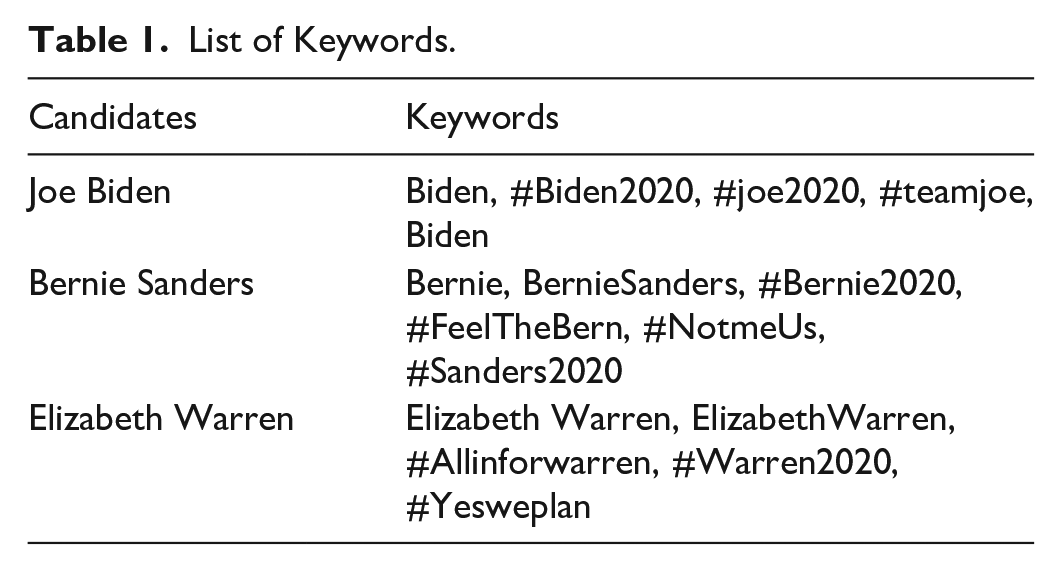
At the time of data collection, the top three candidates for the 2020 Democratic primary were Joe Biden, Bernie Sanders and Elizabeth Warren (FiveThirtyEight, 2020). Thus, these were the candidates used for data analyses. A total corpus of 18,237,296 tweets was gathered from Twitter’s API using the Twitter Collection and Analysis Toolkit (TCAT) between August 1 and September 30, 2019. The unit of analysis was each tweet that mentioned one or more of these specific candidates. Three separate tweet datasets pertaining to Biden, Sanders, and Warren were identified through a set of relevant keywords. Search terms included the names of each candidate and hashtags related to their campaign. These hashtags included both official and unofficial (i.e., supporter generated) campaign slogans. See Table 1 for the full list of keywords. The Biden dataset has 8,863,770 tweets; Sanders dataset has 7,729,850 tweets; and Warren dataset has 1,643,676 tweets.
List of Keywords.
Coding Procedure
A random sample of 1,875 tweets from the original corpus was selected using python’s random library. The selected tweets were then manually coded by the authors (Krippendorff’s α = .70, percent agreement = 89.5%) as “civil” and “uncivil” based on the operationalization provided by Groshek and Cutino (2016). The Krippendorff α of .70 was accepted based on its use as an accepted threshold in the existing literature (Mozetič et al., 2016). Based on the operational definition provided by Groshek and Cutino (2016), tweets were coded as “uncivil” if they incorporated one of the following five elements: (a) personal or inflammatory attacks; (b) threats; (c) vulgarities, abusive, or foul language; (d) xenophobic or other hateful language or expressions; (e) epithets or ethnic slurs, sentiments that are racist or bigoted, and/or disparaging on the basis of race/ethnicity or that assign stereotypes. All tweets that did not meet this criteria were categorized as “civil.”
The manually coded tweets were then passed into a supervised machine learning algorithm BERT (Google-Research, 2020), which stands for Bidirectional Encoder Representations from Transformers. This is a pre-training natural language processing processor developed by Google AI and was open-sourced in 2018. BERT is a textual algorithm that considers words in relation to the other words within a given context (Roitero et al., 2020). We utilized this neural network to extract the embedded vectors of the text of the tweets in our dataset. Compared with other machine learning algorithms, BERT generally performs highest in precision, recall and F1-score (Mozafari et al., 2019).
All machine learning codes were run using Google Colab. 70% of our 1,875 manually coded tweets were randomly selected to serve as the training set and the remaining 30% as the testing set. Following this, we used the ktrain framework in python, which is “a lightweight wrapper for the deep learning library TensorFlow Keras to help build, train, and deploy neural networks” (Amaiya, 2020). At a learning rate of 0.0001, the process was repeated 10 times and rendered a final model accuracy of 0.88. We validated the predictor on 300 tweets and the validation accuracy is 0.84, with a precision of 0.6, recall of 0.7, and F1-score of 0.65.
Since there is a 12-hr runtime limit in Google Colab, we predicted a sample of 3,000,000 tweets (1,000,000 randomly selected from each candidate’s dataset) using the trained predictor, with the algorithm categorizing each tweet as “civil” or “uncivil.” Since it is possible that one tweet can mention multiple candidates, we labeled each tweet with three dichotomous variables—Elizabeth Warren, Bernie Sanders and Joe Biden—after the 3,000,000 tweet dataset was generated. If the tweet mentions any combination of the candidates, we code the corresponding variable as 1. Otherwise, the corresponding candidate variable is coded as 0.
Finally, a small subset of the data (n = 1,000) was manually coded by the authors (Krippendorff α = .83, percent agreement = 92%) based on an abridged version of the operational definition of anonymous/pseudonymous accounts as offered by Peddinti et al. (2017). This sample was used to assess the different levels of incivility between anonymous/pseudonymous users and users whose display name on Twitter appeared to be actual full names as opposed to a pseudonym. A Twitter users’ display name differs from their username or Twitter handle, and serves as a “personal identifier” for the platform (Twitter, n.d.). As defined by Peddinti et al. (2017), pseudonymous account names are those with “no relation to individuals’ real names and effectively make users anonymous.” Furthermore, as defined by Peddinti et al. (2017), an anonymous/pseudonymous Twitter account features neither a first nor a last name. This subsample of the dataset was utilized to test
Bot Analysis
To answer
Data Analysis
We conducted chi-square tests of independence to answer
Results
Using supervised and unsupervised machine learning algorithms, this study yielded a variety of interesting results regarding the presence of incivility on Twitter in conversations pertaining to the top Democratic candidates.
RQ1: How Prevalent Is Incivility in Tweets About the 2020 Democratic Primary Campaign?
In terms of
H1: Tweets that originate from anonymous or pseudonymous accounts will be correlated with higher levels of incivility
A 2 (anonymity: anonymous user, non-anonymous user) × 2 (incivility in tweets: civil, uncivil) chi-square test indicated that tweets originated from anonymous accounts are not correlated with higher levels of incivility, χ2(1, N = 1,000) = 0.13426, p = .714, Φ = .017. Therefore,
Crosstab Analysis for Anonymity and Incivility.

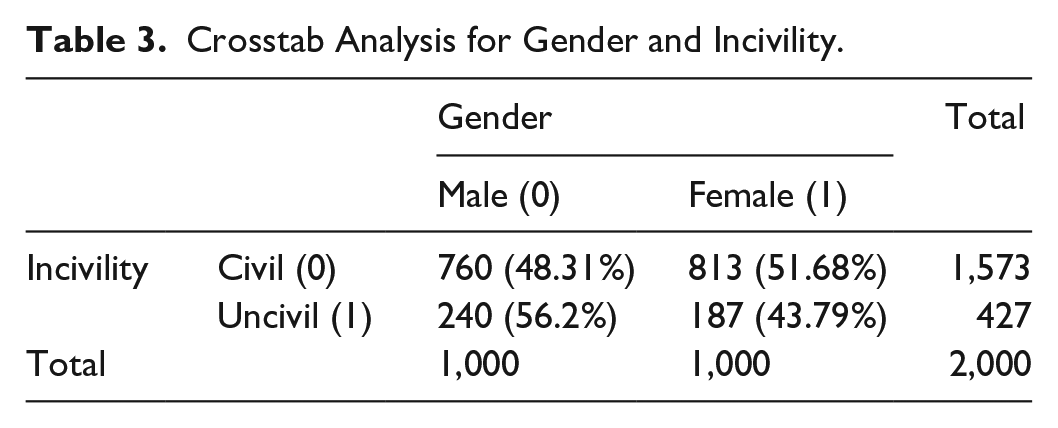
H2: Tweets mentioning Warren are associated with higher levels of incivility
Crosstab Analysis for Gender and Incivility.
RQ2: Within Uncivil Conversations Surrounding the 2020 U.S. Presidential Primary Candidates, What Topics Were Being Circulated by Bot Accounts?
Topic Modeling for Uncivil Tweets Generated by Bots Mentioning Joe Biden.

The greatest proportion of tweets generated by bot accounts that mentioned Joe Biden seemed to be associated with his son, Hunter. This cluster includes words such as “ukrain,” “hunter,” “son,” “corrupt,” “famili,” and “drug.” We posit that perhaps bots focused their attention on Joe Biden’s son as he is a very polarizing figure and many considered him to be one of the greatest factors that could jeopardize the Biden campaign (Entous, 2019). Thus, it is interesting to see this reflected in the k-means cluster analysis, as the bot accounts likely targeted their uncivil tweets on this topic.
In bot tweets regarding Warren, most clusters in Table 5 are personal attacks with words such as “unabashed,” “deranged,” “liar,” and “nuts.” These suggest that bots are mostly focused on defamatory language when mentioning Warren. This is a diverge from her entire uncivil corpus, which focuses predominantly on gun violence and her self-claimed Native American heritage.
Topic Modeling for Uncivil Tweets Generated by Bots Mentioning Elizabeth Warren.

In bot tweets mentioning Sanders, words such as “socialist,” “bro,” “bulli” appeared in several clusters in Table 6. These words may indicate social bots’ attacks on Sanders’ supporter base, known colloquially as “Bernie Bros” (Naranjo, 2020). The mention of Sanders’ support base is actually not present in topic modeling of his entire uncivil corpus.
Topic Modeling for Uncivil Tweets Generated by Bots Mentioning Bernie Sanders.

RQ3: Are Specific Public Policy Topics Associated With Uncivil Communication?
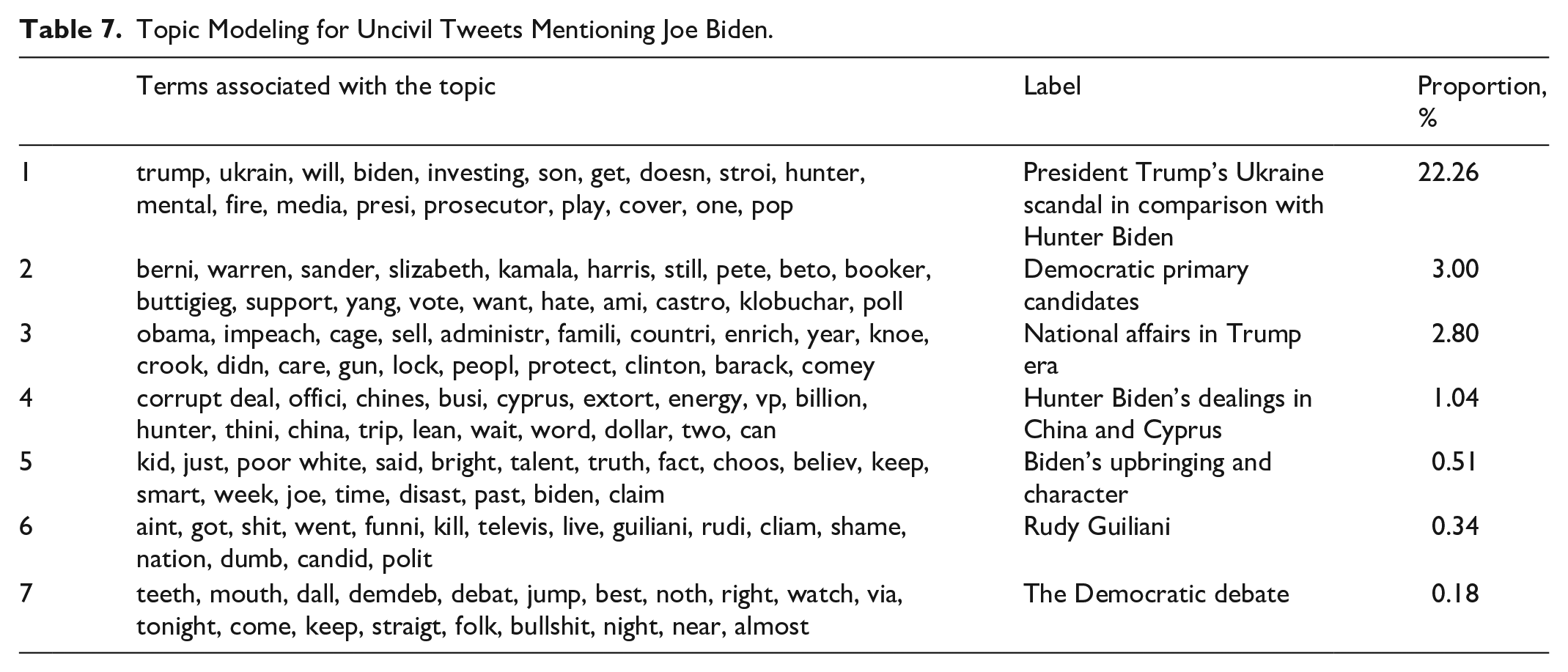
Similar to
In regards to Warren, there is an overwhelmingly high cluster (70.94%) around topics comparing Elizabeth Warren to other 2020 U.S. presidential candidates: “biden,” “berni,” “kamala,” and “democrat” in Table 7 (see Table 8). Within this cluster, keywords such as “nativ” and “lie” showed up as well, alluding to the accusations and uncivil conversations around her nationality and identity. The other clusters that trailed behind the topic of Warren’s comparison to other democratic candidates consisted of President Trump-related events and topics on gun violence, crime, racial tensions and immigration. Under the topic of gun control—“dayton” and “trump” often came up as a keyword to denote the specific 2019 shooting event in Dayton, Ohio and potential discussions around how Trump responded to the shooting. Some of the most glaring uncivil keywords in the Warren tweets were: “nut,” “freak,” “racist,” “evil,” and “coward.”
Topic Modeling for Uncivil Tweets Mentioning Joe Biden.
Topic Modeling for Uncivil Tweets Mentioning Elizabeth Warren.

The topic clusters related to Sanders reflect notable tension regarding the senator and his self-described status as a Democratic socialist (see Table 9). This is reflected primarily in Topic Cluster 3, which includes words such as “money,” “capitalist,” “millionair,” and “billionair.” We posit that these are perhaps indicative of partisan jabs and snarky remarks from Sanders’ critics that he is a “millionaire socialist” (Kruse, 2019). Finally, based on the topic clusters, we can glean that the largest policy topics within the tweets that mentioned Sanders primarily focused on his fiscal policy. It is worth noting that the Sanders clusters have the greatest amount of curse words.
Topic Modeling for Uncivil Tweets Mentioning Bernie Sanders.

RQ4: Which Candidates Are Connected With the Highest Levels of Incivility?
Within the Biden dataset, the two most frequent uncivil terms are “plagiarist” (association = .26) and “investigatethebidenfamily” (association = .42). Both these terms indicate defamatory attacks on Biden, particularly following the quid pro quo political scandal that was occuring during data collection (Re, 2020). Furthermore, the most associated uncivil terms with “sanders” are “swamp” (association = .31), “millionaire” (association = .30), and “idiot” (association = .28). These terms may indicate users criticizing Sanders’ net worth, as he has recently come under fire for what opposers’ believe to be hypocritical rhetoric (Pramuk, 2020). These word associations provide a greater lens to illustrate which terms are associated with specific candidates.
Discussion
This study offers a wide variety of findings regarding the prevalence of incivility in political Twitter discourse. As illustrated, our data reveals a statistically significant relationship between candidate gender and incivility, supporting evidence in the existing literature that online social media platforms are breeding grounds for toxicity and misogyny (Citron, 2009; Megarry, 2014). While the proportions of uncivil tweets may not be monumentally different among the male and female candidates, these findings do support prior work illustrating the relationship between gender and incivility (Citron, 2009; Megarry, 2014).
In this study, we employed a big data, computational analysis to examine the amount of uncivil Twitter conversation about Democratic presidential primary candidates in August and September 2019. Specifically, we sought to expand our understanding of (1) the extent to which candidate gender influences the amount uncivil discourse, (2) the relationship between anonymous accounts and online incivility, (3) whether automated (bot) accounts prioritize specific public policy topics, and (4) if certain public policy issues were associated with higher levels of uncivil communication. Our results show that the highest frequency of uncivil conversation surrounded Senator Elizabeth Warren, the only female candidate in our study. This finding is particularly interesting considering the widespread negative reputation earned by Sanders’ online supporters (Naranjo, 2020).
Interestingly, there does not appear to be a relationship with anonymity and incivility, as uncivil tweets were just as likely to originate from tweets that identified users’ names as they were to originate from anonymous or pseudonymous accounts. This finding is interesting for a handful of reasons. Anonymity has been well documented as a predictor of online incivility (Nithyanand et al., 2017; Phillips & Milner, 2017; Suler, 2004). Thus, it is surprising that our study was unable to replicate these findings. This also sheds light on the need for further investigation of the online disinhibition effect during a time of heightened social media usage. Thus, perhaps the anonymous characteristic of the internet is not the sole contributor to uncivil online discourse. This finding could potentially lend itself to fruitful future research regarding individuals’ intentions to engage in incivility online.
In terms of theory building, this study’s data offered interesting insights for the online disinhibition effect as proposed by Suler (2004). Perhaps this is indicative of a shift in modern society, where anonymity is not necessarily as appealing to users. To this end, Rost et al. (2016) found that in over half a million online comments, non-anonymous individuals tend to be more aggressive in their posts than anonymous individuals. Thus, perhaps future research could focus on more modern disinhibitors that drive online incivility. Similarly, our study offers a myriad of variables that facilitate uncivil online behavior, specifically the role of bots as well as user and/or candidate gender. To this end, we argue that perhaps these are new variables that can be introduced into the pre-existing model established in the online disinhibition effect. Future research would benefit from further exploration of these variables.
Our results also present interesting implications for the role of bots in online discourse. Specifically in regards to Joe Biden, it appears that bots focused the greatest proportion of their uncivil tweets on Joe Biden’s son, Hunter. As discussed, Hunter Biden was an incredibly polarizing figure, and many argued that he could jeopardize Biden’s campaign for president (Entous, 2019). Thus, it is interesting to see this reflected in the topic clusters. Perhaps bot accounts were able to focus on this one polarizing subject and infiltrate Twitter conversations with uncivil communication regarding Joe Biden’s son. These findings echo prior work that demonstrates that bot accounts often serve to instigate political feuds, spread misinformation and spread hateful rhetoric (Albadi et al., 2019).
In addition, our findings provide evidence that certain policy issues are more closely related to uncivil discourse than others. Through k-means clustering, our data reveal that the issue of gun control and immigration is closely related with mentions of Elizabeth Warren and fiscal policy with Bernie Sanders; however, we did not find any policy keywords linked to Joe Biden. Specifically in the Warren clusters, policy topics often appeared alongside mentions of opposing politicians or democratic candidates. For example, the cluster mentioning gun violence included Trump and Dayton Ohio Shooting. Our analysis of uncivil tweets regarding Sanders didn’t show any indication of his health care policies—which is one of the major policy issues that he advocated for throughout the primary. However, there was a significant focus on his democratic socialist ideology which included his economic viewpoints. In summary, our study expands the existing literature by utilizing big data analysis to analyze the specific political policy issues that are most associated with Twitter incivility during this democratic primary. In addition, in line with the existing literature (Albadi et al., 2019), our findings provide support for the argument that bot accounts were able to spread hateful and argumentative rhetoric, likely in an attempt to sow distrust and contempt regarding these three candidates.
This study is not without its limitations. Data was collected during a small window of time during 2019. Furthermore, it has been noted in the existing literature that Twitter is not necessarily widely used among the American electorate—with only 22% of Americans actively using the platform (Hughes & Wojcik, 2019). It is also worth noting that our results are not fundamentally generalizable as the data used for this research was collected during an incredibly high-profile election season, which generated substantial national interest. While the goal of the article is not necessarily to generalize our findings to other political events, we believe that this limitation does merit mention, as does it warrant future research regarding the prevalence of incivility in online discourse surrounding other topics. In addition, as with most machine learning analyses, it is difficult to glean the true tenor of discourse based on the methods we employed. Without more in-depth qualitative analysis, we are unable to pinpoint who the incivility in a tweet is specifically directed to. Finally, while we do feel quite confident in our accuracy rate of 0.88, there is the potential for error in the machine learning classification process. While topic clusters were qualitatively analyzed, we would be remiss not to acknowledge this limitation.
Despite scholarly interest in incivility within both the communication and political science disciplines, relatively little work has been done regarding the intersection of incivility, political communication, and the online disinhibition effect. Along this line of inquiry, our research has provided a number of novel insights of theoretical and practical importance, as well as potential avenues for future research. Future research could illustrate the relationship between incivility and media coverage per candidate. For example, does public incivility toward political candidates determine the valence of media coverage that they receive?
The findings offered here present a myriad of implications for theory building, future research, as well as public policy concerns. As discussed, the lack of empirical support regarding an association between incivility and anonymity is surprising, yet warrants a new perspective on what factors motivate users to act uncivilly online. This is important considering the growing rate of cyberbullying, which has increased by 35% over the last 3 years (Patchin, 2019).
Furthermore, our results present serious implications, particularly in regards to the relationship between gender and incivility. The finding that candidate gender is associated with higher levels of incivility contributes to an important body of research related to the relational dynamics between female politicians and the public (Dolan, 2014). On a practical level, there is the potential for this research to inform policy decisions made by social media platforms. From gender-based cyberbulling and sexual harassment concerns (see e.g., Twitter, 2020) to the problems related to automated accounts during elections (see e.g., Rosen et al., 2019), platforms are broadly concerned with issues examined in this study. We hope that empirical research such as ours can inform ongoing work at the nexus of digital communication, politics, and community safety. In summary, there is ample evidence demonstrating the prevalence of online incivility in Twitter discourse. As indicated, there is great potential for this incivility to bleed over into offline domains, whether in the form of radical movements, violence, harassment, hate crimes, or other forms of bullying. As such, incivility continues to be a critical topic to analyze and understand as digital communication environments grow and evolve.
Footnotes
Declaration of Conflicting Interests
The author(s) declared no potential conflicts of interest with respect to the research, authorship, and/or publication of this article.
Funding
The author(s) received no financial support for the research, authorship, and/or publication of this article.
