




Abstract
Russian-speaking diaspora has spread across the world during the last century and plays a significant role in cultural and political life of the host countries. But its virtual presence remains heavily understudied; it is only Russian-speaking news websites that have received some scholarly attention. This study aims at estimating the globality of mass self-communication of Russian emigrants on Instagram in the context of virtual diaspora studies as a new form of imagined communities. Instagram communication of emigrants illustrates how the nature of mass self-communication influences the nature of ties between diaspora members. We confirm the global scale of ties that are developed by the Russian-speaking “InstaMigrants” by network analysis. We also show that such seemingly apolitical publics possess a potential for politicization of everyday life and migration experience in unconventional ways.
Introduction
While global interdependence continues to increase, lack of evidence for emergence of a global public has raged unabated. Beck (2000) and Sparks (2001) forecasted the appearance of a global civil society; Fraser (2007) and Hafez (2012), on the contrary, doubted that a global public would ever form. This debate has gained new prominence within the discussion on multiple global publics as personalized networks between activists (Stephansen, 2019) or as ad hoc publics and counter-publics that may form around significant mediatized events (Bodrunova et al., 2018).
In particular, stable cross-national ties are created by expatriates, migrants, members of diasporas (Castells, 2008). Digitalization has transformed migration in a profound way (Diminescu, 2008). Studies of the past two decades have provided important insights on transnational publics that coalesce through debates on political events in their home countries (Leurs & Ponzanesi, 2018). However, very few studies have investigated the networked publics formed by migrants residing in multiple countries. This article aims at contributing to this research area.
Immigrants rarely have current politics of their host countries on personal agendas; often, they are non-citizens and cannot vote. For a substantial time span, their focus is upon everyday life; while it is conventional and clear for the locals, it grows into an array of obstacles for the newcomers due to the differing conventions and routines in comparison with their home societies. At the same time, they see the local patterns of life organization with a fresh eye and pay attention to its elements that do not form the local political agenda.
Many attempts to detect a global public sphere and its agendas have encountered the absence of traditional topicalities and issues relevant for domestic politics or international relations (see review in Bodrunova et al., 2018), as the attempts of discovering a global public mostly focused upon agendas and issues induced by news media and political elites. Contrary to that, online communities of migrants discuss mundane topics (Marino, 2015) that constitute a blind spot in the current news agendas but can evoke substantial criticism from both migrants and residents. This criticism is directed not only to the existing political status quo or the migrants’ reduced political rights, but also to patterns of everyday life organization, in general and in particular. The importance of non-news agenda was underlined by the works by Fraser (1990), Dahlgren (2003), Livingstone (2005), Papacharissi (2010), i.a.; however, far too little attention has been paid to publics that emerge on social media around issues not recognized as political by media and elites.
The specific objective of this study is to explore whether Russian-speaking migrants that discuss mundane issues and their migration experience on Instagram might form a global public—and how exactly discussing such issues makes them a public and where lies the potential for politicization in these discussions. To reach it, we deploy a mixed-method based on the concept of networked public (boyd, 2010); in research procedures, we follow Sonne and Erickson (2018).
Being an exploratory study, this research focuses on Instagram users who speak Russian as their native language. In the recent years, there has been a significant growth in the total number of Russian-speaking migrants that reside around the globe. Due to high percentage of middle-class families and highly qualified professionals, their “diasporic presence in digital space is extensive” (Morgunova, 2012, p. 5; Tkach, 2017). So far, however, there has been a little discussion about their “communicative connectivity” (Hepp et al., 2012) on Instagram, as well as of their potential as a transnational public. We focus specifically on Instagram, as it has significantly transformed over the past few years and begun to play a noticeably larger role in the formation of online publics (Caliandro & Graham, 2020); another reason is that Instagram is more representative for feminine social media use.
The remainder of the article proceeds as follows: Next section outlines the theoretical dimensions of the research. The third section describes the research questions, methodology, and data collection. The fourth section presents the research findings, followed by the discussion in the fifth section.
Theoretical Framework: A Global Public Focused on Everyday Life?
Intimate Publics Online and Politicization of the Mundane
Social media platforms have provided Internet users with an opportunity to form different kinds of publics (Baym & boyd, 2012), including those less explored in academic literature. The majority of works on publics seems to focus on political issues and topics “that policymakers recognize” (Ryan, 2011, p. 712; see also Papacharissi, 2015). This approach has been criticized for dismissing mundane topics and overlooking the activities of less politically engaged citizens (Livingstone, 2005). First, some recent research has shown that conversations about such mundane topics as hobbies or traffic have the potential of becoming politically charged (Shklovski & Valtysson, 2012). Second, there is a group of scholars who insist that any kind of public discourse, regardless of its political consequences, should be examined in terms of its potential in deliberation and formation of publics (Dahlgren, 2003; Livingstone, 2005; Warner, 2002).
Within this approach, publics are viewed as groups of people who share “a common understanding of the world, a shared identity, a claim to inclusiveness, a consensus regarding the collective interest” (Livingstone, 2005, p. 9). It also bridges public and private domains acknowledging that belonging to a public depends “on the lived experiences and activities, the conditions and constraints, the identities and relationships of people in their status as private individuals” (Livingstone, 2005, p. 28). When these private individuals gather through social media “for social, cultural, and civic purposes” (boyd, 2010, p. 39), networked publics might emerge.
The boundary between political and mundane was questioned by feminist scholars even before the rise of web 2.0 (Weintraub, 1997). Feminist thinkers have shown that whole arrays of issues remain a blind spot for the dominant public spheres, both in political deliberation and in news media (Beard, 2017; Perez, 2019). As Fraser (2016) explains, “capitalist societies separate social reproduction from economic production, associating the first with women, and obscuring its importance and value.” To this, we may add that, for migrant communities, the number of marginalized topics that have not been regarded as affecting the interests of many other people grows and comprises nearly all the practices of support of everyday living. Encountering and overcoming a wide range of problems, as well as alienating the patterns of life organization in host countries, stimulates many migrants to share and discuss their experience online.
Creation of a space of emotional contact and recognition with the help of first-person narratives and discussions about how to live as “nondominant people” (Berlant, 2008, p. viii) has been described by Berlant as a practice characteristic for “intimate publics.” Participants of an intimate public expect that other participants “share a worldview and emotional knowledge that they have derived from a broadly common historical experience.” However, Berlant denounces intimate publics as limiting in terms of social contacts and apolitical. We challenge this view, as, to me, consciously bringing issues and social critique into any public space (including Instagram) already pushes the boundary between political and mundane toward the political realm, allowing for “new publics to coalesce” (Baym & boyd, 2012, p. 325). Thus, in this article, we will explore whether a global yet intimate public on Instagram provides conditions for unconventional politicization and social critique in migrants’ discussions about management of living.
Socially Mediated Publicness on Instagram
Originally, a photo sharing social network launched in October 2010, Instagram soon allowed users to publish longer texts as captions. Also, with time, an increasing number of Instagram users became politically mobilized. While publics emerging on Twitter or Facebook are well-studied, expressions of solidarity through hashtags on Instagram (Gladchenko, 2019; Kamil et al., 2016) remain almost unnoticed by scholars.
The social connectivity on Instagram is similar to Twitter and some other social networking platforms. In particular, Instagram users may add hashtags to reach out to members of the public outside their existing networks, to acquire more followers, or to share experience with others, and click on hashtags to find like-minded people (Erz et al., 2018). Using a hashtag can be interpreted “as an explicit attempt to address an imagined community of users” (Bruns & Burgess, 2011, p. 4). Thus, a public can emerge around common interests and longitudinal issues marked by hashtags (Zappavigna & Martin, 2018). The continuity of such publics is based on the ability of hashtags to make the content searchable on social media (Heyd & Puschmann, 2017).
Bloggers can ask their followers or other bloggers to share their personal experience by writing their own posts with the same hashtag. Most of these activities are associated with commercial use of Instagram by micro-influencers—“ordinary individuals who develop a career through digitally narrating their lives and monetizing their efforts” (Duguay, 2019, p. 2). Instagram bloggers organize joint activities, such as engagement pods, to reinforce visibility of their posts and acquire new followers (O’Meara, 2019). In these supportive communities, participants like and comment on the posts of other bloggers, publish content in a coordinated manner, and promote posts with particular hashtags. Beyond the pure commercial use, this activity is called participatory hashtagging (Oh et al., 2016) or contributive action (Bodrunova, 2020). It might raise general visibility and public awareness of a topic (see Danina & Folts, 2019, on #faceofdepression). In this article, we will estimate whether Russian emigrants participate in such joint activities on Instagram on a global scale.
Digital Migration
Recently, there has been an increasing interest in migrants’ communicative connectivity (Hepp et al., 2012; Leurs & Smets, 2018). Diasporic communities gain voice and visibility, as well as cast political impact, by making use of the opportunities provided by digital technologies (Kok & Rogers, 2017). “Online diasporic public sphere” (Kok & Rogers, 2017, p. 28) on social media facilitates the integration process and helps fill in the social void associated with migrating to a different country. While other networking services have been well-researched, Instagram has not been the focus of many academic works (for a few extant ones, see Gretzel & Hardy, 2019; Hwang & Cho, 2018; Smoliarova et al., 2020).
In diasporic communities on social media, newcomers interact with already settled migrants who serve as information sources and role models (Bucholtz, 2019). Information requested by the newcomers concerns primarily everyday issues “that migrants might face (and struggle with) during early stages of the settlement process” (Marino, 2015, p. 4), such as opening a bank account or obtaining insurance. These everyday conversations on social media contribute to blurring the public or private boundary, fostering the emergence of “a fundamentally public space” (Marino, 2015).
As Stephansen (2019) has shown for activist communication, global publics are formed from personalized networks and collective communication spaces. These personalized networks are enriched with latent ties—that is, connections with new social circles established through social media (Dekker et al., 2016). Friends living outside host or home countries belong to the closest ties (Fietz & Kaschowitz, 2019); thus, they are an essential part of an intimate public a migrant might participate in. However, connections across national borders between migrants speaking at least one common language remain understudied.
A small number of works explore subjects such as a Vietnamese “transnational migrant community” in Eastern Europe (Szymańska-Matusiewicz, 2015), Somali “transglocal diasporic formations” (Kok & Rogers, 2017), and a “transnational network” of Russian-speaking migrant communities (Morgunova, 2012). While these works employ the term “transnational” to refer to a wide network of ties between people residing in multiple countries, in most papers, its usage is marked by a dichotomy between “home” and “host” communities (Leurs & Ponzanesi, 2018), stemming from its original definition formulated in the early 1990s (Basch et al., 1994). Moreover, although the network as a concept holds a prominent place in the migration studies (Budarick, 2014; Tsagarousianou, 2004), “there is a tendency within migration studies simply to take networks for granted” (Ryan, 2011, p. 707; see Bilecen et al., 2018; Ryan & D’Angelo, 2018).
Thus, we presuppose that there is a branched network of diasporic communities in different countries, and migrants form meaningful connections with people who belong to neither their “home” nor host societies. To reflect the polymorph nature of their connectivity, we prefer the term “global” to “transnational.” In this article, we explore the phenomena of network globality and complexity by studying female Russian-speaking migrant bloggers on Instagram.
Russian-Speaking Online Communities across the Globe
Russian-speaking population abroad is highly varied, originating from different migration waves and generations whose reasons to migrate, ethnic identity, attitudes to their native state, “and ways of expressing mutual solidarity can be completely different” (Byford, 2014, p. 378). Due to the heterogeneity of possible origin, “Russian-speaking migrants” is used as an umbrella term (Mustajoki et al., 2019).
The global resettlement of Russian speakers took shape during all five major waves of migration (Ryazanova-Clarke, 2014). The sixth wave began in the 2010s, when the number of migrants began to grow again after a decrease in migration intensity: since 2013, around 120,000 to 150,000 citizens have been leaving the country annually (Tkach, 2017). Since 2008, the social structure of emigration has diversified and now includes women, youth, pensioners, and people outside capital cities or without higher education, as well as computer scientists (Antoshchuk, 2018; Ryazantsev, 2016).
An attempt to map online networks of websites serving Russian-speaking migrants worldwide (Morgunova, 2012) has shown that nearly every fifth website in the sample does not belong to a particular country. The findings also reveal that the global websites were focusing mostly on preserving culture and collective memory by reproducing identities related to the Russian language. Although Russian-speaking female migrants might be a majority in the post-Soviet migration and are “active subjects creating possibilities and taking decisions in their own lives” (Morgunova, 2012, p. 10), websites oriented to the female audience (fashion, cooking, bridal sites) were excluded from the sample of the Russophone e-diaspora map. In this study, we contribute to filling this gap focusing on Instagram blogs created by female users.
Research Procedures
First-Stage Hashtag Selection
Our research design is exploratory and is based on the methodological approach developed by Sonne and Erickson (2018). It includes the following steps.
At the first stage, we defined a list of general hashtags which we expected to find in the posts by Russian-speaking Instagram users who would write about their migration experience (#immigration, #lifeabroad; see more details in Smoliarova et al., 2020). To identify the “hashtag populace,” we started to follow 30 users whose posts were selected by the Instagram algorithm as “the best posts by the hashtag” in December 2017. Using the snowballing technique, we expanded this list of bloggers with those who commented on the posts or were mentioned in the posts and stories. We also checked regularly for new recommendations in the list of “the best posts by the hashtag.” In sum, we were monitoring up to 100 Russian-speaking bloggers with migration background.
During this period of familiarizing ourselves with the population, we found a specific type of posts published regularly with the same hashtag #international_gir1. Within it, bloggers suggested to their followers to read posts on a particular topic published by other bloggers from different countries (see an example in Figure 1).
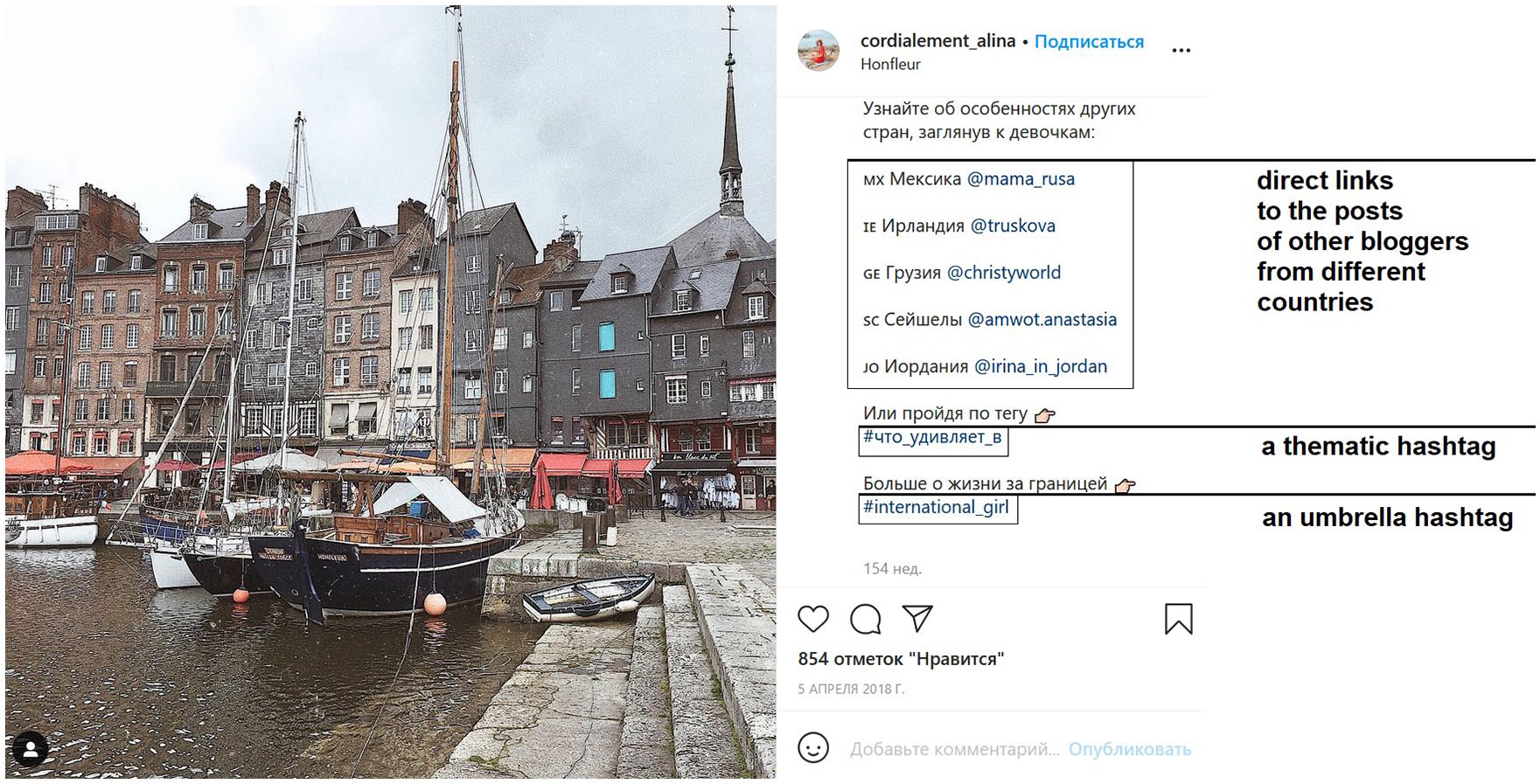
An example of a post mentioning a group of bloggers from different countries and including the hashtag #international_gir1. The blogger suggests finding out “how people work in other countries” by reading posts written by bloggers in the list below.
Posts of this type were dedicated to different topics: working conditions, intercultural communication, migration experience, or raising bilingual kids. The topics of posts were declared in unique thematic hashtags which were searchable labels for posts published on the same day on the same topic. Followers could opt for reading a post written by a blogger from a particular country, or for reading all the posts through this thematic hashtag. In each post, bloggers also added the hashtag #international_gir1 suggesting their readers “to find out more about life abroad.” Thus, we considered it as an umbrella hashtag that coalesced the posts of this specific type.
Research Questions
Based on the literature review and results of the observation at the first stage, we formulated the following research questions:
RQ1. Does a networked public emerge around the hashtag #international_gir1 used by the Russian-speaking migrants on Instagram?
RQ2. To what extent does the network between participants of this public contain cross-national ties? Is it global indeed?
RQ3. What issues dominate the posts marked by this hashtag? Are they conventionally political (driven by news agendas) or mundane (related to support of everyday living)?
RQ4. How does the deliberative nature of the public manifest itself in the posts that belong to #international_girl?
Data Collection and Pre-Processing
At the second stage, we created a collection of posts published with the hashtag #international_gir1. Contrary to Twitter, Instagram restricts parsing data through hashtag-based search. To download the posts hashtagged #international_gir1, we used two Russian-based social media management tools, namely SocialKit and Popsters. The list of users who posted under #international_gir1 was created with SocialKit and included 642 accounts. For each user, we downloaded all posts and metadata (link to the post, data, number of likes and comments, and engagement rate) using Popsters.
We checked whether the posts with #international_gir1 were covering migration experience. 27% of users added #international_gir1 as a random hashtag to promote their account, and their posts were excluded from the dataset (on the level of noise in the Russian-speaking Instagram, see Smoliarova et al., 2020). We identified 466 users that resided in 81 countries and published posts about their migration experience using Russian. The dataset included 1,890 posts published from 24 January 2018, to 20 December 2018.
At the third stage, we identified 114 “collections” of posts published on the same day on the same topic. In 90% of the posts, the topics were labeled with unique thematic hashtags. Topics of the last 10% of posts were described with a short designative phrase. Three thematic hashtags were excluded since they were not unique for the dataset and failed to serve as searchable labels. Thus, the final dataset comprised 1,887 posts covering 111 topics labeled in the text by a thematic hashtag or a templated phrase.
A special parser has been written on Python to automatically extract from posts the mentions of bloggers and countries they reside in. The results of parsing were controlled on a random sample of posts. Out of the parsing results, we created two lists of directed connections—between users (blogger A posted a link to blogger B) and between countries the bloggers resided in. If a post was written by a blogger from France and referenced to bloggers from Belgium, Argentina, Japan, and Italy, four directed connections (France → Belgium, France → Japan, etc.) were added to the list. Both lists contained 7,193 connections including repeating connections between the same countries.
Data Analysis
To address RQ1 and RQ2, we reconstructed graphs of connections between bloggers and between countries using the Gephi algorithm OpenOrd. The latter allows to measure user metrics and show centripetal graphing (Martin et al., 2011). The world map was added into the visualization through a special plugin.
To estimate how global the networked publics created by Russian-speaking Instagram bloggers with migration experience are, physical distances between country territories should be taken into consideration. The distances between countries have been equaled to the distances between their capital cities and then calculated as percentages from the half-equator length, since it is the maximum distance between two points on Earth (20,000 km). The distance of 20% of the half-equator (4,000 km) was defined as a relatively close one, forming the borders of a region (e.g., the distance between Helsinki in Finland and Madrid in Spain is around 4,000 km).
To address RQ3 and RQ4, we qualitatively identified broad themes within the topics through inductive coding based on repetitive reading (Fereday & Muir-Cochrane, 2006). The reading procedure stopped when no new themes emerged. Then, we assessed the posts within topics for problematization and identified the issues of the bloggers’ concern, defined their origin (news agendas vs. everyday life) and the level and nature of criticism they carried.
Findings
RQ1. A Networked Public
Up to 40 bloggers might contribute to one topic, while each post usually includes no more than five direct mentions of bloggers from different countries. In total, 3% of bloggers published more than 40 posts initiating participatory hashtagging activities among Russian-speaking Instagram bloggers with migration background. As shown in Figure 2, they represent the core group of bloggers with the highest eigenvector centrality that measures the influence of a node in a network (>0.73).

The networked public around the hashtag #international_gir1 (a) full picture (b) eigenvector centrality > 0.6 detailed.
Bloggers are connected through thematic hashtags and direct mentions. On average, each blogger is connected to 19 others (max. degree of a node is 120). They participate in the hashtagging activities with different regularity. In total, 46% of bloggers in the dataset have contributed only to one thematic hashtag. In total, 34% published 2–11 posts of the dataset (up to every tenth thematic hashtag).
Thus, a small percentage of bloggers form a quasi-editorial team but the rest do not constitute a close community but more a fuzzy conglomerate with open borders which might be seen as a public. Such an intersection of follower or followee networks, simultaneously being a collection of people and creating an arena, as boyd (2010, p. 41) point out, defines networked publics.
RQ2. A Global Public
The Russian-speaking #international_gir1 bloggers are settled around the world, on all five continents, including South America and Africa. The number of bloggers varies from country to country. The bloggers from Italy, France, and Spain are the most salient in the sample (30–38 users), followed by those from Germany, Turkey, and the United States (22–25 users). Although the biggest number of the Russian-speaking immigrant population is found in Germany, the United States, and Israel, these host countries do not exclusively dominate the list of #international_girl bloggers.
In total, 7,193 mentions of countries, each by a blogger from another country, have formed 1,258 two-country combinations. In total, 15 times a blogger was mentioned by another blogger from the same country, and 37 times bloggers mentioned accounts of digital nomads with no country markers. 377 connections between countries were listed only once; 15% of connections were repeated more than 10 times. The graph for cross-national ties within the networked public #international_gir1 is represented on Figure 3. Size of the nodes reproduces their eigenvector centrality; the density of the edges represents the number of connections between bloggers from two countries.

A global network of Russian-speaking Instagram bloggers.
As Figure 3 suggests, there are regions where bloggers are more connected to countries outside the region than within. Thus, the bloggers from Australia have not mentioned bloggers from New Zealand, and vice versa. Ties within South America are also nearly absent. Among 152 mentions left by the bloggers residing in Argentina, Brazil, Chile, or Ecuador, bloggers from South America were recommended only three times (twice Brazil—Ecuador and once within Chile).
Only in 42.5% of cross-country mentions, the bloggers reside at a distance smaller than 10% of the equator. The share of distances of 4,000–8,000 km (up to 40% of the half-equator, for example, the distance between Berlin and New Delhi) is almost equal to the share of distances from 8,000 to 12,000 km (up to 60% of the half-equator, Berlin—Seoul, Seoul—San-Francisco). These cross-regional connections were created through 48.9% of mentions. Thus, 8.6% of mentions connected bloggers on a distance that exceed 80% of the largest distance that could exist on Earth. Thus, the InstaMigrants’ interconnectedness on the global level is proven.
RQ3: An Intimate Public: Mundane Agendas and Issues
As mentioned earlier, we found 111 topics that were indicated either by a thematic hashtag or by a templated phrase and published by a group of bloggers on the same day. By inductive coding, we identified 10 overarching themes from the initial data: beauty, blogging, cultural capital, care and family, female-male relations, financial personal or family management, immigration experience, norms of host society, tech, and travel. The full list of hashtags in each theme is available on request.
Bloggers contributed most actively to the topics connected with their immigration experience and financial management (20.6% and 16.7% of all posts, respectively). A significant number of posts included information about the host society produced by the bloggers, which is consistent with the previous studies. However, no evidence of topics related to news media-driven agenda was detected. Thus, we consider the public emerging around the hashtag #international_gir1 an intimate one: it invites people with common worldview and emotional knowledge to participate, avoids conventional political context, and is driven by first-person narratives about “how to live as X,” as suggested by Berlant (2008).
If judged by topicality, 63 out of 111 topics (58% of posts) belonged to the realm of everyday living, including personal stories about immigration process, maintaining households and personal or family budgeting, caring about children, and gender relations. It is also supported by the median value for comments per theme, which was the biggest for three topics—care and family (51), immigration experience (49), and financial management (47.5). Interestingly, the most commented theme—care and family—attracted on average less bloggers than any other; still, it is of utmost importance for the followers. Other topics, though, were also mundane.
The issues salient in the posts related to family budgeting, insurance, job search, grocery prices, and gender relations. Bloggers critically reflect upon patterns of life in the countries that were chosen for living: discrimination of migrants, gender pay gap, confrontation with bureaucracy, unsatisfactory level of service, and unemployment. These issues are covered through the lenses of personal experience or mentioned in the form of a subjective point of view on the host society. Three hashtags attracted the biggest number of bloggers: #my_changes_in, #what_surprises_me_in, and #stereotypes_on (in Russian). More than 10% of all bloggers contributed to the hashtag #my_changes_in sharing their personal experience of integration to a host society, how they dealt with challenges and accustomed to a new life in a new country. The two latter hashtags echo offline discussions about host societies, their norms and values.
RQ4. A Mundane Public: Its Deliberative Nature and Manifestations of the Political
As seen from the results for RQ1 to RQ3, the deliberative nature of the global public of female InstaMigrants manifests itself in several aspects that link it to the idea of critical publics (Toepfl, 2020).
Thus, this public, by its own participatory activity, creates an arena for the discussion of issues that are tightly linked to the immediate management of living and, thus, are of immediate and high importance for the immigrant communities, especially in their female part. This arena is global and exists in parallel to domestic politics of the home and host societies, international relations, and mainstream media, covering the “blind spots” of their agendas. Thus, the networked public that emerged around the hashtag #international_gir1 on Instagram considers immigration experience and the realm of management of living worthwhile for a public discussion on a global scale. As a potential result, the public relevance of the issues grows together with the “accumulated meaning of individual contributions” (Bodrunova, 2020, p. 140).
Unlike for other political publics, in #international_girl, the basis for formation of ties is sharing experience, which looks as a powerful tool of unification. Partly, this global public forms under the pressure of “nowhere to go for help,” as there are no institutions, neither global nor local, that would be willing to address the mundane agendas that appear to be relevant across the globe. However, the participants of #international_girl and similar hashtags are not only a self-helping community; they share experience of no immediate nature. Instead, they reflect and summarize upon both their own mistakes and wrong patterns of life organization in host countries: Two months after my arrival, I fell ill. Temperature, cough, snuffle, everything is as it should be. It’s good that there were medicines from Moscow. Local pharmacies only have lollipops and pain relievers. In general, I felt terrible. In a foreign country. Mummy with a cup of hot tea is not around. <. . .> The student insurance that I had at that time would not even cover a doctor’s visit. (julia_blogger_snogami, 21 May 2018) Minibuses do not follow time or even route. Even a branded bus to the shopping center, the schedule of which with an average interval of half an hour hangs at all stops, can come or not. (iamguzelka,17 October 2018)
This self-reflection and summarization, in its turn, provides for a special sort of social critique which links the everyday-life topicality to public representations of the countries where the bloggers reside, as well as to issues of human rights and disempowerment: Well, I married a Tyrolean, and the locals did not greet me for 2 years. Rather, they greeted, but the way Russians greet Uzbeks in Moscow. (asiyana.nagaeva, 26 October 2018) The Mogamma on Tahrir Square, these words make every Egyptian flinch and grab hold of the head, for whoever gets there (and everyone gets there sooner or later) comes out with a terrible headache. This is a huge smoke-misted building, stuffiness, crowds of nervous people of completely different nationalities; these lines are endless and endless; elevators crammed with people to the eyeballs like sardines in a can; endless labyrinths of corridors; men and women running and waving with pieces of paper in temper. (natalia.egypt, 25 May 2018)
Such grassroots critique, provided by the individuals capable of cross-national comparisons and at the same time, deeply immersed into provision of living for their families, resides today in an arena still in the making. However, despite the seemingly apolitical character of the discussion, sharing emotional knowledge and mundane information that belongs to the realm of management of living within a cross-national network, seems to possess a powerful potential of empowerment of women with migration background.
Discussion and Conclusion
This article explores the importance of global publics focused on everyday life and aims at contributing to the discussion on how they can be researched.
Participants of the global networked public consisting of Russian-speaking female Instagram users with migration background share their immigration experience and discuss mundane issues not only with those living in the same host country. In more than half of the cases, the bloggers (and, therefore, the members of their follower/followee networks) were currently residing at a distance larger than 4,000 km away from each other. These findings contribute to the exploration of modern “everyday cosmopolitism” in the cultural identity and communicative connectivity (Hepp et al., 2012).
When posting under #international_girl, the bloggers are aware that her followers from other countries will see it. Description of the personal migration experience or critical reflection upon organizational patterns of living are, thus, addressed to the global audience.
#international_gir1 is an umbrella hashtag; when blogging about a particular topic, the members of the public utilize unique thematic hashtags. The topics that are explored in the posts primarily refer to issues that are mostly seen as part of the private, not the public sphere, such as immigration experience, care about family members, or personal/family financial management. What motivates the followers of one blogger to use her recommendation and read the posts on the same topic from other countries remains an open question; however, the wide public-like readership and reaction to such posts is evident.
The topics related to news media-driven agendas are not discussed in the posts we studied, even if the bloggers may comment on the news of their host countries when they do not contribute to this global hashtag. Instead of discussing the news agendas, the bloggers create an arena on which the topics and issues are “blind-spotted” in the mass media or popular blogs in their host and home countries. On one hand, publicly describing the migration experience turns out to be a condition for transborder unification of people who share such experience. On the other hand, this space suits just as well for critically reflecting upon the living standards and conditions in a host society. By demonstrating the realities of the host country to residents of other countries, the bloggers participate in shaping the image of the host society, and their impact is potentially big enough, as prospective immigrants might have a greater level of trust to such firsthand experience than to official websites or media coverage.
To our best knowledge, the public we have studied and others like it remain largely unnoticed in the literature on the global public sphere, as the primary areas of interest of these publics are deemed unimportant compared to what is traditionally viewed as “the political” and “hard news.” The reason for this is, perhaps, in what we consider a public. A feature that distinguishes a public (say, from “an audience”) is interconnectedness of its members, which manifests in both individualized nature of participation and meaningful connections between the members. Our research shows that, in complementation to studying traditional political agendas and news media as content providers for the public sphere, one needs to look at how, beyond the news agenda, people discuss everyday issues that are within their decision-making purview and affect the quality of life of each member of the public. In such discussions, politicization of everyday life shows up that grassroots critique of personal-level patterns of interaction with the host society realities and generalized descriptions of experience are capable of creating the understanding of the systemic and transnational character of the described problems. This might give birth to solidarity between people, which would further allow them to unite to protect common interests—if they find transborder institutions that would react to their addressing mundane but highly relevant issues that affect the InstaMigrants’ assimilation and further life.
Footnotes
Acknowledgements
The authors express great appreciation to Dr Oksana Morgunova and Anastasia Kalk for their enthusiastic encouragement and useful critique of this research, Irina Antoschyuk and Anastasia Ageiskaya for their constructive suggestions.
Declaration of Conflicting Interests
The author(s) declared no potential conflicts of interest with respect to the research, authorship, and/or publication of this article.
Funding
The author(s) disclosed receipt of the following financial support for the research, authorship, and/or publication of this article: The research has been supported in full by the Russian Presidential Grant for Young Ph.D. Scientists MK-6128.2018.6.
