




Abstract
This study draws from the broad range of cross-disciplinary theories examining digitally networked action (DNA) to offer a rhetorical topology that traces the repeated patterns of communication and digital actions marking the formation and maintenance of protest counterpublics. Grounded in the concepts of collective identity building and network theory, the rhetorical characteristics and digital tactics that scholars have uncovered over the past 10 years were synthesized into a series of a priori classifications (i.e., topoi). These topoi were then applied to the exploration of how Black Lives Matter (BLM) activists used Twitter in service of protest. While the topoi constituting the topology guided the analysis, this study also details the unique and contextually specific personalized communication styles, protest action approaches, and digital affordances used by BLM advocates to constitute a movement that has brought the persistent oppression of Black individuals living in the United States to the forefront of political conversation. This approach sheds light on the elements contributing to the subject positions that encouraged others to commit to BLM as well as provides a resource for those seeking to integrate unified findings from studies focused on the nexus of digital media and social movements in their work.
Introduction
Over the past 10 years, activists involved in social movements have regularly utilized social media to organize their action and mobilize others. This networked component, along with more self-motivated forms of grievance sharing, has been marked by social movement scholars as a notable shift in established presuppositions of how and why collective action is orchestrated. Broadly referred to as digitally networked action (DNA; Bennett & Segerberg, 2012), this change in people’s civic and political participation has resulted in the production of a vast amount of theoretical and empirical work with accompanying handbooks (Porta & Diani, 2015; Snow et al., 2018), book series (Thomas & van de Fliert, 2019), and literature reviews (Bakardjieva, 2015; Foust & Hoyt, 2018; Priante et al., 2018; Skoric et al., 2016) published to synthesize these works.
It is nestled within the interdisciplinary area of DNA research that I place this study. Specifically, this work builds on extant DNA research through the creation of a rhetorical topology that highlights the alternative dynamics of contemporary protest that, as scholars have raised, involve characteristics that do not fit within classical conceptions of collective action. Pulling from rhetorical theory (specifically collective identity theory) and network theory to unpack the relationships between social movement and social media and the construction of networks of resistance, this research explores the ways rhetoric is used to constitute individuals as part of political subjects within digital networks. Holding that activists’ digital tactics and communications can be systematically examined as well as contextually explored and that rhetorical symbols, identity construction, performances, material actions function as members in the same space, the purpose of this study is to illustrate how activists rhetorically create space online to push against systems of power.
The process of creating this topology was achieved by consulting the DNA literature to deductively create an a priori codebook and applying those codes to tweets sent by Black Lives Matter (BLM) activists to see if they were accurately reflective of their rhetorical strategies and communication. Through this case-based approach to topology, a heuristic evaluation was performed to take a deep dive into the aspects that underlie how digital media is connected to the diffusion of protest as well as the ways network positions are rhetorically constituted. This heuristic tool is intended to provide a roadmap for those seeking to understand topology as a technique for post-critical rhetorical analysis, contribute insights into various findings related to BLM activists’ digital action, and expand the study of DNA.
This research particularly contributes to the literature by helping to fill the gaps around generating a detailed conception of DNA that pulls from frameworks across disciplines. Currently, as Grömping and Sinpeng (2018) highlighted, there remains a lack of studies addressing the communication styles that have developed in tandem with associated DNA organizational morphologies, with much of the scholarship focusing on strategies and tactics at the organizational layer (i.e., whether organizations are/are not required for protest mobilization). In addition, there remains a need for clearer understandings of the organizational underpinnings of movements that harness and potentially form because of the digital, which Bennett and Segerberg (2012) claim have not been adequately addressed. Also, through the incorporation of network theory and collective identity theory, this study integrates a multidisciplinary approach to the study of social change advocated for by Foust and Hoyt (2018) and Priante et al. (2018) in their comprehensive reviews of the DNA literature.
This research further advances DNA scholarship by offering a deductive perspective to the qualitative study of social movement. Currently, most qualitative studies in this area inductively explore what strategies and tactics emerge within activists’ rhetorical performances (Alfonzo, 2020). However, this study incorporated a confirmatory approach to generate a priori composite representations (i.e., topoi, see next section) of specific DNA characteristics reported in the literature. Not only does this provide an additional deductively oriented viewpoint into DNA, but it also ushers forth opportunities for further expansion whereby qualitative and quantitative researchers can apply the topoi synthesized in this work to future contexts, movements, times, and populations. In the section that follows, I provide a brief overview of the additions that have been made to social movement scholarship during the age of the internet, discuss rhetorical topology, and outline the specific paradigms and empirical findings from which I deductively designed the elements connected to discourse within DNA.
Networked Social Movements
Notably demarcated as classic behavioral theory in the 1950s and early 1960s, paradigms surrounding social movement organizing began with a focus on the structural conditions required to make individuals engage in collective behavior (Tarrow, 2011). Mancur Olson (1965) popularly introduced “the logic of collective action,” positing that a large group of individuals experiencing an injustice would not voluntarily act to achieve a shared objective if the goal could be attained and the outcome enjoyed without their effort, which required management by formal and hierarchical organizational entities (i.e., the free-rider dilemma). While many theoretical adjustments and reimaginings occurred in between, Web 2.0 developments in the early aughts prompted pivotal growth within social movement theory, with scholars introducing network theory and network analysis to help explain political mobilization (Benkler et al., 2015). During this time, digital media’s role in theories surrounding collective action mobilization was added, expanding ideas related to decentralism, informal/alternative participation, and grassroots democracy generated during the previous two decades (e.g., Benkler, 2006; Bimber et al., 2005). In addition to emerging network theories, scholars built upon concepts of individualism, chronicling new forms of social identity materializing and a rise in the presence of participatory political culture (attributed in part to the use of social networking technologies; Loader & Mercea, 2011). For example, McDonald (2002) introduced contemporary social movement through the distinction of fluidarity, which, unlike collective identity and its reliance on solidarity, depends on “public experience of the self” (p. 111). And Bennett (2008) documented the emergence of an individually defined identity fostered by civic engagement and loose online networked activity.
Then came the watershed protest year of 2011, which saw large-scale activism, including Occupy Wall Street, the Arab Spring protests, and the los indignados movement in Spain, that looked markedly different than large-scale action of the past and sparked scholarship even more focused on characteristics related to horizontal networking, a centering of identity politics, and a preponderance of self-focused behaviors. This wave of research included Bimber and colleagues’ (2012) positioning of individuals, along with organizations, at the center of collective action, which they held was facilitated by the digital-media environment that enabled broader involvement opportunities as well as the ability to “bypass organizations altogether” (p. 184); Castells’ (2012, 2015) hailing of a “new species of social movement” (p. 15); and Bennett and Segerberg’s (2012, 2013) introduction of “the logic of connective action” where they claimed that protest formations using social networking technologies follow different logics. Rooted in participatory culture, Bennett and Segerberg (2012) defined connective action as an organized form of contention in which the sharing of personal action frames (PAFs) across media networks builds the symbolic construction of a collective identity by offering participants “personalized paths to concerted action” (p. 752).
Following these more solidified understandings of DNA, scholars dove deeper into this theoretical situation, often incorporating collective identity paradigms (the symbols that create action frames and identities) with network theory (predication on the horizontal spreading of pathways and enhanced dissemination and circulation of data) to understand the constitution of collectives (Foust & Hoyt, 2018). One valuable contribution along these lines was the enmeshment of affect into the discussion, which enabled scholars to conceptually connect digital actions to identity-building processes. In her mixed-methods study, Papacharissi (2014) built on the logic of connective action through the introduction of affective publics, explicating the ways feeling exudes through storytelling practices on Twitter. She also addressed the importance of network gatekeeping roles in connective action networks, differentiating between networked-based and group-based forms of mobilization. Boler and colleagues (2014) added the concept of “connective labor” (the “invisible digital, immaterial and affective” [p. 440] actions performed by, often womxn, participants), describing it as the affective glue, which helped sustain social movements like Occupy Wall Street. Tewksbury (2018) explored the affective connections within the study of the BLM movement, finding that hybridized online-offline movements like BLM were “movements that must feel something together to do a thing together and to become a body politic that develops and exercises a political will” (p. 56).
DNA research continues to grow as activists involved in today’s social movements continue to utilize rhetorical practices and tactics that embrace personalized styles of expression and interactive forms of sharing and communication made known and potentially organized through social networking technologies. For this study, I center analysis on the constitution of collective identity (i.e., the ways rhetorical symbols produce action frames and identities) alongside affect (a felt intensity) and network theory (the interactive forms of horizontally disseminating communication) to better understand the granularities that mark the formation and maintenance of protest counterpublics. In this capacity, I presume that communication and communicative interaction constitute collectives and are required for collective action. Following collective identity formation in this way is particularly relevant to the study of rhetoric in that it helps show how BLM activists’ communicative actions not only helped advance the change(s) they were advocating for, but also, at the same time, helped define the group’s identity for the activists themselves, thereby providing evidence of the collective’s existence as they specified it (Alfonzo & Foust, 2019).
This close examination of communicative elements allies well with the application of topological techniques, which allow one to follow how actors and arguments are articulated within a network via specific patterns. In this study, the method of rhetorical topology (Walsh & Boyle, 2017) was applied to the dynamics that shaped the BLM connective action network as communicated by activists to provide a more holistic understanding of DNA. In the sections that follow, I outline the technique of rhetorical topology and how it was layered onto these theoretical developments, as well as provide a deeper look into these aspects and the specific elements that were synthesized across findings from the current literature.
Rhetorical Topology
Walsh and Boyle (2017) describe humanist applications to topology as “tracing the contours of a discourse and the ways it may fold into a new configuration,” which provides a helpful illustration of what topology looks like in this study. In this work, I applied topological thought to follow the rhetorical and digital characteristics that positioned actors within the BLM protest network to form a counterpublic. This exploration of involved rhetorical rooting aggregates the patterns and elements connected to discourse with DNA, offering the opportunity to use its heuristic qualities to examine various aspects of change in future studies. Walsh and Boyle explain that in rhetorical topology, a heuristic effect is achieved through a tension between topos (strategic position) and kairos (the folds and shifts within a structure) and are constituted by topoi (repeated patterns of discourse) and kairoi (the exigencies which account for the folds/shifts within the structure), respectively, which are conducive for the interpretation of political effects and is the direction that I followed.
In my previous work (Alfonzo, 2020), I used confirmatory factor analysis (CFA) with social media content analysis to empirically examine behavioral trace data at an individual/activist level, an area that has thus far received limited attention. With CFA, I mapped the discourse and digital labor of activists (i.e., the topoi) in the BLM network onto the dimensional structure of “connective action” (Bennett & Segerberg, 2012). This complementary work covers the tracing of BLM activists’ resistant topoi, capturing important aspects of their rhetorical performance and specific information with which to understand the collective identity formation and counterpublic maintenance that constitute the topology of DNA (recognizing that emergence is a political act in itself; Walsh & Boyle, 2017).
Topoi Identification
The various topoi outlined below were developed from analysis of the literature discussed in the previous section as well as other related DNA research and provide a comprehensive view of the digital labor associated with advancement of collective identity within BLM. Specific focus was paid to the rhetorical strategies evidencing activists’ emergent collective identity-building processes, including scholars’ descriptions and findings surrounding individualized ways of communication and the specific social media mechanisms associated with movement message dissemination, visibility, and spread. Taking these areas into account, I identified eight topoi that scaffold the topology of DNA.
Personal Action Frame Sharing
PAFs were introduced by Bennett and Segerberg (2012) in the context of connective action and defined as the ability to spur others to action by sharing injustices, grievances, or political demands connected to their own experience, which can be created by organizations and/or directly from crowds. The development of PAFs as a topos pulled from not only Bennett and Segerberg’s articulation but also similar studies that have documented the emergence of a more individualized form of communication and collective identity formation, including new kinds of action involving self-organized protests (Flanagin et al., 2006), self-actualizing identity (Bennett, 2008), multitudinous identity (Monterde et al., 2015), connective identity (Beraldo & Galan-Paez, 2013), participatory civics (Zuckerman, 2014), and civic identity (Wells, 2014).
Generally, these studies hold that through their dynamism and articulation of various identities, PAFs create the space for individuals to participate and engage based on their differences, thereby working to constitute a collective identity without instantiating a priori norms, values, and so on inherent in framing within collective action logic. Bennett and Segerberg (2012) offered Occupy Wall Street’s “we are the 99 percent” as a primary example of a PAF emerging from the crowd, characterizing it as an identity reference derived through “inclusive and diverse large-scale personal expression” (p. 744). Other defining characteristics of PAFs discussed by scholars included the use of the pronoun “I” (McDonald, 2002; Vaast et al., 2017); cause-oriented claims about injustice, agency, and identity (Cristancho & Anduiza, 2016; Shehata et al., 2016); personal opinions and views in the form of suggestions, rants, disappointments, and outrage (Fuller, 2018; Penney & Dadas, 2014); and personal expressions of solidarity. 1
Bottom-Up Information Sharing
Several scholars (Bennett & Segerberg, 2013; Flanagin et al., 2006; Lee et al., 2017; Nekmat et al., 2019; Odağ et al., 2016; Papacharissi, 2014; Penney, 2017; Shehata et al., 2016; Wells, 2014) have discussed peer-to-peer citizen reporting within the context of DNA as it constitutes new communication practices involving a co-constructive role that does not rely on an institutional relationship/commitment or the broadcasting of information. This form of communication differs from mainstream media coverage, where reporters often appear disconnected from the action on the ground (McDonald, 2002). Papacharissi (2014) explained that these individual contributions are connective due to their personalness combined with their potential for the content to spread quickly and easily across networks. Nekmat et al. (2019) described this practice of adding to the collective information pool as a contribution to a “connective public good” that is able to enhance visibility and connect protest activities.
In addition to the enhanced dissemination opportunities, researchers asserted that having the agency to craft a counter-narrative, select and share specific news stories, and/or reframe media-related content directly with the public gives activists greater rhetorical power. Penney (2017) explained that these citizen-created networked circulation practices “engender new forms of bottom-up communication power that push back against models of elite control” (p. 407). Hermida and Hernández-Santaolalla (2018) similarly stated that in this manner, the citizen is “empowered to share information away from mainstream media structures” while still achieving ways of “exposing wrongdoing, expressing opinions, mobilizing protest, scrutinizing government, deepening participation, and expanding the horizons of freedom” (p. 418). McDonald (2002) expounded that citizen journalism allows individuals to share their experience directly with others, demonstrating a direct connection to what is happening and pushing against “an experience of communication to a dominant functional logic” (p. 120). One specific example of this comes in the form of “sousveillance,” which Hermida and Hernández-Santaolalla describe as participatory journalism during which the “directionality of surveillance is changed by means of which the forces of the State become audio visually ‘controlled’ by the citizen” (p. 419).
Democratic Ideals
Another common DNA characteristic outlined by scholars involves aspects of horizontalism/decentralism and leaderlessness (Boler et al., 2014; Leong et al., 2019; Lim, 2013; McDonald, 2002; Sitrin, 2012). It should be noted that some have provided foils against the non-hierarchical coordination aspect of this interpretation. For example, Gerbaudo (2012) highlighted the underlying hierarchy of social media teams during the Occupy Wall Street protest. However, even in his criticism, Gerbaudo acknowledged the espousal of value systems based on techno-utopian principles, including the promotion of decentralized structuring. Grömping and Sinpeng (2018) helpfully explained that it is still an open debate of how “leaderless” crowd networks are but stressed that there are defining elements of the communication styles expressed within crowd-enabled connective action networks that are detectable.
Considering those points, I underscore that I captured horizontality and leaderlessness in the confines of tweets communicated by activists and not by the network or organizational structure of the broader movement. To do that, I identified rhetorical evidence of this topos, democratic ideals (DI), following Gerbaudo’s three techno-utopian principles:
“Openness—Criticizing content with editorial filters and promoting content that is made available for free distribution and modification
Horizontality—Rejection of hierarchy
Leaderlessness—Rejection or suspicion of vis-à-vis leaders of all sorts” (p. 188)
Self-Selected Community Actions
Self-selected community action (SSCA) encompassed citizen-initiated contributions, invitations for others to devote their skills to the cause (e.g., volunteering, programming, mentoring) (Flanagin et al., 2006; Vromen et al., 2015), and other forms of rhetorical coordination online, which scholars reported include highly personal calls to action (CTAs) (Nekmat et al., 2015) and real-time coordination of resources (Leong et al., 2019). Lee and Chan (2018) helpfully tested connective action activities, finding eight items loading onto the latent factor “online expressions,” which included changing one’s profile picture, creating original content involving movement-related pictures, videos, or commentaries, forwarding information from the mass media, and forwarding photos, videos, memes, or articles created by friends. Additional actions under this topos included requests, reports, or promotion of movement contributions focused on community collaboration and/or skill-sharing (Bennett & Segerberg, 2012; Boler et al., 2014; McDonald, 2002; Zuckerman, 2014).
A real-world example of SSCAs can be seen in the crowdsourced Cantonese-language song written and performed during the 2019 Hong Kong protests. This unofficial anthem, “Glory to Hong Kong,” was created first by the anonymous user Thomas, who posted an instrumental version on the forum LIHKG. Users on the forum contributed to the song’s composition through comments and sound bites collected and stored in a shared Google Drive folder. Thomas then adjusted and assembled the final product, which debuted during a World Cup qualifying game and then spurred mass singalongs across the city (Victor, 2019).
#hashtags, @handles, and Retweets
Digital affordances such as #hashtags, @handles, and sharing (i.e., retweets) have been well documented in the literature as a vital component of DNA (Bastos & Mercea, 2016; Bennett & Segerberg, 2013; Cha et al., 2010; Lim, 2013; Mercea & Funk, 2016; Sharma, 2013; Theocharis et al., 2015). #hashtags, @handles, and retweeting were specifically selected as topoi as the research has shown them to play essential roles in participatory coordination, being able to contribute to the amplification of messaging and catalyzation by the crowd and/or influencers/celebrities. Bennett and Segerberg conceptualized these elements, along with hyperlinks (captured in dynamic integration level (DIL), see next section), as supporting Twitter’s “stitching potential” by facilitating cohesive connection within and outside the network. Alfonzo and Foust (2019) helpfully added that hashtags that help represent a group or movement show how rhetoric can be simultaneously instrumental, relational, and materially consequential. Topoi formulation also drew from Papacharissi’s (2014) concept of “affective attunement.” In addition to being able to share messaging on Twitter, she explained that the ability to endorse information through a retweet, upload a personal video, and make other conscious creative decisions “permit people to feel and thus locate their own place in politics” (p. 93).
Dynamic Integration Level
The use of hyperlinks within protest networks has been established as crucial to DNA, with scholars citing their connective importance for resource sharing, recruitment, and communication (Benkler et al., 2015; Biddix & Park, 2008; Earl & Kimport, 2011; Hsiao, 2015; Kropczynski & Nah, 2011; Lim, 2013). Specific construction of this topos, DIL, generated from Bennett and colleagues’ (2014) identification of six key link types: news, commentary/opinion, specialty site (e.g., government site, general political organization site), custom-built movement site, a commercial movement site, and personal website; with cohesive use of diverse links pointing to the creation of what they called an attention backbone of a diverse flow of link types that help alleviate reliance on key bridging actors that might otherwise be depended upon.
Summary
The current DNA literature provides a helpful reference for constructing characteristic elements (i.e., topoi) of modern-day social movements, summarized as involving personalized modes of citizenship and communication along with the use and integration of tactics enabled through social networking technologies. As these topoi exist outside of classical conceptions of collective action organizing, they form a topology of DNA that can serve as a tool for examining relationships of power within these contexts. In the sections that follow, I illustrate the application of this topology to the tweet streams sent by BLM movement activists. This procedure illustrates Walsh and Boyle’s (2017) insight that by implementing case study and close reading, rhetorical topologies can “anchor rhetoric’s traditional moorings, which have for centuries made it an indispensable dialectical partner to other disciplines” (p. 10).
Methodology
Research Case: BLM
In 2013, George Zimmerman was acquitted for the murder of Trayvon Martin, an unarmed Black teenager who was shot by Zimmerman on his way back from getting Skittles and an iced tea for looking “suspicious” (i.e., wearing a hoodie and walking slowly in the rain) (Coates, 2012). Following his absolution, Alicia Garza took to Facebook to express her frustrations: btw stop saying that we are not surprised. That’s a damn shame in itself. I continue to be surprised at how little Black lives matter. And I will continue that. Stop giving up on black life. Black people, I will NEVER give up us. NEVER. (Khan-Cullors, 2018, p. 180)
These personal grievances were summarized by Garza’s friend Patrisse Cullors with the hashtag reply: “#BlackLivesMatter” (Day, 2015). Garza, Cullors, and fellow activist Opal Tometi continued to share stories, photos, and other materials on Twitter and Tumblr using #BlackLivesMatter, sustaining the feed and embedding curatorial components which would not gain widespread attention until the next year. Following the death of Black teenager Michael Brown and acquittal of White officer Darren Wilson in 2014, #BlackLivesMatter gained viral momentum and became “a cipher for an urgent national conversation about American racism, police profiling, and brutality, militarized responses of civil unrest, government corruption, and criminal justice reform” (Jackson & Foucault Welles, 2016, p. 397).
During this time, Twitter played a critical role in growing BLM. While not representing the entire protest ecology, Twitter aided in providing activists with the ability to disseminate PAFs via hashtags, memes, and so on; put pressure on key decision-makers and influencers; and quickly inform the broader public as well as influence news agency accounts about real-time goings-on through retweets, link sharing, and on-the-ground citizen reporting (Clark, 2016; Freelon et al., 2018; Jackson & Foucault Welles, 2016). Through the mediation of online articulations of Black cultural identity, often referred to by users as Black Twitter (Freelon, 2017), activists’ tweets were effectually and affectually poised to serve as a springboard for the formation of the BLM counterpublic. These components, along with the heavy digital element, including activists’ discursive strategy on Twitter, positioned BLM as a fitting research case for following the rhetorical performances comprising the topoi.
Sampling and Data Collection
Data collection was a two-part process. First, tweets were scraped from Twitter using approximately 100 unique BLM campaign hashtags 2 with the date of the shooting to the present time the study was conducted serving as the timeframe (i.e., April 2019). The second phase involved identifying the core user accounts and gathering their movement-related tweets from the original dataset. This was done by (1) summating each user’s likes, retweets, and replies to calculate an overall engagement score for all unique users in the database; (2) calculating quartiles based on engagement score and selecting those in the top 75th percentile; (3) randomly selecting 300 accounts from those in that top percentile; and (4) removing organizations, groups, news channels/media outlets, celebrity accounts, politician accounts, and news reporter accounts. This resulted in a sample consisting of tweet corpora/streams from a core group of 184 activists from the BLM movement, 17,411 individual tweets with an average of 95 tweets (SD = 208, range = 2,627) being sent by each activist. 3
Content Analysis Procedure
I consulted approximately 100 different qualitative and quantitative DNA studies to develop the topoi (reading list available upon request), paying special attention to Bennett and Segerberg’s (2012) logic of connective action and related DNA scholarship. 4 Once items were preliminarily defined, they were submitted to researchers for expert review, with their recommendations incorporated into the qualitative codebook accordingly (codebook available in “Supplemental Materials”). Next, I submitted a subsample of randomly selected tweets (n = 472) to four coders to code the data for interrater reliability. 5 Using the ReCAL (Freelon, 2013) tool, acceptable consistency was found among coders (Krippendorff’s α = .728). After interrater reliability was established, I worked with those same four coders to code the full sample. Analysis was primarily focused on text-based rhetorical performances; however, emoji and attached images and videos were reviewed to aid with interpretation. 6
Findings
As stated previously, the deductively created codebook outlined eight topoi, which were used to examine the 184 tweet streams of BLM core activists. However, as it is important to let the content direct the way, I also left room for divergence that emerged and discuss those instances. Descriptive statistics for each topos are provided to exhibit their alignment with the deductively created codebook.
Personal Action Frame Sharing
The types of tweets that fell under personal action frame sharing (PAFS) were punctuated by anger, exhaust, confusion, vigilance, hope, and grievance. While covering a broad range of topics, recurring themes encompassed recognizing individuals who were killed, the tragedy of the formulaic way the police handled these deaths, encouragement to others, and the constant stream of injustices against Black people in the United States. To keep a record of those killed by police officers, activists often shared tweets of mourning, including RIP (rest in peace) messages and remixed RIP variations such as “rest in power,” “rest in love,” “rest in paradise,” and “rest in heaven.” Some individuals participated in conversational exchanges (Twitter threads) to either defend a stance, or provide additional information, or express encouragement. Replies defending one’s position in a Twitter thread were complicated by interjections from sock puppet accounts (fake accounts created for trolling purposes; see Figures 1 and 2 7 ).

Tweet referencing interference of sock puppet accounts.

Tweet referencing having to block trolls/fake accounts.
PAFs were often connected to deaths and subsequent protest events by identity references to one’s local community, relationship with the victim, or broad collective identity (e.g., relating to Sandra Bland, Korryn Gaines, and India Kager because of their gender identity or connecting to Tamir Rice, Aiyana Jones, and so on because of their role as a parent). Communicatively encapsulated by identity phrases that started with “I am Mike Brown” but expanded to include “I am [the victim’s name]” were utilized by activists as well. Leveraging Black Twitter identity through addressivity markers (i.e., @s, RTs/MTs, and #s; Papacharissi, 2014), shorthand, memes, and jokes played an important part within the movement (which was also found in Freelon’s (2017) exploration of BLM).
One notable example was the use of WP, wypipo, and Y.P. Pull to refer to White people, which not only assisted with cutting down on character count on Twitter but functioned as a navigational tactic as it has been recognized as a method for avoiding policies and algorithms that result in automatic banning, deleting, and blocking user accounts (Guynn, 2019). Similar versions were used in “Karen” memes to reference White women who call the police on Black citizens for everyday activities such as having a barbeque (see Figures 3 and 4).

Tweet discussing the origin of the Karen meme.

Tweet referencing “Becky” as a proxy for a racist White woman.
A portion of tweets under PAFS addressed the emotional labor involved with online BLM activism. These technological tolls included losing friends; not being able to escape the newscycle of heartbreak; watching, analyzing, and sometimes editing raw footage that was both graphic and grievous; persisting in the communication of tragedy; getting trolled and exposed to racist disinformation; participating in emotionally laden Twitter debates to inform others; conducting research as police departments, American jurisprudence, and the mainstream media proved themselves to be untrustworthy; and combatting whisper campaigns (see Figures 5–7).

Tweet discussing the mental impact of being faced with constant streams of tragedy on social media.

Tweet discussing the struggles of online activism.

Tweets discussing the struggles of online activism.
The majority of activists shared a high amount of PAFs (52.2%) in their tweet streams, followed by those who shared them a moderate amount (20.7%), a low amount (19.6%), and not at all (7.6%). 8 Overall, approximately 92% of the sample shared at least one PAF in their tweet stream.
Bottom-Up Information Sharing
Bottom-up information sharing (BUIS) tweets included grassroots news reporting (countering police reports/narratives, sharing links from independent or activist media websites, and reframing or adding personal commentary to news/media articles and/or tweets) and citizen journalism (live-tweeting from events on the ground or retweeting someone else’s live tweet, sharing eyewitness accounts, disseminating dashcam/bodycam videos, and maintaining hashtag lists of victims’ names).
Most activists reframed dominant media narratives through retweeting, which served as alternative forms of reporting to rectify the media’s shortcomings where information was not comprehensive enough, biased, or inaccurate. One creative method involved stacking retweets which involved inserting several retweets into the same tweet to provide context on one’s own terms and showcase the absurdity of the media’s interpellation attempts (see Figure 8). Some users connected hashtagged names of the victims to news stories using a “retweet with comment” (a Twitter feature allowing the user to reshare someone else’s tweet along with their own commentary; Kraus, 2020). Other reframing included inserting words such as “pig” in a news headline or quote from the news story to express disgust or “murder” in replacement of shooting/death to re-focus the public’s attention on the gravity of the matter and egregiousness of the offense.

Retweet stacking example.
Regarding citizen reporting, many activists shared their own analyses, bystander videos, live tweets from rallies and events, and, occasionally, annotations/edits to police dash/bodycam videos. A handful of individuals conducted analyses of primary source documents from press releases and press conferences and circulated them on Twitter along with their personal commentary. Incorporating sousveillance, activists sometimes highlighted incongruities by juxtaposing cell phone footage and bystander accounts against dash/body cam videos and official police statements. Requests for open records requests, disseminating information resulting from those requests, and waiting on video footage also played into a cycle of tweeting that required persistence over days, months, and even years.
The majority of activists shared a high amount of BUIS tweets (51.6%) in their tweet streams, followed by those who shared them a low amount (26.1%), a moderate amount (21.2%), and not at all (1.1%). Overall, approximately 99% of the sample shared at least one news/citizen reporting tweet in their tweet stream, making this the most prevalently used tweet type in the sample.
Democratic Ideals
The DI topos mainly comprised criticisms of the media which often came in the form of exposing news outlets’ minimal or biased coverage of the ever-increasing death toll of Black bodies by the hands of those hired to protect and serve. Popular biases exposed included the media’s failure to use the victim’s name, cover racist police violence against Black womxn (e.g., #SayHerName), editorial treatment of White victims as children and Black victims of approximately the same age as adults, and use of a victim’s criminal record to try somehow to justify their death. #IfTheyGunnedMeDown arose in response to the media’s visual portrayal of Mike Brown as a rap-obsessed miscreant during which activists posted their own photos to counter that depiction and associated “thug” narrative. Interwoven were occasional messages acknowledging the power of Twitter and social media to create counter-narratives (see Figures 9 and 10).
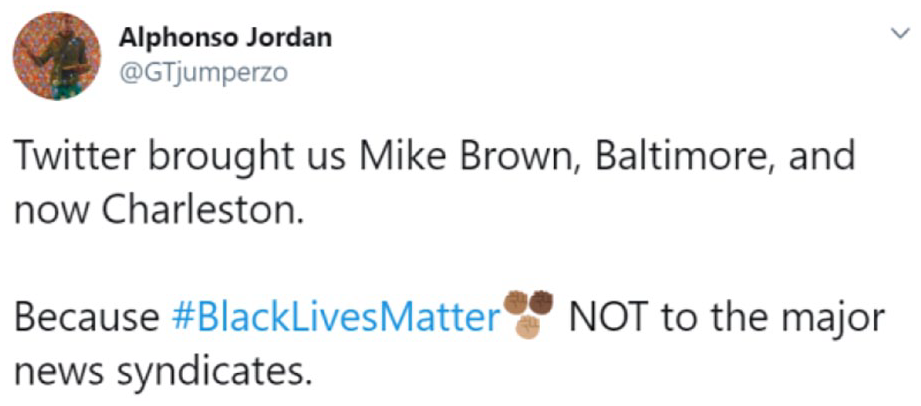
Importance of Twitter.

Importance of social media.
Other criticisms came in the form of disapproval of the judicial system and suspected cover-ups by police departments. Some activists took the National Rifle Association (@NRA & @DLoesch) to task on their reticence to address the killing of Philando Castile, who was a registered gun owner. Other organizations and groups that were criticized were churches, political parties, the NAACP (see Figure 11), the BLM organization, and “respectability politics” more broadly. A small portion of activists pointed out issues with the social media platforms they were using. For example, the #SandraBland hashtag was temporarily blocked on Instagram to censor hate speech (Fitts, 2015), prompting activists to call out their ineffective methods at curbing these behaviors. Facebook deactivated Korryn Gaines’ livestream during her fatal standoff with the police at the behest of the Baltimore police department, resulting in many activists’ condemnation of the platform’s violation of her civil liberties. There were also questions raised regarding Twitter’s algorithm and ability to elevate/block hashtags from their Trends lists (see Figure 12).
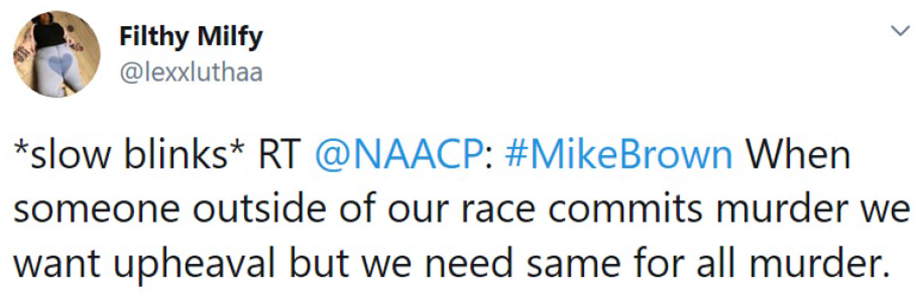
Retweet with comment critically reframing the NAACP’s tweet.
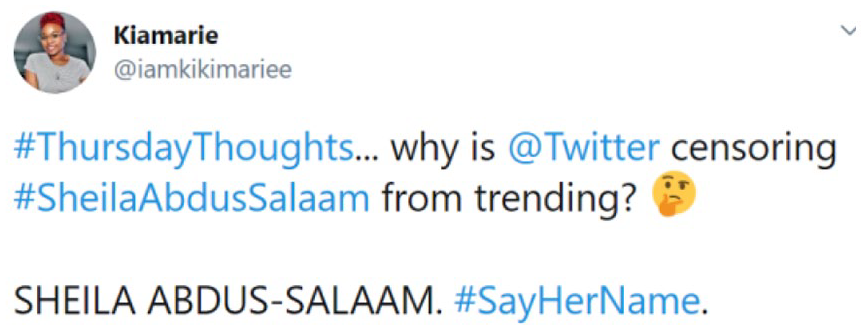
Tweet highlighting Twitter’s algorithmic biases.
Most activists shared a high amount of DI tweets (60.9%) in their tweet streams, followed by those who did not express criticism (19%), then by a low amount (13.6%), and a moderate amount (6.5%). Overall, approximately 81% of the sample shared at least one DI in their tweet stream, making this the least used topos. Such a large portion not discussing issues related to DI or rarely doing so was somewhat unexpected as it was not aligned with findings from other studied movements during which this was more frequent. This could reveal that rather than inherent in DNA, the espousal of techno-libertarian values is more characteristic of protests focused on economic inequality, such as Occupy Wall Street. Another explanation could be related to a preponderance of network-level research on connective action, which results in findings of decentralism on the movement level but breaks apart when examined at the individual level.
Self-Selected Community Action
SSCA tweets related to CTAs and instances of skill/resource-sharing. CTAs were frequently associated with asking people to attend events, get the word out, sign petitions, boycott, and pressure leaders, organizations, and departments. Activists incorporated custom-made digital flyers as well as ones created by small-scale organizations (see Figure 13). Events included rallies, protests, vigils, packing the courtroom, die-ins, flash mobs, walk-outs, and marches. Instructions on how to support efforts on the ground and online were sometimes shared with the broader public (see Figure 14). Links to petitions were connected to the popular for-profit petition site change.org and the non-profit site colorofchange.org. In addition to CTAs, activists tweeted chants and performative texts while participating in protest events.
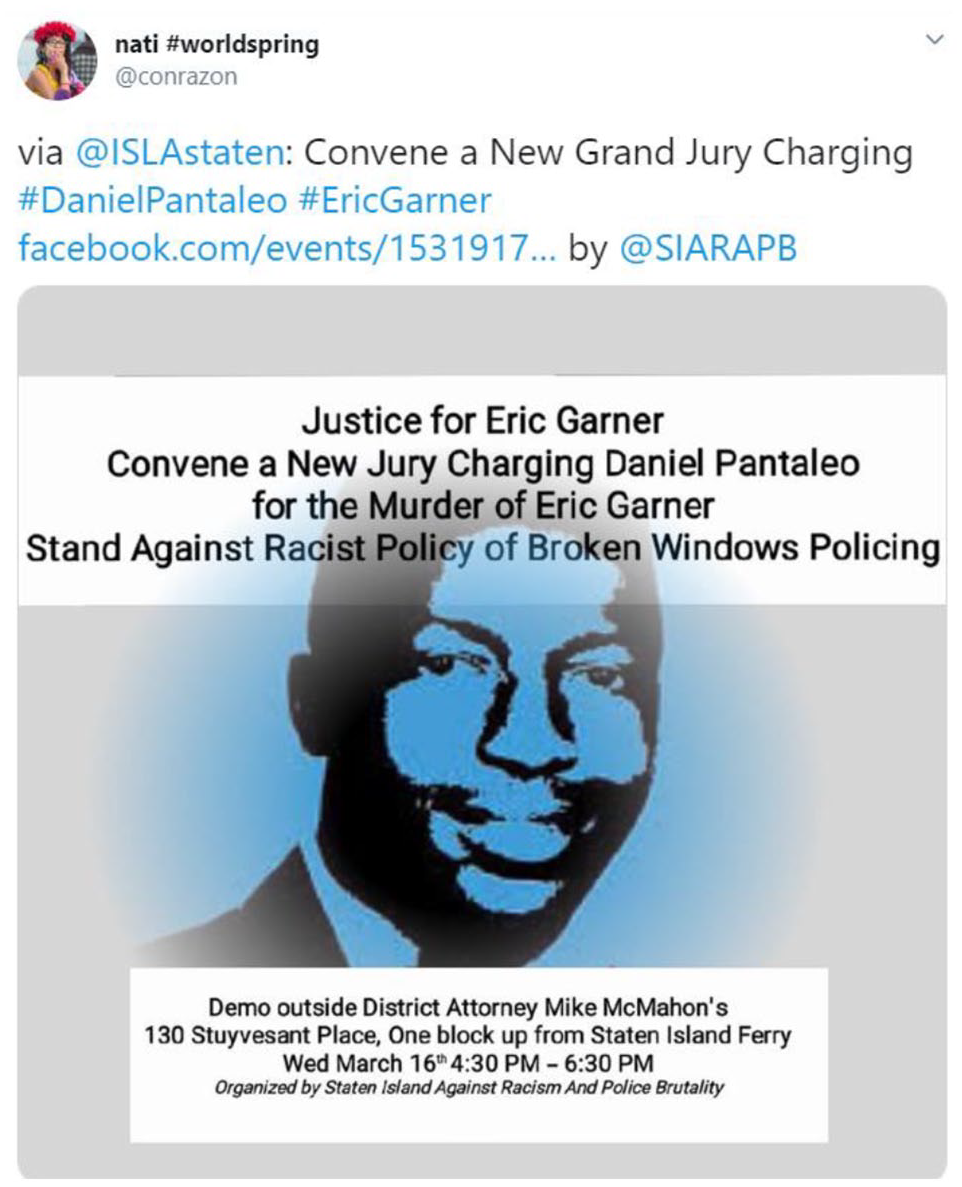
Tweet promoting an upcoming demonstration in honor of Eric Garner.
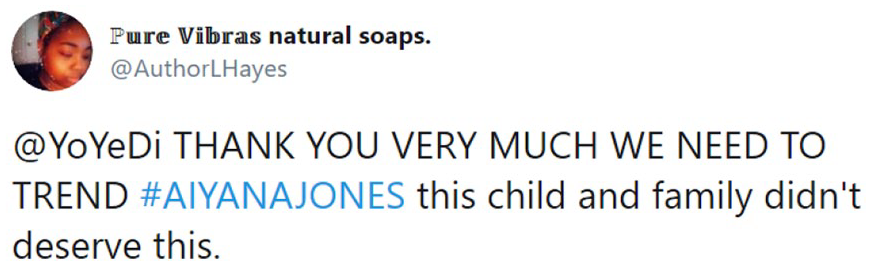
@Reply expressing the need to work together to get the hashtag #AIYANAJONES to trend.
Tactics related to contributions include what I call trolling-lite, defined as interruptions of Twitter norms and netiquette to discursively disrupt systems of power. 9 Examples of trolling-lite in this study included co-opting marketing hashtag campaigns such as #MyNYPD and #AskACop to discuss BLM issues and expose police hypocrisy (a practice known as hashjacking; Bode et al., 2015); jumping on law enforcement tentpole holidays (e.g., #ThankAPoliceOfficerDay, #NationalLawEnforcementAppreciationDay) to point out injustices and engage in wordplay to delegitimize police credibility (e.g., #KKKillerCops, BlueKluxKlan, Blue Lives Murder, and KKKop); encouraging/engaging in tweetstorms (sending tweets in rapid succession to gain awareness); counting down to put pressure on individuals’/departments’ distraction tactics (see Figure 15), indecision, and cover-ups; and flooding police-managed @handles. Another aspect that might fall under trolling-lite, but was associated with the hacktivist group Anonymous, was Operation KKK/#OpKKK; an attempt to identify/dox (i.e., virtually “unhood”) active Ku Klux Klan members (Rao, 2015, see Figure 16).
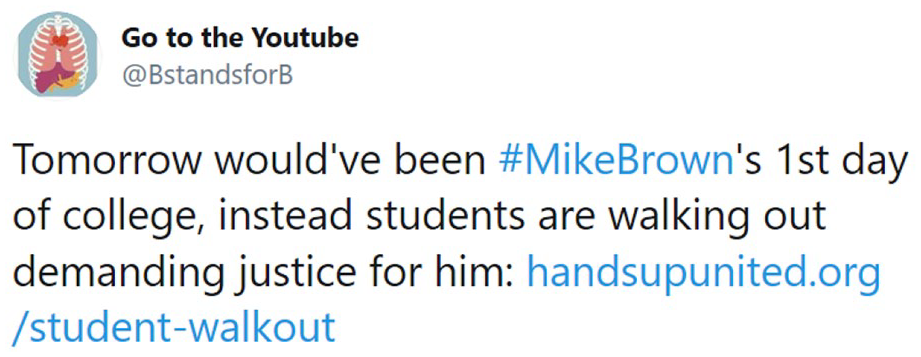
Countdown tweet.
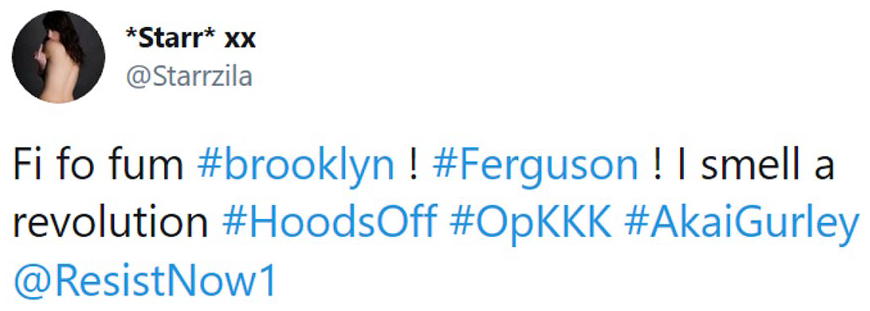
Trolling-lite tweet aligned with Anonymous initiative.
Skill sharing came in various forms, including the creation, remixing, and dissemination of songs and artwork. For example, activists interrupted the St. Louis Symphony by singing “A Requiem for Mike Brown.” On a smaller scale, individuals performatively composed songs, parodies, and poetry on Twitter (see Figure 17). Artwork shared and documented included paintings, graphic designs (see Figure 18), and murals.
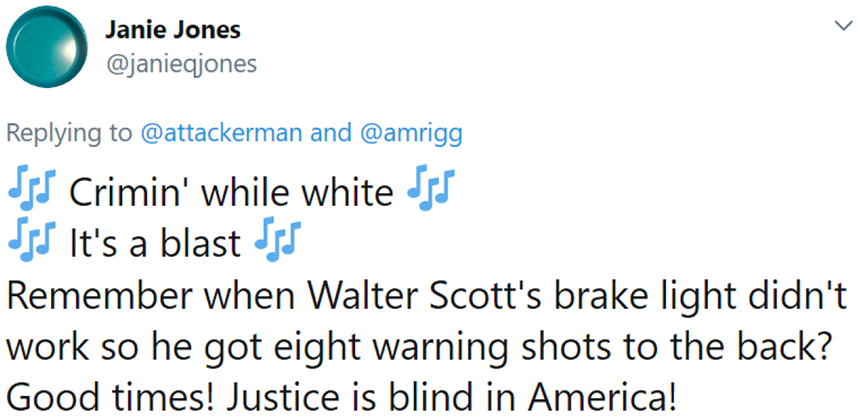
Tweet composed as a short parodic song.
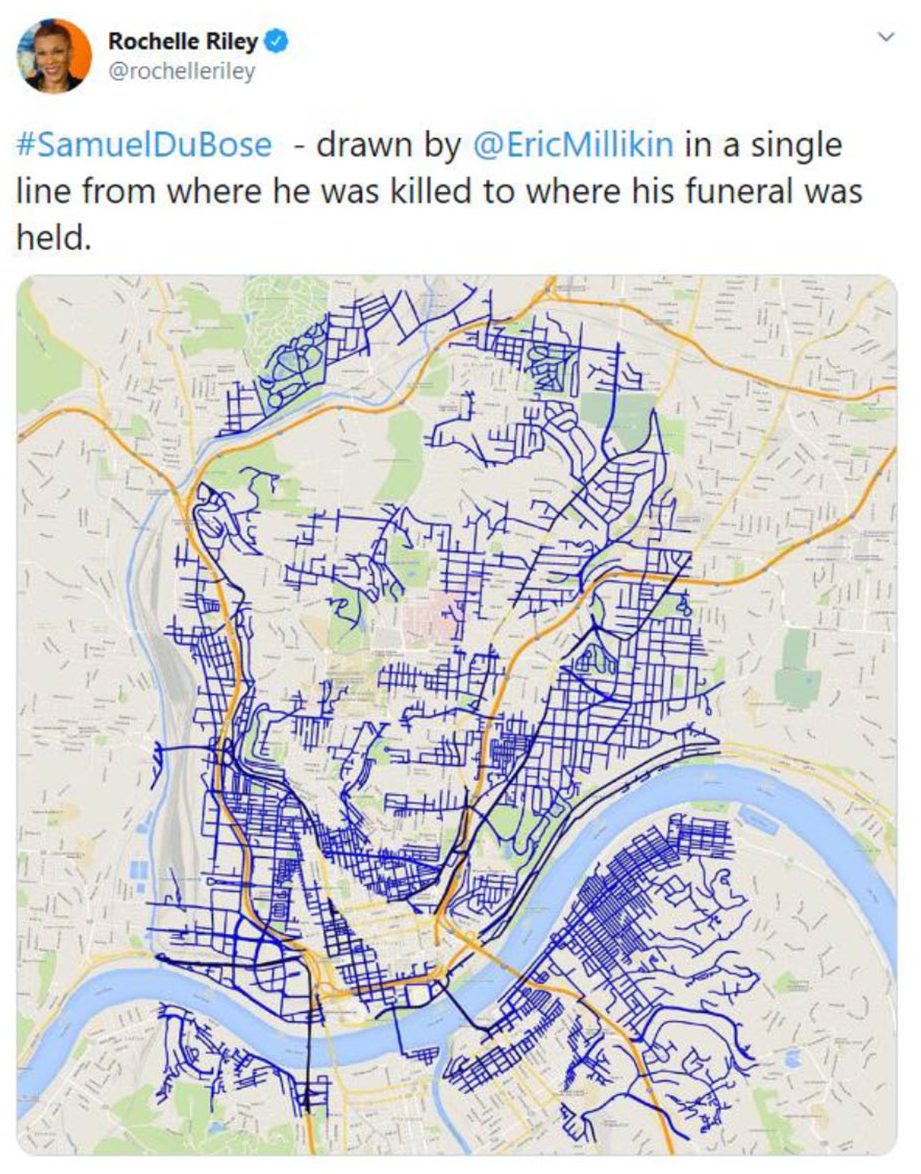
Tweet promoting another user’s artwork honoring Samuel DuBose.
The majority of activists shared a high amount of SSCA tweets (51.6%) in their tweet streams, followed by a moderate amount (20.7%), a low amount (16.8%), and not at all (10.9%). Overall, approximately 89% of the sample shared at least one SSCA tweet.
Twitter Affordances
All activists used Twitter engagement affordances, including the retweet (161 users retweeted), #hashtag (177 users used at least one hashtag), @handle (168 users used at least one @handle), and link (177 people used at least one link). Also, while not in-app features, various community-created practices common across Twitter in general were incorporated by BLM activists, including the cc and the via (a method of attributing the original tweeter). The three affordance topoi discussed below were all quantitatively measured as the ratio of the total number of retweets/#hashtags/@handles divided by the total number of movement-related tweets sent.
Retweets
Retweets (M = 0.175, SD = 0.148) were mainly used to add commentary or solidarity to another user’s/group’s/media outlet’s thought or information share. In addition, some activists retweeted their own tweets to either add more context or make a statement that the situation involving police brutality had not changed (see Figure 19).

Example of retweeting one’s self.
#hashtags
#hashtags (M = 1.40, SD = 0.929) included digital memorials comprising hashtagged lists of those killed by police (a finding also found by Freelon, 2017), tragically described by one user as “counting the dead” and another as “cyber cemeteries,” exposing the stark reality and emotional labor required in communicating the core demand of BLM. Addressivity markers such as underscores and ellipses were sometimes repurposed in hashtagged lists in performative ways to indicate the endless cycle of police brutality, rather than for their original metadata function (see Figure 20).

Activist using ellipses to emphasize the endless cycle of police brutality.
BLM folksonomies were created to bring focus to different issues or aspects within the movement, such as #SayHerName to draw attention to self-identified Black female victims of police violence, #ICantBreathe to quote Eric Garner’s last words while in the police chokehold that would take his life, and #CharlestonSyllabus to crowdsource reading recommendations/information on racial inequality, Black history, civil rights, and other related issues. Some hashtags revealed the requirement of consistent activism over time, such as #IStillCantBreathe, #NeverForget (often used on the anniversaries of the victims’ death two, three, four, etc. years after they were killed), and #HerLifeStillMatters, #SandyStillSpeaks, and #WhatHappenedToSandraBland (which started in 2016 to raise questions and provide information regarding the suspicious circumstances of Sandra Bland’s death by suicide in 2015).
Figure 21 displays a word cloud of the hashtags tweeted in the sample weighted by frequency of use. Hashtags such as #IndiaKager, #VBPD, #Swat, and #Innocent gained prominence mainly due to the work of India Kager’s 10 mother, who tweeted 2,630 movement-related posts in the sample. Part of her strategy was to repeat the same messaging and hashtag several words in the tweet to increase exposure as well as serve as a consistent poignant reminder of her grief and vigilance.
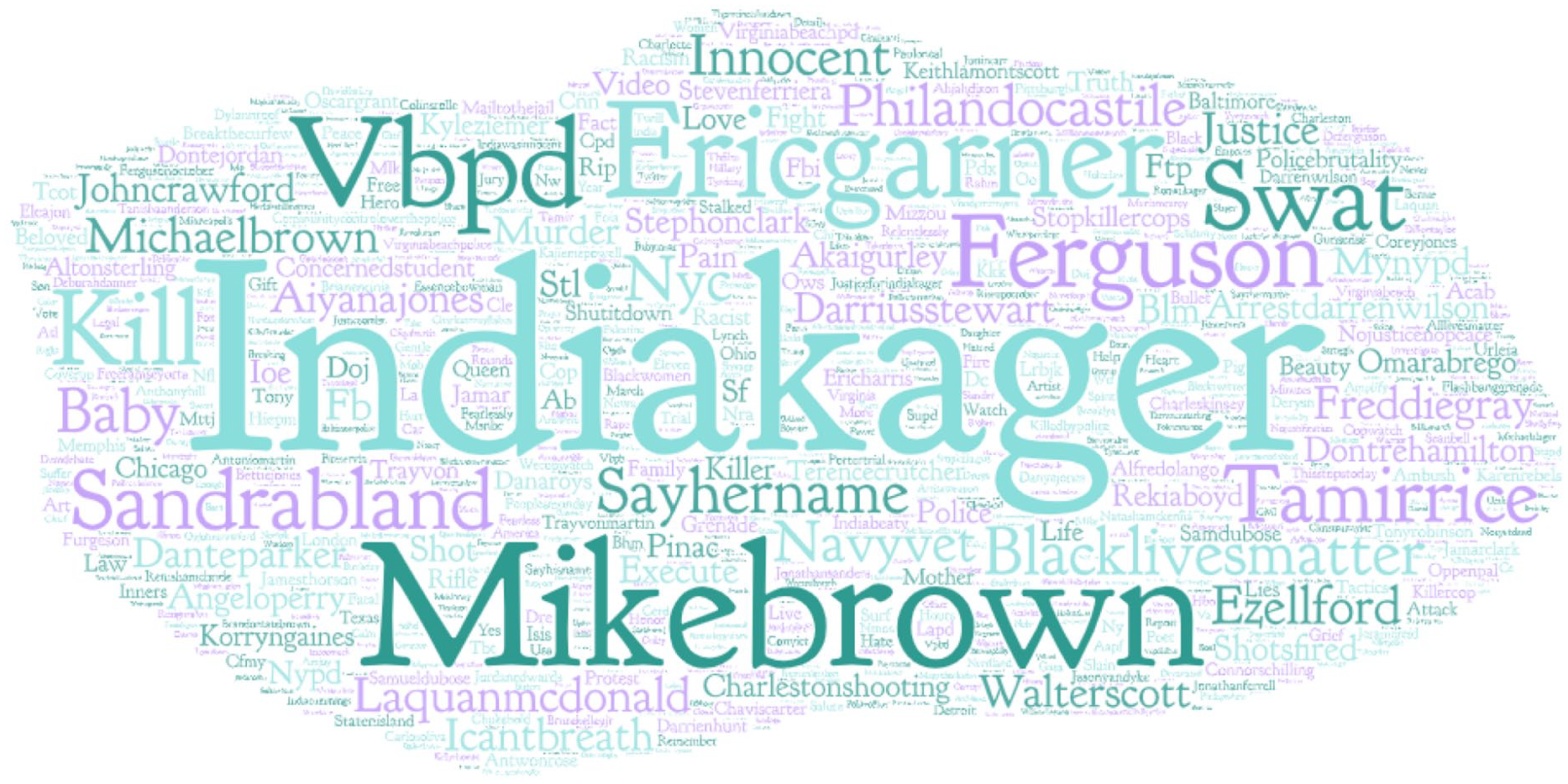
Word cloud of hashtags used in the sample weighted by frequency of use.
@handles
@handles (M = 0.392, SD = 0.358) were mainly used to @reply another individual in a conversation, attribute the person who composed the content in a retweet, or @tag someone to get their attention or criticize them. Attention-grabbing @tagging primarily came in the form of alerting other Twitter users to new information; getting the attention of high-profile users/organizations such as celebrities, media personalities/journalists, or news outlets; and/or putting pressure on police chiefs, police departments, district attorneys, governors, and so on. Popular crowdsourced leaders who were @tagged included BLM activists such as Shaun King, DeRay Mckesson, Johnetta Elzie, and Eric Garner’s daughter Erica Garner. Connection (either by @handles or URLs) to established organizations was low (only 65 tweets out of 17,411 tweets in the sample), but included the Revolutionary Communist Party, ACLU, and different democratic representatives such as Bernie Sanders.
Dynamic Integration Level
DIL (M = 1.62, SD = 0.979) was measured on a scale of high, medium, low, or none. High was selected if the core user utilized five to six different resource link types, medium if they used three to four different resource types, and low for one to two different resource types (see the “Dynamic Integration Level” section under the heading “Topoi Identification” for a list of resource types). Like Bennett and Segerberg’s (2012) observation, activists linked to several different types of websites to varying degrees. Those who exhibited a high diversification of link sharing comprised 22% of the sample, 31% had a medium amount of diversification, 33% showed a low amount, and approximately 14% did not incorporate any functioning external-linking URLs (although these links could have been broken or embedded in a retweet). However, unlike Bennett et al.’s (2014) observation in the Occupy Wall Street network, activists did not often link to webpages related strictly to the movement organization or chapter affiliates (i.e., links to http://blacklivesmatter.com comprised 1% of all external-linking URLs). Figure 22 displays a percentage breakdown of source type linking.

Pie chart presenting the usage percentage of the seven coded website types.
A few link types not directly discussed in the literature included links to public-facing collaborative file hosting services like Google Drive and Dropbox and links to church websites. Some users posted from third-party applications, such as Hootsuite (a social media management tool), Buffer (a social media management tool), Feedly (a website aggregation tool), and/or newsletters. Utilizing Twitter’s stitching potential, several activists linked to standalone websites outside of Twitter as well as cross-posted from Facebook and Instagram. Some activists shared news links shortened by the Facebook URL fb.me, revealing that users most likely received their news while on Facebook and posted directly from there to Twitter.
Emergent Topoi
There were also digital tactics not commonly discussed in the literature that emerged during analysis. One was the creative ways individuals reduced their character count in their tweets, which during the peak of BLM’s network activity in this study was restricted by Twitter to 140 characters. 11 Practices of creative communication included combining words, incorporating shorthand (e.g., WoC = Women of Color, IDC = I don’t care, FOH = fuck outta here), using images of messages (which allowed them to include large amounts of text without having it count against the 140 character count, see Figure 23), and numbering tweets to organize them both in one’s own thread as well as other people’s streams.
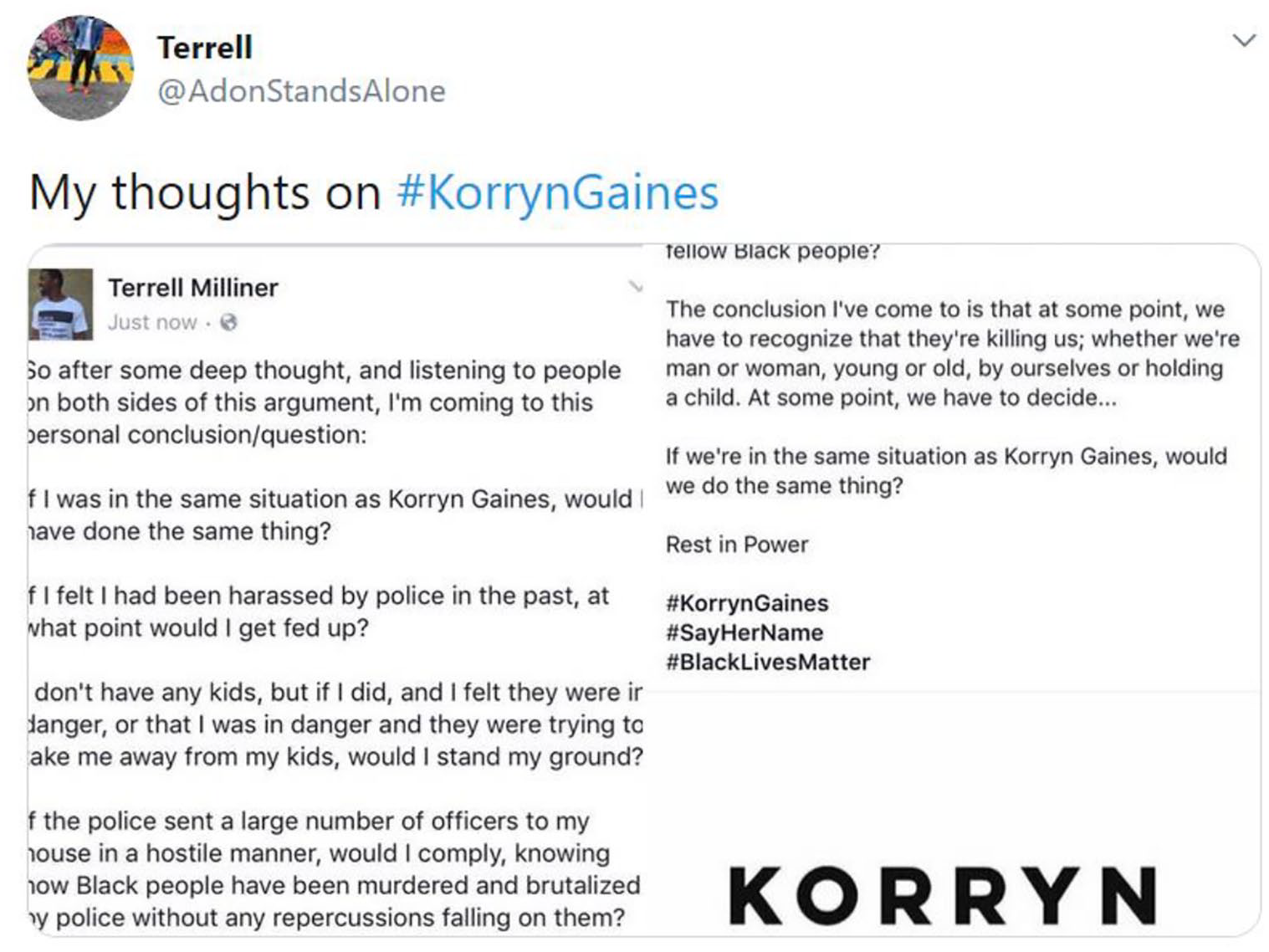
Cross-post with image of Facebook post.
There were also times when people were not strict on the character count, incorporating clever uses of spacing and line breaks most likely to catch readers’ attention and communicate a clear message (see Figure 24). Additional methods of boosting visibility of a tweet included attaching messaging to general tentpole holidays/events, trending hashtags, and/or loosely related news reports; incorporating attention-grabbing tweet introductions (e.g., Breaking, Live, Fact, Alert; see Figure 25); using CamelCase for hashtags (implementing capital letters to signal word boundaries, a method commonly used to help to enhance readability; Mott, 2013); embedding images, videos, memes, and so on; and using punctuation, such as a period, in front of a tweeter’s @handle when replying to someone (e.g., .@BaltimorePolice). The .@ was a well-known Twitter tactic used before the institution of the reply button. Before Twitter offered the reply feature, .@ ensured a tweet that began with someone’s @handle was treated as a standalone post rather than being categorized as a reply, which resulted in it being automatically hidden from a tweeter’s timeline (Ulanoff, 2016).

Tweet with line breaks.

Tweet demonstrating the use of attention-grabbing real-time language.
Digital tactics also included repetition, emoji incorporation, and attaching media. For example, activists often replicated the same text to get victims’ names to trend (see Figure 26). Media attachments (e.g., images and videos) not only allowed visual content to be directly embedded into the tweet (i.e., inline images), which is known to aid in grabbing a viewer’s attention and conserving word count, but it also has been documented as a method for increasing impressions and reach on Twitter as it is favored by the algorithm (Gotter, 2019; Widrich, 2011).

Tweet repeating the victims’ hashtagged name to boost message dissemination.
Discussion
The results of the analysis discussed above revealed that BLM activists’ tweets matched closely to the hallmark characterizations of DNA and comprised a distinct topology. Specifically, activists created and shared PAFs, news reports, and CTAs, stitching them together across networks and within Twitter through links, retweets, hashtags, @tagging, and cross-posting, which confirms the findings that have been uncovered over the last decade in the DNA literature. Through this digital labor (i.e., the communicative efforts and actions performed by participants on Twitter), collective subject positions were created with Twitter (e.g., #BlackLivesMatter, #SayHerName, #ConcernedStudent1950), which were then used to bring people together against oppressive systems allowing racial profiling and police brutality. And then, through these subject positions, individuals, the crowd, and small-scale organizations collated the hegemonic resistance (e.g., protests, boycotts, sit-ins, flash mobs) that took place.
From the initial finding, that the confirmatory classifications (i.e., topoi) align with the DNA within the BLM movement, I unearthed several deeper observations from patterns found in the data. In the following section, I discuss key takeaways that were discovered during this analysis. There is also attention paid to the instances in which the rhetorical actions of activists did not fit into the topology as it was defined. This process demonstrates that the purpose of this proposed DNA topology is not to fit square pegs into round holes but to illustrate the flexibility of this methodological application, open the door for theoretical expansion and fleshing out of findings across DNA literature, and reveal the importance of close reading at the individual-level which are often not explored in platform-level network analyses that provide sweeping overarching definitions.
Crowd Action Framing as Gatekeeper
Examination of the PAFS topos supported the conclusion that collective identity building took place, not through persuasion, but by earnest communication and story sharing at both a personal/individual and a crowd level. Personalized identity-building characteristics aligned with previous observations documented in the literature and involved language that was diverse, highly personal, and encouraged individuality.
However, there were also communicative elements that did not fall under individual-level or organizational/network-level identity construction (common in traditional collective action theories). Like Grömping and Sinpeng’s (2018) finding that a tonality difference exists within more personalized and collective communication styles, I, too, observed a shift in tone that seemed to be functioning differently within identity construction. It is here that I would like to offer an expansion to the PAFS topoi in the form of crowd action frame sharing. While one could easily assign this move from me to we as a hybrid aspect of DNA, the ubiquity of these linguistic elements from BLM activists in this sample and its potential to expand extant collective identity paradigms more broadly warrants dedicated explication and discussion.
Crowd-level identity-building involves communicative framing that is not as diverse as traditional personal action framing nor as strict as collective action framing. This idea builds on Melucci’s (1995) theory of collective identity, specifically the constitutive tradition, that a group’s actions define the identity for the members themselves, evidenced by specific rhetorical actions (Foust & Hoyt, 2018). In this sample, crowd action frames came in the form of rhetorically maintaining Black identity within #BlackLivesMatter on Twitter, which enabled a movement that was inclusive but also distinctly Black.
One example of this was through activists’ expression of grievances using collective tonality that relied on relational support and group affirmation. This rhetorical maintenance of Black identity, in turn, cultivated a loose top-down structuring of collective rhetoric that allowed it to serve in a gatekeeping capacity that was not solely predicated upon personalized characteristics nor organizational alignment. Another example was found in the consistent inclusion of links to Black media sites such as The Root, The Grio, Colorlines, Global Grind, Essence, Blavity, Huffington Post’s Black Voices, and Atlanta Black Star, which contributed to a crowd-level identity rooted in the Black experience. While not requiring gatekeeping prior to action (which often occurs in traditional collective action), checks and balances happened in these types of tweets through the promotion of digital norms and accountability. In this way, a discursive space awareness was created around a loose collective we that was managed by a Black-led anti-racist collectivity.
This type of rhetorical gatekeeping functioned alongside PAFs, with people attaching their own meanings to the movement, often through their role as a parent, community participant, student or alumna/us, and so on. As Papacharissi (2014) describes, PAFs can mobilize others by “connectively rendering open signifiers that invite and contain personalized manifestos for action rather than dictate a single one” (p. 72). In this study, BLM activists established both a fixedness and an openness through the combination of crowd action frames and PAFs, intermixing the I with specific types of we, us, and ours. In this way, #BlackLivesMatter offered a space for individuals to attach meaning and the crowd to set discursive boundaries (or gatekeep), both of which were not at the direction of organizations, celebrities, or leaders but produced some of the same results.
One takeaway from this is that DNA movements can include ideological commitment without the necessity of group membership as well as leave room for invitation and personalization. Another is that the enablement of these identity formations created through and during the communicative action processes created by advocates themselves, with the aid of social media, may have helped sustain BLM and position it to set off the material consequences we are seeing today (e.g., the resurgence in the public’s attention to the movement, cities’ consideration to defund the police and reform policies, officer indictments and firings).
Importance of Affective Attunement
Similar to Papacharissi’s (2014) finding, BLM advocates participated in tweet linking, endorsing news items, and uploading/sharing videos, which, as she explains, attune users to “feel the movement for themselves” (p. 94). Affective attunement was also showcased off-platform through the composition of BLM tribute songs and activist performances. While not seen specifically in this study, impactful BLM-inspired contributions have included Childish Gambino’s “This Is America” song and music video (where he juxtaposes songs/dances that have gone viral because of the internet with gruesome acts of violence against Black Americans), Spotify’s Black Lives Matter playlist which links to the Color of Change’s current campaign initiatives, Run the Jewels’ early release of their album RTJ4, the 2013 movie Fruitvale Station, the popular Netflix show Dear White People, the 2016 miniseries Spike Lee’s Lil’ Joints, the documentary 16 Shots, and the innovative film American Trial: The Eric Garner Story, which uses non-actors and real community members in the retelling of the events relating to Eric Garner’s death (DeFore, 2020), among many others.
These cultural productions spotlighting various aspects of BLM have not been seen on the same scale as early DNA protests such as Occupy Wall Street and the Arab Spring, where activists primarily demonstrated attunement digitally through liking a post, uploading/sharing a video, creating memes, and so on (Papacharissi, 2014). As these movements served as the exemplars for Papacharissi’s identification of Twitter as an affective mechanism, one could look at BLM as an illustration of the digital, visual, and aural ways affective processes commence in second-wave DNA protests (takeaway number two). At the very least, one can see BLM as a setting where music, video, and Twitter streams could converge into an affective tributary of protest movement flow, allowing participants and activists to place themselves in the movement.
Creative Circumvention of Platform Determinism
Twitter’s restrictions of character count and other “pay to play” requirements (i.e., using Twitter’s in-app tools to gain broader exposure through the algorithm) appeared to have facilitated creative ways to circumvent algorithmic control and combat platform determinism (takeaway number three). Instances of this were found in their reworking of socially charged terms/phrases, repetition of content and victims’ names, posting images of text to expand the allotted Twitter character count, and the use of wypipo and other words to thwart censorship (as the phrase “white people” in particular has been flagged as hate speech by social media platforms; Smalls, 2018).
Galis and Neumayer (2016) make an interesting interpretative contribution to these types of platform resistances. Labeling the subversion of mediated images, texts, and symbols of corporate social media platforms as détournement, the authors state that these actions can reconstitute the material conditions of protest in cyber-material resistance, which then allows activists to combat state repression and economic power. Based on concepts such as détournement and my findings of activists leveraging non-traditional affordances (e.g., stacking retweets), nuanced digital tactics (e.g., using attention-grabbing language), and syntax (e.g., .@), there seems to be an opportunity to investigate these concepts further.
A Deficit of DI
The fact that activists did not regularly express techno-utopian ideals in the way I anticipated elicited the takeaway that DI communication might not be as transferrable a concept as once thought (takeaway number four). This lack of promotion of leaderlessness of all kinds and other related communications could be connected to the role of materiality. For example, as oppression and domination were part of BLM activists’ lived experiences, there might not have been room for verbally reflecting on abstractions of democracy. Or, maybe the conceptualization of communicating DI is too rooted in a White Western paradigm that it simply is not an appropriate component of DNA if it is to be applied as a framework across cultural contexts. The lack of this communication in this study sheds light on issues with presuming democracy within studies of social movements, which Ott (2011) points out, is a habit of rhetorical studies in the United States. As Snorton (2009) so clearly puts it, “clamoring for ‘more democracy’ to solve a ‘crisis in democracy’ exhibits a narrow nationalist framework to interpret the uneven deployments of democracy in the U.S. past” (p. 32). This takeaway leads me to preliminarily suggest that the heuristic presented in this study be tweaked in future applications to reflect broader conceptualizations that challenge the Whiteness of democracy (and maybe remove DI as a topos in the topology altogether).
Digitally Networked Actions Have [Connective] Consequences
Intertwined in many of the topoi discussed were obstacles that activists constantly encountered during their digital activism. The difficulty of these actions was brought even more to light when considering the results of my parallel study (Alfonzo, 2020). In my quantitative operationalization of the outlined topoi, I discovered a unidimensional structure to be the best fitting model for measuring BLM activists’ protest actions. This reveals that within the sample, you might have one person creating content; helping with organizing protest assemblies/events; sharing news stories; vetting information; providing analyses; filming instances of police brutality themselves; viewing raw and often graphic video footage; putting pressure on officials and departments; persevering over weeks, months, and even years; and participating in digital activism in an always-on environment. While these analyses explain how personalized communications can motivate others and prompt action in the network, the sheer number of these various efforts also displays how taxing online activism can be and exposes the pressure that comes from activists shouldering the burden once carried by established entities associated with collective action protest.
News reports that activists tweeted in this study, stories that circulated more broadly, and continual instances of police brutality have shed light on some alarming potential consequences of BLM activism. Since this study, three BLM activists have committed suicide and prominent figure Erica Garner (daughter of Eric Garner), who openly discussed the stresses of her activism, died of a heart attack at just 27 years old (Salter, 2019; Wang, 2017). In addition, Eric Garner’s widow, Esaw Garner, reported that she has been harassed by police and lives in fear of their contact, recalling being addressed as “the bitch that had Daniel Pantaleo fired” by one officer (da Costa, 2020).
Specifically having to film instances of police brutality (i.e., sousveillance) has also proven to be a risky and emotionally taxing endeavor. Ramsey Orta, the person who filmed Eric Garner’s death and the main reason “I can’t breathe” reached the ears of the broader public, has discussed constant harassment from the police (Mark, 2019). Kevin Moore, the person who filmed Freddie Gray’s death, has expressed anguish over having to record Gray’s last moments and watch the involved police officers’ acquittals (Woods, 2016). Recently, Darnella Frazier, who captured the crushing and fatal restraint (and horrifically similar last words of “I can’t breathe”) of George Floyd from officer Derek Chauvin, has posted on Facebook that she has been harassed online (Nevett, 2020). Then there were the auto-replays and digital memory reminders (e.g., Facebook’s “on this day,” Snapchat’s “one year ago today,” and Twitter’s “in case you missed it”) of these videos that proliferated activists’ feeds. These occurrences illustrate that while sousveillance and video evidence provide credible footing to combat police narratives and conduct, there are also emotional and physical costs paid by activists.
The threat of being injured, arrested, or fined was another very real consequence faced by activists. For example, mass arrests such as those during the Ferguson protests show the risk that activists took to show up and be present (Gambino, 2014). One extreme instance of this was the litigation taken against Mckesson by a Baton Rouge police officer. Mckesson was sued for damages during a traffic shutdown demonstration to protest the killing of Alton Sterling, during which a police officer was struck and injured by a rock. As a prominent BLM organizer, Mckesson was charged on the grounds that he should have foreseen the possibility of violence (Lang, 2019).
There was also the obvious double-standard of arrests and brutality across racial lines at protests. This keeping the peace duplicity has been made even more apparent through the recent demonstrations against states’ stay-at-home orders during the COVID-19 pandemic, which largely involves White Americans (Branson-Potts et al., 2020). Pictures of White demonstrators strapped with AR-15s (Ecarma, 2020), confronting police barricades, and yelling and threatening officers (Brown, 2020), all while defying their state’s lockdown orders, provide a sharp contrast against police response to BLM where activists were likely to encounter tear gas, rubber bullets, pepper spray, and mass arrests.
On the social media side of things, there were digital onslaughts that activists contended with (e.g., trolling, slander, defamation, antagonistic hashtag campaigns such as #AllLivesMatter). With these on- and offline consequences, it seems like, rather than “slacktivists” (Gladwell, 2010), today’s activists are tasked with an even heavier burden to carry (which I am collectively calling “connective consequences”). There are requirements to be “in it” with other protestors on the ground, interface with people online, educate the masses, produce sound bites for the media, share pieces of their authentic selves, encourage people to participate, organize events, rallies, vigils, and so on, combat digital trolls and counter-protestors, dodge tear gas canisters, and risk arrest, among so many other requirements. Observations of these increased duties and associated levels of stress led me to my final key takeaway and closing question: Does the individuality inherent in building and sustaining a viral movement lead to higher individual-level costs (mentally and physically), and if so, how can these tolls be mitigated while also preserving the horizontal nature of DNA?
Conclusion
The DNA topology outlined in this study provides an index for the participatory activity of online activists, which can be used by scholars interested in exploring the ways rhetoric and digital actions help identify friend/enemy subject positions that encourage others’ participation. The technique of developing and tracing topoi, which was done by consulting DNA literature to deductively create a set of categories and applying those categories to the tweet streams of BLM activists, contributes to the current scholarship as well as, hopefully, spurs scholars to build on the interpretations I have unearthed. In addition, this method illustrates how thick description can function alongside a more systematic analysis.
This study also spoke to the larger issue of the risk and labor associated with digital activism. On one hand, DNA can be an effective approach for combatting hegemonic systems of power by mobilizing others through flexible identity framing that does not require strict ideological positioning. On the other hand, with a more crowd-enabled movement comes increased individual exposure, which can be detrimental to individuals’ social and emotional well-being. Emerging literature has started to reveal the various risks that activists face. For example, Freelon and colleagues (2020) have recently uncovered aspects (i.e., digital blackface and astroturfing) involved in specifically targeting Black people for malicious propaganda efforts uncover some of the barriers associated with BLM activism. However, this research area is still in its infancy, and there are many different avenues researchers could take to further explore risks activists encounter when involved in DNA.
Ultimately, I hope that this work serves as a resource for activists seeking to understand how their political engagement influenced the creation and maintenance of the BLM network. Sadly, continued instances of police brutality have placed BLM back into the national spotlight. While the high-profile deaths of Ahmaud Arbery, Breonna Taylor, and George Floyd, which have prompted this past year’s renewed public interest, are vile and heartbreaking, the years of groundwork laid down over the last 6 years have created a major turning point for the movement. Although I was not able to include tweets from 2020 and 2021 in this study, the findings illustrate consequential rhetoric at work in that this resurgence of support and awareness surrounding BLM did not just happen overnight or even in 2020 but because of activists’ tireless efforts over several years. It also provides a point of reference from which to compare activists’ strategies and tactics during peak activity from 2015 to 2017 (the pre-2020 years during which BLM Twitter activism was at its height) against the resurgence of activity of 2020–2021, which would be an important longitudinal approach to pursue in future scholarship. One might also include analysis of communication over the performative focused platform TikTok, which has played a key role in BLM activism over the past year, especially among younger activists (Research3 Insights, 2020).
Overall, this study’s insights and takeaways provide evidence that sustained online persistence of core activists facilitated the flow of information and identity construction that has resulted in a movement that is still clearing space for justice and putting pressure on systems of oppression and inequality against Black individuals, which can hopefully be used by BLM organizers in some capacity in their future efforts.
Supplemental Material
sj-docx-1-sms-10.1177_20563051211025514 – Supplemental material for A Topology of Twitter Tactics: Tracing the Rhetorical Dimensions and Digital Labor of Networked Publics
Supplemental material, sj-docx-1-sms-10.1177_20563051211025514 for A Topology of Twitter Tactics: Tracing the Rhetorical Dimensions and Digital Labor of Networked Publics by Paige Alfonzo in Social Media + Society
Footnotes
Acknowledgements
The author thanks Drs Christina Foust, Lynn Schofield Clark, and Denis Dumas for their comments on previous drafts. She also thanks Black Lives Matter activists for their permission to directly quote and use images of their tweets.
Declaration of Conflicting Interests
The author(s) declared no potential conflicts of interest with respect to the research, authorship, and/or publication of this article.
Funding
The author(s) received no financial support for the research, authorship, and/or publication of this article.

Supplemental Material
Supplemental material for this article is available online.
Notes
Author Biography
References
Supplementary Material
Please find the following supplemental material available below.
For Open Access articles published under a Creative Commons License, all supplemental material carries the same license as the article it is associated with.
For non-Open Access articles published, all supplemental material carries a non-exclusive license, and permission requests for re-use of supplemental material or any part of supplemental material shall be sent directly to the copyright owner as specified in the copyright notice associated with the article.
