




Abstract
Following Miller, who looked at offline performance capital for musicians and discovered important gender and genre impacts, we examined the role of gender and genre in the development of performance capital for YouTube top cover song artists. This case study suggests that online performance capital on YouTube is slightly different than offline performance capital, and benefits from the affordances of networked media, and specifically YouTube. While there is some gender-based homophily in channel linking behaviors, there are also connections between weakly tied individuals with respect to video category, meaning that musicians are linking to others outside of the music community and vice versa. While music video channels tend to link to other music video channels, and non-music channels tend to link to other non-music channels, the most popular videos tend to post from multiple categories including both music and non-music. Findings suggest that being a long-time poster and having a rich and diverse network are likely elements of building performance capital for YouTube musicians.
Introduction
Bourdieu (1984) noted that when a person wants to gain status within their community(ies), they tend to draw on three types of capital: economic, social, and cultural capital. Economic capital refers to an individual’s ability to access monetary and similar resources. Social capital means the quality and quantity of social connections a person has to draw on. And cultural capital refers to the skills, training, and education a person has in their background. These three capitals often influence each other. For example, if someone is rich in social capital, they may be able to use their wide network of social connections to increase their economic or cultural capital. Building on the concepts of social, cultural, and economic capital, scholars who study individuals with performance-based careers (e.g., politicians, athletes, or musicians) have noted a subtype of social and cultural capital unique to performers called performance capital (Bush, 2016; Davis & Seymour, 2010). Performance capital includes social and cultural capitals within specific genre, sport, or sectoral conventions, and importantly also include the need to perform cultural and social capital for a large and often public audience (Bush, 2016; Miller, 2017). Notably, there is little literature on performance capital in an online environment, even though many performers now grow their audience using social media platforms like YouTube (Baym, 2018). This is a noticeable area for growth since in the years after the concept of social capital was introduced, it has been increasingly employed to understand new media technologies (e.g., Wellman et al., 2001). Despite this, studies have not examined what role, if any, online social networks can play in the development of performance capital for musicians.
YouTube has been suggested as one of the most popular social media platforms for uploading and sharing music (Liikkanen & Salovaara, 2015). YouTube helps to facilitate the development of parasocial interactions between a performer and their audience, which can increase the loyalty that audience members have toward a given YouTube artist (J. Kim et al., 2018). In addition, sites like YouTube help to level the playing field for musicians who are interested in reaching a global audience, because it allows them to record and broadcast their work with little economic cost (Hracs, 2012). Furthermore, since YouTube is driven by the connections between individuals in communities—more like a social network than simply a video sharing site—it enables musicians to build a personal brand (Preston & Rogers, 2012). While theoretically YouTube fame is open to everyone, scholars have noted that YouTube has become a less democratic medium over time, putting new pressures onto musicians who use it to reach their audiences (Hesmondhalgh et al., 2019). Since YouTube is an important emerging media source, and since musicians are now facing new challenges when growing their audience on this platform, we are interested in studying how musicians navigate the unique affordances of the medium to create online performance capital. Given the way that gender impacts the construction and maintenance of performance capital in the music industry generally speaking, we are especially interested in examining the role of gender as part of the online performance capital of musicians on YouTube.
In this article, we draw upon the literature on social, cultural, and performance capital to understand how online performance capital might be created by musicians who use YouTube to share their music and connect with others. We test a sample of YouTube cover musicians using a social network analysis to determine how musicians are constructing online performance capital on YouTube and whether the construction of online performance capital on YouTube is subject to gendered effects. This article begins with a literature review on YouTube and the music industry, then discusses social, cultural, and performance capital, and the role that online social networks like YouTube play in the development of social and cultural capital. After a review of the literature, we outline our methodology and discuss the findings. Finally, we analyze our findings to highlight how YouTube as a “field” encourages unique strategies for musicians who use it to develop online performance capital.
Literature Review
YouTube and Music
Research suggests that originally, unlike some other video streaming sites, YouTube possessed an underlying folksonomic character, driven by connections and interactions among video posters, subscribers, commenters, and lurkers (Cheng et al., 2008). As a result of this, social networks often drive the popularity of YouTube videos in such a way that the music industry has changed how videos are produced to fit the particularities of this medium (Cayari, 2011; Edmond, 2014; Preston & Rogers, 2011). This includes creating unconventional music video content (Edmond, 2014) that is “spreadable” (Jenkins et al., 2013) and offloading responsibility for self-promotion and personal branding on to the artists themselves (Preston & Rogers, 2011).
One of the benefits that creators gain from releasing music videos on YouTube has to do with the tremendous global reach of the platform. In contrast to traditional music broadcast formats such as television or radio, YouTube videos can rapidly be shared around the world, as was the case with Psy’s viral Korean (K-Pop) hit Gangnam Style (Baek, 2015; Xu et al., 2015, 2017).
The practice of remix also plays a role in the diffusion of music videos on YouTube. With respect to Gangnam style, described earlier, memetic content (i.e., memes) created by YouTubers and other social media participants were picked up by traditional media sources in ways that both promoted the meme and led people back to the original video (Xu et al., 2016). This type of user-generated content of remixed music videos is referred to by Liikanen and Salovarra (2015) as user-augmented content. Cover songs are a type of remix with respect to YouTube (Navas, 2018). In fact, musicians often record cover songs to attract a broader audience than they could attract with originals alone (Choi, 2017). In this sense, they help to create and communicate a type of cultural capital among a particular field of online musicians. Furthermore, the way users choose to categorize their videos, and the videos that each content creator chooses to add to their favorites list, could be an indication of the communities a YouTube musician wants to belong to, and of intersecting identities that they hold online (Airoldi et al., 2016).
For musicians, but also for other YouTubers, their social, cultural, and performance capital are related to their ability to cultivate their networks on social media sites (Haynes & Marshall, 2018). Social, cultural, and performance capital all play a role in personal branding, which has become an important part of online influence (Khedher, 2019). However, over time, independent musicians have found it harder to make their name on platforms like YouTube. The involvement of the music industry, rather than individual artists, on YouTube over the last 5–10 years has been part of what J. Kim (2012) calls the “institutionalization of YouTube.” This involves the shift of YouTube from a platform that hosts mainly user-generated content posted by independent creators, to a platform that hosts a large amount of professionally generated content, a movement that runs counter to YouTube’s existing mythology of being open and democratic (Hesmondhalgh et al., 2019). In addition, women often face more challenges building audiences on YouTube compared to men, because of online harassment, and also due to the fact that YouTube is a male-dominated field (Boxman-Shabtai, 2019; Gruzd & Mai, 2020).
Social and Cultural Capital
Social interactions are made up of constant vying for status in which people employ the following three different types of resources available to them: economic, social, and cultural capital, to maintain or gain status relative to those around them (Bourdieu, 1984). Economic capital can be understood as the financial resources available to a person, social capital refers to relationships, family, organizational connections and friends, and cultural capital refers to the knowledge and practices within a specific cultural context that allows people to make sense of the world and perform their belonging in it.
Social capital refers to the relationships (number, kind, and quality) that an individual has to help contribute to their standing relative to others. There are two types of social capital, bonding and bridging social capital. Bonding social capital refers to strong ties between closely networked individuals (family and friends). Bridging social capital refers to ties that connect different bonded groups (Putnam, 2000). Whereas strong ties help people to amass resources and support where they need it most (emotional, physical, and symbolic), weak ties help to increase innovation, creativity, and opportunity for people who possess bridging social capital (Granovetter, 1977, 1983).
Cultural capital refers to the knowledge, skills, training, and education that help an individual demonstrate and grow status among their peers (Khedher, 2019). Cultural capital tends to be quite specific to the field or sector that an individual is working in. For example, the cultural capital required for musicians is different than the cultural capital required for actors. Similarly, musicians working in different genres are in different sub fields, meaning the cultural capital needed to play heavy metal, for example, is different than the cultural capital needed in the folk music or country music communities (Miller, 2017). Musical abilities, often passed down to young people in the form of music lessons, are one way that cultural capital can be shared from one generation to another (Kaufman & Gabler, 2004). However, musical ability is not the only prerequisite for success in the music industry. Here, all the resources identified by Bourdieu come into play to various degrees. Economic capital is useful for purchasing instruments and equipment, paying professional musicians to play with you, recording, styling, and branding services, and paying for costs associated with promoting your music. Social capital helps aspiring musicians to connect with other musicians and music professionals who could support them, as well as connect with potential audience members and other music supporters (managers, publicists, radio, and podcast hosts). Cultural capital, of course, refers to the skills picked up when learning the instrument as well as learning the norms, values, and practices within the music industry itself, as well as genre specific musical and performance conventions.
Performance Capital
Social, economic, and cultural capital are important factors in the establishment and maintenance of status within music communities. Here, an additional concept is instructive: performance capital, which is a special type of resource in which performances for various publics are used to increase either or both of social and cultural capital (Davis & Seymour, 2010; Miller, 2017). While performance capital has been used to refer to a variety of public figures who engage in different types of performance, including politicians (Davis & Seymour, 2010) and athletes (Bush, 2016; Thorpe, 2014), Miller (2017, 2018) provides a definition of performance capital to help understand how musicians form community and choose to work with one another. For Miller, performance capital is a special subtype of embodied social and cultural capital that encompasses both the instrumental habitus and the interpersonal skills necessary to perform music with others within the conventions of a certain genre of music (or field). In a study of local musicians in Toronto, Canada, Miller found that the development of performance capital can lead to greater opportunities, particularly among female musicians, but also found that performance capital can be difficult to develop in some fields—for example, folk music has opportunities for women to learn and network with others in a way that heavy metal does not, as a result of the hegemonic masculinity that is part of metal culture (Riches, 2014).
Work on performance capital has not yet described how performance capital for musicians (or even other performers) who distribute their work through sites like YouTube is unique for this social networking site; however, the literature on social media and social capital is quite large. Work by Baym (2018) shows the role that social media platforms generally play in the lives of musicians. Like a physical location (e.g., size of concert hall), different social platforms shape the kinds of interactions that musicians have with each other and their fans. For instance, musicians are encouraged to show aspects of their personality that they might not normally share in other venues, since social media interactions tend to privilege the idea of authenticity by fostering parasocial relationships. In this sense, the affordances of sites like YouTube should have an impact on how musicians seek to build performance capital, since YouTube itself may have unique characteristics as a field on which people need to develop social and cultural capital. To date, though the concept of “performance capital” has been introduced in an exploratory way to understand social capital in music, sport, and politics; it is underdeveloped with respect to musicians on YouTube. Our study seeks to understand how this concept can apply to cover artists on YouTube in an effort to further apply performance capital in this field.
Online Social Networks and Capital Resources
For musicians, technologies like Garage Band, YouTube, and Spotify make it potentially easier to first produce music for public consumption and also distribute it in ways that were unimaginable in an era of big music studios and broadcast dissemination (Abidin, 2019a, 2019b; Hracs, 2012; Vargas Meza & Park, 2015). While there is a certain level of economic capital required for a person to have a computer and Internet connection, the cost level of producing and distributing music now is greatly reduced (Morris, 2014; Waldfogel, 2017). Traditionally, the success of musicians (and other artists) has been influenced in part by their ability to attract patronage (Swords, 2017). Platforms like YouTube may both assist artists in attracting patrons and may also eliminate the need for patrons to act as cultural intermediaries, since the platform itself facilitates a type of international mobilization previously unavailable to many novice artists.
Similarly, scholars have argued that online social networks help to facilitate the growth of social capital by helping to establish and maintain medium- or weak-social ties (Garton et al., 1997; Wellman et al., 2001) and by connecting users with other people that they would otherwise have no contact with. Both men and women users must remain consistently active to maintain online social capital with others, responding to comments or questions, and using the technologies to reach out to similar others (Lesser et al., 2017) through parasocial interactions. And of course, capital is not equally available to every person. In different online communities, there are different norms, values, and ways to grow social and cultural capital. Thus, YouTube can be thought of as a field, insofar as norms and values guide engagement with the site in ways that advantage some and can disadvantage others (Boxman-Shabtai, 2019).
Parasocial interactions are formed between an online personality and the audience due to the intimacy of online media (Rihl & Wegener, 2019). Parasocial interactions occur when audience members feel as though online celebrities are friends, and lead to the development of one-sided relationships. Parasocial interaction tends to strengthen purchase intentions and brand loyalty when it occurs in the context of social influencers and the products they work with (J. Kim et al., 2018). Thus, parasocial interactions could, in the case of an online influencer who is also a brand and product create increased audience loyalty and deepen opportunities. Even though technically YouTube allows for direct interaction between the audience and the YouTube video producer, interactions between audience members and YouTube influencers can be parasocial interactions (Rasmussen, 2018). This is because audience feelings of friendship with a YouTube celebrity are one-sided, but are strengthened when a YouTuber responds to a comment.
Cultural capital is influenced by the affordances of online participatory platforms. For example, the ability of social networking sites to encourage bridging social ties, and to support vast networks of weaker ties between people could influence the culture on the network and the types of connections that are desired from a social capital perspective (Ellison & Vitak, 2015). Similarly, the algorithmic affordances of online recommendations will influence how YouTubers present themselves and their videos, as well as how they connect with others, in an effort to attract attention from the algorithm (Airoldi, 2021). In addition to the cultural capital needed for a specific area of expertise (e.g., a music education), online cultural capital includes knowledge, language, and practices related to the platforms on which a person is posting. As such, it can include knowledge of subcultural practices, such as meme culture (Nissenbaum & Shifman, 2017), or even just an understanding of how to navigate sites like YouTube and get your content noticed (Airoldi, 2021; Airoldi et al., 2016).
Fields, according to Bourdieu, are areas of interaction that require specialized knowledge, conventions, and rules. Music production is a field (Scott, 2012), however within this field, there are also sub fields (Hesmondhalgh et al., 2019) which correspond roughly to musical genres, and can include the specific conventions of performance (Miller, 2017). For example, jazz is often performed in a soft seat theatre with minimal theatrics, whereas pop concerts often include special effects, light shows, and occur in giant arenas. Fields are competitive and are where contests for capital play in both subtle and overt ways (Stahl et al., 2017). Similarly, artists on sites like YouTube, are working within a distinct sub field (Boxman-Shabtai, 2019), that is both defined by the norms of music production generally and also defined by genre-based norms, and finally, likely to be defined in part by the norms of being a creator on the YouTube site.
For this reason, we suggest that performance capital would also be influenced by platform affordances, since affordances in part will define the norms of a field. Just as different genres dictate different social and cultural expectations for musicians playing in bars and coffee shops, so would different platforms dictate different performance capital. Specifically, the conventions of the platform, which impact behaviors that facilitate the growth of cultural and social capital, and the norms around community building. For this study, we chose to look at YouTube, since YouTube is a popular platform for music consumption and discovery (Marone & Rodriguez, 2019).
Building on the literature review, we examine how online performance capital is formed and sustained by cover artists on YouTube. Thus, we ask the following:
RQ1. How do cover musicians on YouTube create online performance capital?
RQ2. What is different about YouTube performance capital, compared with literature on performance capital for musicians offline?
Hypotheses Development
Guided by our research questions and the previous literature, we developed the following hypotheses.
Gender Homophily
Miller’s (2017) work on performance capital found that gender was a significant factor in the development of performance capital, insofar as sub fields of music that were heavily male-dominated (such as heavy metal) were exclusive and created barriers for women trying to develop performance capital when compared to genre communities with more equal representation of men and women (such as folk). Following these observations, as well as similar gendered observations of YouTube parody artists made by Boxman-Shabtai (2019), we hypothesized the following for our cover artists to judge the presence of gender effects:
H1a. All else being equal, women are more likely to feature channels of women.
H1b. All else being equal, men are more likely to feature channels of men.
Experience
Based on the general idea of the “first mover advantage” backed up by prior research showing that length of time on a social media site plays a role in the diffusion of content on that site (Shulman et al., 2016), our next hypothesis was the following:
H2. All else being equal, individuals are more likely to feature channels of others who have been posting on YouTube for a longer amount of time.
Content Homophily—Music Videos and Video Categories
Since homophily has shown to drive interlinking behaviors on social media sites like YouTube, we hypothesize that there will be interlinking across channels of the same genre (music vs. non-music channels). In a related work, Airoldi (2021) demonstrated that YouTube’s automated recommendation system tends to suggest videos from the same music genre. However, the same question has not been investigated in the context of recommendations driven by YouTube channel owners; that is, recommendations driven by humans and not algorithms. In testing the following hypotheses, we consider a channel to be a “music channel” if it shared more than 75% of its videos under the “Music” category.
H3a. All else being equal, music channels are more likely to recommend other music channels.
H3b. All else being equal, channels that do not predominantly share music videos are more likely to recommend other non-music channels.
We also examined two related hypotheses with the focus on the domain diversity of the content that is being shared by the channel. Hypotheses 4a and 4b specifically examine linking behavior of single-focused channels that post videos under the same category (whether music or otherwise) versus channels that share videos across multiple categories.
H4a. All else being equal, recommendations driven by YouTube channels are more likely within channels that post under a single video category.
H4b. All else being equal, recommendations driven by YouTube channels are more likely within channels that post under multiple video categories.
Popularity
Finally, we examined how content categories of YouTube channels (a specific affordance) may drive their popularity, as measured by the number of recommendations received from other channels. In the context of Twitter use, Wang and Kraut (2012) examined how user’s initial topical focus might have helped them acquire more followers through one of the following two mechanisms: (1) by posting specialized (high focus) content to appeal to like-minded individuals or (2) by posting a diverse (low focus) content to appeal to a wider audience. The researchers found that posting high-focus content was a more successful strategy on Twitter, in terms of attracting followers. However, when Chang et al. (2014) repeated this examination on Pinterest, they found that Pinterest users tend to get more followers by sharing diverse (low focus) content. Since the answer to this question may be platform specific, and no known studies have examined this question on YouTube, we explored if channels that post under multiple categories on YouTube (low-focus content) are more popular than other channels. Without a particular expectation due to the lack of prior research in the area, we hypothesized the following:
H5. All else being equal, channels that post under multiple video categories are more popular than channels that publish under a single category.
Methods
To test the series of hypotheses detailed earlier, we employed network analysis, and Exponential Random Graph Modeling along with content analysis of metadata about YouTube channels collected using Google YouTube application programming interface (API). This mixed method analysis allowed us to get a nuanced picture of performance capital for musicians on YouTube which we were then able to compare to performance capital as described in the literature.
Network Data
To select YouTube videos, we relied on TheTopTens, a crowd-sourced online resource that features top 10 lists in different areas. We chose crowd-sourced videos, because we wanted to understand YouTube musicians who already possessed online performance capital to assess commonalities between them. According to Alexa.com (2021), the website is ranked 19,577 in global Internet engagement, with the largest number of visitors from India (49.8%), the United States (20.5%), and South Korea (7.7%). Visitors to this website can create and vote on different popularity lists once per day by selecting up to 10 items per list (“Top Ten Lists—Frequently Asked Questions,” n.d.). For the purposes of our research, we wanted to confine our analysis to one sub field, so we used the “Best YouTube Cover Artists” list curated by visitors to this website. Using this list, we identified top 100 cover song artists (50 men and 50 women). We chose popular music covers as a field since this field captured the independent and remix properties once thought to be the cornerstone of YouTube and reflect recent research, which indicated that digital musicians often preferentially record cover songs to attract a wider audience (Choi, 2017). Importantly, relying on a crowd-sourced resource to identify seed channels was a deliberate sampling choice, since inclusion in TheTopTens indicates that an artist is well-known enough to occur on the list, and is thus a measure of popularity (Huberman, 2008), suggesting a level of online performance capital that makes them fit for inclusion in this case. Since this is not a longitudinal study, we are not able to observe how social capital is formed over time and, therefore, we have focused on people who have already demonstrated success so we can see the factors (social capital) that underlie their success.
Once selected, we searched for each artist’s name on YouTube to locate their official YouTube channel. This initial list of 100 channels formed our seed list which we used as a starting point to locate other relevant channels that were linked to by our seed channels: the “social network” for each of the 100 artists.
To uncover linkages, we turned to the YouTube Data Collection Tool (Rieder, 2015). This tool has been used by a wide range of studies on YouTube with a particular focus on YouTube’s automated recommendation system in the areas such as food (Meza & Yamanaka, 2020), health (Abul-Fottouh et al., 2020), and political communication (Kwon & Gruzd, 2017). The YouTube Data Collection Tool starts by automatically retrieving all channels that have been featured by the seed channels. Then, for all newly retrieved channels, the tool repeats this step to locate any other channels that they feature. The outcome of this iterative process is a directed network that links one channel to another if one features another one on YouTube. To make sure that this network was representative in relation to our initial sample of cover song artists (the studied population), we limited the depth of this iterative retrieval process to two (channels featured by the seed channels plus one more iteration). Since the YouTube Data Collection Tool relies on Google’s public API to retrieve data from YouTube, only publicly listed channels and their associated metadata were retrieved for this study.
The resulting network of featured YouTube channels consisted of 1,958 nodes (channels) and 7,335 ties among them. Each tie in this network represents a decision by the channel’s owner(s) or manager(s) to recommend (link out to) another channel in the Featured section of their YouTube page. Since we were interested in understanding online networks that help build performance capital for musical YouTubers, we only kept those nodes (channels) that featured at least one other channel (153 isolates excluded). And since investigating the influence of gender on tie formation in this network was one of the primary study objectives, we excluded any nodes (channels) that belonged to a group (not solo performers). The final network included 1,329 nodes and 3,912 ties (channel-specified recommendations by YouTubers). By analyzing this network, we study social and performance capital in a way specific to YouTube, while recognizing that the same group of cover song artists in our sample might also rely on and form connections with others on other social media platforms, such as TikTok and Instagram, which are outside the scope of this study.
Channel-Specific Attributes
To test H1, each channel description was manually reviewed by a human coder to document YouTuber’s gender presentation as indicated through pronouns used in their bio description.
To test H2, we relied on information about the age of the channel (the number of days the channel has been active) as recorded and provided by YouTube during the collection of network data.
Following the exploratory phase of our study in 2018–2019, we expanded the initial set of hypotheses to include H3–H5, which required collecting additional information about the types of videos each channel posted. Since the second round of data collection was conducted in June of 2020, 2 years after the initial data collection in February 2018, out of 1,329 channels in the network, 10 channels were no longer available, and 57 channels had no videos. Excluding missing videos, we collected metadata on 361,924 videos in total.
Next, we calculated the percentage of music-related videos posted by each channel. This was done based on the video-specific metadata field called Category, as assigned by the YouTuber and provided by YouTube API. For hypothesis testing, 648 channels with over 75% of music videos were considered as predominantly music related. The remaining 624 channels were labeled as not music-related channels.
We also calculated the number of videos per channel that fall in one of the 15 domain categories as selected by YouTubers. The list of available categories ranges from Autos & Vehicles, Comedy and Education, to Science & Technology, Sports, and Travel & Events. We used this information to divide channels into two groups based on their genre diversity. The first group consisted of 406 that only posted videos classified under one category. The second group had 866 channels with videos in two or more categories.
When coding 10 channels that were no longer available in 2020, we relied on their description as collected in 2018 and the archived channel content from the Internet Archive project 1 whenever available. Fifty-seven channels had no videos and were not assigned any labels.
Hypothesis Testing
To analyze the network data and test our hypotheses, we used a network-based statistical approach called Exponential Random Graph Modeling or ERGM (Lusher et al., 2013; M. Morris et al., 2008; Schmid-Petri et al., 2018). ERGM works by generating thousands of random networks to match the observed network that we are trying to model. This approach allows researchers to statistically test how likely some features in a given network are to appear. We used ERGM to learn more about how networks of channels help musicians to grow their online performance capital and whether gender and genre play a role similar to the role identified by Miller (2017). While ERGM has already been applied to examine how network ties are formed on different social media platforms such as communication networks on Reddit (Del Valle et al., 2020) and friendship networks on VK (Gruzd & Tsyganova, 2015), this is the first known work to apply this methodology to study network formation among YouTubers based on channel recommendations driven by individuals on this platform.
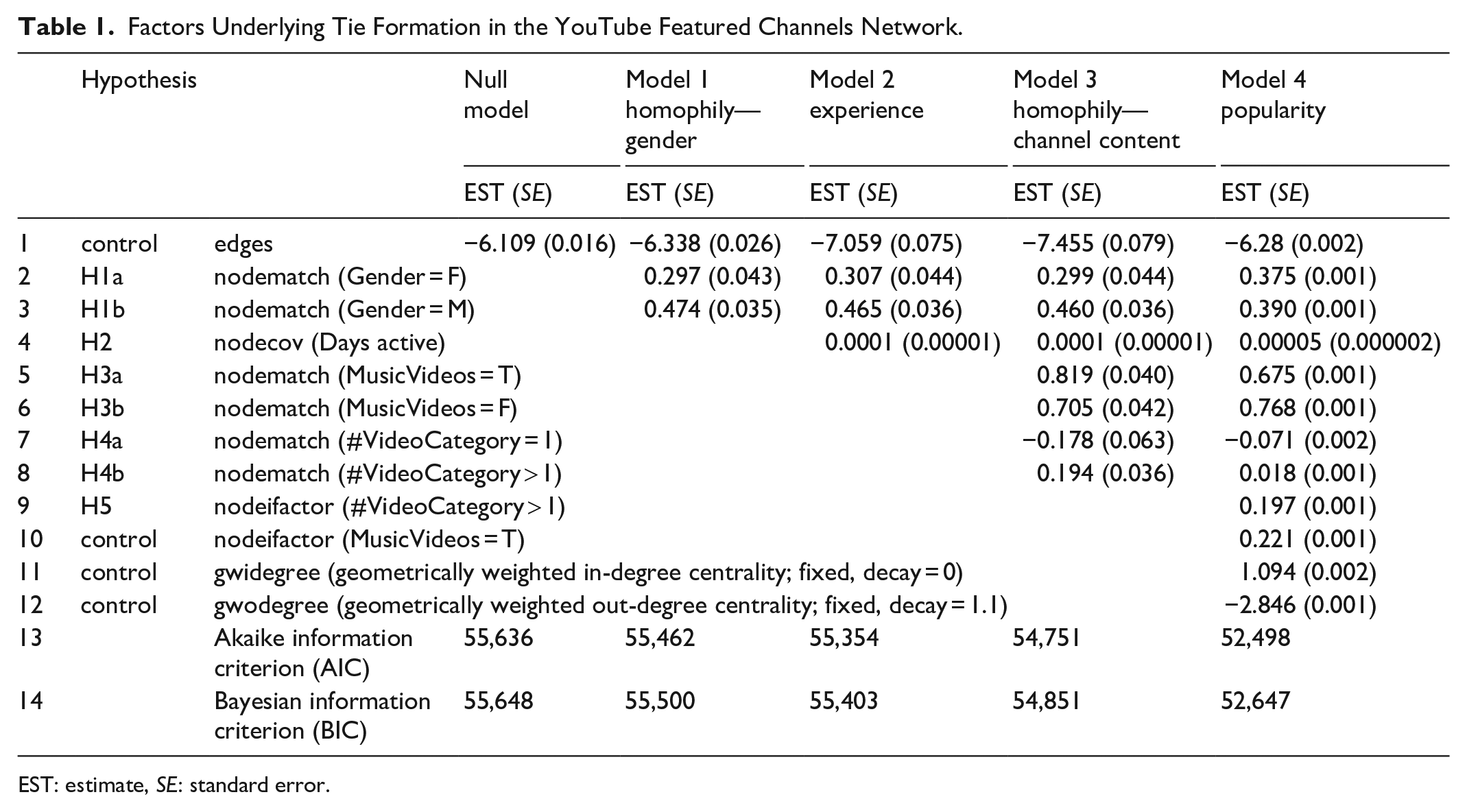
The ERGM terms used for testing are included in Table 1. In addition to including variables needed to test H1–H5, we controlled for the tendency of “popular” channels to attract more ties in this network using the gwidegree term, and for the “active” channels to recommend other channels using the gwodegree terms (rows 11–12 in Table 1). The gwidegree and gwodegree terms capture the “geometrically weighted” distributions of the number of incoming and outgoing links per channel (Cranmer et al., 2017; Hunter & Handcock, 2006).
Factors Underlying Tie Formation in the YouTube Featured Channels Network.
EST: estimate, SE: standard error.
Finally, because of the study’s focus on music channels and because the seed channels were intentionally music-related, we controlled for the prevalence of music channels to get more recommendations from other channels (see row 10 in Table 1).
Results
Descriptive Statistics
Figure 1 shows the resulting network consisting of 1,329 nodes and 3,912 ties, as visualized using the Fruchterman–Reingold layout algorithm (Fruchterman & Reingold, 1991) in Gephi (Bastian et al., 2009). A directed tie in this network shows that one channel featured the other. Node color shows whether a channel belongs to a woman (“dark violet”) or a man (“orange”). Node size represents the number of times a channel was recommended by other channels in the network.
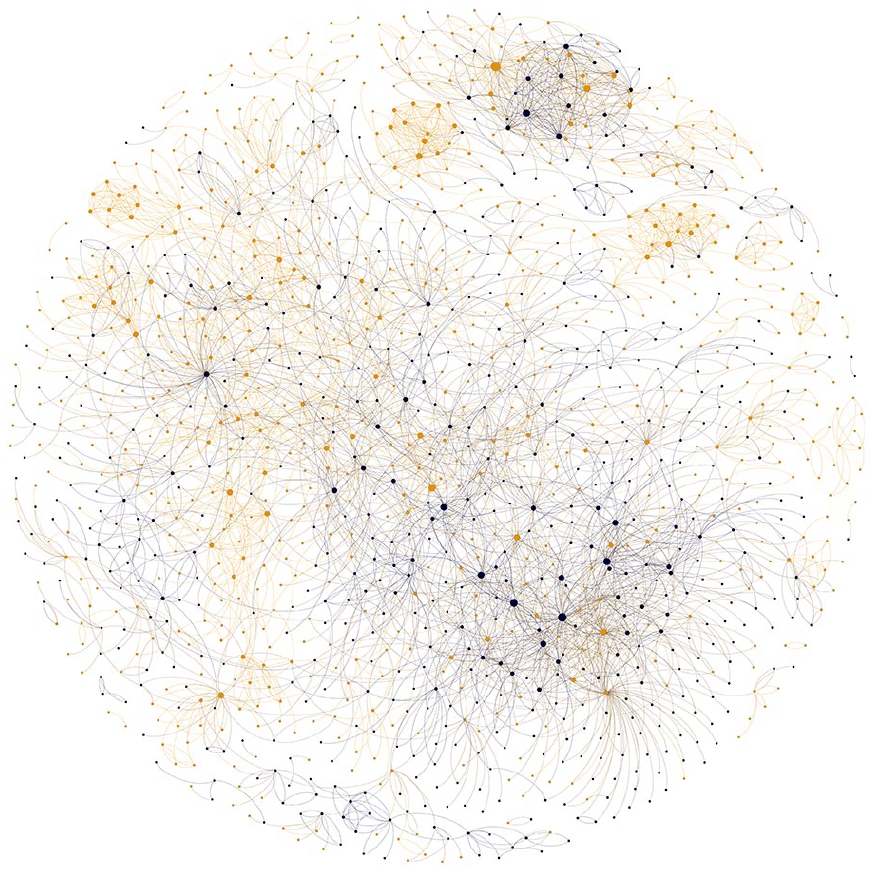
Network of featured YouTube channels (by solo artists, excluding isolates).
In total, 57% or 2,230 ties were mutual, meaning that the majority of channels would reciprocate if they were featured by another channel. This is somewhat expected since reciprocity in online networks has shown to help bloggers grow their audience, and it is a key element in the formation of one’s social capital (Gaudeul & Giannetti, 2013).
Based on the Fast Unfolding community detection algorithm (Blondel et al., 2008), the modularity value for the whole network is close to 1 and is equal to 0.796. Not only does this suggest that YouTube artists, like other musicians, are reliant on building communities through links to others, but because some clusters of nodes are formed around a single channel, this suggests the presence of influential individuals that are attracting the majority of links.
Another observation based on the network visualizations is that most of the channels within each cluster have the same color suggesting that gender-based homophily in linking behavior might be happening on YouTube. To test this and other network patterns more formally, we turn to ERGM models as presented in the next section.
Hypothesis Testing
Table 1 shows the results of our ERGM tests. All modeled factors were statistically significant (p < 1e-04). We also noted that with each new model from the Null Model to Model 4, both Akaike information criterion (AIC) and Bayesian information criterion (BIC) statistics reduced their value, indicating an overall improvement of the model. Furthermore, the goodness of fit test and Markov Chain Monte Carlo (MCMC) diagnostics confirmed that the final model generates networks that are structurally similar to the observed network (see Appendices A and B).
The final model that included all tested variables (Model 4) confirmed all hypotheses, except H4a as outlined below.
Regarding H1, while about 1,533 ties (703 women → men and 830 men → women) or 39% out of 3,912 are between YouTubers with different gender identification (see Table 2), the model shows that men are more likely to link to YouTube channels of other men than by chance alone. At the same time, women are more likely to link to YouTube channels of other women than by chance alone.
Number of Ties Within and Across Gender Identification.

Regarding H2, based on the model, the number of days the channel was active increases the chance of being featured by other channels.
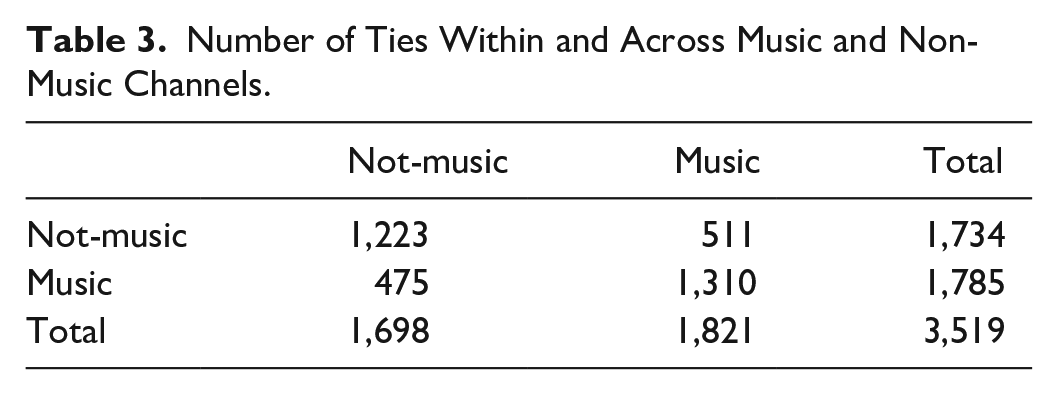
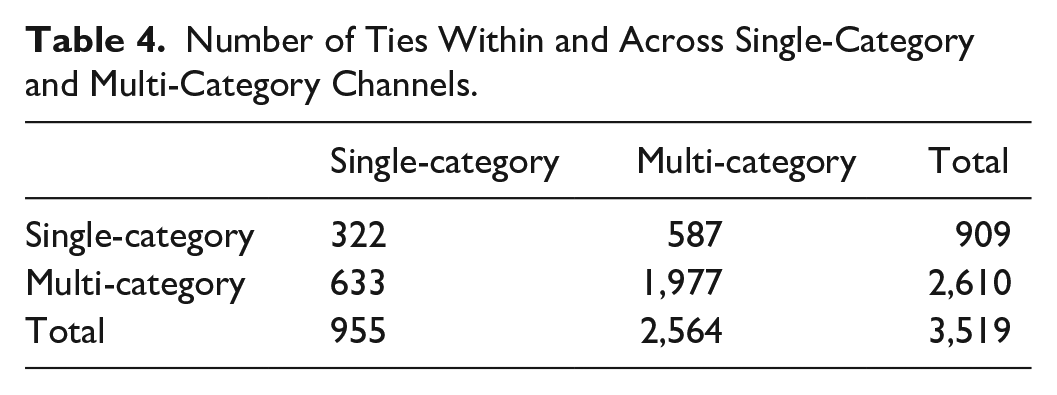
Regarding H3, there is a strong and significant tendency for music channels to recommend other music channels and vice versa. However, when testing H4, we found that channels that tend to post under the same category and channels that post under multiples are both likely to be linked to multi-category channels. This result is also confirmed by H5; channels that post under multiple video categories are more popular than channels that publish under a single category when controlling for all other factors. Tables 3 and 4 show the number of ties within and across channel types and video categories.
Number of Ties Within and Across Music and Non-Music Channels.
Number of Ties Within and Across Single-Category and Multi-Category Channels.
Furthermore, the positive and significant estimate for the number of incoming recommendations to music channels (row 10 in Table 1) confirms that music channels are generally more popular, as expected considering the focus of this dataset on cover song YouTubers.
Finally, the positive and significant estimate for gwidegree (row 11 in Table 1) indicates a tendency of the network to have a larger number of nodes with middle-range of in-degree centrality in comparison to random networks. In our case, most of the channels in the network are recommended by one to five other channels. And the negative estimate for gwodegree (row 12 in Table 1) indicates a tendency of having a larger number of nodes with low and high out-degree centrality in comparison to random networks. In our case, the majority of the channels in the network recommended only one other channel with a few recommending a large number of channels, but not as many channels with middle out-degree centrality (see Appendix A).
Discussion
Social media has radically changed how performers navigate their own art and popularity in relation to other performers and to their audiences (Cunningham & Craig, 2019). In this project, we set to examine the properties of musicians who possessed online performance capital, judging by their current crowd-sourced popularity, to assess any commonalities between them which may indicate unique properties of online performance capital on YouTube.
YouTube Musicians and Performance Capital
RQ1: How Do Cover Musicians on YouTube Create Online Performance Capital?
Our case study shows that successful YouTube cover musicians create online performance capital through several strategies such as linking to a variety of other videos. While these practices have some commonalities with the offline performance capital noted by Miller (2017) and the sport social capital as noted by Bush (2016), notably, the affordances of YouTube seem to encourage practices that take advantage of online social network connectivity.
First Mover Advantage
Our network analysis found a first mover advantage, insofar as YouTube channels that had been around longer were more likely to be recommended by others. This finding confirms existing research which shows that length of time on a social media site plays a role in the diffusion of content on that site (Shulman et al., 2016). Thus, length of time on a YouTube seems to be a field specific norm that helps cover artists develop and maintain online performance capital on the site. However, it is difficult to determine whether length of time generally is enough for popular YouTube cover artists to develop performance capital on the site, or whether it was being on YouTube for a specific length of time relative to now. That is to say, some scholars suggest that YouTube has changed since the early days and become more like the corporate music industry (Kim, 2012). If that is indeed the case, then an early popularity would influence the performance capital for YouTube cover musicians more than presence on the site for a long period of time starting now.
Content Variety
As previous research has shown, the music industry has adjusted its practices to fit YouTube and the way music videos are shared across social media (Cayari, 2011; Edmond, 2014; Preston & Rogers, 2011). One of the strengths of YouTube as a medium is the way it helps artists build parasocial relationships with their audience (Rasmussen, 2018). Our case study suggests that YouTube cover artists seem to be doing this by posting outside of their main genre, and even sometimes posting videos that are not music, sharing interests, and making connections outside of genre and category conventions. The fact that channels with multiple video categories were among the most popular suggest that platforms like YouTube allow cover musicians to reach beyond a limited community and potentially attract fans who have varied interests. Furthermore, each artist’s favorite channels list is an indication of a life beyond the music community and is an indication of intersecting identities and interests (Airoldi et al., 2016). This suggests that the building of performance capital for musicians on YouTube may be as much about reaching out to others outside of the music community, as it is about performing music well and connecting with other musicians. Furthermore, YouTube as a sub field for cover musicians may require self-disclosure in a way that, for example, cover artists in a local bar or club are simply not called upon to do. This means that those who are not comfortable sharing other aspects of their identities outside of their music, may be at a disadvantage on the site.
RQ2: What is Different About YouTube Performance Capital, Compared With Literature on Performance Capital for Musicians Offline?
In this case, we have identified a few possible differences between musicians on YouTube and those in an offline context. These differences could indicate areas for future inquiry, as this was an exploratory case study of YouTube musicians applied to a very specific field, that is, cover musicians.
Gender Effects
Other research suggests that homophily drives interlinking behaviors on social media sites like YouTube (see Airoldi et al., 2016; Ling & Dale, 2013). While we observed the presence of gender-based homophily in channel recommendations, we also found a substantial percentage of linkages across channels with different gender identification (39%, see Table 2). This suggests that as a field, YouTube is more like the folk music field identified by Miller (2017), insofar as it accommodates more linkages between self identified men and women.
Genre Effects
Another way YouTube musicians differed from the musicians studied by Miller (2017) was in the effects or influence of genre. While music channels were more likely to link to other music channels and non-music channels were more likely to link to non-music channels, we were surprised to find that the most popular channels posted videos from a wide variety of categories. Outside of social media, it would be unusual to see a performer build performance capital through deepening their skills, knowledge, and social connections outside of their genre community, which is also a field (Bush, 2016; Miller, 2017). However, our YouTube musicians were posting non-music related videos and building links with YouTubers outside the music community, thus while YouTube musicians can be thought of as a sub field (in a Bourdieu-ian sense) of music broadly, YouTube musicians must also be considered as a sub field of YouTube producers more broadly.
In this sense, YouTube musicians should perhaps be thought of as a unique and distinct field—more YouTube producer than music producer with respect to the norms and habitus guiding their participation on the site. This practice of linking across video categories appears to be a distinctive characteristic of YouTube, that benefits from the affordances of the platform. These connections between cover musicians and many other sub fields of YouTube, highlights the benefits of online social networks for connections of weakly tied individuals across video categories (Kavanaugh et al., 2005). This also supports Baym’s (2018) findings about how musicians build an online personal brand by sharing interests outside of their music. Finally, these practices can also deepen parasocial interactions with fans, who may appreciate feeling close to a musical YouTuber by learning about their other interests (Rasmussen, 2018).
Time Effects
In our network of YouTube musicians, we see established players who post a larger number of videos as more likely to have in-links compared to others. This is somewhat different than the type of offline performance capital described in the literature, since the number of songs played, for example, at an open mic event (or similar) is not listed as one of the main factors that help a musician to build their performance capital. However, this finding is consistent with the marketing literature on how to best use social media, which suggests that content production helps drive audience engagement on social media platforms (Allagui & Breslow, 2016). The correlation of popularity and the number of days on YouTube is not simply habitus, as musicians do become more proficient through practice, but do not become more popular by sharing practice sessions with others. Instead, this might be a distinctive feature of YouTube as a performance space. Long-time posters promote their popularity and, in turn, increase their online performance capital. But this act is not unproblematic, nor equally available to all people. First of all, not everyone has equal time available for frequent posting of good quality content. Second, as women and marginalized YouTubers are more likely to get harassed online in YouTube comments, it may be psychologically and emotionally more problematic for some YouTubers than others to post frequently (Boxman-Shabtai, 2019).
Limitations of Pulling From the Already Popular Category
To understand commonalities between YouTube cover musicians who had already demonstrated a high level of performance capital, we necessarily focused only on those accounts, identified through crowd-sourced means, that had an existing level of popularity. For this reason, however, it is important to note that this analysis technique contains important limitations that speak to the fact that performance capital, like social, cultural, and economic capital, is not equally available to everyone under every circumstance. Our analysis was unable to capture age, race, and cultural data, so while we can see that the most popular videos in our sample were people who made a variety of connections and spent more time on the platform, the well-documented inequalities in the YouTube’s recommender algorithm (Bliss, 2020) that minimize videos by, for example, older women, and other typically marginalized groups were not captured in our sample. Social reproduction is undoubtedly occurring which informs who feels comfortable posting on YouTube as well as what videos become popular, and thus, this aspect of social capital should be researched in future studies. It is important to remember that online performance capital is subject to the same biases that we generally see in social and performance capital, and it is also possible that those biases could be exacerbated by algorithmic filtering, which makes the presence of these biases much less visible.
Conclusion
Performance capital is a type of social and cultural capital that applies to people who perform professionally, such as athletes, musicians, and politicians. To date, studies have shown the different ways these groups build performance capital in offline contexts, but little research has examined the ways online performers, or performers who work primarily in online spaces, build performance capital. Our case study of popular cover musicians on YouTube looked at the ways that performance capital is built on the platform. Comparing our results to Miller’s (2017) study of the ways musicians build performance capital offline shows key differences and similarities between online and offline performance capital for musicians. Online performance capital requires the cultural capital of genre skill and musical training, and also includes the specific digital knowledge of who to connect to and the practice of posting a variety of different video types. The affordances of YouTube mean that an online community of practice is much more diverse and can reach outside the music community. As a case study of popular cover artists on YouTube, as identified by a crowd-sourced website TopTenLists, this study is not intended to be broadly generalizable, and instead, represents a starting point to understanding what online performance capital may look like. Our research suggests that building online performance capital for cover musicians on YouTube does indeed require a different approach then building performance capital in the offline music community, and may indicate that YouTube be considered its own field on which cover musicians employ unique practices as they build social, cultural, and performance capital. It is our hope that future work can expand on this research to look at the music community more broadly, and also examine the various ways that performance capital both within and outside the music industry is impacted by networked media technologies.
Footnotes
Appendix A
Appendix B
Acknowledgements
The authors would like to extend their appreciation to the peer reviewers who provided helpful comments. They would also like to thank members of the Ryerson University Social Media Lab, and especially Lilach Dahoah Halevi, for their feedback and help with the manual coding of YouTube channels. Finally, they are grateful to Zizi Papacharissi and the editorial team from the Social Media + Society for editorial assistance during the preparation of this manuscript.
Declaration of Conflicting Interests
The author(s) declared no potential conflicts of interest with respect to the research, authorship, and/or publication of this article.
Funding
The author(s) disclosed receipt of the following financial support for the research, authorship, and/or publication of this article: This research is supported in part through a 5-year initiative on “Social Media Data Stewardship” funded by the Canada Research Chairs program (2015–2020; Principal Investigator: Anatoliy Gruzd) and a 5-year initiative on “Digital Communication for the Public Interest” funded by the Canada Research Chairs program (2020–2025; Principal Investigator: Jaigris Hodson).
