




Abstract
While music as an artistic form is well studied, the individuals behind the art receive relatively less attention. In this article, we provide evidence of celebrity advocacy with a systematic examination of musicians’ political engagement on Twitter. This study estimates the extent to which musicians use Twitter for political purposes, with particular attention to whether such engagement varies across music genres. Through a computational-assisted analysis of 2,286,434 tweets, we group 881 musicians into three categories of political engagement on Twitter: not engaged (comprising the majority of artists), circumstantial engagement, and active political engagement. We examine the latter categories in detail with two qualitative case studies. The findings indicate that musicians from different genres have distinct patterns of political engagement. The Christian music genre shows the most engagement as a whole, especially in philanthropy. On the contrary, the most active accounts are rock and hip-hop artists, some of whom discuss political issues and call for mobilization. We conclude with suggestions for future research.
On 16 January 2019, the 26th day of the longest government shutdown in U.S. history, rapper Cardi B posted a viral video on Instagram. The video expressed concerns about the shutdown, blasting President Trump for refusing to fund the government unless Congress would provide funding for his border wall. It was quickly shared across several social media platforms, gaining over 1 million views and substantial attention from the public and several U.S. lawmakers. Brian Schatz (D-HI) and Chris Murphy (D-CT) publicly wondered whether they should forward the video. Senate Minority Leader Chuck Schumer tweeted, “Guys. I’m still holding my breath. Are you gonna RT Cardi B or not?” (Schumer, 2019).
This is one of many prominent cases in which musicians have engaged with political issues. Music has been theorized as a vehicle of social force: songs and lyrics are both targets of censorship and means of expression and mobilization, playing a crucial role in social movements and political activism (Street, 2003; Street, 2007). While music as an artistic form has been well studied, the individuals behind the music receive relatively less attention, even though artists use their celebrity status to engage with the public through platforms like benefit concerts, boots on the ground activism, interviews, and social media engagement (Street, 2004). In the U.S., both rock and hip-hop musicians have utilized their public status to advocate for social justice (Frith, 1978; Rose, 1994). In this article, we focus on musicians’ political engagement in terms of how they communicate about politics and political issues through their social media activities such as status updates, comments, replies, and links to news articles (Bode, 2017).
In this study, we provide evidence of celebrity advocacy with a systematic examination of musicians’ political engagement on Twitter, which facilitates issue advocacy by giving musicians a platform to reach the public. To date, research on musician advocacy utilizes in-depth analyses of individual artists. But questions remain about the prevalence of this type of political advocacy. This systematic study estimates the extent to which musicians use Twitter for political purposes, with a particular focus on whether such engagement varies across music genres.
Through a computational-assisted analysis of 2,286,434 tweets, we group 881 musicians into three categories of political engagement on Twitter: not engaged (comprising the majority of artists), circumstantial engagement, and active political engagement. We then explore how artists in different genres discuss politics through several qualitative case studies. The findings indicate that musicians from different genres have distinct patterns of political engagement. The Christian music genre shows the most engagement overall, focusing most on philanthropy. However, the most active accounts were rock and hip-hop artists.
Literature Review
Music and Politics in Different Genres
Through their craft, artists can communicate grievances and explore alternative possibilities to the current social reality (Street, 2001). Music facilitates social emancipation and provides an accessible entry into understanding current events by imagining new possibilities and connecting emotional experiences with political action (Bennett, 2001; Mattern, 1998). Paul Gilroy (1996), for example, when dissecting the African diaspora identity, acknowledges how the spaces where African American music is being composed and performed, can become vehicles to resist “the oppressive power of racial capitalism” (p. 365). Like other media content, however, music can also be a tool for ideological manipulation, using aesthetic affordances to generate an unquestioned alliance with a ruling group (Herzstein, 1986).
While many music genres developed as anti-establishment in the United States, rock and hip-hop were the most vocal. Rock music has long embraced individuality, rebellion against industry, and trends toward nihilism and hedonism (Jones, 2016). Rock musicians became role models for youth counter-culture, which included breaking the rules, having fun, and staying true to oneself (Frith, 1978). Rap and hip-hop music often address social issues like racial justice, domestic violence, and police brutality, touching on themes of freedom and resistance (Bonnette, 2015). While facilitating identity construction, the culture around rap music is also an essential social space to collectively digest similar experiences of social, political, and cultural disparities (Tickner, 2008). Contemporary rap maintains its roots of empowering and giving voice to the oppressed (Halliday & Brown, 2018), linking people’s daily lived experience to political issues and grievances (Tickner, 2008).
In the same way that rock and rap have a situated history of resistance, American country music often expresses conservative patriotism, producing songs supporting the invasion of Iraq and Afghanistan and emphasizing the U.S. military power (Garofalo, 2013). For example, Toby Keith’s chart topping anthem “Courtesy of the Red, White and Blue,” praised military invasion overseas and warned others that “When you hear Mother Freedom/Start ringin’ her bell it’ll feel like the whole wide world is raining down on you”—a sentiment echoed by other artists like Ted Nugent, Lynyrd Skynyrd and Alan Jackson. Country artists challenging these ideological norms have encountered strong opposition. The Chicks’ (formerly Dixie Chicks) mainstream dissent of the Iraq invasion received widespread condemnation from the country music community; their music was blacklisted from radio stations for many years (Cable News Network [CNN], 2003).
While musical content has been studied extensively, there is noticeably less literature about musicians’ involvement in broader public discourse. Studies typically focus on the legacy media output of one or a few artists, with an emphasis on their musical output, including lyrics and music videos (e.g., Papale, 2017; Street et al., 2008). However, digital social spaces offer musicians new avenues of fan engagement, particularly as it relates to sociopolitical issues.
Celebrity Advocacy
Although attention is a scarce resource in digital media, celebrities have an advantage in attracting attention on social media, allowing them to amplify political messages far more effectively than the average social media user. Several scholars have studied celebrity engagement on social media platforms, including fan-interaction, image management, and celebrity advocacy, the latter being the main focus of this article. Celebrities, however, do not limit their engagement on social media to personal interaction and image management. A substantial proportion of celebrities voice their opinions on a range of social issues; we call this action “celebrity advocacy.” Using a sample of 247 U.S. celebrities, Thrall et al. (2008) shows that more than half (62.8%) of celebrities engage in advocacy, with celebrities on the Forbes 100 list being particularly active. Celebrities were most interested in social welfare, health, and children’s welfare, while economics, politics, and animal rights were among the lowest ranked areas of celebrity advocacy (Thrall et al., 2008).
Celebrity advocacy has attracted both praise and criticism from academics. Optimistic accounts praise celebrities who use their fame to raise public awareness about social causes outside the arena of partisan politics (Street, 2010). Celebrities provide credibility to such causes by either lending their names to organizations or making statements on behalf of them. Historically, there have been numerous examples of American film, television, and sports stars who participated in fund-raising campaigns or even lobbying activities to bring attention to issues like pro-choice rights, sexuality, gender equality, and immigration reforms (Wheeler, 2013). However, critics express concerns over whether celebrity advocacy is merely a corollary of consumer culture (Collins, 2007). Scholars also condemn privilege and lack of political substance associated with celebrity status, rendering their voices not representative of the broader public (Kapoor, 2012; West & Orman, 2003). Empirical evidence points toward generally positive but limited effects of celebrity advocacy in instigating action from the non-fans and general public (e.g., Becker, 2013; Brockington & Henson, 2015).
Despite the increasing use of social media among celebrities to mobilize the public toward philanthropy and activism, only a few studies have looked at political discourse on social media platforms, tending to focus on uniquely active cases. For example, Alexander (2013) analyzed the strategies of the actor Ian Somerhalder, who mobilized support for environmental campaigns on Twitter, suggesting the potential influence of his Twitter advocacy on youth political engagement. Another study highlighted how Black celebrities, including Spike Lee, Jesse Williams, and Beyoncé, amplified the #BlackLivesMatter movement (BLM) by sharing its messages, promoting works, actions, and events that the followers can take to advance the #BLM cause (Duvall & Heckemeyer, 2018).
In this article, we study political discourse from well-known musicians on social media (for more on celebrity musicians, see Boykoff & Goodman, 2009). Musicians occupy a special place in celebrity studies often because of their identity as content creators who use auditory communication as a medium to communicate about the human condition. Previous research has found that people develop strong para-social relationships with popular musicians (Krause et al., 2018). Importantly, we distinguish between musician’s advocacy in politics and “celebrity politicians,” the latter referring to those who, outside an elected position, advocate on behalf of a certain community for social issues and policy change (Street, 2004). While most musicians aspire to be known, not all achieve widespread attention; we argue that musicians are celebrities when they achieve national recognition by appearing on a record chart.
Political Engagement on Twitter
Our analysis focuses on musicians’ activity on Twitter, a social networking platform that has become an important space for political communication. Politically engaged citizens often use Twitter to bypass traditional media gatekeeping, build audiences, and communicate directly to one another (Sahly et al., 2019). Twitter is also widely used by journalists to make news judgments and find stories (McGregor & Molyneux, 2018). Twitter is a tool for citizens to not only consume and disseminate news, but also to make political commentary about current events and to mobilize or organize (Freelon & Karpf, 2015; Isa & Himelboim, 2018). Among U.S. adults who have a public Twitter account, one in three post at least twice per year about national politics (Hughes, 2019).
Twitter’s affordances provide ample opportunities for political engagement: hashtags facilitate connectivity for networked publics to follow trending topics; retweeting and quote-tweeting functions allow users to signal participation in the conversation both to the original tweet poster and to their own audiences; and users often utilize the short-message structure to express acknowledgment, agreement, or dissent (Tanupabrungsun & Hemsley, 2018). Compared with other social networking sites such as Facebook, Twitter encourages more weak ties (e.g., unidirectional follower–following relationships and relationships outside of friends and family) and present information based on recency more than intimacy between users (Valenzuela et al., 2018). To capitalize on these Twitter features, many musicians have public Twitter profiles to engage with their audience; if a musician posts about politics, they are very likely to do so on Twitter.
Research Question
Our study is driven by the question, “how often do musical artists use Twitter to engage with political issues?” We anticipate that musical artists vary greatly in their political engagement. Traditionally, some are continually engaged, while others may be only motivated to discuss politics in certain situations or occasions. This is likely to be true of Twitter engagement as well. We therefore ask the following research question:
We are also interested in comparing artists across different genres. We speculate that some genres may have more artists who talk about politics than others. The literature suggests that, relative to other genres, rock and hip-hop are well known for politically active artists (Bonnette, 2015). Because these genres have rebellious or counter-cultural histories, we hypothesize the following:
Method
To perform this study, we construct a corpus of tweets made by recording artists who were listed on the U.S. Billboard genre chart. To construct and analyze our corpus, we applied the following strategy: (1) build a list of artists from the Billboard genre chart, (2) collect tweets posted by the artists, (3) compile a human-coded labeled dataset using a sample of our Twitter corpus, and (4) develop and apply a supervised machine learning text classification algorithm to label the remainder of the corpus.
Identifying Billboard Artists
The first step of this process involved identifying musical artists from the Billboard Top 100 genre charts. The genre-specific charts begin in December 2004, are updated weekly, and list the top 100 songs of that week. Billboard tracks six genres: Christian, country, hip-hop and R&B, Latin, pop, and rock. Using the R package {rvest} (Wickham & Wickham, 2016), we scraped all publicly available lists from the start to 30 November 2018.
The Billboard charts contained the following information: the chart week, the rank of the song, the song name, the artist’s name, and the genre. Several artists appeared on more than one Billboard Genre Top 100 (sometimes for the same song, sometimes for multiple songs); we therefore allowed artists to have up to three affiliated genres (the order of the genres was determined by how many songs appeared under each genre for an artist). Duplicate artists were removed. We also removed bands, as these Twitter pages are used almost exclusively for promotional content, typically under the direction of a PR (public relations) team. Lead artists who themselves had made it onto the Billboard were retained. This process yielded 901 musical artists.
Collecting Billboard Artists’ Tweets
Once the list of Billboard artists was determined, we searched for the Twitter account of each musician. No artist on our list had more than one account (though some were also affiliated with band accounts). Handles had to be verified (i.e., have a blue check next to their name that confirms Twitter has verified this account) or had to explicitly mention the artist. In all instances where the Twitter account was not verified, the artist was promoting their latest song, music video, tour, or album on their Twitter cover photo and latest tweets.
Of the 901 accounts, 7 did not have identifiable Twitter handles (e.g., actor and rapper Will Smith). Six artists on the list had died and therefore did not have Twitter accounts (e.g., Michael Jackson, Elvis Presley, Aretha Franklin). Excluding these artists from the final list of handles left 887 artists’ Twitter handles.
We collected tweets using the R package {rtweet} (Kearney, 2018), which accesses the Twitter restAPI (Twitter Developer, n.d.). The timeline search allows users to collect the last 3,200 tweets of a handle’s timeline (Twitter Development, n.d.). Data were collected from 13 February 2019 to 14 February 2019 (the runtime was 18.3 hr). Tweets in this corpus were posted from 2009 to 2019.
Human Coding
To construct an appropriate training set, five coders coded for the presence of political statements in a sample of 10,000 tweets (from the artist’s corpus). The “political” label was a binary variable, where 0 = no political talk and 1 = political talk. Political talk included any discussion or commentary on elections (e.g., get out the vote efforts, support or opposition for a candidate in any election, live-tweeting debates), politicians (or political parties), and advocacy or opposition toward a social or political issue (e.g., climate change, gun control/rights). Online civic engagement activities with aims of mobilizing resources such as philanthropy, donation, or coordination of “microaction” such as volunteering and nonprofits (Ilten, 2015) could be motivated by political interests. Thus, philanthropic efforts were considered political specifically if the artist wanted the audience to engage in some politically relevant action. Such actions typically involved donating but, on occasion, also included filling out petitions or visiting a website. Political talk was not limited to U.S. politics—discussion of politics in Mexico or Europe, for example, constituted political talk. As our corpus consisted of both Spanish and English tweets, non-Spanish-speaking coders agreed to use Google Translate to translate Spanish tweets.
The coders met repeatedly for 2 months to train and achieve reasonable intercoder reliability. The Krippendorff’s Alpha (Hayes & Krippendorff, 2007), calculated from a sample of 2,000 tweets was .83, with all pairs of coders achieving a Pairwise Cohen’s Kappa score of above .71.
Supervised Machine Learning
Following the coding of the human-coded dataset (n = 12,000 tweets), we attempted to use supervised machine learning to perform text classification. Text classification is a process whereby documents of text (in this case, tweets) are classified into two or more categories (Grimmer & Stewart, 2013). Supervised machine learning algorithms, one strategy for performing text classification, use preemptively coded training data to code the remainder of the text data. In other words, our goal was to produce a supervised machine learning classifier that was able to learn from our human-coded tweets. To perform this analysis, the coded corpus was split into two corpora—a training set, and a test set. The machine learning algorithm would learn on the training set and then be unleashed on the test set to check its accuracy.
The text data was processed by removing function words (e.g., “the,” “above,” “she”), punctuations. Rather than removing the URLs entirely, we rehydrated the shortened URL links (so that t.co/vwxyz became its full url link, perhaps to another tweet or an external site page) and retained the domain of that URL. The shortened link and URL path (e.g., the bolded part of “www.twitter.com/status/123456789”) were removed. Hashtags were retained, but the pound (#) symbol was removed. We retained handles because of the possibility that political tweets mentioned political accounts (e.g., @realDonaldTrump).
One major issue with our data was the extremely unbalanced nature of the codes. More specifically, only 1.8% of the tweets in our coded dataset constituted political tweets—about 200 tweets total (of the 12,000 tweets). This is the computational equivalent of “looking for a needle in a haystack”—we therefore expected our results to be equally imbalanced.
Using the {klaR} (Roever et al., 2020) and {caret} (Kuhn, 2008) packages, we tested five different algorithms, first on a training set of 5,000 tweets: (1) a Naive Bayes (NB) classifier; (2) Classification and Regression Trees (CART), a decision tree classifier; (3) random forest, which relies on an ensemble of decision trees; (4) a coordinate descent Support Vector Machine (SVM); and (5) xgboost, an iteration of a gradient boosting algorithm.
The accuracy scores of these tests were fairly low (all between 40% and 50%); the algorithm that produced the “best” results at this stage was the NB classifier (53% accuracy). We then attempted to perform the classification of English tweets and Spanish tweets in the training set separately. While this helped increase the accuracy marginally, many tweets (more than 40%, in some instances) were still inaccurately coded (The NB classifier again won out, with 59% accuracy for English, and 52% accuracy for Spanish). At this point, all the algorithms were producing too many false positive: at least a third to a half of all the tweets were coded as political.
Finally, we reconstructed training sets to over-sample political tweets and under-sample nonpolitical tweets. The English corpora had 500 tweets, 100 of which were political (political tweets therefore constituted 20% of this training set). The Spanish corpora had 200 tweets, of which 20 were political (10% of this training set were political tweets). This process improved our accuracy, but also discarded a majority of the tweets that human coders had labeled. The algorithm with the best accuracy, and showed the greatest improvement, was the SVM model (78% accuracy for English tweets, 61% accuracy for Spanish tweets).
To validate the accuracy of these results, a synthetic dataset was generated from our corpus of political tweets (n = 214). Synthetic datasets are a common way to help increase the proportion of labels in an unbalanced dataset (Chawla et al., 2004). They are constructed from “attributes” (in this case, words) that are common among a labeled dataset (in our case, the tweets labeled political). The addition of synthetic data is another way to over-sample data, particularly if the labeled codes are sparse (our data were extremely sparse).
The SVM classifier, again, won out, with 91% accuracy for the English tweets, and 82% accuracy on the Spanish tweets (although the NB classifier performed slightly better on the Spanish tweets, with an accuracy of 83%, it performed worse on the English tweets). The Krippendorff’s Alpha between the human coders and the machine were .80 (for English tweets) and .68 (for Spanish tweets).
Results
In total, there were 2,286,434 tweets from 22 November 2007 to 13 February 2019. The majority of the tweets were posted after 2017. This corpus represents tweets from 880 artists (this is 7 fewer than the artist’s list: 5 had private accounts, and 2 had no posts). Of all the tweets, only 1.7% were political (n = 40,704). Many artists (n = 544) did not post any political tweets; this constituted more than half of the artists in our list (61.8%). As shown in Figure 1, distribution of the political tweets made by musicians follows a power law distribution (Adamic & Huberman, 2000). This distribution suggests that most artists posted a few or no political tweets, but a small subset of artists would post far more political tweets. Of the artists that posted at least one political tweet, 35% posted 20 or fewer political tweets. For most artists who did make a political tweet, tweets about politics constituted fewer than 2% of their overall Twitter activity (263 of 336 artists, 78%).

Power log distribution of musicians tweeting about politics.
For 26 artists, political tweets comprised more than 5% of their tweets. Seven of these were Christian artists, five were rock artists, four were pop artists, three were hip-hop and R&B artists (John Legend, who primarily fell into this category, was also listed on the Pop Billboard), two were country artists, and one was a Latin artist.
For four artists, more than 10% of their tweets were political. These artists tended to post political tweets continually throughout the time span. They included Regina Spektor (18.5%), Janelle Monáe (18%), John Legend (16.59%), and Chance the Rapper (11.5%). All four artists were active Twitter users, posting more than what we are capable of collecting with the limits of the Twitter API (e.g., as of January 2021, Chance the Rapper has tweeted roughly 49,800 times since 2010).
These results suggest three types of political engagement: unengaged, circumstantially engaged, and actively engaged. The first, encompassing the majority of artists, do not post political tweets at all and fall in the “unengaged” category. A small subset of artists may post political tweets during a salient political moment, such as encouraging voting during an election, or sending “thoughts and prayers” about a tragedy, or a specific issue (e.g., donating to a charity or supporting LGBTQ [lesbian, gay, bisexual, and transgender] rights). We call these artists “circumstantially engaged.” This study cannot speak to when or why artists who do not post about politics suddenly do; however, it shows that artists can be provoked to tweet about politics when a salient situation arises. Finally, there are Twitter users who talk about politics frequently (though it is not a majority of their tweets). We consider these artists “actively engaged” in politics. Unlike the circumstantially engaged artists, the actively engaged artists had a higher proportion of political-to-total tweets and posted repeatedly about politics throughout the timeframe. Figure 2 displays the proportion of actively engaged, circumstantially engaged, and unengaged artists per genre.

Proportion of artist’s tweets that are political, by genre.
Differences by Genre
When examining differences by genre, we find that the Christian genre had the greatest number of artists who posted a political tweet at least once (see Figure 2). However, all of these artists were circumstantially engaged, rather than actively engaged (i.e., continually tweeting about politics). Some of these tweets also focused on charities; for example, one tweet by Brandon Heath (2013) encouraged people to donate to the Red Cross: “Best way to help tornado victims is to donate to the Red Cross.” Donating during natural disasters was a common theme of the political content in this genre. However, many Christian artists’ tweets also discussed political issues such as police brutality and abortion. It is worth noting that three of the top four artists in the Christian genre were on The Voice (Jeffery Austin, Celeste Batton, and Christian Cuevas), and many of their tweets asking for votes were in the context of the TV show and not in rallying political support. Furthermore, in our qualitative analyses, we did not find examples of circumstantially engaged Christian artists talking about politic issues in their songs or media interviews. For example, singer-songwriter Beckah Shae does not sing about political issues, nor does she discuss her political stance in interviews. However, out of her 3,233 tweets in the dataset, 12 were critical of abortion and she received some news attention for posing in front of the U.S. Embassy in Jerusalem during a tour (Estrin, 2018).
This stands in notable contrast to genres like rock and hip-hop. The anti-establishment, and sometimes defiant, nature of genres like rock or hip-hop can be a safe space for musicians who advocate for social and political causes. In the context of these genres’ counter-cultural histories, political artists and political tweets present a closer association. This may explain why the rock genre had the most overall political tweets. In rock and hip-hop, many political tweets focused on political engagement and the discussion of salient social issues. Three of the four most politically engaged artists were rock or hip-hop artists. Many circumstantially active artists in these genres also participated in the Get Out the Vote campaign, including posting on social media and encouraging their followers to be politically engaged. Unlike the Christian artists, politically engaged artists from these two genres talked about politics in their song lyrics and interviews, and often brought in personally relevant experiences.
To highlight how circumstantially engaged and actively engaged artists in these genres discussed politics, we present three example cases. The first is rock artist Regina Spektor, whose political tweets were 18.5% of her tweets. Next, we focus on circumstantially engaged pop artist Charlie Puth, whose tweets were political 6% of the time. Finally, we examine tweets from hip-hop artist Chance the Rapper who tweeted about politics 11.5% of the time.
Regina Spektor: Politically Active Rock Artist
Of all the artists in our Billboard dataset, Regina Spektor had the greatest proportion of political tweets (18.5% of her tweets had political content). In 2010, Spektor played for President Obama in honor of Jewish Heritage Month. She became more politically vocal during and following the 2016 election. After the Unite the Right Rally in Charlottesville, VA, Spektor spoke up during a concert in Israel: “Just. . . f*cking nazis. They’re back. Who knew? So soon?” In the same year, she spoke with TeenVogue about President Trump’s immigration policy: “There’s this horrible desire for superiority and nationalism, and it’s really toxic to think like that” (Elizabeth, 2017). In her answer, she references her experiences facing prejudice during her first few years in the United States.
Her Twitter activity from October 2016 to February 2019 reflects this politically vocal attitude. Of the 3,160 tweets she posted during this time, 587 were political (see Figure 3). She spoke about a range of issues on Twitter, including President Trump, female political candidates, Planned Parenthood, minority representation, New York state politics, and the Standing Rock protests. She also actively promoted the first Women’s March in 2017, noting that she would be in attendance: “On Jan 21 I’ll be at the @womensmarch fighting for equity, because women’s rights are human rights #WhyIMarch . . ” This activity was a combination of original tweets and retweets. Aside from event hashtags, Spektor also used liberal hashtags such as #UnfollowTrump, #StandWithPP, #Flipthe6th, and #NoMuslimBanEver.
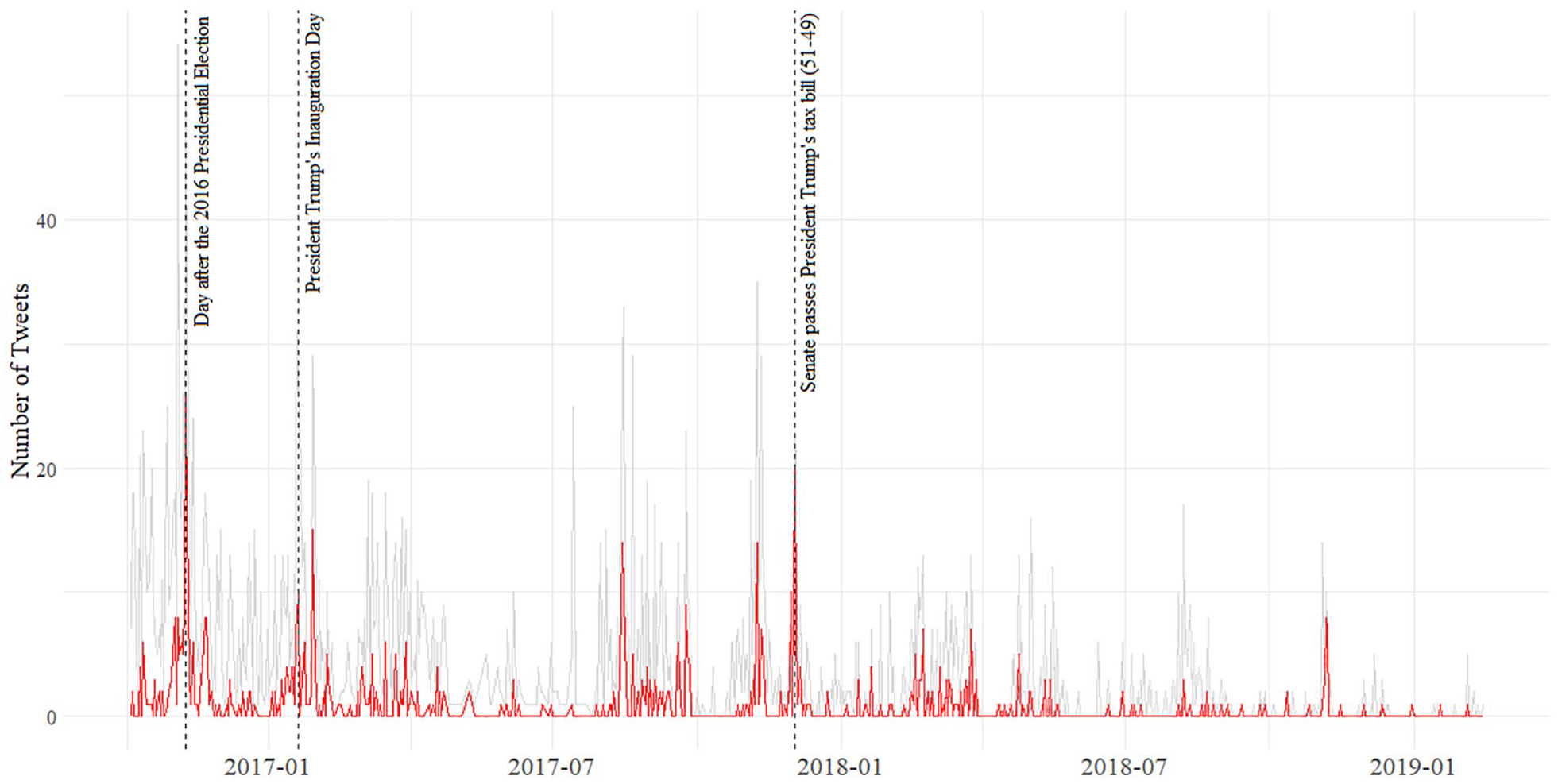
Timeline of tweets by Regina Spektor.
This activity suggests that Spektor used her Twitter platform to both talk about politics and to elevate the events and voices of others. Spektor often promoted or endorsed political protests and marches, even those that she could not attend, and was active in the #GetOutTheVote campaign (see Figure 4).
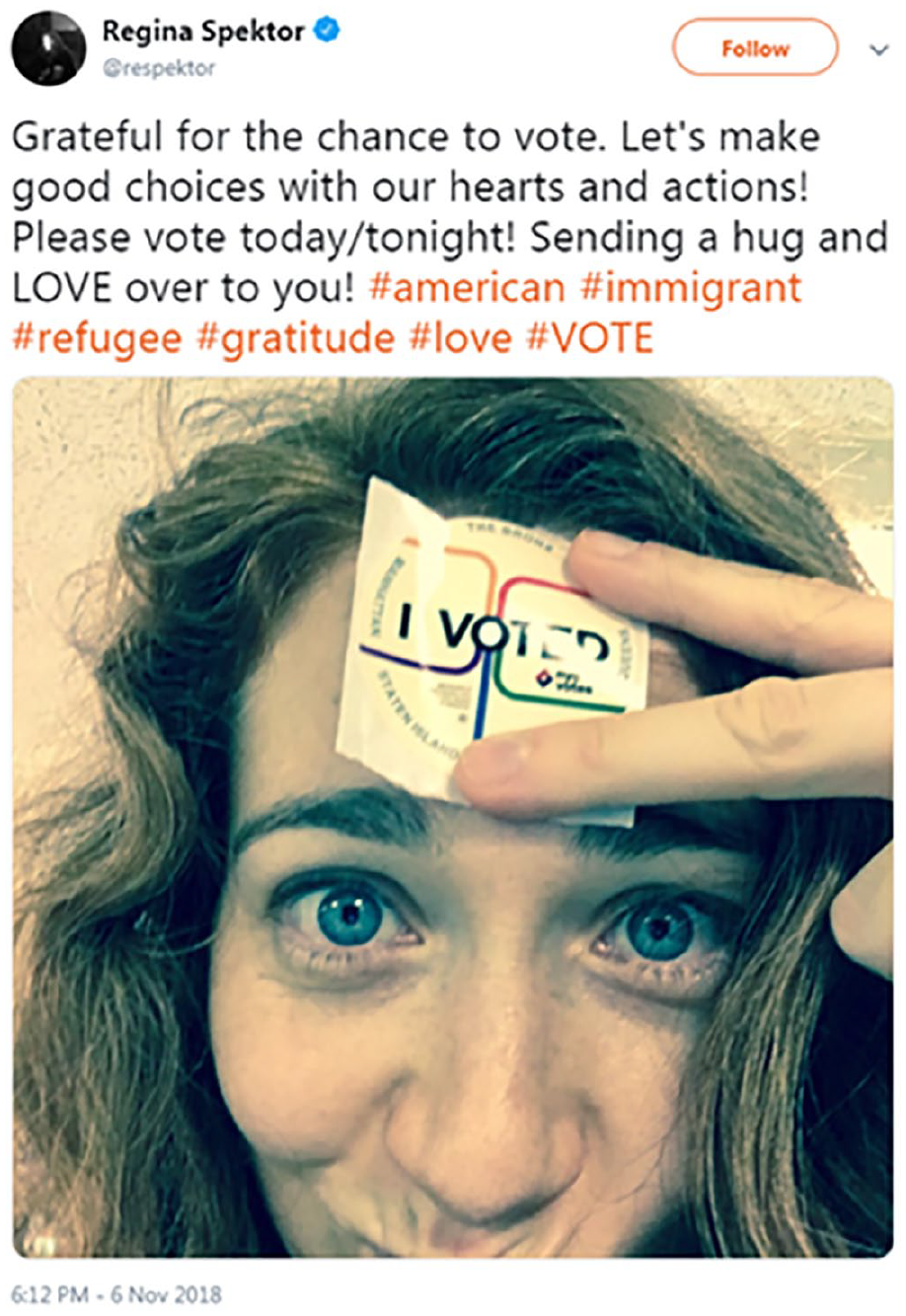
A Regina Spektor tweet about voting.
Although she does not seem to have politically overt songs, Spektor’s Twitter activity parallels what she has said in interviews and during concerts. Her savvy use of hashtags also suggests that she is trying to engage directly with other users who talk about politics, regardless of whether they are her fans.
Charlie Puth: Circumstantially Active Pop Artist Tweeting During the March for Our Lives
Charlie Puth is an example of a musical artist who posted circumstantially about politics. Although he joined Twitter in 2008, he has only posted a small number of tweets. 1 Our corpus contains 670 Charlie Puth tweets, of which only six are political (0.8%). Of the six, three were about the #MarchForOurlives demonstration following the Stoneman Douglas High School shooting a month earlier. Puth debuted his song “Change” during the march (Puth, 2018) and retweeted two other tweets using the #MarchForOurLives hashtag, both on the same day as the march. These spikes can be seen in the timeline of his tweets shown in Figure 5.

Timeline of tweets by Charlie Puth.
He did not post about politics again until 2019, when he retweeted Elliot Page. The tweet was made in criticism of Chris Pratt’s church, whose leaders have made anti-LGBTQ statements: If you are a famous actor and you belong to an organization that hates a certain group of people, dont be surprised if someone simply wonders why its not addressed. Being anti LGBTQ is wrong, there arent two sides. The damage it causes is severe. Full stop. Sending love to all (@TheElliotPage, 2019)
Aside from these moments, however, Puth was notably quiet about politics, choosing instead to post about his music career or his daily life. Unlike Spektor or Legend, Puth tweeted sparingly about politics, and was more likely to amplify the messages of others than to post his own opinions directly. However, when an issue is salient to him, Puth will utilize both his music platform and his social media account to promote a political position.
Chance the Rapper
Chance the Rapper was the most politically engaged hip-hop artist. Unlike Spektor, Chance’s Twitter activity echoed his politically charged lyrics. For example, in February 2019, Chance urged Chicagoans to vote for a woman of color and formally endorsed Amra Enyia by replying to her tweets about her policy and positions.
In addition to mobilizing voters for local elections, Chance keeps his followers informed of daily happenings in Chicago, using the platform for news sharing and amplifying individual citizen concerns. In the below tweet, Chance gives voice to reproductive health issues that Black women in America face: White people are currently making pot a billion dollar industry in both Colorado & California. Theres also a show centered on a white woman selling weed on Netflix. And black ppl are still getting arrested for weed amounts smaller than the size of a penny. https://t.co/0ULGI1nQ5V (@chancetherapper)
In the same month, Chance also shared breaking coverage on the outcomes of a 2015 case of police violence in Chicago. Notably, Chance’s Twitter activity—and by extension, his use of Twitter as a political platform—increases when Chance is promoting a new album or giving a rare interview (see Figure 6). This may also coincide with other actions, such as donating to mental health services.
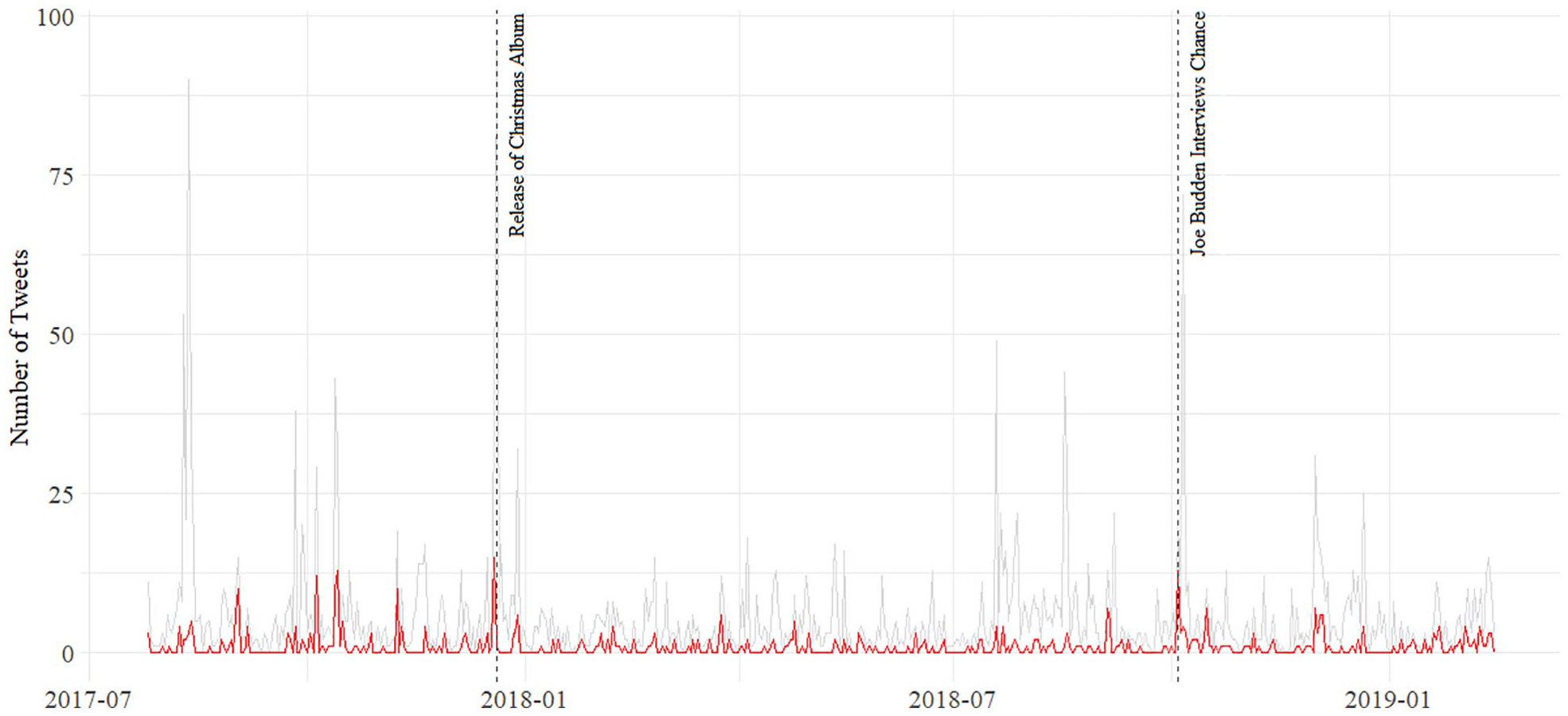
Timeline of tweets by Chance the Rapper.
Outside of our sampling period but during the writing of this article, Chance demonstrated an ability to enact social change, albeit a nonpolitical one. Chance used his Twitter audience of 8 million to bring back spicy chicken nuggets at Wendy’s (Snider, 2019, May 6). Chance’s case demonstrates that even though a small portion of musicians use Twitter for political engagement, the ones that choose to can have significant impacts on informing and mobilizing their audience.
Discussion
Two key findings emerge from this analysis. First, we grouped the artists into three categories of political engagement on Twitter: no engagement (the majority), circumstantial engagement, and active political engagement. The circumstantially engaged artists, like Charlie Puth, would post about politics on occasion, perhaps to advocate for voting or talk about a salient political issue. By contrast, the actively engaged talk about politics more regularly. For artists like Chance the Rapper and Regina Spektor, Twitter was another platform to talk about politics, alongside interviews and sometimes songs.
Our second key finding is focused on genres. Among the artists who do tweet about politics, we see a few interesting differences. Of the genres, Christian artists were the most likely to post at least one tweet. Qualitatively, we found that some of these tweets focused on charities or were related to other voting efforts (i.e., voting in The Voice). Such tweets reflect our coding procedure, which took a broad approach to what we considered a “political” tweet. Tweets that encouraged users to donate to a cause were considered political. This included donations for causes like natural disaster reliefs (e.g., relief for Puerto Rico), medical research (e.g., HIV/AIDS research, or cancer research), and social issues (e.g., Planned Parenthood, education). Tweets that were political in the Christian genre typically promoted conservative issues, particularly anti-abortion sentiments.
Like the Christian charts, many top country musicians also competed on The Voice and American Idol. If we ignore these contestants though, political tweets from country artists are surprisingly liberal. Willie Nelson and Kacey Musgraves are the most politically active, 8.96% and 4.82% political tweets, respectively, and advocated for progressive issues like marijuana legalization and LGBTQ+ inclusion.
By contrast, rock and hip-hop artists talked about political issues more frequently. Many artists who were also actively engaged came from these genres (no Christian artists were actively engaged). Although there were some tweets advocating for philanthropic efforts, more of them seemed to discuss political issues or had calls to action, such as encouraging people to vote or attend a rally. These findings align with previous literature on how rock and hip-hop artists have engaged with politics, even before the advent of the internet. If “rap music is a contemporary stage for the theater of the powerless” (Rose, 1994, p. 101), then Twitter is a new stage in the repertoire of politically active artists.
These differences in social media activity likely stem from their genre’s topical foci: Christian music seeks to extend the teaching of Christ through song, encouraging peace, kindness, and faith (Howard & Streck, 2015). By extension, Christian artists may aspire to promote philanthropic efforts or political attitudes that align with traditional Christian beliefs. Rock and hip-hop, by contrast, have more counter-cultural lyrics, highlighting the hypocrisy of mainstream culture.
Interestingly, though unsurprisingly, the artists who were actively engaged in conversations about politics were often inspired or informed by their personal histories. For example, Regina Spektor immigrated to the United States as a child. This has made issues such as immigration reform and prejudice important to Spektor. Similarly, John Legend often talks about Obamacare and education, two core social welfare issues. He noted, in an InStyle interview, that this was inspired by his experiences: “I grew up in a family that didn’t have a lot of money” (Bush, 2015).
Limitations
Although the number of studies that see the political discourse relationship between pop-music artists and their social media presence is almost nonexistent, this study presents some limitations. Because we only looked at musicians that had a presence on the Billboard charts, we only looked at a specific “type” of artists on Twitter: those currently producing singles and gaining significant airtime on radio and through digital music services. Although this sorting gives insight to artists currently on the scene, it neglects artists that have substantial followings but have older music no longer on the charts. Cher, for example, is often politically engaged on Twitter and frequently shares news stories and commentary on domestic and international affairs. Nevertheless, artists like Cher, who released songs prior to 2003, but persisted as a presence in the music industry, were not on the list. A lot of artists, maybe with a smaller market presence, have composed and released much music that could be aligned with this study’s research criteria. Nevertheless, most of these artists’ songs were probably composed for a niche audience, and never to “top the mainstream charts.”
Another limitation of this study is the focus on Twitter, and the absence of other platforms. While there could be a correlation between an artist’s activity across social media platforms, our observations only focused on Twitter activity/posts. The design of this study—how the team collected the dates and the period observed—also lacks older data. The current political climate could have altered what a “political tweet” constitutes. Consequently, our definition of a political tweet was rather generous. While we tried to detect tweets that were entirely political, or directly related to the current politically polarized atmosphere, we also included content related to philanthropy actions and donations. In continuing to conduct large scale analyses of the most prominent social media users, scholars can begin to truly understand the political consequences of an increasingly networked and digitally mediated society.
Finally, there are limits to the capabilities of computational techniques like machine learning. While we achieved a relatively high percentage of agreement, there is an inevitable degree of error in the machine learning labeling process. For example, tweets about The Voice or American Idol ended up in our dataset. Furthermore, machine learning does not provide context as to why some artists post more political content than others. We therefore supplement our findings with qualitative examples to highlight the type of political content produced in different genres.
Conclusion
While the results of this study are descriptive, they open a door for other researchers to investigate musicians as social media political mobilizers. For example, we can identify musicians who are not overtly political but do engage in political mobilization and discourse online. The artists that are politically vocal on Twitter also discuss politics in interviews and during tours, regardless of whether they have many (or any) overtly political songs.
We also believe it would be interesting to explore the non-engaged and circumstantially engaged artists further. This study cannot assess what triggers unengaged artists to become circumstantially engaged; however, the presence of circumstantially engaged artists suggests that artists will post about political issues if it becomes salient or meaningful. For some, that might be a philanthropic cause. For others, it may be an upcoming election. Future studies can explore this process further by focusing on the factors that encourage celebrities to be politically vocal.
The limited number of political tweets further suggests that while some artists do use their platform to talk about politics, the vast majority do not. Prior research on celebrity engagement highlights that though advocacy is common, political issues are advocated for the least compared with other social issues (Thrall et al., 2008). Artists may be concerned that they are alienating a fan base, thus compromising their popularity and exposure, as was the case with The Chicks when they spoke out against President Bush (CNN, 2003). Additional studies of individual artists can shed more light on this question, focusing on whether individual artists are incentivized or disincentivized to engage in politics.
Future studies should also explore whether political tweets are retweeted more frequently relative to nonpolitical tweets by musicians. Additional metadata such as this could provide more insights about the consequences of these tweets.
Supplemental Material
sj-png-1-sms-10.1177_20563051211019013 – Supplemental material for Chiming In: A Computer-Assisted Analysis of Popular Musicians’ Political Engagement on Twitter
Supplemental material, sj-png-1-sms-10.1177_20563051211019013 for Chiming In: A Computer-Assisted Analysis of Popular Musicians’ Political Engagement on Twitter by Josephine Lukito, Luis Loya, Carlos Dávalos, Jianing Li, Chau Tong and Douglas M. McLeod in Social Media + Society
Footnotes
Declaration of Conflicting Interests
The author(s) declared no potential conflicts of interest with respect to the research, authorship, and/or publication of this article.
Funding
The author(s) received no financial support for the research, authorship, and/or publication of this article.

Notes
Author Biographies
References
Supplementary Material
Please find the following supplemental material available below.
For Open Access articles published under a Creative Commons License, all supplemental material carries the same license as the article it is associated with.
For non-Open Access articles published, all supplemental material carries a non-exclusive license, and permission requests for re-use of supplemental material or any part of supplemental material shall be sent directly to the copyright owner as specified in the copyright notice associated with the article.

