



Abstract
We explore the implications of online social endorsement for the Covid-19 vaccination program in the United Kingdom. Vaccine hesitancy is a long-standing problem, but it has assumed great urgency due to the pandemic. By early 2021, the United Kingdom had the world’s highest Covid-19 mortality per million of population. Our survey of a nationally representative sample of UK adults (N = 5,114) measured socio-demographics, social and political attitudes, media diet for getting news about Covid-19, and intention to use social media and personal messaging apps to encourage or discourage vaccination against Covid-19. Cluster analysis identified six distinct media diet groups: news avoiders, mainstream/official news samplers, super seekers, omnivores, the social media dependent, and the TV dependent. We assessed whether these media diets, together with key attitudes, including Covid-19 vaccine hesitancy, conspiracy mentality, and the news-finds-me attitude (meaning giving less priority to active monitoring of news and relying more on one’s online networks of friends for information), predict the intention to encourage or discourage vaccination. Overall, super-seeker and omnivorous media diets are more likely than other media diets to be associated with the online encouragement of vaccination. Combinations of (a) news avoidance and high levels of the news-finds-me attitude and (b) social media dependence and high levels of conspiracy mentality are most likely to be associated with online discouragement of vaccination. In the direct statistical model, a TV-dependent media diet is more likely to be associated with online discouragement of vaccination, but the moderation model shows that a TV-dependent diet most strongly attenuates the relationship between vaccine hesitancy and discouraging vaccination. Our findings support public health communication based on four main methods. First, direct contact, through the post, workplace, or community structures, and through phone counseling via local health services, could reach the news avoiders. Second, TV public information advertisements should point to authoritative information sources, such as National Health Service (NHS) and other public health websites, which should then feature clear and simple ways for people to share material among their online social networks. Third, informative social media campaigns will provide super seekers with good resources to share, while also encouraging the social media dependent to browse away from social media platforms and visit reliable and authoritative online sources. Fourth, social media companies should expand and intensify their removal of vaccine disinformation and anti-vax accounts, and such efforts should be monitored by well-resourced, independent organizations.
Keywords
Vaccine hesitancy is a long-standing problem, but it has now assumed great urgency. The widespread mortality and economic disruption caused by the Covid-19 pandemic present acute challenges. The long-term decline of trust in UK collective and public institutions compounds the uncertainty (Devine et al., 2020). Despite the growth of “anti-vax” campaigns (Kata, 2012; Wellcome Trust, 2019), recent concerns about vaccine hesitancy mainly focused on childhood immunization (Dubé et al., 2013). The rapid transmission and relatively high mortality rate of SARS-CoV-2, the variability of the symptoms and outcomes of infection, the new mutations of the virus, the diversity of policy responses around the world, and the rapid development of the vaccines together indicate that Covid-19 vaccine hesitancy has some unique characteristics (Freeman, Loe, et al., 2020; Freeman, Waite, et al., 2020; Lazarus et al., 2020; Pollard & Bijker, 2020). This uniqueness also suggests that new types of public health communication will be important for vaccine take-up (Horton, 2020; Sherman et al., 2020; World Health Organization, 2020).
The first phase of the pandemic saw government and health authorities develop new laws and public communication strategies to encourage social distancing. The goal was behavioral change to reduce the spread of infection. The second phase began in December 2020, when the first vaccines were granted emergency approval and given to those most vulnerable to severe disease. Behavioral change will be equally crucial for the long-term success of the vaccines. From the pandemic’s early weeks, an unusually wide range of disinformation and conspiracy theories about the origins and severity of Covid-19 spread online and on personal messaging platforms, partially undermining policy on social distancing (Freeman, Waite, et al., 2020; Miller, 2020). Government missteps, delays, and mixed messages also played a role. From mid-2020 onward, disinformation about the vaccines followed the same pattern (Centre for Countering Digital Hate, 2020). For example, false news reports claiming that a participant in early-stage vaccine trials had died circulated online and were fact-checked by Full Fact and BBC News as entirely fabricated (Full Fact, 2020). “Covid denial” is a minority political movement with links to the populist far right and climate science denial (Falkenbach & Greer, 2020) but has also led to protests outside hospitals and has found expression on social media platforms, and, indirectly, in professional media reports (Gallagher et al., 2020). This ongoing context of crisis and unpredictability suggests misperceptions about the safety and efficacy of Covid-19 vaccines may undermine the long-term goal of population-level immunity (Thunström et al., 2020).
Public Attitudes in the Balance
This study was planned as part of the Oxford Coronavirus Explanations, Attitudes, and Narratives Survey II (OCEANSII) project (Freeman, Loe, et al., 2020). The project includes a survey with a nationally representative sample (N = 5,114), which measured socio-demographics, attitudes, media consumption, and online endorsement of Covid-19 vaccination.
Vaccine hesitancy is, in part, a social information problem. The overall success of any vaccination program will depend on where, and how, information about the vaccines’ safety and efficacy is communicated. It will also depend on engagement with, and by, the public. In this article, we mainly focus on the “where”—the media and information settings. The “how”—the specific thematic messages—is crucial as well but is not our main focus here. In late 2020, among the UK adult population, 16.6% were very unsure about taking a vaccine, and 11.7% were strongly hesitant (Freeman, Loe, et al., 2020). Most estimates to date indicate that vaccination of 80% will be required to end the pandemic (Thunström et al., 2020). It is clear that, by mid-February 2021, despite the United Kingdom’s approximately 118,000 deaths and the world’s highest mortality per million of the population (Johns Hopkins University, 2021), between a fifth and a quarter of the UK adult population is either very unsure or strongly hesitant about getting vaccinated (Institute of Global Health Innovation, 2021; Murphy et al., 2021; Paul et al., 2020; Royal Society for Public Health, 2020; Sherman et al., 2020). Perceptions of the virus and the vaccines are associated with hesitancy: the perceived likelihood of being infected, the vaccines’ efficacy, and the wish to avoid side effects and be “experimented on.” Layering into these are social attitudes: negative perceptions of vaccine developers and health services, and conspiracy beliefs—not only overt belief in conspiracy theories but also high levels of uncertainty about whether the theories are actually true or false. Hostile distrust is also a driver (Freeman, Loe, et al., 2020).
Attitudes may be in the balance for some time, due to the rapidly changing daily news about the virus. Perceived uncertainty has been shown to increase belief in disinformation about Covid-19 (Miller, 2020). Exposure to false narratives about the virus’s origins has been shown to distort attitudes; conspiracy disinformation reduces compliance with social distancing (Bolsen et al., 2020). Yet public opinion research on uncertainty suggests people who are undecided or ambivalent about an issue may be more receptive to gaining information and engaging in dialogue with family, friends, and acquaintances (Berinsky, 2004, pp. 24–35). Some may find that new information resolves their ambivalence (Conner & Sparks, 2002), making it easier to move into either the vaccine-hesitant or the vaccine-positive group. Ambivalence is compounded when professional media coverage of an issue is unclear; people are less likely to be ambivalent if they are exposed to consensual statements in the news (Lewandowsky et al., 2013; Zaller, 1990). But people also encounter dissensus in their social networks. To date, the United Kingdom and most other countries have ruled out mandatory vaccination, due to concerns that state compulsion may increase the suspicion and distrust that links with vaccine hesitancy. Identifying what explains social endorsement of vaccines can help inform a non-coercive approach (Giubilini et al., 2019; Vanderslott, 2019) based on dialogue and peer endorsement, which has had proven success during in-person interventions to reduce hesitancy (Jarrett et al., 2015). Health authorities will need to present clear, transparent, honest, and fact-based information, but this will need to be distributed across a wide range of different media settings. Traditional, top-down health communication, such as advertisements in media, press briefings, leaflets in doctors’ surgeries, and training of health care staff will be important. On their own, however, these might not be sufficient. Addressing vaccine hesitancy will also require that people see that their networks of family, friends, work colleagues, and acquaintances are keen to get vaccinated. Due to the ongoing need for social distancing, many such encounters will be digitally mediated.
With this in mind, our focus is on the role of online social endorsement. We explore how vaccine hesitancy and other relevant factors, including socio-demographics, people’s media and information diet, and attitudes, including hostile forms of distrust, predict the intention to use social media and personal messaging services to encourage or discourage Covid-19 vaccination. By media diet, we mean the different combinations and overall balance of different media sources people use to find out about Covid-19. We conclude with some outline recommendations for how our findings may inform public health communication.
Our survey data allow us to answer our first research question:
RQ1. How many in the UK adult population say they are likely to use social media and personal messaging apps to encourage or discourage vaccination against Covid-19?
Beyond that, the analysis proceeds in three stages. In Stage 1, we use ordinary least squares (OLS) regression, with relevant control variables, to discover the extent to which vaccine hesitancy directly associates with the intention to use social media and personal messaging services to encourage or discourage vaccination against Covid-19. We then test whether media diet acts as a moderating variable that intervenes to strengthen or weaken the relationship between vaccine hesitancy and the intention to use social media and personal messaging services to encourage or discourage vaccination. In Stage 2, we explore the role of an attitude to news consumption that is particularly relevant to online endorsement behavior: the “news-finds-me” attitude (Gil de Zúñiga et al., 2017), which we explain further below. Allowing for relevant control variables, we use OLS regression to see if the news-finds-me attitude predicts the intention to use social media and personal messaging services to encourage or discourage vaccination. We then model media diet as a moderating variable, to see if it intervenes to strengthen or weaken the relationship between the news-finds-me attitude and encouragement or discouragement of vaccination. In the final stage, we focus on a particularly relevant form of hostile distrust of public authorities: conspiracy mentality. We treat conspiracy mentality in the same way we treat vaccine hesitancy and the news-finds-me attitude, testing its direct associations with the intention to use social media and personal messaging services to encourage or discourage vaccination, and considering whether media diet moderates the strength of those relationships.
Online Social Endorsement, Media Diet, Attitudes to News, and Distrust
Online Social Endorsement
Media-systemic change has brought fundamental shifts in how information of all kinds is produced, circulated, and consumed (Chadwick, 2013; Papacharissi & de Fatima Oliveira, 2012). Competition for the attention of audiences has intensified. Elite control over news agendas has loosened. Political activists, major and minor celebrities, “soft news” sites, fact-checkers, social media “influencers,” and sporadically engaged citizens use social media to routinely share opinions and information, amplify or debunk news stories, signal behavioral norms, and act as reporters on the ground. At the same time, professional journalists integrate information produced by these actors into their regular reporting.
Online social endorsement is important for understanding how people are exposed to civic information and act on it (Anspach, 2017; Bond et al., 2012; Chadwick et al., 2018; Kaiser et al., 2018; Messing & Westwood, 2014; Thorson & Wells, 2015; Tully et al., 2020; Weeks et al., 2017). People’s attitudes to previous vaccines have found expression on social media in the form of encouraging or discouraging others (e.g., Bradshaw et al., 2020; Smith & Graham, 2019). We should consider if this applies to Covid-19 vaccines and how this might matter for public health communication. Our first hypothesis is as follows:
H1. Vaccine hesitancy will be positively and strongly associated with people’s intention to use social media and personal messaging apps to discourage others from getting vaccinated against Covid-19.
Media Diet—Understood as Both External to and Including Online Social Endorsement
Media are essential for the public to acquire scientific information from trusted, authoritative, and responsible sources. Media diet also plays an important role in shaping online social endorsement, because people use media as resources they share when they use social media to persuade others (Chadwick et al., 2018; Vraga & Bode, 2018).
Public health communication must deal with the polycentric reality of today’s media systems, which feature greater epistemic competition than even just a decade ago. The public are now less dependent on professional news and public information campaigns for learning about medical science. In the United Kingdom, public service regulations strongly shape broadcast media content and the quality of information provided. A much weaker, though still significant, regulatory framework shapes the non-public-service mainstream press and news organizations. In contrast, beyond the law relating to crime and illegal speech, no equivalent rules currently apply to social media platforms and personal message services. There, beyond the actions of individuals, it is companies’ terms of service, “community standards,” and proprietary algorithms that shape the flow of information. Personal messaging apps are mostly encrypted and are not subject to regulatory intervention, except through design changes. On social media and personal messaging services, there is greater scope for information that did not originate with scientific and public health authorities to spread rapidly (Allgaier, 2019). Previous research identified Facebook and Twitter as popular platforms for anti-vaxxers (Schmidt et al., 2018; Wilson & Wiysonge, 2020). In recent years, the movement has expanded across all mainstream platforms, including YouTube, Instagram, and personal messaging services, such as WhatsApp. Covid-19 has accelerated the growth of the anti-vax movement (Centre for Countering Digital Hate, 2020, p. 5).
Yet audiences for professional news on television, radio, and news websites remain large. During the pandemic’s early stages, UK citizens gravitated toward long-established news brands, particularly the public service BBC, whose output has been the most used during the pandemic so far (OFCOM, 2020a). Still, frequency of access to mainstream news declined during the course of 2020 (Nielsen et al., 2020), and social media were used at high levels. By late 2020, about 49% of the public said they used social media for getting news and information about Covid-19 (OFCOM, 2020b). In light of the potential importance of different media for providing different kinds of resources for people’s online endorsement, we ask,
RQ2. Are specific media diets associated with people’s intention to use social media and personal messaging apps to encourage or discourage vaccination against Covid-19?
The complexity of people’s media diets today belies simplistic binary distinctions between “social media” and “mainstream media.” In recursive loops, vaccine disinformation shared on social media finds its way back into professional media reporting (Mo Jang et al., 2019). Much health information on social media originates in vertically directed, top-down flows initiated by professional media, but can reach broader audiences through horizontal networks of interpersonal sharing. Professional media coverage of what was later determined to be scientific fraud and unethical research falsely linking the MMR vaccine with autism was an important factor in the growth of vaccine hesitancy. But social media also played a key role in maintaining a public infrastructure of visibility for false, anti-vaxxer narratives (Basch et al., 2017; Bradshaw et al., 2020; Mo Jang et al., 2019; Smith & Graham, 2019; Wolfe et al., 2002).
When a social media user positively endorses news articles, it can influence levels of attention to, and favorability toward, those articles among followers (Anspach, 2017; Messing & Westwood, 2014). Many people see traces of others’ endorsements, such as comments and the lists of most-shared news articles, as more “authentic” measures of credibility than selection by a news editor (Sundar & Nass, 2001). Negative tweets about news headlines result in people downrating both an article’s credibility and the issue’s importance (Waddell, 2020). In relation to vaccines, parents’ belief that others in their social networks will not have their child immunized can undermine adherence to vaccination deadlines (Brunson, 2013).
Thus, exposure to social endorsement online is itself an important part of people’s media diets. Exposure to online endorsement is more likely to occur on social media and private messaging, which is also where the constraints on the flow of misinformation and conspiracy theories are comparatively weaker (Allgaier, 2019). This raises the issue of whether different media diets may lead people to encounter different blends of vaccine-related content, which may shape their attitudes toward vaccines and provide resources for their encouragement or discouragement of others. A key question here, then, is,
RQ3. Do specific media diets strengthen or weaken any associations between vaccine hesitancy and the intention to use social media and personal messaging apps to encourage or discourage vaccination against Covid-19?
News and Information: The “news-finds-me”
Attitudes to news have changed over the last decade, as part of the shift away from the broadcasting and print era of mass, relatively unified audiences. The news-finds-me approach (Gil de Zúñiga et al., 2017) suggests that the mass use of social media now means that many individuals grant less priority to active monitoring of news, and instead rely more on their online networks of friends and acquaintances for information. The attitude has been linked with low political knowledge. Less active monitoring of information is associated with lower vigilance, which may make individuals susceptible to disinformation (Lewandowsky et al., 2012) and therefore more likely to discourage others from getting vaccinated. Thus, our second hypothesis is as follows:
H2. The “the news-finds-me” attitude will be positively associated with the intention to use social media and personal messaging apps to discourage others from getting vaccinated.
Media diet may also moderate the relationship between the news-finds-me attitude and endorsement of vaccination. If those who have a more casual attitude to seeking out reliable information tend to encounter unfounded rumors from their networks of online friends, rather than news coverage from reliable sources, they may be more inclined to share those rumors and discourage others from getting vaccinated. In contrast, those who are confident that the news will find them, but who mainly get their news from authoritative sources, may be less likely to share low-quality information and discourage others. Given the previously untested role of the news-finds-me attitude in the context of both media diet and vaccine hesitancy, we ask a fourth research question:
RQ4. Do specific media diets strengthen or weaken any associations between the news-finds-me attitude and the intention to use social media and personal messaging apps to encourage or discourage vaccination against Covid-19?
Conspiracy Mentality
General conspiracy mentality has been linked with perceptions of low status and perceptions of threats to status. It is also associated with perceived lack of control over social and political events, but not over personal life or interpersonal relationships (Bruder et al., 2013). Unlike belief in specific conspiracy theories about Covid-19, conspiracy mentality is a general attitude. It may be particularly relevant to understanding hostility to public authority and unusual government action during a crisis. It may also play a role in people’s interpersonal sharing and endorsement. Spreading the false belief that “secret plots” by powerful groups are to blame for a pandemic and an “unsafe” or “unnecessary” vaccine may fulfill an important need to control one’s interpersonal communication environment, while also fulfilling a public, political purpose. Hence our third hypothesis is as follows:
H3. Conspiracy mentality will be positively associated with people’s intention to use social media and personal messaging apps to discourage others from getting vaccinated.
Finally, as with our other explanatory variables, media diet may moderate relationships between conspiracy mentality and encouragement or discouragement of vaccination. A media diet in which constraints on misinformation are relatively weak may more readily provide resources for people to share when they discourage others. A media diet in which constraints on misinformation are relatively strong provides fewer resources for people to share to discourage others. Our final research question therefore is,
RQ5. Do specific media diets strengthen or weaken any associations between conspiracy mentality and the intention to use social media and personal messaging apps to encourage or discourage vaccination against Covid-19?
Data, Measures, and Methods
Our survey had a quota-sampled participant group of UK adults (N = 5,114) and ran on the Luc.id platform from 24 September to 17 October 2020. The quotas were based upon UK Office for National Statistics population estimates for gender, age, ethnicity, income, and UK region of residence. We received ethical approval from the University of Oxford Central University Research Ethics Committee. Further details are in the Supplementary Materials, which also contains details of all item wordings and Confirmatory Factor Analyses (CFAs) for the variables, where relevant.
Outcome Variable
Two items asked respondents about their intention to use social media or personal messaging apps to encourage or discourage vaccination: “When a vaccine for Covid-19 becomes available, how likely is it that you will use social media (for example, Facebook, Instagram, Twitter, YouTube, or TikTok) to encourage other people to get vaccinated?” and “. . ., how likely is it that you will use text messages or personal messaging apps (for example, WhatsApp, Snapchat, or Facebook Messenger) to encourage other people to get vaccinated?” The options were “I am likely to encourage others to get vaccinated, without a doubt” (scored 1), “I am likely to encourage others to seriously consider getting vaccinated” (2), “I am not likely to encourage others either way” (3), “I am likely to encourage others to be cautious about getting vaccinated” (4), “I am likely to discourage others from getting vaccinated” (5), and “don’t know” (treated as missing). Both items strongly correlated (r = .74, p < .001) and so were combined into a numerical index based on average item scores (n = 3,967, excluding “don’t knows,” M = 2.55, SD = 0.95). The index is a continuum of intentions, from encouragement to discouragement.
Control Variables
Age, sex, educational attainment, religiosity, political ideology, income, and ethnicity were measured. Wording of the items and the distributions of demographic variables are in the Supplementary Materials (SM2). We also measured “need for chaos” (Petersen et al., 2020) as a control for potential confounding associations with our explanatory variable of conspiracy mentality. This had good model fit (comparative fit index [CFI] = 0.980, Tucker–Lewis index [TLI] = 0.960, root mean square error of approximation [RMSEA] = 0.069, Standardized Root Mean Square Residual [SRMR] = 0.023) allowing us to use the predicted latent variable in our regression models below.
Main Explanatory Variables
Vaccine hesitancy was measured using the Oxford Covid-19 Vaccine Hesitancy scale (Freeman, Loe, et al., 2020). We removed one of its seven items (“If my family or friends were thinking of getting a COVID-19 vaccination, I would strongly encourage them”) to avoid conceptual overlap with our outcome variable. The model fit of a CFA with the six-item scale was very good (CFI = 0.990, TLI = 0.984, RMSEA = 0.060, SRMR = 0.009).
The news-finds-me attitude was measured with the original four-item scale introduced by Gil de Zúñiga et al (2017), partly re-phrased to make it specific to Covid-19. Allowing for an error correlation between the first and fourth items in the scale, CFA revealed an acceptable model fit (CFI = 0.996, TLI = 0.978, RMSEA = 0.052, SRMR = 0.008).
Five items assessed conspiracy mentality, based on the widely used scale by Bruder et al (2013). Removing the second item from the scale and allowing an error correlation between the first and third items produced a CFA with good model fit (CFI = 0.997, TLI = 0.982, RMSEA = 0.059, SRMR = 0.008).
Finally, we assessed respondents’ sources of news and information about Covid-19. For each, we used the same question wording: “How often do you turn to each of the following for getting news and information about Covid-19?” The options were “never” (scored 1), “at least once a month” (2), “at least once a week” (3), “every day” (4), “more than once per day” (5), and “don’t know” (treated as missing).
To identify actual combinations of media use in our sample and avoid purely a priori assumptions about media diet, we employed a hierarchical cluster analysis (for a similar approach see Bos et al., 2016; Edgerly, 2015). Twelve sources were selected for inclusion, based on the criteria that they (a) comprised the eight most frequently used media sources in the United Kingdom in our sample (television, radio, Google, national newspapers online, national newspapers print, government websites, National Health Service [NHS] websites, Facebook) and (b) the four most frequently used social media or personal messaging app sources beyond the eight most frequently used sources overall (i.e., personal messaging apps, YouTube, Twitter, Instagram). This procedure yielded our final explanatory variable: media diet for getting news and information about Covid-19. This comprises six, mutually exclusive clusters, to which we assign the following shorthand labels. The first group we term news avoiders (C1, n = 648)—they use all sources well below average. The second group are mainstream/official news samplers (C2, n = 988). People in this group use mainstream sources (newspapers online and in print, television, radio) and official sources (government and NHS websites) slightly more than average to inform themselves about Covid-19, while their use of social media is below average. The super seekers comprise Group 3 (C3, n = 252). These people use all sources far more than the average. The omnivores (C4, n = 764) use all sources, but each source is used only moderately above average. The fifth group are social media dependent (C5, n = 502): they use all social media and personal messaging apps much more frequently than average and all mainstream and official sources less frequently than average. Finally, there are the TV dependent (C6, n = 1,339). They get news and information about Covid-19 mainly from television. They use other sources, but clearly below the average (see Figure 1). See the Supplementary Materials SM4 for the full list of all sources measured in the survey. We entered media diet into our regression models. To test if media diet matters for explaining our outcome variable, we first used the news avoiders as the reference category. To test our ideas about the role of media diets with fewer constraints on misinformation and conspiracy theories, we used the social media–dependent media diet as the reference category.

Media diets for getting news and information about Covid-19.
Results
As Table 1 shows, about 33% of the UK adult population say they intend to use social media and personal messaging apps to encourage others to get vaccinated against Covid-19. About 10% of the UK adult population intend to use social media or personal messaging apps to discourage others. Most respondents (about 40%) said they intend to neither discourage nor encourage others. The largest group of the unsure or ambivalent is augmented by the 18% who responded with “don’t know.” This answers RQ1.
Intention to Use Social Media or Personal Messaging Apps to Encourage or Discourage Vaccination Against Covid-19.

Displayed are frequencies with percentages in parentheses, N = 5,114 (including don’t knows). n = 3,967 excluding all don’t knows for both items. Correlation between the items r = .74, p < .001.
We now assess what explains these intentions. In Table 2, Model 1 presents the results of a regression showing the associations between vaccine hesitancy (H1), the news-finds-me attitude (H2), conspiracy mentality (H3), respondents’ Covid-19 media diets (RQ2), and the intention to use social media or personal messaging apps to encourage or discourage vaccination against Covid-19. Our outcome variable is a continuum. Positive values of the coefficients in the models mean that respondents with higher values on an explanatory variable are predicted to be relatively closer to the discouragement end of the Encouragement–Discouragement scale. Negative values of the coefficients predict closeness to the encouragement end of the scale. Among the control variables, there is a very weak correlation between older age (b = .004, p < .001) and the likelihood of being toward the discouragement end of the scale. The need for chaos (b = .028, p = .043) also associates with a slightly greater tendency toward discouraging others, while religiosity (b = −.032, p < .001) is also associated with a slightly greater tendency to encourage others.
Ordinary Least Squares Regression Models Explaining Intention to Use Social Media or Personal Messaging Apps to Encourage or Discourage Vaccination Against Covid-19 (Models 1–3).

C: Cluster; SE: standard error. R2Model 1 = .376, R2Model 2 = .385, R2Model 3 = .379, n = 3,527. Positive coefficients mean that a variable increases the probability that a respondent will be placed toward the discouragement side of the Encouragement–Discouragement scale.
p < .1. *p < .05. **p < .01. ***p < .001.
As predicted by H1, the higher the levels of vaccine hesitancy, the more likely respondents are to intend to use social media and personal messaging apps to discourage rather than encourage vaccination (b = .486, p < .001). Contrary to our expectation (H2), respondents with higher levels of the news-finds-me perception tend to locate themselves toward vaccine encouragement rather than discouragement (b = −.060, p < .001). Conspiracy mentality is significantly and positively associated with discouragement (b = .020, p = .006), confirming H3.
To assess if specific media diets directly relate to the intention to use social media and personal messaging to encourage or discourage vaccination against Covid-19 (RQ2), we investigated the differences between the news avoiders and the five other groups (see Model 1 in Table 2). The regression results in Table 2 show that the super seekers (b = −.350, p < .001) and the omnivores (b = −.186, p < .001) are significantly less likely to use social media or personal messaging apps to discourage others from getting vaccinated when compared with the news avoiders. The mainstream/official news samplers (b = −.080, p = .074) and the social media dependent (b = −.088, p = .095) are also less likely than news avoiders to discourage others, but the associations for these two diets marginally fail to reach statistical significance. The TV dependent are slightly more likely than news avoiders to use social media to discourage others (b = .120, p < .001). Media diet therefore plays some direct role in explaining how likely it is that people intend to use social media and personal messaging apps to encourage or discourage vaccination. However, as Figure 2 shows, the mean scores on the Encouragement–Discouragement scale for news avoiders and the TV dependent are still short of the mid-point of the scale, so this a matter of movement along a continuum that runs from encouragement to discouragement. Note also that the role of TV dependence changes substantially in our moderator models below, and we return to this finding in our Discussion.

Intention to use social media or personal messaging apps to discourage others from getting vaccinated, by Covid-19 media diet.
The second part of our analysis uses media diet as a moderator (RQ3). See Model 2 in Table 2. Each interaction tests whether the link between vaccine hesitancy and encouragement or discouragement behavior becomes stronger or weaker among respondents with a specific media diet compared with the reference category.
The results show that a super-seeker media diet (b = .126, p = .028) and a social media–dependent media diet (b = .092, p = .032) both slightly strengthen the relationship between vaccine hesitancy and discouraging others from getting vaccinated, when compared with a diet of news avoidance. An omnivorous media diet (b = .073, p = .054) does too, although the relationship marginally fails to reach statistical significance. In contrast, the moderation model shows that the relationship between vaccine hesitancy and discouraging others is significantly weakened by a TV-dependent media diet (b = −.120, p < .001).
Figure 3 plots these interactions. The differences between all media diet roles are small and get progressively smaller as vaccine hesitancy increases. As vaccine hesitancy decreases, we observe larger predicted differences in the likelihood that respondents with different media diets encourage or discourage vaccination. Super seekers who are low on vaccine hesitancy are more likely to encourage others to get vaccinated than are the TV dependent or news avoiders. But as vaccine hesitancy increases, respondents with a TV-dependent media diet are no more likely to discourage vaccination than similarly hesitant respondents with other media diets. A TV-dependent media diet therefore attenuates the association between vaccine hesitancy and the intention to use social media and personal messaging apps to discourage others from getting vaccinated.
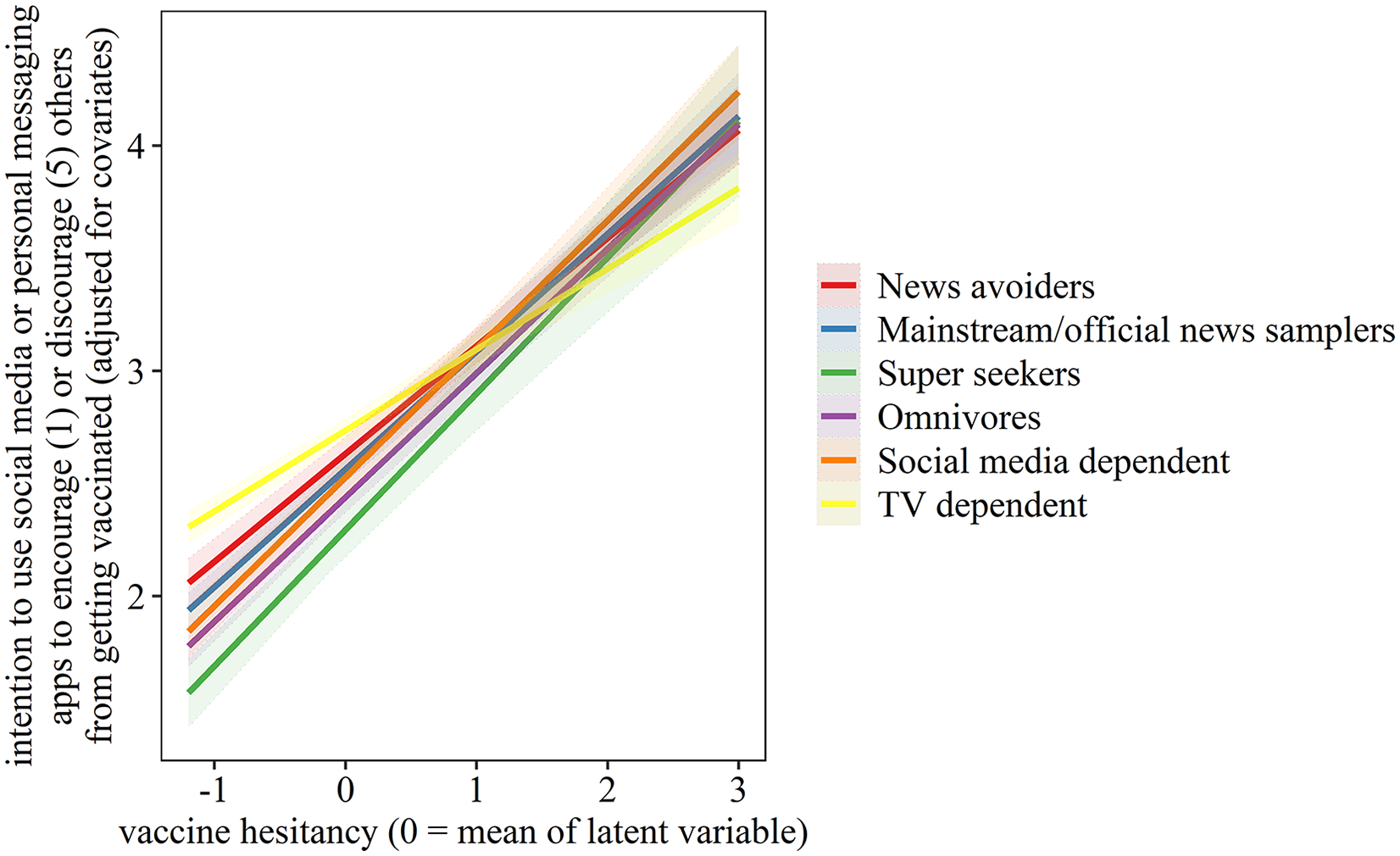
Effect of vaccine hesitancy on intention to use social media or personal messaging apps to discourage others from getting vaccinated, moderated by Covid-19 media diet.
Next, Model 3 in Table 2 assesses the role of media diet in moderating the relationship between the news-finds-me attitude and people’s positions on the vaccination Encouragement–Discouragement scale (RQ4). When compared with the news-avoider media diet, all other media diets (apart from the social media–dependent diet, which marginally fails to reach statistical significance) weaken or even reverse the relationship between the news-finds-me attitude and encouraging vaccination. While news avoiders have a higher tendency toward discouragement than the rest of the sample (as shown by the negative coefficients for the other media diets in Model 3), participants with the mainstream/official news sampler diet (b = −.104, p = .014), the super-seeker diet (b = −.241, p < .001), the omnivorous diet (b = −.108, p = .018), and the TV-dependent diet (b = −.105, p = .010) all tend to move toward higher levels of encouragement when the news-finds-me attitude is higher.
Moreover, as Figure 4 shows, when the news-finds-me attitude is lower, there is no difference between the intention to encourage or discourage vaccination among respondents with a news-avoider diet and a super-seeker diet. In contrast, as news-finds-me increases, Covid news super seekers become significantly more likely than news avoiders to encourage vaccination.

Effect of the news-finds-me attitude on intention to use social media or personal messaging apps to discourage others from getting vaccinated, moderated by Covid-19 media diet.
Finally, we turn to RQ5: Is the link between conspiracy mentality and encouraging or discouraging others moderated by media diet? See Model 4 in Table 3. As the interaction terms reveal, when compared with the social media–dependent media diet, all media diets weaken the association between conspiracy mentality and encouraging or discouraging vaccination. The comparative distinctions that matter most are between the social media–dependent and the two other media diet groups where interactions are statistically significant—the TV dependent (b = −.098, p < .001) and the super seekers (b = −.124, p < .001). The distinction between the social media dependent and the news avoiders (b = −.046, p = .086), the mainstream/official news samplers (b = −.048, p = .063), and the omnivores (b = −.046, p = .074) marginally fail to reach statistical significance. As Figure 5 reveals, when conspiracy mentality is low, the social media dependent and the super seekers differ very little. However, as conspiracy mentality increases, a super-seeker media diet attenuates the association between holding conspiracy mentality and discouraging others from vaccination. In contrast, as conspiracy mentality increases, people with a social media–dependent diet become substantially more likely to discourage others from getting vaccinated.
Ordinary Least Squares Regression Models Explaining Intention to Use Social Media or Personal Messaging Apps to Encourage or Discourage Vaccination Against Covid-19 (Model 4).

C: Cluster; SE: standard error. R2Model 4 = .380, n = 3,527. Positive coefficients mean that a variable increases the probability that a respondent will be placed toward the discouragement side of the Encouragement–Discouragement scale.
p < .1. *p < .05. **p < .01. ***p < .001.

Effect of conspiracy mentality on intention to use social media or personal messaging apps to encourage or discourage vaccination against Covid-19, moderated by media diet.
Discussion
A substantial group among the UK adult population—about 33%—say they intend to use social media and personal messaging apps to encourage other people to get vaccinated against Covid-19. A significant minority—10%—say they intend to use social media and personal messaging apps to discourage others from getting vaccinated. A substantial number are unsure or undecided. Most—about 40%—intend neither to encourage nor discourage others; 18% say they don’t know. Ambivalence is thus the norm, with about 57% of the UK adult population indicating that they are not sure if they will use social media or personal messaging to positively endorse the Covid-19 vaccines.
A key limitation of our study is that it is based on self-reported intentions in a survey at one point in time. The pandemic is a fast-moving context. Still, there is good evidence that people’s self-reports of online sharing and recommendation align closely with their behavior on social media (Mosleh et al., 2020). Ambivalence may, of course, break down over time. As more becomes known about the vaccines and the virus, some people will become settled in their views, more confident in their behavior, and move into the pro-vaccine group. But ongoing uncertainty and new developments in the pandemic will also mean that some will move into the anti-vaccine group. Online endorsement is likely to shape such decisions, to some extent (Tully et al., 2020; Vraga & Bode, 2018). Addressing this precarious context will require careful, imaginative public communication, quite possibly over several years to come, if vaccination becomes a regular annual occurrence. Communication should include national media, science and media literacy initiatives, fact-checking to inoculate against or debunk false claims, and work on the ground in local community and clinical settings (Royal Society for Public Health, 2020). But there will also be a role for encouraging positive online social endorsement.
In themselves, our findings reveal the significant challenge facing UK public health communicators who wish to develop vaccine confidence that finds expression as purposive endorsement behavior online. Given that digital communication has generally become much more important in people’s daily lives than before the pandemic, these findings give some cause for concern. Public health communication based on the assumption of widespread and positive online social endorsement of vaccination must face this reality. Thinking arguably needs to go beyond simplistic understandings of the power of government press conferences, but also equally simplistic understandings of the role of high-profile social media “influencers” and “micro-targeted” online advertising.
We found that the more respondents were hesitant about the vaccines, the more they intended to discourage, and the less they tended to encourage, vaccination against Covid-19. This is a clear and robust link. Covid-19 vaccine hesitancy is finding expression in online discouragement of vaccination. Vaccine-hesitants’ views will circulate beyond interpersonal network ties and potentially shape the perceptions of others. That would have been less the case in the media system of even just a decade ago, when the opportunities to reach beyond immediate family and friend networks were more circumscribed. This new context makes this finding about the link between hesitancy and discouragement of others troubling. It suggests that an obvious task ahead is to address the substance of the beliefs about vaccine hesitancy, because this attitude will understandably lead many people to share unfounded fears about the vaccines in their online networks. But more pragmatically, it also suggests that targeting overt anti-vaccination beliefs directly may be less important than empowering those who are pro-vaccine to be more confident in promoting their experiences to others.
No single media diet directly predicts overt discouragement behavior: all correlate with mean placement on the encouragement side of the Encouragement–Discouragement scale. Yet, even after vaccine hesitancy itself and all the other variables and controls are taken into account, there are still some important differences between how media diets relate to using social media and private message services to encourage or discourage vaccination. The moderation models reveal these distinctive patterns.
The news avoiders use all media well below average. In our models testing direct links with intended encouragement or discouragement, they appear in second highest position toward the discouragement end of the scale. Our findings about the news-finds-me attitude tie in here. Contrary to one of our hypotheses, higher levels of the news-finds-me attitude do not correspond with moving toward the discouragement end of the spectrum. Given that news-finds-me has previously been associated with greater use of social media and lower levels of political knowledge (Gil de Zúñiga et al., 2017), this finding was unexpected. But the moderation models provide deeper insight. The subjective meaning of the news-finds-me attitude may differ according to media diet—a possibility that has not previously been considered. Those who perceive that the news finds them appear to benefit (in public health terms) from a Covid super-seeker media diet. Among the super seekers, our moderation model predicts a stronger intention to encourage vaccination. The opposite occurs for those who perceive that the news finds them but who generally avoid news about Covid-19. Among news avoiders, our models predict a stronger tendency toward discouragement as news-finds-me attitude increases.
For those who frequently access news and information about Covid-19, or have authoritative sources in their media diet, as the other media diets include, the attitude that “the news-finds-me” could rest on confidence in the ability to stay informed, even when an individual cannot proactively do so. People may follow authoritative sources on social media, or have a personalized infrastructure, such as app notifications, social media networks, and informed friends, that help them learn about the vaccines and encourage others to get vaccinated. For those who avoid news, the news-finds-me attitude shows rather different patterns. Those who generally avoid news about Covid-19 are less frequently exposed to authoritative sources, have fewer opportunities to learn about the vaccines, and do not prioritize information-seeking. And yet, they are also more prepared to discourage vaccination, even though they are less likely to have gathered the facts.
We have therefore shown that news avoidance may be a serious challenge to encouraging vaccine take-up. Taken together, the news-finds-me attitude and news avoidance combination is particularly troubling. It is difficult to envisage any form of public health communication that will reach the Covid news avoiders who think the news “finds” them. News avoiders will be hardest to reach, through traditional or digital media channels (Nielsen et al., 2020) but the news-finds-me attitude will make this even more difficult. The best approach may be direct contact, either through local health services, workplaces, direct mail, community work, or even street advertising (which will become more salient in people’s lives as social distancing restrictions ease.) Direct phone counseling with the vaccine-hesitant will also provide further opportunities to route around news avoidance.
Our findings about the TV dependent are also somewhat troubling. Recall that, in the direct models (i.e., without moderators), the TV dependent were the closest to discouragement on our Encouragement–Discouragement scale. We offer an interpretation for this finding. There is an important substantive distinction between those who mostly rely on TV for their news and those who have more varied media diets. The TV dependent use TV moderately above average, but use all other sources, including NHS and government websites, search engines, and national newspaper websites far less than the average for finding out about Covid-19. Indeed, as Figure 1 showed, the TV dependent share many similarities with the news avoiders. The main difference is that news avoiders also eschew TV as a source of news about Covid-19. Given that the TV dependent use all other sources infrequently, their position (in the models without moderators) toward the discouragement end of the scale when compared with the other media diet groups suggests a lack of confidence. We speculate that this is not an overt anti-vaccination attitude, but instead may derive from a lack of purposive information-seeking using other sources, particularly NHS information websites, national newspaper websites, and internet search. We may have tapped into a sense of passive uncertainty about the pandemic—an attitude that may negate some of the benefits gained from exposure to a medium, TV, that is regulated by public service broadcasting standards, which we would expect to correlate with positive vaccine endorsement. Further research, using qualitative methods, could explore this line of enquiry.
An implication for public health communication here is that reaching the TV dependent—the largest group of about 30% of the UK adult population in our sample—is in one sense straightforward but requires careful consideration of aims. Mass public information advertisements, similar to those encouraging social distancing, can be used to reach this group. Yet we also need to consider our findings about how media diet moderates the link between vaccine hesitancy and endorsement behavior. Among all six media diets, a TV-dependent media diet most strongly attenuates the tendency of the vaccine-hesitant to use social media and personal messaging apps to discourage others from getting vaccinated. This finding suggests that increasing TV public information advertisements is not likely to undermine positive online encouragement of vaccination more generally. At the same time, the content of TV public information ads should not aim to do all of the work. Instead, these should clearly point to specific, authoritative information sources, such as NHS and other public health websites that enable informed learning. The sources to which the TV dependent are directed should also feature ways of encouraging people to share those materials among their social networks. This way, the TV dependent might be encouraged to broaden their range of sources, more actively learn through purposive information-seeking, and become more confident in their endorsement behavior. This could potentially be a double gain: increasing exposure to positive information about the vaccines will layer into TV’s role in attenuating the link between vaccine hesitancy and discouraging others. If that exposure then leads the TV dependent to encounter a wider range of good quality, easily shareable information about the vaccines, that, too, might increase positive online social endorsement more generally.
Covid-19 news super seekers and omnivores are more likely, on average, to encourage and less likely, on average, to discourage vaccination. Our moderation models showed that, among those who are not vaccine-hesitant, a super-seeker media diet relates to the strongest intention to use social media and personal messaging apps to positively encourage others to get vaccinated. This suggests that when people gain a broad perspective, from a range of different media sources, they gather evidence and are more likely to positively endorse vaccination. The Covid-19 news super seekers will be much easier to reach with public health communication than the other groups, due to their greater use of all media and their interest in news.
One downside is that the super seekers are the smallest group and make up only about 6% of the UK adult population in our sample. At the same time, however, the super seekers are more likely to be exposed to information about the vaccines generally, without the need for much intervention by public health authorities. But there is also a caveat. If the information that super seekers encounter is good quality, it may help them translate their interest into more persuasive positive endorsement of the vaccines. If the information is of poor quality, it will not help the vaccine-positive in this task. The super seekers use public service–regulated media well above average, but they also use social media well above average. Therefore, a further public health implication is that clear, informative, social media advertising is worth pursuing. This would provide super seekers with good resources to share and potentially blunt the connection between a social media–dependent diet and discouraging others, to which we now turn.
The social media dependent clearly spend a fair amount of time online, but they do not seem to prioritize NHS or government websites, nor do they value internet search. In the moderation model for vaccine hesitancy, a social media–dependent media diet also slightly strengthens the relationship between vaccine hesitancy and discouraging others from getting vaccinated. This reinforces the need for public health communication to encourage those who use social media far more than other sources to go beyond their usual information-seeking routines. It is unrealistic to expect the social media dependent to suddenly flock to public service TV and radio news. Platform infrastructures based on the algorithmic prioritization of content also matter here. Research on climate science denial suggests that organized opposition to scientific consensus has appeared prominently in social media search results and autosuggestions because such groups engage in concerted efforts to “flood” channels and hashtags and there are no hard, economic incentives for platforms to use different ways of ordering the presentation of the material (e.g., Allgaier, 2019). 1 So, this suggests the need for a social media campaign that rests, not so much on direct persuasion in-the-moment on platforms, but on encouraging social media users to visit high-quality, authoritative, sources such as NHS and public health websites, where people can learn about the vaccines and then share that information back into their online networks. There may also be a role here for sponsoring social media influencers on platforms where they are more important, such as YouTube and Instagram, but only if this relies on influencers suggesting that people browse away from social media to visit quality online sources.
However, there are likely to be limits to what any social media–focused strategy can achieve. Our finding about the links between conspiracy mentality, a social media–dependent media diet, and negative endorsement of vaccines reveals perhaps the most worrying picture. In the United Kingdom, people with conspiracy mentality show substantially greater intention to use social media and personal messaging apps to discourage rather than to encourage vaccination. This comes on top of the impact of Covid-19 vaccine hesitancy and the other covariates in our regression model, without moderators. In addition, the moderation models show that media diet also “boosts” the relationship between conspiracy mentality and online social endorsement. When people with high levels of conspiracy mentality get most of their information about Covid-19 from social media, it is more likely that their conspiracy mentality then finds expression in using social media and personal messaging apps to discourage others from getting vaccinated. This suggests that an affinity between conspiracy mentality, social media use, and negative online social endorsement will undermine the vaccination program, to some extent. The public health implications of this finding are not straightforward. Conspiracy mentality can readily assimilate contradictory evidence. It is therefore unclear whether information-based messages targeted at social media will help in these cases. It might lead to a backfire effect that further entrenches anti-vaccine beliefs and leads some social media users to become more assertive in their attempts to discourage others from taking a vaccine, while sharing existing anti-vax material as they do so. Social media companies are becoming more assertive in their removal of vaccine disinformation and anti-vax accounts, with Facebook announcing a new initiative a day before we submitted this article (Facebook, 2021). Difficult though it is, due to freedom of speech issues, as the vaccination program proceeds, there is a need to expand and intensify these efforts while also ensuring they are monitored by well-resourced and independent fact-checkers, researchers, and civic organizations.
Supplemental Material
sj-docx-1-sms-10.1177_20563051211008817 – Supplemental material for Online Social Endorsement and Covid-19 Vaccine Hesitancy in the United Kingdom
Supplemental material, sj-docx-1-sms-10.1177_20563051211008817 for Online Social Endorsement and Covid-19 Vaccine Hesitancy in the United Kingdom by Andrew Chadwick, Johannes Kaiser, Cristian Vaccari, Daniel Freeman, Sinéad Lambe, Bao S. Loe, Samantha Vanderslott, Stephan Lewandowsky, Meghan Conroy, Andrew R. N. Ross, Stefania Innocenti, Andrew J. Pollard, Felicity Waite, Michael Larkin, Laina Rosebrock, Lucy Jenner, Helen McShane, Alberto Giubilini, Ariane Petit and Ly-Mee Yu in Social Media + Society
Supplemental Material
sj-docx-2-sms-10.1177_20563051211008817 – Supplemental material for Online Social Endorsement and Covid-19 Vaccine Hesitancy in the United Kingdom
Supplemental material, sj-docx-2-sms-10.1177_20563051211008817 for Online Social Endorsement and Covid-19 Vaccine Hesitancy in the United Kingdom by Andrew Chadwick, Johannes Kaiser, Cristian Vaccari, Daniel Freeman, Sinéad Lambe, Bao S. Loe, Samantha Vanderslott, Stephan Lewandowsky, Meghan Conroy, Andrew R. N. Ross, Stefania Innocenti, Andrew J. Pollard, Felicity Waite, Michael Larkin, Laina Rosebrock, Lucy Jenner, Helen McShane, Alberto Giubilini, Ariane Petit and Ly-Mee Yu in Social Media + Society
Footnotes
Authors’ Note
The authors are listed in order of contribution to this article.
Declaration of Conflicting Interests
The author(s) declared the following potential conflicts of interest with respect to the research, authorship, and/or publication of this article: Oxford University has entered into a partnership with AstraZeneca for the development of a Coronavirus vaccine.
Funding
The author(s) disclosed receipt of the following financial support for the research, authorship, and/or publication of this article: The project was funded by a grant from the University of Oxford Covid-19 Research Response Fund (Project Reference: 0009519). It was also supported by an award from the National Institute of Health Research (NIHR) invention for innovation (i4i) program (Project II-C7-0117-20001) and the NIHR Oxford Health Biomedical Research Center (BRC-1215-20005). Chadwick and Vaccari are supported by a Leverhulme Trust Research Project Grant (RPG-2020-019). Kaiser is supported by a Swiss National Science Foundation Postdoc Mobility grant (SNSF-P2ZHP1_191288). Freeman is supported by an NIHR Research Professorship (NIHR-RP-2014-05-003). Giubilini is supported by a UKRI/AHRC grant (AH/V006819/1). The views expressed are those of the authors and not necessarily those of the UK National Health Service, NIHR, or the UK Department of Health and Social Care.

Supplemental Material
Supplemental material for this article is available online.
Notes
Author Biographies
References
Supplementary Material
Please find the following supplemental material available below.
For Open Access articles published under a Creative Commons License, all supplemental material carries the same license as the article it is associated with.
For non-Open Access articles published, all supplemental material carries a non-exclusive license, and permission requests for re-use of supplemental material or any part of supplemental material shall be sent directly to the copyright owner as specified in the copyright notice associated with the article.
