




Abstract
Availability of alternative information through social media, in particular, and digital media, in general, is often said to induce social discontent, especially in states where traditional media are under government control. But does this relation really exist, and is it generalizable? This article explores the relationship between self-reported online news consumption and protest participation across 48 nations in 2010–2014. Based on multilevel regression models and simulations, the analysis provides evidence that those respondents who reported that they had attended a protest at least once read news online daily or weekly. The study also shows that the magnitude of the effect varies depending on the political context: surprisingly, despite supposedly unlimited control of offline and online media, autocratic countries demonstrated higher effects of online news than transitional regimes, where the Internet media are relatively uninhibited.
Introduction
The Internet and especially social media have been described as one of the principal factors influencing political participation since it reduced the costs for both access to alternative information (Garrett, 2006; Howard, 2011) and coordination (Castells, 2012; Earl & Kimport, 2013). In authoritarian societies, alternative information may be obtained solely from online sources, and increasingly it occurs through social media (Reuter & Szakonyi, 2015). Availability of such information is thought to contribute to the rise of political awareness of societal problems and grievances (Reuter & Szakonyi, 2015) as well as to social discontent (Hollyer et al., 2015; Howard, 2011; Kalathil & Boas, 2003)—two processes that ultimately affect government evaluation and policy support (Tang & Huhe, 2014). Political knowledge in turn has been said to give rise to political participation, notably to its protest forms (Meirowitz & Tucker, 2013) that are believed to be able to influence political unrest or even overthrow entire regimes (Hollyer et al., 2015). However, the scale and the universality of this connection have not yet been fully assessed. Thus, some researchers have questioned the democratizing role of the Internet in general (Morozov, 2011), the “alternative” character of social media as an aggregated category (Reuter & Szakonyi, 2015), and the link between non-differentiated political knowledge and protests (Little, 2015) and between alternative news and protests (Kaufhold et al., 2010). Evidence both for and against the relationship between online news, alternative political knowledge, and contentious political participation/protest has so far been fragmentary, with some scholars conceding the necessity of better data and analysis (Boulianne, 2009; Farrell, 2012). This article examines the first and the last components of this triad by providing empirical evidence of a positive and robust relationship between online news consumption and protest activity across a variety of nations. To show that online news consumption contributes to an increase in protest participation, this article deploys a multilevel model on self-reported data across 48 countries between 2010 and 2014. We also report marginal effects of online news consumption on protest participation and the level of uncertainty of the estimation that is not often presented in studies on political communication.
This article also seeks to explain the variance in the strength of the online news effect between the countries using the existing research outlined further below. Specifically, we hypothesize that access to alternative information via the Internet might be an especially important factor of protest participation in situations where online news is the only source of that information while traditional media are loyal to the government. Thus, the link between online news exposure and protest behavior might be expected to be the strongest in countries where all media, except the Internet, are controlled by the government because of the largest level of discrepancy between traditional and new media. This is most likely to occur in transitional democracies, or anocracies, that combine autocratic features with democratic ones. Compared to that, this link might be expected to be weaker in democracies where such discrepancies are presumably not that large, and even weaker in complete autocracies where all media are fully controlled and no criticism is available. This study tests this hypothesis by embedding macro-level factors that indicate economic, political, and social development of countries.
The rest of the article is structured as follows. The next section provides a brief overview of existing research highlighting that scholars rarely distinguish between online news consumption and the use of the Internet, social media, and other information and communications technologies (ICTs) in general, an oversight which in turn might affect the precision results in earlier analysis of the issue. Next, we present our argument explaining why testing the relationship between protest and online news consumption specifically is important. We derive three testable predictions on both individual and macro level, specifying regime type and economic development across 48 nations. In the last sections, we formulate our hypotheses and present the results for each of them, focusing on the quantity of interest (expected values and first difference) that allows us to estimate the marginal effects and the level of uncertainty of our estimation. We conclude with a discussion and interpretation of our results, and outline directions for further research.
Revising the Relationship between Online Media and Social Unrest
When looking at the effects of the Internet, scholars often imply the influence either of social media use as a whole (Tufekci & Wilson, 2012; Wolfsfeld et al., 2013) or even of the Internet use in general (Breuer et al., 2014; Howard, 2011). As a result, the effects of online news consumption specifically have not been widely studied, at least not in the cross-country perspective. Similarly, protests are often included into the concept of political participation and studied jointly (Brundidge et al., 2014), but no large-scale research has been made on the relation of online news consumption to protest participation specifically.
Meanwhile, not every political action is contentious nor is every protest political (it can equally be perceived by participants as social or economic). That is why research focused on generalized political participation cannot contribute to a complete understanding of the subversive power of the Internet or social media across a broad range of societal issues. Simultaneously, one can expect that the effect of online news consumption on protests might differ from that of other forms of Internet use such as social networking, gaming, or shopping.
However, as mentioned above, the specific relationship between online news and protest participation has not been a focus of the existing research, although relationships between other similar phenomena have got attention from researchers. There are many studies of social media effects on political participation (Koltsova & Kirkizh, 2016; Theocharis & Lowe, 2016) and even on protests (Enikolopov et al., 2020; Tufekci & Wilson, 2012), while online news are rather ignored. Other studies address the relation of news media and political knowledge (Coffé, 2017; Kenski & Stroud, 2006; Reuter & Szakonyi, 2015) or political participation (Brundidge et al., 2014; Ladd & Lenz, 2009; Vissers et al., 2012; Wojcieszak et al., 2016), but not protests. At the same time, formal models that seek to explain the mechanism of a protest’s onset and regime survival (Kricheli et al., 2011; Little, 2015; Meirowitz & Tucker, 2013) account for information signals, but do not include online news. Similarly, empirical research that focuses on explanation and prediction of protest participation with a multitude of factors does not specifically address online news (Bernhagen & Marsh, 2007; Dalton et al., 2010; Schlussman & Soule, 2005; Welzel & Deutsch, 2012).
This seems to be a serious gap. In a meta-analysis of studies devoted to the Internet and political engagement, Boulianne (2009) finds that the effects of the Internet happen to be larger when the Internet use is measured as online news consumption. However, of the 38 reviewed papers, only 8 address online news, while protests are only very marginally mentioned in one of those 8 papers. A vast majority of studies in Boulianne’s review and beyond find the studied relationships to be positive, with a few exceptions (Theocharis & Lowe, 2016; Wolfsfeld et al., 2013). However, Boulianne’s review also suggests that many of these studies lack methodological rigor. Echoing Farrell (2012), Boulianne calls for more nuanced research of the relationships between specific types of Internet use and specific civic and political activities. Similarly, Wolfsfeld et al. (2013) acknowledge the lack of comparative research and argue that the impact of the Internet on protest may vary depending on political context in general, and political regime in particular.
To the best of our knowledge, the only paper that addresses both online news and protests is the research of the youth protests in Chile by Valenzuela et al. (2012); they find that protest participation is positively related to general online news consumption and to using Facebook for news in particular, among other factors. This work belongs to the vast majority of papers devoted to a single country or even a single protest. Available cross-country comparisons of protest behavior do not include the Internet (Dalton et al., 2010; Welzel & Deutsch, 2012), are devoted to a very narrow set of countries (Wolfsfeld et al., 2013), or both (Bernhagen & Marsh, 2007).
In the meantime, as also mentioned in the introduction, some studies claim that the independent information that online media are able to provide can increase citizens’ awareness of current societal problems. Kalathil and Boas (2003, p. 136) and Howard (2011, pp. 108–112) suggest that online access to previously hidden political, social, or economic news can raise general discontent among the public. The Internet in general is often perceived as an alternative information source, although the picture might, in fact, be more complex. For instance, Reuter and Szakonyi (2015) find that in Russia, the usage of international social networks such as Twitter and Facebook increased the awareness about electoral fraud, while the usage of domestic VKontakte and Odnoklassniki did not. The degree to which the Internet constitutes an alternative to other forms of media may also vary depending on the political regime. Petrova (2008) finds that paradoxically the number of Internet users per capita is negatively correlated with press freedom over a sample of about 90 countries. However, in democracies the relation is reversed, while in autocracies it is also positive, but insignificant. This leaves us to suppose that an exceptionally strong negative relation is found in transitional regimes, in which citizens have an opportunity to turn to the Internet while regular media are tightly controlled. Lorentzen (2014) argues that some autocratic regimes have to tighten control over traditional media when they cannot effectively control all alternative sources, such as the Internet. The authors claim that regimes can be very effective in regulating the safe level of media freedom; however, we might suppose that transitional regimes might also face a situation when tightening control over the regular media coupled with inability to control the Internet would lead to maximal discrepancy between their content. This in turn might lead to higher levels of protest activity, and thus news consumption would be most closely related to protest participation in transitional regimes compared to both democracies and autocracies. In the latter, all sources of information would be effectively controlled; in democracies, both old media and the Internet would be equally inclined to report critical information.
Theory and Hypotheses
In this article, we suggest that exposure to online news contributes to the likelihood of protest participation of an individual because, compared to traditional news sources, this medium is more likely to provide alternative and perhaps even subversive information about the society. We build on the above-mentioned work of Howard (2011) and Kalathil and Boas (2003) who claimed that online access to political, social, or economic news in countries such as Egypt and China, where previously it was concealed, could raise general discontent and create strong incentives for social unrest. In addition, as found out by Hollyer et al. (2015), the availability of economic information in non-democratic societies could destabilize both transitional and consolidated autocratic regimes. The most plausible mechanism of emergence of alternative news online is based on the access of multiple individual and sometimes anonymized users to news production: they bring news about events they have either eye-witnessed or taken from international sources into their national social media environments, after which this news gets a chance to go viral and to force more “regular” online media to react and push it further. Based on this, we derive that the main hypothesis of this article is that protest participation to some extent is associated with higher online news consumption:
Hypothesis 1a: The more the citizens are exposed to online news, the higher the probability of their participation in protests.
This effect might be biased due to the problem of self-selection (Prior, 2007, pp. 94–101, 2013; Knobloch-Westerwick & Johnson, 2014): citizens interested in politics might choose higher involvement in information flows. Thus, protest participation could in fact be caused by interest in politics, but not by news consumption. However, if the latter has its own influence, non-politically interested news consumers would be still more inclined to protest than non-consumers, and furthermore, those who are both politically interested and consume online news would be most of all inclined to protest. Thus, interest in politics and online news consumption would interact. To test this proposition, we derive the following sub-hypothesis:
Hypothesis 1b: Individuals interested in politics and online news will be more likely to participate in protests than individuals who are interested in politics but are not exposed to online news.
Finally, drawing on the theoretical underpinnings of the first hypothesis, we expect that the political regime might affect an individual’s online news consumption, thus determining the magnitude of its effect on protest participation. Specifically, in consolidated democracies, individuals might receive news online from the same media companies that had dominated the market before the emergence of the Internet, and additionally both offline and online media enjoy a visible and comparable degree of press freedom. The implication is that the effect of online news consumption on protests will correlate with traditional media and will not be particularly strong. On the contrary, in fragile democracies, the governments usually effectively control offline media since pre-Internet times, while they fail to enforce their control over the Internet, and especially over social media, as effectively (Bodrunova & Litvinenko, 2013; Howard, 2011). Hence, in those societies, the discrepancy between the offline and online news will be maximal, which is why we expect to observe the strongest association between protest participation and online news consumption. By contrast, consolidated autocracies control all media markets including online outlets (Coffé, 2017; Lorentzen, 2014). Therefore, individuals are less likely to obtain any alternative information, and the analysis might show no or little evidence that protest activity is associated with online news consumption. Accordingly, we derive the following hypothesis:
Hypothesis 2: Compared to consolidated democracies and even more to autocracies, the magnitude of the effect of online news on protest participation is greater in transitional regimes where all media, except the Internet, are expected to be controlled.
Data and Measurements
To test our hypotheses, we draw on the international database, the World Values Survey (WVS), 1 sixth wave. Because of our theoretical setup, we used WVS data for 2010–2014, the time when the Internet was available in all countries included in our sample. That is, the choice of time was a function of the Internet penetration in the countries. The unit of analysis is individuals (around 68,000 observations)—hence individual level—and countries—aggregated level (for information on countries, see Table A8 in the Online Appendix).
Dependent Variable: Protest Participation
We define Protest Participation of individuals as their answers to the question of WVS, on whether they have recently participated in peaceful political demonstrations: 1—if an individual reported recent attendance of a demonstration, and 0—otherwise. 2 We extracted this variable from the cross-table of two related variables: a question on protest participation at any time and a question on recent participation among any-time participants. Thus, the independent variable opposes both non-participants and long-ago participants (0) to recent participants (1). As can be seen from the question wording, we do not distinguish between political protest and social or economic protests. We assume that any protest may change political regimes or decisions of national/local governments; therefore, we define it as a political action (Lipsky, 1968). We use the WVS question related to peaceful demonstrations only because the question about illegal uprisings might have not received reliable answers due to potential legal repercussions. In addition, the frequency of protest participation might differ across nations; therefore, we also apply random effects (i.e., “multilevel” model) to account for this heterogeneity across individuals and countries. Figure 1 and Figure A1 in the Online Appendix show the share of protesters in every country where the question was asked. As expected, the number of citizens participating in protests will not be large in some states both due to the rarity of protests themselves and as a result of the potentially costly repercussions of participation in these activities.
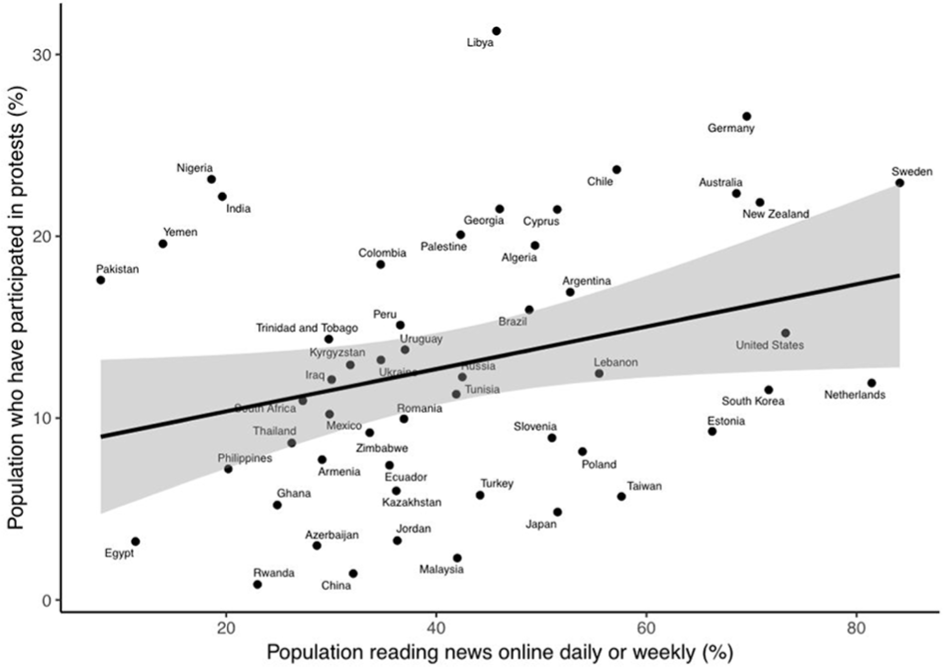
Percentage of respondents who reported that they read news online daily or weekly, and percentage of respondents who reported that they participated in a protest at least once.
Independent Variable: Online News
Based on our testable implications derived above, we include a variable Online News in our analysis. WVS has a direct question regarding online news consumption, asking respondents to report whether they use the Internet to obtain the news about their country or the world: 1—yes, and 0—otherwise. 3 Figure 1 shows the share of online news consumers in every country, where the question was asked. The variable can potentially account for reading online news on news websites such as The New York Times and Google News, as well as on social media: indirect evidence from the United States demonstrates that according to public surveys of Pew Research Center in 2012, more than 49% of American adults read the news via social media such as Facebook and Twitter.
As mentioned above, the significance of the effect of online news on protest participation might be the effect of political interest of individuals: those interested in politics might be more likely to read news. If otherwise, interest in politics and news consumption should interact. To deal with this, and by extension to test Hypothesis 1a, we combine the variable Online News with the variable Interest in Politics (see Table A3 in the Online Appendix for details on variable coding). Thereby, the combined variable Online News × Interest in Politics includes the following categories: 0—not interested in politics and do not read online news, 1—interested in politics and do not read online news, 2—not interested in politics and read online news, and 3—interested in politics and read online news.
Control Variables
Individual-Level Variables
We relied on theory and previous research to select control variables (e.g., Koltsova & Kirkizh, 2016; Welzel & Deutsch, 2012). Only those that were significant in a large set of preliminary regression models were left for the final regression analysis: Membership as an index of active/inactive membership in political parties, charity organizations, environmental organizations, and professional associations (from 0—not a member to 2—active member); Friends as a source of news (1—receive the news about the country or the world from friends, and 0—otherwise); Employment status (1—employed, 0— otherwise); Education (from 1—no formal education to 9—education level with a degree); and Gender (1—male, 2—female). For robustness checks, we also created a model that included the media other than the Internet: Newspapers (1—read the news, 0—otherwise), Radio (1—listen to the news, 0—otherwise), and TV (1—watch the news, 0—otherwise). We include these variables because in some less developed countries in our sample traditional media may exert stronger influence on public opinion than online media. The use of friends as news sources is also conceptually important: in some countries, they may be the only sources of alternative news at all.
Aggregated-Level Variables
For the country-level analysis that Hypothesis 2 implies, we included two substantial variables that according to the existing research have strong explanatory power (Bueno De Mesquita & Root, 2000, pp. 197–204; Doucouliagos & Ulubasoglu, 2008; Treier & Jackman, 2008:): GDP per capita from the World Bank data and political regime based on the scale of the Polity IV project (Marshall et al., 2016). With the latter variable, we follow Polity IV three-item classification of regimes offered on top of its 20-point scale: this is done to make the possible effect sounder. As a result, we form a three-category variable Regime, where 1—democracy (+6 to +10), 2—anocracy (−5 to +5) or transitional regime, and 3—autocracy (−10 to −6). Based on Polity IV classification, countries in transitional states perform traits of both democratic and autocratic regimes in relation to a number of core regime components, such as executive recruitment or executive autonomy constraints. Of special importance for us is the Polity IV Political Competition and Opposition component that involves the suppression of oppositional media in transitional regimes and the absence of the former in consolidated autocracies. As the Internet is technically harder to control than traditional media, we expect the effect of online news on protests to be stronger in transitional regimes where we assume to find relatively free online outlets but censored traditional offline media (Hypothesis 2). For testing the hypothesis, we divided the sample into three groups of countries by Regime and applied pooled regression models with all of the aforementioned individual-level variables to each of the three groups since the number of observations is sufficient for such a division. We thus obtained three separate models for individuals from democracies, transitional regimes, and autocracies, respectively.
Results
The Effect of Online News
The probability that an individual i in a country j answers that he or she participated in a protest is represented as a function of individual-level and country-level characteristics. In the first hypothesis, we suggest that the probability of protest participation is associated with online news consumption on average across all countries. Since the dependent variable has Bernoulli distribution, we apply the formula for a logit model

where

for individual i = 1, . . ., n in country j = 1, . . ., J. Equation (2) shows that Online News and Controls are individual-level covariates, and αj represents a country-level random effect that allows Online News to vary across countries. For robustness, we include a covariate Regime to see whether there is heterogeneity across political regimes. Thereby, we set αj in the following way

In the interpretation of coefficients, our primary quantity of interest is the first difference (FD), which represents how the probability of protest participation changes as an explanatory variable moves from one substantively meaningful value to another (King et al., 2000).
According to Hypothesis 1a, Protest Participation is expected to be positively associated with Online News. Thus, the effect of Online News should be positive and one or two standard errors should be greater than zero. Table 1 Model 1 shows the results. Figure 2 illustrates the marginal effect of Online News for all countries: given an average shift from a category “Do not read online news” to “Read online news,” the probability of protest participation increases by 1.8 percentage points (95% confidence interval [CI] = [0.01, 0.02]), almost doubling the effect. The effect remains positive and significant when we control for political Regime (Model 2), GDP per capita (Model 3), and variation of the effect across countries, namely, random effect of Online News as we predicted (Model 4). 4 To compare the effect of online news with news from other types of media, we include variables Newspapers, Radio, and TV into one of the models. Model 9 presents the results: Online News has a larger effect than Newspapers, while the coefficients of Radio and TV are not significant. 5
Regression Results for Hypotheses 1 and 2 with Different Sets of Controls and Other Robustness Checks.

GDP: gross domestic product.
Note. Models in this table are presented in reduced form. For extended versions of models, see Table A1, A2, A3–A7, and A9 in the Online Appendix. Covariates in Models 1–4 and 6–7: interest in politics, communications with friends, membership in social organizations, employment status, gender, and education. Covariates in Model 5 are the same as in Model 2, and the following categories of individuals—who “read online news and interested in politics,” “interested in politics but do not read online news,” “not interested in politics and do not read online news,” and “not interested in politics but read online news”—are predictors of interest whose coefficients we report. Apart from controls mentioned above, every model includes variables that we specify under each coefficient according to our theoretical framework.
Level of significance: ***p < .01.
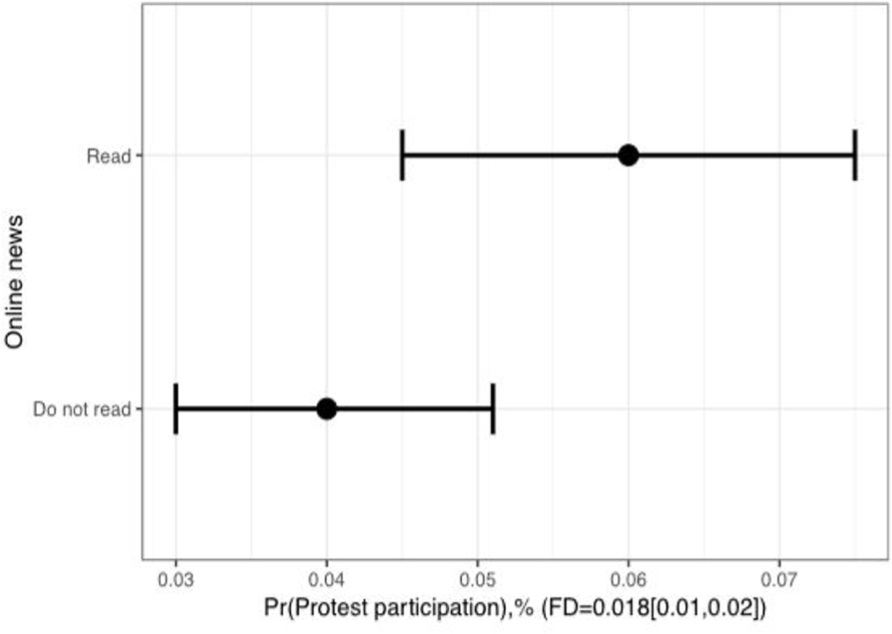
Marginal effects of online news for all countries.
The Effect of Interest in Politics
Hypothesis 1b states that the positive relationship between protest participation and an individual’s interest in politics will be confined by online news consumption. In other words, we expect to observe a stronger positive relationship between protest participation and interest in politics of a respondent given that he or she reads online news. The hypothesis can be written as

where αj is also a group predictor for every country. Equation (4) also includes the interaction term that we model through a combination of variables Online News and Interest in Politics. Due to the nature of these two variables, the resulting variable is not linear, but nominal. Equation (4) defines that the effect of Interest in Politics on Protest Participation is conditioned on Online News. Figure 3 shows that the interest both in politics and in online news demonstrates the largest effect. In particular, this effect is more pronounced than that of interest in politics when not combined with exposure to online news: on average, the probability of protest participation increases by 3 percentage points (95% CI = [0.021, 0.039]) when shifting from the latter to the former. Interestingly, the effect of belonging to the category “interested in politics but do not read online news” is larger than the effect of belonging to those who are “not interested in politics but read online news.” A move from one to the other results in the decrease in protest probability by 1 percentage point (95% CI = [0.007, 0.013]). Finally, moving from the category “no politics and no online news” to “not interested in politics but read online news” leads to a 2 percentage point increase in the probability of protest participation (95% CI = [0.012, 0.023]). Overall, the variable Interest in Politics × Online News demonstrates that news consumption is quite strongly associated with the interest in politics. However, the results show that individuals who read online news but are not interested in politics are more likely to participate in protest than those who are both not exposed to online news and politics. Hence, the effect of online news is significant for all consumers and not restricted to those who are already predisposed to political participation (Model 5).
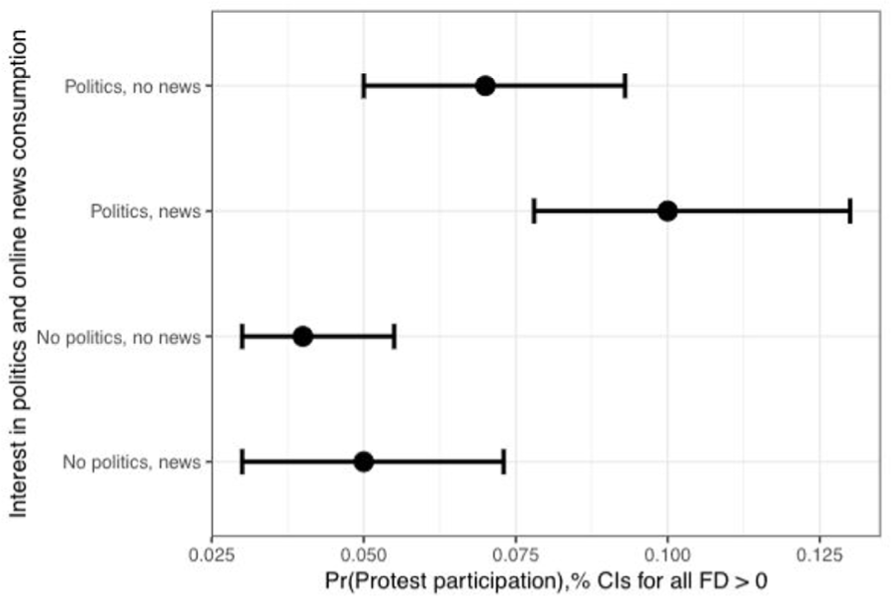
Marginal effects of online news combined with interest in politics for all countries.
Effect of Political Regime
As we pointed out earlier, media consumption differs across political regimes because of local law, policies, and political and civil liberties. Hence, the impact of online news on protest participation might change depending on a country and its political climate. Based on this theoretical consideration, we test the second hypothesis that has a form of a model with the individual level only



We exclude country-level predictors because the subsamples we use include too few countries: 30 democracies (Polity IV score +6 to +10), 12 transitional regimes (−5 to +5), and 5 autocracies (−10 to −6). Models 6–8 in Table 1 illustrate the results (for table with countries and full version of tables with regression results, see in Online Appendix). The effect of online news consumption on protest participation is still positive and significant although its values vary across political regimes. In particular, Online News had the largest magnitude of effect in autocracies rather than in transitional regimes contrary to what had been expected.
Conclusion
In this article, we have demonstrated that distinguishing online news consumption from general social media use and from general Internet use by plugging it into a political context provides new empirical evidence on the debated role of the Internet in protest behavior. The exposure to online news is positively associated with participation in demonstrations across all countries on an individual level, and especially in autocracies on an aggregated level of analysis. We therefore demonstrate the universal character of Internet influence on protests with the focus specifically on online news exposure, in contrast to most other studies which focused on social media or on generalized Internet use in separate countries. Our result is stable when a large number of country-level and individual-level control variables are added. Online news exposure turns out to be more important than reading newspapers, which has been traditionally associated with critically thinking audiences, which marks the shift of such audiences from print to online media. The effect of online news consumption is weaker than that of interest in politics; however, none of them is fully caused by the other, and when combined together they reinforce each other and push individuals toward protest participation with a greater power than when they occur separately.
In addition, we find that the effect of online news consumption is strongest in autocracies and weakest in transitional regimes, a finding which goes against one of our hypotheses. This result demands further research: first, it is necessary to test the significance of the difference between these effects, and second, a theoretical interpretation is needed. Different country groupings may yield somewhat different results in the future; however, in any case, the assumption of transitional regimes being the most vulnerable to online news influence does not hold. Another direction for future research is conducting cross-country surveys specifically aimed at capturing protest participation, with protesters being oversampled to overcome the rare-event effect. Such surveys will be more suited for testing various relevant hypotheses, in particular those about explanations of country variance.
Furthermore, although we find that the effect of online news is significant and has the same direction in all countries, its overall magnitude is modest. This is consistent with the observation of Boulianne (2009) made in her meta-analysis of similar papers, but it nevertheless gives rise to further doubts and reflections. First, this counterintuitive result may indicate the need for a more nuanced research of different types of news obtained through the Internet. As different social media platforms have different effects on political knowledge (Reuter & Szakonyi, 2015), different types of political information, too, may affect protest behavior differently. As Little (2015) claims in his formal model, if the obtained information reveals low levels of protest support, whether true or false, it may in fact discourage protest participation. Similarly, Brundidge et al. (2014) find that only pro-attitudinal news encourages political engagement, while counterattitudinal news does not, meaning that encouragement happens only if the political positions of the news item’s author and the reader coincide. The importance of knowledge about the number of like-minded people and the level of protest support has been, in fact, underlined in many theoretical and empirical, albeit non-news-centered works (Castells, 2012; Earl & Kimport, 2013). Thus, the situation calls for a differentiated approach to news content when predicting protests.
Second, as online news consumption does not take place in vacuum, it may affect protest participation in a more complex way than directly galvanizing readers into action, while non-readers stay at home. Koltsova and Selivanova (2019) find that more active and more numerous online communities of the same social movement are associated with much higher offline turnout to contentious actions in respective neighborhoods, but, paradoxically, offline protesters are not necessarily those who are most involved in online communities. Two other findings complement this study to lead us to further interpretations. First, as we find in this research, getting news from friends affects protest participation with nearly the same magnitude as online news reading. Second, Schlussman and Soule (2005) found that the best predictor of protest participation is in fact being asked to participate. From this, we can assume that online news can transfer into protest participation in a two-step manner outlined by Lazarsfeld and his colleagues (Katz & Lazarsfeld, 1955) back in the mid-20th century: from online news readers to their non-reading friends via face-to-face contact or via other forms of interpersonal communication (e.g., mobile phones). This effect may have obscured the true significance of online news consumption for protests in our research, as well as significance of other forms of online behavior addressed in other studies. As this effect might be expected to be stronger in small and tightly connected neighborhoods, such as rural communities, our last suggestion for further research would be to attempt examining the relationship between news flows and protest participation separately in rural and urban areas.
Supplemental Material
sj-pdf-1-sms-10.1177_2056305120984456 – Supplemental material for Online News and Protest Participation in a Political Context: Evidence from Self-Reported Cross-Sectional Data
Supplemental material, sj-pdf-1-sms-10.1177_2056305120984456 for Online News and Protest Participation in a Political Context: Evidence from Self-Reported Cross-Sectional Data by Nora Kirkizh and Olessia Koltsova in Social Media + Society
Footnotes
Acknowledgements
We would like to thank Veronica Kostenko, Eduard Ponarin, Svetlana Bodrunova, Harald Shoen, Thomas Gschwend, and the Fellows of the Social and Cognitive Informatics Laboratory (SCILa) for their helpful comments.
Declaration of Conflicting Interests
The author(s) declared no potential conflicts of interest with respect to the research, authorship, and/or publication of this article.
Funding
The author(s) disclosed receipt of the following financial support for the research, authorship, and/or publication of this article: The research leading to these results has received funding from the Basic Research Program at the National Research University Higher School of Economics (HSE).

Supplemental Material
Supplemental material for this article is available online.
Notes
Author Biographies
References
Supplementary Material
Please find the following supplemental material available below.
For Open Access articles published under a Creative Commons License, all supplemental material carries the same license as the article it is associated with.
For non-Open Access articles published, all supplemental material carries a non-exclusive license, and permission requests for re-use of supplemental material or any part of supplemental material shall be sent directly to the copyright owner as specified in the copyright notice associated with the article.
