




Abstract
This article examines the role of social media dynamics in the public exchange of information between scientists (experts), government (policy-makers), mass media (journalists), and citizens (nonexperts) during the first 4 months after the Covid-19 outbreak in the Netherlands. Over the past decade, the institutional model of science communication, based on linear vectors of information flows between institutions, has gradually converted into a networked model where social media propel information flows circulating between all actors involved. The question driving our research is, “How are social media deployed to both undermine and enhance public trust in scientific expertise during a health crisis?” Analyzing the public debate during the period of the corona outbreak in the Netherlands, we investigate two stages: the emergency response phase and the “smart exit strategy” phase, discussing how scientific experts, policy-makers, journalists, and citizens appropriate social media logic to steer information and to control the debate. We conclude by outlining the potential risks and benefits of adopting social media dynamics in institutional contexts of science communication.
Introduction
In April 2020, Marion Koopmans, a prominent Dutch virologist, observed that Twitter had been a two-sided sword in battling the Covid-19 pandemic. In December 2019, she found posts in her informal Twitter feeds about a new virus emerging in Wuhan, prompting her to closely track the virus’s spread. Four months later, Koopmans was an expert on the government’s rapid response team and her Twitter feed showed discrediting and hateful messages about her work posted by anonymous sources. At a time of crisis in health communication, social media can be weaponized as conduits for misinformation and for undermining institutional and professional trust (Llewellyn, 2020); at the same time, they can be utilized as valuable tools for public engagement and information distribution. Watching the corona pandemic unfold, we have noticed how the epidemiology of the disease is intricately entwined with the systems and practices of spreading reliable information (Bjørkdahl & Carlsen, 2019). The higher stakes in this contested process of health communication are the public’s trust in expertise: How are social media dynamics deployed to both undermine and enhance public trust in scientific expertise during a health crisis?
In this article, we propose to examine the public exchange of health information between scientists (experts), government (policy-makers), mass media (journalists), and citizens (nonexperts) during the first 3 months after the Covid-19 outbreak in the Netherlands.In “From an Institutional to a Networked Model of Science Communication” section, we explore how, over the past few decades, science communication has shifted from an institutional model toward a networked model (Botsman, 2017). Implicated in this shift is the growing dominance of social media and online platforms as producers of circular—rather than linear—information flows. Many have argued that social media networks, as a central force in the networked model, have undermined the institutional model’s anchors of trust in scientific expertise, government, and legacy news media (Dahlgren, 2018). However, we can also witness how social media is deployed to enhance institutional authority and expertise. We hypothesize that the networked model of science communication transforms, rather than replaces, the institutional model by adapting the logic and dynamics of social media (Van Dijck & Poell, 2013) to enhance institutional authority.
The core of this article tests this hypothesis by taking cues from the public debate following the onset of the Covid-19 pandemic in the Netherlands, between March 1 and June 30, 2020. We collected and analyzed official policy documents, ministry’s press conferences, articles and programs from mass media outlets (newspapers, public television stations), and social media messages quoted in news media to trace the flow of information moving between professional experts to nonexpert citizens and vice versa. 1 We analyzed this public debate in two phases.
The first stage of this process, described in “The Crisis Response Stage” section, was characterized by the “emergency response” mode of the immediate lockdown—a highly volatile period when controlling the health narrative was crucial (Garrett, 2020; Weible, 2020). While social media proliferated as conduits for misinformation and conspiracy theories about the virus, they also served as useful gateways to scientific information (Hagen et al., 2018). In addition, they functioned as instruments of engagement and support for professionals working in the health sector. We explore how scientists, policy-makers, and mainstream media appropriated social media strategies to distribute accurate information and to enhance institutional trust.
The second stage of the debate, analyzed in “The ‘Smart Exit Strategy’ stage” section, shifted attention from the medical emergency response to the broader concern about a “smart exit strategy” from the lockdown. Opening up the public debate to nonmedical experts who were eager to discuss economic and social concerns as well as technical solutions, policy-makers had to confront the power of social media as amplifiers of citizens’ voices, for better or for worse. Looking for new strategies, policy-makers started to engage with citizens and nonexperts in the design of a post-corona society; by adapting networking and crowdsourcing tactics, they strategically tried to retain institutional trust and legitimacy.
In the last section, we will return to the question of how social media dynamics were deployed to both undermine and enhance public trust in institutional expertise during a health crisis and evaluate our thesis about the networked model of science communication transforming the institutional model. Finally, we will discuss the risks and opportunities involved in institutional actors adapting social media tactics to enhance the public’s trust.
From an Institutional to a Networked Model of Science Communication
For the past half century, science communication in Western-European societies has predominantly relied on a conventional model, characterized by linear flows of information between professional actors acting as gatekeeping forces. We trust science and scientists as institutions of knowledge-making, government and its (elected) officials as institutions of policy-making, and media and journalists as institutions of sense-making. All three institutions are aimed at constructing common knowledge, common ground, and common sense.
The institutional model is grounded in shared assumptions on whom to trust, what to trust, and how trust gets built. Naomi Oreskes (2019) explains why we trust scientists: not for their authority as individuals, but as members of a professional community who develop common knowledge and collective wisdom. Experts’ authority is qualified by virtue of their professional training and proven experience, while institutional trust is anchored in transparent methods as well as in rigorous probing and communal judgment of evidence. What can be trusted as the basis of scientific evidence is commonly referred to as facts and data; they are the result of methodical and empirical observations interpreted through logic, arguments, rational deliberation, and testing. Knowledge-making comes slow; it takes time to proceed from confronting a new phenomenon (e.g., an unknown virus) to reaching expert consensus on its meaning and impact. Therefore, it is important to acknowledge how trust gets built and communicated. By producing factual information (data graphs, daily statistics) and applying logical reasoning (modeling scenarios), experts open up their motivated projections to outside evaluation and rational deliberation.
In theory, the institutional model of science communication assumes linear information vectors leading from experts to nonexperts: scientists provide governments with relevant information so they can make informed decisions, while policy-makers inform news media and the public about the rationale behind their decisions, fostering democratic, open debates (Figure 1). In practice, such a model has never manifested in its pure form; scientific knowledge-making and evidence-informed policy-making, rather than being linear transmissions or “translations” of knowledge, have always been part of a dynamic process in which expert voices—framed by scientific, governmental, and media institutions—get interwoven with nonexpert voices in the struggle for public consent (Schäfer, 2016; Van Dijck, 1995; Weingart & Joubert, 2019).

The institutional model of science communication.
The institutional model of science communication has long prevailed in relative stability, enhancing the ideal of institutional filters and gatekeepers as pillars of public trust, until more recently online platforms and social media networks gained a central position in the process of science communication through public debates. According to Oxford economist Rachel Botsman, social media have allegedly “turned trust on its head”; information that used to flow “upwards to referees and regulators, to authorities and experts, to watchdogs and gatekeepers, is now flowing horizontally, in some instances to our fellow human beings and, in other cases, to programs and bots” (Botsman, 2017: 8).
In contrast to the who, what, and how of the institutional model, we present the networked model of science communication—a model that incorporates social media as a centrifugal force, changing the dynamics of information exchange in a public debate. Experts and institutionally embedded science professionals no longer have a monopoly on informing politicians and mass media, as social media platforms afford every citizen and nonexpert a communication channel (Hardos, 2018). Nonexpert voices gain clout through messages and videos they post and also through the automated likes, shares, retweets, and recommendations pushed by platforms; “friends” and nonexperts seem to be qualified to communicate scientific information on par with institutions or experts. Scientists’ slow-growing consensus based in fact-finding missions and processed through logical argument seems no longer the exclusive informant for “evidence-informed” policy which in turn feeds mass media and the public debate. Rather, nonexpert emotions, experience, sentiments, feelings, and trends are distributed through social media and are processed algorithmically, affecting the information cycle in real time. How science information gets transferred relies less on a one-to-many style of communication deploying text, context, and logic to convince recipients, and more on a many-to-many style of communication that utilizes opinions, visuals, memes, and short clips to mobilize crowds. As political economist William Davies (2018) observes, “information moves like a virus through a [social] network in far more erratic ways” (p. 6). The circular vectors of information flows have been illustrated in Figure 2.
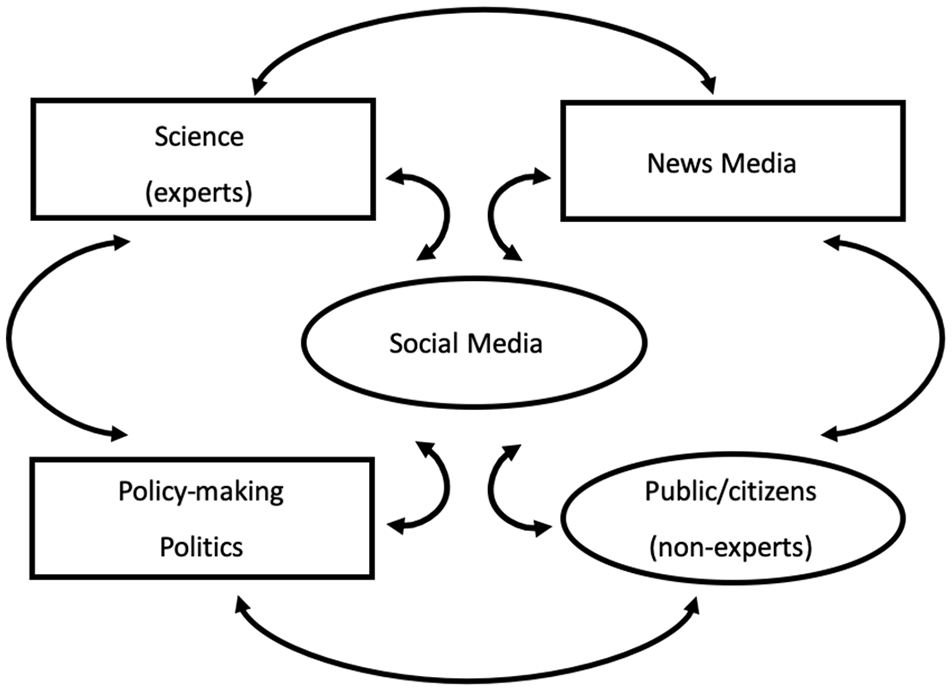
The networked model of science communication.
This networked model of science communication should be considered part of a wider transformation, where epistemic trust is at the heart of a socio-technical and a political power shift. In the 21st century, open democratic societies appear to be moving away from an institutional-professional form of trust toward a networked-algorithmic form of trust (Crawford, 2019). The first is predicated on human-made rules of gatekeeping power governed by publicly accountable institutions and professionals, while the second one hinges on algorithmic filtering and is governed by proprietary business models, the dynamics of which are based on opaque rules (Van Dijck, 2013). Whereas the first form of trust propagates a commitment to orchestrating public knowledge and common sense, the second thrives on maximizing online attention by hyping trends and encouraging opinionated dissent. And while the first form relies on local, national, and supra-national institutions to regulate information exchange to benefit the common good, the second one prioritizes consumer convenience by treating all information flows as economic resources in a marketplace of ideas (Van Dijck et al., 2018).
A number of scholars have voiced their growing concerns about social media platforms undermining public trust, particularly with regard to the rise of misinformation and polarization. For instance, American communication theorist Zeynep Tufekçi (2019) argues that “the internet is increasingly a low-trust society—one where an assumption of pervasive fraud is simply built into the way many things function” (p. n.p.). The shift away from the institutional-professional model toward the networked-algorithmic model, according to Swedish media scholar Peter Dahlgren (2018), has led to a corrosion of trust that visibly affects all independent institutions entrusted with the anchoring of Western democratic values: science and education, courts of justice, government agencies, and news organizations. The question whether social media fuel institutional distrust or whether institutional distrust weaponizes social media has been at the core of scholars’ concerns about fake news and disinformation years before the Covid-19 outbreak (Benkler et al., 2018; Bradshaw & Howard, 2018; Lazer et al., 2018).
However, the idea of social media as unique levers of institutional distrust tends to obscure the underlying complexity involved in processes of knowledge-making, policy-making, and sense-making. Particularly at the time of a health crisis, such as the Covid-19 pandemic, online platforms and social media can be regarded simultaneously as levers of trust and distrust in public debates. On the one hand, the proliferation of unfiltered voices through social media may cause a breakdown of trust in expert voices, officials, and mainstream institutions, because “the differentiation between individuals who are qualified to provide accurate information online and so-called armchair epidemiologists is increasingly difficult” (Limaye et al., 2020: E278). On the other hand, social media platforms give citizens a voice, providing a counterweight “to the felt lack of fit between experience and what we are offered by the official organs, and a corollary lack of trust in them” (Crawford, 2019: 92). Citizens and nonexperts may rightly claim their place next to expert voices in the public debate, if only to promote the transparency and accountability of policy-making (Song & Lee, 2015).
What makes our approach different is that we study the role of social media in a public debate not as an exclusive affordance of specific platforms but as an integral part of a social communication dynamic. Social media networks brings their own “logic”—strategies, mechanisms, style, and economies—to what was formerly predominantly defined by mass media logic (Van Dijck & Poell, 2013). Contrasting researchers who analyze content exchange within platform spaces or who study user-generated content during crisis situations (Stieglitz et al., 2018), we instead focus on science production, policy-making, legacy media, and social media platforms as interrelated parts of an information and communication system. Through this analysis, we are able to not only see the novelties caused by the networked model but also trace the consistencies with the institutional model.
Indeed, each of the two models represents a distinct perspective on how science information is communicated. And yet, it would be misleading to argue that the two models are antithetical or mutually exclusive; it would also be a mistake to argue that the second model has replaced or is replacing the first, resulting in the deterioration of institutional trust per se. Instead, we hypothesize in this article that the two models operate concurrently and are mutually transforming one another. While social media platforms have a profound impact on information exchanges in public debates, where they can help undermine public trust in institutions and expert knowledge, they are also used by authorities to reach across a widespread audience to retain trust. As several researchers have shown, scientific institutions may utilize online platforms to distribute official health information, which in turn enhances these platforms’ trustworthiness (Bjørkdahl & Druglitrø, 2019). Opening up scientific knowledge-making to a diversity of other experts and nonexperts may lead to new perspectives and more democracy in the face of uncertainty (Holst & Molander, 2019). Policy-makers, in their shared concern for evidence-informed decision-making, can deploy online methods to acknowledge the diversity of expert and nonexpert perspectives (Kattirtzi & Winskel, 2020). Novel concepts such as “expert patient,” and “citizen journalist” signal the permeable boundaries between expert authority and quasi-proficiency, but they may also be put to use to inform scientists (Bellander & Landqvist, 2020; Seymour et al., 2015). And legacy media may skillfully deploy the typical communication styles of social media to widen audience engagement (Pieri, 2019).
Against the more general backdrop of this transforming information environment, we now want to turn to a specific case of health communication: the public debate that evolved in the Netherlands after the Covid-19 outbreak, over a period of roughly 4 months in 2020, between March 1 and June 30. As described in the introduction, we will analyze the two stages of this debate—the “crisis response” of the lockdown and the “smart exit” strategy from the lockdown—marking the shift from a primarily expert-driven communication process to an increasingly nonexpert-driven process. Focusing on this two-tiered debate, we try to show how social media dynamics are deployed in various ways to both undermine and enhance public trust in scientific expertise during a health crisis.
The Crisis Response Stage
The government’s decision to impose a lockdown on the country in response to the threat of an unknown virus, which had blown over from China and northern Italy before hitting the Netherlands in early March of 2020, was unprecedented. The first stage of this response was characterized by high volatility and uncertainty—a period when scientific knowledge-making and evidence-informed policy-making almost coincided with public sense-making, due to the intense time pressure under which these communication processes evolved. The most poignant concerns raised during this phase were the following: Is the government doing enough or are they overreacting? How informed are their decisions, based on whose authority, and on what facts or opinions? And how are drastic measures communicated and received?
Throughout late February and early March, the government’s response had been one of lightness and sobriety (“less handshaking, more handwashing”). When the first corona-patients started to fill the hospital beds, the Prime Minister staged a press conference on March 12 that triggered intense reactions of anxiety and insecurity (Rijksoverheid.nl, 2020). A sweeping package of containment measures was announced, including working from home for all nonessential professionals, no more crowded events, and social distancing, but no complete enforced lockdown. Later that week, further, stricter measures were announced by ministers of health Bruno Bruins and Hugo de Jonge; they were flanked by experts, most prominently Dr. Jaap van Dissel, director of the Dutch National Institute for Public Health and the Environment (RIVM). On March 15, Mark Rutte addressed the nation in a live speech—a first in history attracting 7 million viewers—in which he laid out three possible scenarios to fight the pandemic: (1) controlled spread, to avoid the overwhelming of the health system; (2) complete lockdown; and (3) uncontrolled spread (Rijksoverheid.nl, 2020). The government’s choice for the first scenario, Rutte said, was based on scientific evidence informing this policy to reduce the number of deaths and minimize socio-economic impact while building up herd immunity: “I don’t expect people just trust their Prime Minister, but they have every reason to trust the experts.” In the days after the televised address, according to one poll, public trust in the government climbed to 73%, up from 45% (NPO1, 2020a).
At this first stage, the government highlighted rational explanation and reliance on trusted health experts—perfectly in line with the institutional model of science communication. News organizations (TV and print) followed suit by featuring mostly health specialists in their news reports on the measures. The debate about whether the government was overreacting or underestimating the pandemic happened mostly in the opinion sections of newspapers, talk shows, and on social media platforms. Voices that aired dissent, anxiety, and anger came from experts as well as nonexperts. Critical questions were raised concerning the effectiveness of herd immunity. Due to the international nature of the crisis and the global flows of online information, the difference between the Dutch response and measures taken by other governments sharply entered the debate, pressing policy-makers to clarify in the mainstream media and in Parliament that herd immunity was never meant to be a “goal” in itself but a welcome “side-effect” of the controlled spread policy. In both cases, policy adjustments were prompted by counter-voices arguing that the government was not doing enough to stop the pandemic. At times of emergency management, policy-makers who are still used to one-directional dissemination of information were now exposed to “vast amounts of information originating from the public,” which they had to handle with care (Simon et al., 2015: 616). Clearly, the government preferred “imperfect policy-making” approved by public consent over “perfect policy-making” causing public resistance and disapproval.
The emergency response also included strong initial warnings against untrustworthy information coming from unidentified sources, mostly through social media. Unsurprisingly, a barrage of misinformation and fake news had flooded individuals’ Facebook news feeds, YouTube channels, and Twitter feeds. The World Health Organization (WHO) quickly coined the term “infodemic” to point at the “overabundance of information—some accurate and some not—that makes it hard for people to find trustworthy sources and reliable guidance when they need it” (Wiederhold, 2020: 1). False stories quickly went viral; for instance, advice falsely attributed to Stanford University stated that taking a few sips of warm water every 15 min was adequate prevention against infection. More dangerous were the numerous recommendations to drink pure alcohol, use a specific toothpaste, or drink bleach water. And downright rampant were the conspiracy theories that linked the spread of the coronavirus to the ultrafast wireless technology known as 5G. In less than 2 months, the Dutch police reported more than 25 incidents of vandalized telecom infrastructure, all connected to corona-related activists.
National and European governments quickly launched coordinated efforts to fight the infodemic (European Union versus Disinfo, 2020). Although social media platforms were not the exclusive distributors of misinformation—popular newspapers in the Netherlands also published sensational stories—the pressure to act responsibly as mediators of public information weighed heavily on their shoulders. After years of disputing social media platforms’ inability to algorithmically filter out fake news and misinformation, on March 17, a collaboration between the most popular social media platforms (Facebook, Instagram, Twitter, YouTube, Reddit, and LinkedIn) announced global measures to curb the threat (NU.nl, March 17, 2020a). First, Facebook and YouTube started to collaborate with the WHO, the RIVM, and the Dutch government by linking users to official information and to specially produced video-clips, hence buttressing their own authority as respectable mediators of information. Second, Facebook and Twitter put up concerted efforts to block false stories of “miracle cures” and downgrade dubious conspiracy theories in their recommendations. YouTube promised to remove all videos suggesting a relation between 5G (fifth-generation) wireless technology and the coronavirus. Most remarkably, the Dutch government actively fought misinformation using various online strategies. In early April, they started to hire vloggers and popular YouTube influencers, such as YouTuber Rutger Vink (“Furtjuh,” 720,000 followers), to promote the coronavirus measures (RTL Nieuws, April 2, 2020). Later, this strategy backfired when some of these influencers turned their back on health authorities’ messages and started to support dubious anti-government groups.
Legacy media unequivocally pointed to social media networks as perpetrators of the infodemic while strategically reclaiming their institutional authority as trusted channels. During the first 2 weeks of the outbreak, Dutch national television broadcast two primetime television shows titled “Corona: Facts and Fables” (NOS, March 13, 2020). The format featured an anchor reading out loud questions sent by viewers and posted on social media; they were answered by medical experts, including RIVM director Van Dissel, and by national and local policy-makers, such as health minister Bruins. Questions epitomized fear (e.g., is the virus spread uncontrollably and aggressively?), confusion (do face masks work preventively or not?), disbelief (is corona really different from ordinary influenza?), and anger (why do schools remain open even though children can spread the virus?). Emotional appeals, launched by nonexperts and pulled from social media, were unequivocally rebutted by experts providing scientific facts—even if evidence was still scant and yet untested.
Expert voices during this first stage of the debate were overwhelmingly medical representatives; next to RIVM director Van Dissel and virologist Marion Koopmans, the most prominent figures were doctors Diederik Gommers, head of the Federation of Medical Specialists, and Ernst Kuipers, chief of the central coordination effort of corona patient care. Their estimates of how many intensive care (IC) beds were needed over the next few weeks, based on predictive modeling, prominently figured in government communication. Normal capacity of all Dutch IC beds combined is 1,150, while the estimated need surged from 1,600 to 2,000 to 2,400 in just a few days. While hospitals rapidly expanded their volume, IC capacity became the subject of a fierce parliamentary debate. The most popular graph was the “curve” pitting the health system’s capacity against the predicted number of patients, which needed to be flattened at any cost.
Mainstream news media almost unanimously conformed to the crisis response frame, showing how the system got stretched to its limits while experts explained the urgency of the situation. Daily statistics and predictive models dominated the headlines of legacy news media. Every single day for 7 weeks, national public broadcasting news (NOS) listed four numbers as if they were the stock market ratings: the number of confirmed (tested) infections, hospitalized corona patients, filled IC beds, and mortality rates. A majority of news reports between mid-March and mid-April assumed the narrative frame of a “race against the clock” where the robustness of the medical institution was at risk. Visuals showing IC units filled with medical equipment, nurses, and doctors were alternated with images of ambulances and helicopters taking patients to other hospitals. Under mounting political pressure, instant units in tents and convention centers were erected at great speed to meet the demands of politicians and government officials. Meanwhile, images of coffins and improvised mortuaries from Italy underscored predictions of the dire straits the Dutch health system would face if it collapsed.
Interestingly, the images that circulated through social media, while equally urgent, were different in nature. Social media networks appeared the preferred means of medical staff and patients to communicate their feelings and observations; they helped “experiential witnesses” to act as embedded citizen-journalists and cool-headed reporters from the battle field. For patients in isolation, receiving social media messages and clips from their family and friends provided great comfort, and their self-recorded video-messages frequently went viral. For medical staff working in the frontlines of corona care—an area off-limits to journalists—social media clips helped mediate their emotional narratives about death and suffering. Several doctors and nurses became instant celebrities on YouTube and Facebook, even to the point where “established” influencers promoted these professionals’ self-recorded clips on their channels. Social media also served as “weapons of mass appreciation” when users rallied support for health care workers by staging, recording, and distributing spontaneous public applause sessions. This communication style propelled by social media turned out to be immensely popular, leading NOS-News (March 20, 2020) to quickly launch a new daily program called “Frontberichten” (“Messages from the front”). Its format was a simple 15-min concatenation of video-clips self-recorded by nurses, doctors, ambulance staff, and by patients hospitalized in various parts of the country. The program resembled a televised Facebook newsfeed—an instance of legacy media borrowing the “live streaming” strategy preferred by social media.
In sum, the institutional model of science communication clearly reigned the emergency response phase. Expert voices were in the lead; the government sought the exclusive advice of medical and scientific experts participating in the Outbreak Management Team (OMT); evidence-informed policy-making got distributed by mass media; and policy-makers and news media effectively countered and co-opted nonexpert attacks, infused through social media dynamics, thus amplifying their own authority. And even if social media was disturbingly weaponized to sow distrust and propel misinformation, the institutions of government and mass media also adopted the strengths of social media—its distribution power, logic, and style—to enhance their authority and gain the public’s trust. In other words, the two models of science communication turned out to be not as distinct as they appear. And their diffusion became even more poignant when the initial emergency response evolved into the next stage of the public debate.
The “Smart Exit Strategy” Stage
A month after the government imposed a self-described “intelligent lockdown,” the call for a “smart opening up” started to put pressure on policy-makers who got caught between medical experts recommending to flatten the infection curve and economic experts urging to curb the budget deficit. With the pandemic and the public debate entering this new stage, the monopoly of medical experts on informing policy-makers was increasingly disputed: who counts as an expert, what counts as proper advice, and how should institutional authorities weigh information by the voices of a variety of experts and multiple nonexperts? Social media took on an increasingly pertinent role in the circulation of knowledge and information during this next stage of the public debate, focusing on developing smart exit strategies.
In early April, the disputation between those who support a prolonged lockdown versus those who favor a less strict regime moved to the center of public debate. Public policy-making is normally directed by a cost-benefit analysis: achieving maximum societal benefit for the least cost. But at the height of the corona crisis, the public debate pushed a novel twist: how many deaths are we prepared to accept at which economic cost? Popular talk show host Jort Kelder—neither a medical professional nor an economic expert—allegedly voiced the concerns of entrepreneurs and business people when raising the question: How much money do we spend to save the lives of elderly and patients with underlying conditions—including obesity and smoking—whose deaths are immanent anyway (NPO1, April 4, 2020b)? The interview clip went viral and a storm erupted on Twitter, where both sides navigated public opinion. Emotional appeals stating that Kelder wanted “to sentence people in nursing homes to death” appeared on Facebook, while several newspapers featured lengthy articles explaining the costs per saved life year. When Prime Minister Rutte stated that there is no contradiction between economics and health interests, he got backed up by several prominent economists arguing that a higher death toll is just as bad, if not worse, for the economy as the lockdown measures (NRC Handelsblad, April 9, 2020a). Policy-makers weathered the storm of sentiments by reclaiming institutional authority, asking why self-respecting media invite “nonexpert celebrities” to air uninformed and contested perspectives.
Interestingly, the institutional authority of the Outbreak Management Team (OMT) came under mounting scrutiny as criticism pertained to three concerns. First, citizens complained about a mix-up of science and politics in instances of policy-making. One journalist skeptically wondered whether public officials had become “lapdogs” for medical science while another reported the waning distinction between science and politics (Volkskrant, April 9, 2020a). More dubious was a further mix-up with industrial interests. In late March, investigative journalism revealed that the shortage of corona tests was partly due to the power of one pharmaceutical company (Roche) over the testing capacity in The Netherlands; ironically, a firm representative was also a government advisor. Pressured by investigative journalists, parliamentarians, and the European Union (EU), Roche eventually released the testing-recipe to Dutch laboratories, so the latter could scale up the production of tests (Follow the Money, March 27, 2020). The second objection voiced by nonexperts argued that the OMT’s myopic medical perspective limited alternative viewpoints needed for proper exit strategies. They received support from virologist and WHO-OMT-advisor Marion Koopmans, who observed in a newspaper interview: “No one is an expert in a situation like this. You need experts from all kinds of disciplines to get us out of this situation” (NRC Handelsblad, April 10, 2020b, translated by authors). The third complaint concerned the lack of “open science” and even secrecy when it comes to grounding OMT-decisions in solid evidence. A group of renowned scientists urged the government to open up their science-for-policy to “peer review” and comply with the requirements for “open science” (NRC Handelsblad, April 28, 2020e).
Government officials gradually became aware of the need to involve nonmedical experts, professionals, and nonexperts from civil society to shape future exit strategies. To tackle the problem of new outbreaks, health minister De Jonge invoked the help of the tech community when he announced a tender for app developers (Rijksoverheid.nl). On April 7, he solicited plans for two kinds of apps: one for “tracking” contacts of infected patients and the other for “tracing” users who have been in the proximity of an infected person. Both apps had to be operative within 2 weeks and had to meet strict guidelines with regard to effectiveness, privacy, security, and user convenience. The tender resulted in over 700 app proposals, and it took 2 days and 67 experts to sort out the seven most promising ones. Part of the tender was a so-called “appathon,” a live-streamed event lasting 48 hr (on April 18–19), where the seven competing teams were challenged by various technical, medical, and legal experts to improve their design. 2
The appathon tender resonated as a failure in the news media (NRC Handelsblad, April 19, 2020c). It soon became clear that none of the proposed contact tracing apps that emerged from the selection process could be judged by the Health Ministry to meet the requirements embedded in current regulation that would make it ready for public use. For government officials, though, the silver lining to the failed process of app development was the involvement of so many different experts and nonexperts who clearly generated energy, creativity, and public engagement. As the government’s chief information officer stated at the end of the appathon, the crowdsourcing of expertise from citizens served as “valuable input for policy-makers”; for others, the appathon conveyed proof of “democracy in action” by means of “crowdsourcing.”
In a similar attempt to open up the small circle of expertise to broader input, minister of Economic Affairs Erik Wiebes put himself at the helm of an effort to develop the “one-and-a-half-meter society”—a model for opening up businesses and public life while abiding by the stringent measures for social distancing. Entrepreneurs had started to complain that the economy was now in the “intensive care” while governmental policy-making continued to be dictated by the “medical establishment.” Wiebes had to carefully weigh his “smart opening up” strategy against the still reigning medical emergency response narrative. He asked institutions, including schools, sports clubs, and public transport to help engineer solutions to rekindle economic activity; he also invited restaurants, office workers, and shop owners to creatively balance off paced customer traffic with economic viability. Individuals and small business enthusiastically sent in their solutions, such as turning underused hotel rooms into office space, while artists and designers offered their help to transform existing spaces.
When prime minister Rutte announced, on April 21, that the smart lockdown had to be prolonged for another month, arguing that the complex practicalities of the one-and-a-half-meter society did not yet align with epidemiologists’ recommendations, his announcement was met with resignation and disbelief. Despite the government’s attempts to crowdsource technical, medical, economic, and social solutions, a mounting choir of critical voices complained that public policy-making was still exclusively primed by an “expertocracy” of medical authorities. Various commentators started to call for a reassessment of government measures, based on more and broader expert input; they required more transparency from the government in opening up their arguments for policy choices (NPO2, April 25, 2020b; NRC Handelsblad, April 27, 2020d). International news reports claimed that public support for lockdown measures had dwindled in France and Germany. To retain trust, policy-makers felt the heat to gauge public sentiment against scientific rationale and to weigh experts’ limited judgment against strong public appeals to weigh counter-arguments and communal emotions.
Two such appeals evolved in May and June. The first concerned media celebrity and opinion poll strategist Maurice de Hond, who launched a public dispute with the RIVM. He reasoned that the proven possibility of airborne (aerosol) transmission as one of the modes of transmission of Covid-19 was cause to dismiss the government’s social distancing measure on scientific grounds. Later in July, his claim was seconded by a group of mostly nonmedical scientists proposing “emerging evidence” of airborne spread to the WHO, urging the global body to update its guidance on how Covid-19 passes between people. The second group calling into question the government’s preferred exit strategy was a grass roots movement called “Viruswaanzin” (“Virus idiocy”); it was organized by self-proclaimed nonexpert Willem Engel whose effort to annul the government’s corona policy gained clout through Facebook, YouTube, and Twitter. After his videoclip went viral, over 500,000 Dutch citizens signed a petition protesting the prolonged enforcement of social distancing measures in all public places. The protestors took their case to court, where the judge dismissed their claim that the government had no legitimate grounds for its one-and-a-half-meter policy and should therefore disband it (Volkskrant, June 25, 2020b). Although different in scope and result, both public appeals called upon ordinary citizens to dispute “scientific evidence” as the ground for the government’s legitimacy to enforce unpopular policies. Both groups framed their struggles as battles for transparency and democracy, deploying the power of social media to enforce checks and balances on government policies.
During the second stage of the pandemic, we saw many more instances of nonexpert voices thrusting forward their claims to provide “alternative” scientific evidence through social media channels—claims that were subsequently discussed by legacy news media. Scientists and policy-makers were repeatedly challenged to adjust their information strategies; their attempts to appropriate social media logic and dynamics were not always successful and sometimes even backfired. Although the attacks on institutions and institutional expertise never led to a serious decline of trust in their legitimacy, there is a notable difference between the first (crisis) stage and the second (smart exit) phase of the public debate involving Covid-19-related health information; we will reflect on this in the last section.
Conclusion
The public debate on the Covid-19 pandemic is far from over, in the Netherlands or elsewhere, particularly as Europe is entering a second wave of the pandemic. Leading back to our initial questions, we can take away at least three important points from the debate: (1) social media are deployed to both undermine and enhance public trust in scientific expertise during a health crisis; (2) the networked model of science communication has transformed rather than replaced the institutional model; and (3) institutional actors engaged in this process need to develop distinct communication strategies at the various stages of a public debate. Since health crises like this corona pandemic are likely to have significant impact on institutional processes of communication in the future, we want to reflect on each of these three insights.
First, it is crucial to acknowledge that social media are indeed two-sided swords of health communication. They facilitate the rampant distribution of misinformation about Covid-19 at the same time and by the same means as they can help officials to spread accurate information about the disease. The strategy of institutions to adopt social media platforms to fight misinformation and to collaborate with platform owners to counter the infodemic, while inevitable, is not without risks. Hiring YouTube influencers to spread government rules about social distancing and other preventive measures may work well one day; the next day, the same influencers may propagate messages that defy the official one, because they are paid by another interested party to do so. If the WHO—and in its wake the RIVM—cooperates with Facebook to funnel users to their official site, while at the same time advertisers organize a boycott against Facebook to protest their refusal to remove hate speech (e.g., slurs targeting virologists), it sends a double message. It is important to keep in mind that social media platforms are commercial environments serving the marketplace of ideas rather than the common good (Napoli, 2019; Van Dijck et al., 2018).
Second, it may be comforting to conclude from the above analysis that the institutional model of science communication still holds strong and that the public’s trust is still firmly anchored in the expert knowledge of professionals embedded in institutions. However, the increasing pressure from social media platforms assuming a central position in the networked distribution of information marks a significant transformation of the institutional model. Unsurprisingly, social media platforms are heavily invested in gaining a position of institutional authority themselves. In the midst of the corona crisis, only 21% of all Dutch users trusted social media as reliable news sources, compared with 63% who trust news organizations, even though users receive more than 50% of their news through social media channels (NU.nl, 2020b). In the fight against medical misinformation, Facebook, Google, and Twitter were eager to collaborate with (inter)national institutions of science, government, and mainstream news media, to advance their own low-trust public image. These platforms’ much-criticized lack of editorial responsibility sharply contrasts the perceived institutional trustworthiness of mainstream news media, even in the face of the latter’s considerable trust-decline over the past decade (Huber et al., 2019). Scientists, policy-makers, and professional journalists have come to rely on social media networks to receive and send information because these platforms allow direct access to the public debate in various direct ways. For public institutions to become dependent on major online channels, whose technological features and business models are squarely at odds with their own institutional processes, requires constant scrutiny and keen awareness of the risks and benefits involved in borrowing social media tactics, mechanics, and style.
Third, looking at the two stages of the public debate in the period following the Covid-19 outbreak, we have noticed that the process of science communication during the “crisis response” phase was different from the “smart exit” phase, requiring different strategies from institutions in general and from policy-makers in particular. Although there is a fair amount of relevant research about health communication strategies during a time of crisis (Chon & Park, 2019; Oh et al., 2020; Davis & Lohm, 2020), research on the phase following the emergency is rather scarce. During the “crisis response” stage, the public debate roughly followed the linear vectors of information projected in the institutional model, assigning authority to scientific experts and government voices. The second phase, however, reflected the capricious flows of the networked model, allowing more space to nonexperts and citizens, whose voices, amplified by social media, gained traction in unexpected and inexplicable ways. Obviously, policy-makers have to learn how to navigate this complex new information environment at various stages of the debate; they have to engage with divergent kinds of stakeholders and understand the power of social media as a centrifugal force in science communication (Duffy, 2018).
To gain and retain public trust in this new information environment, policy-making involves not just taking evidence-informed decisions, but to sharply distinguish between soliciting expert advice (to emphasize common knowledge), making political choices (to create common ground), and communicating those choices, including the expert evidence on which they were based (to promote common sense). As a recent EU-report notices, policy-makers need to make “better sense of the wealth of knowledge and to manage expert communities, develop networking and facilitation skills” to help build common ground and commons sense (European Commission, 2019, p. 64).
Looking at the Covid-19 public debate in the Netherlands, we can conclude from our analysis that nonexpert voices expressed through social media channels have substantial impact on the circulation of health information and the steering of the public debate, particularly when the immediate crisis response yields to a less urgent phase. The transformed nature of health-science communication process unmistakably impacts the public’s trust in institutions. In the Netherlands, this trust is quite high, so it would be interesting to compare the Dutch Covid-19 debate with other (European) countries to track whether the course of these debates has affected the communicative dimensions of trust. Several researchers have already reported their first observations regarding how processes evolved in Spain (Elias & Catalan-Matamoros, 2020), Germany (Wormer, 2020), and Italy (Lovari, 2020). In addition, more comparative and empirical research is needed to investigate how various models of science communication contribute to long-term trust in science and policy-making (Schäfer, 2016). Indeed, for scientists, policy-makers, and journalists to navigate and control the new reality pushed by a networked model of science communication, it is important to understand how they can refurbish institutional trust to shape information flows in this constantly changing media landscape.
Footnotes
Declaration of Conflicting Interests
The author(s) declared no potential conflicts of interest with respect to the research, authorship, and/or publication of this article.
Funding
The author(s) disclosed receipt of the following financial support for the research, authorship, and/or publication of this article: The authors received financial support from the Horizon 2020 research project “Policy, Expertise and Trust in Action” (PERITIA) (Grant Agreement No. 870883).
