




Abstract
This article presents a study of Twitter-based communication in order to identify key influencers and to assess the role of their communication in shaping country images. The analysis is based on a 2-month dataset comprised of all tweets including hashtags of the three countries selected for this study: Austria, Switzerland, and the Netherlands. Following a two-step flow model of communication, we initially identified the influential Twitter users in all three countries based on their centrality measures. Subsequently, we carried out a qualitative content analysis of tweets posted by these influential users. Finally, we assessed the similarities and differences across the three country cases. This article offers new insights into public diplomacy 2.0 activities by discussing influence within the context of country images and demonstrating how opinion leaders can play a more dominant role than states or other political actors in creating and disseminating content related to country image. The findings also provide practical insights in the production of a country’s image and its representation on new media platforms.
Keywords
Introduction
Introducing user-generated content into diplomatic activities has challenged the exclusive positions of diplomatic corps and institutions as producers and gatekeepers of diplomatic messages. The increased use of web 2.0—and later, of social media—has made it simultaneously easier and more complex for governments and other official bodies to communicate with foreign publics.
Governments and other formal actors have communicated with target audiences for decades through a variety of practices commonly known as public diplomacy (PD). Whether through international broadcasting projects (such as Voice of America) or student exchanges (such as the Fulbright Program), the PD practices that pre-date digital communications were largely, if not entirely, managed by national governments. However, in the digital era, the nature of the relationship between countries and foreign target audiences has begun to change (Bjola et al., 2019; Bjola & Jiang, 2015; Groshek et al., 2017; Kaplan & Haenlein, 2010). Non-state actors, citizens, and individual users can now interact directly with local, national, and international authorities, as well as create PD content themselves that they share with other users (Duncombe, 2019; Kampf et al., 2015; Ross, 2011).
Our study examined this new area of digital interaction between countries and foreign target audiences, which has already attracted scholarly attention. For example, Bjola and Jiang (2015) analyzed and compared the strategies of digital diplomacy pursued on the Chinese micro-blogging website Sina Weibo by the European Union’s (EU) delegation and the embassies of Japan and the United States in Beijing. In their article, Sevin and Manor (2019) investigated how diplomatic networks have moved to a new digital media platform (Twitter); Su and Xu (2015) also focused on this social media, considering so-called “twiplomacy.” They analyzed a case conducted by the US Embassy in China, defining in their study the characteristics, functions, and effects of twiplomacy.
Since existing studies still predominantly focus on official entities and their online activities, we argue that further analytical attention is needed for explaining the role of digital communications on contemporary PD practices—especially for conceptualizing influence within the specific context of practice—rather than relying on generic social media explanations. Our study used the interactions of users on Twitter regarding three countries (Switzerland, Austria, and the Netherlands) to present an analysis of the digital communication concerning these countries. More specifically, we looked at the users, the interactions among them, and the content of the messages. In terms of users and interactions, we focused on identifying influential users who extend the spread of messages through networks (Pamment, 2014). In terms of content, we aimed to determine whether such users’ tweets about these countries concentrate on particular topics (e.g., politics, economy, culture). We asked the following research questions:
The rest of the article is organized into five sections. First, we situate our study within the larger field of PD and social media studies. Second, we outline our methodology by describing our procedures for social network analysis, qualitative content analysis, and case comparison. We share the results of the two analyses in the “Findings” section. The fourth section, “Discussion,” summarizes the outcomes of the comparative studies. We conclude by highlighting the limitations and contributions of our study.
PD and Social Media
PD refers to the practices of various countries that are designed to establish communication bridges between them and target audiences (Ingenhoff & Ruehl, 2013; Pigman, 2013; Zhong & Lu, 2013). These governmental communication activities are aimed at audiences from other countries and cultures and seek to manage the international policy environment (Cross & Melissen, 2013; Cull, 2013). For the sake of brevity, earlier practices of PD can be understood as governments trying to cultivate support for their foreign policy objectives among foreign publics. In this conceptualization, communication processes are controlled by governments. In general, practitioners of PD decide which audiences they want to target, what messages they want to broadcast, and what stories they want to tell about their country.
The advent of social media challenged this hierarchy of communication, as it allowed for more open, direct, and equal interaction between foreign publics and countries (Bjola et al., 2019; Bjola & Jiang, 2015; Costa, 2017; Kurbalija, 2013). Audiences were able to share their reactions to the messages they received and even spread their own views of various countries. The study and the practice of PD have incorporated terms reflecting this change, including PD 2.0 (Costa, 2017; Cull, 2011, 2013) This concept is understood as a government’s use of social media for PD purposes, increasing two-way communication forms such as dialogue and interaction—with the former referring to communication processes in which countries and audiences listen to each other, and the latter to processes in which actors react to the content created by others (Arsenault, 2015; Cull, 2011, 2013; Kampf et al., 2015).
Three main characteristics differentiate the nature of communication in PD 2.0 from earlier PD practices (Arsenault, 2009; Cull, 2013). First, PD 2.0 has the technological capacity to facilitate the creation of relationships on social media (e.g., following on Twitter, likes on Facebook). Second, PD 2.0 relies heavily on user-generated content, such as feedback, comments, or videos. Third, the last distinct characteristic of PD 2.0 relates to the horizontally arranged exchange networks, as opposed to the vertical distribution of information in 1.0 practices (Cull, 2013).
Contemporary studies in the field have analyzed and compared the PD social media activities of different practitioners, such as the United States (Zhong & Lu, 2013); the United States, China, and the European Union (Bjola & Jiang, 2015); and South Korea and Japan (Park & Lim, 2014). Most studies have revealed that nations and embassies tend not to engage in two-way communication on social media, instead using these platforms as broadcasting channels (Bjola & Jiang, 2015; Dodd & Collins, 2017; Kampf et al., 2015; Lee, 2017). However, there are some exceptions. For instance, the South Korean PD organization Korean Clickers and the US embassy in China have skillfully used Facebook and Tencent, respectively, to create interactive relationships with users (Park & Lim, 2014; Zhong & Lu, 2013). Barnett et al. (2017) argued in their article that the way the public discusses foreign countries on social media indicates how they (the public) perceive those countries. Another study by Lee (2017) showed that users react more positively to messages attempting to engage in dialogue than to messages simply disseminating information unilaterally.
A domain of considerable connection between PD and social media is the area of country images. As digital messages are not completely controlled by the countries they discuss, how these messages influence target audiences’ perceptions of countries needs to be further studied. Existing studies have provided basic definitions of digital communication processes (e.g., Kavaratzis & Hatch, 2013; Kavaratzis & Kalandides, 2015) as well as methodological approaches to studying the impacts of such processes (e.g., Zenker & Braun, 2010). It is possible to group these studies into two groups.
In one group, researchers have analyzed the role that publics and stakeholders play in shaping nation and place brands by positioning online chatter as a word-of-mouth communication (e.g., Kavaratzis & Hatch, 2013; Kavaratzis & Kalandides, 2015; Zenker & Braun, 2010). For example, Knott et al. (2015) found that by understanding visitors’ and citizens’ experiences and engagement during large-scale sporting events, a greater knowledge of countries’ images can be developed. Similarly, through semantic and thematic analyses of tweets, Andéhn et al. (2014) attempted to explain the role of social media in creating brand assemblages for cities.
In the other group, studies have centered official resources by examining how destination marketing organizations (Sevin, 2016) and local governments (Cleave et al., 2017) use social media to promote and publicize their cities (Zhou & Wang, 2014). While the former group of studies has focused on social media chatter as a whole in their analyses, the latter has accentuated the practices of places.
Our study fills the gaps in the literature by focusing on the role of individual users, operationalizing influence in PD 2.0 activities, and analyzing the social media activities of key influencers. Influence has been a vital component in the practice and study of both groups, given the fact that projects are more often than not expected to help countries influence foreign public opinion (Gilboa, 2008). Within the context of social media, we posit that an articulation of influence must follow the complexities of the media platforms used (Pamment, 2014).
According to existing studies (Araujo et al., 2017; Himelboim & Golan, 2019; Kozinets et al., 2010; Uzunoğlu & Kip, 2014), influencers are defined as online opinion leaders (e.g., bloggers, celebrities, and public figures) who have acquired the ability to publish and co-produce cultural stories for organizational communities and who communicate in a multi-directional way. In network model approaches to evaluation, PD practitioners have conceptualized influencers as hubs that relay messages to others, often lending their credibility to these messages (Pamment, 2014, p. 57). As argued in the two-step flow model of communication, messages do not directly reach target audiences: rather, they are received by opinion leaders from media outlets, and then by less-active members of the audience who are reached by opinion leaders (Lazarsfeld et al., 1944). Findings of more recent studies have suggested that the two-step flow model can be used to explain digital communication and specifically to identify opinion leaders on social media (Carr & Hayes, 2014; Choi, 2014; De Veirman et al., 2017).
In general, the main focus points of empirical analysis in the field of social media influencers have been investigating the influence that opinion leaders have on their followers on these platforms (Araujo et al., 2017; Gökçe et al., 2014; Lim et al., 2017) or testing new methods to identify influencers (Gökçe et al., 2014; Uzunoğlu & Kip, 2014). Other analyses have focused on determining whether gender plays a role in establishing the online importance of a candidate during elections, or they have investigated the influence of different types of influencers in viral advertising (Himelboim & Golan, 2019; McGregor & Mourão, 2016).
These studies clearly identify the important role that opinion leaders play on social media. Furthermore, as the literature review demonstrated, nowadays social media users can contribute to creating diplomatic content (PD 2.0) by sharing different kinds of information about countries, with both method and content not entirely controllable by official diplomatic bodies. Consequently, we prioritized identifying active and influential accounts—that is, opinion leaders—in the Twitter networks of Switzerland, Austria, and the Netherlands, along with assessing what they share about these countries.
Methodology
This article presents a comparative study of tweets relevant to three countries: Switzerland, Austria, and the Netherlands. We chose Twitter because it offers the opportunity to observe both content and relations among users; its 280-character limit requires brevity but allows for density (Rosen, 2017). Twitter is a prominent social media platform, with over 300 million active monthly users around the world (Clement, 2019). According to the latest public usage data (Hutt, 2017), Twitter is ranked as the second most popular social media platform (after Facebook). The platform is relatively popular in all three countries included in our study.
Moreover, there is precedent in the literature for using Twitter as a plausible platform to study PD and activities related to place branding (Andéhn et al., 2014; Sevin, 2013; Sevin & Manor, 2019). The three countries were chosen for two reasons: their activities in country image campaigns, and their comparability to each other with respect to size and culture. All three countries have active official accounts on Twitter—House of Switzerland (@HofSwitzerland), Urlaub in Österreich (@Oesterreich_de), and Visit Holland (@visitholland)—meaning users can follow them and mention them in tweets, thereby creating social media networks. Moreover, all three are European countries, their populations and land areas are similar in size, and they all belong to the Germanic Europe cultural cluster (as defined by the GLOBE Project, House et al., 2004).
NodeXL Pro (Smith et al., 2010) was used to access the tweets, and data were gathered through a hashtag-based search (#Switzerland OR #Austria OR #Netherlands). Although we did not limit the language of tweets, the hashtag choices meant that most of our tweets were in English. We conducted the analysis between 3 April and 3 June 2018, since no particular events or festivities were held during this period that could have biased the results. The only exception was the Eurovision Song Contest (8–12 May), although this only occupied 4 days over a period of 2 months.
Our final dataset included a total of 12,455 tweets. In order to answer the second research question, we selected only the tweets shared by the most influential users. The 288 identified influencers (see “Social Network Analysis” section) posted 848 tweets, which provided the dataset for the content analysis.
In order to answer our research questions, we carried out three analyses. While looking for influential actors (RQ1), we relied on descriptive measures coming from social network analysis in order to see which actors operated as hubs, or nodes, relaying messages. The content of the tweets (RQ2) was analyzed with deductive content analysis. To ensure comparability among the countries for our comparative analysis (RQ3), we developed a coding system based on the 4D model developed by Buhmann and Ingenhoff (2015b), in which the authors developed a model of country image based on four dimensions: functional, normative, aesthetic, and emotional. The first three dimensions constitute the cognitive component of country image, while the last dimension represents the affective component. Our comparative analysis, where the results of both the influencer analysis and the content analysis are compared across the three countries, is elaborated on in the “Discussion” section.
Social Network Analysis
For this particular analysis, we only included tweets that involved interaction, such as a mention, reply, or retweet. Tweets with only likes were excluded because they do not represent a flow of messages. The next step was the creation of a dyadic list, consisting of source (author of the tweet) and target (mentioned user) for each of the three countries. These lists were then imported into Gephi to create the graphics of the networks (Bastian et al., 2009).
To establish which users had a larger number of relationships and were more active on Twitter, we utilized the social network analysis measures of degree centrality, betweenness centrality, closeness centrality, and modularity. Several authors have understood these measures to be suitable and clear indicators of influencers on social media (Bozdogan & Akbilgic, 2013; Gökçe et al., 2014; Himelboim & Golan, 2019; Liu et al., 2017; Sevin & Manor, 2019).
Degree centrality refers to the number of relations for one actor; the higher this number, the higher the number of relations a node has, and the better its position in the network. We distinguish between in- and out-degree values, where the former represents the number of ties coming into a node and the latter the number of edges starting/going out from a node. In other words, if a user is mentioned, an in-degree value is established; if a user mentions someone, an out-degree value is created (Wasserman & Faust, 1998). Closeness centrality measures the shortest possible paths from a node to all other actors in the network; its value is between zero and one (Wasserman & Faust, 1998). Betweenness centrality indicates whether a node plays a connector role between different communities; it measures all the shortest paths between two nodes and counts how many times a particular node is on the shortest path between two other nodes in a network (Wasserman & Faust, 1998). Modularity measures the density of different communities and compares it to the connections between them (Wasserman & Faust, 1998).
In this analysis, once the sample of tweets was cleaned and the dyadic lists were created, centrality measures and modularity classes were calculated with Gephi (Bastian et al., 2009). The network maps were colored based on modularity groups, which were categorized (where possible) under common topics (e.g., travel, tourism, politics) based on the texts and hashtags of the tweets. Since we defined online key influencers as actors who communicate multi-directionally, we observed their performance across the measures of degree, betweenness, and closeness centrality. We identified nodes for each country’s network as influential when they had above-average degree and betweenness centralities. Furthermore, the precise value of closeness centrality that is needed to identify influencers has not yet been defined in literature; therefore, we decided to set the minimum value to 0.5. This way, only users with a closeness centrality higher than 0.5—that is, higher than the midpoint of the centrality scale—were considered as influencers.
Content Analysis
To analyze the content and hashtags of posts about Switzerland, Austria, and the Netherlands that were tweeted by the most influential users, a deductive content analysis was carried out. The coding system was established based on the four dimensions of country image developed by Buhmann and Ingenhoff (2015b). Thus, the tweets were classified into one of the following four categories: functional, normative, aesthetic, and emotional. Whenever a tweet could be classified into two dimensions, the most dominant aspect was considered in the choice of corresponding category. We argue that this content analysis is necessary, since tweets sent by key influencers reach a higher number of people (as they get retweeted by other users).
Posts referring to a country’s economic, political, educational, and/or academic systems, competences, performances, or effectiveness—as well as tweets about technological and scientific innovation, military and security issues, or terrorism news (without reference to human rights)—were placed in the functional category. Tweets related to integrity, norms, values, and the social responsibility of a country—as well as posts concerning the fight against terrorism, human rights, sustainable development, environmental issues/green economy, and ethics—were classified under the normative category. Tweets about a country’s tourism, entertainment, or cultural activities (e.g., holidays, sports, music, traditions, food and drink, cinema, video games, architecture, art, and leisure) were assigned to the aesthetic category. Finally, any posts containing words that refer to feelings, like “love” or “adore,” were placed in the emotional category.
To test the reliability of the coding system, 10% of the tweets—96 posts (32 per country)—were double-coded. Holsti’s coefficient of inter-coder reliability was .90. In terms of the countries’ individual Holsti’s coefficients, Switzerland had a reliability value of .81, Austria .91, and the Netherlands .94. According to Atteslander (2010) and Früh (2017), all these coefficient values indicate high reliability.
Comparison of Cases
We followed a three-step approach to the comparative analysis. First, a description of differences and similarities, in terms of key influencers and content of tweets, was provided. Second, we identified factors that could explain these differences and similarities. Third, we crafted research questions and hypotheses to predict outcomes, based on the results of the comparisons (Esser & Hanitzsch, 2012; Esser & Vliegenthart, 2017).
Findings
To identify the most influential actors in the Swiss, Austrian, and Dutch Twitter networks, thereby addressing this article’s first research question, we determined 20 modular communities for Switzerland, 35 for Austria, and 72 for the Netherlands, within which we identified 93 Swiss, 73 Austrian, and 122 Dutch influencers. To answer the second research question regarding the country image dimensions to which the posts of the most influential actors refer, we qualitatively analyzed 302 tweets for Switzerland, 260 for Austria, and 286 for the Netherlands, for a total of 848 tweets.
Social Network Analysis: Influential Actors
In our influential accounts analysis, we inductively coded for the type of account; consequently, we established five categories: governmental and intergovernmental organizations (GO/IGO), which included official accounts belonging to embassies, ministries, the United Nations, the European Union, and other international institutions; NGOs and corporations (NGO/CORP), which included for-profit and nonprofit organizations; political users (POLU), which included elected officials, bureaucrats, and diplomats; prominent users (PU), which included celebrities and journalists; and ordinary users (OU), which included the rest of the individual accounts. For all three studied nations, half of the influential nodes were represented by profiles of ordinary users. GO/IGO and POLU accounts represented only approximately 20% of each country’s influencers, as did NGO/CORP accounts (see Table 1).
Account Types by Country.

GO/IGO: governmental and intergovernmental organizations; NGO/CORP: non-governmental organizations/corporations; POLU: political users; PU: prominent users; OU: ordinary users.
We further identified the largest modularity group per country and looked at the specific details of influencers. In the Swiss network, the lilac group—indicating the topic tourism and travel—represents the biggest share, comprising around 5.05% of the accounts in the Swiss dataset, whereas the smallest group (gray, human rights) comprises only 0.71%.
Fourteen actors were observed to be more influential than the rest; eight represented individuals’ profiles, while six were official accounts of tourism organizations, companies, or cities. @MySwitzerland_e, the official account of Switzerland Tourism, and NewInZurich (@NewInZurich), an individual user sharing news and content about the city of Zurich, had the highest betweenness scores, along with high measures of degree and closeness centrality. Accounts with high closeness centrality values were @FabriMaina, an individual profile; 1,000 places to see (@1000Switzerland), an unofficial account run by Matthias Albrecht, who works for Switzerland Tourism; Glockenhof Zurich (@GLOCKENHOF_ZH), a four-star hotel in the heart of Zurich; and @HofSwitzerland, the official Twitter account of the House of Switzerland. The remaining eight actors presented a balanced combination of all centrality measures. These users were Alps in Luxury (@Alpsinluxury), the individual account of a summer resort in the Alps; @carolinevonb, the individual account of Caroline Pirskanen, a photographer; Carolyn B. Heller (@CarolynBHeller) and Diccon Bewes (@dicconb), two writers; Enilda Romero-Hall (@eromerohall), an assistant professor and graduate coordinator of the Instructional Design and Technology program at the University of Tampa; Montreux Riviera (@montreuxriviera), an official account promoting the region of Montreux; The Corporate Ski Company (@ski_corporate), an English company organizing ski events; and, @ticinoturismo, the profile of the official tourism organization of Ticino (Figure 1).
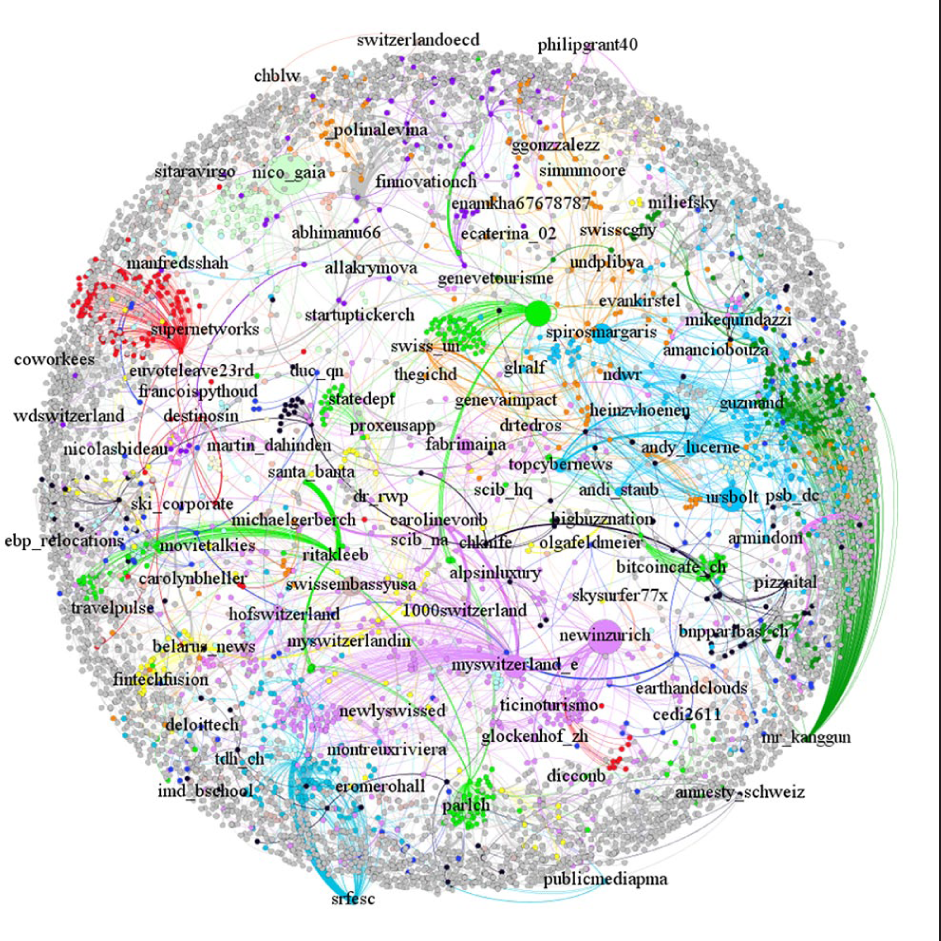
Switzerland’s network and its most influential nodes subdivided into modularity groups.
As shown in Figure 2, the largest modularity group of the Austrian network (lilac) accounts for 4.2% of the accounts and included mostly the accounts of political entities, while the smallest group (gray) comprises only 0.14% of the sample. Seven main actors were identified: Sebastian Kurz (@sebastiankurz), the chancellor of Austria; @hungary_journal, the official account of the newspaper The Hungary Journal; Lettere da Vienna (@letteredavienna), a blog edited by Mila Cataldo; Austria in JO (@amman_ob), the Austrian Embassy of Jordan; Hashim Thaçi (@hashimthacirks), the president of Kosovo; ICDS Tallinn (@icds_tallinn), the International Centre for Defence and Security; and Thomas Oberreiter (@t_oberreiter), permanent representative of Austria to the EU. These accounts were considered to be influential because they all presented high centrality measures and balanced degree counts (e.g., 30 out-degree values and 25 in-degree values). In this case, only one profile corresponds to an OU account, while the others are profiles of politicians, embassies, or newspapers. No official tourism accounts were identified here.

Austria’s network and its most influential nodes subdivided into modularity groups.
For the Dutch network, the largest modularity group (lilac) includes 5.33% of the accounts. Since Dutch influencers did not post many tweets, it was necessary to consider many more influencers and modularity groups than the other countries in order to reach a sample of at least 300 posts for the qualitative analysis. This explains why the smallest class for this nation (gray) includes only 0.05% of the accounts. In terms of the influential actors for the largest modularity group, we could not identify any influencers, since no actors presented sufficiently high centrality measures.
Content Analysis
Key influencers’ tweets receive higher-than-average exposure and interaction (i.e., retweets) than do average tweets, thus occupying a larger space in the digital network. After an analysis of 302 tweets about Switzerland across the four country image dimensions, it became clear that in Switzerland’s network, the aesthetic category dominated, followed by the functional category, then normative and finally emotional. The table in the Supplemental Appendix shows examples of tweets in each dimension for all countries.
One hundred fifty-two posts (50.3%, see Figure 3) referred to aesthetic topics such as the beauty of Swiss landscapes, travel, music, and sports, with the first two topics in this list recurring most in the network and with sports being the least common topic. Ninety-four posts in the Swiss network referred to the competitiveness and strengths of Switzerland, as well as to innovation, financial technology, cryptocurrency, and other PD activities in the functional dimension. Thirty-five of the studied tweets concentrated on topics of the normative dimension, such as gender equality, sustainability, and human rights. Only 21 posts contained words that indicated fascination, included the hashtag #inlovewithSwitzerland, or otherwise qualified for the emotional dimension.

Country image dimensions in considered Swiss network (n = 302).
Concerning the Austrian network, in a classification of 260 tweets, the most common recurring country image dimension of country image was the aesthetic dimension. Figure 4 shows that this category includes 42.3% of the analyzed tweets. The least frequent dimension was emotional, with the remaining two dimensions being relatively close to each other.

Country image dimensions in considered Austrian network (n = 260).
One hundred ten posts referred to aesthetic topics such as sports, video games, music, traveling, and the beauty of Austrian landscapes and cities, with the last two topics being the most common in the network. Of the Austrian sample, 32.7% of posts were functional, related to official meetings between diplomats or politicians as well as to political or economics conferences and events. The 57 tweets in the normative dimension dealt with various topics, such as the integration of European nations, migration, sustainability, solidarity, and charity. The eight tweets assigned to the emotional category did not contain any hashtags like #inlovewithAustria but instead largely included fascination words such as “wonderful,” “breathtaking,” or “amazing.”
After 286 tweets from the Dutch network were classified, it became evident that in this case, the dominant country image dimension was the functional category, as 104 of the 286 tweets, or 36.4%, were assigned to this category (see Figure 5). The emotional dimension was the least frequent category.

Country image dimensions in considered Dutch network (n = 286).
Recurring topics in the functional dimension for the Netherlands were innovation and competitiveness, as well as PD, cooperation between countries, finance, and the economy. In terms of the first two topics, several users tweeted about how innovative the Netherlands is in a number of fields, including technology, welfare, and health. Some tweets were also connected to events that took place in the Netherlands during the months of April and May. In the normative dimension (93 tweets), renewable energy and environmental issues, health, and the integrity and values of the Netherlands were the most discussed topics. The most recurring topics discussed in the 86 aesthetic posts were music (concerts and festivals), the beauty of Dutch cities, travel, and sports. The emotional dimension had the lowest number of posts: only three tweets (1%, see Figure 5) contained fascination adjectives in referring to the Netherlands, such as “wonderful” and “charming.”
For further analysis, we included location data for each tweet, based on user bio information. We assigned values to each tweet as either being domestic or foreign, although in certain instances, we could not determine the location of the account. We found that domestic audiences talked more about functional and aesthetic dimensions, whereas foreign audiences talked more about functional and normative dimensions (see Table 2).
Dimensions by Location.
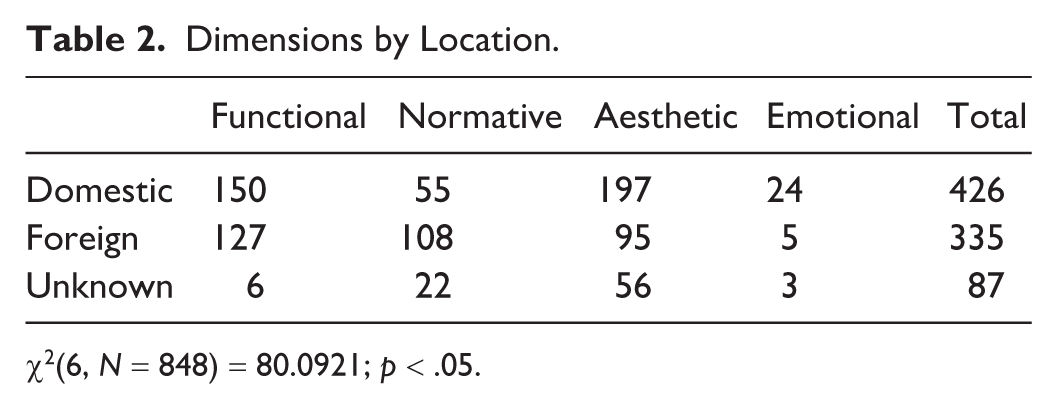
χ2(6, N = 848) = 80.0921; p < .05.
We further examined the composition of country networks to see whether we could find observable differences among locations. In the Austrian and Dutch networks, we had more foreign audiences than in the Swiss network (see Table 3), even though the Dutch network was more equilibrated than the other two.
Location of Users in Country Networks.
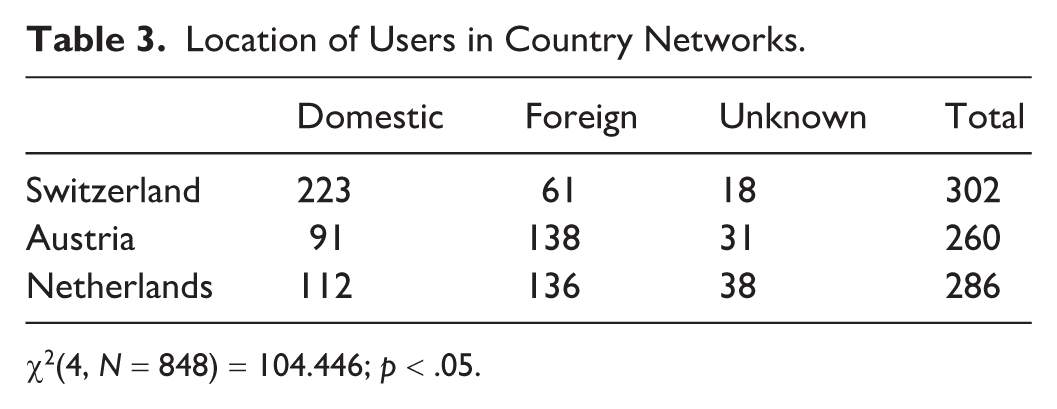
χ2(4, N = 848) = 104.446; p < .05.
Furthermore, we looked at the relative prominence of the country image dimensions among official versus unofficial accounts. While most of the accounts—be they ordinary users or international organizations—did not have an official bureaucratic mandate to promote a country, we also included embassies, ambassadors, and various other levels of governments. No statistically significant correlations were found in the Swiss network; in the Dutch network, official accounts sent tweets highlighting the country’s functional dimension; and in the Austrian network, the emotional dimension was more prominent among official accounts (Table 4).
Percentages of Dimensions by Account Type.

GO/IGO: governmental and intergovernmental organizations; NGO/CORP: non-governmental organizations/corporations; POLU: political users; PU: prominent users; OU: ordinary users.
For the last step in our content analysis, we imposed our five categories of users on country image dimensions. While organizations—both governmental and private—focused on functional and aesthetic dimensions, individual users had different preferences. We observed that the aesthetic dimension dominated the tweets sent by both ordinary and prominent users, whereas political users more often highlighted the functional dimension.
Discussion
In this section, we highlight the discussions of our findings by focusing in detail on influencer types, dimensions of country image, and a comparison of country images.
Within the context of PD 2.0 and country image, influence is based on the demonstrated capacity of an individual or account to create and disseminate content that reaches and influences a large number of people. Our findings revealed that this particular capacity was not necessarily linked with official status; indeed, around 50% of the identified influencers corresponded to individuals’ profiles. These accounts were also the most active users in the three networks. This result confirms the tendency toward a PD 2.0, underlined in the literature review, wherein social media is not only used by governments and official organizations to post content about a country and to interact with publics, but is also used by citizens to share their voices. As posited in the two-step flow model, the most active users contributed to shaping the image of the three studied countries through their individual accounts and tweets, by relaying messages to larger groups. These actions influence how an account’s followers perceive a given country.
In terms of content, we focused on the dimensions that were most accentuated by key influencers, and we found that the most recurring dimension of country image for Switzerland and Austria was the aesthetic dimension. The main topics discussed were the beauty of their landscapes, traveling, and music (among others). In contrast, around one-third of tweets in the Dutch network referred to politics, the economy, and innovation, making the functional dimension the most recurring dimension for the Netherlands. This represents one identifiable difference among the three nations considering country image dimensions. In addition, the two dimensions with the highest percentages in the Swiss network were aesthetic and emotional, whereas these had the smallest percentages in the Dutch network. This change can be partially attributed to the differences among network composition, in terms of account types and user locations (see Tables 1 and 3).
When each dimension received more detailed focus, it became apparent that, with regard to the functional dimension, Switzerland and the Netherlands cared greatly about innovation and the competitiveness of the country—including the economy and finance, which were central topics—whereas for Austria, the focus in the functional dimension was mainly on PD and political meetings/events. This difference could be attributed to the prominence of politicians and other official accounts in the Austrian network.
The normative dimension included potentially controversial topics, but interestingly, none of the tweets from Switzerland, Austria, or the Netherlands were directly connected to such topics. Most tweets from these accounts neither criticized the actions of their respective countries nor any aspects linked to them. Sometimes, the hashtags used seemed arbitrarily chosen or created, explained by the fact that the connection between a tweeted topic (e.g., Catalonia’s independence) and the nation (Austria) was neither explicit nor clear. Nonetheless, these tweets still belonged to the normative dimension and still helped shape country images.
In terms of the aesthetic dimension, few differences were found among the three nations; in fact, as mentioned above, the topics were quite similar. Tweets from this category referred mostly to the beauty of the Swiss, Austrian, and Dutch landscapes or to traveling in these countries. Sports, another somewhat-common topic, played only a marginal role in all three networks. While the aesthetic dimension was prominent in the Swiss and Austrian networks, it was significantly less so in the Dutch network. Even though the Eurovision Song Contest increased the exposure of the country, the aesthetic dimension was not frequently articulated. The composition of the network did not hint to any explanation for the downplaying of this particular dimension; however, it is possible that the findings might be affected by the timing, as April and May are not known as vacation months in the Netherlands.
Even though it was possible to classify several tweets in the emotional dimension in every nation’s network, the number of posts referring to this category was consistently low. It was only in Switzerland that users posted tweets containing affectionate words or hashtags, such as the recurring hashtag #inlovewithSwitzerland. For Austria and the Netherlands, fascination adjectives were primarily used, although the Dutch network contained only three tweets (with two of them having the exact same content). This result is in line with the theory, which argues that in general, the functional, normative, and aesthetic dimensions influence the emotional dimension.
Conclusion
The aim of this study was to look at influential actors engaged in PD 2.0 processes. We proposed methods to determine how influential actors talk about particular aspects of country images when they tweet. Our focus was to identify users who could be deemed influential and to discuss the content they shared.
First, the most influential actors in the Swiss, Austrian, and Dutch networks were identified based on their modularity groups and centrality measures. Second, tweets about the studied nations posted by these actors were classified under the four dimensions of country image created by Buhmann and Ingenhoff (2015b). Third, a comparison among the three nations was conducted, together with a general interpretation of the findings.
Relying on social network analysis measures, we operationalized influence. For all three countries, the most active users were individual accounts, which were both more active and were more engaged with by other users. In terms of the content shared by these influencers, the aesthetic dimension was the most common in the Swiss and Austrian networks, whereas in the Dutch network, the functional dimension was the most common. The results of the 4D model analysis seem to be in accordance with several stereotypes—for example, mountains for Switzerland and Austria, and innovation and ecology for the Netherlands.
This study has some limitations. The first limitation concerns the chosen social media platform, with the analysis focusing solely on Twitter. It could be informative to conduct a similar study on other platforms, like Instagram or Facebook, to establish whether the most recurring dimension or the posted content might differ. Furthermore, the dataset is limited by language, since only English hashtags were used to collect the tweets. In addition, we limited our operationalization of influence to message relays and did not consider behavioral or attitude changes in target audiences. While we argue that social media chatter in itself should be monitored, further studies are also needed to analyze the impact of such chatter on audiences.
Since our objective was to operationalize influence and evaluate conversations on Twitter, we did not assess how influencers chose which messages to share or why they shared the content they did. We hope this study will pave the way for future research on unpacking causal discussions in message formation.
We posit that this study’s approach can be used as an innovative method to assess the influence of PD projects, as it demonstrated a theoretical and an empirical link between social media communication campaigns and audiences’ perceptions of countries. Furthermore, this study applied the 4D model of country image in a way and context that differs from the research of Buhmann and Ingenhoff (2015a) and of Ingenhoff et al. (2019). These authors tested whether the cognitive components of country image influence the affective component, whereas this study aimed to discover whether any of the four dimensions appear to be dominant on Twitter and discussed the implications thereof. This analysis could also be used to develop a measurement tool for country image–related outcomes of PD projects on social media, as it demonstrates how to analyze how key influencers communicate about a country as well as which topics they find relevant.
The social media network analysis could also be integrated into the newly developed integrative country image listening and measurement instrument for public diplomacy (Ingenhoff & Chariatte, 2020), allowing the strategic analysis of how public diplomacy communication and various publics like key influencers contribute to the formation of country images.
Supplemental Material
sj-docx-1-sms-10.1177_2056305120981053 – Supplemental material for Key Influencers in Public Diplomacy 2.0: A Country-Based Social Network Analysis
Supplemental material, sj-docx-1-sms-10.1177_2056305120981053 for Key Influencers in Public Diplomacy 2.0: A Country-Based Social Network Analysis by Diana Ingenhoff, Giada Calamai and Efe Sevin in Social Media + Society
Footnotes
Declaration of Conflicting Interests
The author(s) declared no potential conflicts of interest with respect to the research, authorship, and/or publication of this article.
Funding
The author(s) received no financial support for the research, authorship, and/or publication of this article.
Supplemental Material
Supplemental material for this article is available online.
Author Biographies
 ).
).
References
Supplementary Material
Please find the following supplemental material available below.
For Open Access articles published under a Creative Commons License, all supplemental material carries the same license as the article it is associated with.
For non-Open Access articles published, all supplemental material carries a non-exclusive license, and permission requests for re-use of supplemental material or any part of supplemental material shall be sent directly to the copyright owner as specified in the copyright notice associated with the article.
