




Abstract
Parental sharing of child-related content on social network sites, termed “sharenting,” is often the target of criticism. Yet, through sharenting, parents can find support systems, a way to stay in touch with relevant others, and even an opportunity for additional income. This study contributes to knowledge on antecedents of sharenting. It explores the impact of parents’ privacy concerns on the sharing of child-related content, as well as on their general Instagram sharing. In this study, we differentiate between general and situational privacy. Moreover, we investigate whether parents’ privacy self-efficacy and the support of their peers influence parental sharing practices. Drawing on a rich body of literature on privacy and information sharing, we discuss the results of an online survey distributed among 320 Instagram users who are parents of children younger than 13 and reside in the United Kingdom. We find that parents’ privacy concerns are uncorrelated to sharenting and only situational concerns marginally correlate to parents’ general sharing. Parents’ reported privacy self-efficacy also did not play a role in parents’ sharing of either personal or children-related content. On the contrary, both Instagram sharing and having a network supportive of parental sharenting positively predict sharenting. Our results indicate that (a) neither situational nor general privacy concerns influence parents’ sharenting behavior, and (b) a parent’s supportive network and frequent sharing habits make frequent sharenting more likely.
Introduction
The sharing of child-centric content by parents on social media has been termed “sharenting” (Leckart, 2012). This topic has received considerable media attention in recent years, with opinions ranging from support to outrage toward the practice (Hsu, 2019; Kamenetz, 2019; Meakin, 2013). In a notable example, actress Gwyneth Paltrow’s 14-year-old daughter Apple Martin publicly complained about a photo her mother had shared on Instagram. Commenting on the photo, which showed the mother and daughter skiing, Apple Martin wrote, “Mom we have discussed this. You may not post anything without my consent.” Gwyneth Paltrow in turn replied, “You can’t even see your face!” Paltrow’s 5 million followers were subsequently divided on the issue, taking sides with either the mother or daughter (Bailey, 2019). This story, though self-contained and contextualized within the media-rich lifestyle of a famous actress and her daughter, demonstrates some of the tensions which emerge from sharenting, particularly concerning issues of privacy and consent.
In line with the widespread attention sharenting draws from the media, academic research has begun to look at sharenting in general (Blum-Ross & Livingstone, 2017) and sharenting-related privacy issues in particular (Chalklen & Anderson, 2017; Kumar & Schoenebeck, 2015; Lipu & Siibak, 2019). Most studies in this area have been qualitative and exploratory, providing initial insights into the phenomenon. However, we lack quantitative evidence on the extent of parents’ privacy concerns about sharenting, as well as on the antecedents of sharenting activity. We also lack evidence about whether parents’ privacy concerns affect their general disclosure on social network sites (SNS) in different ways, especially when compared to their disclosure of media content about their children. In this article, we therefore question whether there is any alignment between how often parents share general content on SNS and how often they share content about their own children on SNS. Moreover, we question how privacy concerns, and support from parents’ own personal communities, influence these two forms of sharing.
To address these gaps, we report findings from a survey on Instagram sharenting conducted in 2019 in the United Kingdom. We surveyed 320 Instagram users residing in the United Kingdom with children younger than 13 years old. Instagram was selected because of its widespread popularity as a social media platform. Founded in 2010 and purchased by Facebook in 2012, Instagram boasts 1 billion active monthly users, with more than 500 million using the platform daily (Constine, 2018). While Facebook is the most widely used social media platform, Instagram is particularly popular among young and female individuals (Newlands & Fieseler, 2020; Smith & Anderson, 2018). Instagram is also a visual-first medium, encouraging the sharing of photographs and video content, with a growing ecosystem of emerging cultural practices around parenthood (Abidin, 2017). Previous research has highlighted how Instagram has granted parents with the opportunity to create a digital archive of their children’s pictures, thus providing a convenient platform for sharenting (Le Moignan et al., 2017).
This study also contributes to the emerging literature on sharenting and privacy by offering a differentiated understanding of privacy. We distinguish between general (social and institutional) and situational (i.e., platform-based) privacy concerns, since they can offer a different approach to how perceived vulnerabilities influence sharing behavior.
We proceed in five steps. After the introduction, we provide a thorough review of the relevant literature, where we discuss previous research on sharenting, both in general and specifically on Instagram. We provide an overview of social media privacy research, differentiating between general and situational privacy. We then connect these sub-sections and derive research questions based on privacy research, social-cognitive theory, and peer influence. In the third section, we present the data and discuss the methodological approach. In the fourth section, we discuss the results and hypotheses. Finally, we contextualize the findings and point to implications for theory and practice as well as limitations of our approach.
Literature Review
Sharenting on Instagram
With the diffusion of SNS beyond younger generations, it is not surprising that parents’ patterns of sharing have attracted both media and academic attention. Media outlets have been particularly critical about parents sharing content featuring their children, termed “sharenting” by Leckart (2012) in an early account of the practice. Academic research, however, has focused on parents’ motivations to use SNS, as well as the affordances they find in their use (Ammari et al., 2015; Morris, 2014).
Sharenting can be a form of self-promotion as the parental digital self becomes a part of users’ online self-representation (Blum-Ross & Livingstone, 2017). For parents whose online identity is monetizable, such as professional influencers, children can become part of the promotional activities carried out for brands (Abidin, 2017; Djafarova & Rushworth, 2017). Leaver (2017) has also focused on a slightly different form of celebrity performance, named “micro-celebrity parental mediation.” This involves parents posting child-related content on a separate “child’s own” profile for financial gain.
However, self-presentation is not the only motive of sharenting. Sharing information, especially for new parents, often serves the purpose of consolidating relationships and building community (Bartholomew et al., 2012). For parents dealing with the challenges of a child’s disability (Ammari et al., 2014), single parenthood, or life as a stay-at-home parent (Ammari & Schoenebeck, 2016), social media can represent a space for sharing, comparison, and community. Peer support is also an important motivation for social media use, especially by new parents (Ammari & Schoenebeck, 2016; Morris, 2014).
Instagram, in particular, has emerged as an important tool for parents to share pictures of their children, for the purpose of maintaining a sense of community with friends and family (Le Moignan et al., 2017), and as a digital journal of everyday accomplishments and small events. While children are the protagonists of pictures and videos, however, Instagram accounts are primarily spaces of performance for parents. This is particularly evident in the depictions of the transition from pregnancy to birth to motherhood (Tiidenberg & Baym, 2017) and in some of the challenges typical of early parenting such as breastfeeding (Holtz et al., 2015; Locatelli, 2017; Tomfohrde & Reinke, 2016).
Thus, as much as sharenting can be the source of well-being and support for parents, it appears to substantially contribute to a narrative of parenting, rather than to narratives of childhood. A previous qualitative study, employing Belk’s (1988) Extended Self as a theoretical framework, concluded that “while the children are omnipresent in the images . . . they tend to be supplementary to the primary focus of the parents’ self” (Holiday et al., 2020, p. 5). This motivates our first hypothesis to connect the general Instagram sharing of parents to their sharenting activity on the platform.
General and Situational Privacy Concerns
The relationship between users’ privacy concerns and their sharing behaviors on SNS has attracted considerable academic interest. The directionality of findings, however, remains somewhat uncertain (Baruh et al., 2017; Kokolakis, 2017). Several studies have highlighted the lack of a direct significant relationship between privacy concerns and sharing behavior (Joinson et al., 2010; Taddicken, 2014), thus providing support for the idea of a privacy paradox (Young & Quan-Haase, 2013). However, when considering self-disclosure rather than broader SNS-mediated information sharing as a research outcome, privacy concerns emerge as a clearer negative predictor (Krasnova et al., 2009; Zlatolas et al., 2015). In a systematic literature review that synthesized empirical research on the topic, Kokolakis (2017) described the mixed evidence available on the privacy paradox. Eighteen of 29 studies assessed report a paradox (i.e., they find no significant association between privacy concerns and privacy behavior), while 11 studies do not. There seems to be a temporal and dialectic trajectory, with older studies reporting the paradox and newer ones refuting it. This divergence could be temporal, related to individuals’ increased awareness about privacy issues over time (boyd & Hargittai, 2010). Kokolakis (2017) points to the importance of context when analyzing the privacy paradox, and this is corroborated by Barth and De Jong (2017) as well as Baruh et al. (2017).
Building on this premise, Masur (2018) advocates for a situational approach to privacy. This approach is based on the idea that users might select their desired level of self-disclosure based on the privacy options, which they perceive to be available in the specific context they are operating within. Consistent with this situational approach, a meta-analysis on the privacy paradox found that, on aggregate, SNS were the only context where concerns did not have any effect on privacy behavior (Baruh et al., 2017). Several other contextual elements appear to play a role within the relationship between privacy concerns and self-disclosure. For example, a study by Krasnova et al. (2009) found that the negative relationship emerging between privacy fears and disclosure of personal information in their German sample could not be replicated within a sample of American users with similar characteristics. Additional research by Taddicken (2014) highlighted how the social relevance of the self-disclosed content, as well as users’ general willingness to share, mediated the relationships of concerns to self-disclosing behaviors.
One valuable approach for investigating the relationship between privacy concerns and information sharing is thus the fine-tuning of privacy concerns measures into two different dimensions: a general measure of privacy concerns and a situational, that is, context-related, approach to respondents’ privacy fears. In the next section, we will explore how the context of Instagram, in particular, can inform parents’ privacy concerns and, in turn, their sharing behavior.
Parents and Privacy
Studying sharenting with a privacy lens represents a subtle but substantial paradigm shift from the way privacy and information disclosure are studied within the general population. First of all, while ample research has investigated the relationship between privacy concerns and sharing behaviors of users (Christofides et al., 2012; Krasnova et al., 2009; Taddicken, 2014), third-person sharing and the connected privacy concerns remain largely unexplored. Second, specifically in the context of parental sharing, frequently featuring a “third-person” who is not an adult presents significant challenges. For example, in a child’s early years, it can be difficult for new parents to detach their self-disclosure from the sharing of information about their children (Locatelli, 2017; Tiidenberg & Baym, 2017). Based on a qualitative study of parent bloggers, Blum-Ross and Livingstone (2017) remark that “[parents] practices challenge the kind of boundary policing required by individualistic conceptions of the self” (p. 112). While some of these processes of boundary setting are not unlike the role re-definitions required, by the birth of a new child for instance (Gross Spector & Cinamon, 2017; Höfner et al., 2011), parents find themselves in a complex “privacy-openness paradox,” where on one hand sharenting is emancipating and enjoyable, and on the other problematic in terms of children’s privacy (Chalklen & Anderson, 2017).
Concerns over the exposure of children’s information online also stem from the responsibility connected to the gateway role that parents have toward their children’s information online (Minkus et al., 2015). In this sense, information shared does not only affect the “present day” children but also the future teenagers and adults. Unsurprisingly, parents report concerns about the future wishes of their children and whether the current sharing respect them (Leaver & Highfield, 2018).
Several studies suggest that privacy risk considerations are frequently present when parents recount their sharenting practices (Chalklen & Anderson, 2017; Lipu & Siibak, 2019) to the point of hindering their children-related posting behavior (Ammari et al., 2015). Parents who engage in sharenting employ a series of practices to preserve their children’s privacy. In her research on “the networked family,” Autenrieth (2018, p. 227) codes five strategies of photo editing that parents use in order to maintain a degree of visual anonymity around their children: disguised child; faraway child; parted child, where only fractions of children’s bodies and faces are displayed; child from behind; and digitally processed child. Another type of self-censorship is frequently operated by parents online: Locatelli (2017) finds that new mothers exclusively mention their children’s initial (e.g., “J” or “F”) or use a pseudonym.
Most research on sharenting has examined Facebook or social media more generally (Ammari et al., 2015; Autenrieth, 2018; Damkjaer, 2018; Lipu & Siibak, 2019). By contrast, less research has studied sharenting on Instagram and if has done so, it has looked at specific practices such as breastfeeding (Locatelli, 2017) and ultrasounds (Leaver & Highfield, 2018). Moreover, research on Instagram has primarily employed content analysis as the method of choice (Holiday et al., 2020). Thus, very little research has surveyed parents directly about their Instagram sharenting practices, through either interviews or surveys.
Employing a situational approach to privacy, Instagram emerges as a particularly relevant context. Instagram’s features, such as the option to create a personal family archive or to use funny animal filters on photos, make it simultaneously attractive to parents (Le Moignan et al., 2017) and teens (Sheldon & Newman, 2019). This minimizes the temporal distance between children appearing online as part of their parents’ profiles and children developing a profile of their own, with complex implications in terms of data disclosure, identity formation, and privacy.
Based on our review of current research on general and situational privacy concerns, as well as on the summary of literature on Instagram and sharenting, we thus formulate four hypotheses concerning the relationship between privacy concerns, sharenting, and general Instagram sharing.
Privacy Self-Efficacy
While privacy concerns have for a long time been under scrutiny for their influence on users’ willingness to share online, a more recent body of research has addressed how users’ perceptions of their own privacy skills affect their online behavior (Akhter, 2014; Chen & Chen, 2015; H. H. Lee & Hill, 2013). The construct of “privacy self-efficacy” applies Bandura’s (1994) definition of self-efficacy as “people’s beliefs about their capabilities to produce designated levels of performance” (p. 71) to the realm of privacy protection behaviors. Exploring privacy self-efficacy can provide additional nuance to the analysis of sharing behavior as the result of a privacy calculus, that is, an evaluation of the net-benefits (or net-risks) emerging from sharing (Chen & Chen, 2015).
To this day, research has emphasized two main ways in which privacy self-efficacy can impact sharing. On one hand, some evidence has been found to support the notion that privacy self-efficacy increases users’ privacy protective behavior through behaviors such as information withdrawal (Dienlin & Metzger, 2016). On the other hand, Chen and Chen (2015) found support for a positive relationship between privacy self-efficacy and information disclosure, highlighting how self-efficacy moderates the relationship between privacy concerns and the extension of one’s social network (cf. H. H. Lee & Hill, 2013). This could highlight, as speculated from previous research, that a higher degree of privacy-related self-efficacy might influence users’ perception of risks and benefits of information sharing. For users with higher privacy concerns, this might lead to more risk-averse behavior (Chen & Chen, 2015). Users who are less concerned, by contrast, might be tempted to be more risk-taking (Akhter, 2014; Eastin & LaRose, 2000).
For parents, in particular, privacy self-efficacy has been studied in terms of behavioral influence. In an early study exploring privacy in a parental setting, Youn (2009) highlighted how parental disclosure of privacy concerns could influence a teenager’s own perception of privacy risks and how to mitigate them. In more recent research on teenagers and their families, Shin and Kang (2016) found the degree to which parents communicated self-efficacy and openly talked about privacy protection practices to be negatively correlated to their adolescents’ sharing behavior. Therefore, it seems important to also explore the role of parents’ privacy self-efficacy in terms of their own sharing behavior when it comes to information about their children. As for the previous hypotheses, we will once again explore parents’ general Instagram sharing in parallel to the sharing of their children’s photos and videos, formulating the following hypotheses:
Parents’ Networks and Sharenting
Given the social nature of sharenting on SNS, we are also interested in the role of the social environment as a predictor of sharenting. Social-psychological theories, such as the theory of planned behavior (Ajzen, 1991), have stressed the role of subjective norms in predicting behavioral intention and actual behavior. Subjective norms are defined as “the perceived social pressure to perform or not to perform the behavior” (Ajzen, 1991, p. 188). On SNS, subjective norms often translate into expectations that communities might adopt similar characteristics in their use of platforms, such as a similar frequency or intensity of sharing. Previous research has found that subjective norms apply particularly in SNS, which enable intense dialogic interaction among groups of users, such as the Chinese platform WeChat (Wang & Sun, 2016). A study of selfie posting on Instagram also found subjective norms strongly predict selfie-posting behavior, though mediated by user attitudes (Kim et al., 2016).
For parents, especially, peer influence on SNS sharing behavior can be motivated by other needs. The experience of parenthood requires a substantial amount of identity adjustment, a process which is made easier through the support of physical and social networks, such as families and close friends (cf. Belsky, 1984). When such connections are less available, SNS can be a source of social capital. An early study on new parents and Facebook found that fathers with an extensive online circle of friends reported lower parental stress (Bartholomew et al., 2012). A study of new mothers in the United Kingdom also emphasized the importance of online networks to foster inclusion, combat loneliness, and even find networks of other mothers offline (Gibson & Hanson, 2013). As self-disclosure has been found to correlate positively with the experience of social capital on SNS (K. T. Lee et al., 2013; Liu & Brown, 2014), we can expect that sharing photos and updates about one’s child might be a parent’s channel to better connect to their online network (Blum-Ross & Livingstone, 2017).
However, sharenting is not a behavior devoid of criticism and it is often perceived as a performative distraction from the daily practice of actual parenting (Blum-Ross & Livingstone, 2017). In addition, reluctant parents themselves report feeling peer pressured into sharing children pictures by friends and family (Archer & Kao, 2018). We can thus expect that a network supportive of sharenting might be necessary for parents to experience social capital through this type of sharing behavior. We therefore explore this relationship in Hypothesis 4:
An overview of hypotheses and control variables (gender, age, and education) is available in Figure 1.

Hypotheses model.
Methods
Participants and Procedure
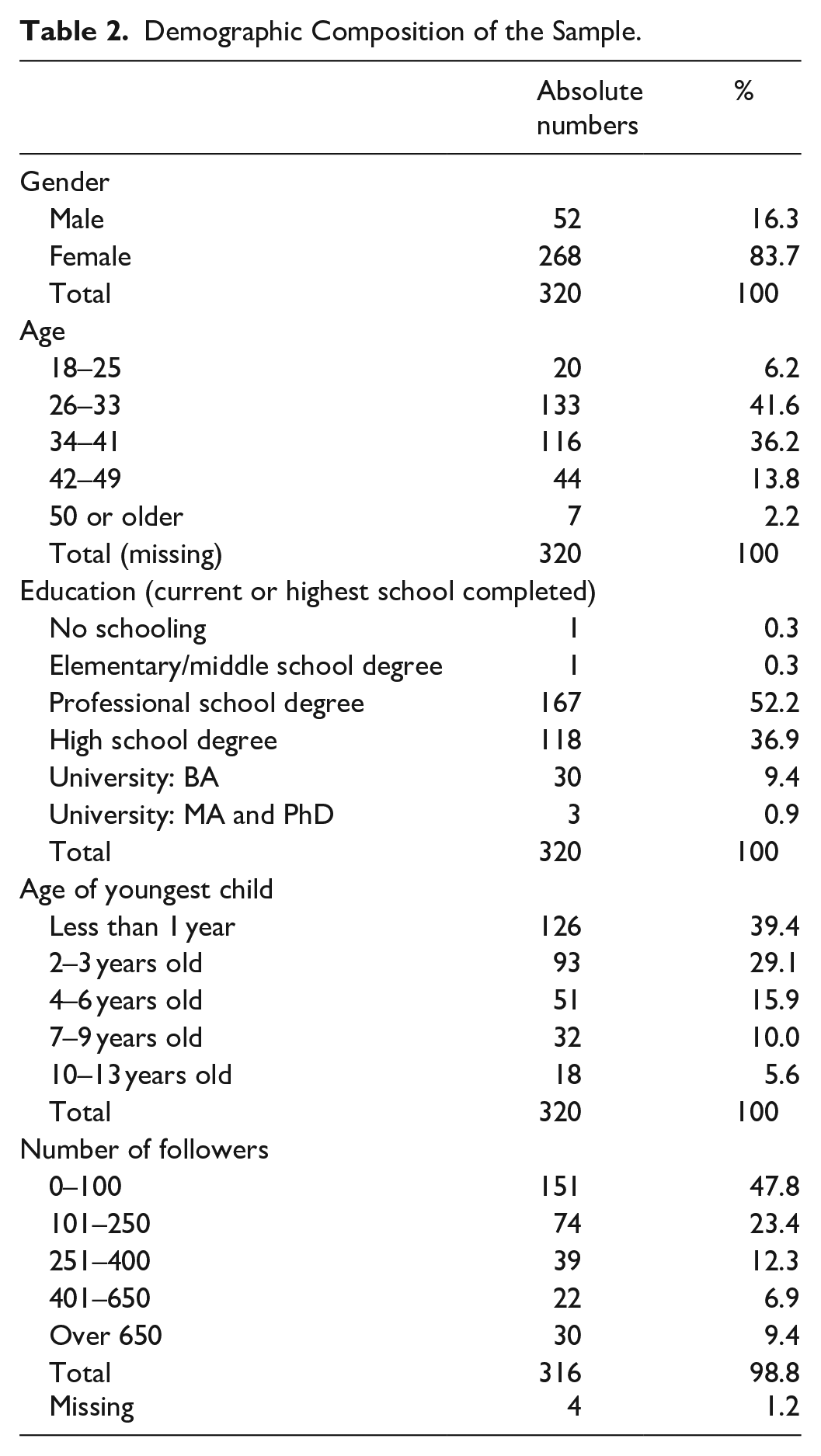
This study is based on a sample of Instagram users who reside in the United Kingdom and who are parents of at least one child under the age of 13. 1 Respondents were recruited through an online participant repository (Prolific). The final sample consisted of 320 participants. A power analysis for structural equation modeling (SEM), with statistical power level of 0.8, probability level of .05, four latent variables/constructs, and 16 indicator variables, showed that a minimum sample size of 209 is required for an effect of 0.25 (Soper, n.d.). Such an effect of 0.25 seems reasonable given the relatively exploratory nature of the topic. Methodological discussion on SEM further recommends per rule of thumb that the number of cases should be at least 5 times the number of parameters to be estimated (Bentler & Chou, 1987). We have 43 parameters, giving us a minimum sample size of 215. Finally, more recent Monte Carlo simulations have detailed minimum sample size requirements for different model specifications in SEM (Wolf et al., 2013). These simulations show that for most models, especially those with high factor loadings such as in our case and relatively few factors, a sample size of 200 is sufficient. Taken together, the power analysis and methodological literature indicate that our sample size exceeds the required minimum sample size. The UK sample is heavily gender unbalanced, as it consists of 268 women (83.8%) and only 52 men (16.3%). The average age is 34 years (M = 34.65, SD = 6.60).
Measures
The dependent variables for this study are measured through individual items. The item about Instagram sharing was worded as “On average, how often do you post pictures or videos (including Stories) on Instagram” and measured through a 10-point Likert-type scale, where 1 = “never” and 10 = “several times a day.” The item about sharenting was worded as “On average, how often do you post pictures or videos (including Stories) featuring your child(ren) on Instagram” and measured through a 10-point Likert-type scale, where 1 = “never” and 10 = “several times a day” (Table 1).
Wording of Scales Used.

General Privacy Concerns (α = .89) are measured through the re-elaborated Social and Institutional Privacy Scale (Lutz & Ranzini, 2017; cf. Stutzman et al., 2011). The scale has been adapted for the context of Instagram, and users were asked to rank their level of concerns (1 = “very unconcerned” to 5 = “very concerned”) to items such as “Other users engaging in identity theft” and “Instagram tracking and analyzing personal data.”
Situational Privacy Concerns (α = .76) are measured through a contextualized version of the Privacy Risks Scale by Krasnova et al. (2010). The scale is composed of four items such as “Overall, I find it risky to publish my personal information on Instagram” and measured through a 5-point Likert-type scale (1 = “strongly disagree” to 5 = “strongly agree”). In the exploratory factor analysis (EFA), one item (Spri_3) was removed because of a low factor loading.
Privacy Self-Efficacy (α = .79) is measured through a scale developed by Mohamed and Ahmad (2012). This scale consists of only two items (“I believe I have the ability to protect my personal information online” and “It is easy for me to enable privacy features by myself while online”) to which participants stated their level of agreement (1 = “strongly disagree” to 5 = “strongly agree).
Peer Influence (α = .88) is adapted from the Social Influence Scale (Venkatesh et al., 2003). Respondents were asked to state their level of agreement (1 = “strongly disagree” to 5 = “strongly agree”) to items such as “People who are important to me think that it is acceptable for me to post content about my child(ren) online” and “In general, my family have supported posting content about my child(ren) online.”
Data Analysis
The collected data were analyzed through an SEM, which allows for the inclusion of latent constructs, the easy testing of indirect effects, and the specification of measurement errors. To ensure feasibility of the study, we employed a two-step analysis. At first, EFA was employed to establish unidimensionality and internal consistency of the constructs. Subsequently, a structural model was constructed for all respondents with the complete data set, using Mplus (Version 6.1; Muthén & Muthén, 1998). Combining the two steps, the formulated hypotheses could be tested for applicability and direction.
At the construct level, Cronbach’s alpha, composite reliability (CR), and average variance extracted (AVE) scored above the acceptable thresholds for criterion values (Hu & Bentler, 1999; Nunnally, 1978). Because of these fitness measures, we could consider SEM as an appropriate tool to answer our research question (see Tables 2–5).
Demographic Composition of the Sample.
Construct Name, Mean, and Standard Deviation.

Measurement Model.

α: Cronbach’s alpha; CR: composite reliability; AVE: average variance extracted.
p ⩽ .001.
Discriminant Validity Test—Fornell Larcker Criterion.

Squared correlations between the constructs shown; AVE on diagonal in bold. AVE: average variance extracted.
Results
Descriptive Results
The descriptive analysis signals that parents report moderately high privacy concerns (M = 3.38, SD = 0.8). Parents’ highest reported concerns are that Instagram might sell their data to third parties (M = 3.54, SD = 1.06) and that someone might hack their Instagram account (M = 3.40, SD = 0.97). When asked to estimate the degree of risk of using Instagram, parents also identify those as moderately high (M = 2.96, SD = 0.78).
Our sample of respondents reports a moderate average frequency of general Instagram sharing (M = 3.18, SD = 1.06; more than once a month) and a lower frequency of sharenting (M = 2.33, SD = 1.08; more than once a year). They also report a moderately high level of peer influence (M = 3.38, SD = 0.8).
Antecedents of Sharenting
The overall structural model has satisfactory goodness-of-fit values (Table 6).
Fit Indices.

CFI: comparative fit index; TLI: Tucker–Lewis index; SRMR: standardized root mean square residual; RMSEA: root mean square error of approximation.
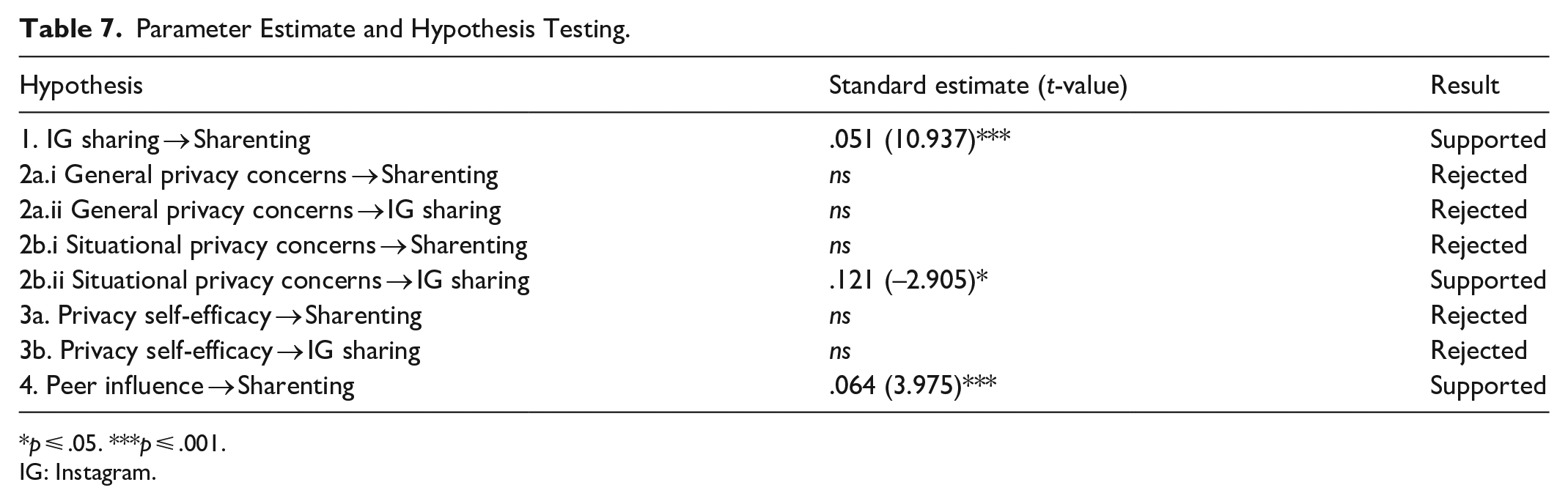
Hypotheses 1, 2, and 3 in our study concerned the direct relationships of privacy concerns, privacy self-efficacy, and peer influence to sharenting. The results of the SEM, depicting each one of the hypothesized relationships, can be found in Table 7 and a visual version is available in Figure 2.
Parameter Estimate and Hypothesis Testing.
*p ⩽ .05. ***p ⩽ .001.
IG: Instagram.

Structural equation model of hypothesized research model.
Hypothesis 1: Instagram Sharing as a Predictor of Instagram Sharenting
Results of the SEM support Hypothesis 1 (β = .562, p ⩽ .001) and indicate that parents’ Instagram sharing is the strongest predictor of their sharenting on Instagram.
Hypothesis 2a
i and 2a.ii: Privacy Concerns (Generic and Situational) as a Predictor of Instagram Sharenting.
The results from the SEM find no significant relationship between the general measure of privacy concerns and sharenting (β = .036, p = .527) or between the Instagram-specific measure of privacy concern and sharenting (β = –.105, p = .375). Thus, Hypothesis 2a is rejected.
Hypothesis 3a: Privacy Self-Efficacy as a Predictor of Instagram Sharenting
We hypothesized that higher privacy self-efficacy could lead parents to share more children-related content on Instagram, but the results of the SEM indicate that this relationship is insignificant (β = .036, p = .527). Thus, Hypothesis 3a is rejected.
Hypothesis 4: Peer Influence as a Predictor of Instagram Sharenting
Peer influence is positively related to the frequency of Instagram sharenting (β = .253, p ⩽ .001). Thus, Hypothesis 4 is supported.
Antecedents of Instagram Sharing
Hypotheses 2b, and 3b focus on the relationships of privacy concerns, privacy self-efficacy, and parents’ frequency of Instagram-based sharing
Hypothesis 2b.i and 2b.ii: Privacy Concerns as a Predictor of Instagram-Based Sharing
We hypothesized that parents’ privacy concerns might limit parents’ frequency of sharing on Instagram. Results of the SEM support the hypothesis for Instagram-specific privacy concerns (β = –.249, p ⩽ .05) but not for general privacy concerns (β = .148, p = .10). Thus, Hypothesis 2b.ii is supported, while Hypothesis 2b.i is rejected.
Hypothesis 3b: Privacy Self-Efficacy as a Predictor of Instagram-Based Sharing
Results from the SEM report a marginally significant relationship between privacy self-efficacy and Instagram-based sharing (β = .139, p = .07). Thus, we can assume that self-efficacy might play a limited explanatory role, or no role, in parents’ Instagram-based sharing. As such, we reject Hypothesis 3b.
Demographics, Sharing and Sharenting
Respondents’ education and gender did not significantly predict their frequency of Instagram-based sharing or sharenting. The age of parents, however, is both negatively related to content sharing on Instagram (β = –.289, p ⩽ .001) and sharenting (β = –.10, p ⩽ .01).
Discussion and Conclusion
This study investigated the role of privacy concerns, privacy self-efficacy, and peer influence as predictors of parents’ Instagram-based sharing and sharenting behavior. Based on a sample of Instagram users who are parents and reside in the United Kingdom, we employed an SEM to explore our hypothesized relationships.
Hypothesis 1 posited that parents who more frequently share on Instagram are more likely to also use the platform to share content about their children. We find a strong and positive relationship between general Instagram sharing and sharenting behavior, which is consistent with the idea that, for some parents, sharing children-related content might be an extension of their habitual SNS use (Fox & Hoy, 2019). In parents’ perceptions, therefore, sharenting might not be remarkably distinct from their own online self-performance: children’s pictures or videos feature because they are part of the self-presentation of parents (Holiday et al., 2020).
Hypotheses 2a.i, 2a.ii, 2b.i, and 2b.ii aimed at exploring the relationship between privacy concerns (general and situational) and parents’ sharing behavior. Consistent with Masur’s (2018) conceptualization of privacy as situational, as well as previous suggestions toward the need for context specificity in approaches to privacy (Kokolakis, 2017; Nissenbaum, 2011), we found a significant negative relationship between our Instagram-specific privacy measure and parents’ general Instagram sharing. However, general privacy concerns are unrelated to our respondents’ Instagram-sharing behavior, and neither privacy measure significantly predicted sharenting. This result is particularly interesting if combined with the high correlation between Instagram sharing and sharenting: if posting children-related content is not conceptually separate enough from personal sharing (Holiday et al., 2020), parents might use similar criteria to decide whether to publish their own pictures or their children’s. Qualitative research has emphasized the influence of the risks perceived by parents on their children-related sharing (Ammari et al., 2015). However, such concerns prioritized children’s physical privacy and safety (boyd & Hargittai, 2010; Symons et al., 2019), which highlights the complexity of the privacy stewardship role parents have (Kumar & Schoenebeck, 2015) as well as the possible gaps between perceived risks and actual sharing behaviors.
The complex boundary management processes between parents and children when it comes to sharenting are described by Lipu and Siibak (2019), who interviewed 14 Estonian mothers and their 9- to 13-year-old children, using communication privacy management (CPM; Petronio, 2002) theory. Their findings revealed instances of privacy turbulence, similar to the one described in the Introduction between Gwyneth Paltrow and her daughter Apple Martin, and showed the intricacies of privacy stewardship in practice. More research on sharenting could adopt CPM and its central concepts of privacy boundaries, privacy rules, ownership, control, and privacy turbulence to study the sharenting practices in dyadic and group relationships.
Hypotheses 3a and 3b explored the relationship between privacy self-efficacy and parents’ sharing behavior. Privacy self-efficacy was not significantly associated with general Instagram sharing and sharenting, leading us to reject both hypotheses. The absence of a significant path suggests that parents’ perceived ability to control their data has limited to no influence on their personal posting behavior and no influence on their sharenting. This result contradicts previous research on adults (Chen & Chen, 2015) as well as on parents (Haslam et al., 2017), which found privacy-related self-efficacy to significantly predict respondents’ frequency of SNS use. However, it is in line with research about SNS that did not find a significant effect of privacy self-efficacy on (Facebook) self-disclosure (Dienlin & Metzger, 2016) or privacy concerns (Youn, 2009). One explanation for the absence of a significant effect of self-efficacy can be found in the fact that we did not specify the purpose of Instagram sharing, contrarily to Haslam et al. (2017) whose research focused on Facebook use for parental support. When unprompted regarding purpose, parents might see privacy risks less clearly or view their skills in terms of privacy protection as less required.
Hypothesis 4 focused on the role of parents’ networks, exploring whether peer support for posting children’s pictures online would provide an incentive for parents’ sharenting behavior. Several studies have identified social networks as an important source of support for parents (Ammari et al., 2014; Gibson & Hanson, 2013; Morris, 2014). However, research on the relationship of parents’ peer networks to their online behavior is relatively scarce. Our analysis suggests that a strongly supporting offline network, such as close friends or family members, positively relates to the frequency of sharenting, which is consistent with previous qualitative research, where participants highlighted the discomfort with conflicting sharing practices between parents in the same family or friends group (Fox & Hoy, 2019). The role peer support plays in the frequency of sharenting might also be interpreted as a subjective norm of Instagram use (Ting et al., 2015), so that parents who are connected with a network supportive of sharenting are more likely to engage in this kind of sharing behavior.
This research includes several limitations. First, our data are cross-sectional and do not allow for observing changes over time or making strong causal claims. We encourage future research to use panel data to study sharenting over a substantial period of time, including developmental perspectives. Second, given the exploratory nature of the study and the scarcity of quantitative studies on the topic, we aimed for a multi-theory approach, including antecedents from a variety of sources. Future research might want to operationalize individual theories such as CPM (Petronio, 2002) and social capital theory (Ellison et al., 2007). Third, and finally, our research relies on a self-reported account of sharenting and privacy. While this allows for more generalizability and the statistical description of sharenting, certain aspects cannot be dealt with in sufficient depth. Future research on sharenting and privacy should adopt a mixed-methods approach, studying the nuances of privacy and boundary management in sharenting across platforms through a combination of self-reported data (interviews, surveys) and observational data (digital traces). Despite these limitations, our study offers a first quantitative exploration of the relationship between privacy and sharenting, as well as a first step in the investigation of how the sharing of children-related content might be perceived by parents in relation to their personal sharing.
Footnotes
Declaration of Conflicting Interests
The author(s) declared no potential conflicts of interest with respect to the research, authorship, and/or publication of this article.
Funding
The author(s) received no financial support for the research, authorship, and/or publication of this article.
