




Abstract
Anonymous online groups such as imageboards have increasing cultural influence. Recently, they have been connected with far-right political movements. This mixed-methods study investigates politics on Overboard, a Finnish imageboard. We use a convolutional neural network to learn linguistic features of the community’s own understanding of politics, studying two large text corpora, collected in 2014–2015 and 2018–2019. This enables us to find political messages in nominally non-political subforums and discount non-political “noise”—finding the “needles in the haystack.” We quantify the prevalence of political talk on Overboard, assess its themes using topic modeling, and evaluate changes in their popularity. Finally, we qualitatively analyze the style of Overboard. We find that around one-tenth of messages on Overboard are identifiable as “political.” Often, but not univocally, they voice far-right opinions, usually somewhat ironically. The prevalence of far-right themes has increased, likely because of importing global imageboard culture and in parallel with the increased popularity of nationalist-right politics in the broader Finnish public sphere. In terms of group style, the strong boundary between members and outsiders, together with the ironic and cynical speech norms, creates a bond between members. Such a group style lends itself to politicizing the collective.
Introduction
Imageboards, such as 4chan and the Finnish Ylilauta (“Overboard”), are online discussion forums where anyone can post anonymously and which have developed their own peculiar subcultures. They are online spaces of cultural consumption and production, and birthplaces of various memes and discourses, which sometimes cross over to the mainstream. It has even been argued that “the intertwine between 4chan and ‘internet culture’ is so deep that you cannot, and you should not, talk about one without talking about the other,” and that “internet culture,” in turn, “has in many ways fused with mainstream popular culture” (Phillips, 2019, p. 2). Imageboards are popular particularly among young men with interests such as games, computers, and comics, often considered “geeky/nerdy” or “marginal.” Despite the increasing cultural significance of imageboards and related subcultures, members still often see themselves as belonging to a “scene” that is alternative, niche, or even marginalized (Marwick & Caplan, 2018, p. 5)—which creates potential for politicization.
Recently, media accounts have claimed that Overboard has become a seedbed for right-wing radicalization of young men (Ikola, 2018; Typpö & Pullinen, 2016), similarly to 4chan (Harwell & Timberg, 2019; Hine et al., 2017; Marwick & Caplan, 2018; Nagle, 2017; Phillips, 2019). Identity-focused political subcultures have growth potential in online grassroots spaces, and ideologues of contemporary politics, particularly on the identity-focused “alt”-right, have become to see online communities such as imageboards as battlegrounds in waging their “culture war” (Hine et al., 2017; Lewis, 2020; Nagle, 2017).
In Finland, like elsewhere, far-right politics have recently enjoyed a sustained rise in popularity, a development in which networked communication and its associated cultural logics have been central (Ylä-Anttila, 2020; Hatakka, 2017). Far-right movements that challenge the mainstream on identity-political terms often shape politics through culture: that is, agenda-setting and influencing public opinion, by bringing new issues and interpretations to the fore, not just through elections and government (Eatwell & Goodwin, 2018, pp. 283–292). All this makes it important to study political culture in places such as Overboard, where the cultural tools, practices, repertoires, and styles through which (young) people understand politics are collaboratively created, shared, and learned (Eliasoph & Lichterman, 2003; Swidler, 1986). Since styles of interaction are culturally patterned, it is likely that they have effects on interaction beyond the immediate context in which they are observed (Eliasoph & Lichterman, 2003, p. 738), particularly in the case of influential subcultural communities such as Overboard.
Previously, Overboard has been interpreted as a peer support community for those withdrawn from society, rather than a political platform: “conversations do not become politicized in the conventional party-political or activist sense because the critique is stuck at the personal level” (Vainikka, 2018, p. 12). However, Vainikka’s materials were collected in 2014 and specifically on the hikikomori 1 board. It is likely that Overboard has become more political since then. Several studies have found that 4chan saw a turn toward the far-right in the latter half of the 2010s (Hine et al., 2017; Nagle, 2017; Phillips, 2019; Thompson, 2018). This article aims to answer whether a similar far-right turn has happened on Overboard and to interpret this turn in a broader political context. To answer these questions, we have to first map how prevalent political talk is on Overboard and then analyze its content and style, in the context of both global imageboard culture and the rise of far-right politics.
Studying politics on imageboards is tricky because of their peculiar subcultural practices including carnivalistic irony, trolling, specialized speech patterns, in-jokes, and myriad cultural references (Phillips, 2016). It has been argued that concepts such as “the public sphere,” “communicative action,” or even “politics” as typically understood may not grasp what actually happens in the unconventional setting of imageboards and should thus be re-framed (Watts, 2019). To answer this call, rather than starting from a pre-defined conception of “politics,” our definition of it is inductive. We use a neural network that learns the linguistic features of politics as defined by the Overboard community themselves, from the language they use to discuss it on the dedicated Politics board. This makes it possible to assess how prevalent political talk is on Overboard and to select the most political messages for further analysis using topic modeling and qualitative analysis of group style (Eliasoph & Lichterman, 2003). We compare two snapshots of Overboard to establish whether there has been a rightward turn, analyze the content and style of politics, and, in the discussion, give possible historical and contextual explanations for our findings. Briefly put, we find that Overboard has taken a sharp turn toward far-right identity politics, likely as a consequence of its cynical ironic style, influence from 4chan and the broader international imageboard culture, and the popularity of far-right politics in the Finnish national sphere.
Chan Culture as Group Style
In this section, we introduce Overboard, paying particular attention to its cultural and political relationship to its international parent 4chan.
Overboard, founded in 2011, is by and large a Finnish localization of 4chan, which in turn was founded in 2003 as an English-language localization of the Japanese imageboard Futaba Channel, colloquially known as 2chan. Originally, these imageboards, or chans, were focused on discussion about Japanese popular culture, which is now a minority topic on both 4chan and Overboard.
Overboard has similar functions to 4chan and other imageboards, including a division to several thematic “boards,” some of which—such as “Random,” the most popular board—are directly adopted from 4chan. The word “board” in imageboard lingo may refer either to one of these topical subsections or to the imageboard (chan) as a whole. Topical boards on Overboard include “Anime,” “Vehicles,” “Relationships,” “Bodybuilding and Fitness,” “Politics,” and so on. (a total of 50 boards were listed on the front page on 21 January 2019). 2 They are composed of discussion threads, like on most online forums, which on imageboards are always started by posting an image or video, and each reply may also include one. Threads with no recent replies automatically disappear as new threads take their place, making the nature of imageboards somewhat fleeting and ephemeral. Particularly on the most popular boards of Overboard, such as Random, only around 24 hr of most recent messages can be viewed. 3 Perhaps the most (in)famous feature of imageboards is anonymity, which is strongly encouraged technologically and culturally. Anyone can post without creating a user account or even choosing a nickname: the board identifies each poster only as “Anonymous” by default. Revealing one’s identity is considered grounds for ridicule and effectual expulsion from the community.
Despite the anonymity and ephemeral nature of communications, certain practices and norms of interaction are upheld by imageboard users and their collective memory. Accumulating shared culture is one of the functions of memes, which users create, collect, creatively modify, and use as part of their communication. Memes are an example of a cultural practice that has spread from chan culture to social media and popular culture more broadly (Shifman, 2013). “Memetic” expressions are ones repeated by multiple participants one after the other so that the meme “travels” from one person to the next, often changing somewhat on the way as each user creates their own variations while still remaining identifiable (Nissenbaum & Shifman, 2017, p. 484).
English-language memetic expressions are often translated literally into Finnish by Overboard users—with comic effect—and a memetic lingo including such translations is used to signal familiarity with English-language chan culture, which is a form of cultural capital on Overboard (cf. Nissenbaum & Shifman, 2017; Trammell, 2014). For example, calling new users uusihomo (“newfag”) does not make much sense unless you know it is a literal translation of an obscure meme. Of course, “newfag” as a concept does not make much sense either—to an outsider—but on the boards it is a repeated signifier of belonging, discursively constructing the in-group while excluding uninitiated newcomers who do not know the group’s speech norms (Eliasoph & Lichterman, 2003). The suffix “fag”, while also a homophobic slur, is used as a neutral or even endearing term on imageboards: while new users are called “newfags,” experienced and knowledgeable members often refer to themselves as “oldfags,” European users may be called “Eurofags,” American ones as “Amerifags,” and so on—however, the implicit assumption conveyed is that members of the group themselves are straight (men).
As such, despite the lack of literal meaning, such practices bond together those “in the know” while excluding those who do not understand. Such boundary-work between “us” and “the normies” is central to chan culture, and in this sense, membership in the community must be earned by proving familiarity with the community’s norms. In the case of 4chan, it has been argued that rather than a rule-less space where “anything goes,” as it is sometimes described, users are in fact “highly invested in delimiting and policing the borders of what counts as ‘acceptable’ posting behavior within the community” (Trammell, 2014, p. 1). What is acceptable on imageboards might be unacceptable elsewhere, but this does not mean that there are no social rules; rather, the rules are different from those of the mainstream public sphere. 4
Chan culture reminds us of Nina Eliasoph and Paul Lichterman’s (2003) seminal work in political sociology on culturally patterned group styles of interaction and how they tie in with politics. Group style is the local culture of interaction of a group: shared assumptions about the boundaries of the group, the bonds between group members, and the speech norms guiding interaction between group members. These elements are implicitly reaffirmed and learned from others in group interaction. Eliasoph and Lichterman’s ethnographic work exemplifies this theory by observing “The Buffalo Club,” who regularly meet in a bar for beers and country western dancing in a West Coast suburb in the United States (Eliasoph and Lichterman, 2003, p. 764)—which may seem like quite a departure from obscure online subcultures. But while the Buffalos met face-to-face and knew each other’s names, unlike imageboard users, the implicit cultural rules of their interaction still called for not revealing too much about one’s life outside this particular social setting and to make fun of outsiders, especially politicians and activists, as does chan culture. Such a group style has political implications.
Neither Overboard nor 4chan has ever had a consistent political ideology or goals; how could they, with thousands or even millions of users contributing without much organization or stated purpose. Chan culture has in fact explicitly shunned politics and morality, denouncing those who care about justice as “moralfags” (Deseriis, 2015, p. 170) and taking pride in mocking those who care about social justice (Phillips, 2019). Such a style of interaction, in which the group is built around mutually affirmed detachment from and disavowal of politics, is in fact political in itself. Eliasoph and Lichterman (2003) describe the Buffalo Club’s “rude and crude” (p. 760) style of interaction, manifested in “constant raucous, racist, sexist, and scatological joking” (p. 760). The function of such a style, they argue, was to appear authentic, to “debunk the pieties and con games that they saw everywhere” (p. 761) in society at large, and thus, the main speech norm was “Do not talk seriously in the group context, and try to appear to be breaking rules” (p. 761)—that is, transgression (in chan culture, see Nagle, 2017). Their “distant, ironic relationship to the wider world” is “a kind of political position” (p. 764), Eliasoph and Lichterman claim. The function of the Buffalo Club’s casual, humorous racism was not necessarily to “say that blacks, Asians and Latinos are bad” (p. 770) but rather show that the group was “inclusive of anyone who had a reasonable, open sense of humor” (p. 770). Still, the racism did have exclusionary consequences, as when a member’s Black son-in-law would not attend Club meetings because of it (p. 767). We expect something similar to be at work in the case of Overboard, which we know is filled with racist and misogynist imagery and rhetoric. Such a style likely also has other functions and meanings for the participants than the racist and misogynist content itself, and consequences for the overall political tenor of Overboard.
Data and Methodology
We use two samples of Overboard as primary data. The first sample was gathered and provided for research use in 2015 by the FIN-CLARIN research infrastructure and consists of 525,096 messages posted between 2012 and 2014 (see Bartis, 2016). We gathered the second one in scraping sessions in October 2018 and March 2019, and it comprises 290,586 messages mainly posted in 2018 and early 2019. Overall, our data consist of 815,682 messages. For simplicity, we will refer to the two corpora as the old and the new corpus. Each includes messages that were online at the time of collection, and since the oldest threads of each board are automatically removed when new threads are posted, each scraping session can only access messages posted in a handful of preceding weeks—the same messages a human user browsing the board on that date would see.
This study employs a mixed-methods combination of computational corpus linguistics and sociological qualitative analysis. In this approach, computational text analysis methods complement rather than replace qualitative close reading (see, for example, Hillard et al., 2008; Laaksonen et al., 2017). With large datasets of online discussions, the methodological problem for empirical research often is one of finding the “needles in the haystack,” in our case, “political” talk (Graham, 2008). Here, we take advantage of the fact that Overboard includes a Politics board (/pol/), the contents of which represent what users themselves understand as politics, which can be used to computationally assess the linguistic features they use to discuss and do politics. Using a convolutional neural network classifier (Evans & Aceves, 2016; Kim, 2014) trained to predict whether messages were from the Politics board (which we name the “target board”) or any of the other specific topic boards (“non-target boards”), we quantified the degree of “politicalness” of each message by the score given by the model, that is, the estimated likelihood the model gave to the message being from the Politics board. This in effect means that the classifier learns the features that make messages in the politics board distinct from other messages in the forum. This enables us to look at political talk (messages that look like they could be from the Politics board) across Overboard rather than focusing just on the Politics board, which is important because online political talk tends to be interspersed within everyday discussions rather than necessarily confined in explicitly “political” spaces (Highfield, 2016). Politics outside “political” spaces is also theoretically interesting since it can illuminate features of political cultures in everyday life (Eliasoph & Lichterman, 2003).
Training neural networks refers to a process in which their mistakes are used to alter their weights and activation thresholds to reduce error (for a more detailed description, see Supplemental Appendix). A network trained to predict whether a given text was from the Politics board or not will associate with the purely textual features of each message a numerical score, representing how confident it is that the message was in fact from the Politics board. This confidence is used during the training phase to alter the neural network to improve its predictions.
Because we are ultimately interested in whether this classifier can be used as a proxy for “politics,” to select political messages, rather than its raw performance in actually predicting whether messages were from the “Politics” board, we manually validated the model similarly to how topic models are often validated in sociology and communication research (DiMaggio et al., 2013; Maier et al., 2018; Ylä-Anttila et al., forthcoming). This was done by qualitatively assessing a random sample of 400 messages from four score categories, 100 from each. The order of the messages was randomized and the scores hidden. After blinded coding, we revealed the scores of each message.
Out of the messages scored <0 by the model, only 3% were considered as political by blinded coders; for messages scored 0–1, the percentage was 29%; for 1–2, it was 71%; and for >2, it was 95%. Thus, it seems that our model detects “politicalness” of content rather accurately, even though due to the nature of neural networks it is not possible to pinpoint exactly which textual features the model considers “political”—but we will give sample messages below. Moreover, the Overboard conception of politics, learned by the model, seems to largely correspond to our own, judging by the fact that our manual scoring gave similar results as the neural network model (more details in the Supplemental Appendix).
We use the score given by the model not only to assess the quantity of politics on Overboard (as defined by linguistic similarity to the Politics board) but also to select samples for closer reading. We employ topic modeling (latent Dirichlet allocation [LDA]: Blei, 2012; Mohr & Bogdanov, 2013) to describe the themes of the most political messages (DiMaggio et al., 2013; Levy & Franklin, 2013; Ylä-Anttila et al., forthcoming). Finally, we qualitatively analyze the group style of Overboard: how users define the boundaries of their group, the bonds between group members, and the speech norms to which fellow discussants are expected to adhere to (Eliasoph & Lichterman, 2003).
We believe that an understanding of Overboard’s politics and culture also necessitates some ethnographic observation (Laaksonen et al., 2017)—“being there.” After designing the general research framework laid out above, we spent several weeks browsing the latest threads on Overboard, through a web browser like any other user. All three researchers participated in this fieldwork, during which we were in constant communication over online chat to exchange notes. These observations are not confined to any single section of this article but permeate all analyses.
Politics on Overboard
The Social Democrats and the Greens are both left-wing too in my book. Some other parties too. (4.03) this. endless lending and giving out benefits won’t save the poor. (0.19) Someone’s forgotten to take their antipsychotic meds. Turn off your computer and go into the woods to breathe some fresh air and you’ll feel better. (−1.48)
The examples above show that discussions of party politics are typically scored by the model as highly political, but even messages that deal with societal issues more vaguely typically score well above zero. Messages that do not mention societal institutions, ideologies, strategies, or motivations typically score negative.
One-fifth of messages in our data received a positive score. By using the proportions for politicalness of each score range found in our manual evaluation of the model, described previously, we can estimate that about 7%–15% of Overboard content is political, following the community’s own conception of politics. 5 This indicates that although political discussion is an important feature of the board, it does not define the whole forum. The majority of the discussion is non-political according to the community’s own conception of politics, as well as ours. However, there is more political talk than the size of the Politics board would imply: only 5% of messages in our data were posted on either the Politics or the Immigration board. Politics is indeed interspersed within discussions of other topics (Highfield, 2016). Although Politics (with a score of 0.96) was the only board with a positive average score in the old corpus, Politics (0.86), Immigration (0.39; only present in the new corpus), and Science (0.02) received positive average scores in the new corpus, and there were some political messages on all boards. The average politics index for all messages was –1.13 for the old corpus and –0.81 for the new one.
Next, we take a look at what political talk on Overboard is about by topic modeling messages with high detected political content (>2.0, 15,668 messages). Topic modeling is based on the simple assumption that if certain words occur together in the same documents, those words are related in meaning, and such clusters of words represent thematic “topics” of texts (DiMaggio et al., 2013; Ylä-Anttila et al., forthcoming). This is a crude model of language but works surprisingly well in detecting the general thematic topics of texts.
We computed LDA (Blei et al., 2003) models using the Python package LDA (on PyPI, see https://pypi.org/project/lda/) for 5–30 topics. We assigned each message to the topic which had the greatest probability for it. We then inspected the top 20 nouns, adjectives, and verbs in each to see whether the topics corresponded to interpretable, actual thematic topics of discussion, as well as consulting a model fit score (log-likelihood), picking the model of 10 topics (see Maier et al., 2018 for guidelines). We then gave each of the topics a name based on the top nouns, adjectives, and verbs, as well as the top documents (for specifics of the interpretation process, see Ylä-Anttila et al., 2020). The top 10 political topics on Overboard, according to our interpretation, are party politics, capitalism, ideologies, race, political philosophy, human rights, immigration, economy, and sexual assault; in addition, we find a “general” political topic (see Table 1).
Top 5 Nouns and Adjectives of the 10 Popular Political Topics, Translated from Finnish to English.
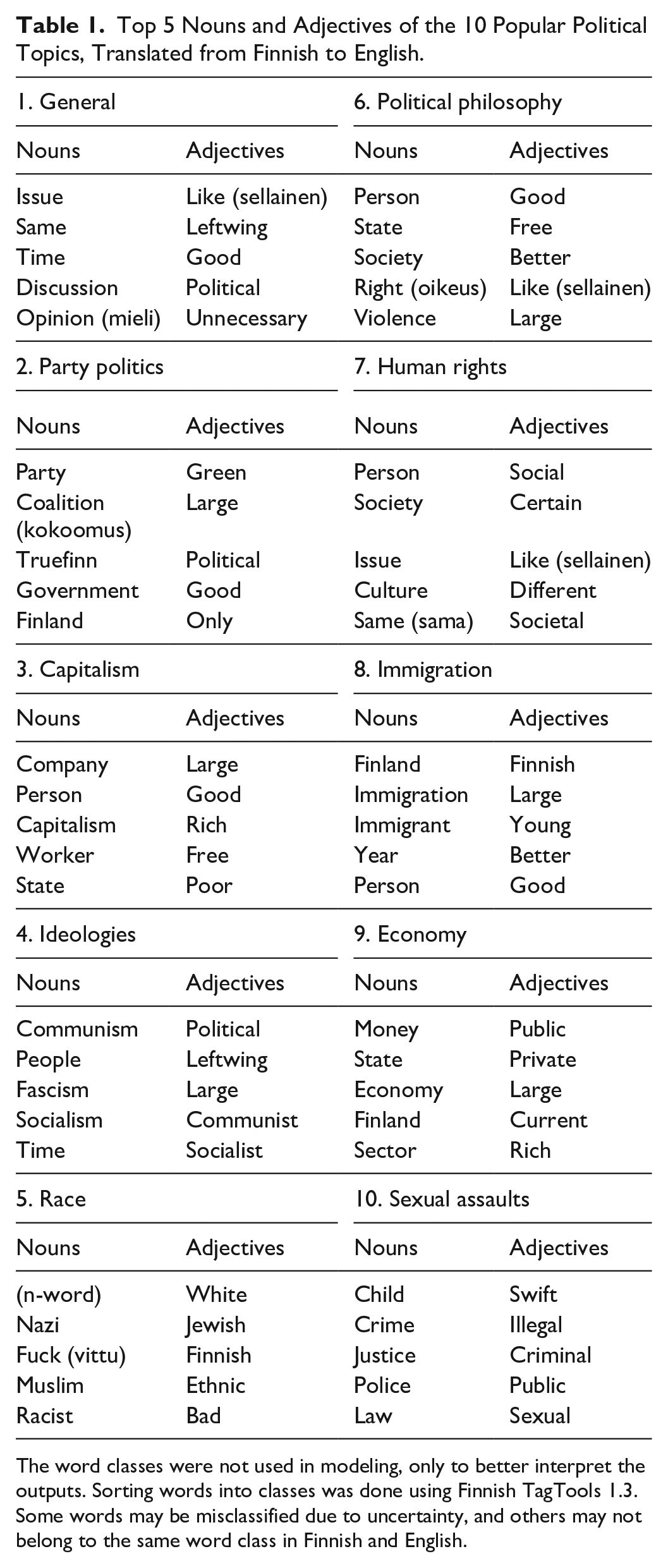
The word classes were not used in modeling, only to better interpret the outputs. Sorting words into classes was done using Finnish TagTools 1.3. Some words may be misclassified due to uncertainty, and others may not belong to the same word class in Finnish and English.
The topic model lends credibility to our expectation that far-right identity issues such as race and (related) discussions on sexual assaults are popular topics of political discussion on Overboard. The sexual assault topic largely deals with immigration (assaults committed by immigrants, a highly charged political topic) and the debate about sexual consent and the legal definition of rape (another hotly contested topical issue). However, it is also notable how prevalent are the quite abstract, even philosophical topics of ideology, democracy, nationalism, liberty, and human rights.
We can also use the topic model to chart changes in the popularity of these topics in time, by looking at how they are distributed between the old and the new corpus. The topics that increased their popularity the most were race, sexual assaults, and immigration, and the topics that declined in popularity the most were economy, political philosophy, and human rights (see Table 2). This would be consistent with a far-right politicization of the board. We discuss the possible reasons for, and implications of, this shift in the “Discussion” section.
Distribution of political topics between the old (2014) and the new (2019) corpus.

Group Style on Overboard
To better understand how and why these matters are discussed on Overboard, we conduct a close qualitative reading of the 60 threads rated as the most political by our politics index on the non-target boards of both the old and the new corpora. This is a sample of 39,039 words. Rather than random, convenience, or snowball sampling, the politics score enables us to focus on the most political content of Overboard without restricting us to the Politics board. Overboard’s group style, we argue, is defined by boundary-work toward a constitutive outside of “normies.” In the absence of personal connections between users in an anonymous space, these delimitations to who we are not—and which are unavoidably political—in fact constitute most of the bonds of the community that is Overboard. Deeply intertwined with this self-understanding are the speech norms of self-reflexive irony and cynicism, which also act to separate the group from outsiders. This group style also contributes to the increased salience of far-right themes, as we will further argue in the “Discussion” section.
Boundaries as Bonds
The category of “normies” (people outside chan culture) is a central group boundary in Overboard culture, we argue—as shown by one of the most common memetic expressions on Overboard, huutista normoille (“lulz at the normies”). In fact, the few bonds between users who do not know each other, and who are culturally bound to not reveal too much of their own lives, arise from boundaries: shared notions of who they are not. Many users use the term “normie” somewhat interchangeably with “sheep” (lampaat), a common international conspiracy-theoretical term (Ylä-Anttila, 2018), referring to the ignorant masses who are easily (mis)led. Sometimes this indeed explicitly refers to the conspiracist belief that some shadowy cabal holds true power, with the (((triple parentheses))) in the following quote referring to Jews. Of course, this message may be satirical, intended as mockery of conspiracy theorists: You still believe in the democracy meme? Democracy was shown to be harmful already back when Hitler was chosen the leader of Germany. After the World Wars a system was created in which (((they))) agree on the results of elections beforehand and the media gets the task of hyping up the agreed results as believable.
More often, though, the “sheep” are referenced not as the unwitting victims of an all-out conspiracy, but merely those who are claimed to not understand the best interests of society: In the next election there will be no shortage of idiots proving to be fucking dumb sheep voting for the greens, social democrats and the left.
The constitutive outside that are “normies” make politicization of group identity easy, as already shown by the above quotes. The category of normies—those who are not us, socially—can readily be given a political meaning: those who, because they do not understand and accept the worldview we do, enable the political developments we do not want, whether actively or passively. This definition of a common political enemy gives birth to a political identity for the group: In many issues I agree with the green-left, however due to the feminazism and failed multiculturalism of the left I sympathize more with conservative forces at the moment. (True Finns)
Explicitly political enemy categories on Overboard include the “green-left,” the “feminazis,” the “Social Justice Warriors” (SJWs), and the “toletards” (a portmanteau of “tolerant retard,” referring to the “useful idiots” that make immigration possible by their excessive “tolerance” of difference). In discussions critical of SJWs, users construct an enemy category of people who have taken social justice ideology “too far,” obsessing over “identity politics.” They are typically described as bent on self-victimization, coddling of self-victimized minorities, and ruining the respectable “mainstream left.” These are, of course, quite typical descriptions of the “enemy” for the far-right, although echoed by some on the left as well (Nagle, 2017). The following quote illustrates how some users identify broadly with the right-wing, in this case including the violent American extreme right in their ideological family, and expecting other users to share this identification with a broad right-wing coalition and a common perception of “our opponents”: Yeah, the board is obviously biased towards the “right wing,” although even this “right wing” isn’t any kind of uniform bloc and it’s also criticized from several different viewpoints. There are True Finn supporters here, reactionary conservatives, national socialists, Fennoman fascists, ecofascists, right-wing liberals etc. The whole bunch. And there’s no consensus. And yeah, with this bias, people aren’t that interested in criticizing let’s say the violence perpetrated by the American extreme right. Why would they be? I don’t give a shit even though I don’t particularly support violence as a strategy. I’m more interested in the mistakes of our opponents.
Ironic and Cynical Speech Norms
In contrast to political articulations arising out of a personal register of grievances, which one might expect to find (Vainikka, 2018), many political discussions on Overboard deal with party politics, grand ideological narratives, and political theory, often in a self-reflexive and rather deliberative fashion. Consider the following quotation in which direct democracy (referenda) are discussed and argued for: Referenda are best-suited for issues in which there is no right or wrong answer: the functioning of society is not significantly endangered whether gay marriage, marijuana or abortion is forbidden or allowed. Everyone understands moral issues and knows their opinion on them, but they’re impossible to justify with objective argumentation. Thus, making collective opinion the law is as good a solution as any.
This emphasis on civil argumentation is partly a product of our methodology, which identifies politics by comparing messages to Overboard’s explicitly “political” board. This might miss the kind of airing out of personal grievances that perhaps lacks political connotations on the surface but can be considered political (i.e., the anti-feminist politics of the “involuntarily celibate” [incels], in which the line between personal grievance and political identity is often fine). Nevertheless, this is somewhat in contrast to the picture given by studies (e.g., Hine et al., 2017) of 4chan and its /pol/ board, which is decidedly more radical than what we see on Overboard.
Despite shared enemies, Overboard is far from unanimous on anything, or simply an “echo chamber” of like-minded people amplifying each others’ beliefs. Many discussants are in fact highly critical of what they see as the recent far-right politicization of Overboard. Such comments include the following: “This /pol/ bullshit of the last few years has nothing to do with real chan culture,” “Being edgy has always been part of chan culture but this obvious alt-right infowar bullshit is new,” and This meme conservatism is only a few years old. Overboard just always wants to be edgy and countercultural, at this very moment Nazi roleplay is the thing you can use to separate yourself from the normies.
Indeed, when studying politics in a community in which ironic “trolling” is a central practice, many will ask whether anything said on Overboard can be “taken seriously,” and if so, how do we know what can and what cannot (Phillips, 2016)? We argue that the situation is more complex than a simple dichotomy between “serious” and “insincere” political expressions, as can be seen in discussions where users self-reflect on their ironic disposition. Take this example: Hitler and right wing forcing is also a meme fucking newfag. It’s a protest against the cancer spread by the mainstream media. Not everyone is a nazi fan. I might post just to fuck with people and to piss off the hippies.
6
This poster, apparently stepping out from behind the veil of irony for a moment to speak directly, confesses to another user (whom they also accuse of being a “newfag” who does not understand the irony permeating the board) that far-right and Hitler posting is “a meme” rather than a reflection of being “a nazi fan.” Rather, the purpose is “to fuck with people” (see Phillips, 2016 on what she calls “fuckery”), and “to piss off the hippies.” On the surface, this is a dismissal of politics. However, at the same time, it is “hippies,” a politically determined identity group that the poster wants to “fuck with,” and as such, a political enemy construction. Furthermore, the poster acknowledges that this “fuckery” is “a protest against the decay of the mainstream media,” a typical grievance of the contemporary far-right, since the mainstream media is in their discourse often blamed for being a puppet of the “multiculturalist elite.” As such, “Hitler posting” can be “ironic” in the sense that it is not intended to be an endorsement of Nazism, perhaps even considered outright non-political by the authors while at the same time containing a right-wing, somewhat radical political agenda.
“Over-the-top” political posting (such as Nazi references) seems in fact to be often used to convey a political position that is somewhat similar to what the message explicitly “means” on the surface (i.e., right-wing), but of a milder degree (e.g., conservative-right rather than national-socialist). Rather than ironic in the sense of the underlying interpretation being completely opposite of what is said on the surface, such expressions are hyperbolic: the difference between the literal meaning and the contextual intended meaning is one of degree, not of kind. This is because what matters is common enemies (see, for example, Lewis, 2020). What decidedly does not matter is whether “normies” accept your style of doing politics—in fact, if you can “fuck with the normies” while making your political point, all the better. After all, “normies” and “SJWs” are strongly criticized by most Overboard users for their moralism and sensationalism, for example, being morally concerned about hate speech online and possibly supporting limitations on free speech on that basis, all of which is directly oppositional to the beliefs of many Overboard users and which makes cynical and irreverent mockery an effective political retort. The style may be adopted for non-political reasons (to belong to the group, or just for “the lulz”), but one cannot escape its political implications either.
Discussion
We have shown that the topics of discussion on Overboard shifted markedly to the nationalist-right between 2014 and 2019. With the limits in methodology and the scope of the article, we cannot give one definite answer as for why this happened. We can, however, give three historical and contextual reasons we believe contributed to this shift. These proceed from endemic (group styles), to international translations (the effects of global far-right online culture and strategy), to the national context (the rise of the populist right in Finnish politics).
Ironic Group Style Contributing to the Far-Right Shift
As we have argued, the political style on Overboard is marked by irony, hyperbole, and trolling, having clearly constructed enemy categories (SJWs) and reveling in transgression of “normie” norms. While this same style has historically given rise also to “liberal” politicizations (Coleman, 2011), some commentators (e.g., Nagle, 2017) have recently argued that this kind of political style is uniquely well-suited for far-right themes. “Hitler posting” represents the gravest possible moral transgression in the political sphere. Taking things “seriously” and arguing for justice will always be open to ridicule in a culture that is geared toward nihilism and maximization of “lulz.” As such, style affects political content.
Overboard Localizing Global Chan Culture
It is well established that a similar rightward shift has happened on 4chan, attributed to intentional cultural work by the “alt-right,” to the presidential campaign (and eventual electoral victory) of Donald Trump, as well as the development of the “manosphere” and the broader online far-right (Harwell & Timberg, 2019; Hine et al., 2017; Lewis, 2020; Marwick & Caplan, 2018; Nagle, 2017; Phillips, 2019). As we have shown, many of the cultural conventions of Overboard are direct translations from 4chan, 8chan/kun, and the like. It is highly likely that the far-right turn of these communities also partly explains what happened to Overboard, which clearly has a segment of users who are active on 4chan, and do the work of translating the cultural conventions for Finnish audiences (much of the vocabulary including “normies,” “sheep,” (((triple parentheses))) denoting Jews, etc.). Overboard is not an island despite being mainly Finnish in language, it is a part of global “internet culture.” But there are differences, too. In the US case, neo-Nazi operatives such as Andrew Anglin have deliberately taken up 4chan’s “lulzy” style because “Most people are not comfortable with material that comes across as vitriolic, raging, non-ironic hatred [. . .] I don’t take myself super-seriously” (Anglin, 2016). On Overboard, apparently serious posts encouraging users to join the neo-Nazi Nordic Resistance Movement were mostly met with disregard or mockery. But other Finnish nationalist-right actors such as the Finns Party have indeed employed an ironic, cynical, “aloof” style in recent years (Ylä-Anttila, 2020), to which we turn next.
Overboard Reflecting the Mainstreaming of the Far-Right in Finland
Overboard is far from the only locus in Finnish politics which saw a marked increase in salience of the themes of immigration, ethnicity, and sexual assault. In fact, the time period between 2014 and 2019 was one in which these exact themes were mainstreamed in the Finnish public sphere, mainly due to the meteoric rise of the Finns Party, resulting in their inclusion in a right-wing coalition government in 2015, the year in which Finland saw an unprecedented increase in asylum-seekers (Ylä-Anttila, 2020). The Finns Party has campaigned primarily on the issue of perceived cultural, economic, and moral threat posed by African and Middle Eastern (male) immigrants, including the politicization of the issue of sexual assaults. The current party head, Jussi Halla-aho, made his name as a blogger, has a loyal online following, and perhaps not incidentally is known for his “cold,” distantly ironic, “aloof” style, which has been his trademark for years. Other core party activists also include online activists, such as Matias Turkkila, a founder of the anti-immigration online forum Homma (Ylä-Anttila, 2018), the subculture of which has similarities to Overboard. Thus, our interpretation is that Overboard reflects broader trends in Finnish politics, albeit as an extreme example, and its development toward the far-right has happened parallel to the mainstreaming of such politics in Finland (see Hatakka, 2017; Ylä-Anttila, 2020).
Conclusion
Overboard is a diverse group of people, acting in diverse ways, often cloaked behind layers of irony and hyperbole. It may be, paradoxically, at the same time a seedbed for harassment, a recruitment place for radicalism, an outlet of hate speech, a safe space of playful humor and camaraderie, a peer support and therapy group for marginalized people, and a democratic forum, all functions which may be participated in by the same or different users. Each sub-board could even be considered a community in itself, with ideologies, bonds, boundaries, and speech norms of its own, which is a limitation of this study and could be addressed by future research. Another limitation is that since our two datasets consist of messages posted in 2012–2014 and 2018–2019, we are left in the dark about developments between these timeframes, for example, most of the Gamergate controversy of 2014–2015. Methodologically, identifying political messages computationally as we have done may leave out political messages expressed in a personal, informal register.
Nevertheless, we have shown that Overboard is political. We estimate that around one-tenth of Overboard messages are political in nature, and that these messages are perhaps surprisingly abstract, argumentative, philosophical, and deliberative in nature, but often deal with the favorite themes of the far-right, such as race and immigration. Moreover, this thematic focus on immigration and race seems to have increased between our two samples (2014 and 2019).
Overboard users often construct a boundary between themselves and the “normies,” those who do not participate in their discussions and thus do not and cannot understand their worldview. This boundary-work, while sometimes “merely” social (who are we and who are we not), can also construct a community of the like-minded, a political identity, a people with common enemies, who understand certain inalienable truths about the world, and are “enlightened,” against a “them”—hegemonic society at large. What participants of political discussions on Overboard often share is what they oppose: feminism, multiculturalism, and related “social justice” advocacy. These positions are deeply connected with Overboard’s transgressive, mocking, shocking, ironic, hyperbolic, and cynical style of interaction: those who are easily offended should stay out. Whether the “trolling” style comes first and the political positions second likely differs from person to person: it is likely that some users become politicized through this group style, whereas some who already subscribe to similar views join Overboard because its style allows them to say things they could not say elsewhere. This is an example of the deep intertwine of style and political content.
A possible interpretation of the “take nothing seriously” group style of Overboard—remarkably similar to that of 4chan—is that being mostly White straight men, they occupy a societally privileged position, from which most forms of political mobilization are in fact status threats. The opinion that challenges to the societal status quo are unnecessary, immoral, or laughable may follow naturally if the status quo is that you hold power (Phillips, 2013). However, such an interpretation hinges on the understanding of Overboard users as “privileged,” which may also be questioned, considering that many of them in fact consider themselves marginalized (Vainikka, 2018).
What Overboard’s group style shows is that irony does not necessarily discount the content of the message. First, because senders never control the interpretations of messages, vast rhizomes of possible interpretations open up. While one receiver of an ironic message may interpret it on the “intended” level of irony, another may miss the irony or at least one layer of it, creating unintended, possibly political meanings in the process—mutations of memes, if you will—unintended changes in meaning. The anonymous and highly ironic culture of imageboards makes messages highly susceptible for such unintended mutations. While it is difficult to gauge the concrete effects of ironic racism, for example, there is always the possibility of someone taking it much more seriously than others intended, as well as of a desensitization effect via the take-nothing-seriously attitude and proud indifference toward issues of justice. A group style allowing extremist speech in an anonymous community such as Overboard creates a space to freely experiment with political positions and rhetoric one does not necessarily deeply hold, air out grievances in a style which one would not use in the public sphere at large—to go overboard—and to fall back on the “it’s just a joke” justification if confronted. As such, political style and content are in complex interplay in our case—highlighting the necessity to understand online irony as more than simply “insincere” political messages.
Supplemental Material
sj-pdf-1-sms-10.1177_2056305120969912 – Supplemental material for Going Overboard: How Ironic Group Style Becomes Political on an Anonymous Imageboard
Supplemental material, sj-pdf-1-sms-10.1177_2056305120969912 for Going Overboard: How Ironic Group Style Becomes Political on an Anonymous Imageboard by Tuukka Ylä-Anttila, Veikko Eranti and Sam Hardwick in Social Media + Society
Footnotes
Declaration of Conflicting Interests
The author(s) declared no potential conflicts of interest with respect to the research, authorship, and/or publication of this article.
Funding
The author(s) disclosed receipt of the following financial support for the research, authorship and/or publication of this article: This study was funded by The Academy of Finland (Grant Number 296969) and The Kone Foundation.

Supplemental Material
Supplemental material for this article is available online.
Notes
Author Biographies
References
Supplementary Material
Please find the following supplemental material available below.
For Open Access articles published under a Creative Commons License, all supplemental material carries the same license as the article it is associated with.
For non-Open Access articles published, all supplemental material carries a non-exclusive license, and permission requests for re-use of supplemental material or any part of supplemental material shall be sent directly to the copyright owner as specified in the copyright notice associated with the article.
