




Abstract
Digital media play an important role in the contemporary rise in visibility of New Right and far-right activist groups online, offline, and in the mainstream media. This visibility has boosted their online and offline mobilization power. Through a live digital ethnographic analysis of the rise of Schild & Vrienden, a recent Flemish far-right activist movement, I will argue that we should understand their online and offline activism as part of a “metapolitical battle” exploiting the affordances of digital media in a hybrid media system. Schild & Vrienden, just like most contemporary New Right movements, draws ideological and strategic inspiration from “La Nouvelle Droite,” the French far-right school of thought. Following their lead, these activists focus first and foremost on the circulation and the normalization of ideas: the discursive or metapolitical battle for hegemony. Digital media like Facebook, Twitter, Instagram, and YouTube prove to be ideal platforms for that metapolitical battle enabling them to gain considerable discursive power in a hybrid media system. This article argues that the distribution of New Right content on these platforms presupposes digital literacy and algorithmic activism. “Algorithmic activists” are defined as activists who use (theoretical or practical) knowledge about the relative weight certain signals have within the proceduralized choices the algorithms of the media platforms make as proxies of human judgment, to reach their (meta)political goals. In this sense, “algorithmic activism” contributes to spreading their message by interacting with the post to trigger the algorithms of the medium, so that they boost the popularity rankings.
On March 3, 2018, the Flemish identitarian movement “Schild & Vrienden” organized an activist intervention to derail ludic protest by civil society organizations at the Gravensteen Castle in Ghent, Belgium. These civil society organizations were protesting the “inhuman European migration policies” (GentInsight, 2018). Schild & Vrienden showed up with 20–30 activists. They pulled down the giant European flag hanging on the wall of the castle and filmed their intervention. This video material was later edited into a 3-min clip and uploaded on the Schild & Vrienden Facebook page. The video immediately went viral. Before that uptake, the offline intervention already generated visibility in mass media (EDG, 2018; VTM Nieuws, 2018) and right-wing partisan media (Decker, 2018a; “Schild & Vrienden Activists Took Action,” 2018) which helped their video post go viral.
Attention even multiplied after Schild & Vrienden’s Facebook video was deleted and different right-wing media framed it as an effect of political correct censorship (Decker, 2018b). After Facebook banned the movie (in reality because of copyright infringement), Schild & Vrienden reuploaded it with a different soundtrack on March 8, 2018, at which point it went viral again. One year later (March 7, 2019), this second uploaded video managed to attract 185,000 views, 2,900 interactions, 1,200 shares, and 1006 comments. These numbers, seen from a Flemish or Belgian perspective, are impressive. At face value, they suggest a huge fan-base. No wonder that the post triggered massive mainstream media attention in Flanders (23 articles in the Flemish press in May 2018) and put them on the radar of (far-) right-wing outlets around the world like the Gateway Pundit and Red Ice TV. All this media coverage in turn boosted the fan—and follower base of Schild & Vrienden’s Facebook page from around 4,000 to over 10,000 in a couple of days (May 2018).
In this article, I will analyze how Schild & Vrienden uses digital media for its “metapolitical” battle. I will argue that the movement successfully exploits the logics of ‘new’ media and old mass media to draw attention of a broad audience to its message. Reach on social media is used as proof that they articulate “the voice of a new Flemish generation conscience about their heritage.” That massive reach is used as part of the populist communicative relation (Maly, 2018e).
After introducing my methodological approach of (live) digital ethnography and the corpus of data, I will describe the movement and its message in more detail. I will address the historical situatedness of their activism and their “metapolitical” strategy. After that, I will show how that metapolitical strategy is adopted in relation to the digital environments by analyzing the mediatization of their intervention at the Gravensteen Castle in Ghent, Belgium that I started this article with. Concretely, I will use the concept of algorithmic activism (Maly, 2018a, 2018e) to stress how Schild & Vrienden not only fights a discursive battle, but uses knowledge on the digital environment to make their message go viral. I will show how the online and offline activism of Schild & Vrienden uses the media logic and affordances of digital media to stretch the so-called overton window in mainstream media. In summary, I will make the case, that their activism should be understood as a metapolitics 2.0.
(Live) Digital Ethnography
The role of new technologies in contemporary political activism poses new challenges for ethnographic research (see Varis & Hou, in press, for an elaborate discussion). The classic methods of ethnographic research—interviews, interactions, fieldwork and text—are still usable, but depending on the research topic and the field, they can be in need of adaptation and flexibility. “In some cases, the tools that have been developed for face-to-face conversation and writing in print media can be easily adapted to analyse online conversations and texts. In other cases, new concepts and new methods need to be developed” (Jones, Chik, & Hafner, 2015, p. 4). In the hope of overcoming some of these challenges, and contributing to the development of new ethnographic methods and practices, I combine two research approaches in this article: long-term digital ethnography and “live ethnography.”
The analysis in this article is part of a long-term digital ethnographic research project dedicated to the study of the New Right movements and politicians and their use of digital media (see Maly, 2012, 2016, 2017, 2018a, 2018b, 2018c). My approach to digital ethnography is grounded in the established ethnographic tradition within anthropology that understands ethnography as a paradigm. It comes with a specific epistemology and ontology (for more details, see Blommaert, 2018; Blommaert & Dong, 2010; Hymes, 1996; Maly, 2018c; Varis, 2016). Ethnography in this conception is understood as a full intellectual program that starts from a very specific perspective on language, communication, and context. In this tradition, language is understood as a resource to be used, deployed, and exploited by human beings in social life: It is the architecture of society. Language can thus never be “context-less.” Even more, context is not something “outside” language; it is an inherent part of language and meaning-making (Gumperz, 1982).
Digital ethnography is thus first of all ethnography: the study of language in society. What is new is the “online dimension” in online and offline meaning making. The object of study is thus language in a digitally networked society (Castells, 1996). This online dimension is not just a new site where one can find data. Digitalization came with “new types of issues related to contextualisation that ethnographers of digital culture and communication need to address” (Varis, 2016). The technological properties of the online world (persistence, searchability, replicability, scalability, algorithmically constructed reality) shape online interactions (boyd, 2014) and are taken into account in the understanding of the processes of meaning making.
Digital media are not just intermediaries, but mediators they (partially) shape the performance of social acts (van Dijck, 2013, p. 29) and as such they are an inherent part of “meaning making.” Concretely, a populist without popular posts will not be seen as somebody who “really” articulates the voice of the people (Maly, 2018e). Liking, retweeting, sharing, and editing are now not only enabling but also shaping (new forms of political) communication (Maly, 2018a, 2018d, 2018e), offline social action (Blommaert & Maly, 2019), political organizing (Gerbaudo, 2014), and affective attachment (Papacharissi, 2015). Digital media force everyone who studies (political) discourse (online) “to rethink our very definitions of terms such as text, context, interaction and power” (Jones et al., 2015, p. 5) and their methodological approaches (Crosset, Tanner, & Campana, 2018).
If we take the digital context into account, we realize that contemporary digital activism is not only about producing discourse in the (passive) hope that it will circulate and get picked up. It is also very much about actively organizing uptake within the digital environments. Activists and politicians have always invested in “uptake,” but that was limited to the stylization of their message in the hope mass media would reproduce it. (See, for instance, Silverstein’s, 2003, discussion of the Gettysburg Address and the communication of George Bush Jr.) Today, political communication is as much about talk to humans as it is about talking to, understanding, and using algorithms of particular interfaces to construct message.
Contemporary digital political activism is thus also about “digital literacies and strategies to determine how algorithms work in different environments (. . .) and making pragmatic inferences regarding their workings” (Varis & Hou, in press). Consequently, digital activist practices are best understood as socio-technical assemblages (Chadwick, 2017, pp. 110-111) or assemblages of actions, discourse, and tools “associated with digital technologies, which have come to be recognized by specific groups of people as ways of attaining particular (. . .) goals” (Jones et al., 2015 p. 3).
The case study analysis is based on a “live ethnography.” Chadwick (2017, p. 71) introduces this methodological approach to describe “close, real-time, observation and logging of a wide range of newspaper, broadcast and online material, including citizen opinion expressed and coordinated through online social network sites.” This “live ethnography” builds further on the notion of “live research” from Elmer (2013, p. 21) who stresses the need for such a “research paradigm” in order to “take into consideration the speed of communication.” This focus on speed is connected to the affordances of digital media that allow actors to quickly intervene in the public debate and have an impact on the information cycles. These affordances, as Chadwick (2017) has argued, have created a shift in mediated temporalities and enabled a move from the news cycle paradigm to a digital media-enabled “political information” cycle.
In the case under scrutiny here, the live ethnography is based on 2 days (March 8 & 9, 2019) of intensive observation of activist interaction on the second post of the video of the intervention of Schild & Vrienden at the Gravensteen Castle on their Facebook page. I monitored, collected, and eventually analyzed likes, interactions, and shares from a perspective of (media-) ideologies and digital literacy of the activists and thus as an inherent ingredient of their metapolitical activism. Speed is important here, as it is the speed of interacting and sharing that triggers the Facebook algorithms and helps constructing “virality” (Maly & Beekmans, 2018). Contrary to the data collection of Elmer and Chadwick, I did not use digital collection tools but engaged in the centuries-old ethnographic notion of observation in combination with screenshotting and “following the social” (Latour, quoted in Crosset et al., 2018, p. 3). The result was a substantial collection of 289 screenshots that not only carefully mapped the rise in likes, shares, and comments but also mapped the different users interacting with the post, their comments, and strategies.
At this point, the ethnographer is confronted with the impact of digital media on “the field.” The ethnographic field in the 21st century is a highly stretchable concept as it is in essence a polycentric, transnational, and layered field (Blommaert, 2010; Maly & Varis, 2016). Digital technologies enable multi-situated use of communicative tools that are more or less accessible to the ethnographer. What happens in the front and the back office is not necessarily all “observable.” It is for instance known that Schild & Vrienden organized itself in different closed Facebook and Discord groups (Pano, 2018); the ethnographer in this case didn’t have access to these groups. Data collection was thus partial. Even more, “local activism,” as a result of the “disembodied translocal nature of digital environments continuous real-time observation may be impossible simply for practical reasons” (Varis & Hou, in press, p. 14).
Nevertheless, as already indicated, an extensive database of users, posts, comments, and profiles was collected. Of course, the abovementioned limitations are taken into consideration. I address those issues in three ways. First of all, I use the affordances of digital media (like time stamps, seeing when one has edited, analyzing comments. . .) to partially remedy these shortcomings.
Second, I only focus on publicly available data. What is analyzed is the “front office” or in other words the activism that was prepared for uptake and visibility. This activism that was stylized, planned, formatted, and discursively constructed as “ready for impact.” We shall see that also its uptake was also partially publicly organized and thus observable.
Third, and this is where the long-term digital ethnography pays of, the digital data produced by activists of Schild & Vrienden in those 2 days, are complemented with my observations during the “live ethnography,” and the observations I made over the last years. My data are thus not limited to this short time frame, but also include publicly accessible posts during the last years, broader cultural content, fieldnotes, interviews, and mass media attention to the movement and other historical data on New Right movements in Flanders and the world. I have already sketched one reason for this broad range of data above, namely the importance of understanding language in its historical, social, and technological context. Another reason is that in a hybrid media system, we should understand the dialectical relation between digital niched media and mainstream media. Meaning is to be found in this complex discursive interdependence between different actors, media, and mediators.
What is lost in “completeness” of data collection is won in the contextual richness of the data. This is where my approach to digital “live ethnography” defers from Chadwick (2017) and Elmer (2013). My approach is grounded in a different notion of “context.” Elmer’s live research for instance is based first and foremost on a quantitative notion of context that equals “the context of a tweet” with the time it was posted (Elmer, 2013, p. 23). In this article, context will, as already discussed, be understood in a linguistic ethnographic tradition. As a result of this approach, my data are not in need for recontextualization (see Crosset et al., 2018 for such an approach) after they were first “decontextualized” by the use of digital extraction tools.
The ethnographic notion of context that I introduced above has a profound effect on my ethnographic approach and on the data themselves. It is here that we see the importance of the ontology and epistemology of ethnography in the study of contemporary activism that “situates language in a web of relations of power, a dynamics of availability and accessibility, a situatedness of single acts vis-à-vis larger social and historical patterns” (Blommaert, 2018, p. 5). My approach yields a very different type of data (see Blommaert, 2018, pp. 113-119, for a useful discussion). All data are analyzed as ethnographic data: as linguistic utterances in a certain social, technological, historical, and political context. This political communication can be analyzed on three axes: the past (or more concretely the modes of production, available resources and goals, media-ideologies, and digital literacy), the now (the placement of the message in certain digital environments and how that message interacts with messages of others), and the future (how one designs the message for uptake) (Blommaert & Maly, 2016). By analyzing the posts and the interactions on these axes, the ethnographer can acquire insights in their competences, resources, and (media) ideologies, how they want to be perceived, and how they envision their audiences.
Analyzing these data as “ethnographic data” also means that I analyze the discourse of Schild & Vrienden in its historical context and thus vis-à-vis other producers of discourse. Their discourse is not “new” but is full of echoes of other voices today and in the past (Blommaert & Verschueren, 1998, p. 27). Analyzing data as ethnographic data thus also means that we understand that language has a history of use and abuse and that this history sticks to it. This intertextual connection between different “texts” is a key analytical tool.
The “live ethnographic approach” can thus not be dissociated from the long-term ethnographic focus and is thus best understood as a digital “ethnographic key incident” (Kroon & Sturm, 2007, pp. 100-101). The ethnographic key incident approach involves the analysis of all kinds of qualitative data (fieldnotes, observations, and in this also case screen shots) and analyzing them as texts-in-context and thus “linking them to other incidents, phenomena, and theoretical constructs and writing it up so that others see the generic in the particular, the universal in the concrete, the relation between the part and the whole” (Erickson, 1977, as cited in Wilcox, 1980, p. 9). It is this long-term digital ethnographic research and its “trans-local” aspect that allows me to contextualize the data in its broader historically, societal, political, and technological context and thus to provide a “thick description” (Geertz, 1973), that is to describe and analyze the activism in its context and thus as a political-techno-cultural and historical phenomenon.
Schild & Vrienden and New Right Metapolitics
The Facebook page of Schild & Vrienden was established in March 2017. The activist group was born out of a Flemish nationalist and New Right Meme-page (Maly, 2018d). On this page, youngsters from different Flemish nationalist student unions (National Student Union [NSV] and Catholic Flemish High Student Union [KVHV]) and youth divisions of political parties (the extreme right Flemish Interest [VB] and the radical right New Flemish Alliance [N-VA]) found each other. The group, from the start, was hierarchically structured with Dries Van Langenhove, a student at Ghent University, as its leader. Around him circled a core group of 30–40 activists and many more less active activists/supporters.
On one hand, Schild & Vrienden was stylized as a Flemish chapter of the pan-European movement Generation Identity (Maly, 2018d). Several members of Schild & Vrienden, including Dries Van Langenhove, were trained at the summer university of Generation Identitaire in France. The activism-format they use is clearly modeled on the successfully mediatized activist interventions of identitarian movements in France, Germany, and Austria. Short, controversial, and small-scale offline interventions are mediatized on social media to generate attention, build an audience, and intervene in the public debate.
On the other hand, Schild & Vrienden drew inspiration (see Maly, 2018d) from the meme-culture of the alt-right movement (Nagle, 2017). Not only do they post memes on their Facebook page, Schild & Vrienden is embedded in a whole network of Facebook pages (e.g., Make Vlaenderen Great Again, De Fiere Vlaamse Memes, or Departement Der Vlaemsche Memes) dedicated to spreading “New Right” Flemish nationalist meme in general, and supporting Schild & Vrienden and Dries Van Langenhove in particular (Maly, 2018d).
At the heart of this type of activism is the idea of “metapolitics.” Van Langenhove describes his movement as follows: “Schild & Vrienden defends the interests of the Flemish youth. We are doing this independently from political parties. We are a metapolitical movement, online as well as offline” (Patyn, 2018). Metapolitics is currently a keyword within the New Right movement worldwide (Hawley, 2017; Johnson, 2012; Maly, 2018d; Nagle, 2017) and it directly refers to the long-term strategy of GRECE (Groupement de recherche et d’études pour la civilization Européenne), better known as La Nouvelle Droite, the school of thought Alain De Benoist, Guillaume De Faye and Dominique Venner founded in 1968 (Maly, 2018d). Their metapolitics started from the idea of “the primacy of culture over politics as the premise to a revolution in the spirit of ‘right-wing Gramscism” (Griffin, 2000). Metapolitics is at its core, an ideological project set up to achieve cultural hegemony (Gramsci, 1971). It aims at hegemonizing a traditionalist, right-wing ideology and a völkish (ethno-nationalist) or in their own words a “differentialist” position (De Benoist & Champetier, 2000). This ideology is contrary to what the etiquette “New Right” suggests—not new: “It expressly and explicitly borrows a great deal from the Weimar Republic’s ‘conservative revolution’” (Salzborn, 2016, p. 40).
According to Tamir Bar-On (2012), the New Right of the 20th century was “a heterogeneous, pan-European ‘school of thought’” wedded to a “‘revolutionary,’ alternative modernist conception of politics which is neither liberal nor socialist” (p. 18). The New Right, including the contemporary 21st century heirs like Generation Identity, the alt-right and Schild & Vrienden, is best understood as the post–World War II (WWII) manifestation of the anti-Enlightenment tradition (Maly, 2018b, 2018d). This political and intellectual movement “was revolutionary, nationalistic, communitarian, and a sworn enemy of universal values” (Sternhell, 2010, p. 9). They reject administrative, legal, social, and gender equality, the French revolution and universal values (see, for instance, Bar-On, 2012, p. 22; Maly, 2018d, pp. 100-104; Salzborn, 2016, p. 40). New Right movements all over the world take the intellectual mustard from thinkers like Julius Evola, Carl Schmitt, Georges Sorel, and Oswald Spengler; thinkers that Sternhell (2010) lists as the third wave of anti-Enlightenment thinkers. Key ingredients of their ideology were an organic (blood-and-soil) nationalism, anti-rationalism, anti-universalism, anti-equality, and deeply anti-democratic.
These ideological ingredients are fully visible in Schild & Vrienden anno 2019. As we shall see, key topics that are addressed on the Facebook page are the nation and “the replacement of white autochthone Flemings,” anti-left, anti-migration, anti-Islam, and anti-political correctness—discourses tackling the ‘fake news of mainstream media’, digital media ‘censorship’, ‘identity politics,’ and LGBTQ+ issues are abundantly found. In this sense, Schild & Vrienden resembles the identitarian New Right movements that we see popping up in Europe, the United States, and the rest of the world. The stickers that they sell in their web shop are a good indication of their ideological positioning (Image 1). From classic Flemish nationalist slogans to fake news and anti-left and anti-Islam discourse: it is all there.

Stickers in the Schild & Vrienden web shop.
What is remarkable in the light of metapolitics is that Schild & Vrienden in first instance tried to position the movement as “positive” by avoiding “far-right” connotations. In all mass media interviews, Van Langenhove stressed that Schild & Vrienden: wants to tell a positive story. We want create a resilient Flemish youth and give them a perspective on a future. In our country, there are too much sissies walking around who are afraid of their own shadow. Be proud to be a Fleming, realize that we are only one generation in a long and rich tradition. In the last decennia, Flanders lost track. Individualism and mass immigration have alienated us from each other. In a land without religion, and a remarkable loss of norms and traditions, it easy for the youth to lose the meaning of life. With Schild & Vrienden, we want to provide the youth again with meaning. Which greater good is there, than to take care for your family, and your people. (Ceder, 2017 (my translation))
The discourse strategy of Van Langenhove resembles the political discourse of the National-Flemish Alliance (N-VA) more than the discourse of the extreme right Flemish nationalist party Flemish Interest (see Maly, 2012, 2016, for a detailed analysis of this discourse). Just like N-VA, he articulates a “soft” anti-Enlightenment ethno-cultural nationalism (Maly, 2018b; Sternhell, 2010) and avoids (a too) explicit blood-and-soil discourse. The fact that the Pano reportage on the public broadcasting company was understood as “unmasking Schild & Vrienden” as extreme-right, racist, and sexist is an index of the success of their message (Cools, 2018; Lesaffer, 2018; SN, 2018). At the same time, we see that as a consequence of the strategic ambivalence that is so central in the political use of “ironic” memes, whiteness was put central (see for instance the sticker ‘it’s okay to be white’ in the web shop, a reference to the alt-right meme campaign).
This played moderateness shouldn’t surprise us. Metapolitics was always more than just a long-term political-ideological strategy. Metapolitics gave them an aura of intellectualism and moderation, despite the very radical anti-Enlightenment nature of their project (Maly, 2018d). Metapolitics was used to position this “school of thought” as “new” and thus seemingly different from the “old right.” 1 The construction of normality was inherent to the metapolitical strategy that advocated using accepted and even scientific language as vehicles for New Right ideas. Hegemonic concepts like democracy, feminism, and antiracism were infused with very specific New Right meanings (see De Benoist & Champetier, 2000). Nouvelle Droite intellectuals like Alain De Benoist but also contemporary Flemish New Right politicians like Bart De Wever (president of N-VA) openly quoted leftist sources and positioned themselves as ni droite, ni gauche (Maly, 2016). The strategy was from the start also deployed by Schild & Vrienden who wrap their anti-Enlightenment discourse in “positive” rhetoric.
New Right Metapolitics 2.0
Metapolitics, as envisioned by La Nouvelle Droite, was in first instance an intellectual exercise and it was produced in classic intellectual products: journals, books, congresses, think thanks, and (intellectual) websites. It focused on giving the extreme and far right an intellectual foundation. In the 21st century, in first instance, we saw similar strategies deployed by New Right activists all over the world. The renaissance of the New Right in Germany in the 21st century was embedded in new institutions and organizations like the “Institut für Staatspolitik,” the “Bibliothek des Konservatismus,” and magazines like Sezession (see Salzborn, 2016 for an overview). In the United States too, we see that people like Greg Johnson and Richard Spencer and the alt-right in general, influenced by the metapolitics of La Nouvelle Droite invested in setting up think thanks (National Policy Institute), publishing houses (Arktos and Counter-Currents) and websites (Taki’s Magazine, Occident Observer, Counter Currents) that were dedicated to intellectually ground a North American New Right movement (Johnson, 2012).
The global renaissance of New Right movements and their metapolitical strategies soon morphed in the 21st century. Contemporary New Right activists use very different means to engage in “metapolitics.” First, we have seen a fundamental European renewal of New Right activism. Pegida is emblematic of that new development, as are the different national and regional chapters of the identitarian movements all over Europe (Salzborn, 2016, p. 50). These movements, usually embedded within mainstream digital media like Facebook, not only try to tap into feelings of alienation, poverty, and fast change in an era of digitalization, globalization, neoliberalism, and superdiversity, but also set up new forms of activism. Whereas the mass protests of Pegida are used to make a populist claim, the identitarian movements use highly mediatized activism to give their positions an “edgy” feel. They use the affordances of digital media to choreograph offline protest marches and organize small-scale interventions that are later remediatized to reach bigger audiences and to conceal that they are not able to mobilize larger audiences offline. Hentges, Kökgrian, and Nottbohm (2014, p. 9) highlight the discrepancy between their online and offline mobilization power. Virality of the remediatization of their offline activism is to a large extend the result of a translocal network.
Second, one could see how New Right activists embedded their metapolitical strategy in Internet culture. A classic example is the New Right alternative for Wikipedia, called Metapedia. The site was explicitly set up as a metapolitical project (see for instance Arnstad, 2015, for an in-depth discussion). That evolution was very visible in the VS. The alt-right exists, according to John Morgan (editor of the New Right publishing house Arktos), first and foremost as “a culture primarily of blogs, memes, podcasts, and videos” which he claims is the “natural outgrowth of the anti-intellectualism inherent in Anglo-American political and cultural discourse” (Morgan, 2017). #Gamergate was also a turning point, as it showed the possibilities for right-wing activism using trolling and memetic warfare (Maly, 2018d; Nagle, 2017; Yiannopoulos, 2017). Just like the identitarian movement, this new form of metapolitical activism uses digital media to attract young(er) people and give their position an “edgy” and revolting character. This is clearly part of the discourse, as they claim to be an avant-garde of their generation.
Third, the Internet enabled the New Right, and especially the so-called alt-light in the United States, to rethink their metapolitical project in terms of “popular culture” and journalism. The aim was to reach a broad audience. Breitbart for instance was from the start, set up as a metapolitical project. “Culture matters,” writes Milo (Yiannopoulos, 2017, p. 27) while quoting Andrew Breitbart stating that “politics is downstream from culture.” The site was set-up to be integrated in mainstream digital media so they could reach a broad audience or in other words to normalize and popularize its ideological agenda. The same logic was also visible in projects like altright.com, The Daily Stormer or in the visibility of New Right activists in their YouTube vlogs and collabs (Lewis, 2018).
The activism of Schild & Vrienden is an excellent case study to highlight and understand how contemporary New Right movements use the affordances of digital media for their “metapolitical battle 2.0.” Their activism can best been seen as a fusion of all three forms of contemporary metapolitics. Digital media are central to this type of activism: they use these digital media to have voice (Hymes, 1996) in a hybrid media system. Growing an audience was thus important. By the end of 2017, the group amassed 3,700 likes and more 4,000 followers. The fact that by 2019 Schild & Vrienden has 33,000 followers on Facebook, 14,000 on Instagram and 5,687 on Twitter (1 March 2019), shows that they at least succeed in reaching an audience, and thus can be understood as knowledgeable concerning the logics and affordances of new and old media.
An important dimension of this type of activism, is the digital literacy of these activists. To engage in metapolitics 2.0, one has to have a very broad range of digital skills and insights. As a collective they should not only be able to film, edit and design their content, make memes or post statuses, they also need to have insights in the nature of the digital ecology. Discursive and mobilization power in this hybrid media system is exercised by those who are successfully able to create, tap, or steer information flows in ways that suit their goals and in ways that modify, enable, or disable the agency of others, across and between a range of older and newer media settings. (Chadwick, 2017, p. 285)
Setting up successful socio-technical activism, means that one should understand the contemporary media ecologies. Within these ecologies popularity is a coded and quantified concept and as such it is manipulable (van Dijck, 2013, p. 13). It is this digital notion of popularity that opens a whole new domain of digital activism. I (Maly, 2018a) called this algorithmic activism: “algorithmic activists use (theoretical or practical) knowledge about the relative weight certain signals have within the proceduralized choices the algorithms of the media platforms make as proxies of human judgment, in relation to the goals of the medium itself” (Maly, 2018a). This type of activism presupposes that activists not only subscribe to the message they interact with, but also understand the affordances and the algorithmic construction of the medium. That they understand how interaction—according to the popularity principle—generates visibility. As we shall see, the New Right activists of Schild & Vrienden use this knowledge about platforms and algorithms in service of its metapolitical strategy. Metapolitics 2.0 inevitably has an important “algorithmic activist” dimension.
The Metapragmatics of the Gravensteen Activism
Let’s return to our central case and zoom in on how Schild & Vrienden prepared their content for uptake. First, I shall revisit the video and analyze it at the level of “metapragmatics” (Jacobs, 1997). This metapragmatic approach focuses on the indicators of the producer’s reflexive awareness of its audience and the communicative context. In other words, we can look at the producer’s intended audiences, the preferred uptake of this clip (Blommaert & Maly, 2016) and their knowledge of the communicative context.

Screenshot of Schild & Vrienden Facebook video after 15 min.
First important finding, is the use of English. Not only is title of the video (“Protecting our heritage”) written in English, the whole video is subtitled in English. This is especially relevant considering the importance of the Dutch Language within the Flemish nationalist tradition. It informs us that the message itself was from the start produced with an international audience in mind and was thus not only targeted at the Flemish population. We will come back to this point later. Second element that deserves our attention is the accompanying Dutch Facebook status: “The Flemish Youth fights for its heritage and future. PS: The leftist tears are more visible in HD!” (my translation from Dutch). The deployed linguistic resources in this status refer to different spatiotemporal frames.
The first sentence clearly positions Schild & Vrienden as a Flemish movement fighting for a Flemish future and trying to protect its Flemish heritage. This aligns well with the use of Dutch and is designed for Flemish uptake. But there is more. They use a populist, or more concretely a generational populist format: they speak in name of the “Flemish Youth.” That is also the dominant communicative frame in the Facebook video: Schild & Vrienden is positioned by its leader Dries Van Langenhove as the representatives of the Flemish youth, and that Flemish youth seemingly hates “the leftists” and fights to preserve the Flemish traditions and heritage.
This discursive frame indexes the influence of Generation Identitaire. From the start, the identitarians clearly positioned themselves as generational movements, fighting against the “babyboomer” generation or the “soixantehuitards” who are accused of advocating multiculturalism and open borders (Generation Identity, 2013; Willinger, 2013). New Right activists around the world have adopted this discursive frame. They all claim that they are just like the students in the sixties. And all of them, from the kekistani in the United States (Maly, 2018a), De Lavendelkinderen in the Netherlands to the identitarian activists of Generation Identity operating in the different European countries, frame themselves as the avant-garde of this youth counter-culture (cf. Dols de Jong, 2018; Rusman, 2018). And Dries Van Langenhove reproduces it too, not only in this video, but in numerous posts and interviews with mainstream media. In an interview with the Flemish mainstream newspaper De Morgen, he for instance says, “The left-wing elite of May 68 has had its say for way too long. (. . .) it is time for a new counter-culture. Schild & Vrienden wants to be the avant-garde of this” (De Ceulaer, 2018) (my translation).
In the video, following this classic New Right frame, the Flemish youth is constructed as distinct from the “the leftists.” Even though the images in the video show many young “leftists,” Van Langenhove claims in the video that at the Gravensteen Castle, the “leftists were all 40, 50 or 60 years old. People who still believe in a dream that we should become a multicultural society with completely open borders” (Schild & Vrienden, 2018). Van Langenhove triggers this public by mobilizing all these classic discursive New Rights tropes and explicitly accusing “left wing” babyboomers of “wanting to attract hundreds of millions of new illegal migrants that have no future here. This way, the leftists are endangering our future, and the future of the whole of Europe” (Schild & Vrienden, 2018).
This frame is a truly global dimension of contemporary local nationalist activism and taps into already discursively constructed “public formations” or affective publics (Papacharissi, 2015, p. 4) by extreme right and radical right nationalist parties, identitarian activists, and mass media in the last decades: the so-called “angry white man” (Kimmel, 2013). The status and the communicative frame of the video is designed as a politics of recognition. It connects to affective traces that bind a New Right translocal networked public together in their fear and anger. As a consequence, this format will be recognized by and resonate with identitarians in the whole of Europe. No surprising, thus, that it generates instant applause and interactional support that helps this type of activism (Image 3) go viral.

Affective reactions.
If we now zoom in on the second part of the status update, we see a reference to a very different spatiotemporal frame. The concept of “leftist tears” in the status update is an index of the influence of the alt-right movement in the United States. In the United States, alt-right activists and 4channers predominantly use the concept “liberal tears” to make fun of the “liberals” and the “lefties” who are portrayed as “snowflakes” (Seargeant & Monaghan, 2018).
Countless memes are produced and distributed reproducing this idea (see Image 4). Through digital media memes travel across borders and become global phatic instruments generating feelings of community (Papacharissi, 2015; Procházka, 2016; Varis & Blommaert, 2014). New Right activists around the world encounter these memes and adapt them for local purposes: They get deglobalized or indigenized without fully erasing their global recognizability. Liberal tears, in a Flemish context, would not really work as “liberals” in Flanders are commonly understood as a (center-) right party. This adaptation not only shows how digital media enable the mobility of resources, it is also an index of the global dimension of local action. It shows how local activism is creatively produced in interaction with resources circulating through digital infrastructures. We will come back to this point in the following sections.

Liberal tears—Trump from meme.
If we now first switch our attention to the form, we get an insight in the digital literacy and the media-ideology of these activists. The fact that the video fared quite well on Facebook, and that this is not a lucky shot, shows us that the activists are knowledgeable about the digital environment of Facebook and which content the medium will push under which conditions. When we zoom in on their digital literacy, their theoretical or practical knowledge of the algorithmic environment, and what is needed to ensure uptake, we first of all see that the activists use a content type that is favored by Facebook: the uploaded video. Facebook videos were a relatively new feature on Facebook, a feature Facebook launched to compete with YouTube. As a consequence, the digital platform pushes (short) videos on its platform.
The video of Schild & Vrienden is relatively short (2 min 50 s) and uses subtitles. As many people scroll through their newsfeed on their smartphone or computer in places where the sound of the video would be inappropriate, subtitles are a crucial feature to have “reach” and “engagement.” Failing to adhere to these format guidelines means that the video will not “take off” and thus fail in its metapolitical goals. Timing is also crucial. In this case, the video was published 10 min before 10 o’clock in the morning, when most people are already behind their computer ready to interact. Immediate interaction with the post in terms of likes and comments but especially in terms of “shares” (Maly & Beekmans, 2018) is crucial for uptake on Facebook.
If we analyze the interaction with the video, we see that the activists of Schild & Vrienden clearly know the game. In the first 15 min (see Image 2), the video generated 330 views, 157 interactions, 17 comments, and 24 shares. After a half an hour, it generated 880 views, 221 interactions, 27 comments, and 41 shares. The uptake of the clip was spectacular and as a result the Facebook algorithms further pushed the video. The uptake shows that the producers managed to tick all the boxes: not only did the clip go viral two times, it gathered a solid number of views (92,000) and likes (2,200) (May 2018). If we zoom in on these likes, we see that around 1,500 profiles “like” the video, 536 “love” it, and around 100 profiles are “sad,” “angry,” or “surprised.” This result is remarkable, especially if you realize that the video is posted on a Facebook page with only 3,000 followers. This wasn’t a lucky shot either, as Schild & Vrienden manages to acquire impressive reach on Facebook.
Virality and Populism
Virality, the likes, shares, comments, and overall “Facebook reach” are important ingredients of the populist discourse of Schild & Vrienden. In Image 5, we see a Tweet by Dries Van Langenhove, the president of Schild & Vrienden, claiming that their Facebook community has a monthly reach of 250,000 up to 500,000 people. This number is subsequently used as proof that ‘the other’—the left—is living in a bubble. It is this quantitative dimension of “reach,” followers, and views that is regularly used to support the claim that Schild & Vrienden speaks “in name of the Flemish youth.” In his discourse, Van Langenhove frames his movement and its social media success as a generational effect, as proof that they articulate the voice of the young generation: Especially generation Z, let us say, everyone who today is between 15 and 25. That generation is more conservative than Generation Y, the millennials, and even that generation was already more right-wing and more conservative than the previous one. Schild & Vrienden resembles the spirit of time. (Segers, 2018 (my translation))
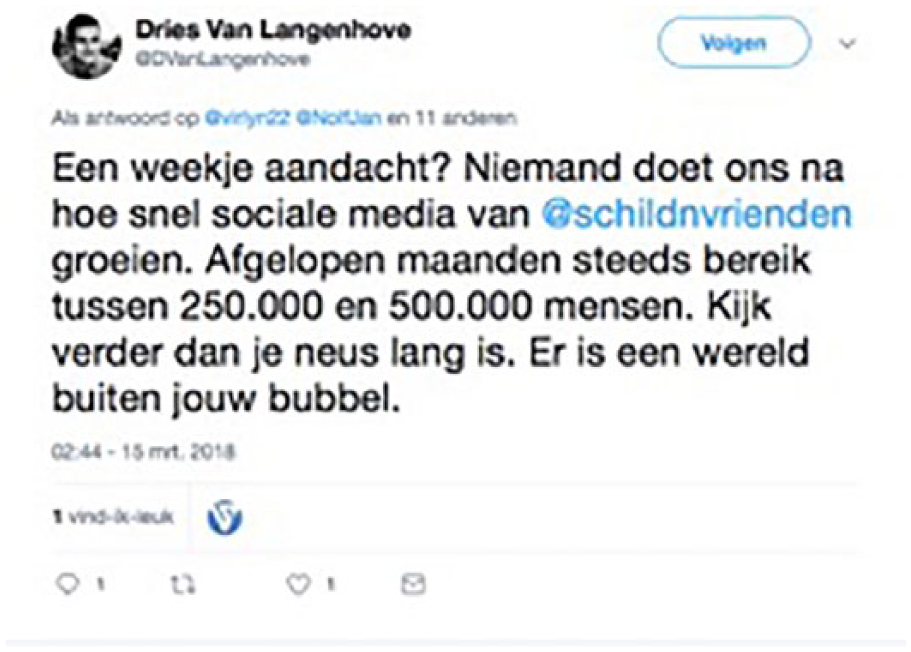
Screenshot of Tweet by Dries Van Langenhove.
Uptake online is an inherent part of the communicative relation that is necessary to make the populist claim stick (Maly, 2018e). It is here that you see how Schild & Vrienden acquires political capital by using the popularity logic of digital media to assure mass media attention and construct their message of articulating the voice of a generation. As KhosraviNik (2018) states, the essence of social media logic is constructing creditability “gained by visibility/popularity in a context where popularity results commercial gains regardless of their consequences” (p. 438). Success on social media leads to visibility in mass media. And not surprising, one of the main motives in questions of mass media journalists when interviewing Van Langenhove and reporting on Schild & Vrienden is their “social media success” (see, e.g., Segers, 2018). In mainstream media, a rise in likes and followers on the social media of Schild & Vrienden is frequently being understood as a rise in popularity and support for the movement (see, e.g., Raeymakers, 2018). In such cases, virality is interpreted within the generational populist frame that Schild & Vrienden produces and is read as support from the Flemish youth and thus contributes to the construction of meaning of their activism.
The facts do not support this populist reading of uptake. If we look in more detail at the profiles sharing the Facebook video from Schild & Vrienden (see Image 6), the activity that generates the largest reach on Facebook (Maly & Beekmans, 2018)—we not only get to see how “niched” and “targeted” but also how global their audience is. This spread was not a coincidence either, as the clip, from the very start, was not only formatted in order to generate algorithmic uptake, it was also designed for global uptake.

Facebook video Schild & Vrienden: shares per country.
On the first day, March 8, 2018, the video was shared 127 times (by 123 different profiles) (of which only one profile shared it to criticize them). This considerable number of shares could easily be mistaken for popularity among the Flemings, the Flemish youth or even among “concerned citizens” approving the message and the offline intervention by Schild & Vrienden. The thing is that from the 123 profiles that share the post on that first day, only 55 indicate that they are from Belgium (four profiles do not give a country of origin). Seventeen people claim to be from the United States; 13 people indicate that they live in the United Kingdom. Profiles from 24 different countries shared this post on the first day it was online.
If we look at the last 70 shares of the video (see Image 7), we see that the Belgian profiles only account for 10% of the shares. South Africa (nine shares), the United Kingdom (seven shares), and 16 sharing profiles don’t give a “home-base.” Especially, these last 16 profiles are truly “global” New Right activist profiles: They only seem to exist in order to share (New Right) content from all over the world.
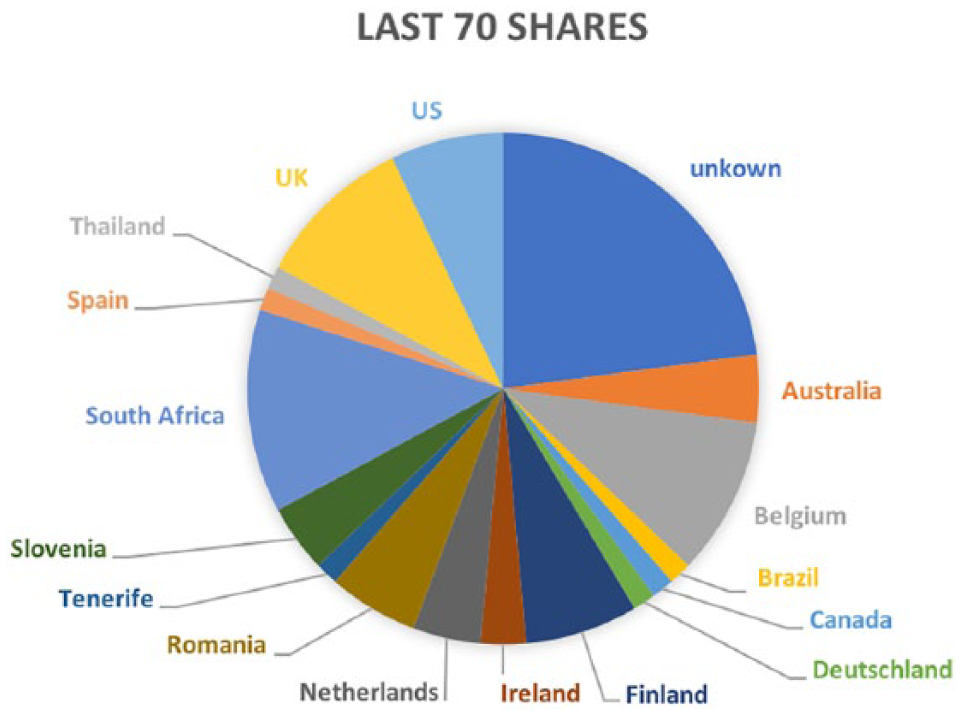
Last 70 shares Facebook video Schild & Vrienden.
The claim of Schild & Vrienden and the superficial reading of some mass media journalists, in which the shares in themselves are read through a populist framework, only contributes to the metapolitical goal of these shares. It is part of the populist communicative relation and legitimates the populist claim of Schild & Vrienden that they speak in name of the Flemish youth.
The data, as illustrated, clearly point in a very different direction. These shares are best understood as metapolitical activism of an affective New Right public embedded within a global New Right mediascape (Appadurai, 1996). The virality of the remediatization of their offline activism is to a large extent the result of this translocal network. This affective public and its infrastructural dimension became very visible when I revisited all the profiles sharing the Schild & Vrienden video on May 30, 2018. At that time, Tommy Robinson, the former head of the English Defence League and Pegida UK who is well networked with Martin Sellner of the Austrian chapter of Generation Identity, was sentenced to 13 months of imprisonment for contempt for the court. Robinson was arrested on Friday, May 22, 2018, and pleaded guilty. Within 5 hr he was arrested, sentenced, and jailed. New Right activists around the world set up petitions and posted their outrage on social media. His arrest was framed as proof of the power of the liberal elite and the fact that truth had to be silenced. If we look at the profiles initially sharing the Schild & Vrienden post, we see that 51 of the 123 profiles also shared at least one post on Tommy Robinson between 28 and 30 May. And again, this was an example of the global dimension of this New Right activist network. Activists from 12 different countries posted memes, petitions, and outrage in favor of Tommy Robinson.
Generational Populism, New Right Metapolitics 2.0 and Algorithmic Activism
The shares and the superficial reading of shares as an instance of “networked individualism” Castells (2015) are analytically insufficient. From the moment one starts to give attention to the “details” and starts investigating the profiles that share the video, we see the “organized” nature of this “popularity.” This is not a spontaneous movement that starts from a spark of outrage. These are not just ordinary citizens showing their support of this message by sharing. It is also not an act of “slacktivism” or feel-good activity as Morozov (2011) and Gladwell (2010) would call it: virality is an essential ingredient of metapolitics 2.0 in which New Right activists wrap their radical ideas in normalcy by claiming to articulate the voice of the people by organizing virality.
Considering the importance or “reach” and virality to the populist claim, it is important to understand how this virality is achieved. Key ingredients of virality are simple packaging, humor, augmented participation tools, prestige, positioning, and the provocation of strong emotions (Shifman, 2014, pp. 94-96). This understanding of virality, implicitly, assumes that virality is an organic phenomenon. That virality is the result of producing a good message, a message that is ready for uptake and resonates with the people. This understanding of virality contributes to the populist claims of New Right movements. Trying to explain virality by only looking at the content of the video would be committing the fallacy of internalism (Thompson, 1995). New Right activists would like you to think that this uptake happens “organically” and locally. It is this assumption that legitimates their populist discourse.
As I have shown, most of the classic elements of virality are in place, but there is more. The video was not only formatted and metapragmatically prepared for algorithmic and global uptake; the uptake itself was actively organized. The first people liking, sharing, and commenting on the video were largely members and dedicated followers of Schild & Vrienden. In many cases, they would react by tagging fellow activists to notify them that the video was back online, ask them to share or tag their “men” (see Image 8). The tagging led to the activation of more structured interaction with the posts from militants and local pages of the extreme-right Flemish party Flemish interest. Very fastly, one would see a rise in people sharing the video, or reacting underneath it, all in similar ways: tagging, liking, and sharing.

“It is back online, tag your people”—Schild & Vrienden activists tags friend to realize uptake.
Interaction is a key parameter triggering the Facebook algorithms. The supporters of Schild & Vrienden are clearly aware of this fact. Interactions were fast and as a result, in a matter of minutes, a much broader uptake was realized. In a matter of 20 min, the video received likes, comments, and shares from New Right activists from all over the world. It is this global uptake that was very important in organizing virality. Most of the local reach of the Schild & Vrienden video was not realized by the sharing of local individuals, but through the sharing of the post by national and international pages and communities. This is remarkable, because the Facebook algorithms favor “personal profiles” (Arbel, 2018). Pages only generate 4% of the Newsfeed traffic. Nevertheless, we see, in the case of the first day of sharing, that 110 individual profiles sharing the video 114 times only managed to generate a measly 158 likes and 30 additional shares in total.
Thirteen (community) pages (most of them with no apparent connection to Flanders or even Belgium), on the other hand, sharing it 13 times, generated a whopping 808 likes and 195 additional shares in that first day. The page that generated the most shares (75) and likes (108) for the Schild & Vrienden video was “Weekblad ‘t Pallieterke.” ‘t Pallieterke was founded in 1945 as a right-wing, Flemish nationalist weekly close to the extreme-right Flemish nationalist party Vlaams Belang. It is through their sharing that several Vlaams Belang militants started sharing the video.
And we see the same dynamic on a translocal scale where Facebook pages and communities engage local militants in sharing content. Pages like “Trump 2020,” Quotidian Conservative News and Red symposium were all set up in 2015, use a very similar design and duplicate content from each other. They were clearly set up to support Trump. And the same is true for pages like “Boer: Aktueel” (47 likes and 28 shares), the Finnish Defence League (20 likes and five shares), White is beautiful (219 likes and 38 shares), or the Traditional Britain Group (208 likes and 70 shares) who trigger local activists to share the video. One of the most influential communities in generating likes (169) and shares (22) for the Schild & Vrienden video is called “Triggering Memes for Regressive Teens II.” This Facebook community of more than 29,000 Facebook profiles is truly global, generating shares and likes for the Schild & Vrienden video by profiles from the United Kingdom, Canada, Romania, Germany, Spain, Switzerland, Australia, and the United States.
It is not hard to see that most of the pages and profiles sharing the video were deeply committed to the battle of New Right voices. Some of the Facebook pages, communities, and even profiles are truly global activist pages. The profile of “Alan Gerard” is interesting in this respect. The profile shared the Schild & Vrienden video a whopping 21 times. The profile does not mention a location and does not have a profile picture, but does manage to have more than 1300 friends. On 30 May alone, this profile shared more than 60 posts, all connected to New Right political movements and politicians around the world: ranging from pro-Tommy-posts, over to posts supporting Le Pen and promoting anti-migration. The pages and communities clearly function as important hubs that structure the global flows in the New Right niche, and organize and mobilize local cells for global activism. Many of these pages have a clear local goal and audience but nevertheless support other radical New Right nationalist movements around the world by sharing their content. What probably helped realizing this global uptake by New Right activists and pages was paradoxically that the first video was deleted from Facebook. This allowed to reupload it with the famous narrative of “left wing” control over social media. That narrative was redistributed by famous radical right media like Red Ice TV (“Schild & Vrienden Activists Took Action,” 2018).
Schild & Vrienden, New Right Metapolitics 2.0, and Algorithmic Populism
Numbers and virality are social facts. The activism of Schild & Vrienden becomes visible through the mediatization on social media and in mass media. This generational populist frame resonates with the radical right, the identitarians, and alt-right activists around the world.
Communication always addresses a specific type of people and excludes others (Blommaert, 2013; Blommaert & Maly, 2019; Scollon & Scollon, 2003). In this case, it is clear that they targeted the global New Right niche: the metapragmatic cues were perfectly managed. The video reproduces a discourse that is dominant within that niche. The enemy par excellence is framed as the “older generation” of “multicultural,” ‘open border “leftists,” fake news media under control of pocos. The video was metapragmatically prepared for algorithmic and global uptake.
As we have seen, not only the format of the post was designed for algorithmic uptake, uptake was at least partially organized by members of the movement themselves. Digital literacy is a crucial ingredient of this type of metapolitical activism. Activists use (theoretical or practical) knowledge about the relative weight certain signals have within the proceduralized choices the algorithms of the media platforms make as proxies of human judgment, in order to reach their (meta)political goal. In this sense, “algorithmic activism” contributes to spreading (and thus functions as a vehicle for normalizing) their message by interacting with the post in order to trigger the algorithms of the medium, so that they boost the popularity rankings.
This virality is discursively exploited to present radical New Right discourse as “voice of a new Flemish generation of youngsters” being sick of the leftists destroying the Flemish nation, its heritage, and traditions. Their success in organizing virality also succeeds in connecting the logic of social media with the logic of mass media. Since the nineties of the last century, mainstream media have been fully incorporated in a neoliberal logic of ratings and commercialization. Success on social media is also understood as a potential “successful story.” The popularity logic of digital media clearly resonates with the mainstream media logic. As a result, online success is very fastly read as popularity of the movement in general. It is their visibility through the use of digital media that contributes to the idea that Schild & Vrienden are representing a real “thing” and should thus be reported on. This “activist action–mediatization–organizing virality–ensuring mass media attention”-loop establishes a populist communicative relation and contributes to an expanding social media audience. The rise to 10,000 followers in the slipstream of this activist intervention at the Gravensteen Castle, the visibility of their posts in mass media, and the reporting on this social media reality in mainstream news (cf. Cools & Andries, 2018, HR. (2018)) construct an image of popularity and relevance, and even more it gives attributes credibility to their populist discourse.
From the start, the group used mainstream digital media like Facebook, Twitter, and Instagram as metapolitical tools. The activists of Schild & Vrienden use these media to (1) choreograph assembly (Gerbaudo, 2014; Maly, 2018c), (2) (re)mediatize that activism (Maly, 2018d), (3) steer the information flow and the production of Message, and (4) gain followers in order to have more leverage for future activism. In doing this, they use and traverse the logics of older and newer media to advance their political-ideological battle. This complex cycle of activities on the online–offline, old media–new media nexus is the essence of this type of socio-technical activism.
The success of the intervention of Schild & Vrienden is not only due to social media. It is as Chadwick (2017, p. 184) stresses the result of complex, hybrid assemblages of older and newer media logics. The activism of Schild & Vrienden is activism on the offline, online, and television nexus. Their offline activism at the castle was first mediated by mainstream news. This immediately caused an increase in their online followers. The publication of the video on their Facebook page started a new cycle of reporting on Schild & Vrienden. These cycles have not stopped. With modest means, and the use of the platforms of mainstream digital media like Facebook and to a lesser extend Twitter and Instagram, we see that the activists succeed in dominating the political information cycle and infusing their radical ideas in the mainstream.
Footnotes
Declaration of Conflicting Interests
The author(s) declared no potential conflicts of interest with respect to the research, authorship, and/or publication of this article.
Funding
The author(s) received no financial support for the research, authorship, and/or publication of this article.
