




Abstract
This study observes two relevant issues in today’s media ecosystem: incivility in online news comments and media bias during election periods. By analyzing 84 stories and 4670 comments published during the 2017 presidential election in Chile, we observed the extent to which news commenters addressed political figures using uncivil discourse, and the extent to which incivility and media bias were related in comments discussing the election. Results indicate incivility in comment sections of Chilean news outlets is higher than that found in the Global North, and the levels of uncivil speech are even higher when the conversation mentions female politicians, especially former president Michelle Bachelet. We also found a relationship between media bias and user bias—stories positively biased toward current president Sebastián Piñera were associated with more positive comments about him. Implications and future research are discussed.
Introduction
Political discussion on digital spaces might trigger uncivil speech. Yet, not all topics spark the same incivility levels, and not all incivility is equally damaging for sustaining a healthy democracy (Papacharissi, 2002). News articles involving public figures and recognizable politicians (Coe et al., 2014), as well as specific events that polarize an already polarized audience, may activate uncivil discussion (Post, 2017). Elections for democratic representatives of a nation fit right into this “highly uncivil” category.
Chile is an interesting case study as quite a recent democracy with high levels of internet use and social media penetration (Valenzuela et al., 2012). The dictatorship of Augusto Pinochet lasted for 17 years, and democracy returned to the country in 1990. For almost two decades, political discussion was limited to in-person conversation, so when digital spaces for discussion flourished, so too did all unfiltered commentary imaginable. This went hand in hand with restoring press freedom, and to this day, editors show caution toward moderating aggressive comments on the basis of the right to free speech (Rosenberg, 2017).
On December 17, 2017, two very different candidates ran for the Chilean presidency. On the one side was Alejandro Guillier, a former TV and radio journalist and editor, politically independent but supported by center-left and left-wing parties. On the other side was Sebastián Piñera, a right-wing politician, successful businessman, and former president of Chile from 2010 to 2014. These candidates made it to the runoff election after obtaining more votes than the other six candidates running for office. Candidate Beatriz Sánchez, also a former journalist, came close to making it to the second round representing Frente Amplio, a new political conglomerate different from Chile’s traditional bipartisan government.
The campaign was particularly aggressive from both ends: while left-wing supporters continuously attacked Piñera, right-wing adherents compared unexperienced Guillier with Venezuela’s leader Nicolás Maduro, suggesting Guillier’s victory would cause Chile’s economic downfall. The term Chilezuela (a juxtaposition of both countries’ names) filled news comments and social media prior to the election (Correa, 2018). Finally, with 54% of the votes, Election Day ended with Sebastián Piñera being elected for the 2018–2022 period (BBC, 2018).
Like many other countries in the region, Chile’s media landscape is concentrated in right-wing conglomerates that tend to showcase negative bias toward left-wing politicians and their policies (Navia et al., 2013), as well as toward female political figures, particularly former president Michelle Bachelet (Navia & Osorio, 2015). However, whether and to what extent media bias, gender bias, and incivility could be related is yet to be determined. This study dives into this matter by analyzing news stories and comments covering and discussing the 2017 election in Chile. In an attempt to observe the news coverage and the online discussion simultaneously, we content analyzed 84 election-related stories and 4670 news comments posted to these stories. This study seeks to identify (1) the levels of incivility in a context other than the United States and Europe, (2) whether male and female political figures enhance uncivil discussion in the online conversation, and (3) whether manifested media bias relates to user bias and incivility in online news comments.
Digital Platforms for (Un)Civil Speech
The emergence of new social platforms and new forms of online communication has opened venues for people to discuss many issues, including politics and the news. As in everyday life, incivility may arise. According to Chen (2017), for a message to be uncivil, it must include “at least one of three main attributes: insulting language or name calling; profanity; and a larger category that encompasses stereotypes, and homophobic, racist, sexist, and xenophobic terms that may at times dip into hate speech” (p. 6). Uncivil messages violate what is considered normal in a conversation and have the potential to cause harm (Chen, 2017).
The scholarship on incivility in contexts other than the United States is very limited. Kim and Herring (2018) found that politeness in comments limited the amount of uncivil expressions in male-dominated discussions in South Korea. Song and Wu (2018), who analyzed the Hong Kong–Mainland China context, found that personal pronouns are a good predictor for uncivil speech. By analyzing Brazil mediascape, Rossini and Maia (forthcoming) found news comments are more likely to express disagreement on news websites than on Facebook pages, and Humprecht et al. (2020) found that German news organizations’ Facebook comments contained lower levels of hostile emotions than US news outlets. Despite these studies, international examples of incivility and the effects of moderation are still scarce, especially in Central and South America (Rosenberg, 2017). As incivility is a difficult concept to universilize (Chen et al., 2019), it is useful to study the concept in different settings.
Despite there is not one consistent definition of incivility, there have been two distinctive ways of understanding this concept. Some scholars treat incivility as a violation of interpersonal politeness norms (e.g., Mutz, 2015), while others argue that incivility goes beyond impoliteness, and includes “democratic consequences of impolite behaviors” (Papacharissi, 2004; p. 267), an approach also defined as public level of incivility (Muddiman, 2017). While we acknowledge that violations to democratic values (such as liberty and egalitarianism) might be more uncivil—and trigger more negative consequences—than a stand-alone profane word, the present study follows the approach of scholars like Coe et al. (2014) and Chen (2017), who consider certain forms of speech as inherently uncivil (like insulting language or stereotypical speech), even if those are not intended to hurt democracy. As such, our approach to incivility relies on forms of uncivil speech addressing groups of people as well as topics discussed in the news.
News Media and Comment Sections in Chile
Chile’s news industry follows a structure similar to the US mediascape—a handful of conservative news conglomerates owns most of the country’s media (Monckeberg, 2011). The two most important newspapers in terms of prestige and subscriptions are El Mercurio and La Tercera, from media companies El Mercurio S.A.P. and Copesa S.A., respectively (Gronemeyer & Porath, 2017). This also includes their news websites EMOL (acronym for El Mercurio on line), and LaTercera.com. These two outlets are not only the two main quality print media in the country, but their websites are also the most used online news sources, especially EMOL (Reuters Institute for the Study of Journalism, 2020).
The news comment sections of EMOL and LaTercera.com have become a place for unfiltered expressions. In-depth interviews with editors from both news sites revealed concern for the quality of the online discussion, yet heavy moderation was not their priority. According to Rosenberg (2017), EMOL moves most-commented stories to the front page to attract more viewers (despite how uncivil those comments might be) and LaTercera.com does not filter any message or word. For Chilean editors, economic considerations (such as time spent on site commenting) are a valid reason to keep the comment exchange as unfiltered as possible (Rosenberg, 2017), despite the positive outcomes of comment moderation found by previous research (Gibson, 2019).
These editorial decisions could partially explain why incivility on Chile’s news platforms has shown higher levels than those previously evidenced in the Global North (Saldaña, 2018). But given the importance of both EMOL and LaTercera.com in the country, the online conversation happening in their news comment sections is a good proxy for understanding the general online news discussion in the Chilean context.
Factors Triggering Incivility
Previous research has found political coverage produces more uncivil discussion than other topics (Coe et al., 2014), probably because of the lack of trust in political figures (Ampofo et al., 2011; Navia & Osorio, 2015). Politics in general elicit strong feelings that translate into heated arguments, especially when a user feels personally attacked and sees an opportunity to “fight back” and defend her beliefs (Chen & Lu, 2017).
The literature indicates that one out of five news comments present some degree of incivility (Coe et al., 2014). Yet, these numbers come mostly from studies carried out in the US context (Coe et al., 2014; Muddiman & Stroud, 2017) and do not necessarily explain incivility in Chile’s mediascape. We expect incivility to be higher in the discussion of Chile’s political news, mostly because of the low levels of institutional trust in the country (Encuesta Bicentenario, 2019), but more evidence is needed to support this claim. Then, we ask:
RQ1. To what extent are newsreaders uncivil when commenting on election-related stories published by EMOL and LaTercera.com?
Another factor triggering incivility is the presence of female figures in the conversation. Incivility hits minorities stronger (Githens, 2011), especially women and people of color. A recent study conducted by Amnesty International and Element AI (an AI software start-up) found that female politicians and journalists were abused on Twitter every 30 seconds in 2017, and women of color were almost twice as likely as white women to be targeted with hate speech (Murgia, 2018). This phenomenon was evident in the 2016 presidential election in the United States, where candidate Hillary Clinton received a great deal of hate speech on social media: “Clinton is also attacked for being a woman, and Trump is not attacked for being a man,” said Jennifer Mercieca, a historian of American political rhetoric, back in 2016 (Taylor-Coleman, 2016; para. 20).
Incivility toward women has been studied and described across different contexts: incivility in the workplace (Lim & Lee, 2011), in the justice system (Cortina et al., 2002), and even in academic conferences (Settles & O’Connor, 2014). All these studies conclude that women are judged harshly as compared with their male counterparts, and face obstacles that men usually do not encounter. This also extends to online settings. Sobieraj (2018) found that women are the target of high levels of incivility on digital spaces and, as a consequence, use defense mechanisms, or withdraw altogether from the discussion, making it an even less representative space for them. And in the specific case of political figures, recent findings show that women who achieve a high status in politics are more likely to receive uncivil messages, as compared with male politicians (Rheault et al., 2019).
Based on the literature described above, we expect female politicians to be exposed to more incivility than male political figures. Then, we hypothesize:
H1. Female politicians received more uncivil comments than their male counterparts in both EMOL and LaTercera.com.
El Mercurio and La Tercera are said to represent the values of Chile’s political right (Gronemeyer & Porath, 2015; Navia et al., 2013), and tend to portray center-left politicians under a less favorable light than right-wing figures (Navia & Osorio, 2015). While we do not know for sure whether EMOL and LaTercera.com readers are right-wing-oriented, readers commenting on these news sites might be more hostile toward leftist candidate Alejandro Guillier. On one hand, studies on readers’ ideology have found that Fox News viewers are more likely to be Republican, while MSNBC viewers are more likely to be Democrat, suggesting that news media ideology is in fact related to news users’ political stance (Gil de Zúñiga et al., 2012). On the other hand, Sobieraj and Berry (2011) found more instances of outrage (a way of being uncivil) on the political right as compared with the political left, while Su and colleagues (2018) found that conservative outlets were more prone to include uncivil remarks from their user comments than liberal media. These findings suggest right-wing-oriented readers might be more uncivil in their opinions, especially when evaluating the out-party candidate. Consequently, we expect newsreaders from EMOL and LaTercera.com to comment about Alejandro Guillier in a more uncivil fashion:
H2. Left-leaning candidate Alejandro Guillier received more uncivil comments than right-wing candidate Sebastián Piñera in both EMOL and LaTercera.com.
Media Bias and Political Figures
Bias in the media is “the degree to which a single news construction favors one ideology, interest, group, issue stand, or individuals against opponents” (Entman, 2007; p. 167). Types of bias commonly described in the literature relate to ideological or partisan bias that manifest through gatekeeping: story selection (selecting stories from one party or the other), coverage bias (the relative amount of coverage each party receives), and statement bias (how favorable the coverage of parties is; Alessio & Allen, 2000).
From a political standpoint, media bias is usually described as being either “positive” or “negative” as a consequence of being presented by more conservative or liberal outlets (Morris, 2005). In the US case, scholars have found Fox News to have negative bias toward Democrat politicians, while CNN and The New York Times are more prone to negatively cover Republicans (Eisinger et al., 2007).
In Chile, studies have shown the existence of positive right-wing bias in print media during presidential elections (Porath, 2009) and at the start of a presidential term (Navia et al., 2013). Navia and Osorio (2015) analyzed how El Mercurio and La Tercera covered the first 100 days (the so-called “honeymoon” period) of four Chilean presidents, and found La Tercera was more critical of all the presidents than El Mercurio and presented positive bias in favor of Sebastián Piñera. El Mercurio, on the other hand, presented gender bias against Michelle Bachelet, the first (and only) female president in the country. As described before, El Mercurio and La Tercera are said to be the main disseminators of the political and economic thinking of the Chilean right-wing (Navia et al., 2013). Thus, we expect these outlets to cover right-wing candidate Piñera in a more positive way than center-left candidate Guillier and former President Michelle Bachelet. Consequently:
H3. There is greater ideological bias against left-wing political figures than right-wing figures in the coverage of EMOL and LaTercera.com.
Literature suggests a presence of gender bias in the coverage of female politicians (Hooghe et al., 2015). Hooghe and colleagues (2015) found that unequal coverage of female leaders in Belgium cannot be attributed to anything else than gender. As females fall under the “minority” category, stereotypes could be activated, especially among male reporters (Ridgeway, 2009). This could explain why female figures receive coverage about their appearance or other traditional “feminine” narratives (Uscinski & Goren, 2011), and even their role as mothers, while males are given the “horserace” frame, focusing on their leadership and stamina (Niven, 2005). These findings indicate gender bias in the media is an extension of gender bias in the society at large. Then, we hypothesize:
H4. There is greater gender bias against female political figures than male figures in the coverage of EMOL and LaTercera.com.
Bias Transferring from the Media to the Public
The idea that the media could transfer different types of bias to the public is by no means something new. Important theoretical frameworks, such as agenda setting, framing, and priming have provided a variety of explanations as to why and how different media exert influences over their audience (Entman, 2007). When individuals struggle to interpret life experiences and to make sense of the world around them (Goffman, 1974), news media become “the cheapest and most accessible news sources” that people can rely on (Page et al., 1987, p. 24). And such reliance has an influence on how an issue is understood by the public. Gitlin (1980) argues that news frames transmit the ideology of news producers to media audiences, and Littlefield and Quenette (2007) show media portrayal of authorities affects public perception of individuals or groups in authority. In consequence, biased coverage of presidential candidates might result in biased evaluations by the public.
The relationship between biased coverage and uncivil comments is yet to be determined. Gervais (2014) found that certain types of uncivil media, like political talk radio and pundit cable news, increase the use of uncivil speech by users expressing political opinions in online contexts. In Chile, research has found both Sebastián Piñera and Michele Bachelet trigger heated discussions in online environments (Saldaña, 2018), but it is not clear if those reactions followed biased news reports about these political figures. If that is the case, we might expect two outcomes: (1) negative coverage of a candidate may lead readers to express negative emotions toward a candidate using uncivil expressions or (2) readers might feel personally attacked when reading negative reports about the candidate they support, activating the need of using uncivil expressions. Previous work has found that uncivil expressions are used as a defense mechanism when high arousal emotions are activated (Chen, 2017).
Other than the work done by Gervais (2014), scholars have not observed whether media bias could foster uncivil speech. Are newsreaders more likely to post uncivil comments toward political figures when news stories cover such figures in a biased way? This study aims to identify whether this relationship exists:
RQ2. Is there a relationship between media bias and incivility in the news comments posted to stories from EMOL and LaTercera.com?
There are low levels of political trust in Chile and high levels of dissatisfaction with the way democracy works (Navia & Ulriksen, 2017). Even if the online discussion is civil, we expect newsreaders to be particularly harsh toward political figures featured in the news and refer to them in negative terms. But is this negativity related to the actual coverage? Are comments negatively biased toward political figures when news stories cover such figures in a biased way? In other words:
RQ3. Is there a relationship between media bias and user bias in the news comments posted to stories from EMOL and LaTercera.com?
Method
Data for this study come from stories covering the Chilean presidential election on December 17, 2017. To understand the online conversation following each story, we decided not to sample comments, but to analyze the entire comment thread posted to each news story. As Election Day provided more stories and comments than any previous day of campaign coverage, we did not include more days in the sample, to avoid retrieving a number of comments not suitable for manual content analysis.
All election-related stories published by EMOL and LaTercera.com on Election Day were retrieved, as well as all comments posted to these stories. As mentioned above, EMOL is the online version of El Mercurio and is by far the most visited online news site (Reuters Institute for the Study of Journalism, 2020). LaTercera.com, on the other hand, is also a top visited news outlet (Reuters Institute for the Study of Journalism, 2020) and has a stream of user comments that averages 2000 a day, one of the highest in the country’s news media (Rosenberg, 2017). By manually inspecting the two websites on Election Day, we collected the links of 40 news stories from EMOL and 44 stories from LaTercera.com. We then developed a Python script to download the actual stories from each link, as well as the string of comments posted to each story. The final news comment dataset contained 4110 comments posted to EMOL stories and 560 comments posted to LaTercera.com stories—4670 comments in total.
We content analyzed stories and comments in three stages. In Stage 1, we analyzed news stories and utilized headlines as the unit of analysis. We focused on media bias—how biased is the coverage of a candidate or political figure. We adapted the measures used by Druckman and Parkin (2005) to capture media bias. Druckman and Parkin coded for space (mentions of a candidate in a paragraph) and tone (is a newspaper negative, neutral, or positive in its portrayal of a candidate?) to measure whether candidate coverage was biased. As we analyzed headlines, we did not code for space but for mention (is a candidate mentioned in the headline?) and tone (does the headline portray a candidate in a negative, neutral, or positive way?). Coders were prompted to look for adjectives and moral evaluations in the headlines to decide the tone of the coverage. For instance, “Piñera wins the election with 54% of the votes” was an example of neutral tone. In contrast, “Guillier humiliated on Election Day” and “International media praises Piñera’s overwhelming victory” were examples of negative and positive tones toward Guillier and Piñera, respectively. The use of words, such as “humiliation” and “overwhelming” indicated a moral evaluation of Guillier’s defeat and Piñera’s win, and were used as indicators of media bias. Negative tone was coded as 1, neutral tone was coded as 2, and positive tone was coded as 3.
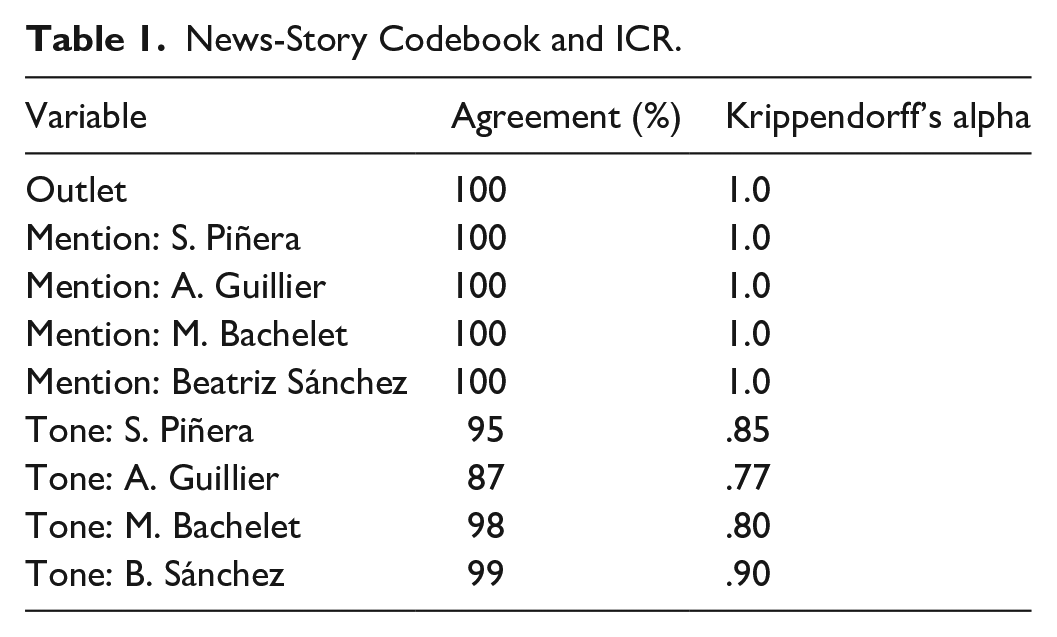
Two coders content analyzed the 84 story headlines included in this study. Inter-coder reliability (ICR) was calculated on a sample of 30 election-related stories published the day before the election and not included in the final sample of stories (a practice suggested by Lacy et al., 2015). ICR was high—the agreement between the two coders ranged from 87% (Krippendorff’s alpha = .77) to 100% (Krippendorff’s alpha = 1.0) for the nine variables included in the codebook (see Table 1).
News-Story Codebook and ICR.
In Stage 2, the unit of analysis was the news comment. Three coders content analyzed the 4670 news comments included in this study, focusing on incivility and user bias.
Incivility
This variable was measured using the attributes suggested by Chen (2017): stereotypes, insulting language/name calling, and profanity, coding 1 if the attribute was present, and 0 if it was absent. When coding for stereotypes, coders were prompted to look for negative connotations about people based on race, gender, or sexual orientations. Comments using terms, such as “feminazis” when referring to women, or “narcos” when describing Colombian immigrants, were examples of stereotypical speech, and were coded as 1. Insulting language was defined as pejorative name calling. Comments using nicknames to refer to political figures were coded as 1, as well as more general insults (like “stupid” or “idiot”) to refer to either political figures or other users participating in the conversation. Finally, comments including profane words were coded as 1 in the profanity category. We used these three attributes to build a dichotomous index of incivility. Comments with one or more attributes were coded as 1 (uncivil), while comments with no attributes of incivility were coded as 0 (civil). Consequently, the goal of this study is to identify not degrees of incivility, but presence/absence of incivility in the conversation.
User Bias
To measure this variable, we replicated the coding process used in Stage 1 to measure media bias. Coders had to identify whether a comment mentioned one of the candidates (Sebastián Piñera and Alejandro Guillier) or one of the female political figures involved with the election (President Michelle Bachelet and former candidate Beatriz Sánchez). If any of these actors was mentioned, coders identified the tone of the mention—neutral, positive, or negative. Examples were provided to better capture tone. For instance, comments such as “Piñera got elected again” were coded as neutral, as no evaluation or opinion about this candidate were made in the comment. In contrast, a comment indicating “Piñera is the worst thing that could happen to this country” was coded as negative, while a comment stating “Soooo happy we got Piñera as president again” was coded as positive. Negative tone was coded as 1, neutral tone was coded as 2, and positive tone was coded as 3.
To achieve proficiency and familiarity with the coding process, the three coders practiced with comments posted to election-related stories published 2 or 3 days before the election. ICR was calculated on a sample of 500 comments posted to stories published the day before the election (not included in the final sample). Coders did not perform well when coding for stereotypes—ICR values indicated they were unable to agree on how to identify stereotypes in the conversation. As such, this variable was dropped from the analysis, and incivility was assessed using insulting language and profanity. ICR between the three coders ranged from 81% (Krippendorff’s alpha = .63) to 100% (Krippendorff’s alpha = 1.0) for the nine variables included in the codebook (see Table 2).
News-Comment Codebook and ICR.

In Stage 3, we combined the news-story dataset with the news-comment dataset. In this combined setting, the unit of analysis is the news story. We created additive indexes for data coded in the news comments controlling for the number of comments posted to each story. To calculate how uncivil the conversation was on a specific story, we used the followed equation:
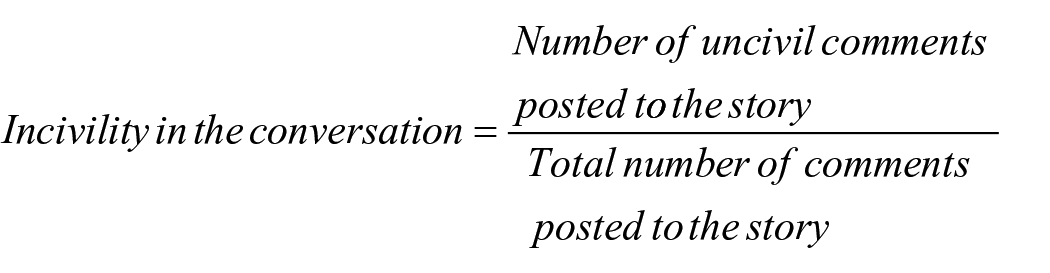
For example, if a story had a string of 10 comments and five comments were uncivil, the incivility index would be .5. Similarly, if a story had a string of four comments and all of them were uncivil, the incivility index would be 1. Consequently, the incivility index ranged from 0 to 1 and was treated as a numerical variable.
We used a similar process to represent user bias in the conversation associated with a news story. We added the tone values obtained in the comments mentioning a political figure, and the result was divided by the total number of mentions in the conversation. Thus:

For instance, if Michelle Bachelet was mentioned in five comments posted to a story, and the five mentions were negative (coded as 1), the tone index would be 1. If the five mentions were neutral (coded as 2), the tone index would be 2. In the case of two positive mentions and three neutral mentions, the index would be 2.4. Consequently, tone indexes ranged from 1 to 3 and were treated as numerical variables, with lower values indicating negative bias and higher values representing positive bias.
Data Analysis
To answer RQ1, we calculated the proportion of uncivil comments. To test H1, we ran chi-square tests to observe if the proportion of incivility received by female political figures was higher than the uncivil comments referring to male politicians. To test H2, we ran chi-square tests to compare the proportions of incivility received by each presidential candidate. To test H3 and H4, we ran t-tests to estimate whether political figures (including male candidates and female politicians) had received negative or positive coverage in the election-related stories. To answer RQ2, we ran chi-square tests to observe if the proportion of incivility varied depending on how biased the coverage was. To answer RQ3, we performed zero-order Pearson’s correlations to identify if more positive news coverage toward candidates resulted in more positive comments about them, and vice versa.
Results
Stage 1. Analysis of News Stories
A first look at the distribution of mentions in the stories indicates right-leaning candidate Sebastián Piñera was more prominent in the coverage than any other political figure included in the analysis (Figure 1). Piñera was mentioned in 60% of the stories analyzed, while center-left candidate Alejandro Guillier was salient in 33% of the stories. President Bachelet was mentioned in nine stories (11%) and former candidate Beatriz Sánchez appeared in 4% of the stories.

Distribution of mentions of political figures in EMOL and LaTercera.com news stories.
We expected greater ideological bias against left-wing political figures than right-wing politicians in the coverage of EMOL and LaTercera.com (H3). The content analysis showed no significant bias in favor or against any of the two male candidates. As such, H3 was rejected. Yet, trends illustrated in Figure 2 suggest that both EMOL and LaTercera.com were more likely to cover center-left candidate Alejandro Guillier negatively than right-leaning candidate Sebastián Piñera, and more likely to present positive bias toward Piñera than Guillier.

Negative, neutral, and positive bias toward presidential candidates in EMOL and LaTercera.com news stories.
We also expected greater gender bias against female political figures than male figures in the coverage of EMOL and LaTercera.com (H4). The low frequency of mentions of both Michelle Bachelet and Beatriz Sánchez did not allow for the calculation of chi-square tests comparing bias for female figures. As such, H4 could not be tested.
Stage 2. Analysis of News Comments
RQ1 inquired about the amount of incivility in news comments on election-related stories. Results show that 29% of the comments were uncivil. When observing each attribute separately, we observe that insulting language was by far the most common expression of incivility in the conversation (see Figure 3).

Incivility attributes in EMOL and LaTercera.com news comments.
We expected left-leaning candidate Alejandro Guillier to receive more uncivil comments than right-wing candidate Sebastián Piñera in both EMOL and LaTercera.com (H2). Findings indicate a significant relationship between candidate and mentions (χ2 = 188.25, p < .001), and candidate and incivility (χ2 = 5.41, p < .05). Bonferroni pairwise comparisons indicate Piñera was mentioned significantly more times than Guillier in the news comments (22% versus 13.7%, respectively), while Piñera received significantly fewer uncivil comments (29%) than Guillier (33%). Therefore, H2 is supported.
We also expected female politicians to receive more uncivil comments than their male counterparts in both EMOL and LaTercera.com (H1). Numbers reveal that President Michelle Bachelet and former candidate Beatriz Sánchez were mentioned in 5.8% and 2.2% of the comments, respectively, far less than mentions received by Piñera (22%) and Guillier (13.7%). In terms of incivility, however, 43% of the comments mentioning Bachelet were uncivil, while 38% of the comments mentioning Sánchez had incivility traits. A Chi-square test (χ2 = 23.88, p < .001) and Bonferroni pairwise comparisons indicate the two most important female political figures during Chile’s presidential election were not the most commented about figures, but when people did talk about them, the conversation was significantly more uncivil than the conversation addressing Piñera and Guillier. As such, H1 is supported.
Stage 3. Combined Analysis of News Stories and Comments
RQ2 asked about a possible relationship between media bias and incivility in the election-related news stories and comments, while RQ3 inquired about a relationship between media bias and user bias. When analyzing stories mentioning right-leaning candidate Piñera, we did not find a significant relationship between bias in the coverage and incivility traits in the news comments. In other words, uncivil discourse toward Piñera was not affected by biased (or unbiased) news coverage. Yet, we did find a significant relationship between media bias and user bias—the more positive the coverage of Sebastián Piñera, the more positive the comments addressing him (r = .49, p < .01).
In contrast, when analyzing stories mentioning center-left candidate Alejandro Guillier, numbers indicate no relationship between media bias and incivility, and no relationship between media bias and user bias. Although Guillier did not receive public approval in the online conversation (57% of the comments mentioning him had a negative tone, and 33% were uncivil), the negativity toward him was not correlated to the coverage he received in both EMOL and LaTercera.com stories.
Discussion
This study sought to understand how Chilean citizens discussed the presidential election in 2017, and how political and gender bias in the news coverage affected the online discussion about the election, if at all. To achieve this goal, this study content analyzed two different datasets comprising 84 election-related stories and 4670 news comments, respectively.
First, we found that incivility in comment sections of Chilean news outlets is higher than incivility found in the Global North. Previous studies indicate that 20% of the news comments are uncivil (Coe et al., 2014), while in this study, incivility reached 29%. These levels are even higher when the conversation mentions female politicians, especially President Michelle Bachelet, who received 50% more disrespectful comments than right-wing candidate Sebastián Piñera. These findings are consistent with previous studies about gender and hate speech—women are more likely to be targeted with offensive discourse on social media, and more likely to be verbally attacked for what they do or what they represent (Chess & Shaw, 2015; Wilhelm & Joeckel, 2019).
Second, we found that most of the stories covering the election in 2017 had a neutral tone toward the candidates—that is probably why we did not find a significant relationship between candidates and media bias. This is good news for journalism in a country with a long tradition of right-leaning media ownership and a concerning lack of ideological diversity in terms of news outlets (Gronemeyer & Porath, 2015). Previous studies looking at both El Mercurio and La Tercera found these organizations have been critical of the work performed by center-left political figures (especially Michelle Bachelet) and have covered right-wing politicians (such as Piñera) with a more positive tone (Navia & Osorio, 2015). But those studies analyzed longer time periods (months, or specific time chunks), while the present study observed the coverage of Election Day only. Consequently, the analyzed time frame might have been too short to judge how biased the election coverage was overall.
Still, some stories did have a positive or negative tone when covering the presidential candidates—around 13% of the stories mentioning right-leaning candidate Piñera were positively biased toward him, while 6% were negatively biased toward center-left candidate Alejandro Guillier. In other words, both newspapers were more likely to assign a negative tone to Guillier and a positive tone to Piñera when bias did emerge. These trends are consistent with the findings in the work of Navia and Osorio (2015) and suggest a stable pattern.
We did not find a relationship between media bias and uncivil discourse. We aimed to identify if stories negatively biased toward a certain political figure could trigger incivility toward that figure in the news discussion. However, we did not observe significantly more uncivil comments in stories negatively biased toward Guillier, just like we did not identify less uncivil discourse in comments posted to stories positively biased toward Piñera. In other words, the presence of uncivil comments was not related to the presence of political bias in the news coverage. Although this might seem like a positive finding, it means that a more objective, unbiased news coverage does not necessarily translate into a healthier, more civil discussion of the news.
It might be the case that, in a highly polarized, nerve-cracking environment like Election Day, how biased the coverage is does not affect how uncivil commenters are. Thus, media portrayals of candidates may not affect how newsreaders talk about them at this point. Future studies should observe this relationship by looking at extended periods of time, and focusing on different issues (not only presidential elections) to assess whether media bias is related to uncivil commentary.
Another explanation is the possibility of users not reading the story before posting comments. Studies have found that some users post comments motivated by the topic of a story, or motivated by other users’ comments, without necessarily reading the story (Stroud et al., 2016). If that is the case, whether the coverage is positive or negative would not make a difference on users’ incivility levels. The design of this study did now allow us to control for this behavior, unfortunately, but future research should look into this possibility.
Finally, we found a significant relationship between media bias and user bias in stories about right-wing candidate Sebastián Piñera. Stories covering the candidate in a more positive way received more positive comments than unbiased stories. Yet, this relationship did not hold for center-left candidate Alejandro Guillier—negatively biased stories were equally likely to receive negative comments about Guillier than unbiased stories. Newsreaders from both EMOL and LaTercera.com were more critical of (and more uncivil toward) Guillier, and their comments did not depend on the tone of the news coverage. Although we cannot directly assume that readers from right-leaning outlets share all the same political ideology, we did find that they talked about center-left political figures in a more negative way, but negatively biased media coverage did not increase readers’ negativity.
Based on these findings, our research has made at least two contributions to the study of news comments in particular, and mediated conversations in general. First, this study has gone beyond the description of incivility to identify the relationship between media bias and uncivil discourse. To our knowledge, no previous research has linked uncivil comments to the existence of bias in the news media, despite that theories such as agenda setting and framing indicate that news coverage of an issue does affect how people understand and evaluate that issue. That is why we aimed to observe if traditional media effects would manifest in these novel communication spaces. Second, this study provides evidence from an under-studied region, the Global South, to understand how mediated conversations unfold in the context of a highly polarized political event.
This study is not without limitations. We did not include a left-leaning news outlet to observe if Piñera was more likely to receive negative coverage, or if news comments were more uncivil toward him as compared with center-left politicians. Unfortunately, Chile’s media landscape is not diverse enough to provide mainstream left-leaning websites to study news comments from. But observing the two most important news sites in the country gives us an accurate idea as of how newsreaders discuss politics in Chile, and the extent to which such discussion is uncivil.
Also, we only looked at one day of coverage and news discussion. We decided not to sample comments to understand the whole conversation regarding the election. While this decision allowed us to understand jokes, replies, and user tagging, it limited our ability to analyze a larger time frame. One day of coverage provided a string of close to 5000 comments. Future studies should look at the election during an extended period of time and develop a sampling strategy that allows comment selection without compromising meaning and context.
Footnotes
Acknowledgements
The authors wish to thank Ariel González, Ángela Parra, and Frederik Zilcher, for their valuable help with the coding process.
Declaration of conflicting interests
The author(s) declared no potential conflicts of interest with respect to the research, authorship, and/or publication of this article.
Funding
The author(s) disclosed receipt of the following financial support for the research, authorship, and/or publication of this article: The authors received funding from Chile’s National Agency for Research and Development (ANID) through the grant Fondecyt de Iniciación 11181254, and the Millennium Science Initiative Program—Code ICN17_002.
