




Abstract
Adolescents are particularly susceptible to development of Fear of Missing Out (FoMO) by using social media. Closely connected to social media addiction, this phenomenon is not exclusively dependent on individual characteristics but is also affected by the family environment. Family structure, parental relationship quality, and parenting style are factors influencing adolescents’ media use, and therefore likely contribute to the development of FoMO. Despite an increasing focus on the relationship between family characteristics and children’s online behavior, not much research has been conducted that relates the family to FoMO. Therefore, this study serves as an exploration. Using online survey data from Flemish and Brussels adolescents aged 13 to 18 years old (N = 831), we developed a structural equation model. As expected, social media use is positively associated with FoMO. Moreover, family structure and parenting style play an important role in the development of FoMO: being part of a non-intact family, fathers’ parenting style, and perceived high-quality relationships with parents are protective factors for FoMO, while perceived high-quality relationships between parents is a risk factor for FoMO. These results demonstrate that an adolescent’s family context is associated with their experiences of FoMO, and also indicate that more insight in this issue is required.
Keywords
Adolescents spend an increasing amount of time in digital environments. It has quickly become one of their dominant leisure activities, and digital media are increasingly considered an extension of their “real-life” selves. Most of this time online is spent on social media (Ahn & Jung, 2016; Barry et al., 2017; Kuss & Griffiths, 2017). Contrary to many advantages of social media for adolescent development are also multiple disadvantages (Reid Chassiakos et al., 2016). For instance, adolescents may develop a fear of missing (important) events when they are not online: Fear of Missing out (FoMO). This phenomenon can be defined as a desire to be online and a constant urge to check social media (Abel et al., 2016; Przybylski et al., 2013). FoMO can be framed within a broader context of excessive (social) media use or internet addiction. Adolescents are particularly susceptible to this (Barry et al., 2017; Kuss & Griffiths, 2017; López et al., 2015), and research has shown that up to 20% of adolescents feel very restless when they cannot look at their smartphone and that they fail to reduce spending time on it (Mediaraven & LINC, 2018).
Parents are crucial actors in the primary socialization and traditional media use of children (Alt & Boniel-Nissim, 2018; López et al., 2015; Vaala & Bleakley, 2015). However, little is known about the role that parents play in their children’s relationship with new media (Notten, 2013) and few studies exist that focus on family characteristics (Alt & Boniel-Nissim, 2018). Moreover, the range of existing research on internet or social media addiction does not provide a clear answer on which family characteristics contribute to FoMO (Mediaraven & LINC, 2018; Notten, 2013). This study is one of the first to explore the relationship between family characteristics, parenting styles, and the experience of FoMO in adolescents. The overarching research question is: Which family characteristics are associated with FoMO in adolescents? Given the lack of literature on this subject, we apply a broad scope and focus on family structure, the quality of relationships with and between parents, and parenting style.
Young People and Social Media Addiction
Mobile and social media enable permanent connection between friends, family, or even strangers. Particularly adolescents have appropriated the cultural norm of “always being online,” especially since the exponential growth of social media (Kuss & Griffiths, 2017). They often rely on social media for communication with family and peers, information gathering, and—to a certain extent—emotional self-regulation (Bolton et al., 2013). Flemish research shows that the percentage of adolescents in secondary education using Facebook, YouTube, Instagram, and/or Snapchat ranges from 65% among 12-year-olds to 92% among 14-year-olds (Mediaraven & LINC, 2018). Moreover, 70% of adolescents indicate that using their smartphone is similar to a reflex, a near-automated action (Mediaraven & LINC, 2018). In combination with the finding that most of the time online is spent on social networking sites (SNS; Barry et al., 2017; Oberst et al., 2017), this raises concerns about the impact of social media use on the well-being and development of children and adolescents both in the short- and long term (Bolton et al., 2013).
Problematic social media use,
1
and more specifically social media overuse, may lead to symptoms that are traditionally associated with substance-related addictions (e.g., withdrawal, conflict, and loss of control; Ahn & Jung, 2016; Blackwell et al., 2017; Chang et al., 2015; de Calheiros Velozo & Stauder, 2018; Durak, 2018; Elhai et al., 2016; Koo & Kwon, 2014; Kuss & Griffiths, 2017). Kuss and Griffiths (2017) state that, for a small minority of individuals, their use of social networking sites may become the single most important activity that they engage in, leading to a preoccupation with SNS use (salience). [. . .] The activities on these sites are then being used in order to induce mood alterations, pleasurable feelings or a numbing effect (mood modification). Increased amounts of time and energy are required to be put into engaging with SNS activities in order to achieve the same feelings and state of mind that occurred in the initial phases of usage (tolerance). (p. 6)
Although the research on social media addiction is still limited, the presence of similar symptoms has been medically validated in the context of internet addiction (Kuss & Griffiths, 2017). Durkee et al. (2012) argue that people are not addicted to the technology itself, but rather to the specific (social) activities they perform on it. For example, interactive online activities, such as gaming, chatting, and social networking, ensure that someone stays online longer than they had anticipated which increases the risk of addiction.
FoMO
Recent research has found that for many individuals, this high engagement with social media—and associated addictive symptoms—is partially due to a “fear of missing out” (FoMO) (Oberst et al., 2017). Przybylski et al. (2013) define FoMO as “a pervasive apprehension that others might be having rewarding experiences from which one is absent, FoMO is characterized by the desire to stay continually connected with what others are doing” (p. 1841). Or, in other words, an anxiety to miss important events which is, as research has shown, associated with the excessive use of new technologies (Durak, 2018; Tomczyk & Selmanagic-Lizde, 2018). While FoMO is not a new concept, its use has risen sharply with the emergence of SNS (Abel et al., 2016). The self-determination theory (SDT) describes FoMO as an emotional experience when certain psychological needs are not met (Przybylski et al., 2013). According to this theory, self-regulation and psychological health are based on the satisfaction of three needs: the competence to participate in the world, the degree of personal independence, and feelings of social connectedness. There is a link between a shortage of these basic needs, FoMO, and social media use. Individuals use SNS to stimulate their social connection and competence, and FoMO therefore acts as a mediator in the relationship between the fulfilment of these basic needs and social media use (Beyens et al., 2016; Przybylski et al., 2013). Blackwell et al. (2017) found that people who demonstrate FoMO are more likely to spend excessive time online because social media enable easy access to social interactions and can increase perceived social involvement, making them ideal platforms for individuals who want to gather information about others (Przybylski et al., 2013).
Abel et al. (2016) argue that an individual is a social being who values how others think and act, and how this reflects on themselves. As the digital world becomes increasingly prominent in people’s daily lives, individuals use social media to observe what is going on in the lives of others (Abel et al., 2016). This constant (digital) access to others enables individuals to see what they are missing out on (i.e., a party, a dinner, etc.), which has been found to stimulate feelings of dissatisfaction, anxiety, and unworthiness (Abel et al., 2016; Przybylski et al., 2013). Individuals tend to become more anxious, irritable, feel more inadequate, and have lower self-esteem after viewing social media (Abel et al., 2016). For adolescents, peer involvement, social connections, and interactions are crucial in making this group particularly vulnerable to FoMO (Barry et al., 2017). In this regard, Tomczyk and Selmanagic-Lizde (2018) argue that FoMO is a type of internet addiction that predominantly affects children and adolescents. When the needs to be online and acquire information as gratification are not met, individuals experience negative emotions. In their study, 20% of adolescents experienced symptoms of FoMO and 30% ran the risk of becoming addicted to SNS. The authors cite three predictors of internet use and addiction (and FoMO). First, they define the escapism motive as the desire to avoid sadness, loneliness, and other psychosocial issues. Second, there is the boredom motive, meaning that there are no alternatives to spend free time on. Finally, there is the “up-to-date” motive, where one wants to stay up-to-date with other people’s activities, stay connected with friends, or look for new experiences.
To conclude, FoMO is both a predictor and a trait of internet addiction. It is a predictor because there is a strong reciprocal relationship between FoMO and social media use, which can evolve into an internet addiction (Blackwell et al., 2017; Franchina et al., 2018). It is an internet addiction trait because the anxiety that is experienced during FoMO can be considered a symptom of addiction and because these phenomena, taken separately, show a vivid overlap in terms of symptoms and consequences (Kuss & Griffiths, 2017; Przybylski et al., 2013; Tomczyk & Selmanagic-Lizde, 2018).
Family Context
Parents play an important role in their children’s media use. They are both gatekeepers in the access to digital devices and content and agents because they socialize their children regarding the use of these media (Vaala & Bleakley, 2015). Several studies have shown that the way in which parents influence their children’s media consumption and the possibility of developing an internet addiction is related to various (family) characteristics (López et al., 2015; Vanwynsberghe et al., 2015).
Concerning family structure, adolescents living in single-parent households use digital technologies more often and adopt risky online behavior (e.g., disclosing personal information to strangers) more quickly than adolescents living in two-parent households (Notten, 2013). Possible explanations for these findings are increased stress, financial problems, and less time spent with parents in non-intact families (Notten, 2013). Regarding problematic internet use, Mei et al. (2016) and Wu et al. (2018) found that orphaned adolescents or those living in single-parent households are more likely to develop problematic or excessive internet use than adolescents in two-parent households.
Family relationships also affect problematic internet use. Chang and colleagues (2015) focusing on the parent–child relationship found that strong attachment to parents is negatively correlated with internet addiction in adolescents. Moreover, a study by López et al. (2015) concluded that parent–child relationships based on trust and communication are powerful protective factors against FoMO. One possible explanation is that when adolescents develop adverse family relationships, they try to “escape” by focusing on online communication with peers (López et al., 2015). This is in line with a study by Ko et al. (2015) on family conflict: in a longitudinal study, they found that adolescents who do not live with their mother or father, who are not cared for by their parents, who experience frequent parent-adolescent conflict, or who experience frequent conflict within their family are more likely to become addicted to the internet. Moreover, they showed that parental conflict was the strongest predictor of internet addiction (Ko et al., 2015). This gives rise to the following sub-questions and hypotheses:
RQ1: To what extent is family structure associated with the degree of FoMO among adolescents?
H1: Adolescents from intact families experience less FoMO than adolescents from non-intact families.
RQ2: To what extent is the quality of the relationship between the mother/father and adolescent associated with the experience of FoMO among adolescents?
H2: Adolescents with a high-quality relationship with the mother/father experience less FoMO than adolescents with low-quality relationships with mother/father.
RQ3: To what extent is the relationship quality between parents associated with FoMO among adolescents?
H3: Adolescents whose parents have a high-quality relationship experience less FoMO than adolescents whose parents have a low-quality relationship.
Intervening Factors
Due to the rise of the “bedroom culture” and mobile media, it is not easy for parents to intervene in their children’s social media use (Vanwynsberghe et al., 2015). When parents are concerned about their children’s online behavior, they pursue various strategies to regulate and guide it (Clark, 2011; Vanwynsberghe et al., 2015). Three mediation strategies for the use of (social) media are discussed in literature: restrictive mediation, instructive/active mediation, and coviewing/co-use (Hefner et al., 2019; Terras & Ramsay, 2016). The first two mediation strategies are similar to a commonly used dichotomy in parenting style, namely, parental control and support (Kiff et al., 2011).
Control, in the sense of regulating children’s behavior, consists of making rules, conveying standards, granting autonomy, rewarding desired behavior, and punishing undesirable behavior. Psychological control is also included in this indicator and relates to the suppression of the child’s self-expression, autonomy, and independent thinking by the parent(s). A high degree of control has been found to negatively affect children’s psychosocial development (Kiff et al., 2011). Erickson et al. (2016) concluded that parents differently estimate the risks faced by adolescents in their online behavior, and that the degree of parental control over adolescents’ online life varies. Tomczyk and Selmanagic-Lizde (2018) found that high parental control leads to lower internet use and to lower FoMO. However, as this effect was small, the authors indicate that parental control alone is not enough to protect adolescents against FoMO. The other indicator, support, is situated between two dimensions of positive affection/acceptance and negative affection/rejection. Characteristics that belong to the positive affection dimension are appreciation and involvement. These relate to a higher degree of empathy, social behavior, and a lower degree of emotional and behavioral problems in children. Characteristics belonging to the dimension of negative affection are rejection and detachment. These result in a higher degree of both internalized and externalized problems and a lower adaptive capacity among children and adolescents (Kiff et al., 2011).
Alt and Boniel-Nissim (2018) investigated how parent–child communication—a vital dynamic in the parental control/support framework—is related to problematic internet use, and whether FoMO mediates this relationship. They found that positive communication activities of parents (e.g., listening to their children, trying to understand how they feel) are related to less FoMO and less problematic internet use among their children (Alt & Boniel-Nissim, 2018). In line with this, Gunuc and Dogan (2013) found that low parental involvement increases adolescents’ likelihood of internet addiction. The mother is the largest source of support in this respect, for which the authors refer to the finding that mothers are more likely to adopt an active parenting style and are more involved with the adolescent. Subsequently, Durkee and colleagues (2012) concluded that low parental involvement increases adolescents’ likelihood of internet addiction. In this regard, internet use serves as a coping strategy for adolescents to deal with their situation. Furthermore, a Chinese study (Xiuqin et al., 2010) found that adolescents with internet addiction indicate that their parents’ perceived parenting style is mainly intrusive and repressive (high degree of control) and unresponsive (low degree of affection).
This shows that parents’ behaviors affect the development of internet addiction in adolescents. However, results up to this point are mixed. Tomczyk and Selmanagic-Lizde (2018) argue that it is important to investigate various family conditions. According to them, the importance of parents is indisputable in studying children’s and adolescent’s online behavior (Durak, 2018; Gunuc & Dogan, 2013). Thus, based on the abovementioned research, we also include parenting style in the form of parental support and control as mediators. Because of the parental influence on adolescents’ social media use, and since a higher degree of (social) media use is accompanied by a higher degree of FoMO (Abel et al., 2016; Barry et al., 2017; Przybylski et al., 2013), we also include social media use as an intervening variable. Several questions and hypotheses follow from these findings:
RQ4: Which associations are mediated by parenting style?
H4.1: Support mediates the relationship between family structure, relationship quality with parents, and relationship quality between parents, and FoMO.
H4.2: The higher the degree of support, the lower the degree of FoMO.
H4.3: Control mediates the relationship between family structure, relationship quality with parents, and relationship quality between the parents, and FoMO.
H4.4: The higher the degree of control, the lower the degree of FoMO.
RQ5: Which relationships are mediated through the adolescent’s use of social media?
H5.1: Social media use mediates the relationship between family structure, relationship quality with parents, and relationship quality between parents, with FoMO.
H5.2: The higher the adolescent’s social media use, the higher the degree of FoMO.
The theoretical model for this study can be found in Figure 1.
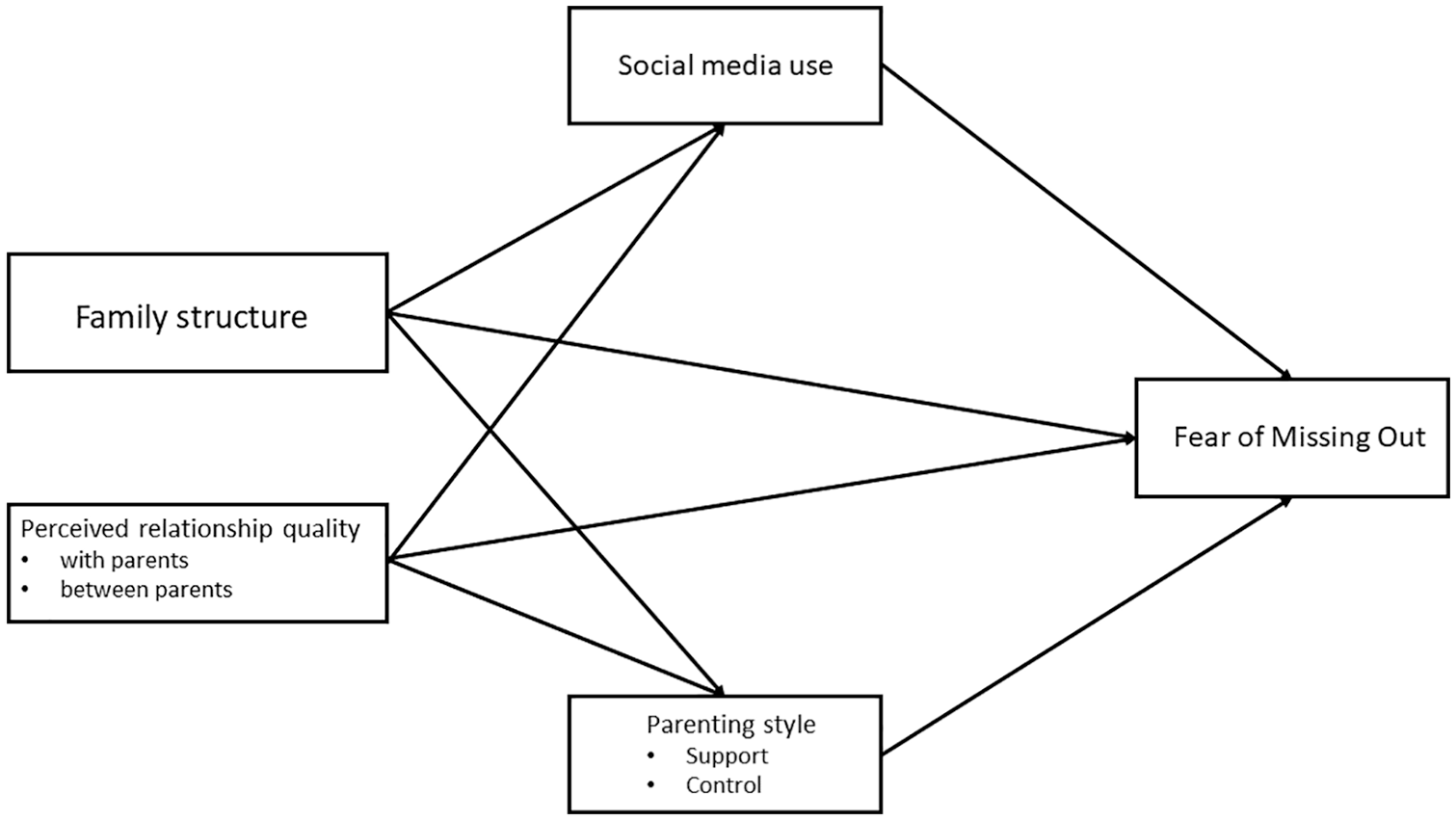
Theoretical model.
Data Collection
Data were gathered via an online survey among a sample of secondary school students in Flanders, the northern, Dutch-speaking region of Belgium, and Brussels, the capital region of Belgium (N = 841). This took place between December 2017 and April 2018 and was limited to secondary school students who were (mostly) aged 13 to 18 years. We collected a disproportionate quota sample, in which strata were composed based on educational type, province, and municipality. Within each participating school, a cluster sample of classes was selected with attention to diversity of grade (second, third, and fourth) and educational type (general, vocational, artistic, and technical secondary education). All pupils from the selected classes were presented with the online survey on a tablet in class. The survey was completely anonymous, and students had the opportunity to quit the questionnaire at any time. The online questionnaire was standardized, with questions and scales chosen based on their validity and reliability (De Coninck et al., 2019).
To further finetune the subsample, we imposed additional restrictions. Respondents were not allowed to be older than 18 years because of the possibility that these adolescents (or young adults) no longer live at home with their parents, which may cause their answers to distort the findings. Furthermore, we only involved students whose parents are heterosexual. As a result of these restrictions, the sample consisted of 831 respondents.
Measures
FoMO
In this research, the definition of FoMO proposed by Przybylski and colleagues (2013) was used: “A pervasive apprehension that others might be having rewarding experiences from which one is absent, FoMO is characterized by the desire to stay continually connected with what others are doing” (p. 1841). To measure FoMO, we used three items: “If I am someplace where I can’t be online, then I am annoyed by this,” “I am afraid that I will miss things if I don’t use social media,” and “I feel restless when I receive a social media message and I can’t look at it immediately,” with answer categories ranging from 1 = don’t agree to 5 = totally agree. The confirmatory factor analysis pointed to one underlying factor, with a Cronbach’s alpha of .70. We calculated and saved the regression score to be used in subsequent analyses.
Family and Relationship Characteristics
We measured family structure by asking students what their parents’ living situation looks like: 1 = married, 2 = unmarried cohabiting, 3 = legally divorced, 4 = de facto divorced. The first two categories were recoded into intact families (code: 1) and the latter two categories into non-intact families (code: 0). (Perceived) relationship quality with parents is measured as the degree of closeness in the attachment between adolescent and parent, as indicated by the adolescent (Juffer, 1993). This was measured by asking how good or bad the student’s relationship with their parent(s) is. Students had to provide an answer for mother and father separately, with answer options ranging from 1 = very bad to 5 = very good. The (perceived) relationship quality between parents was measured by asking students how good or bad the relationship between their biological (or adoptive) parents was, with answer categories 1 = very bad to 5 = very good.
Social Media Use
We defined adolescents’ social media use as the time spent on social media over the course of an average weekday and an average weekend day. The indicator was constructed by calculating the mean of two variables where respondents had to indicate the number of minutes that they usually spend on SNS during an average weekday and on an average weekend day. Values over 1,440 (24 hr × 60 min) were indicated as missing.
Parenting Style
Parenting style consisted of the latent factors support and control for both mother and father separately. The perceived degree of support was measured using 18 items from the Network of Relationships Inventory (NRI) from Furman and Buhrmester (1985). 2 For each item, we asked to what extent this statement applies, with answer options ranging from 1 = not or little to 5 = more is not possible. With the eight items that measured support, a confirmatory factor analysis was performed for each parent separately, which showed that there was one underlying factor for both the degree of support by the father and the degree of support by the mother. The Cronbach’s alpha of this factor is the same for both parents (.80).
The scale that measured the perceived degree of control by mother and father was the Parental Monitoring Scale of Vettenburg et al. (2007). Three items were used: “My mother/father always asks where I go when I go out,” “My mother/father asks what I spend my money on,” and “My mother/father wants to know who my friends are.” Five answer categories were presented, with answer options ranging from 1 = totally disagree to 5 = totally agree, with a higher score indicating a higher degree of control. Confirmatory factor analyses pointed to one underlying factor per parent. In the case of the mother, the Cronbach’s alpha was .67, and in the case of the father it was .70.
Control Variables
In our model, we included three control variables: gender (0 = male, 1 = female), education type (1 = general secondary education, 2 = vocational secondary education, 3 = artistic secondary education, 4 = technical secondary education), and age. Since no artistic secondary-education students participated in the study, and in order to simplify the structural equation model (SEM), education type was dichotomized to 0 = general secondary education and 1 = vocational/technical secondary education. For more information on respondent characteristics, see Tables 1 and 2.
Descriptive Statistics for Socio-Demographic Characteristics.

Descriptive Statistics for Perceived Relationship Quality With Parents, Perceived Relationship Quality Between Parents, Social Media Use, and Age.

Note. SD = standard deviation.
Results
Spearman’s Correlation
Because of the non-normally distributed data, we used the Spearman’s rank correlation coefficient to calculate correlations (Table 3).
Spearman’s Correlations for the Items of FoMO, Maternal and Paternal Relationship Quality, Relationship Quality Between Parents, Social Media Use, and the Averages of the Indicators of Parenting Style.
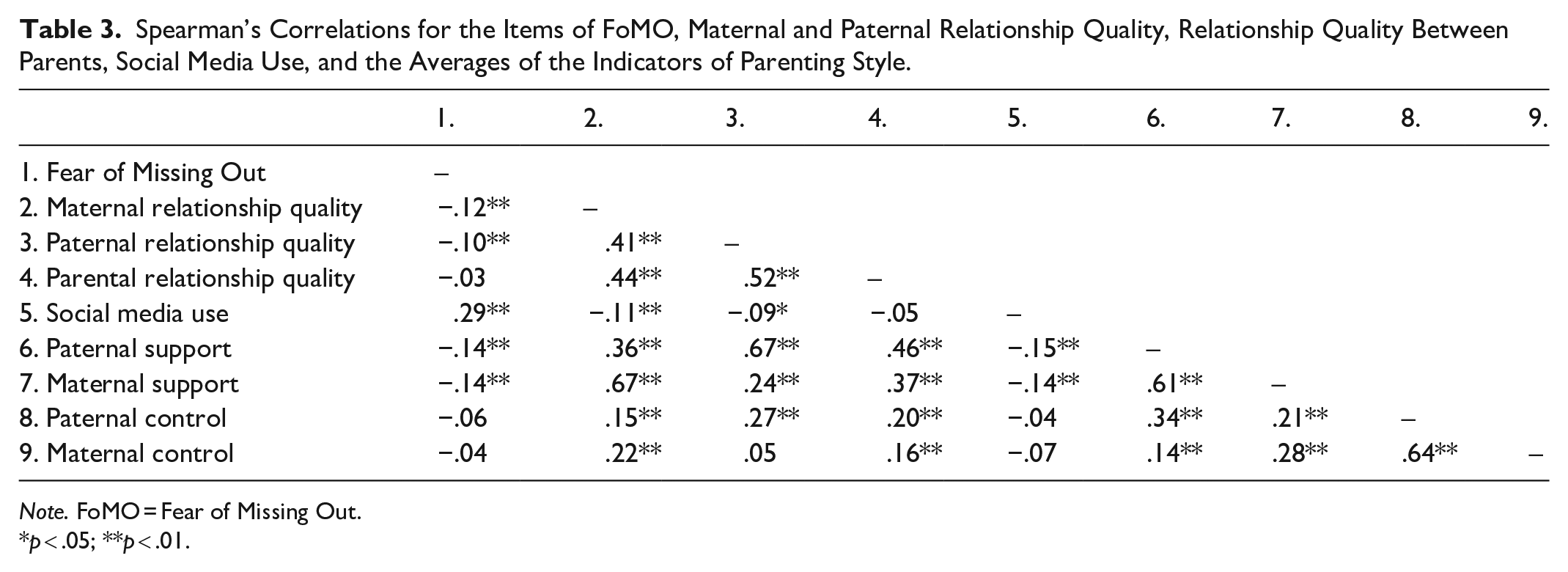
Note. FoMO = Fear of Missing Out.
*p < .05; **p < .01.
SEM
The SEM was estimated in SAS using the weighted least squares (WLS) estimation method with FoMO as the endogenous variable, relationship quality and family structure as exogenous variables, and parenting style and social media use as mediators. Two tables are presented: the partially standardized direct effects on the mediators (Table 4) and the standardized direct, indirect, and total effects on FoMO (Table 5). The goodness-of-fit index (GFI) was 0.99, the Bentler comparative fit index (CFI) was 0.99, the standardized root mean square residual (SRMR) was 0.04, and the root mean square error of approximation (RMSEA) was 0.07. In summary, these fit indices indicated that our model fit the data well.
Standardized Direct Effects on Social Media Use, Maternal Support, Paternal Support, Maternal Control, and Paternal Control.

Note. SE = standard error.
Reference category is intact family.
p < .05; **p < .01; ***p < .001.
Standardized Direct, Indirect, and Total Effects on FoMO.

Note. FoMO = Fear of Missing Out; SE = standard error.
p < .10; **p < .01; ***p < .001.
Table 4 shows the direct effects of the exogenous variables on the mediators. We found that family structure (β = .09, p < .00), perceived relationship quality with the father (β = −.09, p < .00), perceived relationship quality with the mother (β = −.05, p < .05), and perceived relationship quality between parents (β = .07, p < .01) were associated with social media use. Furthermore, results indicated that adolescents from non-intact families used more social media than adolescents from intact families (β = .09, p < .00).
Family structure was also significantly associated with parental support and control: adolescents from non-intact families experienced higher maternal support (β = .04, p < .01), but lower maternal control (β = −.09, p < .00) and paternal control (β = −.07, p < .00) than adolescents from intact families. We also found that the perceived relationship quality with the father was positively associated with paternal support (β = .56, p < .00) and control (β = .19, p < .00), but negatively associated with maternal support (β = −.08, p < .00) and control (β = −.08, p < .00). Perceived relationship quality with the mother was positively associated with support and control for both parents. Perceived relationship quality between the parents was positively associated with parental support, and with maternal control.
Table 5 shows the standardized direct, indirect, and total effects of relationship quality family structure, parenting style, and social media use on FoMO. Focusing on the total effects, we observed that social media use was positively associated with FoMO (β = 0.22, p < .00): when an adolescent spent more time on SNS, they were more likely to experience FoMO. When we linked these findings to those from Table 4, we were able to confirm Hypothesis 5: the higher adolescents’ social media use, the higher the degree of FoMO. In addition, adolescents from non-intact families experienced less FoMO than adolescents from intact families (β = −.09, p < .00). This finding was not in line with our first hypothesis, in which we expected that adolescents from intact families experience less FoMO than adolescents from non-intact families.
Perceived relationship quality indicators were all associated with FoMO: perceived paternal relationship quality (β = −.14, p < .00) and perceived maternal relationship quality (β = −.07, p < .00) were negatively associated with FoMO, while perceived relationship quality between parents was positively associated with FoMO (β = .06, p < .01). These findings supported our second hypothesis, in which we expected that adolescents with a perceived high-quality relationship with their parents experience less FoMO than adolescents with a low-quality relationship with parents. However, our findings contradicted expectations regarding Hypothesis 3, where we expected that adolescents whose parents have a high-quality relationship experience less FoMO than adolescents whose parents have a low-quality relationship. The total indirect effects of the exogenous variables via the mediators were also presented in Table 5. Here, the total indirect effects of perceived paternal relationship quality (β = −.12, p < .00) and family structure (β = .02, p < .00) on FoMO were significant. When linked to results from Table 4, we observed that perceived paternal relationship quality is positively related to paternal support and negatively to social media use and that these are in turn positively and negatively associated with FoMO. These findings partially confirm Hypotheses 4.1 and 5.1, as they indicate that parental support (Hypothesis 4.1) and social media use (Hypothesis 5.1) mediate the relationship between family characteristics and FoMO. However, it should be noted that only paternal support mediates these characteristics, not maternal support (given the lack of any direct effects between maternal support and FoMO). Our findings do not seem to point to a mediating effect of parental control either—leading us to reject Hypothesis 4.3. The total effect of paternal support supported this statement (β = −.16, p < .00). Regarding parenting style, we observed a difference between mother and father: paternal support (β = −.16; p < .00) and control (β = −.05, p < .10) were negatively associated with FoMO, while maternal support and control were not significantly associated with FoMO. These findings partially confirm Hypotheses 4.2 and 4.4. Here, we expected that a higher degree of support would be associated with lower FoMO—which is only true for fathers—and that a higher degree of control would also be associated with lower FoMO—which is also only true for fathers.
Discussion
In this article, we investigated whether family characteristics and social media use influenced FoMO among adolescents in Flanders and Brussels (Belgium). More specifically, we looked at the relationship between the family structure, the perceived relationship quality with parents, the perceived relationship quality between parents, parenting style, and social media use as protective factors against FoMO. The latter is the experience of a fearful feeling of missing events when not online (Przybylski et al., 2013). Adolescents are particularly susceptible to the development of FoMO because they have appropriated the cultural norm of “being online all the time” and are in a crucial period of development (Barry et al., 2017; Kuss & Griffiths, 2017). Moreover, the literature showed that family and parental characteristics are associated with social media use and internet addiction in adolescents (Alt & Boniel-Nissim, 2018; Durak, 2018; López et al., 2015). Despite these findings, little research has been carried out into the association between parental influence and family structure, and SNS-related FoMO, which has motivated us to adopt an exploratory attitude by analyzing multiple family characteristics.
The Role of Family Structure and Social Media Use on FoMO
We found that adolescents from intact families experienced more FoMO than adolescents from non-intact families, which is not in line with much of the existing literature (Mei et al., 2016). In addition, adolescents from non-intact families use SNS (a risk factor for FoMO in this study; Franchina et al., 2018) more frequently than adolescents from intact families (Wu et al., 2018). It would then make sense that, if adolescents from non-intact families use social media more often, and high social media use stimulates FoMO, then adolescents from non-intact families should experience more FoMO. However, we found the opposite. If we return to the definition of FoMO in line with the SDT, it states that FoMO occurs when three needs are not met: the competence to participate in the world, personal independence, and feelings of social connectedness (Beyens et al., 2016; Przybylski et al., 2013). Several aspects of this definition open explanatory avenues for our finding regarding the role of family structure. Regarding personal independence, studies have shown that adolescents from non-intact families report higher feelings of independence than adolescents from intact families (Riggio, 2004): adolescents from non-intact families often face additional household tasks and caretaking responsibilities for younger siblings and are “thus likely to become more independent at an earlier age” (p. 109). While some studies have found that these role shifts are detrimental to adolescents, others found that adolescents from non-intact families understand the necessity of increasing self-reliance and enjoy the benefits of greater independence and decision making (Arditti, 1999; Riggio, 2004).
In addition, regarding feelings of social connectedness, Riggio (2004) found that adolescents from non-intact families reported significantly greater numbers of perceived available social supports than adolescents from intact families. Potentially, these adolescents adapt to less parental availability and other family changes by becoming more reliant on social support outside the family. In the age of SNS, it is likely that adolescents connect with this (non-familial) support through social media, which may explain why the higher social media use of adolescents from non-intact families does not stimulate higher FoMO when compared to adolescents from intact families. In short, since adolescents from non-intact families seem more adept at achieving personal independence and social connectedness (in part, thanks to their family structure) than adolescents from intact families, they may develop less FoMO.
Perceived Relationship Quality and Parenting Style
Relationship quality with and between parents is directly and indirectly associated with FoMO (RQ2): having a (perceived) high-quality relationship with mothers and fathers is related to lower FoMO. Curiously enough, and contrary to much of the literature (Gunuc & Dogan, 2013), the association of the relationship with the father with FoMO is stronger than the association with the relationship with the mother. However, there is some evidence that relationships with fathers may be taken less “for granted” by adolescents than those with mothers, and that “high quality, positive relationships with fathers [are] indicative of individual competence and desirability in relationships, and low quality relationships indicative of fathers’ rejection or unwillingness to form close relationships with offspring” (Riggio, 2004, p. 110). Relationships with mothers, in contrast, are perhaps viewed as “granted” or expected, such that individual performance or competency in the relationship is of less influence on levels of anxiety or FoMO.
Moreover, we found that a higher perceived relationship quality between parents is positively associated with FoMO (RQ3). This finding contradicts the escapism argument of López and colleagues (2015). In addition, this is also inconsistent with the findings of Ko et al. (2015) that poor family functioning and conflict between parents are important predictors for the development of internet addiction in adolescents. However, this finding is in line with our earlier finding regarding family structure. Adolescents from intact families—who we found are more likely to develop FoMO than adolescents from non-intact families—likely have a more positive perception about their parents’ relationship quality than adolescents from non-intact families. Given that these two findings point in the same direction, it is clear that the dynamic of FoMO is more complicated than initially assumed.
With regard to parenting style, we found that a higher level of support and control by the father only is related to lower levels of FoMO among adolescents (RQ4). This may again be an illustration of the earlier explanation regarding the role of relationships with the father in the development of anxiety (Riggio, 2004). This finding is partly in line with the literature. Alt and Boniel-Nissim (2018) stated that the more communication (support) there was, the less FoMO the adolescent experienced (Chang et al., 2015; Tomczyk & Selmanagic-Lizde, 2018). Subsequently, Gunuc and Dogan (2013) also experienced a negative effect of the perceived support on the degree of internet addiction.
Limitations and Directions for Future Research
This study features limitations that require mention, but however also opened several avenues for future research. Given the cross-sectional nature of the current data, they merely reflect snapshots of adolescents in time. As such, “future work examining FoMO in experimental settings will be valuable and allow for causal models to be evaluated” (Przybylski et al., 2013, p. 1847). In that regard, longitudinal designs may also benefit in the assessment of FoMO, as “it is reasonable to expect situational and relational factors may influence variability in FoMO across months, weeks, or even the course of the day” (Przybylski et al., 2013, p. 1847). We also encourage researchers to utilize qualitative methods, and in particular ethnographic research, to further investigate the specific ways in which FoMO differs between adolescents of different family types.
Furthermore, we cannot generalize our findings to adolescents beyond Flanders. The construction of some of the variables may also be problematic. For example, it is impossible to exclude social desirability in the questionnaire and one can question whether adolescents were able to make an accurate assessment of their social media use. In addition, in follow-up studies, it is recommended to strengthen the scales concerning parenting style and FoMO by adding more items and applying them more to the specific research context. For example, it is useful to use scales concerning active and restrictive mediation rather than a more general question concerning support and control.
Furthermore, it appears that parents’ media use and attitude also have an important influence on adolescent media use (Terras & Ramsay, 2016; Vaala & Bleakley, 2015), but these were not included in this study. Nevertheless, we should not lose sight of some new research avenues that this study has opened regarding the importance of the broader family context in the development of FoMO via social media use. Contextual influences of the family structure play a role in the development of FoMO and internet addiction through, for example, the time spent by the parents with the adolescent, the frequency of contact with parents, the residence arrangement, the experience of a divorce or separation, or the influence of new family members. In addition, the quality of the relationship with and between the parents and the parental mediation strategies may also differ depending on the family structure, which has not been considered in this study. It would therefore be interesting in a follow-up study to look more closely at how these specific mechanisms differ by family structure, and how this interacts with FoMO among adolescents.
Footnotes
Appendix
Acknowledgements
The authors would like to thank the anonymous reviewers for their valuable feedback on earlier versions of this article.
Declaration of Conflicting Interests
The author(s) declared no potential conflicts of interest with respect to the research, authorship, and/or publication of this article.
Funding
The author(s) disclosed receipt of the following financial support for the research, authorship, and/or publication of this article: This publication was made possible through funding support of the KU Leuven Fund for Fair Open Access.
