




Abstract
This study examined people’s lived experiences with social media through 10 focus groups with 82 total participants across five countries: Brazil, Germany, Malaysia, South Africa, and the United States. Findings demonstrate that social media make people’s lives less complex, but this belies heightened complexity as they negotiate three paradoxes when using social media. We describe these as dialectics between: convenience versus privacy, trust versus distrust, and meaningful versus wasted time. These dialectics fit into one over-arching theme that social media make people feel better but also worse, sometimes at the same time. We characterize these experiences as negative—and likely unintended—side effects of reflexive modernization. According to our participants, these tensions leave people in a sort of existential limbo—knowing social media can distress them but not always having the will to leave.
As society modernizes, some of the side effects of this modernization can backfire, leading to uncertainty, change, or even chaos (Beck et al., 2003; Wimmer & Quandt, 2006). This is called reflexive modernization, where the “‘meta-change’ of modern society results from a cultural mass of unintended side effects” (Beck et al., 2003, p. 2). This reflexivity does not refer to a conscious act of reflecting upon a problem (Beck, 1992). Rather, it refers to a “‘boomerang’ effect, where mostly unplanned results of (production) processes in modern societies backfire on these societies and force them to change” (Wimmer & Quandt, 2006, p. 337). While the concept of reflexive modernization did not originate with social media, in this article, we apply it to the digital space to understand the tension people may feel over the role of social media in their lives. Clearly, people find these platforms beneficial, with an estimated 3.8 billion people worldwide using them (We Are Social, 2020), yet negative and unintended side effects of using social media are well established—from inciting jealousy to threatening privacy (e.g., Fox & Moreland, 2015; Tsay-Vogel et al., 2018).
Thus, this article is concerned with the paradox of modern society—that social media are at once touted as a cure for some societal ills and, at the same time, the poison that exacerbates these problems. Drawing on data from 10 focus groups with 82 participants across five countries—Brazil, Germany, Malaysia, South Africa, and the United States—we delve into what experiences on social media resonate with people and which ones undermine the role of social platforms in their lives. These countries were chosen based on high penetration of 3G networks as well as high Facebook, Twitter, and Internet use. We use complexity theory as an organizing principle for our findings by adapting the theory’s dialectic lens, which argues that while social systems seek to reduce complexity (Seidl & Mormann, 2014), they actually may increase complexity in people’s lived experiences. We apply this lens to social media, positing that these platforms appear to make life simpler by providing an easy way to connect with friends and relatives, instant access to news and information, and a digital footprint that alerts users to products they may want based on their search patterns. Yet, our data show that complexity belies this simplicity because the ease of social media creates unintended—and sometimes negative—consequences. Social media create new choices for people to navigate, complicate their sense of privacy, and may make them yearn for a simpler time. Thus, in trying to reduce complexity, social media actually may create more complexity. This results in a series of dialectical paradoxes—or love–hate relationships—that people have with social media that may both improve their lives and make their lives worse, sometimes at the same time. This knowledge is important because it provides wider global context to the impact of social media in people’s lives and illuminates how they negotiate the dialectical paradoxes of these unintended side effects of the modern era.
Literature Review
Modernity and Complexity
It is axiomatic to say social media play a pivotal role in today’s society. Since the first recognized social networking site, SixDegrees.com, launched in 1997, 1 social platforms have been increasingly defined by their sociality—the way in which people associate with each other to build relations and communities (Miller et al., 2016). As Bruns (2015) put it, “[a]ll media are social, but only a particular subset of all media are fundamentally defined by their sociality, and thus distinguished (for example) from the mainstream media of print, radio, and television” (p. 1). This distinction is derived from the technological and structural properties of social media (Bruns, 2015): being built as networks where many-to-many communication can take place; allowing people to produce content, rather than limiting it to media professionals; and being largely free from editorial control, rather than subject to editors. Much research has explored what motivates people to use social media and what gratifications, such as feelings of connection with others or sating a need for information, they derive from it (e.g., Chen, 2011, 2015; Joinson, 2008; Sundar & Limperos, 2013). Yet, what is not well understood is how people navigate what may be the unintended side effects of social media use.
Beck et al. (2003) argued that society as a whole may encounter unintended side effects as communities modernize. Modernization often aims to make life easier than in the past, yet modernity is a “double-edged phenomenon” (Giddens, 1990, p. 7). For example, modernity enables people greater security from animal predators than our early ancestors had, yet consumerism and the digital era have opened up new ways for people to be virtually attacked. We posit that individuals may also face these types of inadvertent consequences as they use and navigate social media. Like society as a whole, social media are an outgrowth of modernity. They seek to make life easier by enabling people to connect with others from wherever they are at the touch of a button. Indeed, online relationships progress more quickly, although with less depth, than those offline (e.g., Walther, 2007) because of the imagined closeness that the Internet encourages (Marwick & boyd, 2011; Papacharissi, 2010).
Thus, complexity theory is a natural fit to dismantle the tensions—or dialectics—between what people love about social media and what they hate about it. The theory becomes a jumping off point to help us interpret and make sense of people’s lived experiences on social media in a cohesive manner. Complexity theory refers to the “study of many individual actors who interact locally in an effort to adapt to their immediate situation, thereby forming large-scale patterns that affect an entire society, often unpredictably and uncontrollably” (Murphy, 2000, p. 450). Complexity theory argues that people are “myopic pragmatists” (Murphy, 2000, p. 451) and, thus, do not always make rational decisions or think about long-term implications of actions. Instead, they adapt to circumstances often without conscious strategies and in unpredictable ways, shaped by “norms, history, power, and resources” (Murphy, 2000, p. 452). Times of stability are interrupted by sporadic crises and people then start the adaption process all over again, complexity theory argues (Murphy, 2000).
Complexity has been discussed in communication studies before, with research suggesting that digitization and increased connectivity lead to higher levels of complexity (Katzenbach & Pentzold, 2017). Luhmann’s (1985) systems theory argues that the very “function of social systems (and their respective structures) lies in their ability to reduce complexity” (Seidl & Mormann, 2014, p. 127). In a similar vein, social media companies seek to shape, order, and reconfigure communication processes, making it easier for people to connect with others, gain social benefits through online conversations, and find information and news that may interest them. Yet, these same platforms may complicate people’s lives by confusing them about what content should be trusted (Tandoc et al., 2018), overloading them with too much information (Holton & Chyi, 2012), and presenting a sanitized view of others’ lives (boyd & Ellison, 2007; Oh & LaRose, 2016; Papacharissi, 2010) that leaves them longing for things they do not have.
Defining complexity itself is difficult. Most definitions prominently feature the notion of emergence—processes and interactions beget new processes and interactions and, thus, lead to increased complexity. Urry (2005) argues that “[c]omplexity investigates emergent, dynamic and self-organizing systems that interact in ways that heavily influence the probabilities of later events” (p. 3). Taking stock of ever-evolving processes leads to integrative complexity, “a style of problem solving that involves recognizing and integrating multiple perspectives and possibilities and their interrelated contingencies” (Browning, 2009, p. 153). When discussing complexity, Nowotny (2005) has pointed out how dynamics may change once the public appropriates a theory (such as chaos theory or complexity theory) and uses the concept in a non-scientific way to explicate observations. She argues that “[c]omplexity points to something which is just beyond our ability to understand and control, yet we presume it is densely packed, ordered, and structured in some way that we fail to comprehend as yet” (Nowotny, 2005, p. 15). In this way, complexity serves as a discursive tool for people to discuss what lies beyond their comprehension, but that they assume operates under a specific, rigid structure.
When appropriating complexity for the purpose of investigating social media platforms, Qvortrup’s (2006) theorizing on the advantages of complexity theory is helpful. His approach deprioritizes the features of a particular medium under analysis and instead focuses on the “complexity management capacity” (Qvortrup, 2006, p. 351) of the medium. When discussing media, this approach posits that “the basic function of media is to manage social complexity, the basic mechanism being that complexity is managed by complexity” (Qvortrup, 2006, p. 350). Consequently, when complexity theory is applied to social media and technology platforms of various kinds, we can assume that such platforms strive for complexity reduction in areas that are continuously becoming more complex. Perversely, this very process itself leads to more complexity.
Social media, in this line of thought, “increase social complexity, and . . . are also used for managing complexity” (Qvortrup, 2006, p. 354). Inherent in this complexity paradox is technological solutionism, the idea that technology would solve most, if not all societal ills (Morozov, 2013). In such a techno-deterministic manner, Nowotny (2005) argues that “[s]cience and technology . . . enable us to increase complexity beyond the complexity offered by nature and provide us with tools to reduce some of the complexity we encounter in nature or that we have engineered ourselves” (p. 20). Complexity theory as applied to technology and social media suggests a perpetual acceleration of complexity for the sake of complexity reduction. In this study, we apply this theory as we dismantle focus group participants’ experiences with how they want social media to make their lives less complex, but they actually may heighten complexity:
RQ1. What role does complexity play in how people situate social media in their lives?
Resolving Discrepancies Through Dialectics
Inherent in the complexity that resonates in a modern digital life—including the use of social media—is the idea of paradox. In the early days of the Internet, for example, researchers contended that the Internet itself was paradoxical because it is a technology for communication that simultaneously decreases social involvement (Kraut et al., 1998), a thesis that was revisited and rejected only shortly thereafter (Kraut et al., 2002). Another example is the productivity paradox (Triplett, 1999), the idea that even though technologies and computing power are increasing, this computing power does not increase productivity to the extent one would expect from the replaced human labor. Similarly, the complexity of social media use produces paradoxes. People use social media to simplify their interactions with others, for instance, but their use of these platforms may actually complicate these aims, leaving them feeling alone (e.g., Fox & Moreland, 2015). The concept of dialectics is a useful framework for understanding these paradoxes.
Dialectics relate to the philosophical tradition of exploring opposing sides of an argument in debate and has a rich Marxist history. For example, Engels (1954) described dialectical thought as “the reflection of the motion through opposites which asserts itself everywhere in nature, and which by the continual conflict of the opposites and their final passage into one another, or into higher forms, determines the life of nature” (p. 280). Dialectics, therefore, are the continuous negotiation of opposites that remain in flux. Dialectics have been applied to study paradoxes in social media and technology-related subject matter. For example, Briziarelli (2019) investigates three dialectics of the platform Snapchat—“autonomy/heteronomy, sociability/alienation, and display/concealment” (p. 591). Rauch (2015) uses a dialectical approach to juxtapose the notions of alternative and mainstream media to “produce useful tensions” (p. 137).
A dialectical approach assumes that social media platforms add complexity to reduce complexity, and paradoxes emerge that cannot be conclusively resolved. The result is contradictions are put into discourse with each other. This serves as a fruitful way to take stock of behaviors, processes, attitudes, and communicative practices. Rather than explaining away contradictions, a framework of dialectics escalates contradictions and seeks productive debate:
RQ2. How do people understand and negotiate paradoxes in their lived experiences on social media?
Method
Institutional Review Board approval for this project was granted on 9 April 2019. We contracted with an international market research firm to conduct 10 focus groups in five countries: Brazil, Germany, Malaysia, South Africa, and the United States (Table 1 provides country-level details). To decide where to conduct focus groups, we consulted international experts 2 and examined patterns of social media usage. The final selection reflects geographically diverse countries with relatively high rates of 3G penetration and Facebook, Twitter, and Internet usage (Table 2).
Country-Level General Metrics for Countries Where Focus Groups Were Held.

GDP: Gross Domestic Product.
Data sources are United Nations Populations Division, CIA World Factbook, The World Bank.
Country-Level Data for Focus Group Countries Used as Criteria for Inclusion.
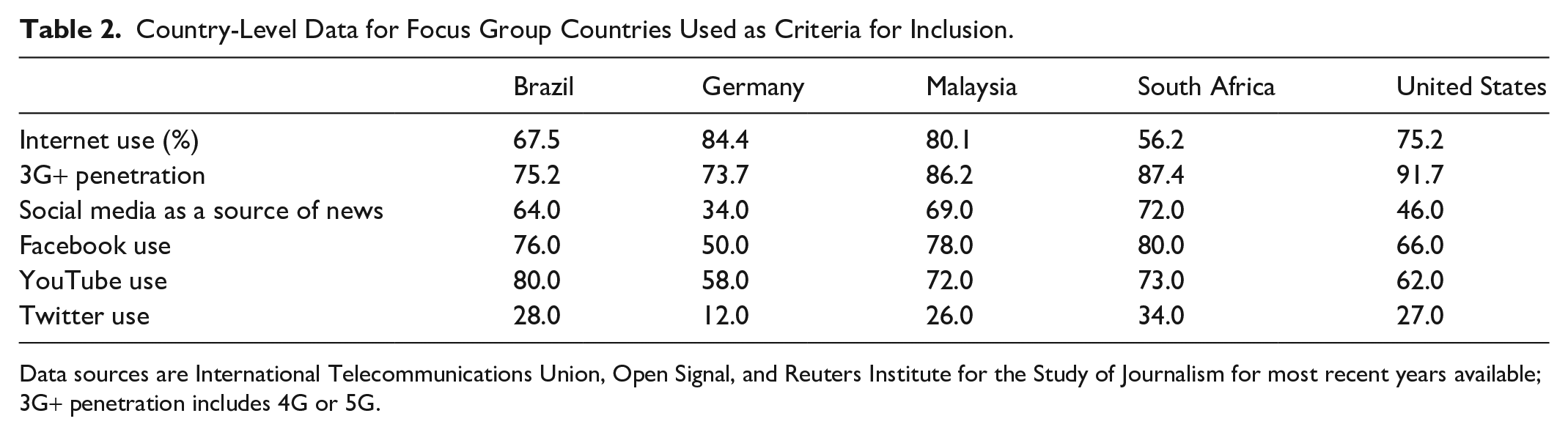
Data sources are International Telecommunications Union, Open Signal, and Reuters Institute for the Study of Journalism for most recent years available; 3G+ penetration includes 4G or 5G.
Focus groups are uniquely suited for this type of research as they invoke personal experiences and diversity of opinions while unearthing how participants allot meaning (Lunt & Livingstone, 1996). The focus groups were exclusively conducted in large cities: Berlin (population: 3.6 million); 3 Johannesburg (population: 9.7 million); Kuala Lumpur (population: 8 million); New York City (population: 18.8 million); and São Paulo (population: 22 million). Focus groups were conducted on 28 and 29 August 2019. They were all videotaped and transcribed. Each focus group was conducted in the dominant language of the country where it took place, and the market research firm translated transcriptions into English when necessary. Country-appropriate pseudonyms 4 were assigned to each participant, and these are used whenever participants are mentioned.
Participants
Participants were incentivized and recruited through the market research firm. Participants had to be 18 years or older, and efforts were made to create a diverse pool of participants in regard to age, gender, education, and race. 5 Participants were further required to use at least two out of three social media platforms (Facebook, Twitter, YouTube) four times per week or more. Across the 10 focus groups, a total of 82 people participated. The sample consisted of 42 women and 40 men, ages 19–65 years.
Procedures
After consenting, participants joined in-person focus groups carried out by a moderator from the research firm or a subcontractor who was in charge of leading the discussion. While discussions were held in different languages across all countries, they used one common discussion guide, similarly to research conducted by Fletcher and Nielsen (2019). The moderators posed the same open-ended questions at each focus group, asking participants about their most rewarding experiences on social media, the benefits and drawbacks of social media, and what they wish social media could provide that they value offline. In all cases, moderators prompted participants to provide examples or personal stories from their own lives and added follow-up questions in the flow of discussion.
Analysis Strategy
Our goal was to make meaning from our data, so we adopted an interpretivist paradigm (Brechin & Sidell, 2000), rather than cull facts from the focus group participants (Johnson, 2000). Three researchers read all transcripts and discussed the iterative codes that emerged through analysis. This involved a constant-comparative process, where we read through the transcripts multiple times, looking for commonalities in what people were saying. We tried to “grasp the processes by which people construct meaning and to describe what those meanings are” (Bogdan & Biklen, 1992, p. 49). Therefore, we grouped data into broad themes where participants seemed to be echoing similar lines of thought, rather than code our data line by line (Corbin & Strauss, 2015). This analysis strategy borrows from the idea of grounded theory (Charmaz, 2006; Corbin & Strauss, 2015) and aids in exploring interconnections in people’s experiences. Using this iterative approach, we revised our categories multiple times, reducing some categories with similar ideas and discarding others that did not resonate as strongly in our data (Cresswell, 1994). Thus, we sought to uncover both the manifest and latent, or “deeper or more critical interpretations of the text,” in our data (Kvale & Brinkman, 2009, p. 207). Finally, we made sense of focus group participants’ observations by bringing themes into discourse with each other through the notion of dialectics and complexity theory.
Results
Our analysis surfaced one main theme: that social media both make people’s lives better and worse, sometimes at the same time. Thus, a negative and, perhaps, unintended side effect of social media is to complicate people’s lives, even though technology as a whole seeks to simplify life. Using complexity theory as a lens, we interpret this main theme through three dialectics that deal with the paradoxes of people’s lived experience on social media. These three dialectics are linked in one over-arching theme because they all relate to the paradox of social media making life better but also worse. The following dialectics surfaced in our data: convenience versus privacy, which depicts people’s desire that social media make their lives easier while simultaneously bemoaning the loss of privacy this entails; trust versus distrust, which points to the skepticism people have regarding the content they engage with through social platforms; and meaningful versus wasted time, which delves into the existential angst people felt about becoming consumed by their platform use. These dialectics collectively answer our two research questions about the complexity of their lived experiences on social media (RQ1) and the paradoxes inherent in their engagement with social platforms (RQ2). The dialectics seemed equally dominant across the five countries we studied. Convenience versus privacy was more prominent of all the dialectics, across all countries. People discussed a variety of platforms, from WhatsApp to Reddit, although Facebook came up in discussions far more than other platforms, especially regarding privacy concerns. Discussions about what information to trust revolved frequently around Twitter and Facebook, according to our data.
Convenience Versus Privacy
This dialectic reflects a palpable tension many participants felt about how easy social media made their lives—yet how this ease also worried them. For example, several participants suggested social media platforms should merge, so there would just be one place to check. As Tevaughnay, 37, of South Africa noted, “I don’t know why they don’t integrate.”
6
Shaun, 42, of South Africa, made a similar point: Because there are so many platforms . . . I mean just in a work context I have email, WhatsApp, and a couple of others. So throughout the day I am having to constantly switch between different applications to respond or whatever. What would make my life easier would be a way to consolidate that information, so that I didn’t have to fetch it from multiple places.
7
Even those who did not suggest merging platforms welcomed the ease that social media provided them. They said online platforms make it easier for them to keep up with the news, particularly in areas outside their own community; stay in touch with friends both close and near; and find items they want to buy online. A comment from Ahmet, 25, of Germany, reflects an observation that many shared: If I want to know what is happening on the other side of the world or what a particular person is doing at the moment, I only have to visit his account, and then I will be able to see what he has done within the last few minutes or hours or what has happened there in the last few minutes.
8
This finding is unsurprising as it supports earlier research about people using social media to connect with others (e.g., Chen, 2011, 2015; Joinson, 2008; A. Smith, 2011; Sundar & Limperos, 2013). However, it suggests how dominant this need to connect is with people worldwide and how they envision social media fulfilling it.
Participants described social media as making their lives so much easier that they could hardly imagine life without it. As Farah, 47, of Malaysia, put it: “Now it is the era of social media. Everything is at the fingertip. We don’t want to leave the house. We can buy something. It is convenient and easy.”
9
At the same time, this ease created a paradox for many participants: The very convenience they enjoyed required that platforms collect data about them, and that collection of data made them worry about privacy. Some participants appreciated that if they did a Google search for a particular item, they would see ads for that item on Facebook. This made it easier for them to find what they wanted to buy. Many did not fully understand how algorithms work or why this was happening. A quote from Jéssica, 43, of Brazil, illustrates this confusion: It’s impressive. Sometimes you look up things on Google. For example, I wanted to buy a minibar . . . Then, you go to Facebook and, in the middle of your timeline, there’s a minibar post. So, everything is kind of linked.
10
She was not sure why this happened and speculated Facebook was spying on her with a camera.
But this ease came at a high cost, many participants noted. Marlene, 65, of Germany, summed up this point: “It feels like surveillance.”
11
This concern raised issues about data privacy more broadly on social media. Yusuf, 19, of Germany explained this fear: What I also wanted to mention is the whole issue of data protection. You reveal so many private things about you, and I personally find it absolutely unclear where these data are used and stored. I do notice that thanks to my Google account and my Facebook account, the advertising, which is overflowing me, is absolutely personalized. This is sometimes rather creepy.
12
Shaun, of South Africa, voiced a similar worry: “All your activity online is tracked and recorded. They mine that data.”
This dialectic demonstrates a side effect of social media, a likely unintended consequence of reflexive modernization (Beck, 1992; Beck et al., 2003), whereby people see a benefit that also has a more somber side they did not anticipate or desire. Thus, the convenience of social media complicates their need for privacy, making the experience on social media more complex. This resonates with the privacy paradox (H. J. Smith et al., 2011), the idea that even though people are concerned about their privacy they still use products that require submitting private information for convenience’s sake. Our participants did not offer many solutions for this problem except to put the onus on platforms to be more transparent about how they collect and use data. For example, Phumzile, 29, of South Africa, suggested platforms should educate the public: Educating people on privacy and safety—I think a lot of that is missing. They are not being open and transparent about what they do with our information . . . Facebook is a free app, but you need to ask yourself, “If I‘m getting this app for free what are they getting in return?” Chances are they’re getting my information. What happens to my information? We’ve seen with Facebook that they sell it, and they use it for other things.
13
Trust Versus Distrust
A prominent concern among participants was that they have good reason to distrust much of what they read on social media. This dialectic echoes a seminal concern among much of the larger public about both misinformation, which is false information spread inadvertently, and disinformation, which is incorrect information intended to deceive (Tandoc et al., 2018). Our participants’ focus on this issue is important, as research shows that concerns about false information online can contribute to broader societal problems, such as decreased trust in news (Van Duyn & Collier, 2019) and political polarization (Allcott et al., 2019).
The people in our focus groups really appreciated how much information they could get on social media, from recipes to news. Different platforms served to fill varying needs for them. YouTube, in particular, stood out for them as a spot to learn new skills, from making fried rice to playing the piano. They loved how Facebook groups help them find people to go running with or to hang out with offline. The event function on Facebook was a draw for some. Getting advice on travel was also a strong appeal of Facebook. Mary, 39, of the United States, for example, described posting about an upcoming trip to South Africa and being overwhelmed by helpful tips from Facebook friends: All of a sudden it was like hundreds of responses; you have to go here, and don’t go here and stay here and eat here . . . It kind of made my trip, those experiences of like off the beaten track kind of thing.
14
For news and information, there were different favorite social media platforms. Tracy, 28, of the United States, for example, reported he uses Reddit the most because the sub-reddits are “an easy way to keep track of your favorite niches, like science and technology—just like your favorite movies or games or whatever.”
15
But Facebook was favored for community happenings, so people could feel connected to where they live. For more general-interest news, people gravitated to Twitter. As Brad, 24, of the United States, explained, Twitter is kind of like my primary news source just because I follow a lot of magazines or newspapers on Twitter, so I get a lot of my news from that or similar accounts that I follow, those kind of accounts as well. And then the fact that you have the option to search in real time to see what people are posting, to me, I really like it whenever it’s relevant politically or with the entertainment industry, you can see what’s happening right now. So I get a lot of information from that.
16
But again, there was a paradoxical unintended dark side to this ease of information. “Too much fake news,” 17 noted Jia Ming, 26, of Malaysia, summarizing what many participants across our sample reported. People found it hard to trust what they read on social media, for fear of being duped. Nur, 53, also of Malaysia, recalled a report about an artist in her country who had passed away, “but it turned out to be fake news.” 18 This concern made people conflicted: It makes life simpler that they can find out information easily on social media, but it makes it more complex if they have to verify information on their own. Their solution to this problem was sometimes to adopt a default of not believing anything. “You don’t know what to believe on their Facebook,” noted Elisa, 62, of the United States “. . . I tend not to believe half the stuff I read . . . It’s not even fake news; it’s just made up crap.” 19 Others embraced a more extreme strategy to counteract distrust by reducing their use of various platforms or even quitting a platform. A quote from Jô, 26, of Brazil, reflects this finding: “My frequency of use of Facebook decreased because of fake news.” 20
Across the sample, participants pointed to platforms to solve this concern by doing more to verify what is posted. Omer, 37, of Germany, explained, Someone posts something on Twitter and then it is taken up, and it spreads like wildfire. And nobody can verify if this is true. And this should be verified more. Because it is so easy to post something, which spreads so quickly. And as I told you, fake news becomes rife.
21
Similarly, Alexander, 29, of Germany, wants Facebook to take more action: I think Facebook should sanction much more if it can be proven that fake news have been spread. And they should make sure that information about fake news is distributed as fast as the prior fake news. But what mostly happens is: Fake news is distributed. Many people see this, and a few hours later it turns out that it was fake news, but only a small share of people get to know this. But harm has already been caused.
22
Meaningful Versus Wasted Time
People also felt conflicted about the time they spend on social media. On the one hand, they found great merit in Twitter and Facebook for social activism, helping their communities, and participating in political movements. “I do a lot of volunteer work,” explained Elisabeth, 47, of Germany. “I’m active in the field of animal welfare. I collect donations. And this is most easy to do on Facebook.” 23 Shaun, of South Africa, finds inspiring speakers on YouTube and Twitter, so he feels more positive about spending time on those platforms. And, Irene, 49, of the United States, cherishes her Facebook time when it helps her bond with others. “If I’m reconnecting with somebody that I haven’t been in touch with since I was younger, and suddenly there was a memory that’s brought up, that we both share, there’s this shared connection, the shared bond, the shared experience,” 24 she said.
However, often people felt like they spent too much time on social media and did not see the gain. “I believe we waste too much time with social media, too, because sometimes we spend hours seeing things that won’t really bring you any value,” explained Socorro, 33, of Brazil. “You give up doing something in your home to check on Twitter, or you give up doing something at work to check Facebook, so you waste a great deal of your time with that.” 25 Or as Mary, of the United States, noted, “There’s just so much more I could do with my life if I counted like how much I’m actually on my phone and took that time and did something useful.” This dialectic again reflects the conundrum of the modern world: Digital technology is designed to save time, and it does—by making information and news easier to find, our participants said. But it also makes it easier to waste time, adding complexity to their lives.
Summary
Across the three dialectics, our findings demonstrate one unifying theme: that social media may make people feel better because they can connect easily with friends or find products they desire to buy but also worse because they feel overwhelmed by information they are not sure they can trust or because it feels like a waste of time. Overall, their strategies for dealing with the tensions were underdeveloped. Some participants limited their social media time; others quit a platform temporarily to deal with the complexity they felt using these platforms, answering RQ1, which asked about the role of complexity in people’s lived experiences on social media. For instance, Andrew, 23, of the United States said it felt like a relief when he quit Instagram for 10 days. “I realized that most of the time when I’m on Instagram, or just on social media, I’m just consciously comparing myself to the people,” 26 he explained. Yet, it is notable that the strategy was short-term, echoing a consistent finding throughout our sample that people did not have long-term solutions for the paradoxical complexity that social media brought into their lives. Many put the onus on the platforms to solve the problems they saw, suggesting they were aware of the paradoxes that social media create, answering RQ2, which asked about how people understand the paradoxes they encounter on social media. However, it seemed they felt it either was not their responsibility or within their power to resolve these dialectics.
Discussion
This work plumbed rich qualitative data from focus groups in five countries—Brazil, Germany, Malaysia, South Africa, and the United States—to document a perhaps unintended side effect of today’s reflexive modernization on social media: that it makes their lives better and worse, sometime at the same time. Using complexity theory as a lens, we dismantle this paradox through three dialectic examples that demonstrate that while social media may appear to make life less complicated by providing shortcuts to connecting with friends or finding news and information, it may actually increase complexity in people’s lives. Our most important finding is that people in our sample shared very similar observations about social media and expressed a united tension about the role these platforms play in their lives. Collectively, their observations were united around the main theme we found—that social media both make lives better and worse. Three inter-related dialectics relate to this theme: Social media make their lives more convenient but also make them feel less safe because their privacy is being infringed upon. Social media provide helpful information, but people doubt much of its veracity. The time they spend on social media feels meaningful while they are doing it, but then seems wasted when they realize how much of their lives social media occupy.
Social media pose a conundrum: While the platforms themselves may be useful for reducing complexity (Qvortrup, 2006), they actually may, as complexity theory suggests, amplify that complexity. For example, people in our sample described the ease of having news or items they wanted to buy targeted by their own online searching. That made it simpler for them to find out about what is going on in the world or even conquer such mundane tasks as finding products they want to buy. But behind this simplicity lay what to participants felt like a more sinister agenda. Were social platforms taking their data? Was their privacy compromised? Was the ease of buying products a fair trade-off for feeling violated? These were questions our participants pondered, and these questions made them worry. When applied to computer-mediated communication such as social media, complexity theory suggests that complexity reduction begets more complexity. Technological determinism suggests that technology even further accelerates capitalistic tendencies. That sense was very clear in our data, too. Some people wondered if social media companies were making money off them under the guise of convenience, so while they enjoyed some of the convenience, they also rejected it. As Dennis, 44, of the United States, noted, Is my information secure? Is my kids’ information secure? Are my kids secure? You know, like how safe are these things? . . . Facebook, I mean time and time again their information is being used for this, they’re selling information for that, so I don’t trust Facebook. I don’t use it.
27
Another paradox social media create, according to our data, is a wariness that what people read on social platforms might not always be true. This dialectic, in particular, uncovers some sobering realities for society at large. The inability to determine the veracity of information on social media, which some participants described, could lead people to reject or accept anything they read, without a clear reason. Some participants hinted at this, suggesting almost everything they read on social platforms is made up. This dialectic demonstrates a paradox for individuals, but also for society by illuminating people’s inability to navigate today’s information age. The very usefulness of online platforms is undermined by the distrust people have in them, rendering these platforms less beneficial than they could be.
The dialectic of meaningful versus wasted time offers an example of an innate complexity in platforms that belies the superficial simplicity. Participants reported gaining discrete skills or experiences on social media but not enough gain to warrant the time that seemed to evaporate online. This finding is particularly cogent as the world grapples with a global pandemic of COVID19 that has led many to increase their online time.
Collectively, our three dialectics are linked through a common theme that social media made people feel better but also worse. People found it challenging to solve this tension because social media feel both essential but also superfluous at the same time. They felt more connected through social platforms, but also less fulfilled. They felt they had greater access to information than ever before, but the amount of information overwhelmed them and left them doubting what they could trust. In essence, our findings suggest that people’s lived experience on social media simplified their lives but also made them more complex, offering a chilling example of the “boomerang” effect of the unplanned effects of the modern age (Wimmer & Quandt, 2006, p. 337).
Limitations and Future Research
Of course, despite these compelling findings, our study is limited in that it focused on five countries and collected data from 82 people that are by no means generalizable to these countries or the world. Future research should examine more countries, and our research also suggests great merit in quantitative surveys about these same issues to see if the same tensions are present. Furthermore, our data are limited by the fact that the skill of moderators across our five countries may be uneven. In addition, while focus groups are great at encouraging people to talk about a topic in a meaningful way and generate discourse that might not appear in separate interviews, it is also possible that one or more voices dominated discussions. This could influence what people said. We suggest further inquiry in this area using in-depth interviews as well as focus groups. This project was designed to make meaning from people’s lived experiences on social media, so we did not focus a great deal on detecting differences between countries or cultures. Our data also did not suggest many solutions to these tensions. We suggest both are fruitful areas for future research.
Conclusion
In summary, this study provided a five-country look into what benefits and drawbacks people experience on social media. In particular, it illuminates the dialectal tensions people feel by being drawn to platforms that help them in many ways yet feeling a palpable discomfort at the limitations and even negative effects of those very platforms that they enjoy. According to our participants, these tensions left people in a sort of existential limbo. They felt distress from social media, but also enjoyed it, and felt little agency to solve this problem. Instead, they felt platforms, not users like them, should solve these tensions.
Footnotes
Acknowledgements
The study is a project of the Center for Media Engagement (CME) at Moody College of Communication at The University of Texas at Austin, USA. The authors thank CME Director Natalie (Talia) Jomini Stroud, Eli Pariser, Tamar Wilner, and the whole CME team for invaluable insights that informed and shaped the design and execution of this project.
Author’s Note
An earlier version of this manuscript was presented to the International Communication Division of the Association for Education in Journalism and Mass Communication (AEJMC) during its annual conference in August, 2020, where it was awarded third-place in the Robert L. Stevenson Open Paper Competition.
Declaration of Conflicting Interests
The author(s) declared no potential conflicts of interest with respect to the research, authorship, and/or publication of this article.
Funding
The author(s) disclosed receipt of the following financial support for the research, authorship, and/or publication of this article: Funding support came from the Omidyar Network through an award to CME.
