




Abstract
On 24 March 2018, Tumblr terminated 84 user accounts identified as being “linked to Internet Research Agency or IRA (a group closely tied to the Russian government) posing as members of the Tumblr community.” In response, Tumblr deleted the blogs and accounts of these 84 users but allowed reblogs of their posts to continue to circulate openly on the platform. Through a case study of posts originating with one IRA account, Lagonegirl, and qualitative interviews with 13 Tumblr users, this article considers the platform conventions and social norms that were utilized by the Lagonegirl account to facilitate its distribution of disinformation. Posing as a Black woman concerned with social justice but also sharing humorous posts that resonated with Millennials, Lagonegirl’s performance shows overlap with existing work on “Left Troll” IRA Twitter accounts while demonstrating platform specificity in the construction of posts.
Introduction
On 24 March 2018, Tumblr account holders received a mass email informing them that 84 user accounts identified as “linked to Internet Research Agency or IRA (a group closely tied to the Russian government) posing as members of the Tumblr community” had been terminated. The Tumblr users receiving this email were, in turn, identified as having “followed one of these accounts linked to the IRA, or liked or reblogged one of their posts.” They had interacted on Tumblr with one or more of these IRA-linked accounts in some digitally traceable way. Following this, Tumblr listed all identified IRA-linked user names (Figure 1).

Tumblr’s email to users regarding IRA-linked accounts, complete.
The email goes on to explain what steps were taken by Tumblr in response. The offending IRA-linked accounts were deleted, but their posts, sometimes reblogged by hundreds, thousands, tens of thousands of users, were left accessible and interactionable on non-IRA blogs. Tumblr had not mass deleted those reblogs, or provided users with a mechanism for locating and deleting offending content from their own blogs. “You can curate your own Tumblr to reflect your own personal views and perspectives” and that now included information deemed by Tumblr and “law enforcement” to originate with IRA programs.
In March 2018, Tumblr hosted over 400 million blogs (Clement, 2020a). While this pales in comparison to Facebook’s reported user base of about 2.2 billion active users in Quarter 1 2018 (Clement, 2020b), it is similar to Twitter’s user base at 336 million active users in Quarter 1 2018 (Clement, 2019). However, the Tumblr number does not count users, but blogs, and a single user account can manage multiple blogs. It is also not an “active” number and includes blogs whether or not they have been recently used by the account holder. Currently, there is a lack of academic treatment of IRA and disinformation operations on Tumblr, even as research regarding disinformation on Twitter and Facebook has received increased attention since 2017 (Freelon & Wells, 2020).
Regardless of Tumblr’s size or perceived popularity in the United States when compared to other platforms, it remains that the IRA undertook coordinated operations on Tumblr, as they did on Facebook and Twitter. It is important to emphasize that the IRA approach to spreading disinformation on Tumblr was specifically adapted to Tumblr’s platform conventions and social norms. The number of Americans directly reached by IRA operations on Tumblr and how that may have affected their voting behaviors and/or political engagement isn’t something easily quantifiable. Kremlin disinformation operations focus more on creating confusion, undermining traditional journalism, and widening existing divides within a democratic population, rather than persuading targets to adopt specific views as is the case in propaganda (Pomerantsev & Weiss, 2014). Furthermore, the IRA took the time and resources necessary to adapt their activities to each social platform on which they distributed content. It is thus vitally important that scholarship equally understands the mechanisms, including platform conventions and social norms, that allowed for production and distribution of disinformation on each platform.
This study focuses on one Tumblr account in particular, Lagonegirl, who had posted a mixture of affirmations, humor, and political content, while inauthentically portraying herself as a Black woman (Figure 2). Following the IRA announcement, Lagonegirl’s posts were singled out and reblogged with additional jokes or commentary of a more serious nature, as Tumblr users could now analyze Lagonegirl’s non-political and political posts (including a number critical of Presidential Candidate Hillary Clinton) through a new lens.

Lagonegirl’s Tumblr user icon, depicting a young Black woman taking a selfie on her phone.
IRA Activities on Social Media
A month prior to the Tumblr email, on 16 February 2018, United States Special Counsel Robert Mueller indicted the IRA, along with two additional Russian agencies and 13 Russian individuals for “interfere[ing] with the U.S. political and electoral process, including the 2016 presidential election” (U.S. House of Representatives Permanent Select Committee on Intelligence, n.d.). Twitter and Facebook decided to remove both “troll accounts and false information” in the wake of discovering IRA materials (Starks et al., 2019).
The House Intelligence Committee Minority reports and hearings focused on Russian activities on both Facebook (over 3,393 purchased advertisements; 80,000 pieces of “organic content”) and Twitter (almost 4,000 accounts; 130,000 tweets; exclusive of the “bots” sorted into their own category). The volume of content produced and distributed by IRA-linked Facebook and Twitter accounts makes the Tumblr group appear rather insignificant in comparison. Only 84 accounts in total were identified on Tumblr.
Creating thousands of accounts and tens of thousands of bots, such as was the case on Twitter (Badawy et al., 2018; Howard et al., 2018 also Woolley, 2016, for social and political Twitter bot uses prior to 2016), would not necessarily result in the same kind of widespread distribution on Tumblr, which still primarily displays user-generated content reverse-chronologically based on the people who you follow, rather than algorithmic popularity. The most publicized mode of distributing content on Facebook that the IRA utilized, having “groups” purchase ads to drive users to the group pages and encounter content that could serve to polarize their opinions on divisive issues (Anstead et al., 2018; Kim et al., 2018), would also be untenable on Tumblr, where groups do not exist and ads (and other revenue models) have never proven to be effective (Dellinger, 2019). The IRA approach to Tumblr had to be distinct from either Twitter or Facebook, which is not to deny that programs on Twitter and Facebook were distinct from one another.
Disinformation Campaigns
Eschewing the use of the term “fake news” for a myriad of reasons, including both the politicization of the term by those in power seeking to undermine any press that paints them in a negative light and the impreciseness of the term over time, Wardle and Derakhshan (2017) instead outline a number of “information disorders” that proliferate with the aid of social media. They define misinformation, disinformation, and malinformation, based on criteria of truthfulness and intent to harm. Disinformation encompasses content that is both false and intending to cause harm (Wardle and Derakhshan, 2017, p. 5). Prior to 2017, disinformation rarely appears in academic literature, though now there is a marked increase in research across multiple disciplines (Freelon & Wells, 2020). Rather than necessarily drive a population toward a particular action, disinformation campaigns can create a confused, polarized, hostile information landscape (Pomerantsev & Weiss, 2014) that undermines deliberative democracy (McKay & Tenove, 2020).
Linvill and Warren (2020), drawing from the partial IRA tweets dataset released by Twitter, identify five different account types being utilized by the agency between 2009 and 2018. Accounts are identified as Right Trolls, Left Trolls, News Feed, Hashtag Gamer, or Fearmonger, depending on the persona the account adopted and the content shared. Most relevant for this study, Left Trolls frequently focused their tweets on racial identity, including Black Lives Matter (BLM), posted and retweeted content that undermined candidate Hilary Clinton, and were supportive of candidate Bernie Sanders. However, these accounts also shared content that had no clear political message (p. 6). These findings are consistent with Arif et al. (2018) who, drawing from a sample of tweets focused on BLM and not initially on IRA operations, found both left and right leaning IRA accounts participating in BLM discussion and that tweets were tailored based on the performance and persona adopted by the account. Left leaning accounts frequently impersonated Black Americans. Arif and colleagues (2018) ultimately state that these accounts behaved in a way similar to “improvisation in the sense that an actor is give a set of constraints, but then dynamically adapts their performance in interaction with the crowd” (p. 21).
While the above literature seriously considers both Twitter and, to a lesser extent, Facebook as platforms for distributing disinformation, and frequently note the problematic news sites and external resources they may link to in disinformation social media posts, none address Tumblr directly.
Tumblr’s Opacity and Opportunities
Tumblr, at least through 2018, served as a gathering point for multiple niche groupings and marginalized identities, including but not limited to: fandom participants (Bury et al., 2013; Hillman et al., 2014; Morimoto & Stein, 2018); queer and trans users (Cho, 2018; Dame, 2016; Fink & Miller, 2014; Oakley, 2016); and chronically ill users (Gonzalez-Polledo, 2016; Gonzalez-Polledo & Tarr, 2016). Bailey and Trudy (2018) first wrote about, developed, and disseminated the concept of misogynoir on Tumblr and the #blackout movement originated on Tumblr in 2015 (Calhoun, 2020).
Despite boasting hundreds of millions of blogs, Tumblr is considered notoriously opaque to and difficult to parse by outsiders (McCracken et al., 2020), and indeed, the difficulty of accessing and understanding how to use Tumblr is part of the appeal for account holders attempting to maintain some semblance of privacy online (Cho, 2018). The fact that non-Tumblr users, and by extension the press, paid little attention to IRA activity on Tumblr perhaps demonstrated that some of the reasons users chose Tumblr over other social platforms to share particularly marginalized and/or denigrated aspects of their personal experiences still held true in 2018. This is despite the fact that Tumblr lacks many technological privacy controls present on other platforms, such as limiting individual post visibility to certain groups of friends or even making a blog private but visible to the people who you follow.
While Tumblr removed the offending IRA-linked accounts’ blogs, the reblog chains of those posts shared on other users’ blogs were left behind and remain accessible. This does not mean that they are easily accessible. As Cho (2018) observes in his discussions with queer youths of color who view Tumblr as a more secluded online space when compared to the likes of Facebook and Twitter, Tumblr’s design contributes to its opaqueness and inaccessibility. Pseudonyms are the norm and users do not tend to share their real names. Because everything on Tumblr is immediately visible to everyone who can navigate Tumblr’s landscape, social norms have supplemented for technological restrictions (Cho, 2018; Neill Hoch, 2018). The search function on Tumblr usually only brings up original posts, and not reblogged ones with additional commentary. Even then, search results tend to be unreliable and inconsistent. Thus, even though the posts that originated from the IRA-linked accounts still exist, somewhere, out there on Tumblr, they are difficult to systematically locate post-blog-deletion. Furthermore, no definitive record of what posts the IRA-linked accounts reblogged from other users exists, now that the IRA-linked blogs are gone. This poses considerable challenges to the research process. While several high-circulation posts from the IRA-linked accounts can still be located, much of the environmental context of these posts, including those original posts that did not achieve widespread popularity, is difficult to access.
In light of the minimal coverage of the IRA-linked activities on Tumblr in general and the difficulty of accessing content post blog-deletion, the research questions here prove to be modest and focus on a single IRA account, but are important for understanding how IRA disinformation operations on Tumblr both resembled and deviated from operations on other platforms.
RQ1. What Tumblr conventions were mobilized by the Lagonegirl account when originating posts?
In defining conventions, I draw from Norman (1999) who explains that “a convention is a cultural constraint” that has “evolved over time” and is difficult to change once established (p. 40). These conventions are underpinned by both physical and logical constraints that are designed into graphical screen layouts. Norman notes that what many scholars refer to as affordances are in fact conventions. Conventions capture how users interact with the technological features available to them when engaging with Tumblr, while retaining that there is a cultural element to how the platform is used.
RQ2. What social norms prevalent on Tumblr were mobilized by the Lagonegirl account to encourage the spread of their posts?
While the term social norm has been used inconsistently across scholarship (Reynolds et al., 2015), here I draw strongly from Honeycutt’s (2005) understanding of how collectively agreed upon and self-monitored behavior online can be group specific, contribute to maintaining boundaries, and control admittance of new members into an online space. While Tumblr is vastly more diffuse and less centrally controlled than the AOL message board studied by Honeycutt, there are remarkable similarities in how interview participants in this study vetted blogs and managed their privacy through monitoring the blogs they followed and making judgments regarding appropriate behaviors. Below, these two questions are explored predominantly through the concepts of identity, privacy, and ambivalence.
Method and Procedures
In response to the aforementioned difficulties when trying to collect and observe posts originating with IRA-linked accounts, this study uses a combination of a case study of two posts originating with one of the IRA-identified accounts (“Lagonegirl”) with qualitative interview materials to explicate the conventions and social norms enacted by the IRA-linked accounts on Tumblr.
The two posts reproduced here were originally posted by the Lagonegirl account and heavily circulated on Tumblr prior to the revelation of Lagonegirl as an IRA-operated blog. Both posts continued to circulate after the announcement, often with additional commentary now that Tumblr users were aware that Lagonegirl was IRA-operated. The posts reproduced here are not the only versions of these two posts that circulated after the announcement, as users added hundreds of additional reblogs, ranging from humor to concern, to outrage. However, they provide some concrete examples of how users themselves strove to make sense of Lagonegirl’s posting history. I use multimodal discourse analysis (Bateman, 2008; Holsanova, 2012; Jewitt, 2004; LeVine & Scollon, 2004) techniques, which consciously places focus on visual arrangements, auditory information, the arrangement of space, and moving images, to explicate each of these posts. Images, text, hyperlinks, emojis, and so on are considered in conjunction with one another as they contribute to each post’s meaning.
Interview materials originate prior to the March 2018 email and were conducted from September to November 2017, as part of a larger project aimed toward understanding the socio-technical interaction between the Tumblr platform and Tumblr users through a social construction of technology (SCOT) framework (Bijker et al., 1989). Fourteen users ranging from 19 to 34 years old participated in semi-structured interviews. I conducted the interviews via Discord’s direct messaging feature, allowing participants maximum flexibility in responding to prompts asynchronously, though many responded very quickly and engaged in active back-and-forth discussion. Interview materials were then pseudonymized and transferred into MS Word for analysis. Qualitative analysis followed a grounded theory approach (Corbin & Strauss, 2014) informed by a SCOT framework (Bijker et al., 1989) and particularly concerned with moments where social and technical processes came into conflict to produce new solutions. Participants were not limited geographically and included respondents in Europe and South America, in addition to those from the United States. All interviews were conducted in English. Participants selected their own pseudonyms (with the instruction it could not be the same pseudonym they currently used on Tumblr) and confirmed pronouns.
Identity: Lagonegirl and Popular Posts
In order for the Lagonegirl blog to have any hope of distributing content across Tumblr, the posts originating on the blog had to be reblogged by other Tumblr users. Wardle and Derakhshan (2017) note that each interpreter that encounters disinformation then becomes a potential agent, reframing and redistributing messages for the next phase of interpreters. Drawing from the foundational work of Lazarsfeld et al. (1944), Giglietto and colleagues (2020) emphasize the importance of personal influence in disinformation campaigns. Reaching a wide initial audience, often through non-political posts first, then allows disinformation agents to “convey political content to a largely unguarded audience” (Giglietto et al., 2020, p. 7). In order for Lagonegirl to build and maintain this potential audience, the actors behind the blog had to navigate platform conventions and social norms on Tumblr and project authenticity. One way in which this could be accomplished is by sharing relatable, concise, humorous, non-political content. This, in turn, required an understanding of what would be “popular” on Tumblr.
Lagonegirl originated several “popular” posts with notes in the tens of thousands. What exact threshold a post has to meet to be deemed “popular” on Tumblr can vary from user to user. But, generally, a popular post is one that has a note count (combination of likes, reblogs, and replies) in the thousands. However, exactly how many notes is a high number may also be largely subjective. In my interviews, no participant believed themselves to be a popular Tumblr blogger, though several had follower counts in the thousands and multiple posts with tens of thousands of notes. Interview participants also at times demonstrated that they could not judge how many followers another blog had, and follower numbers are not visible on Tumblr. Participant Randy believed that I had “like 10k followers,” because of one particular popular post with over 100,000 notes, when in reality we had very similar followings numerically. What is clear, however, is that Lagonegirl was notable enough on Tumblr that when the username appeared in the list of IRA-linked accounts, Tumblr users noticed and immediately began scrutinizing Lagonegirl’s content.
Figure 3 shows one post that the Lagonegirl account originated. This post circulated extensively prior to the revelation of Lagonegirl as an IRA-controlled account and was reblogged again in the aftermath of the announcement. The initial post consists of a line of text, followed by an animated reaction gif, prevalent throughout the internet in part because of their polysemic nature, but also the use of which displays cultural knowledge on behalf of the user (Miltner & Highfield, 2017). Furthermore, reaction gifs participate in the construction of that cultural knowledge (Kanai, 2017). Tumblr’s emphasis on visual content (Cho, 2015; Morimoto & Stein, 2018; Xu et al., 2014) is underscored by the widespread production and circulation of reaction gifs on the platform (Bourlai & Herring, 2014; Gürsimsek, 2016) and claims that animated gifs are “significantly more engaging than other kinds of media” (Bakhshi et al., 2016, p. 575).
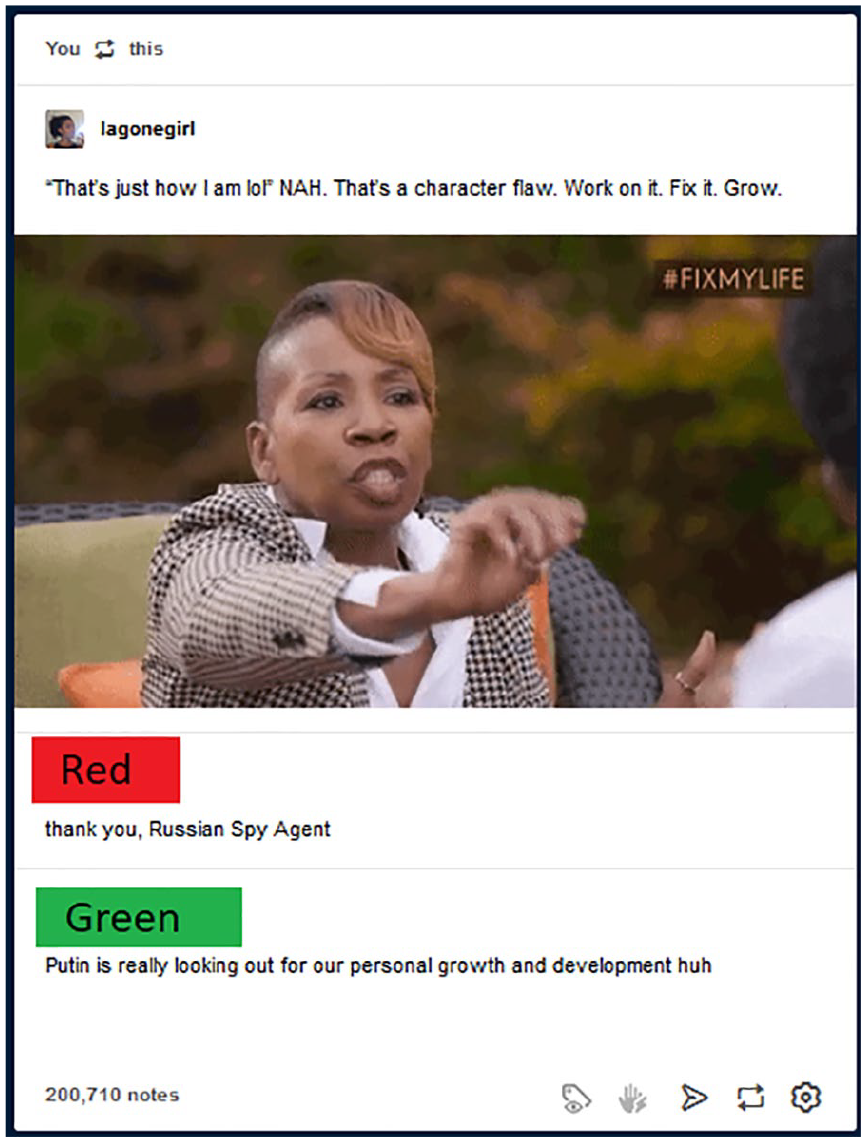
Lagonegirl’s Iyanla Vanzant post, with post-IRA-announcement commentary in reblogs by Red and Green.
The text from the post reads “‘That’s just how I am lol’ NAH. That’s a character flaw. Work on it. Fix it. Grow.” The animated gif is of Black American life coach/talk show host Iyanla Vanzant. The use of images of expressive Black women in particular for reaction gifs has been argued as a type of digital blackface (Jackson, 2017; Thomas & Stornaiuolo, 2019) that becomes starker as one considers that the Lagonegirl account was an IRA performance of “Blackness” all along. Also visible in Figure 3 is Lagonegirl’s user icon, which is a photograph of a young Black woman, reinforcing the performance of Blackness (see also Figure 2). Jackson (2017) notes that “digital blackface uses the relative anonymity of online identity to embody blackness.” Tumblr’s social norms underpin the possibility of digital blackface as users are able to minimize their connection between both their face-to-face connections and their off-Tumblr (but often still online) existence. On Tumblr, you don’t use your real name and the expectation is you don’t know the vast majority of your followers face-to-face.
Elijah, who was introduced to Tumblr by a friend in high school, was interested in Tumblr specifically because it would help them in developing online friendships, sharing: i think she thought it was a good platform to talk to her internet friends. She’s always had a lot of internet friends and because especially in high school i felt like ridiculously isolated i immediately was like cool I’ll make an account right now and i did.
Elijah’s experience is reflective of many interview participants, who tended to have a small number of people they knew in face-to-face contexts who also used Tumblr, but primarily saw the platform as an opportunity to begin and develop online connections with minimal face-to-face overlap.
The construction of Lagonegirl’s post demonstrates the platform conventions utilized to structure a post that would encourage sharing and minimize the potential for exposing the blog as not operated by a Black user. The image and text combination that the Lagonegirl blog shared is sourced from a Tweet originally posted in the summer of 2017. The Tweet does appear to originate with a Black woman on Twitter. Brock (2012) and Florini (2014) have shown how Black users on Twitter engage in linguistic practices of “signifying’” in order to demonstrate cultural competence and negotiate in-group and out-group membership. The excessive use of reaction gifs and incorrect African American Vernacular English (AAVE) can be clear indicators to the in-group that a user is preforming digital blackface, rather than an authentic member of the community (Jackson, 2017). As the original tweet is also still accessible (along with the user’s Twitter page), it is reasonable to believe that this Twitter user was not involved in IRA activities, even if her Tweet was reformatted and redistributed by the IRA.
By re-sharing (on a different platform) a Tweet that originates from a Black woman, Lagonegirl potentially avoids misuse of AAVE and being accused of inauthenticity. Lagonegirl in her post in fact does not claim to be the ultimate, original source of the content, and source information back to the original Tweet is still accessible on reblogs of the post. By re-using content posted by another (presumably Black) user, the Lagonegirl account was able to perform “Blackness” through the sharing of this post without ever having to compose the actual text, reducing the possibility of, as Shafiqah Hudson and I’Nasch Crockett would popularize on Twitter, “her slip showing” (Crockett, 2014; Hampton, 2019). The IRA members involved with the production of this post did not have to navigate the social and cultural specificity of AAVE and potentially fail in composing a post that would be read as authentic.
Importantly to Lagonegirl’s performance on Tumblr, sharing this post in particular has no overt, or even implicit, political meaning. What it accomplishes instead is participation in a perceived communal space of the Tumblr Dashboard that fits into common cultural themes and topics discussed frequently on Tumblr. On its own, it is a rather innocuous self-help style post, encouraging and funny, rebloggable across a broad audience, and, importantly, demonstrating cultural competence. Geeng et al. (2020) in their study of how users interact with misinformation on their Facebook new feeds found that participants tended to look at and interact with short, attention grabbing meme content, rather than longer news-style posts.
Making use of Tumblr’s platform conventions, Lagonegirl also appropriately included source information for the original tweet, though in a way that would allow some users to believe the account had come up with the gif/text combination. Lagonegirl could have it both ways, showing themselves as conscientious of attribution and allowing users to mistake the post as their original content and thus pose as a person competent in AAVE. Lagonegirl could have made the source information more prominent, a link to the original tweet in the body of the post along with the user’s name would be more accessible. Using Tumblr’s “source” field actually conceals source information. As can be seen (or rather, not seen) in Figure 3, source information isn’t actually visible on the post as it appears on the Tumblr Dashboard.
In addition to the conventions and social norms embedded in the post itself, including copying the text from another user, the inclusion of an animated gif, and selecting content from Twitter that would resonate with the Tumblr audience, the above post also contributes to satisfying criteria that some Tumblr users set for managing their privacy in an online environment where technological privacy safeguards are insufficient and supplemented with social norms.
Privacy, Personality, and Humor
Trust and a sense of authenticity were crucial for interview participants to feel confident about and comfortable with the blogs they were following and the people behind those blogs, as well as negotiating their privacy in an environment that otherwise has very few built-in controls. In most cases, interviewed users expressed that they felt as if they were following people rather than blogs. Participant E when asked about the blogs they followed and their sense of connection shared:
are there blogs you follow that you don’t feel a particular connection to? why do you follow those blogs?
mm not really? i think every blog i follow i feel some kind of connection to, even if its just a familiar “oh hey this person finished knitting that laceweight shawl! good for them” when i see them on my dash
Here E shifts the subject from the question, about “blogs,” to the answer, about a “person.” E, for the most part, might technically follow blogs, but that is almost always linked back to a person.
Furthermore, it was participants’ lack of trust in Tumblr as a platform specifically that led them to rely so intensely on feeling a personal connection (whether real or imaginary) to the people behind the blogs they followed.
When asked if there were features she would like to see Tumblr implement in the future to help her maintain her privacy and better control access to her posts on Tumblr, Erin replied that she just “wish[ed] that they had worked properly.” Similarly, Constance was convinced there was nothing that Tumblr could do to increase her sense of trust in the platform, sharing: Don’t get me wrong. I understand it isn’t easy to update your stuff in this industry. My husband works in video game development as a dev. Broken code will always live. But tumblr’s foundation is nothing BUT broken code. And that’s where my lack of trust comes from
Despite this lack of trust, Constance later spoke about the meaningful social support system she had developed through Tumblr. Instead of hoping that Tumblr would come in and address the problem of privacy, users instead articulated the social norms they adhered to order to better manage their privacy and comfort on Tumblr. Most frequently this meant being cautious in who they followed and monitoring who was following them back. A sense of personal connection to the person behind the blog, no matter how tenuous, such as the shawl comment by E above, allowed participants to feel in control of their privacy.
Randy discussed visiting blogs several times and browsing the blog’s content thoroughly before deciding to follow. Randy was much more likely to follow a blog if they had an idea of the blogger’s personal sense of humor, explaining “I usually follow someone after scoping their blog and content out for a couple days, check for red flags, and I’ll be more likely to follow if they make funny personal text posts.” They expected some level of self-disclosure on other people’s blogs, and for that self-disclosure to be humorous. Following behavior on Tumblr is far more reciprocal than other blogging platforms (Chang et al., 2014) and for interview participants following another user first meant that the user that you followed may look at your blog and follow back. Doan explained that he used “any kind of like/reblogs I get from my blog can always be seen on my phone as well. If I see a new name show up several times, I get interested and check out their blog. Again, if the content they post is similar to mine I follow them back.” Although Doan said that he really wasn’t looking to follow more blogs, seeing a new name following him and liking/reblogging posts would lead to him looking through that blog.
While these users’ responses have much in common with Marwick and boyd’s (2014) understanding of networked privacy, importantly Tumblr users have even fewer options for erecting technological boundaries when compared to Facebook. They cannot sort their followers into groups and segment access to posts to only those who belong to the group. On the contrary, my participants were less likely to have concerns regarding context collapse (Marwick & boyd, 2011) on Tumblr when compared to other platforms, as the majority of the people they interacted with knew them only through Tumblr initially (though they may have some followers they then later also communicated with through direct messaging or friended/followed on other platforms). Making sure that their potentially judgmental “real life” contacts don’t know about their Tumblr presence in the first place, and an awareness that they cannot restrict who accesses their Tumblr in any meaningful way, meant that they must be vigilant in vetting who they follow and who might follow them.
E discussed maintaining multiple blogs as a way of managing their privacy, explaining, “usually i share stuff thats funny or generally lighthearted? my sibling and an irl friend follow my main, so i don’t post anything super sad or concerning to avoid getting asked about it in person sldfkjsf.” They then go on to say they have a separate “vent” blog where they don’t have to be concerned with others reading their more emotional content.
Anuli, when asked about what blogs she would not follow, shared “If their political opinions are wonky or if they post too much nsfw content, I won’t follow.” Engaging in political posting, as long as it wasn’t “wonky” was fine. The blogs she did follow were “people who are on my dash a lot. Most of the people I follow are mutuals of each other and seeing their banter is entertaining to me.” In other words, she tended to follow the people who were reblogged by other users she was already following and enjoyed seeing Tumblr users interact with each other “like watching tv.” The entertainment value of Tumblr content was key for her and this entertainment was largely derived from watching the social interactions of other users.
It is exactly the style of content shared in Figure 3 by Lagonegirl that could encourage other Tumblr users to follow the account. Even if the post is not originally Lagonegirl’s, it still reflects a “personal” taste in humor in their choice to originate the post. The post is about changing for the better, a self-motivational ethos that speaks to many interview participants’ comments that much of what is unique about Tumblr is tied to a humorous take on the theme of despair. The use of concise language paired with the animated gif lends humor to the general tone of the post. It’s lighthearted, well-intentioned, and targeted for the Tumblr audience to share. The gif engages with Tumblr vernacular as a heavily visual platform and the hyperlink to the original source shows Lagonegirl to be both connected and concerned with attribution in a way “bots” are not. Lagonegirl, for many users, did not throw up “red flags.”
While interview participants generally denied that there was such a thing as a unified “Tumblr community,” they nonetheless were quick to note that a shared sense of humor was perhaps the one thing that many Tumblr users, despite their specific enclaves, shared with one another. Missati explained her perception of Tumblr humor as, Well that whole neo-Dadaism shit and the deadpan humor. Also, dark humor as a coping mechanism for our depression and mental illness. I notice that it’s something unique to Tumblr, and even though I see it on other social media now I know it originated from there.
Randy also highlighted Tumblr humor as being somewhat different when compared to elsewhere on the internet, explaining:
I think there’s a very specific brand of humor on there that’s inaccessible to anyone outside of the site
how would you characterize it?
millenial humor I guess?
There’s a lot of depression memes and very niche memes that are really only funny to people who are immersed in or grew up with the internet.
While not discussing humor explicitly, Amy picked up on similar themes embedded in Missati and Randy’s responses. They noted that while they felt as if some sort of Tumblr community did exist, they were not a member. However, they did feel as if they participated in Tumblr culture (multiple participants made this distinction, that on Tumblr one could have culture without community, and one could belong to one but not the other): There seems to be some kind of culture stemming from the fact that tumblr is mostly people who for whatever reason don’t fit in so well irl. Although maybe that’s not all of tumblr, I’m not sure. And the culture seems mostly to be nihilism and existential despair. Maybe it’s a reflection of how most millennials feel, they’re just more open about it in the relative anonymity of tumblr.
In this light, Lagonegirl’s post above in Figure 3 is directly participating in discussion revolving around this “millennial despair.” Instead of wallowing in dark coping mechanisms, their post instead encourages users to move beyond the nihilistic humor rooted in mental illness and instead make a good faith effort to grow as a person. Expressing despair need not always highlight the negative aspect, and many Tumblr posts discussing mental, emotional, cultural, and financial hardship do try to express optimism and a desire to improve.
Posts like Figure 3 would have been key in Lagonegirl overcoming individual user’s privacy concerns and “earning” a follow. The Lagonegirl blog didn’t pose as a “social justice” blog, but instead as a blogger, a person, participating in both Millennial culture and social justice concerns.
Ambivalence, Politics, and Performance
Phillips and Milner (2018) in an effort to move away from the impreciseness of collapsing many “weird” internet behaviors that engage with “the slightest whiff of mischief, oddity, or antagonism” (p. 6) into the category of “trolling,” instead propose the concept of “ambivalence” as a way of understanding that which is not normal on the internet. For Phillips and Milner, ambivalence captures the “both, on both sides” nature of much of this content. They explain that ambivalence is not meant in “the blasé sense of indifference” (p. 9). But instead they highlight “cases that could go either way, in fact could go any way simultaneously, immediately complicated any easy assessment of authorial intent, social consequence, and cultural worth” (p. 9). Content that is ambivalent is further articulated as that which can be antagonistic and social, creative and disruptive (p. 10), and that those “behaviors that can wound can also be harnessed for social justice” (p. 13). In Figure 4, the Lagonegirl account originated a post that, through reblogging, shifts from cursory awareness raising and manipulative, shock and outrage, and back to media and political literacy as it travels through time and across Tumblr. And, given that disinformation is not intended to be persuasive, but instead aims to exacerbate ideological differences and prompt citizens to question mainstream news outlets (Pomerantsev & Weiss, 2014), this ambivalence can serve IRA aims.
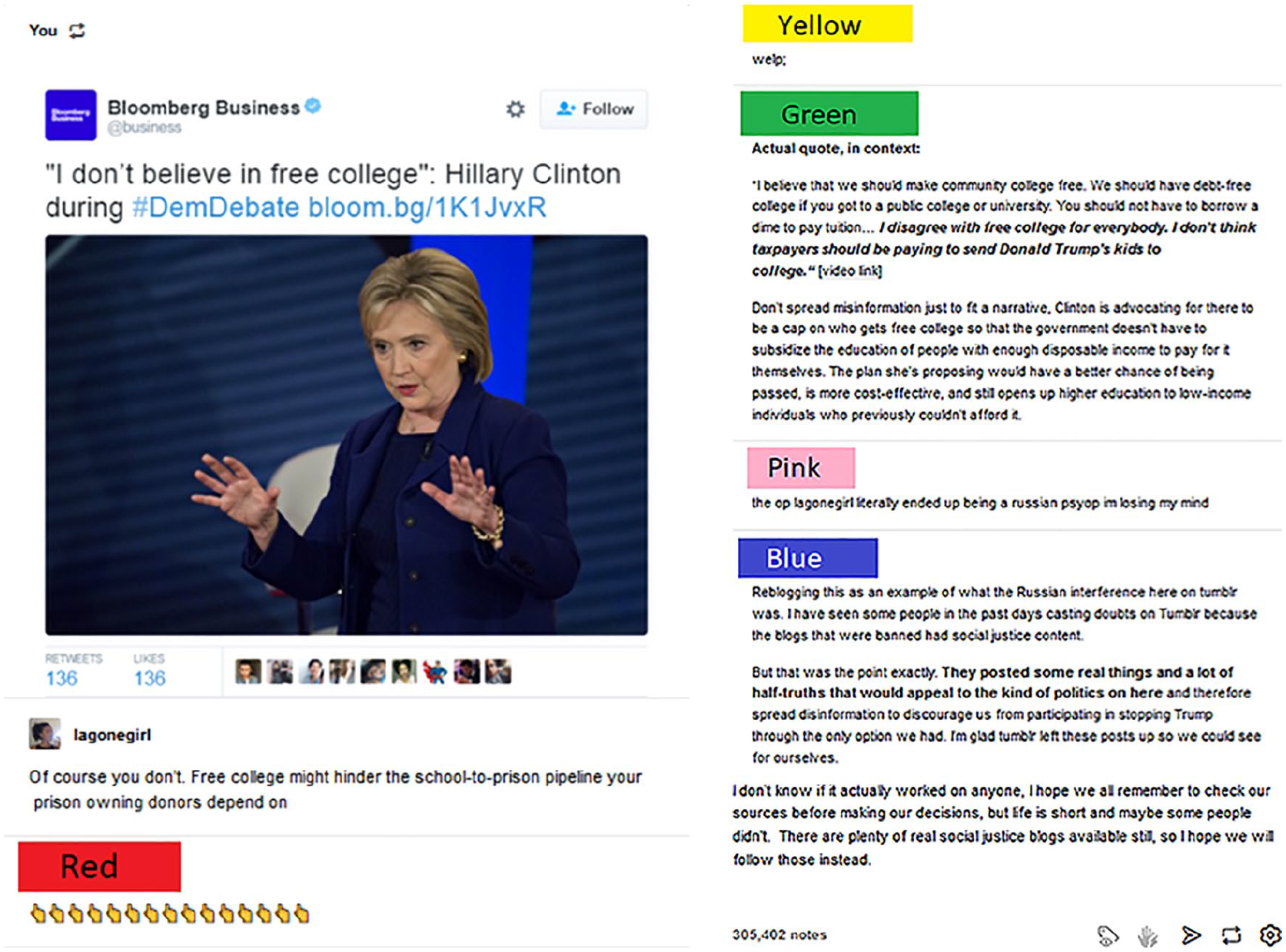
Lagonegirl and the school-to-prison pipeline.
The post in Figure 4 begins with Lagonegirl sharing an image of a tweet from the Bloomberg business account. 1 Lagonegirl notably does not include an active link to the article, instead posting a screen shot of the tweet and providing commentary regarding how Clinton’s supposed stance enables the school-to-prison pipeline. The anti-Clinton position here is consistent with “Left Troll” tweets categorized by Linvill and Warren (2020). Two users (red and yellow) express either concise agreement (the upward pointing finger emoji) or concern (welp) before the user in green provides additional context regarding how Lagonegirl, by way of the Bloomberg tweet, misrepresented what Clinton actually said in the February debate.
Importantly, the way Lagonegirl constructed this post foreclosed further interaction with the source material (the Bloomberg article and by extension the February 2016 debate) and prevented users from engaging with the context of this quote more deeply themselves (that Clinton believed that the very wealthy, such as Donald Trump’s children, should not be provided free tuition, while the vast majority of Americans should have “debt-free” education through community colleges and public universities). Like the example in Figure 3, the post’s construction, making use of platform conventions, obscures the origins of the information being shared. Though here instead of allowing Lagonegirl to be mistaken as the original creator, it attributes the original Bloomberg article visually, while preventing deeper engagement. By not including a link to the article, Lagonegirl further emphasizes the anti-Clinton (to progressives) headline and forecloses opportunities to learn more about the specifics of Clinton’s policy position, while the image and text of the tweet offer an opportunity for Tumblr users to comment upon the sensational headline and potentially engage in divisive, anti-deliberative responses (Kim et al., 2018; McKay & Tenove, 2020).
Tumblr’s lack of mechanisms for establishing a strict chronology and the transformative nature of reblogging makes it impossible to determine with precision how many users liked and reblogged which version of this post. “Tumblr time” is extremely affective and ephemeral (Cho, 2015) and makes community and collective memory difficult to trace and maintain (Popova, 2020). How many users liked and reblogged this post in support of Lagonegirl’s initial premise; how many liked and reblogged the user in green’s rebuttal; and how many of these likes and reblogs occurred before and after Lagonegirl’s outing as Russian account are not easily parsed. What can be observed that is of September 2019, the original tweet from Bloomberg Business has 260 retweets and 220 likes. This Tumblr post has over 300,000 notes, indicating strong differences in engagement between the two platforms and subsequent distributions regarding this particular headline.
Ambivalence comes into play once again as the post circulates, with the user in pink “losing their mind” that the op was “a Russian psyop.” This post, as much as any of the others originated by Lagonegirl, could have been made a joke. And indeed, is made a joke in other reblogs of this same post. Reblogs of this post also mock Tumblr users and liberals for being duped and devolve into absurdity. However, in the version archived here, the user in blue instead highlights how serious the situation on Tumblr actually was and continues to be. The user in blue feels positively about Tumblr’s decision to leave the IRA-affiliated posts accessible precisely because Tumblr users would (hopefully) be able to learn from these posts. In addition to serving as a catalyst for humor and derision, equally these posts opened up possibility for continued media literacy education. And yet often Tumblr users also encountered versions of this post ripe for ridicule. However, any and all distributions of this post could potentially serve IRA aims and contribute to what Mckay and Tenove (2020) identify as pervasive inauthenticity where citizens believe “that a significant number of interlocutors hold problematic identities” (p. 7) and ultimately may perceive inauthenticity when encountering legitimate contributors.
Conclusion
The IRA-linked Lagonegirl account on Tumblr included several performance elements consistent with IRA operations on Twitter (Arif et al., 2018; Linvill & Warren, 2020) and Facebook (Kim et al., 2018). There is noticeable overlap with the group of IRA Twitter accounts that Linvill and Warren label as “Left Trolls” including the emphasis on racial identity and sharing non-political content alongside political posts. While there are similarities between Twitter performances and the Lagonegirl Tumblr account, there are also Tumblr-specific platform conventions and social norms that shaped Lagonegirl’s performance.
Disinformation campaigns on social media are not limited to only the most populated and mainstream of platforms. There are platforms that have received even less attention to date than Tumblr, and with each new social media platform comes the possibility of new conventions for bad actors to exploit, many of them being increasingly difficult to study (McKay & Tenove, 2020). By considering platform conventions and social norms both as distinct elements of IRA blog performance and how these two elements interact and reinforce one another, this article contributes to the existing literature on platform-specific disinformation campaigns. While limited in scope, and focusing only on a single IRA-linked Tumblr account, Lagonegirl’s performances in two specific posts are placed into a context of day-to-day behaviors and expectations on Tumblr as expressed by users through qualitative interviews. Future research should consider disinformation campaigns on alternative platforms in a wider manner, including, where possible, determining if multiple persona typologies are present on these platforms, similar to the work that has been done on Twitter (Linvill & Warren, 2020). However, just as importantly, the opaqueness and difficulty of engaging with niche platforms and disinformation production and distribution should not provide an excuse to not undertake research at all.
To address RQ1, by crafting posts that simultaneously appeared to be properly credited and sourced, but also left room for ambiguity regarding whether or not Lagonegirl originated the content or foreclosed opportunities for more involved engagement with news articles, the Lagonegirl account made use of Tumblr’s platform conventions to appear authentically concerned with political engagement. To address RQ2, by sharing a mix of humor and politics relatable to Millennials, the Lagonegirl account fulfilled social norm criteria that Tumblr users employ to screen blogs that they are thinking about following. The Lagonegirl account needed to be followed by non-IRA users in order to effectively turn interpreters into agents (Wardle & Derakhshan, 2017) and further distribute content. Reblogs of Lagonegirl’s political posts garnered additional commentary as they circulated, both before and after the blog was identified as IRA-linked. Crucially, even reblogs that were critical of Lagonegirl’s posts could potentially serve IRA objectives, as disinformation campaigns are not necessarily concerned with persuading interpreters to a particular point of view, but rather to exacerbate divisions and erode trust of traditional media outlets and those politically dissimilar to ourselves (Pomerantsev & Weiss, 2014). This divisiveness makes the processes of deliberative democracy less and less tenable (McKay & Tenove, 2020).
The utility of the Lagonegirl account and Tumblr’s role in disinformation production and distribution did not end with the deletion of IRA-linked accounts. Nor does the removal of Twitter handles and Facebook groups undo the work already accomplished by the IRA and other disinformation groups. In understanding platform conventions and social norms that could bring regular social media users into the process of spreading disinformation, we are perhaps better equipped to understand the pervasiveness of disinformation, without falling into hopeless cynicism.
Footnotes
Declaration of Conflicting Interests
The author(s) declared no potential conflicts of interest with respect to the research, authorship, and/or publication of this article.
Funding
The author(s) received no financial support for the research, authorship, and/or publication of this article.
