




Abstract
Internet and social media sites have long served as a rich form of community-building and knowledge exchange within transgender communities. In particular, Tumblr has become a popular site among trans youth in recent years. Paralleling changes in medical and mainstream societal understandings of what it means to be transgender, trans Tumblr users have engaged in dialogue and debate about the definitions and limits of trans identity. While research has established the potential for positive identity-formation among LGBTQ+ youth on Tumblr, it is also important to consider how online trans communities may re-inscribe hegemonic narratives in addition to disrupting dominant discourses and ideologies. Using a critical discourse analysis of Tumblr posts, this research analyses how trans Tumblr users define “who counts as trans,” including how users define gender dysphoria and its relationship to trans identities. Our findings provide critical insight into how trans communities define the boundaries of their identities in a struggle for visibility, resources, and respect.
In May 2014, TIME Magazine declared that we had reached the “Transgender Tipping Point” (Steinmetz, 2014). Since then, transgender people and their lives have become ever more visible. A set of standard narratives has dominated representations of trans identity, including a sense of being “born in the wrong body,” an expression of an authentic inner self, gender non-conformity since childhood, medical transition, and overwhelming feelings of dysphoria in relation to gender as assigned at birth. Johnson (2016) coined the term “transnormativity” to describe this set of assumptions and their regulatory influence.
In parallel with a rapid expansion of public visibility, there have been significant intra-community discussions and debates about what legitimately counts as trans identities, and who may claim them. Many of these discussions have taken place online, including through the social media micro-blogging platform Tumblr. Byron et al. (2019), Cavalcante (2019), Fink and Miller (2014), Haimson et al. (2021), Jenzen (2017), Oakley (2016, 2017), Schudson and van Anders (2019), and Walker (2017) have all found that Tumblr has played a significant role for many LGBTQ+ young people in identity-formation and community-building. We approached this research asking if online trans communities may re-inscribe a hegemony of transnormativity while also disrupting dominant discourses and ideologies. Given that transgender identities are made legible when named and labelled in contrast to dominant discourses of cisnormativity, identity labels and definitions are often contested and politically significant within trans, non-binary, Two-Spirit, and other gender diverse communities. Accordingly, our research explored the question: How do trans Tumblr users define “who counts as trans”? 1
Fink and Miller (2014) described the unique role that Tumblr has served in transgender community-building and creative practices, arguing that “from at least 2011 to 2013, people collectively oriented in opposition to dominant discourses of gender and sexuality used Tumblr to refashion straight cisgender norms and to create everyday art in a hybrid media space” (p. 625). However, Tumblr has declined in popularity since its trans heyday as described by Fink and Miller. In 2017, media conglomerate Verizon purchased Tumblr from Yahoo, and a year later implemented an adult content ban (Bronstein, 2020). The ban was intended to prohibit pornography and sexually explicit imagery, but users found even non-explicit material related to LGBTQ+ identities was being censored (Bronstein, 2020). Users left the site in droves, with a more than 40% reduction in traffic in just one year, and Verizon soon sold Tumblr for a fraction of its purchase price (Bronstein, 2020). The trans community on Tumblr was irreparably altered by the adult content ban, but many of the original draws of Tumblr persisted for users that stayed.
Renninger and other scholars identify several unique features of Tumblr that make it particularly well suited to LGBTQ+ community development. Renninger (2015) described Tumblr as a “networked counterpublic” that forms a discursive and technological space particularly suited to LGBTQ+ community formation. He explained that, for asexual communities, Tumblr provides a space to both “work out ideas related to identity, community, and relationships, and […] develop tactics to assert or adapt identities to configure oneself and asexuals in general within relationships, families, communities, and sexusociety” (p. 1516). As another LGBTQ+ group marginalized in the dominant public sphere, trans communities may find a similar home on Tumblr, as noted by Dame (2016).
For example, Renninger notes that profiles on Tumblr are less tied to singular personas and real-world identities than are posts on other social networking sites. Instead, pseudonyms are typically used on Tumblr to create alternate identities online. Additionally, Tumblr uses a followers rather than friends list structure. As such, Tumblr blogs can be followed be anyone who finds them, with no need for a mutually acknowledged relationship. Finally, the public commenting tools on Tumblr are primarily likes and reblogs. Likes express affirmation of the content, while reblogs share the content to the user’s own blog, often accompanied by new commentary. This structure emphasizes the original content creator over the user who most recently shared the post (Renninger, 2015). Hashtags, or tags, are another key form of interaction that allow users to search for content related to their interests. Tags collate all posts related to a particular topic or group, allowing users to easily participate in conversations about, and find the genealogy of, content with which they have engaged (Renninger, 2015).
Dame (2016) expands on Renninger’s analysis of Tumblr by focusing on queer and trans users’ use of tags. He identifies five different types of tags in trans Tumblr posts: trans identity labels (#trans, #ftm); subcultural vocabulary (#testosterone, #preop); post content or topic descriptor (#selfie, #transition update); personal, individualized tags (#depression, #personal); and politically-loaded terminology (#cishet, #truscum). As users make posts on their own individual blogs, hashtags serve to connect individuals’ posts to larger bodies of related content, indicating that their posts are part of larger, collective narratives or discussions. Through repeated uses over time, tags develop stable meanings, usages, and definitions. Dame argues the tags’ meanings are also transferred to users personally: “Their tags are their ontological stake: I am identifying myself and my self-narrative as trans, in order to be recognizable to you as such in this moment” (Dame, 2016, p. 31). In defending these ontological stakes, Tumblr users often defend their own meanings of the tags through a variety of strategies such as “tagspamming” to ensure users in a certain category see targeted information, coining new tags for differentiated purposes, and responding to perceived misuses of tags as the self-proclaimed “tag police.”
Several studies also noted that Tumblr has carried over into the offline lives of LGBTQ+ teens as a source of community, information, and subcultural terminology. Jenzen (2017) found that social media—and Tumblr in particular—is a “crucial lifeline” for trans youth, creating a space for creative resistance, self-expression, and community formation. Cavalcante (2019) described LGBTQ+ youth’s experience of Tumblr as immersive, intense, all-consuming, and expansive. He argued that Tumblr represents a queer utopia for LGBTQ+ youth who can find respite there from a larger homophobic and transphobic world. Participants in Byron et al.’s (2019) research also described diving deeply into Tumblr in their early days of use, where they encountered a dizzying number of genders and sexualities that were helpful as they engaged in clarifying their own identities.
Byron et al. (2019) hints at another common theme in LGBTQ+ experiences of Tumblr: the creation of new identity labels. The youth in Schudson and van Anders’s (2019) study identified Tumblr as a site where new terms to describe LGBTQA+ identities were constantly being coined. These identity labels serve a variety of purposes: they foster a sense of belonging; identify previously invisible experiences as “nameable, and thereby livable subjectivities” (p. 362); position identity work and self-labelling as an ongoing, provisional, and fluid process; and serve as a site of counter-hegemonic world-making that challenges definitions of “normal.” Oakley (2016) described how Tumblr users coin new labels by adapting existing terminology, such as by adding a prefix to an existing noun or adjective (e.g. demi-girl, grey-sexual). While simply adding a new prefix does not fully destabilize the discursively constraining logic of sexual and gender identities, it adapts and builds on existing terminology to better meet the needs of LGBTQ+ youth.
However, even within these invented counter-hegemonic identity labels, Tumblr users work to establish boundaries and normative definitions for terms. Dame (2016) explained that: As the folksonomy settles into a stable, ontological organization through repeat use, the vocabulary options available to trans users are limited. Limited vocabulary ultimately prompts user debate over tag definition. Given the deep importance of ontological security to trans self-narrative, users react strongly to contestations over meaning. Without a structuring apparatus to maintain social norms, users implemented horizontal discipline to resolve the embedded uncertainty around tag definition. (p. 35)
In sum, Tumblr can be a site of identity label creation as well as one of negative intensity for trans users. However, no research has investigated the relationship between the two. As such, this is the point of departure for our research to examine how online trans communities may both re-inscribe hegemony and disrupt dominant discourses and ideologies.
Materials and Methods
The research design, data collection and analysis were led by the first author. The second and third authors contributed to research design, analysis, interpretation, and discussion. We conducted a critical discourse analysis (CDA) of selected Tumblr posts. CDA is a constructivist approach to qualitative research that positions language as both constitutive of, and determined by, social relationships and power structures. van Dijk (1995) states that “CDA especially focuses on (group) relations of power, dominance, and inequality and the ways these are reproduced or resisted by social group members through text and talk” (p. 18) and often deals with power relations that concern social identities like gender and sexual orientation.
The first author used criterion-based purposive sampling to select Tumblr posts for analysis. They tested out various trans-related search terms on Tumblr to explore what content they generated, and then determined appropriate search terms for inclusion in the sample accordingly.
Tumblr’s algorithm includes posts in search results if the term is found in either the hashtags or the body text of posts. The search terms used were: transmed; anti transmed; tucute; truscum; mogai; non dysphorics; and trans discourse. Transmed, anti transmed, tucute, and truscum refer to different ideologies on trans identity (as will be further explained later), mogai is an acronym for marginalized orientations, genders and identities, non dysphorics refers to trans people who do not experience gender dysphoria, and trans discourse is often included in posts that focus on intra-community debate and discussion. Results were then filtered to include only text posts and ordered according to Tumblr’s “most popular” rankings. The search only generated posts in English, possibly due to the browser language, IP address, search terms, or other unknown factors. All data collection was completed on September 30, 2019. Within each set of results, posts were included that met the following sampling criteria:
Referenced or mentioned definitions or criteria for being trans E.g. “real,” “valid,” “trans is/is not,” “not trans,” “are trans,” “are cis,” “you need ___ to be trans,” “you don’t need ____ to be trans” Actively mentioned a definition of trans, not just discusses the discourse/debate in general or the impacts of the discourse Had at least 50 notes (a measure of likes and reblogs by other users) Was publicly accessible and did not require a password to access
Users did not need to explicitly identify as trans, because it was evident from the posts generated that most, if not all, users identified as trans or non-binary in some way. This process was repeated for each search term until 40 posts had been sampled. In order to ensure a breadth of sampling, a maximum of 8 posts were collected from any one search term. The final sample included 38 posts, after two posts were removed because they did not, in fact, meet the sample criteria.
It is important to note that the criteria Tumblr uses to determine what posts appear in search results is opaque, and according to Tumblr, “change almost daily” (Appearing in Search Results, n.d.). As such, it is difficult to replicate our sampling technique. We have provided as much detail as possible to ameliorate the effects of Tumblr’s opaque algorithm on our research’s reliability.
In considering the ethics of using online sources, we note that most of the content on Tumblr is fully accessible to the public, unless the user has created a password-protected blog. All data in our sample came from publicly accessible blogs. In line with Vásquez and Creel (2019), we have not published any usernames in this paper in order to preserve users’ “pseudonymity.”
Norman Fairclough’s (2001) three levels of analysis guided coding and analysis. The first author began by familiarizing themselves with the data and developing a preliminary codebook. We then began the discourse-as-text level of analysis, using open inductive coding to identify the key content of each post. Moving on to the discourse-as-discursive-practice stage, codes were grouped into various themes in order to examine competing definitions and delineate posts’ arguments and beliefs. A second level of open coding followed, this time focusing on the structure of the posts and the rhetorical strategies employed. Finally, the texts were considered at the discourse-as-social-practice level. This level of analysis links the text to broader power structures using the concepts of ideology and hegemony (Fairclough, 2001). In this case, transnormativity and pathologization were the most significant concepts.
Given the subjectivity inherent in the construction of identities, it is neither possible nor desirable to be an entirely objective and detached researcher. However, because trans people have historically been studied largely by cisgender researchers and often using methods that have not served the trans communities well, researcher positionality can serve as a significant asset (Vincent, 2018). The first author is a young trans and non-binary identified person, who is active in local LGBTQ2+ youth cultures and was active on Tumblr from 2014 to 2016. They have experience and knowledge from being an insider in these communities, but are not currently active in the Tumblr communities analyzed for this project. The second author is a trans-identified scholar with more than three decades experience in the field of Transgender Studies. The third author has expertise in sociological research on digital communities.
The first author’s positionality also created challenges, as they engaged with data that was personal, political, and emotional for them. Data collection and analysis involved deeply engaging with material that debated whether or not people with identities and experiences that resemble the first author’s count as trans. As they grappled with internalized transnormativity and transphobia as part of the research process, various emotional reactions arose, including a range of distress and negative emotions. Rosie Nelson (2020) identifies a number of impacts on the researcher of doing LGBTQ+ research as an LGBTQ+ person, including “(i) the euphoria of connection, (ii) relationships with participants, (iii) retraumatization through listening, (iv) finding oneself on the outside and (v) the researcher’s shifting identity” (p. 6). They frequently experienced some level of retraumatization, yet sharing the research with other queer and trans folks has brought the euphoria of connection to light as well. By using strategies to manage risk to themselves and care for their emotional needs, they were able to complete this important research in a safe and rewarding way.
Results
Two Groups: A Tumblr Divided
Our foray into Tumblr quickly revealed two mutually hostile groups of trans Tumblr users: transmed and anti-transmed. These ideological positions have appeared in passing in some research (Dame, 2016; Williams, 2019); but are largely a new phenomenon not yet explored in academic literature. Transmed, short for transmedicalist, refers to trans people who believe that dysphoria 2 is required to identify as transgender. The term appears in hashtags and the text of posts, and functions as an identity label used both by members of the group, and by others to identify the views they oppose. The term originated on Tumblr and was originally used solely by trans people but now seems to be expanding onto other platforms and offline communities and may be used to refer to medical models of transness generally. In contrast, anti-transmed people are largely defined by their opposition to transmedicalist ideology and believe that you do not need dysphoria to be trans. The more emotionally loaded terms truscum and tucute are also used to refer to transmeds and anti-transmeds, respectively. 3
While the origins, evolution, and definitions of both terms are difficult to conclusively determine, several online sources (Ballard, 2019; Ross, 2014) suggest that truscum is a portmanteau of true transsexual and scum. True transsexual refers to the term coined by Harry Benjamin to distinguish between transvestites and surgery-seeking transsexuals and is associated with a highly medicalized model of trans identity (Davy, 2015), while scum denotes what is perceived as truscum’s aggressive imposition of their views onto others. Originally coined as a derogatory term, the term has since been reclaimed as a positive identity label. The opposite term, tucute, was created from the phrase “too cute to be cis” and is also sometimes claimed as an identity label (Ballard, 2019). Transtrender also sometimes appears in reference to tucute and anti-transmed people, suggesting that such individuals are actually cisgender people who are pretending to be trans to get attention. For the sake of clarity and simplicity, we use transmed and anti-transmed throughout to refer to the two ideologically opposed groups.
Most Tumblr users in our sample who participated in such debates aligned themselves with one of these two sides and adopted the corresponding group label as a personal identity. Some users identified themselves in the body text or tags of the post, and those who did not usually identified their views on their blog’s homepage. As such, we could easily identify what posts belonged to which ideological camp. The positions of a handful of users could be inferred based on context or other posts on their blog, and only one user did not appear to identify with either side.
A popular webcomic circulated on Tumblr presents caricatures of a trans man and a transtrender based on the views of transmeds. Derivatives of the image with various adaptations often appeared in searches during data collection. The comic is useful for understanding the flavor of the Tumblr debates, so it is included in Figure 1:
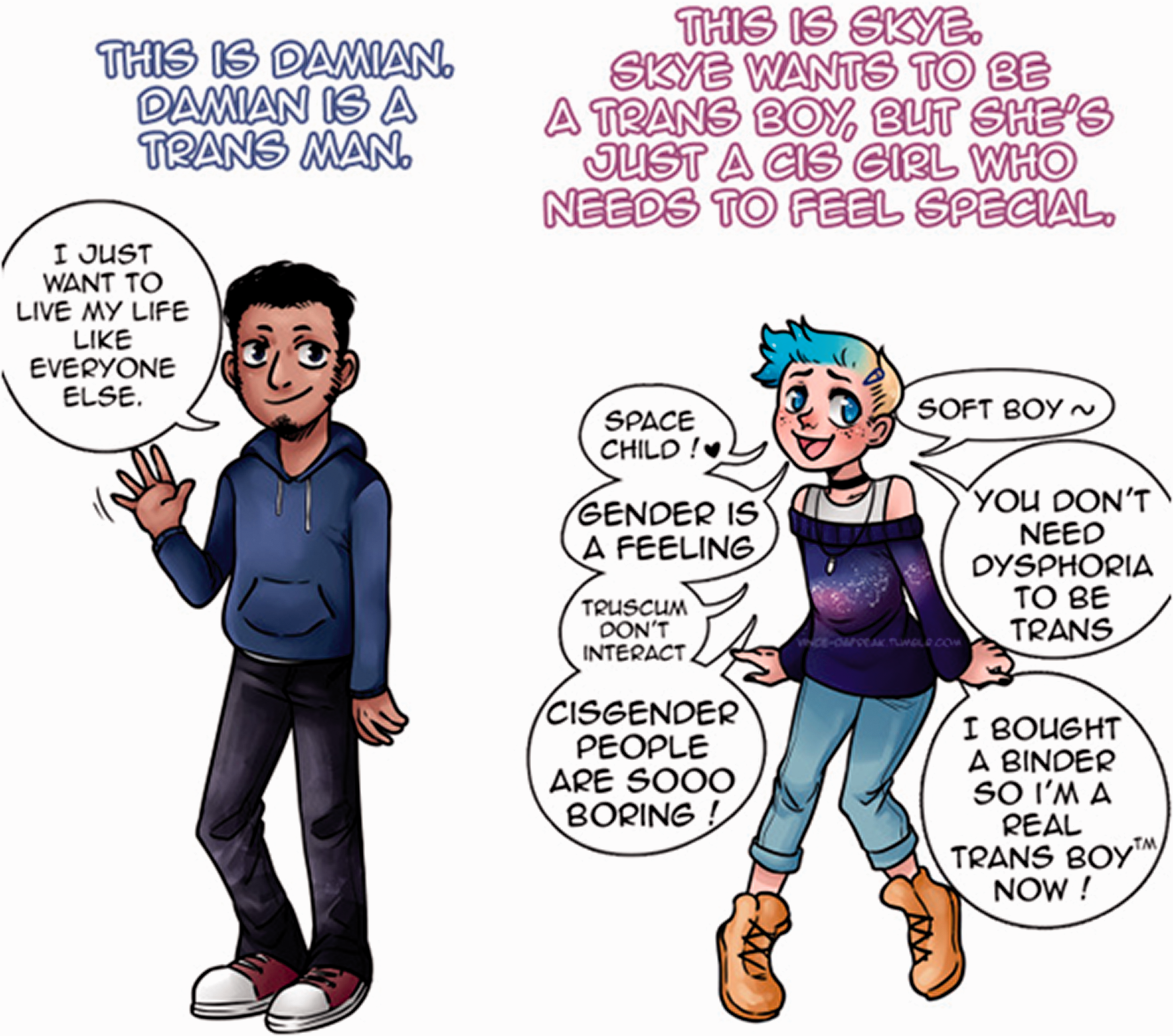
Vince-dafreak. (2018, March 2) Being trans is not special or fun … [Tumblr post]. Retrieved from https://vince-dafreak.tumblr.com/post/171463969084/being-trans-is-not-special-or-fun-you-need.
While transmeds and anti-transmeds are largely defined based on their beliefs about dysphoria, the labels are also associated with a constellation of other views on gender, although not all group members agree on every stance. For example, transmed views are often associated with a rejection of non-binary identities and gender fluidity. In contrast, many anti-transmeds embrace neopronouns and neogenders—identity labels and pronouns coined on Tumblr to refer to specific experiences of gender falling under the non-binary umbrella, of which transmeds are highly critical (e.g. demigirl, genderapathetic, catgender). These internal disagreements can make it difficult to delineate on which issues transmeds and anti-transmeds agree and disagree. As such, a significant portion of our analysis was devoted to attempting to understanding each group’s positions.
Who Counts as Trans?
The primary debate on Tumblr revolves around whether or not dysphoria is required to be transgender, which in this context usually means physical or bodily dysphoria about primary or secondary sex characteristics. In addition to transmeds’ belief that dysphoria is required to be trans, various other qualifications and criteria for transness circulated among Tumblr posts. For example, one transmed user argued that: If you do not have at least some measure of dysphoria YOU ARE NOT TRANS. If you think you can pick and choose what you are dysphoric about YOU ARE NOT TRANS. If you do not at least some of the time, attempt to outwardly present as your chosen gender- barring safety reasons, or if you are still closeted- YOU ARE NOT TRANS. If you are hesitant to even use a nickname because it’s “too much work” YOU ARE NOT TRANS. If you are “Dysphoric” about things that do NOT have anything to do with outward sexual expression, and ONLY these things, YOU ARE NOT TRANSGENDER, you just hate your body like everyone else. (TransmedUser1)
In contrast to transmed’s detailed lists, anti-transmeds assert that the only requirement to be transgender is self-identification. Several other posts explicitly included groups labelled by transmeds as transtrenders, such as non-binary people, non-dysphorics, and people with neogenders. However, anti-transmed posts were generally much more focused on promoting the idea that no one has the authority to decide whether another individual is trans. These users argued that “There are no ‘fake trans’ people!” and asserted the right of all trans people to bodily autonomy, respect, and medical intervention if they desired it.
Dysphoria, Euphoria, and Incongruence
Much of the Tumblr debate centered around whether dysphoria is needed to be trans. Accordingly, the definition of dysphoria has considerable significance, as it determines the scope of who is included under the trans label, at least for transmeds. Interestingly, even within the transmed posts, there was no singular definition of dysphoria. Rather, users drew upon a variety of definitions that served to include or exclude various individuals. At its most extreme, dysphoria was understood as intense hatred of body parts related to gender expression that causes debilitating, oppressive, or even lethal distress. Posts using this definition used the language of self-hatred and distress, such as in the following three quotes: It does make me hate my body, but I don’t really hate myself as a person. (TransmedUser2) I just need a body I can be happy in, because this one hurts me. (TransmedUser2) Stop trying to sugarcoat a lethal mental disorder. (TransmedUser3) Dysphoria isn’t self hatred. it’s like static on the radio that after years you’ll stop noticing unless you try. (TransmedUser3) Dysphoria is not “hating yourself unu” where did that even come from. If you feel a disconnect between your birth sex and gender and if causes you any degree of discomfort, that’s dysphoria! (TransmedUser4) “I’m not dysphoric but I don’t want to be perceived as a gender I’m not” that’s dysphoria. (TransmedUser4)
“The root cause of being trans is the disconnect. And for some, that disconnect causes dysphoria. But for others their body feels fine, it’s the labels that don’t fit.” (TransmedUser4). Both anti-transmeds, and most transmeds, acknowledged that feeling disconnected from one’s assigned gender can constitute a trans experience by itself for some people, but differ in whether this experience is called dysphoria or incongruence, and, accordingly, whether dysphoria is a requirement of identifying as trans.
Some debate centered on the related concept of gender euphoria. Interestingly, this term only showed up in transmed posts. Transmeds were responding to a definition of euphoria as joy about one’s gender resulting from transition or gender affirmation. However, transmed users argued that euphoria is simply temporary relief from dysphoria. Euphoria, in their view, is not an independent construct that provides an alternative to dysphoria in defining the trans experience, but a phenomenon that is simply the flipside of dysphoria. Thus, in their view, dysphoria was still required to be transgender.
By broadening their definitions of dysphoria to include a variety of experiences of gender disconnect and distress, transmeds reinforce and legitimate their definition of transness as requiring dysphoria. They are able to co-opt and absorb threats from anti-transmeds, upholding their authority as the correct opinion. While this is largely an unspoken strategy, one user did specifically speak to other transmeds about this strategy: I propose to transmeds that we shouldn’t stop saying “if you don’t have dysphoria, you aren’t trans” and start saying “If you are trans, you have dysphoria. I think a lot of tucutes have the idea that transmeds are somehow excluding some trans people who are supposedly non-dysphoric. This phrasing might highlight our more
Rhetorical Strategies
Personal Experience as Evidence
Tumblr users drew upon a variety of rhetorical strategies to grant their voices authority and legitimacy. For example, several users used their personal experiences to illustrate a concept or provide evidence for a theory. For instance, one user illustrated their mathematical model of dysphoria with their own experiences: “using me as an example, i was roughly 60% happy with my body before i came out and transitioned.” (TransmedUser6) Others cite their identities in order to establish themselves as authoritative experts: “As someone with multiple types of dysphoria, not just gender dysphoria, the idea that dysphoria can be ‘just discomfort’ is insulting at best and downright harmful at worst.” (AntiTransmedUser2) Personal experiences were also used to demonstrate the harmful impacts of transmed/anti-transmed debates. For example, in a post titled “my experience with truscum and the trender theory,” a user stated: i realised you don’t need dysphoria to be trans, just gender incongruence. but truscum ideology left a scar. i still doubt myself often, even though i know trenders don’t exist. i hope that i can heal, but i know it will take time. (AntiTransmedUser1)
Register, Tone, and Typography
Posts also used stylistic devices such as capitalization, font size, bolding, italics, sentence structure, and tone to communicate their messages. In linguistics, these context-specific techniques that guide a speaker’s use of tone, vocabulary, jargon, vernacular, formality and more are referred to as register (Vásquez & Creel, 2017). As is popular on Tumblr, many users adopted a conversational tone, using tools such as typing in all lowercase, erratic punctuation, textspeak abbreviations, and fractured syntax. While in many written contexts this would be seen as too informal to be taken seriously, on Tumblr this particular style of writing gives an author relatability, accessibility, and a conversational tone. Soffer (2012) explained that a lack of capitalization creates the impression of oral language as is used in a casual conversation. He explained that “as this digital discourse replaces FtF [face-to-face] conversation, users want it to be seen as one that preserves their authentic, personal voice” (2012, p. 1106). Through creative use of tone and typography, users produced a conversational tone that lent them authenticity and therefore credibility.
However, not all users conformed to the casual Tumblr register. Some posts adopted a much more formal register and adhered much more closely to conventional written English standards, using proper capitalization, punctuation, and grammatically correct syntax. Rather than using all-caps to draw attention to key words, these users were more likely to bold them. Posts often to employed academic transitional phrases such as “I propose,” “first of all,” and “overall” rather than the “like,” “…,” “so anyways,” and “let’s say.” Additionally, posts tended to begin with phrases that signal fact, rather than opinion, such as “a reminder that,” or a simple declarative statement of facts, such as “Gender euphoria isn’t real” as compared to the opinion signal phrases of “god, i realized something today” or “hot take.”
This formal register was found in posts by both groups, although it was used more often by transmeds. In general, the tone of transmed posts was more aggressive, assertive, and declarative, while anti-transmeds relied more upon humour, playfulness, casual internet register, and creative typography. These stylistic differences further fueled the debate, as transmeds held up anti-transmed style as evidence of their immaturity and ridiculousness. Several image posts depicted exaggerated personas of stereotypical anti-transmeds. Meanwhile, some anti-transmeds embraced this style and reclaimed their image from mockery. Termed the “trendercore” aesthetic, this group prolifically created text and images with lots of pastel colours, rainbows, and galaxy prints. As such, style and register became tools of identity formation and group cohesiveness for both transmeds and anti-transmeds.
Dialogue Posts
A significant number of posts were written as invented dialogues. In these posts, the author established several competing voices and staged an interaction between them in order to prove a point or create an effect. This type of post originated from Tumblr’s unique “Chat” post format, which auto-formats the speaker and dialogue structure for the user. However, the style has since expanded to standard text posts as well. Vásquez and Creel (2017) analyzed Tumblr Chat posts using the concept of polyphony, which “refers to appropriating, mixing, enacting, or impersonating, the voices of others,” whether real or hypothetical individuals expressed through varying styles and registers (p. 64). Often, these posts would set up a dialogue between the respective opposing side (transmed or anti-transmed) and other actors in order to demonstrate the foolishness of the group’s argument. One post staged a dialogue between a truscum, a tucute, and the author to demonstrate how individual people’s voices got lost in the crossfire of debate.
Another post (Figure 2) personified History and Science to highlight the perceived Eurocentrism and ahistoricism of transmed ideology. Often, a series of authoritative voices would be used to create the appearance of consensus on a topic, and then the anti-transmed/transmed user would reject the consensus, making the earlier position look ridiculous. Authors of these posts used hyperbole, style, and register to exaggerate the claims and tones of their staged voices, in order to further their point. These posts provided unique insight into the views of different actors in the debate. Because posts were often written about the opposing group’s argument, it was possible to compare how members of the group in question framed their argument to how it was understood and presented by the opposing side. While the parody and hyperbole employed in Chat posts may not factually match the actual arguments expressed, they express the emotional flavour and tone of the debate.
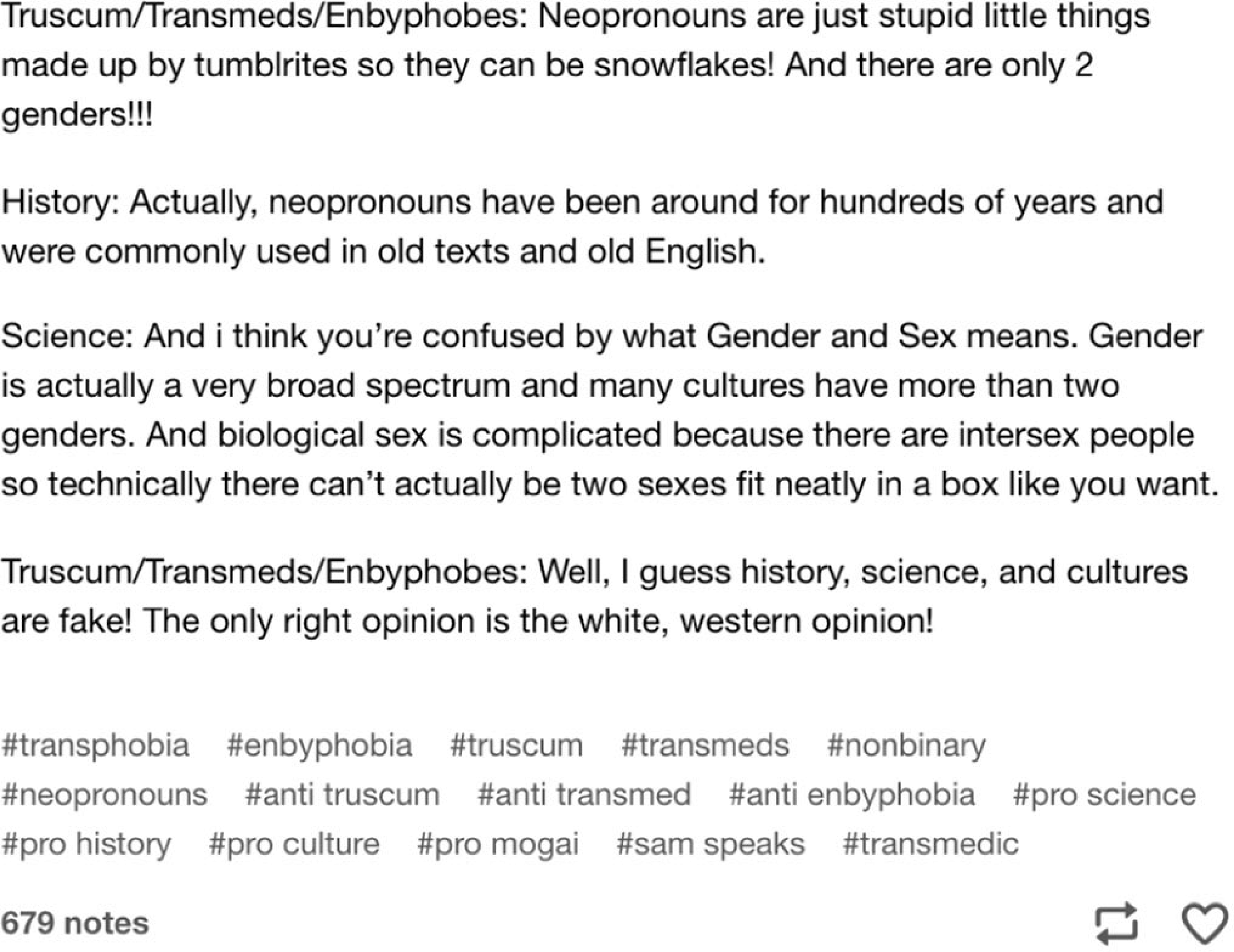
Tumblr post.
Medical Discourses
Interestingly, both transmeds and anti-transmeds drew upon medical discourses to legitimate their claims about dysphoria, despite anti-transmeds claiming to be against the medicalization of trans identities. In uncannily similar sentences, an anti-transmed stated “Stop making light of my mental illness and get your head out of your ass, scum” (AntiTransmedUser2) while a transmed said “Stop trying to sugarcoat a lethal mental disorder.” (TransmedUser3). Both sides strategically employed medical terminology to bolster their arguments. For example, one anti-transmed said: The idea that you can only call yourself trans if you’ve been diagnosed-especially now that the World Health Organization has removed transgenderism from the list of mental illnesses- is transphobic. (AntiTransmedUser3) “you need dysphoria to be trans” … simply means that your gender incongruence (the disconnect between your gender identity and your body) significantly affects your life and takes up a big portion of your time (according to the DSM-V). (TransmedUser6)
Discussion
In order to understand the implications of defining and re-defining dysphoria on Tumblr, we must consider the historical medicalization of trans identities and evolution of the concept of dysphoria. Historical interactions between transgender people and the medical system have produced a pathological hierarchy of transness, once epitomized by Harry Benjamin's 1966 6-point scale of gender variance with “true transsexuality” at the most extreme (Davy, 2015). At the lowest end were “pseudo-transvestites” who lived as their assigned male gender but took pleasure in occasionally dressing as women. In contrast, “true transsexuals” experienced intense gender discomfort and emotional distress, hated their genitals, and urgently demanded sex reassignment surgery (Benjamin, 1966). While Benjamin’s scale is no longer used, echoes of the true transsexual hierarchy live on in the DSM-5. To be diagnosed with Gender Dysphoria, a person must express a “strong desire” to be treated, seen, and embodied as a different gender than assigned at birth, and that strong desire must cause “clinically significant” distress or impairment in everyday life (American Psychiatric Association, 2013, p. 452). This definition is largely paralleled in transmeds’ views of dysphoria, as is suggested by their name.
Anti-transmeds’ understanding of dysphoria, in contrast, resembles the description laid out in the World Health Organization’s ICD-11. The ICD-11 makes no mention of dysphoria; rather, it uses the diagnostic label of Gender Incongruence to refer to a “marked and persistent incongruence between an individual’s experienced gender and the assigned sex” (World Health Organization, 2019, section 17). Thus, when anti-transmeds argued that incongruence is the only requirement to be transgender, they were drawing on the language of the ICD-11. While a cursory glance of Tumblr suggests that transmeds are firmly pro-medicalization and anti-transmeds are categorically against it, the reality is a much more nuanced and involve a complex series of strategic engagements with medical discourses.
Research on offline trans communities suggests that the internalization of medical discourse demonstrated by transmeds is not unique to Tumblr. Davy (2015) noted that many trans people tailor the narratives of gender identity they present to psychiatrists when seeking gender-affirming medical treatments, as they understand that a psychiatrist can refuse to recommend them for medical transitioning if they fail to live up to psychiatric definitions of gender dysphoria and transgender identity. As such, many trans patients present a hyper-binary self-narrative that emphasizes their distress over their body and minimizes any uncertainty or gender nonconformity. Several studies looking at spaces outside of Tumblr have provided evidence that trans people learn this narrative within trans communities in a form of utilitarian advocacy to assist individuals in accessing the medical care they need (Bradford & Syed, 2019; Garrison, 2018; Johnson, 2015; Mason-Schrock, 1996; Psihopaidas, 2017). Given Tumblr’s role in identity-formation for trans youth, it is reasonable to assume that this process is also occurring on Tumblr, as our findings suggest.
As these normative clinical narratives become internalized by some trans individuals—namely, transmeds—they become upheld as the gold standard of trans identity. Johnson (2016) terms this transnormativity: “an ideology that structures trans identification, experience, and narratives into a realness or trans enough hierarchy that is heavily reliant on accountability to a medically based, heteronormative model” (pp. 467–468). Johnson explains that transnormative narratives are one way for trans people to understand themselves and their identities, thereby making previously marginalized and unstable identities “legible and solidified through the interactional practice of narrative formation” (p. 470). However, trans individuals who fail to conform to these transnormative medicalized narratives—non-binary and non-medically transitioning people, for example—may have their claims to authenticity rejected by both medical providers and other transgender people, subjecting them to micro-aggressions, accusations of being “not trans enough,” and exclusion from community spaces (Hudson, 2017). Both of these phenomena are precisely what has occurred on Tumblr.
Miller’s (2019) interviews with trans YouTubers who consciously disrupt transnormative narratives revealed similar findings on the role of social media in enforcing transnormativity. Miller noted the visible and vocal hostility among trans YouTubers, particularly between non-binary and transnormative binary individuals. They explain that: Instead of various trans identities and expressions revealing the polyvocality of human experience and opening up ways of existing safely, many trans people resort to name-calling, particularly through personal attacks about one’s appearance. These tactics inform trans people that adhering to transnormativity will, at least superficially, grant them the privilege of social inclusion. (p. 833)
This research explored how trans Tumblr users defined “who counts as trans.” Not surprisingly, there was no singular answer to this question. However, our findings suggest that there are two distinct groups of Tumblr users: transmeds or truscum, who believe that you need to experience dysphoria to be trans, and anti-transmeds or tucutes who believe you do not need to experience dysphoria, but rather incongruence or simply self-identification will suffice. Much hinges on the definition of dysphoria, and so the debate centers around the meaning of dysphoria and, by extension, the limits of the trans community.
This research affirms previous research findings that Tumblr continues to be a site of individual and collective identity formation for many trans people. However, our findings trouble the impulse to assume that digital trans spaces are always counter-hegemonic (Dame, 2016; Jenzen, 2017; Oakley, 2016, 2017; Walker, 2017). Our research shows that Tumblr is sometimes home to intense debate, division, hostility, toxicity, and lateral violence. Analyzing how these processes of exclusion play out provides some insight into how some trans communities define the boundaries of their identities as they struggle for visibility, resources, and respect.
Our research captures a particular slice in time on Tumblr based on a sample of text posts. Further research might explore a larger sample, potentially including other search terms and post formats. Additionally, interviews with trans Tumblr users would enable researchers to triangulate between online and offline trans communities and activism and to hear how trans people perceive the impact of this debate. With data collection conducted just over one year after the adult content ban, the trans community that remained was smaller, but nonetheless vocal and present. As Tumblr users have migrated to other platforms, TikTok has bloomed in popularity, with many of the same debates about trans identity playing out on the short-form video app—in particular about identity labels, neopronouns and neogenders, with some referring to TikTok as a revamped Tumblr (Clement, 2021). Future research into TikTok and other platforms could reveal how these debates have changed—or not—since the peak of trans Tumblr.
This research principally focused on revealing the stakes of debates about trans identity on Tumblr, the assumptions that informed the grounds of contestation, and the strategies used by each side to further their arguments. The authors affirm the right of all trans people to self-definition, and support the depathologization and demedicalization of trans identities. As such, we are concerned by the exclusionary rhetoric used by transmedicalists. Yet our analysis cautions us that expressing these beliefs by reinforcing the transmed/anti-transmed and other binary categorizations of trans people is counterproductive. The best trans community-building involves long-term, respectful discussions that build consensus, respect differences, and value the perspectives and lived experience of all trans-identified people.
Footnotes
Acknowledgments
The authors would also like to thank the two anonymous reviewers for their generous, thoughtful, and insightful feedback.
Declaration of Conflicting Interests
The authors declared no potential conflicts of interest with respect to the research, authorship, and/or publication of this article.
Funding
The authors disclosed receipt of the following financial support for the research, authorship, and/or publication of this article: This research was supported by a 2019/20 Jamie Cassels Undergraduate Research Award.
