




Abstract
Younger people are exposed to misinformation that circulates rapidly on their mobile devices through instant messaging applications such as WhatsApp. Under the guise of news, an attractive format and outrage discourse, fake news appeal to their emotions by inviting them to distribute them impulsively. All of this is supported by a device—the mobile phone—in which the action of sharing is a matter of trust. Therefore, they are less likely to check a piece of content before resending it if it comes from a contact in their personal address book. To understand young people’s habits when receiving informative content through WhatsApp and the reasons why they choose to share it or not, this study designed a “Questionnaire on Student Habits for Sharing Fake News on the Mobile” (CHECK-M), to measure young teenagers’ exposure to “fake news” and their behavior. Empirical data, from a sample of 480 adolescents, confirmed that (1) they are more likely to share content if it connects with their interests, regardless of its truthfulness, that (2) trust affects the credibility of information, and that (3) the appearance of newsworthy information ensures that, regardless of the nature of the content, this information is more likely to be shared among young people.
Introduction
Concerns about the spread of online disinformation have generated a rapid international response. Since the concept of fake news was recognized as a measurement unit for this phenomenon (European Commission, 2018a; Oxford Dictionary, 2017; World Economic Forum, 2018), numerous studies have attempted to describe it and explain how it affects citizens (Aguilar, 2013; Hobbs, 2017; Lazer et al., 2018; Mihailidis & Viotty, 2017). It is worth stressing the contribution of Derakhshan and Wardle (2017) and their taxonomy on the most frequent types of “fake news” which they define as an information disorder with different formal characteristics and intentions: satire/parody (ridicule and irony content to criticize elements of society without the intention to harm), false connection (headlines, images, or captions do not confirm the content), misleading content (misleading use of information to frame an issue or individual), false context (genuine content shared with false contextual information), imposter content (when genuine sources are impersonated), manipulated content (genuine content manipulated), fabricated content (new content 100% false to deceive and to harm), clickbait (tabloid or misleading headlines), and propaganda (true or false information spread to persuade an audience with economic, political, religious, racist purposes among others).
The Reuters Institute’s Digital News Report 2019 reveals that more than half of all respondents in 38 countries (55%) are concerned about their ability to discern what is real and fake on the Internet (Levy et al., 2019). These studies have revealed a particular exposure of young people to these contents (Eurobarometer, 2018; National Literacy Trust, 2018a, 2018b; Ofcom, 2019; Robb, 2017) and their special vulnerability as consumers, as lost as adults when it comes to assessing the credibility of information (Figueira & Oliveira, 2017).
The results of these works conducted in different European countries, in the United States, or in Australia coincide with the analysis of teenagers’ habits, and more specifically of children and adolescents, with regard to information. Their access takes place mainly through social media, where secondary sources and contents received from their friends are more highly valued than the original source of information. They display little interest in the accuracy of a news item in favor of contents that really affect them, preferably of a humorous, striking, or novel nature (Austrian Safer Internet Center, 2017; Figueira & Oliveira, 2017; Greek Safer Internet Center, 2019; Loos et al., 2018; Notley et al., 2017; Sbardella, 2017; Tickle, 2018; Wineburg et al., 2016).
To counteract this trend, most experts advocate school-based media literacy, focused on promoting critical thinking and developing skills related to finding information and contrasting sources (McDougall et al., 2018). Although Middaugh (2019) considers that we cannot be tempted to provide resources, such as lists of reliable sites or items to check, instead, we must place teens in front of the information, for them to learn how to subject it to a process of critical reasoning, of reflection.
Some experiences have already shown that comprehensive training against misinformation—“false, inaccurate or misleading information designed, presented and promoted to cause public harm intentionally or for profit” (European Commission, 2018, p. 10)—has positive effects on the recipient. Awareness raising and some literacy campaigns may be yielding results; according to the latest Reuters Report (Levy et al., 2019), respondents had begun to trust “more reliable” news sources. In the case of teenagers, they claimed to be paying more attention to the origins of the information on social networks and were learning to question those friends who shared inaccurate news. Moreover, the delivery of training workshops for children in the United Kingdom confirms that training provides more confidence in identifying reliable and unreliable information (National Literacy Trust, 2018b).
On the contrary, other authors such as Middaugh (2019, p. 47), citing Selemon (2013), consider that, although media literacy is important to prepare teens for later learning in adulthood, it is also a critical period due to the complexity of the information they access and the malleability of their brains. As a result of the mentioned research, in which the skills of children and adolescents to assess the credibility of the information were evaluated and the results of the research, the author questions their validity and relevance, since most of them have placed the minors in front of information that is alien to their interests or hardly related to the issues that affect them.
In view of this idea, and the fact that, as Middaugh (2019) says, young people have not created the fake news problem, but can contribute to solving it, this work aims to analyze the behavior of young people when faced with information that interests them, emphasizing their responsibility and critical thinking. In other words, in their ability to combat this phenomenon by asking them, by means of a questionnaire, about their habits when sharing certain content on WhatsApp and the motivations behind their behavior.
This article aims to respond to a demand from the European Research Council, which, in the words of its president, Jean-Pierre Bourguignon (2018), calls on the scientific community to prevail in the battle against fake news and to train a new generation of critical minds:
The majority of youth rely mostly on social media to get their news, so we must tackle this issue through improved news literacy, and it is the task of our educators and society at large to teach children how to use doubt intelligently and to understand that uncertainty can be quantified and measured.
Theoretical Background
According to an international study by the Pew Research Center (Schaeffer, 2019), in the United States, 95% of 13- to 17-year-olds have a mobile phone, spending most of their time connected to the Internet (45%), communicating with others, and learning new things. The study by Sola-Reche et al. (2019, p. 123) states that in Spain, 50.8% of children use it to send and receive WhatsApp messages, and 29.4% to play. While on social networks they share photos and videos “always” (10.7%), “almost always” (6.4%), and “sometimes” (32.6%).
Young people have turned this technology into a tool for self-expression. They are also developing their digital identity, mainly through instant messaging applications (Fernández & Fernández, 2017). Among the applications, WhatsApp is the most successful, especially among Spanish girls (Tejada et al., 2019), and the ages where its use is most prevalent include 15 and 16 years old. Over half of the teenagers confess their dependence on this application; a good part of them receive through it “between 501 and 1000 WhatsApp messages per week and belong to several groups” (Fernández & Fernández, 2017, p. 29). The survey conducted by Sola-Reche et al. (2019) adds that half of the students are in three or more WhatsApp groups.
Young people’s addiction to this technology is becoming a public problem. The work of Gimenez and Zirpoli (2015, cited in Sánchez Díaz de Mera and Lázaro, 2017, p. 125) confirms that teenagers behave like adults in WhatsApp: they often check the status of their contacts (if they are online) or wait impatiently for a reaction when they share content. This, and other behaviors that are harmful to children (Peris et al., 2018), has placed the company in the spotlight, forcing it to modify the terms of use, increasing the age of access to its services from 13 to 16 years within the European Union, but not in other countries. If this age is not reached, the consent of the parents or legal guardians is requested.
This generation that spends their lives hooked to their smartphones has been named the “Mute Generation” (14 and 24 years old) in the report La Sociedad Digital en España 2018 (The Digital Society in Spain 2018) by Fundación Telefónica, which states that Spain is the paradigmatic example of these young people’s behavior: in 2018, 96.8% of these users preferentially used WhatsApp to communicate. This falls in line with results of the Reuters Institute’s report showing that the majority of Internet users (from young to older people) spend their time on WhatsApp to the detriment of other social platforms (Levy et al., 2019). It is therefore worth asking about the use that teenagers are making of this application.
WhatsApp Uses
The expressive possibilities afforded by the WhatsApp instant messaging service, from text, photos, memes, audio and video notes, files in different formats (Word, Excel, PDF), emoticons, stickers, GIFS, contact numbers, and even geolocation, or direct access to the camera of the mobile device from which it is used, seem more than enough to understand why teenagers are spending most of their time on these devices.
Added to this is an immediacy that is already difficult for them to forego. Martínez-Pastor et al. (2019, p. 263) highlight the results of the research by Montag et al. (2015) who set the time young people in Germany spend on average on WhatsApp at 32.11 min a day. This space, according to different studies, would be distributed in the establishment of relationships with friends and family, in the construction of their own identity (Gimenez & Zirpoli, 2015), and in more formal actions such as sharing and exchanging knowledge and academic information: notes, task delivery, coordination for group work, and so on (Suárez, 2018). The decision to share one type of content or information over another may sometimes be motivated by a need to assert one’s own identity or to show affinity with the ideas of others or a shared interest (Marwick, 2018).
For some time now, there has also been a trend toward the opposite, affecting the use of WhatsApp: the very conversations or content that is created and exchanged through that messaging application ends up as a screenshot, that is, an image, on some other open social network, as accessible content. Sometimes, this is being used to denounce certain realities, and on other occasions, it responds to a practice related to humor and parody, as explained by Caro (2015).
On the contrary, taking advantage of the anonymity (using specific applications to hide the phone number) and the loss of nuance of a face-to-face conversation, situations are occurring where WhatsApp is abused to harass others or generate misunderstandings (Gimenez & Zirpoli, 2015). In this sense, Middaugh (2019, pp. 53–54) appeals to the ethics of young people and their responsibility in transmitting and sharing information: “when young people use the media to communicate, to create content, for their peers or for the general public, they should be invited to consider the impact of their words, their actions and their images.” Furthermore, the facts must be considered carefully in terms of their formal aspect, their presentation, and the manner of expression.
Studies of the quasi-compulsive activity that drives instant messaging on WhatsApp—sending and forwarding—emphasize information-sharing behavior. However, until now, the nature of such content had not been differentiated, whether it was positive or, on the contrary, as Yin et al. (2019) point out. The research by Sola-Reche et al. (2019 p. 124) shows that Spanish adolescents are using the mobile phone “for aggressive or violent purposes,” “about half of the respondents have been expelled from a WhatsApp group.” In addition, most of them said they were aware that the mobile phone is also used for insults, which can have consequences on the development and personality of children. This is where the emphasis should be placed, as negative information spreads much more quickly than positive information (Stieglitz & Dang-Xuan, 2013, cit. in Yin et al., 2019).
Fake News and WhatsApp Sharing Behavior
If we consider, as the scientific community and international bodies are beginning to point out, that fake news are negative contents that are circulating mainly on the mobile phones of children and adolescents (National Institute of Cybersecurity (INCIBE) & Office of Internet Security (OSI), 2019), where it is difficult to identify “what is reputable journalism and what is amateur reporting, let alone what is disinformation” (Abu-Fadil, 2018, p. 73), we should assess the interest of these “in consuming and sharing news that fit under the umbrella of fake news (i.e., news that use exaggerated language, appeal to emotion, lack balanced perspectives, or rely on anecdotal or unverifiable content)” as suggested by Middaugh (2019, p. 45). “If a piece of content attracts their attention, they do not hesitate to share it, sometimes in masse, without pausing to assess whether the information is reliable. Often, they spread it even knowing that it is not” (INCIBE & OSI, 2019).
Although social networks, in general, are the channels through which disinformation spreads among friends and followers as automatic facts (Wardle & Derakhshan, 2017), the channel through which these dubious contents circulate most effectively is WhatsApp. Resende et al. (2019) analyzed the distribution of misinformation in the instant messaging application over a period of time. They identified the most important sources for the spread of false images and their virality through WhatsApp groups and from there to other social networks and web platforms. These authors conclude that “messages containing misinformation tend to spread more quickly within particular groups, but take longer to spread across different groups, making such messages last longer on WhatsApp” (Resende et al., 2019, p. 828). Previously, they had studied the spread of misinformation in shared images on WhatsApp. Comparing both works, they determine that the dynamics of disinformation propagation can depend on the type of media used to transmit said information. In addition, the act of sharing is a matter of trust, meaning that when we trust the information and news shared through WhatsApp, we are more likely to share false news with others and less likely to check them out before resending them (Talwar et al., 2019). Miller (2019) mentions a study from Columbia University which states that 59% of the links that are shared in social media have not been previously read because users are in the habit of viewing attractive images and text and sharing on the impulse of that intriguing, suggestive or attractive content, and so fake news are being shared.
Another aspect to consider is that in sharing, emotions are impulsed by the outrage discourse referenced by Middaugh (2019); that language which seeks to provoke strong emotional responses through the presentation of misleading, out-of-context, flashy facts, personal attacks, generalizations, and so on. And teenagers are especially vulnerable to this type of language because they tend to act “before they think” and this encourages more interaction (Badillo, 2019). This expert inquires as to the cognitive aspect and magnetic reasoning, and gathers a series of studies that show, for example, how teenagers somehow deactivate the mechanisms of defense reasoning when they receive positive feedback in their social networks about the contents they publish while also being more generally receptive to media that have positive ratings. This indicates that cognitive control mechanisms are less likely to be activated in the face of dangerous content. And it raises the question of how emotional responses influence information processing and behavior toward it. Maybe that outrage language to motivate them to use the media. Therefore, they need to work on critical thinking as an advocacy strategy, to learn to value the credibility of the messages they are exposed to (outrage news). Larkin (2017) proposes that young people ask themselves before sharing content that can go viral: “Why should I believe this?”
Media Literacy Against Disinformation
The best “antidote” to the threats posed by false news is education (Larkin, 2017; McDougall et al., 2019). Despite the fact that the public has different characteristics and is not completely naive, nor are these news items as powerful, as Badillo (2019, p. 31) explains, it is evident that “the lack of formal or informal education processes in the use of new media” is affecting our perception of their effects: “Schools are vital in helping children and young people effectively discern the truth when they seek information and news online” (Goldberg, 2017, p. 436). They were at one time, as Hobbs and McGee (2014, cited in McDougall et al., 2018) recall, when in the 1930s United States, media literacy took its first steps to promote critical thinking in the face of mass communication propaganda.
But when is it advisable to start acting? Professor Beth Hewitt considers that it is pertinent to educate children from the earliest age (Tickle, 2018). Because, “It has never been more important for young people to develop their critical thinking, news knowledge, and the skills to discern lies from the truth, especially on their social networks,” as James Harding, BBC’s Director of News and Current Affairs, says (Cooke, 2017). Even Spratt and Agosto (2017) believe that simply instilling a sense of responsibility to prevent their circulation and spread is a big step toward becoming information-conscious consumers.
McDougall et al.’s paper (2018) compiles different studies that discuss the appropriateness of age to implement media literacy. While some experts recommend the age of 13 because it is a period in which logic and deduction are worked out and reasoning is systematized (Jeong et al., 2012), Nelson (2016) presents the positive impact that advertising training had on creators, sources, and persuasion with American students aged 8 and 9 years. However, most researchers agree on the need for training, since “Knowledge and education are by far the best weapons against fake news” (Valero & Oliveira, 2018, p. 72).
Another issue raised by media literacy is teacher training. If it previously had to deal with the peculiarities of digital natives, it now finds itself with “digital naïves”: teenagers who do not question the credibility of the information they consume and who are driven by emotion, rumor, and deceit (Schulten, 2015). The governments of different countries are taking steps to renew their curricula, a decision supported by the results of the research by Khan and Idris (2019).
Given the severity of the effects of misinformation, these authors call for people-centered training to stop the spread of misinformation. For example, in Italy (Donkova & Crosier, 2018), high school students are being taught to detect false news. The same has been done by the Organization for Economic Co-operation and Development (OECD; 2018), adding a new OECD Programme for International Student Assessment (PISA) module to work on the ability to identify false news, as it considers that teenagers can easily be misled by partisan, biased, or false news due to a lack of media literacy. Sweden, for its part, has modified the educational curriculum to work on critical thinking (Cordellat, 2018). Similarly, in Finland, which heads a list of European countries considered the most resistant to misinformation according to the Open Society Institute’s (OSI) Media Literacy Index, schoolchildren are learning how to check information and work on critical thinking through Faktabaari’s methods (FactBar), a medium dedicated to the verification of facts that has adapted the journalistic practices of its professionals into a training plan for these users, as Charlton (2019) explains in the World Economic Forum blog. The author adds that, “studies show a positive relationship between the level of education and resistance to false news.” Although Khan and Idris (2019) estimate that many of the actions developed to address this phenomenon have not been useful, Buckingham (2019) is also very critical of the idea that media literacy is the solution to all the ills of misinformation. He believes that governments are holding education and citizens themselves accountable when they should be focusing their efforts on regulating the media that are helping to spread such content that affects citizens’ trust and democracies. He calls for greater transparency in the professional practices of journalists and greater skepticism.
Critical Thinking
Critical ability is “the capacity to critically analyze the information obtained” (Rodríguez-de-Dios et al., 2016, p. 1068). Learning to discern, taking time to think and reason about what is true and what is not, or what intentions a piece of information may have, as a previous step before sharing it, and also making this procedure a habit, that is, fostering critical literacy, is not a first-level curricular requirement, as Tickle (2018) reflects, although he is aware of its importance.
Critical thinking seems to be the most demanded solution in the findings of numerous studies on the fake news phenomenon, as if it were something new. However, Donkova and Crosier (2018) show that this skill is not something that schools need to start teaching, as they are already developing it as a key and transversal competence. Just as critical judgment must be applied when surfing social networks, watching television, or reading traditional print media, it can be applied to other areas of knowledge such as language learning or social sciences, for example. These authors warn that, far from contributing to the development of responsible citizens, a disconnection of this competence from the rest can lead them to question everything that does not coincide with them in terms of ideology or opinion. Instead of constantly adding to and reviewing school curricula, they advocate supporting teachers and parents in teaching children to live in an Internet where misinformation is here to stay and where a skeptical attitude can help protect them.
Reading comprehension, discussion, debate, and dialogue are good practices for training critically literate subjects (Goldberg, 2017). Also knowing how the Internet is financed, thinking about the interests that may be behind the production of false or misleading content, and reflecting on the risks that may be involved in disseminating it are some of the tasks that education in the critical spirit must include according to the National Institute of Cybersecurity (INCIBE) and the Spanish Government’s OSI. Among their recommendations for children to acquire this skill are reading all the content, quarantining excessively conspicuous headlines, checking the authorship of an information item, the sources of information and the publication date, as well as its consistency, and whether or not it is reasonable. It also invites children to contrast content by doing several Internet searches, thus learning to research and verify data.
If critical skill can be effectively taught, Buckingham (2019) wonders whether it can really be trained in the classroom and continued outside the classroom: How many people are willing to routinely assess the reliability of online sources or verify information, especially in an age where we have become accustomed to instant access to information? The author himself admits not to doing so and doubts that a teenager would do the same, and points to relativization as an added problem: between an absolute truth and an absolute lie there are complex nuances for any adult, more so for a young person in training. And reflects an idea of Maha Bali who states that “real” news often require a great deal of critical and emotional energy. In addition to this effort, which must be more responsive to one’s own will, as Buckingham points out, the following educational issues are added to address the misinformation that McDougall et al. (2018) bring together in the report Teaching media literacy in Europe: a teaching staff who questions scientific evidence in the face of a student body swept up in emotions, propaganda of deception, lies and interests, who access information through biased media, and most seriously, who live comfortably in bubble filters and echo chambers that reinforce their own convictions and isolate them from debate, reflection, and criticism.
To know what the critical attitude of teenagers really is, the purpose of this study is to explore their habits in relation to the information they receive in digital form, specifically through WhatsApp, before sharing it. That is, to contribute or not to its propagation and, second, to know the motivations that drive or avoid such behavior.
The following objectives are therefore proposed:
Objectives
• H1: There are differences in habits depending on the nature of the digital content received (reliable content and misinformation).
• H2: There are differences in the reasons why teenagers choose to forward information content through WhatsApp depending on the nature of the digital content received (reliable content and misinformation).
Method
This quantitative study is ex post facto, non-experimental, and cross-sectional in nature. To achieve the objectives and scientific hypotheses proposed, a survey methodology was used.
The design of the study for the analysis of teenagers’ behavior when sharing digital content through WhatsApp was carried out by confronting them with four typical cases, with different content close to their interests. In Case 1 (Code: NEWS), reliable information was presented, about a singer who is popular among teenagers, published in a mainstream publication, such as the newspaper La Vanguardia, under the headline “Rosalía: This is what ‘Con Altura’ sounds like, the new single by the Catalonian . . . .” The following three cases correspond to three types of misinformation, taking into account different taxonomies (Derakhshan & Wardle, 2017; Molina et al., 2019; Tandoc et al., 2018). Specifically, for Case 2 (Code: CLICKBAIT), a dubious YouTube video that would fall under the definition of “clickbait,” with a striking headline: “Obese child beaten and crying,” was used to provoke an immediate reaction. Case 3 (Code: PARODY) corresponds to a humorous piece of information or news parody, from the satirical medium El Mundo Today, with the headline “Mercadona launches its own sitcom channel with ‘The Walking Fuet’ and ‘The Jessica Jones’.” And, finally, in Case 4 (Code: FAKE), a fake news broadcast by the medium alertaadigital.com was presented, titled “Muslim schoolchildren from a school in Tarrasa prevent people from eating ham sandwiches.”
Sample
The population under study comprises 74,026 students in the third and fourth year of Compulsory Secondary Education and Baccalaureate in the province of Seville (Spain), from different educational centers (public and subsidized) according to official statistical data (Autonomous Government of Andalusia, 2018, 2019). The sample selection was carried out following the probabilistic technique of simple random sampling for finite samples, assuming a confidence level of 95%, with a confidence interval of 4.46% and a precision level of 50%. Finally, 480 teenagers (N = 480) aged 14 to 18 years old participated in the study (M = 16 years, σ = 1.885), with a medium socioeconomic level. The gender distribution of the sample was 51% male and 49% female; 99% of the subjects indicated that they had smartphones.
Instrument
For data collection purposes, a questionnaire, titled “Questionnaire on Students’ Habits for Sharing Fake News through Mobile Phones” (CHECK-M), was designed and used to measure young teenagers’ exposure to “fake news” and their behavior when evaluating and sharing digital information. This questionnaire consists of three distinct blocks.
The first block contains a series of questions aimed at obtaining descriptive data on the mobile habits of teens and the specific use of WhatsApp. In this article, we present data extracted from this first block, specifically those related to the use of the instant messaging application. Two scales were used to respond to the scientific objectives described. For the first objective, the scale consists of five items (see Table 1) and for the second objective, a scale consisting of four items is used (see Table 5). On one hand, the first scale has an internal consistency with a Cronbach alpha value of .647, when removing the item “Forward once you have seen the contents.” However, a decision was made to keep it as it is considered relevant to the study from a theoretical point of view. On the other hand, the second scale has a Cronbach alpha of .615. So, both scales are deemed as having an acceptable reliability, since they are comprised of few items (Nunnally, 1967). In addition, a cognitive validity assessment of the scales was carried out with a pilot group of young adolescents to ensure that all the items were understood and to refine their wording, thus ensuring that the final version was as rigorous as possible. The measurement scales used in this block are 5-point Likert-type scales, where 1 = no, never, 2 = surely not, 3 = not sure, 4 = probably yes, and 5 = yes, sure.
Descriptive statistics on youth’s behavior when receiving informational content through WhatsApp.

The second block of the CHECK-M test is based on the Ofcom Report (2017) and aims to explore teenagers’ awareness of the existence of fake news. The third and final block is based on Blakeslee’s CRAAP test (2004), which seeks to evaluate the credibility of information by teens based on the criteria: currency, relevance, authority, accuracy, and purpose. The results derived from these last two blocks are not part of this work.
Procedure and Data Analysis
Data collection was carried out in different schools during the 2018–2019 academic year, and the sample members received the questionnaire in paper format. A researcher accompanied the respondents at all times during their completion of the survey to resolve any possible doubts arising from it, thus guaranteeing cognitive validity.
Data analysis was carried out using the SPSS v.24 statistical data analysis program. Specifically, descriptive statistical techniques of central tendency (mean, standard deviation, and variance), as well as inferential or contrast statistics (analysis of variance [ANOVA] and Tukey’s post hoc tests), were applied.
Results and Discussion
Teens’ Behavior When Receiving Informational Content Through WhatsApp
Performing a global analysis, as can be seen in Table 1, the average results obtained for all items are low, not reaching in any case the central point of the scale (3 = I am not sure). The item “Forward without looking at the content” with a score close to 1 (no, never), the lowest value on the scale, is particularly noteworthy. This shows, at the outset, a certain awareness of news sharing by teenagers who, according to the results, practically never share information without looking at its contents, as the item “Forward once you have seen the content” with an average value of M = 2.94 confirms. Grossly, the low scores obtained for all the items show a trend toward the non-virality of this type of news-like information.
Yet, are there statistically significant differences in what young people do when they receive digital information through WhatsApp depending on the nature of the digital content received (reliable content and misinformation)?
The results relating to the contrasting hypotheses reveal that there are indeed statistically significant differences between the four cases studied linked to different types of information content. Specifically, in Table 2, we can see how p-values for all the cases studied are lower than .001.
Results of the ANOVA test on the different behaviors of teenagers when receiving informational content through WhatsApp.

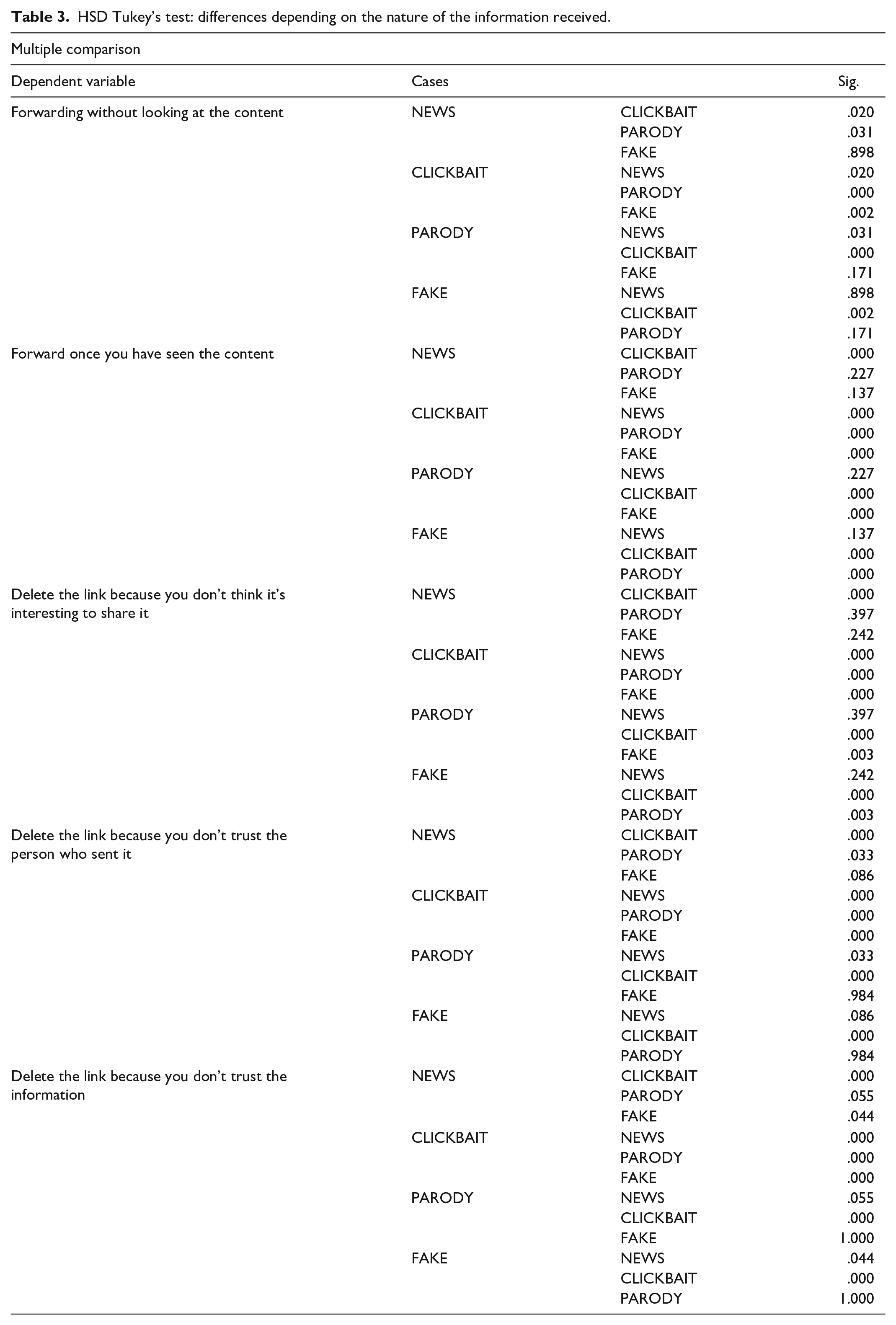
As one delves deeper into the behaviors of digital content, one determines that there is content that functions in the same way, regardless of its nature. In relation to the item “Forwarding without looking at the content,” Case 1, relating to reliable information, and Case 3, to parodic information, function similarly to Case 4, which relates to the most unreliable information of all (see Table 3, in which p-values are greater than .05), with no statistically significant differences obtained. As can be seen in Table 4, averages are obtained in a range of 1 (never) and 2 (surely not). Case 2, however, which corresponds to clickbait content from YouTube, works differently from all the others. With an average of M = 1.2, it is the closest to the value never. This suggests that if the content does not attract the attention of young people, they do not forward it, regardless of the veracity of the content. As mentioned above, the results seem to indicate that this form of content, with a news structure, is not very common or viral in WhatsApp.
HSD Tukey’s test: differences depending on the nature of the information received.
Descriptive statistics on teens’ behavior when receiving different informational contents through WhatsApp.

A: Forwarding without looking at the content.
B: Forward once you have seen the content.
C: Delete the link because you don’t think it’s interesting to share it.
D: Delete the link because you don’t trust the person who sent it.
E: Delete the link because you don’t trust the information.
As for the item “Forward once you have seen the content,” the sharing behavior changes. Case 2 (CLICKBAIT) is again the only one that differs completely from the other cases (see Table 3, p-value less than .05). However, it is worth noting that no statistically significant differences are detected between Case 1, true content, Case 3 and Case 4, parody and fake news, respectively. An analysis of the averages (Table 4) shows that they approximate a score of 3, which reveals that young people are not sure whether they will share, even after checking the content. However, on one hand, Case 4, fake news, is slightly different from Case 3, parodic, with statistically significant differences between the two cases (see Table 3, p-values of less than .05). Table 4 shows the averages that reveal a tendency for teenagers not to share the parodic information, Case 3 (PARODY), M = 2.97, versus the less truthful content, Case 4 (FAKE), M = 3.32. On the other hand, Case 4, the least reliable content, behaves similar to Case 1, the most truthful. This last case is very striking.
As for the option “Delete the link because you don’t think it’s interesting to share it,” Case 2 is the one that induces a totally different response from the rest, with an average value of 3.45 (Table 4). Table 3 reveals that p-values are lower than .05 when contrasted with the rest of the cases. Looking at the averages it seems that there is a positive tendency to delete the content if you do not find it interesting in all cases (see Table 4). Returning to the comparison between cases (Table 3), we can see how case 1 (NEWS) again behaves similarly to Case 3 (PARODY) and Case 4 (FAKE), despite, as already mentioned, corresponding to information of very different natures. This is reinforced by the study of the average values which are between 2.5 and 2.8 for the three cases. In these cases, the intention to delete the information from the application is not as strong.
This trend is maintained in the items “Delete the link because you don’t trust the person who sent it” and “Delete the link because you don’t trust the information.” As can be seen, Case 2 (CLICKBAIT) behaves differently from the rest (see Table 3, p-values less than .05). Teens are not sure if they would delete the link or not. This dubious information from YouTube would be the first to be deleted if the receiver does not trust the sender or the content. If we look specifically at the item “Delete the link because you don’t trust the sender,” Case 4 (FAKE) behaves similarly to Case 1 (NEWS) and Case 3 (PARODY) (see Table 3, p-values greater than .05). That is, users say that they would probably not delete the information received if they trusted the sender. However, the last two cases, Case 1 (NEWS) and Case 3 (PARODY), behave differently (see Table 3, p-values less than .05), and the parodic content would be deleted before the truthful one if the subjects do not trust the sender. This same trend applies to the item “Delete the link because you don’t trust the information,” in which they would probably not delete the link, as a consequence of trusting the information.
On the basis of these results, it was found that the appearance of information presented as news (headline, image, being published on a digital portal, etc.) ensures that, regardless of the nature of the content, this information is more likely to be shared among teens. Therefore, digital content in the form of news appears to be more credible. The above results, which show clear differences between Case 2, dubious content on YouTube, and the rest, is the evidence that underpins the above. The information in Case 2 (CLICKBAIT) is presented using a different structure from the rest, which makes the subjects more distrustful, linking it to more conservative, that is, less impulsive, behavior when it comes to sharing and forwarding. Faced with this information, young people were more careful. Moreover, one could ask whether the influence of the information being linked to a problem with considerable moral implications, of direct physical mistreatment of a subject, would cause this refusal to share even if the content was presented in video form supported by a commonly used social network among young people such as YouTube.
Reasons Why Teens Share Informative Content Through WhatsApp
First, by conducting an overall analysis of the reasons why young people indicate that they share certain digital content, as can be seen in Table 5, the average results obtained for the different items indicate a predominance of information-related reasons such as “to inform others” (M = 3.59) and “because I find it interesting” (M = 3.16) over interpersonal ones such as “for entertainment” (M = 2.68) or even “for popularity” which turned out to be the lowest value, close to the minimum value (M = 1.38). These results rule out popularity as one of the key reasons for sharing information and denotes, a priori, a young population more concerned with consuming and producing information when sharing digital information than leisure or entertainment.
Descriptive statistics on reasons why teenagers share informative content through WhatsApp.

In the search for differences regarding the reasons why young people shared the information, the results extracted from the ANOVA indicate that there are statistically significant differences between the four cases (see Table 6).
Results of the ANOVA test on the different reasons why teenagers share informative content through WhatsApp.
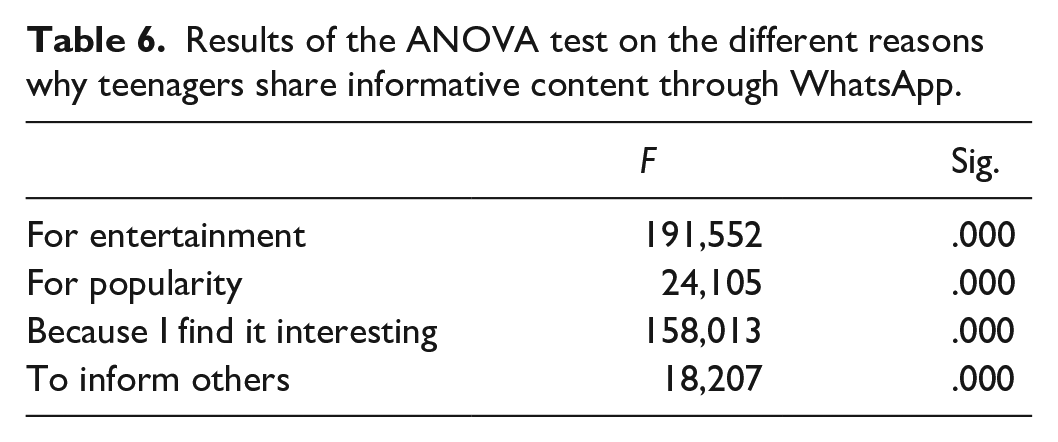
By studying each of the cases independently, the results shown in Table 7 were obtained. First, in relation to entertainment as a driver of sharing behavior, statistically significant differences were obtained between all the cases (see Table 7, p-values less than .000). Case 1, linked to accurate information, is the one they would probably share for entertainment, reaching the highest average score, with an average value of 3.7 (see Table 8). Case 3 (PARODY) and Case 4 (FAKE) yield an average ranging between 2 (probably not) and 3 (not sure), while Case 2 is located in the range between 1 (no, never) and 2 (probably not). So, Case 2 (CLICKBAIT) ranked the least likely to be shared for entertainment.
HSD Tukey’s test: differences of reasons depending on the nature of the information received.

Descriptive statistics on reasons why teenagers share informational content through WhatsApp.

A: For entertainment.
B: For popularity.
C: Because I find it interesting.
D: To inform others.
Thus, in terms of the motivation to achieve greater popularity, the analysis of the average scores for each of the cases (see Table 8) confirms the general trend described above, falling within a range of 1 (never) and 2 (probably not). This indicates that popularity is not a reason why young people would share this type of information. Specifically, no statistically significant differences were drawn between Case 3 (PARODY) and Case 4 (FAKE) (see Table 7, p-values greater than .05); however, there were significant differences between the remaining cases (see Table 7, p-values less than .01).
With regard to the reason “Because I find it interesting,” it is observed that, for all cases, statistically significant differences were found (see Table 7, p-values less than .000). In terms of the average values in the different cases, Case 2 (CLICKBAIT) stands out, with the lowest average (M = 2.1), compared with the rest of the cases with values of M = 3.9, M = 2.42, and M = 3, for Case 1 (NEWS), Case 4 (FAKE), and Case 3 (PARODY), respectively (Table 8). This suggests that the young people surveyed do not consider Case 2 (CLICKBAIT) to be interesting enough to share. This coincides with the results of the previous scale, where it was observed that digital information in the form of news appears as more truthful and interesting to young people, and therefore more viral, than those formatted differently, as is the case of YouTube content. In addition, it is worth noting the possible relationship between young people’s impulse to share and the content they receive, where there is less impulse when the information attacks subjects or damages their image.
Finally, in relation to the motive “To inform others,” taking into account the differences between cases, it is noted that Case 1, true news content, and Case 4, false information, behave exactly the same when it comes to informing others (see Table 7, p-values greater than .05). In addition, their average results (Table 8) also show similar values with M = 3.8 and M = 3.7 for Case 1 (NEWS) and Case 4 (FAKE), respectively. This once again highlights the fact that when information is presented in the form of news (in terms of its structure), young people are not able to differentiate between them by their veracity, which highlights the power of fake news and the vulnerability of young people in the face of it. As for the rest of the cases, Case 2 (CLICKBAIT) and Case 3 (PARODY), they also show similar behavior patterns in connection to the reasons why young people share the information (see Table 7, p-values greater than .05), also showing their averages and similar values (M = 3.36) (Table 8).
Conclusion
This study, which aimed to find out whether teenagers are contributing to the problem of the spread of disinformation with their habits and behavior, particularly when they exchange content through WhatsApp, allows us, thanks to empirical data, to identify their motivations for sharing, something that has not been researched until now. We can say that these users act on WhatsApp moved by the power of attraction of conspicuous, emotional, or outrageous language to camouflage hoaxes, rumors, or manipulations, under the guise of reliable information. Using narrative persuasion techniques, disinformation influences the behavior of teens, who, seduced by a new, provocative, or suggestive content, are helping—probably due to ignorance—to the distribution, and sometimes virality, of false, erroneous, or unverified information, as pointed out by Middaugh (2019). Therefore, this research confirms that teenagers belonging to the province of Seville, the capital of the Autonomous Andalusia Community (the most inhabitants in Spain), are not able to discern the veracity of the content when a false information has the appearance or structure of the news, because the language used deceives them, which highlights the power of fake news and the vulnerability of teens to them, as stated in the literature. Hence the need for this author to focus on these users, so that they stop being, as Schulten (2015) said, “digital naïve” and become conscious consumers of information as Spratt and Agosto (2017) demand. Although teens surveyed assure that they do not share information without looking at what it consists of, in addition, they declare that, for this, they have to trust both the information itself and the people with whom the young people are connected in WhatsApp, as pointed out by Talwar et al. (2019).
However, the data extracted are, in some aspects, encouraging, as it seems that among the motivations of teenagers when sharing certain content, popularity is not the main one. Thus, when faced with clickbait-type content on YouTube, about a child who apparently receives a beating, they display a certain reluctance to share it. Although, on the contrary, probably resulting from their ignorance or naivety, teens share with the intention of “informing others” contents of their interest, which affects them or which is very spectacular (Figueira & Oliveira, 2017; Loos et al., 2018; Notley et al., 2017; Sbardella, 2017; Tickle, 2018; Wineburg et al., 2016). It is also possible that, within this eagerness to inform others underlies, as Marwick (2018) and Fernández and Fernández (2017) pointed out, the need to reaffirm one’s identity or to convey certain affinities, ideologies, or interests. Considering that the surveyed teenagers would share the fake news of Case 4 (FAKE) content with a clear ideological purpose, the latter would pose a risk, because as McDougall et al.’s (2018) report highlighted, young people settle into undemanding spaces, with no room for criticism or debate, where their attitudes are reinforced.
All these findings allow us to make decisions aimed at reinforcing critical thinking, so that, as recommended by Buckingham (2019), they employ all the critical and emotional energy that deception requires, specifically toward greater awareness in the use of WhatsApp, where the behavior tends to be more impulsive. It can be concluded, based on the results, that this application favors the exchange of content that enhances the confirmation bias of the teenagers surveyed, in an environment of trust—due to the possibility of selecting the contacts with whom they interact—in which relaxes the judgment on the reliability of the content received. In addition, that relaxed atmosphere would also favor that fascination that they claim to feel for the contents with an outrage language.
Finally, this study could be expanded nationally and internationally, as well as applied to other platforms that are also successful among teenagers’ users (YouTube, Instagram, TikTok, or Snapchat) to compare the correspondence between usage habits and motivations for sharing informational content in those contexts and in WhatsApp.
Supplemental Material
Appendix_A – Supplemental material for Teens’ Motivations to Spread Fake News on WhatsApp
Supplemental material, Appendix_A for Teens’ Motivations to Spread Fake News on WhatsApp by Paula Herrero-Diz, Jesús Conde-Jiménez and Salvador Reyes de Cózar in Social Media + Society
Footnotes
Declaration of Conflicting Interests
The author(s) declared no potential conflicts of interest with respect to the research, authorship, and/or publication of this article.
Funding
The author(s) disclosed receipt of the following financial support for the research, authorship, and/or publication of this article: This study was partially funded by the European Commission/Erasmus+KA201 (project code: 2019-1-ES01-KA201-064365). SPOTTED—School Policies to Tackle and Detect fake news.

Supplemental material
Supplemental material for this article is available online.
Author Biographies
References
Supplementary Material
Please find the following supplemental material available below.
For Open Access articles published under a Creative Commons License, all supplemental material carries the same license as the article it is associated with.
For non-Open Access articles published, all supplemental material carries a non-exclusive license, and permission requests for re-use of supplemental material or any part of supplemental material shall be sent directly to the copyright owner as specified in the copyright notice associated with the article.
