




Abstract
The prevailing presence of social media in the twenty-first century has changed processes of self-presentation. This study questions how Instagram users employ the platform’s tagging features to claim and seek status. Content analysis on a random sample of 787 posts carrying the hashtag “instagood” revealed that they utilize the tagging affordances to make their audience aware of their capital. In addition to displaying their capital through tags, however, users employ hashtags and account tags to increase their visibility on the platform. Interestingly, analysis shows the prevalence of attempts to conceal these obvious paratextual status-seeking strategies. Over half of the Instagram posts in the sample showed traces of the creators taking active steps to hide their use of like-hunter hashtags, through which users explicitly ask other Instagrammers for likes and follows. This finding builds upon Marwick’s concept of aspirational production: The perfecting of one’s online presentation does not only happen by producing a high-status image, but also by concealing the “inauthentic” nature of this production. Furthermore, the fact that traces of obvious status seeking can be found online implies that the lines between Goffman’s front- and backstage are blurred in the digital age.
Status claiming and seeking on social media has been an interest of scholars for years (e.g., Abidin, 2016; Gandini, 2016; Scolere et al., 2018). In particular, the “free photo and video sharing app” Instagram forms an intriguing research site for studying status performance (What is Instagram?—Instagram Help Center, n.d.), as the platform culture is especially conducive for the building of a large follower base (Marwick, 2015). On the platform, users actively construct a visual profile of themselves. Some carefully craft every update they share with the intention of maximizing their status, which comes in first instance in the form of tangible status affordances, such as likes, follows, and positive comments (Marwick, 2013; Mau, 2019). Based on a threshold of status affordances, a select few are capable of turning their social media usage into a profit-making business (Duffy, 2017). As a vital part of seeking status, the cultivation of a profile is a labor-intensive process (Madianou, 2011). Nonetheless, Instagrammers go to great lengths to make their engagement with the platform seem effortless (Duffy & Hund, 2015). They downplay or even fully disregard the work that goes into creating desirable content, including staging a scene, editing pictures, and choosing the appropriate caption.
While the importance of considering platform affordances when studying social media has been widely acknowledged (e.g., DeVito et al., 2017), the existing literature on status performance rarely examines Instagram’s features in a systematic manner. To fill this gap, this study focuses on the various tagging affordances of the platform, including hashtags, account tags, and location tags, in attempt to answer two questions: (1) How do Instagram users employ the platform’s tagging features to claim and seek status? (2) How do they manage their self-presentation while using tags? After establishing a framework for understanding status and impression management, an analysis of 787 posts carrying the popular hashtag “#instagood” reveals that Instagrammers use the tagging affordances of the platform to construct a high-status image of themselves. Simultaneously, however, the study finds that Instagram users obscure the usage of tags that increases their visibility, which indicates that Marwick’s (2013) notion of aspirational production does not only include the creation of a high-status profile, but also the concealment of the labor required to produce that profile. These two findings present a tension; as Instagrammers use tags to claim status, they simultaneously obscure those same tags. The discussion of this tension advances the conversation on front- and backstage in the Instagram era (Goffman, 1967). Despite users’ attempt to separate their front- and backstage by obscuring tags, the context of the platform does not allow for that, causing the lines between the public and the private to blur.
Background
Social Status and Symbolic Capital
This study looks at social status in terms of symbolic capital, which is the term Pierre Bourdieu (1993) used to describe one’s reputation and legitimacy. Most generally, the term capital refers to resources that are beneficial to the individual possessing them. Bourdieu distinguishes between four types of capital, of which symbolic capital is arguably closest to status. This is “a form of power that is not perceived as power but as legitimate demands for recognition, deference, obedience, or the services of others” (Swartz, 1997, p. 90). Status, or Bourdieu’s symbolic capital, differ from, for example, income and social class. While someone can have high social esteem or prestige, through their position in a community, they might not be wealthy at all.
The process of status seeking involves a transformation of social, cultural, and economic capital into symbolic capital. Capitals, according to Bourdieu, appear “in a wider system of exchanges whereby assets of different kinds are transformed and exchanged within complex network or circuits” (Moore, 2008, p. 99). For example, economic capital might give one access to high-quality education, which, in turn, provides them with cultural and social capital. Symbolic capital interacts in a more complex way with the other forms of capital. David Swartz (1997) points out that “symbolic capital obtains from the successful use of [all] other capitals” (p. 92). Symbolic capital is a largely invisible form of capital that complements the more visible forms of economic, social, and cultural capital.
Even though symbolic capital is ascribed by others, Thorstein Veblen’s (1899) theory on “conspicuous consumption” suggests that people can take an active role in their acquisition of symbolic capital. According to Veblen, the deliberate expenditure and exhibiting of wealth through consumption is a clear manifestation of status. By blatantly displaying a product that is widely known to have great monetary value, one can demonstrate their economic well-being, which leads to social recognition. In the vein of Bourdieu’s capital, while conspicuously consuming, people use their economic capital to garner symbolic capital.
Impression Management
Following Veblen’s conspicuous consumption, people actively attempt to influence the impressions others of them through their self-presentation, which they monitor through a multiple-part process (e.g., Cooley, 1902; Leary & Kowalski, 1990). The impression management model described by Leary and Kowalski (1990) consists of two parts: impression motivation and impression construction. The process of becoming motivated to manage one’s impressions includes determining the relevance of impressions for their personal goals, the value of those desired goals, and the discrepancy between the desired and current image. According to Leary and Kowalski (1990), even “without consciously considering how others might be perceiving them, people nonetheless scan the social environment for information regarding how others regard them” (pp. 36–37). Hence, impression motivation originates from one’s understanding of how others view them. Following impression motivation, impression construction consists of five determinants: (1) self-concept, which is how one views one’s self; (2) desired and undesired identity images; (3) role constraints, which refers to the expectations of social roles; (4) how people want to be seen based on perceived values of significant others; and (5) the social image one believes they give off currently. In the last 20 years, concepts as the self-monitoring process have been applied to the context of computer-mediated communication and social media, which arguably allow people to engage more directly with the image they give off (Madianou, 2011; Walther, 2007). Since the majority of platforms request users to build a profile of themselves, platforms encourage users to engage constantly with the cultivation of one’s online presentation. In that way, social media profiles function as a mirror displaying the constructed presentation.
According to Goffman (1967), the context where this process of self-presentation and impression management takes place is essential to consider. Using dramaturgy as a metaphor for impression management, Goffman views the world as a stage where social actors perform different roles. Depending on the audience (family, friends, teachers, managers, etc.), people take on different versions of themselves. He specifically differentiates between the front- and backstage, where the former entails a public and the latter a private performance. On the backstage, there is no audience and, thus, provides the performer an environment to recharge in preparation for the frontstage. Several scholars have applied Goffman’s theorizing on the front- and backstage on social media platforms (e.g., Brems et al., 2017; Marshall, 2010). According to Marwick and boyd (2011), managing different audiences has become harder as a result of social media. Following their interviews with Twitter users, they argue that “like many social network sites, Twitter flattens multiple audiences into one—a phenomenon known as ‘context collapse’” (Marwick & boyd, 2011, p. 122). Subsequently, users change their self-presentation based on their imagined audience.
Status Seeking on Social Media
Status seeking on social media has been widely studied in terms of personal branding, which is a particular form of deliberate self-presentation that requires clear distinction between front- and backstage (e.g., Gandini, 2016; Khamis et al., 2017; Scolere et al., 2018). Personal branding concerns the adoption of a production and promotion strategy that resembles “the (waged) work of traditional media producers, including journalists, video producers, advertisers, and publicists” (Duffy, 2017, p. 8). Strategizing as such is a highly labor-intensive process that covers both careful content production for particular imagined audiences and content promotion, such as intentional planning of content publication and building a far-reaching network. Those who practice personal branding can be called “micro-celebrities,” which is a term Theresa Senft (2013) coined to describe “the commitment to deploying and maintaining one’s online identity as if it were a branded good, with the expectation that others do the same” (p. 346). Micro-celebrity has the property of a verb rather than a noun, meaning it is something that people do rather something they are. It requires the deliberate construction of an appealing online presence and adoption of techniques to increase attention. It is, thus, a set of behaviors rather than an ascribed identity, which means that the micro-celebrity status does not necessarily require a large audience and any social media user can enact these practices. The labor users put into creating and maintaining that online presentation, particularly to simulate the online presence of celebrities, is what Alice Marwick (2013) calls “aspirational production.” By, for example, photographing themselves in a way that resembles the style of paparazzi, social media users work to “portray themselves in a high-status light” (Marwick, 2013, p. 122).
For some Instagram users, the objective of personal branding entails economic capital in addition to symbolic capital (e.g., Abidin, 2016; Duffy, 2017). This subset of online content creators hopes to use social media platforms as a springboard into a career. In her book, Duffy (2017) coins the term “aspirational labor” for the unpaid labor as well as the ideology behind the aspirational influencer accounts (p. 4). The labor is similar to the personal branding strategies described earlier, but it tends to be more intentional: they aim to turn their passions into profit-generating businesses. Through a variety of practices, aspirants deliberately create audience-oriented contents that follow a predetermined strategy for one’s online personal brand. Similarly, Abidin (2014) finds similar practices among Singaporean lifestyle bloggers who already monetize Instagram. She argues that “performing commercial personas on Instagram is strenuous because a lot of effort is needed to ‘manufacture’ a persona that is desirable” (Abidin, 2014, p. 126). Ultimately, it is the acquisition of likes, follows, and other metrics of one’s online status that defines success, especially since marketers typically require “a baseline level of followers or commenters” to be eligible for an advertising partnership (Duffy, 2017, p. 78). This reinforces the prevalence of status affordances.
Performing Authenticity on Social Media
Even though personal branding and aspirational production require enormous amounts of time and energy, aspiring influencers on Instagram and other platforms tend to divert attention away from this labor (Abidin, 2014; Duffy, 2017; Duffy & Hund, 2015). In their qualitative analysis of top US fashion blogs, Duffy and Hund (2015) discovered that, on their blogs, “bloggers tended to downplay the discipline and investments that go into this mode of self-production” (p. 4). According to Jenny Davis (2014), people mask identity labor to achieve what she calls the ideal–authentic balance, which “entails accomplishing a particular version of the self, but doing so in a seemingly natural way” (p. 505). Davis considers an authentic performance on social media to be in line with one’s self-views and personal values. Following this understanding, authenticity is reached when consistency is found between one’s inner belief and outside actions. At the same time, Davis (2014) argues that we tend to create an ideal image of ourselves, displaying strengths and qualities. The so-called ideal–authentic balance refers to the optimal middle ground between one’s authentic self and ideal presentation. This explains Duffy and Hund’s (2015) finding that female bloggers “utilize a series of interrelated tropes—predestined passionate work, staging the glam life, and carefully curated social sharing— to depict” a particular desirable lifestyle, while obscuring “the labor, discipline, and capital necessary to emulate these standards” (p. 2). While their self-presentations seem effortless on the blogs, Duffy and Hund (2015) discover through interviews with the bloggers that their online presence is far from effortless, as it involves conscious impression management strategies.
While the scrutiny of performativity on online blogs and forums has been around since the late 1990s (e.g., Langellier & Peterson, 2004; McNeill, 2003), the question of authenticity changed in the light of (aspiring) influencers, as they pride themselves in being more accessible to and intimate with their audience than traditional celebrities (Marwick, 2013). In general, this intimacy leads to a type of material that audiences tend to perceive as more authentic. However, for several reasons, they risk being perceived inauthentic by their audience. The idea that a blogger has financial motivations for their social media activity can easily turn away followers, as it undermines their reputation as “naturally” relatable. Thus, bloggers actively navigate having “to maintain their Instagram personas without appearing too commercialized” (Abidin, 2014, p. 124). Similarly, the lack of personal content can lead to audience disapproval. According to Duffy and Hund (2019), (aspiring) influencers experience a “visibility mandate” (p. 4984), which is a social obligation to exhibit themselves and their lives to their followers. They attempt to create a relatable persona by sharing personal content, while simultaneously maintaining a level of privacy.
Affordance-Based Approach to Studying Social Media
Studies examining the balance between performing a high-status frontstage presentation, which is an integral part of status seeking on Instagram, and achieving a particular authenticity hardly ever take platform affordances as a central focus. Nonetheless, affordances have been understood to be fundamental to users’ behavior on social media (e.g., DeVito et al., 2017). Affordances are “the range of functions and constraints that an object provides for, and places upon, structurally situated subjects” (Davis & Chouinard, 2016, p. 241). In other words, affordances determine the parameters of user behavior on a given platform. This study examines how Instagram users operate tagging affordance to advance their self-branding.
According to DeVito et al. (2017), the new environment of social media platforms presents users with challenges for self-presentation. One challenge is, for instance, that other actors—such as friends and family—can play a larger role in an individual’s self-presentation, for example, by writing on one’s Facebook wall or tagging a picture. This leads to a decrease in control over one’s own self-presentation. Based on these challenges, DeVito et al. (2017) present a typology of self-presentation affordances: (1) presentation flexibility, (2) content persistence, (3) identity persistence, (4) content association, (5) feedback directness, (6) audience transparency, and (7) visibility control. Different social media encompass different self-presentation affordances, leading to platform-specific self-branding practices (Duffy et al., 2017). Duffy et al. (2017) find that users change their strategies based on how they understand a given platform’s affordances. These imaged affordances “are constructed through the interplay between platform features, assumptions about the audience, and the producer’s own self-concept” (Duffy et al., 2017, p. 7).
The category of affordances that directly relate to status seeking are what Marwick (2013) calls “status affordances,” which are “technical mechanisms that signal greater social status” such as likes, follows, and friends (p. 75). Their quantitative nature makes it easy to compare them across users. For some social media users, the quest to increase one’s status as indicated by these status affordances involves explicit strategies (Dorsch et al., 2017; Veszelski, 2016; Zhang et al., 2017). Veszelski (2016) looked at the relationship between the image of a post and the hashtags used in the caption, which resulted in the categorization of hashtags: (1) thematizing, (2) contextualizing, and (3) like-hunter hashtags. The concept of like-hunter hashtags relates directly to status seeking. This category of hashtags aims “to boost the number of views” (Veszelski, 2016, p. 141) as well as likes on the post and follows on the user’s profile. Examples include #followme, which asks other users to follow the creator’s profile, and #like4like or the abbreviated #l4l, through which users ask fellow users to engage in a reciprocal exchange of likes. Since like-hunter hashtags concern a highly visible status-seeking strategy, how do users using these hashtags balance an ideal and yet effortless presentation?
Research Context
Instagram and its Affordances
The photo- and video-sharing platform in Instagram provides a particularly compelling site for studying status, as Instagram is particularly conducive to status portrayal and seeking. Both terms, such as “followers” and “following” as well as the platform’s affordance of one-directional connections suggest a relationship that mimics one of a celebrity and a fan (Marwick, 2015). This way, the platform allows for the endless building of a network of followers. Besides, Instagram’s popularity continues to increase, unlike other social media platforms (Pew Research Center, 2018). In 2018, 35% of American adults use the platform, of which 60% open the application daily (Pew Research Center, 2018). The medium is especially popular among young adults: Pew Research Center (2018) reports that 71% of 18- to 24-year-old Americans have adopted Instagram.
The platform’s affordances allow users to upload a photo or video to their profile grid or to their story. A post on the profile grid consists of a visual—whether image or video—and a caption. Whereas the content on the story disappears after 24 hr, the grid remains on one’s profile until the user deletes the post or account. Users can react to content shared by those they follow by clicking the like button or commenting. In addition to the profile grid and the story, users can send each other content through direct messages. These are private by design, while the privacy settings of the profile itself can change to either a fully public or a fully private profile.
For content on the grid, Instagram has three main tagging affordances: (1) hashtags, (2) account tags, and (3) location tags. Hashtags are a commonly researched affordance of social media (Highfield & Leaver, 2015). Users can create these searchable tags by adding the pound sign (#) in front of a word or phrase without spaces between each word. However, the function of hashtags “has morphed beyond findability and toward metacommentary,” where they carry the function to emphasize, to critique, to identify, to iterate, and to rally (Daer et al., 2014, p. 2). Account tags concern the tagging of other Instagram accounts. This can be done directly onto the image in any spot chosen by the user or by naming the account in the caption preceded by the “at sign” (@). Finally, the location tag feature allows users to tag a location at the top of their post. The possible locations range from a geographic region or a city to a specific building or address, such as a restaurant or a gym.
#Instagood
In accordance with Highfield and Leaver (2015), this study takes a hashtag “as an initial point of departure for studying activity on Instagram” (p. 18). As #instagood is one of the most popular hashtags on the platform (“The Ultimate List of the Most Popular Instagram Hashtags on the Planet,” 2018), the sampling frame of this study presumably includes posts created by a wide variety of Instagrammers, setting this study apart from studies solely focused on aspiring influencers (e.g., Abidin, 2014; Duffy, 2017).
Originally, the term “instagood” was coined in 2011 as the name of shout-out accounts on various social media platforms (Instagood [Facebook account], n.d.; Instagood [Instagram account], n.d.; Instagood [Tumblr account], n.d.). Like other shout-out accounts, the @instagood accounts feature a selection of Instagram posts that mentioned the hashtag #instagood. In other words, by including “#instagood” in their caption, Instagram users would enter their post into a pool of posts from which the owner of the @instagood accounts would choose posts to share. Thus, #instagood started off as a direct form of status seeking, since it was a way to increase one’s chances to be featured on the @instagood social media accounts, and therefore, increases the chance of being seen by a larger audience. Being featured on the accounts is a marker of status in itself, since only a select group of posts are chosen to be featured. In addition, the increased visibility might lead to an increase in likes, follows and other markers of status, as the owners of the instagood accounts give explicit credit to the original creators of the posts.
While the shout-out accounts provide reasons to suspect that Instagram users contributing to #instagood do so to increase their status, it is unclear how many Instagram users still use the hashtag nowadays with the goal to grab attention of the owner of @instagood. The explanations of #instagood in popular media refer to it as a label for users’ best pictures, ones they are “particularly proud of” (Johnston, 2018). Therefore, it is more likely that today #instagood is used as a self-acclaimed mark of quality and status. Then, this study examines how these Instagrammers display capital in their “instagood” posts. How do they use the platform to convince their fellow users of their quality? While presenting themselves to their fellow Instagrammers, what paratextual strategies do the contributors to #instagood employ to seek status and how do they manage their self-presentation?
Methods
Sampling
The sample used in this study included 295,522 public Instagram posts containing the hashtag #instagood, posted between 1 October and 31 October 2018. This sample was obtained by using the application Netlytic, which was set to extract 500 public posts mentioning #instagood every hour. The hourly collection of posts ensured that the collected data account for a wide variety of posts with the chosen hashtag. From the initial sample of 295,522 posts, data cleaning was applied to a random sample of 5000 posts. Data cleaning involved the exclusion of non-English posts due to the researcher’s limited language skills. Non-English posts were in part identified using the language detection function in Google Spreadsheet (2216 posts) and in part identified manually, where posts with multiple languages were also excluded (991 posts). Another 498 posts were excluded, since they had been deleted from Instagram between the time the data were extracted and the analysis was conducted. In addition, to select a sample relevant for identity-based research, the choice was made to exclude posts by third parties (parents, modeling agencies, etc.; 52) and advertisement posts (366). Finally, posts with videos rather than an image were excluded to allow for consistent analysis (91). The remaining 787 posts were then analyzed according to the framework described below.
Coding and Analysis
The final sample was analyzed using digital ethnographic content analysis (DECA). This method uses participant observation as the primary guiding factor for the process of data collection, coding, and analysis of online content (Altheide & Schneider, 2013; Barnard, 2018). In this study, participant observation informed the development of a coding system, which was tested in a pilot study. In addition to systematically coding posts in Dedoose, a computer-assisted qualitative data analysis software (CAQDAS), the pilot study entailed thorough content analysis of a theoretical sample based on past user experience, taking into account all aspects of the Instagram posts (image, caption, comments, user’s profile, etc.). The themes identified through the pilot study informed the development of the final coding system, which primarily focused on markers of status as well as traces of status seeking present in the posts. Ultimately, DECA allowed for the researcher to uncover patterns in both the Instagram platform and the content of the sample.
Coding fell into two types. The first concerned markers of status, including both built-in markers and alternative indicators of status. Each post was coded for number of likes as well as follows on the user’s profile. The posts were also coded for four less quantifiable status markers—product, location, self-objectification, and social capital—on a 3-point scale of conspicuousness from less conspicuous to highly conspicuous. If a particular type of capital was not present at all, the post was not coded for this type. Product refers to the presence of any (branded) commercial good, such as an iPhone or a designer handbag. Location refers to the visible presence of a location, either through a location tag or through clear portrayal of a place, for example, the colored houses of Copenhagen or the letters “Amsterdam.” Self-objectification concerns the portrayal of one’s body as a form of cultural capital. This code echoes what Ghaznavi and Taylor (2015) called sexual suggestiveness, which “includes alluring gaze, winking, flirting, posing sexually (e.g., one leg forward an lifted) or sexual teasing: unbuttoned or ripped or partially open clothing” (p. 57). In this study, for example, someone displaying their bare upper body was considered highly conspicuous, while someone wearing a turtleneck was considered less conspicuous. Social capital refers to the presence of other people. The second type of codes concerned status seeking. The posts were coded for number of obvious like-hunter hashtags, such as those mentioning like, follow, or shout out (e.g., #like4like, #followme, or #shoutout), as well as number of less obvious like-hunter hashtags, which are re-occurring hashtags with the primary function to increase the visibility of the post (e.g., #instago, #photooftheday, or #tweegram). Then, each post was coded for the location of the #instagood hashtag. The four options for that were at the top of the caption, at the bottom of the caption leaving line space between the text and the hashtags, in the comments, and deleted since creation of the post. The posts were also coded for number of accounts being tagged in the caption or image.
Ethical Considerations
The sample used in this study only includes public Instagram posts, which is content available to anyone with access to the internet, including those without an Instagram account. Due to the publicness of their profiles, the creators of the posts are considered to be at no greater risk than they encounter in their everyday activity online. Nevertheless, since there are significant tensions around this (see Highfield & Leaver, 2015; Townsend & Wallace, 2016), the author has taken reasonable precaution to protect the privacy of the creators of the content studied. This involves anonymizing the content and abstaining from referrals to any usernames, which easily identifies the content creator, and avoiding any other languages pertaining to demographics of Instagrammer (i.e., gender and race). Furthermore, usernames, profile pictures, and faces are obscured in all screen captures used in the published article. Finally, per Laestadius (2017), the researcher excluded “posts that have been deleted or made private” within a month after data collection (p. 13).
Findings
Status Claiming and Seeking
The Prevalence of Tagging as a Portrayal of Capital
Analysis of the sampled content revealed that Instagrammers regularly use the tagging affordances of Instagram to portray capital, which the post in Figure 1 exemplifies. This post is an archetype of the conspicuous portrayal of branded goods. The clothing and the associated brands are clearly the center of the post. The self-portrait shows the user in front of a plain wall, giving nothing to distract the viewers from the person on the picture and their clothing. By tagging the Instagram accounts associated with the brands in both the image and the caption, the user ensures their audience is aware of the brands they wear. The outright identification of the brand of each clothing item, both in the caption and through the placement of the tags in the photo, makes the post an ideal example of conspicuous consumption (Veblen, 1899). The account tags are used to display the consumed goods blatantly.

An example of an Instagram user conspicuously using account tags to display branded clothing.
The use of account tags in particular can have a commercial nature. While it is impossible to infer the users’ motivations from the posts in the sample, users might aim to establish a collaboration with a celebrity, modeling agency or a brand that they tag in their post. For example, aspiring influencers might hope to gain modeling work for a specific brand and, in that way, monetize their Instagram activities (see Duffy, 2017 for analysis on aspiring influencers). If that is the case, the goal of the tag is to increase not only symbolic capital, but also economic capital.
Similar to the post above, the user behind the post in Figure 2 used the tagging affordances to make their audience aware of their location: the Eiffel Tower in Paris. While the Eiffel Tower is not visible in the image, since the picture appears to be taken from the inside of the tower, the location tag and hashtags reveal that the user is indeed at this well-known travel destination. Without the presence of tags, the creator’s audience would probably not have known the location. Therefore, the tags expose the economic and cultural capital of visiting an affluent city that otherwise would have remained unknown.
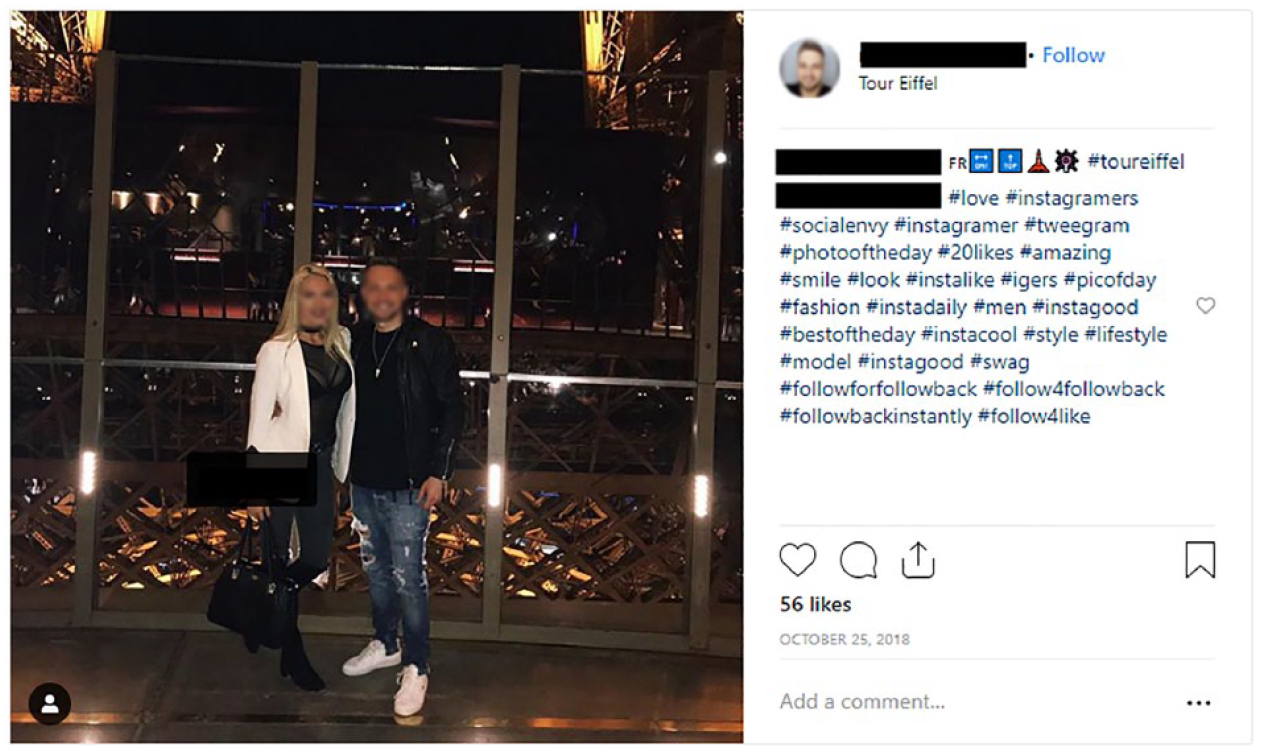
An example of an Instagram user tagging a well-known travel destination through the location tag and hashtags.
The posts shown in Figures 1 and 2 represent a trend of the way in which Instagrammers portray their capital. They establish their economic capital through displaying branded clothing items or a travel destination as well as their cultural capital to understand the cultural significance of the location, the brands, the pose, and the post more broadly. In addition to branded clothing, other posts showed similar patterns of portraying economic, social, and cultural capital through a focus on travel locations, their bodies, or their social networks. For example, a trend emerged of posts with a higher number of other personal accounts tagged, through which users can portray their social capital. Others tagged the photographer of a picture or the model in a picture, which might simply serve the function of giving credit to the respective photographer or the model. However, it also gives off the suggestion that the user has the economic and social capital to work with professionals.
The Prevalence of Tagging to Seek Status
In addition to claiming status, Instagrammers use the tagging affordances to increase the visibility of their posts and, thus, the status affirmation they might receive. This is most apparent in users’ usage of like-hunter hashtags, which explicitly ask for status affirmation in the form of a like, follow, or shout-out. For example, the Instagrammer behind the post in Figure 2 used the following like-hunter hashtags: #20likes, #followforfollowback, #follow4followback, #followbackinstantly, and #follow4like. A significant portion of the sample (43%) included at least one like-hunter hashtag in their post.
Another direct strategy to reach a wider audience is by tagging other Instagram accounts. Even though only 29% of the posts in the sample included account tags, it is worth taking a closer look at these posts, since it can be used as a direct way to increase visibility and indirectly, status affirmation. When a user tags another account, the tagged account receives a notification that they have been tagged in a post. Thus, by tagging other accounts, users can encourage other users to see their content. In that way, account tags have great potential to increase the visibility of the post.
Obscuring Status-Seeking Strategies
While examining the conspicuous use of the tagging affordance on Instagram, the iterative coding process revealed that hashtags and account tags were not always as easy to detect, despite all posts containing at least one hashtag: #instagood. This contradicts the finding that Instagrammers use the tagging affordance to claim different forms of capital, since if users claim capital through these tags, one would expect the tags to be extremely visible. The following section explores how users obscured their hashtags and account tags.
Obscuring Hashtags
The most conventional place for hashtags to be placed is in the caption, straight after the text of the caption is over, which was the case for 47% of posts in the sample. The other 53% of posts in the #instagood sample had hashtags incorporated in three other places, which were all less noticeable than the top of the caption. The first obscured location for hashtags is in a comment (11%). While the visibility of the post will still increase based on the hashtags, the comment with the hashtags will blend in with other comments. Since Instagram’s affordances automatically hide older comments beneath more recent ones, the comment with the hashtags is harder to find for the viewer of the post. The second location where hashtags are less visible is at the bottom of a caption, which requires the user to add a number of line spaces between the textual component of the caption and hashtags (27%). This way, the textual part of the caption receives attention, while the hashtags fall—as it were—off the screen. To be able to see the hashtags, the viewer of the post needs to scroll down and click on “see more,” which requires more effort than simply reading the hashtags on the top of the caption. The final method to obscure hashtags involves deleting them after posting (15%). While the hashtags are beneficial for the visibility of the post in the first couple of days, they are less so after time as the Instagram algorithms start to pick up on more recent posts to feature. By deleting the hashtags, a user basically hides the traces of their status-seeking behavior.
While placing the hashtags at the top of the caption is the method that occurred most often (47% of the posts), when grouping the data in terms of overtly displaying hashtags versus attempting to hide them, the majority of users in the sample place their hashtags in less noticeable places (53%). Since hashtags, especially like-hunter hashtags, are devices to increase visibility and attention for the post, the act of obscuring hashtags is an act of obscuring status-seeking behavior.
Obscuring Account Tags
Another opportunity within the Instagram platform for obscuring status-seeking behavior is the placement of account tags. Users can tag other accounts anywhere in the caption of the post, on the image, and in the comments. However, the primary places to tag accounts are the caption and the image. Similar to the hashtags, tags in the caption are most openly on display for other users. A common thread of accounts tagged in the caption are photographers, models, and sometimes brands. It appears that, if a user wants their audience to see the tagged accounts, they add the tag to the caption. That way, the user ensures that their audience sees the tags by simply just scrolling past their post.
In contrast, the tags in the image remain invisible until the viewer clicks on the button in the left bottom corner of the image. Therefore, by tagging in the image rather than in the caption, a user is able to make it slightly more difficult for their audience to see the accounts tagged. An apparent trend in the sample is that users often tag topic-specific accounts in the image, such as accounts that are dedicated to nature photography, music festivals, or make-up, such as in Figure 3. The user of this post tagged accounts in their photo featuring eyes with an extensive makeup design. At the bottom of the photo, they tagged brands as well as two accounts related to the topic of makeup. The two accounts, @100daysofmakeup and @w7makeupuk, explicitly request in their respective profile bio to tag the account in makeup-related posts to get featured on those same accounts. Presumably, the function of tagging these accounts is thus to seek endorsement and increase visibility.
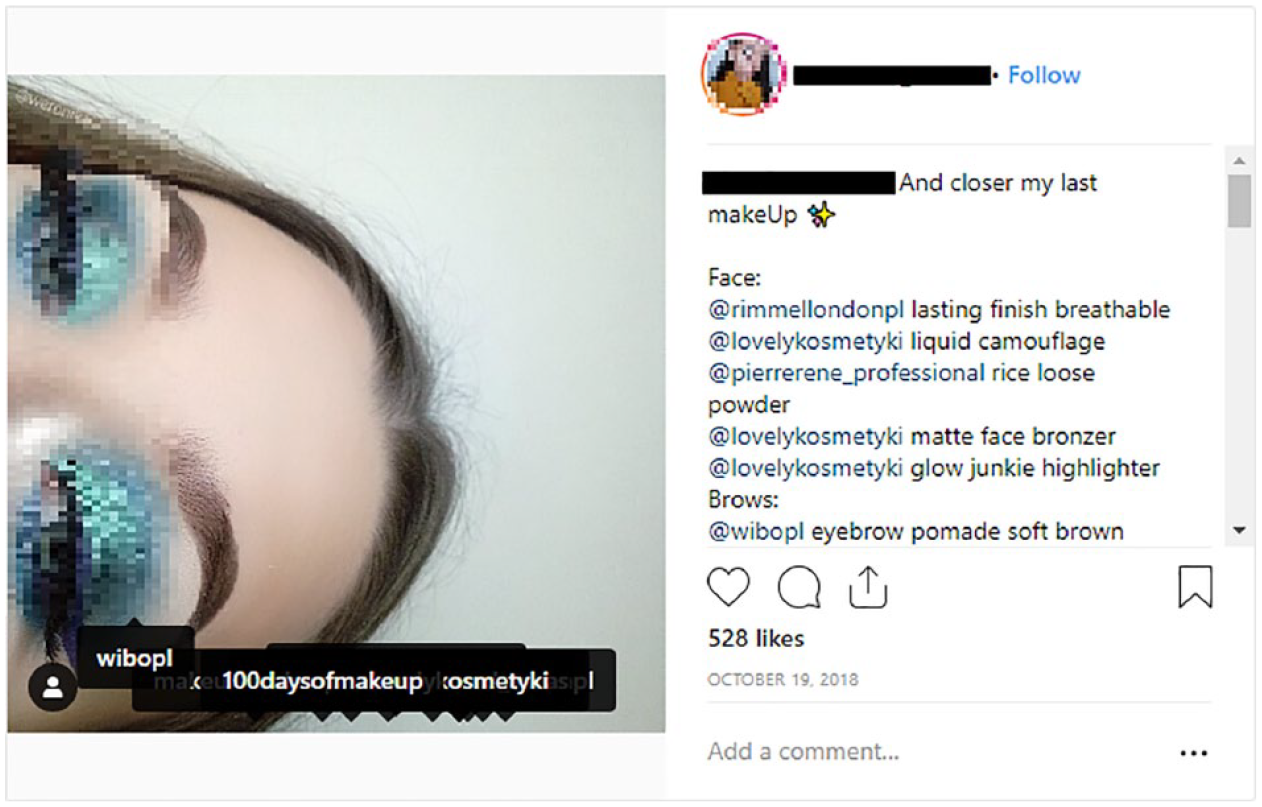
An example of a user placing the account tags in a way causing them to overlap.
The variety of places Instagram users tag accounts within the image suggests that they want some tags to be more visible than others. Moving different tags over each other or all in one corner makes it more difficult for the viewer to detect which accounts have been tagged. The post in Figure 3 exemplifies this. In contrast, tags spread out over the image are more visible, which is beneficial in the case of portraying one’s capital by tagging brands or friends.
Discussion
The findings of this study expose a paradox. On one hand, Instagram users take advantage of the platform’s tagging affordances to portray their status. Users in the #instagood sample presented here extensively use the feature of location tags, hashtags, and account tags to advance their self-presentation, particularly by displaying different forms of capital. They ensure that their followers associate them with expensive brands, exclusive locations, such as travel destinations or high-status restaurants, and a significant social network. This aligns with Marwick’s (2015) analysis of Instagram profiles with over 10,000 accounts, which exposes that prevalence of micro-celebrity practices among users to augment their popularity on the platform. By tagging costly goods and locations indicating activities, Instagrammers engage in conspicuous consumption as part of aspirational production (Veblen, 1899). Thus, they employ location tags, hashtags, and account tags to portray their capital blatantly and create a high-status image.
On the other hand, this study’s findings demonstrate that Instagrammers engage in behavior that obscures their usage of some hashtags and account tags. Particularly, users concealed their hashtags by placing them in comments, by leaving space between their caption and the tags, and by deleting them after posting. Similarly, it required additional energy to trace back the usage of account tags in posts when the tags were all placed on top of one another in a corner of the image. The finding that users obscure tags suggests that the usage of the tagging affordance is more complicated than simply contributing to one’s high-status profile. While users in some cases place their tags in conspicuous places, in which they clearly contribute to the user’s high-status image, users apparently feel the need to obscure their tagging behavior in other cases. Even though analysis of the content used in this study suggests that like-hunter hashtags in particular are frequently hidden, future research should investigate which tags users place conspicuously and which ones they tend to obscure. A quantitative study on the meta-data of Instagram posts could potentially identify patterns, clarifying the relationship between type of tag and the way the user treats the tag.
The paradox of visible and obscured tagging implies the interplay of two competing mechanisms: the “effort to evoke the aura of an unattainable brand,” which Marwick describes in the term aspirational production, and the effort to obscure the traces of that same brand building. These competing mechanisms are represented in Davis’ (2014) notion of the ideal–authentic balance, which entails creating a particular version of oneself while making the process of doing so seem effortless. The usage of like-hunter hashtags and account tags suggests that users actively strive for a high-status profile, manifested in a high number of followers and likes. Obscuring these tags is, thus, the obscuring of the suggestion that the Instagram users engaged in active labor to construct a particular self-presentation. According to Davis (2014), the suggestion of this labor affects their ability to claim authenticity, which “refers to an uncalculated core, an unmediated guide for the actor’s inner thoughts and emotions, such that outward actions are mere reflections of what lies inside” (p. 505). Consistent with this definition, it is the inauthentic portions of their online presence that Instagram users hide when they conceal like-hunter hashtags and account tags, as these portions clearly indicate calculated identity work. Ultimately, this demonstrates that perfecting one’s online presentation does not only happen by producing a high-status image, but also by concealing the “inauthentic” nature of this production. In conceptualizing aspirational production, Alice Marwick (2015) solely focuses on the active ways in which social media users portray themselves “in a high-status light, simulating the attention given to celebrities” (p. 156). However, this study’s sample of #instagood posts reveals that aspirational production does not only include the production of a celebrity-like profile, but also the hiding of the labor required to produce that profile.
Front- and Backstage in the Instagram Era
The obscuring of tags implies that Instagrammers might not want their audience to see them. In terms of Goffman’s (1967) distinction between the front- and backstage, they presumably want their usage of the platform’s tagging affordance to be part of their backstage work. The backstage is where users prepare for their frontstage performance. The archetypical preparation of an Instagram post can include applying make-up, trying different poses, or choosing a filter. This contrasts the self-presentation that users construct on their profile, which is clearly part of their frontstage appearance. Interestingly, while hashtags and accounts appear on the public profile, the hidden locations of these tags indicate that users do not regard them part of their frontstage performance. However, the configuration of affordances of the Instagram platform makes that the tags have to be part of the frontstage self-presentation. Simply due to the public nature of the public Instagram profiles, the identity work is more public, which is observable in the hidden tags. This advances Duffy and Hund’s (2015) study on fashion bloggers’ self-presentation, which implied that the bloggers are able to separate their backstage from their frontstage performance by deliberately deciding which content to include and to leave out. In contrast, this study shows that despite Instagram users’ attempt to separate their front- and backstage, the context of the platform does not always allow for that.
The existence of traces of backstage labor on the frontstage suggests that Instagram, and possibly social media more generally, has blurred the lines between the front- and backstage. Due to its particular configuration of affordances, where tags have to be visible in some sort of way, Instagram has pushed some backstage preparation onto the frontstage. This leads to users having to put in additional labor to keep their front- and backstage separated, which entails the hiding of tags. In other words, they have to make sure actively that their backstage behavior does not spill over onto the frontstage. This furthers the discussion on context collapse in the digital age (Marwick & boyd, 2011), since it implies that social media users are not only attempting to differentiate between different imagined audiences, but also between the public and private environments. In other words, the context of the backstage collapses with the context of the frontstage.
The Power of Affordances
A tension appears between the public nature of Instagram tags and the users’ desire to keep their tagging behavior on the backstage. By obscuring the hashtags and account tags, users attempt to resolve this tension. From placing the hashtags in the comment section or below the “see more” button to revisiting a post to delete the hashtags, Instagram users go out of their way to cover up these traces of identity labor. This attests to the strong influence that social media platforms have on user behavior through the design of affordances (Davis & Chouinard, 2016). In this particular case, Instagram causes users to face different levels of resistance when attempting to obscure their usage of tagging. For example, Instagram allows users to edit and delete published content, including comments, captions, and entire posts. Users, thus, do not face any resistance in polishing their content, even after publication. Similarly, Instagram users do not face any resistance when attempting to place hashtags in the comment section instead of in the caption. In contrast, however, users face more resistance when wanting to create a space between the text and the hashtags within the frame of a caption. By automatically deleting any empty lines, the platform refuses to allow for any empty space in the caption. However, users hacked this affordance by placing periods as a way to trick the algorithm into believing they wrote full-fledged sentences. They ended up making use of the way Instagram chops off part of the caption and hides that segment of the caption under the “see more” button. By using periods, users insert their agency and use the platform’s affordances to their advantage.
By allowing users to edit published content, to place hashtags, and to break up part of the caption under the “see more” button, Instagram supports the limitless polishing of profiles and, indirectly, the culture of perfection. While this study gives clear indication of the lines between the front- and backstage blurring, Instagram makes it easier for users to exercise power over their self-presentation. The social media platform normalizes the close monitoring of one’s past and current online presence. Arguably, this culture is further strengthened by the option to overlay images with one of 23 filters. Recently, Instagram has been testing different changes to the affordances of their platform. Particularly, over the course of 2019, the platform removed the like count for a select group of users. This raises questions on how people adapt to newly implemented affordances. Building on the findings of this study, future research might look at the prevalence of like hunting and the hiding thereof as Instagram implements different affordances.
Conclusion
Through the lens of Bourdieu’s concept of capital, this study examined how Instagram users claim and seek status. In addition to simply displaying a high-status lifestyle in the content of the post, contributors to the hashtag #instagood employed the affordances of the Instagram platform to make their audience aware of the social, economic, and cultural capital they possess. In particular, Instagrammers used the different tagging features—hashtags, location tags, and account tags—to overtly name status indicators, such as brands and exotic travel locations. This exemplifies how Veblen’s concept of conspicuous consumption manifests itself in the digital age. In doing so, Instagram users employ the platform’s affordances to display the purchased goods and seek recognition by their peers. Behaviors, such as these are micro-celebrity practices, as users calculate “their popularity based on status update” likes and comments (Senft, 2013, p. 349).
The blatant usage of tags to claim status contradicts the finding that Instagrammers actively attempt to hide their (like-hunter) hashtags and account tags. The act of obscuring these tags reveals that aspirational production includes not only the construction of a high-status image, but also the concealment of the “unauthentic” strategies to produce this image. In a larger theoretical context, the fact that traces of obvious status-seeking behaviors are visible on the public realm of Instagram implies that it has become harder to differentiate between the front- and backstage. Nonetheless, users engage in active behavior to keep their backstage behavior private by concealing their hashtags and account tags. For the most part, Instagram’s affordances allow for this concealment, for example, by providing the option of revising published content. Through these affordances, Instagram normalizes the platform culture of constantly polishing one’s presentation.
Footnotes
Acknowledgements
The author would like to extend their deepest gratitude to Stephen Barnard for their guidance and support, which was essential to the development of the research project. Many people provided detailed feedback at various points in the process, including Aaron Shaw, Jeremy Birnholtz, Julia Fernandez, Erik Johnson, and Wendy Griswold. Finally, the author would like to thank the reviewers of Social Media and Society, Zizi Papacharissi, and the publications staff for their hard work and feedback.
Declaration of Conflicting Interests
The author(s) declared no potential conflicts of interest with respect to the research, authorship, and/or publication of this article.
Funding
The author(s) received no financial support for the research, authorship, and/or publication of this article.
