




Abstract
That Twitter is a major form of political mobilization and influence has been well documented. But what is the role of linked media—references to newspapers, photos, videos, and other external sources via URLs—in political Twitter messaging? How are linked references employed as campaign tools and rhetorical devices in messages published by political parties on Twitter? Is there a quantifiable relationship between a party’s ideology and linked media in tweets? With the spread of fake news, threats to a free press, and questioning of the legitimacy of political messaging on the rise globally, the sources on which parties draw to convince voters of their online messaging deserve critical attention. To explore the above questions, this article examines uses of linked media in tweets generated by the official accounts of Spain’s top five political parties during, in the lead-up, and in the immediate aftermath of the Spanish General Elections held on April 28, 2019. Grounded in a corpus of 10,038 tweets collected between March 1 and May 15, 2019, this study quantifies, compares, and critiques how linked media are integrated and remixed into tweets published by the left-leaning Spanish Workers’ Socialist Party (@PSOE), right-wing Popular Party (@populares), left-wing Podemos (@ahorapodemos), neoliberal Citizens (@CiudadanosCs), and far-right Vox (@vox_es) parties. Evidence reveals that each party links to media from somewhat homophilic groups of news outlets, journalists, and public figures, an analysis of which can shed light on how parties construct their digital self-representations, ideological networks of information, and attempt to sway voters.
Twitter is a “medium of immediacy” (Johnson, 2012, p. 57) that enables political parties to respond continuously to the flow of current events and speak directly to their constituents. But what is the role of linked media—references to web resources such as national and regional newspapers, GIFs, photos, videos, newspapers, and other external sources integrated into tweets via URLs—in political Twitter? How do linked references operate as rhetoric—that is, as a form of persuasion—in messages published by political parties on Twitter? With the spread of fake news, threats to a free press, and questioning of the legitimacy of political messaging on the rise globally, how, from where, and to what end parties draw on external media in their online messaging deserve critical attention.
To explore the above questions, this article considers what it means to read linked media as rhetoric—that is, as a form of persuasion—in the context of Spanish political Twitter. To this end, this article examines usage of linked media in tweets generated by the official accounts of Spain’s top five political parties during, in the lead-up, and in the immediate aftermath of the Spanish General Elections held on April 28, 2019a as the primary case study for this essay. Grounded a corpus of 10,038 tweets collected between March 1 and May 15, 2019, and employing Natural Language Processing methods to parse these tweets for URLs, this study quantifies, compares, and critiques how external sources are integrated into tweets published by Spain’s left-leaning Partido Socialista Obrero Españo/Spanish Workers’ Socialist Party, or PSOE (@PSOE), right-wing Partido Popular/Popular Party, or PP (@populares), left-wing Unidas Podemos/Together We Can, or UP (@ahorapodemos, typically referred to as simply “Podemos”), neoliberal and right-of-center Ciudadanos/Citizens, or Cs (@CiudadanosCs), and far-right Vox (@vox_es) parties. Evidence reveals that most parties link to media from somewhat homophilic groups of cross-promotional campaign sites and news outlets in primarily two ways: (1) through self- and cross-promotion that construct favorable digital self-representations of a party and (2) by creating new, self-serving, and often self-aggrandizing political narratives and ideologically aligned networks of information that echo party ideology and policies. The first can be understood as a way to establish a party’s ethos, the most powerful of the three modes of persuasion according to Aristotle whereby the rhetor establishes their character and credibility, and the second as logos, where the rhetor uses supporting evidence—in the form of links to external sources that sustain and mirror party messaging—to appeal to their audience’s reason. Using Spanish political Twitter as case study, I will argue that these tactics create a partisan echo chamber (Sunstein, 2009) in which only certain voices, ideas, beliefs, and information are heard, shared, amplified, and mirrored to accomplish what Lloyd F. Bitzer (1968) argues is the ultimate function of rhetoric: “to produce action or change in the world” (p. 4). In Bitzer’s (1968) words, “the rhetor alters reality by bringing into existence a discourse of such a character that the audience, in thought and action, is so engaged that it becomes mediator of change. In this sense rhetoric is always persuasive” (p. 4). Both types of linkage ultimately aim to persuade the electorate to vote for the tweeting party and therefore alter Spain’s political reality, and, as such, serve a rhetorical function.
Linked Media
Brian L. Ott suggests that perhaps the best evidence that Twitter is structurally ill-equipped to handle complex content is the common practice of linking. Twitter users often post links to videos, news articles, government reports, and research studies because the ideas contained in those messages are too complex to be tweeted. When clever and even smart ideas are expressed on Twitter, the form demands that they are greatly simplified. (Ott, 2017, p. 60)
For scholars such as Thimm et al. (2012), “linkage” refers to any reference to an external source, be it via a URL, hashtag, mention, or retweet. These types of linkage are “non-verbal interactions” that are marked by communication operators—http://, #, @, and RT—that each take on a specific function within the Twittersphere, namely, hyperlinking, indexing, mentioning and addressing, and redistributing (Kondrashova & Frame, 2016, p. 54). Thimm et al. classify these operators as indicators of two major Twitter styles: one that is interactive and personal and employs @ and RT more heavily, and another that is focused on sharing information with followers through external links (Thimm et al., 2012). Kondrashova and Frame (2016, p. 65) add to Thimm et al.’s classification of communication operators by also including visual and audiovisual media—videos, photos, and screenshots—in their consideration of linkage in tweets. While analyzing how and in what contexts these types of linkage are used across political party accounts has the potential to reveal patterns in a party’s style, rhetoric, and campaign and discursive tactics on Twitter, this study focuses exclusively on the use of the http:// operator in party tweets to better understand how Spain’s political contenders are using linked media as rhetoric to inform and persuade voters, self- and cross-promote, and create ideological networks of users and media and news outlets online.
URLs as Self- and Cross-Promotion
Enli and Skogerbø identified practices of self- and cross-promotion in the social media use of Norwegian political campaigns in the lead-up to the 2009 Norwegian elections. The authors found that most linked content directed visitors to pages that promoted the campaigns, including favorable media coverage, politicians’ blogs, and party websites (Enli & Skogerbø, 2013, p. 765). The linked content in this case was employed as logos to appeal to the audience’s reason by providing proof—or apodeixis—that the party and its messaging were credible. In other words, logos was used to establish ethos by casting the party as a political authority whose messaging was supported by other credible sources.
Of the 10,038 Spanish party tweets collected, 11.59% included URLs (see Table 1). The center-left PSOE, conservative PP, and neoliberal Ciudadanos link most often to their own party websites (psoe.es, pp.es, ciudadanos-cs.org), whereas the more ideologically extreme Podemos (far left) and Vox (far right), respectively, link more often to YouTube and nationalist digital newspaper, Okdiario (see Table 2). Most links—be they to official campaign, third-party news, or social media sites—take followers to media promoting party candidates. Podemos’ links to YouTube, for instance, mostly lead users to videos of its party leader, Pablo Iglesias, being interviewed, meeting voters along the campaign trail, making electoral speeches, and attending campaign rallies across Spain.
1
Similarly, Vox’s links to YouTube generally lead followers to videos of the party’s campaign rallies and speeches.
2
PSOE, unlike Vox and Podemos, most often includes links to YouTube (its second-most linked website) within a list of links through which followers can watch campaign events. In other words, PSOE’s tweets will include YouTube links alongside links to Facebook Live and the campaign website, as seen here:
Hoy a las 12:30 presentamos en Toledo a nuestros candidatos y candidatas al Parlamento Europeo. ¡Síguelo en nuestros canales! facebook.com/psoe/youtu.be/qnIluM4gyNs psoe.es #LaEuropaQueQuieres
[Today at 12:30 we will introduce our candidates for the European Parliament in Toledo. Follow it on our channels! facebook.com/psoe/youtu.be/qnIluM4gyNs psoe.es #TheEuropeYouWant] (@PSOE, 2019)
URLs in Party Tweets.

PSOE: Partido Socialista Obrero Españo/Spanish Workers’ Socialist Party; PP: Partido Popular/Popular Party; Cs: Ciudadanos/Citizens.
Top 10 Linked Domains by Party.

PSOE: Partido Socialista Obrero Españo/Spanish Workers’ Socialist Party; PP: Partido Popular/Popular Party.
This type of cross-promotion is what Thimm et al. (2012) characterize as a “thematic-informative style” of tweeting, which aims to distribute information to followers rather than invite them to interact. In Foucaultian terms, one might consider this practice of self- and cross-promotion a form of “simultaneity” in that it transforms Twitter into a site where “dispersed” digital spaces, websites, temporalities, individuals, and organizations can simultaneously co-exist as “near and far” and “side-by-side” (Foucault & Miskowiec, 1986, n.p.), just as links to different sites and media can co-exist in a single tweet and platform. Having sites link to and reference one another across platforms transforms Spanish political Twitter into a “closed” or “semi-closed” site (Foucault & Miskowiec, 1986, n.p.), where one site leads to another within the confines of a particular space—in this case, an ideological space that functions as a partisan echo chamber. Whereas Foucault uses the interconnectedness of “the house, the bedroom, the bed” (Foucault & Miskowiec, 1986, n.p.) as an example of a “semi-closed” site, in the context of this study, “the house” can be re-imagined as a political ideology, “the bedroom” as a political party, and “the bed” as a hyperlink, each of which opens up to and mutually reinforces the other.
Ideological Networks: Linked News Outlets
Examining the type and frequency of the links incorporated into political tweets enables one to identify the types of websites and content to which parties lead their followers and use to create their closed or semi-closed ideological networks. Figure 1 visualizes the types of news outlet to which each party links. Interestingly, there is an identifiable relationship between a party’s political ideology and how often it links to a particular size of newspaper (measured by readership). From far left (Podemos) to the far right (Vox), there is a decrease in the percentage of links to large (with a monthly readership of 10M and more) and generally mainstream papers, like El País (80M readers/month). An exception to these patterns is seen in the slight variation between PSOE (left of center) and Ciudadanos (right of center), with neoliberal Ciudadanos (50%) making slightly more use of large newspapers than PSOE (47%). Nonetheless, the general pattern aligns with the rising global trend in conservative political messaging that simultaneously decries mainstream media as an unreliable source of false stories or fake news (Allcott & Gentzkow, 2017, p. 212), as often seen in tweets by far-right and nationalist Vox in Spain. By discrediting mainstream media, the far right strips political and media establishments of ethos and, in their place, creates a new partisan echo chamber, or house. Notably, Vox’s criticism is not limited to left-leaning media outlets, as is clear from their sharp criticism of the right-leaning, albeit established, paper La Razón (12M readers/month):
La Razón manipula sus preguntas diciendo que proponemos cosas que no proponemos sumándose a la campaña de las #FakeNews contra VOX de los medios progres
[La Razón uses manipulative questioning to say that we are proposing things that we aren’t, joining the campaign of #FakeNews that the progressive media wages against VOX] (@vox_es, 2019a)

Types and sizes of media outlets in party tweets.
In place of traditional mainstream news sources, Vox’s top linked site is Okdiario.com (9M readers/month), a right-wing periodical with the tagline “El sitio de los inconformistas” (The site of the non-conformists). While the third-most linked site (Libertad Digital) is a well-established far-right paper with a midsize digital audience (5.4M), the party also tweets content from self-pronounced “alternative” news sites, including El Debate (eldebate.es, readership undetermined), La Gaceta (gaceta.es, readership undetermined), 3 and Mediterráneo Digital (mediterraneodigital.com, 2M), which swing politically right and, respectively, boast the following taglines: “Nadie habla de ello. Nosotros sí.” (Nobody talks about this. We do.), “Información alternativa” (Alternative information), and “Políticamente incorrecto” (Politically incorrect). 4 Vox not only undermines established media by branding them as fake but also creates their own semi-closed network of information by linking to “alternative” news sources that support Vox’s vision and disrupt media and political establishments. In essence, Vox strips mainstream media of its ethos and, in its place, establishes its own party’s ethos by creating a web of self- and cross-promotional messaging and news and media sources that reference and link to one another as “proof” of their credibility to persuade voters to vote for them.
While Vox is most disruptive in that it references ideologically radical and alternative sites with smaller audiences more so than any other party, it is not the only party to amplify the reach of politically convenient news sources. Figure 1 reveals that the parties that link most often to nationally broadcast television and radio stations are, relatively speaking, the most centrist three of the five parties—PSOE (44%), Ciudadanos (36%), and PP (56%) (Figure 2), and the most frequently linked broadcasting stations are the state-owned RTVE (an estimated audience of 23M/month), Spain’s oldest private radio company, Cadena Ser (8M users/month), and the private Atresplayer (2.5M/month), a streaming platform for various news channels—all relatively centrist as well (Piña, 2016, n.p).

Audience size and ideology of linked news sources by party.
Unsurprisingly, if one includes the more extreme Podemos and Vox in this analysis of links to national broadcasting stations, one finds that, while both parties share some linked sources with the more centrist parties, the two do not share a single linked source in their top five news sources. Podemos only links to three national TV and radio sources—Cadena Ser (8M), RTVE (23M), and Onda Cero (2M), all of which are ideologically centrist or left of center—whereas Vox links to Atresplayer (2.5M), the religious and socially conservative Cope (an estimated audience of 3.5M), nationalist and far-right El Toro TV (2M), Antena 3 (7.1M), and La Sexta (4.1M). In other words, while both of the more extreme parties link to some of the same centrist media sources as the PSOE, Cs, and PP, overall, the linking behavior of Vox and Podemos reveals two extensive networks of ideologically competing sites that largely do not overlap (Figures 2 and 3). In creating their own ecosystem of mutually referential hyperlinked media and news sources, these parties craft cohesive and logical narratives on Twitter that are presented to their audiences as reasonable, intelligible, and supported by third parties. Hyperlinking as logos, then, becomes the foundation of these parties’ ethos.
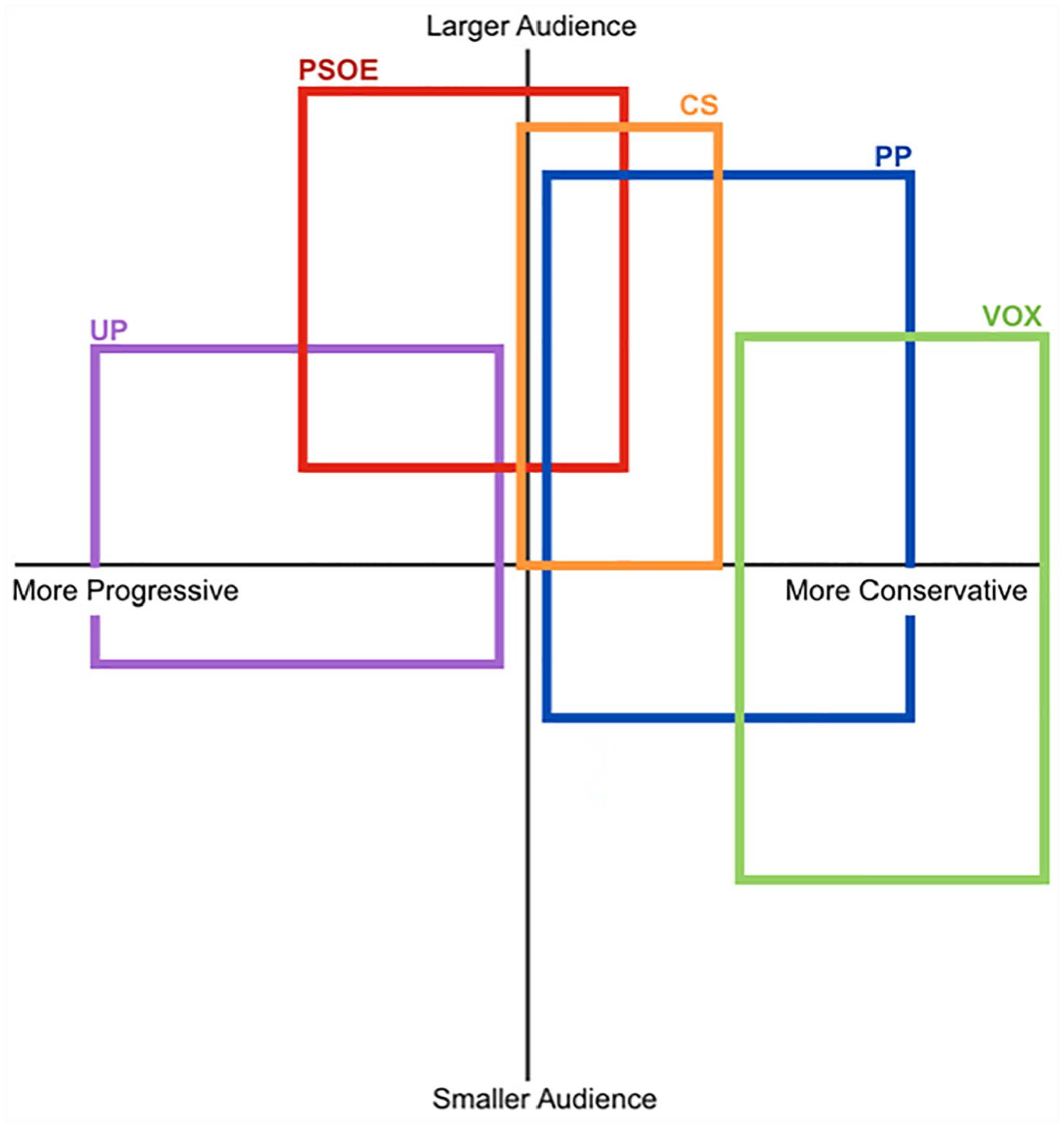
Averaged size and ideology of linked media by party.
Concluding Remarks
This analysis explores how weblinks in Spanish political Twitter effectively function as “organizational connectors” (Bennett & Segerberg, 2012, p. 753) that not only enable parties to cross- and self-promote by linking to their respective campaign pages and favorable third-party news coverage but also create digital ecosystems of ideology that connect politically aligned individuals (followers) and organizations (political parties, news outlets, blogs, interest groups, etc.). The semi-closed structure observed in the linkage patterns of these parties, on the one hand, amplifies party messaging and, on the other hand, validates certain news sources over others to create a media-backed narrative that supports each party’s ultimate goal: to obtain, retain, or disrupt political power. To do so, parties must gain the confidence of voters and persuade the electorate to vote for them. By examining some of the relationships between the types, sizes, reputability, and ideologies of media that are most often linked to in Spanish political Twitter, this study offers a sample of how Spain’s five leading political parties establish ethos by creating cohesive political narratives that appeal to the voter logic and altering Spain’s political media landscape, as Vox did when it became the first far-right party to enter Spanish Parliament in post-authoritarian Spain in April 2019 after winning 24 of 350 parliamentary seats.
Footnotes
Declaration of Conflicting Interests
The author(s) declared no potential conflicts of interest with respect to the research, authorship, and/or publication of this article.
Funding
The author(s) received no financial support for the research, authorship, and/or publication of this article.
