




Abstract
Indigenous peoples remain among the most marginalized population groups in the Americas. The decline of the Indigenous protest cycle in Latin America by the mid-2000s meant that research on collective action turned elsewhere just as the use of social media was becoming more prominent in the tactical repertoire of collective action, and we know little about how Indigenous groups have adapted new technologies for the purpose of civic engagement. If social media has begun to take the place of disruptive action (the most effective tactics in the 1990s according to Indigenous leaders), if personalized action is replacing collective identity (a strength of the Indigenous movements in the 1980s–1990s) and if their access to technology is limited, what does this mean for the ability of Indigenous communities to pursue their claims? Based on 2 years of fieldwork, this article addresses this question from the perspective of Indigenous organizations in three Latin American countries, Bolivia, Chile, and Ecuador. We find that some Indigenous organizations have benefited from the use of information and communication technologies (ICTs) in terms of enhanced communication, access to information, visibility, interest promotion, and commercialization of products and services. At this point in time, however, it appears that the disadvantages outweigh the benefits.
Indigenous peoples remain among the most marginalized population groups in the Western Hemisphere (World Bank, 2015). The wave of democratization that swept Latin America in the late 20th century provided new political opportunities and groups representing Indigenous communities have engaged in diverse forms of collective action with varying degrees of success. This has resulted in a wealth of literature addressing the emergence and development of Indigenous social movements in the 1980s and 1990s. Drawing on theoretical frameworks related to resource mobilization, political opportunities, and identity, the literature has focused on protest, usually selecting visible and successful cases that involve “traditional” disruptive tactics, identity politics, and collective social goals. At the same time, there is an expanding body of research on the use of information and communication technologies (ICTs), such as social media for the purpose of civic engagement and mobilization.
Authors point to a shift in the nature of civic engagement, arguing that it increasingly centers on new media and communication technologies (Bennett & Segerberg, 2013; Biekart & Fowler, 2013; Bimber, 2017; Castells, 2009, 2012). Some present technology as potentially empowering for marginalized groups in that ICTs may reduce the cost of participation (Carlson et al., 2017; Castells, 2009, 2012; Koc-Michalska & Lilleker, 2017; Murschetz, 2018; Soriano, 2012). Others argue that advantages enjoyed by groups in the “real” world will be reproduced in cyberspace and that ICTs may in fact serve to deepen the divide between those with the resources to use ICTs effectively and those who do not (Eckert, 2018; Flores-Yeffal et al., 2019; Linabary & Corple, 2018; Norris & Inglehart, 2013). The relative decline of the Indigenous protest cycle by the mid-2000s coincided with the adoption of social media as part of the tactical repertoires of social movements in the Global North. While there is a growing body of literature on the use of social media and other ICTs by Indigenous actors, these studies have rarely engaged with social movement theory, or considered the strategies of Indigenous movements. There remains a gap in our theoretical and empirical knowledge with respect to the impact of ICTs on the capacity of Indigenous organizations to engage in sustained civic participation.
This article addresses this gap by asking, to what extent do social media and ICTs make it easier or more difficult for Indigenous civil society organizations (CSOs) to engage in civic participation by promoting Indigenous identity, mobilizing resources, and taking advantage of political opportunities? What contextual factors enhance or diminish their ability to use social media to pursue these goals? We examine these questions from the perspective of Indigenous CSOs in three Latin American countries, Bolivia, Chile, and Ecuador. We find that some Indigenous organizations have benefited from the use of ICTs. At this point in time, however, it appears that the disadvantages outweigh the benefits. ICTs create additional barriers and threats for marginalized Indigenous communities that have a negative impact on their position in the power structure.
Indigenous Movements, Activism, and ICTs
In the late 20th century, strong Indigenous movements emerged in countries, such as Bolivia and Ecuador, using disruptive tactics, such as marches, occupations, and roadblocks to pursue their claims (Rice, 2012; Yashar, 2005). These include rights to land and natural resources, as well as cultural, political, and legal rights (Lupien, 2011). Indigenous groups in Ecuador began organizing as early as the 1920s into organizations linked to the traditional left. The first fully independent movements emerged in Amazonian region in the 1960s and helped to launch the Confederation of Indigenous Nationalities of Ecuador (CONAIE) in 1986, which was the first national umbrella Indigenous organization in Latin America and achieved significant policy outcomes in the 1990s (Rice, 2012; Yashar, 2005). From the 2000s onward, however, CONAIE has been unable to reproduce its successful large-scale mobilization efforts. In Bolivia, highland and lowland peoples developed two strong regional movements, respectively, the Syndical Confederation of Rural Workers of Bolivia (CSUTCB) and the Confederation of Indigenous Peoples of the Bolivian East (CIDOB; Postero, 2007). Bolivia is unique in Latin America, in that, it witnessed the rise to power of a social movement-based, Indigenous-led political party, the Movement Toward Socialism (MAS), founded in 1997 by Indigenous leader Evo Morales with activists from the CSUTCB and other organizations. The Mapuche movement in Chile is country’s only significant social movement. Yet it remains fragmented, consisting of various local organizations which are often in conflict with each other as well as with the state (Kowalczyk, 2013; Rice, 2012).
Considering the enduring social and political marginalization of Indigenous peoples throughout the Americas, the remarkable success of some of movements, such as the CONAIE attracted considerable academic attention during these decades. Scholars engaged with and contributed to various theoretical approaches to understand the emergence of Indigenous social movements, the strategies and tactics they have used, and the factors behind their success or failure (Lupien, 2011; Postero, 2007; Rice, 2012; Van Cott, 1994; Yashar, 2005). Some scholars have studied Indigenous movements through the lens of framing and identity politics. This research notes that Indigenous social movements in the past few decades have fostered a strong collective ethnic identity which drives their political strategies and mobilization capacity (Albó, 2004; Lucero, 2008; Postero, 2007).
Others draw on resource mobilization and political opportunity theories to study Indigenous movements. The former approach posits that actors are more likely to mobilize if there are resources in place that facilitate this mobilization. These may include pre-existing Indigenous political structures, or settler mechanisms that Indigenous movements appropriate for their own purposes. Political opportunity theory argues that certain conditions, such as increasing political pluralism, a decline in repression, and divisions within elites, open up new spaces for civil society to pursue its goals (McCarthy & Zald, 1977, 2001; Tilly, 1978; Zald & McCarthy, 1987). Comparative studies suggest that Indigenous movements were most successful when the development of a sense of collective identity was combined with resource mobilization strategies and favorable political opportunity windows (Rice, 2012; Yashar, 2005, 2007). Movements emerged where political opportunities allowed them the associational space required to mobilize, while pre-existing networks present in many parts of Latin America facilitated Indigenous mobilization by providing them with essential resources (Yashar, 2005).
The relative decline of the Indigenous protest cycle by the mid-2000s meant that research on collective action turned elsewhere. This period coincides with the emergence of social media and a dramatic upswing in the use of ICTs in Western countries and among middle-class groups in the Global South. A growing number of researchers argue that political engagement increasingly centers on ICTs (Bennett & Segerberg, 2013; Biekart & Fowler, 2013; Bimber, 2017; Castells, 2009, 2012; Koc-Michalska & Lilleker, 2017; Murschetz, 2018). Participation is far more individualized, with collective identity and ideology taking a back seat to personalized action frames. This “networked individualism” is replacing collective social narratives and hierarchical organizations (Bennett & Segerberg, 2011). Many authors recognize that the potential of ICTs to empower marginalized social groups may be hindered by unequal access (Eckert, 2018; Flores-Yeffal et al., 2019; Linabary & Corple, 2018; Norris & Inglehart, 2013). Our understanding of the digital divide has shifted from inequality differentiated by a simple measure of access, to multiple dimensions of digital inequality that include equipment, autonomy of use, skill, social support, and the purposes for which the technology is employed (DiMaggio & Hargittai, 2001).
Most of the studies on the use of ICTs by social movements focus on Western democracies (Breuer & Groshek, 2014). There is, however, a growing body of literature that examines how Indigenous peoples have actively appropriated technologies for new forms of cultural resistance and revitalization in support of self-representation (Ginsburg, 2000, 2008; Salazar, 2002, 2011). The literature provides a rich portrait of the variety and diversity of purposes for which Indigenous actors have used ICTs. Ginsburg (2000) identifies four dimensions of ICT use among Indigenous groups, promoting recognition of peoples and their practices, sustaining and transforming of contemporary culture, enhancing political struggle for collective rights, and criticizing non-Indigenous interpretations of Indigenous people. Studies have looked at Indigenous communities working to indigenize the use of digital technologies for storytelling (Ginsburg, 2008); using ICTs a tool of self-representation to communicate messages independently of the mainstream media, and to challenge dominant stereotypes (Basanta, 2013; Carlson et al., 2017; Petray, 2013; Soriano, 2012); communicating with other Indigenous groups and mobilizing supporters and allies (Virtanen, 2015); creating new forms of cultural expression (Landzelius, 2004); producing news and information that cover issues that matter to Indigenous people (Carlson et al., 2017); engaging in political campaigning (Basanta, 2013; Budka, 2019; González Lorenzo, 2009; Monasterios, 2003; Virtanen, 2015; Wagner, 2018); and supporting participatory democracy initiatives (Cruz & Gravante, 2018).
Not all researchers view ICTs exclusively as tools of empowerment for marginalized actors. Online platforms and search engines are typically infused with Western or East Asian cultural codes that frequently ignore or devalue Indigenous ways of knowing, which can generate barriers (Srinivasan, 2013; Wagner, 2014; Wagner & Fernández-Ardèvol, 2019). The capitalist market structure within which ICTs are embedded may threaten to commodify Indigenous knowledge, limit the participatory nature of online activism, and reproduce “real world” colonial logics (Budka, 2019; Fuchs, 2009; Hinzo & Clark, 2019; Salazar, 2002). Yet a common theme has emerged in the literature. Indigenous communities seek to use ICTs as tools of both cultural preservation and change, and as part of an ongoing strategy of resisting and re-writing colonial narratives (Carlson et al., 2017; Ginsburg, 2016; Hinzo & Clark, 2019; Landzelius, 2004).
While there is a growing body of work on how Indigenous actors use ICTs to participate in the public sphere, this research does not engage with the social movement literature, despite the fact that many studies on “traditional” Indigenous social movements are grounded in social movement theory. While much has been written about uses, we know less about the impact of ICTs on the ability of Indigenous CSOs to mobilize resources, or about how technologies shift the political opportunity structure. Furthermore, with few exceptions, the research involves single case studies. There is a lack of comparative work that reveals the impact of ICTs on identity promotion, resource mobilization, and political opportunities, as well as the conditions that affect these outcomes.
Methodology
Fieldwork was conducted from June 2016 to March 2019 with Indigenous CSOs organizations in Bolivia, Chile, and Ecuador. We used a community-engaged participatory research approach to ensure that Indigenous perspectives were incorporated into the research design. This approach involves four steps. First, we established local advisory groups of Indigenous leaders to articulate some of the goals of the research before the fieldwork began. For example, it became clear that communication was a priority for Indigenous CSOs; the questionnaire and interview questions, therefore, featured additional questions related to this topic. Second, the interview questionnaires were tailored to each country based on issues that emerged from this process. Third, the advisory groups were consulted during the course of the fieldwork to ensure ongoing alignment with community needs. Finally, the author and research assistants are preparing reports for the participating CSOs, and the research assistants will be delivering the results to communities through a series of meetings and workshops.
We developed a diverse sample of 90 cases (CSOs), including 36 in Bolivia, 32 in Ecuador, and 22 in Chile. They were selected according to a diverse case method, which involves the purposive selection of cases to represent a range of important variables (Seawright & Gerring, 2008). We selected cases to provide variation along key dimensions, size, cultural differences, urban versus rural, and relationship with the state (which is closely related to political opportunities; see Table 1). Large, national CSOs serve as umbrella organizations; they represent Indigenous communities across the country (or aspire to do so) and many regional organizations are members. Mid-sized regional organizations represent political subdivisions, such as provinces, or specific nations. Small, local CSOs are by far the most common type. These may represent Indigenous peoples in a specific community or municipality. Most local organizations have very limited resources. In all three countries, Indigenous CSOs are primarily rural, although large- and mid-sized organizations are usually headquartered in cities. Relationships with the state vary between and within the three countries.
Cases.
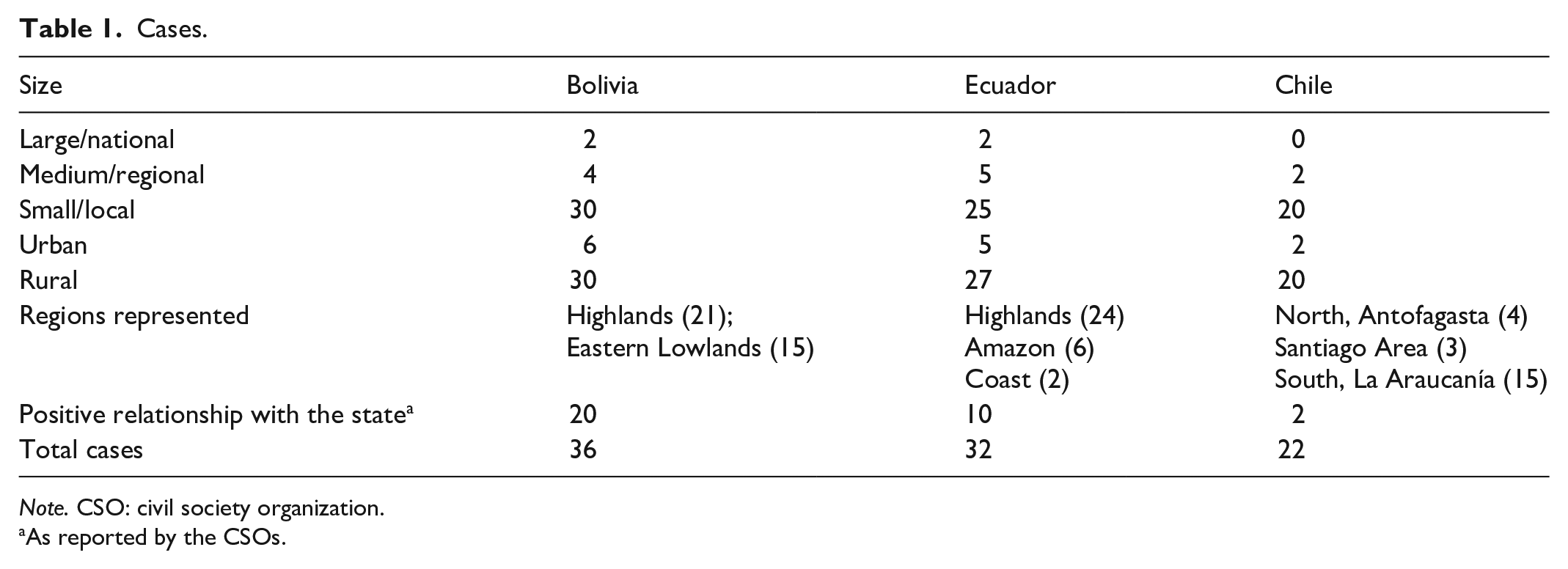
Note. CSO: civil society organization.
As reported by the CSOs.
Ecuador, Bolivia, and Chile provide variation that allow for important within and across-country comparisons of these variables. The three countries have significant Indigenous populations that have all engaged in some type of collective action in recent decades. 1 There are also important differences. Indigenous movements in Ecuador and Bolivia were considered the most powerful in their respective countries in the 1990s and early 2000s (Yashar, 2005). In contrast, Indigenous peoples in Chile never managed to create these types of strong, united movements but Chile has a higher level of development and stronger formal institutions (Rice, 2012). Indigenous CSOs in these countries vary in terms of size, resources, and relationship with the state.
The data include a survey and a series of semi-structured interviews conducted with 106 leaders, communications agents, and other representatives from the 90 Indigenous CSOs in the three countries. In most cases, we interviewed one individual from each CSO (generally the leader), although we interviewed more than one individual from six of the larger cases. Questionnaires were distributed to all 106 participants. They were asked about the technologies used, including hardware and software, the availability of infrastructure and Internet access, ICT-related skills, and preferred social media platforms. We also asked leaders to estimate access to ICTs and level of training in their communities. We then conducted interviews in Spanish with the same 106 individuals; these were intended to elicit in-depth perspectives that could not be captured through questionnaires, including current uses, potential uses, concerns, strategies, and perceived barriers and threats.
Indigenous CSOs and ICTs: Identity, Resource Mobilization, Political Opportunities
As discussed above, Indigenous movements gained influence by promoting a sense of collective identity, taking advantage of political opportunities, and drawing on existing structures and other resources to effectively develop and deploy “traditional” disruptive tactics. This section considers the extent to which social media and other ICTs have helped or hindered these efforts in the digital age.
Indigenous peoples in Latin America are not a homogeneous group, and this extends to their use and perceptions of ICTs and social media. The survey demonstrates that the use of ICTs by smaller Indigenous CSOs remains limited. An overwhelming majority (85%) of interviewees feel that it is impossible for Indigenous communities or the organizations that represent them to be completely integrated into society without using technology. And they also identify significant barriers and threats that risk tipping the balance of power away from marginalized actors. Some of these, such as lack of adequate infrastructure and training, are linked to geographical isolation and lack of resources. Larger urban organizations have largely overcome these. Other obstacles are both more subtle yet perhaps more difficult to resolve in the long term.
Identity and Framing
From the 1980s onward, Indigenous CSOs in Latin America worked to re-focus Indigenous activism around ethnicity. In theory, digital technologies should facilitate these efforts by allowing Indigenous CSOs to reach a wider Indigenous and non-Indigenous audience. Our work demonstrates that while CSOs generally have computers and Internet connections, lack of basic access remains a barrier for most Indigenous communities in Latin America. Over three-quarters of interviewees (78%) believe that this has implications for their ability to promote collective identity, and that these efforts were more successful prior to the digital age.
According to our survey, over 80% of CSOs (and all in Chile) have computers in their head office and use Internet and e-mail. Those that do not were located in the Amazonian regions of Ecuador and Bolivia. Half of the organizations we studied have a website, but a review of the content reveals that most have not been updated for years. Websites are primarily in Spanish; there is very little content available in Indigenous languages such as Quechua and Aymara, although Chilean organizations are increasingly using online tools to revive the Mapudungun language. Large- and medium-sized national and regional organizations make regular use of social media, while smaller local ones either do not have a presence or use their accounts sparingly. Facebook is by far the most popular platform; over 70% of organizations have at least one active account. Numbers of followers range from 500 for smaller organizations to over 25,000 for the larger national CSOs such as Ecuador’s CONAIE. Less than one third (29%) of organizations use Twitter. The numbers of tweets correspond roughly with the size of the organization; large national associations, such as the CONAIE and Bolivia’s CIDOB tweet on a regular basis, sometimes daily depending on the current political climate, while smaller organizations may have only produced a handful of tweets since they established their accounts. But 85% of respondents claim that they are not able to reach their communities with these tools, although they may be reaching international audiences.
Cellphones are relatively ubiquitous across the three countries. They are used extensively in urban and rural settings both by CSOs and by people in the communities they serve. Smartphones remain relatively rare, however, and cellphones are used primarily for voice or text communication. As is the case throughout Latin America, 2 WhatsApp is used extensively. In our survey sample, over 75% of organizations use WhatsApp for communication within and between Indigenous organizations, and to communicate with members of their communities. Our survey asked leaders to estimate the proportion of their communities that have access to Internet-enabled smartphones. Most estimated that less than a quarter of the individuals in their communities had access to such devices (the average estimate was less than 10% in Bolivia, 20% in Ecuador, and 30% in Chile). CSOs can use WhatsApp and other applications to send simple messages, but efforts to reach communities through more complex campaigns intended to promote identity and culture are unlikely to reach large numbers of people.
In Chile, where basic access is somewhat more widespread, Indigenous organizations have started to explore new avenues for using ICTs. But leaders were also apprehensive about the impact of social media on young people who do have access. A Mapuche elder summarized these concerns: Young people are the ones who use these technologies, if they don’t have access, they go to Internet cafes. We have developed online content to promote Mapudungun (Mapuche language), to promote our traditional ways and culture, but this content can’t compete with what comes from abroad. Young people are losing the culture.
Nearly, half of interviewees (43%) attribute a decline in their capacity to mobilize supporters to the influence of technology and the Internet on identity. Leaders in Bolivia and Ecuador look back with nostalgia on the 1990s, when organizations were successful in creating a strong sense of common Indigenous identity among formerly disparate peoples. They were able to channel this collective identity into large marches, roadblocks and occupations, which lead to significant political victories. An Ecuadorian elder lamented that: It is harder to mobilize than in the past because there is lack of interest, our Indigenous identity is become diluted. The Internet brings in foreign ideas that make people want to pursue a different lifestyle and leave their Indigenous culture behind. Without a strong sense of collective identity, people will not mobilize.
Resource Mobilization
Indigenous CSOs use ICTs for communication between organizations, with their communities, and with state agencies. Leaders noted that ICTs can help to strengthen ties between organizations or government agencies (particularly local government) in that they allow for faster and more efficient communication, which helps to coordinate efforts. As one Ecuadorian leader noted, “They help to bring us closer together, to make the territory smaller . . . before we often didn’t know what was happening elsewhere.” Pointing out that even in isolated communities there is at least one individual with a cellphone, a communications director for a Guaraní organization in eastern Bolivia explained, “Within minutes we can send a message to most communities, it could sometimes take days before.” Particularly in Bolivia, Indigenous leaders noted that as recently as a decade ago, communication with isolated communities involved sending messengers by foot to deliver information from door to door, a process that was especially difficult during the rainy season. Most also mentioned the potential of ICTs to enhance communication with Indigenous organizations in other parts of the country and in other countries. While this type of communication has been enhanced between larger- and mid-sized organization leaders, interaction between communities, or between CSOs representatives and leaders of rural villages remains limited.
Use of technologies for communication with the public, whether at the domestic or international level, remains limited. Yet this is arguably the most important potential use of social media. Indigenous organizations seek to increase their capacity to communicate with the public by allowing Indigenous actors to deliver their messages without an intermediary. An Indigenous Ecuadorian communications official explained, “With social media, we can take our message to the world. We don’t have to go through private media, who will only distort what we have to say.” But most of the individuals interviewed stressed that the fact that everyone can create social media posts does not in itself shift the balance of power. The state and corporate interests have greater resources to develop targeted social media campaigns and more practice when it comes to framing issues. They also insist that technology is a means to an end, and that it can only be helpful if Indigenous aspirations are taken seriously. As one director said, “Technology helps us, but some things remain constant: we need people to respect us and accept out proposals. If our claims aren’t accepted, technology or no technology, we’re no further ahead.”
Information gathering includes using the Internet to seek and share information. Three-quarters of interviewees (73%) claimed that ICTs have made their jobs easier on this front. As one leader said, technology “brings us closer to what is going on. We are better informed, and we can get information directly without having a third party select and interpret it for us.” The Internet is primarily used for access to information about relevant legislation, data and statistics, social trends, or current news that may impact the community or the organization’s goals. It is seen as a particularly valuable tool for information gathering because it provides access to sources that would otherwise be unavailable. In the past, it was necessary for CSO representatives to travel to the cities or rely on external allies to deliver information to them. An activist from rural Santa Cruz province (Bolivia) expressed the sentiments of many of her compatriots: “Well informed people are freer people.”
Finally, many organizations use ICTs for commercialization of products or services. Over one third (38%) of the CSOs in our survey sample use ICTs for these purposes, and many others are exploring the possibilities. Indigenous organizations or their members produce various types of goods, such as agricultural products, clothing, leather goods, art, and crafts. Communities can announce their participation in a market or fair through social media, with information about what kind of goods will be available. Another use involves promoting specific products on social networks or on a website. Some felt that technologies could help them to export their products internationally to consumers in Western countries who are interested in purchasing Indigenous handicrafts and clothing online. As a seamstress from El Alto, Bolivia explained, “We can only sell so much in the tourist markets; the Internet lets us reach potential buyers all over the world.” Communities also create pages on sites such as Facebook to advertise services, such as community tourism experiences. In northern Ecuador, for example, the village of Pesillo, with a few hundred residents, has created a Facebook page with over 6,000 followers to promote cultural tourism. Finally, some have started to use the Internet to help them make decisions about what potential consumers are looking for. For example, a women’s cooperative that produces and sells traditional Indigenous clothing has a dedicated member that browses websites to find out about current styles and seasonal trends to think about how to market their products.
Mobilization is surprisingly absent from this list, although it is the focus of much academic attention on the use of ICTs by social movements. When asked about this, most Indigenous leaders repeated that while CSOs and leaders have access to computers, social media accounts, and training on how to use them, many of those in the communities they serve do not. This means that their capacity to use social media to mobilize large numbers of people remains limited. As one Ecuadorian leader pointed out: We don’t have the capacity to extend this to our communities. So we use old fashioned means of communication, including simply walking to communicate in person. I think this means we are losing out, we are falling behind other groups that are using ICTs effectively.
Political Opportunity Structure
A majority of Indigenous leaders interviewed (68%) want to use ICTs to promote their political agenda. This may involve disseminating information about the needs of a community, or about their position on a public policy issue. One of the most important positive effects of ICTs for many Indigenous actors is visibility. While many in the communities they represent do not have Internet access, Indigenous leaders see the value of having an online presence beyond their communities. One leader captured what many of his colleagues expressed: Facebook pages can be used to provide more visibility and perhaps this can be important in terms of getting messages out there. Government agencies, as well as potential allies do tend to have a presence online, so it is important to be there too. Plus, we need the make sure the general public knows what our movements are doing from our own perspective; otherwise, we allow others to tell our story.
Mapuche organizations in Southern Chile have also used social media extensively to raise awareness about state violence or human rights violations committed against Indigenous citizens.
CSO directors and representatives unanimously felt that the Internet is not being used its full potential for promoting Indigenous claims and goals to national and international publics. Most attributed this to lack of IT-related skills among Indigenous community members, but many also pointed out that even when their organizations have access to social media and the skills to use them, they cannot compete with powerful actors, such as stage agencies and mining corporations when it comes to designing public relations campaigns. A leader from the Ecuadorian province of Pastaza, which has been the site of increased oil drilling, insisted that: ICTs create online spaces which are supposed to be equal. But like in the real world, powerful people, the oil companies, they dominate these online spaces too. They have more money, they have entire teams trained to create nice web pages, big social media campaigns to promote their interests.
Perhaps the most significant potential outcome of using the Internet for the purpose of selling products and services is political autonomy. Our interviews demonstrate that in all three countries, Indigenous organizations rely heavily on state subsidies, which limits how they can use ICTs to engage in the political process. This puts CSOs at a disadvantage vis-à-vis both government departments and privately funded groups that do not depend on public funding. Increasing business opportunities by promoting Indigenous products, services, and experiences to a worldwide audience is a means of gaining revenue to replace state subsidies, which should in turn decrease dependence on government and allow organizations more autonomy to use social media to express political positions and criticize elected officials. But many organizations rely on government funding to survive, which limits how they can use ICTs to engage in the political process. Directors and representatives interviewed noted that they must use caution about what they post on social media, because it may not be in the best interests of the organization. Even when the infrastructure and training are in place, as is the case in some of the larger urban organizations, this acts as a barrier to using ICTs for effective political communication as it leads to self-censorship. As one activist stated: We are careful about taking positions because it can hurt us, and our responsibility is to respond to the needs of people we represent. We depend so much on the state, on funds from government agencies, we can’t offend them by taking strong positions.
Using ICTs to shift political opportunity structure remains limited; in Ecuador and Bolivia, less than half of CSO representatives (42% and 48%, respectively) believed that social media have had an impact on their ability to engage in the public sphere. Chile appears to be the exception, as nearly two thirds (62%) of those interviewed argued that social media has allowed them to promote their perspectives without an intermediary. Indigenous organizations in southern Chile used social media to publicize the killing of Camilo Catrillanca, a young Mapuche man, at the hands of the Carabineros (state police). The squadron that shot Catrillanca in the back originally claimed that he was armed, but videos subsequently distributed online demonstrated that this was not the case. Events surrounding the extrajudicial killing were widely disseminated via social media, leading to mass protests across Chile, a criminal investigation into the killing, and the resignation of several top officials. According to local leaders, social media not only allowed them to tell the Chilean public and the world their side of the story, but also encouraged mass demonstrations in La Araucanía and beyond. The leader of a Mapuche regional organization stated: Social media played a key role which made this situation very different compared to other extrajudicial killings in the past. Within hours, what happened was all over the national and international news. They couldn’t just cover it up as they used to do. It also allowed us to mobilize thousands of people, and this led to real consequences for those responsible.
Many organizations also identify threats including cyber surveillance and the spread of misinformation designed to discredit Indigenous communities or frame them as threats to national security. There was variation between the three countries, but a majority of leaders in each jurisdiction (52% in Bolivia, 88% in Ecuador, and 90% in Chile) expressed these concerns. Latin American governments have different capacities with respect to cybersecurity but there is a clear trend emerging. Governments are spending significant sums of money to purchase and maintain security software, including surveillance systems, bio-metric data and identification registries, CCTV, and drones. State intelligence agencies appear to be using these technologies without regard for the law or constitutional provisions (Scott-Railton et al., 2015). Indigenous leaders are certainly aware that they may be targets.
Ecuadorian and Chilean Indigenous leaders, many of whom have been arrested or threatened in recent years, believe that ICTs only provide yet another area for officials to engage in political persecution. As one leader stated: Technologies have some benefits for us, but governments have the capacity to use them much more effectively than we do. ICTs make it easier to communicate with supporters, but they also make it easier for them (state and foreign agents) to monitor us, to know what we say and do.
Another was more blunt, claiming that he “does not trust social media, ICTs, because we know that it is now easier for them (state officials) to watch us than in the past.” These fears lead to self-censorship and severely limit the potential of ICTs to support Indigenous mobilization. The percentage of interviewees who claim to have engaged in self-censorship is slightly lower than the proportion that expressed concern about cyber security and surveillance (38% in Bolivia, 78% in Ecuador, and 66% in Chile), suggesting that at least some leaders believe that the benefits of using social media outweigh these threats.
But others spoke of benefits of being able to disseminate information. Referring to the killing of Camilo Catrillanca, another Mapuche activist stated: They (the state police) tried to use social media to say he was a terrorist, that he was shooting at them. But guess what? We used the same tools to show the world that they were lying. And this time, the world believed us.
What explains the variation?
Lack of training and access to technology are resource mobilization issues that are largely related to place, level of socioeconomic development, and to the size of the organization. With respect to the first factor, we note an important rural=urban divide. In Bolivia and Ecuador, and to a lesser extent in Chile, Internet access is limited to larger and mid-sized towns but coverage in rural areas is sparse. Cities also enjoy a higher level of development, with more established neighborhoods often having infrastructure and services equivalent to those found in developed countries. While large- and medium-sized organizations are generally located in cities or towns, the communities they serve are frequently rural, or on the outskirts of urban centers where infrastructure and access may be more limited. Expanding infrastructure to local residents poses a long-term challenge; local governments do not have sufficient resources; and these investments are unlikely to come from a private sector that does not see a profit in expanding access to rural Indigenous communities. Larger organizations tend to have greater resource mobilization capacity as they can generate income from products and activities in addition to receiving grants from the state and/or from foreign NGOs. Not surprisingly, this allows them to invest more into acquiring technology and providing training to individuals who work for the organization’s employees. The rural=urban divide also has an impact on training and skills development. Most leaders point out that urban dwellers are more likely to have access to formal education and to opportunities to use ICTs. Computer skills are increasingly learned in schools throughout the region and are standard in colleges and universities. In more isolated areas, the fact that infrastructure and Internet access are limited means that people have few opportunities for formal training and are less likely to be able to teach themselves through everyday use. According to interviewees, those who are able to provide training, or who already have computer skills, are also concentrated in urban areas.
Within-country comparisons revealed that urban organizations generally made more regular and varied use of ICTs. Between the three countries, Chile’s higher level of socioeconomic development and superior infrastructure was reflected in the wider and more advanced uses of ICTs among Indigenous organizations. By most accounts, Chile is the most developed country in Latin America, with a stable economy and human development indicators on par with countries of Southern Europe. The country’s infrastructure reflects this development, with even the poorest neighborhoods enjoying access to basic services that many communities on the continent do not (Lupien, 2018). Chileans are far more likely to be regular Internet users (82% of the population, compared with 54% of Ecuadorians and only 34% of Bolivians). 3 This allows Chilean organizations a greater resource mobilization capacity; it is, therefore, not surprising that their use of ICTs is more varied and sophisticated. In our sample, the most isolated communities—those in the Amazon regions of Bolivia and Ecuador—had used ICTs the least.
The political opportunity structure is an important factor with respect to threats, such as cyberespionage, disinformation, financial dependence on state agencies, and related self-censorship or reluctance to use ICTs for political engagement. Looking at the three countries, Ecuadorian and Chilean Indigenous organizations were far more likely than their counterparts in Bolivia to identify these concerns. In these countries, the relationship between Indigenous communities and the state ranges from strained to hostile. Even within the two countries, CSOs in regions that have witnessed greater tension between security forces and Indigenous communities, such as the Ecuadorian Amazon and Chile’s Araucanía, are far more concerned about cyber espionage. For the most part, Indigenous organizations in Bolivia have maintained a positive relationship with the Morales administration. These organizations are more likely to struggle with access and training issues (Bolivia is the least developed country of the three), but do not seem to fear using tools like social media once they do acquire access. Leaders were generally aware of the possibility of state espionage, but claimed that this would not prevent them for using social media and other technologies to advance their agenda. Of those who did express concern, almost all were leaders representing organizations in the lowlands, where relationships with the Morales administration have been more strained. Only two of the larger organizations claimed to have the resources and capacity to investigate and protect themselves against these types of measures.
Interestingly, larger, national organizations are more likely to perceive that ICTs have shifted the balance of power in the wrong direction. This may seem surprising, given that they generally have access to equipment and infrastructure and their leaders and employees are likely to have developed related skills. There are at least two reasons that explain their pessimism. First, these CSOs are generally more political than smaller organizations. Larger, national, or regional organizations have a long history of both institutional and disruptive civic engagement. Their leaders compare their resource mobilization capacity in the past with what they believe to be a less favorable present. This is particularly the case when it comes to mobilizing supporters. The larger organizations are also more likely to have been targeted by disinformation, or “fake news” campaigns via social media. This makes them more aware of and sensitive to how social media can be used by state actors or corporate interests to delegitimize Indigenous resistance or to frame Indigenous actors as security threats.
Discussion
Indigenous movements gained momentum in the final decades of the 20th century based on their success at uniting different groups through the promotion of a sense of collective identity, their capacity to build on existing structures and mobilize resources, and their ability to take advantage of new political opportunities. Social media and other ICTs support these activities in some ways and hinder them in others.
ICTs allow Indigenous actors to perform, represent, debate, and re-conceptualize indigeneity in new and innovate ways. They provide tools for cultural positioning and survival, for countering essentialized understandings of indigeneity, as well as for new expressions of culture and identity. But this only matters if there is an audience to receive, interpret, internalize, and reproduce these messages. According to Indigenous representatives in countries, such as Bolivia and Ecuador, most individuals in their communities are still unable to benefit from the products of these efforts. It may be that Indigenous organizations are increasingly reaching international audiences through social media, which may help CSOs to develop political resources and support. But if the development and reproduction of a strong sense of ethnic identity among disparate Indigenous peoples is key to sustaining strong social movements, and ICTs have become central to identity promotion, Indigenous CSOs must also be able to engage with their own communities. Even if they are able to do so, the literature tells us that online activism is more individualized and less focused on collective identity than traditional forms of mobilization. Leaders expressed concern that younger people, while more likely to use social media, are subject to more outside influences, which many see as chipping away at Indigenous identity. And while ICTs allow Indigenous actors to produce content on their own terms, they do not necessarily have the resources to compete with well-financed, powerful actors.
ICTs are an essential component of resource mobilization in the 21st century. On one hand, ICTs supply resource-poor actors with access to information and with tools to communicate and promote their interests more efficiently. Enhanced communication is a benefit in itself for marginalized communities. Having a social media presence can allow Indigenous actors to tell their stories without an intermediary, promote their activities, and join conversations beyond their communities. While this may be more likely to reach those already inclined to support their agenda, it can serve as a tool for calling attention to their causes and solidifying support among activists and citizens at home and abroad. With some training and support, maintaining this presence is possible even where access is limited in the wider communities. The ability to sell revenue-generating products to international consumers beyond local crafts markets has the potential to strengthen the finances of some CSOs.
On the other hand, the widespread use of ICTs may further exclude small and rural organizations representing marginalized peoples because their communities lack access, infrastructure, and training. Even when communities and organizations have access to ICTs and the skills to use them effectively, more powerful groups enjoy significant advantages in that they are better positioned to mobilize financial resources and know-how, to hire IT and communications professionals, and to develop and deploy savvy media campaigns. If the Internet is now at the core of resource mobilization, this puts the “resource poorest” at a disadvantage with respect to other actors.
Just as importantly, the current political opportunity structure in Latin America is not favorable to the use of ICTs by Indigenous political and social movements. Governments in the region are investing in various technologies that may further hinder the ability of social actors—particularly marginalized groups—to use ICTs to advance their agendas. Information security is essential for groups to maintain the confidentiality, integrity, and availability of their information and activities. This narrows the opportunities available to Indigenous organizations, which generally lack the technical expertise and resources to detect and counter espionage and cyberattacks. Security, therefore, should be seen as yet another factor in the digital divide, as it is shaped by the same challenges that hinder broader use of ICTs. ICTs may, therefore, reinforce marginalized actors’ position of vulnerability, exposing them to threats in ways that they may not have anticipated. This concern is exacerbated in regions where Indigenous organizations are in conflict with the state and powerful private interests. While social media may in theory provide a means for Indigenous peoples to make their voices heard, there remains an imbalance with respect to political opportunities between those with the power, skills, and resources to develop expensive online campaigns free from state surveillance, and those who do not.
Digital inequality involves various dimensions and Indigenous communities face many of these barriers. In the case of Indigenous actors in less-developed societies, such as Bolivia and Ecuador (and to a lesser extent, Chile), our original understanding of the digital divide as a problem of basic access remains relevant. Many of the assumptions made by researchers in the Global North—that access has been diffused to segments of the public initially excluded—do not always apply in the Global South (DiMaggio & Hargittai, 2001). Recurring themes in the literature on ICTs and civic engagement raise concerns for those who study Indigenous movements in the second decade of the 21st century. If social media is replacing “on the ground” mobilization, if digital inequality remains a fact of life in Indigenous communities, and if the state and other powerful actors are better positioned to take advantage of ICTs, then Indigenous CSOs may have lost some of the advantages they had in late 20th century. These issues must be central to future discussions around the impact of ICTs on marginalized communities. The inclusion of Indigenous experiences in the study of ICTs enhances our broader understanding of the impact of new forms of online civic engagement on marginalized actors. In the current context, the risk is that protest will remain the domain of the dominant classes.
Footnotes
Declaration of Conflicting Interests
The author(s) declared no potential conflicts of interest with respect to the research, authorship, and/or publication of this article.
Funding
The author(s) disclosed receipt of the following financial support for the research, authorship and/or publication of this article: This research was funded by the Social Sciences and Humanities Research Council of Canada (SSHRC).
