




Abstract
Social media is becoming a valuable resource for hosting activism as illustrated in the rise of the hashtag movements, such as #MeToo and #Endrapeculture, used to speak out against rape culture. In this article, we discuss the use of social media as the source and object of research, using the case of the 2016 South African #nakedprotest. We used naturalistic observation on Facebook comment threads and followed these up with online Facebook focus groups. Qualitative content analysis and thematic decomposition analysis were used, respectively, to explore online discourses of rape culture. We found that the use of social media as a medium for data collection is valuable for exploring trending social issues such as the rape culture #nakedprotest. We uncovered that social media offers researchers the opportunity to collect, analyze, and triangulate rich qualitative data for the exploration of social phenomena. This study illustrates the usefulness of social media as a pedagogical instrument.
Keywords
Introduction
In recent years, the number of people using social media technologies has exponentially increased, thereby creating new digital social networks in which individuals can create and share content with millions of users across the globe. Therefore, unlike traditional mass media models in which there is one sender and many recipients, social media cultivates a participatory culture as users, audiences, and consumers are involved in the creation of culture and content. Due to this increased participation, some scholars have argued that this increased participation of audiences in the production of culture and knowledge has resulted in a more democratic society. However, others have argued that the change brought by social media is superficial at best. To this end, more research is needed to answer questions regarding the implication of social media platforms for society, power, and the global political economy. In this article, we draw on findings from a study that explored the potential of social media as a pedagogical tool using Facebook to explore people’s perceptions of rape culture following the 2016 #Endrapeculture protests that took place on South African university campuses. Through presentations of our main findings, we consider the duality of social media both as a research site and as a method of data collection to explore digital activism.
Background
Social media is a term used to refer to new forms of media that involve interactive participation by individuals through the creation and exchange of user-generated content (Kaplan & Haenlein, 2010). Currently, Facebook has been identified as the most popular social network platform worldwide, with a reported increase of monthly active users from 100 million in 2008 to 2.27 billion in 2018 (Statista, 2018). The growth in social media usage has in many ways positively influenced the way people, communities, and organizations communicate and interact (Baym & Boyd, 2012; Kaplan & Haenlein, 2010; Ngai et al., 2015). In our contemporary society, digital media consumption has become one of the standard platforms for accessing news and viewpoints on social, political, and cultural issues (Zaleski et al., 2016). Through social media, individuals can provide information and events not covered in the news (i.e., cell phone footage of protest events), can share their opinions, and can engage with others concerning events reported in mainstream media (Stubbs-Richardson et al., 2018). As such, social media has become a pertinent aspect in contemporary culture and cultural change by becoming a valuable resource of providing and disseminating information—including information concerning feminist theory (Stubbs-Richardson et al., 2018).
In addition, virtual communications are used as sources of data to understand the dynamics and role of social media in society (Lijadi & van Schalkwyk, 2015; Snelson, 2016). Feminist researchers and other social scientists, for example, have explored how women, people of color and LGBT + communities have used social media to speak out against injustices and establish spaces to shape their identities (Rentschler, 2014; Zaleski et al., 2016). Other studies have explored how youth in the Global South use social media technologies to mobilize citizens for social change (Hart & Mitchell, 2015; Mare, 2017). The literature demonstrates the role of social media sites in empowering the youth, from both developed and developing areas, by providing them with a platform to actively participate in social and political life (Hart & Mitchell, 2015).
The interest in using social media in academic research is increasing as evidenced by the growing number books aimed at defining social media research and the increasing literature reviews depicting the use of social media in qualitative and mixed-method research (Armstrong & Mahone, 2017; Giraldi & Monk-Turner, 2017; Markham, 2013; Ngai et al., 2015; Rentschler, 2014; Snelson, 2016; Stubbs-Richardson et al., 2018; Zaleski et al., 2016). Studies using social media platforms for data collection illustrate its numerous advantages: simplified and accelerated data collection, reduced costs, and streamlined participant recruitment (King et al., 2014; Lijadi & van Schalkwyk, 2015). For example, Lijadi and van Schalkwyk (2015) used Facebook to conduct online focus groups with a sample of adult Third Culture Kids—referring to children who grew up in a culture different from the one in which his or her parents grew up. They reported that through the Facebook focus groups, they were able to collect rich amounts of data from purposively selected, hard-to-reach participants who lived across the globe, in a cost-effective manner.
Social media platforms also provide researchers with the opportunity to explore unfiltered public attitudes and opinions to events. A recent study by Stubbs-Richardson et al. (2018) used the Twitter social media platform to explore rape culture online by analyzing tweets relating to the Torrington and Steubenville rape trials, the Rehtae Parson’s rape, and suicide case that occurred in the United States. According to Stubbs-Richardson et al. (2018), their findings indicate that rape culture discourses were prevalent on social media and was most commonly expressed through attitudes of victim-blaming. These findings were reflected in a similar study conducted by Zaleski et al. (2016), in which they used content analyses to explore rape culture on Facebook news reports concerning rape and sexual assault.
Stubbs-Richardson et al. (2018) suggested that data about social phenomena are readily available and accessible on social media. Other academics like Armstrong and Mahone (2017) and feminists such as Rentschler (2014, 2015) highlight the importance of doing research on social media and to understand how digital content is perceived by its users. While social media as a form of social interaction presents new opportunities for qualitative researchers, it also brings challenges related to questions around ethics, participation, and the boundaries of fieldwork (Lynch & Mah, 2017; Markham, 2013). In this article, we reflect on using social media as a data collection site and tool (method) to triangulate data from Facebook comments related to the 2016 #Endrapeculture protests and asynchronous online focus groups conducted on Facebook. To this end, we first discuss the research context and methods utilized. Following this, we present two main themes that arose from the triangulation of the data. The presentation and discussion of these themes are done to further illustrate and support the usability of social media as a research site and a tool for data collection.
Research Context: The 2016 #Endrapeculture Protests in South Africa
Due to the contributions of digital feminism and activism, the discourse surrounding rape and sexual assault is shifting (Rentschler, 2014, 2015; Sills et al., 2016). Instead of talking about rape only as a case of sexual assault and criminal offense, more people are talking about the ways in which society perpetuates rape through a rape culture (Brownmiller, 1975; Rentschler, 2014; Sills et al., 2016). First, conceptualized by Susan Brownmiller (1975), rape culture describes a pervasive ideology, in which male sexual violence is normalized and victims are consequently blamed for perpetrating their own assaults.
South African university students played a significant role in bringing forward conversations concerning rape culture in the mainstream domain through protest action and hashtag campaigns. On social media, hashtags (#) form an integral part of online communication as the symbol is used to transform any word or group of words that directly follow the hash into a searchable link. This allows the user to organize online content and track threads or discussions related to those links. In April 2016, an awareness campaign known as #chapter212 was launched at a South African University to raise awareness of the policies relating to the sexual assault and rape on campus, which students accused of perpetuating a rape culture through university management’s attitudes of victim-blaming and perpetrator support (Wazar, 2016). The initial protest activity took the form of posters displayed on the face of the Rhodes University Library with quotes accusing the university management of victim-blaming and perpetuating rape culture. Using the hashtag symbol, the campaign rapidly gained momentum on social media platforms, such as Twitter and Facebook. The reactions of the student body to the campaign ranged from curiosity over the movement to outrage at managements’ lack of engagement (Wazar, 2016). During that time, protest action on rape culture erupted at other universities across South Africa who launched their own campaigns against their universities’ policies on rape and sexual assault (Gouws, 2018; Wazar, 2016).
Across all the campuses, social media has been valuable in providing instrumental information regarding rape and sexual assault in relation to the policies of the respective universities, as well as communicating the experiences of students who have been victims of sexual assault or rape on campus (Gouws, 2018; Wazar, 2016). The use of social media served to attract attention, spark debates, and mobilize support for the rape culture protests. Social media platforms are part of the public sphere. As a result, people from across South Africa could engage with each other regarding the protest actions. While there were many who showed their support online, others expressed negative sentiments. Regardless, using social media as part of the protest campaign, students succeeded in reaching a large number of people—a feat that may not have been accomplished through mainstream media alone.
Not only did the student protest action raise awareness about rape culture on campus; it also extended the issue of rape culture to the broader South African society. This is evidenced in the “Remember Khwezi” protest, where four women staged a silent protest against the fourth post-apartheid South African President at the announcement of the August 2016 local municipal election results. “Khwezi,” as she was known in the media, was a young woman who, in 2005, accused the former President of rape and was subsequently vilified for it. Though this protest was small in number, its message quickly went viral on social media as people were able to share media and their own opinions on the matter with the use of hashtags, such as “Remember Khwezi” and “I am one in 3.” Therefore, social media was an instrumental tool in raising awareness of the protest.
Methodology
In this section, we describe the data collection methods and analysis techniques that were used. In the first phase, naturalistic observation (NO) was used to collect comments on the Facebook platform. These comments were subsequently analyzed using qualitative content analysis. In the second phase, we used the secret Facebook focus groups (SFFGs), which were analyzed through thematic decomposition. In the third phase, we triangulated the data from the previous phases (see Figure 1)

Diagram demonstrating the procedures followed.
Data Collection
Naturalistic Observation
NO is a qualitative data collection method that involves observing subjects in their natural environment (Bryman, 2012; Wells, 2012). The use of NO allows for the description of a behavior or phenomenon as it occurs in its natural setting. Unlike participant observation, NO does not allow for any interference from the researcher. As such, the method demonstrates high ecological validity (Bryman, 2012; Wells, 2012). In this study, we used NO during the first phase of data collection for its value in providing rich descriptive data. However, NO does not allow for conclusions to be made regarding cause and effect. To improve the credibility of the findings, we supplemented the NO with online focus groups to allow for the triangulation of data (Bryman, 2012).
Secret Facebook Focus Groups
Research on traditional and online focus groups indicates that the two methods share more commonalities than differences (Lijadi & van Schalkwyk, 2015; Stancanelli, 2010). Online focus groups are defined as an interactive group discussion involving a selected group of individuals who have provided consent to participate in a facilitated online discussion on a specific topic (Lijadi & van Schalkwyk, 2015). There are various platforms that allow researchers to conduct online focus groups. However, these platforms often require payment. Facebook offers researchers a unique opportunity to conduct online focus groups through the “Secret group” application, without having to pay any fees.
Facebook is a free social media platform. Signing up to become a Facebook user only requires a valid email address or phone number to validate the account. Once signed up, users can connect with other Facebook users from across the globe. Furthermore, users need to accept “friend requests” from others to become part of their friendship circle. Once the request has been accepted, all parties can view each other’s comments, posts, and news feeds from other members connected within the friendship circle.
Users have the ability to create special interest groups on Facebook, which could be either public or closed depending on the purpose of the group. Public groups are visible and any Facebook user can interact or post within the group. Closed groups are also visible, but users must request and be granted access to interact within the group. The “secret group,” on the other hand, allows for strict confidentiality and privacy settings. Secret groups are not visible on Facebook, meaning that only users who have accepted an invitation to the group can find or see the group’s existence and conversation threads. Only the group facilitator can invite members to join the group.
As previously mentioned, the use of Facebook to conduct focus groups was carried out in a study conducted by Lijadi and van Schalkwyk (2015), who termed it the SFFG. As with other online focus groups, SFFGs can be conducted as synchronous or asynchronous groups. The benefit of using SFFGs is that participants can be recruited directly from Facebook. According to Lijadi and van Schalkwyk (2015), online focus groups produce large amounts of data, as the participants are able to reflect on the conversation and use the platform to formulate well-thought out responses. Therefore, it is argued that it is appropriate, and perhaps preferable to use five to six participants per focus group rather than the traditional recommendation of eight or more (Lijadi & van Schalkwyk, 2015).
Data Analysis
Qualitative Content Analysis
Content analysis is described as a method of analyzing written, verbal, or visual communication (Cole, 1988). The goal of content analysis is to systematically quantify content in terms of predetermined categories (Bryman, 2012). A recent literature review by Snelson (2016) reported that content analysis is the second most used approach in social media research that use Facebook and Twitter posts, YouTube videos, or other social media content as data sources. We conducted content analysis deductively using an unconstrained categorization matrix to take advantage of the method’s characteristic of being highly flexible when applied in digital contexts (Elo & Kyngäs, 2008). Through the use of content analysis, we were able to analyze people’s unfiltered responses and reactions to the #nakedprotest, which reflected rape culture discourses. The Facebook focus groups allowed for smaller group discussions around the issue of rape culture on campus, which served to triangulate the findings from the content analysis.
Thematic Decomposition Analysis
We analyzed the data from the SFFGs using Stenner’s (1993) thematic decomposition analysis approach. Thematic decomposition analysis describes a process of thematic analysis, which incorporates principles of discourse analysis to understand how subject positions contribute to the construction of social phenomena (Stenner, 1993). Therefore, thematic decomposition involves a close reading of selected texts in an attempt to separate it into coherent themes or stories, and subsequently tracing subject positions of individual participants and how these positions impact their engagement in the group and the constructions of social phenomena (Stenner, 1993).
Procedures
Phase 1: NO and Qualitative Content Analysis
Step 1. Facebook was chosen as a suitable site to conduct the NO of the comment section, as these comments were available in the public sphere. Considering that the posts were public posts, there was no need to request access to online communities, nor was there any need to request consent (Stubbs-Richardson et al., 2018; Zaleski et al., 2016). News, stories, and public posts relating to the 2016 #Endrapeculture protests were searched for on Facebook using the hashtags; #RUReferenceList, #nakedprotest, #Endrapeculture, and #chapter212. Only public posts that were posted between April 11 and 30, with a comment thread of ten or more comments were included in the analysis (see Figure 2; Lijadi & van Schalkwyk, 2015; Zaleski et al., 2016).
Step 2. Posts meeting the abovementioned criteria were copied into a data sheet along with the comments. The data sheet indicated the type of post (i.e., personal, news report, video, etc.), the date posted, the date accessed, the number of shares and reactions (Facebook allows users to react to a post by either using the “like” , “love”
 , “laugh”⎕, “wow”
 , “sad”
 , or “angry”
  reactions), and the number of comments. During the data cleaning, the comments were copied into a new document, formatted, and de-identified by deleting the profile pictures, surnames, and any other personal information of the commenters.
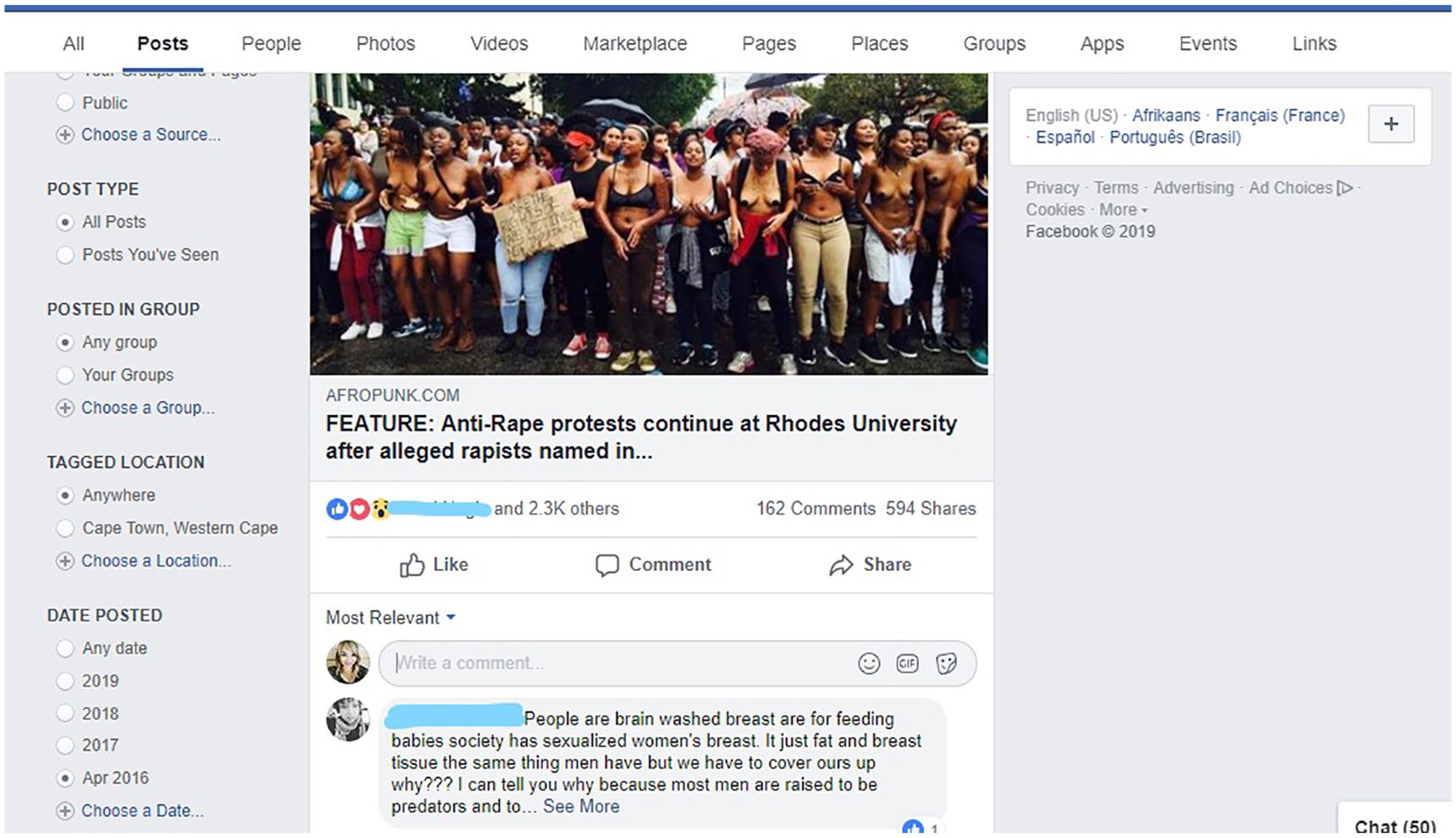
Example of a Facebook search of posts relating to the #Endrapeculture protests.
Traditionally, ethical requirements call for participants to be provided with pseudonyms (Bryman, 2012). However, the large number of commenters under each post made this an impractical option. Instead, we de-identified the commenters by numbering them and using either M or F to designate the male or female gender, respectively (ex. User F). Following this, the new document was entered into Atlas.ti for analysis. The information in the data sheet was used purely for organizational purposes and was not necessary for the analysis. For the content analysis, the interest resided in emerging themes of a digital discourse of rape culture in the comment thread as it related to the campus protests, rather than the people posting the comments. A total of 590 comments from eight Facebook posts were collected in August 2017.
Step 3. Deductive content analysis was used to analyze the data. We developed an unconstrained categorization matrix based on the few existing studies focused specifically on rape culture and social media. This matrix was used in conjunction with other studies and literature which defined the concept of rape culture in society (Brownmiller, 1975; Gqola, 2015). The initial categories included: victim-blaming, perpetrator support, survivor support, statements about the law and society, and the presence of patriarchy (Armstrong & Mahone, 2017; Giraldi & Monk-Turner, 2017; Stubbs-Richardson et al., 2018; Zaleski et al., 2016). Using an unconstrained categorization matrix allowed for inductive principles to filter through the analysis process, by viewing the categories in the matrix as fluid rather than fixed (Cole, 1988; Elo & Kyngäs, 2008). In other words, while we had a predetermined set of categories by which to code the data, these were open to change in interpretation based on the information that emerged from the comment threads.
Step 4. We immersed ourselves in the data by reading and re-reading the collected data. This allowed the researchers to become familiar with the context of the data and gain a deeper understanding of the nature of the comments.
Step 5. The data were coded using the Atlas.ti platform. The first round of coding involved a process of developing conceptual codes to describe sections or chunks of the data. Following this, codes were further developed and refined. The refined codes where then categorized using the matrix. Based on the emerging codes, some of the categories were redefined to reflect the data.
Phase 2: SFFGs and Thematic Decomposition Analysis
Step 1. Participants were recruited using a process of convenience sampling. On 28 August 2017, a public invitation to participate in the study was posted on the primary investigator’s personal Facebook page. The invitation was made public on Facebook and the researcher requested people to share the post via their own Facebook pages. This created more exposure and allowed the invitation to reach a larger network of people. In addition, we sent emails and personal messages to the Facebook accounts of the Student Representative Council (SRC) of five South African universities. However, only one university responded by asking for the study invitation to be sent through. Despite providing them with the information, the invitation was never posted on their social media pages. Finally, we submitted invitations on open public student entertainment Facebook pages. On these pages, users are allowed to submit a message that is screened and approved by the administrators of the page. Our invitation was approved and posted on the page.
To protect the personal information of the potential participants, we asked that they leave a comment on the invitation post. Those indicating interest were sent a personal message via the Facebook messenger app to request that they provide their email address to receive further information. All interested individuals received an email explaining the nature of the study, the rules concerning confidentiality, and the contact information of the first author with the assurance that they may ask for any additional information and clarification.
The email also included the following attachments; a focus group consent form, an information sheet, and a biographical questionnaire, which potential participants were asked to complete and send back via email should they wish to proceed with the study. The biographical questionnaire also included a question asking participants if they have ever been sexually assaulted and if they would be comfortable talking about topics of sexual assault in the focus group. This question was included to allow the SFFG admin to be aware and responsive to participants that may experience emotional discomfort during the conversation. Twenty emails were sent; with three individuals declining to participate. After returning the consent forms, the participants were assigned a number and randomly allocated to one of the three focus groups using a random choice generator. The focus groups were not conducted simultaneously. As such, the participants who were allocated to the second and third focus groups were informed of their placement, and were provided with the preliminary start dates of their assigned group.
Step 2. Data collection took place from September to October 2017. Three asynchronous focus groups consisting of 16 participants in total were conducted using the Facebook secret group application. The first two groups consisted of five participants each, while the final group had six participants. Indeed, the challenges of conducting an online focus group are different than the traditional focus groups.
All participants were either currently registered as students at a South African university, or they graduated within the last 2 years (2015/2016). We decided to include participants who graduated in the 2015/2016 cycle, as they were students at the time of the #Endrapeculture protests, and would therefore have valuable insights. Furthermore, all participants had a valid Facebook account, spoke English or Afrikaans as their first language, and were between the ages of 18 and 25 years. While there were older postgraduate and undergraduate students who would have experienced the #Endrapeculture protest, it was decided that the cut off age of 25 years should be used. This decision was based on the theory of emerging adulthood, which suggests that this period does not simply represent a transition into adulthood, rather it is a distinct period in an individual’s life course, characterized by change and exploration of possible life directions (Arnett, 2000).
Step 3. Once all the participants were allocated, we proceeded to create the first SFFG. It is worth clarifying that the person who created the group is assigned the role of moderator and only the moderator has the authority to invite and approve new members. However, the creator of the group can customize the group settings to allow only more than one moderator (admin). It should be noted that only the group moderators have the ability to add members to the group. For this study, only the researcher acted as a moderator to control group access. Following the creation of the group, the participants assigned to the first group were asked to accept a Facebook friend request from the moderator to become a member of the group. It should be noted that the participants were not required to accept a friend request from the other members in the group. A feature of the Facebook secret group application allows the moderator to personalize the group space. Therefore, we added a cover photo to make the group space more welcoming (see Figure 3). This photo was chosen as a generic image to personalize the space. As such, it did not include any images of real people or situations. Following this, we opened up the group discussion by posting a welcoming message thanking the members for joining and explaining some of the “house rules” of the group. We made it clear that the members should remain respectful of one another, and that they should think of the group as a safe space to share their opinions. The facilitator monitored the group discussion to ensure all participants adhered to the agreed upon rules.

Example of the SFFGs home screen.
The participants were informed that the SFFG would be active for 1 week. The SFFG was asynchronous; thereby allowing participants to respond whenever they were available. However, for the purpose of facilitating a group discussion, we requested that participants suggest certain times that everyone could try to be online. The discussion progressed as each member introduced themselves and agreed on a time in which everyone could try to be online. To facilitate the discussion, a question was posted from a preliminary interview schedule a few minutes before the agreed time. Other questions came forth based on the points raised by the participants. At the end of the week, we posted a farewell message and encouraged participants to raise any other questions they may have. The participants were informed that the SFFG would remain open, so that, we may present them with feedback from the study.
Using the memos and reflections from the first focus group, we prepared for the remaining two SFFGs. The remaining SFFGs were conducted in a similar manner as the first SFFG. To maintain consistency, we used the same cover picture, opening message, and closing message in the second and third focus groups. Reflecting on the data collection, we concur with Lijadi and van Schalkwyk (2015) regarding the amount of data that were collected from the SFFG. Not only did participants provide lengthy responses to questions in the group, but they also shared relevant content in the form of video and article links in the group to further facilitate discussion.
Step 4. After the focus groups were completed, the information from each group was copied into three separate word documents to be cleaned by removing the participants’ profile pictures and changing the names to pseudonyms, and analyzed.
Step 5. The SFFGs were analyzed using the thematic decomposition method. Based on the postmodern feminist theoretical framework, aims, and objectives of this study, the thematic decomposition method was deemed appropriate as it allowed us to trace how students subjectively position themselves and use discourse to engage with others to make sense of, and construct rape culture as a social phenomenon (Stenner, 1993; Ussher & Mooney-Somers, 2000). The process of the thematic decomposition analysis closely followed Braun and Clarke’s (2006) phases of thematic analysis.
Step 6. To familiarize ourselves with the data, the two authors read and re-read the focus group discussions. Furthermore, we read the reflexive journal notes that were kept during data collection, the content some of the participants shared in the group (video links, articles, and pictures), and the de-identified private messages that some of the participants sent to the SFFG facilitator via the Facebook messenger app. Both authors discussed their reading of the data to achieve consensus.
Step 7. The focus group data were entered into the Atlas.ti version 8 program to be analyzed. As with a traditional thematic analysis, we first created conceptual codes from the data which were refined after a second round of coding. Subsequently, we grouped the codes into categories, which were then developed into themes. The authors then attempted a “close reading of the data” by reviewing the themes to check for patterns, variability, consistency, and for the function and effects of specific participant narratives (Bryman, 2012; Stenner, 1993; Ussher & Mooney-Somers, 2000). The interest here was to explore how these narratives interlink with the identified themes. Inherent in the thematic decomposition approach is the recognition that meaning is shaped by the social, emphasizing the role of language, subjectivity, power, and the co-construction of meaning (Van Niekerk & Boonzaier, 2015). Throughout this process, we reflected upon the subject positions taken up by the participants during the discussion, while keeping in mind the context of the SFFG and the #Endrapeculture protests. The themes were further validated through linking the context of the findings to relevant literature. Following this, the final themes were selected. The decision on which discursive themes to choose was based on the participant narratives and the themes that emerged from the content analysis to trace a richer understanding of rape culture narratives as a social phenomenon. By doing this, we were able to present a reading of how participants in the SFFG understood and collectively discussed rape culture, and linked these themes to the broader rape culture discourse as it relates to the 2016 #Endrapeculture and #nakedprotests movements.
Phase 3: Triangulation
According to Denzin (1970), triangulation is an approach that uses multiple observers, theoretical perspectives, sources of data, and methodologies in the study of a social phenomenon. Webb et al. (1966) have argued for greater triangulation in social research, whereby conventional (reactive) and unobtrusive (non-reactive) methods would be employed in conjunction. In this study, we triangulated two data collection methods; NO (non-reactive) and SFFGs (reactive).
Once the data analyses phases were completed, we cross-checked the themes that emerged from both the content analysis and the thematic decomposition analysis to search for corresponding or contrasting patterns. Some of the emerging themes from the SFFGs aligned with the themes from the NO and provided us with a better understanding of the theme in general. There were themes from the NO that did not come up during the SFFGs and vice versa. However, while these themes were not similar, we did not find any contradiction in the data.
Findings
Two major themes arose from the Facebook comments and the SFFGs, namely, victim-blaming and rape or rape culture. First, through our content analysis of the Facebook comments, we found that some people perpetuated rape culture by engaging in victim-blaming discourses. However, commenters using victim-blaming discourse were often met by opposition from other commenters who tried to explain the nature of the protest and rape culture. These conversations often resulted in a “back-and-forth” debate between those who supported the #Endrapeculture protests and those who critiqued the protests. Unlike the online public platforms from which the Facebook comments were extracted, the SFFG discussions, allowed the researchers to ask participants to reflect and discuss their thoughts and opinions on rape culture. In these discussions, the participants predominantly used victim-blaming examples to define and explain what rape culture. Therefore, the findings from both the Facebook comments and SFFGs suggest that victim-blaming is recognized as a prominent indicator of rape culture. Second, in both the Facebook comments and the SFFGs, the theme of rape or rape culture emerged through comments and discussions, in which participants described the physical act of rape and the phenomena of rape culture to be synonymous. These two themes will be discussed below.
Victim-Blaming
Mardorossian (2014) states that traditionally, victim-blaming narratives occur as a two-fold process in which victims blame themselves for their own assaults, and are routinely blamed by others (as cited in Morales, 2015). The victim-blaming experienced externally reinforces personal victim-blaming, thereby forming a sexual script that is a direct result of the perpetuation of rape myths. Consequently, victim-blaming allows the perpetrators to go unpunished. The findings from the content analysis suggest that victim-blaming discourses are prevalent within the Facebook comment threads. This is comparable with previous studies using content analysis that found victim-blaming to be prominent on social media platforms (Stubbs-Richardson et al., 2018; Zaleski et al., 2016). However, unlike the previous studies, the comments in the current study were not directed at the victims of sexual assault, but rather toward the #nakedprotesters.
. . . and the rapists choose their next victims by breast size . . . this isn’t really helping their cause. (User 2–M) Some of them rapist were busy playing “my mother told me to choose that 1 but l want the best of them all” pointing so if any of them fine ones get raped don’t be astonished coz they asking for it. (User 4–M)
These comments suggest that by appearing topless in public, the protesters are not achieving their goals, rather they are placing themselves in a position that could possibly result in them becoming victims of sexual assault. The comment by User 4–M suggests that protesters are asking to be raped despite protesting against rape culture. While these comments do not follow the traditional victim-blaming scripts that emerged in previous studies, they do reveal the mechanisms which serve to perpetuate victim-blaming attitudes in society.
In the SFFGs, the participants had the opportunity to share their thoughts on rape culture and the #nakedprotest.
When students protest (look at Rhodes last year)—news channels that cover the protest apologise to sensitive viewers because women are displaying their boobs. Why not apologise to the students that they have to feel unsafe in an educational institution? Again, with making the female/victim feel they should be ashamed for their actions. (Saajidah–FG2) I feel rape culture exists in how females are blamed for rape over their clothing or because they were out drinking rather than men being blamed for raping. (James–FG3) I haven’t seen this particular one before I have not seen this precise post yet. I like the message behind the protests where they are fighting against the common notion that it was part of the women’s fault for the rape for she was wearing provocative clothing. I do not know whether this was effective? I suppose it depends on what you define as effective. If you define it as attention-grabbing and shocking then yes. The message is powerful, and the statistics of rape that they showed the public was shocking. I agree with Stephanie, in saying that I am uncertain on whether the actual protest really changed the rape culture on campus. (Jessica–FG1) I think it was effective in raising awareness but you get people who would have mocked the woman who have their shirts off . . . maybe even disregard what they’re trying get across entirely. The thing about this is, it only reaches a small population and it only wonders a person’s mind for so long before people forget about it. I personally think it’s effective in a way but possibly also just showing off the very thing that men want thus men don’t actually focus on the real matter they, just looking at the naked woman. (Stephanie–FG1)
In the SFFG discussions, examples of victim-blaming were given as the most visible indicators of rape culture. The idea of victim-blaming further emerged as participants recognized that the protesters were topless to challenge victim-blaming discourses, which implicate a woman’s state of dress in her assault. As Saajidah and Stephanie point out, the focus of the protest was more on fact that the protesters were topless rather than the message being passed. The points made by Saajidah and Stephanie reflected in the Facebook comment section as many of the commenters focused more on the nakedness of the protesters rather than commenting on the message behind the protest.
The findings from the SFFGs show that while the participants believe the #nakedprotest was effective in creating awareness and providing information, they are unsure over the long-term effects of the protest. As Jessica states, the question of how effective the protest lies in and how we define what “effective” entails. Participants agreed that the protest was effective in raising awareness. This was further demonstrated in the amount of comments posted on Facebook that were identified in the content analysis process. While the long-term effects of the protest were not measured in this study, it should be noted that the SFFGs were conducted a little more than a year after the #nakedprotest took place and, during the discussion, the majority of participants revealed that they first learned about rape culture through the protest action and social media.
Rape/Rape Culture
Through content analysis, rape/rape culture emerged from debates between commenters who problematized the act of rape and the rapist, and those who focused on rape culture as a problem in society that perpetuates rape. This suggested that some people view the act of rape and rape culture as synonymous.
Don’t for one second think anyone that’s committed/thinking about rape will see these protests and think “Ahhh they have their breasts out, I change my mind.” (User 62–M) Rapist are psychopaths naked bodies are not going to stop rape. (User 68–M)
While the theme of rape/rape culture emerged from the content analysis it was not further explored through questioning in the SFFGs, rather it emerged naturally from the discussions. In the SFFGs, this theme also emerged as some participants viewed “rape” and “rape culture” as synonymous. However, in the SFFGs participants were able to ask questions and engage with each other to better understand rape culture.
Ok so rape can be verbal? Is rape an extreme version of harassment? Surely there are levels to this. Can street harassment have the same impact as physical rape? Your thoughts? (Matthew–FG2) The act of rape is far more severe than just the physical component. The mental scars endure for a far greater time than the physical wound. As a frequent victim of street harassment I (and many of my peers) can vouch for the severe psychological impact street harassment has. The comments are not merely sexual—they imply violence and destruction. i.e. “Lemme wreck that p*ssy,” “I’d love to tear that ass up,” “Let’s find a nice dark bush and I’ll f*ck you raw.” Those are personal accounts. (Kendall–FG2) Something is either rape or it isn’t. We can’t possibly rely on what someone “perceives as rape” in individual situations. If the only way we could decide if someone was raped is if they feel they were, we’re not sticking to a factual basis of what rape is. We need to find an agreed upon textbook definition of rape and stick to that. (Luke–FG3)
These findings from the comment section and SFFGS indicate that there was a distinct disjuncture between those who focus on rape culture as the problem, and those who problematized rape.
Discussion
Similar and complementary themes emerged from the comment section and focus group analysis to provide insight concerning rape culture. We specifically chose comments related to the 2016 #Endrapeculture protests as it represented a moment in South African society in which dominant ideas concerning rape and sexual assault on campus were rejected and openly challenged through the production of online counter-publics. Therefore, the observation of the comment section allowed us to observe a multitude of voices contributing their thoughts of resistance, defiance, outrage, support and camaraderie. The amalgamation of these voices demonstrated a rape culture narrative with some users perpetuating rape culture through their comments, and also the resistance of rape culture narratives through the construction of the counter-public. The focus group discussions provided a more controlled insight into the ways participants, who experienced the #Endrapeculture protests as students, positioned and structured their thoughts and opinions to engage with one another to discuss rape culture in an online space.
Using social media as a research site as well as a method for data collection, we were able to gain some insight as to how people discuss a current social justice topic, such as rape culture. The two themes presented above, victim-blaming and rape/rape culture, are discussed to provide a demonstration of how we were able to use social media to collect and triangulate qualitative data online to better understand the rape culture phenomenon through the #Endrapeculture protests.
The phenomenon of victim-blaming is well-established in the literature concerning rape, and in modern discourse, understanding victim-blaming is essential to understanding rape. The results from comment section show that while there are people who have knowledge of victim-blaming and actively challenge it, there are also those who perpetuate it. What was most surprising was the emergence of victim-blaming discourse in the Facebook comment section.
Based on the just world beliefs (JWB) framework, which argues that people desire to live in a world which is just and fair, we can argue that the commenters perpetuating the victim-blaming discourse against the protesters are engaging in cognitive exercises which presume that marching topless through the streets is a deviation from societal norms. But this raises questions around the morality of appearing nude in public. As we can see from Saajidah’s comment, people who commented on the protest often used shame as a tactic to discredit the protests and the women behind the protests. Why was being naked considered wrong? Was it the display of naked bodies that ignited outrage of some of the commenters? To unpack this further, let us consider that these bodies are not only naked, but they are also black and they are angry (Gouws, 2018). Would the reception of this demonstration be different if it were majority white bodies on display? There are various contexts where nudity is accepted, celebrated, and revered as artistic expression, especially in mainstream media. Yet, protests involving nudity or even breastfeeding in public are associated with shame, even though these scenarios present the body in its most natural state. As some of the commenters pointed out, being topless is part of traditional African cultures.
While the JWB framework explains why people engage in victim-blaming behaviors, it fails to give insight on how people acquire these beliefs or why they maintain them. As Brownmiller (1975) argues, all women can be victims of rape. We have seen news reports of old women, young girls, babies, commercial sex workers, and niqabis being victims of sexual assault. Yet, the commenters and some of the participants in the focus groups perpetuated the idea that being naked in public would result in sexual assault. The idea that a woman’s clothing has any impact on either preventing or precipitating sexual assault has received criticism and is openly challenged during the #Endrapeculture naked protests (and in similar international protests, such as SlutWalk). The nature of the victim-blaming comments that emerged suggests that it was not the nudity of the protesters itself, but rather the context and performance of these bodies that became the narrative.
The naked female body marks a site of friction, empowerment, and politics (Eileraas, 2014). Therefore, we argue that the victim-blaming comments aimed at the protesters were based on the belief that these bodies were disrupting the patriarchal narrative, and the resistance that lies within the victim-blaming discourse represents an attempt to protect this patriarchy and to provide a warning to those who do not abide by the rules of patriarchy. In this way, we perpetuate a culture of fear that is meant to keep women in line. Unfortunately, this fear is not unfounded considering the high rates of gender-based violence (GBV) in South Africa. As Gqola (2015) argues, South African women are a collective majority (52%) under siege. The victim-blaming discourse serves to perpetuate the notion that women who do not follow the rules are punishable, which in turn serves to normalize sexual violence in our society (Morales, 2015).
The findings from the comment section also suggest that we may need to critically rethink what constitutes “victim-blaming.” In 2013, the hashtag #Safetytipsforladies trended on Twitter as a result of women’s exasperation with anti-rape advice which was critiqued as perpetuating victim-blaming. Women who used this hashtag criticized rape prevention strategies for placing the responsibility on women to protect themselves from rape, rather than teaching men not to rape (Rentschler, 2015). This suggests that feminist hashtags represent a symbolic rerouting of anti-rape discourse, which in turn influences how discussions and politicize the prevention of sexual assault and GBV (Gouws, 2018; Rentschler, 2015). Trending hashtags, such as #Safetytipsforladies, suggest along with the findings from the comment section that there is a need to critically think of how victim-blaming is perpetuated in a society through everyday practices, and not only as a practice that occurs after the fact.
While the comment section provided insight into societal views of victim-blaming, the focus group demonstrated how a group of students engaged with each other on the topic. While there were group members with polar opposite views on the topic, there was a sense of learning and co-construction that occurred within the groups. Group members were able to debate, provide information and ask questions concerning various components of rape culture. The majority of participants understood rape culture through the concept of victim-blaming.
In addition, the second theme of rape/rape culture aligns with Brownmiller’s (1975) theory of rape culture by suggesting that the failure to make connections between dominating male aggressive behavior and a rape culture framework is a problem (Gouws, 2017; Rentschler, 2014). First, by only focusing on the rapist as the problem, people are excused from critical reflection into how their own behaviors may contribute to the perpetuation of rape (Brownmiller, 1975). Second, in public social media spaces, this resistance hinders effective communication and engagement, as people believe they are talking about the same thing, even though they are not. Through the use of content analysis of the Facebook comment threads and the SFFGs we were able to collect rich qualitative data regarding the #Endrapeculure protests.
Furthermore, the participants in the SFFGs revealed that they first learned about rape culture through the #Endrapeculture protests and subsequent social media coverage. While the participants stated that they doubted whether the actual protest resulted in decreasing rape culture on campus, they conceded that the protest was successful in creating awareness on the subject. In the Facebook comment section, we observed how different people took part in online debates and shared their opinions on the protests. While these debates were not effective in changing people’s perspectives, it did demonstrate that people were engaging in discussion around the topic. Other studies have demonstrated the value of social media and hashtag campaigns in creating awareness and mobilizing support for various social issues (Armstrong & Mahone, 2017; Rentschler, 2014). Therefore, while social media may not be effective in bringing about structural change, it demonstrates value through its ability to quickly disseminate information to large groups of people.
The usability of making inductive and deductive inferences from the data obtained via various channels of Facebook demonstrates that social media can effectively be used as a research tool. Based on the large amount of data obtained in our study, we support the claims of other authors such as Zaleski et al. (2016) that social media offers the opportunity for researchers to collect large amounts of rich qualitative data. Our study also showed that various online data collection strategies can be used on social media to triangulate research findings. Nevertheless, because social media sites are primarily based on user-generated content, the risk of subjectivity and bias in qualitative research on these sites is ever-present (King et al., 2014). Therefore, it is increasingly important to consider triangulation during the data collection process to ensure greater credibility of findings (Bryman, 2012).
Conducting research on social media provided various opportunities and challenges. We found that using NO online was beneficial in providing us with rich unfiltered initial data. Searching Facebook for relevant articles and public posts was relatively easy due to the search options which could be filtered according to date. However, the way the Facebook algorithm is structured may have influenced the results that came up during the search. According to Facebook, when you use the search function, the results are sorted into four different categories: Top, Latest, People, and Photos, allowing you to view them in any of those ways. Furthermore, Constine (2015) reports, “Once you’ve chosen one of these options, you’ll get a results page personalised based on around 200 factors including what you Like and engage with, what you’ve searched for, and info about your identity.” Therefore, it may be that another person conducting the same search and following the same procedure we did, would yield different results. The bias of social media algorithms further reinforces the need for data triangulation. Based on this, we recommend that more research needs to be done on understanding how social media algorithms work, specifically for social science research purposes.
We found that the process of conducting the SFFGs had strengths and challenges that are not common with traditional focus groups. The challenging aspect was related to having all the potential participants logged on at the same time. While participants made efforts to be online at a certain time, it did not always work out as some of the students were busy with exams at the time of data collection, thereby limiting real-time discussions. However, the participants were able to respond and ask questions retrospectively. In addition, the SFFGs produced large amounts of data as participants could reflect and type out lengthy responses or share relevant content (articles, pictures, and video links) with the group. Building a rapport with and between participants was a challenge that was anticipated owing to the absence of face-to-face interactions. However, we found that the participants could still build, a rapport with the other participants to enable online interaction. Unlike traditional focus groups, the SFFGs allows users the option of using the Facebook messenger app. The Facebook messenger app allows participants the option to privately message the facilitator and vice versa. We found that this messenger app was useful in helping us to start building a rapport with the participants before and during the SFFGs. Prior to the start of the SFFG, the admin could chat to the participants about their participation. In the course of arranging the groups the admin could use humor and emojis to engage with the participant. These chats were also used to verify if participants would be comfortable speaking about rape culture in their assigned group and to remind the participant that they could reach out via the messenger app should they have questions of feel uncomfortable at any stage. During the SFFGs, the admin would use the messenger app to check in with participants and to remind them to answer questions in the group if they have not done so already. After checking with one of the participants, it was revealed that they did not particularly feel comfortable sharing their view as they felt it was in opposition with the other members. However, the admin encouraged the participant to share this view by reminding them that the purpose was to learn from each other. The admin also provided the participant with the option of answering privately if they wished. Ultimately, the participant was encouraged to share with the group and followed it up by sending a YouTube video to the researcher to further demonstrate their point. In another instance, we used the messenger app following a debate between two of the participants. Both of the participants indicated that the debate was friendly, but they appreciated the message from the facilitator to ensure that they were comfortable to continue.
The smaller SFFG discussions provided participants with the opportunity to engage with each other and collectively discuss their thoughts and opinions. Within the SFFGs, participants were provided with more privacy than if they were to comment on public pages. Participants expressed that they were able to speak more openly within the SFFGs as they were less likely to receive the verbal backlash that can occur when commenting on public pages. Based on this information, we argue that social media can be used two-fold; to provide relevant information on a larger scale by posting publicly and making use of hashtags; and using applications like the SFFG to engage a selected number of people conversations around social issues.
Limitations
While we managed to obtain rich data from both the Facebook comment section and the SFFGs, some limitations of the study are worth considering. First, recruiting participants to take part in the SFFGs ensured that all the participants had an active Facebook account necessary for entrance to the group. However, due to the nature of social media algorithms, we cannot be sure that the invitation reached all possible potential participants. Second, the participants in the SFFGs may have been more willing to engage and reflect on rape culture in such a group due to the self-selected nature of the study. In other words, while the participants in this study found their engagement in the group to be useful, this may not be the case for everyone. Third, all comments from all the Facebook posts were in English, whereby demographics of respondents were not clearly indicated, and that in reality many were responding in their second or third language. However, this would not be strange as the language of instruction in most South African universities is English. Therefore, the current research could not shed light on how race intersects with misogyny and gendered violence. Based on the abovementioned limitations, we recommend that more research should be conducted to better understand how social media algorithms may influence data collection and to understand how race and gender intersect in these online spaces. In addition, while many of the participants felt that there was an increase in awareness regarding rape culture following the protests, the extent, and nature of this awareness is not fully understood. It could mean that people are more familiar with the term rape culture, yet lack comprehension of its meaning. Based on the findings from this study, we have shown that this may be the case as some people could not distinguish between the act of rape and rape culture. Therefore, we would recommend more research aimed at investigating the actual structural impact and concepts of “awareness” following viral digital activism events.
Conclusion
In this article, we attempted to illustrate the value of social media as a research site and a tool of research by discussing the online data collection methods we used to explore rape culture on social media. We found that using social media in qualitative research allows researchers the opportunity to triangulate data using multiple methods of online data collection, thereby strengthening the credibility of the research findings. Previous studies have shown how feminists and young activists use social media to create awareness and gather support for various social movements. However, we believe that future research on social media should be more intentional to better understand the utility and applicability of social media as a research tool and a mechanism to promote social change.
Footnotes
Declaration of Conflicting Interests
The author(s) declared no potential conflicts of interest with respect to the research, authorship, and/or publication of this article.
Funding
The author(s) disclosed receipt of the following financial support for the research, authorship, and/or publication of this article: This work was supported by the National Research Foundation [112696] and the Oppenheimer Memorial Trust [20829/01].
Ethical Approval
All procedures performed in studies involving human participants were in accordance with the ethical standards of the institutional and/or national research committee and with the 1964 Helsinki declaration and its later amendments or comparable ethical standard.
