



Abstract
We analyzed comments published on the Man Up Facebook page (manuptvseries) during the roll-out of the Man Up digital campaign. The aim was to gain insight into how the public perceived the Man Up campaign and the conversation topics that the campaign instigated. We downloaded Facebook threads (posts and comments) from the manuptvseries page using NCapture and performed conventional content analysis on a random set of comments (n = 2,236) to identify how the campaign was perceived and what were the popular conversations. Overall, the campaign was perceived extremely positively by the Facebook audience showing many comments endorsing the content of the campaign by sharing among their Facebook community. The strongest themes were expressing emotions, help and support, and masculinity/gender roles which related to the higher level theme of expressions of masculinity. Another strong theme was suicide and topics related to suicide. Comments acknowledged the importance of discussing the issues of male suicide and masculinity publicly. Men were less engaged with topics on masculinity and expressing emotions compared with women and recognized stigma around help-seeking for mental health issues. The Man Up Facebook campaign did foster a public discussion on masculinity and suicide. A gendered approach in mental health promotion is needed with stigma still present for men when seeking help for mental health problems. Social media holds considerable potential for the use of health promotion campaigns aiming to increase interpersonal communication on challenging health topics. Yet, these campaigns need to carefully manage the risk of reinforcing stereotypes.
Keywords
Introduction
Every 40 s, a person dies by suicide somewhere in the world, and in almost every country around the world, more men than women die from suicide (World Health Organization [WHO], 2014). In Australia, three quarters of all suicides are by men (Australian Bureau of Statistics, 2018). The higher rate of male suicide is often linked to men’s reluctance to seek help for emotional problems which in turn has been shown to be influenced by certain dominant masculine norms like self-reliance, invulnerability, and avoidance of expressing emotions (Boman & Walker, 2010; Levant, Wimer, Williams, Smalley, & Noronha, 2009; Thompson & Bennett, 2015; Thompson & Pleck, 1995; Wong, Ho, Wang, & Miller, 2017). In fact, stoicism and a strong manifestation of self-reliance have been found to increase the risk for suicidal thinking (Coleman, 2015; Pirkis, Spittal, Keogh, Mousaferiadis, & Currier, 2017). In an attempt to affirm their masculinity, men often downplay health problems, prefer to solve problems on their own, and see asking for help as a sign of weakness (Courtenay, 2000b; Oliffe & Phillips, 2008). Men also report higher levels of stigma toward mental health problems compared with women (Oliffe, Ogrodniczuk, et al., 2016; Wang, Fick, Adair, & Lai, 2007), lower levels of mental health literacy, and have more difficulties in recognizing nonspecific distress as emotional problems (Cotton, Wright, Harris, Jorm, & McGorry, 2006; Oliffe, Hannan-Leith, et al., 2016; Swami, 2012; Wang & Lai, 2008). It is often claimed that men’s lower rates of help-seeking is due to a feminized mental health system which deters men from engaging with services and increases their risk to develop more severe mental health problems and potentially become suicidal (Cleary, 2012; Oliffe, Ogrodniczuk, Bottorff, Johnson, & Hoyak, 2012).
Challenging adherence to dominant masculine norms can help to increase men’s help-seeking for emotional problems and ultimately reduce male suicide rates. Yet, engaging men in questioning traditional ways of thinking and behaving is a complex task and requires innovative interventions with a broad reach and a gendered approach (Kingerlee, Precious, Sullivan, & Barry, 2014). A population-based multi-level health promotion intervention that takes advantage of a variety of communication channels including mass, digital, and social media platforms is expected to be most effective given the systemic and social nature of male suicide and masculinity (Freeman, Potente, Rock, & McIver, 2015).
The Man Up Digital Campaign and Documentary
We developed an innovative mental health promotion campaign called Man Up that involved a three-part television documentary and digital campaign that had a significant emphasis on sparking conversations via social media. Man Up explored Australian masculinity, and encouraged men to be more emotionally expressive and seek help for emotional and personal problems if needed.
The documentary follows a presenter (radio personality Gus Worland) as he travels around Australia on a quest to find out what drives men’s suicidal behavior and what can be done to address the problem. Gus visits various locations including his son’s secondary school, a telephone helpline, a remote cattle station, and a rural town. He watches his son participate in a workshop with his high school peers redefining what it means to be a man. He talks to suicide survivors, mental health experts, ex-servicemen, men and women on the street, adolescent boys, families bereaved by suicide, and many others. The men he talks to model positive behaviors such as talking about problems, expressing emotions, and seeking help. The documentary finishes with Gus creating a 60-s campaign ad video with the tag line “Man Up, Speak Up,” which promotes to stop telling boys and men not to cry and encourages expressing emotional struggle. It was released on social media and the web.
The digital campaign centered around a website which acted as a hub for additional information, resources, and video content and five social media platforms (Facebook, Twitter, Instagram, YouTube, and Tumblr). The social media component was a crucial part of the overall campaign and aimed to kick-start, fuel, and continue the conversation beyond the reach and lifespan of the documentary. The digital campaign included a mix of short videos, photo portraits and stories of men, links to articles and research, and showcases of various organizations that help men. The content was curated in alignment with and preparation for the launch of the Man Up documentary on television and ran from 15 August to 20 November 2016. The documentary was screened on free-to-air television on three consecutive weeks starting on 11 October 2016.
Research Questions
The aim of this article is to gain understanding on public perceptions of the Man Up campaign and the conversation topics that the campaign brought up. We developed three research questions:
How was the Man Up campaign perceived by the public audience?
What were its most talked about topics?
How did masculinity and suicide feature in public conversations?
To answer these questions, we use data from the Man Up Facebook campaign page. We further seek to add to the discussion on the potential to use social media networks for national health promotion campaigns and offer a new perspective on how to use qualitative campaign data to better understand the impact of social media campaigns on interpersonal communication. This article forms part of a larger evaluation of Man Up (King et al., 2018a; King et al., 2017; King et al., 2018b; King et al., 2019; Schlichthorst et al., 2018a; Schlichthorst, King, et al., 2019; Schlichthorst et al., 2018b).
Literature
Health Behavior and Adherence to Masculine Norms
Dominant male gender norms are still deeply manifested in Western societies and dictate what is perceived as acceptable male behavior (Rice, Fallon, & Bambling, 2011). Deviating from these norms can result in negative consequences such as loss of status and power (Moss-Racusin, Phelan, & Rudman, 2010). Men who don’t live up to the traditional masculine ideal can feel inadequate, worthless, and reside to higher risk-taking to improve their masculine standing (Courtenay, 2000a; Möller-Leimkühler, 2003). As such, adopting dominant masculine norms also influences the ways in which men choose to negotiate their health (Evans, Frank, Oliffe, & Gregory, 2011).
For this study, we adopt a constructionist perspective and define gender as a dynamic social construct that is shaped by social structures and norms (Canetto & Cleary, 2012). We recognize that masculinity is a fundamental determinant influencing men’s health throughout their life course (Evans et al., 2011). Multiple masculinities can exist in parallel and can sometimes compete or even contradict each other (Connell & Messerschmidt, 2005). The performance of a particular type of masculinity is situation specific and varies by environment and culture, and serves as a means to improve one’s status and power within society (Connell, 2005). We therefore argue that challenging dominant masculine norms can mean an opportunity for improving men’s help-seeking and therefore men’s mental health and reduce suicide risk. A more open interpretation of masculinity could facilitate alternative pathways of help-seeking for men without the fear of losing male status and experience discrimination.
The Potential of Social Media for Health Communication
As social media has seen continued growth over the last decade concerns about accessibility of new technologies have rapidly decreased. In 2019, the number of social media users worldwide is nearing 3.5 billion, representing a 9% increase from the previous year (Chaffey, 2019). Facebook is the most popular and most actively used social media channel (Statista, 2018). Increasing user numbers, broadening user demographics, technological advancements in surveillance and tracking of online behavior hold the potential for tailored messaging and extended cost-effective reach of target groups (Suggs, 2006). Social media channels may be particularly useful in reaching remote populations or those that do not interact with traditional health services, such as men (Clarke & Van Amerom, 2008). Beyond this, social media offers alternative methods of communication that traditional mass communication channels (television and print media) cannot provide. People (users) can connect and interact on social media channels which allow for more effective two-way communication and can foster conversations among individuals (Luxton, June, & Fairall, 2012). Health organizations today make use of this advantage by providing information and services to clients through Internet media (Moorhead et al., 2013).
It has long been argued that interpersonal communication may be a crucial link between the campaign activities and its desired outcomes and can be defined as an outcome of health promotion campaigns (Southwell & Yzer, 2009). Yet, the challenge of traditional mass campaigns was how to measure conversation in response to a campaign. With social media networks, these conversations are visible and measurable (to some extent), especially on channels like Facebook and Twitter, and provide valuable information on the uptake of the campaign messages. Conversation circles can spread beyond personal network boundaries as social media users exchange information and opinions free of time and location constraints and at their own will (Coyle & Vaughn, 2008). Campaigns that aim to affect individuals’ personal perception and introduce new ways of thinking about a topic are expected to enable higher levels of interpersonal communication and therefore more likely to benefit from using new media (Southwell & Yzer, 2007). These advantages however introduce some risks especially in the context of (mental) health. Spreading of inaccurate or unhelpful information, and discrimination, harassment, and bullying of vulnerable users are among the risks most often mentioned (Law, Shapka, Hymel, Olson, & Waterhouse, 2012). Although autonomy of sharing information and discussing different viewpoints can lead to increased reach of campaign messages and support campaign goals, campaign activities need to be carefully monitored to avoid undesirable outcomes for individuals (Southwell & Yzer, 2009).
Suicide and Social Media
There is increasing evidence that social media and the Internet influence suicide-related behavior both positively and negatively (Arendt & Scherr, 2017; Luxton et al., 2012; Luxton, June, & Kinn, 2011; Scherr & Reinemann, 2016). Much of the early research has focused on the risks of the copy-cat or so-called Werther effect caused by reporting on suicide in the media and the Internet (Niederkrotenthaler et al., 2010; Phillips, 1974). The Internet was predominantly seen as providing easy access to pro-suicide information and opportunities to connect with pro-suicide individuals and groups that may encourage suicide acts and increase harm to suicidal individuals (Aiba, Matsui, Kikkawa, Matsumoto, & Tachimori, 2011; Biddle et al., 2016; Biddle, Donovan, Hawton, Kapur, & Gunnell, 2008; Gunn & Lester, 2013; Hagihara, Miyazaki, & Abe, 2012). In online media, participation in forums and chat groups can influence decision-making, in particular when other users are encouraging of suicidal behavior, provide “how-to” information, or enable users to form suicide pacts (Dunlop, More, & Romer, 2011; Eichenberg, 2008; Luxton et al., 2012; Rajagopal, 2004; Scherr & Reinemann, 2016; Smithson et al., 2011). With the rise of suicide awareness media campaigns, the potential for the positive effects of media in suicide prevention have been explored (Niederkrotenthaler et al., 2010). Studies found that interaction with other users resulted in reduced suicidality, reduced stigma, and increased help-seeking (Harris, McLean, & Sheffield, 2009; Mok, Jorm, & Pirkis, 2016; Niederkrotenthaler, Gould, Sonneck, Stack, & Till, 2016). Online environments can be protective for people with suicidality by offering peer, social, and emotional support (Kral, 2006; Niederkrotenthaler et al., 2016; Takahashi et al., 2009) and they have the advantage to generate informal discussions, be less intimidating, and accessible without waiting times (Adams, 2010). The potential of media campaigns to have both positive and harmful effects need to be managed carefully in health promotion.
Method
Data Collection
Data were downloaded from the manuptvseries Facebook page on 9 February 2017 using the NCapture plug-in for Windows Explorer and imported into Excel. We downloaded 271 threads (including posts and comments) published during the Man Up campaign (15 August 2016 to 20 November 2016). The data download also included the username and ID of the commenter which we used to identify and code the commenter’s gender. Of the 271 threads, 150 were eligible for analysis. Only posts that published content related to the campaign (e.g., news, information, and stories) were eligible. On comment level, we excluded all comments made by manuptvseries in response to other people’s comments. The final data set with 150 posts (by the host manuptvseries and by mental or male health organizations) had 4,053 comments.
Data Analysis
We performed conventional content analysis on a random selection of comments to identify the themes that the audience engaged with (Hsieh & Shannon, 2005; Kondracki, Wellman, & Amundson, 2002). The unit of sample selection was the thread, and the unit of analysis was the comments in each thread. We selected 25% of the original 150 threads into the sample, which led to a sample size of 38 threads representing 990 comments. One more thread was manually added into the sample due to the large number of comments (1,246) it received and therefore potential impact on the overall discussion.
Our aim was to qualitatively analyze the Facebook comments to identify common themes that the audience talked about in the context of the Man Up campaign. We allowed themes to emerge from the data. Themes were identified in two ways. First, we determined preliminary themes based on reading through the posts of the Man Up campaign. This was based on the assumption that themes emerging from the comments would align with the content presented in the posts. Second, we refined the list of themes by reading through a subset of the sample. In this stage, two researchers (K.K. and M.S.) independently coded comments of a randomly selected subsample of 5% of the threads. After this first round of preliminary coding, the researchers came together, discussed newly emerging themes, and compared coding to all themes. New themes were added to the list where required and the revised list was then validated by independently coding a second randomly selected subsample of 5% of threads. From this second round, no new themes emerged and the coding by the two researchers showed to be consistent at comparison. Through this process, the two independent researchers who developed the list of themes gained a good understanding about the data and also developed a good joined understanding about the coding of comments to themes. This achieved high alignment of coding in the last round of test-coding. Alignment in coding was determined in formal meetings where the two researchers came together and compared their coding. This process is common to ensure high compatibility for the coding of the remaining data. We did not measure intercoder reliability formally.
The full data set was then split in half and analyzed by K.K. and M.S. based on the basis of the complete list of themes. Comments were assigned a maximum of two themes to avoid over-coding. Once all comments were coded, data underneath each theme were explored, and subthemes were identified. Considering all possible themes together, a coding framework was collaboratively developed by the same two researchers. Framework analysis, a content analysis method that involves summarizing and classifying data within a thematic framework, was then conducted to order the themes into an overarching framework and to contextualize the emerging themes (Green & Thorogood, 2018). Table 1 presents the final coding framework.
Final Coding Framework.
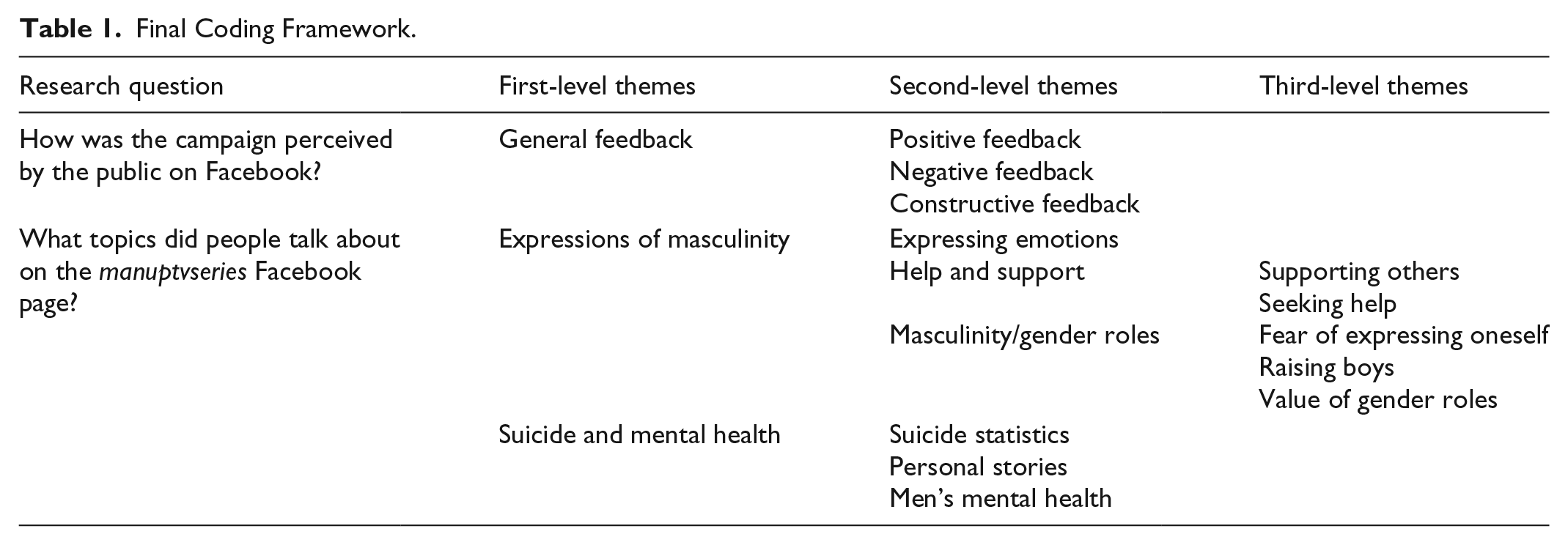
We identified three first-level themes: general feedback on the campaign, expressions of masculinity, and suicide and mental health. General feedback with its three sublevel themes provides information on how the campaign was perceived. Expressions of masculinity and suicide and mental health categorize and describe the topics that people talked about.
Results
Description of Comments
The data set for analysis included 2,236 comments by 1,890 unique users. Of these comments, 2,217 were published by private persons and 19 were from various organizations (including not-for-profit, mental, and male health services). Three quarters of comments (1,545 or 69.1%) were made by women and 653 comments (29.2%) were made by men. For the remaining 38 comments (1.7%), gender could not be identified. Overall, 996 comments (44.5%) endorsed the documentary and content published on Facebook by tagging others in their comments. Thirty-nine comments (2%) shared an external resource by including names or links to a website, Facebook page, or YouTube clip. Some of these mentioned not-for-profit organizations, such as Movember Foundation, Lifeline (crisis helpline), Headspace (youth mental health support), and Men’s Sheds (community organization), all of which promote positive male mental health. Others advertised men’s self-help groups such as the Mankind Project or shared their own contact details to advertise their professional services or offer collaboration with Man Up. Twenty-two comments (1%) posed a general query related to the documentary or content published. Table 2 lists the theme counts for all comments and by gender.
Theme Counts for All Comments, and for Subsamples.
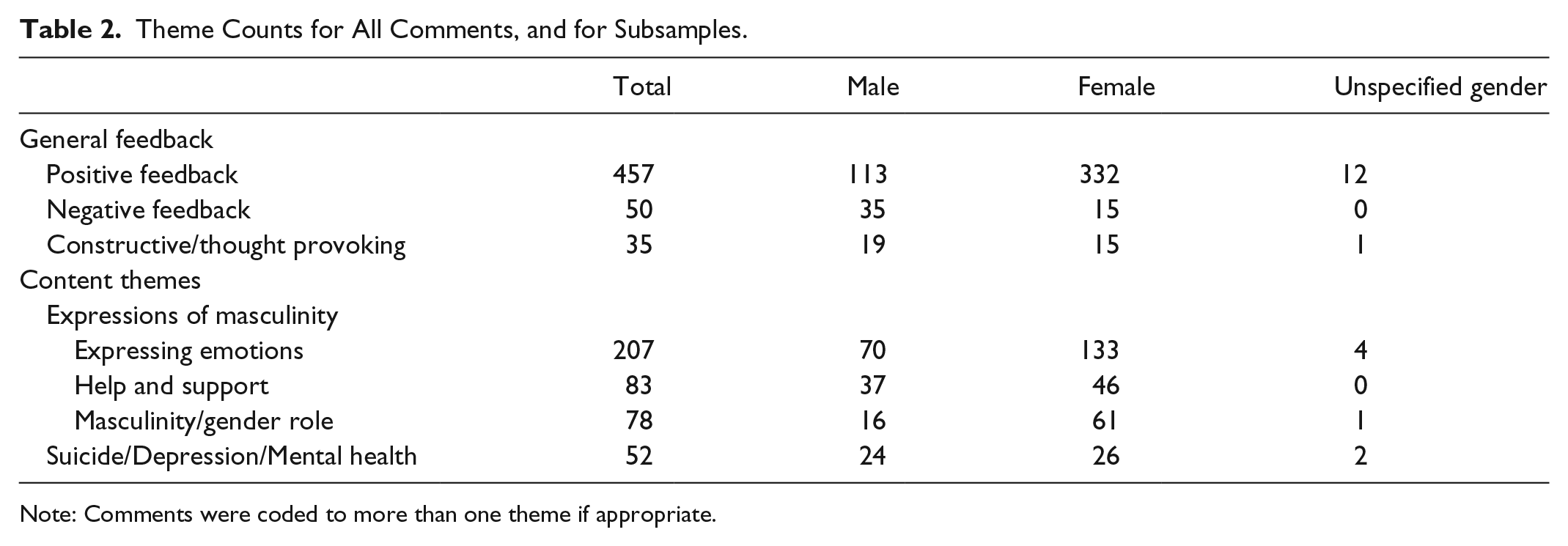
Note: Comments were coded to more than one theme if appropriate.
How the Man Up Campaign Was Perceived by the Facebook Community
Three subthemes were identified within the general feedback category: positive feedback, negative feedback, and constructive feedback. The majority of feedback (456 comment) was positive; 332 of these comments were from female Facebook users and 113 were from males. Many comments offered general endorsement for the documentary and mentioned plans to watch it or encouraged others to do so. Others showed appreciation after having watched it. Many comments specifically mentioned Gus and his team and offered congratulations on making a documentary on male mental health. There was a sense that a public discussion of male mental health was needed and long overdue. Comments also highlighted the importance of the workshop with high school boys, praised the workshop facilitator’s way of interacting with the boys and suggested it should be available to all schools: Wonderful series, great people, great advice. This series has been very interesting and very emotional. I hope people are taking note and I would love to see more of these workshops at schools. I commend Gus on getting out there to try and make a difference. Great series.
On the contrary, 50 negative comments were identified. These were mainly by males (35). Some rejected the idea that traditional notions of masculinity were linked to high rates in male suicide. Others linked the high male suicide rate to unfair treatment of men in the Family Court, and a few argued that feminism is to blame for male suicide and asserted that asking men to open up and share their feelings is to feminize men. These types of negative comments created many responses as they were perceived as provocative due to the harsh language used. Many commenters of both genders challenged the negative viewpoints. In some instances, the exchange of opposing viewpoints turned into heated discussions with at times disrespectful language and personal attacks. The comments by females in this theme were often in response to the strong language used in respect to the feminist movement and toward men who choose not to follow the protocol of the stoic man: And yet tomorrow the two biggest entities responsible for men’s suicides will be open and it will be business as usual. The broken Family Courts will be raking it in and the bullies at the soul and life destroying Child Support Agency will be laughing their heads off hiding behind closed doors. Nothing will change. If you want to decrease the male suicide rate get feminist to stop demonizing us.
Thought-provoking viewpoints and constructive criticism were given by 35 comments; 15 were posted by females and 19 by males. Some comments mentioned the higher rate of female contributors and questioned whether this could be interpreted as males being less engaged with talking about suicide, expressing emotions, and masculinity. Some comments indicated that the documentary missed the opportunity to touch on a couple of important issues related to male mental health and suicide such as the high levels of alcohol consumption and general drinking culture in Australia, and the pressure of perfectionism in society leading to the inability to cope with one’s own mistakes. Furthermore, it was noted that opening up depends on a person having strong social networks and that this may not always be the case for men. Finally, the point was made that although a 3-hr documentary series was a good starting point, it would not be enough to change deeply entrenched behavior: I just checked, and the last 40 posts are almost all women commenting about this though—what does that indicate? My only thought was the constant focus on “opening up to your friends,” (Tom facilitated this brilliantly), but what about the many guys who don’t have a social network? Finding friends is not easy, creating networks takes a long time. It’s too easy to say open up to your mates if you are struggling to find and make mates (and it’s not as easy as “go to some clubs, go to the pub or get out more”). Loneliness is a crippling epidemic for many men. Looks to be a cool TV show, but it’s going to take more than three episodes of a TV show to get to the bottom of the male suicide problem.
What Campaign Content Was Talked About Most
Three second-level themes were identified under the higher level theme expressions of masculinity: expressing emotions, help and support, and masculinity/gender roles. The most dominant theme under expressions of masculinity was expressing emotions with 207 comments; of these, 133 were from females and 70 were from males, and 4 were unidentified. For the most part, comments were made in response to two specific stories (featuring in various posts): the launch of the “Man Up, Speak Up” campaign ad and the masculinity workshop in the high school. Commenters (mostly women) encouraged men to open up and express their emotions. Women, in particular, responded to the issue of suppressing emotions in boys. Male commenters in this theme often presented with lived experience of mental health problems. A few commenters rejected the idea of teaching boys and men to cry and suggested that it was natural for men not to express emotions following traditional masculine norms. Others recognized that the usefulness of expressing emotions depends on the context and that sometimes “harden up” can be the right strategy, especially for boys: This is encouraging and inspiring . . . boys/men have received a raw deal from our somewhat harsh cultural conditioning. Emotions are an essential part of our human experience and yet men, and also women, are disapproved of when feeling and expressing what they feel. Our bodies and souls can only suppress it for so long, and as we know, it comes out in a myriad of unhealthy ways. No wonder we’ve largely disconnected from who we truly are, and that there’s such a high degree of mental/emotional illness . . . and is continuing to rise. Bring on the tears and healthy expression of rage, fear etc.! Great now we are teaching boys to be soft men are the pillar of strength for their family and friends and crying gets you nowhere what utter bullshit. I don’t completely agree with this. I mean yes, if you feel down, do speak out. That much is right. Silence can kill . . . I think when your son cries, understand WHY he cries. If it’s a physical pain and it’s not too bad of an injury, yeah say harden up and you’ll be right. But if they’ve been hurt emotional, understand that, help them deal with it.
Help and support was present in 83 comments, 40 of which were from females and 37 from males. About half of these comments discussed help-seeking and men’s reluctance to reach out when help is needed. They offered insights into the challenges men face when reaching out. Some commenters raised concerns about the risks that men may face when opening up, including experiencing stigma, being rejected by other men and women, lacking social support, and feeling isolated. Talking to someone outside the immediate social circle (a health professional) was seen as the better option by some: Unfortunately, when they do talk, reach out for help or make themselves vulnerable, they are mocked for it, so it is often a no-win situation. Hence the reason why men have higher suicide rates, because they “typically” find it hard to talk, reach out for help and or like to feel vulnerable or “weak.” When it comes to depression, it’s often easier to talk to a stranger about it than to people who know us and are more likely to judge. Sad thing is when people actually know you have a problem they also steer clear. Dealing with someone with these issues is never easy. It’s easy to say RU ok but to actually help is another thing?
The other half of the comments touched on the theme of supporting others. These comments tended to occur when people shared their struggles with mental health issues. In these situations, the Facebook community offered advice based on own their experience or encouraged help-seeking which was accepted positively by those feeling in distress and helped to see life more positively in that very moment: Hey NAME—hang in there mate. I got pretty close few years ago . . . So glad now I didn’t go there. Love, support & medication got me through. And hope. Most of all hope. So, hang in. Try counselling and anti-depressants, plus meditation to calm your thoughts. They all really help and allow you to see the world differently, brighter too. xxx Hi NAME. Been there a couple of years ago. I think it could be well worth another try. I think that alcohol is probably playing a big part in my depression. Thank you for your support. It’s amazing how total strangers step up to support someone they don’t know. Thanks for that. You made my day much brighter.
Seventy-eight comments were related to masculinity and the social norms by which men are expected to live their lives. Of these, 16 were from males and 61 were from females. Some comments described and acknowledged the pressures that some men experience in today’s society, including the pressure to behave like a “real man.” Male identity problems and fear of expressing oneself were mentioned as consequences and linked to feelings of frustration, anger, and isolation: As a mother of two grown sons I feel that we need more of these campaigns to recognize the struggles men face in trying to fit the so-called mold society place on them. Men need to learn to be more comfortable and able to sit with another man’s distress. From what I see, their discomfort when a man shows distress causes them to pull back and shun that person, sometimes even cut the connection. This only adds to the distress and isolation. Society, the way men are socialized from birth and the blokey culture have messed with men’s capacity for compassion for each other. It stinks.
The theme of raising boys was particularly strong with many noting the importance of a healthy father-and-son relationship and acknowledging the need to allow boys to express emotions and refrain from telling them to “toughen up” when they are hurting: From where we sit at the fathering project, the role of a good father or father figure from an early age is profoundly important in this issue of suicide and mental health and an essential part in how we tackle this crisis. Finally!!!!! I’m sick to death of hearing parents make light of children’s pain and suffering, when they get hurt on the sporting field or have a broken heart! How do we expect to raise empathetic, caring children when we show none ourselves!! Finally, boys have been given permission to feel!
A few commenters voiced their preference for traditional gender roles and rejected the idea of men to change: Great now we are teaching boys to be soft men are the pillar of strength for their family and friends and crying gets you nowhere, what utter bullshit. The same damage as telling them they should be in touch with their feminine side. Boys are boys, men are men, girls are girls, women are women. It’s like yin and yang. I get saddened when we just can’t let kids and the young grow up making mistakes but being themselves. We analyze everything today! Why?
We identified 52 comments on the first-level theme of suicide and mental health; 24 were posted by men and 26 by women. Many of these comments included personal stories about suicide (e.g., the loss of a friend or family member to suicide). Some expressed surprise about the suicide statistics in Australia and following this, the acknowledgment of the importance of this topic and call for more action: My Dad died from suicide when I was 12 in 1990. Death by loneliness really hit home for me. There was minimal support for him and it was never spoken of. We still have a long way to go in men’s mental health, but you just made the biggest impact. Big hugs to you! I was gutted when I heard that 2000 men a year die of committing suicide in Australia. That is so shocking—imagine the uproar and investigations if that number were killed in a terrorist attack.
It is also worth mentioning that eight comments explicitly mentioned the impact that watching the documentary had on them which ranged from conversations with friends and family at home to seeking out professional help. Examples of these comments are given below: Since watching the Man Up series my husband and I both refer to it at different times by saying who made that rule??? It often releases pressure to do things “how they’re supposed to be done” or how they’ve always been done. The series definitely is a life changer. That workshop on the show this week was amazing. So powerful and got us having an interesting conversation at home.
Fifty-one comments were classified as diverted conversations. These were conversations between members of the Man Up Facebook community that turned into arguments and diverted from the topic of the original comment. Finally, 273 comments could not be categorized into any theme. These included spam comments, comments in a language other than English, and private conversations between people.
Conversations on Masculinity and Suicide
Across the identified themes two topic areas stood out in generating conversations among followers of the campaign. One area was related to people sharing personal stories and experiences with suicide and depression. These stories covered both being bereaved by suicide and experiencing suicidality and allowed cross-over in conversations from both sides. These comments were positively received by the broader audience and were widely commended on for their bravery in sharing this personal and sensitive information. Support and advice were also offered to those who signaled experiencing mental health problems at the time of posting. It was encouraging to see how Man Up followers rose to the occasion and encouraged others to seek professional help and not give up.
The second area that created conversations was related to challenging masculine stereotypes. Conversations started in response to negative or critical messages toward the campaign’s call for men to open up emotionally. Strongly opposing viewpoints, stating that “real men” have to be tough and rejecting change of masculine identity reached considerable amount of feedback by other followers. These opposing comments often used aggressive and provocative language, seeking to attack men who open up as “weak” and women who commented positively to men’s emotional expression as emasculating men. As a result, these comments were often met with numerous counter arguments and quickly silenced. Whether this behavior pattern reflects the perceptions of the wider population or whether the Man Up Facebook community was biased toward a more accepting view of masculinity cannot be determined from these data.
Discussion
Response to Research Questions
The Man Up campaign was well received and widely shared by the Facebook community. Over the duration of the campaign, our 150 posts yielded 4,053 comments of which just short under 1,000 were tagging at least one other person. This was an important indicator of the growing support for the campaign and its messages. Content analysis of Facebook comments identified that the campaign was perceived very positive with a larger number of comments endorsing the messages of the campaign and the associated documentary. The public discussion of male suicide and masculinity was considered an important issue by many. We identified three content themes through framework analysis: expressing emotions, help and support, and masculinity/gender roles which show different aspects of expressions of masculinity. Another important theme that emerged was suicide and mental health. Posts including content about the campaign ad video and the workshop with high school boys let followers question the presence of social norms and the way they restrict men’s and boys’ emotional expression (Mac an Ghaill & Haywood, 2012). These comments demonstrated an increased interest and awareness about the link between social norms, masculinity, restrictive emotional expression, and mental health in men and boys; a link which is still widely unrecognized in the wider population despite the long history of previous research and public debate (Oliffe, Ogrodniczuk, et al., 2016; O’Brien, Hunt, & Hart, 2005).
We further found that the Man Up campaign fostered conversations among Facebook users, in particular in relation to suicide and help-seeking. We saw positive and supportive comments for those in the audience who declared their personal struggles with suicide. Support included encouraging words and suggestions for seeking help and was often combined with sharing information about personal journeys of recovery by the supporter. In line with previous studies, this suggests the potential for social media channels to offer peer-to-peer support (Kral, 2006; Niederkrotenthaler et al., 2016) and much like face-to-face peer support programs could have a positive effect on individual’s suicide trajectory (Harris et al., 2009; Solomon, 2004). It is often argued that the immediacy of available social support via the Internet can break the cycle of negative thinking and prevent a situation from escalating. But concerns of safety and ethical considerations remain, and this effect should be monitored if possible (Harris et al., 2009; Lehavot, Ben-Zeev, & Neville, 2012; Niederkrotenthaler et al., 2016).
In the Man Up campaign, we also saw heated discussions in respect to challenging masculine norms and encouraging emotional expression in men in the context of mental health. Those opposing this message were mostly men who interpreted the call for opening up as feminizing men and diminishing manhood. Conversations of opposing viewpoints hardened and at times turned disrespectful. It is possible that this opposition is driven by the innate fear of losing status when deviating from the accepted norm (Kierski & Blazina, 2010) and is linked to the experience of stigma and discrimination by some men when expression emotional struggle.
The heated discussions are important information in and by itself, and they pose an interesting ethical challenge for the researcher, especially in the context of suicide and mental health. Policing inappropriate behaviors may sometimes be necessary to keep people safe but may also result in loss of opportunity for debate. The ethical issues in social media research are widely debated, yet there is further need for establishing useful guidelines for researchers in metal health (Robinson et al., 2016).
We identified gender differences in engagement with the campaign themes as measured by the number of comments. Men were less inclined than women to talk about masculinity, and those who did, talked about masculinity in the context of another issue such as struggling with mental illness or experiencing stigma when needing to ask for help. These men acknowledged the pressures they face in society to appear strong, but seemed unsure about how to navigate this issue confirming the widely discussed issue of mental health stigma for men (Oliffe, Ogrodniczuk, et al., 2016). Men’s engagement with content on suicide, help-seeking, and support, however, was on par with women. Some men openly shared their experiences with mental health and suicide and others acknowledged the importance of this topic. This suggests that in general men are open to talking about suicide. But it seems this is more likely the case when they had personal experience with either mental health issues or had lost someone to suicide.
Implications and Limitations
Campaign success depends on reach of the target audience and the ways in which users choose to participate on social media. Women are generally more active Facebook users and are more likely to comment and share a post, whereas men prefer to use social media to gather information (Mellema, 2014). In the Man Up Facebook campaign, we saw women being more engaged with commenting on the manuptvseries page. This however does not conclude that men were not exposed or receptive to the campaign messages.
Women played a vital role in distributing the messages to males in their lives and encourage them to watch the associated documentary confirming the influential role of women on men’s help-seeking behavior (Norcross, Ramirez, & Palinkas, 1996). This highlights the ongoing challenge for health promotion campaigns to gain direct engagement with men and make men take responsibility for their own health choices. Women have often been named as being the ones making doctor’s appointments for men and “nagging” men to look after themselves (Seymour-Smith, Wetherell, & Phoenix, 2002). Although women play a vital role as partners and mothers to men, true improvement in men’s health can only be gained by achieving direct involvement of men through an improvement of attitudes and behaviors. Furthermore, women’s involvement as a strategy will fail for isolated men and those who struggle with disclosing health issues which is more likely in the stigmatized context of mental health and suicide. Health promotion campaigns such as Man Up can help to further destigmatize help-seeking for men though taking a gendered approach.
Women also had a strong voice in encouraging men to change and adapt a more open interpretation of masculinity. Most women in our study welcomed and open discussion about restrictive masculinity and supported change, so did men who had or were experiencing mental health problems and were able to see the negative influence of some masculine norms. From this and the fact that the Man Up campaign was generally perceived very positively, our data suggest that there is an acceptance for societal change. On the contrary, the small group opposing any change in masculinity was exclusively male. This group presented as resistant to changing masculinity and was especially vocal against the views of women.
One way to circumvent the female bias and increase male voices could be to capitalize on social media platforms known to have a more balanced user profile. Male-friendly online communities such as the LADbible however may carry the risk of giving a stronger voice to those men who oppose changing masculinity and favor a return to traditional gender roles. This could then cause silencing those vulnerable men who suffer under the pressure to be masculine yet would benefit from a more accepting performance of masculinity.
The Man Up campaign used multiple channels as part of the digital campaign, including platforms such as Twitter where men were more strongly represented (Schlichthorst et al., 2018b). Our campaign messages were also re-posted via other male-dominated channels (e.g., LADbible). Unfortunately, we were not able to obtain data from these channels due to access restrictions.
The impact of peer-to-peer conversation should be part of social media campaign evaluation to enhance understanding on how these conversations can help or hinder campaign success and how we can gauge campaign effect from conversations (Southwell & Yzer, 2007). From the Man Up Facebook campaign data, it seems that conversations were either affirmative to a person’s or group’s view, or they were opposing arguments that seem to harden rather than opening viewpoints. It remains unclear how the social media campaign affected those followers that were in between the two extreme viewpoints and those who saw and read the conversations but did not actively participate in the conversation. These are limitations of social media network data and additional data sources may need to be considered to identify change in attitudes or behaviors.
In the same vein, conversations on social media networks can create unintended talk about the campaign depending on the attitudes and norms underlying the network composition (Southwell & Yzer, 2007). In this article, we identified some of the conversations among commenters as being heated discussion. The identification of heated discussions emerged from thematic analysis and was defined and labeled by the researchers as part of the synthesis for findings. This was done on the grounds of the volume of opposing comments within a thread and the use of derogative or abusive language to express these opposing views. We did not set out to examine polarizing discussions from the start of this research and therefore did not include a conceptual definition of what constitutes heated discussions. Given that social media conversations are becoming increasingly more polarized and at times abusive, it could be benificial for future studies to consider approaches that capture these phenomena in the coding framework. This however does also require conceptual and methodological groundwork including semantic analysis which was not in scope of this article.
In these heated discussions, the viewpoints seemed to harden rather than open new thinking (as far as we could determine from the data) and therefore may reinforce negative attitudes and behaviors and those commenters who were opposed to the campaign. This may carry the risk of the campaign working against its own goals and reinforce masculine stereotypes (David, Cappella, & Fishbein, 2006). Although campaigns require careful monitoring in this context, this risk cannot be entirely avoided in social media environments as information are often shared across channels which makes controlling the original message difficult if not impossible.
Health is a gendered issue, and health promotion campaigns seeking to influence male health behavior need to account for the intersectionality between gender and health (Evans et al., 2011; Robertson et al., 2016). Future campaigns need to continue breaking down mental health stigma and create safe spaces for men to open up and challenge the stereotypical notions of masculinity. In this context, it is important to recognize the concept of multiple masculinities and remain inclusive to all men, meaning to abstain from using stereotyping in conveying health messages (Smith, 2007; Smith & Robertson, 2008).
Concluding Remarks
Interpersonal conversation and their impact on campaign success should be part of social media campaign evaluation to enhance understanding on how these conversations can help or hinder campaign success (Southwell & Yzer, 2007). Yet, most social media campaign evaluations focus on analytical statistics, and a systematic review of conversations is rarely part of evaluations. We sought to respond to this gap by evaluating a real-world campaign that was designed to challenge perceptions on gender norms, generate awareness on complex social and health issues, and engage men (and women) to talk openly about the issue of male suicide. We demonstrated that a social media health campaign can create conversations and awareness on social and mental health issues and has potential to change attitudes. Social media networks such as Facebook are useful technologies to provide input into interpersonal conversations.
We however recognize that on its own the evaluation of Facebook campaign comments is limited in showing evidence for overall campaign effectiveness. Todays’ health promotion campaigns are likely to follow multi-channel designs including digital and traditional media introducing the challenge of multiple data sources and the need for new approaches to evaluate these complex data (Balatsoukas, Kennedy, Buchan, Powell, & Ainsworth, 2015). More research is needed to develop methodologies that work with these complex data and help to identify overall campaign effectiveness and the relative effectiveness of different types of social media channels (Moorhead et al., 2013).
Footnotes
Acknowledgements
The authors thank the Movember Foundation for supporting the development and evaluation of Man Up. The authors also thank Heiress Films for producing the documentary and associated social media campaign, and the Australian Broadcasting Corporation for screening the documentary. The authors are grateful to the Advisory Group that provided guidance at various critical stages in the project. The authors also acknowledge Gus Worland and everyone else who appeared in the documentary, and the men who took part in the study reported here.
Declaration of Conflicting Interests
The author(s) declared no potential conflicts of interest with respect to the research, authorship, and/or publication of this article.
Ethical Approval
This study received ethical approval from the Human Research Ethics Committee at the University of Melbourne (Ethics ID: 1647844.1).
Funding
The author(s) disclosed receipt of the following financial support for the research, authorship, and/or publication of this article: Funding for Man Up was provided by the Movember Foundation. Funds supported the development of the documentary and associated social media campaign, as well as their evaluation. The Movember Foundation had no role in the design or conduct of the study reported here, or in the collection, management and analysis of the data, or in preparation of this manuscript.
