




Abstract
Social-psychological research aims to understand and improve human functioning in a wide variety of contexts. With research showing that trust, joy, and anticipation are among the most influential positive emotions in aspects of online communication, determining the environmental factors that may influence communication and interaction is of significant interest. This research aims to identify the ways prosocial actions influence language within an online social community. Using a longitudinal observational analysis of linguistic markers, an analysis was done on an online community, surrounding the game “Fortnite.” At different time intervals, the written dialogue was analyzed for psycholinguistic markers through LIWC to detect variance in tone within the community. Users were queried (n = 9,037), filtered to meet the inclusion criteria (n = 7,221) and having their posts (n = 1,232,741) assigned to three cohorts, those of pre-prosocial, post-prosocial, and post-reciprocity, depending on the posting date. A statistically significant (R2 = .572) increase in positive emotion linguistic markers was detected in the data set after the prosocial action was added. A change in motivation did not reduce the use of positive emotion linguistic markers, contrary to what was expected. This research observes how individuals within online communities treat each other and that interaction can be influenced to improve the participant’s experience and the quality of dialogue. This research addresses how game design and human–computer interaction influence human communication and behavior. It supports that small changes to the real world have ripple effects in online communities for the better.
Keywords
Introduction
Online communities are commonly built around a single identifiable facet of a participant’s life (Williams & Cothrel, 2000). As such, individuals and organizations utilize virtual or online communities as a knowledge sharing platform to assist in business-related tasks (Hsu et al., 2007) or as a means to engage in professional development (Duncan-Howell, 2010). In recent years, there has been significant growth in the number of online communities. Smith (2018) outlines that the largest collection, Reddit, has over 330 million active users and witnesses over 2.8 million comments per day (Smith, 2018). Some of the largest online communities are formed around video game playing, Reddit’s “/r/Gaming,” for example, hosts over 17.5 million accounts subscribed to its content (Top Subreddits, 2018), researchers are drawn to these areas as they provide insight into applied human behavior in digital social environments (Guarino et al., 2019) and how relationships, trust, and social bonds are formed (Oh, Ozkaya, & Larose, 2014). Video game research has significantly contributed to this line of enquiry. Gaming environments provide researchers with the opportunity to explicitly control for in-game characteristics and other activities being planned in online communities. Among the best examples for this behavior is a game known as “Eve Online,” where player-run corporations discuss plans extensively outside of game before enacting them in-game (Taylor et al., 2015). The movement of language also happens implicitly with tone and terms, a frequently studied example being the word “kek,” meaning a malicious laugh, moving interchangeably between the game world and the online communities of World of Warcraft (Root, 2016).
There is a growing interest in linguistic research to analyze emotional-based linguistic markers and apply these findings to human emotion (Harris & Paradice, 2007). For example, Verhagen et al. (2013) sought to understand how online word-of-mouth can significantly influence buying behavior, finding a moderating effect on the relationship between negative word-of-mouth comments and response behaviors. While consumer based, this research highlights the insight and value of analyzing language within online communities and how, behaviorally, individuals interacting within the community did so to support other members. Linguistic markers have also been used in research to identify participants with negative dysfunctional dispositions on Facebook (Akhtar et al., 2018), the growth of racist intent on forums (Bäck et al., 2018), or even the behavior of Twitter users with influenza (Flekova et al., 2018). In the domain of social media, his approach can also be used to estimate whether or not a player enjoyed playing a game (Secui et al., 2016). In gaming, the majority of the research in this area is retrospective and correlative. It focuses on the review of actions already taken or the analysis of content for future review. It has not yet focused on the analysis of members in a community to establish how that community or those members reacted to a change in non-linguistic behavior.
The purpose of this study is to demonstrate a causal link between the changes a company makes to its game and the culture of the community that surrounds the game. In particular, it will focus on the addition of a prosocial activity in a game and the changes that have happened in the community surrounding it by comparing linguistic markers before and after its introduction, while controlling for other changes.
Literature Review
Communities Within Social Media
According to David Jacobson (1999), online groups form around a single identifiable facet of the participant’s life or an artifact they interact with. These communities are user-generated, and the participant’s motivations range from a wish to share information, a need for human interaction, or seeking to be part of a collective experience (Malinen, 2015). Online communities have their own set of social norms and expected behavior from the participants. These norms can be stated explicitly via our rule sets or moderation guidelines, or implicitly based on encouragement from other peers within the community and the tone of the response (Johnson, 2001).
Changing Online Communities
Online communities are constantly in flux, with shifts in tone, mood, and engagement styles that can be said to be caused by two inherent attributes of the group (Hamilton et al., 2017). The first attribute is internal, where there is a change in participants who are involved in the community, with older members leaving and new members joining (Hamilton et al., 2017). The other is external, with ongoing changes to the area, topic, or artifact that caused the community to form in the first place (Riverin & Stacey, 2008). While there is a significant amount of research into a community’s participants and their loyalty (Hamilton et al., 2017), motivation over time (Stragier et al., 2016), stickiness (Kuo & Hou, 2017), and trust (Kang et al., 2016), there is a lack of analysis of how this is impacted by changes to the explicit topic of the community. When looking at online communities, two separate areas have distinct theoretical models; the first is the formative process of a community, and the second is its structures and norms (Groenewegen & Moser, 2014). Both fall under the umbrella of computer-mediated communication, itself a broad topic that covers a lot of different facets of the online discourse of which community analysis is only a small part (Herring, 2019). The method of studying, however, depends greatly on this conceptual model or theory being applied (Groenewegen & Moser, 2014). When doing quantitative, longitudinal analysis on structure/norms within a community, there is a large body of research that points toward Psycholinguistics as the preeminent method of analysis of tone and mood in a community (Anand et al., 2011; Berger & Milkman, 2012; Newman et al., 2003).
Psycholinguistics and Online Communities
The choice of words people make when communicating online has a clear and measured correlation with intentions and behaviors. In both experimental and observational research, the linguistic tags used online correlate with actions such as levels of adult playfulness (Proyer & Brauer, 2018), the stress level of academics based on their publications (Ratsamy et al., 2018), and learning outcomes in online courses (Lee & Recker, 2018). Focused on game communities, however, psycholinguistic and linguistic markers can also be used to estimate player enjoyment during gameplay (Secui et al., 2016).
The LIWC (Pennebaker et al., 2007) is a dictionary-based Linguistic marker detection tool. It has been used extensively in the analysis of mood and tone in online text-based observational research (Bäck et al., 2018; Klein et al., 2018; Sánchez-Moya, 2018). LIWC contains 70+ dictionaries that have been compiled by several groups cross coding and “selecting for fit” from larger correlated dictionaries (Pennebaker et al., 2015). These were then assessed for internal and external reliability and assigned a corrected Cronbach’s alpha by the creating researchers.
Research into the community changes in online communities that are affected by prosocial activity must begin by ensuring the activity meets the definition of prosocial behavior. Maturing rapidly over the last 30 years, one of the most widely cited definitions is that of Brief and Motowidlo (1986) who define prosocial behavior as “acts carried out to produce and maintain the well-being and integrity of others” (p. 710). A more recent definition, by Simpson and Willer (2015), suggests that prosocial behavior could be a more individualistic behavior once it “benefits one or more others” (p. 44). Based on this definition, the act of thanking someone is a prosocial act because it is a gesture of gratitude that would improve the well-being of others.
Communities of Prosocial Behavior and Trust
A communal prosocial activity has a large and measured impact on the community involved in it. In an offline context, it has been linked to a positive influence on the subjective view of the self of a community (Stürmer & Snyder, 2009). This change can be tracked for a significant duration after the behavior has been completed with some analysis suggesting it is permanent (Stürmer & Snyder, 2009). Unfortunately, the study of the behavior impact of gameplay extensively focuses on aggression and behavioral disorders (Anderson, 2014). It has been said that this research has come at the cost of other areas of analysis (Huesmann, 2010). Thus, this could partly explain why there is limited research done on prosocial behavior and its effect on game players. In an experimental analysis carried out in 2009, it was shown that people who played a game that included prosocial activities were more generous to their peers (Gentile et al., 2009) after they finished playing. Replicated in a 2014 study, this finding was further demonstrated through a correlation between prosocial gameplay and civic actions among teens (Anderson, 2014).
Prosocial Behavior and Fortnite Motivation
The motivation behind prosocial activities is an area that has received a lot of attention over the last 15 years (Batson et al., 2008; Grant, 2008; Grant & Berg, 2012). Some models group the motivation into three areas: those of solidarity, defined as the appeal and obligation to support and protect the welfare of others; reciprocity, defined as the willingness to help in exchange of something; and altruism, defined as acting with no expectation of reward and beyond social expectation, (Guttman et al., 2016). However, there is a growing body of work that suggests that altruism does not exist (Kurzban et al., 2015), due to research suggesting all prosocial activities could be seen as having a positive selfish motivation on the part of the participant. While this is still an area of some discussion, when using this as a lens on prosocial behavior, one can view all prosocial activity as having a level of intrinsic personal satisfaction upon completion. When the act stops being motivated by solidarity and becomes motivated due to reciprocity, one would expect to see a change in the number of people involved and the culture around a prosocial activity, with different personalities being motivated at different levels by solidarity versus reciprocal rewards (Gerhart & Fang, 2015). While there is research related to what happens when something intrinsically rewarding becomes extrinsically rewarding, there appears to be less on what happens if the extrinsic reward is then subsequently removed, leaving only the original intrinsic reward (List et al., 2017).
Fortnite is an online game released by Epic in 2017, which saw an explosion of users in the first quarter of 2018 (Epic Games, 2017). The rapid growth led to it reaching the position of the most played game in the world, peaking with 78.3 million unique players in August of 2018 (Fortnite Usage and Revenue Statistics, 2018). Fortnite uses the “Games as a Service” business model (Hamari et al., 2017), this approach follows the principles of a low barrier to entry and ongoing new functionality added to a game. These improvements are designed to encourage the player to return to the game, with new and innovative functionality keeping the content from becoming formulaic (Hamari et al., 2017). During the growth in the player base, online communities were created to cater to and discuss the game. The largest Fortnite community is the r/FortniteBR subreddit (R/FortniteBR, n.d.) which, as of January 2019 has 988,705 subscribed members. These users have generated 10,395,533 comments between 20 February 2018 and 20 February 2019 (Baumgartner, n.d.).
In software development, two separate, practical areas are affected by the surrounding community. The first is financial and is supported by two aspects of revenue growth: the total number of units sold of a product can be correlated with an active online community (Manchanda et al., 2015) and a direct positive relationship between total individual spend per user and community engagement (Lin & Sun, 2011). However, it is important to acknowledge that the research has not yet demonstrated if this is correlative or causational. The other area is the codependent aspect of community behaviors as they are affected by the in-game behaviors and vice versa (Zimmerman, 2017). In the game Eve Online (Taylor et al., 2015), all team-level activities are discussed outside the game in online forums before being enacted by players. This leads to the culture of the community, driving how the game is played and, in turn, these actions form the environment for all players. The opposite can be demonstrated in the game World of Warcraft. The word “kek” emerged from the text obfuscation between different warring factions. This has led to “kek” being used in the game’s community and eventually joining the wider online lexicon (Root, 2016). Whether viewed from a financial point of view or a game design point of view, the importance of the community is clear.
As part of its iterative release process, Fortnite introduced update Version 5.30, which was released on 28 August 2018 (V5.30 Content Update, 2018). This release included the ability to say “thank you” to the bus driver, displayed in Figure 1. In the game, the bus driver is an invisible artificial intelligence–based character that transports the players across the map. The act of thanking the bus driver, on initial introduction, gave the player no tangible benefit or reward and had no bearing on any tangible facet of the gameplay experience. This action is ubiquitous; it can be done in every single game and on every platform. In the last 2 weeks of December 2018 (14 Days of Fortnite, 2018), another update related to the bus driver was added to Fortnite. If the player thanked the bus driver 11 times, they would unlock a new pickaxe to use in the game, a cosmetic item that altered the look of an in-game tool. This was explicitly reciprocal, with only players who thanked the bus driver during this window ever getting the pickaxe (14 Days of Fortnite, 2018). This creates a unique situation for an online community. Over 8 months, the community went from no prosocial behavior to a ubiquitous prosocial behavior, then to a ubiquitous prosocial behavior with explicit reciprocity. This change from no behavior, to one based on solidarity, then to one based on reciprocity is the focus of this research.
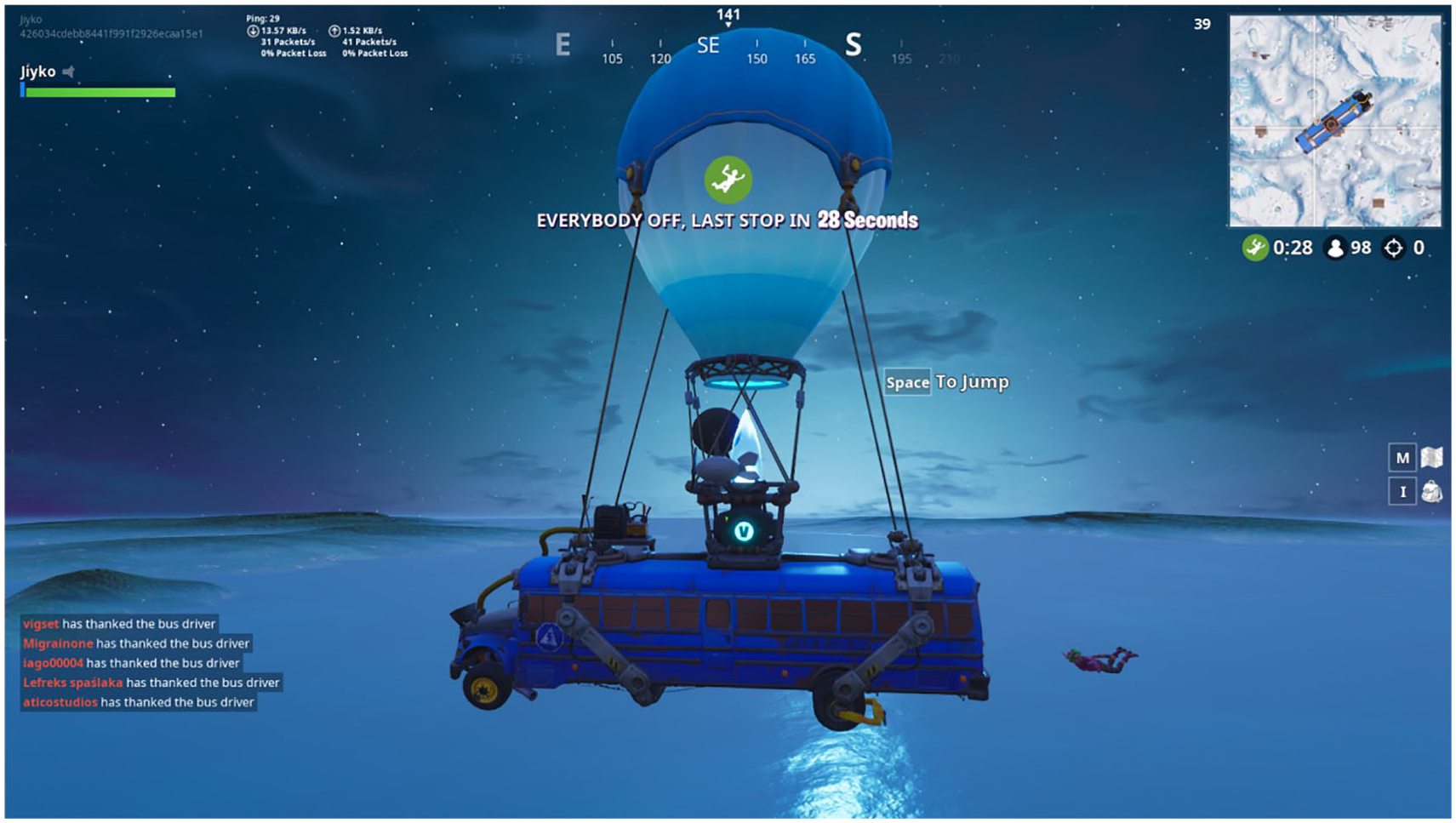
Players thanking the Bus Driver, text in the bottom left corner.
Research Questions
Do the linguistic markers used by a community change over time?
Does a community demonstrate more positive emotion linguistic markers after a prosocial activity is added to the game?
Hypothesis 1: An introduced Prosocial action can be correlated with the increased use of Positive Emotion linguistic markers in a community.
Hypothesis 2: An introduced extrinsic Reciprocity on an existing Prosocial action can be correlated with a reduction in Positive Emotion linguistic markers.
Methodology
Design
In this study, the researcher will collect data from before and after the introduction of the in-game prosocial activity as well as after the reciprocation event. The text will be collected from comments, selected at random, within the FortniteBR community on Reddit. There are three sets of data cohorts which are split between those made before the prosocial activity was introduced in the game (pre–23 August 2018) and after (post–1 September 2018) as well as post reciprocation (post–1 January 2019). Those that do not reach the participant requirements were removed from the data set. The LIWC is run on these data sets separately while reviewing the results of key dictionaries of Positive Emotion.
Procedure
The users are selected randomly from the FortniteBR subreddit. Their post history was read to ensure they meet the qualifying criteria. Not valid posts were filtered out, these included posts with text that the moderation team had edited or linked to other web pages.
Participants will not be included in the data unless they meet the qualifying inclusion criteria:
Three separate posts with a total combined word count of at least 150;
Posts must be made to the /r/FortniteBR subreddit where the conversation is exclusively related to Fortnite and where English is the default language; and
To be included in the pre-prosocial, posts must have been made before 23 August; to be in the post-prosocial, posts must be between 1 September 2018 and 15 December 2018; and to be in the post-reciprocity group, posts must have been made after 1 January 2019.
Upon satisfying the inclusion criteria, data were cleaned through
The removal of all posts with web links, as these are posts that are copied every week and are not written manually; and
The removal of all moderator replaced posts, as some posts that do not meet the community standards are replaced with a template content.
These posts are then grouped based on date and saved to the file storage. The username is converted to a hash to avoid duplicate readings and then deleted. The researcher will then use a dictionary-based software to identify the language markers for each time window. Once this is done, the original text data will be deleted to make the data fully anonymous.
Measurement of Linguistic Markers
LIWC is a dictionary-based text analysis tool (Pennebaker et al., 2015). It reviews the text and outputs 70+ variables related to different linguistic markers. For this research, the analysis will focus on two dictionaries: those of Positive Emotion and Negative Emotion (Table 1).
Reliability Scales for LIWC (Pennebaker et al., 2015).

Statistical Analysis
A Linear Regression Analysis will be done to assess the variance of the linguistic markers between cohorts. This will look for the changes in the dependent variables, the results of LIWC, with the independent variables, the status in relation to the prosocial behavior. The level of statistical significance is set to .05.
Data Collection Process
The corpus of data that was used is Pushshift.io (Michael, n.d.). Data were gathered, validated, and formatted for LIWC (Pennebaker et al., 2015) programmatically using a custom-created open source tool called RDR V1.0 (Ryan, 2019).
Results
Descriptive Statistical Information
During data collection, a sizable cohort of participants was observed (n = 9,037), with a significant proportion (n = 7,221) meeting the inclusion criteria. In total, the valid participants posted 1,245,829 times. After additional filtering, there were 1,232,741 posts, with a total of 18,990,637 words. These were broken into separate 2-week windows based on posting date, and the windows were grouped into three cohorts (Table 2). Statistical information and breakdown at the cohort level is located in the supplementary material.
Descriptives of All Data Sets.

WC: word count.
Statistical Analysis
A regression analysis was run on the gathered data, with the analysis being run twice to compare the pre-prosocial group with the post-prosocial group, then the post-prosocial group being compared with the post-reciprocity group for both the posemo and negemo linguistic markers. Statistical significance was set at <.05.
Posemotion Linguistic Marker Analysis
For the analysis of posemo linguistic markers, by comparing the pre-prosocial group with the prosocial group, the level of statistical significance (Table 3) was reached. The simple correlation of .756 indicates a high degree of correlation (Table 4). The resultant R2 indicates that 57% of the total variation in the posemo linguist markers can be explained by the independent variable.
ANOVA Comparing the Pre-Prosocial Group With the Prosocial Group Within Posemo Linguistic Library.

ANOVA: analysis of variance.
Dependent variable: posemo.
Predictors: (Constant), ProSocialStatus.
Regression Model Comparing the Pre-Prosocial Group With the Prosocial Group Within Posemo Linguistic Library.

Predictors: (Constant), ProSocialStatus.
Based on this dataset, Hypothesis 1 (An introduced Prosocial action can be correlated with the increased use of Positive Emotion linguistic markers in a community) is demonstrated.
In the analysis of posemo linguistic markers, comparing the prosocial group with the reciprocity group, the level of statistical significance (Table 5) was also reached, though at a lower level. The simple correlation is .608 (Table 6). The resultant R2 indicates that 37% of the total variation in the posemo linguist markers can be explained by the independent variable. Based on this data set, the inverse of Hypothesis 3 (An introduced explicit Reciprocity of said Prosocial action can be correlated with a reduction Positive Emotion linguistic markers) is suggested to be true.
ANOVA Model Comparing the Prosocial Group With the Reciprocity Group Within Posemo Linguistic Library.

ANOVA: analysis of variance.
Dependent variable: posemo.
Predictors: (Constant), ProSocialStatus.
Regression Model Comparing the Prosocial Group With the Reciprocity Group Within Posemo Linguistic Library.

Predictors: (Constant), ProSocialStatus.
Discussion
This research and data set demonstrated two interesting aspects of the psycholinguistics on an online community. First that the addition of a prosocial act has a positive impact on the total percentage of positive emotion words used in an online community. It also showed the motivation behind this prosocial act has limited effect on linguistic change. On the other side of the coin, there was no change in negative emotion linguistic markers, which implies two things, that an increase in positive emotion does not correlate with a decreased use of negative emotion and that the introduction of a prosocial act does not correlate with a change in negative emotions. This holds significant meaning for a game company that wants to improve the quality of dialogue in its community or indirectly shape the nature of communications that surrounds it. Looking at the stated research questions, the proposal that linguistic markers used by a community change over time, which is suggested by the existing research (Hamilton et al., 2017; Riverin & Stacey, 2008), is demonstrated in this dataset, with the trend line with an R2 of .166 (Supplementary Data Figure A.1) detected in the pre-prosocial group. Based on this existing research, it is possible that there would have been a continued slow increase in positive emotion linguistic markers regardless of whether the act was introduced.
This research also bears out the expectations established by Gentile et al. (2009) as discussed in the literature review. The community’s involvement in a digital prosocial act had a measurable bearing on their behavior in other areas, with the significant R2 of .539 for changes in the use of linguistic markers. The expected change in negative emotion linguistic markers was the area with the least existing supporting academic research. While a data set would have been expected to demonstrate a decrease, based on the work of Raposa et al. (2016), this research was carried out in an offline context and the results are not directly comparable.
This work has several areas that can be both improved on and built upon. There is the possibility that a person might express a tone in their communication that does not reflect how they would act in the moment of gameplay; limiting the data to only those that did the prosocial activity could produce different results. There are also uncontrolled variables in the form of seasonal changes in the community. A potential improvement could be made in normalizing the tone changes during the same time across the entire site where the data were collected. Additional work could also be done to control for additional changes within the game. This includes the possibility that the introduction of the prosocial act accelerated a change that was already happening within the community. There are a few areas of research that this work can be expanded into. The questions of whether this can be replicated for a non-game piece of software and if it can be replicated using in-app discussion instead of external community merit additional analysis. There are also areas of behavior that can be looked at, like were there any other changes due to the introduction of the prosocial activity? Did it attract a different player base after the introduction of the action? From a business point of view, is a Prosocial community the most profitable? Is the result replicable using a different psycholinguistic model? All of these areas merit additional research. A potential criticism common across some of this type of research is that it conflates the terms “mood,” “tone,” “theme,” and “linguistic marker.” This is especially evident when the dictionary used, to refer to a collection of linguistic markers, is named for an emotion. There is also criticism of the lack of context used in the grouping of words (Karimi & Ferreira, 2016). Being an active area of research, this multidisciplinary field combines computing and psychology through the use of emerging analysis methodologies such as “soft word comparison” (Gong et al., 2018) and “second order soft co-occurrences” (Razavi et al., 2014). Both of these approaches are theoretical methodologies based on emerging machine learning technologies and are not replicable without significant engineering work, though adoption could be expected shortly. In addition, there is also a building body of research that shows emotions as the leading factor in the act of decision making (Lerner et al., 2015; Phelps et al., 2014). There is an opportunity for additional research that shows the causal relationship between emotion and the use of certain linguistic markers, as well as emotion and in-game behavior.
Conclusion
This research has several implications for academics interested in psycholinguistics and prosocial behaviors in games as well as professionals working in the industry. First, the methodology was intentionally designed to be highly replicable so it can be used by both academics and industry researchers. Both the software used to gather all data and the statistical models are available either from the original researchers or open source.
It contributes to current research exploring the psychology of video game design and how it affects those that play them, as well as the direct impact a game has on the shaping of dialogue in a community. The ongoing improvement of the methodology would have a significant impact on how a game designer could assess the knock-on effects their design decisions have on the well-being of those in the community.
Supplemental Material
Supplementary_Data_File – Supplemental material for “Lock, Load, n’ Thank the Driver”: The Positive Influence of Prosocial Activity on Language in Online Social Groups
Supplemental material, Supplementary_Data_File for “Lock, Load, n’ Thank the Driver”: The Positive Influence of Prosocial Activity on Language in Online Social Groups by Seamus Ryan and Dean McDonnell in Social Media + Society
Footnotes
Declaration of Conflicting Interests
The author(s) declared no potential conflicts of interest with respect to the research, authorship, and/or publication of this article.
Funding
The author(s) received no financial support for the research, authorship, and/or publication of this article.

Supplemental material
Supplemental material for this article is available online.
Author Biographies
References
Supplementary Material
Please find the following supplemental material available below.
For Open Access articles published under a Creative Commons License, all supplemental material carries the same license as the article it is associated with.
For non-Open Access articles published, all supplemental material carries a non-exclusive license, and permission requests for re-use of supplemental material or any part of supplemental material shall be sent directly to the copyright owner as specified in the copyright notice associated with the article.
