




Abstract
Recent work demonstrates that hostile emotions can contribute to a strong polarization of political discussion on social media. However, little is known regarding the extent to which media organizations and media systems trigger hostile emotions. We content-analyzed comments on Facebook pages from six news organizations (N = 1,800) based in the United States and Germany. Our results indicate that German news organizations’ Facebook comments are more balanced, containing lower levels of hostile emotions. Such emotions are particularly prevalent in the polarized information environment of the United States—in both news posts and comments. Moreover, alternative right-wing media outlets in both countries provoke significantly higher levels of hostile emotions, thus limiting deliberative discussions. Our results demonstrate that the application of technology—such as the use of comment sections—has different implications depending on cultural and social contexts.
Keywords
Introduction
Currently, more than one-third of adults in the United States are consuming news on the world’s largest social network, Facebook (Newman, Fletcher, Kalogeropoulos, Levy, & Nielsen, 2017). This makes the platform a prime engagement tool for news organizations to publish news stories and allows users to comment on those stories. Essentially, news organizations hope to engage with their readers through their comment sections on Facebook and to drive traffic to their own websites. While social media was initially praised for providing a platform for public discourse, user comments on social media often contain high levels of negative emotions, incivility, and antipolitical rhetoric (Anderson et al., 2014; Ceron, 2015; Muddiman & Stroud, 2017; Rowe, 2015b). Particularly when political topics are discussed on social media, negative emotions seem to thrive (Trilling, 2014; Ziegele, Quiring, et al., 2018). Commenting on political news represents an engagement with journalistic content that is important to analyze, as these comments may reveal the opinions of those who are willing to engage in public debates and attempt to influence public opinion (Buckels et al., 2014).
In addition, research in political communication has pointed out the potentially detrimental impact of negative emotions, cynicism, and incivility in political discourse and electoral politics (Cappella & Jamieson, 1997). However, negativity in comments is not inevitably challenging online discourses. While passionate disagreement is considered a deliberative opportunity for online communication, it is hostility, including anger, contempt, disgust, frustration, and hate, that violates the norms of deliberative conversations (Oz et al., 2018). Hostile emotions include the direct or indirect attribution to another person of negative or blameworthy features (D’Errico & Poggi, 2013). In online conversations, hostile emotions function as strong partisan identifiers (Miller & Conover, 2015). Partisans behave like sports team fans who strive “to preserve the status of their teams rather than [being] thoughtful citizens participating in the political process for the broader good” (Miller & Conover, 2015, p. 225), and express hostile emotions. It has been argued that hostility undermines the preconditions for deliberation because it limits personal freedoms, promotes stereotypes, disrespects opposing views, and threatens democracy (Hwang et al., 2018; Popan et al., 2019). Moreover, an environment of hostile comments triggers more hostile comments, which creates a downward spiral regarding comment hostility over time (Cheng et al., 2015). This makes hostility a particularly important research area of online debates because hostile emotions potentially promote harmful and aggressive behaviors as they feature medium to high arousal that can progressively increase (D’Errico & Paciello, 2018).
While previous research has analyzed drivers of hostile comments on news on the content level (D’Errico & Paciello, 2018; Ziegele, Quiring, et al., 2018), not much is known regarding the influence of the macro- and meso-level contexts on hostile emotions in online comments. However, patterns of discussion among readers vary depending on the country they live in (Walter et al., 2018). In this article, we therefore examine the prevalence of hostile emotions in user comments—including anger, contempt, disgust, frustration, and hate—and relate the sentiment of comments to the sentiment of news posts of six news outlets in two different countries, namely, Germany and the United States. We focus on Facebook due to its wide reach and heterogeneous readership and compare news outlets with varying political leanings and degrees of market orientation (mass-market, up-market, and alternative right-wing). We argue that political leaning and market orientation of news outlets as well as country differences, such as different levels of audience polarization, can impact the extent of hostile emotions in user comments. Therefore, we follow the social informatics perspective that explains social consequences of information and communication technologies (ICTs) based on cultural and institutional contexts (Kling, 2000). In contrast to technological determinism, the social informatics perspective suggests that ICTs have different outcomes when introduced to different cicumstances. That is, ICT’s social consequences, such as the knowledge-building capacity of communication on social media, depend on the the meso- and macro-level contexts of technology use (Greyson, 2019; Zhang et al., 2019).
This study is therefore the first to shed light on factors at the national and organizational levels that potentially foster hostile emotions in user comments and thus emphasizes that the micro-level as well as the meso- and macro-level contexts are relevant when analyzing interdependencies between people and technology.
Literature Review
News Content as Micro-Level Driver of Hostile Emotions in User Comments
D’Errico and Paciello (2018) reveal that user comments that contain annoyance, irritation, and contempt, that is, aspects of hostility, are related to antisocial opinions that manifest in blame attribution or dehumanization of victims. Thus, impoliteness, incivility, and hostility are closely related (Naab et al., 2018; Oz et al., 2018). Building on this literature, we conceptualize hostile emotions in user comments as impolite emotional expressions that aim at insulting individuals or social groups. This definition combines aspects of impoliteness and incivility to determine an unconstructive and extremely negative sentiment in user comments. Emotional components of hostile user comments include anger, contempt, disgust, frustration, and hate (Oz et al., 2018; Sobieraj & Berry, 2011; Soroka et al., 2015).
On a micro-level, the type of news content explains varying levels of hostile user comments (Oz et al., 2018; Rowe, 2015a; Sydnor, 2018). News coverage on controversial topics, such as immigration or public policy, is often followed by high numbers of user comments, among them often those including hostile emotions (Farkas et al., 2018; Oz et al., 2018). News outlets might provoke hostile comments on their Facebook pages by posting articles that contain negative emotions or scandals. Negativity is an important news factor as well as a discussion factor (Weber, 2014). By favoring dramatic, conflict-emphasizing news reporting, news outlets might generate follow-up communication reflecting their negative tone (Soroka et al., 2015). Thus, we propose the following hypothesis:
H1. Higher levels of negative emotions in posts trigger higher levels of hostile emotions in user comments.
Moreover, hostility as an emotional expression is usually targeted toward a specific group or actor, and commenters frequently attack certain actors, such as immigrants, the media, or the political elites (Coe et al., 2014). Meanwhile, populist movements often rely on such negative emotions as a key strategy for their continuous support (Blassnig, Engesser, et al., 2019; Rico et al., 2017). We therefore pose the following hypothesis:
H2. Comments referring to immigrants, the media, or political class contain higher levels of hostile emotions compared to other comments.
However, content alone may not be sufficient to explain different levels of hostility in user comments across news outlets and media systems.
Drivers at the Organizational Level: Market Orientation and Political Stance
Previous research found that the level of incivility in comments differs across news outlets (Ziegele, Quiring, et al., 2018). Two aspects may cause news outlets to accept or trigger deviant comments, including hostile emotions in comments: the market orientation and the position of an extreme political leaning.
News outlets have been found to differ in the degree to which they strive to maximize their reach and revenue (Benson, 2016; Humprecht & Esser, 2018). The market orientation of some media types is reflected not only in the news content they produce, but also in the comments they moderate or allow (Benson et al., 2018; Blassnig, Engesser, et al., 2019; Walter et al., 2018). Previous research has highlighted the differences between mass-market and up-market media companies in terms of market orientation and its impact on news production (Dunaway, 2013; Humprecht & Esser, 2018).
Most news organizations run their own Facebook pages, but the purpose of these pages is often simply to increase readership (Rowe, 2015b). Therefore, news making for social media adapts to the logics of social networks, and editors are more likely to select news stories that have the potential to be popular and trigger engagement (van Dijck & Poell, 2013). Provocative, negative comments may serve as a means to increase the popularity of and engagement with an article. Although media companies often complain about negative emotions in user comments, they tolerate them (Cheng et al., 2015) because such comments attract audiences (Muddiman & Stroud, 2017; Rowe, 2015a), trigger attention, and broaden the reach of news stories (Weber, 2014; Ziegele, Weber, et al., 2018).
When professional norms are subordinated by financial goals, market orientation is likely to be reflected in the moderation of user comments (Weber, 2014). Previous research has shown that news outlets employ various strategies to manage comment sections (Ksiazek, 2015). Interestingly, news outlets’ pre- and post-moderation strategies have been found to differ between their websites and Facebook pages (Naab et al., 2018; Rowe, 2015b). On their own websites, outlets often have guidelines for commenters and might even suspend users who do not comply with these rules. On Facebook, however, other rules seem to apply. The rules on Facebook are often not made explicit and are, in many cases, less strict (Hille & Bakker, 2014). This lax handling of deviant commenting on Facebook pages is likely to be driven by the aim to increase audience reach and thus may differ across news outlets depending on their goal to maximize reach (Carlson, 2018). Hence, while mass-market outlets target a broad audience and are often highly market-oriented (Humprecht & Esser, 2018), up-market outlets often have distinct professional standards and are less mass-market-oriented (Benson et al., 2018). Therefore, we assume the following:
H3. Facebook pages of mass-market outlets contain higher numbers of hostile emotions in user comments compared to up-market outlets.
Recent research has shown that populist actors deliberately fuel negative emotions to crystallize grievances, often toward political elites or immigrants (Hameleers et al., 2017; Mazzoleni, 2008, 2014; Wardle & Derakhshan, 2017). Alternative right-wing media news outlets use this communication strategy to frame issues in a way that confirms these ideological predispositions (Heft et al., 2019; Krämer, 2017). This type of news content is found to trigger hostile emotions in user comments (Coe et al., 2014; Esau et al., 2017). Moreover, certain journalistic styles foster negative emotions and outrages in comment sections. Sobieraj and Berry (2011) found that overgeneralizations, sensationalism, misleading or patently inaccurate information, ad hominem attacks, and partial truths about opponents lead to those outrages. The employment of certain frames and styles depends on the political positioning of news outlets. Research has shown that conservative media utilize significantly more outrage speech than liberal media (Bessi et al., 2015). Regarding political stance, Republicans are regarded as ruder than Democrats in the United States, suggesting that commenting styles differ depending on the political leaning of a news outlet’s audience (Gastil, 2019). However, these findings are mostly limited to the political context of single countries, focusing on the United States, and have not been validated in a comparative setting. It is thus crucial to understand whether certain strategies of news outlets lead to different outcomes across different countries. Based on these findings, we suggest the following:
H4. Facebook pages of alternative right-wing news outlets contain higher levels of hostile user comments compared to mass-market and up-market news outlets.
Drivers at the System Level: Polarization of Online Discourses
Previous research has established that different information environments, such as in the United States and Germany, shape public discourse, which might also be true for online discussions (Esser et al., 2012; Ferree et al., 2002; Gerhards & Schäfer, 2010) and commenting behavior (Sherrick & Hoewe, 2018). Recent developments such as the rise of populist parties and growing societal and political polarization (Barnidge et al., 2018; Esser et al., 2017) can explain important dynamics of user comments’ expression. In Germany as well as in the United States, right-wing populism is a relatively new phenomenon (Norris, 2005; van Kessel, 2015). However, while the United States is currently governed by a populist political leader, the German populist party is not able to dominate public discourse to the same degree President Trump does in the United States (Blassnig, Rodi, & Tenenboim-Weinblatt, 2019; Timbro, 2019). Moreover, a growing polarization among political elites and the public is arguably being reflected in public discourse (Kenski et al., 2018; Layman et al., 2006) and in specific news media diets of populist users (Schulz, 2019). In this line, recent research has shown that audience polarization has increased in some countries (Fletcher et al., 2020). This research shows that audiences in the United States are more polarized compared to Germany where major news outlets attract audiences from different sides of the political spectrum. In highly polarized countries like the United States, frequently used news outlets have strongly left-leaning or strongly right-leaning audiences, while outlets with mostly mixed or centrist audiences become less important (Fletcher et al., 2020).
Against this background, we argue that the polarization of audiences is reflected in public discussions on Facebook. Previous research has shown that hostile emotions and antipolitical rhetoric seem to flourish on social media (Ceron, 2015; Ferrara et al., 2016; Muddiman & Stroud, 2017; Sobieraj & Berry, 2011). Exposure to this kind of rhetoric, in turn, shapes expectations of public deliberation (Hwang et al., 2014; Stroud, 2011). Moreover, the unmanageable amount of information sources on the web can lead to selective exposure of content that is consistent with one’s own beliefs or the avoidance of news (Aalberg et al., 2013; Iyengar et al., 2009; Stromback et al., 2012). However, some studies indicate that the social media environment also enhances exposure to inconsistent information, that is, when information is shared by friends. For example, Filer and Fredheim (2016) found in their study of Twitter discourses in Argentina and Russia that political actors did not shut down opposition discourse, but tried to undermine it with their own framing of certain events. This interplay between political antagonists may explain the polarization of controversies in digital societies (Post, 2019). Thus, exposure to inconsistent information does not necessarily add to a more balanced world view. In contrast, readers may reject unpleasant information and use comments sections to share their negative emotions. These negative comments, in turn, make readers with similar views feel affirmed (Sherrick & Hoewe, 2018). In environments with strong audience polarization, user comments are likely to be strategically hostile to defend partisan views and offend the counter party (Miller & Conover, 2015). Hence, audience polarization and hostility in online discourses are closely related. However, empirical evidence regarding the increasing audience polarization and declining deliberative quality of online discussions is inconclusive, and most studies focused on the United States (Oz et al., 2018; Rowe, 2015b; Wang & Silva, 2018).
The United States and Germany offer excellent conditions for comparative research because both countries—to different extents—have been impacted by political parties and leadership of the far-right (e.g., President Trump in the United States and the rise of the Alternative for Germany [AfD] far-right party). In addition, research has shown that audience polarization is more pronounced in the United States compared to Germany (Fletcher et al., 2020). Summarizing the findings discussed above, we conclude that substantial differences exist between the United States and Germany regarding the hostility in online discourses. Thus, we hypothesize the following:
H5. Facebook pages of US-based news outlets contain higher levels of hostile emotions in user comments compared to the Facebook pages of German-based news outlets.
Finally, cross-national research has established that the national context shapes public deliberation (Ferree et al., 2002). However, empirical studies have not yet examined how characteristics of different political and media systems shape user comments. Thus, we pose the following research question:
RQ1. How does the country interact with outlet-level and content-level characteristics?
Data and Methods
To assess the hypotheses, a quantitative content analysis was performed. The sampling was conducted in three steps. First, two countries with different levels of audience polarization were sampled, namely, Germany and the United States. Previous research has established that audiences in the United States are highly polarized compared to Germany (Fletcher et al., 2020). One reason for this is that Germany and the United States have different media systems. Germany has been considered part of the democratic corporatist media systems model, characterized by low levels of political parallelism and media-party parallelism (Brüggemann et al., 2014; Büchel et al., 2016; Hallin & Mancini, 2004). Moreover, the country has a strong public broadcasting system with a diverse audience, also in terms of political orientation (Fletcher et al., 2020). The United States, in contrast, is characterized by strong audience polarization, a finding that has been linked to the country’s increasing polarization of political elites which is reflected in news reporting as well as in audience orientation (Fletcher et al., 2020).
In a second step, we sampled news outlets with different degrees of market orientation and different political leanings. This distinction helped us to sample functional equivalent media organizations across both political and media systems. Based on the categorizations of media types used in previous research (Blassnig, Engesser, et al., 2019; Ernst et al., 2019), we sampled news outlets with the highest number of followers in each category. Following Ernst et al. (2019), we sampled one mass-market news outlet in each country, namely, USA Today and WAZ, one up-market news outlet in each country, namely New York Times and Süddeutsche Zeitung, and one alternative right-wing news outlet in each country (Breitbart and Kopp Report) (Table 1). This categorization is based on the assumption that some news outlets follow more professional criteria in their editorial work (e.g., up-market outlets), while others are rather guided by profit orientation (e.g., mass-market outlets). 1
Selection of Countries and News Outlets.
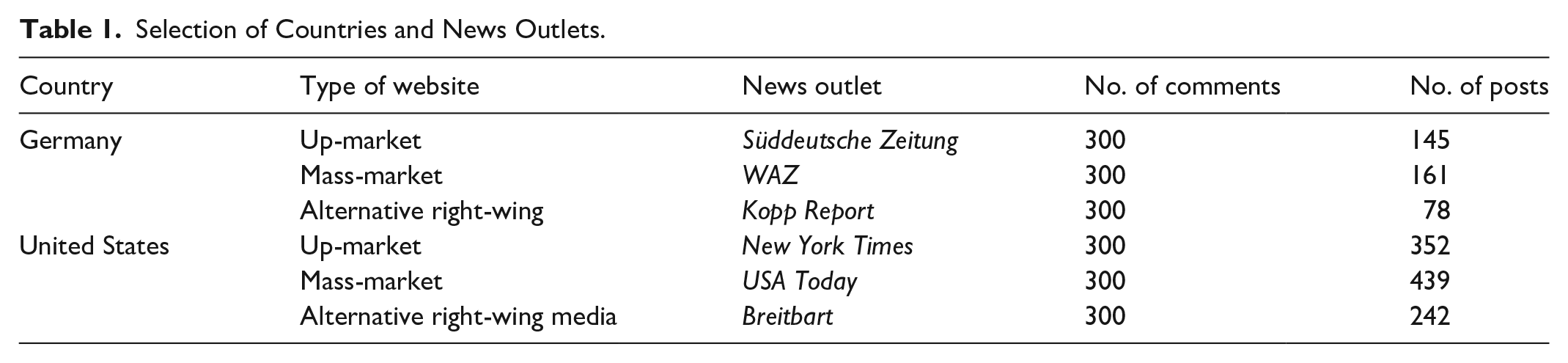
Third, we identified the news outlets’ official Facebook pages and collected 244,562 user comments and their original posts (n = 1,438) within 1 week in February 2017. We then randomly sampled 300 comments on each Facebook page, summing up to N = 1,800 comments. The coding was conducted by two native speakers who underwent several rounds of coder training until the intercoder reliability test achieved satisfying results, with average Krippendorff’s alpha values of .79 (>.65; <.85).
The sentiment of each comment was operationalized by coding the manifest tonality of each comment in the respective language (English or German). Drawing on previous research (Oz et al., 2018), a hostile sentiment was indicated by use of expressions of anger (e.g., “That’s an insult.”), offensive contempt (e.g., “delusional narcissist sociopath”), disgust (e.g., “pathetic embarrassment”), frustration (e.g., “They screwed us!”), and hate (e.g., “I hate everything about him! EVERYTHING”). In contrast, an affirmative, positive tone was indicated by cheering or approving expressions, such as “great,” “well done,” “I love it,” “I support it,” or “okay.” For the subsequent data analysis, the various forms of hostile emotions were combined into a hostile emotions index.
Furthermore, we coded the main actor of each comment. We coded the most important political and societal actors, for example, heads of state, political parties in congress, news media, and different societal groups. Actors were assigned to the following categories: Donald Trump, Hillary Clinton, Barack Obama, Angela Merkel, Republican Party (US), Democratic Party (US), CDU/CSU (DE), SPD (DE), Die Grünen (DE), Die Linke (DE), AfD (DE), other politicians, politics/political class, business/economics, media/journalism, immigrants/foreigners, general public, and other actors. Furthermore, we coded the target object of each comment. Target objects were coded if a comment attacked, defamed, or offended an actor. We used the same actor list that was used for the coding of main actors.
In the last step we turned to the n = 1,438 news posts that belonged to the comments. To analyze the large number of posts, we opted for an automated analysis using the Linguistic Inquiry and Word Count (LIWC). LIWC is a psychological dictionary that allows us to analyze the emotional tone of the news outlet’s Facebook posts (Pennebaker et al., 2007). The LIWC dictionary contains lists of words and word stems linked to a number of psychological categories developed and refined by Pennebaker et al. (2007), including positive or negative emotional tone. One of the most widely used language dictionaries in existence, LIWC has been applied successfully in a variety of social science research (Ahmadian et al., 2017; Cheng et al., 2015; Connor et al., 2010; Hwong et al., 2017). LIWC is particularly useful in our case as it provides equivalent versions for the English and German posts (Brand et al., 2003; Tumasjan et al., 2010).
Results
Our results reveal important differences across the countries and outlets under study. The Facebook pages of the US news outlets featured significantly more hostile comments (M = 0.66) compared to the German news outlets (M = 0.48; scale ranges from 0 to 1). The German comments more frequently used a neutral tone (M = 0.43) compared to the English-language comments (M = 0.21) (Table 2). Based on these results, we accept Hypothesis 5, postulating that higher levels of audience polarization on the national level, as present in the United States, foster hostile commenting on social media.
Comment Type by Country.

Total N = 1,800. Values are means with standard deviations in parentheses.
At a meso-level, we assume that mass-oriented news outlets feature higher levels of hostile user comments on their Facebook pages because of their strong market orientation (Hypothesis 3). In addition, the political leaning of news outlets is expected to drive hostility in user comments (Hypothesis 4). As Table 3 shows, market orientation does not seem to be a driver for hostile emotions in comments since mass-market outlets (M = 0.56) did not differ significantly from up-market outlets (M = 0.50). However, the Facebook pages of alternative right-wing news outlets showed significantly more hostile comments (M = 0.64) than other outlets.
Comment Type by Outlet Type

Total N = 1,800. Means with different superscript letters are significantly different at the p < .001 level; means with the same superscript are not statistically different (based on post hoc Dunnett’s T3 test for unequal group variances at the p < .05 level).
Differences were also found on a micro-level with regard to actors and target objects in user comments. As shown in Figure 1, commenters from both countries frequently focused on the US President and on immigrants. At the time of data collection, Donald Trump was relatively new in office and predominantly focused on the topic of immigration. News media in both countries reported intensively about his plans and policies.

Top 10 main actors per country (%).
Regarding the target objects of the comments, country differences were more pronounced. The commenters in the United States frequently targeted the US President, the political class, and the Democratic Party. In contrast, the German commenters more often attacked immigrants or mentioned the consequences of immigration for the general public (see Figure 2).

Top 10 target objects per country (%).
To compare the relative weights of the micro-, meso-, and macro-levels, predictors were tested in a multivariate ordinary least squares (OLS) regression with the hostile emotions index as the outcome variable. Independent variables were entered in two blocks: (1) county-level, outlet-level, and comment-level variables and (2) interactions. Table 4 presents the results of the two models that were tested. In the first model, country characteristics are positively associated with hostility in Facebook comments. We find that comments on the Facebook pages from US-based outlets are more hostile (β = 0.17). However, hostile emotions in posts are not related to higher levels of hostile emotions, a finding that leads us to reject Hypothesis 1. Moreover, the meso-level predictors of market orientation and political stance revealed no effects in the multivariate setting, thus rejecting Hypotheses 3 and 4. On the micro-level, we found significant effects for all three actor types: media (β = 0.07, p ⩽ .01), immigrants (β = 0.06, p ⩽ .01), and political class (β = 0.10, p ⩽ .001). These results are consistent with Hypothesis 2 stating that comments featuring these issues are likely to have a hostile tone.
Regression Models for Predicting the Level of Hostile Emotions in Facebook Comments.

OLS: ordinary least squares.
OLS regressions. Entries are unstandardized coefficients, standard errors, and betas.
p < .05; **p < .01; and ***p < .001.
In Model 2, we tested several interactions to answer our research question. The interaction between country and alternative right-wing news outlets revealed a significant, negative effect (β = −2.05, p ⩽ .001). We tested this interaction to examine whether the influence of political leaning increases in polarized environments. However, this result indicates that in less polarized environments, such as in Germany, comments on alternative right-wing Facebook pages predict higher levels of hostility. Furthermore, we tested interactions between the country and different actors mentioned in the user comments. We found significant, negative main effects for the media (β = −0.16, p ⩽ .001) and immigrants (β = −0.1, p ⩽ .01). Furthermore, we found a weak, positive effect of the prevalence of political actors in the comments (β = 0.05, p ⩽ .05). These results show that unless the comments on German Facebook pages contain lower levels of hostility compared to the comments on US pages, the level of hostility rises in polarized debates, such as on immigrants, the media, and on alternative right-wing pages. In other words, when immigrants and the media were mentioned in comments, hostility in the German comments increased. The same, but weaker, effect was found for the mention of political actors and increasing hostility in the US comments. The data fit improved to 8% of the explained variance in the comprehensive Model 2.
Discussion
Going beyond the literature on individual-level factors for online participation, this study is one of the first to systematically test and identify organizational and system-level drivers for hostile emotions in online user comments on Facebook. The starting point of this study builds on previous research that examined hostile emotions in discussions on social media as a potential threat to democracy because of its potential to polarize public discourse and the absence of finding common ground for consensual decision-making. Although hostility in the form of uncivil, angry, and aggressive language is present in most countries, this phenomenon seems not to be driven purely by technology and the rise of social network sites but depends on contextual factors. Several authors have argued that characteristics of the information environment as well as the type of news outlet can explain the prevalence of hostile comments on news outlets’ Facebook pages. However, empirical research examining macro- and meso-level factors is scarce as most previous studies focus on individual factors that predict commenting on news stories, or studies examine the types of media organizations that trigger hostile comments. To fill this gap, we conducted cross-country and cross-outlet comparisons to examine the influence of the information environment and the outlet type.
Generally, we find significantly higher shares of hostile Facebook comments in the United States compared to Germany. This result seems to confirm our assumption that polarized audiences are linked to hostility in online discussions. The political communication culture of the United States is marked by heated electoral campaigns, including negative campaigning and frequent verbal attacks of political opponents. Recently, social media has become an important tool to whip up the masses in the fight for attention (Kenski et al., 2018). This combination seems to increase the level of hostile emotions in user comments.
In environments with less polarized audiences, such as in Germany, hostile comments occur when controversial topics are debated. Our analysis shows that hostile comments are more frequent on the alternative right-wing media Facebook pages. The polarized debates on the refugee crisis and the “lying press”—an expression referring to the news media’s positive reporting on refugees—seem to trigger higher numbers of hostile comments in Germany than in the United States, across all three types of news organizations. This difference is also reflected in the strong personalization of comments in the United States, which frequently target political actors, such as the President. Moreover, the comments on the German alternative right-wing media Facebook page seem to be less undermined with opposition discourse outbalancing hostility, as found in Filer and Fredheim’s (2016) results. Thus, audience composition related to the diversity of political leaning might be relevant to understanding the relationship between macro- and meso-level characteristics. The results of this study illustrate the different online discussion cultures in these two countries. In the United States, negative social media comments are pervasive. In Germany, however, social media discussions are likely to have a hostile tone when they involve polarized topics.
What role do news outlets play in regard to hostility in social media comments? News outlets frequently complain about the rising number of hostile comments on their platforms (Meltzer, 2014). Hate speech, incivility, and impoliteness challenge media organizations in many ways. Large numbers of negative comments can affect the credibility of single outlets (Anderson et al., 2016; Prochazka et al., 2018). Therefore, newsrooms must compile guidelines for the moderation of user comments and implement them without repelling (too many) users (Ziegele & Jost, 2016). However, although media actors complain about hostile emotions in comment sections, some outlets accept and even provoke them (Lengauer et al., 2011; Muddiman & Stroud, 2017). Those news outlets benefit from outrageous and uncivil discourses because they trigger attention—thus increasing advertising revenue. Our results do not show a direct relationship between hostile emotions in posts and in comments, but the editorial orientation of news outlets seem to influence the discourse in comment sections. Alternative right-wing news outlets are pioneers in this area: their content is supposed to fuel polarized debates and outrages that attract attention and thus become lucrative (Heft et al., 2019; Wardle & Derakhshan, 2017). The results of our study confirm this logic: Facebook pages of alternative right-wing news outlets contain significantly higher numbers of hostile comments. However, when considering the macro-level of the media system and the micro-level of the content, the meso-level of political stance has no predictive power. That is, alternative right-wing news outlets post more content that triggers hostile comments than up-market and mass-market news outlets but the alternative right-wing outlets do not cause greater hostility per se.
The question remains whether hostility in online discussion fosters political and societal polarization, or whether it is a result of such phenomena which manifest in audience polarization. Our study does not ultimately answer this question. However, one interpretation of our results is that the relationship between user comments and audience polarization is a reinforcing spiral (Cheng et al., 2017). Where political actors continuously attack their opponents and alienate their supporters against each other, deliberation and consensus-driven discourse becomes difficult. The result is split societies with citizens who barely share common values and avoid talking to each other in a rational way.
Naturally, this study has several limitations, most of which stem from its limited sample. First, we only compared two countries. To fully examine the importance of macro-level factors for the prevalence of hostile emotions on Facebook, a larger set of countries is needed. Future research may select larger sets of countries to explore further macro-level factors, such as trust in politics and national discussion cultures. Moreover, to sample functional equivalents, only three news outlets per country were sampled. Thus, the results do not reflect the entire variety of political online discussions related to news content in both countries. Furthermore, this study quantitatively examines hostility in user comments. To better understand in which ways political online discourses differ across countries and news outlets, qualitative studies are needed. They are able to identify the patterns of argumentations used by commenters in different environments. Moreover, a qualitative look at heavy commenters is another important future avenue for research as those actors presumably shape online discourse by setting important frames.
Conclusion
Comparing hostility on social media across news outlets and media systems, this study reveals that comparing contexts of use is relevant when analyzing interdependencies between society and novel technology in line with the social informatics perspective. While incivility and hostility have been described as a phenomenon related to hyper-partisan and alternative right-wing news outlets, hostile comments occur with polarizing topics in politically polarized systems. Benkler et al. (2017) argue that those news outlets are “combining decontextualized truths, repeated falsehoods, and leaps of logic to create fundamentally misleading views of the world.” By addressing polarizing actors and issues and by framing them in an ideological way, alternative right-wing outlets provoke a large number of hostile comments. Moreover, mass-market outlets may copy this successful strategy for profit motives and thus also contribute to increasing hostility and pollution of the social media public sphere. Overall, our study shows that hostility in Facebook news comments is not solely a technology-driven phenomenon but is driven by structural factors of the information environment and the news organization. Certain types of news outlets strategically provoke hostile comments on their Facebook pages, however, these patterns differ across the two countries examined in this study. These results have implications for the discussion of the nature and the causes of increasing hostility on social media. The existing research on the effects of hostile emotions in user comments indicates important implications for individuals. Some authors argue that those discourses increase political intolerance and decrease trust in politics and the news media (Muddiman & Stroud, 2017; Stroud et al., 2015). Other authors see potential for greater attention to public affairs and increased levels of political participation caused by politicized, polarized online debates (Molina & Jennings, 2017; Sobieraj & Berry, 2011). Whether predominantly hostile online discourses are corrosive or constructive to the health of democracy will remain an important question for future research. Moreover, new online platforms and greater self-selectivity are questioning traditional ideas of deliberation and the public sphere in democratic societies. When established media brands lose hold of their audiences, sharing a common stock of political knowledge is impeded. In such an environment, citizens are hardly required to think about the concerns and ideas of their political opponents, thereby immersing themselves in a media world filled with voices that share and bolster their existing perspectives without challenging them (Bennett & Iyengar, 2008). Our work deepens the understanding of the drivers of hostile emotions in online discussions and will hopefully provide guidance for future research in the field of social media discussions.
Footnotes
Declaration of Conflicting Interests
The author(s) declared no potential conflicts of interest with respect to the research, authorship, and/or publication of this article.
Funding
The author(s) received no financial support for the research, authorship, and/or publication of this article.
