




Abstract
Media literacy interventions provide education about the way media influence attitudes to tanned skin and promote risky health-related behaviors (e.g., sun exposure). This study tested whether higher levels of media literacy can protect against the internalization of a tanned ideal and participation in appearance comparisons online. A total of 151 young Australians aged 18 to 29 years (61 males, 90 females) completed a measure of media literacy before being randomly assigned to view photos of models with either tanned (n = 77) or pale skin (n = 74) on social media. Participants completed measures of internalization of a tanned ideal and tendency to make appearance comparisons following exposure to the photos. There were significant negative relationships between level of media literacy skills and both internalization of a tanned ideal and appearance comparisons. Moreover, exposure to tanned models resulted in a higher tendency to make appearance comparisons than exposure to pale models. Results indicate that media literacy skills protect against skin cancer risk factors associated with media exposure. Future interventions to reduce skin cancer risk should address the role of social networking sites in proclaiming tanned skin as ideal and increase skepticism about photos of tanned models online.
Melanoma incidence is increasing faster than any other malignancy (Rigel, 2008), with the annual number of deaths tripling in Australia between 1982 and 2016 (Australian Institute of Health and Welfare, 2016). The primary cause of skin cancer is skin cell damage resulting from exposure to ultraviolet radiation (UVR) primarily obtained through time spent outdoors without the use of sun protection such as sunscreen or protective clothing (Balk & the Council on Environmental Health Section on Dermatology, 2011; World Health Organization, 2007). Tanned skin is coveted in western cultures as part of an ideal appearance and is associated with positive expectancies including physical attractiveness, self-confidence, and social inclusion (Thomas & Peñas, 2017). Subsequently, adolescent and young adults are dissatisfied with their skin tone and desire darker skin (Hutchinson et al., 2014; Prichard et al., 2013). Despite knowledge of the known risks, people continue to expose their body UVR deliberately (Keeney et al., 2009). Young people in this population actively seek a tan and the risk of skin cancer is greater in Caucasian compared to non-Caucasian populations (Geller et al., 2002). Although individuals may neglect sun protection for reasons such as an aversion to the oily texture (e.g., Wickenheiser et al., 2013), a primary motivation to ignore sun protection recommendations is the desire for tanned skin, which, in turn, is driven by the perception that tanned skin is more attractive than pale skin (Mahler et al., 2010). Kasparian et al. (2009) reported the perceived benefit to physical attractiveness to be the most widely cited motivational factor affecting the likelihood of adhering to sun protection recommendations, as well as social factors including the belief that one’s peers prefer tanned skin.
Perceptions of attractiveness and positive expectancies for specific appearance ideals are often derived from socio-cultural norms (Thompson et al., 1999). Various forms of mass media disseminate and perpetuate culturally constructed perceptions of beauty (Xie & Zhang, 2013). The tripartite influence model, a socio-cultural theory of body image, proposes that exposure to media leads to the internalization of the ideals that define beauty. According to this model, people make comparisons of their own appearance to the media ideals and subsequently experience body dissatisfaction (Thompson et al., 1999). Internalization is said to have occurred when the individual adopts a media norm as their own personal standard and uses this to guide their decision-making and behavior (Thompson et al., 2004). When applied to tanning behavior, the model proposes that media contribute to the perception that tanned skin is attractive, a belief which is then internalized by an individual based on the extent to which this appearance is perceived as valued by others, and then acted upon through the seeking of behaviors to attain a tanned appearance. Although originally developed for use within thin ideal and dieting research, the tripartite model is applicable to other salient appearance ideals and has been extended to sun exposure and the desirability of tanned skin (Cafri et al., 2009; Mingoia et al., 2017).
Exposure to photos of people with tanned skin in traditional media (i.e., television, film, magazine) is correlated with greater pro-tan attitudes, positive beliefs about tanning, frequency of tanning, and other behaviors linked to UVR exposure (McWhirter & Hoffman-Goetz, 2015). Furthermore, internalization of a tanned ideal mediated the relationship between socio-cultural norms endorsing tanned skin as attractive (e.g., media, peers, family) and sun exposure behavior (Mingoia et al., 2017). The results of experimental research support these associations, with increased positivity in attitudes toward tanning reported following exposure to photos of models with tanned skin (Mahler et al., 2010).
While most research has focused upon exposure to traditional media, there is now a need to address the role of social networking sites (SNSs) in proclaiming appearance ideals because these sites include idealized portrayals of the self (Meier & Gray, 2014). SNSs are immensely popular, with 90% of young adults having at least one SNS account, and most of these using SNSs daily (Pew Research Center, 2016). SNSs provide users with unprecedented access to content available for viewing, creating, and sharing across a limitless number of personal mobile devices (Perloff, 2014). Photo sharing is one of the most common activities on SNSs and these photos are used to manage self-presentation online. The nature of online self-presentation is much more controlled than in offline environments (Diefenbach & Christoforakos, 2017), allowing the user to careful construct, and if deemed necessary, edit their appearance. In particular, editing photos prior to posting is associated with internalization of a tanned ideal, and the level of investment that a user demonstrates in the posted photos (e.g., their concern for the quality and effort expended in selecting photos) is associated with internalization of a tanned ideal as well as the propensity to engage in appearance comparisons to others on social media (Mingoia et al., 2019b). Furthermore, viewing photos related to tanning on SNSs is correlated with greater skin tone dissatisfaction, more frequent sun exposure, and less frequent use of sun protection (Mingoia et al., 2017). Although inferences of causation and directionality are yet to be tested, these findings suggest that posting and viewing photos on SNSs may affect tanning decisions.
Public health campaigns, such as SunSmart in Australia, have attempted to modify tanning decisions by improving health education related to sun safety behaviors (Montague et al., 2001). While these health-orientated campaigns have been effective in improving sun protection behaviors including sunscreen use (Dobbinson et al., 2015), the underlying appearance motivations for the desirability of tanned skin is rarely challenged (Perez et al., 2015). This is problematic because young people may engage in tanning behavior because of a focus on the perceived immediate appearance benefits rather than the potential long-term health concerns (Knight et al., 2002). Therefore, decreasing the internalization of a tanned ideal and the propensity for individuals to make appearance comparisons are important components of skin cancer prevention by challenging the need to appear tanned.
Considerable success in challenging the desirability of other risky health behaviors that have been endorsed in the media has been achieved by improving media literacy in the target population group. Educational techniques that focus on improving media literacy are used to develop critical thinking skills. These skills enable individuals to recognize the pervasive way media influence knowledge and attitudes and how this influence, in turn, can promote poor behavioral choices (Gonzales et al., 2004). Jeong et al. (2012) performed a meta-analytic review and found media literacy interventions improved judgments about perceived realism and improved attitudes, beliefs and behaviors related to tobacco smoking, alcohol consumption, drug use, and sexual behavior. Furthermore, one study applied social media literacy education to portrayals of tanning on SNSs and found this resulted in decreased positive attitudes to tanning following participation in a 2-week social media literacy intervention (Mingoia et al., 2019a). The authors also found those who received the social media literacy education reported less internalization of a tanned ideal, less propensity to engage in appearance comparisons, and lower tanning intentions at post-test compared to a wait-list control group. Although the authors in that study found tanning attitudes significantly changed from pre-test to post-test, the effect of media literacy on internalization and comparisons requires further investigation because these outcomes were only measured at post-test in that study. Furthermore, it is important to determine whether experimental manipulation of exposure to either SNS photos of tanned models or pale skinned models is affected by individual differences in media literacy. Given that the tripartite model proposes internalization and appearance comparisons to be causal predictors of sun behavior, there is a need to tease-apart whether an individual’s level of media literacy is a protective factor for these factors.
In this study, we aimed to test the hypothesis that an individual’s level of media literacy correlated negatively with the internalization of a tanned ideal and appearance comparisons following exposure to SNS photos. Specifically, we hypothesized that participants with high media literacy at baseline would (a) internalize a tanned ideal from SNS photos to a lesser extent and (b) report making fewer appearance comparisons between their own appearance and social media models than participants with low baseline media literacy. We also hypothesized that participants exposed to SNS photos of models with tanned skin would subsequently: (c) internalize a tanned ideal to a higher extent and (d) report more frequent appearance comparisons than participants exposed to SNS photos of models with pale skin.
Method
Participants and Procedure
Participants were 151 Australian young adults (61 male and 90 female), ranging in age from 18 to 29 (M = 21.81, SD = 3.04). Participants with Fitzpatrick skin type levels between I and IV were included and those with levels of V and VI were excluded (n = 1) from further data analyses because these individuals rarely develop skin cancers (Kennedy et al., 2003). People of other ages and races participated but those data are excluded in this article. Participants with a reported history of skin cancer (n = 15) were excluded because individuals report significantly lower sun exposure post-diagnosis (Falk et al., 2013).
Upon receiving ethics approval from the University of South Australia Ethics Committee, participants were recruited for a study on recreational use of social media from hard copy and email advertisements in nine randomly selected Australian universities. Participants were offered the opportunity to enter a draw to win a AU$100 prepaid VISA card. Participants completed all study requirements using online survey software in their own time to enhance the external validity of the study; social media photos are traditionally observed at a time convenient to the user rather than in at a set time and location (R. Cohen & Blaszczynski, 2015). After providing consent, participants were randomly assigned to either the tanned or paler skin photo group and completed the demographic, SNS use, and media literacy measures. Participants were not aware which group they were randomized to and then viewed a series of 10 photos embedded within the questionnaire, for 20 s each. The time frame was selected to be consistent with past research (Tiggemann & Zaccardo, 2015). The order of the photos was randomized and a timer feature was used to ensure participants viewed the photos for the entire 20 s. Following exposure to all 10 photos, participants completed the internalization of a tanned ideal and appearance comparisons measures.
Measures
Demographic Information
Participants were asked to indicate their age, gender, race, Fitzpatrick Skin Type (Fitzpatrick, 1988; α in this study = .78), and history of skin cancer.
Media Literacy
The Media Attitudes Questionnaire (MAQ; Irving et al., 1998) was adapted to assess media literacy in relation to the tanned ideal. McLean et al. (2016) assessed the psychometric properties of the MAQ using exploratory and confirmatory factor analyses to address the inconsistent use of the scale in other research and found the best-fitting model included eight items (see Table 1). Items are rated on a Likert-type scale ranging from 1 (completely disagree) to 5 (completely agree). The items are reverse-scored and a mean score calculated, with high scores indicating greater skepticism about media and a higher level of media literacy. McLean et al. (2016) reported high internal consistency for scores on the MAQ subscales (α = .80–.83). Internal consistency in this study for mean scores on the MAQ was α = .74.
MAQ Items Used in This Study.
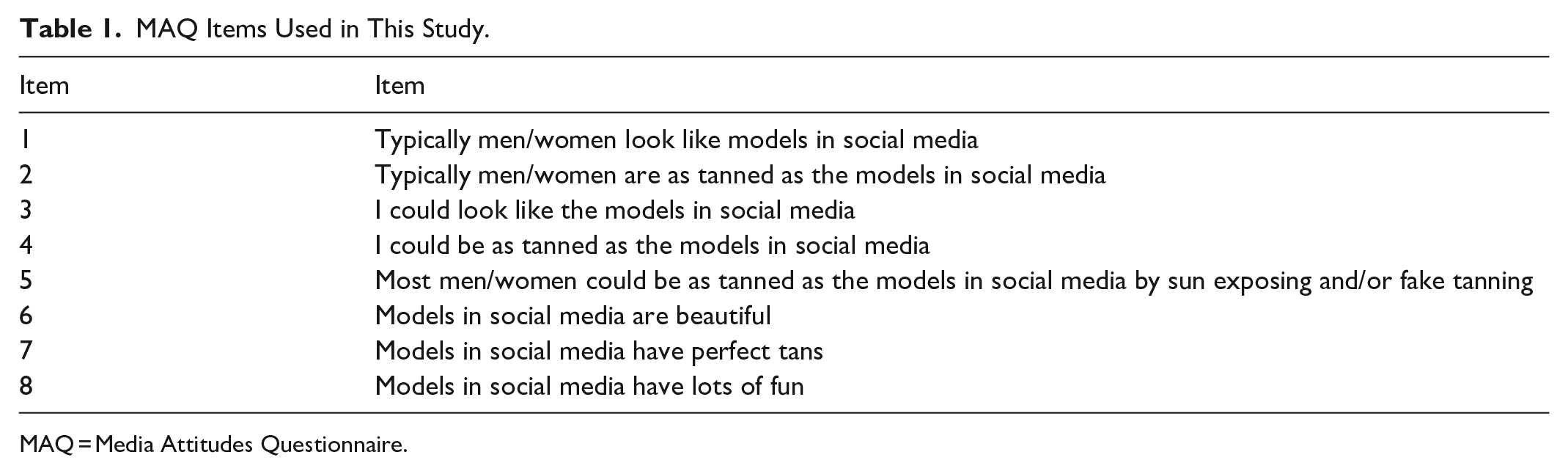
MAQ = Media Attitudes Questionnaire.
Internalization of a Tanned Ideal
Internalization of a tanned ideal was measured with three items modified from the internalization muscular/athletic scale of the Sociocultural Attitudes Towards Appearance Questionnaire–4 (SATAQ-4; Schaefer et al., 2015) to reflect a tanned ideal (see Table 2). Items were rated on a 5-point Likert-type scale from 1 (definitely disagree) to 5 (definitely agree). For each individual, a mean was calculated, with high scores indicating a higher endorsement of a tanned ideal. Schaefer et al. (2015) reported high internal consistency for scores on the internalization muscular/athletic scale of the SATAQ-4 in male (α = .90) and female (α = .91) samples. Internal consistency for scores in this study was α = .90.
Internalization of a Tanned Ideal Items Used in This Study.

Appearance Comparisons
Appearance comparisons were assessed with a modified version of the five-item Physical Appearance Comparisons Scale (PACS; Thompson et al., 1991). Scale items are rated on a 5-point scale from 1 (never) to 5 (always). A mean was calculated, with higher scores indicating higher frequency of appearance comparisons. Given the focus on media rather than social situations, three of the items were modified to state, “when using media (e.g., watching a film or using a social networking site)” instead of “in social situations” (see Table 3). Given the focus on skin tone rather than weight, one item was modified to state, “I sometimes compare my tan to the tan of other people” instead of “I sometimes compare my figure to the figures of other people.” Schutz et al. (2002) reported high internal consistency (α = .89) for scores on the PACS. Internal consistency for scores in this study was α = .71.
PACS Items Used in This Study.

PACS = Physical Appearance Comparisons Scale.
SNS Use
Participants were asked to specify which SNSs they have accounts with and how many minutes they spend per day using SNSs. Participants were also asked two items used by Tiggemann and Zaccardo (2015) to rate the importance they place on the quality of photographs (i.e., blurriness, composition) posted on SNSs by themselves, and others. The items were rated on a 7-point Likert-type scale (1 = not important at all, 7 = extremely important). Internal consistency for scores on the two items in this study was α = .84.
Experimental Manipulation
We created two sets of 10 photos for this study; a set of images that were body-focused, with tanned skin presented for the experimental group and a non-body-focused, set presenting people with paler skin for the control group. The tanned set contained five photos of males and five photos of females with tanned skin on a beach posing in swimwear. In accordance with the results of a review of content analyses examining photos of models with tanned skin in media (McWhirter & Hoffman-Goetz, 2012), the photos of the tanned models portrayed a model outdoors, in swimwear, and not visibly sun protected (e.g., not wearing a hat or protective clothing). The photos of models with pale skin contained five photos of males and five photos of females in popular travel destinations (e.g., monuments or landscapes) with no perceived focus on the body in the photo. Adobe Photoshop software was used to insert the photos into Facebook and Instagram templates to create the perception that the photos were posted on an SNS and to account for the popularity and use of varying types of SNSs (Primack et al., 2017).
Photos were sourced from an online photography database. We compiled an initial pool of 30 tanned skin photos and 30 pale skin photos to cover a broad range within each category. A group of 10 independent participants (five male and five female) rated the photos to ensure the photos clearly did or did not reflect the tanned ideal or a body focus as relevant. Consistent with previous research (e.g., R. Cohen & Blaszczynski, 2015; Leit et al., 2002), raters were asked to indicate the extent to which the photos reflected a tanned ideal using a 5-point Likert-type scale ranging from 1 (very poor/very pale skin) to 5 (excellent/very tanned skin) and whether the photos were perceived as body-focused on a scale that ranged from 1 (very poor/no focus on the body) to 5 (excellent/very focused on the body). The 10 photos receiving the highest scores for tanned ideal (M = 4.53, SD = 0.27) and body focus (M = 4.44, SD = 0.37) were included in the tanned photos set and the 10 photos receiving the lowest scores for tanned ideal (M = 1.76, SD = 0.35), indicating very pale skin, and body focus (M = 1.78, SD = 0.40) were included in the pale skin photos set. The tanned photos were rated as significantly more tanned, t(18) = 20.03, p < .001, and significantly more body-focused than the paler skin photos, t(18) = 15.45, p < .001.
Manipulation Check
Participants had to correctly select the two photos they had previously viewed from four photos, two previously viewed stimuli photos and two new photos to ensure they had carefully observed the experimental stimuli. Only participants who selected the correct photos were included in the analyses (n = 3 excluded for incorrect responses).
Data Analyses
Data were analyzed using SPSS version 21. Two separate mixed model regressions were conducted to test the hypotheses. In each analysis, photo group (experimental/tanned skin; control/pale skin) was entered as a categorical variable and media literacy was entered as a continuous variable. The dependent variables were internalization of a tanned ideal and appearance comparisons. There was homogeneity of variances for the analysis with internalization as the dependent variable (p = .844) and for the analysis with appearance comparisons as the dependent variable (p = .224). Extreme SNS use scores over 720 min per day were transformed to 720 min (n = 10; 6.6%). Effect sizes are presented as partial eta squared and interpreted according small (0.01), medium (0.06), and large (0.14) (J. Cohen, 1988).
Results
Characteristics of the Sample
The most common skin type was Type III (45%). Participants reported an average of 172.26 min of SNS use per day (SD = 183.87) and the most commonly used SNS were Facebook (96.7%), YouTube (84.8%), Instagram (69.5%), and SnapChat (69.5%). Participants reported that the quality of the photos they post on SNSs (M = 5.18, SD = 1.35) was significantly more important than the quality of photos other users post on SNSs (M = 4.82, SD = 1.32), t(148) = 3.28, p = .001, d = 0.27. There were no statistically significant baseline differences in characteristics between the tanned and natural skin tone groups indicating randomization was successful.
Media Literacy as a Protective Factor
We predicted that participants with higher baseline media literacy would internalize the tanned ideal to a lesser extent than participants with lower baseline media literacy and that participants in the tanned group would, after exposure to the photos, internalize a tanned ideal to a greater extent than participants in the pale skin group. In support of our hypothesis, media literacy was significantly and negatively related to the participant’s internalization of a tanned ideal (see Table 4 and Figure 1) and this was a large effect (J. Cohen, 1988). The adjusted means (see Table 5) show that internalization was greater in the tanned photo group compared to the pale skin photo group, a mean difference of 0.25, 95% confidence interval (CI) = [–0.007, 0.513].
Summary of Regression Results for Analysis Predicting Internalization of a Tanned Ideal Among 151 Young Adult Australians.

SE = standard error; 95% CI = 95% upper and lower confidence intervals.

Relationship between scores on media literacy and internalization of a tanned ideal.
Means (Ms) and Standard Deviations (SDs) for Key Variables Among 151 Young Adult Australians.

SE = standard error.
Tanned skin photo group n = 77 and pale skin photo group n = 74.
We also predicted that participants with higher baseline media literacy would report less propensity to make appearance comparisons than participants with lower baseline media literacy and that participants who viewed photos of models with tanned skin would report more frequent appearance comparisons than participants who viewed photos of models with pale skin. As predicted, media literacy was significantly and negatively related to the participant’s frequency of appearance comparisons (see Table 6 and Figure 2), a large effect. There was also a significant effect of photo condition on frequency of appearance comparisons after controlling for the effect of media literacy. Participants exposed to the SNS photos of models with tanned skin reported engaging in appearance comparisons to a greater extent than participants exposed to the SNS photos of models with pale skin, a mean difference of 0.18, 95% CI = [0.022, 0.340].
Summary of Regression Results for Analysis Predicting Appearance Comparisons Among 151 Young Adult Australians.
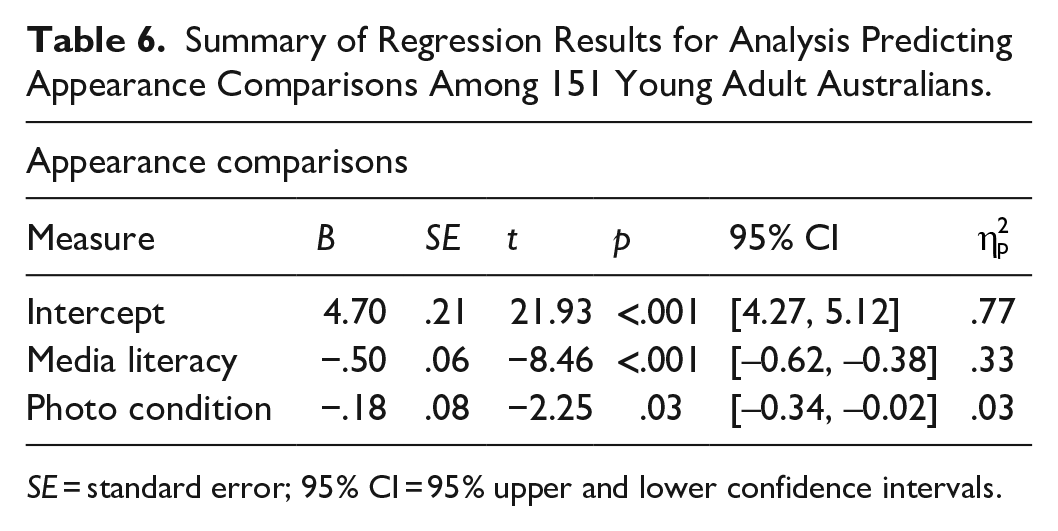
SE = standard error; 95% CI = 95% upper and lower confidence intervals.

Relationship between scores on media literacy and frequency of appearance comparisons.
Discussion
This study was the first to address the role of media literacy in predicting reactions to SNS photo postings and tanning. We aimed to determine whether a participant’s level of media literacy affected their response to idealized SNS photos. Overall, significant and negative relationships were found between an individual’s level of media literacy and their internalization of a tanned ideal and propensity to engage in appearance comparisons between themselves and others following exposure to SNS photos.
SNSs are a new outlet that present additional barriers to healthy sun behaviors. Participants who viewed SNS photos of models with tanned skin in this study reported more frequent appearance comparisons than people exposed to models with pale skin. Tanned models on SNSs may serve as targets for upward appearance comparisons and there is evidence to suggest that upward comparisons made through social media may be more influential to body image than comparisons made in-person because of additional reinforcers including “likes” or praise from other users (Fardouly et al., 2017). Fardouly et al. (2017) found comparisons made to others on SNSs are associated with lower appearance satisfaction and lower positive mood than comparisons made in person.
An individual’s level of media literacy affected their response to SNS photos in this study. The findings presented in this study, in conjunction with the efficacy of a pilot intervention reported by Mingoia et al. (2019a), suggest that improving social media literacy related to tanning may be able to interrupt important processes in the desire for tanned skin such as internalization of a tanned ideal and propensity to engage in appearance comparisons to people with tanned skin. Media literacy education empowers individuals to critically analyze and challenge unhealthy media messages (Wade et al., 2017). Media literacy education tends to focus on explaining the way media messages are constructed, the potential impact of implicit messages on cognition and attitudes, and the often-unrealistic nature of the material to which individuals view online. Improving critical thinking strategies should help to strengthen the logical processing of appearance-related SNS messages and reduce the effect of messages on attitudes and behavior (McLean et al., 2016).
Researchers have utilized other appearance-orientated prevention strategies to reduce the rate of sun exposure and sunburn in Australian adolescents and young adults. McWhirter and Hoffman-Goetz (2015) used specialized equipment to capture ultraviolet (UV) photographs that depicts the current level of skin damage resulting from UV exposure that is not visible in traditional photographs. Pagoto et al. (2010) promoted sunless tanning such as creams or sprays that artificially darken the skin tone without the need for UV exposure. These strategies have demonstrated positive outcomes including increased sun protection; however, they primarily focus upon changes within the individual (e.g., the consequences of sun damage to the individual’s appearance) and not the broader socio-cultural norm endorsing tanned skin as attractive. For example, exposure to a UV photograph may lead an individual to want to avoid further sun damage; however, despite this concern, the individual remains immersed in a social environment that promotes tanned skin as attractive and repeated exposure to these messages maintains the intention to achieve a tanned appearance modeled by peers or role models on SNSs. Therefore, it is recommended the media literacy education be used in conjunction with these types of appearance-orientated interventions or researchers could incorporate other appearance-related information within the media literacy content.
The results of this study should be interpreted in consideration of the following limitations. Participants in this study viewed 10 photos for a period of 20 s each which may not have been sufficient to cause significant differences between the tanned and pale skin photo groups. Future studies could repeatedly expose participants to the SNS photos over a longer period of time (e.g., several weeks), and on a number of different SNSs (e.g., Instagram and SnapChat in addition to Facebook), to improve ecological validity by creating a more realistic social media experience and determine whether main effects are evident between photo groups. Participants were exposed to these photos in their own environment rather than in a laboratory setting to increase validity and a timer was set on each photo so that progression could not be made before 20 s had elapsed; however, the completion of this task in a private setting made it difficult to assess whether participants truly viewed the photos for this time period. Furthermore, the photos had no indication of “likes” or comments from other users. Reactions from other users may be critical to the comparisons process in determining whether the person is a target for upward comparisons on SNSs because of their popularity or social capital (Junghyun & Jong-Eun Roselyn, 2011). Future researchers could manipulate the number of likes and comments attached to each photo to test for differences in the outcomes depending on the perceived social desirability of each photo. This study also made use of different settings (i.e., beach and travel) in each condition to account for popular themes in social media. Travel selfies, or photos posted while traveling, are a common theme on social media and individuals who post these photos engage in strategic self-presentation, including editing the photos to present desirable impressions, which is associated with appearance surveillance and dissatisfaction (Lyu, 2016). Travel photos have been used as a control group in other social media and body image research (e.g., Tiggemann & Zaccardo, 2015); however, future research could aim to assess differences between tanned skin and pale skin models in the same setting (e.g., both on the beach) rather than use different settings to control for contextual differences.
Exposure to photos of known peers rather than celebrities or models is a feature unique to social media. The photos used in this study were not of people directly known to the participants and this may have influenced the results. The presentation of strangers rather than known peers may have affected the perceived realism of the photos and the true effect of SNS photos on internalization of a tanned ideal and appearance comparisons may be far greater. Future research should aim to assess the extent of internalization and appearance comparisons that occur following exposure to photos of peers taken from existing social networks. This study did not measure the education level of the participants and this may be an additional consideration for future research because it is plausible that media literacy skills may improve with an increased level of education. Furthermore, the sample was recruited from university campuses and there was disparity between the number of males and females which could limit generalizability to the broader population.
In summary, an individual’s level of media literacy is an important factor to consider for skin cancer prevention. A high level of media literacy can reduce the impact of exposure to SNS photos and protect users against the internalization of a tanned ideal and appearance comparisons. Greater skepticism about media messages is likely to be associated with lower acceptability of those messages and better health outcomes. Overall, media literacy education appears to offer a promising prevention approach to address skin cancer risk factors.
Footnotes
Declaration of Conflicting Interests
The author(s) declared no potential conflicts of interest with respect to the research, authorship, and/or publication of this article.
Ethical Approval
All procedures performed in studies involving human participants were in accordance with the ethical standards of the institutional and/or national research committee and with the 1964 Helsinki declaration and its later amendments or comparable ethical standards. Informed consent was obtained from all individual participants included in the study.
Funding
The author(s) disclosed receipt of the following financial support for the research, authorship, and/or publication of this article: This work was supported by the Commonwealth Government funding the first author received under the Research Training Program (RTP). John Mingoia received the RTP funding to cover the costs associated with the PhD program, but did not receive funding for publication.
