



Abstract
Concerns over the harmful effects of social media have directed public attention to media literacy as a potential remedy. Current conceptions of media literacy are frequently based on mass media, focusing on the analysis of common content and evaluation of the content using common values. This article initiates a new conceptual framework of social media literacy (SoMeLit). Moving away from the mass media-based assumptions of extant approaches, SoMeLit centers on the user’s self in social media that is in dynamic causation with their choices of messages and networks. The foci of analysis in SoMeLit, therefore, are one’s selections and values that influence and are influenced by the construction of one’s reality on social media; and the evolving characteristics of social media platforms that set the boundaries of one’s social media reality construction. Implications of the new components and dimensions of SoMeLit for future research, education, and action are discussed.
Introduction
Media literacy is a concept and practice necessary to help citizens be informed and empowered in a world increasingly populated with diverse media and messages. Abilities to access, analyze, and produce media messages have been conceived to be the essence of media literacy (Aufderheide, 1993). Media literacy education programs based on this principle have sought to deter harmful media effects and have demonstrated efficacy in improving media-induced beliefs, attitudes, and intentions for the better (see for a review, the study by Jeong et al., 2012).
Extant conceptions of media literacy, however, may be predicated on the operations of mass media, which differ from social media in various aspects. These current conceptions may not be adequate to prevent unhealthy effects of social media. Misinformation is one of the challenges presented by social media (Wang et al., 2019); digital media harm (Twenge et al., 2020; cf. Orben and Przybylski, 2019) is another. Social media, concurrently, offer possibilities for grassroots mobilization and movements that mass media lack (Freelon et al., 2018). Existing conceptions of media literacy may not reflect the full extent to which these distinct functions of social media may promote or hinder positive social change. Rising to these challenges requires a social media literacy framework for citizens, educators, researchers, and policymakers.
This essay aims to conceptualize social media literacy, explicate its core content and competencies, and outline an agenda for research, education, and action. After examining mass media–based assumptions inherent in current conceptions of media literacy, it proposes interrelated content and competencies of a social media literacy framework (SoMeLit), drawing on extant theory and research on social media use motivations, processes, and effects accumulated in diverse disciplines. In SoMeLit, the content comprises the self, the medium, and the reality. This content is interrelated to the competencies of analysis, evaluation, and contribution. Together with mass media literacy, social media literacy comprise a more comprehensive framework of media literacy in the 21st century.
Current conceptions of media literacy
Media literacy is defined as “the ability to access, analyze, and produce information,” the fundamental objective of which is “critical autonomy in relationship to all media” (Aufderheide, 1993: 1). In this definition, media literacy comprises the competencies necessary to become informed consumers of the media. To date, this remains a leading definition of media literacy, and the competencies of analysis and production have been adopted in media literacy education programs for a wide range of social issues (Jeong et al., 2012).
Scholars have expanded on this conception of media literacy. Potter (2019) has viewed that media literacy encompasses not only skills, but also knowledge structures and personal locus. In this perspective, skills, the tools with which to make sense of media messages, include induction, deduction, synthesis, and abstracting, in addition to analysis and evaluation. Knowledge structures refer to the sets of organized information within individuals that provide a context they can use to interpret media messages. To develop and use these skills and knowledge structures, individuals must have personal locus, which are goals and drives. Stronger personal loci lead to more effortful processes of information seeking and processing (Potter, 2019).
The media interpretation model (Austin and Johnson, 1997) describes the components and processes with which users may analyze and evaluate media messages. It predicts that decisions to adopt a media-portrayed behavior (e.g. drinking, smoking) are based on logic and affect. In logical comparison, users evaluate whether media messages are a representation of the reality. In affective evaluation, users assess whether they like the messages. Based on these two-pronged analyses, users consider the outcomes of adopting a behavior, which then leads to decisions. Countering and addressing these variables is the task of media literacy education.
Efforts to respond to changes in media landscapes have focused on the skills of production, which scholars have reconceptualized to participation, reflection, action, and prosuming. Jenkins (2009) stressed fostering participatory culture in digital media, asserting that providing youth with social skills and cultural competencies is instrumental to full participation in digital culture. Hobbs (2010) proposed the addition of reflection and action to the core competencies of digital and media literacy to empower and support lifelong learning among users. Similarly, other scholars viewed “prosuming,” the ability to participate in the media environment and to create and distribute media messages, as pivotal to new media literacy (Lin et al., 2013). Advancing this line of ideas, Mihailidis (2018) proffered a conceptualization of civic media literacy, central to which is concern for the common good.
Moving beyond digital media, scholars have recently begun to offer ways of conceptualizing social media literacy. The social media literacy model (SMILE; Schreurs and Vandenbosch, 2021) is comprised of the two interfacing domains of development and empowerment. According to SMILE, the development of social media literacy is influenced by family, peers, and educators. Connecting the domains of development and empowerment is social media literacy, which consists of cognitive and affective processing abilities. In the domain of empowerment, social media literacy moderates the effects of social media usage on well-being (Schreurs and Vandenbosch, 2021).
Limitations of the current conceptions
These current thoughts provide a valuable basis for conceptualizing social media literacy, but they alone may not be sufficient to represent the distinct nature and functions of social media. Social media have brought about major changes to the ways in which people use the media, generating impacts on society, culture, politics, and more. This section describes the limitations of current approaches and their implications for social media literacy.
Commonality of content
Current conceptions of (mass) media literacy emphasize competencies including analysis and evaluation of common media content. While shared content may characterize mass media, assumptions about content commonality may not adequately capture the distinct manner in which users construct, interpret, and legitimize content on social media. Although mass media users may selectively use television channels or print publications, the content is cast by the outlet to its entire audience, with scarce feedback or engagement loops for individualization.
In the spaces of social media, the self is embedded in the channel and networks that one builds and weaves together. Content is personalized (Thorson and Wells, 2016), and those sharing beliefs and values congregate and communicate in a way that is unfeasible through mass media (Bayer et al., 2020). They do so both voluntarily and through the ecology of each platform (Bossetta, 2018). The assessment of the content, in turn, can be self-centric. Cues to congruent perspectives with oneself and like-minded groups can guide the evaluation of the credibility of the source and the validity of the claim (Nekmat et al., 2019; Sohn and Choi, 2019). Some of the members of these groups may rarely cross paths with users outside of their belief- and value-linked circles (Wilson and Wiysonge, 2020).
The different nature of content curation on social media has profound implications for the current media literacy competencies of analysis and evaluation. Common standard-based analysis and evaluation may not be similarly useful, or feasible, for the members and followers of divergent value and belief-based groups. Social media literacy, therefore, requires an emphasis on the self and a willingness and ability to examine the social media self in the analysis and evaluation of media content (see the content dimension the Self, and the competency dimension Analysis, below).
Boundary between the media and the user
In the current conceptions of media literacy, the media and users are discrete entities inhabiting separate spheres, allowing for more detached analyses and disimpassioned assessments. Social media may lack these discrete boundaries, as this world is coinhabited by the media and the users.
In social media, the content is selected, fed back, and refined through iterative interactions between the media, the community, and the individual user (Bolin, 2011; Neff, 2005). The self develops and manages ties and relationships on social media, thereby determining not only the content but also the sources and routes of delivery and receipt of the messages (Klinger and Svensson, 2018). Through these networks and processes facilitated by social media platforms, users develop their episteme with which to filter and evaluate environmental stimuli, including information, facts, and anecdotes. Schwarzenegger (2020) found that social media users exercise selective criticality and pragmatic trust and negotiate between their own feelings of competence and confidence in navigating personal media repertoires.
The self is the foundation on which one builds their social media content and is inextricably linked to all aspects of their social media use. One’s social media world may be Bourdieu’s (1977) habitus, a “subjective system of perceptions and practice.” Core to social media use are the motivations of self-expression, self-validation, and self-enhancement, as well as social belonging, social learning, and social management of impression and relationships through selective self-presentation afforded by the technical capacities of social media (Cho et al., 2019; Moreno et al., 2013; Zheng et al., 2020). Consequently, one cannot analyze the content of social media without an understanding of the self. This blurred boundary and increased intimacy between the media and user should be accounted for in the conception of social media literacy (see the Self and Evaluation below).
Units of reality and mutability of identity
In mass media, the real world and the media world may comprise dual realms. The media world represents dominant messages from institutions and their experts equipped with systems and structures for production and dissemination. The actual world may be comprised of individual receivers who interpret the meanings of the messages produced by the media institutions. In social media, realities are more than a duality. Media producers are multifarious on social media. New and old institutions, operating at local and global levels, a multitude of individuals, and sundry groups participate in these processes. Each of these entities’ encodings of ideology, culture, and reality are permitted and prohibited by the norms, affordances, and architectures of social media platforms (Boczkowski et al., 2018). Users, in turn, decode and engage with these representations of reality.
The fluidity of reality on social media can further be demonstrated through the identity of the user. Digital media provide opportunities to express “identity-important and phenomenally real aspects of self” (Bargh et al., 2002). Individuals modify and reshape their identities across different virtual social encounters per cues from others and affordances at hand (Hu et al., 2015; Jin, 2013). This multiplicity of reality and identity may require differential analyses and evaluations of messages on social media than mass media. Judging realism of social media messages and interactions requires discerning identities, identity management motivations, and how identities may operate and impact differentially in social media settings as compared to the real world. Each of these identities may differentially guide users’ communicative behaviors and actions online (Postmes et al., 1998) and offline (Yee and Bailenson, 2007). On social media, multiple representations of identities and realities create more work for the social media literate person. Now, many representations should be compared and contrasted against each other rather than juxtaposing a single representative media message and a representative actual world, or directly comparing between the “real” and the “fake” (see the Reality, below).
Direction of influence
In current conceptions of mass media literacy, influence is mainly one-directional, from the media to the user. This may mirror the mass media era, in which the media were institutions purveying dominant ideologies and representing existing social distribution of power and resources (Lewis and Jhally, 1998). Most individual media users, in this paradigm, lacked power or resources. On social media, however, the influence is multidirectional. Social media traverse the boundaries of these previously discrete power and resource domains. Affordances of social media make it feasible for users to provide feedback and influence the media and other users. Knowledge and technology for producing mediated messages have increasingly become available to lay members of the public. Social media users are encoders of their values and beliefs, influencing other users, society, and old and new media institutions, as well as decoders, interpreting and processing ideologies disseminated by media institutions. This agency and subsequent ability to influence may come with responsibilities.
Locus of responsibility
In mass media contexts, responsibilities reside chiefly with the media. As institutions with knowledge, technological infrastructure, and structures of production, the media created content and the users consumed it. Consequently, the media were responsible for the content they produced, and regulatory agencies oversaw the media practices. In social media, users may shoulder responsibility through two roles. One is engagement with the content that others create. In this domain, civility and decency may be two of the more salient considerations that online communities and society at large have been grappling with. Second is the generation of content representing the convictions, sentiments, and stories of the individual user or group of like-minded individuals. The truthfulness of information, and fairness of representation, are some of the public concerns over social media content.
Together with multiple directions of influence, multiple loci of responsibility on social media suggest that production, one of the three main competencies in the current conceptions of media literacy, may no longer be adequate. Production, specifically, refers to the ability to create alternative messages countering the dominant messages in mainstream media (Aufderheide, 1993). This definition may lack the recognition of responsibility that accompanies agentic production on social media; the proliferation of misinformation, in part, reflects lack of responsibility in active production by lay individuals and groups. Recent scholarship on new media literacy recognizes the responsibility of the user. As discussed above, Mihailidis (2018) articulated the notion of civic media literacy. Festle (2020) identified participatory and moral behavior as one of the dimensions of socially competent online behavior. Accordingly, the current media literacy competency of production should be reconsidered to capture the full range of agency and accompanying responsibility available on social media (see the competency dimension, Contribution, below).
Defining social media literacy
Responding to these characteristics and effects of social media requires identifying the components of social media literacy: its content, competencies, and the interrelations between the two. Content refers to the awareness, understanding, and knowledge necessary to attain social media literacy. Competencies are the skills and abilities for demonstrating social media literacy. Members of the public, educators, and policymakers alike should know what social media literacy comprises (content) in addition to how it can be achieved (competencies).
Currently, (mass) media literacy is conceived primarily as competencies, including analysis, evaluation, and production. These competency-based conceptions may be limited because they may assume common content to be analyzed, common criteria for evaluation, and the value of production itself as end state. Figure 1 depicts the SoMeLit framework comprising content and competency dimensions.
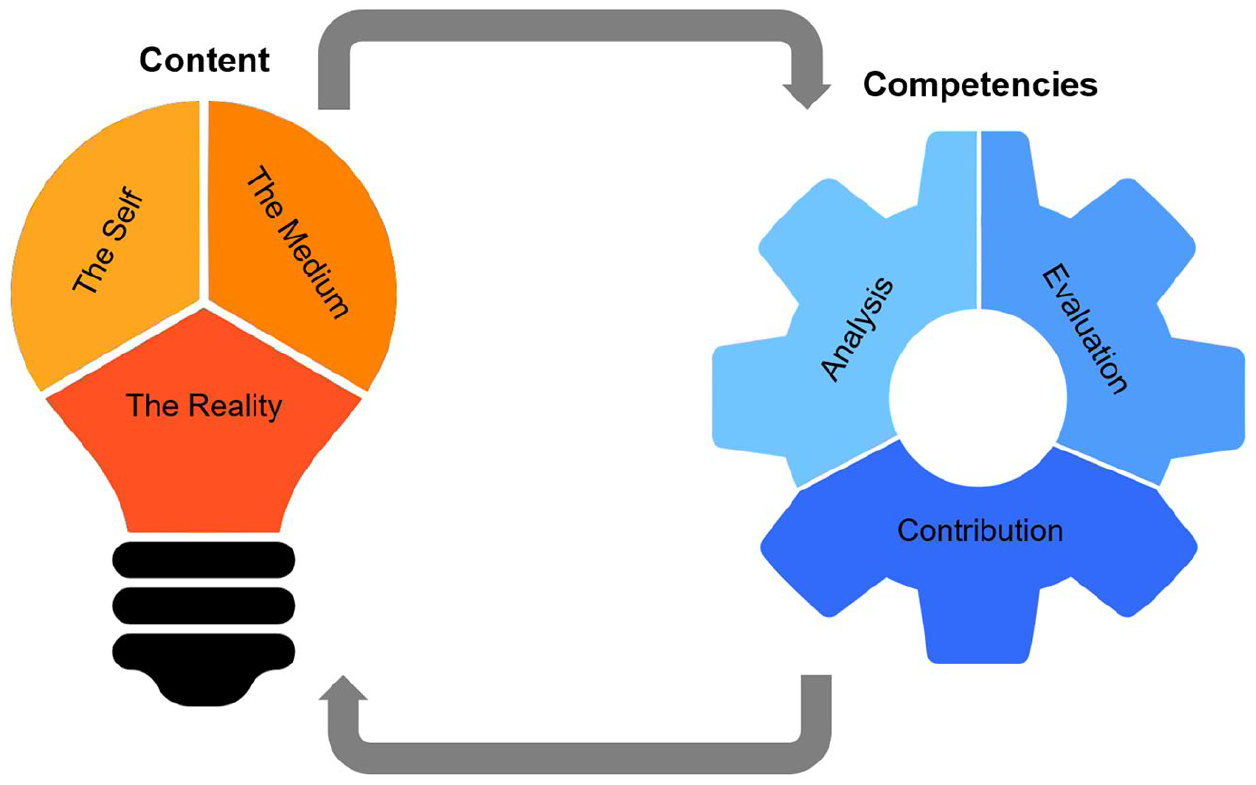
Social media literacy framework: content and competency.
The content components identify which subject matters of knowledge and understanding are necessary for social media literacy. This conceptualization builds on two main streams of thoughts in the broader literacy literature. First, unlike prior autonomous models that conceived literacy as technical skills, the new literacies perspective focuses on the social nature of literacy, defining it as a social practice (Street, 1984, 2003). Second, the multiple literacies perspective responds to “the changing world and the new demands being placed upon people as makers of meaning,” emphasizing how meaning-making occurs through a multiplicity of communication channels and media (Cope and Kalantzis, 2000: 4).
The content component of SoMeLit also advances Meyrowitz’s (1998) idea of distinguishing different types of media literacy, mainly that of the message (i.e. discernment of meaning) and the medium (i.e. characteristics of the channel). Developed during a mass media era, however, message literacy conceives the boundary between the message and user to be discrete and the message to contain dominant social ideologies, rather than a reflection of the self’s values. On social media, individuals can construct and consume different content, which reinforces and shapes their values and world views, resulting in discrete realities. The values reflecting and intertwined with the different content and realities should be identified and examined.
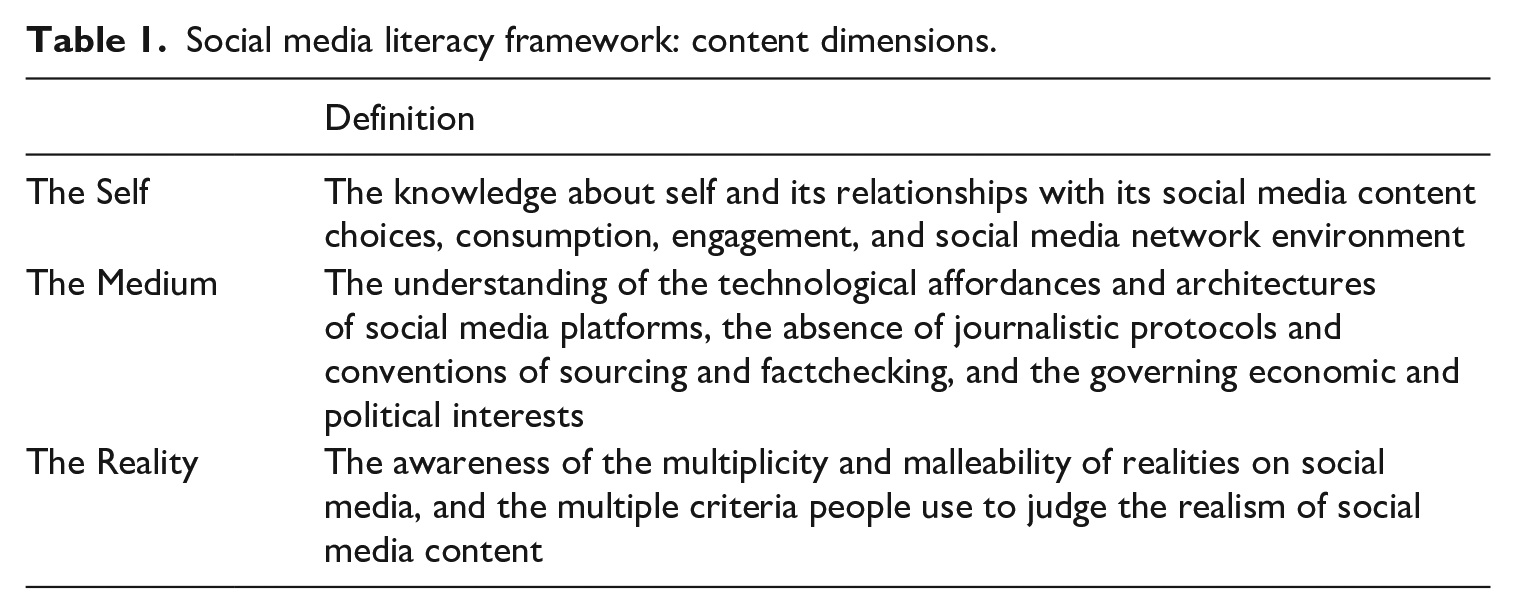
Similarly, medium literacy (Meyrowitz, 1998, 2009) focuses on the characteristics of each medium, rather than the interactions between the user and the medium. Unlike mass media, social media platforms are demanding and responsive to user engagement, influencing perceptions of reality and identity. On social media, the user engages with both the message and the medium to construct their own realities. Discrete realities, in turn, can direct differential valuation of facts. On this basis, SoMeLit proposes three content dimensions of social media literacy: the self, the medium, and the reality. Table 1 provides the definitions of these content dimensions.
Social media literacy framework: content dimensions.
Content of social media literacy
The self
As discussed, common content may be a feature of mass media. In social media, the content to be accessed, analyzed, and evaluated differs from individual to individual. Consequently, social media literacy should be founded upon knowledge about the self and its relationships with its actions and environments. This entails an awareness of the self’s motivations, choices, networks, and the resulting mediated social worlds they construct and manage. Drawing on social cognitive theory (Bandura, 1986), SoMeLit conceives the self in social media to be in mutual causation with its media choices and networked environments (see Figure 2). The centrality of understanding the self and its actions sets social media literacy apart from the current (mass) media literacy.
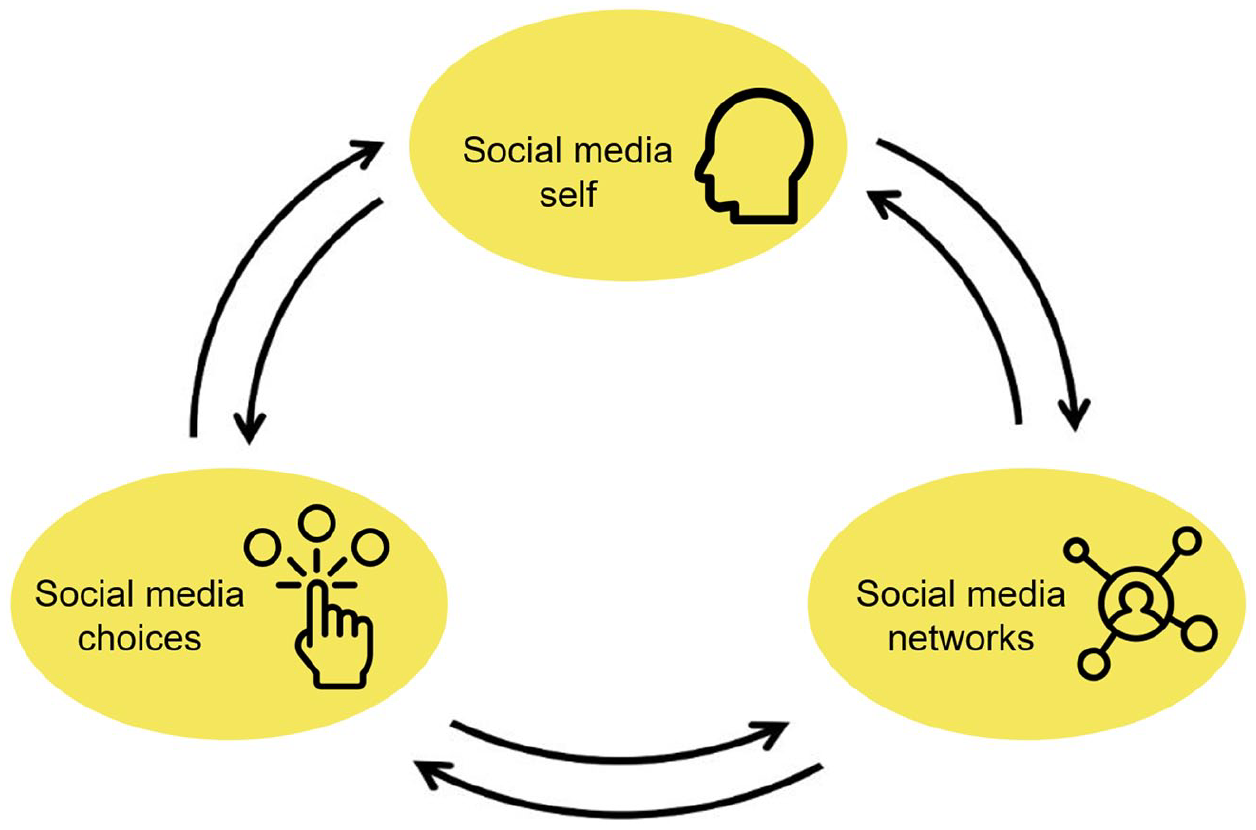
Self on social media.
Awareness of one’s social media use motivations may be a critical first step toward social media literacy. Differential motivations can lead to differential outcomes (So, 2012). According to the uses and gratification framework (Katz et al., 1973), media users are aware of their motivations, interests, and intents. These motivations influence the content choices one makes on social media and their consequences. The theoretically infinite content choices available on social media, together with digital algorithms, facilitate the construction of increasingly personalized media content and individualized media worlds. The notion of a “filter bubble” (Pariser, 2011; see also Fletcher et al., 2021) aptly captures this phenomenon in which “the user is the content.” Construction of a self-centric content filter is one of the motivations of using social media (Cho et al., 2019), and selective exposure is associated with motivations to confirm existing beliefs and viewpoints rather than challenging them (Knobloch-Westerwick and Meng, 2009).
In addition to motivations and content choices, social networks, both online and offline, shape the nature and functions of the self on social media. Users build egocentric social networks comprised of others who share their beliefs and values (Bayer et al., 2020). Homophilous (Bennett, 1998) but not always homogeneous (Goel et al., 2010), these networks influence the self’s information diet through their social tie structures. Just as people shape their ego networks, their ego networks shape them. Just as the user is the message (Pariser, 2011), the source is the message on social media; they are nodes of one’s egocentric network who exchange information selectively (Shin and Thorson, 2017). Thorson and Wells (2016) asserted social media may facilitate a return to a powerful two-step flow (Lazarsfeld et al., 1944), in which ego networks, as intermediaries, mitigate and moderate other media’s influence and shape the ego’s mediated reality. The characteristics of ego networks influence not only what people consume but also what they produce (Davis, 2017).
For these reasons, foundational to social media literacy is the awareness of and knowledge and understanding about the self and its motivations, choices, and networks.
The medium
Extant (mass) media literacy intervention research has focused on the analysis and evaluation of media content (e.g. violence, sex, substance use; see the study by Jeong et al., 2012). Less attention has been paid to the characteristics and features of each medium (e.g. radio, television, print; Meyrowitz, 1998, 2009). Perhaps this was because each medium had stable and fixed characteristics, while content factors (e.g. arguments, protagonists) could travel across mediums with ease (Meyrowitz, 1998). On social media, however, mediums are more dynamic and fluid, based upon what is technically possible and normalized by users. While social media comprise platforms, we use the term “medium” following Meyrowitz (1998, 2009) to denote this construct’s focus on particular characteristics of the (social media) platforms and modifiable features within each.
Medium theory (Meyrowitz, 2009) contends the nature of the medium impacts social, individual, and societal processes. The identities and realities constructed and communicated by users and groups differ by platform. For instance, Twitter use is for “information and informality,” Instagram use is for “stylized self-presentation,” and Snapchat is for “spontaneous ludic connections” (Boczkowski et al., 2018: 245). These platforms provide sites of subcultures where different standards of realness are applied, accepted, and reinforced by the users themselves. On a more macro-level, the technical affordances of social media challenge the one-way monopoly of mass media institutions in setting the public agenda and selecting the framing of the public issues (Boynton and Richardson, 2016). Social media are flipping the traditional ecology, allowing users to have roles and influences in agenda setting and framing processes.
Technological affordances are not the only source of potential and pitfalls for these platforms. The absence of journalistic protocols and conventions for sourcing and factchecking has made social media, across platforms, a hotbed of misinformation and hate speech (Andrews, 2021). For the same reason, platforms of social media are an “information laundering” system in which hate communication gains legitimacy and enters mainstream discourse via search engines and social networks (Klein, 2012). In July 2021, the US Surgeon General declared that confronting health misinformation, including that on social media, is a public health priority (Office of the Surgeon General, 2021).
Compared to mass media institutions, platforms lack formal regulation and protocols, affording them with political and economic flexibility. Being privately owned, the platforms may be attentive to financial interests. Many platforms may remove content or terminate accounts at their own discretion, and enforcement is often perceived as arbitrary at best (Duguay et al., 2020). While federal laws govern the content and conduct of public and private broadcasting companies, social media companies lie largely outside of their purview, granting them substantial power surrounding political speech, discourse, and perhaps political bodies themselves. For instance, in January 2021, Twitter and Facebook banned President Trump for inciting violence at the US capitol and for the risk of further provocations.
These political and economic systems and structures of social media, different than those of mass media and less bridled by conventions of public regulation, place a greater burden on the user. Individuals rather than institutions are left to determine the credibility of sources and information on social media, and these judgments are vulnerable to multifarious influences. These characteristics and features of social media, through user engagement, shape and reinforce perceptions of reality (see below).
A social media literate person, hence, should have knowledge about not only the stable and modifiable characteristics of different platforms, but also how their interactions with them shape, modify, and reinforce their perceptions of the reality.
The reality
Extant (mass) media literacy research has identified perceived realism as a key factor in determining media effects, connecting it to the efficacy of media literacy education programs. For example, in a long-term evaluation of media literacy intervention efficacy, the correction of perceived media realism completely mediated the intervention effects on behavior change at 6 months (Cho et al., 2020). Perceived realism, moreover, moderated the effects of social media e-cigarette message exposure on e-cigarette use attitudes among adolescents: when perceived realism was low, e-cigarette use attitudes were mitigated (Cho et al., 2019).
The reality takes on new and different dimensions on social media, however, making it even more important and challenging to understand. Whereas realism judgments may have involved a duality between the media world and the reality on mass media, they involve a multiplicity of media worlds and realities on social media. Before social media, only a handful of mass media institutions possessed the technical capabilities and infrastructures to produce content. These institutions tended to use frameworks of knowledge that mirrored existing distributions of power, resources, and hierarchy (Shoemaker, 1987). Producers in mass media institutions were experts who had conventional training in journalism and filmmaking.
On social media, producers of content are innumerable. Enabled by affordable technical machinery and equipment, creators on social media, formerly consumers of mass media, generate a vastly more diverse array of content and realities, than mass media. Moreover, these realities are malleable as they are constructed according to disparate motivations, viewpoints, and experiences that are steeped in specific cultures, times, locations, and economic, political, and social contexts.
Communication scholars have viewed perceived realism of the media as a multidimensional construct (Busselle and Greenberg, 2000). These dimensions include factuality, plausibility, and typicality, which concern the proximity of media content to the actual world; on the other hand, the dimension of narrative consistency focuses on whether components of a story come together to “ring true” (Fisher, 1984; Hall, 2003). Research, furthermore, has found that the persuasive impact of the media may be less dependent on the factuality of the content but more on its narrative consistency (Cho et al., 2014). That is, rather than the information’s perceived proximity to truth, the perceived internal consistency of the story can be more important to lay judgments of realism. Narrative consistency, in turn, evokes emotional responses that energize and direct action (Cho et al., 2014). This reliance on personal, emotional resonance could mislead people from facts and truth (Cho and Friley, 2015; Van Bavel et al., 2021).
Multiple, malleable realities on social media may be facilitated by the limited volume of common content and blurred boundary between the media and the user discussed above. Not only may judgments of narrative consistency be fragmented, but also evaluations of plausibility (i.e. the event could possibly happen in real life) and typicality (the event is representative of the reality). Novel affordances and architectures on social media may encourage new and different ways of coming to terms with reality judgments.
Therefore, central to social media literacy is the understanding that the realities can often be embedded in specific experiences and perspectives. The social media literate person is cognizant that realism judgments are multifaceted and that each is made with limitations. The social media literate person is also aware that the personal and emotional resonance of information on social media may not always make it real, representative, or a fact.
Competencies of social media literacy
The content dimensions of SoMeLit work together with its competency dimensions: analysis, evaluation, and contribution. These build on current conceptions of (mass) media literacy (analysis, evaluation, production; Aufderheide, 1993), but the competency dimensions of SoMeLit differ in conceptualization. New conceptualizations for social media literacy competencies are needed for the following reasons.
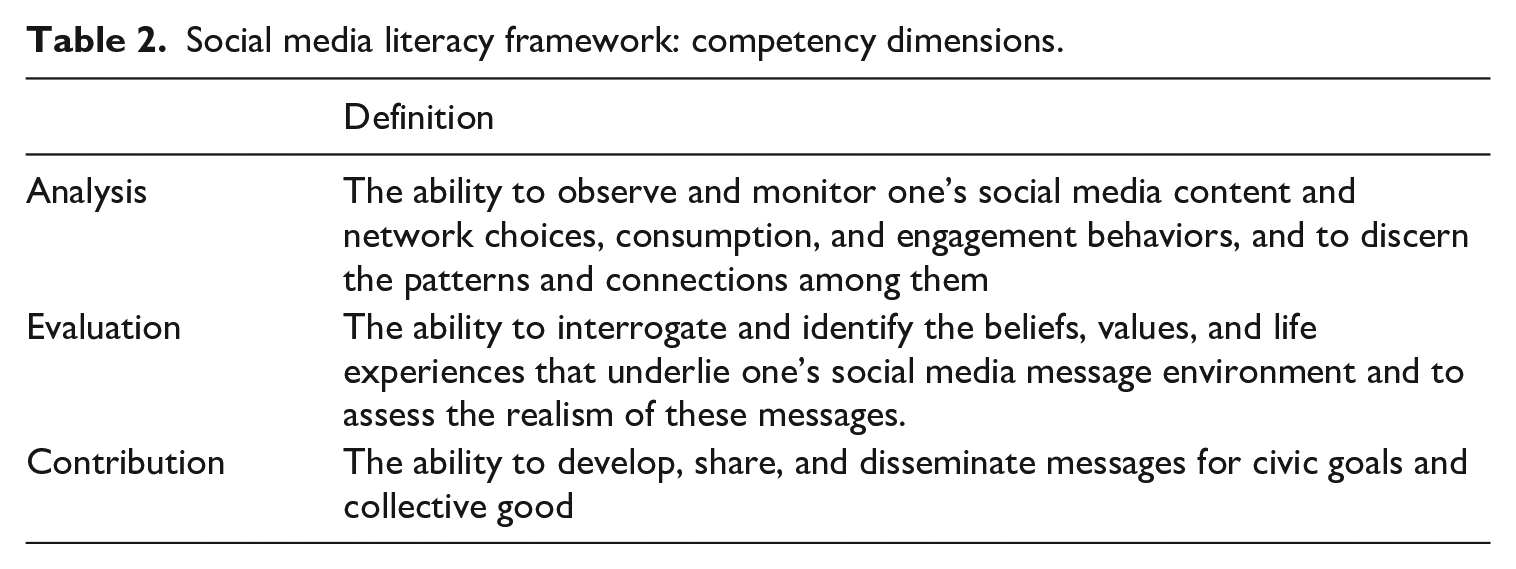
The original competencies may be more pertinent to mass media contexts, and they may assume common content to be analyzed, common criteria for evaluation, and production as desired end-goal (see Limitations above). Social media may challenge the foundational premises of these competencies. Specifically, social media’s lack of dominant content, evolving nature, and resulting multiplicity of realities necessitate reconceptualizations of the first two competencies, analysis and evaluation. Moreover, the porous boundary between the media and users and concomitant mutual directions of influence and multiple loci of responsibility on social media platforms require a transformation of the third, production. That is, the (mass) media competency of production should be changed to contribution. Table 2 provides the definitions of these competency dimensions.
Social media literacy framework: competency dimensions.
New focus of analysis: the self on social media
In (mass) media literacy, the target of analysis is the media content. This content is independent of the self as it was created by media institutions and professionals, and it represents the values of the institutions and their advertisers, funders, and supporters.
In social media literacy, analysis should take on a different focus: the self, its content choices, and its social networks. The self on social media is in mutual causation with the choices it makes about what content to consume and engage with as well as what networks to build, modify, and maintain on differing platforms (see Figure 2). As a set of skills, the social media competency of analysis includes the abilities to monitor and observe one’s social media use behavior, motivations, and outcomes.
The target of observation ranges from the frequency and duration of social media use to the abilities to discern, classify, and make connections among the choices of content one makes and the kinds of networks one has, including their composition (e.g. homogeneity, diversity) and ties (strength, weakness). As social cognitive theory (Bandura, 1997) describes, self-regulation processes necessitate quality (e.g. accuracy, regularity) in the monitoring of one’s behavior and pertinent facets.
The importance and effectiveness of self-observation has been demonstrated across a range of behavioral science domains, including chronic disease management and health behavior change (Hennessy et al., 2020; Wilson et al., 2020). Tools for this new analysis competency can be developed and implemented for social media literacy education. The theoretical mechanisms of self-regulation, including self-monitoring, have been translated to a range of digital health promotion and disease management programs. In addition, recent media effects research has successfully carried out diary-based self-reports of digital media use behavior (Hall et al., 2019; Orben and Przybylski, 2019).
From evaluation of media content to examination of one’s values
The focus of the evaluation competency in SoMeLit is the realism of the content that one selects and chooses to consume. Perceived social media realism is more than factuality; it includes subjective judgments about whether the content reflects the creator’s true experiences. A factor making a social media message ring true may be the resonance between personal experience, values, and perspectives and the information at hand (Cho et al., 2014, 2019). Users should be aware of the multiplicity and malleability of realities on social media. A social media literate person demonstrates an awareness of the multiple criteria with which people assess realism and the pitfalls of relying on personal, emotional resonance, and perceived internal consistency of a social media message for realism judgments.
Therefore, an important way to foster media literacy and combat misinformation can be to help individuals examine the self, the medium, and how these intersections generate realities that are vulnerable to biased evaluations of information. In addition to factchecking, users should be provided with tools and resources to understand the lived experiences through which the misinformation is interpreted, accepted, and internalized, as well as the values and worldviews that propel the production and dissemination of misinformation.
Research has found that acceptance of conspiracy theories, such as QAnon, may not stem from a lack of knowledge. Instead, it was lack of trust (that institutions and people in general will do what is right) that predicted conspiracy acceptance (Miller et al., 2016). An important factor determining social trust is perceived value similarity (Earle and Cvetkovich, 1995). Although these values are often automatically elicited, rapid, and implicit in situations, they can be identified and examined (Cvetkovitch, 1999). For example, Kahan et al. (2007) found that, across different races and genders, people’s differing cultural values governed their varying estimations of risks associated with social issues. Reflecting on their own values and those of other content producers in their social media environment may help users understand the influence of the reality they co-construct.
From production to contribution
In (mass) media literacy, production is the competency to generate counter-messages against dominant media messages that can engender harmful effects (e.g. tobacco ads). In the SoMeLit, production is amended into the competency of contribution for two main reasons. First, social media remove barriers to the delivery and dissemination of messages, expecting users to possess a set of skills beyond production. In (mass) media literacy education, production often took the form of classroom posters. Mass media did not allow the educators to consider the dissemination of these messages and their impact outside of the classroom. For counter-messages to have social impact, they should reach the eyes and ears, and hearts and minds, of the public and policymakers. Social media literacy competencies should prepare youth for these goals.
Second and more importantly, contribution differs from production in that the former involves civic goal orientation. Through civic-orientation, people should be committed to the greater common good by using their agency to participate in sociocultural and political discourse on social media (Mihailidis, 2018). Counter-messages should be those that ethically contribute to the collective good. Thus, contribution requires an array of knowledge and skills to use social media to create accurate counter-messages and share them with others for positive social impact. These skills will evolve with the medium and the development of the self (Brough et al., 2020). The goal- and civic-orientation should remain intact, however. This competency of contribution, hence, is integrally related to the content dimensions of the medium and the reality, as well as the self.
Final reflection
This article advances a new conceptual framework of social media literacy. SoMeLit recognizes the dynamic interactions among the self, the media, and the reality on social media and identifies them as the core content dimensions of social media literacy. In this framework, the social media self is in mutual causation with its content choices and network connections. Utilizing the unique affordances and architectures of social media platforms, the self can construct and inhabit discrete realities. Based on personal lived experiences and assessed per their emotional resonance, these social media realities protect one’s egos and values.
Achieving this essential knowledge about the self in social media necessitates new and different competencies than those in existing conceptions. Specifically, the foci of analysis should be shifted to the social media self and its choices, connections, and actions. The content dimension of the reality calls for attention to the emotions and values underlying realism judgments, in addition to the current emphasis on factuality and proximity to the common reality. Moving beyond participation and the production of counter-messages to the mainstream media content, user engagement on social media can be guided by civic goal-orientation.
SoMeLit differs from existing conceptions of media literacy in the following ways. First, SoMeLit reconceptualizes the relationship between the user and the media. In the existing paradigm, the media are discrete outside entities, separate from users, that can be objectively analyzed and evaluated with shared values and standards among users. In SoMeLit, the self and its values and social media choices act in mutual causation to construct one’s own reality.
Second, SoMeLit considers how media literacy extends beyond skills or competencies and includes content, or the awareness, understanding and knowledge about the self’s role in a social world that increasingly operates on social media platforms. This embracement of content, comprising the self, the medium, and the reality, necessitates a retooling of competencies. In previous conceptions of analysis and evaluation, the targets were the media, the messages they expertly and independently produced and mass-disseminated, and the system and structure of these media institutions. In the SoMeLit framework, the self’s relationship to social media and social worlds is a focus of analysis and evaluation.
Education and intervention efforts focusing only on skills may not be fruitful without integrating these sociocultural contexts in which people use media. In fact, a recent study evaluating a media literacy intervention reported limited efficacy (Badrinathan, 2021). A look at the intervention suggests that the education focused on fact checking and misinformation identification and correction. The investigators lacked access to a media literacy conceptual framework that considers how users may engage the media to reflect, form, and protect their own values and realities. More than factuality, the values that people use to examine and evaluate information and the social world could be assessed and addressed.
Implications for research, education, and policy
SoMeLit, in its initial form, intends to serve as a generative framework for advancements in theoretical development, empirical investigations, and everyday practice and action. An important next step in this process would be to further conceptualize, modify, and refine this currently parsimonious and open framework. A greater range and details from theories of perceptions, learning, and decisions can be imported and incorporated into the current SoMeLit. Research should investigate multiple realities on social media and their antecedents, contexts, and outcomes. On this basis, research should identify approaches for cultivating the skills for the analysis of the self on social media and the examination of the values underlying social media choices and decisions.
Specific programs and tools can be developed to help students acquire and practice the content and competencies of SoMeLit. The outcomes of educational efforts using this new framework should be rigorously tested and compared with prior paradigms. Helping individuals analyze their own choices of content and networks while examining values intertwined with these preferences may require tailored and personalized approaches to media literacy education. A next step in these educational efforts may be to translate this SoMeLit framework into interactive online curricula for students and accompanying guides for parents and teachers in K-12 schools and beyond. Livingstone and Helsper (2010) demonstrated that acquisition of online skills can be instrumental to digital well-being. Educational programs could be designed with responsiveness to individual users and their choices and networks.
Of note, SoMeLit intends to empower the members of the public by providing them with a framework that they can practice and harness. Such an effort may be more generative and sustainable than misinformation correction, which can be situation- and context-specific. As the types of misinformation vary, so may the efficacy of different corrective approaches. In tandem with misinformation correction, emphasis can be given to the development of social media literacy. Beyond identifying misinformation, a social media literate person should demonstrate the ability to locate herself in the interconnections between the media and actual worlds, be cognizant of the exchanges between the self and the media, and discern the values underlying these exchanges.
Literacy of any kind, including media literacy, is an individual level construct (Potter, 2019). Attaining literacy at the individual level is no small task and requires concerted efforts and commitments from policymakers and public sectors. Necessary are robust public information systems and infrastructure where valid and vetted information is easily accessible. Resources should be allocated to develop the SoMeLit educational programs and guides described above. A commitment to continuous modifications and updates is also necessary to respond to the evolving features of social media and user behaviors. In conjunction, regulatory science and policy on social media should be advanced to illuminate the rights and responsibilities of individuals, groups, and platforms.
Footnotes
Funding
The author(s) disclosed receipt of the following financial support for the research, authorship, and/or publication of this article: This study was supported in part by grant R01CA176196 from the National Institutes of Health. The content is solely the responsibility of the authors and does not represent the official views of the National Institutes of Health.
