



Abstract
The usage of social media in the context of the museum visit continues to grow. This research examined Instagram and Snapchat stories shared by visitors at the Brooklyn Museum via semi-structured interviews and photo-elicitation. The results provide insights into the characteristics of this ephemeral media and the motivations behind these posts. Similar to traditional photography, ephemeral content on social media is often motivated by capturing an artwork found to be aesthetically pleasing, documenting a feeling, sharing an experience, or building self-identity. However, the content shared is shaped by the ephemeral aspect that motivates minimal curation and editing. The study results add to the rapidly evolving field of social media within the museum context. Moreover, it advocates for an active role for the museum to have policies and opportunities that respond to these behaviors and learn from the content shared informing interpretation and learning materials.
Introduction
The percentage of visitors that bring a smartphone with them to the museum continues to increase with photo-taking and sharing via social media as one of the main usages. Originally, social media acted as a personal archive for photographs where visitors could create albums and post to feeds, but a new wave of platforms are taking an opposite approach, emphasizing the ephemeral and intangible nature of digital products. This study, conducted at the Brooklyn Museum, provides insights into people’s behavior with ephemeral media within the museum, with a particular focus on content shared on Instagram stories and Snapchat. The main particularity of these platforms is that content posted is temporary as it disappears by default in 24 hr. This unique feature of these platforms influences users’ content composition, the presentation of themselves, and the communications behavior with friends and followers, which differs from other social media platforms (McRoberts et al., 2017; Piwek and Joinson, 2016). Another singular characteristic is the editing options for this media which allow the user to include stickers, video effects, tags, drawings, or text among other options. While there is some previous research that analyzes the usage of social media in museums, there are no studies that focus specifically on this evanescent content and how these features impact the visitor-generated content posted in the stories format.
The research aim of this study is to understand visitors’ behavior and experience creating this ephemeral content in the context of a museum. In particular, this piece of research examines what ephemeral content is posted via Instagram and Snapchat looking at the type of media and editing functions utilized. Moreover, the study investigates people’s motivations to share this content and whether this social behavior affects the connection with the art and the museum. The data were gathered through semi-structured interviews with visitors at the museum capturing information about postings, but also the impact on the experience and connections created with the museum collection object, the building itself, or other elements of the visit. This study is one of the first attempts to examine the impact of creating and sharing ephemeral content within a museum context. Most importantly, it discusses how people’s behaviors and attitudes with social media platforms impact visitor experience, and communication habits within their networks. The findings from this study make several contributions to the current literature. The most obvious findings to emerge from this study are the differences in the content posted compared with regular social media feeds. Stories, in which many museum objects are present, are rarely edited and represent more spontaneous communications of someone’s daily life. Related to this finding are the motivations to share this content, which includes narration of their visit experience, sharing something aesthetically interesting, inspiring, sharing humor stories, and generating conversation.
Although traditionally there has been some resistance from museums to let visitors take photographs of artworks, the study of this phenomenon argues that the usage of social media to document, capture, and share daily experiences is embedded in many museum visitors’ behavior, and that museums should adapt and be open to this behavior for the betterment of visitor experience.
Insights gained from this study may be of interest to cultural organizations and public locations as it provides some clarity into how people use social media platforms to express and communicate with others in an environment. The museum is a pertinent and relevant site for understanding pressures inherent to users compelled to use social media in fluid cultural environments. The context of such a space that actively blends multifaceted, and complex modes of engagement contains a number of contrasts; public experiences and private engagements, personal and communal pasts, singular narratives and multiple viewpoints, subject and object, onsite and offsite, interpretation and re-presentation, history, and memory and forgetting (Kidd, 2011). Understanding how individuals, museums, and digital communities coexist will contribute to future innovative outcomes, and expanded growth opportunities (Russo, 2011). The result would likely be a win–win scenario that builds more inclusivity, conversation, and participation in informational experiences.
Context: Evolution of Social Media at the Museum
Instagram and Snapchat Stories
Snapchat and the stories feature of Instagram have ushered in a new era of social media activity. In 2011, Snapchat was originally launched as an essentially instant messaging application for mobile devices only. Ephemeral in nature, users can send photos or videos (referred to as snaps) directly to their friends or add a snap to their My Story. In the My Story, snaps play in the order that they were taken and last up to 24 hr. When a snap is sent directly to a friend it will disappear as soon as the person views the photo or video. Both Snapchat and Instagram stories allow editing before content is added to a story or sent to an individual. The editing options include text, GIFs, emojis, image filters, video effects, and more. In addition, a user can include metadata in the form of hashtags, tagging other users, or geotagging to mark the user’s location. While Instagram has been around since October 2010 the stories feature, that mimics Snapchat’s design, didn’t launch until 2016. The only noticeable difference between the story features on both platforms, beyond the filters, is that “Your Story” on Instagram is not the application’s most prominent feature. Originally, it was launched as a photo-sharing application with a series of filters that could be applied to photos and then shared on a user’s profile and viewed in a feed similar to Facebook’s functionality. This is still a major part of the platform, thus combining two popular approaches to social media in Snapchat’s stories and Facebook’s newsfeed. In terms of audience, Instagram’s stories reach daily 400 million active users, doubling Snapchat’s reach (Salinas, 2018).
Studies about social media behaviors show that 60% of Snapchat and Instagram participants use those platforms daily and over 80% of users are using them at least once a week. This means that these platforms are acting as daily or weekly touch-points where a large chunk of the US population can be interacted with. This is especially true of young adults in the 18- to 24-year-old demographic; 78% of social media users in this age group use Snapchat and 71% use Instagram (Smith & Anderson, 2018). Another study that focused on college students and the distinctiveness of use motivations across platforms chose this group because of the 90% social media adoption rate among young adults and it found that teens are abandoning Facebook for Instagram and Snapchat, motivated by entertainment and convenience (Alhabash & Ma, 2017).
Studies on the usage of ephemeral social photography among platforms provide compelling arguments for the added narrative power that results from users tying their personality and social nuances through text, audio, annotations, and so on. According to Piwek and Joinson (2016), Snapchat facilitates more bonding social capital; these interactions create strong-tie relationships that involve sharing strong personal or intimate connections and providing emotional support. Here, ephemeral social media is likened more to a conversation than an archive. In a paper by Rettberg (2018), she shares that the often ritualized, sharing of ordinariness that occurs with a platform like Snapchat, results in more personal communication. This intimate setting that Snapchat creates and the ephemeral nature of the content allows the app to be used as a visual storytelling platform similar to verbal storytelling.
Photography and Social Media at the Museum
Photos and videos today are a means of communication in their own right. Museums have begun to recognize this in the past decade as barriers to photography within the museum have been removed or loosened with updated policies (Miranda, 2013). Stylianou-Lambert (2017) studied the debate on whether photography should be allowed in art museums by asking visitors about their attitudes and motivations. Using photo-elicitation she discovered four camps of visitor attitudes. Visitors with mainly positive attitudes often cited that photography made the museum more accessible and welcoming, while visitors with mainly negative attitudes often appeared conflicted between actively participating and passively recording their experiences. Understanding the motivations behind these attitudes sheds even more light on the case for photography in the museum. Of the six motivations Stylianou-Lambert coded—to aid memory, to share, for further research, to inspire, as building material for self-identity, and as an art form in its own right—most also relate to social media photography. To share was the second most cited reason behind visitor photography; visitors with mainly negative attitudes were still taking photos to share with family and friends. Interconnected with sharing was the motivation for building self-identity, a very personal exercise in which the museum can have an impact on the visitor’s journey. An early study that investigated people taking photos with their mobile phones at the museum defined a category of visitor types based on their motivations: icon baggers (photos of key objects), reminiscences (photos taken for personal interest), spur-of-the-moment snappers (capture interesting or fun objects), souvenir hunters (photos to remember the visit), and pack paparazzi (group pictures with a high level of interaction; Leighton, 2007).
The use of photography is providing an entry point into the museum when shared with others during or after their visit. Oftentimes, fears of selfie culture, strongly tied to social media, are touted as reasons not to allow social photography in the museum space. Nevertheless, Kozinets et al. (2017) argue that selfie-taking is complex, multidimensional, and a dynamic art form in its own right. These kinds of photos are part of ongoing identity projects, or as Stylianou-Lambert described, these photos are building material for self-identity. Similarly, Burness argues that this interaction with the museum object, what she calls “self-representational social photography” constructs not only the visitors’ identity but that of the museum (Burness, 2016). Koke and Ryan (2017) go as far as to say that indulging the desire of visitors to see themselves in the museum in such a literal way can only lead to deeper relationships between visitors and the museum, thus ensuring a sustainable future. In addition, these photos are transforming a personal experience into a shared one. And in the curation process museum objects are used as symbolic resources. In fact, several studies have found the subjects of visitor social photography to be more focused on the objects or artifacts overall. Wall (2015) found that 89% of the 22,000 photos about The Metropolitan Museum of Art posted on Flickr included an artwork. Vu et al. (2018) also used Flickr to examine visitor experiences based on travel photos and they also determined that visitors were more interested in artifacts, as well as indoor scenes. In another study, this time examining Twitter, the main subject depicted by visitors at The Tanks at Tate Modern was the museum space, due to the uniqueness of it, but then closely followed by the live and performance art presented (Villaespesa, 2013).
Data from several other studies, this time on Instagram, suggest that a museum object focus dictated the content shared by visitors. Furthermore, the study at the Gothenburg Natural History Museum by Weilenmann et al. (2013) highlights the liveness aspect of Instagram as a platform and the construction of their own exhibitions in their mobile phones based on their interests and meaning-making. A detailed and comprehensive exploration of how visitors engage during the museum experience by taking photos has been undertaken by Kylie Budge in the past few years with three studies. In the first study, Budge (2017) talks about a resurgence of interest in the material world and the fact that the depiction of people with exhibition content appears to be an exercise in meaning-making through a lived experience. In the process, this is disrupting old patterns of broadcast communication between museums and the public. Budge and Burness (2018) expand on this in another study with the Museum of Contemporary Art in Sydney, Australia, which focuses on visitor Instagram posts using the museum’s geotag. Again, visitors were primarily engaging with the objects and in the end the researchers explained that the visitor’s eye is a way for museums to see themselves and how their patrons interact with their institutions. When visitors use social photography they are communicating through their photos, not around them. In a more recent study, investigating the usage of Instagram in an interactive space, specifically the immersive room at the Cooper Hewitt, Smithsonian Design Museum, Budge (2018) identified four themes in the posts shared on Instagram: visitor as designer, sharing emotions, place-making, and self.
Armed with smartphones outfitted with high-resolution cameras and high-speed Internet, visitors are sharing their experiences instantly, while also receiving commentary from friends and followers. Audience feedback plays an increasingly important role in how the narrative around an image is built. According to Seyfi and Soydas (2017), social media can be explained as communicational memory. The instantaneous nature of social photography has changed our understanding of time and place by compressing them; storytelling has evolved, making it important to understand and explore this shift in order to use the tools effectively. Social media has a dual role in museums: it is about co-creation of a narrative and increased shared authority, according to Arias (2018). Her study shows the power of performative memory or the meaning-making process of cultural or heritage values based on an individual’s interactions with their surroundings. Interactions online are not only a recording of everyday lives, they are also playing a role in the production of our lives. The collective experience of social photography can be seen as a reimagining or reinterpretation of museum objects, giving them new life in the modern world.
All of these added layers emphasize the importance of what Pink (2007) refers to as biographies of images. Her work on visual ethnography stresses reflexivity and the relationship between research and analysis. The meaning-making process during analysis in this study was supported by other knowledge gleaned through interviews and interactions with visitors to the museum. It was important to examine how different participants give subjective and contingent meanings to their photos and videos. Traditional social photography has clearly made an impact on how we view museums, but this study is going a step further to explore ephemeral social photography and video as it is shared via Snapchat and Instagram stories. Added metadata in the form of geotags, text captions, likes, shares, and networks create a new form of communication and storytelling and therefore a different kind of engagement with museums.
Method
Data Collection
Data for this study were collected via semi-structured interviews with 28 visitors at the midpoint or end of their visit. Visitors were intercepted next to the exit of the museum. In order to confirm their eligibility to participate in the study, every visitor was screened to confirm that they had already visited the galleries of the museum and that they had posted at least one Snapchat and/or Instagram story. Before starting the interviews, a brief explanation of the research and the methodology was provided including the fact that they would be asked to show their stories during the interview. Once the visitor agreed, they signed the consent form and decided how their stories content would be shared, for analysis and/or publication of the research. Interviews took place during 3 days in the month of September 2018. During this period, the museum had a temporary exhibition on display: Soul of a Nation: Art in the Age of Black Power. This exhibition contained artworks from Black artists from 1963 to 1983 that addressed the unjust situations and conditions of Black Americans during this period. A high proportion of the visitors interviewed came motivated just to see this exhibition, which is reflected in the content taken and shared.
The semi-structured approach was chosen because it would allow us to collect some specifics of these sharing actions across all participants and explore in detail visitors’ behaviors. The interview consisted of 24 questions grouped into three parts. The first part of the interview included questions about the person’s frequency of visiting museums in general, the Brooklyn Museum, in particular, and social media behaviors, that is, in which platforms they were active and how often they posted. The second and core part of the interview focused on the stories shared during the visit. The questions were designed to identify the motivations to take and share media content. A fundamental question was asked here to understand the characteristics of this ephemeral content gauging their decisions to post via a story instead of using the main feed of these platforms or other social media sites such as Facebook or Twitter. During this part of the interview, participants were asked to show the stories on their phones and talk through what they had posted and what their thoughts and feelings were behind this sharing activity. The third and last section of the interview aimed to gather data about the visitor profile, such as their age and connection with the arts.
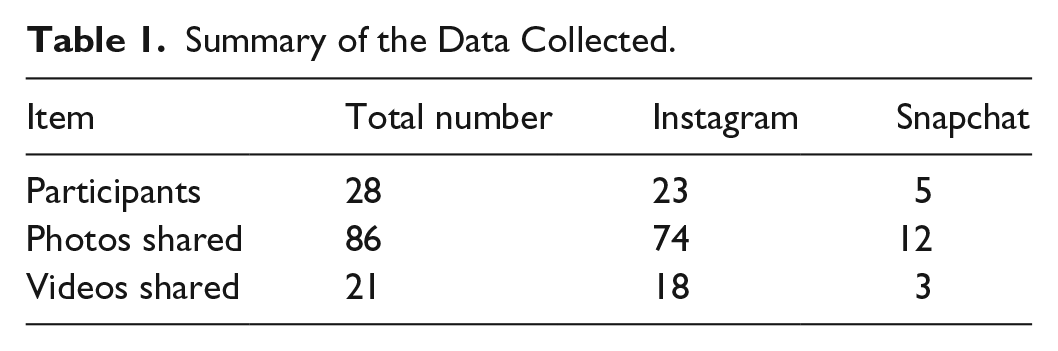
The data collected included 23 Instagram stories and 5 Snapchat stories (Table 1). The total pieces of media was 107 and the distribution of the number of content pieces varied across the participants (Figures 1 and 2). For example, while the average is 3.8, the majority of participants only shared 1 or 2 photos or videos but there was a participant that had shared 18.
Summary of the Data Collected.
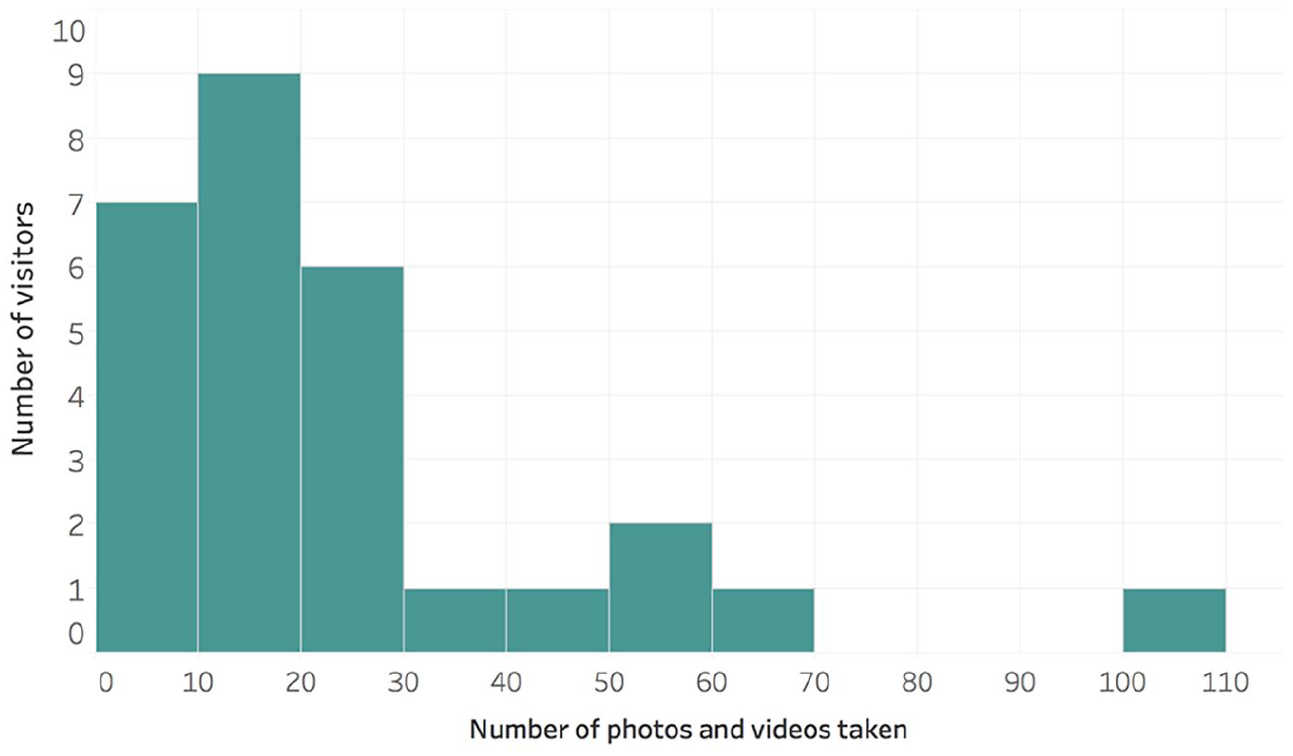
Histogram of the number of photos and videos taken by participants (N = 630).

Histogram of the number of photos and videos shared (N = 107).
Participant Profiles
Participants came to the museum with a range of intentions in mind. There were participants that wanted to enjoy the art and feel inspired while other participants came with a clear focus, which was to visit the Soul of a Nation exhibition, mentioned repeatedly during the interviews. The social motive was also a driver to come to the museum, as this is a place people wanted to have a good time with relatives or friends (25% of the participants came alone to the museum).
Half of the participants had a connection with the arts sector as they were either studying or had a profession in the arts (e.g., designer, photographer, art director, or artist). All participants had previously visited a museum and 35.7% were heavy users of these spaces visiting over 10 times per year. For 35.7% of the participants, this was the first visit to the Brooklyn Museum. The rest of the participants were returning visitors whose frequency of visit varied (42.9% visited the museum 1–5 times a year, 10.7% did between 6 and 10 visits a year, and another 10.7% came more than 10 times a year).
The social media behaviors are relevant in the context of this research. All participants had an account on Instagram, some of them actually more than one. The next most mentioned social media site was Facebook; however, the lack of activity in the past months was acknowledged by some of the participants. Snapchat and Twitter were the next popular ones in the list, used by 40% of the participants. These visitors were pretty active on social media with half of them posting daily, in some cases several times a day. Looking at the participants’ age, 39.3% were between 18 and 24 years old, 32.1% 25–29, and 28.6% 30–49.
Content Analysis
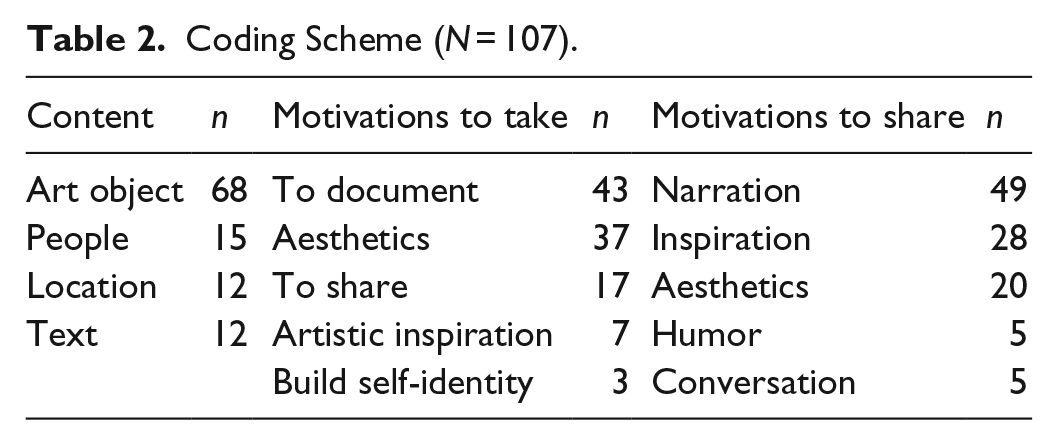
The ideal scenario for analyzing images and video for research purposes involves assessing the appropriate methods in a particular research context. Pink (2007) discusses the relationship between research and analysis and believes that analysis occurs throughout the entire process, not as a separate process in and of itself. Meaning-making should occur during an exploration of the relationship between the visual content and other knowledge. In the case of this research, the biographies of the images included the motivations expressed during the interviews to take and share this content. This media and interview content was coded following a deductive approach in which the coding was influenced by the previous literature, but then adapted to the new scenario (Elo & Kyngäs, 2008). First, all the pieces of content were printed to better visualize and identify common topics (Figure 3). This step was fundamental to determine the categories and define the codes looking at the type of content and themes mentioned by the participants. Second, the codes were cleaned up and grouped into four or five under each level. Finally, coding was performed in a spreadsheet at the video or photo level, because participants posted sometimes more than one piece of content. The motivations, extracted from the interview transcripts, were also, on occasion, different for each piece so multiple codes were entered in those cases for the same participant. The coding scheme along with the number of media items in each category is presented in Table 2.

Prints of all photos and videos to develop the content scheme.
Coding Scheme (N = 107).
Limitations
The results of this study are subject to certain limitations. The small size of the dataset meant that it was not possible to cross-tabulate the motivations to take and share content on these platforms with other response data such as age, frequency to visit museums, or connection to the arts sector. Another fact to be taken into account is that the interviews took place at the museum, so it only included visitors who had shared stories during the visit. However, it is common to post on social media after the visit. This behavior may impact the motivations and format of the content shared. For instance, having more time to reflect on the experience at home may result in more edited and curated stories than the ones analyzed in this study. Another factor to consider is that a high number of museum visitors came to see the special exhibition on display, Soul of a Nation, a fact that may influence the motivations and behaviors to share on social media.
Results
The results of the coding provided key insights into the characteristics of the content shared and the motivations behind taking and sharing this content.
Content and Composition
The context of the museum visit and the ephemeral social medium where the content was shared influenced the characteristics of what people posted. The majority of visitors took photos or videos of the objects themselves, whether in the permanent collection or the special exhibitions. The composition varied: some visitors took a picture/video of the whole piece while others zoomed in to capture a specific detail (Figure 4). The fact that 67% of the media were about the art objects on display is a significant finding in this analysis. This shows that, same as with non-ephemeral social photography, in this ephemeral medium the object is frequently the most depicted subject.

Video taken by a participant who commented, “This is a basket which I thought was really cool. I took a video so you could see all the different people and smaller baskets” (Instagram).
Three-quarters of the participants came with a friend or family member. The people the participants came with sometimes became the focal point or the reason for taking the photo/video. Unexpectedly, there were only three people who took a selfie. Another commonly shared piece of content is both the interior and exterior of the building. The building facade is used to contextualize and start the story. When the geotag was used it was in the majority of cases in the image or video of the building (see examples in Figures 5 and 6).
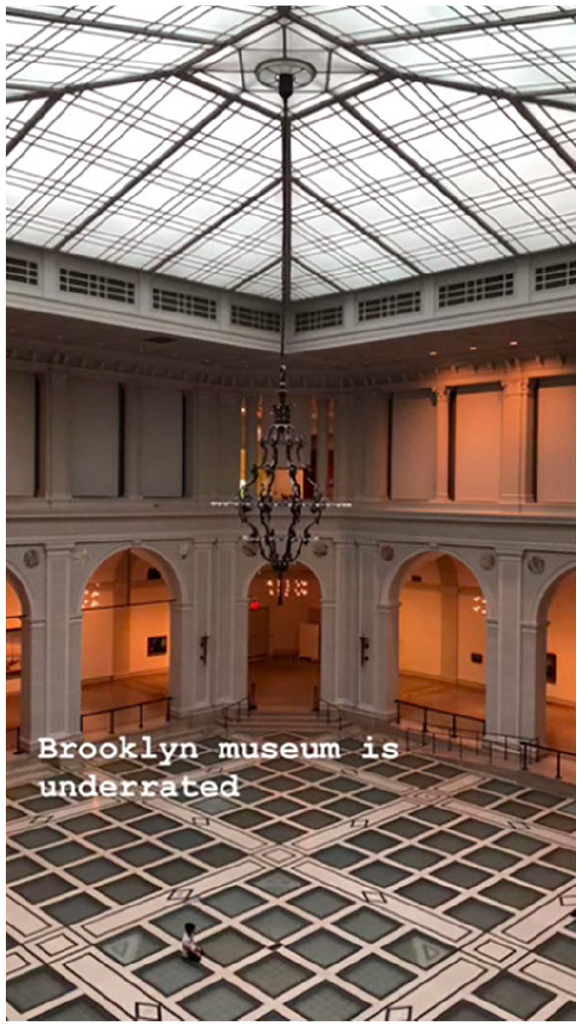
Photo of the Beaux-Arts Court (Instagram).
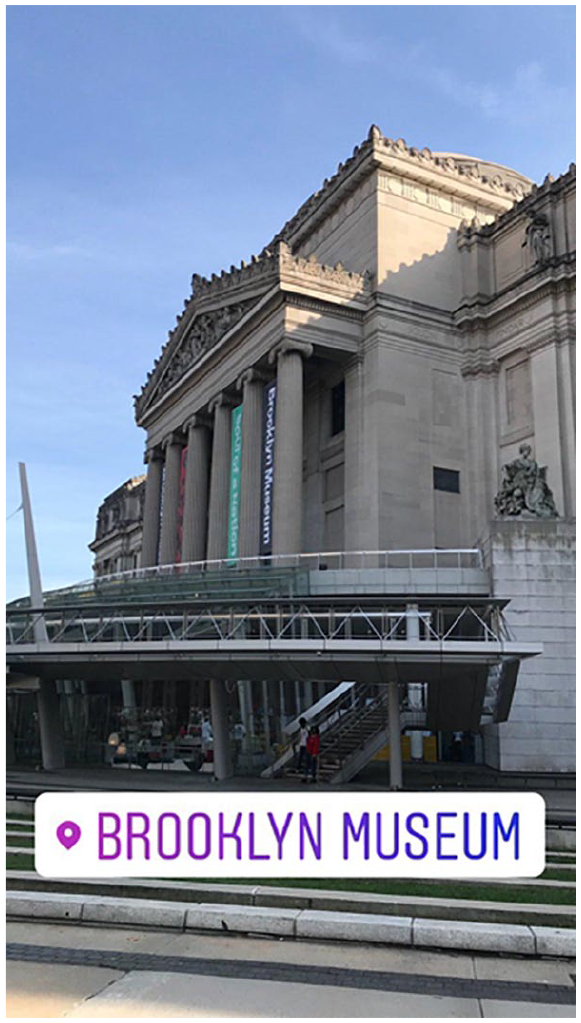
Photo of the museum’s facade with the geotag (Instagram).
Photos or videos of the signage and ephemera such as the exhibition entrance wall, the museum ticket, and gallery posters were used as the beginning of the story. Interestingly, the entrance of the Soul of Nation exhibition was one of the most shared images by the participants interviewed (Figures 7 and 8).

Photo of the entrance wall of the Soul of a Nation: Art in the Age of Black Power exhibition (Snapchat).

Photo of a wayfinding signage (Instagram).
Stories on both Instagram and Snapchat present a set of editing options to enhance the quality of the photo, manipulate the image with filters, produce video effects, and add elements to it (emojis, hashtags, geotags, text, stickers, and polls). However, the majority of the content was shared in its raw format with very minimal or no edits. The main modifications visible in the content were text that is primarily used to narrate the visit and add an artist name or artwork title, geotags, and mentions. The low number of edits and extra content was in fact due to the ephemeral aspect of stories. For example, one interviewee said, I posted Instagram stories because I feel like my Instagram page is set up where I like to control it a lot more. I like the positions on how the photos lay next to each other. If I can color coordinate them I would like to. Instagram stories are up for 24 hours and then they go away. It just seems like a revolving door. It doesn’t have any rhyme or reason to them.
As another participant put it, “I can post it right away. I don’t have to think about any captions, tag and hashtag and all that. It’s easier for me to just post it right away and not worry about any other long-term impact.” This lack of editorial process is linked to the motivations to take and share the experience, explained in the next section. The real-time interaction with the objects and the museum environment carries live conversations and convenience to tell what is going on in someone’s day. Another remarkable aspect of the content analysis results that reflects this live sharing activity is the usage of video, which equates with the increase of this medium on the Internet.
Visitors Motivations to Take Photographs and Record Videos
The analysis of the motivations to take photos or videos during the museum visit provide insights into the first action that the visitor takes in sharing the content. In this study, approximately one out of six media pieces taken were then shared on either Snapchat or Instagram. There were five types of motivations to take photos or videos that were identified in the participant’s responses. The most common reason mentioned by the participants was to document the experience, so in the future they could remember an object viewed during the visit or capture a feeling that was evoked by an artwork and moment at the museum. These feelings could be the result of hearing or having a story behind the artwork or artist. One participant commented, “In taking the photographs what I cared to do is bottle in that photograph the emotion I felt. So the ones that I responded to the strongest are the ones I took photographs of.”
The next most popular motivation to take a photo or video was purely for its aesthetic value. The visitor was using their unique perspective to reframe the art object, in some cases, purposely creating their own art from the art they are viewing. A substantial number of participants answered that they were taking photos or recording videos with the sole intention of sharing that imagery on social media. As one of the participants affirmed, “I don’t even take photos of things that I wouldn’t want to share.” Another interviewee said, “Some things I just thought they’re cool and just want to share it with people and get them to come to this museum.” In some other cases, capturing this visual was to serve as a source of inspiration for the participant’s job (often an artistic field) or their own artwork. One participant said, I’m a lighting designer, so this one was about the moonlight [Moonlight Halo, Su Xiaobai]. And it was kinda interesting to me that it was like this block of blue with these little outlines of white. I’m doing a midsummer and so that one was inspirational for the moonlight.
Yet another reason that motivates visitors to take photos or videos is the implications toward a participant’s self-identity. These feelings may have been the result of hearing or having a story behind the artwork or artist. In one case, the story behind the photo taken was, Then this was Rosa Parks, you know the bus situation, sitting in coloreds only, sitting in the back of the bus and things like that. And this particular photo I like, of course because I am African American and my father actually marched with Dr. Martin Luther King.
Another participant explained the personal connections with a display of art from her country: I guess I shared that because I’m Korean American and for me the fact that there was an exhibit that was specifically for Asian culture but also like Korean culture was something that I found very unique. So that had more personal meaning to me which is why I shared that one. (Figure 9)
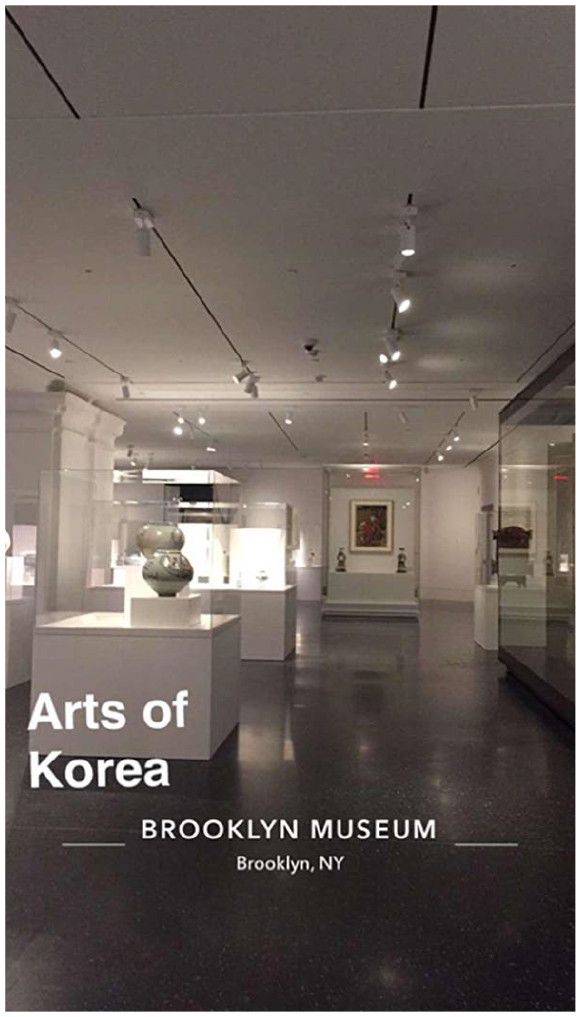
Photo of the Arts of Korea galleries (Snapchat).
The reasons behind capturing the art and moments around that experience are important to contextualize why users are motivated to share; a topic presented in the next section. The fact that some of the visitors took photos for the sole purpose of sharing the content on social media displays key behavioral aspects of the current museum experience.
Visitor Motivation to Share
Diving deeper into the engagement aspect of social media, five separate motivations to share photos or videos taken in the museum were coded: narration, aesthetics, inspiration, humor, and conversation. Starting with narration, this often corresponded with photos where the motivation to take them was to build self-identity. This category involved taking a moment of introspection and sharing it out. In addition, there were several instances in which sharing ephemeral photos was motivated by simply letting friends and family know what was going on in the participant’s life that day. Followers were getting a glimpse into their internal and external life. As one participant stated, “I don’t post a lot to Instagram with a post post [feed post] so I try to fill in the gaps by doing it on my story. So my friends know I’m still alive, that kind of thing.”
As was seen with visitors’ motivations to take photos/videos, aesthetics was also a motivation to share. One participant even shared that they sent a selection of the photos of the artwork to their sister to be used as a phone background. Lighting, composition, color, these elements of design were being taken into consideration to produce a photo aesthetically pleasing to other people. While ephemeral content is often informal and conversational there was still an element of artistic expression in these stories.
Participants often stated that they knew many of their followers were working in the same field as they were or had similar interests, so they were hoping to inspire them artistically as well. In addition, participants at the Brooklyn Museum were very impressed with the Soul of a Nation exhibit specifically and they wanted to inspire their followers who may not visit museums often to visit this exhibition. Two participants that were visiting together had this to say: It’s not only for me, but to show them [younger followers] other things that you can do and experience . . . you can go into a museum and learn something on your day off, when you’re not working. And learn more about yourself. And where you come from.
The couple quoted here, discussed at length their motivation to get their followers into the museum. They were very passionate about showing an alternative learning experience and a way to build self-identity.
Another way that participants shared their experiences was through humor. Meme culture is such a huge part of communication in today’s social media realm that it wasn’t surprising to see several photos shared for a laugh. “I just like that I can make somebody’s day or make them laugh just through what’s going on in my life,” one participant stated. Much like narration, the participant is sharing a feeling but the experience of amusement is so overwhelmingly cited in ephemeral content sharing that it deserves its own category. Figure 10 was the only photo shared by one of the participants, she was excited for their friends, who are familiar with The Metropolitan Museum of Art collection and specifically hippopotamus William, to get the joke. During the interview she said, “. . . a lot of my friends are in the know with museums too so they’d probably get the reference. Kinda like meme culture. Fun little inside joke.”

Photo of Standing Hippopotamus (Instagram).
Finally, participants were motivated to share their photos to start a conversation with their followers. They wanted to get their followers thinking critically about what was on display at the museum: I posted this because I saw this signage about how because of the Native American Graves Protection and Repatriation Act the museum has had to return some artifacts to Native Americans. And then I just commented on how a lot of things here are stolen and not returned. And I saw these Peruvian ear ornaments, which were cool, and also probably stolen.
This particular participant was inspired by a piece of signage with the Native American artifacts at the museum (Figure 11).

Photo of wall text next to an object (Instagram).
Discussion
Similarities and Differences Between Ephemeral and Non-Ephemeral Social Media
This article has investigated the content shared by museum visitors on Snapchat and Instagram stories along with the motivations behind this action. The coding structure that revealed itself as interviews and visual content were analyzed reflected much of what had been discussed in earlier research around social media and visitor photography in museums. However, this research uncovers some differences in the format of the content shared and adds specific motivations directly linked to the particularities of these platform features. The findings seem to be consistent with other studies that found museum objects to be the main element captured by visitors’ digital lenses and shared on social media (Burness, 2016; Wall, 2015; Weilenmann et al., 2013). The museum space is also represented as observed in other studies (Villaespesa, 2013) and what may be perhaps surprising is that the number of selfies in the study was very low, which echoes previous research (Budge, 2017). The motivation to take and share are consistent with those determined in previous research: to collect key objects, to share something interesting, fun or aesthetically appealing, to inspire, or as building material for self-identity (Budge, 2017; Leighton, 2007; Stylianou-Lambert, 2017). Snapchat and Instagram stories achieve these goals. The desire to document the experience to remember a specific object or capture a feeling in a shorter period of time prove what Seyfi and Soydas (2017) meant when they expressed that technology is continuing to compress time and place. The motivation to share here applies primarily to social media platforms. Newer motivations included starting a conversation and capturing a feeling, which may reflect the narrative quality of these newer platforms. The visitors at the Brooklyn Museum were creating their own stories about the experience and the museum facilitated this co-creation with a liberal photography/video policy and eye-catching signage. This curated personal experience as the outcome of the sharing action resonates with previous findings on how people post on social media. However, the format is different. There is an editorial process for the regular Instagram feed posts that involve improving the aesthetics of the image, adding filters, and carefully writing engaging captions (Weilenmann et al., 2013). This does not appear to be the case for visitors that are using the ephemeral aspect of the platform. As this study demonstrated the stories feature called for raw content or minimal edits.
Expanded Storytelling: The Rise of Social Video-Making
Snapchat and Instagram stories have been playing a crucial role in the rise of video as a means of communication. What stands out from this study is that half of the participants shared at least one video. Social photos and social videos have become pretty interchangeable to users and are not seen as separate entities mostly due to social formats that allow them to coexist together more fluidly. A participant in the study said it best when they explained their reason for taking a video of one of the objects: “It was just too much I couldn’t take a picture to connect it. It’s hard to take a picture, it’s like a neighborhood so I had to film it.” However, many museums still have policies that do not allow video, which may make it more difficult for those institutions to remain a topic of conversation for younger visitors. This was the case with photography policies less than 10 years ago; those policies were difficult to enforce because of the ubiquity of smartphones and the irrepressible urge to take pictures (Miranda, 2013). If visitors are allowed to take photos in the galleries now it would hardly be noticeable by security, in most cases, if a video was being shot instead.
New Narratives and Meaning-Making in the Museum Experience
While this study is valuable for understanding how visitors were interacting with the Brooklyn Museum, how does this research benefit the museum community as a whole? It starts with understanding why visitors are choosing to use ephemeral platforms: convenience, conversation, and interaction. As expressed by the participants, it is easier to snap and share a photo that is going to disappear because not a lot of thought needs to go behind the post, unlike using Facebook or the Instagram feed. It becomes a more efficient medium for telling the story of their day. This also makes the posts more conversational. As discussed previously by Piwek and Joinson (2016), this type of photography is used in a way similar to texting; it is even more conversational than traditional social media because images and videos, for the most part, are not intentionally archived. It is a quick anecdote, which also sparks more interactivity. There is real-time engagement with exhibitions and art objects. One participant in the study capitalized on the interactivity of Instagram stories by creating a video based on the odd juxtaposition of two objects. One was a machine gun made out of a xylophone, so they added cartoonish xylophone music to accompany the display and create their own interpretation of the curators’ decisions in the gallery. While no editing is necessary, there are a lot more editing options with ephemeral social photography that give visitors an opportunity to interact with the museum and objects on another level: from critiquing curation decisions to becoming a curator in their own right.
In Goffman’s (1959) terms the museum and objects become a setting that defines the situation for those observing the performance. In this way, the museum becomes an integral part of everyday communication. An example of this is provided by two different participants who stated the following: So I have kids that are younger than me that need to see some things, I mean they see everything else that I post, like parties and different things like that, to see and experience. So it’s not only for me in that way to show them other things that you can do more and experience more than just doing one thing
and I just wanted to share it so people can feel, I know a lot of my friends and family like to see stuff like this. It’s like ‘Oh wow, where did you go? Where is it? I want to go, I want to see this.
These words have a clear connection with Goffman’s theory. He outlines an analytical framework from the perspective of a theatrical performance in which each individual puts on a show and wears a particular mask according to the social scenario in which they are immersed. Goffman’s work helps us understand how we utilize social media to express a message that may be tailored to a particular group of followers with the intention of guiding and controlling their impression.
Further research asks us to consider how the museum can work with these new narrative devices to understand visitors and create an experience that lets them tell their own story about the museum experience. Traditionally, museums have tried to keep the authorship and narratives of the exhibitions and collection displays. However, museum practice is slowly changing to become more visitor-centered (Samis & Michaelson, 2017). The disruption of technologies in the museum and, particularly, social media have added multiple voices and narratives around the museum objects. This view is supported by Parry (2007), who argues for a “personal museum,” that is, “a place where authorship and authority could be shared rather than made the preserve of the curator alone.” A person can look at their phone and be transported around the world with the tap of a screen. Before, what might have been introspection or a conversation among friends as visitors explored museum exhibitions has expanded to conversations with hundreds or even thousands of followers online. That is why it is important to be open with visitors about museum practices and build museum strategies, not just digital strategies, around this kind of communication. As one participant explained, “There’s a connection [with the art] because you’re choosing pieces that mean something to you or that you were drawn to and then showing them to other people, so it’s like you’re doing your own curation.” One of the motivations behind taking and sharing photos and videos has been building self-identity and as Koke and Ryan (2017) discussed, if the museum is becoming part of one’s identity, it can only mean that a stronger relationship is being formed with these institutions. Visually appealing signage and ephemera may spark a visitor’s creativity and help them to create their narrative using ephemeral mediums. In turn, going back to Arias’ ideas about co-creation (Arias, 2018), reviewing these hashtags and museum geolocations then provides another avenue for discovering which objects visitors are spending the most time with and what they want to learn more about, thus, allowing museum professionals to create more useful, enjoyable, and relevant interpretive materials.
Conclusion and Further Research
The results of this study contribute to the understanding of people’s motivations to take and share content on social media in the context of a museum visit. This research in particular examined people’s behaviors using Snapchat and Instagram stories. Similar to previous photo-taking behaviors at the museum, social ephemeral photography is often motivated by capturing a feeling, an aesthetically pleasing museum object, sharing an experience, and building self-identity. However, these motivations are contextualized to the medium in which the content shared is shaped by temporary features that motivate minimal editing. While the study was undertaken within the museum space, the fact is that this spontaneous social phenomenon goes beyond the museum walls and it is now a part of how people communicate and express themselves. The museum is just another scenario in someone’s day when they visit. This is clearly demonstrated in stories in which the images of the museum visit were just a fraction of the total content contained within a user’s daily story. Therefore, this study suggests that museums should adapt their policies and programs to current social media communication behaviors to remain relevant and be a part of what and how people share their lives. Moreover, the results bring another opportunity for museums to foster a proactive approach to be a part of these conversations in order to produce interpretative spaces, and engaging materials.
While the study provides insights into the particularities of this ephemeral content, there were certain challenges to capture how this sharing action actually adds to the intrinsic value of the museum experience. In people’s responses, there were indications that sharing content on social media contributed positively to the experience, but further research could explore this topic in detail. Moreover, the interviews were done at the museum so it did not include responses from visitors who may post after their visit. Potentially, having more time to reflect on the visit and prepare the content to be shared may bring different results from the ones presented in this article. At the time of this study, Instagram had just included the possibility to archive stories and a few months later, the platform added an autoarchive feature. The usage of the archiving options could be explored in future research. Furthermore, the recurrently mentioned motivations of the participants who specifically came to visit the temporary exhibition, Soul of a Nation, may have also influenced the reasons to take and share on social media. Another future study could expand the sample size and conduct the interviews in another museum. Snaps and Instagram stories have been the first type of temporary medium people are using to share their experiences. However, this feature is increasingly being adopted in other platforms, such as Facebook and Google searches, which in the medium term can potentially influence current behavior. This study documents the specific motivations and behaviors within museums at a crucial point of social media evolution. This rapidly changing environment will require continuous research to capture visitors’ usage and museum practice.
Footnotes
Acknowledgements
The authors thank Sara Devine, Director of Visitor Experience and Engagement, and Brooke Baldeschwiler, Senior Manager of Digital Communications at the Brooklyn Museum, for their help and support with this research.
Declaration of Conflicting Interests
The author(s) declared no potential conflicts of interest with respect to the research, authorship, and/or publication of this article.
Funding
The author(s) disclosed receipt of the following financial support for the research, authorship, and/or publication of this article: This research was funded by Pratt Institute, School of Information Faculty Innovation Fund.
