




Abstract
This article considers on what grounds contemporary photography may be understood as play. This is done by tracing the common characteristics of play that are revealed in the constant photographing and photo sharing among young friends through the camera-based social media application Snapchat. The arguments are built by presenting qualitative data, consisting of saved snaps and interviews, together with existing theory of play. Snapping, as it emerges from the article’s data, aptly fits in with the theoretical notion of play mainly adopted from Winnicott’s Playing and Reality (2005[1971]) and Huizinga’s Homo Ludens: A Study of the Play-Element in Culture (1998 [1949]): the aim of snapping resides in itself; it is limited in terms of time and space; it is executed according to shared rules; it is fun, playful and enjoyable; and it is different from ‘ordinary life’. Further, it reinforces friendships through indices of togetherness, intimacy and trust. The article concludes with a discussion on the advantages of understanding current photography as play and the affordances that photographs provide for that play.
Introduction
Many young people take and share massive numbers of photographs using their phones and applications such as Snapchat. It stands to reason that photography has become a substantial part of their everyday lives. To better understand this constant photographing and sharing, in this study, twofold data consisting of interviews and Snapchat communications was gathered. From the data, the concept of play emerged as a new perspective for examining photography and the data itself.
Play has a central role in human life. It is an intrinsic psychic activity for children and adults, an essential precondition for creativity and an enjoyable form of social interaction (Huizinga, 1998[1949]; Winnicott, 2005[1971]). Photography is often a playful practice, as people engage in playful actions with their cameras, photo manipulation techniques, facial expressions, compositions and poses. However, even though it might be relatively easy to find comments connecting photography and playfulness in previous literature, more profound reflections on play and photography are scarce. In this article, contemporary photography, specifically photographing and photo sharing among young friends through the camera-based social media application Snapchat, is studied as play. It appears that prevalent mobile phone technologies and contemporary photo-sharing applications are enabling digital ‘photoplays’ to flourish.
Both children and adults play with technological objects. Maines (2009: 3) refers to these objects as ‘hedonizing technologies’ that privilege ‘the pleasures of production over the value and/or significance of the product’. Today, play is increasingly part of how people engage with digital technologies (Pink et al., 2018: 27). Current photography is also fundamentally tied to these technologies and screens, especially mobile ones. All in all, current society appears to approve of play (Heljakka et al., 2018: 2786). However, as mobile screens have taken a central role in our everyday lives (Gómez Cruz, 2020), concerns have arisen over addictive technologies diminishing our conversations and relationships into mere connections, with little or no meaningful content (Turkle, 2015).
Previous research has echoed the need for more empirical work to better understand ‘the current and potential impacts of camera phone technologies on our culture and lives’ (Gye, 2007; see also Lehmuskallio and Gómez Cruz, 2016). This article is an attempt to find a frame for understanding the current practices of photography, clearly affected by available technologies. Specifically, it considers on what grounds contemporary photography may be understood as play. To be even more precise, it traces the common characteristics of play that are revealed in photographing and photo sharing among young friends (aged between 12 and 21). The arguments put forward here are built by presenting qualitative data together with existing theory and research. This article begins with a short history of the snapshot – that is, personal or amateur photography – after which the concept of play is covered. Then, the data is introduced and examined. In the conclusions, we discuss the advantages of understanding contemporary photography as play and reflect on the affordances of photographs as playthings.
From Visual Memories to Ephemeral Communications
Since the introduction of amateur cameras in the late 19th century, photography has enabled non-professional photographers to visually document their lives. By and large, personal photography has been quite conventional. Many of its conventions have existed almost as long as snapshot photography itself and survived through the digitalization of photography (Zuromskis, 2016: 19). We tend to take pictures of friends and family, celebration and holidays – of things we want to remember, the way we want to remember them. Indeed, vernacular photography has often been referred to as a technology of memory (Van House, 2011).
However, from the outset, photographs have not been produced only for personal remembrance. They have always been shared: they are handed on, shown and communicated to others (Bourdieu, 1990; Lobinger, 2016: 478). Lobinger (2016) outlines three theoretical modes of current photo sharing: (1) sharing photographs in order to talk about them, (2) sharing photographs to communicate visually, and (3) phatic photo sharing. The first two modes are quite straightforward: photographs are shared for their content or visual qualities either to tell a story about or with the photograph. Here, photographs work primarily as representations, and the visual content plays a central role. In the third mode, phatic photo sharing, the propositional informative content of a photograph is seen to give way to the pure social bonding function of the photograph (for the history and theoretical background of the concept of phatic communion, see Niemelä-Nyrhinen and Seppänen, 2020). In other words, in phatic photo sharing, photographs are mainly shared for the sake of creating and reinforcing connections between people. As previously argued (Niemelä-Nyrhinen and Seppänen, 2020), in phatic photo sharing, the exceptionally strong sense of presence embedded in photographic images plays a central role.
The camera phone, together with the ubiquitous internet, has been a game changer for personal photography, making the instant and distant sharing of photographs effortless. Today, Roland Barthes’ (1983: 77) famous interpretation of the photograph as ‘that-has-been’ is partially replaced by the notion that the photograph shows us ‘what-is-going-on’ (Gye, 2007: 285; Sandbye, 2012). While still storing dear memories, photography has also become a performative, communicative practice connected to presence (Murray, 2008: 151; Sandbye, 2012).
Today, the present tense of the photograph is increasingly accompa-nied by ephemerality. For photographs that are used as tools for passing communication, there is no need to save or store them by default after usage. Most often, their function is transient. Ephemerality invites comparison with ‘real life’ communications that are not stored but fade away (Soffer, 2016). This contradicts the foundational notion that a photograph is a permanent trace of a fleeting moment and frames photography more dynamically as a mode of communication (Zuromskis, 2016: 22). The camera-based social media application Snapchat is a pronounced example of an application that supports this kind of ephemeral communication. First released in 2011, the application is particularly popular among under 25-year-olds (Perrin and Anderson, 2019). On Snapchat, the contents of communication are not stored but automatically disappear. In fact, the users of the application consider ephemerality to be one of its most desirable features (Kofoed and Larsen, 2016: 7).
In addition to ephemerality, playfulness seems to be another characteristic of current photography. For example, Snapchat’s many features – such as filters or the ability to add text, drawings and stickers to images – encourage its users in playful behaviour. However, playfulness in photography is not a new quality tied only to digital tools or applications; rather, it has been one of the affordances of photography throughout its history. Previously, the camera has been referred to, for instance, by Flusser (2006[1983]: 27, 84) as a plaything, ‘an object used in the game’ of photography, and by Maines (2009: 3) as a hedonizing technology. Sutton-Smith (1997: 4) has used photography as an example of solitary play. In relation to digital technologies in particular, Heljakka et al. (2018) have studied photographing and the use of social media in sharing photographs and videos of dolls as an extension of traditional object play, and Mäyrä (2012: 61–62) has analysed the photo-sharing service Flickr as a playful mobile communication tool. Within human–computer interaction (HCI) research, features of ‘playful photography’ have been elicited from design cases in support of designing future playful photo systems (e.g. Petersen et al., 2009; Rowland et al., 2015). However, it appears that there is a need for more profound research connecting current photography and the theory of play.
Characteristics of Play
In this study, the notion of play is adopted mainly from the works of cultural historian Johan Huizinga and psychoanalyst Donald W. Winnicott. Taken together, their understandings form a comprehensive conception of play as an essential psychological, social and cultural human activity. Moore (1999: 158) has noted that the concepts of play depicted by these two theoreticians are ‘remarkably similar’. In their profound writings on play and playing, play is considered an integral part of life and culture, something characteristic of all humans. It is ‘the natural and universal thing’, as Winnicott (2005[1971]: 56) puts it in his book, Playing and Reality. Correspondingly, Huizinga (1998[1949]) claims in Homo Ludens: A Study of the Play-Element in Culture that there is an innate urge to play within all humans across time and space. Further, Huizinga strives to show that play is ‘one of the main bases of civilisation’ as ‘play actually becomes culture’ (pp. 5, 9). In a similar vein, Winnicott (2005[1971]: 135) stresses the importance of play for culture by suggesting that cultural experience begins with creativity, which is first manifested in play.
According to Huizinga (1998[1949]: 13), play appears in two basic forms: as a contest for something and as a representation of something. He states that representation may simply consist of exhibiting something naturally given before an audience, or it may include imagination and stepping out of the ordinary, thus ‘making an image of something different, something more beautiful, or more sublime, or more dangerous than what . . . usually is’. Huizinga affirms that, although play escapes an exact definition, it may be described through its characteristics as: a voluntary activity or occupation executed within certain fixed limits of time and place, according to rules freely accepted but absolutely binding, having its aim in itself and accompanied by a feeling of tension, joy and the consciousness that it is ‘different’ from ‘ordinary life’. (p. 28)
The goal and primary aspect of play seems to be its ‘aesthetic quality’: the fun and the feeling of joy and pleasure (Huizinga, 1998[1949]: 2–3). Playing is essentially satisfying (Winnicott 2005[1971]: 70). While describing how the aim of play is intrinsic, Caillois (2001) has suggested that, in fact, play is ‘an occasion of pure waste: waste of time, energy, ingenuity, skill, and often of money’. Further, for Huizinga (1998[1949]: 7–8), play is, first and foremost, a voluntary activity that entails playfulness. However, he notes that, when play is recognized as a cultural function, a rite or a ceremony, it may be bound up with the notion of obligation. Accordingly, some scholars feel that it is not only possible, but perhaps necessary, to conceptually differentiate between the phenomenological personal mental experience, attitude or mindset of playfulness and the culturally recognized activity of playing (Danet, 2001: 8–10; Stenros, 2015: 64).
This study applies a comprehensive concept of play, which entails not only playfulness but also other relevant characteristics that relate to the activity of playing. One of these characteristics is the limitedness of play in regard to time and space. Play is distinct from ‘ordinary life’ both in terms of duration and locality (Huizinga, 1998[1949]: 9). Play begins and ends. Most notably, play occurs in a limited space. Winnicott (2005[1971]) occasionally refers to this space of play as a playground. According to him, this playground is located neither in the subjective inner reality nor in the external objective world, but in the space between the two, wherein objects from the external reality are used in the service of the inner self (Winnicott, 2005[1971]: 55, 64, 68, 138–139). Huizinga (1998[1949]: 10) argues that ‘all play moves and has its beginning within a playground marked off beforehand either materially or ideally’. In his thinking, playgrounds are temporary worlds within the ordinary world. Thus, both Huizinga and Winnicott understand that playing takes place ‘within a level of reality that is different from that of ordinary life’ (Modell, 1990: 29). Within these playgrounds, special rules apply and determine what holds true in the world of that play. If these rules are violated, the play-world or ‘magic circle’ collapses (Huizinga, 1998[1949]: 11).
Paradoxically, play is certainly part of ‘ordinary life’ and, at the same time, different from it. All the other characteristics of play – the feelings of joy and pleasure, the limitations regarding time and space and the rules – seem to contribute to this difference. However, play also has an impact beyond play, within the ‘ordinary life’. According to Groos (1919: 341–342, 356–357), for both children and adults, social play, from ‘ordinary society chat’ to ‘soul stirring spectacles’, is indispensable for strengthening ‘the bond’. Huizinga (1998[1949]: 13) sees play as promoting the formation of social groupings that surround themselves with secrecy and emphasize their difference from the common world by disguise or other means. The saying ‘This is for us, not for the “others”’ aptly describes this feeling of secrecy or being ‘apart together’ (Huizinga, 1998[1949]: 12, emphasis in original). Thus, playing as such implies trust in others (Winnicott, 2005[1971]: 69). According to Huizinga (1998[1949]: 12), the social groupings formed in play generally retain their ‘magic’ beyond the duration of play.
Studies on digital play have suggested that what changes in the context of digital is not, in fact, the essence of play or the types of play possible (Fleer, 2016; Marsh et al., 2016). This supports a conception of play that is not tied to digital contexts only. However, as contemporary play draws from both the digital and non-digital properties of things, it is able to move fluidly across the boundaries of space and time in a sense that was not possible in the pre-digital era (Marsh et al., 2016). In other words, digital play may be more geographically and temporally dispersed, and thus its limitedness in regard to time and place may be different from non-digital play.
Method and Data
The exact nature of photo sharing using ephemeral applications, such as Snapchat, is considered difficult to examine due to disappearing content (Piwek and Joinson, 2016: 358). Consequently, previous research has relied mainly on participants’ descriptions of Snapchat contents (e.g. Kofoed and Larsen, 2016; Piwek and Joinson, 2016; Roesner et al., 2014). In this study, we wanted to gather data based on the actual content of communications to figure out what our young study participants are, in fact, doing when they are constantly sharing photographs with their close friends. The data was gathered in 2019 in Finland. It consists of saved snaps (98 photographs and videos in total) and in-depth interviews of two friend pairs and one friend triad. Each participant was asked to save all the snaps they sent to their friend (the one/ones participating in the study) during one appointed day, prior to the interviews. Four of the study participants were female and three were male. Their ages ranged from 12 to 21, and their level of education varied from elementary school to undergraduate.
A decision was made to concentrate on Snapchat as it appears to encourage constant photo sharing. Currently, it is also the favourite medium of communication with close friends for many young people (Bayer et al., 2016; Statista, 2019). As cross-platform research has been strongly encouraged by previous studies (Lobinger, 2016; Lobinger et al., 2020; Vermeulen et al., 2018), our interviews also covered interpersonal communications through other applications that support the use of photography and were used by the participants (i.e. WhatsApp, Instagram, Facebook).
Saving snaps that were originally meant only for the eyes of a specific friend (or friends), for research purposes, requires a high level of trust. In this study, to ensure data access, the participants were recruited from the circle of acquaintances of the first author. On the one hand, this closeness and some level of understanding of the participants’ phases of life may have aided in analysing the data. On the other hand, it is possible that the closeness could have led to the participants’ withholding of delicate snaps. However, the participants reported that they do not send secret or delicate photographs or videos through Snapchat. Overall, they felt that the saved snaps accurately represented their average snapping. In addition, to ensure the data were as authentic as possible, it was agreed that only the researchers would examine the snaps, and if they later wished to publish them, a separate consent would be required.
The friends were interviewed in pairs and as a triad so that they could discuss their visual communication together. The interviews started with basic questions concerning the participants’ Snapchat use. After the initial questions, the saved snaps were shown, and the participants were asked to describe them and the related situation one by one. Photo elicitation (Harper, 2002), which, in this case, involved looking at and discussing the saved snaps, provided an opportunity to reflect on things that otherwise might have been overlooked. The interviews were recorded and transcribed verbatim. All direct quotes in this article are translated from Finnish by the first author. Only the ages of the study participants are given with the quotes to ensure anonymity.
All the participants were Snapchat savvy. At the time of the interviews, their Snapscore (approximate total amount of sent and received snaps provided by the application) varied between 20,000 and 229,000. The youngest participants had been using Snapchat for about two years, and the oldest for four to five years. During the snap data gathering day, the participants exchanged from 25 to 47 snaps with the friend/friends participating in the study.
Initially, the data were approached openly, without a fixed theoretical framework, which allowed for the emergence of the concept of play during the data gathering. After the decision was made to use play as a framework, the following central characteristics of play, derived from the above cited literature, were examined within the interview data: (1) play is executed within fixed limits of time and space, (2) play is executed according to rules, (3) play has its aim in itself, (4) play is accompanied by a feeling of joy, and (5) play is different from ‘ordinary life’. In addition, attention was paid to the ways in which play reinforces friendships. Furthermore, we attempted to identify the different types of snaps and conversation structures in the data.
Findings
Snaps
Most of the snaps in the data are photographs complemented by a short text. Accordingly, in the interviews, the participants explained that most of their snaps consist of photographs and that they use videos only to capture movement or sound, to emphasize something (for example, with a zoom effect) or when everything they want to depict does not fit into one frame.
The older participants were well aware of the structure of their snapping. Their discussions started with an opening snap that was often a funny and/or an informational remark or comment on everyday life. This opening snap would be followed by a varying number of snaps in reaction to the first one. Thus, there were two basic types of snaps: opening snaps and reactive snaps.
Yup. It begins with sending a picture and then reacting to it. (21) ... it is just like, you know, comment, reaction, comment, reaction, reaction. Basically. (16)
An opening snap is usually shared in order to tell something about or with the photograph (see Lobinger, 2016); therefore, pictorial content plays an important role. Yet, in reaction snaps, the pictorial content is often of less importance. It does not necessarily relate to the opening snap; rather, the photograph communicates the location and situation of the reacting participant and may be interpreted as phatic communication. Many of these photographs seem to be signs of connectivity and the presence of the sender saying, ‘Hi, I’m here, right now!’ (Figure 1) (Niemelä-Nyrhinen and Seppänen, 2020). In reaction snaps, it is often the text that provides the actual reaction with respect to the content of the opening snap.
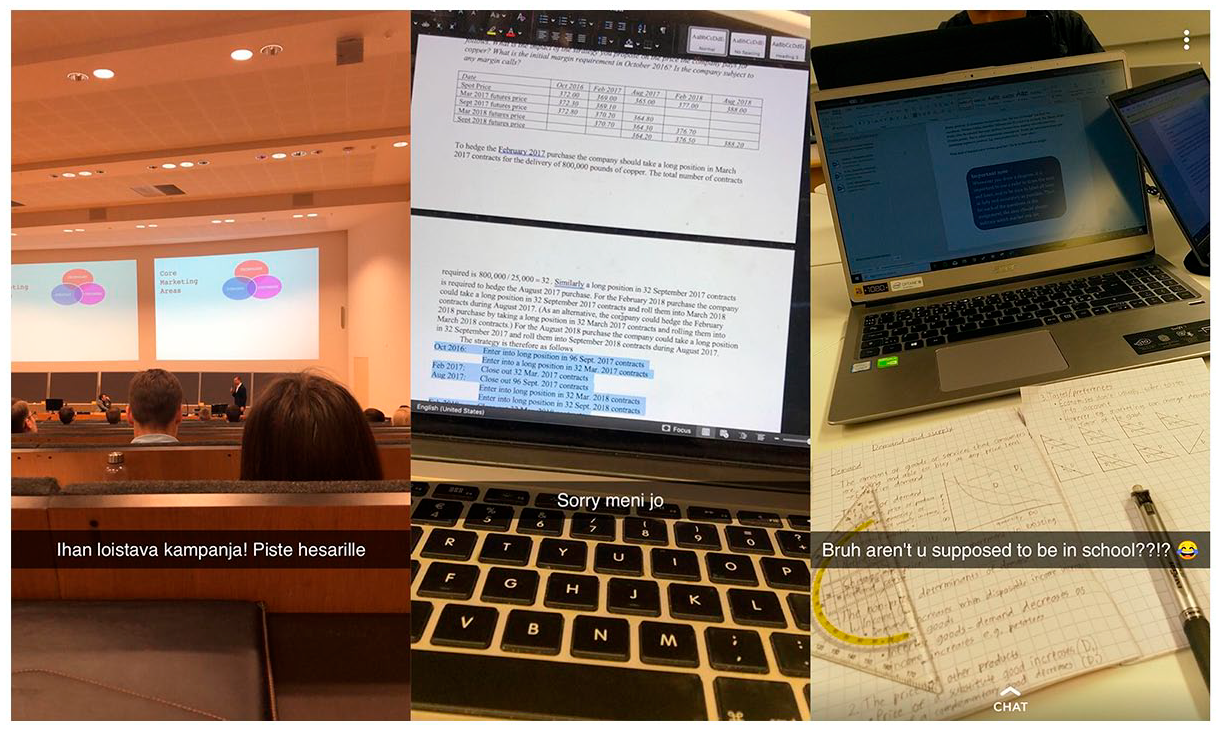
Reaction snaps that signal: Hi, I’m here, studying!
In general, the contents of the snaps in the data were repetitive. For example, they included photographs of interesting or amusing observations, food, feet, school desks, places, travelling and faces (Figure 2). This repetition of subjects may be interpreted as a manifestation of the ‘faculty of repetition’, which is connected both to play as a whole and to its inner structure (Huizinga, 1998[1949]: 10). Photographs of interesting or amusing observations are quite naturally photographs that open up a conversation. Similarly, pictures of food are often sent as an opening snap to highlight the pleasures of everyday life. Photographs of feet, school desks, places, travelling and faces are most often used as reaction snaps, although there are exceptions.
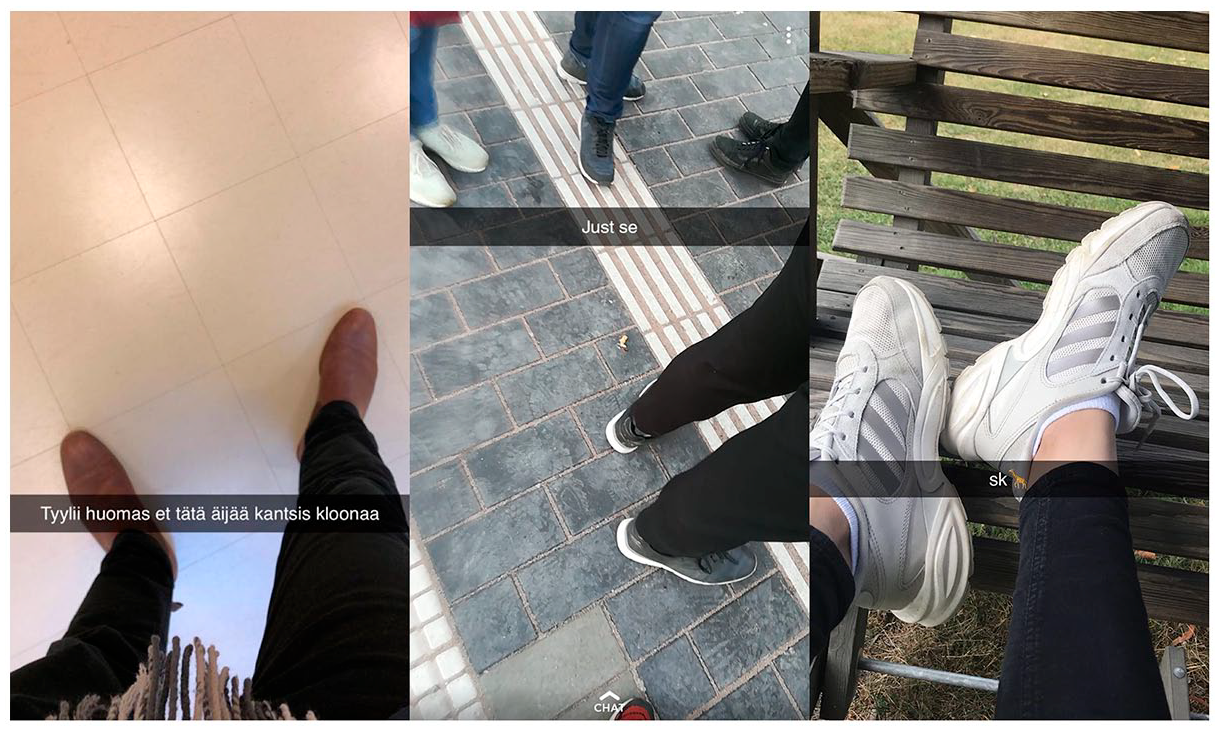
Reaction snaps with feet.
The youngest participants differ from the older ones both in the number of selfies they share and in the way the selfies are used. They send a lot of selfies and also use them as opening snaps. Of their 47 snaps in the data, 33 are faces. The older participants send considerably fewer selfies. In the case of the younger participants, in particular, the exchange of faces seems to be analogous to reciprocal looks. Here, the camera, a representative of human vision, opens the possibility for looking and being looked at, from a distance, through the shared photographs (Figure 3).
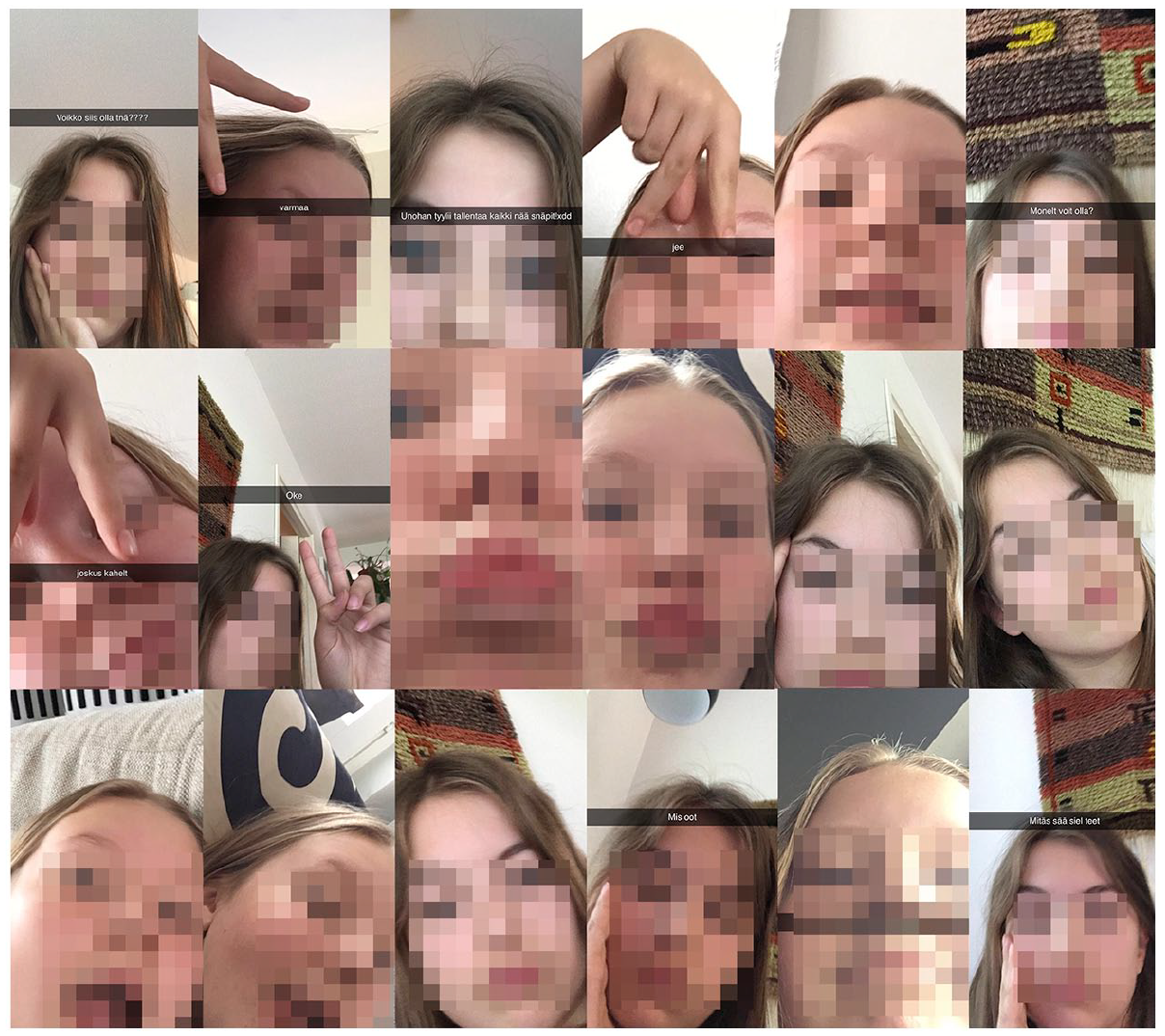
‘Face-to-face’ conversation on Snapchat (faces are pixelated to preserve participants’ anonymity).
Characteristics of play
It appears that the purpose of snapping is in itself. The participants indicated that, if there were no applications like Snapchat, most of the photographs would not be taken or sent. Because of their disappearing quality, snaps are not suitable for communicating ‘real issues’, for serious conversations or for sharing information that one should be able to return to. As such, there are no extrinsic utilitarian goals; rather, snapping is about making comments, being in touch and having fun in the moment.
Through the framework of play, snapping comes across both as a social and a self-centred activity. The participants amuse themselves with snapping, claiming that it is an easy way of telling others ‘what is going on in my life’ and that it is entertaining to receive funny remarks and light, but interesting, content from others. Thus, the fun element that characterizes the essence of play is essential in snapping. This is in line with previous research that has found fun to be one of the key appeals of Snapchat (Piwek and Joinson, 2016: 362; Roesner et al., 2014: 69; Vermeulen et al., 2018: 216).
The fact that snapping is fun was almost tangible in the interviews, which were light-hearted and full of laughter. The participants saw both the application and their communications through it as fun and lightweight. They described their snaps as inside jokes, chit-chat, funny remarks and quick comments. In general, snaps are about everyday life. In a similar vein, Murray (2008: 151) has noted that photography has become less about the special moments, such as celebrations, and more about ‘an immediate, rather fleeting display of one’s discovery of the small and mundane’. Snaps are about the ordinary and, at the same time, distinctly different from it, as they find and emphasize the fun in the ordinary. In other words, play appears to make routines more playful, although not less mundane (see also Pink et al., 2018: 33).
There is a strong element of spontaneity in snapping, which may be interpreted as a feature connected to playfulness (see, e.g., Mäyrä, 2012). The decision to take a photograph is made quickly, as soon as one sees something funny or interesting or as a quick reply to a friend’s snap. The photograph is taken practically without planning, arranging or retaking. In the case of opening snaps, even the receiver of the snap is often decided only after the photograph is taken.
One push and that’s it. (21) . . . I get a snap, I have my phone like this and then . . . I have just pushed (to take a picture) from that moment and written a text on it. (21)
In relation to spontaneity, the fact that a phone has two cameras, rear and front, adds a certain element of randomness to snapping. The participants indicated that, when taking a reaction photograph, if they do not have a specific target in mind, they often use the camera that happens to be open when they enter the application. Thus, photographs are sometimes taken and sent without giving much conscious thought to the content.
But, like, if I have the front camera open or if I have the rear camera open, so usually, whichever happens to be open. And then I take the picture like basically on the spot. (16) It might be that I sent a picture of my face to someone else and then changed the camera direction. Well, then I just took it from there. (16)
Similar to play in general, snapping is limited in regard to time and space. Although the participants snapped throughout the day, one particular day consisted of several smaller bursts of communication. As noted earlier, the limitations of time are different in digital contexts compared to non-digital contexts (Marsh et al., 2016), as the play acts do not need to be synchronous. However, even though snapping might be temporally dispersed if compared to non-digital play, it still seems to be limited in regard to time in the sense that the play has a beginning and an ending. In terms of space, the online environment and its many social applications may be understood as playgrounds – that is, spaces between the inner reality of people and the ‘real’ world (see Daisley, 1994: 110). On the one hand, these playgrounds are marked off by objects with physicality or materiality. On the other hand, phenomenologically, the space for play in an online environment is abstract and held in the minds of the players (Danet, 2001: 8). Accordingly, Snapchat provides a playground which is marked off both materially – by the application, devices and bodies using them – and ideally – as a space with its own logic and rules.
In the interviews, it became clear that there are many shared but unspoken rules in snapping. Most of these rules came up when the participants compared Snapchat to other applications, such as WhatsApp and Instagram, as the rules differ from application to application. They concern the content, privacy, reciprocity, style and tempo of the conversations. Content-wise, Snapchat differs from other applications. When compared to Snapchat, WhatsApp appears to be a channel for more formal, important and intimate content. The passing, lightweight comments often sent through Snapchat would appear strange to the participants if sent through WhatsApp.
When using Snapchat, the participants made a creative choice to use ‘sloppy’ aesthetics. It is apparent that this is, in fact, an intentional choice and a rule of the playground. The ephemerality of the application encourages a lack of care or concern for beauty. Thus, as a rule, Snapchat communications follow alternative aesthetics, which Douglas (2014) has previously labelled as ‘the internet ugly’. It is a visual dialect with social implications, as it signals the user’s casualness, capacity for irony and internet savvy (p. 226).
Because it is not very often that the point is to take a fine picture. (21)
In general, a major goal in using the alternative aesthetic of internet ugly is to normalize imperfection and counteract the effects of mainstream commercial media that favour unattainable representations of the world (p. 327). The participants made a distinction between photographs they post on Instagram and those they send through Snapchat. The former predominantly follows the mainstream photographic aesthetics of beautiful memories, whereas the latter represents a more authentic and mundane view of life. Thus, the photographs in the data are not ugly per se, but rather non-polished and more realistic. This casualness is notable, for instance, in the selfies in Figure 3. Not using this visual dialect on Snapchat and, for example, sending beautiful, thought-out selfies, was considered awkward by the participants. Further, if filters are used, they are not used to beautify oneself. Rather, if used, the ‘ugly’, ‘hideous’ and ‘weird’ ones are chosen, as they are considered humorous.
So, I don’t use that kind of, the kind of cute ones; I use filters that are hideous. (12) None of us, like in that sense, like a nice or beautiful filter and then to take a nice and beautiful picture of yourself. No way, not in that sense. Only as a joke. (21)
There appears to be an interesting rule concerning the reciprocity of content among all the participants. The snaps are adjusted according to what the other person sends. Particularly, if one sends a picture of one’s face – i.e. a selfie – the reply should also be a selfie. Thus, a selfie seems to be a gift that is responded to with a similar gift. Doing otherwise would be considered rude.
Yes, seriously, it is sometimes kind of nasty if you snap an ugly face to one of your really close friends, and then she replies to you with a white ceiling or a wall. It is sometimes a little bit hurtful. Well, not really, but. (13) Hmm. Maybe also just that, if I snap with someone, if he sends me a picture of his face, and I send one of a wall, and then he sends another one of his face, at that point, I feel like, okay, I will send him one of my face too since it would feel somehow harsh to send another picture of a wall, it’s like that. (21)
Another interesting rule concerns the privacy of the snaps. It is completely acceptable to send the same snap to multiple recipients. The participants believe that their friends can tell, based on the content, if a snap was sent only to them or to other people as well. For example, if the content refers to a previous discussion or inside information, then it is safe to assume that the snap was only sent to one person or to a limited group. Whereas, if the snap is of a general nature, it was most likely sent to multiple recipients. There is no obligation to respond to these kinds of general snaps. In contrast, if one receives a message through WhatsApp, it is assumed that it is always something one should react to.
It feels like it is kind of a general like an etiquette because everyone knows if I send . . . [a non-specific snap], they don’t have an obligation to reply or anything. Like, everyone knows that this was probably sent to others as well. Whereas, on WhatsApp, the same assumption does not apply. (21)
Finally, there are rules concerning the tempo of snapping. Quite naturally, if one wishes to respond to a snap, one should do it immediately after viewing it. Otherwise, when the snap has disappeared, it is difficult to remember what one was supposed to react to. Interestingly, it is not expected that the snaps will be opened quickly after receiving. However, as the participants check their snaps quite often, the tempo seems to be intense.
Reinforcing friendships: indices of togetherness, intimacy and trust
Play also has an impact beyond play. In the case of snapping, play reinforces friendships through the rich array of indices of togetherness, intimacy and trust that the photographs entail. The contents of the photos sent are often indicative of a friendship, as they illustrate common interests and phases of life. For instance, there are a lot of snaps in the data that picture laptops, lecture halls, school classes and study materials. These snaps might not appear meaningful to an outsider but, in the context of these friendships, they signal togetherness.
In addition, for example, certain hand gestures (e.g. the V signs in the selfies in Figure 3) and facial expressions were described in the interviews as ‘our thing’, and extra sloppy images and ‘ugly’ faces (e.g. double chins) as something that is ‘only for us, not for the others’. Thus, they are indices of intimacy and trust. The participants agreed that the closer the friend, the sloppier or uglier the photographs. Sometimes, the participants take screenshots of their friends’ ugly selfies. This is acceptable only among close friends, as it is trusted that these screenshots will not be forwarded to outsiders. However, the screenshots might be used later creatively – for instance, as reaction photos that replace emojis, as ‘stickers’ attached to new snaps or in creating birthday greeting collages.
For friends, like for close friends, you always try to send funny snaps. (13) Hmm. Ones that are really weird and embarrassing. (12) You know, if it is a newer acquaintance then, well, I do not necessarily put much more effort into it, but like the direction of the camera might be different or something. But you know, the better the friend, the uglier the picture. So, it’s really the wrong way round. (16)
Although the snaps entail indices of intimacy and trust – that is, sloppy images and ugly faces – the participants stressed that Snapchat is not a place for intimate, sensitive or secret content. This is in line with the findings of Roesner et al. (2014). Thus, the photographs sent through Snapchat are intimate only in a very subtle way.
Discussion
This article has studied photography as play, specifically in the context of Snapchat. As it emerges from the data, snapping aptly fits in with the theoretical notion of play. The purpose of snapping is intrinsic in itself; it is limited in terms of time and space; it is executed according to shared rules; it is fun, playful and enjoyable; and it is different from ‘ordinary life’. Further, it reinforces friendships through the indices of togetherness, intimacy and trust.
The advantage of viewing constant photographing and photo sharing as play may simply be that play allows seeing meaning in something that might otherwise appear meaningless. Without the notion of play, the constant sharing of photographs that are often low in content could be easily judged as pointless. According to Huizinga (1998[1949]) and Winnicott (2005[1971]), playing is an essential, innate urge of human beings, which has a crucial function in the well-being of individuals, in the bonding between people, both children and adults, and lays the foundation for all creativity and culture. Thus, even if constant photographing and sharing is a pure waste of time and energy, it is of significant personal, social and cultural value – supporting mental well-being, strengthening social relationships and even encouraging creativity, which is the basis of all human culture.
The concept of play offers contemporary photography a comprehensive theoretical framework, which, in addition to the photographic image, entails the playing individual and the playground in which the play takes place. The camera-based communication application Snapchat is one example of such a playground: its features, such as ephemerality, filters and other creative possibilities, serve to encourage play. In this play, in addition to the camera (Flusser, 2006[1983]), the photograph may be understood as ‘a plaything’ – an ephemeral object used in the social play of photography. It seems that photographs lend themselves well to play; they also have affordances, highlighted below, that enable and encourage individuals to play.
First of all, the photograph’s basic form of existence as an iconic representation is well suited to play, as one basic form in which play appears is, in fact, representation (see Huizinga, 1998[1949]). In addition, it is easy to see photographs located in the same theoretical space with play – in the space located between the inner self and the external world (see Winnicott, 2005[1971]). Photographs produced with mechanical cameras capture something true to the external world. However, at the same time, they are interpretations made by humans, even more so in camera-based applications, such as Snapchat, in which manipulating, filtering or even adding augmented reality is made effortless for the user. Snaps as such are objects of the external world impregnated with the inner psychic reality of those who create them and those who consume them – they are play representations.
Finally, due to the way they are created, photographs are not only iconic representations of their targets, but also indexical traces of them (Seppänen, 2006). Indexicality is an affordance with the potential to promote a strong sense of presence of the photographed objects and the photographer as well (Niemelä-Nyrhinen and Seppänen, 2020). This sense of presence is valuable within social play that happens mostly in the physical absence of the players. In fact, understanding photography as play strengthens the meaning of this non-iconic affordance and emphasizes the potential of photography in creating and sustaining social relationships.
In this study, we take a positive perspective on snapping and play, as the notion of play is seen to elevate snapping from something potentially pointless to a meaningful action. Although previous research has highlighted the importance of not demonizing ephemeral media and exploring its generative uses among young users (Charteris et al., 2018), for some, this idealistic view might appear as a limitation of the study. After all, Snapchat also provides a possible venue for problematic behaviour, such as cyberbullying or harassment (Messit, 2014). In the interviews, questions on bullying were not asked, nor did the topic come up spontaneously, as snapping was discussed in the context of close friendships. However, as the notion of play fits well with snapping, it might also prove useful in understanding the undesirable forms of photo sharing. ‘In “bad play”, the rules are just one more thing to play with’ (Stenros, 2015: 73), and since play implies trust (Winnicott, 2005[1971]), it also opens the possibility for violations of trust. For instance, receiving unwanted explicit pictures could be considered as one-sided play on the part of the sender, or screenshotting and sharing pictures that were meant ‘just for us’ could be seen as breaking the rules of the play. A closer scrutiny of ‘bad play’ is left for future research. However, it is suggested here that perhaps the concept of ‘bad play’ could aid in grasping pictorial bullying, and, thus, it may be of help in discussing the downsides and risks of ephemeral media.
Another potential limitation of this study relates to our small data set. However, the size of the data is not seen as problematic here, as we are not attempting to define playing or contemporary photography as such, but rather to explore how the characteristics of play that are already established in the literature emerge in current photography within Snapchat. In addition, there is strong uniformity between the findings of this research and previous ‘Snapchat literature’, suggesting that our participants’ use of the application does not particularly deviate from that observed in other studies.
The theoretical correspondence between play and snapping, and the aforementioned affordances of photographic images that encourage play lead us to think that, even though the idea of photography as play, in this article, was examined among young Snapchat users, perhaps its significance is not limited to any age group or specific application. Rather, it might be worthwhile to examine the theoretical fit of play within photography as a whole.
Footnotes
Funding
The author(s) disclosed receipt of the following financial support for the research, authorship, and/or publication of this article: This work was supported by Academy of Finland, 320263. There is no conflict of interest.

Biographical Notes
JENNI NIEMELÄ-NYRHINEN is a researcher in visual studies at the Tampere Research Centre for Journalism, Media and Communication (COMET), Faculty of Information Technology and Communication Sciences, Tampere University, Finland. She currently works as a postdoctoral researcher in the project ‘Post-Digital Epistemologies of the Photographic Image’ funded by the Academy of Finland. Her research interests include philosophy of photography, the social uses of vernacular photography and the potential of photography in empowering sustainability.
Address: Tampere Research Centre for Journalism, Media and Communication (COMET), Faculty of Information Technology and Communication Sciences, Tampere University, Tampere 33014, Finland. [email:
JANNE SEPPÄNEN is a professor of Visual Journalism at the Faculty of Information Technology and Communication Sciences, Tampere University, Finland. He is a specialist in visual communication and visual methodologies and has, for instance, written the basic academic textbooks on visual culture studies in Finland. He has published seven monographs and over 50 articles. He is the author of The Power of the Gaze: An Introduction to Visual Literacy (Peter Lang, 2006). Currently, he leads the research consortium Post-Digital Epistemologies of the Photographic Image (PEPI) funded by the Academy of Finland. The main objective of the consortium is to answer the question of how epistemological questions of the photographic image are formulated after the digitalization of the medium. The PEPI is a multidisciplinary project combining media studies, psychology and art studies.
Address:Faculty of Information Technology and Communication Sciences, Tampere University, Tampere 33014, Finland. [email: