



Abstract
The aim of this study was to explore social media, and specifically Twitter’s potential to generate a European demos. Our use of data derived from social media complements the traditional use of mass media and survey data within existing studies. We selected two Twitter hashtags of European relevance, #schengen and #ttip, to test several theories on a European demos (non-demos, European democracy, or pan-European demos) and to determine which of these theories was most applicable in the case of Twitter topics of European relevance. To answer the research question, we performed sentiment analysis. Sentiment analysis performed on data gathered on social media platforms, such as Twitter, constitutes an alternative methodological approach to more formal surveys (e.g., Eurobarometer) and mass media content analysis. Three dimensions were coded: (1) sentiments toward the issue public, (2) sentiments toward the European Union (EU), and (3) the type of framing. Among all of the available algorithms for conducting sentiment analysis, integrated sentiment analysis (iSA), developed by the Blog of Voices at the University of Milan, was selected for the data analysis. This is a novel supervised algorithm that was specifically designed for analyses of social networks and the Web 2.0 sphere (Twitter, blogs, etc.), taking the abundance of noise within digital environments into consideration. An examination and discussion of the results shows that for these two hashtags, the results were more aligned with the demoicracy and “European lite identity” models than with the model of a pan-European demos.
Introduction
Questions of whether the European Union (EU) is characterized by a democratic deficit and whether a European demos is necessary for efforts underway to evolve the EU project are at the heart of contemporary debates. Normative questions and propositions for a European demos have abounded in recent years. Examples of these questions include the following. Does Europe really need a demos? What are the requirements for a demos to exist within Europe? Do the peculiarities of the European project necessitate a different definition of demos in the European and global context? (Katzenstein & Checkel, 2009; Risse, 2010a).
The aim of this study was to explore social media, and specifically Twitter’s potential to generate a European demos. Our use of data derived from social media complements the traditional use of mass media and survey data within existing studies. We selected two Twitter hashtags of European relevance, #schengen and #ttip, to test several theories on a European demos and to determine which of these theories was most applicable in the case of Twitter. For this purpose, we used the integrated sentiment analysis (iSA) algorithm, which was designed specifically for the analysis of social media content.
This study addresses the question of the extent to which discussions on Twitter focusing on topics of European relevance reflect European or national identities. In other words, do Twitter users perceive themselves as nationals of particular countries or as Europeans when tweeting on topics of European relevance? This study illuminates whether policies relating to the concerned issue publics that are mapped in this article are perceived by users from a national or European standpoint. The answer to this question has implications not only for theorizing the emergence of the European demos but also for the democratic development of the EU project. Thus, it has a crucial bearing on the future of an EU-centered European project.
The article is organized as follows. In the first part, we present three distinctive theoretical approaches to the European demos, followed by the introduction of the research question and hypotheses. In the second part of the article, we present the data and results of applying sentiment analysis. In the final part of the article, we discuss the results, framing them in the context of the literature and outlining their significance with regard to the formation of a European demos.
The Discussion on the European Demos in the Literature
In recent years, the literature has reflected extensive discussions on a European demos, and even its existence. What is incontestable is that at a time when the EU is under increasing strain, and nationalism seems to be growing exponentially throughout Europe, the topic of a European demos has become more pertinent than ever. The existence of a European demos is important for the success of the EU political project. Democracy and demos cannot be understood in isolation from each other: a demos is a prerequisite of democracy and of self-government (Martí, 2015), and a demos requires a democratic system for its survival (Ruiz-Soler, 2014). The EU cannot be fully democratic in the absence of a European demos (Horizons, 2015). Similarly, unless a shared sense of community exists within populations, a democratic political unit, such as the EU, cannot be viable. Without the support of citizens, and their sense of ownership of the project, such a political unit cannot endure (Dahlberg, 2004). Moreover, a community also entails communication among its members and their ability to debate issues of common concern. The above discussion therefore points to the linkages among demos, collective identities, and public spheres.
Discussions on the European demos have been sufficiently broad to encompass different academic disciplines. Scholars within the disciplines of political science, history, communications, and even linguistics have engaged with this issue (Risse, 2010d). Two opposed groups can be identified in these discussions independently of discussions on the reason for the existence—or lack thereof—of a European demos. Thus, there are scholars who argue that there is no European demos (e.g., Bellamy & Castiglione, 2012; Bellamy & Kröger, 2013; Grimm, 1995; Jolly, 2005; Kaina & Karolewski, 2013), others who argue for the existence of a European demos (Fligstein, 2008; Martí, 2015; Risse, 2010a), and still others who posit the existence of a European “demoicracy” (Cheneval & Schimmelfennig, 2013; Lacey, 2016).
The “No-Demos” Thesis
The majority of scholars argue that Europe lacks a demos. They contend that a European demos does not exist or that it cannot exist, thus endorsing the “no-demos thesis” Grimm, 1995; Kraus, 2008). The reasons given for the lack of a European demos can be summarized as follows:
Citizens across Europe do not share the same identity (Grimm, 1995; Kaina & Karolewski, 2013). There is no common collective of “we Europeans” that European societies can refer to. Indeed, social scientists have attempted to locate or conceptualize that “we” without much success (Sifft et al., 2007; Van de Steeg, 2005; Wessler et al., 2008). Thus far, the European project has remained a political entity that is devoid of people with a mutual understanding of how the EU benefits them. As Eder (2014) has pointed out, “as long as European society is not more than a sum people, there will not be a demos beyond the nation state” (p. 211).
Europe lacks a Europeanized party system that integrates the different EU member states. In theory, the existing European Parliament represents the people of Europe. However, the different groups represented at the European Parliament are nourished by national parties, thus representing national interests at the European level (Bellamy & Kröger, 2013).
The absence of a lingua franca or common language among the members makes communication impossible. Indeed, the emergence of a united European demos is almost inconceivable given the existence of multiple languages.
The emergence of a European demos is further hampered by the absence of a European public media or communications system. Such a system remains a gap. Despite the support provided by European institutions and their efforts to develop diverse European media, European topics continue to be framed around national “stories.” This is because European issues are filtered through national media to reflect national identities and interests (Innerarity, 2014).
The absence of genuine European civil associations or citizens’ movements (Kröger, 2013; Liebert, 2013) is a further constraining factor. A sense of European belonging among different populations cannot be engendered in the absence of an operative network of civil society organizations, the activities of which are coordinated at the European level.
In sum, whereas the EU has extended its authority and competences, a European demos has not taken shape. There is no collective identity, no public sphere, and no political structure encompassing political parties and civil society organizations at the European level, with national entities continuing to predominate (Cheneval et al., 2015). The reasons for the absence of a European demos are evidently interlinked. Thus, the non-formation of a European identity can be attributed to the absence of a European public sphere (EPS) or of European media. At the same time, a European civil society cannot be engendered in the absence of a transnational political system.
Demoicracy, as a Solution in the Absence of a European Demos
The above discussion suggests that the establishment of a European demos is not possible. Moreover, scholars have argued that even attempting to establish one can be detrimental, as efforts to overcome some divisions may lead to the creation of new ones within Europe (Nicolaïdis, 2013). In reality, there appears to be a conglomeration of demoi rather than a single demos (Cheneval & Schimmelfennig, 2013; Lacey, 2016). Instead of a horizontal demos existing above national demos, there appears to be a vertical European demos, which, some scholars argue, is the closest approximation to a European demos that can be developed by the EU. In brief, because a horizontal European demos positioned above national systems is not conceived to be possible, or may be even be counterproductive, the Europeanization of national systems could serve as a feasible possible solution that is aligned with what researchers have described as the Europeanization of national public spheres. Specifically, they have argued that a European demos cannot exist in the absence of a transnational—or supranational—EPS; at the most, the EU can achieve the Europeanization of national public spheres. Previous studies have found that there are multiple European identities as opposed to one unique and robust European identity (Katzenstein & Checkel, 2009). Moreover, studies have confirmed that citizens have primarily national orientations and hold different visions of Europe and the EU (Beetz, 2015; Fligstein, 2008).
In addition, it has been argued that a multilingual European demos contributes to the development of both vertical and horizontal EU communication. Countries such as Canada and Switzerland have received attention because of similarities in their political configurations entailing differences in political regions and languages; a situation paralleled by some EU members (Lacey, 2014). Some EU member states, such as Belgium and Spain, share similar characteristics of multilingualism. Thus, four languages are officially recognized in Spain (Castilian, Galego, Catalan, and Basque). All of these examples point to the success of multilingual democracies. In fact, most countries in the world are multilingual (Risse, 2010c).
The Argument for a Pan-European Demos
Some researchers are more positive about the existence of a pan-European demos (Fligstein, 2008; Martí, 2015; Risse, 2010a). They argue that, first, Europe and the European project have their own characteristics and particularities and require the use of a different conceptual lens. This is because attempts to locate a European demos have entailed the use of an overly narrow nationalistic lens premised on the assumption that a European demos has the same characteristics as a national demos (Wolkenstein, 2018). To challenge this assumption, scholars have developed new, more flexible definitions of the demos in contrast to those formulated for nation-states. Such definitions have been specifically framed for the European project. Put simply, these scholars have refuted or responded to each of the arguments provided by supporters of the no-demos theory as follows:
If a demos is theorized as a group of people sharing identical elements (such as a passport, flag, political entity, and citizens’ rights), then a European demos (in addition to the national demos) does exist (Martí, 2015). Moreover, the concept of “inclusive nationalism” (Risse, 2010a) has been proposed to further clarify the notion of a European demos. Scholars advocating this concept concur with advocates of the demois that citizenship is not confined solely to national borders. European citizenship is not a substitute for national identity; both forms of identity can coexist harmoniously. Indeed, according to the results of a survey conducted by the Eurobarometer, around 78% of people identified themselves as citizens of Europe, of whom 29% “definitely” identified as European citizens and 49% identified as European citizens “to some extent” (European Comission, 2018). In addition, 56% of respondents expressed an attachment to Europe; of these, 14% felt “very attached” and 42% felt “fairly attached” to Europe (European Comission, 2018).
To address the absence of a Europeanized party system, a voting system entailing transnational electoral lists has been proposed (Bright et al., 2016). The intention is to provide the people of Europe with a voice through the establishment of a more participatory and grassroots-based electoral system.
Linguistic differences may not initially pose a problem for the emergence/development of a European demos. In fact, different languages could cohabit in harmony. However, studies have confirmed that the establishment of English as a lingua franca is the only solution for enabling transnational communication among individuals whose native languages differ (Risse, 2010a).
Proponents of a pan-European demos have argued that a European civil society network does in fact exist at the European level, especially with regard to issues of concern involving different countries. Researchers have proven the existence of transnationally organized networks and associations that coordinate their activities in Europe through their institutional headquarters in Brussels (Bennett, 2012; Bouza Garcia, 2015; Marshall & Staeheli, 2015). More recently, demonstrations organized to protest against the TTIP have shown a high level of mobilization and contestation at the European level (Caiani & Graziano, 2018).
It is too early to witness the complete formation of a European identity. The European project, entailing efforts to achieve European integration, which commenced in the 1960s, is only 20–25 years old, whereas the process of identity formation evolves over centuries. In any case, demography is working in the EU’s favor. The section of the population with the strongest European identity is young, educated, and possesses highly valued skills relating to the labor market. This demographic is not only occupationally engaged across national borders but it also consumes other types of European media as well as popular culture originating from national, American, and European sources. This group is part of and connected to social fields and can facilitate the formation of a European society. Studies on the “Erasmus Generation” have confirmed these characteristics of young cosmopolitan European citizens (Mitchell, 2015; Stoeckel, 2016). In addition, Fligstein (2009b) provided evidence of the existence of a European society comprising mobile, educated, and middle or upper middle class people.
Sources of the European Demos: Empirical Evidence of a European Demos in the Making
Previous studies found a lack of common European sentiment expressed in mass media reports on European affairs (Sifft et al., 2007; Van de Steeg, 2005; Wessler et al., 2008). Despite this reported absence of a “we Europeans” sentiment, or very weak expressions of it, subsequent studies found increasing levels of “Europeanness,” especially among those who claimed both national and European identities (Risse, 2010b). This finding has further been endorsed by the findings of Eurobarometer surveys (Eurobarometer, 2017b). These surveys showed that the EU became more “real” for the average European during the 2000s following the introduction of European symbols, such as the flag, passport, and euro. The establishment of symbols is an important precondition for the emergence of an imagined European community (Anderson, 2006; Risse, 2010d). Previous studies reveal an emerging European demos, with the majority of EU citizens identifying both with their respective nation-states and with Europe (Fligstein, 2009a; Risse, 2010c). This phenomenon, which has been termed inclusive nationalism, or “European identity lite,” entails the simultaneous possession of two compatible identities: national and European.
What then are the sources of a European demos, apart from the above-mentioned symbols? These sources comprise a multitude of activities, events, and initiatives. Different activities, events, or projects, whether political or cultural, could foster a European identity and demos. Various initiatives have been implemented by European institutions, such as the .eu first-level Internet domain, which is only accessible to residents of EU countries (EURid, 2018), or the Erasmus educational and training program funded by the European Commission that provides opportunities for participants to spend a certain period of time in another European country receiving training (Stoeckel, 2016). Most recently, the European Commission launched an initiative aimed at establishing a network of “European Universities” across Europe in 2019 (European Commission, 2018). Furthermore, the DiscoverEU initiative provides young people with an opportunity to travel around Europe (European Commission, 2018). Even private sector organizations in Europe have begun to promote a sense of European belongingness among their clients. 1
There have also been initiatives originating in civil society. For instance, Café Babel, Eurozine, and Vox Press Europe have all contributed to the formation of an online EPS (Brüggermann, 2008; Cafébabel, 2018; Eurozine, 2018; VoxEurop, 2018). Moreover, think tanks such as the European Democracy Lab and Talos have framed strategies for developing projects targeting a pan-European audience (European Democracy Lab, 2018; Talos, 2018). Events or initiatives relating to sports and entertainment also target a European audience and promote a European identity. Such events include, for example, the Eurovision Song Contest, European Film Awards, and European Olympic Games. The conclusions emerging from this discussion are clear: transnational contact creates a sense of European belonging and identity in addition to increasing knowledge of Europe and focusing attention on European news (Ieracitano, 2014; Mitchell, 2015; Stoeckel, 2016).
The literature reveals that apart from these different sources of Europeanization that promote the positive aspects of a united Europe, negative events, such as economic crises, terrorist attacks, and Euroscepticism could also contribute to the building of a European demos. This is attributed to the fact that these problems, crises, and events are shared within Europe, and possible solutions also require collective implementation (Fossum & Schlesinger, 2007; Hepp et al., 2016; Risse, 2010d). In sum, even if they appear to be anti-European, topics that are of common concern may contribute to the development of a European demos.
It is important to consider the possibility that citizens organize themselves in relation to specific topics of European relevance or those that have become Europeanized (Hänska & Bauchowitz, 2018). This is especially true for digital communications tools, such as social media. Topics or policies of European relevance discussed online could also constitute a “source of European demos.” Internet and social media could, therefore, contribute to the development of a European demos, even if the comments posted are negative and opposed to the EU. Indeed, social media could even be a source of Europeanization. Different studies focusing on the question of identity have shown that social media enable the organization of users into communities of belonging (Seargeant & Tagg, 2014); this could also be true for the European case. This study is aimed at exploring this possibility.
Moreover, our intention is to complement previous research conducted on the European demos through an analysis of the content of the European Political Twittersphere (EPT), which constitutes the object of study. The contributions of this study are as follows. First, the EPT is considered a digital public space (Schäfer, 2015), and attention is focused on users’ freely expressed opinions and comments on topics of interest within this public space, where their potential audience is unlimited. These opinions expressed in the EPT add a new layer to research on the European demos. Second, this approach enables a study of an explicitly European digital public sphere. Indeed, previous research on the European demos has barely touched on online environments and social media. Thus, Michailidou (2016) indirectly explored the question of whether a European demos is evolving within social media, concluding that a sense of Europeanization among social media users is discernible.
Research Question and Hypotheses
The study’s objective was to address the question of whether the discussions occurring under hashtags of European relevance are national or European in their orientation. In other words, the study was aimed at determining whether these topics are considered to be of national or European relevance and whether European politics affect them as members of a national or European society. Our aim was to identify which of the three theories on a European demos that have been discussed in the literature applies to the content of the tweets: the no-demos thesis, European demoicracy, or pan-European demos. The study was also aimed at testing the following hypotheses:
Data and Method
Data
We used Twitter’s streaming application programming interface (API) and the Twitter Capture and Analysis Toolkit (TCAT) software to gather the data required to trace online conversations centering on the two hashtags (Borra & Rieder, 2014). The collected data covered the period extending from August 2016 to the end of April 2017. All tweets containing #schengen and #ttip that were posted during this period in Spanish, English, and Italian were collected. These two hashtags were selected because of their European relevance and usage across different countries. European relevance is evidenced by the fact that the issues covered in related tweets, such as mobility within Europe and the EU space or trade agreements, not only affect the daily lives of Twitter users but are also regulated at the European level and subsequently implemented at the national level. Moreover, the two hashtags are simultaneously used in different European countries by different national publics.
The period of the data collection is relevant and meaningful because of the occurrence of various events during or close to the periods of data gathering. For example, for Schengen, the wave of refugees in summer of 2016, the terrorist attack in Berlin in December 2016, and the travel of the terrorist to Milan where he was killed by the police. For the TTIP, demonstrations were organized on the same day in different European cities as a show of unanimous opposition against the TTIP during the period of data collection. Both Schengen and the TTIP were prominent topics of concern throughout the period of data collection because of one or more events that occurred, and in all three languages.
Table 1 introduces the datasets for both hashtags, showing the number of tweets collected in each language, the number of users, and the proportion of retweets (RT), represented by their percentages.
Datasets.

RT: retweet.
Method
To answer the research question and test the above hypotheses, we performed sentiment analysis, which is a text mining method applied in the field of computational social sciences that has recently gained prominence. Sentiment analysis enables the determination of individuals’ perceptions of a product, service, or a social, economic, or political topic. Sentiment analysis performed on data gathered on social media platforms, such as Twitter, constitutes an alternative methodological approach to more formal surveys (e.g., Eurobarometer) and mass media content analysis. Using this method, we were able to collect and analyze political opinions entailing bottom-up perspectives obtained firsthand from citizens. The use of a public platform, such as Twitter, for obtaining bottom-up perspectives can yield knowledge on the content of users’ discussions on these issues and how they conduct them. Indeed, the use of social networking sites and other digital media platforms has expanded the public space for expressing opinions and mobilizing citizens (Barisione & Ceron, 2017).
Among all of the available algorithms for conducting sentiment analysis, iSA, developed by the Voices from the Blogs at the University of Milan (Ceron et al., 2016a), was selected for the data analysis. This is a novel supervised algorithm that was specifically designed for analyses of social networks and the Web 2.0 sphere (Twitter, blogs, etc.), taking the abundance of noise within digital environments into consideration. Its efficiency in comparison to that of other algorithms has been conclusively demonstrated (Ceron et al., 2015). Moreover, the algorithm has already been used in various studies, (Barisione & Ceron, 2017; Ceron et al., 2016b, Ceron et al., 2019) with remarkable success.
iSA is a supervised machine-learning algorithm. The main advantage of a supervised algorithm is that human supervision enables all of the nuances in the data to be captured, whereas unsupervised techniques for capturing the categories and variables present in the data do not account for the distinctive characteristics of the data or the particular research perspective. There is, however, a limitation: iSA conducts very reliable estimations at the agregate level—that is, the overall percentage in each category. However, it is not able to clasiffy tweets individually, contrary to other machine-learning algorithms. However, the choice for iSA is driven by the following research question: if the interest is in the distribution of the percentage of the category to code (as it is the case for this article), then iSA is a preferable choice.
English, Spanish, and Italian were selected as the languages to be considered in the analysis. There were two methodologically oriented reasons for selecting these three languages. First, the trainer(s) or coder(s) must be fluent in the languages. This is of vital importance for effective coding, as tweets could express ironies, jokes, or reappraisals. Accordingly, three different training sets were coded, one for each language. For this study, a single coder was in charge of the training sets. Second, the use of the three languages provided a comparative base.
Operationalization of the Dimensions and Training Sets
Three dimensions were coded: (1) sentiments toward the issue public, (2) sentiments toward the EU, and (3) the type of framing. These three dimensions were investigated to test the previously described hypotheses. To extract the sentiments and the framing of the tweets, a codebook was written. The aim of the codebook is to code coherently data for the training sets in each of the three languages according to the sentiments and the framing expressed by the users in the tweets.
The process of hand coding and training of the iSA algorithm was the following. First, a random selection of 400 tweets per language was extracted from the data. These 400 tweets in each language, making a total of 1,200 tweets, were coded following the codebook designed for the analysis of this article. If the meaning of the tweet in one of the dimensions was not clear, it was left blank. It is advisable to leave it blank instead of coding it without a clear reason or meaning identified in the tweet. This way, the hand coded is coherent with the tweets and meanings of the dimensions, and the algorithm is more precise when learning from the training set.
The manual coding of the tweets was done using Voices from the Blogs platform. It is a user graphic interface platform allocated in an external server where the iSA was installed. The platform displays one by one the tweet, metadata information, and the dimensions to code with the predefined options written in the codebook. The coder, in this regard, reads the tweet and tags the sentiment toward the topic (positive, neutral, negative), the sentiment toward the EU (pro, neutral, against) and the type of framing (national or European), following the instructions and examples in the codebook. 2
Validation of the Tagging and Accuracy Estimation
It is advisable to run a cross-validation of the results to prove accuracy estimation. In this regard, a five k-fold cross-validation was conducted. The training sets were randomly partitioned into five test sets of equal size. They are then tested within each other as if they were new unseen data. With this process, it is tested that the tagging and results are similar and robust of those of the full training sets. Once k-fold cross-validation was conducted, we computed the mean absolute error (MAE) across all k trials to forecast accuracy. Table 2 provides the MAE in percentage for each of the dimensions and languages. All results provided less than 5%, which indicates a solid performance and accuracy estimation.
Mean absolute error (MAE) from the cross-validation.

Results
Table 3 presents a summary of the results for the three dimensions coded for the entire period of data collection. In some cases, the number of neutral tweets accounted for more than 50% of the total tweets. This was particularly apparent in the case of sentiments toward the EU. A closer examination of the dataset revealed that this was because the tweets contained retweeted media news, that is, headlines that did not convey any sentiments toward the EU. However, because the focus of this article is on the signal rather than on the polarization of the sentiment, neutral tweets were excluded from the plots in the subsequent pages of this article and the percentages of tweets that, respectively, expressed positive and negative sentiments toward the issues and the EU were recalculated. The aim was to capture the overall signal that indicates how these issue publics are being treated by Twitter users.
Summary of the results.

Sentiments toward the issue publics and the EU are plotted in Figures 1 and 2, respectively. Both the figures depict the recalculated percentages of each type of tweet after removing neutral tweets, with the aim of determining the overall signal.
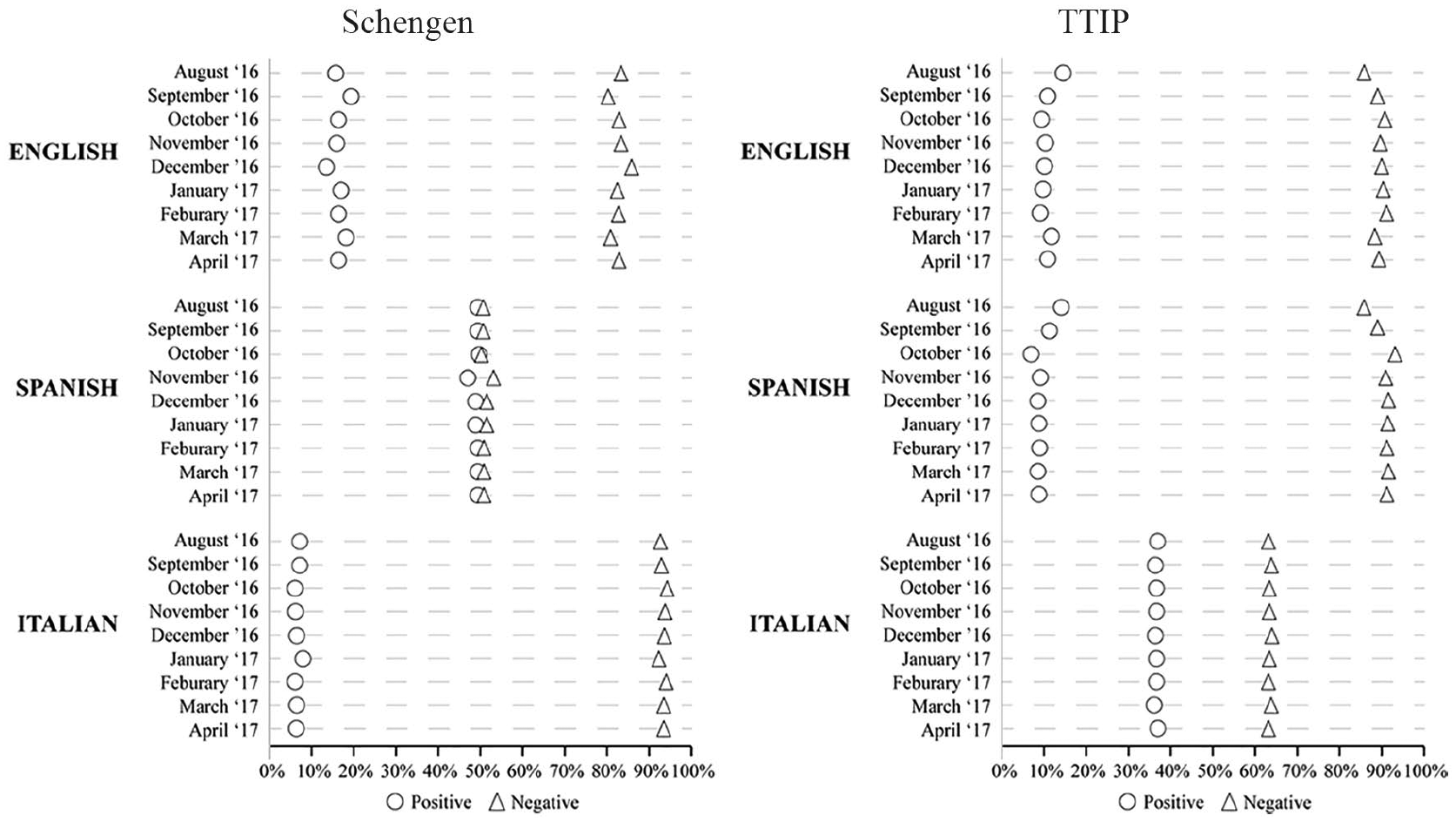
Sentiments toward the issue publics.

Sentiments toward the EU.
As depicted in Figure 1, all six datasets, in all the three languages, conveyed negative sentiments about both Schengen and the TTIP, with no exceptions. The results were close for tweets on Schengen in Spanish, but still reflected the negative sentiment of the majority of users (an average of 51%) toward the issue public. The average results for the entire period of analysis ranged from 63% (for tweets in Italian on the TTIP) to 90.8% (for tweets in Spanish on the TTIP).
Figure 2 depicts sentiments toward the EU. For the Schengen hashtag, the analysis of the English language dataset clearly showed that the majority of Twitter users (an average of 81.8% of tweets) were opposed to the EU project. By contrast, the majority of users writing in Spanish (69.2%) were supportive of the EU, while the results for the Italian dataset were very close, with 50.7% of tweets being in favor of the EU. However, the results obtained for the TTIP hashtag indicated that sentiments toward the EU were positive for the datasets in each of the three languages. As for the Schengen results, Spanish tweets were the most supportive of the EU (82.3%) followed by English tweets (55.3%), with Italian tweets being the least positive toward the EU (51.2%).
If we compare the results of this dimension with the previous (sentiment toward the issue public), we can observe that the tendency is to hold negative sentiment toward the issue, but positive sentiment toward the EU (except Schengen English). However, we have to point the high number of neutral tweets in this respect (see Table 3). In any case, since the interest was focused on those showing negative/positive and pro/against, we considered it more pertinent to focus on this aspect. In addition, the results presented here are recalculated and computed taking out the neutral tweets.
Figure 3 depicts the results for the third dimension, revealing whether the topics under investigation affected Twitter users as citizens at the European or national levels. Overall, in all the six networks, these topics affected users as citizens of Europe rather than as nationals of particular countries. For Schengen, the percentages of Spanish and Italian tweets that reflected a perception of European citizenship were almost identical for Schengen at around 80%.
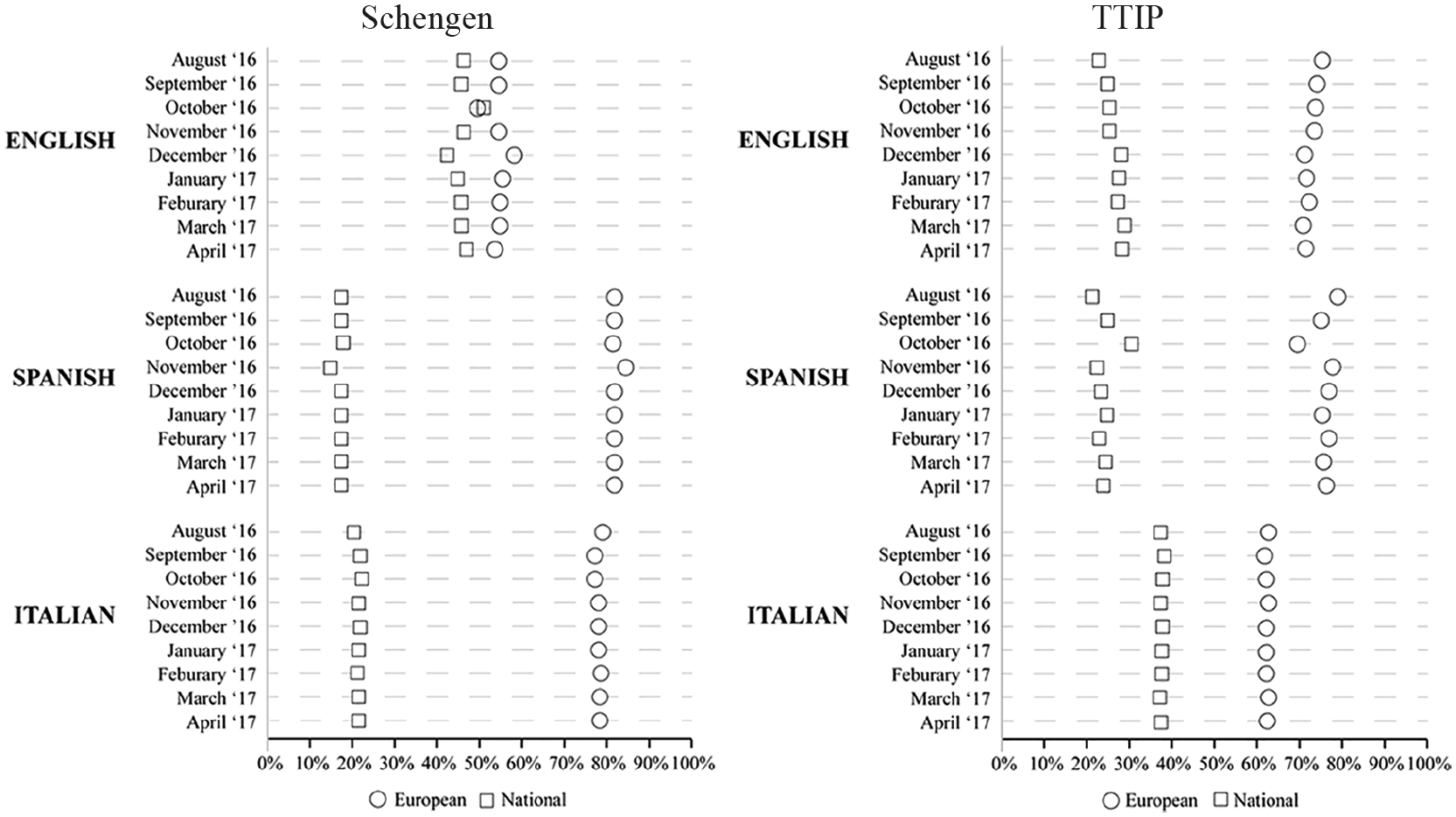
Type of framing: European versus national.
Discussion
Research Question and Hypotheses
In the previous section, we presented the results of applying the iSA algorithm to the content of tweets relating to two hashtags: #schengen and #ttip for three different dimensions and in three different languages. Three main discussion points emerge from these results. The first, which relates to the testing of Hypothesis 1 concerns the type of framing, and the question of how the results relate to the existing literature on the European demos. The second point of discussion, which responds to Hypotheses 2 and 3, concerns sentiments toward the issue publics and the EU, respectively.
First of all, the results provided empirical evidence that these issue publics, expressed in the three languages (English, Spanish, and Italian) affected users who identified as European rather than on the basis of their nationalities. Therefore, a common understanding of these topics, which affected them as a European community, independently of the language spoken, was apparent. When tweeting about these two issue publics (#schengen and #ttip), users referred to themselves as “we Europeans.” This is an important finding because it confirms that users tweeting within these issue publics see themselves as citizens of Europe. Moreover, it confirms that social media data provide another indicator of Europeanization that is different from that obtained from mass media and survey content examined in previous studies on the European demos.
The two Twitter topics were selected and analyzed as topics that affect users who tweeted as Europeans, thus addressing the research question framed for this study and validating Hypothesis 1.
How these issue publics are seen (negatively or positively), and what these users think about the EU (whether they are for or against it) is a second discussion point. The analysis revealed that sentiments toward the issue publics in all languages, and in both issue publics, were negative. This finding is not surprising, as previous studies have shown that when individuals do not like something or want to complain, especially in relation to highly contested political topics, they generally express their opinions easily and freely on social media platforms (Pew Research Center, 2016). The results of this study were in line with the expectations and confirmed Hypothesis 2. The issues examined in this study have generated high degrees of controversy and mobilization and were expected to garner a high volume of negative comments and critics. We would ascribe the close results for Spanish tweets to the polarization of the debate about the provision of asylum for refugees and the Schengen policies in South American countries. There was a significant volume of data generated through tweets in Spanish by South American citizens, talking about Schengen rules, and thereby balancing the score in relation to positive sentiments.
Despite the prevalence of negative sentiments toward Schengen and TTIP, tweets in all the three languages demonstrated remarkably positive sentiments toward and support for the EU. Bad news and negative events, such as economic and political crises, triggered a transcultural public discourse, as reported in previous studies (Fossum & Schlesinger, 2007; Hepp et al., 2016). Accordingly, Hypothesis 3 was confirmed. There was no correlation between negative or very negative sentiments toward Schengen and the TTIP in all the three languages, and sentiments toward the EU, the European project, or European institutions. Despite users’ negative perceptions relating to the two topics under discussion, they still believed in or approved of the EU project, and considered themselves European rather than foregrounding their nationalities, as evidenced by the type of framing they used.
A comparison of the results for both the Schengen and TTIP issue publics revealed that there was very little difference between them. Although scores differed from language to language, both issue publics demonstrated the same three general characteristics: users’ engagement with the topics reflected their perceived impacts on them as Europeans rather than as individuals of particular nationalities; their sentiments toward both topics were negative rather than positive; and in both cases, they demonstrated support for the EU, with the exception of English tweets on Schengen. However, these results have to be put in perspective, as there were large numbers of neutral tweets and retweets. More than half of the content did not reveal any particular opinion relating to the two coded dimensions of sentiment. Such tweets originated from media outlets and headlines that did not convey any kind of opinion about the issue public or the EU. In addition, the large number of retweets could have impacted on the results, which though not unusual on Twitter, skewed the results to one side. For example, hundreds of retweets of a tweet expressing a positive sentiment toward Schengen would result in a positive score using the iSA, as the algorithm considers each tweet/retweet as a separate unit within the dataset. In any case, despite the high number of neutral tweets and retweets, the results can be considered valid because the intention was to capture the signal and overall sentiment.
A European Demos on Twitter
The question that arises is whether a European demos can be discerned on Twitter. An examination of the results clearly shows that for these two hashtags, the results were more aligned with the demoicracy and “European lite identity” models than with the model of a pan-European demos (Fligstein, 2009b; Lacey, 2016; Risse, 2010a). Twitter users do evidently discuss European topics from a European perspective, but it is difficult to ascertain whether they are aware of what is being said in other languages. The Europeanization of national public spheres separated by linguistic bubbles thus appears to be in evidence. Language bubbles, which in this case are Spanish and Italian, appear to be more European than English, which is considered within the literature to be the lingua franca of a pan-European demos bridging different public spheres. In conclusion, what appears to have emerged is a collectivity of individuals (Twitter users) belonging to Europe and not a demos existing beyond and above the nation.
Framed in terms of the concept of a “European lite identity” (Fligstein, 2009a; Risse, 2010c), the results both complement and contradict previous findings in the literature. On one hand, it has been posited that two identities, national and European, can coexist, with the primary one being national and the secondary one being European. On the other hand, the results indicate a reverse order: a European identity is the primary one reflected in the type of framing of the majority of users (see Figure 3), whereas the national identity is secondary. However, we do not know “who the Europeans are.” Fligstein (2008, 2009b) theorized that those who espoused a stronger European identity were generally young, skilled, and educated, belonging to the category of white-collar workers. The extraction of socio-demographic indicators could possibly confirm Fligstein’s theory in relation to the data. This would show whether or not they are the same type of users identified by Fligstein and other scholars as “the Europeans.” However, socio-demographic indicators are not available at this point in time, necessitating reliance on data showing how users perceived these two issue publics: as Europeans or as nationals of individual countries.
Overall, the results of this study indicate that one of the barriers identified as an impediment to the emergence of the EPS in the literature was not found. Three main barriers have been identified in the literature: different languages spoken within Europe, national media that control and filter information to national publics, and different cultures and values within Europe that impede the development of a common sentiment of belonging to Europe (Bohman, 2004; Kaitatzi-Whitlock, 2007; Pérez, 2013). The results of this study revealed that the third barrier (different cultures and values within Europe) was not in evidence. Different cultures and values, at least in relation to the three languages mapped in the study, are not an impediment to Twitter users seeing and recognizing that they are all part of a community and that the topics affect them all as a European community.
These results reinforce the position in the literature that negative comments against the issue publics do not imply a lack of support toward the EU (Fossum & Schlesinger, 2007). Indeed, 41% of Europeans tend to trust the EU, while only 35% trust their national governments (Eurobarometer, 2017b). Therefore, legitimacy issues facing the EU are no worse than those faced by national institutions and governments. It can be the proof to demonstrate that even negative comments against the issue publics can be viewed positively, as in many cases they express demands for a better or different EU: “Another Europe is possible” (Varoufakis, 2016).
From a normative perspective, negative comments toward the EU or the issue publics are constructive. They reveal the will to change the status quo regarding the EU and the issue publics to bring about improvements. Even when the comments were opposed to both the EU and the issue publics, the identity frame with which they were associated was European. This shows that irrespective of whether the comments were positive or negative, they revealed a European perspective, and targeted a European audience. This can be viewed positively in relation to the construction of a European demos from a normative perspective. However, unless such negative perceptions are addressed, they will not be beneficial for Europe in the long term. The rise of Euroscepticism, mainly promoted by right-wing parties, even when framed in a way that target European audiences, can be dangerous for the EU project and can erode its legitimacy.
Nevertheless, the two indicators of sentiment coded in this article say very little by themselves about identity or a European demos. In fact, they have to be taken into consideration with the type of framing (Hypothesis 1). Therefore, Hypotheses 2 and 3 complement/support Hypothesis 1: the type of framing and the expression of the users that the topics affect them as a European community rather than national.
Conclusion
This study complements previous studies on the European demos by applying sentiment analysis, an innovative computational methodology, to analyze the Europeanism of Twitter data comprising discussions on certain European issue publics. In addition, the consideration of three different languages enabled a comparative analysis to be performed, aimed at elucidating the characteristics and configurations of overlapping language bubbles. The analysis has shown that users perceived the impacts of the mapped issue topics, #schengen and #ttip, as European citizens rather than as nationals of individual countries, thus revealing the existence of a European consciousness. In addition, the results showed that a highly critical stance on the topics under discussion was not correlated with criticism directed at the EU or European institutions. From a more practical perspective, the ideal approach would be to avail of the results of the analysis, showing how Twitter users think about certain European issues and policies, to promote and enhance direct conversations among European institutions, citizens, and officials. The results show that the discussions were more aligned with the demoicracy and “European lite identity” models than with the model of a pan-European demos (Fligstein, 2009b; Lacey, 2016; Risse, 2010a) or non-demos thesis.
The research presented here is a first attempt to apply Twitter data and a supervised computational method for assessing the extent to which an EU identity and Europeanization exist and contribute to the emergence of a European demos. To date, studies on the European demos and identity have relied on mass media and survey data. This study demonstrates that social media data, and specifically Twitter data, open up new avenues for investigating the European demos. However, the specificities of Twitter data must be taken into consideration. They are not comparable in scale to data on the general population or even data derived from the Eurobarometer. Issue publics are shaped by the technicalities of networked platforms. Nevertheless, the results of this study on two discussion topics indicate that a sense of European belonging can be fostered through the application of Twitter technology on digital platforms. European institutions need to acquire more experience engaging with grassroots audiences as another source of a European demos.
The study has opened up three new potential avenues for future research. The first entails the inclusion of more languages in future studies. Comparative studies could focus on different languages—and also on different time periods relating to the same languages—analyzed here to advance understanding in this field. Other languages connected with a more Eurosceptic national public opinion (e.g., German, Dutch, or Swedish) could be analyzed, and they could provide new comparative insights. This was not possible in this study, as language proficiency is a required skill for the individual who codes the training set for the algorithm. In this case, my fluency did not extend beyond English, Spanish, and Italian. Future studies could also benefit from comparing located data in the continental Europe and outside Europe in these languages. Although it was argued that the hashtags were taken as chambers of discussion of topics of European relevance independently where the tweets were posted, future studies could explore the possibility of comparing any difference within the languages with geolocate data. This is increasingly relevant in the context of globalized politics.
Nevertheless, the results of this study incorporating these three languages constitute a first step toward developing an understanding of how hashtags of European relevance are discussed and treated by Twitter users. In addition to including more languages, the analysis could be repeated with different sentiment algorithms, as this could provide complementary or different results. Evidently, social scientists need to take advantage of new data sources and methods, especially computational methods.
The second avenue of inquiry relates to developing improved methods for identifying common reference points. This study examined how Twitter users spoke about the two issue publics but did not investigate what they said. Therefore, the application of unsupervised content analysis to attempt to find similar reference points in different languages appears to be feasible. This would significantly contribute to a discussion on the emergence of transnational EPSs through the identification of common topics within the issue publics in different languages. Third, as noted in the “Discussion” section, national events could have affected the scores.
Supplemental Material
Codebook – Supplemental material for Commenting on Political Topics Through Twitter: Is European Politics European?
Supplemental material, Codebook for Commenting on Political Topics Through Twitter: Is European Politics European? by Javier Ruiz-Soler, Luigi Curini and Andrea Ceron in Social Media + Society
Footnotes
Declaration of Conflicting Interests
The author(s) declared no potential conflicts of interest with respect to the research, authorship, and/or publication of this article.
Funding
The author(s) received no financial support for the research, authorship, and/or publication of this article.

Supplemental Material
Supplemental material for this article is available online.
Notes
Author Biographies
References
Supplementary Material
Please find the following supplemental material available below.
For Open Access articles published under a Creative Commons License, all supplemental material carries the same license as the article it is associated with.
For non-Open Access articles published, all supplemental material carries a non-exclusive license, and permission requests for re-use of supplemental material or any part of supplemental material shall be sent directly to the copyright owner as specified in the copyright notice associated with the article.
