




Abstract
Asking whether social media can plausibly facilitate a European public sphere, this article provides the first operationalization and empirical examination of Europeanization of social media communications. It maps the geospatial structure of Twitter activity around Greece’s 2015 bailout negotiations. We find that Twitter activity showed clear signs of Europeanization. Twitter users across Europe tweeted about the bailout negotiations and coalesced around shared grievances. Furthermore, Twitter activity was remarkably transnational in orientation, as users interacted more often with users in other European Union (EU) countries than with domestic ones. As such, social media allowed users to communicate with one another unencumbered by national boundaries, to bring into existence an ad hoc, issue-based European public sphere.
Keywords
Introduction
In this article, we examine whether Twitter can feasibly provide a platform for the emergence of a transnational, European public sphere. Much previous research, focusing almost exclusively on mass media, considered the emergence of such a European public sphere unlikely or even impossible, given that Europe’s diversity of languages, cultures and media systems produce overwhelmingly nationally bounded public discourses. Instead, we focus on social media, which are mostly unconstrained by geography and language. Interest in the ways digital, social, and mobile media are shaping political communication, and transforming public spheres has grown steadily over the past decade (Dahlgren, 2005; Farrell, 2012; Papacharissi, 2002). This article carries this line of enquiry forward in the European context.
Different technologies afford different kinds of connections, and augment different kinds of divisions. For example, geographic and linguistic constraints are hard-wired into broadcast media, favoring communications that are national in scope. Because production of social media content is distributed, diffusion is networked, reception is self-selected, and social media platforms optimize for user experience, some worry that social media may augment ideological polarization as users seek out the like-minded. Yet, these same affordances also unencumber communication from spatial-geographic, temporal, institutional, and linguistic constraints that characterized mass media—social media are inherently cross-border (boyd, 2011; boyd and Crawford, 2012). This is cause for optimism. Social media is said to facilitate communication and the mobilization of opinion across border, especially on issues that elude resolution at the national level (Castells, 2008). As such, social media could plausibly support the emergence of new, transnational collectivities.
To better understand the role of national borders in structuring political communication online, this article provides the first operationalization and empirical exploration of Europeanization of social media communication, by mapping the geospatial nature of Twitter activity around Greece’s 2015 bailout negotiations. Little attention has been paid to the role of political geography in shaping communication on social media. Whether national divisions are amplified or diminished online is of particular interest in the European context. Could social media feasibly provide a platform for the emergence of genuinely transnational public sphere in Europe?
Conceptualizing a European Public Sphere Facilitated Through Social Media
Steadfast divisions between national public spheres, on a continent where political institutions have undergone half a century of supranational integration, has attracted much scholarly attention—particularly as this mismatch is seen to explain some of the European Union’s (EU) democratic deficit. A long-standing view holds that a genuinely transnational, European public sphere is desirable, if not necessary to ensure democratic legitimacy (de Beus, 2010; Koopmans & Pfetsch, 2003). The 2005 constitutional referenda highlighted the need for generating political legitimacy from the bottom up, something, it is hoped, a European public sphere would support.
The initial idea of a persistent, unified European public sphere, akin to national publics and realized through pan-European media, was fast disbanded as distant and unrealistic. Distinct and dissimilar media systems, the national focus of journalism, and Europe’s socio-cultural and linguistic diversity are often thought to make a single unified public sphere unlikely or even impossible (Hallin & Mancini, 2004; Hepp et al., 2016; Latzer & Sauerwein, 2006; Lingenberg, 2009). Instead, Gerhards argued that the Europeanization of national publics was more realistic (Gerhards, 1993, 2000; Gerhards & Neidhardt, 1993), after all the nation remains the primary loci of political allegiance (Golding, 2008; Sifft, Brüggemann, Königslöw, Peters, & Wimmel, 2007). Europeanization takes national public spheres as starting points for the emergence of European publics, and wants to make them more porous to foster interconnections (Heinderyckx, 2015). Following this conceptualization, a European public sphere, emergent through Europeanized public communications, would be more fluid, less unified, less deeply integrated, and less persistent, than its national equivalents.
Generally, Europeanization appears to be event-driven, in that convergence appears to be propelled by European events such as elections, a Europe-wide economic crises (Post & Vollbracht, 2013), the European Parliament’s plenary calendar (Gattermann, 2013), or changes in Euro-zone monetary policy (Koopmans, Erbe, & Meyer, 2010). Nevertheless, previous findings do not amount to conclusive evidence on the Europeanization of national public spheres, or the development of a European public sphere (For an overview see: Bärenreuter, Brüll, Mokre, & Wahl-Jorgensen, 2009; de Vreese, 2007; de Vreese, Banducci, Semetko, & Boomgaarden, 2006). Yet unlike existing research, which focused on mass media, our focus is event or issue-driven Europeanization on social media.
What would the geospatial footprint of an (ad hoc) online community look like if it were to be Europeanized (or even constitute a European online public sphere)? In our case, we examine Twitter, which has been a popular platform for empirical analysis, as it is widely recognized as the second most important social media platform, and because its data are relatively accessible to researchers. Like Europeanization, Twitter activity is mostly event-driven. On Twitter, people communicate through tweets, which also allow users to interact with and address others. Public Twitter profiles also include a field where users can specify their location (tweets can also be geotagged, but this feature is not widely used), allowing us to study what people are tweeting about where—more on which later.
Following Koopmans and Erbe (2004; see also: de Vreese, Peter, & Semetko, 2001; Koopmans & Statham, 2010), we can distinguish between supranational, vertical and horizontal Europeanization (summarized in Table 1). Though all kinds of Europeanization are relevant, some are more salient in the social media context. Vertical Europeanization consists of communicative linkages between the national and the European level, where a distinction is made between bottom-up (e.g., citizens using social media to express grievances about EU politics), and top-down (e.g., EU actors using Twitter to address the European public).
Dimensions of Europeanization on Twitter: How a European Online Public Sphere May Take Shape.

EU: European Union.
In the mass media context, supranational Europeanization refers to increased attention on EU actors or institutions in national debates. Weak horizontal Europeanization refers to increased national media attention on issues or debates in another member state. Taken together, this would require Twitter users in one or more countries to be tweeting about EU politics, and/or issues and events pertaining to other member states. As Europeanization is said to be event driven, we would expect cross-national Twitter activity to align around key European events, such as elections or EU summits (Meijers, 2013; see Table 1).
Most salient to social media, strong horizontal Europeanization refers to direct linkages between actors in two or more EU countries, effectively cross-border conversations. Given the unidirectional nature of (national) mass media, broadcasting only afforded a very truncated form of interaction. Interactivity between users, on the other hand, is the sine qua non of social media. Strong horizontal Europeanization would require pan-European interactions between Twitter users. To develop an operational definition of social media Europeanization, we must ask: What would the network structures of pan-European interactions between social media users look like?
We can adopt a structuralist or connectionist optic to make different kinds of networks visible (Borgatti & Foster, 2003). The more frequently used structuralist approach focuses on the topology through which relevant phenomena could have, and are assumed to occur. Twitter follower networks, for example, are akin to studying road networks along which we assume traffic to flow. Follower networks serve as proxy measure of interaction, as following a user indicates only potential engagement—the link may, after all, be dormant.
Instead of focusing on topology, the connectionist approach focuses on actual instances of interaction/communication between users (Howison, Wiggins, & Crowston, 2011)—akin to counting the actual number of people traveling along a road. Users have the possibility of sending @messages, replying to, retweeting, or quoting someone else’s tweet, thus establishing a clear link, or interaction, between users. These @messages and replies are signs of direct conversational interaction, whereas retweets and quotes indicate “a user’s intention to pass on interesting, controversial, or simply funny information” (Jungherr, 2015, p. 49). D’heer and Verdegem (2014) call these “markers of addressivity,” because tweets embed references to other users or tweets that are being interacted with. Thus, we focus on the geographic structure that underlies linkages between tweets (and the respective users in different EU countries) as first-order evidence of interaction to conceptualize horizontal Europeanization (see Table 1). Although the mere presence of a link between tweets does not necessarily indicate closeness between users, at a minimum it indicates cross-border awareness or endorsement, and at most active discussion and engagement.
Research Objectives
Conceptualizing a European public sphere emergent through networked interactions on social media allows us to move beyond the national analogy, which sees public spheres as stable, linguistically bounded and carried by national media systems, and view it as an evolving and heterogeneous category (van de Steeg, 2002). Our working premise is that, if there is no pan-European discourse, then there can be no pan-European public sphere. And, if there is pan-European discourse, then this can support the idea of a pan-European public sphere. With this study, we aim to examine whether people within the EU are tweeting about European issues (supranational and weak horizontal Europeanization), if they are addressing EU-level politics and possibly being heard (vertical Europeanization), and if users are discussing these issues across national borders (strong horizontal Europeanization, as set out in Table 1). If so, we can speak of the Europeanization of Twitter activity, or possibly even the beginnings of a European Twittersphere. As events of European significance are likely to drive the kind of communication that would constitute a European public sphere, we focus on the 2015 Greek bailout negotiation (explained below) to examine Europeanization of Twitter activity.
Our first research objective (RO1) is to examine whether Twitter users located in different EU countries were tweeting about the bailout negotiations, whether Twitter activity was aligned cross-nationally (supranational and weak horizontal Europeanization), and whether there were any noteworthy instances of users addressing EU policy making (vertical bottom-up). If there were vertical bottom-up instances of Europeanization, did they have any wider impact? Given the interactivity social media affords, we would also expect some strong horizontal Europeanization, namely cross-border interactions between users. Therefore, our second research objective (RO2) is to determine the proportion of cross-border interactions between European Twitter users. If Twitter does play host to an ad hoc European public sphere, we would expect a sizable portion of interactions (for argument’s sake, around 50% or more) to be between users based in different EU countries. If such interactions are indeed prevalent, our third objective (RO3) is to determine which country’s Twitter users are most open or internationally oriented, and which are most central in a European Twittersphere (i.e., which are most Europeanized). In addition, given language constraints of mass-mediated publics, which languages mediate cross-border tweets, what is the “lingua franca” of a European Twittersphere (RO4).
Having set out the article’s aims, we must outline some critical caveats, that we urge the reader to bear in mind. While much empirical research is interested in the public sphere, conceived as persistent, tight-knit communicative networks that provide the communicative and informational basis for collective decision-making—an ideal most frequently associated with the ‘Habermasian public sphere’— available empirical evidence is often one-off and fragmented. Even national public spheres are sometimes said to be less unified than the Habermasian ideal suggest, consisting of many overlapping sphericules (Gitlin, 1998). Empirical evidence is by necessity focused on specific media or communicative phenomena, at particular points of time. Europeanization is usually operationalized longitudinally, such that a series of studies can reveal some persistence (or the ebb and flow) of alignment and similarity in discourse, connections and interactions between national public spheres over time. In the broadcast context, longitudinal studies of reporting in key media outlets made for an obvious research design. Social media activity is by its very nature spiky and effervescent. We can only track activity of specific users or the use of specific terms (that reference real-world events, and thus need to be updated to track ever-changing events), as capturing a global view of all activity is presently not feasible. Furthermore, much social media activity would never be a candidate for Europeanization in the first place (e.g., because it concerns purely local events). Consequently, longitudinal research designs for studying Europeanization of social media, akin to studies of broadcast media, face significant, and as yet unsolved design hurdles.
The present study is one-off in nature too, and does not include a longitudinal dimension. That means that we cannot extrapolate from its limited scope to more persistent phenomena—at best we can claim that event-based Europeanization of Twitter activity can and did occur in a particular instance. Notwithstanding the fact that the kind of event-based Europeanization outlined above seems intuitively plausible (or even trivial), we hope that the empirical evidence we wrangle can add value to the debate. Moreover, it is not clear that the analogy of a persistent, unified, and integrated national public sphere is qualitatively appropriate for understanding transnational online publics, which may be more fluid, less persistent, and less institutionalized. The very concept of a public sphere remains, to an extent, contested. The present study should, therefore, be understood against these caveats.
Empirical Context of the Greek Bailout
As Europeanization of Twitter communication is expected to be event-driven, and our research design depends on event-based data collection, this study focuses on the acrimonious negotiation of Greece’s third bailout in 2015, a series of events of European significance. In 2009, mounting doubts about Greece’s ability to service its debt triggered a series of European sovereign debt crises, and sovereign bailouts. Throughout, the European sovereign debt crisis grabbed headlines around the world (Picard, 2015). It significantly affected the fortunes of many Europeans and required a collective response. Particularly counties within the Eurozone are invariably linked by their common currency and the attendant need to address monetary (and resultant fiscal) problems in concert. Non-Eurozone countries (e.g., the United Kingdom) were also adversely affected by economic malaise within the Eurozone. As others have argued that monetary policy (Koopmans et al., 2010), or a Europe-wide crisis (Post & Vollbracht, 2013) can be drivers of Europeanization, it seems likely that these events may have driven Europeanization of the Twittersphere.
In particular, we focus on a couple of summits between 11 and 13 July 2015 which lead to Greece’s third bailout. Greece’s second bailout was due to expire in 2015, just after the newly elected Syriza government sought to fundamentally change the terms under which the Eurozone, European Commission and IMF provided financial assistance, setting the country on collision course with its European creditors. Initially, Eurozone finance ministers and central bankers negotiated until midnight on Saturday 11 June, when they gave up in failure. They resumed negotiations on Sunday until Eurozone heads of state took over at 4 pm on Sunday and negotiated for a further 17 hr until reaching a last minute compromise. The sovereign debt crisis is often considered one of the most serious challenges the EU faced to date, because it came so close to the involuntary expulsion of one of its members from the common currency (Greece leaving the Eurozone, aka Grexit), which would have toppled the founding assumption that European integration is irreversible and could have fatally undermined confidence in the single currency.
Data and Methods
Some caveats should be borne in mind when working with Twitter data—in particular we must pay attention to how it is created and collected for analysis. Twitter data are not created for research purposes, rather it is the by-product, or trace people leave when interacting through information technologies. As much Twitter activity is event-driven, most Twitter data are a record of users responding to events (Howison et al., 2011). Thus, Twitter data are reflective of certain kinds of communicative activity, and not necessarily of Twitter users in general, or of offline discussions and linkages. For instance, the frequency with which a political party is mentioned on Twitter does not necessarily translate into popularity (Jungherr, 2015). However, as we are not using Twitter to make inferences about offline behavior (e.g., about beliefs, preferences or to detect events), but instead seek to understand whether the geospatial footprint of European Twitter activity displays markers of Europeanization, and whether social media could thus feasibly facilitate a European online public sphere (or Twittersphere), these issues are of limited concern. The public sphere is, after all, a communicative phenomenon, constituted in and through communication, for which physical presence is not necessarily a prerequisite. So, it stands to reason that exchanges and interactions between Twitter users are “real” enough for our purposes, even if, absent a sampling frame for Internet users, we cannot determine how representative these interactions are of society in general.
The Twitter API
Twitter allows researchers and developers to retrieve tweets and associated meta data. However, by default Twitter’s API does not grant unfettered access to its data. The standard search function is limited to Tweets of up to 1 week in age. 1 So search does not allow retrieval of all tweets from the database that match the search query. Twitter also provides a streaming API which we used for this research. The streaming API allows access to a continuous live stream of tweets, but is unforgiving as researchers can get access to past data only with difficulty, forcing researchers to get their tracking parameters right ex ante. This makes it difficult to collect data on ad hoc instances of vertical bottom-up Europeanization (absent advance knowledge). Thus, available tools for data collection require us to make choices about what kind of activity to track. We opted for a text based, rather than geospatial search. Luckily, the design of this study focused on planned events, which allowed us to make most of the streaming API. The selection of filtering/tracking parameters is key, as search terms inevitably introduce selection bias. In addition, casting too wide a net by using broad search terms and filtering once the data are collected is not necessarily feasible. The API is subject to a rate limit which cuts off the stream at 1% of global tweets, such that the tweets returned to our dataset would be truncated if the parameters we track matched more than 1% of all tweets.
While the streaming API does not provide access to past tweets, a workaround is available for some purposes as individual tweets whose unique id is known can be retrieved using the search API. As the raw Twitter data contain the ids of tweets that are retweeted (retweeted_status_id), quoted (quoted_status_id), or to which a given tweet is a reply (in_reply_to_status_id), we made use of this technique to retrieve tweets that were referred to in the tweets that matched our filtering criteria but that did not themselves match the parameters. It stands to reason that if these messages are referenced in an interaction that can be associated with the bailout negotiations, they have been sent as a reaction or response to the event. We used python’s tweepy and Twitter libraries, and custom scripts to collect and process the data, that we stored in a SQL database. 2 We used the R statistical package for our analysis.
Data Collection and Processing
Between 11 and 13 July 2015, we collected all tweets containing at least one of the following words: eurogroup, eurogruppe, eurogrupo, eurogruppo, eurogroupe, eurozone, grexit, and eurosummit, without limiting ourselves to hashtags. 3 Eurogroup is the meeting of Eurozone finance ministers, Eurosummit the meeting of heads of state (both of which were involved in the bailout summits). The terms we tracked were refined through piloting in a number of languages during previous EU summits. During piloting, we included a broader set of terms and languages, but found that doing so did not meaningfully increase the amount of data we collected, because terms such as Eurogroup or Grexit are used in many languages, and because many users across Europe use transliterations. While our search terms are as neutral as possible, we did not track Greek-language terms, because piloting revealed these to return many tweets unrelated to the events we were tracking. This may potentially bias our sample toward more internationally oriented Greek users. Nevertheless, our dataset also contains a considerable number of Greek-language tweets (often including transliterations, and because the API does not only match our search terms against tweet content but also against metadata such as expanded URLs). For instance, many Greek tweets include references to “Grexit” or “Eurogroup,” or shared English news stories about Grexit (such as Paul Krugman’s columns). Furthermore, our random sample provides a representative set of tweets for comparison and benchmarking (see next paragraph). A parsimonious approach that balanced restrictiveness of search terms and likelihood of a matching tweet being related to the event needed to be found, to avoid hitting the API’s rate limit. More generic search terms such as “Greece” or “Euro” would have yielded too many irrelevant tweets (e.g., while piloting data collection, “bots” tweeting about holiday offers in Greece dominated the sample). These limitations represent inherent trade-offs when working with Twitter data. As with most comparable research, the ideal design would build on unfettered access to all tweets. In practice, researchers need to work within the constraints of Twitter’s API.
Between noon of the 11 and noon of the 13 June 2015, we collected a total of 583,244 tweets, which serendipitously included many tweets using the hashtag #ThisIsACoup (see Results). Where those tweets were marked as retweets, replies to, or quotes of specific other tweets, we collected those “parent” tweets as well yielding a total of 703,423. A random sample of 1,000 tweets was drawn from our dataset, and manually coded to ensure that most tweets collected via the search terms were genuine and related to the events in question (94% of coded tweets were indeed related to the bailout negotiations). In addition, we downloaded a random sample of tweets during a 48-hr period using the sample endpoint of Twitter’s streaming API, which allows users access to approximately 1% of the total volume of all tweets (roughly 5 m tweets per day). The random sample is required as a benchmark for comparing our filtered data set collected during the summit, with the volume of national Twitter activity we may ordinarily expect.
Location Data Matching
While some users geotag their tweets, most do not. 4 However, many users specify a location in their profile. And while users can enter any text, most use actual locations (Hecht, Hong, Suh, & Chi, 2011). There are several methods for inferring location data from user profiles and tweets. We used a combination of Google and Bing’s geocoding services to infer quantitative location data from toponyms in user-specified location fields. Feeding each user’s toponym into the geocode APIs, these return (possibly approximate) longitude and latitude. We discarded all those tweets for which Google and Bing returned different country level location information or for which locations could not be resolved. Location data are not available for every tweet—of 703,423 tweets, 330,714 contain a useable location. After matching each of these to the country of origin, we retained 250,157 tweets originating from users that had specified a location in a EU country.
As we are interested in the European geography of Twitter activity and interaction, inferring location information at country level provides sufficient granularity for our purpose. Inferring country-level location, rather than city or address, appears to be fairly accurate (Graham, Hale, & Gaffney, 2014). Using Yahoo and Bing’s geocoding APIs, Kulshrestha, Kooti, Nikravesh, and Gummadi (2012) report that countries were identified correctly 94.7% of times in their sample.
Analysis
To examine RO1, we plot a frequency distribution of tweets by country of origin, which provides a useful impression of the amount of Twitter activity surrounding the bailout negotiations, and allows us to visualize the cross-national alignment of activity. To benchmark the amount of activity relative to what we may ordinarily expect, we compare our bailout sample with our random sample. Given the absence of a sampling frame, and the difficulty of gaining reliable information on the number of active Twitter users in different EU countries, such comparative approaches offer the best way of gaining an impression of the significance of the observed phenomena. Furthermore, to comprehensively study vertical Europeanization would require identifying all users in our dataset to determine who was interacting with whom, which is currently not feasible given limitations of available data. Therefore, we relied on scanning our data for pronounced, ad hoc, instances of vertical Europeanization serendipitously captured in our data, to explore some micro instances of pronounced engagement with EU officials (vertical top-down), or European Twitter users addressing the European political process (vertical bottom-up Europeanization).
Cross-border interactions are those where a tweet from a user in one country is retweeted, quoted, or replied to by a user in another country, or where an @message is addressed to a user in a different country. For each tweet that is a retweet, reply, quote, or @message we take the four coordinates belonging to the author’s and addressee’s user accounts to geospatially map the interactions. This allows us to determine the proportion of cross-border interactions in bailout related Twitter activity (RO2). Each cross-border interaction either imports a tweet (by retweeting, quoting, or replying to a tweet from elsewhere) or exports a tweet (by sending an @message, being retweeted, quoted or replied to elsewhere) (Kulshrestha et al., 2012). We then aggregate incoming and outgoing interactions to the country level (we are not concerned with interactions at the user-level), to map incoming and outgoing Twitter interaction between users from different countries.

To examine which countries’ Twitter users are most internationally oriented (RO3)—which are most Europeanised or transnational—we calculated E-I indices to determine how internally or externally oriented national Twitter users are (Krackhardt & Stern, 1988). Extending the Export/Import analogy, we calculate two E-I indices for each country, one for tweets exported (i.e., the number of times a tweet was interacted with abroad) and another for openness to tweets from elsewhere (i.e., the number of times domestic users interact with tweets from abroad). E-I indices provide a normalized measure between +1 and -1 as explained in Table 2.
Interpreting the E-I Index.

The way in which we collected our data does not permit us to make claims about languages used other than the ones we searched for. However, if we focus on a subset of cross-border tweets that contain the (universally used) term Grexit, we can make claims about other countries as well, to ascertain which languages are used in cross-border interactions (RO4).
Results
Twitter Attention on the Negotiations and Vertical Europeanization (RO1)
Users from across Europe tweeted about the bailout negotiations. Plotting all tweets in our dataset, we get a clear sense of the way attention ebbed and flowed, and how the attention cycle is driven by sub-events (Figures 1 and 2). Indeed, Bruns and Stieglitz (2013) note that Twitter acts as a “backchannel for live events” (p. 100), following their choreography. In our data, while tweets can be seen to be driven by day and night time in Europe, the periods of greatest activity are clearly linked to the events unfolding in Brussels—in line with other results on Europeanization of mass media. In the early morning hours of the 12 July, Twitter activity sharply diminishes shortly after Finnish Minister of Finance Alex Stubb tweets “End of #Eurogroup session. To be continued tomorrow.”

Tweets on the Grexit summit compared to typical Twitter activity (based on our random sample).

Tweets on the Grexit summit by country of origin (annotated with key sub-events).
A noteworthy sub-event that we serendipitously captured in our data, and which provides a powerful example of bottom-up vertical Europeanization, emerged around reports that the German Finance Ministry had prepared a paper detailing the option of a Grexit, which were met with a flurry of activity that, after initially dying down, reignited once MEP Sven Giegold issued tweets linking to the proposal. The German paper sparked upheaval on Twitter as anti-austerity protesters rapidly coalesced around the hashtag #ThisIsACoup, to express the view that the bailout process was usurping Greek democracy (Hänska and Bauchowitz, 2018). The hashtag #ThisIsACoup was conceived by a group of Spanish activists and first used by a physics teacher from Barcelona at 6:01 pm. But it did not gain wider European traction until Barcelona’s mayor Ada Colau used the hashtag an hour later at 7:02 pm (Ulrich & Schulz, 2015). Colau effectively brokered the connection between Spanish and European Twitter networks, allowing the hashtag to spread beyond Spain. It was then fervently taken up in Greece: In the early morning of the 13 July, 50% of tweets collected from Greece contain #ThisIsACoup. The first use of the hashtag in Spain is also captured in Figure 3. Other researchers have reported that the hashtag was used over 600,000 times by over 140,000 users globally, and was viewed over 1 billion times (Ahmed, 2016). By coalescing people from across Europe with misgivings about the bailout process, the hashtag opened up a pan-European communication space for citizens to express their grievances, and contest the bailout process. Indeed, this instance of vertical bottom-up Europeanization had significant impact on wider public discourse. A powerful example of cross-media agenda-setting, #ThisIsACoup’s message reached far beyond social media. Over 700 newspaper articles globally, including in German, Greek and British newspapers, reported on this online protest against the terms of the Greek bailout. This pan-European instance of online activism, which we serendipitously captured in our data, demonstrates the effect that Europeanised social media communication can have on wider public discourse (for a detailed account of #ThisIsACoup see: Hänska and Bauchowitz, 2018).

#ThisIsACoup trending during the summit from 12 to 13 July, and first emerging in Spain.
On Monday, 13 July, at 8:55 local time, the account of EU Council President Donald Tusk tweeted, EuroSummit has unanimously reached agreement. All ready to go for ESM programme for #Greece with serious reforms & financial support.
Tusk’s tweet was retweeted 6,000 times all across Europe, and following his tweet activity is at its highest—between 9 am and 10 am we collected 43,391 tweets. Though not particularly surprising, Tusk’s tweet (and the aforementioned tweet by Alex Stubb) serves as an example of top-down vertical Europeanization—of a EU official using social media to communicate. Figures 2 and 3 clearly demonstrate the cross-national alignment of Twitter activity, especially around key events such as the conclusion of each round of negotiation, and the emergence of #ThisIsACoup.
To get a sense of how much users in different countries tweeted about the Grexit negotiations, we compare relative volumes of tweets in our bailout data with our random sample, as a workaround for the absence of information on total users in each EU country. This gives us a sense of which country’s Twitter users were particularly active compared to what one may expect (see Figure 4). Greek, Belgian, German, Italian and Dutch Twitter users were especially active, suggesting that the bailout negotiations were of particular interest to users there. French, Portuguese, Spanish and UK users were less active, relative to what may be expected. Perhaps unsurprisingly, given the incredible importance of the issue to the country, Greek users were most active.

How much do users in different countries tweet about the bailout negotiations, compared to how much they normally tweet?
Cross-Border Interactions (RO2)
As noted, it seems likely that national boundaries are more porous on Twitter than they are for broadcast media, something that we capture through interactions (retweets, replies, quotes, or @messages). Noticeably, most tweets in our dataset are retweets. We map all cross-border interactions in our dataset in Figure 5, breaking them down by country and presenting domestic and pan-European interactions side-by-side. Pan-European interactions are further split into incoming (openness to tweets from abroad, captured by the number of tweets imported by retweeting, quoting, or replying to a tweet from elsewhere in the EU) and outgoing interactions (how many tweets are exported by sending an @message, being retweeted, quoted or replied to elsewhere in the EU).

International (incoming and outgoing) versus domestic Twitter interactions, showing Belgium as significant exporter (countries with >1,000 interactions).
As is apparent from Figure 5 over half of all interactions for all countries (except France) are cross-border, meaning that national boundaries do not appear to play a significant role in Twitter communications about the bailout negotiations. For a majority of countries less than 25% of interactions are domestic. It should be noted, however, that we are only able to trace actual interactions, not all communication flows (many people across the continent will have viewed tweets in our dataset without interacting with them). The chord diagram in Figure 6 plots the interactions among users between and within different EU countries, showing directionality: for instance, that Belgian tweets (in yellow) are interacted with frequently in most other countries. Overall, cross-border interactions on Twitter clearly demonstrate significant horizontal Europeanization of bailout-related Twitter activity. This offers compelling evidence that social media can facilitate an ad hoc, issue-based European online public sphere, where public communication is unconstrained by national boundaries.

Directionality of cross-border Twitter interactions.
Openness, or Europeanization of National Twitterspheres (RO3)
The E-I index in Figure 7 offers a sense of which countries’ users are most open or Europeanised in their interactions, and which are most “central” in a European online public sphere (see Table 2 for an explanation how to interpret the E-I indices). Countries whose users interact more with tweets from elsewhere are more open. A country that is interacted with frequently abroad is more central in the European online public sphere. Austrian Twitter users, for instance, are remarkably open to tweets from abroad, while Belgium is remarkably central as its tweets are interacted with frequently abroad (presumably because of the press corps reporting from Brussels, see also Figure 6). In contrast, French Twitter users engage less regularly with users in other EU countries. Overall, a majority have a positive E-I value, indicating the preponderance of external interactions.

E-I indices (countries with >1,000 interactions).
To examine the lingua franca of transnational communication on Twitter (RO4), Figure 8 breaks down the language composition of cross-border tweets by origin. It is notable, but perhaps unsurprising, that those tweets that travel across borders are predominantly in English. Nevertheless, while the lingua franca of this ad hoc, issue-based European Twittersphere appears to be English, many cross-border tweets are also mediated in other languages.
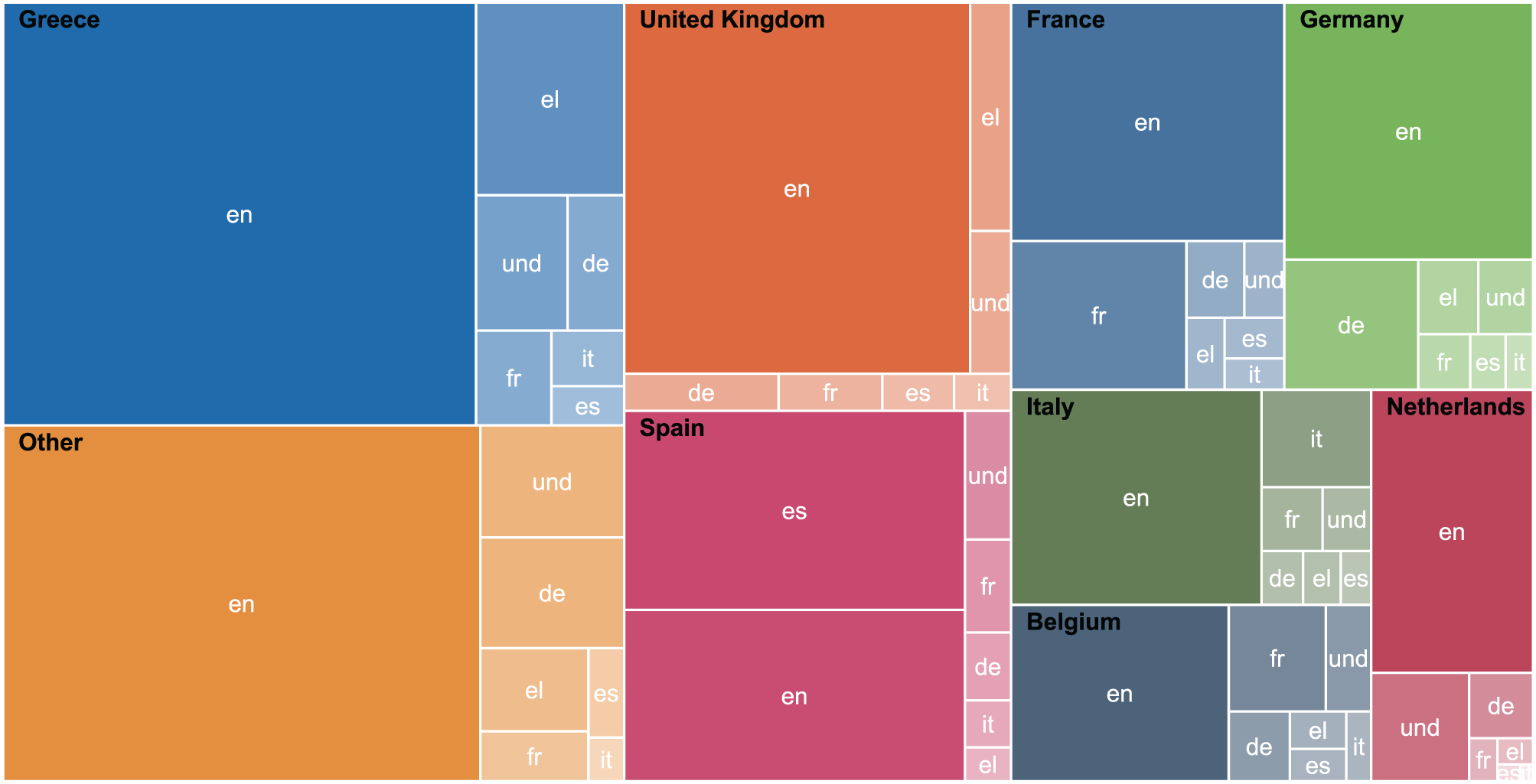
Language of tweets retweeted elsewhere in the EU, by country of origin.
Discussion and Conclusion
Building on theories of Europeanization, this article provided the first systematic empirical operationalization and examination of an ad hoc, issue-based European online public sphere. Setting itself the task of examining Europeanization of Twitter activity, we found that users from across the continent tweeted about the bailout negotiations, and that their activity aligned cross-nationally, following the choreography of sub-events (RO1), thus providing evidence of supranational and weak horizontal Europeanization. In #ThisIsACoup we happened upon a noteworthy instance of users addressing EU policy making (vertical bottom-up Europeanization). The hashtag coalesced anti-austerity protesters around Europe, giving rise to an ad hoc transnational space for contestation. The fact that #ThisIsACoup gained significant attention in the European press, demonstrates the impact this kind of pan-European online activism can have on wider public discourse. Perhaps most significantly, and in stark contrast to broadcast media, national boundaries and linguistic constraints do not appear to encumber social media communications, with more than half of all interactions crossing borders (strong horizontal Europeanization—RO2). To quantify transnationality, we used E-I indices to measure openness and centrality of national Twitterspheres, determining that Austrian users are most open, and Belgians most central. Furthermore, over half of all interactions were transnational, so that we may describe the observed twitter communications as effectively borderless (RO3). The lingua franca of these exchanges was English (RO4).
Users tweeting about the Greek bailout negotiations brought into existence an ad hoc trans-national European communication space that displayed hallmarks of vertical, horizontal and supranational Europeanization—following our repurposing of Koopman and Erbe’s (2004) definitions. This lends credence to the argument that social media is inherently transnational and borderless in scope, and therefore able to diminish the constraints national borders placed on (mass-mediated) public communication. Overall, this result supports the idea of a pan-European public sphere.
While social media can feasibly facilitate transnational, ad hoc issue-based European public spheres, this remains a one-off study focused on a time-limited event of significant importance. Whether transnational communicative patterns have the depth, breadth, and persistence, that we have come to associate with national or local public spheres, remains to be seen. Might these patterns, observed during a large-scale critical event, continue to any extent during normal times? Would the same proportion of cross border interactions persist more generally, were we to examine social media discussions around other European issues (i.e., not purely local issues, but those that we may expect to be of pan-European relevance) and other European events in a longitudinal study? The extent to which social media communication more generally is Europeanised, and whether we could speak of a European online public sphere (beyond the emergence of narrow, event-based communication spaces), remains an open question. As with all research, the scope of this study is limited, and leaves many important questions unanswered.
To gain a more comprehensive picture, future research should address these questions. Above all, it would be valuable to examine the transnational geography of social media communication in different cases, to discover whether the same level of transnational interconnection is reproduced in other instances, and whether particular kinds of political issues or events lead to more Europeanised twitter activity or even catalyze transnational online publics (e.g., European Elections, trade agreements, or the refugee crisis). A longitudinal study of the Europeanization of social media communication would significantly strengthen the evidence needed to assess the nature of transnational online publics. The users participating in such transnational communications should also be studied, to understand whether these are elite or more inclusive phenomena. Finally, our study focused on the structure of communicative linkages, rather than the content of these communications. To provide a more complete understanding of the Europeanization of online communication would require insight into the nature of its discourse.
The study of additional cases, users, and the content of transnational online communications, would augment our understanding of transnational online publics, and stimulate efforts to rethink public sphere concepts for the age of networked, participatory online communications. For instance, are assumptions of inclusiveness, efficacy, continuity and persistence, boundedness, and unity (i.e., a single public rather than multiple sphericules that often inform thinking about mass mediated public spheres, still appropriate? Can these conceptual parameters help us make sense of contemporary, transnational communicative phenomena?
Consider the contrast between the assumption of continuity and persistence of public spheres, and the spontaneous emergence of issue- or event-based publics. In this study, we focused on event-driven Europeanization, and thus the kind of publics that emerge spontaneously around a particular issue. These can generate spikes of activity, but not the kind of institutional depth and persistence that are needed to have a long-term impact on political institutions. After all, one-off emergences are unlikely to force long-term state-responsiveness to public concerns. The kind of publics that emerge through networked communications on large media platforms may well be very different to the persistent, unified and deeply integrated publics that mass media, and mass participation in unions, political parties, and other social organizations, brought about. Social media afford spontaneous, event-driven communications and linkages with distinct geo-spatial footprints, the nature and consequence of which we are only beginning to understand. The very mode of political participation may be shifting from patterns of collective- to practices of connective-action, in which participation is short-lived, issue based, and does not require deeper ideological or personal commitment to an organization (Bennett & Segerberg, 2012). Perhaps we need to follow van de Steeg (2002), to conceptualize the public sphere as an evolving and heterogeneous category. In short, some basic assumptions about the public sphere may need to be reconsidered. Maybe it is only by the light of a revised conceptual toolkit that the quality and functioning of transnational, ad hoc, online public spheres, can be fully understood.
Footnotes
Declaration of Conflicting Interests
The author(s) declared no potential conflicts of interest with respect to the research, authorship, and/or publication of this article.
Funding
The author(s) received no financial support for the research, authorship, and/or publication of this article.
