



Abstract
In 2015, a series of memes appeared on Twitter under the hashtag #HumanitarianStarWars. Combining still images from the original Star Wars movies with ironic references to humanitarian/development jargon and institutions, the memes presented a humorous reflection on the modern aid industry. While memetic content has become an increasingly scrutinized area in digital culture studies—particularly with regard to unbounded and anonymous online communities, and popular discursive contestation—this article examines #HumanitarianStarWars to shed light on the possibilities and problematics of social media auto-critique undertaken by “insiders” in a particular professional realm. Keeping in mind critiques of the racial and imperial connotations of the (Western) pop-culture mythology itself, the article explores the use of the Star Wars franchise as a vehicle for commentary on an industry at work in the “Global South.” It highlights an ambiguous process of meaning-making that can be traced through the memes’ generation, circulation, and re-mediation. Although the memes provide a satirical self-reflection on practitioners’ experiences and perspectives of power relations in the global development industry, certain tendencies emerge in their remixing of this Hollywood universe that may reinforce some of the dynamics that they ostensibly critique. The article argues that examination of the ideological ambivalence of an institutional micro-meme can yield valuable insights into tensions playing out in professional social media spaces where public/private boundaries are increasingly and irrevocably blurred.
Always some white boy gotta invoke the Holy Trilogy. Bust this: those movies are about how the white man keeps the brother man down—even in a galaxy far, far away . . .
In 2015, a series of memes coalescing around the #HumanitarianStarWars (hereafter #HSW) hashtag garnered a modest amount of attention in media and professional forums associated with the aid industry. Pairing iconic still images from the original Star Wars film trilogy with ironic NGO jargon-laden captions, the memes satirized some of the power relations, absurdities, paradoxes, and juxtapositions that critical development studies scholars have been exploring in the industry for decades. The memes humorously critiqued the neo-colonial roots of militarized humanitarianism and the power of language to create hierarchies of the benevolent and the “beneficiary.” They also highlighted the bureaucratic constraints of the sector and some of the more prosaic grumbles of development/humanitarian professionals “in the field.”
This article argues that complex and context-dependent ambiguities of satire can be productively analyzed by engaging with theories of the comedic media genre in question: the digital meme. Whereas much literature on memetic production, remixing, and dissemination has focused on massive, anonymous, and unbounded “Internet communities,” #HSW provides a novel example of memetic communication within a “participatory culture” (Jenkins, 2012) that is relatively identifiable and linked to a particular real-world industry. We have a fairly clear idea of who the participants are in this game of memes because of their literacy in Western popular culture, their use of particular forums, and their obvious familiarity with aid, development, and humanitarian jargon. This is not an “Internet culture” per se, but a “professional” culture—people letting off steam through a memetic auto-critique of the work they do or are implicated in.
The #HSW meme was fairly short lived, and all of the 38 distinct creations linked to this (that the author has identified) were generated by social media users in 2015. The majority of these memes were “image macros” (Wiggins & Bowers, 2015), with a smaller number of Tweets without pictures. This article reflects on trends identifiable within this limited number of texts and analyzes the content and discourse of a selection of these memes. Compared to the billions of views and (potentially) millions of remixes identified for other viral memes (see Soha & McDowell, 2016), the quantity of digital engagement with #HSW seems insignificant, hence my description of it as a “micro” meme. Nonetheless, I argue that a focus on ideological ambiguities reflected in this form of professional communication can be highly instructive, particularly when we can identify specialist media coverage of the trend (Banning-Lover, 2015), and the engagement of social media accounts of “official” institutions—in this case, governmental and non-governmental development organizations. In “getting” (or apparently not getting) the joke, and using the meme to communicate about their work, these institutions re-appropriated and further adapted the non-official labor of industry staff. This exemplifies the blurring of professional/private boundaries that characterizes social media culture in general (Lange, 2007) and intersects with wider changes in patterns and discourses of humanitarian communications that have been precipitated by the development and increased ubiquity of new media technologies.
Participation in the meme reveals the existence of particular discourses and communities within the aid industry. Kanai’s (2016) study of “spectatorial girlfriendship,” in relation to GIF memes on Tumblr, demonstrates how jokes privilege “ideal readers” who are able to read into memes particular assumptions—in her case study those grounded in neoliberal, post-feminist, and post-race subjectivities (p. 6). Examination of #HSW illustrates the emergence of another particular “readerly lens,” in this case characterized by participants’ familiarity with abstracting institutional jargon, and ambiguously articulated postures toward dynamics of power and race in their industry. This article thus responds to Kanai’s (2016) suggestion that future studies of memetic meaning-making examine “how literacy is demonstrated by followers through their individuated adaptations [of memes]” (p. 6). Despite its relatively small scale, the meme represents a complex and multifaceted “assemblage” (Deleuze & Guattari, 1988; Frazer & Carlson, 2017) of intertextual meaning-making among (Western) professionals in an important industry that engages (sometimes controversially) with people around the globe, but often primarily in the “Global South.” With this in mind, the discourses and narratives generated in this process are worthy of critical analysis.
As a White, Western, ex-humanitarian professional and current academic working on related topics, I include myself within the category of institutional “insider” that I identify as being associated with the production of this meme. Indeed, my exposure to #HSW came as a result of my experience in the humanitarian industry, and later in the academic fields of development studies and African studies. Involvement in related (social media) networks meant that I came across the memes, and I started using them as teaching aids to introduce particular topics and theories in a postgraduate “development management” module I was convening at the time (e.g. Figure 1). Much of the content analysis undertaken in the latter parts of this article grew out of self-reflection on this use of the memes as teaching aids, and my interrogation of the messages and underlying assumptions that could potentially be “decoded” (Hall, 2001) from them by students from diverse professional and cultural backgrounds.
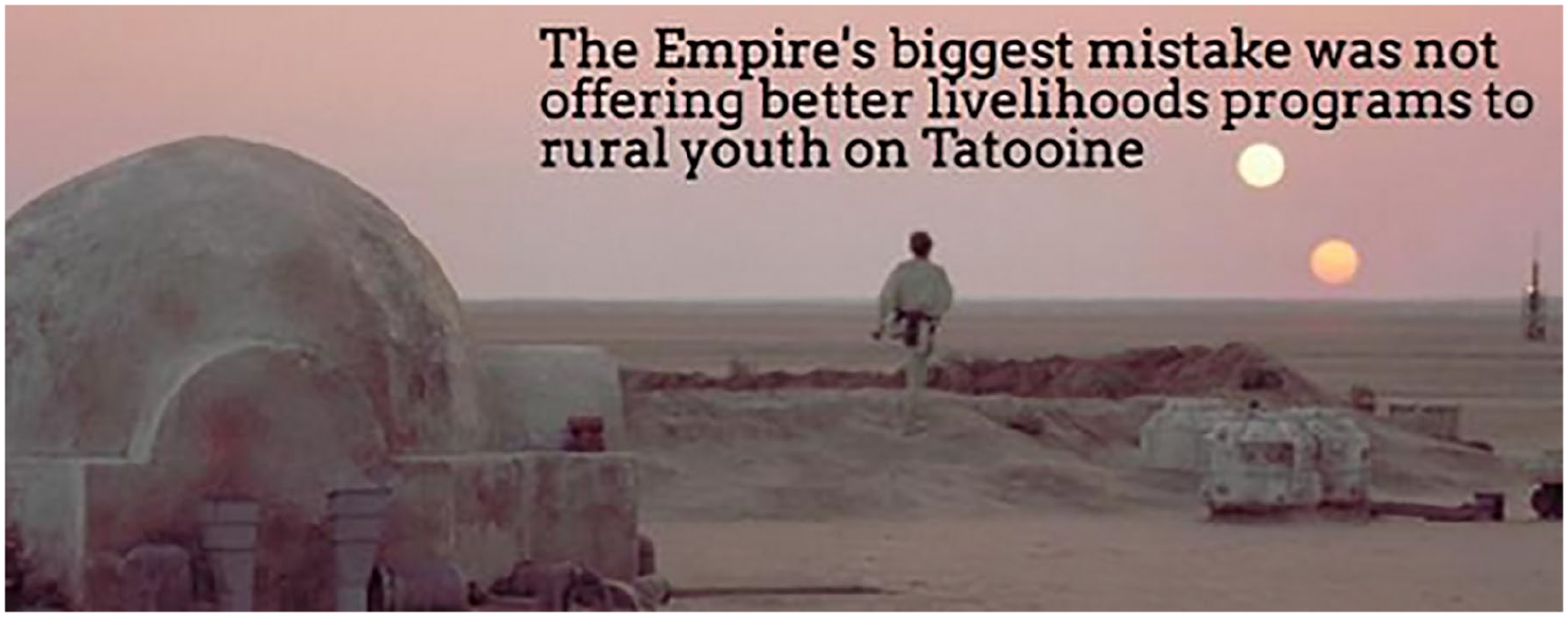
#HumanitarianStarWars image macro meme.
The article undertakes its examination of #HSW as a distinctive auto-critical meme in the following steps. I first survey definitions and theorizations of Internet memes that highlight and debate the role of ideology in online spaces. To begin to explore apparent ideological ambivalence in the #HSW case study, I then examine the particular participatory culture within which this meme emerged. In identifying a specific professional participatory culture of meme generation, I illustrate an apparent divergence from theories that have tended to focus either on unbounded and anonymous “Internet cultures” or socially marginalized groups. As such, I contribute to existing theories on meme practices by highlighting what auto-critical memetic culture can help us understand about professional spaces where private/public boundaries are increasingly blurred. Here I outline Chouliaraki’s discussion of “post-humanitarian” communications in the social media age (Chouliaraki, 2010) and adapt her conceptualization of the “ironic spectator” (Chouliaraki, 2013) to account for ways in which individuals within the aid industry position themselves through these memes. I argue that these institutional texts reflect tensions within the industry on various discursive levels. This is demonstrated in the final two sections through analysis of examples of the hashtag/meme: first, focusing on the ways in which the Star Wars metaphor provides a vehicle for an apparently anti-imperialistic self-reflection on the industry, and then considering existing film studies literature on Star Wars to probe deeper connotations that can be read in the application of this particular mythology for parodying this specific industry.
This article seeks to both unpack and critically engage with this mode of satire. Leaving aside the fact that the best way to “kill” a joke is to analytically dissect it, I am interested in exploring the underlying tensions that make the memes (potentially) funny. Reading this critique, however, is not entirely straightforward. Star Wars mythology is about empire and resistance, so, on one hand, the use of this visual backdrop speaks to long-standing critiques of the aid industry in reinforcing global inequalities and participating in forms of neo-colonialism. Having said this, the Star Wars mythology—as a Western cultural behemoth in of itself—has been interpreted through the lens of the racialization of alien species and tropes of White supremacy. Hooper X’s (fictional) movie polemic—quoted at the beginning of the article—can be read alongside academic film studies critique that examines the merits of these arguments (Howe, 2012; Wetmore, 2017). As such, I interrogate here whether the use of these images of alien worlds and civilizations to parody aid workers and humanitarian action serves to satirize imperialistic trends of global governance, or instead reflects implicit worldviews of the meme producers themselves—dehumanizing and alienating the people they work “for,” and the (Global South) contexts they work in.
Internet Memes and Ideology
The concept of the meme was first coined in 1976 by biologist Richard Dawkins as part of his broader theorization of cultural evolution. For Dawkins, a meme constituted a distinct “cultural unit”—such as behavior, a part of speech, a form of dress, a concept (e.g., “God”)—that is passed on in human society and that is replicated over time through transmission, mimesis, and adaptation. In the Internet age, this conception of memetic content and behavior has been seized upon by communications scholars to theorize the various ways “semantic units” and “design worth copying” (Pelletier-Gagnon & Pérez Trujillo Diniz, 2018, p. 2) are disseminated, remixed (and potentially) subverted through online communities.
Far from remaining an abstract analytical concept, the term has entered popular culture with creators of digital content explicitly referring to such images, videos, animations, catchphrases, and #hashtags as memes. Online cultures are awash with a vast quantity of memetic behavior and production. However, only a tiny percentage of memes will “go viral” (a phrase that itself harks back to Dawkins’s original biological metaphor) through the sharing behavior of users and the platform or search engine algorithms that facilitate such spread (Knobel & Lankshear, 2007). As such, Shifman (2013) points out that the concept of the meme has moved from academic into popular discourse, and then back again, as “new media” scholars attempt to conceptualize the nature and importance of this type of mass communicative culture and its social, political, and economic impacts.
Figure 2 illustrates the journey of the concept, and its recursive, self-referential capacity. It also provides an example of one particular type of online meme: the “image macro” (Wiggins & Bowers, 2015). Such memes usually feature a still image from popular culture paired with a satirical, ironic, incongruous, outrageous, or absurd caption. Often, image macro memes set up the joke in the top line, and feature an image that “baits” the reader into a biased expectation and then “switches” with the apparently incongruous (and thus funny) punchline. The “successful Black man” image macro meme below (and its White variant) are examples of how this tactic can be used to ostensibly subvert racial stereotypes (Figure 3a and b).

Image macro meme featuring Richard Dawkins.

Two variants of ‘bait and switch’ image macro memes.
One could say “ostensibly” because the ideological intent of the creator cannot necessarily be inferred, and it may remain an open question as to the extent to which such memes challenge through satire—or reproduce through repetition—the stereotypes that the joke relies upon. The ability (and disposition) of audiences to “decode” this material (Hall, 2001) remains important here, but this is complicated by the anonymity of the “produsers” (producer/users: Bruns, 2008) and the opaqueness of environments of production and dissemination.
Ambiguities of satire become salient in certain social media environments that—some would argue—are characterized by the use of humor to bring otherwise unacceptable racist or misogynist content into mainstream discourse. Discussion boards such as 4chan or Reddit have provided fertile ground for anonymized memetic humor, as well as some of the more toxic subcultures of racist and misogynistic discourse that either generate or appropriate memes themselves (Massanari, 2017). Furthermore, when memes “go viral” they penetrate wider online spaces and attract ever more radical remixing and subversion. Pelletier-Gagnon and Pérez Trujillo Diniz’s (2018) study of the (in)famous “Pepe the Frog” image charts this meme’s online evolution: from the appropriation of an obscure comic book character and the appendage of innocuous taglines, to its “colonisation” as vehicle for “alt-right” racism and a subsequent campaign by the original artist either to reclaim the message or kill off the memetic character completely.
In increasingly polarized online environments, while one audience member may decode content as parody, another may take the extreme viewpoint expressed at face value. Cumulative algorithmic effects of user engagement (irrespective of one’s “decoding” or “getting” of the joke) define what goes viral and enters a mainstream of pop-culture discussion and further remixing. Such ambiguities of meme practice contribute to a “post-truth” political climate in which former taboos become expressible and legitimize new types of political agency and entrepreneurship highly sensitive to the communicative dynamics of social media (Tait, 2017). The Trump presidency is, of course, the archetype product of (and producer in) this emergent information environment. Indeed, some media scholars draw explicit links between memetic communication in “toxic” cyber-cultures, and the rise of the “alt-right” and the related electoral success of the celebrity-entrepreneur President (Massanari, 2017; Vaidhyanathan, 2018).
These new objects of study for meme scholars illustrate how research has moved beyond an earlier primary focus on “progressive” political communication, and now often highlight the ideological ambiguities of the publics within which meme generation, engagement, and contestation takes place. For instance, Frazer and Carlson’s (2017) discussion of indigenous Australians’ meme creation highlights that while memes can challenge official (colonial) histories, these spaces also become sites for contestation and racist re-appropriations of these materials. At the same time, popular engagement with “trolls” can itself have a strengthening effect on these communities of resistance and emancipation.
All of these accounts highlight the need to examine underlying ideologies articulated through meme practices. Moving away from Dawkins’s focus on imitation (the “mimeme”), Wiggins (2019) emphasizes how the concept of the “enthymeme” better captures the practices of discursive and ideological interplay and argumentation that characterize Internet memes (p. 1). He defines Internet memes as “units of discourse [that] indicate an ideological practice” (Wiggins, 2019, p. xv) and describes how the directionality of critical memes generally involve at least two groups: “one which is positioned to ‘get the joke’ and one which may be the target of the joke” (Wiggins, 2019). However, as will be illustrated in the #HSW case study below, this is potentially complicated by the auto-critical stance of the memes relating to a specific industry and created by “insiders.” In Shifman’s (2013) approach to meme analysis, “stance” referred to the tone, style or communicative function of the text, to be considered alongside content and form (p. 367). Wiggins (2019, p. 9) points out that as Shifman generally applied this typology to video memes, some adjustment is helpful for analysis of image-based memes, namely a merging of stance and content, “given that the conveyance of ideas and ideologies occurs within deliberate semiotic and intertextual construction, especially with the absence of human speech” (p. 15). I adopt this approach to stance here, taking a particular interest in the intertextual choices made by meme producers in their appropriation of the Star Wars imagery and mythology.
Examining producers’ “deliberation” (Wiggins, 2019, p. 17) on how their texts should be ideally understood (and by which imagined audiences) is not always an easy task. Here the concept of “ambivalence” is also important to consider, as has been emphasized in recent analyses of the impact of online cultures on wider political discourse. In Phillips and Milner’s (2017) account of “mischief, oddity and antagonism” online, the Internet itself is understood as an inherently “ambivalent” realm. Drawing from Phillips’s (2015) earlier work on trolling, they argue that certain communities create cultural products (“jumble[s]” of ideologically incoherent or contradictory material) that position all groups as bait for laughter and are intended to be understood ambivalently (Phillips & Milner, 2017, p. 211).
Problematizing in a similar way a presumed earnest Internet of rational intent and clear impact, Papacharissi (2015) encourages us to consider how platforms and digital practices support affective processes and publics. Here, supposedly clear distinctions between communicative emotion and rationality are collapsed, encouraging scholars to give greater consideration to how structures and logics of online platforms themselves shape the actual content being produced. For instance, Papacharissi (2014) describes Twitter (the main platform engaged with in my case study) as being “defined by hashtags which combine conversationality and subjectivity in a manner that supports both individually felt affect and collectivity” (p. 27). Continuing this discussion and drawing connections between the communicative affordances of online spaces and the ambivalence or ambiguity of meme discourses, the following section outlines some key features of the #HSW meme in terms of its producers, associated networks, and wider trends in the field of humanitarian communications.
#HSW and a Professional Participatory Culture
Before directly engaging with the ideological ambiguity of #HSW, it is first necessary to think more closely about the practices and communities from which the memes emerged. Here both continuities and contrasts are visible with relation to wider scholarship on memetic participatory cultures.
Defining features of the image macro meme (as with other types of memetic content) are their ease of replication and adaptation. This “remixing” is a quintessential behavior of the Web 2.0 era, and for a meme to survive and spread it needs to be quickly mimicked and altered, with varying degrees of fidelity to its original form or content. This necessity often accounts for the “DIY” character of meme creation or remixing. Here, the sloppy photoshopping of Dawkins’s head in Figure 2 corresponds with Douglas’s (2014) description of “Internet ugly” as a characteristic aesthetic style. Contributing to the reproduction of particular styles, the use of dedicated online tools allows users to quickly remix the words and images for participation in game-like meme conversations that take place on different online platforms.
The #HSW image macros share much in common with these archetypical memes. They feature recognizable images from popular culture, reworked with ironic captions. They are generated by (semi)anonymous users often with the aid of such online toolkits. They have spread on social media—particularly Twitter, with the hashtag serving as an “indexical” marker to perpetuate the conversation of production and sharing (Bonilla & Rosa, 2015). In other ways, however, they differ. For example, instead of relying on a single iconic image, the memes draw upon the entire universe of Star Wars mythology, with any still from those films being made potentially applicable to the joke. That joke relies partially on a shared understanding of Star Wars, but perhaps much more on producers’ common experiences of the humanitarian/development/aid profession.
This raises the question of who exactly is producing these memes, and the importance of identifying a specific participatory culture for understanding memes as a form of organizational auto-critique. Literature on digital memes has often focused on the “huge and heterogenic crowd” (Shifman, 2013, p. 371) of Internet culture writ large. Particular online spaces (such as discussion boards) that have been important sites of meme generation often have producer anonymity ingrained into their user interfaces, while the dissemination and (potentially extreme) remixing of memes often renders the original location or identity of the producing culture even more opaque and unknowable.
Moving beyond this focus on broader (mostly anonymous) Internet communities, scholars have begun to explore meme creation by particular communities, often highlighting the digital discursive engagement of historically marginalized groups such as indigenous peoples (Frazer & Carlson, 2017; Lenhardt, 2016). My analysis of #HSW continues this sectional trend, but instead explores dynamics of memetic production within a particular and identifiable professional culture, itself affected by the blurring of the boundaries of private and institutional communication that social media use affords.
The brief memetic flourish of #HSW hardly took the world by storm, and certainly could not be said to have entered wider public consciousness or popular culture. Nonetheless, it did attract attention from insiders: those members of (offline) professional communities that are connected in some way to the aid industry—be they practitioners themselves, or academic or journalistic commentators focused on the sector. The “insider” status of the participants in #HSW was clear from the social media profiles of many of those posting and reposting the memes. This, along with the small scale of the meme and the particular platform that was predominantly used for sharing content (Twitter), had implications for the (semi)anonymity of their producers. When these image macro memes were being posted within Tweets, it was generally unclear whether that user had created that particular image or had found it and shared it from elsewhere. In this sense I cannot and do not attribute authorship to any of the specific memes that I discuss in this article. Given this ambiguity (and practical difficulties in attributing authorship), I did not seek or gain permission to use or discuss these memes. Although there are important debates ongoing about the ethics of using social media data where boundaries between public and private communications are blurred (Fuchs, 2018; Townsend & Wallace, 2016), I consider this to be less ambiguous in the case of Twitter, a more clearly “public” micro-blogging platform (even as opposed to Facebook) whose users are presumed to understand the public visibility of the content they post or share. To set a requirement to attribute authorship and then gain consent for reproducing and analyzing specific memes would be impracticable and could also foreclose examination of a trend that was picked up on (and contributed to) by “official” development industry institutions themselves, as I discuss below.
There were certain individuals who were linked (often by other participants) with the wider hashtag, but although they may have been associated with the initial generation or spread of the meme their authorship of specific content is not verifiable. This is an important considering the wide range of different (and often ambiguous) discourses expressed across the meme series. As such, although I generally do not include individual Twitter user names here, it is important to consider the professional backgrounds of participants. For example, some of the specific figures involved identified themselves as development professionals and/or writers who had moved in these industry circles in various parts of the world. Falling into the latter category was a writer 1 with experience in the NGO sector and a publications history of books such as Expat Etiquette: How to Look Good in Bad Places (Bear & Good, 2016)—a (semi)satirical guide for foreigners working in “difficult” locations.
Subsequent attributable write-ups of the trend on blogs and industry websites also hinted at the genesis of the meme around the water cooler of development agency offices and the fact that many meme producers were working within the industry: What if the principles applied to humanitarian work were used in Star Wars? To some it sounds rather silly, to others it is a ripe for using to parody the entire industry. Fortunately for all of us, the latter won out and the #humanitarianstarwars meme took off last week on Twitter and is showing few signs of slowing down. An idea said in jest two years ago is now a thing and we are all better for it. Well — at least we can have a few laughs on a Wednesday about it. (Murphy, 2015)
The fact that this participatory culture related to a particular professional community was further reinforced by the engagement in the meme by various development organizations through official social media accounts. Médecins Sans Frontières’s (MSF) UK Twitter account remixed the meme (Figure 4) to reference their prohibition on the carrying of weapons in their vehicles—a serious business in conflict zones, where humanitarian agencies are increasingly targeted by belligerents.

MSF UK Tweet.
An official USAID Twitter response was intriguing in that it seemed to misunderstand the purpose of the meme, stating that its intention was to “make humanitarian issues accessible.” 2 Given the reliance of the memes on “in-jokes” involving NGO jargon, it seems unlikely that anyone engaged in their creation was thinking of audiences outside of the industry. The notion that these parodies would make NGO activities and discourses more understandable to outsiders seems to be a misreading of their generally satirical and auto-critical intent.
Miltner’s (2014) examination of the absurd and seemingly pointless “lolcat” meme subculture demonstrates the creation of a specific community through a discourse that is unintelligible to outsiders, not “in” on the constantly self-referential and recursive joke. NGOs, of course, already have this: a jargon of buzzwords and acronyms impenetrable (and of presumably little interest) to those not involved in these professional communities. Use of this jargon as part of the joke not only helps us identify the likely “insider” status of the producers but indicates the imagined audiences that these meme-makers have in mind during their engagement with the trend—other professionals who will get the joke. However, as Litt and Hargittai (2016) remind us, an imagined audience may not necessarily align with an actual audience and may fluctuate over time. The appropriation of the meme by the “official” social media accounts described above demonstrates this potential mismatch, either in relation to those organizations’ apparent disregard for some of the more radical critiques contained in the memes, or a misunderstanding of the function of the meme for staff joking among themselves.
Regardless, “official” engagement with the meme takes place here in a context where development actors increasingly appreciate the power of, and directly utilize, social media platforms for different forms of public communication including for fundraising, “brand management,” advocacy, and awareness raising (Scott, 2014). As such, boundaries between professional and private social media use may become blurred as both individuals and organizations present and express themselves in public. This is a trend I have observed in the Horn of Africa where high-level international agency representatives may maintain private social media accounts but communicate directly through these on the issues and communities with which they work. Given the impact of development/humanitarian interventions, their high (and sometimes controversial) profile, these practices raise questions around reputation management for large organizations. This becomes increasingly salient when considering recent scandals around sexual exploitation by foreign aid workers and attempts to apply #MeToo-type scrutiny around harassment to the industry. Many international organizations have increasingly strict rules about the social media usage of their employees, often because the physical embeddedness of staff in “the field” further contributes to the online blurring of private and professional boundaries of public communications on these platforms.
Beyond operational considerations relating to internal and external institutional communications, the wider discursive or ideological position of this memetic case study also warrants scrutiny. For Chouliaraki (2010), the rise of new media technologies (and Web 2.0 applications) has been one of the driving forces behind shifts in aesthetics and discourses of what she terms “post-humanitarian” communication. She argues that NGO communications toward potential donors and supporters have increasingly encouraged a “self-orientated morality” and a “contingent ethics of solidarity” (Chouliaraki, 2013, p. 5). These move humanitarian discourse away from grand narratives of shared humanity as the basis of compassion and action, to approaches that foreground the feelings and disposition of the (potential) giver. This renders the member of the audience an “ironic spectator”: “an impure or ambivalent figure that stands, at once, as sceptical towards any moral appeal to solidary action and, yet, open to doing something about those who suffer” (Chouliaraki, 2013, p. 2). Chouliaraki’s account focuses on humanitarian communications that are intended for external audiences, while the case study presented here of (semi) internal communication between figures in the industry offers an intriguing glimpse of how the act of getting and participating in a joke serves to subjectivize humanitarian professionals. Again, ambivalence is a key concept here. For Chouliaraki, this links her understanding of irony as a “disposition of detached knowingness” to the continued imperative for people to act in the face of suffering (Chouliaraki, 2013).
As such, the #HSW meme resonated beyond cyberspace and into a professional “field”—in Bourdieu’s sense, an institutional arena where various forms of social, cultural, or symbolic capital are circulated, reproduced, and competed over (Bourdieu, 1990; Gaventa, 2003). The meme provided space for anonymous auto-critique of a massive global sector which affects the lives of millions of people. For many critical or “post” development studies scholars, this is also an industry implicated in regimes of securitized global governance, militarized liberal imperialism, and neo-colonial type power relations of dependence between the “global north” and “south” (Duffield, 2008; Escobar, 1992; Gulrajani, 2011; Hancock, 1992). To highlight the ambiguities that can be read into these memetic jokes, the following two sections deconstruct the visual humor used in a selection of disseminated images. The sample reflects tendencies toward an (internal) anti-imperialist critique of the sector, while also highlighting the limitations of this satire and the problems inherent in using this Western popular culture lexicon in the presentation of development actors and (potentially) racialized “others.”
Decoding the Memes: Aid and Empire
The first #HSW meme featured in the introduction to this article (Figure 1) clearly associates development programming with prerogatives of empire. In the Star Wars universe Luke Skywalker emerges as a talismanic hero fighting for the Rebel Alliance against the Galactic Empire. In the meme above, his rise from obscurity on the barren backwater planet of Tatooine might have been prevented had the Empire put more resources into “livelihoods” programming, giving Luke opportunities for productive distraction and inoculating him against the romantic allure of cosmic resistance.
This sci-fi fantasy counterfactual speaks directly to interrogations of the aid industry in the real world, which portray it as being intimately intertwined with projects of “global governance.” In Duffield’s influential account, this critique is spatialized with reference to the management of global “borderlands,” or, more precisely, the dangers that emanate from those regions to threaten a Western or “international order” of globalized market capitalism (Duffield, 2001, 2008). As such, humanitarian programming becomes securitized (and is justified this way to funders in the global north) in terms of the prevention of terrorism, piracy, organized crime, unregulated migration, the risk of epidemics, and so on. This intersects with a wider historical trend that Chouliaraki argues has precipitated the emergence of new forms of (post)humanitarian communications—an intensified “instrumentalization” of the aid industry and development field toward political and economic goals that are in the interest of developed world donors (Chouliaraki, 2013, p. 2; Donini, 2012).
Agamben’s (1998) theorization of the management of “bare life” in the study of development and humanitarianism has increasingly pushed such critiques to engage with the “biopolitics” of these forms of global governance. “Bare life” is life that is reduced to its most basic biological functions or mere existence, and is maintained through humanitarian action outside of the polis of national citizenry, for instance through the archetypical spatial enclosure of the refugee camp (Turner, 2005). Some would argue that such biopolitics have, in turn, precipitated general shifts in a global humanitarian agenda away from targeted interventions for the preservation of individualized human life in the context of “disasters,” to analyses of risk that increasingly focus on species survival and the adaptation (or mal-adaptation) of certain crisis-prone regions to recurring emergencies (Reid, 2010).
The so-called humanitarian wars of the early 2000s—in the context of the “Global War on Terror”—featured the ever closer entanglement of humanitarian agencies with invading Western armies (De Torrente, 2004). Such development actors—infamously described by former US Secretary of State Colin Powell as “force multipliers” (Lischer, 2007)—often struggled to maintain operational independence and deflect charges that they have served as palatable fig leaves for militarized global governance. On 21st-century battlefields in Iraq and Afghanistan, humanitarians became increasingly reliant on occupying forces to maintain their access, while military planners expected humanitarian programming to speed up reconstruction and contribute to the winning of local “hearts and minds.”
This trend is captured in another satirical #HSW meme, which depicts imperial forces marching through the desert. Here a storm-trooper ruminates: “we’re going to build a school after this, right?” In this case the soldier (occupying a barren landscape that may evoke Iraqi or Afghan deserts) is musing on what will come next in the “stabilization” process, after kinetic operations have ceased. Once again a direct link is drawn to militarized humanitarianism and the critique of Western development actors as handmaidens of imperialistic Western governments and projections of geostrategic power.
Other associations in the memes between empire and the aid industry are somewhat less stark, and appear to relate to how individuals working within the industry perceive and experience the wider institutions they are a part of or interact with. A common theme positions the Galactic Empire as the United Nations “system,” possibly in reference to how UN agencies relate to other humanitarian actors, like NGOs. Here we find links drawn between the UN’s “cluster system” of inter-agency coordination and the Death Star: “that’s no moon!” (referring to the organizational diagram of the main sectors of humanitarian action). Elsewhere, the character of Darth Vader reprimands underlings over funding issues; while a joke has it that the construction of the Death Star “faced [a] long procurement process and needed a no cost-extension,” parodying procedural finance jargon. Although such memes don’t feature the more direct critique of the aid sector’s implication in imperial agendas, these more lighthearted associations drawn between agencies and the Galactic Empire hint at of how some people in the industry feel about the position and power of big institutions.
Decoding the Memes: Heroes and Aliens?
Returning to the more critical memetic engagements with concepts of humanitarianism and empire, one might consider how their somewhat radical stance can be reconciled with the aforementioned appropriation of the trend by mainstream development organizations on social media. This raises the question of the effectiveness of the satirical project, assuming of course, that one goal of the producers was to initiate some kind of conversation (even in jest) about power dynamics in the industry and critiques of the role of humanitarianism in projects of global governance.
Given the limited scope of the meme and its containment within the relevant professional culture, it may be fair to say that there were few wider discernable impacts of this auto-critique—beyond generating “a few laughs” around the office water cooler, as the industry blogger put it above. Having said this, another way to evaluate the stance and effectiveness of the parody involves a deeper reading into the politics and assumptions built into the very format of the meme: that is, the use of a particular (Western) cultural product (the behemoth that is the Star Wars universe and brand) to speak to apparent truths about how (primarily Western) development professionals actually work with, for, and toward populations in the global south. Certain problematics inherent in these portrayals are worth exploring for their underlying assumptions and the possibility that they may reinforce some of the very power dynamics that the memes ostensibly critique.
My reading of the meme series in this way draws on critiques of the Star Wars mythology itself and the idea that the films can be interpreted through a racialized lens. Central here is the notion that certain characters and species evoke (human) ethnic or racial stereotypes, explicitly or implicitly written into their appearance and behavior by their (White) creators. Howe (2012) reviews these critiques and argues that the most persuasive example relates to the links that can be identified between the Tusken Raiders/Sand People of the desert planet of Tatooine and a stereotyped vision of real-life Bedoin peoples (or as proxy for nomadic pastoralist cultures more generally). Here it is alleged that there is an orientalist-type projection of a Middle Eastern “other”—exotic, violent, irrational, unintelligible (Said, 1978)—into the plotlines of a “galaxy far, far away.” One #HSW meme used the Sand People as a representation of populations engaged with by external development actors: “Tusken Raiders do not make good enumerators” the joke went (enumerators are often “local” staff employed in data collection for development projects).
One difficulty, however, with such racialized readings of the fantasy space opera lies in the eye of the beholder, or “decoder” in Halls’ terms. Do apparent similarities between a racialized (human) stereotype and a science-fiction alien race stem from the conscious or unconscious intentions of their creators, or do they merely reflect the audience’s projection of that stereotype onto this creation? In short, who’s being racist here? The creator or the critic?
Hooper X’s (fictional and comedic) racial critique of Star Wars—quoted from the Hollywood film “Chasing Amy” at the beginning of the article—takes a somewhat different approach by focusing on the way in which good and evil are depicted in the series and their discursive association with “Whiteness” and “Blackness” respectively. This also interrogates how humanity is represented, as well as the simple fact that all of the main (human) heroes of the original trilogy were White—epitomized by “Nazi poster boy” Luke Skywalker, as Hooper’s line memorably has it. The fact that subsequent 2000s’ reboots of the franchise have made efforts to include (and then foreground) heroic Black representatives of humanity (the casting of Samuel L. Jackson, and then, more significantly, John Boyega) can be read as responses to that type of critique (Watercutter, 2017). They also relate to a greater recognition by modern Hollywood filmmakers of the moral (and potentially commercial) value of “diversity” in the sci-fi fantasy and superhero genres, as the reception and success of Marvel’s Black Panther film has demonstrated.
Given the cultural and commercial significance of the Star Wars franchise, both popular and scholarly deconstructions of racialized character identity and narrative have been both inevitable and important. It is therefore an interesting choice of popular culture material for meme creators parodying an industry plagued by its own set of racial politics and power imbalances. How then do we undertake a critical reading of this universe’s re-assemblage and remixing in the #HSW meme? It is possible here to map some of these related critiques onto the ways in which identities and characters are deployed in the apparent satire of the industry. This requires reading different levels of the joke and some of the assumptions that may lay behind them. To start with, we can take for example the meme (Figure 5) that riffs on Luke Skywalker’s famous interaction with Yoda on the moral compass of a true Jedi.

#HumanitarianStarWars meme.
Aside from a surface joke that critiques (Western) development workers’ problematic predilection for the “adventure” and “excitement” of the exotic “developing” world, the meme implicitly positions this same professional as the hero of the story—as Luke is in Star Wars. This, arguably, reproduces (and does not challenge) the “White savior” trope that can also be used to critique the development sector, further reinforced by Luke’s own racial identity.
Another relevant example here is shown in Figure 6, a meme which depicts the dissatisfaction of the Ewoks of Endor in their characterization (presumably by humanitarians) as “beneficiaries.”

#HumanitarianStarWars meme.
Again, the meme works by engaging with critiques of the power dynamics of language and jargon in the industry (Kerr, 2008; Win, 2004). “Beneficiary” is a catchall term used by development actors to refer to anyone directly (and often indirectly) who “benefits” from an intervention. This often forms a basis for impact metrics of actions and characteristically assumes that the outcomes of aid are invariably beneficial to individuals. Reducing these people to mere recipients of charity, the catchall term reinforces a prescribed power dynamic of givers and receivers. Here the Ewoks bridle at the label and, presumably, the way it compromises their agency as individuals.
On further reflection, however, it is noticeable that these “beneficiaries” are a non-human species in the Star Wars mythology. If they serve as proxies in the meme for non-Western recipients of development aid, then this dehumanization is potentially problematic. Taken on its own, this individual meme may be of limited significance to the wider #HSW discourse. However, taken together with several other memes in the series, a pattern emerges of development professionals (see Luke Skywalker above) being portrayed through heroic, human (and White) avatars, while non-White populations of the global south have a tendency to be represented by non-human Star Wars characters.
Figure 7 critiques the practice of supposedly “progressive” Western development organizations in maintaining pay imbalances between “local” and “international” staff. Once again, this is a valid contention, and one grounded in the realities of inequality across the industry and the power dynamics that are part of the operation of large Western development organizations in the global south. It does, however, make a potentially uncomfortable association between non-White and non-human.

#HumanitarianStarWars meme.
Analyzing the discourse of these memes is complicated by the fact that they are the product of multiple different creators, all engaged in mimicry and remixing within a shared vocabulary that draws on both professional and popular cultures. Furthermore, the memes don’t amount to a coherent series of work with entirely consistent themes. Certain broad patterns can be identified (such as problematic associations of people in the global south with non-human species), but this isn’t universally reflected in the memes. Recalling the first example on livelihoods programs on “Tatooine” (Figure 1), the potential “beneficiary” of imperial power is a young (White, human) Luke Skywalker. Elsewhere (Figure 5) Skywalker is positioned as an avatar of the “White savior” development worker. Considering this, a precise reading of individuals’ implicit and explicit intent in the creation and dissemination of these memes is difficult to ascertain. For instance, does the “local staff rates” meme above serve to critique the discriminatory practice of wage differentials between “international” and “local” staff in the INGO sector, or does it reproduce this dehumanization through its implicit association of these local staff with non-human characters in the Star Wars mythology? Although the level that the meme works on is left to the audience to decode, what emerges more generally is a striking ambiguity, itself illuminating important tensions being expressed, debated and “remixed” within this particular professional culture.
Conclusion
This article has analyzed the #HSW meme series to advance two points: one related to new media communications-focused theorization of meme culture, and one in regard to the critical potential of these memes in parodying the power relations in the global humanitarian industry. As such, it has argued that memes can be productively studied and theorized beyond the amorphous “Internet cultures” with which they have hitherto been most commonly associated. #HSW is not the product of a message board community connected online through logics of Internet humor. Instead, it is the product of a dispersed but professionally orientated community, bounded in an offline world of institutional jargon and practices. It’s an insider joke that follows memetic dynamics of (semi)anonymous participation, production, remixing, and re-appropriation. It can be read as a type of auto-critique of the industry undertaken by insiders who position themselves, in my adaptation of Chouliaraki’s (2013) terms, as “ironic spectators.” These are individuals who seemingly understand a range of the problems that affect humanitarian and development work, while remaining both aloof in their humorous representations of these issues and still employed in the industry. The significance and scope of the meme remained within this professional context but rose to the extent that it was legitimized by official social media accounts of certain mainstream development organizations themselves. These practices all occur in a professional space where social media use by practitioners is ubiquitous and boundaries between professional and private profiles and communications are increasingly blurred. The meme both reflects and feeds into these dynamics, which themselves have wider implications for both the operational and discursive character of modern humanitarian communications.
Reading these memes as a form of auto-critique of the industry, the article has interrogated the role of the parody and explored certain underlying assumptions that may be considered to undermine its critical potential. The memes often play astutely to anti-imperialist arguments ranged against the industry from the fields of critical development studies and critiques of “global governance.” Nevertheless, there remains a trend among some of the memes to present a binary that associates development professionals with White savior heroes and (non-Western) “beneficiaries” with exotic alien species of the Star Wars universe. This could be argued to reinforce some of the very power dynamics that the memes ostensibly critique. It is not my intention here to label these memes as universally “racist”—they are the product of various different creators, and while they share a basic vocabulary and memetic logic of remixing they may be inspired by a range of different experiences and perspectives (albeit largely from within the industry itself). What the article has done is to problematize the use of a Western popular culture lexicon in a memetic depiction of a (Western-dominated) industry. This has illuminated some of the ideological complexities inherent in audiences’ “decoding” of the material: on a meta level, for instance, do the dehumanizing tendencies of some of the memes actually serve to critique these very effects in professional discourses and practices of humanitarians, or reproduce them in new forms of expression?
Given the general anonymity of the creators this is largely unknowable, but this should remind us that understanding the nature of the platforms of production is important, and can help us dig deeper into different and ambivalent meanings conveyed through participatory parodies. Recall here the “Chasing Amy” movie line (1997) quoted in the introduction. Although this provides a succinct example of the racialized critiques that have been leveled against Star Wars mythology, we should recognize that the line was penned by a White movie writer/director and delivered by a character (Hooper X) who is disingenuous in his Black nationalist persona: the film portrays him “in reality” as an effeminate gay man who uses his fiery speech and (literally) faked militancy to sell his comic books to impressionable teens. There’s a clever nod to the intersectional prejudices he has faced; but does this portrayal undercut any validity of his cultural critique of Star Wars? Are these complexities of producer identity/intent amplified in the social media era, and do these environments of production, or the ideological stance of creators, matter? This article argues that they do, particularly considering wider scholarly attention currently being paid to “post-truth” socio-communicative environments where memetic forms of parody can often be seen to both challenge injustice, while also potentially mainstreaming certain previously unacceptable discourses. As such, #HSW provides an interesting example through which to examine some of the ambiguous and ambivalent ways in which memes work in a new media environment. This case exemplifies the blurring of distinctions between private and public communications, and is grounded in an (offline) professional culture that has power and influence in the “real world.”
Footnotes
Acknowledgements
The author wishes to thank two anonymous peer-reviewers for their thoughtful critical engagement with this article.
Declaration of Conflicting Interests
The author(s) declared no potential conflicts of interest with respect to the research, authorship, and/or publication of this article.
Funding
The author(s) received no financial support for the research, authorship, and/or publication of this article.
