



Abstract
With the digitization of the entertainment industry, our everyday media encounters become increasingly data-saturated. In the framework of the digital attention economy, lifestyle technologies stimulate and modulate intensive participation on a regular basis. By conceptualizing the American streaming brand and content provider Netflix as a networked experiential environment, this article explores the practice of binge-watching in light of its multilayered possibilities for user engagement. With the focus on the affective entanglements of recommendation, attention, and attachment, the first part of the article foregrounds binge-watching as the main driving force behind Netflix’s promotional stance on personalization and quality. The second part provides a situated analysis on how binge-viewing technologies and bodies connect and disconnect by zooming in on users’ adaptations of the viral catchphrase “Netflix and chill” on Tumblr. Highlighting the embodied dynamics of engagement with today’s tech brands, I argue for thinking about the value of these dynamics as embedded in the digital logic of contact/capture.
Introduction
Since its launch in 1997, Netflix, a popular American video-streaming brand, has evolved from a local mail-order DVD rental service into the world’s leading Internet entertainment provider with 125 million subscribers in over 190 countries. Addressing “the Netflix effect” (McDonald, Smith-Rowsey, 2016) on the industry, media scholars usually refer to the pioneering role of the platform in the streaming culture of recommendation, immediate delivery, and custom-tailored production. Yet, the power of algorithmically driven programming decisions is not necessarily primary for understanding the value of Netflix as a tech brand. In addition to its growing content database varying by location, the company’s main transformative potential relies on its playful strategies of user engagement (Barker & Wiatrowski, 2017; Jenner, 2018; Tryon, 2015). Designed to capitalize on our viewing activities, the data-intensive techniques that Netflix applies to maximize time spent on the platform are highly affective. Along with the promises of plentitude, participation, and personalization, the capacity of the brand to produce attention value revolves around the practice of binge-watching and its experiential qualities.
In what follows, I explore this experience/practice as embedded in digitally mediated dynamics of affective capture in which the boundaries between life, work, and play are rendered increasingly irrelevant (Crary, 2013; Dean, 2015; Paasonen, 2016; Seaver, 2018; Terranova, 2004). By engaging with a range of perspectives on affect and digital culture, I address binge-watching as productive of the varying capacity to pay attention while being simultaneously distracted. In the first part of the article, three main features of Netflix streaming—recommendation, attention, and attachment—will be analyzed with regard to the ways in which the platform constitutes its brand through ongoing contact with its subscribers. Focusing on how the practice of binge-watching is embedded in Netflix’s promotional stance on personalization and quality, I will show that at stake here is not so much what Netflix does to facilitate our repeated viewing activities (although this is important, too, considering the habit-forming function of attention-based technologies in general; see, for example, Chun, 2016). Rather, I address the mediated entanglements within which the brand is re-enacted through the practice of binge-watching as part of a larger assemblage of relations between bodies, technologies, and their intensive (dis)connections. As I understand it, Netflix binge-watching is as much about its platformed affordances as it is about its attachments or “qualitative possibilities” (Lury, 2004) through which the brand accumulates user data and repositions itself in a process of differentiation of experience.
Against this background, the second part develops the idea of the brand as a networked experiential environment, arguing that the quality of Netflix experience largely benefits from its integration of users’ everyday media interactions and practices of appropriation, sharing, and circulation. In making this argument, I look at how people relate to the practice of Netflix binge-watching in networked formations of visual social engagement. By zooming into the mainstreaming of the viral catchphrase “Netflix and chill” on the popular micro-blogging platform Tumblr, where contributions connected to fandom and identity are highly diverse and visual (Bourlai & Herring, 2014; Cho, 2015; Highfield & Leaver, 2016), I analyze 437 still images (including screen grabs, memes, and pictures taken with smartphones) shared with Netflix-related tags in December 2015. My approach to this material is twofold. First, by investigating the interplay of user-generated visual content and searchable textual data on Tumblr, I address the circulation of “Netflix and chill” as influenced by platform cultures and users’ associations with the specific practices that these cultures facilitate. Second, I use three “Netflix and chill” scenarios as a means of providing a situated view on the practice of binge-watching in its device- and body-centered arrangements. With this in mind, I argue that the body of serial binge-viewer affects and is affected by the recurring contact with mediated environments. Captured in a state of attentive distractedness, this (dis)connected body is simultaneously excited and bored, separated from the world and reciprocally engaged in the networked process of value generation.
Binge-Watching Netflix: Recommendation, Attention, Attachment
Introduced in the late 1990s, the term binge-watching (binge-viewing or bingeing) dates back to fandom-related practices of watching multiple episodes of the same television series in a single sitting. For many television industry scholars, the growing visibility of binge-watching as leisure activity is linked to the overall mainstreaming of serialized quality content and associated cultures of intense repeated consumption (Jenner, 2018; McDonald & Smith-Rowsey, 2016; Tryon, 2015). With its roots in DVD home entertainment and programming decisions of television brands such as HBO and Showtime, binge-watching has evolved into Netflix’s main marketing strategy in the course of popularization of streaming, recommendation, and cord cutting practices. Characterized by a high degree of affective and cognitive involvement, the specific experiential qualities that Netflix affords can be described in terms of immersive and algorithmically pushed media marathoning (Perks, 2015; Pittman & Sheehan, 2015).
Due to the principle of simultaneous distribution, Netflix’s subscription-based model provides on-demand access to all episodes of each newly released show without commercial interruptions. Beyond its interactive affordances, such as auto-play and recommendation, the main appeal of the platform derives from its capacity to produce a pleasurable sense of choice and immediacy. In this context, Netflix binge-watching has been promoted by positioning the idea of attentive, culturally informed spectatorship at the heart of the brand (Havens, 2018).
Recommendation
Constitutive of its content and user interface, Netflix’s experiential orientation toward binge- or “database-watching” (Lovink, 2008) has an important function in framing the brand as a mediator of its subscribers’ preferences. Geared toward providing us with more variations of the same, the platform’s experience design plays out in a shift from “couch-potato” behavior to binge-watching as a deliberate mode of active participation—“one that produces delight (and, of course, profit) by fusing technology and subscriber information in a complex alchemy of audiovisual matchmaking” (Hallinan & Striphas, 2016, p. 117). First mentions of binge-watching in this context emerged in 2012, shortly after the company announced its move toward original programming with House of Cards. For instance, in an interview with Los Angeles Times, Greg Harty, a screenplay writer and one of the first Netflix taggers, describes binge-watching not only as his job but also as a source of inspiration that makes him “a better writer” (Fritz, 2012). Developed to produce more accurate personal recommendations, the method of tagging involves independent contractors from different creative backgrounds and cultural origins. Those who are hired to watch Netflix content become part of an expanding rating system, which encodes every product in the database into a series of tags specifying plotlines, locations, and actors as well as more ambiguous categories such as “tone” or “emotional effect.” Aiming at a better understanding of content, the nuanced generic knowledge produced through tagging is subsequently meant to enable connecting “members worldwide with stories they’ll love” (Raimond & Basilico, 2016; for a discussion see Alexander, 2016).
In digital environments of networked entertainment, love translates into data (see Latour, 2007). The data that Netflix receives through its streaming interface allow the company to accumulate and evaluate information about our viewing habits. Within this mode of redistributed creation, what we experience as a personal choice feeds into a continuum of anticipatory pleasure and suggestibility activated each time that we reconnect with our favorite content on a binge-watching device. According to Netflix vice president of product innovation Todd Yellin, “what people watch, what they watch after, what they watch before, what they watched a year ago, what they’ve watched recently at what time of the day” (Plummer, 2017) forms the second part of the recommendation system. Within this system, the activities of taggers and subscribers are continuously correlated by Netflix’s algorithms. Responsible for steering users toward items that they are likely to enjoy, the algorithmic work of the platform relies on the routine of capturing variations in personal viewing histories. To produce more relevant suggestions, the recommendation algorithm must continuously adapt as the appeal of content changes and viewer preferences evolve over time.
In other words, the company’s preoccupation with the idea of immersive, custom-tailored consumption is embedded into typically serial patterns of user engagement. By constantly reminding us of our previous choices through forms of personal address such as “Because you added . . . to your list” and “Because you watched . . . ,” Netflix invites us for further interaction. According to Wendy Chun, the “you” in this arrangement performs brand loyalty by virtue of simultaneous contact and capture. For Netflix, “you” are valuable because what “you” choose to watch is both singular and plural. Each action “you” perform on the platform is a variation in a series of other repeated actions. Each repetition leaks information about “your” future preferences: “Whether or not YOU respond, YOU constantly register and are registered—YOUR actions are captured [ . . . ] and made statistically significant through the actions of others ‘like YOU’” (Chun, 2016, p. 23). 1 Here, brand-building through ongoing contact with subscribers is characterized by the intermeshing of algorithmic and immaterial labor. By transforming user input into a means of producing new content (recommendations), the value of Netflix binge-watching becomes a matter of consumers getting back their own processed data (Bucher, 2018, p. 2; Jenner, 2018, pp. 127-134).
Attention
It follows that, by being plugged into the imitative patterns of our platformed interactions, the practice of personalized Netflix streaming reenacts the Frankfurt School’s critique of leisure time as the prolongation of the working day. Yet, while in The Culture Industry (Adorno, 1972/1991), leisure merely comes to act as a period of inattentive relaxation within the ongoing reproduction of the same, the affective value of engagement with Netflix derives from the ongoing disruption of the same as part of the “attentional assemblages of digital media” (Terranova, 2012). Here, as Terranova argues drawing on Crary (1999), attention and distraction coincide, while imitation does not always imply homogeneity. More specifically, as we can learn from Netflix’s “TV got better” campaign, the company celebrates binge-viewing as a disruption of scheduled television viewing. What Adorno and Horkheimer associated with the effortless, stupefying mass amusement, Netflix reenacts in the idea of a “better” culture industry with “highly sentient people watching TV in an upright position” (McCracken, 2014). In the realm of Netflix binge-watching, the disruptive patterns of consumption are not only propagated by the platform to assist in the classification, organization, and identification of consumers (Horkheimer & Adorno, 1944/2002, pp. 97–98). Resulting in user ability to choose when and how to watch, the immediacy of delivery that Netflix affords is as much about the pre-selected diversity of content-related options as it is about the production of difference in sensation and intensity.
Inscribed into the company’s promotional discourse, the rhetoric of liberation from the limitations of linear media consumption is supposed to invite us to take control of our free-time addictions. At the same time, and despite all promotional efforts, Netflix’s focus on personalization does not change the fact that, in terms of its experiential quality, binge-watching remains highly ambivalent. According to Steiner and Xu’s (2018) qualitative interview study, while viewer’s primary motivations can be “catching up, relaxation, sense of completion, cultural inclusion and improved viewing experience” (p. 1), for those who binge on a regular basis, the pleasurable intensity of feeling culturally connected goes hand in hand with feelings of shame, guilt, exhaustion, disconnection, and regret. Interestingly, regarding their affectivity, both positive and negative experiences of bingeing Netflix seem to be less about the distinction of active versus passive viewing. Instead, the micro-dynamics of motivation that drive users’ desire for watching and rewatching popular content “as much as they want, anytime, anywhere, on nearly any internet-connected screen” (Netflix Media Center, 2016), can be more adequately understood as productive of simultaneously unfolding intensities of attention and inattention. This mixed mode of engagement can be more or less immersive, depending on “the degree to which viewers make cognitive effort to concentrate on content” (Steiner & Xu, 2018, p. 14).
Beyond using binge-watching as a tool for imagining engaged brand experience, a further reason for Netflix to focus on its subscribers’ attentional patterns is the improvement of its recommendation system. The platform employs its algorithms in a captivating way to hold user attention for longer than one episode. By extracting data from our browsing, playing, searching, and scrolling behavior, Netflix captures each form of contact with its interface in order to provide more data for its recommendations: “The more you use Netflix, the more relevant your suggestions will be” (Netflix Help Center, 2018). In this context, Nick Seaver (2018) conceptualizes the company’s move from explicit content ratings toward implicit user-centered measures as a trap for fickle audiences. For Netflix, it is not only the accurate prediction of potentially appealing new content that is important, but also the need to keep users streaming and paying (attention) on a regular basis. By virtue of the same logic, the affordances of endless content feed, skipping intros, and auto-playing next episodes hook Netflix viewers in a loop of “scripted interactivity” (Chamberlain, 2011). Aiming to evoke further investments of attention, these interactive techniques inform the platform’s algorithmic infrastructure where both “enjoyment” and “critique” are measured by how much time people spend watching a particular show. Although they are supposed to be perfectly matched by differences in the content that Netflix recommends, differences in degrees of attention while binge-watching nevertheless remain intangible. The traces that we leave on the platform are insensitive to ephemeral shifts in motivation, mood, and other contextual influences, and hence only partial articulations of our unstable and noisy brand attachments.
Attachment
Framed by the logic of recommendation, the intensities of capture in Netflix binge-watching also involve what Terranova (2004) has described as “distracted perception” (p. 19). In particular, the ephemeral dynamics of disconnection from the platform—or the fact that viewers can be otherwise engaged, bored, or distracted—confront the brand with alternative forms of attachment. For Antoine Hennion (2017), the value of attachment stands for what it means “to defend a taste, a practice or a habit; to share it with others; to oblige ourselves to renounce it; to weigh what it costs to maintain it, ‘live with’ it, or abandon it” (p. 112). To feel attached, in a mediated affective sense, can potentially intensify or diminish our possibilities to interact. As it shifts over time and transforms from context to context, the value of attachment derives its energy from both connection and disconnection. It links brands to a tactile, embodied environment of use and appropriation. Brands, as Lash and Lury (2007) have argued, are characterized by a quality of doing, or doing something “with them” (p. 8)—a quality of repeated contact, of dis- and re-embedding the brand in permanently changing contexts. Accordingly, brands evolve by multiplying the ways in which they can be related to, activated, or felt. They are networks of qualitative possibilities.
In user experience design, attachment, detachment, and reattachment constitute a base for lasting relations between the brand and consumers since interactions that have been performed in unintended ways can be taken up and re-established by the brand in new forms (Callon, Méadel, & Rabeharisoa, 2002). Patterns of engagement with tech brands like Netflix connect and disconnect bodies, devices, content, and contexts into a networked infrastructure of intermingling affective intensities and referential qualities. Brought about by an increased competition for our time and attention, these digitally mediated formations of connectivity indicate that, in terms of their interactive possibilities, brands operate as much through design as through accident. The accidental mode is central not only because it disconnects the brand from its established trajectories of use but also because it can unlock future value by involving consumers in further, potentially “sticky” interactions (Julier, 2009; Lash & Lury, 2007; for a discussion of the term “stickiness” from a marketing perspective, see Jenkins, Ford, & Green, 2013; Seaver, 2018). In Netflix binge-watching, this value is partly calculated in relation to the promise of forthcoming content based on what is already popular. At the same time, it is articulated through playful exchanges in networked communities where the attention economy is also an economy for the socialization of the brand through practices of appropriation and sharing.
Matrix (2014) similarly notes that the reason why Netflix and binge-watching have become synonymous on social media entails the desire for more cultural capital. Both the affordances and constraints of “the Netflix effect” are shaped within our varying relations to what occupies other people’s attention as well as through media habits, literacies, and preferences of our own, which we willingly share. This “grafting the power of the brand on that of the internetwork” (Terranova, 2004, p. 39) is characteristic of the affective and communicative circuits of digital capitalism, in which our repeated engagement with entertainment technologies coincides with free labor through the production, circulation, and reappropriation of user-generated content. Such creative, repetition-oriented forms of spreadable participation have been previously discussed in their availability for processes of commercial recycling (Dean, 2010; Dovey, 2011; Jenkins et al., 2013; Paasonen, 2016). In the networked movement of content, which involves multiple layers of appraising and mobilizing user acts of remix and redistribution, social media contributions are a value-producing force. Every comment, every forwarded image “accrues a tiny affective nugget, a little surplus enjoyment, a smidgen of attention that attaches to it” (Dean, 2010, p. 95), making affect circulate as a binding technique through which media brands multiply their experiential qualities. Following this line of argumentation, I approach the multilayered interplay of users’ attachments to Netflix binge-viewing by examining the circulation of the viral catchphrase “Netflix and chill.” This leads us to the social dynamics of binge-viewing, or the question of what people think other people might be doing while watching Netflix.
“Netflix and Chill”: The (Dis)Connected Body of Serial Binge-Viewer on Tumblr
According to KnowYourMeme (2018), the number of Google searches for the phrase “Netflix and chill” began to rise in August 2015, with people searching for “Netflix and chill meme” and “Netflix and Chill meaning.” Understood first predominantly in its literal sense as a routinized form of relaxation while binge-viewing Netflix, “Netflix and chill” launched its semantic drift as a teenage code word for “hooking up.” A remediation of a slightly more traditional “want to come over and watch a movie”-invitation for sex, it emerged in late 2014 as a highly (hetero)sexualized and racially coded communicative phenomenon on “Black Twitter” (for a discussion of racial hashtags on Twitter, see Sharma, 2013). In this function, it was circulated by Black male users as a “starter pack”-meme series featuring food, comfortable clothes, and condoms to which female millennials were reacting with pictures of shocked, dismayed faces captioned with “When you find out what Netflix and chill really means” (Rickett, 2015). In July 2015, after Netflix US picked up the expression on Twitter by posting an animated GIF of a dating scene from the 1995 comedy film Clueless, the ambiguous sexual connotation of “Netflix and chill” leaked into a mainstream Internet joke. Spreading to other social media platforms in a series of body-centered image variations, some memes were shared to imitate “20 minutes into Netflix and chill look,” while others complained about how Netflix was making its recommendations “intentionally boring” (Huzlers, 2015). In August 2015, Nicki Minaj’s fake pregnancy Instagram photo captioned “Straight Outta Netflix & Chill” created a new cascade of “Netflix and chill” reactions commenting on the mutation of the meme into “the most uncool thing to say” (McGloster, 2015). Widely celebrated online, the joke and its multiple viral adaptations produced a new trajectory in Netflix’s brand performance.
On Tumblr, in what KnowYourMeme identifies as the final stage of “Netflix and Chill” mainstreaming, the intensive traffic in memes produced a platform-specific articulation of what I call the (dis)connected body of serial binge-viewer. Known for its affectively charged and visually dominated communicative culture, Tumblr brings together a variety of engaged fandoms with multiple intersecting media preferences, identity formations, and subcultural belongings (Anselmo, 2018; Bourlai & Herring, 2014; Cho, 2015; Nagele, 2017). Users’ lifestyle performance on the platform is articulated in Tumblr’s interactive image exchanges, allowing to explore how practices of cultural consumption mutate through networked activities of sharing, tagging, and liking user-generated content. Focusing on users’ associations with Netflix binge-watching, the following analysis draws on 866 public Tumblr posts using the tag “Netflix and chill” in December 2015. Examining these as mediated expressions of brand attachment, I acknowledge mixed social media content in its capacity to align technologies, images, and bodies into natively digital configurations of affective value and meaning-making (Highfield & Leaver, 2016; Pearce et al., 2018). Taking into account the ambiguous ephemeral and durational nature of these configurations, I examine the visual social entanglements of “Netflix and chill” tag within Tumblr’s subcultural ecology and communicative infrastructure. Figure 1 presents the semantic neighborhood of the tag, or its main network of associations, in which all tags were shared together with “Netflix and Chill” at least 10 times and which emerged by using the DMI Tumblr tool (Rieder, 2015).

Tumblr co-tag network for “Netflix and chill” in December 2015 (undirected graph with 43 nodes and 366 edges. Before filter: 2,814 nodes and 21,111 edges. Size of the nodes indicates the degree of their connectedness (filtered by range/count of 10). The network was visualized with Gephi and manually structured in accordance with the dimensions of content/media specificity, temporality, and context.
The size of the nodes indicates the degree of connectedness of each individual tag, which is characteristic of Tumblr’s tendency to use multiple tags in the same post. The more frequently any two Tumblr tags appear together (such as “Netflix” that was co-tagged with “Netflix and Chill” 269 times), the stronger the links between the nodes. By organizing and circulating user-generated content, tags serve not just as a textual form of metadata but allow us to see what “sticks” or, in words of Sara Ahmed (2004), where the object of interest “has traveled through” and “what it has gathered onto its surface, gatherings that become a part of the object” (p. 91). Focusing on this latter quality in regard to Netflix’s expanding brand environment, I examine a sample of 437 user-generated still images (including memes that were re-shared from other platforms with Tumblr-specific variations, screen grabs, and images taken with smartphones). 2 Within this sample, I analyze three recurring “Netflix and chill” scenarios in their context-, time- and content-specificity, which derive from the co-occurrence of the main tag with the tags “netflix and cuddles” and “alone” (1), “meme” and “2015” (2), and “chill” and “netflix” (3).
For each scenario, two images focusing on the embodied specifics of (dis)connection during a Netflix binge were selected in accordance with two parameters: As each scenario evolves from the repetition of user-generated content with a similar “stance” (Shifman, 2014), I decided to use images sharing a common theme with at least five other images from the dataset. The second parameter is the count of notes—likes and shares for singular postings on Tumblr—which together creates a “record of every image’s circulation” (Fink & Miller, 2014, p. 612). By considering Tumblr’s “Netflix and chill” exchanges as relational, time- and platform-specific articulations of brand attachment, I shift the focus away from linear transactions between the brand and individual users. Instead, following Celia Lury’s (2004) discussion of brands as new media objects, I ask what makes the practice of Netflix binge-watching valuable in its capacity to constitute the brand as a network of bodies, technologies, and their mediated interactions.
Context: Between Recommendation and Co-Presence
Within the circulation of #netflix and chill on Tumblr, contextual affordances of using/watching Netflix “from everywhere at any time” have shifted toward even more unspecific registers of co-presence with Netflix. The first scenario of this co-presence is presented in various combinations of #netflix and chill with the tags #netflix and cuddles and #alone. Accompanied by #personal, #relationship, #love, and #bae (Internet slang for “babe”), #netflix and cuddles is linked to a series of smartphone pictures of homo- and heterosexual couples, cute cats, dogs, and comfortable bedrooms. Focusing on the place of the body during a binge-viewing session, the pictures re-enact a range of interrupted “body-technology-place relations” (Richardson & Wilken, 2012). Some of them were taken in front of, or in close proximity to video-streaming devices displaying Netflix’s notorious “Who is watching?” or “Are you still watching?” messages in different languages (Figure 2, bottom right). Others just show fragments of binge-viewing bodies (e.g., finger touching the screen) as they connect, disconnect, and reconnect with Netflix. As proposed in the “Netflix and Chill Buddy Application” meme (top right), the sexual connotation of these interruptions can be highly ambiguous. Emerging by means of not responding to Netflix’s technological affordances, it can be seen as an attempt to escape the logic of recommendation toward embodied rather than embedded forms of co-presence and togetherness (see, for example, the category “preferred spooning,” which appears in the application along with the category “favorite television shows/movies”). At the same time, it ironically rearticulates the recommended or intended practice of using Netflix by relating the “cuddling” binge-viewing body to its intimate techno-social environment where playing next episode is always an (automatic) option.
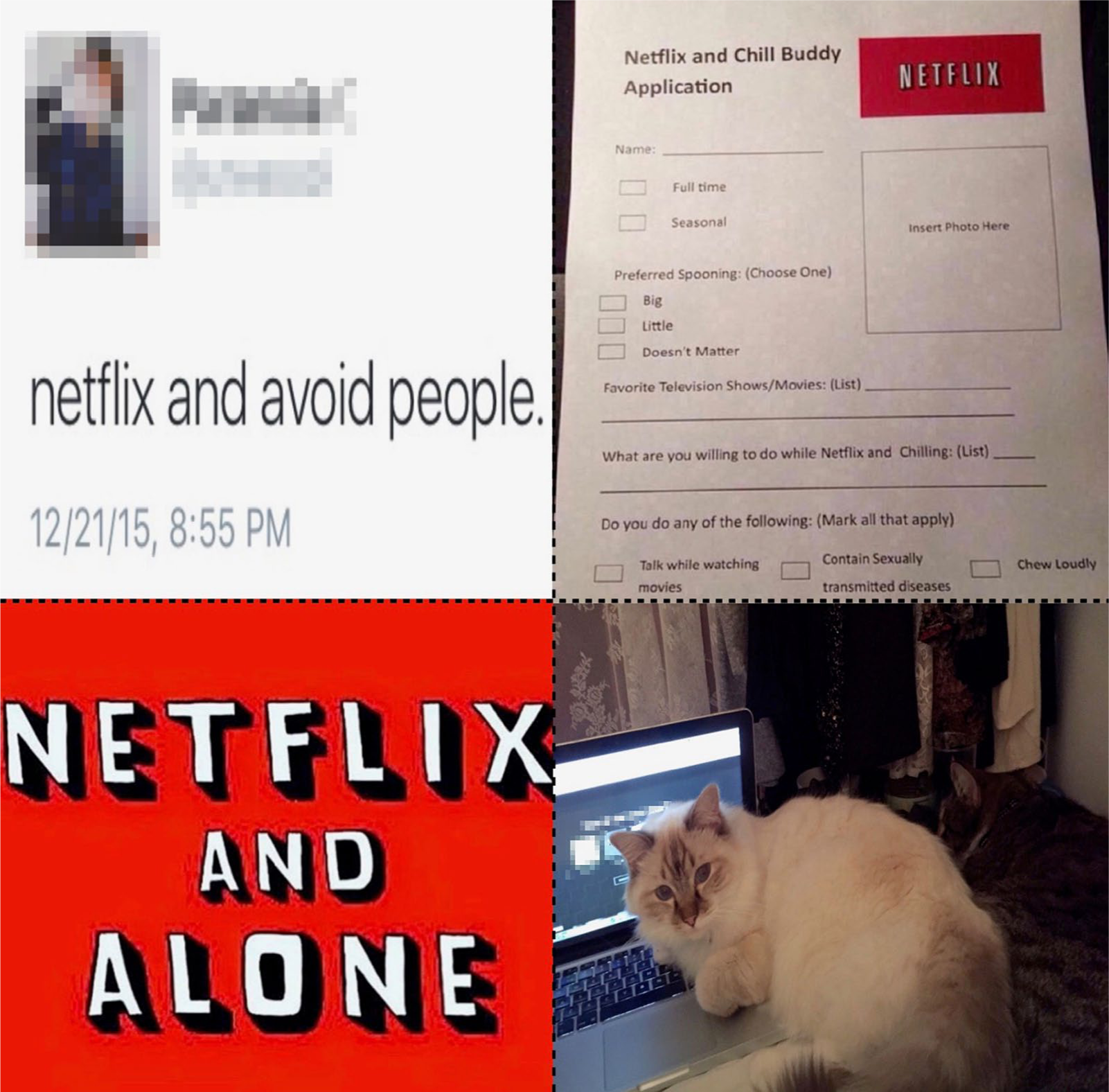
Left: Two images that were tagged with “Netflix and chill” and “alone”: a screen-grabbed user status update with 51 notes (top left) and a memetic reappropriation of Netflix and Chill with three notes (bottom left). Right: Two smartphone pictures that were tagged with “Netflix and chill” and “Netflix and cuddles” showing a printed “Netflix and Chill buddy application”-meme with eight notes (top right) and two cats with a laptop displaying Netflix’s user interface with six notes (bottom right).
If “Netflix and cuddles” seems to intimately connect bodies through the use of binge-viewing technologies, the competing intensity of chilling “alone” suggests modalities of interaction with Netflix that disconnect binge-viewers from the world. The most common meme variation in this context associates “Netflix and Chill” with both more and less enjoyable states of isolation and social incompatibility (Figure 2, top left and bottom left). Reproducing popular narratives of how binge-watching Netflix is making you feel lonely, unhealthy, and depressed (Gregoire, 2015), a large amount of related imagery on Tumblr celebrates the consumption of (fast) food, alcohol, and marijuana as an important and enjoyable part of the binge. Circulated through corresponding tags (Figure 1) in different photographic and memetic variations, this dopamine-driven scenario of Netflix experience suggests a potential lack of self-control. However, to the same extent that it affords destructive behavior associated with “too much” enjoyment, it also promises a “safe space” where the binge-viewing body can recover from the emotional challenges of relationship drama, stress, and social pressure. Attached to this alternative affective framework, the predominantly heterosexual connotation of “Netflix and chill look” was contested by Tumblr’s affinity with queer subcultures. Indicating a potential invitation for casual sexual contact, the reorientation of the binge-viewing body from watching Netflix alone toward playful forms of interaction with others was made explicit in the circulation of selfies of young gay men co-tagged with #netflix and chill, #alone, #me, and #cute. In this platformed articulation of co-presence, mundane-mediated engagements constitute the practice of binge-watching as intimately tied to a sense of overlapping contexts that are socio-cultural and imitative as they are singular in their capacity to (dis)connect (Hjorth, 2013; Sundén, 2018). Allowing for more than one interpretation, both #netflix and cuddles and #alone situate the brand as a medium of relationality, able to support differentiation of relations between user practices and device affordances.
Temporality: Between Attention and Distraction
The second affective scenario of “Netflix and chill” on Tumblr is related to the ways in which binge-viewing is played out in practices of memetic appropriation and time-specific frameworks of networked attention/distraction (Paasonen, 2016). Operating within the repetitive patterns of visual social circulation, and drawing together otherwise unrelated contexts, practices of tagging and sharing memetic content are more than just communicative byproducts of culture industry networks that inspire iteration from a fixed premise (Goriunova, 2014). Rather than spreading along the same trajectory of reproduction, Internet memes activate non-linear arrangements of the visual, the social and the technological that intermesh in a process of mutual reenactment. Always in anticipation of new adaptations yet to come, viral memetic media can be seen as sticky indicators of value. When memes connect with and disconnect from the participants who circulate them, and intended response spirals into collective participation, their value amplifies (Milner, 2016). Understood in terms of brand attachment, such networked dynamics of valuing involve both contact and capture where things that “go unrestrained” through new connections are simultaneously “re-restrained by evaluation, narratives of experience and appropriation into stories” (Hennion, 2017, p. 115). In their metamorphic function as mechanisms for context- and platform-specific adjustment of shared content, memes mediate fragments of user experience, creating possibilities for further engagement. Considering Tumblr’s diverse and affectively dedicated television fandom, such practices of remix and redistribution play an important part in the process of brand valuation. Connected through humorous memetic appropriations of Supernatural (Figure 3, top left), for example, a popular fandom-specific “Netflix and chill” articulation of the tag #meme alludes to an important quality that many television fans associate with Netflix. Driven by the experience of self-conscious immersion in a Netflix binge, the viewing pleasure demands full concentration on each new episode without any interruptions wanted.
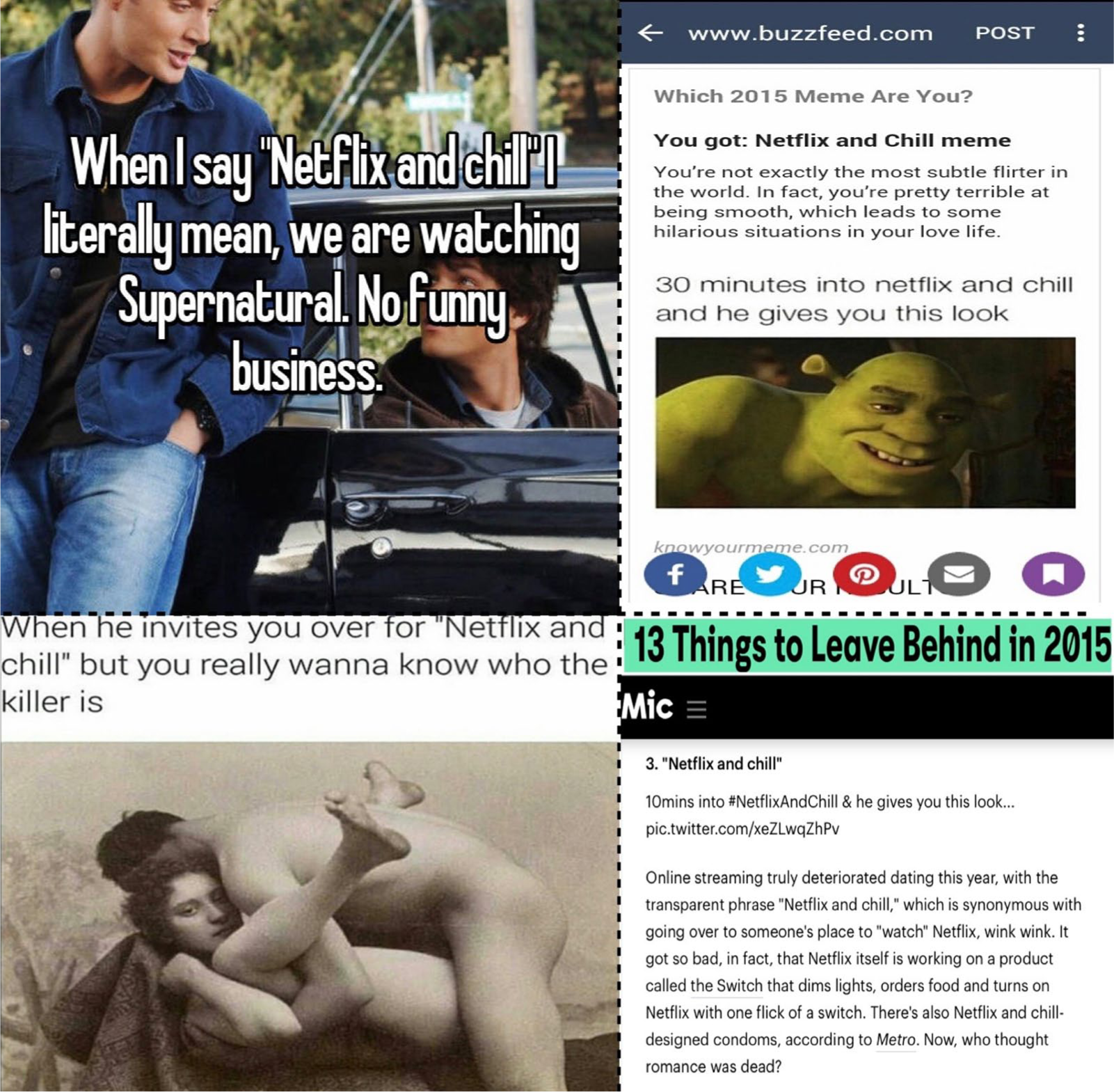
Left: Two memetic images that were tagged with “Netflix and chill” and “meme” reappropriating the phrase in the context of Tumblr’s Supernatural fandom (top left, 74 notes) and ironically suggesting full concentration on Netflix content during a “Netflix and chill session” (bottom left, 12 notes). Right: Two screen grabs that were tagged with “Netflix and chill” and “2015” referencing Buzzfeed’s quiz “Which 2015 meme are you?” (top right, with three notes) and a report by mic.com suggesting “Netflix and chill” among “13 things to leave behind in 2015” (bottom right, 30 notes).
Another popular memetic theme of #netflix and chill addresses experiential affordances of “chilling” as binge-viewing and vice versa, which can well be “interplayed” as much as mutually distractive (Figure 3, bottom left). As proposed in a VICE article on how “to do Netflix and Chill properly” (Golby, 2015), the whole experience, even at its best, seems to be not without its challenges. Accompanied by repeated efforts and shifts in concentration, it often requires those involved in a binge/chill to switch from trying to follow along with a series’ storyline to straight up having sex. Imitating this mode of “multitasking,” “Netflix and chill” memes focusing on users’ capacity to pay attention while being distracted by watching/dating situate the body of the binge-viewer within a typical state of serialized media temporality. Within this state, boredom is experienced as an affective threat that is always anticipated to return (Buchannan, 2017; Kendall, 2017). If not successfully interrupted by endlessly renewable engagement with Netflix (or some other platform), it needs to be countered through an alternative form of pleasurable interaction. In other words, as another meme suggests, if not “Netflix and chill,” then get ready for “Hulu and do you?” “Google Play and Threeway?” “Amazon Prime and sexy time?” The more diverse the options of capture, the more dispersed attention becomes.
A more literal expression of how users playfully adjust to the temporalities of media entertainment is connected to the circulatory dynamics of #netflix and chill and its memetic adaptability to new occasions. In December 2015, Netflix recommendations produced multiple tongue-in-cheek variations of the “best Christmas movies” to watch in 2015. At the same time, the tag #2015, which was used in combination with screen-grabbed metacommentary from other platforms (Figure 3, top right and bottom right) indicates the final phase in the mainstreaming of “Netflix and chill” and its transformation into a viral source of product placement. Appearing among “13 things to leave behind in 2015” (Wong, 2015), the catchphrase triggered a series of promotional micro-campaigns centered around a new DIY Netflix device called “The Switch,” which can sync with other devices to silence smartphone calls, put on mood lighting, and order food (Figure 3, bottom right; Brian, 2015). With its follow-ups such as Netflix dating surveys (Kiefaber, 2016) and “Bed’N’Binge”-hotel rooms (Read-Dominguez, 2017), “Netflix and chill” officially became part of the brand.
Body: Between Attachment and Detachment
If affective media engagement makes us attached to popular tech brands like Netflix, then what needs to be considered in more detail is the anticipatory quality of this attachment. Assembled through the most frequently co-occurring tags #netflix and chill, #chill, and #netflix, the last scenario of Tumblr’s fan-specific metacommentary reveals this quality as embodied and data-intensive. At issue here is the calculated value of binge-viewing Netflix, where the “instrumental correlation of entertainment (or ‘service’) and operationality (or ‘data’)” (Hansen, 2015, p. 73) is derived from the capacity of binge-viewing bodies to “stay tuned.” One of the main components of this embodied value comes from the intensity of bingeing behavior. While bingeing Netflix, viewer experiences are intensified through a series of repetitive actions (e.g., playing next episode). Reinforcing continued engagement with Netflix content, the binge works in accordance with the logic of anticipation, which often results in a strange desire to finish an entire season as fast as possible (Figure 4, top left). To paraphrase Jodi Dean (2015), because we enjoy through repetition, the binge-viewing body gets stuck in doing the same thing over and over again by being entrapped precisely when pleasure and its anticipation come together at once. In this sense, the immediate availability of Netflix content is also what instructs us to keep watching Netflix, producing anticipated regret along with a strong temptation to stay up to watch “just one more episode” (Figure 4, bottom left).

Left: Two images that were tagged with “Netflix and chill” and “Netflix”: a captioned photo of a laptop screen displaying a cartoon character falling asleep (bottom left, 74 notes) and a captioned stock image of a heart-shaped “Netflix and chill” pizza celebrating excessive binge-viewing behavior (top right, 25 notes). Right: Two images that were tagged with “Netflix and chill” and “chill”: a meme putting Netflix’s logo on a McDonald’s French fries paper bag full of cannabis joints (top right, 153 notes) and a sarcastic variation of a “Netflix and chill starter pack” meme (bottom right, 54 notes).
As suggested in relation to health implications of the phenomenon (Walton-Pattison, Dombrowski, & Presseau, 2016), feeling attached often means feeling exhausted. The price we pay for our guilty binge-watching pleasures is, then, often that of sleep—which, according to Netflix CEO Reed Hastings, is the platform’s main competition (Raphael, 2017). Sleep is what disconnects us from our capacity to (actively) interact with technologies. Sleep interferes into data flows. Sleep makes Netflix customers wait. It interrupts fun, while binge-viewing bodies increasingly become what Tony Sampson (2012, p. 43) calls a reinvention of Gabriel Tarde’s (1903) somnambulist in the network age—a “subjectivity only half asleep and dreaming that [s]he is in command while reciprocally engaged with the hypnotist.” Within the rhythm of 24/7 attention seizure, the practice of binge-watching captures us in positive registers of dedication and free choice to the same extent as it affords negative intensities of indifference and disorientation (Figure 4, top right, bottom right). The politics of user engagement with Netflix are embedded in such forms of affective modulation (see Crary, 2013), producing mixed modes of captive behavior that spill over to other related products and practices (see, for example, a popular meme putting Netflix’s logo on a McDonald’s French fries paper bag full of cannabis joints). Actively contributing to Netflix’s brand environment, the body of the binge-viewer is designed as a relational assemblage of simultaneous attachment and detachment. In this assemblage, overstimulation by the unlimited possibility of watching is often accompanied by pleasurable states of immersive consumption. At the same time, potential boredom caused by repeated encounters with the very same possibility can involve dissatisfactory intensities of digital disaffect (Petit, 2015). Against this background, the micro-event of Netflix releasing a series of marijuana strains named after its most beloved original shows (Loughrey, 2017) is more than simply anecdotal. It is about the expanding experiential network of the brand and its longing for increased affective investment.
Conclusion: Capture and Contact in the Digital Economy of Attention
By analyzing Netflix’s technological and experiential affordances in connection with their renegotiation as “Netflix and chill” memes, this article has explored the practice of Netflix binge-viewing in its capacity to revitalize the brand through the accumulation of user data and cultural capital. Approaching Netflix as a networked brand environment (Lury, 2004), I have examined what makes the body of serial binge-viewer valuable in its mediated interactions and qualitative possibilities. Within the participatory framework of the digital attention economy, brands become sticky with a wide range of associations through user practices of sharing, appropriation, and embodied engagement. The shifts in the experiences of digital entertainment that these practices facilitate are simultaneously modulated by the communicative strategies of global media companies. By treating the unintended qualities of binge-watching as playful forms of interactivity, Netflix extracts value out of our lifestyle preferences and social relations. A brand, therefore, is more than its pre-defined affordances. It is an infrastructure for multiplying the possibilities of attachment in a process of experience differentiation and brand integration.
To illustrate these interactive dynamics, I conclude with another promotional variation of “Netflix experience” which, in April 2015, shortly before the first preorder day for the new Apple Watch, was reintroduced in material form of a wrist-bound video device designed to provide “a total freedom of streaming experience you can take anywhere” (Netflix, 2015). The fake video announcement of “the Netflix Watch” continued the streaming service’s series of “public service” announcements titled “Binge Responsibly” (Luckerson, 2015), in which stars from House of Cards and Orange Is the New Black warned of the social, physical, and psychological dangers of binge-watching. Urging users to get up from the couch and do something different after having seen more than two episodes of a series in a row, the fictional video ad suggests a not so unrealistic association between streaming interfaces and self-tracking devices. Outbidding users’ “Netflix and Chill” scenarios, the radical demand of the platform to start bingeing “responsibly” reconnects the volatile body of the binge-viewer with Netflix by promoting a 24/7 experience of multitasking and active selection. If a good binge-watching experience is about the qualities of intimacy and relaxation, then a good Netflix experience is about how we relate to ourselves and others through the consumption of streaming media. It is about life quality, which is supposed to be rendered quantifiable.
This controlled freedom returns us to the double-fold logic of redistributed value generation as a mode of contact and capture. On one hand, the co-occurrence of these dynamics increasingly involves our media experience in a “feed-forward” data circuit (Hansen, 2015; Harcourt, 2015). This is how, by playing on people’s habits of returning to experiences that matter, Netflix’s recommendation feature constitutes our viewing preferences as always already mediated. On the other hand, the anticipatory structure of networked entertainment technologies does not necessarily disempower viewers but can offer a means of imagining and inhabiting this capture differently (Chun, 2016; Seaver, 2018). In both scenarios, our participation in digital attention assemblages mediates our desire for contact. Giving more consideration to the affective underpinnings of how we connect with and disconnect from technologies allows for a better understanding of contemporary media brands as networked objects of recommendation, attention, and attachment. Creating new meanings and possibilities for more engagement out of affect, each contribution to the infrastructure of brand communication operates as a value-producing force. By capitalizing on algorithmically processed interactions, popular tech brands do both: they operate through tangible personalized traces and facilitate new flows of mediated affective investment, which we hopefully can learn to enjoy outside our ongoing feedback loops.
Footnotes
Acknowledgements
I would like to thank two anonymous reviewers and the issue editors, whose detailed comments to earlier versions of this paper helped me develop my argument. Thank you also to the participants of the symposium “Affective Politics of Social Media” in Turku and the 4th “Affect and Social Media Conference” in London for inspirations.
Declaration of Conflicting Interests
The author(s) declared no potential conflicts of interest with respect to the research, authorship, and/or publication of this article.
Funding
The author(s) received no financial support for the research, authorship, and/or publication of this article.

Notes
Author Biography
References
 Straight outta Netflix & Chill